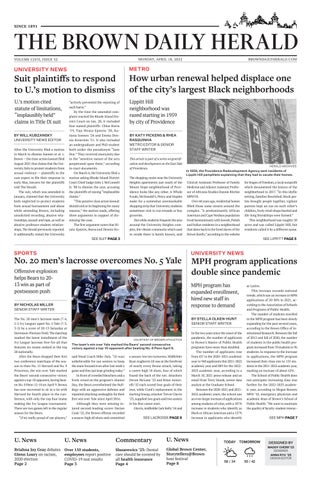
SINCE 1891
THE BROWN DAILY HERALD MONDAY, APRIL 18, 2022
VOLUME CLVII, ISSUE 32
BROWNDAILYHERALD.COM
METRO
UNIVERSITY NEWS
Suit plaintiffs to respond to U.’s motion to dismiss
How urban renewal helped displace one of the city’s largest Black neighborhoods
U.’s motion cited statute of limitations, “implausibly held” claims in Title IX suit
Lippitt Hill neighborhood was razed starting in 1959 by city of Providence
BY WILL KUBZANSKY UNIVERSITY NEWS EDITOR After the University filed a motion in March to dismiss Soenen et al. v. Brown — the class-action lawsuit filed August 2021 that claims that the University fails to protect students from sexual violence — plaintiffs in the case expect to file their response in early May, lawyers for the plaintiffs told The Herald. The suit, which was amended in January, claimed that the University both neglected to protect students from sexual harrassment and abuse while attending Brown, including unsolicited recording, abusive relationships, assault and rape, as well as abusive professor-student relationships, The Herald previously reported. It additionally stated the University
“actively prevented the reporting of such harm.” By the time the amended complaint reached the Rhode Island District Court on Jan. 28, it included four named plaintiffs: Chloe Burns ’19, Taja Hirata-Epstein ’20, Katiana Soenen ’24 and Emma Dennis-Knieriem ’21. It also included an undergraduate and PhD student both under the pseudonym “Jane Doe.” They received anonymity due to the “sensitive nature of the acts perpetrated upon them,” according to court documents. On March 4, the University filed a motion asking Rhode Island District Court Chief Judge John J. McConnell Jr. ’80 to dismiss the case, accusing the plaintiffs of raising “implausible claims.” “This putative class action lawsuit should end at its beginning for many reasons,” the motion reads, offering three arguments in support of dismissing the case. The first argument notes that Hirata-Epstein, Burns and Dennis-Kn-
BY KATY PICKENS & RHEA RASQUINHA METRO EDITOR & SENIOR STAFF WRITER This article is part of a series on gentrification and development on the East Side of Providence. The shopping center near the University Heights apartments just south of the Mount Hope neighborhood of Providence looks like any other. A Whole Foods, McDonald’s, Petco and Staples make for a somewhat unremarkable shopping strip that University students sometimes visit to run errands or buy groceries. But while students frequent the area around the University Heights complex, the vibrant community which used to reside there is barely known, said
HERALD ARCHIVES
In 1959, the Providence Redevelopment Agency sent residents of Lippitt Hill pamphlets explaining that they had to vacate their homes. Clinical Assistant Professor of Family Medicine and Adjunct Assistant Professor of Africana Studies Dannie Ritchie MPH’03. Over 60 years ago, residential homes filled those same streets around the complex. “A predominantly African American and Cape Verdean population lived harmoniously with Jewish, Polish and Italian residents in a neighborhood that dates back to the freed slaves of the Brown family,” according to the website
for Stages of Freedom, a local nonprofit which documented the history of the neighborhood in 2017. “In this idyllic setting, families flourished, block parties brought people together, vigilant parents kept an eye on each other’s children, lively retail shops bustled and life-long friendships were formed.” This neighborhood was roughly 30 acres and was called Lippitt Hill, but residents called it by a different name.
SEE SUIT PAGE 3
SEE LIPPITT PAGE 5
SPORTS
No. 20 men’s lacrosse overcomes No. 5 Yale Offensive explosion helps Bears to 2013 win as part of postseason push
The No. 20 men’s lacrosse team (7-4, 2-2 Ivy League) upset No. 5 Yale (7-3, 3-2) by a score of 20-13 Saturday at Stevenson-Pincince Field. The matchup marked the latest installment of the Ivy League lacrosse free-for-all that features six teams ranked in the top 20 nationally. After the Bears dropped their first two conference matchups of the season to then-No. 15 Harvard and No. 9 Princeton, the win over Yale marked the Bears’ second consecutive victory against a top-10 opponent, having beaten No. 8 Penn 12-10 on April 9. Brown has now recovered to sit in a tie with Harvard for fourth place in the conference, with only the top four teams making the Ivy League tournament. There are two games left in the regular season for the Bears. “(I’m) really proud of our players,”
Briahna Joy Gray debates Glenn Loury on racism, 2020 election Page 2
MPH program applications double since pandemic
MPH program has expanded enrollment, hired new staff in response to demand
BY NICHOLAS MILLER SENIOR STAFF WRITER
U. News
UNIVERSITY NEWS
BY STELLA OLKEN-HUNT SENIOR STAFF WRITER
COURTESY OF BROWN ATHLETICS
The team’s win over Yale marked the Bears’ second consecutive victory against a top-10 opponent after beating No. 8 Penn April 9. said Head Coach Mike Daly. “(It was) unbelievable for our seniors to keep the team focused even after last week’s game and they just kept grinding today.” In front of crowded bleachers and a lively crowd on the program’s Alumni Day, the Bears overwhelmed the Bulldogs with an aggressive defense and repeated attacking onslaughts for their first win over Yale since April 2016. Although they were missing injured second-leading scorer Darian Cook ’22, the Brown offense recorded a season-high 60 shots and committed
U. News Over 150 students, employees report positive COVID-19 rest results Page 3
a season-low ten turnovers. Midfielder Ryan Aughavin GS was at the forefront of nearly every Bruno attack, taking a career-high 18 shots, four of which found the back of the net. Attackers Devon McLane ’23 and Brian Antonelli ’22 each scored four goals of their own, while Cook’s replacement in the starting lineup, attacker Trevor Glavin ’23, supplied two goals and two assists in his first career start. Glavin, midfielder Jack Kelly ’24 and
SEE LACROSSE PAGE 6
Commentary Slusarewicz ’23: Dental care should be covered by all health insurance Page 4
In the two years since the onset of the pandemic, the number of applicants to Brown’s Master of Public Health programs have more than doubled. The number of applicants rose from 437 in the 2020–2021 academic year to 948 applicants this 2021-2022 academic year and 889 for the 20222023 academic year, according to a March 10, 2021 press release and an email from Terry Snook, senior data analyst at the Graduate School. Between the 2020-2021 and 20212022 academic years, the school saw an even larger increase of applications among students of color, with a 187% increase in students who identify as Black or African American and a 137% increase in applicants who identify
U. News Global Brown Center, Storytellers@Brown host festival Page 8
as Latinx. This increase exceeds national trends, which saw an increase in MPH applications of 20-30% in 2021, according to the Association of Schools and Programs of Public Health. The number of students enrolled in the MPH program has been slowly expanding for the past several years, according to the Brown Office of Institutional Research. Between the fall of 2012 and fall of 2020, the number of students in the public health program increased from 70 students to 96 students. In response to the increase in applications, the MPH program increased their class size to 155 students in the 2021-2022 academic year, marking an increase of about 62%. The School of Public Health does not anticipate increasing class size further for the 2022-2023 academic year, according to Megan Ranney MPH ’10, emergency physician and academic dean of Brown’s School of Public Health. “We want to maintain the quality of faculty-student interac-
SEE MPH PAGE 7
TODAY TOMORROW
DESIGNED BY MADDY CHERR ’23 DESIGNER
58 / 34
55 / 42
ANNA RYU ’25 DESIGN EDITOR
2
THE BROWN DAILY HERALD | NEWS
MONDAY, APRIL 18, 2022
UNIVERSITY NEWS
Briahna Joy Gray, former Sanders press secretary, debates Glenn Loury Professor Glenn Loury, Gray discuss issues of systemic racism, 2020 election BY BRENDAN GARDNER METRO EDITOR Briahna Joy Gray, former national press secretary for Sen. Bernie Sanders’s 2020 presidential campaign and host of the “Bad Faith” podcast about progressive politics, joined Professor of the Social Sciences and Economics Glenn Loury on Friday at the Watson Institute for International and Public Affairs for a wide-ranging discussion on race, the 2020 campaign and the state of American liberalism. Gray and Loury were inspired to host the event, entitled “A Conversation with Briahna Joy Gray on Race, Politics and Journalism,” after the two debated the causes of racial inequality on an episode of Gray’s podcast. Loury, a conservative commentator, argued the main driver of racial disparities in America is not systemic racism but rather cultural problems within the Black community. Alternatively, Gray argued that racial inequality is the result of institutional racism caused by America’s history of slavery, disenfranchisement and redlining. Despite the pair’s divergent views, the discussion was intimate and amicable. After a brief explanation of their positions, the two began voicing their critiques of each other’s viewpoints. Gray argued that what Loury sees as cultural issues are often the result of deeper systemic problems. Responding to Loury’s belief in the importance of a traditional two-parent household, Gray said, “(That’s) a material issue. I don’t think it’s the psychic value of having married parents that necessarily confers the benefit. I think stability confers the benefit, having two earners confers the benefit … and it’s not necessarily what I would describe as culture.”
Gray questioned the effectiveness of cultural narratives in creating actual change. “It seems to me that there’s often a political agenda attached (to these narratives), where folks are trying to say, ‘There’s no point in doing social programs,’” she said. Similarly, Loury called into question the utility of Gray’s systemic narrative for ending inequity. “(What has been) the political fruit of the racial reckoning? I see a lot of book sales, I see a lot of chatter … but I don’t see this white supremacy rhetoric leading to any politics of repair and restoration for our community,” he said. Gray agreed that meaningful change has been slow but said that the reason was the public’s shallow understanding of systemic racism, adding that some views of the problem don’t support larger policy solutions. “There are certain maximalist arguments about the nature of racism and white supremacy that I think are harmful because … they are (disconnected) from any policy goal,” she said. She said that narratives about race and identity that ignore material issues of class allow politicians to avoid making real change. “From my perspective as a leftist, I’m frustrated that … (President) Joe Biden thinks he can have (Vice President) Kamala Harris or appoint a Black Supreme Court justice — which is well and good — but not do anything substantive,” Gray said. “And that’s an excuse for him to have betrayed his campaign promises” around policies such as COVID-19 relief and debt forgiveness for students at Historically Black Colleges and Universities, she added. “I’m not critiquing identity politics,” she said. “I’m critiquing the weaponization of identity politics.” Gray emphasized the importance of social class in understanding politics and argued that it should be taken into account when analyzing identity politics. She added that shallow rhetoric about race can inadvertently increase the appeal of right-wing demagogues.
BRENDAN GARDNER / HERALD
While Loury argued the main driver of racial disparities in America is cultural problems within Black communities, Gray believed that racial inequality is a consequence of institutional racism. By ignoring issues of class and its intersections with race, she said, some “well-meaning white liberals” may end up alienating working-class people “because of the aesthetics of their politics.” “A lot of (the working-class) people who are unhappy are going to watch Tucker Carlson, because at least he’s talking in populist terms,” she said. This resentment “is broiling, and it’s going to boil over.” “I would love it if (this resentment) got channeled into a leftward direction and we had a Bernie Sanders-style presidency,” Gray said. “But that doesn’t look like it’s happening because the Democratic Party is more hostile to progressive populists than the Republican Party is hostile to right-wing faux populism.” Loury expressed skepticism about the effectiveness and feasibility of an intersectional Democratic coalition focused on issues of race and class, referencing the fact that Biden earned a far greater portion of the Black vote in the South Carolina Democratic primary than Sanders, giving Biden momentum that led to him securing the
nomination. Black voters in South Carolina “didn’t choose your enlightened path. They chose the conventional Democratic Party path,” Loury said. “What’s up with that?” Gray acknowledged that progressive forces, including the 2020 Sanders campaign, sometimes fail in their messaging on race. “There were moments where I felt (Sanders) was tone-deaf,” she said. “For example, I begged him once to stop telling the (civil rights) story,” referring to Sanders’s emphasis on his history of civil rights activism while attending the University of Chicago in the 1960s. “Bernie’s entire policy agenda (was) great for Black people, and I was trying to help him understand how to characterize what he’s already doing in that light,” she added. Near the end of the conversation, Gray said that a central aspect of the Sanders campaign and the broader progressive movement is their willingness to combine politics and positive morality. “A lot of (Sanders supporters) were
really fulfilled … on a spiritual level by the sense of community that came with getting behind a campaign that framed its objectives in moral terms,” she said. “Our politics doesn’t really talk in moral terms unless it’s judging the other. There’s no real substantive conversation about what kind of society we want to be.” “What Bernie did was he gave me permission to connect my morals and values and my politics in a way that I never really expected to happen. And when he went away, I think a lot of people really didn’t know where to put all that energy, and they really felt a spiritual loss,” she said. Part of what Gray found so compelling about the Sanders campaign was the idea that “we’re in the richest country in the history of the world and I have a moral debt to you as a human being, even if you’ve transgressed, even if you’ve committed a crime, even if you had a baby out of wedlock, I care about you,” she said. “Bernie gave us permission to care about other people. I miss that a great deal.”
STAY UP-TO-DATE. FOLLOW US ON FACEBOOK. FACEBOOK.COM/BROWNDAILYHERALD
MONDAY, APRIL 18, 2022
THE BROWN DAILY HERALD | NEWS
3
SUIT FROM PAGE 1 ieriem’s claims are time-barred by the three-year statute of limitations for Title IX in the state of Rhode Island. Because these claims “accrued” before Aug. 6, 2018, the plaintiffs “cannot resurrect their clearly time-barred claims.” And since none of the three have indicated that they are presently academically involved with the University, they lack standing to seek relief, the motion said. The University’s second argument details how each plaintiff “implausibly pled Title IX and state law claims fail as a matter of law.” It notes the absence of “intentional gender discriminatory conduct” and discusses how the events leading to two of the plaintiffs’ claims ocurred in third-party owned buildings. They also invoked Title IX’s “deliberate indifference” standard — which requires schools to respond to Title IX sexual harassment in a “way that is not clearly unreasonable in light of the known circumstances,” according to the Department of Education website — which they argue the University fails to meet. Brown’s third argument, which seeks to strike the class-action nature of the suit, notes that there is “no justification to allow any of the six Plaintiffs to litigate collectively in a single lawsuit,” as the plaintiffs’ allegations fail to meet all of the necessary prerequisites to file a class-action lawsuit under federal law, according to the motion. “Throughout their pleading, Plaintiffs have tried futilely to escape the inherently individualized nature of their sexual misconduct claims by focusing on alleged common practices of ignoring complaints of harassment,” the motion reads. “However, courts have declined to gloss over the highly individualized nature of the proof that is typically at issue in cognizable sexual misconduct claims.” “Plaintiffs want to redefine the university-student relationship under Rhode Island law, with serious and immediate implications for every Rhode
VICTORIA YIN / HERALD
The University filed a motion to dismiss the case on March 4, accusing the plaintiffs of raising “implausible claims.” “This putative class action lawsuit should end at its beginning for many reasons,” the motion read. Island college and university,” the introduction to the motion to dismiss reads. If the district court does not dismiss the claims, the suit calls for the Rhode Island Supreme Court to hear “appropriate questions.” In an email, University Spokesperson Brian Clark told The Herald that the motion to dismiss is the “most current” update to the University’s response to the lawsuit. Plaintiffs have until May 2 to file their response to the motion to dismiss, according to public records from the Rhode Island District Court. According to Kimberly Evans, a lawyer for the plaintiffs from Delaware law firm Grant & Eisenhofer, their response will come in on that day. “We’re still very confident in the complaint,” Evans said in an interview with The Herald. “We’re looking forward
to putting forward our opposition to their motion to dismiss.” Evans and Irene Lax, another lawyer for the plaintiffs, declined to share the details of their response to the motion to dismiss. Following a motion to dismiss in any given case, if a judge determines that a complaint’s allegations “fail to state a claim,” that judge could dismiss a suit as a whole, according to Julie Goldscheid, a professor at the City University of New York School of Law who focuses on gender equality. But if a case proceeds to litigation, she added, it could go on for “many years.” Last June, the Supreme Court of Rhode Island dismissed a Title IX lawsuit, Jane Doe v. Brown, after an eight-year investigatory and legal process, The Herald previously reported.
While Goldscheid stressed the difficulty of generalizing, she noted that it is “relatively rare that cases go to trial.” Cases, she said, often end through settlements or preliminary motions from judges. The University has not approached the plaintiffs about a settlement for the case, Evans said. Since filing the initial complaint in August 2021, one name has also dropped from the case: Carter Woodruff ’22, who helped spearhead the End Sexual Violence campaign on campus in Spring 2021. Woodruff declined to comment, instead referring The Herald to a statement released on her Instagram page on April 10. “When I returned to Brown from my leave, I was overwhelmed in many ways,” the statement said.
“It was a chance for me to start fresh,” it continued. “In order to do this, I needed to take a step back from my activist efforts, as well as from the lawsuit.” Evans said that Woodruff is “still very much part of the process” and that her departure stemmed from personal reasons. “I am completely confident that (the suit) will remain just as strong, valid, and necessary as it would have been should I have stayed a plaintiff,” Woodruff’s statement read. Burns, Hirata-Epstein, Soenen, Dennis-Knieriem and the Jane Does were not made available for comment by Evans and Lax. “They’re doing well in terms of dealing with the real emotional toll that a litigation has,” Evans said, “especially in these types of cases.”
UNIVERSITY NEWS
Total positive COVID-19 cases on campus surpass 150 U. will maintain mask-optional policy, despite other colleges reinstating mandates BY HALEY SANDLOW SENIOR STAFF WRITER From April 7 to 13, 134 students and 37 employees reported positive COVID-19 test results, according to an April 15 Today@Brown announcement from Executive Vice President for Planning and Policy Russell Carey ’91 MA’06. “We feel we’re seeing a continuation of what we expected … after a break (and) after people travel,” Carey told The Herald. Individuals reporting positive COVID-19 test results “generally have no or mild symptoms, and we have seen no instances of severe illness or hospitalization or any indication of widespread transmission on campus,” he wrote in the announcement. “We’re going to be watching (cases) very carefully,” Carey said. “But we’re
TRACY PAN / HERALD
East Coast universities such as Columbia and Georgetown University reinstated their masking policies after an increase in cases either on campus or in the surrounding areas. not at this time making any changes to campus policies or protocols.” The rise of the BA.2 subvariant of the Omicron variant, now the dominant
strain of COVID-19 in the United States, has caused cases in Rhode Island to rise in the past few weeks. Between April 9 and 15, there were
220.1 new cases per 100,000 people in Rhode Island — up from 199 cases per 100,000 people the previous week, according to the Rhode Island Depart-
ment of Health COVID-19 data tracker. Some universities on the East Coast, including Georgetown University, American University, Columbia and Johns Hopkins University, have reinstated mask requirements in some settings in recent weeks following an increase in cases either on campus or in their surrounding college towns. “We’re encouraged by the fact that people are using their tests and reporting when they’re positive and isolating,” Carey said. “At this point, we’re not recommending changes currently to our masking policy.” The Today@Brown announcement also reported that 83 students are in isolation. Designated on- and off-campus isolation housing is “being managed well,” and the University does not “have any concerns,” Carey said. Last week, admitted students from the class of 2026 had the option to visit campus for A Day on College Hill. Visiting students were required to follow the same masking conditions and policies on campus as current community members and “attest to being vaccinated,” Carey said.
4
THE BROWN DAILY HERALD | COMMENTARY
MONDAY, APRIL 18, 2022
Slusarewicz ’23: We need to start caring about dental care When I was growing up, I didn’t know that scheduling biannual dental appointments was commonplace. Due to the economic recessions of the 2000s, my family’s income was shaky for many years, and even after the Great Recession, we moved around repeatedly for work. Most of the time we didn’t have the stability to attend regular medical appointments due to our health insurance’s high deductible — under which there are typically significant out-of-
occurs, resulting in both medical and financial consequences. Financial obstacles add to these disincentives. Dental spending makes up less than 4.5% of health care expenditures yet constitutes a large part of patient spending: An astronomical 44.2% of dental bills were paid out of pocket, as opposed to 10.3% of physician costs, which are largely covered by insurance plans. Recent research indicates that the expensive nature of
tists tend to set up businesses in affluent areas where residents can afford better insurance or can pay for procedures out of pocket. As a result, the poorest areas of the United States offer little to no access to dental care — over 50 million Americans live in communities with a federally designated shortage of dental professionals. Medicare, which insures those who are 65 and older or have disabilities, also offers insuf-
received dental coverage as well, leaving the rest uninsured for dental care. The dental uninsured rate is four times higher than the medically uninsured rate, with some 74 million Americans having no dental coverage in 2016. Even those who can purchase separate dental insurance don’t receive all the coverage they need. For example, many private dental insurance plans don’t cover major dental procedures, which can be pricey. Though dental insurance
pocket payments — let alone go to the dentist, which wasn’t covered by our insurance. When I started attending regular dental appointments in middle school, I was dazzled by the experience. But we still don’t have dental insurance and instead pay for appointments with no help. Thus, if our financial situation were to again turn bleak, we would drop the appointments once more. General medical opinion considers oral health to be a vital part of public health. Poor oral health is correlated with worse bodily health and quality of life and disproportionately disadvantages marginalized communities. Yet the lackluster dental care covered by both public and private health insurance policies perpetuates the perception that dental care and non-dental care are inherently separable. Dental care is unaffordable for many Americans and insurance plans frequently fail to cover important operations. Comprehensive dental care must be fully covered by both public and private health insurance policies if we hope to promote the health of all Americans. Poor oral health can contribute to numerous illnesses and conditions, including cardiovascular disease, pneumonia and complications with pregnancy and birth. And the relationship between oral and non-oral bodily health works both ways. For example, diabetes and gum disease worsen each other in a positive feedback loop, and conditions such as HIV/AIDS, osteoporosis and Alzheimer’s disease lead to dental decline. Despite the potentially severe effects of neglecting oral health, the lack of access to primary dental care discourages people from engaging the medical system until an emergency
dental care prevents medically insured individ-
ficient dental coverage. The program doesn’t
companies cover preventative care, regular dental maintenance does not completely eliminate the risk of dental emergencies. All of these factors add up to a clear image of dental care in the United States: inaccessible and unacceptable. As medical journalist Mary Otto put it, “Due to economic deprivation, geographic isolation, age, disability and lack of dental coverage, an estimated one-third of the population faces significant difficulties getting access to the autonomous, insular and privatized system that provides most of the dental care in this country.” Addressing disparities in dental care could, in turn, improve dental coverage for everyone. The Medicare and Medicaid Dental, Vision and Hearing Benefit Act, introduced to the U.S. Senate Aug. 5, would greatly expand the breadth of dental care covered by the Medicare and Medicaid programs. This legislation could be the first step in shifting attitudes around dental health, but as of now, the bill has a 3% chance of passing, according to predictions by machine learning prediction firm Skopos Labs. For real progress to be made, dental health must be considered inseparable from non-dental health at all levels. It is time to move past antiquated insurance structures so that we can focus on advancing the health of all Americans, regardless of their socioeconomic status.
“Yet the lackluster dental care provided by both public and private health insurance policies perpetuates the perception that dental care and non-dental care are inherently separable.”
uals from fulfilling their treatment needs. While the federal Medicaid program helps to ease some of the economic burden of oral health care from low-income individuals and families, it still falls short. Although Medicaid is supposed to cover dental care for all children, fewer than half of children who qualify actually receive dental care. Furthermore, adult dental care depends on state Medicaid policy. In 2016, 15 states provided extensive adult dental benefits, but 13 only provided dental coverage for emergency care or pain relief and four states provided no dental benefits. But even if a state offers substantial dental care, individuals are limited by whether they can find dental professionals in their communities. Fewer than half of U.S. dentists participate in the Medicaid dental program due to low reimbursement. As a result, den-
cover primary dental services — “care, treatment, removal or replacement of teeth or structures directly supporting teeth”— necessary for installing dentures and removing diseased teeth. Furthermore, while it covers surgeries necessary for “non-dental” procedures, Medicare will not pay for dentures or any other type of appliance necessary for taking care of the mouth post-operation. Medicare’s insufficiencies in dental coverage are particularly egregious due to the heavy burden of oral diseases on older populations. While the separation of dental and non-dental medical care in health care policy disproportionately harms marginalized communities covered by Medicaid and Medicare, a much larger group can feel the consequences. Of civilian workers who received medical insurance through work in 2018, like my family, only 44%
Megan Slusarewicz ’23 can be reached at megan_slusarewicz@brown.edu. Please send responses to this opinion to letters@ browndailyherald.com and other op-eds to opinions@browndailyherald.com.
Follow us on Instagram! @browndailyherald CA L E N DA R
COVID -19 AT BROWN APRIL 7 TO 13
APRIL S
3
M
4
Tu
5
W
6
Confirmed positives
Th
7
F
171
S
1
2
8
9
10
11
12
13
14
15
16
17
18
19
20
21
22
23
24
25
26
27
28
29
30
Students in on-campus, designated off-campus quarantine housing
83* MARCH 31 TO APRIL 6 Confirmed positives
108 Students in on-campus, designated off-campus quarantine housing
25* *APPROXIMATE
MONDAY, APRIL 18, 2022
LIPPITT FROM PAGE 1 “The people that lived there didn’t define it as Lippitt Hill — they defined it as the East Side,” Ritchie said. The neighborhood was formerly bordered by North Main Street to the west, Camp Street to the east, Olney Street to the south and Doyle Avenue to the north. At the time, Lippitt Hill was one of the largest Black neighborhoods in the city. But in April 1959, residents received pamphlets at their door from the Providence Redevelopment Agency, which was part of the city government. They said that the Lippitt Hill area was to be purchased by the agency for redevelopment. “It will be torn down to make room for new private housing and other facilities to be built in the proposed Lippitt Hill Urban Renewal Area,” the pamphlets read. “This means that at a later date you must find a new home.” Starting about one year later, these residents were moved out to make way for demolition and urban renewal, the Providence Journal reported Nov. 19, 1959. The community that once was In 2017, Ray Rickman, executive director of Stages of Freedom, conducted oral histories with people that had lived in Lippitt Hill. “They were in a joyous mood,” he said of the East Siders who were on the panel. The project was completed in two parts. Rickman said residents often faced discrimination when working with landlords, making it difficult to get structural issues in their homes resolved. Despite these issues, Rickman explained, the Lippitt Hill community was “not an unhappy lot.” “People went to church,” Rickman said of Lippitt Hill residents. “There were a lot of nice things going on, separate from your house falling down.” “Our house … would’ve been where today the Starbucks is” today, said Sylvia Ann Soares, a participant in the oral history project, in 2017. “Who knows what’s going to be there later?” “It was a very strong community,” Soares added. “Some of those houses — if you went to visit people, you walked up the back steps — you could eat off the stairs because people’s homes were immaculate.” She described how fish vendors would come down the streets, ringing a bell and selling from carts. There was an ice cream man who would regularly sell in the neighborhood as well, she added. “We also (had) the crab man that used to come,” Joanna Tavarez Fernandez said in an interview for the Stages of Freedom oral history project. “So we’d all be sitting outside with your newspapers, eating your crabs so you could just wrap it up afterwards.” Several East Siders described Bates Street playground as well, a spot where kids would gather to play. “We had the pool and everything,” said Virginia Veiga, another former East Sider, in 2017. “We didn’t have to go to the beach.” “We had markets, we had laundromats. We had things,” Deborah Young Tunstall, another participant in the Stages of Freedom oral history. “We were poor, but we didn’t know we were poor.” She was a “lifelong resident of Lippitt Hill — what you call it,” Young Tunstall said. “The East Side is what I call it.” The neighborhood was home to several social spots frequented by residents. The Holy Name Club, according to residents interviewed by Stages of
THE BROWN DAILY HERALD | NEWS
5
Freedom, was owned by Cape Verdeans. The Celebrity Club, the participants added, was visited by celebrities from Fats Domino to Billie Holiday. There were 52 Black-owned businesses in the community in 1949, according to the Stages of Freedom project. Naomi Jax-Brown, another participant in the oral history, said during the oral history project that her father owned one barbershop on Lippitt Street and two on Camp Street. “We grew up with everybody,” said Veiga. “We all got along. It was peaceful, nice. (We) could go into the stores,” without fearing that she or her family would not be served because they were Black, she added. Urban renewal and displacement in Lippitt Hill There was a large push for urban redevelopment after World War II to beautify cities, and Providence was swept up by this movement as well, The Herald previously reported. Urban renewal was a process in which entire swaths of neighborhoods were bulldozed to make way for new development. With the passage of the Housing Act of 1949 by the federal government and the Slum Clearance and Redevelopment Act of 1950 and the Community Redevelopment Act of 1946 in Rhode Island, Providence was poised for major change. The PRA was created in 1947 to oversee and implement redevelopment in the city. “When 70% of the houses in a neighborhood are substandard, and one in five of those houses is uninhabitable and all the signs of blight are to be seen in the area, there is only one recourse for the city,” said the broadcaster on WPRI’s “Lippitt Revisited,” a television special which aired in 1959. “And that is to demolish the houses by condemning the area.” “They painted the whole thing as a slum,” Rickman said of the Lippitt Hill neighborhood. “There is no guarantee that the residents of the Lippitt Hill redevelopment section will be able to move back into the neighborhood, even if they can afford it,” said David Joyce, administrator of the city’s relocation service at the time, because new landlords would be in charge of the area, the Providence Journal reported Feb. 9, 1959. At an information session about the project, Joyce told a group of over 100 residents of Lippitt Hill — most of whom were being displaced by the project — that the “best potential” neighborhood for them to find different housing would be South Providence. When Joyce opened up the event to questions, one resident said, “We as a people are tired of moving and we expect a certain degree of stability one day. We are tired of running and we have got to stop one day,” the Providence Journal reported. On March 12, 1959, the PRA rejected a proposal which would prioritize “tenancy applications from present residents of the slum-ridden neighborhood” because of fears that this would “scare off” developers, the Providence Journal reported. The PRA originally planned to give displaced residents $30 to $100 — $296 to $987 in today’s money — which was eventually raised to $40 to $200, or $390 to $1,976 adjusted for inflation. Commercial units were given a maximum $2,500, which was bumped to $3,000 for relocating, the Providence Journal reported. Buildings slated for demolition included a laundromat, a synagogue and
HERALD ARCHIVES
A survey of residents of the neighborhood in 1959 conducted by the University of Rhode Island found that many had been unable to find new housing in the prior six months. several churches, including St. Hedwigs, a Polish Roman Catholic church that had been “a focal point of life for … Polish-speaking Catholics” in the area, the Providence Journal reported Dec. 6, 1959. The Herald published an article entitled “Lippitt Hill Redevelopment” Dec. 2, 1960, which stated that construction and demolition of the neighborhood had begun in the spring of that year. The article reported that Matilda Litwin, area supervisor of the city’s Division of Public Assistance at the time, said, “A community with slum areas and deteriorating neighborhoods suffers a three-way loss in the health and welfare of its citizens, its property values and in community morals.” Lippitt Hill “in addition to its substandard housing has had inadequate recreational, shopping and other facilities that contribute to the type of social relationships and family life that we do not want for all residents of our city,” she continued. In total, 650 units in Lippitt Hill were destroyed, with 450 of them — roughly 70% — occupied by non-white residents, the Providence Journal reported in 2017. In addition to about 659 families — including over 400 African American families — being forced out by the city, 89 businesses were also lost, Ritchie said. “It’s not only about people losing their homes. It’s about losing their livelihoods. It’s about losing their community. It’s about being disconnected,” she said. “There (had) been a systematic push in saying that these areas are ‘substandard’ or there’s some reason that these areas need to be changed or made better,” she added. This displacement also occurred during a period in which housing discrimination and segregation were widespread, Ritchie added. People faced difficulties finding housing elsewhere and were generally unable to afford the prices offered in the redeveloped area years later. Residents were forced to move from mixed, integrated neighborhoods into more segregated ones, Ritchie said. When the urban renewal project was initially in the works, the Provi-
dence Journal repeatedly reported on the difficulties of rehousing these 450 displaced Black residents. “We found the problem of relocating our family more difficult than we expected,” said one resident who was interviewed for “Lippitt Revisited” in 1959. She spoke into a microphone, looking at the camera, as active construction and demolition took place in the background. “The racial issue was much greater than the economic considerations,” referencing difficulties in finding new housing. According to the 1959 Study of Housing Needs of Non-White Families in the Lippitt Hill Area, a survey of residents of the neighborhood by the University of Rhode Island, “most of the attempts made to rent or purchase during the six month interval before the study were unsuccessful.” Those who attempted to purchase a home during the study were unsuccessful 71% of the time, according to the report. Renters were unsuccessful 92% of the time. “Failure to complete a rental agreement or a purchase was attributed most frequently to high rental or purchase price, discrimination and a lack of satisfaction with the dwelling or location under consideration,” the report said. University Heights “After reviewing five excellent plans during the past three months, the Providence Redevelopment Agency has selected the University Heights plan as the most promising for the future of Lippitt Hill and the whole Providence community,” WPRI reported the week of April 15, 1962. “University Heights is a combination of the Star Market company and some 60 local citizens who represent the variety of the Rhode Island people.” “The redevelopment agency is confident that this new neighborhood will be a source of pride to all Rhode Island,” the broadcast continued. University Heights Inc. would “develop the 32 cleared acres of (the) Lippitt Hill redevelopment project,” the Providence Journal reported in April 1962. Along with housing, the development would include a supermarket and would strive to be a “cosmopolitan community.”
“There will also be no public housing on the site, and while the new corporation is determined to practice social integration, the scale of middle-income rents will keep much of the new housing beyond the reach of the Negro families who lived on the site before the land was cleared and who are of low income,” the article continued. Antoinette Downing, prominent preservationist in Providence, advocated for historic preservation to be a key part of urban renewal, The Herald previously reported. But this same vigor for preservation was not brought to the Lippitt Hill project, according to Rickman. “Lippitt Hill was never documented by (the Providence Preservation Society), or by the people who formed PPS, as a place of significant architectural heritage,” said PPS Executive Director Brent Runyon. “Today, we would say, that’s bizarre, of course it” was a place of architectural heritage. The College Hill Study, compiled by PPS in the late 1950s, flagged the Lippitt Hill area as a “blight” that should see redevelopment rather than preservation, The Herald previously reported. Partially because there was no push from residents to preserve the homes in Lippitt Hill rather than demolish them, total redevelopment was the chosen option, Rickman said. Because the neighborhood was majority Black, Rickman said, the neighborhood was not given the attention from preservationists it deserved. Ritchie teaches a research class that looks at the Providence housing ecosystem, development, displacement and gentrification. Her goal in creating the class was to tell the story of Mount Hope and to emphasize the value of remembering what used to be there. “People don’t know about Mount Hope,” Ritchie said. Rickman stressed the importance of gathering first-hand accounts of life in Lippitt Hill at the beginning of the second session of the oral history project in 2017. “It’s often fascinating to hear from the folks who were on the ground,” he said in the remarks, “who lived something.”
THE BROWN DAILY HERALD | NEWS
6
LACROSSE FROM PAGE 1 defenseman Colin Hart ’23.5 all picked up their first career goals. “Obviously (you) hate to see (Cook) go down,” Antonelli said. “He’s been playing really hard for the last four years for us so (it’s) never good to see that and it’s been tough, but Trevor Glavin stepped up really well.” “I think we’ve been playing with (Cook) on our minds,” he added. On the defensive end, goalie Connor Theriault ’24 made 15 saves, while long poles Andrew Geppert ’22, Silas Newsome ’22 and Luke Gaydos ’22 each caused a pair of turnovers and continually frustrated the Bulldog attackers. Aughavin kicked off the scoring just 47 seconds in when he received the ball at midfield, began a full sprint at the Yale defense, made a slight dodge to his left and then fired a missile past Yale goalie Jared Paquette. Glavin scored minutes later to dou-
ble the Bears lead. It wasn’t until seven minutes in that Yale was able to find the back of the net. Kelly ripped a shot into the top shelf to restore the Bears’ two goal lead, but following a subsequent media time-out, the Bulldogs scored three straight goals to pull ahead 4-3. After a Yale turnover, McLane was able to even the score with just seven seconds left in the quarter. The Bulldogs committed seven turnovers in the first quarter, but made up for the lost possessions by winning seven of nine faceoffs. In the second quarter, the Bears scored three unanswered goals in the first five minutes including two more from Aughavin, but again Yale responded after a time-out and scored three of their own in the next five minutes. Glavin and Kelly each added a goal for the Bears before Yale drew within one at the end of the half. Bulldog attacker Matt Brandau, who entered the game with 5.89 points per game, a
mark that ranked fourth in the country, scored two and assisted two more in the quarter and finished the game with four goals and three assists. Yale continued their dominance at the face-off X, in total winning 14 of 19 in the first half. But Brown found more space in the attacking zone and recorded 33 shots to Yale’s 20. But it was in the third quarter that Brown’s faceoff fortunes began to shift, helping them pull away from Yale for good. Faceoff man Matthew Gunty ’23 won four straight face-offs to begin the second half, a crucial part of a 4-0 Brown run that would have been even more fruitful if not for several stunning saves from Paquette. Yale created a number of promising opportunities for the rest of the quarter, but repeated reflex saves from Theriault — plus a couple more from the posts — limited Yale to three goals in the quarter, while Hart and Antonelli each added another for Brown to make
SINCE 1891
THE BROWN DAILY HERALD
132nd Editorial Board Editor-in-Chief Ben Glickman Managing Editors Benjamin Pollard Caelyn Pender Senior Editors Katie Chen Gaya Gupta Jack Walker post-magazine Editor-in-Chief Kyoko Leaman Sections Arts & Culture Editors Rebecca Carcieri Irene Chou Laura David Metro Editors Brendan Gardner Oliver Kneen Liza Mullett Katy Pickens Sameer Sinha
University News Editors Corey Gelb-Bicknell Will Kubzansky Caleb Lazar Alex Nadirashvili Shilpa Sajja Kaitlyn Torres Science & Research Editors Kathleen Meininger Gabriella Vulakh
Multimedia Photo Chiefs Danielle Emerson Victoria Yin Photo Editors Elsa Choi-Hausman Roslyn Coriz Julia Grossman Dana Richie
Senior Science & Tech Editor Claire Liu
Illustrations Chiefs Ashley Choi Loki Olin
Sports Editor Peter Swope
Social Media Chief Alejandro Ingkavet
Commentary Editorial Page Editor Johnny Ren
Podcasts Chief Livi Burdette
Opinions Editors Augustus Bayard Bliss Han Jaehyun Hong Jackson McGough Matt Walsh
Podcasts Producer Da-Young Kim Production Copy Desk Chief Lily Lustig
it a 15-11 game. And in the final quarter, the Bears ran rampant, recording another 4-0 run while Newsome and Gaydos hounded the Yale attack and Theriault denied anything that got through. The Bulldogs would not score for the first 10 minutes of the quarter, and by the time they ended the drought, the Bruno lead had ballooned to eight. Finishing at 20-13, the game marked the first time the Bears had scored more than 12 goals since March 5, when they defeated Providence College 22-10. “It was as complete of a team win as we’ve had all year,” Daly said. “The offense answered a lot of times; the defense got their stops; (on) faceoffs … they just kept working and grinding and came up with a few key wins at the end.” The schedule doesn’t get any easier for the Bears, who next travel to Ithaca to face No. 4 Cornell (10-2, 3-1 Ivy) and continue their run through the Ivy League gauntlet.
MONDAY, APRIL 18, 2022
The conference has the most ranked teams in the top 20, and in total the Ivy League schools have an astonishing 34-9 non-conference record, with five of those nine losses coming against top 10 opposition. “It’s where we expect to be,” Aughavin said of the Bears’ performance Saturday, but he emphasized that the team is not focused on the other Ivy teams. “We worry about us, we worry about the guys in our locker room.” A win against Big Red plus a victory over last-place Dartmouth (4-7, 0-4 Ivy) in the final conference game of the season would cement Brown’s place in the Ivy League tournament in early May. “(We’re going to) keep playing team offense,” Antonelli said of the Cornell game. “We’ll go up there and see what we can do.” “Our goal is always to be playing our best lacrosse in May,” Daly said. “We took a good step toward that.”
Submissions: The Brown Daily Herald publishes submissions in the form of op-eds and letters to the editor. Op-eds are typically between 750 and 1000 words, though we will consider submissions between 500 and 1200 words. Letters to the editor should be around 250 words. While letters to the editor respond to an article or column that has appeared in The Herald, op-eds usually prompt new discussions on campus or frame new arguments about current discourse. All submissions to The Herald cannot have been previously published elsewhere (in print or online — including personal blogs and social media), and they must be exclusive to The Herald.
Design Editors Julia Grossman Lena He Neil Mehta Anna Ryu Brandon Wu
Submissions must include no more than two individual authors. If there are more than two original authors, The Herald can acknowledge the authors in a statement at the end of the letter or oped, but the byline can only include up to two names. The Herald will not publish submissions authored by groups. The Herald does not publish anonymous submissions. If you feel your circumstances prevent you from submitting an op-ed or letter with your name, please email herald@ browndailyherald.com to explain your situation.
Digital News Graphics Chief Aanchal Sheth
You can submit op-eds to opinions@browndailyherald.com and letters to letters@browndailyherald. com. When you email your submission, please include (1) your full name, (2) an evening or mobile phone number in case your submission is chosen for publication and (3) any affiliation with Brown University or any institution or organization relevant to the content of your submission.
Director of Technology Jed Fox Business Office Manager Chelsey Barton-Keenes General Managers Alexandra Cerda Sophie Silverman
Please send in submissions at least 24 hours in advance of your desired publication date. The Herald only publishes submissions while it is in print. The Herald reserves the right to edit all submissions. If your piece is considered for publication, an editor will contact you to discuss potential changes to your submission. Commentary: The editorial is the majority opinion of the editorial page board of The Brown Daily Herald. The editorial viewpoint does not necessarily reflect the views of The Brown Daily Herald, Inc. Columns, letters and comics reflect the opinions of their authors only.
Sales Directors Joe Belfield Amit Levi
Corrections: The Brown Daily Herald is committed to providing the Brown University community with the most accurate information possible. Corrections may be submitted up to seven calendar days after publication. Periodicals postage paid at Providence, R.I. Postmaster: Please send corrections to P.O. Box 2538, Providence, RI 02906.
Finance Director Andrew Willwerth
Advertising: The Brown Daily Herald, Inc. reserves the right to accept or decline any advertisement at its discretion.
Design Chief Raphael Li
@the_herald
facebook.com/browndailyherald
@browndailyherald
youtube.com/browndailyherald
88 Benevolent, Providence, RI (401) 351-3372 www.browndailyherald.com Editorial: herald@browndailyherald.com Advertising: advertising@browndailyherald.com
The Brown Daily Herald, Inc. is a financially independent, nonprofit media organization bringing you The Brown Daily Herald and Post- Magazine. The Brown Daily Herald has served the Brown University community daily since 1891. It is published Monday through Friday during the academic year, excluding vacations, once during Commencement and once during Orientation by The Brown Daily Herald, Inc. Single copy free for each member of the community. Subscription prices: $200 one year daily, $100 one semester daily. Copyright 2021 by The Brown Daily Herald, Inc. All rights reserved.
MONDAY, APRIL 18, 2022
THE BROWN DAILY HERALD | NEWS
7
UNIVERSITY NEWS
Brown China Summit concludes with look at China’s political economy Summit includes expert panels discussing China’s economy, history, future BY ALEX NADIRASHVILI UNIVERSITY NEWS EDITOR The Brown China Summit — an annual conference that brings academics, business leaders and policymakers to the University to discuss critical issues relating to China — wrapped up its weekend lineup of events on Sunday. This year’s conference, which began on Friday, April 17 with a keynote address by Robert Kuhn, was split into four distinct categories: future, entrepreneurship, humanity and political economy, according to the summit’s website. Most of the events were held as online Zoom webinars, though community members could gather to watch the webinars at the Stephen Robert ’62 Hall in the Watson Institute for International and Public Affairs. Sunday’s programming began with a lecture and moderated Q&A with British historian and political scientist Rana Mitter, who spoke on Chinese conceptions of World War II. “The Second World War still remains a very important part of the national culture” in countries across the world, Mitter said. “The continued collective social memory of the World War II experience is one … of the important tools, vehicles and narratives … that explains the ways in which contemporary international relations” are defined in China, he added. Mitter explained that countries like China and the United States attempt to rewrite the political legacy of the war to legitimize the “burdens and sacrifices” they made during wartime, which he said represents their continuing competition over politics, economics and culture. World War II “broke out in full form” in China in 1937, before the other allied powers entered the war, according to Mitter. Mitter concluded that this historical approach enables China to “make a bigger case that (it) should get certain
ALEX NADIRASHVILI / HERALD
This year’s conference was split into four distinct categories: future, entrepreneurship, humanity and political economy, according to the summit’s website. concessions, both international and domestically, because of the sacrifice that it made back in the 1940s.” As a result, “the Second World War has become a (sort) of good war in terms of the imaging projects for the China of today,” he added. The current Chinese leadership is “very keen to keep control of” the narrative which positions China as a central member of the United Nations in an effort to “create a present-day sense of unity and patriotism,” Mitter said. Mitter’s “China’s Good War” lecture was followed by three other events that discussed US-China competition and the policy environment, journalistic relations and sustainable architecture in China. The summit concluded with “Innovation & Reinvention: What Does the China Model Look Like in the 2020s,” a panel discussion that included Dwight Perkins, professor of political economy at Harvard University; Victor Shih, a
political economist at Northwestern University; and Arthur Kroeber, founder of the China-focused Gavekal Dragonomics research service. The panel aimed to offer its attendees an understanding of China’s current and future economic and political models, according to the panel’s two moderators. Kroeber opened the discussion by explaining that Chinese economic growth is motivated by “improvements in the labor force, increases in capital and increases in productivity.” In recent years, the trajectory of the labor force and capital has been “going into reverse, and … (the Chinese government’s) obsession with top-down control is not ideal for productivity growth,” he said. China can address its simultaneous problems with productivity growth and a shrinking population by “simply increasing the retirement age, (which is) very low,” Perkins said. He added that
as the number of unskilled job opportunities decreases, “what the industry and the economy (will) need are highly skilled people.” The panel also discussed the global economic and military repercussions of China’s potential involvement in the Russia-Ukraine conflict. “I think there’s a belief among many Chinese leaders that … the United States is hostile and they’re very powerful, but they’re also in decline,” Kroeber said. He explained that China’s alignment with Russia is an effort to erode the current U.S. global order in order to create more space for the two countries. “From a long-term strategic perspective, it is hard to see this as anything other than a big mistake by China,” Kroeber added. “Its economic relationship with Russia … is very narrow and based on resources. “Over a five to 10 year period, this (alignment) will probably come to be
seen as a pretty major error of judgment,” he concluded. At the same time, because of its shared border with Russia, China wants to avoid the possibility of Russia democratizing, Shih said. This creates a situation where Putin “can make bigger military gambles … knowing that financially, China’s going to come to its aid.” “Rationally, I agree that China would not intervene in any way,” he added. “On the other hand, this (conflict) is a credible threat to China. … The situation is evolving, so I guess we’ll see.” After the panel’s conclusion, the summit’s Co-Presidents Wendy Chen ’23 and Zoey Liu ’23 closed out the weekend by thanking the different groups that helped organize the conference. “BCS is here to bring thoughts and inspirations to” you, Chen told audience members. “We look forward to seeing you all next year.”
MPH FROM PAGE 1 tion and get that trademark Brown way,” Ranney said. This means keeping class size manageable, she added. Some of this past and continuous growth might be due to COVID-19 sparking a broader interest in public health, Ranney said. During the pandemic, “the value of public health got demonstrated in real time,” she said. “Folks also saw where public health wasn’t able to do enough … and they want to be a part of the solution.” Ranney believes that the new leadership and vision behind the School of Public Health are two additional factors attracting students to apply. Students “know that they are going to learn how to help change the world and create a more equitable and forward-looking version of public health” at Brown, Ranney said. According to the Director of the MPH program Annie Gjelsvik PHD ’03, enrollment in the subsidiary fifth-year MPH program has also increased. This program — which allows students to obtain an undergraduate degree and
GAYA GUPTA / HERALD
an MPH in five years, according to the program’s website — is only open to Brown undergraduates. “I think the pandemic made a lot of people realize how important public health” is, including pre-med students who realized “public health could be really relevant for them in their careers,” Molly Siegel ’23, who is in the fifth-year MPH program, said. Siegel believes that the School of Public Health has been “climbing the rankings” under Dr. Ashish Jha’s leadership and growing recognition during the pandemic, leading to additional
funding and global attention that has increased the competitiveness of the program. Jha was named one of World’s 50 Greatest Leaders by Fortune Magazine in 2021 and is currently the White House COVID-19 response coordinator, The Herald previously reported. In addition to its greater media attention, the School of Public Health has made some structural changes that have increased the number of enrolled MPH students. The fifth-year program was previously only open to public health
concentrators in the honors program, according to Gjelsvik. But in the past few years, the program has allowed applicants from all Brown students, regardless of concentration. The School of Public Health also recently added a new, fully online MPH option, The Herald previously reported. To facilitate growth in the program, the MPH program is hiring additional faculty, according to Gjelsvik. “We added … three staff positions this past fall,” said Gjelsvik. Some of the core courses are now offering additional sections, both in the fall and spring,
Gjelsvik added. Overall, Gjelsvik said she is really excited to see the increased number of applicants and evidence of a broader interest in public health. “We were worried about turnover and retirement (among the public health workforce) before the pandemic, and now we’re really worried about it,” said Gjelsvik. “We’re just so excited that we’re able to attract these students and get people interested in … this career because it really is necessary within the United States and globally.”
MONDAY, APRIL 18, 2022
THE BROWN DAILY HERALD | NEWS
8
UNIVERSITY NEWS
Global Brown Center, Storytellers@Brown host International Festival Students, staff reflect on festival’s importance to international community BY ISHITAA GUPTA SENIOR STAFF WRITER The Global Brown Center for International Students, in collaboration with Storytellers@Brown, hosted its annual International Festival on the Main Green Saturday afternoon. The International Festival “is an opportunity to gather cultural student organizations around campus … and celebrate the awesome work that they do,” said Natalia Roman Alicea, the GBC program coordinator. “It’s an opportunity for us to also bring to the front and center the experiences of our international students.” The theme of this year’s festival was “Global to Local: Telling stories of home,” said Andrew Heald, program director for the center. “We feel that storytelling is a really strong tool for giving voice to the unseen (and) for people to take charge of their own narratives,” Heald said, speaking on the center’s collaboration with Storytellers@Brown. This year, each cultural student organization present at the festival recommended a book that represented the organization’s mission or felt reflective of home. These books will be used to open The Global Brown Center Library, which will be housed
in the GBC and will be accessible to all members of the Brown community, according to Heald. The festival featured 23 booths from cultural student organizations and University offices linked to the international community, such as the Sarah Doyle Center for Women and Gender and the Center for Language Studies. Groups such as Mezcla, the Brown/RISD Latinx dance troupe, and Brown Lion Dance, a student group dedicated to the ancient art of Chinese Lion Dance, also performed. The festival offered many of the participating organizations an opportunity to expand their presences within Brown’s community. “We really welcome the opportunity to both tell people who we are and share a little bit of our culture, as well as get to know other” cultures, said Hailey Chen ’24, who was representing the Brown Taiwan Society. In order to share their cultures with the Brown community, organizations brought traditional games and foods to their stalls. The recently formed Himalayan Cultural Association shared momos, dumplings from Tibet and Nepal, and chatpati, a popular Nepali street food. The Brazilian Students Association brought brigadores, a sweet made of chocolate and condensed milk. The Center for Language Studies invited their booth’s visitors to write small notes about what language means to them. “A lot of people at Brown speak another language or learn other languages. It’s a big part of a lot of people’s
AREEZ KHAN / HERALD
Student groups such as Mezcla, the Brown/RISD Latinx dance troupe and Brown Lion Dance performed at the Global Brown Center’s International Festival Saturday afternoon. identities and not one that gets necessarily talked about,” Olivia Howe ’22 said. An emphasis on language is relevant to the festival because it aims to represent “lots of different backgrounds and cultures,” she added. At the booth for the Sarah Doyle Center for Women and Gender, community and creativity were brought together through a pom-pom making activity, with the goal of “having conversation with one another through the making of something,” according to Claritza Maldonado GS. Organizers and attendees alike
spoke about how special it felt to see Brown’s international community come together through the festival after two years of the pandemic. Chen, who started her first year in the middle of the pandemic, said that organizing an in-person event posed a challenge. “I’ve never really known what social events look like at Brown prior to 2019,” she said. “I really appreciate the International Festival. It’s the first time I’ve seen so many people together in a while … and you can really form those connections.” For attendee and international
student Nishitha Chaayanath ’25, the festival was a great way to reconnect with other members of the international student community she had not seen since orientation. “It was a great opportunity to see everyone (and) experience all these different cultures and I really enjoyed it,” she said. “The heart of the International Festival is two things for me: celebration and recognition,” Heald said. “My hope — especially this year — is that we’re focused on the stories of these groups and … that someone walks away from the festival with a new story.”