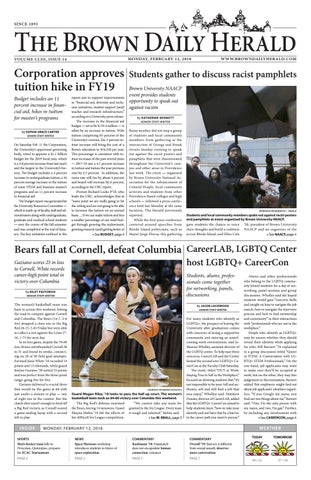
SINCE 1891
THE BROWN DAILY HERALD MONDAY, FEBRUARY 12, 2018
VOLUME CLIII, ISSUE 14
WWW.BROWNDAILYHERALD.COM
Corporation approves Students gather to discuss racist pamphlets tuition hike in FY19 Brown University NAACP Budget includes an 11 percent increase in financial aid, hikes in tuition for master’s programs By SOPHIA GRACE CARTER SENIOR STAFF WRITER
On Saturday Feb. 11 the Corporation, the University’s uppermost governing body, voted to approve a $1.1 billion budget for the 2019 fiscal year, which is a 3.8 percent increase from last year’s and the largest in the University’s history. The budget includes a 4 percent increase in undergraduate tuition, a 16 percent average increase in the tuition of some STEM and business master’s programs and an 11 percent increase in financial aid. The budget report was generated by the University Resources Committee — which is made up of faculty, staff and administrators along with undergraduate, graduate and medical school students — over the course of the fall semester and was completed at the end of January. The key initiatives outlined in the
report aim to support improvements in “financial aid, diversity and inclusion initiatives, student support (and) teacher and research infrastructure,” according to a University press release. The increase in the financial aid budget — set to be $135.4 million — is offset by an increase in tuition. With tuition comprising 65 percent of the University’s revenue, the 4 percent tuition increase will bring the cost of a Brown education to $54,320 per year. This percentage is consistent with tuition increases of the past several years — 2017-18 saw a 4.1 percent increase in tuition and tuition the year previous rose by 4.5 percent. In addition, the room rate will rise by about 4 percent and board will increase by 6 percent, according to the URC report. Provost Richard Locke P’18, who leads the URC, acknowledges that at “some point we are really going to hit the ceiling and are not going to be able to increase the tuition on an annual basis. ... If we can make tuition and fees a smaller percentage of our total budget through growing the endowment, growing research (and) getting better at » See BUDGET, page 4
event provides students opportunity to speak out against racsim By KATHERINE BENNETT SENIOR STAFF WRITER
Rainy weather did not stop a group of students and local community members from gathering at the intersection of George and Brook streets Sunday evening to speak out against the racist posters and pamphlets that were disseminated throughout the University’s campus and other areas in Providence last week. The event — organized by Brown University National Association for the Advancement of Colored People, local community activists and students from other Providence-based colleges and high schools — followed a press conference held last Monday at the same location, The Herald previously reported. While the first press conference centered around speeches from Rhode Island politicians, such as Mayor Jorge Elorza, this gathering
MARIANNA MCMURDOCK / HERALD
Students and local community members spoke out against racist posters and pamphlets at event organized by Brown University NAACP. gave students the chance to voice their thoughts and build a coalition across Rhode Island, said Ellen Cola
’20, president of Brown University NAACP and an organizer of the » See NAACP, page 4
Bears fall at Cornell, defeat Columbia CareerLAB, LGBTQ Center host LGBTQ+ CareerCon
Gaziano scores 25 in loss to Cornell, White records career-high point total in victory over Columbia
Students, alums, professionals come together for networking, panels, discussions
By RILEY PESTORIUS SENIOR STAFF WRITER
The women’s basketball team was back in action this weekend, hitting the road to compete against Cornell and Columbia. The Bears (14-7, 2-6 Ivy) dropped a close one to the Big Red (6-15, 2-6) Friday but were able to collect a win against the Lions (716, 1-7) the next day. In its first game, despite the 70-68 loss, Bruno outrebounded Cornell 38 to 31 and found its stroke, connecting on 26 of 56 field goal attempts. Forward Janie White ’18 recorded 14 points and 13 rebounds, while guard Justine Gaziano ’20 netted 25 points and was perfect from the three-point range, going five for five. Gaziano delivered a crucial three that would tie the game at 68 with just under a minute to play — one of eight ties in the contest. But the clutch shot wasn’t enough to fend off a Big Red victory, as Cornell scored a game-sealing layup with a second left to play.
INSIDE
By JACOB LOCKWOOD SENIOR STAFF WRITER
COURTESY OF BROWN ATHLETICS
Guard Megan Riley ’18 looks to pass the ball up court. The women’s basketball team took an 84-80 victory over Columbia this weekend. The Big Red’s defense swarmed “We cannot take any team for the Bears, forcing 14 turnovers. Guard granted in the Ivy League. Every team Shayna Mehta ’19 felt the effects of is tough and talented,” Mehta said. her difficult Ivy League competition. » See W. BBALL, page 3
For many students who identify as LGBTQ+, the prospect of leaving the University after graduation comes with concerns of losing a supportive community and entering an unwelcoming work environment, said JeShawna Wholley, assistant director of the LGBTQ center. To help ease these concerns, CareerLAB and the Center hosted the second ever LGBTQ+ CareerCon at the Faculty Club Saturday. The event, titled “OUT at Work: Staying True to Self in the Workplace,” focused on showing students that “it’s not impossible to be your full and authentic self and still find a job that you enjoy,” Wholley said. Matthew Donato, director of CareerLAB, added that the LGBTQ+ CareerCon aimed to help students learn “how to take your identity and not have that be a barrier to the career path you want to pursue.”
Alums and other professionals who belong to the LGBTQ community joined students for a day of networking, panel sessions and group discussions. Wholley said she hoped students would gain “concrete skills and insight on how to navigate the job search, how to navigate the interview process and how to find mentorship and community” in their interactions with “professionals who are out in the workplace.” People who identify as LGBTQ+ may be unsure whether they should reveal their identity while applying for jobs, Bill Barnert ’78 explained in a group discussion titled “Queer in STEM: A Conversation with LGBTQ+ STEM Professionals.” On the one hand, job applicants may want to make sure they’ll be accepted at work, but on the other, they may fear judgement or discrimination, Barnert added. But employers might find out about job applicants’ identities regardless. “If you Google my name, you find out two things about me,” Barnert said. “One, I’m the only person with my name, and two, I’m gay.” Further, by including any involvement with » See CAREERCON, page 4
WEATHER
MONDAY, FEBRUARY 12, 2018
SPORTS Men’s hockey team falls to Princeton, Quinnipiac, prepares for ECAC Tournament
NEWS Space Horizons workshop introduces students to future of space exploration
COMMENTARY Kaufmann ’18: Datamatch does not encapsulate human connection, romance
COMMENTARY Overall ’19: Bad sex is different from sexual assault, deserves more conversation
PAGE 2
PAGE 3
PAGE 7
PAGE 7
TODAY
TOMORROW
44 / 22
37 / 26
NEWS
PAGE 2 • MONDAY, FEBRUARY 12, 2018
THE BROWN DAILY HERALD
Bears resume conference play with losses to Princeton, Quinnipiac Giuttari ’20, Lafferty ’18 each record two points as Bruno outshoots Tigers in home clash Friday By ALEXANDRA RUSSELL SPORTS EDITOR
Following a close duel with the University of Connecticut last weekend, the men’s hockey team resumed conference play with a pair of losses and fell to Princeton 7-2 Friday and Quinnipiac University 3-0 Saturday. Zach Giuttari ’20 and Sam Lafferty ’18 led the Bears’ (6-13-4, 5-11-1 ECAC) offense against Princeton Friday as each recorded two points in the loss. Tommy Marchin ’19 also notched a goal against the Tigers. Brown 2, Princeton 7 Friday night, Marchin and Giuttari both scored, but Bruno was unable to fend off a persistent Princeton (11-11-3, 8-9-1) offense. The Tigers opened scoring with a pair of goals — including one on the power play — in the first period, before Marchin narrowed the deficit to one late in the stanza. Lafferty maneuvered around a Princeton defenseman in the Bears’ offensive zone and sent a shot toward the crease where Marchin redirected the puck into the net for his team-high ninth goal of the season. Brown peppered the Princeton net with shots in the second frame and outshot the Tigers 15-10 for a two-period advantage of 27-19. Princeton added a pair of goals midway through the period, but Bruno answered when Giuttari capitalized on a power play 13 minutes into the stanza. Giuttari collected a pass from
HUGH O’CONNOR / HERALD
Following this weekend’s losses, the Bears will close out away competition for the regular season with visits to No. 3 Cornell Friday and Colgate Saturday. Bruno has four games remaining before ECAC playoffs begin March 2. Max Gottlieb ’19 in the slot and fired a shot top shelf to extend his point streak to four games. The Tigers scored twice in the final period to secure the victory, their fifth consecutive win. In net, goaltender Gavin Nieto ’20 made 13 saves before giving way to Luke Kania ’21 in the second period. Kania stopped 12 shots as the Bears outshot the Tigers 35-32. Brown 0, Quinnipiac 3 The following day, Bruno pressured the Quinnipiac (12-14-4, 7-9-2) net with 22 shots but was unable to break down the Bobcats’ defense as goaltender Andrew Shortridge delivered a shutout performance.
Joe O’Connor gave the Bobcats an early lead in the first period by edging a shot past Kania from the slot. The Bears held off the Quinnipiac attack for the rest of the stanza, but Brandon Fortunato and Kevin Duane added a pair of unanswered goals in the second frame to claim the victory. Giuttari led the Bears with four shots. Kania made 23 saves as the Bobcats outshot the Bears 26-22. “Guys are getting a lot of shots — they’re doing a lot of good things,” Kania said. “If we just stick to the process, the goals will come, and we’ll get some wins.” With only four games remaining in the regular season, the Bears seek to translate their offensive opportunities into goals by gaining composure in front
of the net and capitalizing on rebounds. “We’ve got to have a little bit more of a poise around the net. I think a lot of times (when) there are pucks there, we just throw them right back into the goaltender,” said Head Coach Brendan Whittet ’94. “We need to take away the goalie’s eyes; we need those second chances, those third chances — that’s how we’re going to generate offense.” Bruno went 4-for-6 on the penalty kill over the weekend. The team hopes to achieve a greater balance between playing with aggression and passivity on the kill, Whittet said. “We have a tendency to be so passive at times that it leads ... to a lot of possession and then your penalty killers get tired,” Whittet said. “When your penalty
killers get tired, systematically you kind of fall apart, so that’s why we’ve got to know when we should press and when we shouldn’t.” Mentally, the Bears remain positive and maintain their day-by-day approach leading up to the ECAC playoffs, which begin March 2. “We just want to come to the rink every day and work hard, get better every day — it’s a process,” Kania said. “We’re a never-give-up team — we’ve had our struggles this year, and we’ve been good this year, so we just battle through and keep fighting.” The Bears will close out away competition for the regular season with visits to No.3 Cornell Friday and Colgate University Saturday.
Entrepreneurial magazine covers new companies Student-run online publication InnovationFWD launches Brown edition By LYDIA DEFUSTO SENIOR STAFF WRITER
InnovationFWD — an online publication primarily run by undergraduates that focuses on entrepreneurial pursuits — has launched one of its six sites at the University. The publication was founded by Kevin Fung, a Yale graduate, and Vivek Katara, a current Yale sophomore. When Fung was a student at Yale looking to expand his early stage startup, he struggled to learn more about innovation happening beyond his campus. “There was a real dearth of information on resources at other innovation hubs,” Fung said. Since then, the site launched Jan. 15 and has a team of managing editors and writers at Brown and six other universities, including Harvard, Princeton and Stanford University. InnovationFWD is meant “to identify promising early-stage startups and entrepreneurs and … report on their companies to the right audience at a national and global scale,” Fung said. Brown’s two managing editors, Nick Faulkner ’20 and Annabel
Strauss ’20, are “in charge of doing research (and) finding out what startups are out there” at Brown and affiliated organizations, such as entrepreneurial groups on campus, Strauss said. Faulkner and Strauss then assign articles to a member of InnovationFWD’s team of three writers at Brown. Emily Skahill ’21, one of the writers that Strauss and Faulkner oversee, said that living in Silicon Valley fostered her interest in startups. Skahill, who expects to produce about two articles per month, said her goal for a “comprehensive article” is to highlight “the entrepreneur’s story and then how they got interested in what they’re doing and why they’re passionate about their product.” “Our number one priority is quality journalism (and) accurate reporting,” Fung said. “We feel that a lot of what’s out there already doesn’t really do justice to the innovation that a lot of these incredible founders are coming up with.” “There’s really nothing that kind of cuts through that noise to identify promising companies and share their stories to the right audience, whether that’s investors or influencers or customers,” Fung added. So far, the site has received between 20,000 and 30,000 page views, Fung said, with a 24 percent return rate of users, “which means that there’s a lot of people who are interested in
coming back to see the new articles we post,” Katara said. The publication also produces a weekly newsletter, and its hundreds of subscribers receive a short email detailing one company and what InnovationFWD likes about it, Strauss said. Currently, InnovationFWD is funded exclusively by its founders. “We’ve purposely not really pursued any kind of venture funding, yet, at least, because once you add venture funding to the equation, … we think it becomes a bit of a bias,” Fung said. “We want to stay as objective as long as possible at identifying cool companies and reporting on them.” “Our long-term goal with InnovationFWD is to be the go-to source of information for early-stage companies on a global scale,” Faulkner said. The publication may be expanding beyond the United States soon, as Katara said that they “have connections to establish grassroots in China and London moving forward in the near future.” While the publication currently focuses on universities, Fung noted that it’s important to them to “look outside of the Ivy League bubble” toward other innovation hubs, like accelerators such as Y Combinator or Techstars, which take place across the United States. “Innovation is ubiquitous,” Katara said.
COURTESY OF ANNABEL STRAUSS AND NICK FAULKNER
Annabel Strauss ’20 and Nick Faulkner ’20, managing editors of InnovationFWD at Brown, coordinate coverage of startups on campus.
NEWS
MONDAY, FEBRUARY 12, 2018 • PAGE 3
THE BROWN DAILY HERALD
» W. BBALL, from page 1 Mehta contributed 13 points in the loss, while forward Erika Steeves ’19 added 11 points and 7 rebounds. Visiting Columbia to play its second game of the weekend, Bruno took down the Lions 84-80, notching its second Ivy League victory and first
since an overtime win over Yale Jan. 19. Mehta was happy to get back on the right track, especially after the loss of the team’s starter Taylor Will ’19. “It was great to finally get another win in the Ivy League. Ever since we lost Taylor to injury, we’ve been trying to find our groove. It’s been pretty
tough, but I think we’re starting to find it,” Mehta said. Mehta was among five players for the Bears to score in double figures, tallying 17 points and going five for eight on three-point shooting. Joining her were Steeves and Gaziano, who picked up 18 and 15 points apiece. Steeves also grabbed 14 rebounds.
White scored a career-high 21 points, and guard Dominique Leonidas ’21 added 10 points off the bench. Despite Brown’s strong offense, the contest witnessed 12 lead changes and came down to the wire. Bruno trailed 38-42 at the half, but took control in the third quarter, scoring 28 points. It was Steeves, Gaziano and
Leonidas who would help cinch the victory, scoring the last few points. The Bears’ defense also managed to stop the Lions at the other end in the final minutes of the game. The team will continue to fight for a spot in the Ivy League tournament this month, hosting Harvard and Dartmouth next weekend.
University holds tenth annual Space Horizons workshop Event focuses on private sector space industry, brings together students, researchers By CATE RYAN SENIOR STAFF WRITER
This past weekend, students, faculty and aerospace professionals gathered in Barus and Holley to participate in the tenth annual Space Horizons workshop. The event focused on the industry’s shift toward the private sector, a change that has become increasingly prevalent in recent years. The workshop was designed to provide an informal setting for conversation and interaction with the audience. It was also shorter than more traditional conferences, lasting only 24 hours, said Rick Fleeter, adjunct associate professor of engineering and organizer of the conference. The shorter time span ensures that the audience is constantly engaged and actively participating throughout the day, he added. The workshop included a series of keynote presentations from a wide array of speakers. “We try always to get a collision of different points of view,” Fleeter said, adding that the schedule included traditional scientists, a space policy professional and entrepreneurs with business models in asteroid mining and moon resources. “Each of them has a different
trajectory in their business careers. However, they are all really relevant to what people might face in the industry,” said Isabel Torrón, Rhode Island School of Design student and the lead student organzier of Space Horizons 2018. The freedom of the private sector allows space exploration to have a faster “turnover time,” Torrón said. Private corporations can avoid otherwise drawn out government approval processes. Commercial companies are also able to complete projects that would “traditionally cost millions of dollars” for much lower prices, she added, pointing to an on-campus example — Brown’s EQUiSat satellite, which will be launched later this year, as The Herald previously reported. Student groups from both RISD and Brown made an appearance at the workshop. Brown Space Engineering presented on its work with the EQUiSat satellite, while the RISD Rover team spoke about its entrance into the annual NASA Human Exploration Rover Challenge, which hopes to put a robot on Mars. As a RISD student and member of BSE, Torrón’s leadership in the event highlights its blend of science and design. She is currently working on developing a conceptual space station for her senior thesis and hopes that she can incorporate “design-based thinking” into the otherwise STEMheavy field. Space Horizons was started in
November 2008 when Fleeter set out to change the way conferences in his field were held and received. “I was sort of a contrarian,” he said, commenting on his experience attending conferences before he became a professor at the University. Fleeter hoped to bring together scientists who were working in niche fields and were willing to shift away from more conventional ideas in the field, he said. “I hope this conference serves as a way to network and meet other people,” Torrón said. This year’s workshop had the highest student registration the organizers had ever seen, Fleeter said. He believes that this year’s focus on private industry was especially welltimed as companies like Elon Musk’s SpaceX and Amazon’s Jeff Bezos’ Blue Origin gain popularity among students. “Students are interested in commerce, in startups … and space is just an interesting topic now when you have these high profile individuals … investing in space. It brings together those two things,” Fleeter said. Tamara Rudic ’21 and Amanda Hinh ’21 are taking PHYS 0160: “Introduction to Relativity and Quantum Physics,” Hinh said, and the conference was an opportunity for them to learn more about the topic outside of the classroom. The workshop also allowed them to learn about the commercial side of space, Rudic added.
COURTESY OF SPACEX
Companies like SpaceX have shaped the space industry and encouraged students to pursue space-related careers in the private sector.
STAY UP-TO-DATE. FOLLOW US ON FACEBOOK. FACEBOOK.COM/BROWNDAILYHERALD
NEWS
PAGE 4 • MONDAY, FEBRUARY 12, 2018
THE BROWN DAILY HERALD
COURTESY OF BROWN UNIVERSITY
CareerLAB cohosted the LGBTQ+ CareerCon with the LGBTQ Center for the second year in a row Saturday. The event provided students an opportunity to network with alums and professionals who identify as LGBTQ+.
» CAREERCON, from page 1 LGBTQ+ community groups on resumes, “you automatically out yourself,” Barnert added. Although he noted that “navigating the professional world … is different for everyone,” Barnert said he has typically been open about his identity throughout his career in software engineering and design. “I couldn’t be someone different at home and at work,” he said. “I don’t know how to do that.” But some people are not so comfortable sharing their identities in the workplace. Jon Kaye ’95, who spent several years as a geobiology researcher, said in the same group discussion that “there’s a bit of a code of silence
going on in STEM fields. There are queer people, but they’re not all out.” “STEM does not have the best reputation of being the most inclusive space,” Wholley told The Herald. Around 70 percent of students who registered for the event were STEM concentrators, she said. Barnert noted that two of the biggest companies he has worked for, IBM and Teradyne, lacked queer communities. “In both companies … I helped make (a queer communtiy) happen,” he said. “If the support isn’t there, you can find it, or you can make it.” “Ultimately, you have to be the change you envision,” Kaye agreed. Gabriel González ’20 MD ’24, who attended the CareerCon, told The Herald that the event taught him he
must “lift while climbing” as he enters the professional world. “As queer and trans people of color keep fighting the fight, it’s important to continue forming communities,” he said. González added that “it is validating” to meet queer and trans alums and professionals who have built successful careers. “There is hope,” he said. The LGBTQ+ CareerCon marked the first of a series of four CareerCons that CareerLAB has planned for the coming month, including events geared toward international students, first-generation college students and students interested in policy, Donato said. “We want to make sure we are helping specific groups of students who have specific needs and concerns about entering the workplace.”
FROM BAGHDAD TO PARIS
TALES FROM A NEW YORK TIMES FOREIGN CORRESPONDENT ALISSA RUBIN ’80
Pulitzer Prize winning reporter and Paris Bureau Chief for the New York Times
TUESDAY, FEBRUARY 13 AT 5:30PM
» BUDGET, from page 1
» NAACP, from page 1
fundraising, we will be less dependent on tuition and fees and will have the wiggle room to not go up close to four percent every year,” he said. The URC’s report aims to diversify revenue sources by increasing the cost of certain master’s programs such as computer science, data science, engineering, physics and entrepreneurship to match market-based pricing, which factors in the cost of the similar programs at peer institutions. Prior to this change, all of Brown’s master’s programs cost the same as its undergraduate tuition, according to Locke. The computer science program tuition will increase by 20 percent, the data science and engineering programs by 17, Program in Innovation Management and Entrepreneurship by 15 and physics by 10 — all of which combined will bring the University about $1 million each year in additional revenue, according to the URC report. It is important to match graduate tuition with student earning potential, Locke said. “We found that those who are in master’s programs such as computer and data science go off and get high-paying jobs, so it seemed to me that the tuitions for these programs should correspond to that,” Locke said. Part of the increase in financial aid corresponds to the University’s success in raising capital for Brown Promise, which aims to replace loans with scholarships, The Herald previously reported. The initiative will be instituted for the 2018-19 academic year, Locke said. Besides financial aid, other investments outlined in the operating budget are aimed at diversity and inclusion. “We really grew the QuestBridge program from three QuestBridge matches to 20 to 25,” Locke said. QuestBridge is a non-profit organization that helps lowincome students through the college application process. Additionally, “we doubled the funding to support lowincome students to come to (A Day on College Hill) and we increased staffing in the English Language Center as well as in the Title IX office,” Locke added. The URC report projects a $5.5 million budget deficit, but that estimate is the result of conservative bookkeeping, Locke said. “So when you have a budget of $1.1 billion, a project deficit of $5.5 million is almost a rounding error.” Building the budget “really is not a top-down decision-making process, but really emphasizes community input and engagement,” Locke said. “Organizing (the committee) this way makes the budget stronger because getting input from a vast array of people allows us to find the proper balance of things such as diversity with research.”
event. Through their attendance, students demonstrated their initiative in fighting against racism in Rhode Island, Kevin Boyce ’21, the secretary of Brown University NAACP, told The Herald. “There was a lot of unrest among the students, especially when we weren’t allowed to speak in the first (press conference). … A lot of people came out of it thinking this is great and all, but what exactly is going to come from it?” At the event, students took turns speaking into a megaphone to publicly condemn the posters. “I cannot say I’m surprised by the audacity of the individuals (that) passed out blatantly racist pamphlets across the state of Rhode Island. I’m angry, I’m disappointed, but I’m not surprised,” Boyce said. “However, I’m also not surprised by the response of our amazing community,” he added. “By showing up and speaking out against these groups, we are collectively showing that we will no longer put up with this behavior,” he said. The pamphlets confirmed that “unrelenting anti-black racism is still happening on our campuses,” said Nikkie Ubinas ’18, an attendee who also spoke at the community gathering. “Here we are, still here, still angry and still tired … this is why it’s super important to take a stand.” The event highlighted student initiative from Brown, Providence College and the University of Rhode Island “to make sure our voices are truly heard in our community,” he added. As Brown University NAACP is in the process of planning future events, Cola said she hopes people will be motivated to keep this momentum going. “One thing that needs to come from this is a continued conversation between community members and students from all campuses and ... high schools in Providence and in Rhode Island” in pushing back against racism, she added. “We’re out here trying to make a difference and we’re here as a strong community to show that there are problems here on Brown’s campus, but that we will work with other campuses and Brown University to make it a better place,” Boyce added.
MEAL PLAN
changes
STEP ONE:
Choose a Meal Plan. VIEW OPTIONS AT BROWN.EDU/FOOD
85 WATERMAN STREET, ROOM 130
REMINDER:
T DAY THE LASEA L PLAN
TO MAKE M EDNESDAY, CHANGES IS W
FEB. 14!
• You can ADD a new Meal Plan at any time during the year • You can make one CHANGE per semester. The deadline for spring semester changes is Wednesday, Feb. 14. • Meal Plan CANCELLATIONS are not available during the spring
STEP TWO:
Let us help!
EMAIL DINING_SERVICES@BROWN.EDU OR CALL 863-3343 WITH QUESTIONS
• Changes may be made in person weekdays from 9:00AM to 4:00PM at the main Brown Dining office located at 144 Thayer Street (Sharpe Refectory).
TODAY
MONDAY, FEBRUARY 12, 2018 • PAGE 5
THE BROWN DAILY HERALD
menu
sunsets over the scili
SATELLITE DINING ANDREWS COMMONS
Pizza: Cheese, Pepperoni, Chicken Ranch, Caprese, Sammy Special Grinders JOSIAH’S
BLUE ROOM
Chicken Wings Bar, Grilled Cheese
Turkey Chili, Grain Bowl
DINING HALLS SHARPE REFECTORY LUNCH
DINNER
Honey Mustard Chicken, Gnocchi with Pesto, Fresh Vegetable Melange
Linguica with Peppers and Onions, Italian Clam Sauce with Linguine, Beef Stew
VERNEY-WOOLLEY LUNCH
DINNER
Chicken Arrabiata Baked Pasta, Seasoned Curly French Fries, Swiss Fudge Cookies
Tuscan Pork Roast, Creamy Smashed Sweet Potatoes, New York Cheesecake
sudoku
SAM BERUBE / HERALD
As daylight savings time inches near, days on College Hill grow longer. Students studying in the newly finished Prince Laboratory were treated to a vibrant sunset over the Providence skyline earlier this week.
Q U O T E O F T H E D AY
RELEASE DATE– Monday, April 8, 2013
Los Angeles Times Daily Crossword Puzzle c rNorris o s sandwJoyce o rNichols d Lewis Edited by Rich
ACROSS 1 Eva or Juan of Argentina 6 “Taking you places” premium movie channel 11 Suffix for hero 14 ’60s-’70s Twins great Tony 15 Nest on a cliffside 16 “Friends” actress Courteney 17 Many a coffee shop, vis-à-vis Internet access 19 Corner PC key 20 Subj. for immigrants 21 Synagogue 22 Cowpoke’s seat 24 Flightless South American bird 26 Scottish hillside 28 “... believe __ not!” 29 Hairstyling immortal Vidal 31 “Ship out” alternative 34 Humble home 35 1980s secretary of state Alexander 36 False show 37 “No need to hurry, is there?” 41 “__ ’nuff!” 42 Move, in Realtorspeak 43 “In __ Shoes”: Cameron Diaz flick 44 Meddles (with) 46 “Pretty please ...” 50 GPS choices 51 Pinnacle 53 Geologic periods 54 Extensive property 57 Sorrowful cry 59 Slangy “OK” 60 “Wheel of Fortune” purchase 61 Genderdetermining heredity unit 64 Mauna __: Hawaii’s highest peak 65 Harbor cities 66 ESPN analyst Garciaparra 67 Bachelor in personals, briefly 68 Early stage 69 Extends across
“So when you have a budget of $1.1 billion, a project deficit of $5.5 million is almost a rounding error.” — Provost Richard Locke P’18
DOWN 38 The Twins, at 48 Like a single1 __ that be: Minneapolis’s performer show authorities Target Field 49 Leads, as to a 2 Inventor Otis 39 “Born Free” lion seat 3 Remington 40 Press for 52 Garçon’s weapons 41 Windex targets handout 4 Egg: Pref. 45 Free TV ad 55 AutoCorrect 5 Casual 46 Words before target turndowns “Can you give 56 Keynes’s sci. 6 Second-largest me directions?” 58 Male heirs planet 47 Cellist who 62 Appt. book 7 Physicist Nikola performed at rows 8 Dadaism founder Steve Jobs’s 63 Soak (up), as 9 Spanish rivers funeral gravy 10 Greek letter that seems like it ANSWER TO PREVIOUS PUZZLE: should be last 11 Summer refreshers 12 Hardly an amateur 13 Quote in a book review 18 “How frustrating!” 23 Chip go-with 25 Pale as a ghost 27 “La Bamba” co-star Morales 30 Very strange 32 Car headlight setting 33 Strike a bargain 35 “The Newsroom” channel 37 Request for the 04/08/13 xwordeditor@aol.com latest update
See budget on page 1.
calendar TODAY
FEBRUARY MARCH
S
M
T
W
Th
F
S
28
29
30
31 1
12
23
34
45
56
67
87
89
10 9
10 11
11 12
12 13
13 14
14 15
15 16
16 17
17 18
18 19
19 20
20 21
21 22
22 23
23 24
24 25
25 26 By C.C. Burnikel (c)2013 Tribune Media Services, Inc.
04/08/13
26 27
27 28
28 29
30
31
Renting in New York: A Practicul Guide 12:00 P.M. CareerLAB
Massage Mondays! 12:00 P.M. Stephen Robert ’62 Campus Center, 229
Physics Colloquium 4:00 P.M. Barrus and Holey, 166
Narcissism and Power 6:30 P.M. Corliss-Brackett
TOMORROW Summer Study Abroad 101 12:00 P.M. J Walter Wilson, 420
Fluids at Brown: Brenden Epps 3:00 P.M. Barus and Holley, 190
Archaeological Theory in the New Millenium 5:30 P.M. Rhode Island Hall, 108
Mardi Gras Party! 8:30 P.M. Machado House
COMMENTARY PAGE 6 • MONDAY, FEBRUARY 12, 2018
THE BROWN DAILY HERALD
P HO E B E AY R E S
STAY UP-TO-DATE. FOLLOW US ON FACEBOOK.
comic Comic | Ceyhun Firat
FACEBOOK.COM/BROWNDAILYHERALD
Find us online! facebook.com/browndailyherald
browndailyherald.com
@the_herald
Location: 195 Angell St., Providence, R.I. www.browndailyherald.com
@browndailyherald
youtube.com/browndailyherald
Editorial Leadership
Sections
Multimedia & Production
Editor-in-Chief Elena Renken
Arts & Culture Editors Connor Sullivan Elizabeth Toledano
Design Editors General Managers Kyle Cui Michael Borrello Eduard Muñoz-Suñé Matilda Lynton Assistants: Julie Wang, Kelvin Yang
Metro Editors Emily Davies Bella Roberts
Photo Editors Sam Berube Anita Sheih
News Editors Anna Kramer Eduard Muñoz-Suñé Priyanka Podugu Sarah Wang
Copy Desk Chief Abby Borges
Managing Editor Kasturi Pananjady Senior Editors Julianne Center Madison Rivlin Alex Skidmore Hattie Xu POST- MAGAZINE Editor Saanya Jain
Science & Research Editors Jonathan Douglas Jackson Wells Sports Editors Alexandra Russell Nicholas Wey COMMENTARY Opinions Editors Connor Cardoso Anuj Krishnamurthy Clare Steinman
Illustrations Editor Pia Mileaf-Patel Directors of Web Development Eli White
Business
Office Manager Diane Silvia Directors Sales: Shreya Raghunandan Finance: Ravi Betzig Strategy: Caroline Ziegler
Editorial contact: 401-351-3372 herald@browndailyherald.com
Advertising contact: 401-351-3372 advertising@browndailyherald.com
Submissions: The Brown Daily Herald publishes submissions in the form of op-eds and letters to the editor. Op-eds are typically between 750 and 1000 words, though we will consider submissions between 500 and 1200 words. Letters to the editor should be around 250 words. While letters to the editor respond to an article or column that has appeared in The Herald, op-eds usually prompt new discussions on campus or frame new arguments about current discourse. All submissions to The Herald cannot have been previously published elsewhere (in print or online — including personal blogs and social media), and they must be exclusive to The Herald. Submissions must include no more than two individual authors. If there are more than two original authors, The Herald can acknowledge the authors in a statement at the end of the letter or op-ed, but the byline can only include up to two names. The Herald will not publish submissions authored by groups. The Herald does not publish anonymous submissions. If you feel your circumstances prevent you from submitting an op-ed or letter with your name, please email herald@browndailyherald.com to explain your situation. You can submit op-eds to opinions@browndailyherald.com and letters to letters@browndailyherald.com. When you email your submission, please include (1) your full name, (2) an evening or mobile phone number in case your submission is chosen for publication and (3) any affiliation with Brown University or any institution or organization relevant to the content of your submission. Please send in submissions at least 24 hours in advance of your desired publication date. The Herald only publishes submissions while it is in print. The Herald reserves the right to edit all submissions. If your piece is considered for publication, an editor will contact you to discuss potential changes to your submission. Commentary: The editorial is the majority opinion of the editorial page board of The Brown Daily Herald. The editorial viewpoint does not necessarily reflect the views of The Brown Daily Herald, Inc. Columns, letters and comics reflect the opinions of their authors only. Corrections: The Brown Daily Herald is committed to providing the Brown University community with the most accurate information possible. Corrections may be submitted up to seven calendar days after publication. Advertising: The Brown Daily Herald, Inc. reserves the right to accept or decline any advertisement at its discretion. The Brown Daily Herald, Inc. is a financially independent, nonprofit media organization bringing you The Brown Daily Herald, BlogDailyHerald and Post- Magazine. The Brown Daily Herald has served the Brown University community daily since 1891. It is published Monday through Friday during the academic year, excluding vacations, once during Commencement and once during Orientation by The Brown Daily Herald, Inc. Single copy free for each member of the community. Subscription prices: $200 one year daily, $100 one semester daily. Copyright 2017 by The Brown Daily Herald, Inc. All rights reserved. Periodicals postage paid at Providence, R.I. Postmaster: Please send corrections to P.O. Box 2538, Providence, RI 02906.
COMMENTARY MONDAY, FEBRUARY 12, 2018 • PAGE 7
THE BROWN DAILY HERALD
Data (mis)match NIKKI KAUFMANN op-ed contributor Math dictates almost every process in our lives: It can determine if an infectious disease will become an epidemic, how quickly a biochemical system will reach its equilibrium and the circumstances under which a certain species will become extinct. However, though I am firm in my conviction that math is the single most important system of thought discovered on our planet, I don’t think it has any place in human romantic interactions. Recently, the Blognonian paired with the Harvard Computer Society to bring to Brown an edition of Datamatch — a matchmaking service in which over 60 percent of Harvard’s campus participates, according to its organizers. The premise of Datamatch is to use mathematical algorithms to assign students their “perfect match.” Though math can account for an infinite number of phenomena, how can it perfectly predict interpersonal chemistry? More importantly, should we aim to improve artificial intelligence to the point that it can assign us our “perfect match?” “Black Mirror,” a British television series proudly touted by Netflix, often depicts dystopias in which technology rules all interpersonal interactions. In
the series’ most recent season, the episode “Hang the DJ” highlights what romantic and sexual exploration would look like if every participant had a device that could predict the outcomes of their potential relationships. The data compiled from one’s series of relationships — that could last hours or years — ultimately promised to lead the users to their 100 percent match: in other words, their soulmate. As millennials, we have been indulged by instant gratification: Instagram “likes” immediately invalidate our insecurities, and Facebook reac-
but the underlying fallacy remains blatantly clear: No data can truly predict the chemistry between two (or more) individuals. A fundamental element in solving most mathematical proofs is the “if and only if ” statement. In using this step to prove a conclusion, we must prove that event A causes event B and vice versa. In this case, can we prove that if we participate in mathematically-founded systems such as Datamatch, we will find our “perfect match?” If we find our “perfect match,” will it be a result of participa-
ten don’t know what we’re looking for in a relationship until it’s right in front of us? The theorems of Pythagoras and the methods of Euler and Newton have maintained their immutability as universal truths since their logical conceptions. However, in a time when our world is constantly being shattered and glued back together by technological and social processes, it is impossible for human interactions to not be impacted by temporal circumstances. Furthermore, even if we were to live in a vacuum untouched by scien-
How can we rely on algorithms and internet applications to dictate what is “perfect” for us when we ourselves often don’t know what we’re looking for in a relationship until it’s right in front of us? tions remind us that we have online communities that support our ideas and pursuits. The most dangerous factors to consider, when contemplating systems such as Datamatch, are the instant gratification and the false sense of certainty they provide us. Why endure the “ghosting,” the ignored texts, the meaningless hookups, the heartbreak and emotional torment that the pursuit of love often entails when we can answer tangential questions such as “Why do you take classes S/NC?” and be delivered our “perfect match?” The simplicity of the question above (provided by Datamatch) is not universal across all dating applications,
tion in Datamatch’s services? When I was growing up, my mom always told me “opposites attract.” Maybe this was to justify that she, the woman who becomes friends with every cashier at Stop and Shop, married my father, who wears soundproof headphones around the house to avoid conversation. Some couples, regardless of sexual orientation or identity, prefer to be with those who share identical characteristics, whereas some want to be with those who supply the very characteristics they lack. How can we rely on algorithms and internet applications to dictate what is “perfect” for us when we ourselves of-
tific, technological and social advancements, math still would be unable to assign us our “perfect match.” In Oscar E. Fernandez’s “The Calculus of Happiness: How a Mathematical Approach to Life Adds Up to Health, Wealth and Love,” the mathematician and Wellesley College professor attempts to estimate N, the maximum number of potential partners one could possibly have based on a number of variables: P represents the population from which you would like to find your partner, S is the fraction of the population of the desired sex, A the fraction within the desired age range, E the fraction within the stratum of desired educational
attainment, D the fraction that is available, H1 the fraction you would want to date and finally, H2 representing the fraction who would date you. N=(P)(S)(A)(E)(D)(H1)(H2) The product of all of the variables above is supposed to give a rough estimate of the potential number of partners who could be a “perfect match.” I would like to elaborate on Fernandez’s equation to accommodate sexual preferences and orientations within the two last variables. Even if this equation were to work perfectly, however, it does not account for an individual’s sexual and romantic preferences (of which there are an infinite number) and how they are weighted. It’s impossible to quantify how much it means when your partner gets along with your parents, how they care for you when you are sick or whether they help you with your problem sets. Quite simply, it is impossible to mathematically model love. Math may be infallible in the classroom and the lab, but its influence on our personal lives is far more inconclusive.
Nikki Kaufmann ’18 is an applied mathematics concentrator and can be reached at nicole_kaufmann@brown.edu. Please send responses to this opinion to letters@browndailyherald.com and op-eds to opinions@browndailyherald.com.
Wanting more than bad sex SOPHIA OVERALL staff columnist In the past couple of months, a radical shift in American culture has unfolded. Women have been able to publicly identify and censor men who commit assault — and for the first time in American history, society seems to be listening. Yet, while the broader culture’s condemnations of serial abusers marks a new era in which men are held accountable for their behavior, this shift has simultaneously furthered the widely-held assumption that sex is either consensual or assault. But this dichotomy is deeply flawed, for it ignores the other ways in which gender dynamics and social norms manifest themselves in sexual interactions. As author Rebecca Traister presciently wrote in her 2015 article “The Game Is Rigged,” “a vast expanse of bad sex — joyless, exploitative encounters that reflect a persistently sexist culture and can be hard to acknowledge without sounding prudish — (goes) largely uninterrogated, leaving some young women wondering why they feel so fucked by fucking.” Beyond the welcome progress of the #MeToo movement, there remains the eerie reality of a vast gray area of “bad sex” — defined by writer Ella Dawson as the “the sex we have that we don’t want to have but consent to anyway.” Without a doubt, sex doesn’t have to be assault to constitute a violation. Confronting the hidden scourge of “bad sex” — which, though not assault, perpetuates gendered power dynamics, normalizes antiquated social norms and results from miscommunication — is the next step in redefining our expectations of sex. Kristen Roupenian in her New Yorker fic-
tion piece, “Cat Person,” provides a stirring depiction of the lead up to bad sex and what it feels like through the perspective of a young woman. In her story, a 20-year-old college student, Margot, has sex with Robert, a much older man who she does not find particularly attractive. After a date one night, she chooses to go home with him. In the middle of their hookup, she feels a deep sense of disgust and wants to leave. But she doesn’t — she doesn’t want to come off as selfish or difficult. Afterwards, she tries to ignore Robert. Over text, he insults her character and slut-shames her.
are turn-offs. In short, women are taught to expect and accept bad sex — to be malleable and non-combative at the hands of men. In light of Roupenian’s short story, it is necessary to devote more attention to the kinds of sexual encounters — like presumptuous, uncommunicative and “bad” sex — that still hurt men and women, even though they too often escape our attention. It is true that separating sexual assault and the decidedly bad sex that Margot and Robert experience is extremely difficult. Still, as we combat assault, we must also work to address the cases that lie in the gray area. This
Women have been conditioned to minimize ourselves; take up as little space as possible, both physically and emotionally; and believe that self-assertion and objections to widely accepted masculine norms are turn-offs. What Roupenian describes is neither rape nor assault, but bad sex resulting from the intersection of gender and power — the product of many mens’ entitled approach to sex, and of womens’ efforts to manage men’s feelings. Roupenian’s “Cat Person” is a parable about how men and women are taught to negotiate sexual encounters differently. Men have been socialized to see the pursuit and completion of sex like the pursuit of money: the more sex is had, the more of a man they are. In contrast, women have been conditioned to minimize ourselves; take up as little space as possible, both physically and emotionally; and believe that self-assertion and objections to widely accepted masculine norms
argument does not seek to reduce the pain of emotionally violative and uncomfortable sexual experiences by not labeling these encounters as “assault.” But it is critical to acknowledge how uncomfortable sexual experiences and assault diverge and how gendered power dynamics can still govern hookups, hurt people and, as Traister notes, leave women feeling “fucked by fucking.” Bad sex keeps happening, in part, because we don’t talk openly about what we want or what we’re comfortable with and instead defer to entrenched social norms. The absence of communication carries more weight and dictates the afterlife of a sexual encounter more than what is
actually said. Young men and women alike are socialized to think that bad sex is normal and that going home with a stranger, waking up the next morning hungover and disillusioned and exchanging horror stories with friends at breakfast are all inevitable parts of the romantic experience. But this pervasive belief is wrong, and all genders have a role to play in resolving this dangerous dynamic. The power dynamics of gender must be confronted in the moments right before bad sex. Men must acknowledge, publicly and privately, the importance of unspoken cues during a sexual encounter and understand that consent is continual. And we, as women, can reject social norms that compel us to be passive in the face of uncomfortable situations and to brush aside of bad hookups as “something that just happened.” In order to begin to resolve the “vast expanse” of bad sex that both Traister and Roupenian discuss, I believe we need to do a better job of teaching sexual partners to communicate — face-to-face, in the moment, no matter how awkward it may be — their boundaries and their expectations. It is easy to assert that the everyday conditioning and sex education of men and women need to be re-examined, and that sex needs to be placed within a new, femaledriven framework centered on consent. But putting these solutions into practice is difficult, and at this moment, confronting “bad sex” through honest communication is the best way to stop it.
Sophia Overall ’19 can be reached at sophia_overall@brown.edu. Please send responses to this opinion to letters@browndailyherald.com and opeds to opinions@browndailyherald.com.
NEWS THE BROWN DAILY HERALD
MONDAY, FEBRUARY 12, 2018
Bears ride unlikely heroes to victory over Lions Okolie ’20 hits game winning three, moving Brown to third place in Ivy League By ALEX SMOLAR SENIOR STAFF WRITER
After splitting its games last weekend, the men’s basketball team fell to Cornell Friday before riding the rebounding of Tamenang Choh ’21 and clutch shooting of Obi Okolie ’19 to an overtime victory against Columbia Saturday. Okolie hit a three-pointer in the waning seconds of the game to secure the victory over the Lions.
M. BASKETBALL With the weekend’s results, the Bears (11-10, 4-4 Ivy) remain in a third-place tie in the Ivy League standings. As Bruno prepares for its final six games of the regular season, the team is positioned to qualify for the Ivy League Tournament in March. “Every game is so important,” said Head Coach Mike Martin ’04. “We’ve won some really close games so far in this league. ... We’re confident.” Brown 60, Cornell 78 Brown did not look prepared at the start of the game against the Big Red (9-12, 3-5). The Bears did not respond well to Cornell’s full-court press, and shot 0-8 to start the contest and fall into an early 13-0 hole. “We got some good looks early that didn’t go down,” Martin said. “We were just a little bit rushed offensively once we got down, and our defense didn’t allow us to get out in transition.” Brown was unable to recover from the early deficit in the first half. Cornell shot a hot 60 percent from the field
and played stifling defense against Bruno’s offensive attack. At halftime, Cornell held a 47-35 lead. Following last weekend’s game-winning performance against Princeton, Desmond Cambridge ’21 was a standout again for the Bears, scoring 16 first-half points with three rebounds. In the second stanza, Brown came out slow once again and allowed the Cornell advantage to quickly widen to 18 points. But the Bears refused to give up and tried to claw their way back into the game. An athletic block from Choh woke up the Pizzitola Sports Center, as a shot from Okolie trimmed the Big Red lead to 13. But the Bears were ultimately unable to break through Cornell’s defense, ceding an 18-point loss. Cambridge was the star for Brown with 26 points, followed by Okolie, who notched eight points. The team recorded 20 offensive rebounds and shot 31 percent from the field, compared to Cornell’s 55 percent. “Tonight was probably a reality check for all of us,” Martin said. “If we thought that we were better than we are, tonight showed us that we are not.” Brown 91, Columbia 88 (OT) The Lions (6-15, 3-5) were blazing hot from the opening tip, as Columbia started the contest with three straight three-pointers. Their 7-8 shooting mark helped them jump out to an early 17-7 lead. But the Bears were not ready to allow a repeat of the night before. The duo of Brandon Anderson ’20 and Cambridge powered Bruno to match Columbia’s high-scoring attack. A thunderous breakaway dunk from Okolie tied the game at 20 and gave the Bears momentum. At the half, the Bears led 36-29, paced by Cambridge’s 13-point effort.
Zach Hunsaker ’20 also notched nine points and two rebounds. Both squads shot 37 percent from the field and grabbed 22 rebounds. In the second half, Brown and Columbia continued to trade blows and keep the game close. Cambridge electrified the crowd with a 360-degree dunk, but two costly fouls on Columbia’s threepoint attempts kept the Lions in the game. With seven minutes remaining, Columbia took a six-point lead on a three-pointer from Lukas Meisner and jump shot from Mike Smith. But Cambridge managed to get free with an athletic spin and drove to the basket for a vicious dunk to keep the Bears within striking distance. But a minute later, Cambridge went down with an apparent ankle injury on an attempted block, and would not play the rest of the game. With four minutes to play, Choh drove to the basket to complete an and-one layup to tie the game at 69. Anderson completed a reverse layup with just 59 seconds remaining in the game to give the Bears a slim one-point lead. After Smith missed a three-point shot, Anderson gave Bruno a three-point lead on a jump shot with just 18 seconds left in the contest. Smith drained a contested trey with five seconds to go to tie the game at 77, and Anderson could not sink the open shot to win the game at the buzzer. In overtime, both squads started strongly, each making a three-pointer to level the game at 82. With a minute and a half to play, Kyle Castlin drained two free throws to give the Lions a three-point edge. But Choh knocked in a tough layup moments later to trim the Lions’ lead down to one. After two free throws from Smith extended the Columbia lead to three,
HUGH O’CONNOR / HERALD
Desmond Cambridge ’21 drives to the basket against Cornell. He averaged 24.5 points per game against the Big Red and Columbia. Anderson was fouled with 13 seconds remaining and sank his first free throw. He missed the second, but Choh got the clutch offensive rebound and passed to Okolie behind the threepoint arc. Okolie launched a step-back three and made the shot with nine seconds left to give the Bears a onepoint lead. “It was a huge rebound by (Choh),” Okolie said. “He had the awareness to pass it out to me, and they were scrambling off his rebound. So I stepped up and made the three.” Smith took the ball coast-to-coast and attempted a layup with two seconds remaining, but could not get the shot to fall. Okolie got the rebound and was fouled, making both his free throws to extend Bruno’s lead to three. He would finish the game with
12 points. Smith missed a half-court heave as the buzzer sounded, propelling the Bears to a much-needed victory. “I can’t tell you how proud I am of our players,” Martin said. “It wasn’t going our way, but we fought through it.” Cambridge finished leading all Brown scorers with 23 points, followed by Anderson with 17 points and Hunsaker with 15 points. The Bears shot 48 percent from the field and recorded 42 rebounds. “That was college basketball at its finest,” Martin said. “Ultimately we made one more play than they did.” The Bears will take to the road next weekend, facing conference-leading Harvard Friday and Dartmouth Saturday.
Bears post season-high team score at Maryland quad meet Team tallies 193.325 on the road as rookie Emma Hansen ’21 finishes in third on uneven bars By TESS DEMEYER SENIOR STAFF WRITER
Season-best scores on vault and floor and personal-best performances by multiple gymnasts lifted the gymnastics team to new heights as it tallied a 193.325, its highest mark of the season, while on the road at the University of Maryland. The Bears traveled to College Park for a quad meet where they faced tough competition. Bruno finished fourth behind the College of William and Mary, Rutgers University and the hosting Terrapins. But the team came away from the competition feeling accomplished. “This is what we’ve been working for,” said Head Coach Sara Carver-Milne. “Each meet we’ve come so close to this result but had one too many mistakes, so it’s been frustrating. ... Before the competition, even yesterday, all of us at different times of the day were saying that we really feel like this is going to be the meet where we put it all together and realize our potential. So it was really rewarding.” Bruno began the meet on floor exercise and erased memories of last week’s mistakes by posting a 48.050.
“(Floor) was a big test for us because ... last week that’s where we made all of our mistakes,” Carver-Milne said. “Coming into this meet in a big arena at the University of Maryland with teams from the Big 10, there was a lot of pressure, but there was a calmness over the team. They were confident.” Anne Christman ’20 kicked off Brown’s best performance to date with a season-high 9.625, and Anya Olson ’18 followed with a season-best 9.700. Julia Green ’19 added a 9.575, and Anya BarcaHall ’18 closed the Bears’ first rotation by earning a career-high 9.700. “The energy was great,” Olson said. “We knew vault scores were hopefully going to be higher than at different meets, so that kept building energy because we were definitely getting scores that we wouldn’t have gotten at other meets.” The Bears carried that positivity to the vault where all six gymnasts raised or matched their season-best scores to notch a 48.100. Christman remained composed in the leadoff position, posting a 9.550. A solid front handspring front pike from Green earned her a 9.675, and Alyssa Gardner ’21 delivered in the anchor position, upping the team score with a 9.750. Riding the momentum of muchimproved marks on floor and vault, Bruno took to its strongest event, the uneven bars. Co-captain Claire Ryan
’18 earned a 9.725 for her first routine of the meet while Olson finished her day with a season-high 9.775. Kate Nelson ’21 matched Ryan’s score, and Emma Hansen ’21 tied her personal-best 9.850 to finish third. The Bears came away with a 48.750, repeating the season-high they set on bars at home last Sunday. After three strong rotations, Brown closed out the competition on balance beam where all six gymnasts hit their routines for the second consecutive week. “The last couple of meets, they’ve just really figured things out,” Carver-Milne said. “They’ve gotten way beyond the nerves and really have been able to focus on the details and performing. There absolutely was not one blip today where we felt like we lost confidence.” Rose Domonoske ’21 showed no signs of nerves as she landed her back handspring layout stepout series with ease and posted a career-high 9.750. Hansen followed with a 9.625, and Regan Butchness ’18 added another 9.750 to Bruno’s team total. Green put on the Bears’ final performance of the day, earning a 9.700 to bring up the final 193.325 and put Brown .325 behind third-place William and Mary. “It was a great turning point because we could have gone down a bad path of not believing in ourselves,” Olson said. “We kind of went into this meet with a different attitude and a newfound
COURTESY OF BROWN ATHLETICS
In the gymnastics team’s performance over the weekend, multiple gymnasts set personal bests against tough competition. confidence. ... Coming out of it, there’s meet at North Carolina State Univerthis new hope that it’s still going to be a sity Saturday. Brown will also compete great season. We’re right in the running against the University of Michigan and for Ivy (Classics) and ECACs.” the University of North Carolina Feb. 17 The Bears go back on the road next before chalking up for a meet versus the weekend as they fly south for a quad Tarheels Feb. 19.