SINCE 1891
THE BROWN DAILY HERALD Friday, March 5, 2021
VOLUME CLVI, ISSUE 6
METRO
R.I. residents turn to communal aid
BROWNDAILYHERALD.COM
METRO
First New England Uighur restaurant reopens Owner Nadia Parhat cites community support as main impetus for reopening BY VICTORIA YIN SENIOR STAFF WRITER
JACK WALKER / HERALD
Members of grassroots organization Project Weber/RENEW distribute resources, including Naloxone, fentanyl-testing strips and clean needles, to local community members at Kennedy Plaza in Providence.
Grassroots fundraising supports marginalized communities during COVID-19 pandemic BY JACK WALKER SENIOR STAFF WRITER “All Services Free & Confidential,” reads a corner of the black-and-white hand-
out being distributed to Kennedy Plaza passersby on a chilly March afternoon. The other side of the printed graphic advertises resources ranging from HIV testing to job application support. In spite of growing winds — a hallmark of New England winter — paperweights pin the flyers to a folding table. Bundled in parkas and scarves, four community members sit at a makeshift booth. A red minivan is parked on the
METRO
SEE AID PAGE 2
SEE JAHUNGER PAGE 4
METRO
Jhamal Gonsalves’ crash incites calls for change No criminal charges to be filed against PPD officers involved in Gonsalves’ crash
walkway beside them, its side door open, revealing cardboard boxes of supplies. Occasionally, someone comes up to the booth to chat and walks away with resources or pamphlets in-hand. Kennedy Plaza, a commuter hub for the state’s bus service, garners foot traffic from residents as far away as Newport. But it serves another purpose
The Chinese idiom, 麻雀虽小, 五脏俱 全, Má què suī xiǎo, wǔ zàng jù quán, translates to: Despite its small size, a sparrow still has all the vital organs, Jahunger owner and founder Nadia Parhat explained. The traditional saying, she said, shows that despite being small, places like Parhat’s hometown, Urumqi, Xinjiang and the Ocean State that she now lives in, still encompass richness, completeness and convenience. Jahunger, the Uighur restaurant Parhat co-owns on Wickenden Street in Providence with her husband Dilmurat Subat, also embodies the idiom. Despite its modest size, Jahunger boasts a full range of carefully-crafted, authentic Uighur dishes. Parhat and Subat opened Jahunger in March
2017, making it New England’s first Uighur restaurant, she said. Before opening, she worried that customers’ palates might not be used to the spices and tastes of Uighur cuisine, but the reception to the opening was very warm and many customers enjoyed the food, Parhat said. Subat’s family — which has been in the restaurant business for almost 25 years — owns three Jahungers in Xinjiang, and they inspired him and Parhat to start their own restaurant in the U.S., she added. The name Jahunger was coined by Subat, and is an easier-to-pronounce iteration of the Persian word jahangir. Subat’s family learned the word, meaning empire, while doing business in Dubai thirty years ago, and adopted it for their restaurants, said Parhat. The couple arrived in Rhode Island about 10 years ago, and after living in many different places around the country, found their way back to the Ocean State in 2013, she said. The couple rent the entire navy-blue building on Wickenden Street
PVD may be underestimating emissions
family members filed suit on his behalf. The lawsuit, filed in U.S. District Court, Providence, accuses Providence police of “excessive force and physical brutality” in their interactions with Gonsalves. The complaint says Gonsalves was rid-
BY KARLOS BAUTISTA SENIOR STAFF WRITER
ing a moped in “a safe manner” and “using due care” when the Providence police followed him, forcing Gonsalves
Anger and hurt. Those were the two
to lose control of his moped. At around
emotions Mark Gonsalves Sr. said he
the same time, Endres, according to
experienced when he found out in Jan-
the complaint, turned his cruiser “in a
uary that the Providence police officers
negligent and reckless manner.”
involved in an October moped crash that
In a February court filing, Endres and
left his son Jhamal in a coma would not
Officer Brad McParlin, who was also at
face criminal charges.
the scene of the crash, denied the claims
Jhamal Gonsalves “has never had (malicious) intentions to hurt anyone or anything,” Gonsalves Sr. told The Herald. Rhode Island Attorney General Peter
of negligence and reckless driving. In January, Endres received a twoday suspension without pay. Gonsalves remains in long-term care.
Neronha announced in January that he
“Could be better and could be worse.
could not prove beyond a reasonable
That’s what I’m known for saying. That’s
doubt that the officers involved with the
what I say to everyone” that asks about
crash acted with criminal recklessness,
my son, Gonsalves Sr. said. “I try not to
the Providence Journal previously re-
pray too much to ask God for things and
ported. But he noted that Kyle Endres,
just give thanks for what I have already
the officer who, in his cruiser, hit a stop
received, like my son still breathing.”
sign that struck Gonsalves, may have
The Providence Police Department did not respond to requests for com-
taken civilly negligent action. Shortly after the attorney general’s announcement, two of Gonsalves’
SEE GONSALVES PAGE 3
USHA BHALLA / HERALD
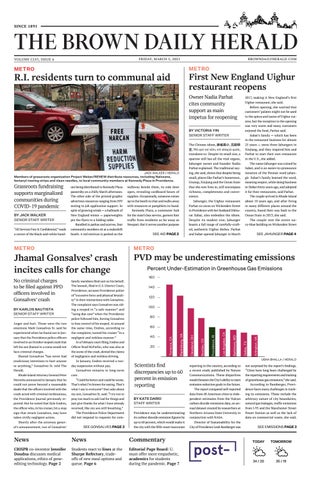
Scientists find discrepancies up to 60 percent in emission reporting BY KATE DARIO STAFF WRITER Providence may be underestimating its carbon dioxide emission figures by up to 60 percent, which would make it the city with the fifth-most inaccurate
News
News
Commentary
CRISPR co-inventor Jennifer Doudna discusses medical applications, ethics of geneediting technology. Page 2
Students react to lines at the Sharpe Refectory, tradeoffs of new meal options and queue. Page 6
Editorial Page Board: U. must offer more empathetic, academics for students during the pandemic. Page 7
reporting in the country, according to a recent study published by Nature Communications. These disparities would threaten the City’s ability to meet emission reduction goals in the future. The report compared self-reported data from 48 American cities to independent estimates from the Vulcan carbon dioxide emissions data, an annual dataset created by researchers at Northern Arizona State University in conjunction with NASA. Director of Sustainability for the City of Providence Leah Bamberger was
not surprised by the report’s findings. “Cities have long been challenged by the reporting requirements and tracking of greenhouse gas emissions,” she said. According to Bamberger, Providence faces many challenges in tracking its emissions. These include the arbitrary nature of city boundaries, natural gas leakages, traffic emissions from I-95 and the Manchester Street Power Station as well as the lack of data on commercial waste, she said,
SEE EMISSIONS PAGE 3
TODAY
TOMORROW
34 / 20
35 / 19
2
THE BROWN DAILY HERALD | NEWS
Friday, March 5, 2021
SCIENCE & RESEARCH
Nobel winner Jennifer Doudna discusses CRISPR Pioneer discusses applications, ethics of the gene-editing technology BY CLAIRE LIU SENIOR STAFF WRITER Nobel Prize winner Jennifer Doudna, who co-invented CRISPR-Cas9 genome editing technology, joined President Christina Paxson P’19 for a virtual conversation on CRISPR’s wide-ranging applications and its ethical implications in medicine and beyond. Doudna and collaborator Emmanuelle Charpentier received the 2020 Nobel Prize in Chemistry for their pioneering invention of CRISPR technology, which modifies DNA with novel precision and is globally recognized as a revolutionary development in science. The event, attended by more than 800, was the inaugural lecture in the Lemley Family Leadership Lecture Series, which was established in 2020 through a gift from Wayne C. Lemley ’80 to feature exceptional intellectual leaders that “inform, challenge and educate” the Brown community, said Provost Richard Locke P’18 in a Feb. 25 news release. Doudna discovered CRISPR unexpectedly while examining how bacteria fight viral infections. When a bacterial cell with a CRISPR sequence in its DNA is infected by a virus, the cell acquires a piece of the DNA from the virus and stores it in the CRISPR part of its genome, Doudna explained. The cell can use RNA copied from the stored DNA, along with a tracer molecule and the Cas9 protein, to search for a sequence that matches the segment originally taken from the virus. When this match is found, the cell uses the Cas9 protein to cut the DNA
AID FROM PAGE 1 for people experiencing homelessness in Rhode Island, who, left with few places to turn, make do with nearby benches and brave the cold weather for another night’s rest. The pandemic has hit at-risk populations like those experiencing homelessness particularly hard, as they now face nation-wide financial instability and public health concerns. But in a time when outreach has become increasingly challenging, members of the community have turned to supporting one another directly. The booth at Kennedy Plaza, part of the harm reduction services offered by an organization known as Project Weber/RENEW, is just one example of direct community outreach used to support vulnerable populations across the state. For PWR, community support means providing for the health and safety of community members without judgement. Haley Carbonneau, PWR’s project coordinator for Kennedy Plaza, emphasized that, as part of the organization’s harm reduction, “everything is free and confidential.” PWR’s street-based outreach aims to increase safety among drug-using populations. For example, the group offers free Naloxone, a medication used to counter the effects of opioid overdose. The organization also provides fentanyl-testing strips so individuals can test their drugs for trace amounts
like a pair of genomic scissors. This cut triggers rapid destruction of viral DNA in bacteria, effectively creating immunity “in real time” to viruses, Doudna said. By studying the mechanisms behind this bacterial defense system, Doudna’s lab was able to create a single molecule of RNA that provides both the directions for Cas9 to find certain DNA sequences and the information for its assembly with the Cas9 protein. Though earlier technologies had allowed scientists to make double-stranded cuts in DNA at specific locations, CRISPR’s “simplicity, of having a single protein that is easily reprogrammed with RNA molecules, turned this into a tool that many labs quickly adopted (for) modifying DNA in human cells and many other types of organisms,” Doudna said. CRISPR’s applications in curing genetic diseases, such as sickle cell anemia, have “generated a lot of excitement in the field,” Doudna said. Because CRISPR can edit genomes, it can be used to target the gene that creates the form of mutated hemoglobin responsible for sickle cell disease. The first sickle cell patient received CRISPR-based therapy in 2019 and has seen successful results. “This is not a fantasy,” Doudna said. But while it holds great therapeutic potential, CRISPR technology could be used to make heritable genetic modifications to embryos or sperm cells, opening “the door to many potential risks and ethical concerns,” Doudna added. Current research is working to move CRISPR technology into a realm where it will be “effective,” “safe,” and “importantly, ultimately affordable,” Doudna said. The CRISPR-based therapy for sickle cell disease currently costs more than a million dollars. To make genome editing more accessible, Doudna emphasized
the importance of the method used to deliver editing enzymes like Cas9 to cells in the patient’s body. “One of the keys to (accessibility) is finding ways to deliver Cas9 in a simpler package that doesn’t require things like bone marrow transplantation,” but could still be delivered to existing cells in the body, she said. Researchers in Doudna’s lab have developed an effective delivery strategy: using engineered HIV viral particles to deliver the gene editors — the CRISPR Cas9 protein and its RNA guide — into mixed populations of T-cells, white blood cells that are key actors in the body’s immune response. They determined that these engineered viral particles were able to successfully differentiate between two types of T-cells and carry out gene editing for one designated type — “a great demonstration of what we hope to be able to do much more broadly in the future,” Doudna said. Doudna’s lab, which has focused on research addressing the COVID-19 pandemic over the past year, has found that CRISPR’s applications also extend to diagnosing COVID-19. Applying CRISPR to detecting COVID-19 requires the use of a different cutting enzyme, Cas13. Unlike Cas9, which cuts DNA, the Cas13 protein randomly cuts RNA, which composes COVID-19 viral particles. The lab found that when Cas13 is coupled with a fluorescent reporter, a fluorescent signal is released once Cas13 begins cutting, creating a “molecular diagnostic” for the presence of COVID-19. Since this kind of diagnostic detects viral RNA directly instead of through a DNA intermediate, as is the case with current methods, it has potential to be a faster alternative. An ongoing partnership with the company Wainamics aims to create tiny sensors that use the CRISPR Cas13 to quickly detect
of the deadly opioid before usage in a time when fentanyl is growing in consumption nationwide. Additionally, the organization offers a needle exchange program that provides users with clean needles in order to prevent the spread of diseases like Hepatitis C. By paying attention to community needs and prioritizing local safety in their outreach, PWR offers Rhode Islanders attainable solutions without fear of judgement, Carbonneau said. When accessing these resources, “nobody ever has to worry about getting in trouble.” Similarly, community members have turned to grassroots fundraising to provide for one another in a time of unprecedented change. Rooted in the work of Black organizers and the Black Lives Matter protests of 2020, one community support phenomenon has been revitalized in the social media mainstream this past year: mutual aid. Mutual aid involves members of a community using their own funding and resources to support one another, based on a desire for political change. The work of mutual aid organizations “focus on dismantling injustice,” Stefanie Kaufman ’17, executive director of Rhode Island-founded mental health advocacy and support organization Project Let’s Erase the Stigma, wrote in an email to The Herald. Whereas many national charity organizations “give to look good” and wait for “grants (and) donations (to) come in to take action,” mutual aid
funds “address and understand the root of systemic oppression and inequity” and “use whatever resources are available,” Kaufman wrote. Combined, these factors allow mutual aid to reach communities in a way larger charity organizations cannot, they added. “Mutual aid projects also need to be cautious of replicating the same power dynamics in (national) charities,” Kaufman wrote. “We must be careful not to engage in saviorism, self-congratulation and paternalism.” Additionally, Project LETS is “led by and for folks with lived experience of mental illness/madness, Disability, trauma and neurodivergence,” according to its website. Since the onset of the pandemic, disabled and mentally ill populations have faced a disruption of community support and, for some, greater health risks should they contract COVID-19. These issues ring particularly true in Providence — a city recently ranked as one of the worst cities in the nation for people with disabilities. “Disabled folks are experiencing crises and are concerned they will no longer have access to the things they need to be well,” including medication, community and therapy, Kaufman wrote. “With regards to mental health, there is a serious crisis approaching. Social factors like layoffs, houselessness and isolation are the perfect storm of suicide triggers; and we know that marginalized communities are more
COURTESY OF BROWN UNIVERSITY
The Lemley Family Leadership Lecture Series was established through a gift from Wayne C. Lemley ’80 to feature intellectual leaders. COVID-19 RNA in contexts outside of testing sites, Doudna said. “I wanted to share a big picture of what this technology is enabling,” and the science behind it, to appeal to both scientists and non-specialists in the audience, Doudna told The Herald in an interview. As the CRISPR field has become more popular with researchers, Doudna’s lab is focusing on “the areas where our lab has unique capabilities,” specifically genome editing delivery, which is “a big bottleneck right now,” she said. Doudna also recently made the decision as president of the Innovative Genomics Institute at University of California, Berkeley and University of California, San Francisco to focus
the institute’s work on using genome editing to combat climate change. For instance, CRISPR technology can manipulate the genome of plants and microbes in soil and water to increase their capacity to store carbon dioxide. She hopes attendees of the lecture will leave with “a kind of high-level understanding” of CRISPR technology and “feel hopeful” for its possibilities, rather than afraid. “CRISPR is the result of fundamental curiosity-driven science,” Doudna said. “I encourage students to follow their interests, follow their passions, and even if you think it’s in a narrow (field), you never know where the next fundamental discoveries are going to come from.”
vulnerable.” In 2020, Project LETS created a Disability Justice Mutual Aid Network in Providence that has since re-distributed more than $26,000 in community funds to “disabled, neurodivergent and immunocompromised community members,” Kaufman wrote, offering “support related to getting groceries, safely cleaning houses (and) transportation.” Through their direct community support, mutual aid funds aim to combat wider legacies of cyclical poverty and discrimination. “When we say solidarity not charity,” Kaufman wrote, “we mean building a sense of unity through shared lived experience, but also growing through political education.” Other communities are predisposed to greater risk due to the nature of their work. With limits on in-person interaction and rises in unemployment stifling financial opportunities, the Providence sex industry is especially vulnerable during this time, according to Bella Robinson, founder and executive director of Call Off Your Old Tired Ethics RI. Robinson’s organization has advocated for the rights and safety of sex workers throughout the state since 2009. Robinson believes that the conditions sex workers face today are a product of the broader criminalization of the sex industry, with laws that “dump (sex workers) at a crossroads and leave them to live in poverty.” Community-driven fundraising
plays a large part in COYOTE RI’s outreach. In 2020, over 80 percent of the organization’s annual income went to providing direct support to Rhode Island-based sex workers. Other initiatives the organization has undertaken in the past year include providing jail support, case management and health supplies to more than 100 incarcerated workers, as well as distributing condoms, hygiene kits and narcotic overdose treatment kits to the local community. In 2020, the organization raised an additional $45,000 in pandemic relief grants for Rhode Island sex workers. Robinson, who has more than 30 years of experience as a sex worker, also expressed that the inaccessibility of federal funding for sex workers has created more obstacles in the industry. To offer her community financial support, Robinson worked with state organizations to secure and distribute funding to local street-based sex workers in the form of grocery store gift cards. Despite the recent revitalization of community-driven aid across the nation, local organizers are in agreement: These issues predate the pandemic. “I think COVID has definitely exacerbated problems, but these problems have been around,” Carbonneau said. While the pandemic has heightened substance use and homelessness alike, “we would be down here (doing outreach at Kennedy Plaza), COVID or not.”
Friday, March 5, 2021
GONSALVES FROM PAGE 1 ment by press time. Amato A. DeLuca, one of the attorneys representing Gonsalves, told The Herald that he was unsurprised by how the attorney general’s investigation concluded. DeLuca said that the actions and “aggressive tactics” taken by Endres and McParlin violated Gonsalves’ civil rights. In pursuing civil action, DeLuca said he aims to help Gonsalves receive compensation for the injuries he suffered. While Gonsalves is no longer in a coma, he still has trouble with cognitive functioning and is severely neurologically impaired, according to DeLuca. It is “more probable than not” that he is “going to have these problems for the rest of his life,” DeLuca said. Based on consultations with and evaluations from neurologists and life care planners, DeLuca said that anywhere from $10 to $20 million would be needed to pay for the various services that Gonsalves will need, including nursing assistance and physical therapy. DeLuca said that the Providence Police Department needs to make a coordinated effort to create a policy that provides clear indication of what officers should do when following mo-
THE BROWN DAILY HERALD | NEWS torcyclists and motor scooter riders. “Frankly, it’s not rocket science,” DeLuca said. “It’s just sitting down and figuring out how it should be done.” DeLuca added that he thinks the city is making an effort to create such a policy so that an incident like Gonsalves’ “doesn’t happen again. Obviously, (the police department) doesn’t want it to happen again.” Direct Action for Rights and Equality Managing Director Kiah Bryant, with whom Gonsalves Sr. has worked following his son’s crash, was also unsurprised by the results of Attorney General Neronha’s investigation. “They close ranks and, of course, they protected their own instead of actually getting justice,” Bryant said. Students who followed Gonsalves’ case expressed frustration with the outcome of the investigation. As the investigation, which began in October, went on, “I think it became clearer and clearer that there wasn’t going to be any sort of disciplinary action or criminal charges,” Aida Sherif ’22 said. Jordan Walendom ’23 said that he felt that the results of the investigation reflect the ability of police officers to “live beyond the law” and avoid consequences for their actions. He wants to see police officers be held accountable “for how
3
ELISE RYAN / HERALD
The Providence Police department officers involved in a crash that sent Jhamal Gonsalves into a coma will not face criminal charges. they negatively impact communities” and create “distrust for the communities that they’re supposed to serve.” For Bryant, Sherif and Walendom, Gonsalves’ crash is emblematic of the larger issue of police brutality in Providence and the nation as a whole. “I’m an abolitionist,” Bryant said, “I do not believe that we need police.” The PPD, Bryant said, is an arm of “state-sanctioned violence” against Black and brown communities. Changing policies and training within the police department “is not going to help,” Bryant said. “There’s something more to the problem, and
that is policing in general,” she added. “It’s bias. It’s racism. (There needs to be) a complete overhaul of what we know as policing.” DARE, in focusing its activism toward reducing the presence of police in the Providence community, supports the “Counselors Not Cops” campaign started by Providence organizations, according to Bryant. The campaign seeks to remove law enforcement officers from Providence public schools and replace them with additional guidance counselors, The Herald previously reported. According to Governing, U.S. police jurisdictions with a population between
100,000 and 200,000 people had an average of 15.9 officers per 10,000 residents in 2016. Providence, which had a population of 178,851 in 2016, had an average of 23.6. “I don’t really think that improving the police is necessarily the solution to police brutality,” Sherif said, “because violence is inherent to the practice of policing.” Instead of proposing ways to change the PPD, City leaders should look to defund the department and reallocate funding to Providence’s public schools, Sherif added. Providence’s proposed budget for fiscal year 2021 includes $88 million for the city’s police department, in addition to $3.5 million for the city’s human services department, which includes its housing authority and human relations commission, and $130 million for the city’s public schools. Over the coming weeks, DARE wants to focus on what a world without police officers could look like for community members who “know what it feels like to be abused and brutalized” by the police, Bryant said. The organization is looking to hold political education events for the Providence community through regular weekly or monthly meetings.
UNIVERSITY NEWS
Committee searches for new VP for institutional equity and diversity VPIED search committee discusses criteria for successor, seeks community input BY ESTELLE ZHU CONTRIBUTING WRITER The University has formed a search committee to find a successor for Vice President for Institutional Equity and Diversity Shontay Delalue, according to a Feb. 12 Today@Brown announcement from President Christina Paxson P’19. Delalue will depart her role at the University July 1 to become senior vice president and senior diversity officer at Dartmouth, The Herald previously reported. The search committee, which is cochaired by Paxson and Vice President for Campus Life Eric Estes, consists of faculty members, staff and students who will discuss and identify criteria for Delalue’s successor. The committee expects to make its decision by September at the latest, Paxson wrote in an email to The Herald. “The priority is to take the time needed to find the right candidate for Brown,” she wrote.
EMISSIONS FROM PAGE 1 adding that the City has to make difficult decisions about how to include and measure these factors. J. Timmons Roberts, professor of environmental studies, environment and society and sociology at the University, provided further context for why Providence would be more inaccurate in its reporting than other cities. In an email to The Herald, he wrote that people could drive through Providence but buy their gas elsewhere, thus possibly eluding the City’s tracking of transportation emissions. Because people commute to and through Providence — a relatively small city — it is likely that the City’s methods for measuring carbon dioxide emissions cannot pick up on these contributions,
The new VPIED must be “a strategist and a leader with a strong sense of empathy” who is able to represent the values and voices of all community members, including faculty, staff, students and alumni, with the goal of improving inclusivity and diversity at the University, Paxson wrote. “It will be essential that this individual also have the expertise to develop and oversee policies and strategies in state and federal compliance areas that include Title IX, Affirmative Action plans and (Equal Opportunity Employment),” Paxson wrote. Committee member Sheyenne Allen ’23, who serves on the Office of Institutional Equity and Diversity student advisory board and who has worked closely with Delalue, believes that the new VPIED should be collaborative and possess a willingness to listen to students. She also hopes that the new vice president will be just as heavily involved in the community as Delalue. “How can you make decisions, how can you bring up ideas and introduce policies without understanding the community that you’re making these policies for?” Allen said. There are “lots of situations at Brown where students aren’t being
heard, so I think it’s really important that we have a candidate who listens to the students,” Allen added. The new VPIED will lead the continuing implementation of Phase II of the University’s Diversity and Inclusion Action Plan, which outlines the steps Brown must take to achieve an inclusive and diverse community, according to the plan’s website. Phase II will be released later this spring. As such, Paxson explained the importance of acknowledging the progress made since the launch of the plan five years ago, as well as the necessity for more important work in the future. “This means continuing work with stakeholders across Brown to build an architecture for diversity, equity and inclusion that sustains the work through all aspects of academic, administrative and campus life” and decision-making, Paxson wrote. To represent a variety of community voices, Paxson invited faculty, staff members and students to join the VPIED search committee, Estes wrote in an email to The Herald. “Members of the committee were chosen because of their roles, their work related to diversity, equity and inclusion and their capacity to contribute insights
The search committee consists of administrators, faculty members, staff and students. It will release a decision by September. to the search,” Estes added. “There was members of the Brown community will also a focus on student representation, be able to contribute their thoughts on which led to the inclusion of an under- the search, Paxson wrote. Keeping the graduate and graduate student on the larger community informed about the committee.” search process and the significance of The committee is currently in the the OIED and VPIED role is a key obprocess of establishing criteria for jective for the committee, Allen said. candidates, Allen said. This informa“It’s really important that the comtion will then be passed on to a search munity knows we’re really excited for consultant, who will present potential this search,” Allen said, “and we’re recandidates to the committee. ally excited to get someone into this The committee plans to hold infor- position who will further the institumation sessions with the search con- tional equity that we’ve so far been sultant and committee members, where implementing.”
he wrote. In contrast, it is likely that larger cities have more gas stations and more registered vehicles, which yield more accurate emissions data. Still, despite these challenges in calculating emissions, Bamberger underscored the value in having a consistent methodology for doing so. “It’s really about benchmarking ourselves and making progress in reducing emissions,” she said. “That’s not to say accuracy is not important, but our options are to report what we know and benchmark ourselves against that.” Even with some unavailable data, the City still aims to do the best it can “to assess and understand and make reductions in our carbon footprint,” she added. Both Bamberger and Roberts also mentioned limitations of the Nature Communications report. The findings
of the report “don’t really help us in any way,” she said. “In terms of plans for the future, it doesn’t offer us a consistent new way to track or measure our greenhouse gas emissions.” Roberts noted that the report failed to mention any natural gas leakage issues. According to him, this problem — which he outlined in a 2019 study — “could mean that Rhode Island’s greenhouse gas emissions could be 45 percent higher than the state reports.” Speaking more broadly about the risks of inaccurate reporting, James Crowley, a staff attorney for the Rhode Island chapter of the Conservation Law Foundation, discussed the importance of accurately accounting for environmental factors. He said that inaccurate understanding of carbon emissions can make it harder to formulate the best
policy goals to tackle climate change. Allison Archambault, a supervising air quality specialist at the Rhode Island Department of Energy Management, emphasized that to have the most accurate understanding possible, the state tries to use Rhode Island-specific data when utilizing the Environmental Protection Agency’s estimation tools. But Crowley expressed concern over some of the state’s accounting practices. He explained that the state still bases carbon reduction goals off of reports from the 1990s, despite having changed their tracking methodology repeatedly since then. He said it would be more effective to redefine Rhode Island goals based on the most current data. While potential inaccuracies in emission reporting make it difficult to meet future reduction goals, both
MUKUL KHANNA / HERALD
Crowley and Roberts said an even more effective approach to staying on track would be to make these goals mandatory and enforceable. “City pledges are nice, but they aren’t necessarily binding,” Roberts wrote. “States and the country should have binding limits, as Massachusetts and Connecticut have from their 2008 Global Warming Solutions Acts. R.I. only has non-binding targets from its 2014 Resilient Rhode Island Act.” He and Crowley both support the Act On Climate bill, which is currently being debated in the state legislature. Crowley said that the bill would make reduction targets mandatory and enforceable, update the state’s emissions goals from an 80 percent reduction to net-zero by 2050 and change the methodology of emission accounting.
4
JAHUNGER FROM PAGE 1 that houses the restaurant. In July 2018, an electrical shortage fire sparked on the third floor, which is used as storage and as a break room. Firefighters poured water on the roof to stop the fire, in the process causing extensive water damage and prompting the restaurant to close, Parhat said. The restaurant recently reopened for takeout and delivery Feb. 3. Repairing the damage and installing a new sprinkler system took over a year to complete. After they brought the building up to code, Parhat and Subat planned to reopen last year, but the COVID-19 pandemic presented yet another challenge, she said. “Honestly, actually, we almost gave up the restaurant,” Parhat said, but widespread community support, and outreach on Facebook and Instagram, encouraged her to bring Jahunger back. The restaurant stayed closed while Parhat searched for a potential new location on Park Avenue in Cranston last fall. When the deal fell through, the couple decided to wait out the fi-
Caption
THE BROWN DAILY HERALD | NEWS nal repairs to their original location, Parhat said. After the restaurant closed, Parhat said her kitchen staff were also eager to reopen. One chef, who found work in Boston and New York in the interim, was more than happy to return to Jahunger, she said. Although they have other occupations — Parhat is a loan officer and Subat is a realtor — community feedback, and the desire to spread awareness about their culture, compelled them to reopen. “We just want more people to know our food and our culture,” Parhat said. The restaurant’s menu includes classic Uighur and northwestern Chinese fare, including spiced chicken stew, kavaap lamb skewers, handpulled laghman noodles and polo, a slow-cooked carrot, lamb, raisin and rice dish. Parhat emphasized the importance of authenticity and an accessible menu, and said that she flew in a head chef from Xinjiang, China to train her kitchen staff on the intricacies and idiosyncrasies of cooking Uighur food.
Friday, March 5, 2021
Most of her staff was unfamiliar with Uighur food when they were first hired. “It’s a lot of work, it’s not like typical Chinese food,” Parhat said. “Everything is made from scratch.” “So whatever you’re eating here, it will taste the same, like you are eating in China, in Xinjiang,” she said. Ethan Pan ’22 said he first tried Jahunger days after it reopened last month and “enjoyed it a lot.” “I ordered the ‘lamb on dry land’ because I thought, this looks like something I’ve never tried before,” Pan said. “I thought it was really good and personally interesting… I think it provides a very new perspective of a general region of food that I want to eat from.” Kavya Gopinath ’22, who recently tried Jahunger’s stir-fried green beans, said, “It was well cooked and kind of spicy — but not too spicy — and very flavorful... I’m definitely going to go back.” Parhat and Subat are planning on opening a second location of Jahunger in the future, possibly even next year, she said. “We believe that this is not going to be the last one.”
PHOTOGRAPHER’S NAME / HERALD
Submissions: The Brown Daily Herald publishes submissions in the form of op-eds and letters to the editor. Op-eds are typically between 750 and 1000 words, though we will consider submissions between 500 and 1200 words. Letters to the editor should be around 250 words. While letters to the editor respond to an article or column that has appeared in The Herald, op-eds usually prompt new discussions on campus or frame new arguments about current discourse. All submissions to The Herald cannot have been previously published elsewhere (in print or online — including personal blogs and social media), and they must be exclusive to The Herald. Submissions must include no more than two individual authors. If there are more than two original authors, The Herald can acknowledge the authors in a statement at the end of the letter or op-ed, but the byline can only include up to two names. The Herald will not publish submissions authored by groups. The Herald does not publish anonymous submissions. If you feel your circumstances prevent you from submitting an op-ed or letter with your name, please email herald@browndailyherald.com to explain your situation. You can submit op-eds to opinions@browndailyherald.com and letters to letters@browndailyherald. com. When you email your submission, please include (1) your full name, (2) an evening or mobile phone number in case your submission is chosen for publication and (3) any affiliation with Brown University or any institution or organization relevant to the content of your submission. Please send in submissions at least 24 hours in advance of your desired publication date. The Herald only publishes submissions while it is in print. The Herald reserves the right to edit all submissions. If your piece is considered for publication, an editor will contact you to discuss potential changes to your submission. Commentary: The editorial is the majority opinion of the editorial page board of The Brown Daily Herald. The editorial viewpoint does not necessarily reflect the views of The Brown Daily Herald, Inc. Columns, letters and comics reflect the opinions of their authors only. Corrections: The Brown Daily Herald is committed to providing the Brown University community with the most accurate information possible. Corrections may be submitted up to seven calendar days after publication. Periodicals postage paid at Providence, R.I. Postmaster: Please send corrections to P.O. Box 2538, Providence, RI 02906. Advertising: The Brown Daily Herald, Inc. reserves the right to accept or decline any advertisement at its discretion.
The Brown Daily Herald, Inc. is a financially independent, nonprofit media organization bringing you The Brown Daily Herald and Post- Magazine. The Brown Daily Herald has served the Brown University community daily since 1891. It is published Monday through Friday during the academic year, excluding vacations, once during Commencement and once during Orientation by The Brown Daily Herald, Inc. Single copy free for each member of the community. Subscription prices: $200 one year daily, $100 one semester daily. Copyright 2020 by The Brown Daily Herald, Inc. All rights reserved.
post-
MAR 5 — VOL 27 — ISSUE 5
FEATURE
See Full Issue: POST.BROWNDAILYHERALD.COM
NARRATIVE
Out West
on snowballs in july, onion dip, and found family By Jordan Hartzell
Snowed In the austin winter storm and its aftermath by Allegra Friedman illustrated by Chloe Chen I spent Valentine’s Day weekend snuggled up on the couch in Austin, Texas, with Jason, a guy I started dating a couple of months ago. That afternoon, the temperature outside had dropped from our usual 70 and sunny to a chilly 15 degrees. Jason and I huddled inside, occasionally looking out the window for the six inches of snow we were expecting, the most Austin had seen since 1985. We waited out the cold by my fireplace, keeping each other warm and making s’mores. In recent weeks, we’d been spending almost every night together, and I usually enjoyed our comfortable silences. But today, we sat awkwardly in front of the fire, avoiding any mention of Valentine’s Day and what it meant for our exclusive, but poorly defined, relationship. He roasted the marshmallows while I assembled the sandwiches, burning my fingers
on melted chocolate and wondering why my notboyfriend wanted to introduce me to his family in South Texas but refused to acknowledge the holiday. Frustrated, I got wine drunk and fell asleep in front of the fire. *** 9:22 a.m. – The next morning, I woke up to the sight of my breath condensing in front of my face, shivering. The thermostat read 40 degrees. While Jason snored from the bedroom, I looked around: Power? Out. Toilet? Frozen. Pipes? Burst. The snow outside? Everywhere. Overnight, Texans had cranked up their heaters in response to the record-breaking cold, pushing the state’s power grid to the brink of collapse. As the only state in the U.S. with an independent grid, utility companies couldn’t transfer electricity in from other states. In-state gas-powered plants went offline, and uninsulated pipes froze and burst. Millions of Texans, including me, awoke shivering, in the dark, and without running water.
“Imagine all the people, living side by side, they all have feet and hands.” “Who's that little guy from the Danimals commercials. The short banana man. No—it’s called
Cursed Boba 1. Green apple tea with brown sugar boba Flavors 2. Coffee boba. No. Just no.
9. AHA boba
3. Eggnog boba
10. Chai Tea Latte Boba. Very colonial.
4. Coca-Cola boba 5. Matcha latte with milk foam ft lychee boba 6. Water boba 7. Orange juice boba for that chewy deliciousness with your Vitamin C
post–
8. Boba boba. Just a plastic cup full of tapioca, baby.
Want to be involved? Email: olivia_howe@brown.edu!
We all say that the drive from Jackson to Sun Valley is something special. It takes us out past the cratered rocks, lunar wasteland, and brush speckling the hills that flatten down into the Idaho borderlands. Through that atomic ghost town, past the “Ice Cream 9 Miles” sign—red like the cherry on top of the milkshakes we wait in line for. It is windows down so the wind can tangle up our hair, shouting the lyrics and taking the turns too fast. The mountains start up again one by one, lone and pinkish in the distance if it’s late afternoon. Into Wyoming, the trees get denser and roadside signs point to trailheads as the drama of the Teton Pass opens. Up and over, a pause at the top to capture on camera the moment and the bugs mashed into the front of the car after so many miles of sitting in the passenger seat with a knee tucked up against the car door. Down the pass, through the log cabin towns, past the grassland that rolls right up to the steely ladies: Grand, Middle, South.
ARTS & CULTURE
Tiktok Pirates shanties on the high seas of the internet By annie cimack A few months ago, my friend sent me a TikTok. The video, captioned “When I hand my brother the aux,” features a man named Promise Uzowulu (@ strong_promises on TikTok) and his brother sitting in the car and listening to music. If you’re familiar with TikTok, you may already know where this is going. His brother is blasting a sea shanty called “The Wellerman,” and Promise is not having it. At least, not at first. But, over a short sequence of videos, we see Promise begin to enjoy the shanty more and more. By the end, he’s not only feeling the music, he’s even singing along and performing backup for his brother.
LIFEST YLE
Beating the MidSemester Blues by Eashan Das & Gus Kmetz
We’ve all been there. You’ve got a midterm tomorrow, a problem set today, and a paper due yesterday. We’re now in the thick of mid-semester, and with it, midterm season. Many of us are stressed, whether from the sheer volume of work or the added weight of being expected to perform under the immense pressure that is college during COVID-19. [shouldn’t there be a sentence introducing that they’re going to give coping mechanisms here?] Music Much like the girl from the lofi hip hop radio beats to relax/study to video, we all spend inordinate March 5, 2021
5
6
THE BROWN DAILY HERALD | NEWS
Friday, March 5, 2021
UNIVERSITY NEWS
Increased choice at Sharpe Refectory leads to longer lines Students face extensive food wait times, as well as ability to customize own meals BY ADAM REMELS CONTRIBUTING WRITER Lines outside the doors of the Sharpe Refectory have become a new normal since the dining hall’s transition from
offering preselected meals to a new “build your own” model, which offers students more variety. The change was prompted by student feedback requesting more “autonomy” over selections and “variety and in-
times per week. Though Merkel believed “there’s a lot of upside” to the changes at the Ratty, he preferred the old system. “You can get more food if you need more food, and you can mix and match in a way you couldn’t beforehand,”
Ratty to the time he leaves — time that Merkel could otherwise use to do work or see his friends. “It would be made less annoying if there were other options,” Merkel said. “But the GET app doesn’t really allow
part, students’ wait times have been cut drastically.” “We are, however, keeping this top of mind and are in the process of planning for the implementation of a second parallel line in the Refectory,”
creased portion sizes,” wrote George Barboza, director of dining programs, and Jessie Curran, assistant director of wellness and nutrition in an email to The Herald. Gabe Merkel ’23.5 gets most of his meals from the Ratty, going about 15
Merkel said. “But it just comes with this massive tradeoff where you now have to spend 25 minutes of your time waiting in line to get the same food that you got before.” Merkel usually waits between 15 and 25 minutes from the time he enters the
you to book anything past a certain time because all the slots fill up pretty quickly. You end up forced to go to the Ratty and wait in line, which, first, feels a little inconvenient if you have a lot of work and, second, feels like a waste of time.” Matthew Stephens ’23 also had to adjust to the longer lines at the Ratty, where he gets dinner every day, by going earlier or later than peak times to circumvent the wait. Despite re-arranging his schedule, Stephens still was not able to avoid the longer wait one day and had to return to his dorm without getting dinner because he had “so much work to do.” Like Merkel, Stephens believes the negatives of the new system outweigh the positives. “As someone who works a lot, as so many other students do at Brown, and as someone who doesn’t have very strict dietary restrictions, I would personally prefer time and efficiency,” Stephens said. “I completely understand someone who was a very strict vegan and was dairy free wanting to have more options for them, but in terms of my schedule, I think the tradeoff is not really worth it.” The express line has been one way students have bypassed the longer lines. Curran and Barboza described the express line as a way “for students who are in a hurry and want to build a meal in a flash” to pick up preselected meals,
Curran and Barboza wrote. “With this we could serve double the number of students at the same time. We are again consulting with the Brown Office of Environmental Health and Safety and the RI Department of Health to ensure staff and students safety.” The longer lines have created some COVID-related concerns due to the increased number of people in the Ratty at a time. Though Merkel believed most students were responsible when waiting in line, he acknowledged the lines came with a greater risk. “It is somewhat frustrating that they implemented this system right when cases started to go up because ... it requires us to be inside in close contact for much longer than it did before,” Merkel said. Brown Dining Services implemented safety measures, such as six foot high plexiglass, after consulting with the Brown Office of Environmental Health and Safety and RIDOH. Floor decals and signs indicating proper social distancing are placed around the Ratty in addition to the three healthy ambassadors who remind students to keep their distance. Merkel said that the early closing times of dining halls — which close at 8:30 p.m. at the latest — can pose a more indirect COVID-19 risk, forcing students to go off campus for food and in turn increasing potential exposure.
which can be reviewed ahead of time on the dining website. Eshaan Mangat ’24 gets at least one meal from the Ratty five days a week and spends about 30 minutes waiting in line. Mangat believed better utilization of the express line could be key to reducing the length of the lines and wait times. “What I think the University should do is make a super distinct regular and express line,” Mangat said. “Because to get into the Ratty itself, that’s where the clog is happening.” Curran and Barboza wrote that the express line has led to “substantial decreases in lines” and that “for most
Though Mangat also favored the Ratty’s previous pick-up system, he believed “Brown (has) been pretty good with listening to students” and was hopeful “they (would) do something to alleviate some of this.” Merkel agreed, remembering the longer lines in the first few days of Quiet Period, which were quickly corrected. “People in the kitchen really do want us to have the best dining experience possible,” Merkel said. “I think they probably are working hard to figure out ways to decrease the length of the line and make sure we can get our food faster with the same amount of options.”
CA L E N DA R
COVID -19 AT BROWN LAST 7 DAYS*
MARCH S
7
Completed Tests
People Tested
M
Tu
W
Th
F
S
14,368
8,453
1
2
3
4
5
6
Confirmed Positives
Positivity Rates
34
0.2%
8
9
10
11
12
13 SINCE AUGUST 24, 2020*
14
15
16
17
18
19
20
21
22
23
24
25
26
27
28
29
30
31
Completed Tests
People Tested
269,935
10,462
Total Cases
Prevalence
422
4.0 %
*AS OF MARCH 5
Friday, March 5, 2021
THE BROWN DAILY HERALD | COMMENTARY
7
EDITORIAL
Brown, be kind As we approach COVID-19’s anniversary on College Hill, the University is better equipped than ever before to handle a pandemic. From the automated COVID-19 test reminders to the plexiglass dividers in the dining halls, Brown has created its own “new normal” to keep members of the campus community safe. But something crucial remains missing from the University’s pandemic response — a true understanding of the continued social and emotional effects of the pandemic on students. In a rush to regain some pre-pandemic normalcy in the classroom, many instructors and administrators have neglected to acknowledge that there is, in fact, nothing normal about our “new normal.” If Brown truly takes care, it must create a more accommodating academic experience — one that actually prioritizes students’ overall well-being. The stress caused by this semester’s shortened academic calendar cannot be overstated. Midterms, problem sets and group projects are sources of stress in normal years, and even more so during a pandemic. We need some rest. But it is difficult to have any when the University has tried to do too much with too little time. Spring break has been removed
without any adequate replacement. We recognize that, as has been the case throughout much of this pandemic, concessions have been necessary. Had Brown maintained the normal length of a semester, first-years, who already have to enroll in four contiguous semesters, would be even more strained. Nevertheless, the shortened nature of this semester has taken a problematic toll on many of us. The University’s accelerated academic calendar has only been made worse by a lack of top-down oversight for classes. There has been little standardization of how instructors should have adapted their coursework. Many have attempted to cram a regular semester’s worth of content into this semester’s shorter time frame. Some even require additional participation unusual even in a regular year, whether through additional lectures or virtual discussions. And others have opted for a minimalist approach instead, with students interacting primarily with pre-recorded versions of their instructor. This inconsistency has been especially damaging amidst a pandemic. Undue academic uncertainty and stress should be avoidable in a world where so much — our health, finances and
more — is already in flux. The University administration should have set better guidelines for courses this semester, perhaps by instructing professors to remove material from syllabi instead of condensing the same material into less time, or by putting mechanisms in place to actively ensure that instructors are more considerate of student circumstances. We don’t have extra free time right now, but the entirely serious emails we have received from professors suggest otherwise. If anything, we have less time, not just because of the extra work on our plates, but also because of the challenges to our well-being that we are all facing from this pandemic. To be clear, many professors and lecturers have made sincere efforts to make the best of remote learning. As students, we are deeply appreciative of the thought and energy instructors have put into adapting — and even enhancing — the learning experience for students. Still, even the most well-designed teaching plans will fall short in a virtual semester; no matter how engaging a lecture or discussion is, Zoom fatigue can set in. And structural challenges, whether they be time zone differences or unreliable internet connections, make it harder for students to
learn, in spite of everyone’s best efforts. Some issues just can’t be fixed. But professors, lecturers and teaching assistants alike can help their students a great deal by simply being empathetic. Instructors need to recognize that, for the time being, their classes might well be the least of their students’ worries. Classes may have to make some concessions, and sacrifice some assignments in order to give students some breathing room. More broadly, instructors should be receptive to the individual struggles of their students, some of whom are quite literally dealing with matters of life and death. Our world is one of plastic dividers, masks and social distancing. We are all attempting to deal with unparalleled social and emotional upheaval, and we’ve all found ways to cope. But inconsiderate academics only infuse unnecessary stress into a time that is already unlike any other in recent memory. Things are not normal. Our classes shouldn’t try to pretend like they are. — Editorials are written by The Herald’s editorial page board. This editorial was written by its editor and assistant editor, Krista Stapleford ’21 and Johnny Ren ’23, and members Olivia Burdette ’22, Devan Paul ’24 and Kate Waisel ’24.
Mackie ’59: Cliff Stevenson and the coaching road less chosen PETER MACKIE ‘59 OP-ED CONTRIBUTOR It was 1960, and Brown was trying to gain a foothold in the newly-minted athletic Ivy League. Overmatched in facilities, financial resources and athletic pedigree, one question dogged the program: Do we really belong in the Ivy League? Historically, Bruno had been an outlier, faring poorly when taking on Ivy teams, especially in the major sports. Now Brown was playing a round-robin schedule in all Ivy sports. Enter Clifford “Cliff” Stevenson, a World War II veteran who had grown up in nearby Pawtucket and had spent eight years as soccer and lacrosse coach at Oberlin College. Brown’s first full-time soccer coach, Stevenson was undaunted by the challenge, and over the next three decades, answered the lingering “belonging” question with a resounding “yes.” After a dismal 1960 season, the dynamic and irrepressible coach quickly turned the soccer program around, winning an Ivy title three years later — only Brown’s second since formal Ivy play began in 1956. The next five seasons saw a succession of titles, including an unbeaten season in 1967. During that stretch, Stevenson’s teams ran off a string of 25 consecutive wins as Brown dominated the League. Soon, a steady stream of talented booters arrived on College Hill, a result of Cliff’s relentless recruiting. He was not hesitant to go head-to-head with the recruiting programs of Ivy powerhouses, who had well-established relationships with key secondary schools. Cliff made it clear to these schools’ gatekeepers that he would meet with only the top student-athletes, not their second tier. His persuasive, forthright approach and ability to promote Brown as a special place was masterful. Employing a creative strategy, he often made home visits with his wife Muriel, signaling to parents that their sons would be well taken care of at Brown as extended family. Shepherding prospects through the admissions process was often an ongoing battle, with Stevenson and admissions officers at loggerheads over candidates.
Stevenson’s record was exemplary, however; he did his homework and made compelling arguments to support his recruits. As spectators began to flock to soccer games in large numbers — drawn by Stevenson’s attacking, up-tempo style of play — Cliff, ever the communicator, began to galvanize support by forming a Soccer Association at Brown. He kept everyone involved through newsletters on recruiting and other relevant soccer news. He also began scheduling games that did not overlap with football. Cliff had noticed that 11 a.m. games on home football Saturdays resulted in fans leaving for Brown Stadium at halftime. He wanted soccer to be a stand-alone event, not a preliminary football warmup. As his teams improved, so too did the soccer field. Originally part of the Dexter Asylum farm purchased by Brown in 1957, the soccer pitch began as an unleveled, rock-strewn patch. Brown had the only soccer field in the country where after a hard rain, a soccer ball could float from one end to the other. Players from the early years remember the task of picking up stones before practice. With no field lights, late afternoon practices were illuminated by automobile headlights that lined the sidelines. Gradually, stands and fencing around the field were added, and a lighted scoreboard discarded from Meehan Auditorium was mounted on a trailer at the edge of the field. A master groundskeeper, Stevenson nurtured every blade of grass, working with Brown Facilities to create a first-rate playing surface. Permanent field lights and a modern scoreboard completed his dream facility, which was named in his honor in 1979. Stevenson was a tireless promoter of the game at all levels, a soccer evangelist who was a pioneer in running summer camps and introducing youth soccer in Rhode Island. He was also indirectly responsible for the establishment of women’s soccer at Brown. In 1972, his daughter Karen Stevenson ’76, a first-year, asked Cliff why there was no women’s team. The result of the discussion was that Karen recruited a group of students who practiced after the men. Several players from the men’s team were volunteer coaches. At Homecoming that
year, the women played a preliminary game on the varsity field against a group of older women from Pawtucket. In 1975, Brown Women’s Soccer played its first intercollegiate games. Cliff Stevenson’s visionary leadership resulted in other lasting changes to the League. He is responsible for the introduction of a standardized ball in the Ivy League, changing the practice of each school using its preferred ball in matches. He also introduced filming of games in the 1960s. By the time he retired in 1990, Cliff Stevenson had amassed a record of 251 victories, including 10 Ivy League Titles, 13 NCAA Tournament appearances and four Final Fours. Brown soccer was a national power. Meanwhile, Stevenson was doubling as the head coach for lacrosse, a program that had been in mothballs since 1937. After two club sport seasons, the laxers began varsity play in 1963, winning 11 games. After joining the Ivy League in 1964, the team won its first title just five years later. As usual, Stevenson was not reluctant to schedule games with the established giants of lacrosse. His 1973 team ran the table in the Ivy, after “Coach” had promised them watches if they won the title. In April, the Bruins took on number one-ranked Johns Hopkins at Brown Stadium, a contest witnessed by over 7,000 fans. By the time the program was turned over to Dom Starsia ’74 in 1983, the Stevenson lacrosse ledger included 188 victories, eight New England Championships, two Ivy titles and three NCAA tournament appearances. Everyone who entered Cliff Stevenson’s orbit has a “Cliff story.” A few years ago, I was touring the new lacrosse locker room at the Pizzitola Center with Cliff and then-Brown Men’s Lacrosse Coach Lars Tiffany ’90. Noticing the whiteboard, Cliff grabbed a marker and began to draw up an offensive zone play for Lars. Cliff was a “lifer” who never stopped coaching. When he retired in 1990, Cliff Stevenson had changed the culture of Brown athletics, replacing doubt with pride and optimism. He had laid the foundation for two of Brown’s most consistently successful programs, and he had
remained Ever True in spite of tempting offers from other schools. He enjoyed his status as the Athletic Department’s elder statesman and goto person. Stevenson’s legacy is profound and is perpetuated by major soccer and lacrosse awards, as well as the Athletic Department’s annual Cliff Stevenson Award, given to “the male athlete who best exemplifies Cliff’s boundless enthusiasm, indomitable spirit and devotion to the quality of life at Brown and the surrounding community.” Stevenson has been enshrined in the Brown Athletic Hall of Fame as well as those for college soccer and lacrosse. During his retirement, Cliff and Muriel traveled countless miles in the motor home presented to him at his Brown retirement. They often returned to New England from Florida to see former players and to revel in the open road. Cliff’s zest for life was always at full throttle. “What a country,” he would often exclaim. Always a straight shooter, in his final holiday letter to hundreds in December, he wrote: “I am 92 now … Memory a problem … I can still catch bass with my $2 lure and I can exercise on my 3 wheel electric motorized bike … I finally sold the motor home and put a little money in the bank.” A final footnote: Cliff Stevenson watched his final sports event on Super Bowl Sunday. The next day his motor stopped running. As a youth in Pawtucket, Cliff played the three main sports of the early 1940s: football, basketball and baseball. Cliff’s son Dave Stevenson ’75, recently shared his rationale for choosing soccer and lacrosse coaching as his life’s work: “He selected two of the least-played sports at the time and wanted to grow with them.” Mission accomplished. Rest easy, Coach. We will not see your like again.
Peter Mackie ’59 is the University sports archivist with the Edward North Robinson Collection of Brown Athletics. He can be reached at peter_mackie@brown.edu. Please send responses to this opinion to letters@browndailyherald.com and op-eds to opinions@browndailyherald.com.
8
THE BROWN DAILY HERALD | NEWS
Friday, March 5, 2021
ARTS & CULTURE
Amazon’s newest dark venture explores publishing, fiction Corporate giant releases “Currency”: eight weakwilled short stories by famous authors BY CECILIA BARRON SENIOR STAFF WRITER “Inequality. Influence. Fraud. Sabotage. These are the themes of great fiction and our modern economy,” says Amazon, the retail giant currently pressuring employees to go against unionization. Leaving a definitive footprint on the slow death-march of the publishing industry, Amazon recently released a collection of eight short stories by some of the most prominent writers today. Featuring stories by authors like Jia Tolentino, staff writer for the New
Yorker and author of the very millennial essay collection Trick Mirror, Curtis Sittenfeld, author of Prep and a speculative fiction novel about Hillary Clinton (Rodham) and Justin Torres, author of We the Animals, the collection is titled, without irony, “Currency.” The authors approach the title’s theme with an Amazonian abrasiveness. Currency as sex. Currency as followers. Currency as — to be as devastatingly contemporary as this short story collection — influence. Power is a word these writers dance around. To expressly acknowledge the contemporary impossibility of the common man grasping onto any power in a world dominated by monopolies and a few men would be to acknowledge Amazon itself. So instead, the authors settle on the effusive, digitized locus of influence.
Influence explains why half of the stories focus on fame, the most democratic of the powers, though one that applies to few. It may also explain why many of the stories deal with some sort of guilt — class guilt, white guilt, age guilt — with fear rather than introspection. Is Yumi, in Kiley Reid’s story “Simplexity,” losing her credibility with the few Black women in her office as she starts a battle they never asked her to fight? Should Tolentino’s protagonist in “I Would Be Doing This Anyway?” keep working for an insensitive, spoiled influencer, even though it feels like “pissing the bed”? By teaching “Postcolonial Perspectives,” is Andy in Sittenfeld’s story righting his wrongs as a white male? Jeff Bezos, barring apocalypse, will have power tomorrow. Yet any of the characters in these stories could be socially obliterated by one tweet. Unlike
COURTESY OF AMAZON
The collection features authors like Jia Tolentino and Justin Torres, focusing largely on “currency and sex.”
Register for these virtual events at watson.brown.edu/events
power today, influence isn’t sacrosanct. You can lose influence just as quickly as you gain it. And these characters, presumably like their authors, are determined to maintain their influence as long as they can. This fixation on influence is the second most essential flaw of the “Currency” collection. There is nothing more important to Tolentino, Sittenfeld, Cline or Torres than influence; all transactions are influential, all losses are losses of influence. This allows for even the most banal first-world conflicts in this collection to become epic power struggles of purported importance when, in fact, they are as inconsequential as losing followers. Tolentino’s story builds to her protagonist realizing, in the wake of the George Floyd protests, that she can’t stomach working for her employer anymore. Fine. But the dramatization of the moment (“Helicopters were circling overhead because of the protests — all protests were illegal now”) falsely suggests that this decision was rooted in anything deeper than a fear of what working for a soulless influencer could do to her social clout in the long run: its effect on her influence. Kiley Reid’s story makes note of this phenomenon through her character Yumi: “My tendency is to over-index the ethnic implications of a situation, when really, at the end of the day, wellness is wellness, you know what I mean?” Wellness is wellness, Instagram is Instagram, influence is influence. While everything is deserving of analysis, Cline’s attempt to link an experience at a beauty store to the basic “deception” of commerce in an already underdeveloped story feels disingenuous. Reading “Currency,” it feels as if Bezos ran a finger through each of the stories, marking places where an author could make another artificial reference to a social issue. But the most essential flaw of these
stories is that they are written for Amazon. No matter how good these stories could have been — and they were not good — it would be hard to stomach something that I can only read through Amazon.com, on my Amazon app or through my Amazon Kindle. There were parts of these stories I liked. Some of them, like “The Summer House” by Cristina Henríquez, tried to deal with cold, hard power. Torres examined the guilt of succeeding as a queer, poor man. Reid’s story included a sharp account of microaggression, examining who’s allowed to be angry and when. Even Tolentino’s story, one of the weakest, maintained her familiar blunt, humorous tone. But every time a story made me laugh, AMAZON was emblazoned upon my brain. Any time a story came close to moving me emotionally, my eyes flashed to the read. amazon.com URL in my browser. What is most ironic about these stories is that for each of the authors, currency is obviously synonymous with money, despite any attempt to glean deeper and more abstract meaning from the word. While they can dive deep into microaggressive haircuts, they fail to investigate the most prominent transaction in their writing: the one between the author and Amazon, how they managed to write about class and privilege for a corporation forcing their employees in Chicago to work from 1:20 a.m. to 11:50 a.m. or else lose their jobs. That’s the currency that’s interesting to me. In Tolentino’s story, she acknowledges her publisher — “I was troubled about the working conditions in warehouses, we had both been ordering stuff on Amazon Prime every week” — with such frailty and obfuscation that I wonder whether she really believed she was somehow sticking it to Bezos. More likely, she thought this feeble jab could absolve her of some criticism and save her some of her influence.