SINCE 1891
THE BROWN DAILY HERALD Friday, February 12, 2021
VOLUME CLV, ISSUE 37
BROWNDAILYHERALD.COM
UNIVERSITY NEWS
UNIVERSITY NEWS
Fashion at Brown announces 2021 lineup
Married professors reflect on teaching at home
Sarah Jessica Parker, Emma Chamberlain, Gwyneth Paltrow among speakers
Married professors discuss shared experiences during pandemic
BY JACK WALKER SENIOR STAFF WRITER Brown Fashion Week ’21 promises “bigger-than-ever” virtual programming this March, including a star-studded lineup of CEOs and style icons, according to an email to The Herald from President of Fashion@Brown Sasha Pinto ’21. Set to run from March 4 to 22, Brown Fashion Week has been extended by F@B to last more than two weeks this year. Operating virtually for the first time since its creation, Brown Fashion Week will offer 16 different events, featuring a total of 24 fashion industry leaders in conversation with F@B student moderators. Sarah Jessica Parker, Emma Chamberlain, Gwyneth Paltrow, Stella McCartney, Kenneth Cole, Steve Madden, Olivier Rousteing, Olivia Palermo and Francesca Bellettini, among others, will all feature as speakers. Events will also include a conver-
BY GAYA GUPTA CONTRIBUTING WRITER
COURTESY OF FASHION@BROWN
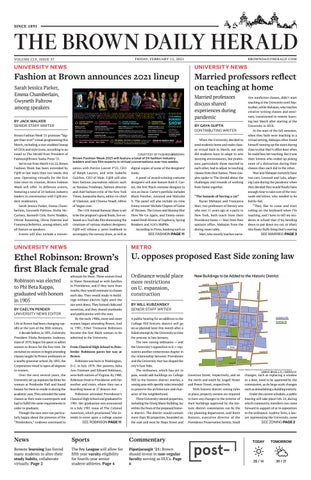
Brown Fashion Week 2021 will feature a total of 24 fashion industry leaders and two film experts in virtual conversations over two weeks. sation with Patrice Louvet P’22, CEO of Ralph Lauren, and with Isabelle Guichot, CEO of Maje. F@B will also host fashion journalism editors such as Vanessa Friedman, fashion director and chief fashion critic of the New York Times, Samantha Barry, editor-in-chief of Glamour, and Chioma Nnadi, editor of Vogue.com. The 11th Annual Runway Show is set to be the program’s grand finale, live-released as a YouTube film showcasing the creations of various student designers. F@B will release a print lookbook to accompany the runway show, as well as
UNIVERSITY NEWS
BY CAELYN PENDER UNIVERSITY NEWS EDITOR Life at Brown had been changing rapidly at the turn of the 20th century. A decade before, in 1891, University President Elisha Benjamin Andrews, class of 1870, began his quest to admit women to Brown for the first time. He recruited six women to begin attending classes taught by Brown professors at a nearby grammar school. By 1892, the Corporation voted to open all degrees to women. Over the next several years, the University set up separate facilities for women at Pembroke Hall and found houses for them to reside in during the academic year. They attended the same classes as their male counterparts and had to fulfill the same requirements in order to graduate. Though the men were not particularly happy about the presence of the “Pembrokers,” Andrews continued to
SEE FASHION PAGE 11
“The hazards of having a cat” Karan Mahajan and Francesca Mari, two professors of literary arts who met 11 years ago at a party in New York, both teach from their Providence home –– Mari from their upstairs office, Mahajan from the dining room table. Mari, who mostly teaches narra-
SEE MARRIED PAGE 3
METRO
Ethel Robinson: Brown’s first Black female grad Robinson was elected to Phi Beta Kappa, graduated with honors in 1905
digital copies of some of the designers’ looks. A panel of award-winning costume designers will also feature Ruth E. Carter, the first Black costume designer to win an Oscar. Carter’s portfolio includes Black Panther, Amistad and Malcolm X. The panel will also include six-time Emmy winner Michele Clapton of Game of Thrones, The Crown and Mamma Mia! Here We Go Again, and Emmy-nominated Heidi Bivens of Euphoria, Spring Breakers and A24’s Mid90s. According to Pinto, booking such an
When the University decided to send students home and make classes virtual back in March, not only did students have to adapt to new learning environments, but professors, particularly those married to each other, had to adjust to teaching classes from their homes. Three couples spoke to The Herald about the challenges and rewards of working from home together.
tive nonfiction classes, didn’t start teaching at the University until September, while Mahajan, who teaches creative writing classes and seminars, transitioned to remote learning last March after starting at the University in 2018. At the start of the fall semester, when they both were teaching in a virtual setting, Mahajan often found himself running up the stairs during class to shut Mari’s office door when he could hear her teaching. But it was their kittens who ended up posing more of a distraction during their classes than each did to the other. Mari and Mahajan currently have two cats, Leonard and Lulu, adopting Lulu during the pandemic when they decided they would finally have enough time to take care of the twoweek-old kitten, who needed to be bottle-fed. “They like to come and start rolling on the keyboard when I’m teaching, and I have to tell my students at school that (I’m) bending down to put down my cat, or (that) this floaty fluffy thing that’s moving
advocate for them. These women lived in Slater Homestead or with families in Providence, and if they were from nearby, they would commute to classes each day. They would study in buildings without electric light until the sun went down. They formed clubs and sororities, and they shared yearbooks and publications with the men. By the early 1900s, more and more women began attending Brown. And in 1901, Ethel Tremaine Robinson became the first Black woman to be admitted to the University. From Classical High School to Pembroke: Robinson paves her way at Brown Robinson was born in Washington, D.C. in July 1878. Her parents, Julia Ann Freeman and Edward Robinson, were both natives of Virginia. By 1900, Robinson lived in Providence with her mother and sister, where they ran a boarding house at 27 Beacon Ave. Robinson attended Providence’s Classical High School and graduated in 1901. Her graduation was announced in a July 1901 issue of The Colored American, which proclaimed “she intends to enter upon a college course
SEE ROBINSON PAGE 11
U. opposes proposed East Side zoning law Ordinance would place more restrictions on U. expansion, construction BY WILL KUBZANSKY SENIOR STAFF WRTIER A public hearing for an addition to the College Hill historic district will go on as planned later this month after a failed attempt by the University to slow the process in late January. The new zoning ordinance — and the University’s opposition to it — represents another contentious chapter in the relationship between Providence and the University that has shaped the city’s East Side. The ordinance, which has yet to pass, would add buildings on College Hill to the historic district overlay, a zoning area with specific rules intended to preserve the architecture and character of the neighborhood. Three University-owned properties, including the Orwig Music Building, lay within the lines of the proposed historic district. The district would contain more than 90 properties, bounded on the east and west by Hope Street and
News
Sports
Commentary
Remote learning has forced many students to alter their study habits, collaborate virtually. Page 2
The Ivy League will allow for fifth year varsity eligibility for fourth-year senior student-athletes. Page 4
Pipatjarasgit ’21: Brown should invest in non-regular faculty serving as DUCs. Page 6
Governor Street, respectively, and on the north and south by Angell Street and Power Street, respectively. With historic district zoning rules in place, property owners are required to have any changes to the exterior of their buildings approved by the historic district commission run by the city planning department, said Brent Runyon, executive director of the Providence Preservation Society. Small
USHA BHALLA / HERALD
changes, such as replacing a window or a door, need to be approved by the commission, as do large-scale changes such as demolishing a building entirely. Under the current schedule, a public hearing will take place Feb. 24, during which community members can come forward in support of or in opposition to the ordinance. Andrew Teitz, a lawyer representing the University, came
SEE ZONING PAGE 2
TODAY
TOMORROW
28 / 14
30 / 21
2
ZONING FROM PAGE 1 forward at a Jan. 27 meeting, raising a procedural objection to the scheduling of the hearing. The objection was related to procedural rules of City Council committees, University Spokesperson Brian Clark wrote in an email to The Herald. The City Council committee on ordinances, guided by legal counsel, moved ahead with scheduling the hearing despite Teitz’s objection. Clark, in an email to The Herald, confirmed that the University opposes any of its buildings being included in the district. “We share the Providence Preservation Society’s commitment to preserving historic buildings on College Hill, support a reasonable expansion of the College Hill Historic District and appreciate the diligent community engagement process PPS has undertaken in recent years,” Clark wrote, “but we object to the boundaries proposed in PPS’s proposal for the district’s expansion.” Much of the proposed district currently lies under I-2 zoning — zoning specifically designed for areas jutting out from educational institutions. That districting, Clark said, already requires “multiple layers of review” of the University’s plans that consider the history and character of the neighborhood. “That process, and the City Plan Commission’s jurisdiction over properties within the I-2 District, already provide the necessary protection of the surrounding neighborhoods,” Clark
THE BROWN DAILY HERALD | NEWS wrote. “Another layer of review is unnecessary.” But Runyon said that the existing regulation has “no teeth to it.” “The City Plan Commission has no authority to say, ‘no, you cannot demolish that,’” he said. Ward 1 City Councilman John Goncalves ’13 MA’15 told The Herald that additional regulation would not necessarily rule out further development. “The city, generally speaking at this moment, is somewhat pro-development,” he said. “The historic district commission, while they do want to preserve the local historic districts, they are certainly amenable to hearing what developers have to say.” Goncalves also noted in a message to The Herald that the commission is confined by what’s allowed legally. Aside from the University, property owners who have communicated with the city regarding the proposed ordinance have largely expressed support, Runyon and Goncalves said. “The party that seems to be heavily in opposition is Brown University,” Goncalves added. “The reason why they’re in opposition is … because it can limit their opportunity to expand in the way that they desire in the neighborhood.” PPS, Runyon said, began crafting this district in 2013, following interest from property owners. While many properties on College Hill are on the National Register of Historic Places, that status offers no local protection in the event of proposed demolition.
But the properties in the local historic district, which was created in 1960 and expanded in 1990, receive local protection from the historic district commission. When the 2012 proposal for 257 Thayer called for the demolition of numerous buildings on the national historic register, residents elsewhere on College Hill approached PPS about creating a new local historic district, fearing their properties might be next. Residents requesting that their own homes be rezoned into a historic district, Runyon said, are a rarity. “Most people are happy to have restrictions on other people’s properties, but not their own,” he added. After a draft of the plan for the new historic district — which at one point included dozens of University properties — was revised repeatedly to satisfy the University, residents and the city planning commission, the proposed ordinance came before a City Council committee. The University has “engaged in discussion at multiple points” over the last decade regarding potential expansion of the College Hill Historic District, Clark said. The relationship between East Siders and the University has long been fraught, said Rocket Drew ’22, advocacy chair of student group Housing Opportunities for People Everywhere. That the University intervened in the process doesn’t come as a surprise, according to both Runyon and Drew. “Brown has the resources to put up
a fight like that and doesn’t have the shame to hold back,” Drew said. Goncalves, a lifelong Fox Point resident and a graduate of the University, related the University’s opposition to the ordinance with previous “challenges” the University’s expansion has created for College Hill residents. Low-income communities and Black residents, Drew added, have also been historically displaced by the University’s expansion. “There’s a drive from the greater community to protect the historic vibrancy of the community,” Goncalves said. “It’s a bummer that Brown is unwilling to budge” Still, the properties encompassed in the new district are mostly home to “middle and upper-middle class residents,” Runyon said. The properties included, he added, were largely chosen based on architectural and historical merit. The net effects of historic districts are often unclear: While houses in historic districts retain value better than other properties in economic downturns, Runyon noted, the cost of maintaining a historic property is usually high. Drew added that enabling the University to build in the area without more restrictions could hypothetically help the neighborhood: If the University were to expand with the purpose of building more on-campus housing while keeping the number of students it admits flat, it could take students out of the housing market in Providence, he
Friday, February 12, 2021 said, dropping prices for other renters on the East Side. Historical preservation, Runyon noted, can often be a “double-edged sword,” where preservation may be used to “exacerbate gentrification” or cause further displacement. If the ordinance passes, its tangible impacts may prove “marginal,” Drew said, as the University may still find a way to litigate around the ordinance’s restrictions. Still, the ordinance could have other important consequences, such as “setting a precedent for holding Brown accountable.” HOPE has not officially endorsed the zoning ordinance. Goncalves echoed Drew’s comments: Expanding the new historic district could be an opportunity for the University to “right the wrongs” of its past. “Expansion is important, but I think it’s also important to ensure their expansion is somewhat checked,” Goncalves said. “We can’t undo the damage that Brown has done,” Goncalves said, referencing impacts including the destruction of homes and uprooting of communities. “But here’s an opportunity to do what we can to preserve what we have that’s left,” The University, Clark said, will detail its position “more expansively” at the public hearing in late February.
UNIVERSITY NEWS
Student reflect on new study habits, challenges of online learning Difficulties include workload balance, connecting with peers, self-care BY ANNE WANG CONTRIBUTING WRITER “For many University students, the shift to remote learning has also necessitated a shift in study habits. Many have found it difficult to stay connected with other students through the screen, a disconnect which can negatively impact the virtual classroom experience. Undergraduate Council of Students Chair of Academic Affairs Deepak Gupta ’22, “when you’re over zoom, people really only stay for class, from the beginning to the end,” resulting in a loss of informal connection before and after class. Maisy Meyer ’22, a chemistry teaching assistant and head of the Chemistry Departmental Undergraduate Group, has seen firsthand the effects of online learning on staying connected. The ease of collaboration in study groups, for example, is inevitably lost in an online setting, she said. To help combat this loss of connectivity, the chemistry DUG arranged study groups for introductory classes within the department to accommodate students across time zones, “predominantly first-years,” Meyer said. Meyer also often recommends to students that they go to office hours, which can serve as smaller meetings that can relieve students of the pressure of speaking in front of a large audience. “I’ve been encouraging all my students to make a study group. Literally just look for something fun in someone’s
background of the Zoom and message them about it,” Meyer said. “It really (can form) a lasting relationship.” Director of the Sheridan Center for Teaching and Learning Mary Wright also spoke to the benefit of connecting with other students in study groups. “Often when you’re studying, if you can explain your thinking or teach it to someone else, you’re learning three times as well,” she said. Utilizing Zoom features like the emoji react feature, as well as turning cameras on, can help to simulate the in-person classroom experience. In addition, with all schoolwork and activities being remote and accessed through the screen, it can be difficult to distinguish work from home, Meyer said. In a normal, non-pandemic year, “I would leave my home, I would work for a certain number of hours and I would come home and do other things,” Meyer said. “I don’t really do that anymore.” As such, Meyer believes that right now, practicing self-care — including taking regular breaks, getting enough sleep and not skipping meals — is especially important. Avery Oliver ’23 said she finds it particularly important to take breaks from her phone, especially since most interactions are now virtual, and uses an app called “Focus Keeper” to maintain good study habits away from the screen. “Distance from the work environment is especially important now since it’s harder to separate the two,” Oliver said. She also finds it beneficial to talk to peers and to take walks when she’s not in class. Virtual learning also presents other challenges. According to Wright, over half of student respondents to a fall
PAVANEE GIROTI / HERALD
In order to help foster connections between students in the virtual sphere, the chemistry Departmental Undergraduate Group has set up study groups and encouraged students to go to office hours for extra help. 2020 survey expressed that they had trouble finding quiet rooms for class and study spaces to focus. She added that this challenge may be exacerbated for students who are studying entirely remotely and those who may need to balance school work and family obligations. Many professors have been moving away from assessment-heavy courses, which typically culminate in a final paper or exam, Wright added. Instead, professors have been assigning more evenly spaced quizzes and papers. According to scientific literature, she said, this approach is more beneficial for students, encouraging them to study in “chunks” rather than cramming for a final, along with giving them the ability to pause, rewind and consume record-
ed course material at their own pace. This allows students to engage more thoughtfully with course material than they may have been able to in prior years, Wright said. Still, Meyer believes this approach can be overwhelming. “It seems like there’s always an assignment that pops up that’s new,” she said. “The boundary of when to stop is hazy.” Soon, the University will again begin to offer numerous opportunities for small group learning settings, such as meeting with Writing Fellows, offering small group academic tutoring and offering small group peer tutoring. “Those peer to peer small group learning contexts can be really helpful all of the time, but especially in times
like this when you have to learn in socially distanced ways,” Wright said. The UCS Academic Affairs committee has been working on addressing study concerns by working closely with the University, said Gupta, who has been meeting with Dean of the College Rashid Zia ’01. The committee also plans on sending out surveys to gauge student concerns and to increase communication between the University and the student body. “Obviously remote learning is not the ideal way for students to engage in their classes,” Gupta said, “but at the same time, students have been willing to accept the circumstances given to them and try to make the most of them even if they are not ideal.”
Friday, February 12, 2021
THE BROWN DAILY HERALD | NEWS
3
SCIENCE & RESEARCH
Brown researchers study airflow, Study recommends opening car windows to mitigate spread of COVID-19 BY JARED ZHANG SENIOR STAFF WRITER “By studying vehicle airflow patterns, University researchers showed that opening windows opposite the side where a person is sitting in a car can help passengers reduce COVID-19 transmission. The study, published in early January, aims to fill a current gap in the understanding of the passenger car, which presents a challenge in preventing the spread of COVID-19 due to its small indoor environment. “You cannot maintain six feet inside a car, and the ventilation in cars is not designed to prevent spread,” said Varghese Mathai, former postdoctoral researcher at the University and current assistant professor at the University of Massachusetts Amherst. Mathai, a joint first author of the study, explained that the data provides a better understanding of airflow in passenger cars. “There’s not a lot of literature about air quality in single family cars and
MARRIED FROM PAGE 1 across the screen is not really my fault,” Mahajan said. Mahajan and Mari both appreciate the benefits of teaching their classes remotely –– for example, being able to invite guest lecturers from around the world –– and also enjoy getting to spend time with each other immediately after their work ends. “We developed a routine that we enjoy even as we both begin to slowly lose our minds,” Mahajan said. An “extensive Google shared calendar” For Hilary Friedman, visiting assistant professor of education, and John Friedman, professor of economics and international and public affairs at the Watson Institute, working remotely hasn’t made them any less busy with classes, but it has given them more time to spend with family. The Friedmans both studied at Harvard as undergraduates but didn’t meet
infectious diseases,” said L. James Lo, assistant professor of architectural and environmental engineering at Drexel University, who was not involved in the study. This is partly because traveling in another person’s car was not as common until about five years ago when companies such as Uber became popular, he added. Associate Professor of Pathology and Laboratory Medicine at Alpert Medical School and practicing physician at Miriam and Rhode Island Hospitals Jeffrey Bailey was inspired to begin the study when he noticed many people were driving with their windows up on a rainy day during the pandemic. “I noticed the people driving were sitting in very confined spaces. I then thought about (COVID-19) transmission,” Bailey said. The idea to study COVID-19 transmission in cars soon made its way to the engineering department in the University’s signature interdisciplinary collaborative nature, he added. “It’s very intuitive that an open window will result in less transmission as air can flush particles outside,” said Asimanshu Das GS, a joint first author of the study. Less intuitive was deciding where passengers should sit to reduce contamination and what configuration of open windows works best to prevent the
would often travel to give lectures and conduct research, so the increased time he spends at home now allows their family to eat dinner together almost every evening, Hilary Friedman said. Now, she and her husband have also been able to put their kids to bed together most nights. With John Friedman largely working from his office on campus, the pair found that it was easy to coordinate when one of them needed to use a space at home for meetings or to record a class. But they credited an “extensive Google shared calendar” for keeping their lives organized, Hilary Friedman said. With the lack of after-school activities and babysitters due to the pandemic, they have to work together to coordinate their busy schedules to pick up their kids from school. But Hilary Friedman is grateful for how helpful her partner has been throughout the year. “There’s so much coverage during the pandemic about how women have been impacted and that is 100 percent
KARAN MAHAJAN AND FRANCESCA MARI
until several years later during their fellowships at the University of Cambridge in fall 2002. It took five years for them to realize they should date and get married, Hilary Friedman said, but John Friedman interjected that he knew all along. The couple started teaching at Brown together in 2015. Before the pandemic, John Friedman
true, and it’s something I care very much about advocating for,” she said. “But I am very fortunate because as successful and busy as John is, he is definitely involved both around our home and with our kids.” “Brainstorming around the kitchen table at night”
spread of particles, Das added. The researchers hoped computer simulations would shed light on these unanswered questions. They decided to use Computational Fluid Dynamic computer simulations to understand the particle spread and air flow through the car. The simulations involved a digitally modeled car moving at 50 miles an hour with one driver in the front left seat and one passenger in the back right seat. CFD simulations are “definitely useful for studies” on COVID-19 and would provide a better understanding of how the virus particles spread, said Professor of Civil and Environmental Engineering at Clarkson University Andrea Ferro, who is not associated with the study. The CFD simulations showed that a greater number of open windows resulted in more air circulation through the car, which “was not unexpected,” said Professor of Engineering Kenneth Breuer. But the specific configuration of the open windows also made a difference. Drivers and passengers may decide to open their respective adjacent windows to try to limit the transmission of COVID-19. But the findings show that when only two windows are open, opening windows at the seat opposite each person is the best configuration
The study found that opening windows can improve airflow and reduce chances of COVID-19 transmission. to limit infectious disease spread, Das said. In the case of the simulation, this ideal configuration was when the rear left and front right windows were open, he added. Physics principles account for this optimal configuration. The front of a car with faster airflow has lower pressure. This creates an “air curtain” that helps prevent the spread of tiny aerosol particles that are released when people breathe and talk, Mathai said. The researchers obtained qualitative confirmation of findings from their computer simulations through additional small-scale experiments, such as trials performed using their own vehicles.
They hope their findings will inform the safety protocols the general public will take while traveling in cars. In addition to current COVID-19 recommendations, such as wearing a mask, the researchers recommend that “if you need to rideshare, open a window and ask the driver to open windows,” Mathai said. Even opening windows halfway or intermittently will help.
JOSEPH ROVAN AND KATHERINE BERGERON
When the pandemic forced Joseph Rovan, professor of music and former faculty director of the Brown Arts Initiative, to work from home, he extended his sabbatical and decided to help his wife Katherine Bergeron, the University’s former dean of the College from 2006 to 2013, with her work as the current president of Connecticut College. Rovan was finishing up a commissioned large orchestral piece when Connecticut College’s videographer was forced to quarantine after coming home from Europe last year. As president of Connecticut College, Bergeron needed to film several videos addressing the school, including graduation and Convocation. Rovan, with a “basic skill set” in videography and his own orchestral work postponed, helped his wife film content across campus. “I teach media at Brown, so it’s not like it’s outside my wheelhouse, but I
to Connecticut and Rovan started commuting to Brown, where he teaches MUSC 0450 by himself. Rovan found that making videos together and collaborating on other music projects, which most recently involved Bergeron singing “Eleanor Rigby” in a Gregorian chant for Rovan’s songwriting class, has allowed them to spend more quality time together. “Brainstorming around the kitchen table at night … has been so important,” Rovan said. “The kitchen table has been like idea central where everything gets laid out and we figure it out, and I think everyone can resonate with that because we’ve all been there trying to figure out, ‘okay what’s the next step?’”
had never done commercial video production,” Rovan said. “We all had to improvise, you just had to figure out how to make things work.” When Bergeron and Rovan both worked at the University, they enjoyed teaching a class together, MUSC 0450: “On Songs and Songwriting.” When Bergeron left her position as dean of the College in 2013, the couple moved
time spent with their families and trying new things. “It was fun to be able to adopt a two-week-old kitten who needed to be bottled,” Mari said. “That’s just something we couldn’t have done if the world were normal and we were going to class and away for hours at a time.” The Friedman family has enjoyed a slower pace, especially without as
“Something we couldn’t have done if the world were normal” Though most couples are excited about the world going back to normal, some know they will miss rare quality
much travel and as many after-school activities. In the spring, when their kids had remote school, the couple particularly enjoyed giving their children a “cinematic education” with family movie nights. “We watched movies like ‘E.T.’ and ‘Back to the Future,’ and we just had more time to do that,” Hilary Freidman said. Now, Friday is “Family Movie Night” and Saturday is “Family Game Night,” traditions they hope to maintain going forward. Rovan also feels that he became a lot closer to his wife during the time they spent together this past year. “One of the wonderful things about being a couple is that you face challenges together,” he said, “whatever they are.”
4
THE BROWN DAILY HERALD | NEWS
Friday, February 12, 2021
SPORTS
Ivy League to allow fifth year of varsity sport eligibility amid pandemic Decision breaks from League’s previous rejection of similar measure BY COREY GELB-BICKNELL SENIOR STAFF WRITER The Ivy League will allow fourthyear senior student-athletes, who may have lost playing time due to COVID-19-related cancellations in their final year of sports eligibility, to continue playing their varsity sport for the 2021-22 season if they are accepted to and enroll as a graduate student at their current institution, Associate Director of Athletics and Compliance Bridgette Cahill ’06 wrote in an email to senior student-athletes Thursday. “As a department, we’re grateful to the Council for extending fifth-year eligibility waiver opportunities to current seniors who have missed much of their athletic experience,” Interim Director of Athletics Colin Sullivan wrote in an email to The Herald. “This is a positive outcome, creating an opportunity for our student-athletes who have been
affected by this pandemic.” To allow for this exception, the Ivy League Council of Presidents had to waive Ivy rules I.B.IV.A.2., V.C.2.a. and V.D. for the upcoming academic year, according to Cahill’s email. This exemption will not be available to other undergraduate years. When the early stages of the pandemic led to the cancellation of the spring sports season in March of last year, the Ivy League voted against a similar measure to allow the then-senior spring athletes to continue their varsity careers after graduation for the current 2020-21 spring season, according to ESPN. At that time, the Ivy League said that its decision to deny fifth-year eligibility upheld its “longstanding practice that athletic opportunities are for undergraduates,” ESPN reported. The NCAA Division I Council went a different route last spring, announcing that all spring-season athletes whose seasons were canceled by the pandemic would be eligible for a fifth year, according to its website. Since then, it has expanded the decision to include all student-athletes in every varsity season, according to ESPN.
NAT HARDY / HERALD
The Ivy League Council of Presidents waived Ivy rules for the upcoming academic year to allow fourth-year seniors to continue playing their sport for the 2021-22 season in light of lost playing time due to COVID-19.
Submissions: The Brown Daily Herald publishes submissions in the form of op-eds and letters to the editor. Op-eds are typically between 750 and 1000 words, though we will consider submissions between 500 and 1200 words. Letters to the editor should be around 250 words. While letters to the editor respond to an article or column that has appeared in The Herald, op-eds usually prompt new discussions on campus or frame new arguments about current discourse. All submissions to The Herald cannot have been previously published elsewhere (in print or online — including personal blogs and social media), and they must be exclusive to The Herald. Submissions must include no more than two individual authors. If there are more than two original authors, The Herald can acknowledge the authors in a statement at the end of the letter or op-ed, but the byline can only include up to two names. The Herald will not publish submissions authored by groups. The Herald does not publish anonymous submissions. If you feel your circumstances prevent you from submitting an op-ed or letter with your name, please email herald@browndailyherald.com to explain your situation. You can submit op-eds to opinions@browndailyherald.com and letters to letters@browndailyherald. com. When you email your submission, please include (1) your full name, (2) an evening or mobile phone number in case your submission is chosen for publication and (3) any affiliation with Brown University or any institution or organization relevant to the content of your submission. Please send in submissions at least 24 hours in advance of your desired publication date. The Herald only publishes submissions while it is in print. The Herald reserves the right to edit all submissions. If your piece is considered for publication, an editor will contact you to discuss potential changes to your submission. Commentary: The editorial is the majority opinion of the editorial page board of The Brown Daily Herald. The editorial viewpoint does not necessarily reflect the views of The Brown Daily Herald, Inc. Columns, letters and comics reflect the opinions of their authors only. Corrections: The Brown Daily Herald is committed to providing the Brown University community with the most accurate information possible. Corrections may be submitted up to seven calendar days after publication. Periodicals postage paid at Providence, R.I. Postmaster: Please send corrections to P.O. Box 2538, Providence, RI 02906. Advertising: The Brown Daily Herald, Inc. reserves the right to accept or decline any advertisement at its discretion.
The Brown Daily Herald, Inc. is a financially independent, nonprofit media organization bringing you The Brown Daily Herald and Post- Magazine. The Brown Daily Herald has served the Brown University community daily since 1891. It is published Monday through Friday during the academic year, excluding vacations, once during Commencement and once during Orientation by The Brown Daily Herald, Inc. Single copy free for each member of the community. Subscription prices: $200 one year daily, $100 one semester daily. Copyright 2020 by The Brown Daily Herald, Inc. All rights reserved.
post-
FEB 12 — VOL 27 — ISSUE 2
FEATURE
See Full Issue: POST.BROWNDAILYHERALD.COM
NARRATIVE
my dad loves to ride his bike
the intersection of guilt and love By elliana reynolds CONTENT WARNING: violence, car accidents, near-death experience
attempting to write about writing
what is Asian-American literature and what does it mean? by victoria yin illustrated by connie liu When I write, I don’t usually start with a plan. I start with an idea and then proceed to avoid outlines, bullet points, and topic sentences. My fingers gently tap at my keyboard and the fully formed letters magically appear on the screen to spell out the wrong words as often as the right ones. I simply write. But when I’m writing, be it an academic essay, short story, or news article, I can’t help but wonder: who am I to write this? And what do I even have to say? My college admissions essay was titled “You’re White Until You Aren’t.” I wrote about my decision
as a first-generation immigrant to ignore my heritage in order to fit in from a young age. I abandoned my ancestral language and chose to solely speak English in an attempt to live a facsimile of my white peers’ lives in Des Moines, Iowa. That commitment shattered after a trip to Western China when I was a teenager. Standing in the middle of my grandmother’s living room, I saw a package of thin, golden-brown crackers: the exact brand I had loved when I last visited years before. The gesture touched me, and I was guilted by the fact that the language I had chosen to forget was the only one I could use to speak to her. I made a vow to myself to understand and embrace my culture, language, and heritage from then on. Reading it now, I can’t resist the urge to cringe. I chose to present myself as a first-generation Chinese-American first, because I thought I was a first-generation Chinese-American first. Doing so overshadowed other important aspects of myself and further reinforced the idea of a unilateral identity story. Just as for many others, nothing has had a deeper or more painful effect on my life than my identity. Writing on the subject directly is difficult because...
“We passed by so fast that I didn't get to fully experience your height.” “Why are there little car horns? *face lights up* Oh, it's jazz.”
ValentineThemed Academic Paper Titles
post–
1. A Hot Foucault: Navigating Sexual Power Relations over Tinder
6. Bee Mine: Social Cues in the Waggle Dance
2. Hacking Neural Networks: A Novel Methodology to Make You Fall in Love with Me
7. Sex and Softboys: A Musical Survey of Sad Girl Indie’s Heartbreak Hall-of-Fame
3. Bare Banes: Excavating My Meager Love Life from the Literal Dirt
8. Et Tu, Brutgay?: Love and Friendship in Julius Caesar
4. You’ve Got Me Speechless: Intimate Communication Following Broca’s Aphasia
9. And They Were Roommates: A History of Lesbian Lovers Friendzoned by Historians
5. Forever and Hallways: High School Romances in Contemporary Media
10. Books and Boobs: Anatomy in Literature
Want to be involved? Email: olivia_howe@brown.edu!
I took a nap that day. It was warm. The very last day of April. I had begun a relationship earlier, around 2 a.m. I was happy. Euphoric even. But that unadulterated euphoria was nipped right in the bud as darkness descended on my house. My mom was in the living room, her voice oozing panic. I ignored it for a bit. And then she texted me, “Can you locate your dad?” I opened the Find My Friends app. Location not found. *** My dad loves to ride his bike. On the weekends, he would wake up around 5 a.m., eat a banana, and hop on his bike by 6:30 a.m. He would track all of his bike trips on the Strava app, competing with other cyclists to see who could go the fastest on X stretch of trail or road. It was an obsession. He was incredibly competitive about it, reporting people...
ARTS & CULTURE
books to have and to hold
literary love for Valentine's Day By naomi kim I kind of feel like college is breaking up with me. I don’t want to graduate and leave college life behind, especially not in the middle of a pandemic. But college keeps telling me I need to get ready to move on. What? In my heart of hearts, I feel like I’m still in March of my junior year. Definitely not a senior. Definitely not ready to move on. (Cue Taylor Swift’s “Right Where You Left Me” from Evermore). I guess, really, that this long breakup started last March, given that nothing since then has been as...
LIFEST YLE
stuff for single people to do on valentines day by gus kmetz and eashan das
If you’re among the 50.2 percent of people in the United States who are single—congratulations, you’re part of the ignored majority! People in a relationship, who constitute a minority in the United States, get an entire holiday dedicated to them. Well, in this house, we won’t stand for this lack of single representation... We believe firmly in claiming a day for us single folks. And we’d like to suggest some ways to spend your Valentine’s Day for single folks (especially during quarantine). There will be no cute brunch plans, no.... February 12, 2021
59
6
THE BROWN DAILY HERALD | NEWS
Friday, February 12, 2021
Why does Brown have so many visiting DUS? BY POOM ANDREW PIPATJARASGIT STAFF COLUMNIST When you declared your concentration, did you ever pay attention to the rank and title of your director of undergraduate studies? At Brown, each concentration has a DUS. Some serve as the concentration’s sole advisor, while others enlist the help of faculty colleagues within the academic unit to serve as concentration advisors. Most concentrations have just one DUS, but some concentrations split the role among multiple faculty members. Occasionally, the job is held by a dean, but directors of undergraduate studies are usually regular faculty members, meaning individuals with full-time appointments of indefinite length (such as professors with tenure) or definite length but with opportunities for renewal (such as senior lecturers or assistant professors). But for many years, many of the University’s concentrations have had directors of undergraduate studies who are not regular faculty members, meaning their short contracts generally do not explicitly offer opportunities for renewal. Non-regular faculty members typically have the term “adjunct,” “research,” “visiting,” “practice” or “fellow” in their title. The University should allow non-regular faculty members with at least two years of service as DUS to be considered for a regular appointment. Doing so would ensure that directors of undergraduate studies can best perform in their role and build relationships with undergraduate students to the fullest extent possible while being incentivized and adequately recognized for their efforts. The DUS is usually the most visible, student-facing representative of an undergraduate concentration: Most directors of undergraduate studies staff the concentration fair, support the student leaders of the concentration’s departmental undergraduate group, approve study abroad and study away coursework for concentration credit, clear students for graduation and oversee all advising matters in the concentration. They
are referred to as the “key bridge between the department and its undergraduates.” Clearly, the DUS holds many responsibilities and has a significant, ongoing commitment to be available to students for advising. In most concentrations, this is a crucial
bers are afforded clear expectations outlining the processes and requirements for contract renewals. By contrast, non-regular faculty members are not entitled to “specific advance notice from the University regarding possible reappointment” because
tors of graduate studies was a visiting faculty member. While I concede that the nature of doctoral programs compared to undergraduate concentrations is very different, I still don’t believe this sends a very constructive message about the value the Univer-
“Non-regular faculty members who currently demonstrate excellent performance in the DUS role should be considered for regular appointments on the lecturer or the professorial tracks.”
role that often requires a substantial time investment in order to do it well. Because of their central role in advising, it is a disservice to students to have a DUS whose appointment at the University lacks stability, which is the case when the DUS is a non-regular faculty member. The College’s description of the role outlines excellent goals for strong concentration advising. But it is difficult for these goals to be met if the DUS position is given to a faculty member who may not have the opportunity to stay at Brown long-term. To be clear, I have nothing against these individuals, and I have personally met several excellent directors of undergraduate studies who just happen to have non-regular appointments. But as Herald reporting from 2017 notes, the “year-by-year nature of adjunct and visiting positions … results in a dearth of job security,” in the view of one anonymous faculty member interviewed for the story. By contrast, faculty on the lecturer track, who hold regular positions with opportunities for promotion, anecdotally “have pretty good job security” and “are generally renewed at Brown.” Contract lengths are usually one to three years for lecturers, four (or sometimes two) years for assistant professors and six years for senior lecturers and distinguished senior lecturers; all of these faculty mem-
their contracts are “terminal appointments.” Moreover, untenured regular faculty members have “the right to appear before (the Tenure, Promotions and Appointments Committee) at the time the Committee takes up the department’s recommendation” that a reappointment or promotion be denied, according to the Handbook of Academic Administration. No parallel process exists for non-regular faculty members. One visiting faculty member told The Herald in 2017 that “there’s no real recourse” for the reduction in one’s teaching load and loss of pay if the University were to indiscriminately make such a decision. As a student, seeing so many non-regular faculty members serving as directors of undergraduate studies sends a strong message about the University and its priorities. I understand the need for regular faculty to take sabbaticals or leaves, which may require a non-regular faculty member to temporarily serve as DUS for a semester or two. However, I do know of several non-regular faculty members now in their second, third or even fourth year as DUS. In one undergraduate concentration, the DUS role was even passed from one visiting faculty member to another. By contrast, a thorough review of Brown’s Ph.D. programs shows that, as of fall 2020, not one of the programs’ direc-
sity places on cultivating excellence in mentorship in Brown’s undergraduate programs. The term “visiting” has clear connotations of temporariness. A part of me wonders how long I will have with my DUS and if it is worth trying to form a good advising relationship with the non-regular faculty member. I imagine that this is also not a great dynamic for the visiting faculty who take on this role. Many visiting faculty members struggle “to feel involved and included in their respective departments,” The Herald reported. How are these directors of undergraduate studies, who are not even afforded the dignity of regular faculty member status, able to build these bridges between students and the rest of the academic unit? How fair or democratic is it that non-regular faculty, who do not have rights as voting members of the Faculty, are expected to advise more and more undergraduate students? To be fair, being a visiting faculty member at Brown does not mean that permanence is an impossibility: Maud Mandel P’22 was a visiting assistant professor at the University before earning a tenure-track appointment that eventually led her to Dean of the College and Professor of History and Judaic Studies. Of course, a regular faculty member (either in the professorial or lecturer ranks) serving
CA L E N DA R
as a DUS is no guarantee of stability for students either; faculty can leave Brown, lose their tenure or not be re-appointed (in the case of assistant professors and lecturer ranks). That being said, what each title implies is important. A senior fellow who will be at Brown “for a limited time, usually for one year, in order to conduct research” and is also serving as DUS gives me much less confidence than seeing an associate professor or senior lecturer in the DUS role. Non-regular faculty members who currently demonstrate excellent performance in the DUS role should be considered for regular appointments on the lecturer or the professorial tracks. Rules in the Handbook of Academic Administration against preferential hiring of non-regular faculty members for regular faculty positions (defined as “pre-selection”) should be reconsidered and waived if a non-regular faculty member has demonstrated excellence in undergraduate concentration advising over at least two years. They have shown their willingness to invest in the Brown community with little expectation of meaningful return for themselves, so they deserve greater respect from the University and a path toward job security and stability if they so desire. Not only is this the fair thing to do for non-regular faculty members, but it is the least the University can do to support them, and by extension, improve the stability and quality of undergraduate advising at Brown. Poom Andrew Pipatjarasgit ’21 can be reached at poom_pipatjarasgit@brown.edu. As a concentrator in anthropology, French and francophone studies and Latin American and Caribbean studies, he has had five directors of undergraduate studies as a declared concentrator. Please send responses to this opinion to letters@ browndailyherald.com and op-eds to opinions@browndailyherald. com.
COVID -19 AT BROWN LAST 7 DAYS*
FEBRUARY S
7
Completed Tests
People Tested
M
Tu
W
Th
F
S
13,476
8,250
1
2
3
4
5
6
Confirmed Positives
Positivity Rate
8
0.1%
8
9
10
11
12
13 SINCE AUGUST 24, 2020*
14
15
16
17
18
19
20
21
22
23
24
25
26
27
28
Completed Tests
People Tested
226,243
10,341
Total Cases
Prevalence
342
3.3%
*AS OF FEB. 12
Friday, February 12, 2021
THE BROWN DAILY HERALD | NEWS
7
Brunonia’s Oldest Tradition BY JOHN WRENN STAFF COLUMNIST
Since our University first crowned campus with its Edifice (now University Hall), a league of extraordinary Brunonians have sought to summit its roofs, survey every nook and sneak through its tunnels. Whatever force compelled Amos Hopkins, class of 1795 to climb up to the cupola of University Hall in 1792 persists to this day — marking an almamatriotic throughline that links the spirits of intrepid students across more than two centuries. The University has long celebrated this tradition of exploration; among its participants are Brunonia’s most adoring adherents and visionary pioneers. Now, despite all that this tradition has given — from lasting institutions to a sense of belonging and significance for countless students — University Hall takes unprecedented and misguided action to sever it. For the title of Brunonia’s Oldest Tradition, the exploration of Brown’s roofs, nooks and tunnels vies only with our tradition of student activism, preceding it by just a few years. In 1792 — the year that Brown University hoisted its bell into the cupola of the College Edifice — Amos Hopkins, class of 1795, summited its roof with a jackknife to sign his name into one of the cupola’s upright frames. Hopkins was no outlier; in 1803, Henry D’Wolfe, class of 1806, repeated the feat. By contrast, the University’s first recorded display of student activism was a 1798 protest featuring surreptitious entry: That April, tensions between students and the administration culminated with students infiltrating University Hall in the dead of night to fill the locks of the door to the bell with lead. As the bell was essential for timekeeping, the protesters significantly disrupted University business the following morning. Despite these roots in vandalism and insurrection, Brown’s prohibition on unauthorized access was entirely passive until the spring of 1939 — Brown’s roof hatches had previously not been locked. It was in this permissive climate that students claimed Brown’s roofs and tunnels for the mundane as well as the extraordinary. Until that Spring, a Herald editorial reported, it was common for students to sunbathe on dormitory rooftops. But, The Herald continued: Now it is a different story. Dorm roofs have been locked, barred and sealed; strict vigilance has been used to keep sunbathers from the perils and pebbles of Littlefield, Maxcy, Slater and Hope. The result: numerous complaints from tan-seekers and consequent migration to the campus. (The Herald concluded that the ploy was futile: “Clamping down on sun-bathing is like prohibiting Pembrokers from using the John Hay. Try and do it!”) It is to this formerly lax prohibition on unauthorized access that we owe the existence of college radio as we know it. The Brown Network — predecessor of the Brown Broadcasting Service (WBRU) and Brown Student Radio
— gained a permanent foothold on campus in 1937, when Dave Borst ’40 orchestrated the stringing of 16,000 feet of transmission line between Brown’s rooftops, and the snaking of a whopping 30,000 feet of line through the steam tunnels. (This tunnel transmission network, with some modifications, remained operational as late as 1994.) In May 1940, an AM anten-
The Brown University Student Code of Conduct has long served to outline the barest standards of behavior that we Brunonians must uphold; we shalt not engage in bribery (§D.2), nor harass others (§D.9), shalt not steal (§D.21) — to name a few. At its best, this document has encoded our most fundamental values. The 2012 edition of the Code of Conduct, for in-
“In elevating their ‘offenses’ to the same level as theft, bribery and rape, our administration demands that we disavow the actions of student explorers as fundamentally un-Brunonian.” na mounted by students to a chimney of Slater Hall made possible the first transmission of the Brown Network beyond the confines of College Hill — a feat garnering national attention. These landmark achievements of the students of the Brown Network utterly lacked University approval. In his memoir, The Gas Pipe Networks, Louis Bloch ’40 recollects how only a wave of national attention saved the nascent organization from administrative injunction: The Dean had grievances about The Brown Network and summoned George and me to appear in his office the following week. … When we arrived at the Dean’s office for the meeting, he stated that we had no business climbing over the buildings, and stringing our lines through the heating tunnels. He then opened his desk drawer which revealed hundreds of press clippings received from almost every state describing the great contribution which Brown had made by developing a new extracurricular activity which was in step with the times. Also the press praised Brown for permitting an activity which was certain to become a most important training ground for the radio industry. The Dean’s only comment was, “So What Can I Say”. The University now lauds these pioneers in its marketing and alumni communications. An online timeline produced by the University in celebration of its 250th anniversary proclaims “College Radio Born At Brown” beside a photograph of radio pioneer George Stuckert ’42 straddling a chimney cap of Slater Hall. This timeline, developed to celebrate the “shared ethos that values discovery, creativity and collaboration; and the persistent drive — by its community of faculty, students, staff and alumni — to build a better Brown,” neglects to mention that the administration’s stance towards the Brown Network during its formative years ranged from apathy to hostility. While Bloch’s story has a happy ending (“After that incident, the Dean became a good friend and we had no further problems,” he wrote), this column does not: In 2019, our administration took unprecedented and misguided action to subdue wouldbe student adventurers by targeting campus exploration in a document governing the base principles of our community.
stance, begins with an exposition of students’ rights, followed by a list of just twelve offenses. With the unfortunate exception of a federally-required drug policy, these prohibited behaviors are acts that would interfere with the basic rights of students or the functions of the University. This roughly 1,200 word document unobjectionably succeeds as representation of the basic values of the Brown community. In contrast, during the tenure of President Christina Paxson P’19, our Code of Conduct has bloated into nearly 4,000 words of legalese that outline twenty-four prohibited behaviors. It no longer begins with, or even includes, an exposition of students’ rights. Although several of the prohibitions adopted by the 2019-20 edition of the Code are outright repugnant to basic decency — I’ll tackle these in my next column — two new prohibitions merely demand that we disavow the values of curiosity and collaboration that are the ethos of our community: “Unauthorized Entry or Use of Space” (§D.22) and “Collusion” (§D.3). Such prohibitions are harmless as operational policies. At worst, their enforcement irritated the displaced rooftop sunbathers of the Herald’s editorial staff — with whom I agree “that the administration is sincere in its efforts to keep the dormitory roofs for their original purpose” in the interest of public safety. However, when Bloch and his countless collaborators surreptitiously constructed the Brown Network, the greatest academic risk they faced was an order to cease and desist from an administrator. Today, they would face immediate censure, probation, suspension and potential expulsion on the grounds of trespass and collusion on a grand scale. I question whether they would have even attempted to create their network in such circumstances. In elevating their “offenses” to the same level as theft, bribery and rape, our administration demands that we disavow the actions of student explorers as fundamentally un-Brunonian. On the contrary, our explorers past and present are united by their remarkable reverence for Brown, and their feats rightfully captivate — not repulse — much of our community. The achievements of legendary “nightclimb-
ers” Peter Blatman ’74 — famed for his ascents of the Sciences Library, the Sharpe Refectory, Sayles Gymnasium and many, many more — earned him a breathless feature in the April 1972 issue of Brown Alumni Monthly. In it, he reflects on the “spiritual kinship” he felt toward predecessors like Dennis Merritt ’67 and Cherry Austin ’67, authors of A Climbing Guide to Brown University. Likewise, Whit Schroder ’09 and Ben Struhl ’09 — subjects of a thrilling March 16, 2007 profile by The Herald — cite the thrill of discovery and the connection they felt to Brown’s past as motivation for their adventures. Dan Snyder ’79, Mark Levesque ’79 and Andy Szewczyk ‘79 — who chalked their names into the eves of Wilson Hall — state their ethos plainly: “We are ever true to Brown.” Six years ago, I sobbed with joy when I got notice of my acceptance to Brown University. To come here was, simply, a dream come true. To feel as though I belonged here — a new PhD student fresh from the University of Rhode Island — was not so simple. In that perilous, isolating first year, it was through connecting with Brown’s historical and physical landscapes that I gained my sense of belonging (and countless cherished friendships). In the years since, I’ve sought to preserve the history of campus exploration, amassing a collection of Herald clippings, oral histories and an archive of more than five thousand photographs that spans decades. I will not be the last of Brunonia’s explorers, but I might be the last to write here about it. Our administration’s sanctions will not quell students’ curiosity for their campus. Instead, it will silence and isolate them. Unfortunately, Brown’s explorers-to-be would be wise not to share their experiences with The Brown Daily Herald, Brown Alumni Magazine or any other publication, as their predecessors once did. And student publications like The Brown Daily Herald would be wise to steer clear of such stories, lest they be charged with “collusion” (i.e., “knowingly or recklessly aiding, abetting, assisting, or attempting to aid or assist another individual to commit a violation of the Code.”). Indeed, it was a Herald story that recklessly introduced Blatman to his collaborator John Lewis ’75, a Herald story that recklessly introduced me to the likes of Ben Struhl and this column that will recklessly connect you, dear reader, to campus exploration long after I graduate. Now, I prepare to leave campus for my next, yet-unknown adventure. As I walk past the unwelcoming doors of our mostly-shuttered campus, I cannot help but reflect warmly on not only the corridors I wandered, the roofs I conquered, the tunnels I mapped and the mysteries I stumbled upon — but also the recognition that I am not the first to do so. What a thrill it is to feel kinship with a graduate of the class of 1795! Yet, equally, I despair that the administration of my soon-to-be alma mater repudiates the facet of Brunonia in which so many of us found our sense of belonging. We are ever true to Brown.
STAY UP-TO-DATE. FOLLOW US ON FACEB O OK. FACEBOOK.COM/BROWNDAILYHERALD
8
THE BROWN DAILY HERALD | NEWS
Friday, February 12, 2021
ARTS & CULTURE
Student YouTubers discuss their “niche” creative processes Kaiti Yoo ’22, May Gao ’21, Kaito Ran ’23, reflect on opportunities, struggles on platform BY REBECCA CARCIERI SENIOR STAFF WRITER When Kaiti Yoo ’22, a former senior staff writer at The Herald, was sent home from Brown in March 2020 due to the COVID-19 pandemic, Yoo experienced what she described as an “existential crisis.” All throughout January and February, she was applying to countless internships, all of which were canceled. Yoo felt discouraged and lost, so she decided to immerse herself in a creative practice: creating videos. As a modern culture and media and economics concentrator, Yoo had experience working with video editing software from her VISA 0120: “Foundation Media” class. Her mother also once tried to start her own cooking YouTube channel, and as a photography-oriented family, Yoo had all of the supplies she needed to start her own channel. At the start of her YouTube career, Yoo focused on content related to college and Brown, but did not find passion in it. She pivoted to creating fashion-related content and now views herself as a fashion content creator. Her most popular video, entitled “what different college majors would wear if they had proper sleep & decent fashion sense LMaO,” has nearly 850,000 views. “I didn’t love talking about college,” Yoo said. On a normal week, Yoo uploads on Tuesdays around 11 a.m. EST, and then gets right to work the next day brainstorming. She then films on Fridays and edits oftentimes until 5 a.m. Tuesday to meet her desired post time. Yoo frequently interacts with her subscribers through comments and her Discord server in order to gauge what her audience wants to see. But Yoo doesn’t do it all alone: She also works with a manager that helps her negotiate brand deals for companies like Skillshare and BetterHelp therapy, among others. Yoo has a simple piece of advice for creating videos: “Throw anything at the wall and see what sticks,” she said. “You have to push through the highs and lows and the audience will find you.” May Gao ’21 started her YouTube channel in 2017, at the end of her senior year of high school. As an Asian American, she felt that her representation in mainstream media was near-nonexistent. The little representation she did see in Asian American YouTubers like Wong Fu Productions and Ryan Higa compelled her to start vlogging (video blogging) on the platform. At the time of her channel’s inception, Gao had just finished applying to colleges and realized that there was a lack of content regarding college life at specific universities, so she developed a channel to talk about the application process, mistakes she made and any tips she had. Gao has stayed loyal to the niche she has created, developing a narrow focus on academic and pre-med life at Brown and intentionally avoiding her personal life. She has come to value her privacy and disconnecting from social media. “After finishing each video, I ask myself if it’s 1) something I’m okay with anyone on the internet seeing, and 2) if it’s helpful in some way,” Gao wrote
KATE OK / HERALD
The Herald interviewed a number of student YouTubers on their experiences with creating videos. Some have found success in creating school related content, while others have forayed into other topics like lifestyle and fashion. in an email to The Herald. Gao is especially proud of her video “A Day in My Life at Brown University,” which has amassed over 400,000 views and brought her a large portion of her current subscribers. Gao also recently created an MCAT study video complete with a written guide she created with a friend at the University of Southern California, Anuva Mittal. “Every time I open the document there are like 20 people on it, so it’s amazing to know that people actually find it useful,” Gao wrote. “I ran into a Brown student (on Zoom) for a completely random event and she mentioned using the document to study for the MCAT. It was super out of the blue but made my day.” She has also engaged in external endeavors as a result of her successful platform, such as starting Collab Culture, a free college essay reviewing and mentorship program for first-generation low-income students and those who do not have college counseling at their high schools. Gao has also worked on a project called CollegeSide Chats with other students from Brown, Yale and the University of California at Berkeley where they have hosted free college panels with current university students. She has even been featured in the Chronicle of Higher Education. “Having my YouTube platform really made this a possibility, and it’s so rewarding to be able to interact and help my viewers in a meaningful way,” Gao wrote. “My goal is always to improve accessibility to higher education and academic resources, and to help students tell their story without feeling like they need to fit in a predefined box to get into college/medical school.” For now, Gao plans on taking a gap year before heading to medical school
and hopes to continue making videos. “I’m really grateful for my experience on YouTube, since it really pushed me to think innovatively and creatively about how I can use my audience for good,” Gao wrote. “It’s also just really nice to be able to look back on my college experience (I vlogged the first time I met two of my now-best friends at Brown… it’s mind-boggling that I captured that moment).” Like Gao, Kaito Ran ’23 started his YouTube channel in 2017, while he was still in high school. Ran started off by making study vlogs and college-related content, but similarly to Yoo, he soon realized it was an area he was not passionate about. “I didn’t really resonate with those videos,” Ran said.Instead, as someone who lives in Japan, he has developed a following surrounding Tokyo-related content, such as one of his most popular videos, “what highschoolers in TOKYO are actually wearing.” Ran has also discovered the harsh realities of being a content creator, like the importance of posting frequently. Since the pandemic, he has not been able to film vlog-style content, and his channel has taken a hit as a result. “I’ve lost a little under 20,000 subscribers since I don’t post consistently. It’s kind of sad,” he said. Still, YouTube has helped Ran discover his passion for working in a creative field. “It’s helped me realize that I enjoy having creative endeavors and it’s something I can do on my own,” Ran said. “I guess YouTube helped me realize I should just do whatever I wanted to.”
COURTESY OF MAY GAO AND KAITI YOO
Friday, February 12, 2021
THE BROWN DAILY HERALD | NEWS
9
UNIVERSITY NEWS
Virtual love and connection is just a survey away Datamatch, Spring Fling, First Year Friend Scramble among online surveys for students BY VICTORIA YIN SENIOR STAFF WRITER Searching for love? Or just simple human connections? Valentine’s Day is only a few days away, and, in preparation, several student organizations have released fun and casual online matchmaking surveys to help students form virtual connections. These online services include the seminal online matchmaker, Datamatch, which is joined by Brown Student & Community Radio’s Mixtape and Match as well as Class Coordinating Board’s Sophomore Spring Fling and First Year Friend Scramble. Datamatch was created by the Harvard Computer Society in 1994 and in 2018, the Harvard Datamatch organization teamed up with The Blognonian to bring the tradition to University students, The Herald previously reported. That same year, Datamatch expanded to Columbia University, Barnard College and Wellesley College. Now the service is available at over 30 colleges and universities and this year established an international network by reaching McGill University in Canada. In the past, the service has been a humorous activity to add a bit of happiness into Valentine’s Day. That core tradition and structure of Datamatch continues this year, with some additional website and design upgrades. “I feel like it fits in well with what happens at Brown… because it’s kind of silly but it’s what you make of it,” said Myung Joo Lee ’22, current editor-in-chief of the Blognonian as well as campus lead and design lead for Datamatch. So far, over 1,500 Brown students have filled out the survey, which contains a series of 20 quirky but relevant questions like “What kind of Zoomer are you?” and “My biggest fear at the testing center is…” Students can choose to receive either romantic or platonic matches, and are then paired with around 10 people based on a “top secret” algorithm. In the past, The Blognonian has spread
HEE WON CHUNG W/ HERALD
the word about Datamatch using “flyer posting parties,” where students display flyers for the matching service all around campus, Lee said. This year, because of the pandemic, The Blognonian has resorted to digital promotion, including having student staff use Zoom backgrounds advertising Datamatch. This year, instead of providing credits or gifts from local businesses and restaurants as an incentive for participants to reach out to their matches, the Brown survey will be providing a $10 Snackpass credit. Users also now have the option to participate in Crush Roulette, which allows a user to submit the emails of two other people they believe would fit well together to boost their chance of matching. Another new feature is the blocklist, where students can submit the names of users they wouldn’t like to be matched with. The form opened at midnight on Feb. 7 and closes on Feb. 13. Datamatch’s algorithm processes the surveys overnight and releases the matches on Valentine’s Day. Mixtape and Match, BSR’s Datamatch-inspired survey, was created in 2018 with the goal of matching students
based on music taste. The survey operates like Datamatch in that participants are asked to take a five minute survey of fun questions and are connected with their romantic or platonic music match on Valentine’s Day. The purpose Mixtape and Match was twofold, according to Caitlin Pintavorn ’21, current station manager and co-president of BSR — to bring attention to BSR and match students with common music tastes. “We had at that time just launched onto our FM signal, so we didn’t really have that much exposure since we had been off air for almost a decade,” she said. “It was just kind of a way to bring together students on campus through music.” Last year, close to 500 Brown students participated in Mixtape and Match. The top three artists that were submitted were Frank Ocean, The Beatles and Kendrick Lamar and top genres included indie, pop and alternative. For Mixtape and Match users, there is an option to create a Spotify playlist with your match. Matches who create a playlist together can enter a raffle for two giftcards to Ceremony, a local Thayer street cafe, though matches need not
go together in-person. Nicholas Moreno ’21, another co-president of BSR, said that data from Mixtape and Match could provide “input from the students on what we put in our program.” The Mixtape and Match form opened Feb. 1 and closes the night of Feb. 13. Like BSR and The Blognonian, the Class Coordinating Board created two matching services this year, called the Sophomore Spring Fling and the Freshman First Year Scramble, with the goal of helping students form relationships and meet new people during the pandemic. “We got a lot of feedback from the First Years that they didn’t know how to make friends without breaking Covid rules,” said Taylor Knapp ’23, president of 2023 CCB. CCB presidents organized the platonic survey for the First Years and had about 700 participants, Knapp added. About 450 sophomores participated in the Sophomore Spring Fling, which generated both platonic and romantic matches and used a survey to match students like Datamatch. Students received around five matches, those matches’ emails and a fun fact about them Feb. 4. Knapp said she thought the event went well and that the CCB had received
positive feedback. “We thought this would be a cool, not super difficult way of connecting people,” Knapp said.
10
THE BROWN DAILY HERALD | NEWS
Friday, February 12, 2021
SPORTS
Track and field throws coach Craig Kinsely talks uncertain spring season Kinsely discusses team morale amid restrictions, reinstatement BY GABRIELLA SARTORI SENIOR STAFF WRITER Track and field throws coach Craig Kinsely ’11 joined the track and field program in December 2016. Before he joined the staff, Kinsely was the 2010 NCAA National Champion in javelin at Brown and earned a spot on Team USA in 2012, becoming the top American finisher at the London Olympics. Kinsley was also a high jumper at Brown and became the school record holder in javelin. This year will be uncharted territory for him: his first year coaching athletes that he has personally recruited to Brown. As one of the many spring sports coaches leading their teams toward an uncertain season, Craig Kinsely ’11 has been selected for this week’s edition of Coach’s Corner. The Herald: How has your approach toward facilitating the team’s practice plans shifted since the fall semester? Coach Kinsely: There have definitely been a share of positives and negatives when having to constantly tweak and adapt plans within the (COVID-19) restrictions. A positive is that we are actually able to throw unlike last fall. Not only that, we are able to train for more hours within a sport specific guideline. However, given … weather conditions
lately, it has been a bit difficult to respond with such short notice without the usual back-up plan. Normally on a snow day or (with) any inclement weather conditions, the OMAC would be the way to go. However, for obvious reasons with the routine testing maintaining its space, we are to do what we do best: adapt to change. So instead, we have been throwing medicine balls against the walls of the two buildings between the OMAC and the Pizzitola. What has the team morale been like as the boundaries between “in-season” and “off-season” have become blurred? The team morale has been shockingly high. I think everyone is just super fired up and happy to actually have a sport-specific workout. It has been a year for some of them to finally throw, and especially now with the (first-years) on campus this has been a time where everyone has been able to enjoy what they are training for and interact with each other. Has there been a lasting effect on the team since Brown’s decisions over the summer to cut the men’s track and field program? Absolutely. The team has never been closer not only with each other, but with the alumni network that has come out to support the team. This program specifically has been around for 143 years so you can imagine how many people have come and gone from the program. But since the (Excellence in Brown Athletics) decision over the summer (to cut
and later reinstate the program), alumni
of in the way that your program has
anything. They continue to amaze me
COURTESY OF BROWN ATHLETICS
Track and field throws coach Craig Kinsely ’11 commended his athletes on their perserverence through the various challenges and restrictions brought on by the ongoing COVID-19 pandemic. who wouldn’t normally support us have come out of the woodwork and continue to do so after reinstatement. I think the athletes now understand, if they haven’t already, how much of a privilege it is to be a member of this program. Not only that, but throughout the entirety of the decision-making process and the uncertainty of the pandemic, our morale has been based solely on the knowledge of not knowing what you have until it’s gone. I know coaches come and go, but the alumni network established here has showcased that they will always be there for the long haul, emphasizing what we preach as a program — the sustainability in what they are building and continue to build. As a coach, what are you proudest
persisted through both the pandemic and the controversy around cutting and reinstating the men’s team? What I am most proud of is just the team’s progression, not only as athletes but as people. I have had the honor to watch these athletes since high school and mature throughout a time that has never been experienced by anyone before them. It is so cool to see them have their roles be changed into leadership roles as they continue to navigate for themselves the new challenges that continually arise from the pandemic. You would think the biggest challenge for them would be to continue to adapt and reevaluate the situations that an uncertain season may bring. However, they are sadly used to it at this point and because of it, they are ready for
with their tenacity and attentiveness during training and are like sponges absorbing everything they learn and soak it in toward their performance. Whether we have a season tomorrow or next year, this process has shown me that I am confident in these kids. This interview has been edited for length and clarity.
Friday, February 12, 2021
THE BROWN DAILY HERALD | NEWS
11
ROBINSON FROM PAGE 1 next fall.” She then began her education at Brown University Women’s College, where she is listed among the Pembroke Hall freshmen in a 1901 article in The Herald. During her time in college, she continued to live at home with her family, with her address recorded as 27 Bea-
University argued “that they couldn’t take a lot of Black females because they didn’t have respectable Black families to place them with,” Rickman said. “Of course, they could have found families, but they didn’t work very hard at it.” In 1904, Robinson played the roles of Devils and Jennie Perry in a rendition of Dr. Faustus for the Andrews Association for the Benefit of the Women’s
“It was rough sledding for Black folks at the University, really rough,” Rickman said. “Most of the teachers gave them a very hard time.” Black women had access to very few academic resources while at the University, and they faced rampant racism from classmates and professors alike. “There were virtually no scholarships anyway for young women, and there
to University Archivist Jennifer Betts. Robinson graduated with honors in 1905 and earned a Bachelor of Philosophy degree. From student to educator: Robinson passes down her wisdom at Howard After graduating from Brown, Robinson took up a post teaching “Methods of Teaching and Rhetoric” at Howard University in Washington, D.C, a his-
she added, Robinson would have been “wanting to create a sense of community … knowing how important that was.” In 1914, Robinson married Joaquin Pineiro, who was in the U.S. on a diplomatic mission from Cuba. They briefly lived in France, where he worked as a chancellor for Cuba. They returned to the U.S. in 1916, after the start of World War I.
con Ave. in her 1904 Liber Brunensis yearbook. This was not an uncommon occurrence at the time, as Black women were not allowed to live on campus until after World War II, Ray Rickman, director of the nonprofit Stages of Freedom, explained. The University “claimed it wasn’t a strict rule, and they’re lying,” he said. “They had four or five houses (off campus) that the University had arranged for Black girls to live at.” The University accepted very few Black women as students partially because they would not allow them to live in the residence halls. At the time, the
College. The money raised by this performance was added to a fund to build a women’s gymnasium. “While there were necessarily defects in the acting of such a difficult play wholly by a cast of girls … on the whole, the performance was of a high order of merit and the members of the cast deserve the greatest credit for their interpretations of their parts,” said an April 1904 article in The Herald about the play. Like Inman Page and George Washington Milford, the first two Black graduates of Brown, Robinson faced intense racism during her time at the University.
were certainly no scholarships for Black women … They did not get any resources to speak of,” Rickman said. “That’s all you get is racism and more racism, and it doesn’t abate,” Rickman added. “This is what went on at elite institutions. The majority of people would not associate with Black people.” Regardless of these hurdles, Robinson won the Class of 1873 Prize Essay competition’s collateral prize for her essay on the topic of “Conscience, its Origin, Development and Significance” in her final year at Brown. She was also elected to Phi Beta Kappa, according
torically Black university. There, she taught English and Literature in the College of Liberal Arts until 1914, according to Howard’s archives. Robinson is credited for guiding her student Ethel Hedgeman to found Alpha Kappa Alpha, the first sorority created by and for Black women at Howard. Hedgeman was inspired by the stories of Robinson’s own sorority experiences at Brown. “It may have been because of her experience with Phi Beta Kappa at Brown (and) her experience of being a sole Black woman on campus,” Betts said. Because of these experiences,
In 1930, she once again lived in Providence, now as a widow, according to census data. After 1930, Robinson disappeared from the historical record. She never had any children, and her death date is unknown. Though Robinson is a trailblazer for being the first Black woman to attend Brown, the University “ignored her for a very long time,” Rickman said. In 2018, the University named Page-Robinson Hall after Robinson and Inman Page to honor their legacy as Brown’s first Black students. A portrait of her hangs as part of the University Portrait Collection in the faculty club.
FASHION FROM PAGE 1
resentation and empowerment in the fashion industry, a panel of fashion designers discussing culture and ethics and a screening and discussion of “The Remix: Hip Hop X Fashion,” co-hosted by the Brown Arts Initiative. These events mark a continuation of F@B’s efforts to cater its programming to a remote audience, given the impact of the COVID-19 pandemic. In the fall, student leaders from the organization spoke with André Leon Talley MA’72 over Zoom to discuss topics including his experiences in the fashion industry and the industry’s response to the Black
Lives Matter movement. The COVID-19 pandemic “changed everything,” bringing all programming “virtual, which was a factor in so many speakers agreeing to participate,” Pinto wrote. “In past years, appearing at Brown Fashion Week meant making your way to Providence to appear on stage, which, of course, limited our options, since a superstar like Stella McCartney was unlikely to pop over from London.” Still, the pandemic posed new challenges for the F@B staff. “The biggest (disappointment) has
been not being able to hold an in-person 11th Annual Runway Show,” Pinto wrote. “We had hoped to be able to do something creatively socially distanced, like holding the event outdoors in an enormous field, or in the football stadium — even without an audience.” But due to restrictions on club activities, F@B has had to cancel all in-person components of its programming for Spring 2021. “The sheer number of events this year is the biggest difference,” Pinto wrote. “And of course the star power we’ve managed to attract is awe-inspir-
ing. It’s surely one for the record books.” “I dreamed of making Brown Fashion Week 2021 bigger-than-ever to spread inspiration, creativity and community within the University and beyond,” she added. “And the fashion industry responded in overwhelming numbers, which is an amazing tribute not to only the kindness and generosity of the individual speakers but of the industry in general.” “Most of all, at Brown Fashion Week this year, we wanted to give something wonderful and of value to the community,” Pinto wrote. “And I believe we have
esteemed array of guest speakers was no easy task. “Despite our incredible success in lining up 25 of the top people in the fashion industry, we probably had 25 people turn us down for every one that said yes,” she wrote in an email to The Herald. “It was a process of cold calling, letter writing, emailing, DMing … in short we tried doing anything and everything to reach out to people on our wish list.” Brown Fashion Week will also feature a panel of models discussing rep-
12
THE BROWN DAILY HERALD | NEWS
Friday, February 12, 2021
SCIENCE & RESEARCH
Annual Space Horizons conference discusses sustainability in space Virtual conference focuses on ecological, economic sustainability of space exploration BY TYLER JACOBSON STAFF WRITER Scientists, researchers and space enthusiasts convened at the annual Space Horizons conference from Feb. 8-12, where they attempted to answer some of the most pressing questions in space exploration and research: How can we ecologically sustain human activity on the moon? How do you maintain a cooperative international society beyond Earth? And how do you convince the public that a space exploration program is even necessary? Speakers from across the globe with expertise ranging from ecology to public policy to theology gathered virtually at the event, titled “Making Space Sustainable,” said Adjunct Associate Professor of Engineering and co-organizer of the event Rick Fleeter ’76 PhD ’81. Each day of the event focused on a different theme with regard to sustainability in space, from “sustaining public involvement” to “sustainable space ecosystems,” said Anthony Capobianco ’21, the lead student organizer for the event. Fleeter founded the Space Horizons conference after growing frustrated that the space industry stopped “pushing the envelope” on what was possible. “There were lots of good ideas out there and either the government wasn’t funding it or private companies weren’t investing in it,” Fleeter said. Space Horizons took on the mission of finding interesting endeavors that nobody else was pursuing and asking, “why aren’t we doing it?” The conference previously involved round-table discussions with experts, now replaced byPowerPoint lectures, Fleeter said. The organizers tried to maintain the interactive nature of the conference when transitioning to a virtual format due to the COVID-19 pandemic. Noting people’s shortened atten-
tion spans over Zoom, the organizers spread the event over five days from the typical two and shortened the length of the conference each day to about an hour and a half, Fleeter added. The organizers further subdivided every day into three parts, with two main speakers bookending a “halftime show” in which a student or a guest lecturer presented their work on space research for five minutes to “keep the screen moving” and retain attention. Hosting the event virtually also enabled the organizers to more easily attract experts to participate without having to coordinate travel and lodging accommodations, Capobianco said. One of the event’s featured speakers was Scott Pace, former executive secretary of the National Space Council and current professor and director of the Space Policy Institute at George Washington University, who discussed his experience and accomplishments working closely with former Vice President Mike Pence. He promoted U.S. interests in space, including establishing the U.S. Space Force and drafting the Artemis Accords. Space exploration and research can be a useful tool to build lasting international relationships and vice-versa, according to Pace. Since space is a much more globalized and democratized environment now than it was during the Cold War, when the United States was trying to prove what it could do by itself, cooperation across all sectors is more important than ever. “International involvement (and) engagement is really what’s going to make the program ... viable for the longer term,” Pace said. Space cooperation can allow the United States to promote its values abroad, Pace added. “Space is an area that’s not subject to claims of national sovereignty,” Pace said. But “as you get other sovereign states voluntarily to agree with you, to cooperate with you and align with you,” you can influence other states and promote U.S. values, such as the rule of law, democratic institutions, mixed market economies and human rights, Pace said. John Adams, deputy director of Biosphere 2, and Kai Staats, director
COURTESY OF SPACE HORIZONS
A variety of speakers with backgrounds in fields including ecology, public policy and theology gathered virtually at the week-long conference to discuss questions about the sustainability of space exploration. of A Space Analog for the Moon and Mars, presented together at the event. Biosphere 2 is a 3.14 acre, hermetically sealed earth science research facility run by the University of Arizona that tests the viability of living in closed ecological systems, and SAM is the smaller version of Biosphere 2 designed to sustain life outside of Earth. A self-sustaining ecosystem on the moon or Mars is critical if humans want to have a more permanent presence outside of Earth, Staats said. Without a way to grow food, frequent resupply missions would be the only way to sustain human life, Staats said, but this method is unsustainable over the long term. Biosphere 2 is investigating the viability of growing fungi or introducing insect larvae into a closed environment to break down inedible food waste for consumption, Staats said. But sustaining life for even the smallest animals requires a large amount of space. “There’s just no way that we can ever recreate Earth and pack it up and take it somewhere else,” Adams said. Dealing with challenges within a closed system requires different solu-
tions than on Earth, Adams said. For example, as the plants mature within a greenhouse, they develop their own microbiome, which could clog nearby air filters or damage electronics. To prevent unwanted growth around these areas, “you can’t just throw bleach or chemicals on it because in a (completely) closed environment that bleach doesn’t go away,” Adams said. “Any harsh chemicals that you put in your environment, you are breathing in.” Charity Weeden, vice president of global space policy at Astroscale U.S., led a discussion on the challenges and economic opportunities brought on by space debris in the lower Earth orbit. “Over the last six decades, both government and industry … have been polluting Earth’s orbit,” Weeden said. This pollution comes from remnants of rockets and space satellites that have collided. But there was “never any worry about the ... long-term impact of leaving upper stage rocket bodies in orbit.” There are currently over 100 million pieces of debris in the lower Earth orbit that could catastrophically collide with satellites, Weeden said. Many investors of satellite systems place an economic value on the calculated cleanliness of
a potential satellite orbit, she added. Astroscale works to clean up large pieces of debris, many of which are reusable and have high economic value. Weeden is also developing international policy to maintain a debris-free lower Earth orbit as the commercial space industry grows. She hopes that governments step in to form their own programs to remove small pieces of debris that have little economic value yet could still damage satellites. Joseph Lillard ’24, who is interested in engineering and entrepreneurship and attended the conference, noted that Space Horizons “brings the correct balance of optimism and analytics into an environment where it gets people fired up to want to continue the passion of space” while also being realistic about the expectations of space research. Space Horizons has “been a really good opportunity for me to develop a bunch of different life skills but also be able to engage with people who are just as passionate about space as I am,” Capobianco said,reflecting on his final year organizing the conference. “Being able to spend a few days really just immersed in space is just a great thing.”