SINCE 1891
THE BROWN DAILY HERALD FRIDAY, FEBRUARY 7, 2020
VOLUME CLV, ISSUE 13
SPORTS
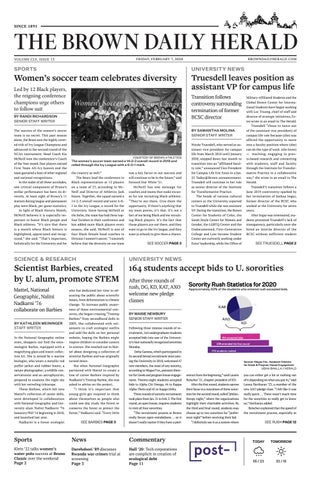
Women’s soccer team celebrates diversity Led by 12 Black players, the reigning conference champions urge others to follow suit
COURTESY OF BROWN ATHLETICS
The women’s soccer team earned a 14-2-3 overall record in 2019 and rolled through the Ivy League with a 6-0-1 mark. the country as well.” The Bears lead the conference in Black representation at 12 players on a team of 27, according to McNeill and Director of Athletics Jack Hayes. Together, the squad earned a 14-2-3 overall record and went 6-01 in the Ivy League, a record for the University. Since having McNeill at the helm, the team has had three topfour finishes in their conference and has added more Black players every season, she said. McNeill is one of four Black female head coaches in Division I women’s soccer. “I sincerely believe that the diversity on our team
Scientist Barbies, created by U. alum, promote STEM
BY KATHLEEN MEININGER STAFF WRITER In the National Geographic online store, shoppers can find the entomologist Barbie, equipped with a magnifying glass and insect collection kit. She is joined by a marine biologist, who wears a metallic red puffer jacket and rubber boots; a nature photographer; a wildlife conservationist and an astrophysicist, prepared to examine the night sky with her swiveling telescope. These Barbies, which fall into Mattel’s collection of career dolls, were developed in collaboration with National Geographic and University alum Nalini Nadkarni ’76 honorary PhD ’14 beginning in 2018, and launched last year. Nadkarni is a forest ecologist
Truesdell leaves position as assistant VP for campus life
BY SAMANTHA MOLINA SENIOR STAFF WRITER
SCIENCE & RESEARCH
Mattel, National Geographic, Nalini Nadkarni ’76 collaborate on Barbies
UNIVERSITY NEWS
Transition follows controversy surrounding termination of former BCSC director
BY RANDI RICHARDSON SENIOR STAFF WRITER The success of the women’s soccer team is no secret. This past season alone, the Bears won the highly coveted title of Ivy League Champions and advanced to the second round of the NCAA tournament. Head Coach Kia McNeill won the conference’s Coach of the Year award, four players earned First Team All-Ivy honors and the team garnered a host of other regional and national recognitions. In the midst of all these accolades, one critical component of Bruno’s stellar performance has been its diversity. At least eight of Brown’s 11 starters during league and postseason play were Black, per game statistics. In light of Black History Month, McNeill believes it is especially important to honor Black people and Black athletes. “It’s nice that there is a month where Black history is highlighted, appreciated and recognized,” she said. “That’s important, holistically for the University and for
BROWNDAILYHERALD.COM
who has dedicated her time to educating the public about scientific issues, from deforestation to climate change. To increase public awareness of these environmental concerns, she began creating “Treetop Barbies” from secondhand dolls in 2003. She collaborated with volunteers to craft ecologist outfits and sold the dolls on her personal website, hoping the Barbies might inspire children to consider careers in science. She reached out to Mattel about designing a collection of scientist Barbies and was originally turned down. But when National Geographic partnered with Mattel to create a line of career Barbies inspired by Nadkarni’s Treetop Barbie, she was asked to advise on the project. “I think it’s important that young girls get inspired to think about themselves as people who could one day study the forest or conserve the forest or protect the forest,” Nadkarni said. “Every little
SEE BARBIES PAGE 3
was a key factor in our success and will continue to be in the future,” said forward Star White ’21. McNeill has one message for coaches and teams that make excuses for not recruiting Black athletes: “They’re out there. Give them the opportunity. If there’s anything that my team proves, it’s that. It’s not a fact of me being Black and me recruiting Black players. It’s the fact that those players are out there, and they want to go to the Ivy league, and they want (a school) to give them a chance.
SEE SOCCER PAGE 3
Nicole Truesdell, who served as assistant vice president for campus life from March 2018 until January 2020, stepped down last month to transition into an “affiliated faculty role,” announced Vice President for Campus Life Eric Estes in a Jan. 25 Today@Brown announcement. Truesdell will continue in her role as senior director of the Institute for Transformative Practice. The heads of various cultural centers at the University reported to Truesdell while she was assistant VP. During the transition, the Brown Center for Students of Color, the Sarah Doyle Center for Women and Gender, the LGBTQ Center and the Undocumented, First-Generation College and Low-Income Student Center are currently working under Estes’ leadership, while the Office of
Military-Affiliated Students and the Global Brown Center for International Students have begun working with Loc Truong, chief of staff and director of strategic initiatives, Estes wrote in an email to The Herald. Truesdell “chose to move out of the (assistant vice president) of campus life role because (she) was offered the opportunity to move into a faculty position where (she) can do the type of work (she loves) — teaching, engaging in praxis-based research and connecting with students, staff and faculty through the Institute for Transformative Practice in a collaborative way,” she wrote in an email to The Herald. Truesdell’s transition follows a June 2019 controversy sparked by her termination of Joshua Segui, former director of the BCSC who worked at the University for seven years. After Segui was terminated, students protested Truesdell’s lack of transparency, particularly once she hired an interim director of the BCSC without sufficient student
SEE TRUESDELL PAGE 2
UNIVERSITY NEWS
164 students accept bids to U. sororities After three rounds of rush, DG, KD, KAT, AXO welcome new pledge classes
Sorority Rush Statistics for 2020
Approximately 60% of the students who entered rush accepted bids.
ΔΓ
KAθ BY MAISIE NEWBURY SENIOR STAFF WRITER Following three intense rounds of recruitment, 164 undergraduate students accepted bids into one of the University’s four nationally recognized sororities Monday. Delta Gamma, which participated in its second formal recruitment since joining the University in 2018, welcomed 47 new members, the most of any sorority, according to Megan Fox, assistant director for Greek and program house engagement. Twenty-eight students accepted bids to Alpha Chi Omega, 44 to Kappa Alpha Theta and 45 to Kappa Delta. Three rounds of sorority recruitment took place from Jan. 31 to Feb. 3. The first round, an open house, requires students to visit all four sororities. “The recruitment process at Brown really favors open-mindedness … so it doesn’t really matter if they have a pref-
Sports
News
Commentary
Klein ’22 talks women’s water polo success at Bruno Classic over the weekend Page 2
Darehshori ’89 discusses Rwanda war crimes trial at screening Page 3
Hall ’20: Tech corporations are complicit in creation of ecological debt Page 11
AXΩ
KD
164 accepted bids 239 attended the first round 270 students rushed
Source: Megan Fox, Assistant Director for Greek & Program House Engagement USHA BHALLA / HERALD
erence from the beginning,” said Lauren Reischer ’21, chapter president of KD. After the first round, students narrow their focus to a maximum of three sororities for the second round, called “philanthropy night,” where the organizations highlight their charitable activities. By the third and final round, students may choose up to two sororities for “preference night” before receiving their bid. “I definitely see it as a system where
you can either get a lot or nothing out of it depending on what you put in,” said Leona Hariharan ’23, a member of the new AXO pledge class. “I felt like it was really quick. … There wasn’t much time for the sororities to really get to know us,” Hariharan added. Reischer explained that the speed of the recruitment process, especially at
SEE RUSH PAGE 12
TODAY
TOMORROW
55 / 23
33 / 15
2
THE BROWN DAILY HERALD | NEWS
FRIDAY, FEBRUARY 7, 2020
SPORTS
Klein ’22 leads women’s water polo to 5-1 record at Bruno Classic Attacker nets 12 goals over weekend in team’s first tournament of spring season BY AMELIA SPALTER STAFF WRITER Katie Klein ’22 helped the women’s water polo team achieve five victories over the weekend in their first tournament of the season. She converted 12 goals in six games while guiding her team to a 5-1 record, with the only loss coming to No. 18 Wagner College. Klein’s weekend was highlighted by a four-goal performance against Austin College and a hat trick against Siena College. Klein, an attacker, made her presence known from day one of her collegiate water polo career, scoring at least two goals in each of her 17 games during her rookie season. She led the team in scoring with 54 successful shots and came third in opponent ejections drawn at 31. Before coming to Brown, Klein played at the club level for Diablo Water Polo and at Campolindo High School, where she earned USA Water Polo Academic All-America honors in her junior and senior year. For her achievements at the Bruno Classic, Klein has been named The Herald’s Athlete of the Week.
Herald: What was your favorite game in the tournament over the weekend? Klein: My favorite game was probably our last game, the (Wagner) game, even though we lost. It really exposed what we need to work on because it was a more competitive game. We’ll benefit from playing more games like that going forward. You were originally committed to the University of Southern California. Why did you ultimately decide to come to Brown? I had a huge change of heart because I decided Brown would be a better fit for me all around, both academically and sports-wise. There’s a better balance between the two at Brown, whereas at USC, I think I would have spent a lot more time in the pool and not as much time in the classroom. My sister played water polo at Princeton, and she really liked her experience. I really wanted a similar experience to what she had, but not the exact same, because I was always following in her footsteps growing up. I wanted to do something a little different. But our coach, (Felix Mercado), is what put me over the edge in wanting to come to Brown. He really embodied everything I wanted out of a coach. How did you first get involved with water polo? My older sister played water polo.
I was always pretty hesitant to play because I didn’t like the idea of swimming without any goggles. But our family has always been super involved in sports, and my sister was doing it. So my parents made me try it, and I ended up loving it. Do you have any water polo idols or role models? My club coach growing up, Maureen O’Toole, has always been someone I looked up to. She went to the Olympics, and I’ve always admired how she approaches the sport. She’s one of the hardest workers I know. What accomplishment are you most proud of in your collegiate water polo career so far? That’s hard to say because water polo is such a team sport, so it’s difficult to pinpoint anything as an individual accomplishment. I think in terms of team accomplishments, I would say last year, when we beat (Marist College) during our senior game. That was a really fun time for the team, and it was really memorable. Do you have any goals for your water polo career before you leave Brown? I definitely want to beat Princeton and Harvard before I leave Brown, and I definitely want to play in the championship game of our conference. This interview has been edited for length and clarity.
TRUESDELL FROM PAGE 1 involvement. Students and several campus organizations signed and shared a petition in support of Segui. “We, the undersigned, demand that Brown University recognizes Joshua’s dismissal, the shady circumstances leading up to it and the administration’s dishonesty and lack of transparency in the aftermath as deeply unjust and shameful,” the petition stated. “We call upon the University to start taking steps to set things right immediately.” Brown College Democrats is among several campus organizations who protested Truesdell’s actions. Brown College Democrats President Zoë Mermelstein ’21 said that the petition was written by allies of the student group. After Mermelstein spoke with Brown College Dems’ diversity coordinator, she felt that the circumstances surrounding Segui’s termination were questionable. She heard similar sentiments from numerous members of Brown College Democrats and knew it was an issue that the group could responsibly support. “The fact that (Truesdell) is stepping down tells me that there was probably truth to the allegations, which again was something that we already believed when we decided to support (the petition),” Mermelstein said. Former director of the Global Brown Center Christina Bonnell, who left the University fall 2019 to pursue a PhD, cited Truesdell’s leadership style as a potential factor in her departure from her position as assistant VP. “From what I observed and experienced, there was a disconnect between Dr. Truesdell’s stated values and her actual management style which negatively impacted staff morale and discouraged team-building,”
COURTESY OF BROWN UNIVERSITY
Truesdell served as assistant vice president for campus life from March 2018 to January 2020 until stepping down. she wrote in an email to The Herald. “I’m hopeful that Campus Life will continue to listen to their employees’ and students’ voices in the selection of a new Assistant VP.” The University is currently searching for a new assistant vice president for campus life. “Later this semester, we expect to share further information on plans for our search process,” Estes wrote in the Today@Brown announcement. In a Feb. 5 Today@Brown announcement, the Division of Campus Life publicized the search for a new BCSC director, emphasizing that a search committee will include three undergraduate students, one graduate
student, three staff and one faculty member. “The BCSC is an important resource for the Brown community, especially students, and thus we feel it is important for students to hold the majority constituency of the eight-member committee,” the announcement stated. The announcement also solicited nominations to the search committee through a Google form. “We are asking several established groups to help by nominating undergraduate and graduate students for possible service on the committee. Both undergraduate and graduate students will be able to self-nominate.” Nominations will be accepted until Feb. 10 at 11:59 p.m.
COURTESY OF BROWN ATHLETICS
Katie Klein ’22, an attacker, led the team in scoring with 54 successful shots and came third in opponent ejections drawn at 31.
In This Issue
JORDAN HARTZELL
ELANA HAUSKNECHT
3
Red Fin
Witness Windows 4 6
DAVID KLEINMAN
ANNELIESE MAIR 5
Hey, That's My Knife!
Words We Never Knew NICOLE FEGAN
Fiery Red 7
postCover by Julie Sharpe
FEB 7 —
VOL 24 — ISSUE 14
FEATURE
Witness Windows
looking at construction, envisioning a space of belonging BY ELANA HAUSKNECHT ILLUSTRATED BY RUIHONG JIANG
I
descended four stories below ground. I wasn’t in a basement—at least, it wasn’t a basement yet. I was in the rectangular pit between Angell Street and Olive Street, a pit that will eventually be Brown’s Performing Arts Center. With me stood John Cooke, a program manager in Brown’s Facilities Management department, and Mike Kotuby, the project superintendent. “Here’s where the orchestra rehearsal room will be,” Mike said, pointing in the direction of a yellow vehicle with a shovel that looked big enough to hold dozens of violins. Nearby, a concrete wall that had recently been poured was still drying. A group of four construction workers hosed down this new surface. I tried imagining cellos and sheet music and chairs arranged in a semi-circle just a few feet away, but it was hard to picture that scene amidst the drilling
and the airhorn and the overwhelming gray of exposed rock and concrete. Then I looked up. Up, past the neat row of metal rods stuck into the wall of the pit, holding back the excavated rock so it doesn’t fill back in; up, past the elevated platform that runs around the perimeter of the pit; up, past the green construction fence. The Granoff Center for the Creative Arts hulked far above, its shining glass facade reflecting the western sky over Downtown Providence. And that’s when I realized how many there were. One, two, three... 10... 20... in that moment, I noticed how many windows surrounded the construction site. *** What’s a window? It’s a space through which to look, and perhaps also to speak or shout. It’s a surface to tap on, available for the sun to shine through. Windows
are often reflective surfaces, and for me, they serve as invitations to reflect, so to speak, on what I’m seeing. *** As a music concentrator, the prospect of a new performing arts building compelled me almost by default, but I didn’t expect to find myself so drawn to the site itself. Constantly fluctuating, this soon-to-be-butnot-yet building is its own entity. The beep of backingup trucks, the crush of gravel being poured into a dump truck, metal hammering into wood and then into rock— whole new palettes of sound emanate to reach my ears as I sit in a Page-Robinson classroom or walk under the Biomed archway toward Pembroke. Microfracturing, a technique used to blast away the millennia-old bedrock, shakes the ground beneath me as I sit on the lawn beside the tinfoil people. By way of its vibrations (perceived
Letter from the Editor Dear Readers, I hope you are finally settling into the swing of life back at Brown and finding some way to manage coursework, 9 a.m. classes, social outings, and whatever else you have overloaded yourself with this spring. With these mere two weeks feeling like two months, it is trop facile to find yourself running in the hamster wheel that is the Brown bubble, never stopping for a minute to realize your surroundings, let alone initiate an exploration outside of campus. Yet— and I hate to be the bearer of bad (old?) news—life is just going to get busier and more complicated as the semester progresses. So I invite you to take a break and try something outside of your normal routine, creating opportunity for growth. I suggest trying a new restaurant downtown, picking up a new hobby, reaching out to an old friend, or taking a day trip outside of familiar Providence. Hot tip—if you are lacking inspiration, read this week’s edition of post-, which showcases several instances of exploration, both subtle and bold. In Feature, the writer steps into the future to envision the implications of the construction of
Email Sign-Offs
Brown’s new Performing Arts Center. The writers in Narrative take a more introspective and linguistic method, as one writer reflects on the stories of her parents’ relationship that made her who she is, and the other discovers new words to express familiar, old feelings to expand her way of thinking. Lastly, in Arts & Culture, one writer investigates his relationship with New England through the film Knives Out, while another writer discusses her search for identity and subsequent growth alongside Hayley Williams’s music. I am encouraging everyone to try something new and to appreciate what they have. Maybe this was sparked by my scary realization that I am halfway through my life at Brown and still feel like there is so much to discover. I also know that it is my default mode to keep stressing about the future and to be blind to the priceless friendships and experiences we have had. Anyways, I hope this issue of post- encourages you to reflect, to try, to fail, and to be present.
*Insert a Top 10 email sign-off of choice*
Caitlin McCartney Managing Editor of Lifestyle
! 4
POST–
1. Regards, 2. Best regards, 3. Best warm regrds, 4. Yours, 5. Sent from my iPhone 6. Sincerely, 7. xoxo, 8. I love you, 9. Live long and prosper, 10. Your old friend and erstwhile companion,
both aurally and physically), the site extends far beyond the construction fence, impacting the otherwise orderly campus fabric that surrounds it. Subtly but surely, it demands attention. Last semester, I took a class that met on the fourth floor of Granoff. Each week before class started, I’d take some time to look down. What’s happening in there? I wondered. What was the role of that pile of mats, of those planks of wood? How much deeper would the hole get? When I left class, I’d often go downstairs and out the main entrance to peer through the green, tarpcovered fence that surrounds the site. If I stood a foot away, I could make out blurry silhouettes of the people and construction vehicles that I’d seen more clearly from above. This past October, I noticed that the construction team had punctuated the green fence with plexiglass sheets three feet wide, each surrounded by thick white frames. With these windows, I could walk up to the fence and observe the construction whenever I pleased rather than needing to access the (usually locked) Granoff classrooms to see into the site. Endless details revealed themselves the longer I looked: the horizontal layers of rock visible within the walls of the pit, the sheer number of tasks being done in the space at once, the people at the next window over, also looking. *** Looking down at the pit makes me think about Brown’s position on a hill above Providence. In both senses, students, faculty, and administrators are positioned to gaze upon, to study, to maintain a distance from the people and places we see below. But sight lines aren’t unidirectional. When I look at the construction site, there are times when the clouds shift and the sun shines upon the plexiglass windows in such a way that images of myself and the students passing behind me obscure my view of the people working below. Through the fence come the heavy sounds of drilling and hammering, but there are times when the voices of people walking behind me, discussing Bear Bucks and grade options, are still louder. As much as these windows invite interested passersby to witness the construction process, they also serve as a portal for viewers to reflect back on themselves. *** There’s so much to know that the windows don’t tell. When I told my advisor about my interest in the site, he immediately recalled the 200-year-old beech tree that came down when construction began: “That was a treasure we’ll never get back.” It made me wonder: What else came down when construction began? What other changes occurred in this place throughout the lifetime of the beech tree? Might orchestras have already played right here, in a building that’s since been moved or demolished? What was the area like before the beech tree was even a seedling? Before Brown, before Roger Williams? How have Narragansett, Wampanoag, and other Indigenous peoples' relationships to this land changed over time? There’s no way to answer these questions completely. Newspaper archives, collections in Brown’s libraries, oral histories, tax and zoning databases— together, documents like these might draw a vivid picture, but in trying to understand how a space has
changed over time, I’ve realized that perhaps only the land itself can hold the complete memory of how it has been occupied. This memory in its entirety isn’t available at any given point in time. And yet, as I write, the land is changing rapidly— the land is being changed, in a very tangible way. All of us who encounter the site can remember this process—the current chapter in this land’s long and inherently complex history—thanks to the windows in the construction fence. Passersby can choose to peer in, notice the changes, and document the process by
across the river, up the hill, and behind the gates doesn’t make that too easy. It begets an image of an insular institution where, all too often, privilege simply fosters more privilege. In order for the completed Performing Arts Center to actualize its goal of “contributing to cultural and economic vitality,” Brown needs to counter the image and campus culture that has resulted from its separateness from the rest of the city. This new building is about performance, and that entails connections between artists and audience members and crew members; the Center will be
taking pictures or telling a friend about what they saw when they looked. Just a few months ago, it was harder to discern what was happening on the other side of the green fence, but the windows have offered a chance to collectively bear witness as the hole continues to be dug, as concrete is poured, as foundations are laid and a building rises out of the ground. They turn what might otherwise have been perceived as a noisy nuisance marring the campus landscape into a monument of this particular moment. The windows will only be here for a while and then, presumably, they will be removed. Because soon, as the site workers build the structure taller and taller, we onlookers will be able to gaze up above the fence from our vantage point on the ground and see quite clearly how the construction is progressing. *** At some point, the new building itself will have its own windows installed. The architectural renderings of the Performing Arts Center indicate there will be a lobby with a shimmering floor-to-ceiling wall of glass that faces the Granoff entrance, just as the windows in the construction fence do now. When the building is complete, who will look through those windows from the inside and who will look from the outside? Brown exists on Providence’s East Side, which is so disproportionately white and wealthy that Rhode Island-specific housing reports give data about the East Side separately from everywhere else in the city. With this in mind, I often think about the sentence on the Performing Arts Center’s project website stating the University’s commitment to “contributing to the cultural and economic vitality of the surrounding community.” What does that mean? Who are the “surrounding communities”? And what is the entity that those “surrounding communities” surround? It seems safe to guess it’s Brown. So, who constitutes the “Brown community”? Students, faculty, administrators? Might a “Brown community” extend to alumni? What about the staff who are so vital to this campus, yet whose presence is often under-acknowledged? Or the construction workers whose activities and interactions on campus are heavily limited, even as they bring this building into being? I would like for this campus, for the imagined “Brown community,” to be a place where the widest possible range of people can all feel a sense of belonging. People from neighborhoods in Providence beyond College Hill, from communities that don’t match Brown’s historically white, high-income demographics, should feel welcome to share the cultural and educational resources that those of us with Brown ID’s can access readily. But the University’s position
inherently equipped to bring people together. In order to deliver on this potential, students, faculty, and administrators can mobilize their important kinds of influence on the university and insist that the space functions as inclusively as possible. I envision a future where people who have no affiliation with Brown will be invited to use the Performing Arts Center’s rehearsal rooms and performance spaces to incubate and showcase their own work. I envision the building being exceptionally accessible: Brown could commit to providing transport, childcare, translation, food, and more to open up the space and all it holds. What do you dream of for the new Performing Arts Center? How could this new building represent a starting point for a more just and equitable relationship between Brown and the rest of Providence (and beyond)? While the Performing Arts Center is under construction, constantly changing and each day coming more into its future self, our conception of the place it will become can also be in process. As we anticipate the future space—how the sunlight will fall differently as the building grows taller, the gradual exchange of construction sounds for those of an orchestra—we can also imagine how it will be existed in and who will get to do that existing. Whose building will this be? And, more broadly, who gets to feel belonging on this campus? In this time of construction, when the future is so tangibly at our fingertips, we must demand that our inclusive and hopeful answer becomes the reality.
“I say stupid things all the time, and I remember almost none of them.” “I’ve been passionate about finance since I was a child.”
Red Fin
and other places my parents built for me BY JORDAN HARTZELL ILLUSTRATED BY GABY TREVIÑO
CONTENT WARNING: Animal death “Mud Run, 2008” There’s a state park in Pennsylvania, a test site for dynamite blasts in the ’50s turned hunting and fishing club in the ’70s. Dad’s been going since he was six years old, and it hasn’t changed much. It’s a two-mile drive from the opening gates to the cabins: Red Fin, Turnaround, Eagle’s Nest, Log Cabin. They’re scattered along the dirt road, which traces the veins of the park and then bumps into the old railroad at the edge of the Lehigh River gorge. Mom tells us not to get too close to the edge where stray rocks tumble down into the river. Dad helps us steal antique blue glass insulators from the old electric line at the end of the tracks. We take the dogs off their leashes for the hike back to the cabin. There’s a deer head above the fireplace with four-point antlers and glass eyes. Dad tells us that the deer’s back half is in the chimney where we can’t see it— the poor guy is just resting there. The sofas are green and red and brown, leaves in autumn worn tan along the seams. Pine frames encase charts of local fish and topographic maps of the Pocono Mountains, FEBRUARY 7, 2020!
5
NARRATIVE leaves in November and dog-eared chapter books and fairy houses made out of acorn tops and twigs. I’m pinky promises and a salmon entrée split down the middle, dancing on tables and Pennsylvania valleys from a little yellow plane.
Words We Never Knew discovering new words for old feelings BY ANNELIESE MAIR ILLUSTRATED BY OLIVIA LUNGER
etched with light blue contour lines and the words “HICKORY RUN.” It smells like cherry tobacco pipe smoke and dirt after rain. Evergreens hold their breath to hear the waterfall, dammed at the bottom of a hill below Red Fin. Dad’s in the kitchen, putting two steaks on a plate to take out to the charcoal grill and stirring pasta every few minutes to check for al dente-ness. He’s whistling the cello part of the Aubrey-Maturin theme. Mom’s knitting in the faded La-Z-Boy with one of our dogs curled up between her armpit and hip. She holds the half-completed scarf up a little higher as she works so as not to wake the pup, unraveling her yarn to start fresh when she finds a bad stitch. One of my sisters reads on the couch with her heels tucked up under her hips, and the other just dozes in front of the fireplace.
“Love Languages” With Mom it’s the offer of an outstretched pinky, held out as an I’m sorry or a let’s start fresh or an I know you’re going through a lot right now and I’d do anything to take the hurt away. Pinky lock doesn’t mean keep a secret, it just means that Mom sees you. She’ll rest her wrist on the center console of the car with her pinky out, not saying anything while she drives with you in the passenger seat. And you’ll link your pinky with hers and look out the window, and everything will be okay because you have a partner now and you’re in it together. With Dad it’s sharing food at restaurants. Everyone else in the family has some kind of dietary restriction: no red meat, low sugar, no thisor-that. We’ll debate over the burger or the catch of the day—we had fish yesterday, but it’s so good here,
When Dad has a beer on Fridays, he’ll tell us about Mom before we were around. How she danced on tables and made pasta from scratch and ran the emergency room of their residency program like nobody’s business. “He Used to Be a Pilot” The day after my parents met, Dad drove Mom home in a car with the top down. He hit a cardinal and it exploded on the windshield. Red feathers, red insides, red in the face because Mom was crying. A few years ago it was a duck—a mama with more daughters than he had then, so Dad took off his shirt and scooped up the ducklings and sang to them while he carried the bundle home. For my 13th birthday, Dad took me to the little airport where he kept his red and blue Cessna highwing in a hangar between a neighborhood and an open field. We cracked cans of Sprite in the pilot’s lounge and he introduced me to a friend who’d be taking me for a ride in his Piper Cub, a little yellow plane in which the pilot sits behind the co-pilot. Dad explained why these planes were special, and now, years later, I don’t remember the reason he gave. I just remember taking off and looking over the yellow siding that felt much too thin to carry one full-grown adult and one newly minted teenager over Buffalo Valley. The pilot, this friend of Dad’s, tipped the wings to either side, rocking our papiermâché machine to wave at the ground before he told me over our headsets to grab the yoke and look at the horizon and take a deep breath and drive for a while. I only flew with Dad once before he stopped flying. Tragic for a flighted thing to end up on the ground. ! 6
POST–
so maybe we should each get one and split them. No need to narrow it down. What about dessert? He wants chocolate cake and I want ice cream so we’ll compromise and get both. “Two plates,” we’ll tell waiters. “It’s a Heart With Her Name Inside” Dad’s tattoo is on his upper thigh, where his patients and teenage daughters won’t see it. Mom now jokes that Dad can never leave her because he’ll never find another Judi spelled with an i. When Dad has a beer on Fridays, he’ll tell us about Mom before we were around. How she danced on tables and made pasta from scratch and ran the emergency room of their residency program like nobody’s business. How on Friday nights, when they weren’t on call, they’d take $10 to buy soup from Chinatown and rent a movie. He’ll say, “You shoulda seen your mother,” and then beam like he could see her with her dark curly hair and green eyes right there in front of him. Some local shop in Philly did it, I think. He signed a waiver saying yes, he was sure, and no, he wasn’t drunk and then they carved in Mom’s name so she knew he was forever and always, like the inside of their rings. “And Other Places My Parents Built For Me” I am built of logs and fireplaces and the first few chords of George Winston’s “Colors/Dance.” I am
I'm watching a "Cutest Moments on the Bachelor" YouTube video with my friend Ben, landscape shots of tropical islands flipping to footage of intimate conversations in perfectly constructed gardens. The video cuts to a close-up of a contestant holding her face and grinning into her hands, too giddy to formulate whatever she hopes to say. She looks into the eyes of that season's bachelor and admits, repeatedly, "I'm so smitten!" I realize that "smitten" is one of those words whose meaning has always drifted past me, that blends so seamlessly into its context that I don't even think to question it. I ask Ben what exactly it means. "Oh!" He sighs into a bright smile. "It means… really drawn to. Almost like infatuated. It's such a good word." It is such a good word—it's almost muffled, like the contestant's dialogue as she giggled through her hands. It's cute and cozy, like a mitten or a kitten. Smitten. Of course, I knew this word, but I hadn't truly understood it. I immediately felt regret that I hadn't looked it up earlier. And even though Ben's explanation was patient and his expression kind, I still read confusion on his face: You write fucking poetry and you don't know the word "smitten?!" It's a word I really could have used, both in life and in a whole bunch of poems. The word was missing from me, but its concept wasn't—I must've talked around it, or thought it up in images, or shown the feeling on my face. *** That moment of learning “smitten” makes me think of a snowy evening at Brown a few years ago, when I was trudging home to Chapin through the white sidewalks, aligning my steps with those left by snow boots before me. The sky hadn't quite fallen to black, but a deep blue had settled into the frosty air, its darkness accumulating like static. At the intersection of Thayer and George, I stepped under a streetlight and looked toward the silent road, not a car or soul in sight. Suddenly I found myself inside of a memory—my view was several feet closer to the ground, but the same kind of packed snow crunched beneath my feet. Another hazy streetlight, its shade a tired orange, was thrown over uneven piles before me—and the same feeling rushed through my
ARTS & CULTURE core, viscous, frigid, and slow. Loneliness, I thought, my exhale collecting in a white cloud and streaming up through the air. That was loneliness: a night where I’d insisted on staying outside to play long after the snow had stopped drifting down through the sky, the slow and sudden capture of the atmosphere by sunset and by stars, the pale streetlight leaving an orange patch at the edge of my driveway, the sight of nobody else. This was my first memory of experiencing something bright, joyful, and communal in low light and solitude; it's my first memory of feeling lonely. And I remember it now, at a time where I can think of the correct word, when I can see its amorphous shape behind my closed eyes, can remember it elsewhere, piece it together or apart, or try to talk it out and away. That childhood night, standing in orange-lit snow at the edge of my driveway, I did not know its name. I had no choice but to feel it. Standing at that intersection just outside Brown’s campus, in a process that was both similar and had somehow occurred in reverse, I put a new word to another thing not unknown but still not yet learned. I put a word into my younger self who did not yet have the tools to pick it apart, to know it in any way outside of its pure existence. *** What do we call the new acquisition of something already intuitively known? And does this knowledge transform the nature of feeling it? It's a learning process that feels sort of like a revision. It paves the way for specificity and power, for redefinition, for intellectualization or dismissal. Discovering a word can deeply validate a feeling, allowing us to connect through shared experience. Or, it can create the possibility for misunderstanding through generalization—a single term can never truly describe the same experience across different bodies. The English language provides an extremely limited set of words to describe our emotions, which arguably encompass our most human experiences. This is partly why I love the work of poetry: It tackles the language of feeling, and therefore of connection. Sometimes I find myself at the edge of a stanza and feel, despite my frustration with not really knowing what the author describes, that I do know it in this unnameable way–that I would “know” it vocally or concretely if only there were a word out there to describe it. I try to find a word that describes this simultaneous learning and knowing of a word. It may exist in some niche corner of academia, or deeper in the internet than I am willing to search, or maybe in another language. It's a word I would love to know—the moment of learning a "new" word, the thrill or regret of its existence in a form that can be shared. The moment of either its unlearning or its unfolding.
Hey, That's My Knife!
knives out and the horror of new england fall BY DAVID KLEINMAN ILLUSTRATED BY IRIS XIE
The moment I knew that Knives Out would be my topic of conversation for weeks wasn’t the first time I heard Daniel Craig’s dulcet take on a Southern accent, or the ending twist, or even the appearance of Chris Evans’s oversized raglan sweater. It was when
our heroine finds a toxicology report with the little emblem in the top corner that reads “Norfolk County, Massachusetts”—also known as the place I’ve lived for my entire life. While I’ve been joking to people that the movie is based on my life—I’m the knife, I tell them, not the Thrombey family’s neoconservative teenage alt-righter, Jacob—it really is true that the film captured the essence of southern Massachusetts extremely well, boiling it down to one incredible throughline: a sense of being trapped. I’ll be the first to say that Knives Out probably wasn’t intended for me. From the film’s focus on Ana de Armas’s expert portrayal of a child of undocumented immigrants to its skewering of “wellmeaning” rich white suburbanites regardless of their position on the political spectrum, Knives Out isn’t exactly marketing its humor to reasonably wealthy cishet white men (and the film is made immensely better by this). Moreover, without giving too much in the way of spoilers, every piece of the film is clearly designed to make fun of murder mystery moviegoers, or at least the tropes of classic murder mysteries. The fact that the film’s victim is a mystery writer and that the main set piece is literally a bullseye made of knives, however, didn’t dissuade me from putting on my Sherlock Holmes hat. I assumed every single fact of the case was a lie and looked carefully for the ways I could be being deceived. I eagerly awaited the parlor room scene that would reveal everything I thought I knew to be an elaborate ruse. I wanted to have every single expectation subverted, and in a sense, that’s what I got. Knives Out made a point of tricking me— not into thinking I knew what was going on, but into thinking I didn’t. I constructed elaborate theories, and when the movie showed me that I’d been given the pieces all along, I had to ask myself—why did I so badly need a mystery to solve? Norfolk County, Massachusetts includes several towns and even some cities, and among its lesserknown communities is my hometown of Sharon. Sharon is the quintessential commuter town, smack dab between Boston and Providence, originally a resort town for the rich colonial families that wanted to escape the hustle and bustle of the city. In its current state, “sleepy” doesn’t do it justice—one could more easily call it “exhausted.” The characters of Knives Out seldom leave the family’s big, beautiful manor, and I can tell you firsthand that it’s for good reason. In that neck of the woods, there’s extremely little that would get you out of the house. Because I went to a private school (like I said—I’m undeniably the butt of Knives Out’s jokes) and therefore didn’t interact as much as I could have with the community, my view of the town might not be the most accurate—but that means I have
the exact same knowledge of the area that the spoiledrotten Thrombey family does. I was looking for familiar landmarks throughout the film, and I could swear I saw a train station I once commuted from to take ballroom dance classes with my then-girlfriend, but it could really have been any MBTA stop in the county. That’s sort of the point: There just aren’t that many landmarks in Norfolk County that allow you to distinguish one town from another. It’s generic; it’s standardized. It was a stroke of genius to have the film take place in the autumn, because that’s when the melancholy feeling that haunts suburban Massachusetts is at its most powerful—things aren’t as beautiful or lively as one would expect, but they are stereotypically rural New England, which is to say: quiet. You can hear a twig snap for miles, and you’re much more likely to see a car passing through to break your terrifying isolation than a person who might actually be attempting to experience the world around them. The trees are beautiful, but no one who lives here actually cares enough to get outside and experience them. That’s why the claustrophobia of Knives Out resonated so powerfully with me that at first I didn’t even notice it: That’s just what New England is like in the fall. Unless, like young Meg Thrombey, you’ve got friends nearby and a way to travel some distance to them, you’re going to be stuck inside with your family. To again attempt to explain something without spoilers, the one great reveal of Knives Out is that a character you thought you could trust is the closest thing to the crime’s mastermind. Like I said earlier, this is hardly a twist; learning that this character is evil just means everyone else was right about them. As I thought about this, I realized that, though the knives may be out, no one in the Thrombey family has a way out. For sure, they have all the privilege that money can buy—and some it can’t—but Daniel Craig’s Benoit Blanc refers to the family as “a pack of vultures at the feast, knives out and beaks bloody,” and no noise in the deathly quiet Norfolk County is going to drown that out. They know what monsters their family members are, and with the film’s aforementioned great reveal, we come to recognize that they know what monsters they themselves are, too. As much as the film lampoons mystery as an escape from dealing with real-world socioeconomic injustice, the Thrombeys clearly hope that patriarch Harlan’s death and even the subsequent whodunnit will serve as an escape from themselves. The twist is that we knew how horrible each and every one of them was from the very beginning; nothing was hidden, nothing was secret. The horror of suburban Massachusetts isn’t what you don’t know, but what you wish you didn’t. FEBRUARY 7, 2020!
7
ARTS&CULTURE This unease (and the white guilt that accompanies it) isn’t just a side theme of the film, but a crucial aspect of its setting, an invisible essence like the wind that carries the leaves down from the trees there. I love my hometown, but there’s a moment in the New England autumn, in the midst of all the talk of harvests and hunkering down for winter, that you can’t help but take stock of yourself, and if you come up lacking, there are no winter storms, spring flowers, or summer sun to distract you. When I’m faced with that, I bury myself in stories where things make a little more sense, where triumphs are a product of valor and defeats are lessons to learn or cruel plots to be outthought. Knives Out stripped that illusion away and showed me the world I grew up in exactly as it is, reminding me that no matter how far I may get from home, I’ll always have to come back to that cold, crisp look at who I am—the kind born from a Norfolk County fall.
Fiery Red
on hayley williams, hair, and radical change BY NICOLE FEGAN ILLUSTRATED BY ANNA SEMIZHONOVA
Hayley Williams, fiery red and heavily banged, was the inspiration for my abysmal sixth-grade haircut. A noted social rebel (noted, I say) usually found wearing mismatched Converse sneakers with a middle-grade book about astronomers under my arm, I didn’t just want to look like Hayley Williams—I wanted to be her. Hayley was doing what no one else seemed capable of: She was at once powerful, in charge, and unabashedly herself. Even at age 12, I felt a growing need to get out of my town, away from my friends, and far from everything that made me me. The hair was supposed to be step one—my transformation from Old Nicole into New Nicole, as vibrant as I could possibly get away with in my Long Island town. As might have been expected, my mom didn’t want me going red, so I settled for a set of bangs that haunt me to this day [image deleted], holding on to the notion that there was still time for me to become everything I wanted to be. *** Middle school saw me recede, riddled with mental health problems, a pervading desire to be a good student, and a resultant lack of positive memories. Those years were spent in an in-between space, still shackled to my childhood while grasping at straws in an attempt to figure out who I wanted to be. I discovered poetry and dove headfirst into writing, continued developing my weird love for extracurricular math, and was still able
to find solace in the pages of an old, dusty novel, but I lacked a sense of clarity. High school, at least, gave me a change of scenery; finally leaving behind the friends I had made back in elementary school, I found myself in a drama program with a brand new group of people. Paramore, meanwhile, spent these years working through their own identity crisis: The departure of guitarist Josh Farro and drummer Zac Farro left the remaining three members angry, excited, and ready for whatever was to come next. By the end of ninth grade, Paramore’s new self-titled album had supplied me with anthem after anthem for my fresh start. They were ready and unafraid, dropping lyrics like “If there’s a future, we want it now” and “It’s just a spark but it’s enough to keep me going.” As a scared teenager balancing aspirations of becoming a poet, a novelist, a math professor, and an astronomer, I was still paralyzed by the sheer notion that I had to become anything at all. *** By the time I got to Brown, I felt as though I should have all the answers, but I quickly realized this was not the case. I got accepted as a chemistry major and still have yet to take a college chemistry class. I diverted to mathematics and nearly failed MATH0350. Eventually, I landed on becoming an English major and also discovered a passion for philosophy. Still, I found myself presenting one way externally (my outer persona: a person who has her shit together) while wondering when the fabled inner transformation was going to begin in earnest. A continuous cycle of optimism and failure developed: Giddy with the promise that I was capable of becoming a confident badass à la Hayley Williams, I reached until my selfconsciousness kicked in and I receded yet again with no visible progress having been made. It was around this time that Paramore released After Laughter, their happy-sounding new wave album full of lyrics about hard times and fake happiness. Hayley’s lyrics once again magically found me at the time I needed them most, and I was intent on recovering from my selfimposed personal heartache—always getting closer to yet farther away from myself.
EDITOR-IN-CHIEF Amanda Ngo FEATURE Managing Editor Liza Edwards-Levin
“Unfortunately, Future’s best (i.e. worst) days are behind him. Like a bizarre reverse-victim of his own anti-success, the dude’s just kinda happy now.”
Section Editor Erin Walden
– Julian Towers, "what's coming after that?" 2.1.19
“Success and failure are intimately evident in every corner of College Hill and in every competitive, insecure, brilliant student it hosts.” – Sydney Lo, “grit and bear it,” 2.2.18
Staff Writers Anna Harvey Gaya Gupta NARRATIVE Managing Editor Nicole Fegan Section Editor Michelle Liu
After years of tumult, change, turnover, and personal struggle, Hayley Williams has emerged in 2020 with a full-fledged solo career. On the release date of her first single, “Simmer,” I sat in a window seat at 85 Waterman furiously refreshing the YouTube page that promised the video would be released at 2:30 p.m. exactly. When the video finally appeared, I watched, my mouth wide open, in childlike glee. Her fire had never been brighter, the video red-tinted and deliciously dark. The videos kept coming over the next few weeks, featuring Hayley constructing and entering a personal chrysalis and then emerging from it at once gracefully and grotesquely. Paramore was still intact, and Hayley had answered the question that had consumed my mind for my entire young adulthood: How can you remain boldly your own person without cutting yourself off from the world around you? Books still in hand, math still on my mind, I exited the building with a newfound confidence. *** When I finally dyed my hair bright red in the summer of 2019, my childhood friends were all quick to echo the very same sentiment: You remind me of Hayley Williams with your red hair! Admittedly, as I walked into that appointment, I did have “Decode”-era Hayley Williams in mind, bright and dark and tucked softly underneath a purple beanie. But red felt like it was mine this time around. Hayley had graduated to platinum blonde months before, and this allowed me to use red as a way of becoming my own person rather than an imitation. At 12 years old, wracked with uncertainty about my future, I had thought the only way to be yourself was to not be seen—to not let anyone know who you are, so that no one could judge or try to change you. I was Hayley in her chrysalis, unknowable and unseeable. In her recent “Leave it Alone Interlude” video, she is seen making an ornate garment out of the very chrysalis she has just emerged from; she stares at the door to the room she has been encased within, ready to step back into the world. Hayley refuses to go unseen, and walking across campus with a head full of bright red hair, so do I.
Staff Writers Kaitlan Bui Siena Capone Danielle Emerson Naomi Kim Anneliese Mair Kahini Mehta ARTS & CULTURE Managing Editor Griffin Plaag Section Editor Maddy McGrath Staff Writers Rob Capron David Kleinman Julian Towers
LIFESTYLE Managing Editor Caitlin McCartney
Staff Writers Eashan Das Lauren Toneatto COPY Copy Chief Moe Satar
SOCIAL MEDIA Head Editor Paola Solano HEAD ILLUSTRATOR Gaby Treviño LAYOUT Co-Chiefs Amy Choi Nina Yuchi Designers Joanne Han Steve Ju Iris Xie WEB MASTER Jeff Demanche
Want to be involved? Email: amanda_ngo@brown.edu!
8!
POST–
FRIDAY, FEBRUARY 7, 2020
THE BROWN DAILY HERALD | NEWS
ARTS & CULTURE
CHRHS screens documentary ‘The Uncondemned’ at Watson Institute
VICTORIA YIN / HERALD
After the screening, Sara Darehshori ’89, who served as a co-prosecutor in the groundbreaking 1997 Rwandan war crimes trial at just 27 years old, fielded questions from the audience.
Event features Q&A with film protagonist Sara Darehshori ’89, examines trial
Before international lawyers, activists and Rwandan women worked to win justice at the International Criminal Tribunal for Rwanda, rape had never before been prosecuted as a war crime. “The Uncondemned,” a documentary screened by the Center for Human Rights and Humanitarian Studies Thursday evening, examines the first trial that prosecuted rape as a war crime and an act of genocide in an international court. A question-and-answer portion with Sara Darehshori ’89, who prosecuted the case as a young lawyer in 1997, followed the screening. The documentary takes an “in-depth look” at the trial of Jean-Paul Akayesu and the tensions between human rights law as it is written and “how it’s actually practiced on the ground in some of the most difficult and complex settings in the world,” said Director of the CHRHS Adam Levine in his opening remarks for the event. The film features commentary and reflections from Darehshori and the trial’s other prosecutor Pierre-Richard Prosper, as well as activists and the three Rwandan women who anonymously testified in the trial to Akayesu’s knowledge of rapes that occured and were used as weapons of war during the 1994 Rwan-
for individuals to make a difference. She added that while the women spoke up “for their own personal reasons,” their testimony “had a ripple effect much greater than they could have expected, both in terms of precedent and in terms of other victims feeling like they could come forward.” The women only recently received recognition for the role they played in the trial and in setting precedent for international law, Darehshori said. Through the film and co-director Michele Mitchell, they have been able to communicate with and support other survivors of sexual abuse in conflicts around the world. After the screening, Darehshori discussed modern humanitarian aid and human rights issues with Levine and answered questions from student and faculty attendees. Darehshori, when discussing the progress made to hold perpetrators accountable for using rape as a weapon in war, noted the significance of a changed “baseline assumption” that now recognizes rape as a “part of war.” While first investigating the Akayesu case, sexual abuse “was not even on the radar screen because there was so much fear that we would screw up the genocide case,” she said. “It was such a clear case of genocide” that failing to obtain a conviction would be “monumentally disastrous.” Now, the International Criminal Court immediately looks into issues of sexual abuse when investigating war crimes and genocide, Darehshori added. Also during the question-and-answer portion, Lily Gordon ’21 asked why
when she began working in Rwanda as co-counsel for the prosecution. “When I got there, I assumed that I would be the most junior, bag-carrying person,” she said, but more experienced prosecutors were unable to move to Rwanda with their families for security reasons. In response to another question, Darehshori said, “Justice means different things to different people.” One of the most important things is to understand what would justice be for “the people for whom you’re seeking justice.” Darehshori also addressed the issue of some humanitarian aid workers committing sexual abuse while in the field in response to a question from Levine. Power dynamics and cultural issues sometimes combine to create complicated problems, she said, noting that “there’s a real question about implementation and how resources are devoted to ensuring that people are doing the right thing.” Students from PHP 1802S: “Human Security and Humanitarian Response: Increasing Effectiveness and Accountability,” taught by Levine, attended the screening as part of the course. Ingrid Mader ’20 said the event “really complemented” course discussions about the humanitarian aid system and international law. After the event, Darehshori told The Herald about the impact of her time at Brown on her career, noting her experience volunteering at a rape crisis center as a student. “If you responded to someone with sympathy, it could change their trajectory and how they recovered from the experience,” she said. “The rest of my
dan Genocide. One of the takeaways of the film, Darehshori told The Herald, is the ability
such young and relatively inexperienced lawyers were chosen to prosecute the Akayesu case. Darehshori was only 27
career has actually been focused on institutional response to sexual violence in some way or another.”
BARBIES FROM PAGE 1
said, noting that the career Barbie “opens up (that) possibility.” “I do really appreciate that these (Barbies) are out there to broaden perceptions of what a scientist looks like,” said Rebecca Kartzinel, assistant professor of ecology and evolutionary biology, referring to the diversity within the career Barbie collection, which appeals to girls with a wide variety of interests and backgrounds. The dolls “highlight that science as a career can mean a lot of different things and that it should be accessible to anyone who is interested.” The Barbies exhibit another way that Mattel has sought to represent diversity in its products. Alongside a wide range of career dolls, including a judge, political candidate and news anchor, the company announced a
gender-neutral doll in September 2019. But Nadkarni notes that it is not Mattel, a “mainstream corporation,” that has changed. “It’s that society has changed.” “There’s been a real shift just in the last 15 years, that there’s sort of a market for dolls that would encourage young girls to have scientific careers. I think that’s really wonderful. I think that’s splendid,” she said. Now, Nadkarni wishes to take the project even further. “My hope for the future is not only that girls would just play with these Barbies, but also that they would have information that goes along with these dolls … like a website where they (could) have a conversation with a real scientist,” she said. “That would be wonderful and really productive.”
BY KAYLA GUO UNIVERSITY NEWS EDITOR
girl I know loves Barbie. … Maybe Barbie could be a sort of ambassador to these young girls and get them excited about forest conservation.” Atmospheric chemist and Associate Professor of Earth, Environmental and Planetary Sciences Meredith Hastings also believes the Barbies will be useful in educating girls on the variety of careers available to them. Hastings is the co-founder and president of the Earth Science Women’s Network, an organization that hosts professional development workshops and provides peer mentoring for women in STEM. Hastings created the ESWN as a young scientist.“We didn’t feel we had any female role models in our institutions,” Hastings
9
SOCCER FROM PAGE 1 And particularly for minorities, they need to (know) that the Ivy League is for them. The (Ivies) as predominantly white institutions should not deter them from coming here.” According to Hayes, over 100 candidates applied to the head coaching position when it opened four years ago, and McNeill stood out because of her experience as an assistant coach at Boston College and Northeastern University. The challenging part of the hiring process was that many assistant coaches don’t come in with head coaching experience, Hayes added. “When we met with (McNeill), we looked for skills applicable to the job,” Hayes said. “(She) had all the credentials (and) was certainly able to share that her experiences as a student, a coach and her involvement at the national level were going to be applicable to coaching and recruiting at Brown. And it has been. It’s been a great hire.” When McNeill took over the team for the 2016 season, she became the only Black head coach in the league and inherited just one Black player, Jenny Caruso ’19. As a school and program, “you can’t promote diversity yet lack it in major parts of what makes your school so great,” Caruso said. Caruso also expressed that being the only Black athlete on the team was odd considering how many there were across the country ready to compete. “It was weird, and I straight up (told McNeill) it needed to change, and soon. And she did (it),” Caruso said. “I was so lucky to be a part of and watch a new generation of Brown women’s soccer players.” McNeill says that the conversation with Caruso bothered her. “At that moment, a lightbulb switched for me. I thought, wow, we do need to be more diverse.” For McNeill, a critical part of recruiting is targeting players who may not be considering Ivy League schools or may not know about them. “That’s not their fault,” McNeill said. “If they’re ‘A’ and ‘B’ students, and they’re elite-level athletes, I want to be in a conversation with them. That’s what’s given us a wide range of diversity (on) our team, and it’s paid off.” Her goal is to broaden the team’s recruiting scope, negate stereotypes about the Ivy League and find the best athletes. “We’ve got a very diverse team,” Hayes said. “We would feel good
about that no matter where we finished in the league. But by finishing first, more attention (is) inevitable. And when you draw more attention, you can share your story more widely.” According to McNeill, winning a championship and making an NCAA playoff run has definitely made recruiting easier because a lot of players now reach out to her. “It’s obvious that more Black players are looking for Black coaches because it’s more of them coming to me,” she added. Kayla Thompson ’21, the team’s goalkeeper, said that she “decided to transfer here (because there’s) a Black female head coach. That’s almost unheard of in the NCAA. I’ve never had (one). The diversity you see is spearheaded by her, and we’re fortunate to have that as a reality.” Thompson added that the team doesn’t often talk about how many Black players there are because it’s so normal, but “we do mention it to each other when we go to play other Ivy League teams, and we see how white (they) are.” She is proud to be on a team full of people who look like her, but it’s “especially incredible to have women of color be the face of an elite institution.” “To look up on the sidelines and receive information from (McNeill), somebody who looks like me, definitely goes a long way,” said co-captain Sydney Cummings ’21. “It’s a relationship that’s very fluid and that you can’t mirror. She’s a great role model, and I love having her as a coach. No matter who you are, it’s just something special to look at her and see a potential older version of yourself.” Cummings said that she’s never had a Black coach in her career and has never played on a team this diverse. “It’s amazing because it showcases a more realistic view of the world and of success,” she said. One of Cummings’ favorite things about Brown is looking around and seeing others who look like her. “It’s fantastic that when I go to practice, that feeling is still there. That’s something a lot of people lose when they go to soccer practice (across the league).” McNeill said that she takes “a lot of honor and pride in this position. I’m happy that I can be an example for young women. It is important to see people (like me) in positions like a head coach or some type of authoritative position that players look up to.” McNeill sees herself as a coach, but also as a mentor guiding young women through life.
COURTESY OF NALINI NADKARNI
Scientist Barbies present another way that Mattel has sought to represent diversity in its products.
10
THE BROWN DAILY HERALD | COMMENTARY
FRIDAY, FEBRUARY 7, 2020
The Silent Minority JONATHAN DOUGLAS STAFF COLUMNIST
Brown is famous for its incredibly liberal student body. In 2016, only 1.8 percent of students said they planned on voting for President Donald Trump; more students supported Green Party candidate Jill Stein. In 2006, the most recent year for which data is available, a mere five percent of the student body identified as Republican. Even among Democrats, Brown students lean toward the far end of the political spectrum — 36.4 percent of students said they would support either Bernie Sanders or Elizabeth Warren in the Democratic primary as of fall 2019, compared to a combined 15.7 percent for Joe Biden and Pete Buttigieg, the leading center-left candidates. As many know, Brown exists within somewhat of a liberal bubble. After almost four years on campus, I’ve seen virtually no change in the representation of conservative voices. Campus Republicans and conservatives therefore have a responsibility to play an important role in breaking this trend by voicing their viewpoints more effectively. These students must increase their activism, outreach and mobilization to create a better academic environment that fosters a marketplace of ideas. The existing right-leaning groups on campus must step up their efforts as well, both to increase their membership and further engage with the community. The Brown bubble is incredibly dangerous. Students are placed within a self-reinforcing community, only exposed to the political agendas that they already share with their peers. On the off-chance that students are challenged on any number of political issues, from health care to gun rights, it is usually from students who are even further to the left than they are. I’ve seen this impact first-hand; as a Democrat and political science concentrator, I am rarely exposed to conservative views from my peers, either in my courses or outside of the classroom. This lack of ideological diversity ultimately fosters a weaker academic experience for students. Social psychologist Jonathan Haidt studied the factors that influence research outcomes among academics and found that a variety of political viewpoints promotes creativity, discovery and problem-solving. In Brown’s current state, we do not experience the full potential of that diversity. Contrarily, conservatism and the Republican Party are alive and well in the world outside of
College Hill. Nationally, Republicans hold both the presidency and the majority in the Senate. On the local level, the majority of governors lean right. A near-complete lack of conservatism on campus therefore leaves students ill-prepared to understand the key decision-makers across every level of government. I’m not the first to encourage a louder conservative voice on campus. Students have called for more conservative speakers, a greater number of conservative faculty and more conservative publications. Yet others have largely ignored the role of increased student activism. Activism is one of the principal ways to effect change and promote dialogue on campus. Instead of focusing on how students can vocalize different ideologies, the responsibility has been placed on University faculty. There are likely a number of reasons why Republican and conservative activism on campus has been noticeably insubstantial. To begin, there are simply very few conservatives on campus. This could be partly due to the admissions process — just 21 percent of the class of 2022 came from states that voted for Trump in 2016. If fewer conservative students are applying it may be because right-leaning students might self-select out of coming to Brown due to its progressive reputation. Or many conservatives could choose to spend their time in any number of nonpolitical activities on campus, from volunteering to playing sports. Their political views may be less important to them, so instead they choose to spend their four years elsewhere. The remainder, however, often refrains from engaging in politics for fear of retribution. It is difficult, disheartening and sometimes upsetting to voice the minority opinion, especially when so many at Brown hold their progressive values close to their identity and view attacks upon them as egregious. Many of my conservative friends fear speaking out loud on political issues, hoping to preserve their reputations amongst their liberal peers. While it is certainly imperative for Brown’s liberal students to become more welcoming of dissenting ideas, conservative students must speak up despite a harshly liberal environment. In the classroom, conservative viewpoints can have rigorous intellectual roots, exposing students to thought-provoking ideas that often remain outside of the realm of class conversation. Through student groups, activism on both particular issues and broader values can sway local decisions on campus and in Rhode Island, chal-
SINCE 1891
THE BROWN DAILY HERALD Editorial Leadership Editor-in-Chief Colleen Cronin Managing Editors Sophie Culpepper Allie Reed Senior Editors Elise Ryan Alex Smolar post- magazine Editor-in-Chief Amanda Ngo
Sections Arts & Culture Editors Katherine Ok Emily Teng
Special Projects Coordinators Jacob Lockwood Melanie Pincus
Metro Editors Henry Dawson Olivia George Isabel Inadomi Maia Rosenfeld
Commentary Opinions Editors Jordan Allums James Flynn Krista Stapleford
News Editors Olivia Burdette Daniel Goldberg Li Goldstein Kayla Guo Kamran King Spencer Schultz
Editorial Page Board Amanda Brynn Riley Pestorius Vicky Phan Krista Stapleford Dylan Tian
Science & Research Editors Emilija Sagaityte Cate Ryan Sports Editor Ryan Handel
Multimedia/Production Design Editors Bilal Ismail Ahmed Keelin Lyons Head Photo Editors Rebecca Ho Victoria Yin
Copy Desk Chief Vicky Phan Illustrations Editor Summer Zhang Graphics Editor Usha Bhalla Immersive Editor Michael Bass Business General Managers Nicholas Fabrizio Mariel Jackson Office Manager Diane Silvia Directors Rey Blandon Shreya Das Arman Lateef Michael Wang
@the_herald
facebook.com/browndailyherald
@browndailyherald
youtube.com/browndailyherald
195 Angell St., Providence, RI (401) 351-3372 www.browndailyherald.com Editorial: herald@browndailyherald.com Advertising: advertising@browndailyherald.com
lenging the extensive progressive efforts in these realms. Doing so will not only benefit liberal students by exposing them to opposing ideas — these actions will strengthen the conservative and Republican communities as well. Students will more fully experience freedom of expression, giving them the opportunity to engage with their political ideology in an honest way. They will also feel the benefit of being a teacher, relishing that “aha” moment from others when they learn new concepts and facts they had not considered. Some students have taken this advice to heart. On campus, the Brown College Republicans is the largest conservative student group, but it is joined by Turning Point USA, Young Americans for Freedom, Young Americans for Liberty and most recently, Students for Trump at
“This lack of ideological diversity ultimately fosters a weaker academic experience for students.” Brown. No Labels seeks to promote bipartisanship on campus, while Students for Life provides a space for pro-life students. Though at first glance it may seem that campus conservatives are very active from this list, the sheer number of groups is misleading. Many members overlap between groups, and three of the organizations — Young Americans for Freedom, TPUSA and Students for Life — were either founded or revived only in the past year, giving them little time to organize any events on campus. TPUSA brought its founder, Charlie Kirk, to campus last semester for a lecture co-sponsored by the College Republicans, one of the few successes for conservatives on campus. However, Kirk represents a more Trumpian version of the Republican Party, one that is easiest for Brown students to despise and dismiss as outright misguided. No Labels organized a debate between campus Republicans and Democrats, but due to
the inherent format of debate, the event did not give Republicans the ability to dialogue their viewpoints without the immediate counterpoints from the other side. While the University sponsored former Republican presidential candidate John Kasich’s visit to campus last semester, this event was completely unrelated to student efforts or activism. To be fair, the small output from these clubs is not for lack of trying — each club president that I spoke to, including President of College Republicans Julian Haag ’20, President of Young Americans for Liberty Adam Shephardson ’22, No Labels President and Vice President Aidan Brice ’21 and Rohan Gupta ’22, was genuinely attempting to expand their club’s reach and membership, doing anything from individual one-on-one meetings with students who feared to express themselves publicly to larger information sessions and weekly meetings. Yet they have ultimately found it difficult to bring students out of their comfort zones and into political activism. There is thus no better time than now for conservative students to step out of their shells. It’s time for posters, rallies, protests, frustrated emails and refuted talking points — all tactics that have succeeded for the liberal student body. Republicans that wish to see Trump reelected should continue their mobilization, and Democrats who wish to have any chance of winning the upcoming election must seek to understand these viewpoints to the fullest extent possible. In the classroom, more students have to challenge the predominantly liberal viewpoints that dominate the discussion. Outside of the classroom, students should seek out the existing conservative clubs and form their own if they don’t align with them. In nearly every single policy issue, from prison reform to infrastructure renewal to climate change, a broader conservative voice is needed on campus, both to help students express themselves politically and to give others a greater understanding of the challenges they face. If these changes don’t happen, many on campus will likely find themselves facing the same surprise as in 2016, unable to fathom the reelection of our current president. Jonathan Douglas ’20 can be reached at jonathan_douglas@brown.edu. Please send responses to this opinion to letters@browndailyherald.com and op-eds to opinions@ browndailyherald.com.
Submissions: The Brown Daily Herald publishes submissions in the form of op-eds and letters to the editor. Op-eds are typically between 750 and 1000 words, though we will consider submissions between 500 and 1200 words. Letters to the editor should be around 250 words. While letters to the editor respond to an article or column that has appeared in The Herald, op-eds usually prompt new discussions on campus or frame new arguments about current discourse. All submissions to The Herald cannot have been previously published elsewhere (in print or online — including personal blogs and social media), and they must be exclusive to The Herald. Submissions must include no more than two individual authors. If there are more than two original authors, The Herald can acknowledge the authors in a statement at the end of the letter or op-ed, but the byline can only include up to two names. The Herald will not publish submissions authored by groups. The Herald does not publish anonymous submissions. If you feel your circumstances prevent you from submitting an op-ed or letter with your name, please email herald@browndailyherald.com to explain your situation. You can submit op-eds to opinions@browndailyherald.com and letters to letters@browndailyherald. com. When you email your submission, please include (1) your full name, (2) an evening or mobile phone number in case your submission is chosen for publication and (3) any affiliation with Brown University or any institution or organization relevant to the content of your submission. Please send in submissions at least 24 hours in advance of your desired publication date. The Herald only publishes submissions while it is in print. The Herald reserves the right to edit all submissions. If your piece is considered for publication, an editor will contact you to discuss potential changes to your submission. Commentary: The editorial is the majority opinion of the editorial page board of The Brown Daily Herald. The editorial viewpoint does not necessarily reflect the views of The Brown Daily Herald, Inc. Columns, letters and comics reflect the opinions of their authors only. Corrections: The Brown Daily Herald is committed to providing the Brown University community with the most accurate information possible. Corrections may be submitted up to seven calendar days after publication. Periodicals postage paid at Providence, R.I. Postmaster: Please send corrections to P.O. Box 2538, Providence, RI 02906. Advertising: The Brown Daily Herald, Inc. reserves the right to accept or decline any advertisement at its discretion. The Brown Daily Herald, Inc. is a financially independent, nonprofit media organization bringing you The Brown Daily Herald and Post- Magazine. The Brown Daily Herald has served the Brown University community daily since 1891. It is published Monday through Friday during the academic year, excluding vacations, once during Commencement and once during Orientation by The Brown Daily Herald, Inc. Single copy free for each member of the community. Subscription prices: $200 one year daily, $100 one semester daily. Copyright 2019 by The Brown Daily Herald, Inc. All rights reserved.
FRIDAY, FEBRUARY 7, 2020
THE BROWN DAILY HERALD | COMMENTARY
11
Activists Must Sever Links Between Climate Crisis and Big Tech GALEN HALL STAFF COLUMNIST
The most exciting contenders for the Democratic presidential nomination are those with the boldest diagnoses of our country’s malaise. On the one hand, Sen. Bernie Sanders (I-VT) and Sen. Elizabeth Warren (D-MA) fixate on the deepening climate crisis and the power of the elite class. Andrew Yang ’96, conversely, focuses on the immense and growing influence of artificial intelligence and big data in the American economy and political sphere (not to mention everywhere else), which he calls the “fourth industrial revolution.” I empathize with Yang. Two years ago, I helped lead a student group which held talks and workshops on the ethical implications of recent advances in computer science — from predictive policing and Cambridge Analytica to Amazon’s amoebic ingestion of the American economy — that could generate an unprecedented concentration of power. My generation could be the last to remember a life free from what Shoshana Zuboff calls “surveillance capitalism.” Some of the most profitable firms in the world subsist entirely on the revenue earned from selling data or data-based behavioral predictions about you and me. After the publication of the Intergovernmental Panel on Climate Change’s landmark October 2019 report, I switched gears to focus on the climate crisis, recognizing it as a growing catastrophe that governments and corporations have abysmally failed to solve. Recently, however, it looks like both the climate crisis and the behavior of big tech companies are becoming increasingly entangled. Two of the most important struggles to define the political economy of the twenty-first century — one over our information system, the other over our energy system and the environment — are deeply linked. That’s because the growing technological behemoth of surveillance capital both depends on and exacerbates the patterns of consumption and power that fuel the climate crisis. The simplest part of this linkage lies in the material connection between our energy and information systems: Computers run on electricity. A friend recently had the unusual opportunity to sit down with an official from the Kyrgyzstani Parliament at a clean energy roundtable. The official explained that Kyrgyzstan sources nearly all of its power from abundant supplies of hydroelectricity, which
makes energy incredibly cheap. So cheap, in fact, that until late 2019, Kyrgyzstani officials didn’t seem to notice that a fraction of its national electricity supply, equivalent to the consumption of three regions of the country, was being illegally siphoned off by cryptocurrency miners. Recent estimates hold that Bitcoin mining alone consumes as much electricity as Switzerland. But the internet’s energy needs extend far beyond cryptocurrency, to producing, powering, cooling and maintaining data centers and servers for corporations such as Google or Facebook: the paradigmatic corporate examples of surveillance capital. This surveillance capital and its associated infrastructure may
proudly hosts oil supply chain software on its cloud and provides artificial intelligence analytics for fossil fuel companies. It is only one of many cloud companies competing for the nearly $20 billion that fossil fuel corporations spend on cloud computing and storage each year. Across Microsoft, Amazon, Google and others, executives defend lucrative contracts with an industry fighting to hold onto power it should have lost decades ago, claiming that, in Jeff Bezos’ words, “we need to help them instead of vilify them.” The complicity runs deeper than commercial transactions. Recent reports revealed that these same tech corporations donate substantially to conservative lawmakers and think
“One might easily come to see these companies as staunch allies of a climate justice movement trying to wrest control of the global energy system out of a few oily hands.”
consume up to 20 percent of global electricity within 10–20 years. This exponentially increasing consumption deepens the ecological debt that the older generations are leaving the youngest. Nonetheless, tech corporations are far from the worst offenders in this regard. In fact, they appear remarkably ahead of older business sectors when it comes to the adoption of clean energy. Microsoft recently announced its commitment to not only achieve net-zero carbon emissions, but also to retroactively negate its cumulative historical emissions by buying further carbon offsets. Google has announced its intention to increase its world-leading investments in renewable energy . One might easily come to see these companies as staunch allies of a climate justice movement trying to wrest control of the global energy system out of a few oily hands. This would be an understandable but mistaken impression. If major tech companies green their supply chains, it is often because it makes economic sense and wins easy publicity. At the same time, those companies continue to work hand-in-hand with the owners and exploiters of the world’s biosphere. Microsoft
tanks who publicly deny basic climate science. Google made substantial contributions to the Competitive Enterprise Institute, whose director of their Center for Energy and Environment Myron Ebell proudly takes credit for gutting the Environmental Protection Agency as part of President Trump’s 2016 transition team. The combined effect of this collaboration between tech and fossil fuel giants is difficult to quantify, but it likely outweighs any benefits from tech companies’ direct emissions reductions. Workers at those companies already know this — that’s why organizers at Google, Amazon and Microsoft launched campaigns in 2019 demanding that their companies end contracts with fossil fuel producers and stop donating to climate-denying entities. These are inspiring movements with clear-eyed understandings that their employers are anything but innocent purveyors of electronic goods. Any Brown students entering the tech world should join one of these campaigns. But the entanglements between the technology and fossil fuel capitalists arguably go deeper even than these campaigns realize, for reasons that relate back to Zuboff’s definition of surveillance capital. First, we need to understand the context and impor-
tance of this term. The advent of the internet, followed by its rapid domination by a few large entities, has dramatically reshaped the grounds of public discourse throughout much of the world. In the past, groups seeking to influence public opinion had to work through relatively impersonal channels such as the news media, TV or (further back) mass-produced political pamphlets. Any greater level of personalization typically required sending out political organizers: a high-cost and hard-to-manage system. Those days are gone. Recent articles in the New York Times give sobering insight into the amount of information a willing buyer can collect about nearly any individual with a smartphone: from daily travel patterns to content preferences and even emotional states. Campaigns seeking to influence public opinion now have access to an immense trove of information and tailored individual predictions — if they can afford it. Running a serious data-driven campaign can cost tens to hundreds of millions of dollars. Those who can afford access to that data include those least disposed to upset the capitalist status quo: conservative political campaigns and, of course, corporate marketing campaigns. The people exploiting the power of surveillance capital are not the labor unions, the climate strikers or the indigenous rights campaigners, partly because none of those groups have enough money. Instead, surveillance capital serves mostly as a tool for the Mercer family and the Trump campaign. Trump’s electoral victory was aided by advanced data-driven campaigns that micro-targeted voters and made creative use of social media, often in ways eerily similar to modern corporate public relations strategies. There is probably not a shadowy cabal of tech CEOs and Bolsonaro-esque figures conspiring to take over the world. But the underlying problem is simply that platforms like Facebook or Google provide another means of consolidating power, and the people best disposed to take advantage of those means come from the same group of mostly old, rich white men who have benefitted from fossil-fueled capitalism. If the broad coalition of young people, union members, racial and indigenous rights activists and others who comprise the climate justice movement are to achieve a transition away from carbon, we will need to confront the power of surveillance capital. Galen Hall ’20 can be reached at galen_ hall@brown.edu. Please send responses to this opinion to letters@browndailyherald. com and op-eds to opinions@browndailyherald.com.
C O R R E CT I O N A previous version of the Feb. 3 article, “Brown men’s basketball bests Columbia, Cornell,” stated that the men’s basketball team currently ranks fifth place in the Ivy League. In fact, the team is currently in a three-way tie for third place. The Herald regrets the error.
STAY UP-TO-DATE. FOLLOW US ON FACEBOOK. FACEBOOK.COM/BROWNDAILYHERALD
12
THE BROWN DAILY HERALD | NEWS
FRIDAY, FEBRUARY 7, 2020
SCIENCE & RESEARCH
U. research shows significant impact of sleep on learning Researchers find that sleep improves learning of visual perception tasks BY KAAN SAYIN SENIOR STAFF WRITER Researchers from the University’s Laboratory for Cognitive and Perceptual Learning found that improved performance in reward-driven visual perceptual learning occurred only when combined with sleep. Visual perceptual learning, the ability to process and understand visual information, is a “crucial type of learning, one that until recently has been … poorly understood,” Phil Kellman, distinguished professor and chair of the cognitive area in the University of California at Los Angeles Department of Psychology, wrote in an email to The Herald. Kellman was not involved in the study. The roles of sleep and reward, independent of each other, have already been established in previous research, according to Professor of Cognitive, Linguistic and Psychological Sciences Yuka Sasaki, corresponding author of the study. But “none of the reward studies have controlled the sleep component. They ignored it,” she said. “We didn’t know that sleep was necessary for the reward to have (an) effect in visual learning.” All of the participants in the study were subjected to the same visual perceptual tasks, such as focusing their eyes
on the center of a screen and then trying to detect the change in orientation of surrounding objects. The two-part study consisted of two groups, both of which were instructed not to eat or drink anything before they arrived to perform their tasks. Whenever they completed a task correctly, they would be rewarded with water. The team chose water as their reward instead of money because “it’s a first order physiological desire for creatures. It’s more fundamental than money,” Sasaki said. Money and food also would have been more difficult to control in the experiment, whereas the researchers “could use the computer to give water to the subjects.” Participants left after this approximately one-hour process and were instructed to come back 12 hours later to perform the same kind of tasks, Sasaki said. Although the tests were identical, the main difference between the two groups was the opportunity to sleep between the testing sessions, she said. While one group went to the tests in the morning and then returned 12 hours later without sleeping, the other group went to the first session at night and slept before the next
session. The team found that the group that slept in between the sessions showed a significantly larger improvement in performance.
CAROLINE DAI / HERALD
“The research is exciting in its use of combined behavioral and brain measures to provide evidence about the interaction of sleep and reward in perceptual learning. Perhaps the most compelling results involved the strong correlations between performance gains (outside of the learning sessions) with measures of brain region activations during sleep,”
Kellman wrote. While the study participants performed the tasks, the team conducted behavioral testing using psychophysics, which is the quantitative observation of the relationship between physical stimuli and mental phenomena, or the brain’s response. The researchers recorded subjects’ responses after introducing them to a visual stimulus and did so again after altering the stimulus, Sasaki said. For those who slept between the sessions, the researchers also conducted sleep experiments using polysomnography, a combination of tests to detect muscle, eye and brain activity. Through this process, they connected the effects of sleep with an increase in visual perceptual learning performance. The findings suggest that sleep sacrificed in favor of late-night cramming may not actually help students in the long term. “Sleep is very important. I want to stress this a lot for Brown students,” Sasaki said. “Sleep allows you to open space in your brain to learn. You may be okay for the next day, but the next, next day, maybe not. You’ll be pushing your brain way too much.”
RUSH FROM PAGE 1 first, requires that members “skip over chitchat and get straight to getting to know the girls and what they want out of being in a sorority.” KD looks for students that “are willing and excited to participate and share our values of inclusivity,” she added. In accordance with these values, “we don’t tolerate any kind of discrimination, bullying or prejudices,” Reischer said. “We’re definitely not looking for girls to fill any type of mold.” With an understanding of the “historical whitewashing” of sorority recruitment, Reischer said they participate in diversity and inclusion training and recognize its importance. “We don’t try to fill a quota, because that is problematic as well, but we do try to make sure that people are not showing preferences to girls based on similarities they may have.” Throughout the three rounds of sorority recruitment, students are encouraged to follow a dress code outlined in an “outfit guide” released by Panhellenic Council, the governing body of sorority recruitment at Brown. The dress code becomes progressively more formal with each new round. “I don’t know why there is a dress code,” Reischer said. KD “does not make our judgments based on appearance … we don’t want that to detract from getting to know you as a person.” Reischer also said that she had found the dress code concerning when she was rushing. “I have cerebral palsy, so I am on crutches, and physical appearance and body image (are) something I have struggled with my whole life.” Reischer recognizes that Greek life at Brown is changing and believes it is for the better. “As we continue to improve our community, we see a more diverse set of women every year,” she said. Reischer is “proud to be the first woman with a disability to be president
While the selection process for the participants was nearly completely random and they mostly consisted of college students, two specific groups were left out intentionally. “We didn’t include subjects who have participated in our studies before,” Sasaki said. “We also didn’t include people who play a lot of action video games because video games require a lot of visual perception and processing. … Thus, the visual processing of those people might be different from the others’.” “It was novel that participants didn’t have any experience in this kind of activity,” said Masako Tamaki, assistant professor of cognitive, linguistic and psychological sciences and lead author of the study. Still, there is much to be explored in this field. Sasaki suggested applying the “interference paradigm” to their experiments in the future. “If you do very similar but slightly different tasks very close in time to each other, they cancel each other (out). If they were separated, we could learn them both,” Sasaki said. As Sasaki noted, the “brain becomes plastic during sleep,” meaning it can undergo change. But if there is exposure to too much information, some prior information may not be retained. The main focus of research of this kind is to figure out how to “keep old learning, new learning and future learning,” she said. Understanding the role of the different stages of sleep in perceptual learning could also be a future step, Tamaki added.
of a chapter at Brown.” While the sororities are working on becoming more inclusive, not all students who registered end up in a sorority. Of the 270 students who registered for recruitment, 239 attended the first round, and 164 students received bids. “A lot of girls ended up dropping out halfway through the process because they didn’t feel they needed it. … If you are passionate about their philanthropy and want to make lots of new girlfriends, then it’s the place for you,” Hariharan said. “But if you’re interested in finding lots of parties, you can do that without a sorority,” she added. One of the disadvantages of holding sorority rush over the course of four days, according to Reischer, is that “it is a big time commitment, especially if you get invited back to the maximum number (of sororities) each round.” For example, round two of rush could last up to seven hours, she said. This quick and intensive process for rush is relatively unique to sororities at Brown. Other Greek and program houses at the University have a much longer recruitment period, Fox said. These groups will have until Feb. 20 to recruit new members, in accordance with the timeline enforced by the Student Activities Office. At other schools, recruitment tends to be even longer and more intense. “I think we do a good job at Brown keeping it more low stakes than some of the big southern schools,” Reischer said. She attributes this to the fact that Greek life at the University is a much smaller presence on campus than it is at other schools. Overall, “we’re really thrilled about our new pledge class. This year, recruitment went overall really smoothly, and we can’t wait to see what else these girls will bring to our community,” Reischer said.