SINCE 1891
THE BROWN DAILY HERALD MONDAY, APRIL 22, 2019
VOLUME CLIII, ISSUE 52
WWW.BROWNDAILYHERALD.COM
Stop & Shop employees end strike BuDS workers respond to
policy, leadership changes
New tentative agreement for Stop & Shop workers includes pay increases for all associates
Members of student management team raise concerns over shift away from student leadership
By COLLEEN CRONIN METRO EDITOR
Stop & Shop and 31,000 of its New England employees entered a tentative contract agreement Sunday night after ten days of picketing with community support but without pay. Picketers, including those from College Hill’s Eastside Marketplace, are expected to return to work Monday. The new, three-year agreement will include increased pay for all associates and continued health coverage and pension benefits, according to a Stop & Shop statement. A statement from the five local United Food and Commercial Workers unions that represent New England’s striking workers called the strike and subsequent deal a “powerful victory.” The strike, which began April 11, started after union employees were dissatisfied with proposals made by the company during contract negotiations that would have changed wages, pensions and health care. With workers on strike, some locations like Eastside,
By ALLIE REED UNIVERSITY NEWS EDITOR
COLLEEN CRONIN / HERALD
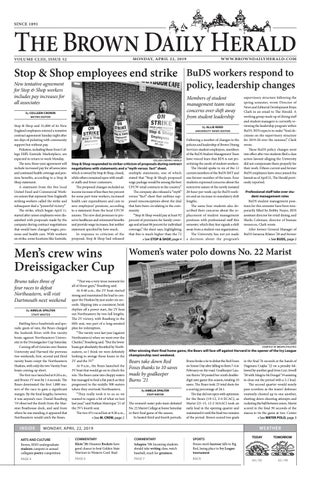
Stop & Shop responded to striker criticism of proposals during contract negotiations with statements and a “myth versus fact” sheet. which is owned by Stop & Shop, closed, multiple statements, one of which while others remained open with small- stated that “Stop & Shop’s proposed er staffs and fewer customers. wage package would be among the best The proposed changes included an UFCW retail contracts in the country.” income increase of less than two percent The company also released a “myth” for some part-time workers, increased versus “fact” sheet that outlines suphealth care expenditures and cuts to posed misconceptions about the deal new employees’ pensions, according that have been circulating in the comto a statement from the local UFCW munity. unions. The new deal promises to pre“Stop & Shop would pay at least 92 serve healthcare and retirement benefits percent of premiums for family coverand provide wage increases, but neither age and at least 88 percent for individual statement specified by how much. coverage,” the sheet says, highlighting In response to criticism of the that this is much higher than the 72 proposal, Stop & Shop had released » See STOP & SHOP, page 4
Men’s crew wins Dreissigacker Cup Bruno takes three of four races to defeat Northeastern, will visit Dartmouth next weekend By AMELIA SPALTER STAFF WRITER
Battling fierce headwinds and sporadic gusts of rain, the Bears charged the Seekonk River with five varsity boats against Northeastern University in the Dreissigacker Cup Saturday. Coming off of victories over Boston University and Harvard the previous two weekends, first, second and third varsity boats swept the Northeastern Huskies, with only the two Varsity Four boats coming up short. The first race launched at 8:20 a.m., and Bruno 1V won by 1.4 seconds. The Bears dominated the first 1,000 meters of the race to gain a significant margin. By the final lengths, however, it was anyone’s race. Daniel Boasberg ’19 observed the finish from the Marston Boathouse dock, and said from where he was standing, it appeared that Northeastern would catch the Bears.
INSIDE
“That was a very tense moment for all of those guys,” Boasberg said. At 8:40 a.m., the 2V boat started strong and maintained the lead to conquer the Huskies by just under six seconds. Slipping into a consistent, brisk rhythm off a power start, the 2V beat out Northeastern by two full lengths. The 2V victory, with Boasberg in the fifth seat, was part of a long-awaited plan for redemption. “The varsity won last year (against Northeastern) when we went over the Charles,” Boasberg said. “But the lower boats got absolutely throttled by Northeastern, so I think we were definitely looking to avenge those losses in the 2V and the 3V.” At 9 a.m., the Bears launched the 3V boat that would go on to clinch the win. The Bears came into choppy waters but managed to find a flat patch as they progressed to the middle 500 meters where they overtook Northeastern. “They really took it to us so we wanted to regain a bit of what we lost last year,” said Nathan Manrique ’21 of the 3V’s fourth seat. The two 4Vs raced last at 9:20 a.m., » See M. CREW, page 2
Following a number of changes to the policies and leadership of Brown Dining Services student employees, members of the BuDS Student Management Team have voiced fears that BDS is not prioritizing the needs of student workers. The Herald spoke to six of the 12 current members of the BuDS SMT and one former member of the team. Four students expressed concerns about the restrictive nature of the newly instated 20-hour-per-week cap for BuDS workers and an increase in mandatory shift lengths. The same four students also described their concerns about the replacement of student management positions with professional staff this semester, which they fear signals a shift away from a student-run organization. The University has not yet made a decision about the program’s
supervisory structure following the spring semester, wrote Director of News and Editorial Development Brian Clark in an email to The Herald. A working group made up of dining staff and student managers is currently reviewing the leadership program within BuDS. BDS expects to make “final decisions on the supervisory structure for 2019-20 over the summer,” Clark wrote. These BuDS policy changes went into effect after two students filed a class action lawsuit alleging the University did not compensate them properly for their work. Fifteen current and former BuDS employees have since joined the lawsuit as of April 21, The Herald previously reported. Professional staff take over student management roles BuDS student management positions for this semester have been temporarily filled by Bobby Noyes, BDS assistant director for retail dining, and Sheila Coleman, director of human resources, Clark wrote. After former General Manager of BuDS Savanna Rilatos ’20 and former » See BUDS, page 2
Women’s water polo downs No. 22 Marist
COURTESY OF BROWN ATHLETICS
After winning their final home game, the Bears will face off against Harvard in the opener of the Ivy League championship next weekend.
Bears take down Red Foxes thanks to 10 saves made by goalkeeper Burns ’21 By AMELIA SPALTER STAFF WRITER
The women’s water polo team defeated No. 22 Marist College at home Saturday in their final game of the season. In heated third and fourth periods,
Bruno broke a tie to defeat the Red Foxes on Senior Day after falling to them 7-4 in February on the road. Goalkeeper Lauren Burns ’20 posted her ninth doubledigit save game this season, totaling 10 saves. The Bears took 23 total shots for a scoring percentage of 26.1. The day did not open with optimism for the Bears (19-12, 2-4 ECAC), as Marist (21-15, 12-2 MAAC) took an early lead in the opening quarter and maintained it until the final two minutes of the period. Brown scored two goals
in the final 76 seconds at the hands of Dagmara Czajka ’22 on a penalty followed by another goal from Lexi Atwell ’20 with Maigrie McDougal ’19 assisting to close out the period with a 2-1 lead. The second quarter would nearly pass scoreless as the teams’ defenses routinely chested up to one another, shutting down shooting attempts and rocketing the ball between zones. Marist scored in the final 30 seconds of the stanza to tie the game at two. Center » See WATER POLO, page 3
WEATHER
MONDAY, APRIL 22, 2019
ARTS AND CULTURE Brown, RISD undergraduate students compete in annual collegiate poetry competition
COMMENTARY Klein ’20: Houston Rockets have good chance to beat Golden State Warriors in Western Conf. final
COMMENTARY Schapiro ’19: Incoming students should take writing class, watch baseball, reach for greatness
SPORTS Bruno men’s lacrosse falls to Big Red, losing place in Ivy League tournament
PAGE 4
PAGE 6
PAGE 7
BACK
TODAY
TOMORROW
64 / 50
63 / 49
NEWS
PAGE 2 • MONDAY, APRIL 22, 2019
THE BROWN DAILY HERALD
» BUDS, from page 1 Assistant General Manager of BuDS Benjamin Potee ’19 left their positions this semester, the University chose to fill their positions with professional staff because the semester was already underway, Clark wrote. The past three general managers of BuDS did “not complete their traditional terms of service within BDS,” wrote a former member of the SMT, who wishes to remain anonymous for fear of professional repercussions, in an email to The Herald. “There are good questions to be asked about the pressure this position puts on an individual.” The assistant general manager and general manager positions “consist of responsibilities that are both administrative … and deeply interpersonal,” the source wrote. By shifting these responsibilities to professional staff, BDS risks increasing the chance that students are uncomfortable reporting problems to their management, he added. Professional staff are removed from students’ daily lives and problems, which increases the chance they will be unable to appropriately relate to or manage students, he wrote. In the past, students have come to the general manager and the assistant general manager about Title IX violations and mental health concerns, and the former member of the SMT believes “that it is less likely for a student to go to a less accessible administrator.” Without students filling these two roles, there will be less accountability for BDS administrators, said another member of the SMT who wishes to remain anonymous for fear of professional repercussions. Students in the AGM and GM positions served as an essential buffer between BuDS and BDS and ensured students’ concerns were heard, she said. By not replacing the AGM and GM with students, “it feel’s like they’re consolidating power,” the source said. Furthermore, with professional staff taking on the duties of AGM and GM, BuDS “is technically not student-run,” she added. But Clark wrote “the changes to the program made to date — and any that
SARAH MARTINEZ / HERALD
may be made moving forward — are focused on enabling students to effectively balance their academic study and other activities with their employment.” Student working hours capped at 20 per week At the start of the semester, BDS implemented a new policy: BuDS workers are now limited to working “a maximum of 20 work hours per week,” Clark wrote in an email to The Herald. Previously, there was no upper cap on working hours, and many students worked more than 20 hours per week, particularly in the supervisory and unit manager positions, The Herald previously reported. As a result, “last semester we asked to have a soft way to prevent students from over working,” wrote Mathilde Barland ’21, a member of the SMT, in an email to The Herald. BDS and BuDS previously made changes — such as increasing wages for student workers and eliminating on-call hours — to make BuDS a more desirable work environment and reduce the workload for supervisors and unit managers, The Herald previously reported. BDS set this cap “to ensure the ability for student workers to effectively balance their academic work
and other activities with employment,” Clark wrote. Students’ requests to work more than 20 hours per week will be considered on an individual basis. BDS will approve students’ requests to work beyond the 20-hour cap “only in exceptional circumstances,” Clark wrote. But four students who spoke with The Herald said this system is both inefficient and can feel invasive. Students may feel uncomfortable sharing their personal reasons to justify their request to work beyond the cap, Barland wrote. For example, “people in the administration are not students or do not always understand that having to pay a $1,000 medical bill is actually a lot of money for someone whose only source of income is what they earn through BuDS,” Barland wrote. Isabella Teran ’19, a member of the SMT, said she had to go through an extensive process to get approval to work more than 20 hours in a week. Teran, who takes classes at both Brown and the Rhode Island School of Design, was hoping to “rack up hours” to help with her family’s financial situation at home before her RISD classes began in the spring. “I thought I could work a ton, and it wouldn’t necessarily impede academics. I just wanted to work more,” she said.
When Teran sent an email to administrators notifying them that she would be working more than 20 hours, she engaged in back and forth communication with administrators before being referred to the Office of Financial Aid. “There’s a lot of stress for lowincome students trying to balance financial circumstances and academics. But this wasn’t one of those scenarios,” Teran said. The Financial Aid Office offered to give Teran emergency funding, but she did not feel that her situation merited emergency funding and declined the offer. After speaking with the Financial Aid Office, Teran circled back to BDS and was then allowed to work more than 20 hours. “So much time was wasted on that. It should’ve been such an easy situation to handle,” Teran said. Mandatory shift lengths increase The University has mandated an increase in shift lengths for many dining units. In the carts unit, shifts have increased from two hours to three or more hours. Four students on the SMT allege that the University is prioritizing the needs of temporary workers by increasing shift times, which they say is more convenient for those workers and
more inconvenient for student workers due to their class schedules. “As a student, you don’t have a three to four hour block in your day. A lot of the workforce is underclassmen,” a member of the SMT said. In an email exchange reviewed by The Herald, a student involved in BuDS wrote to a BDS administrator criticizing the extended shift times. In response, the administrator explained that motivations for the change include demand from professional staff for longer shifts. There is “no effort underway in Dining to prioritize the needs of temporary employees over student workers,” Clark wrote. “Adjustments to shift lengths are not intended to prioritize temporary employees over student workers, but rather to provide Dining with the ability to have the required staff on hand to meet campus dining needs.” “Brown typically relies on temporary employees for short-term operational needs or instances in which significant flexibility is required,” Clark wrote. Clark said their focus is on “addressing the concerns raised directly by the students themselves about work hours, compensation and employment structure.”
» M.CREW, from page 1
COURTESY OF BROWN ATHLETICS
Following last year’s defeat by Northeastern University, Bruno came back with victories in first, second and third varsity in the Dreissigacker Cup this past weekend. Bruno next heads to Dartmouth to compete for the Atalanta Cup.
with the B boat coming in just over five seconds behind the Huskies and the A boat coming in about one second later. Typically, the two boats would race as a single eight-rower boat, but Northeastern did not have enough rowers to field an eight-person 4V boat, forcing Brown to split into two. “It’s a very, very tough thing to ask of them,” Boasberg said. “You have to do selection which involves a lot of tough racing practice and then come up with crews, (who then must) develop chemistry together and go out and race under really tough conditions. They put forth a really good effort.” With the team’s nine seniors bidding farewell to the Seekonk River, Lachlan MacKenzie ’22 from the eighth seat of the 3V said recruitment will be key for next season.. “Crew is great, and you should join,” MacKenzie added. Men’s crew heads to Dartmouth next weekend to compete for the Atalanta Cup, their second to last regular season race before the Intercollegiate Rowing Association Championships.
NEWS
MONDAY, APRIL 22, 2019 • PAGE 3
THE BROWN DAILY HERALD
LGBTQ+ panelists examine experiences, challenges in tech Panelists discuss coming out in tech, tackling workplace microaggressions By JANET CHANG SENIOR STAFF WRITER
When Simon Zheng, a software engineer at Peloton Interactive, first started working, he felt uncomfortable telling his coworkers that he was gay. “I was unproven (since) I had just graduated. I was very private about who I was dating. But after a year of working there and … feeling like I could do whatever I wanted, I came out.” Zheng and other panelists from large and small companies in New York and Boston reflected on their experiences of being LGBTQ+ in the tech world during the Friday event “Out in CS.” The panel included Izaak Baker ’15, a software engineer at Two Sigma, Mariel Freyre and Allie Jones, senior software engineers at Etsy and Jingo Mante, a product manager at HubSpot. To organize the event, Diversity Advocates on the Department of Computer Science’s Diversity Committee partnered with Laura Dobler, the department’s Financial and Outreach Coordinator, and oSTEM, a student group that advocates for the success of LGBTQ+ students in STEM fields. The groups worked together for several months to plan the panel. Panelists spoke on topics ranging from their beginnings in tech to managing their personal identities at work. They also shared strategies for handling workplace microaggressions, maintaining work-life balance and staying connected to their community. Although all of the panelists are out in their respective workplaces, the process of coming out was not always easy. “This is interesting because a lot of the narrative around coming out makes it sound like it’s like one event or one occasion in your life … like you weren’t out and and (now) you are, versus something that you consistently have to do over and over. It’s different for different identities. And … there’s
» WATER POLO, from page 1 defender McKenna Miller ’19 explained that defense is the foundation of Brown’s strategy. Head Coach Felix Mercado “always says our offense starts with our defense,” Miller said. “We really wanted to make sure that our defense was the number one thing we were focusing on for this game because that’s what we’re going to be focusing on most (in the championships) next week.” In the third quarter, Bruno scored two goals to lift Brown’s lead to 4-2, punctuated by quality saves from Burns and a seemingly continuous stream of penalties exchanged between teams. With 3 minutes and 34 seconds remaining in the period, Carissa Perez ’21 faked out Marist’s goaltender to sink a power play shot high in the top left corner. Following a Brown timeout, Czajka claimed Brown’s second power play goal on a skip shot with Katie Klein ’22 assisting at 1:36 remaining. Marist would continue a strong showing of shooting attempts, each of which Burns located
VICTORIA YIN / HERALD
Software engineers and a product manager described how their identities affect their workplace dynamics and interactions. Diversity Advocates on the Department of Computer Sciences’ Diversity Committee partnered with Laura Dobler and oSTEM to organize the event. never really a good place in a workplace conversation where you can say, let’s pause this (and come out),” said Baker, who identifies as gay. For some of the panelists, coming out has been a process of slowly testing the waters while progressively becoming more courageous about what to disclose about oneself. “My comfort with my identity, I think that took a while. It started out with, like, a little rainbow flag. And then it started being about (talking about) my girlfriend,” said Mante, who worked in traditional management consulting roles before switching to tech due to the industry’s more socially inclusive work environment. Others found it difficult to keep their identity under wraps. “I just can’t keep it to myself. … It honestly pops out of me. But, I’ve been at my company for two years and I’m very comfortable with my team and there’s stability in that way,” Freyre said. Sometimes, having a different
and intercepted. Under heavy pressure in the final minutes, Burns beat back a shot by the left post at 1:13 remaining and took a fast ball to the chest in the final 30 seconds to preserve Brown’s lead. Marist opened the final period with two goals, evening the score. It was not until 2:55 remained in the final stanza that Kaitlyn Cook ’21 capitalized on a power play opportunity to score off a pass from Czajka. McDougal would draw a five-meter penalty in the final 90 seconds, creating an opportunity for Klein to secure the last goal, bringing the Bruno lead to 6-4. Mercado told Brown Athletics that “it was great to send out our seniors with a win in their final regular season home game.” The Bears will take on Harvard in the opener of the conference championship next weekend. Their game against Marist will prove “very beneficial in figuring out what we need to work on before our conference championships,” Klein said. “Marist is a great team to play against in order to do so.”
identity lends a valuable perspective, which can be advantageous to building better products at work. For instance, Etsy compiles “things like gift guides and there are ‘gift guides for him’ and ‘gift guides for her’ and I think as someone with a more complex gender identity than that, I like being able to be the advocate for other people who might not feel like they’re included in those lists, or make sure there are futures in our products that are more thoughtful for a broader range of people than just the majority of people who use our product,” Jones said. In any case, there was general consensus on the panel when the discussion turned to the importance of being open with one’s identity at work. “It made me so much more creative … As soon as (there is) confidence in who you are, it really does show in your work and relationships,” Mante said. To find an inclusive workplace while interviewing at companies, Zheng offered the helpful adage: “Money speaks
more truthfully than words.” He recommended figuring out whether the company provides a budget for creating LGBTQ+ groups, organizing events like Pride or offering health insurance benefits for domestic partners. When combatting microaggressions in the workplace, Freyre emphasized the importance of speaking up, even with the temporary discomfort one might endure in the process. “A lot of the time, I am that angry bitch,” Freyre said, while laughing. “But … either way, you’re going to suffer. You’re going to suffer if you say it (but) you’re (also) going to suffer if you stay silent.” Meanwhile, Baker stressed the importance of picking one’s battles. “I have to drag you through 15 realizations to get you to understand why what that thing you said is not okay, how it could be better and why you should care. … It’s very exhausting to do that.” Patrick Freeman GS, one of the cofounders of oSTEM, said, “I feel like, so often, the professional world seems so
far away … so stifled in many ways and we always have to be performing. And I feel like (this event) kind of dropped the barrier for a little bit. It was really exciting to see (the) undergraduates so excited about the questions and laughing and agreeing with what was said. … There was a lot of good energy.” Ben Wilks ’15 GS, the other cofounder of oSTEM, said, “I appreciate the fact that they talked about having multiple identities … how they each played a very important role in the work that they do and in their personal life. I really appreciated that they were like, ‘we’re still kind of on this trip of figuring out how to take care of yourself and how to adjust to adult life.’ … It was really valuable to hear that.” Evan Dong, ’22, who is considering working in tech after graduation, said, “It was nice to hear that, for the most part, people could find … workplaces (and) communities where they did feel supported and (that were) not oppressive for them to have their identities.”
STAY UP-TO-DATE. FOLLOW US ON FACEBOOK. FACEBOOK.COM/BROWNDAILYHERALD
NEWS
PAGE 4 • MONDAY, APRIL 22, 2019
THE BROWN DAILY HERALD
Brown/RISD poetry slam team earns 5th place in annual competition Brown/RISD poetry slam group ranked historical highest at 2019 College Unions Poetry Slam By EMILY TENG SENIOR STAFF WRITER
Last weekend, Brown and the Rhode Island School of Design’s joint poetry slam team sent members Kris Cho ’22, Blessed Sheriff ’19, Dāa Guy RISD ’19 and Manuel Ávalos ’19 to take part in the College Unions Poetry Slam Invitation, an annual collegiate poetry slam tournament. The team took home 5th place, falling just 0.2 points short of a spot in the finals. A poetry slam is a competition in which poets perform spoken word and “slam” poetry which combine the elements of performance, writing, competition and audience participation. “(Poetry Slam) is a weird game that started off in bars in Chicago. … People thought it would be interesting to bring poetry back to everyone, because before that people thought (of) poetry as (being) very elitist, so they wanted it to be just a spoken thing where people can read work and also encourage (others) to write,” Ávalos said. The four group members selected to compete this year performed group and individual pieces that drew on intimate themes and subject matters that were expected to resonate deeply with others. Sheriff ’s piece “Anarcha” voiced her anger toward the institutional discrimination against African American women and received the Best Poem Award at CUPSI. Nominated in the same category, Ávalos’ “La Cempoalxóchitl” narrated the story of his family’s struggle with the AIDS crisis. Cho and Guy both talked about feeling estranged from their
» STOP & SHOP, from page 1 percent of family premiums and 80 percent of individual premiums other retailers pay on average. Workers who spoke with The Herald said the previously proposed contract changes would have increased out-ofpocket healthcare spending and failed to raise wages enough to keep pace with inflation rates. “We want what’s owed to us,” said Valerie Giblin, an Eastside employee and UFCW Local 328 union executive member who has worked for Stop & Shop for 23 years, and before the strike “never had a problem” with the company. Giblin stood with over a dozen other employees outside Eastside Saturday to show frustration over what they view as less-than-fair contract changes. As workers held up signs Saturday morning, people passing in cars honked and waved in support, while other community members brought over food for the picketers.
COURTESY OF WORD SLAM POETRY
(L-R) Poets Dāa Guy RISD ‘19, Blessed Sheriff ’19, Kris Cho ’22 and Manuel Ávalos ’19 competed at the annual College Unions Poetry Slam last weekend, sharing complex works that celebrated their identities. cultural norms — Korean and Jamaican respectively — and celebrated their resistance aginst family expectations in their respective works “Edit Please” and “Rastafarian: Reggae.” While topics in solo performances are commonly derived from individual experiences, members seek to forge connections with each other in group pieces. “It’s a lot of just talking to each other. We just talk about our lives and talk about things that we think about a lot and see where there (are) overlaps and try to write something together to match that,” Ávalos said. Ávalos and Guy’s group performance “Masculinity: Detox” was inspired by their mutual perception of beer as a symbol of toxic masculinity.
“Our father,” written and performed by Sheriff and Cho, narrated the turmoil they felt in finding their identities without father figures in their lives, while “Google Translate for Immigrant Mothers” by Cho and Ávalos used Translate as a medium to break down the actual, unscripted meanings behind the language of immigrant mothers. “Something I really wanted to focus on this year was confronting your own emotions,” said Chrysanthemum Tran ’17, the poetry slam team’s coach. She explained that a large part of her coaching involved helping the members articulate and express their genuine emotions, while she also offered support when urging them to confront their vulnerabilities.
In the statement from the local UFCW unions announcing the agreement, the workers thanked the community for their support: “We are incredibly grateful to our customers and everyone who proudly stood together with us every day.” Community leaders also stepped into the conversation. Mayor Jorge Elorza expressed his support for the picketers, and four 2020 presidential hopefuls, including former Vice President Joe Biden and Senator Elizabeth Warren, visited the picket line last week. The International Brotherhood of Teamsters also backed their fellow union workers, and would not deliver fresh foods to Stop & Shop locations that remained open. Some University groups supported the strike, including the Brown College Democrats and the Brown Student Labor Alliance. The Brown Dems and SLA, among other groups, organized trips to the picket line at the River Street Stop &
Shop, which remained open. Rose Lang-Maso ’20, president of the Brown Dems and Rhode Island resident, took a group of students there last week. “We got a lot of cars to turn around,” Lang-Maso said, adding that she saw an “immediate impact” happen as customers chose not to shop after speaking with strikers. The picketing appeared effective, as regular customers decreased their visits to the store by 75 percent, the Boston Globe reported. SLA member Hal Triedman ’20.5 also went to the picket line and said that groups worked to raise awareness of the strike and urged students to shop elsewhere. Without pay, some strikers were struggling. Dot Mandeville has worked for the grocery store chain for five years. “It was in the wind,” Mandeville said of the strike, and so she put a little money away before it started. She was unsure how those who live paycheck to paycheck were managing. Before the tentative agreement was struck and while the strike was ongoing, Stop & Shop donated to food pantries and children’s hospitals, as stores remained full of food and empty of customers. With a deal in the works, “associates’ top priority will be restocking our stores so we can return to taking care of our customers and communities,” according to Stop & Shop’s statement.
STUDENT RESEARCHERS SOUGHT
Alum author seeks research assistants for book about Brown. Should be sociable and outgoing.
Pay approximately $40/hour Send resume to: Richard Montauk rmontauk@aol.com
According to the official rules of the tournament, contestants are required to prepare several original compositions, each under three minutes long, which they then perform in preliminary “bouts,” or four round intervals, for the first two nights. The compositions can be individual or collective and sometimes feature the voices of several different poets at once. Top ranking teams then enter the semi-finals, where they perform four more pieces. The Brown/ RISD team made it to the semi-finals with a cumulative score of 227.2 — the second highest ranking out of the 58 teams. Each year, the Brown/RISD poetry slam team selects its representatives through an open mic slam in the fall
semester, in which all interested students are welcomed to try out for one of the team’s coveted five spots. The performances are scored from 0 to 10, including decimal points. The club chooses judges for the open mic slam using the rules followed by CUPSI, which require judges to be completely random and have no prior affiliation with the performers. “There’s kind of a joke in the slam poetry world that it’s even better if you don’t know anything at all (about poetry),” said Ávalos. Ávalos explained that poetry slam is not only about writing but also depends on performance and storytelling abilities, which require careful choreography and preparation. “We practice every single detail down to even how you adjust the mic, how you walk on stage, how you prepare before you start, how you read it, how you end it and how you walk off,” he said. Ávalos became interested in poetry slam after seeing the Brown/RISD team perform at A Day on College Hill. He has since taken part in the CUPSI competition during his second year and fourth year at the University. Since 2010, the Brown/RISD poetry slam team has produced numerous notable alums who have successful careers in poetry, including Phil Kaye ’10, Jamila Woods ’11, Franny Choi ’11 and Tran herself, among others. Apart from coaching, Tran and her co-coach Justice Ameer ’16 also just recently performed their debut two-woman musical performance, ANTHEM, at the American Repertory Theater in Cambridge, Massachusetts. “There’s no shortage on these campuses of poets whose talent and voices urgently expose necessary truths — personal reckonings with politics and narratives historically ignored by the ivory towers of poetry,” she said.
Follow us on ...
TODAY
MONDAY, APRIL 22, 2019 • PAGE 5
THE BROWN DAILY HERALD
menu
fun on the field
SATELLITE DINING ANDREWS COMMONS
Baked Pasta, Pulled Pork Sandwich, Chili Basil Pork Tofu Yellow Curry, Corey’s Sweet Chili Chicken, Caprese Pizza, BBQ Chicken Ranch Pizza JOSIAH’S
BLUE ROOM
Asian Salad, Southwest Salad, Grilled Portobello Mushroom
Focaccia Bar, Deli Sandwiches, Cake by the Slice, Danish
DINING HALLS SHARPE REFECTORY LUNCH
DINNER
California Style Salad Bar, Siberian Style Grain Bowl, Canja Soup, Beef Lo Mein
Asian Style Boneless BBQ Ribs, Hoisin Shrimp Stir Fry, Sautéed Leeks and Mushrooms
VERNEY-WOOLLEY LUNCH
DINNER
Tempeh and Lentil Muffin, Mexican Salad Bar, Cavatini, Chickpea Shawarma
Taqueria, Vietnamese Style Chicken Cutlet, Kimchi Vegetable Fried Rice
sudoku
TIFFANY DING / HERALD
The Ultimate Frisbee Team hosted the Greater New England Conferences Saturday, April 20 and Sunday, April 21.
Q U O T E O F T H E D AY
“The professional world seems so far away … so stifled in many ways, and we always have to be performing…
”
(This event) kind of dropped the barrier for a little bit.
— Patrick Freeman GS
See lgbtq+ on page 2. crossword
calendar TODAY
APRIL
S
7
M
T
W
Th
F
S
1
2
3
4
5
6
8
9
10
11
12
13
Does Cash Bail Increase Mass Incarceration? 12:00 P.M. Smith-Buonanno Hall
Migration Flows at the Mexican Borders 12:00 P.M. Watson Institute
Tulsi Gabbard: Build Don’t Bomb 4:00 P.M. List Art Building
Consumed By Slavery 6:00 P.M. Faculty Club
TOMORROW
14
15
16
17
18
19
20
21
22
23
24
25
26
27
28
29
30
Stammtisch 12:30 P.M. Stephen Robert ’62 Campus Center
Hip Hop Lecture Series: Austin Martin ’17 1:00 P.M. IBES Carmichael Auditorium
Talk: Image-to-Image Translation 4:00 P.M. Watson CIT
Contemplative Music of South Asia 7:00 P.M. List Art Building
COMMENTARY PAGE 6 • MONDAY, APRIL 22, 2019
THE BROWN DAILY HERALD
Why the Rockets can beat the Warriors GEORGE KLEIN sports columnist As the first round of the NBA playoffs continues, it is becoming clear that the Golden State Warriors will face the Houston Rockets in the Western Conference Semifinals. The Warriors can easily demolish the Clippers one more time, and the Rockets have severely outmatched the Jazz over the first three games of their series. As a result, more and more chatter has arisen in the sports world that the Rockets have a chance of taking down the Warriors. While the thought may seem ludicrous at first glance, don’t disregard it immediately. If any team can beat Golden State, it’s Houston. First of all, it took seven games and a Chris Paul injury for the Warriors to escape the Rockets last year. True, Andre Iguodala missed time in the series with an injury of his own, but if anything, the talent gap between the two teams has only narrowed. Golden State hoped DeMarcus Cousins would put to rest any hope for Houston and other challengers, but with Cousins out for a while (probably the rest of the season) with a quad injury, the Warriors are now left without their biggest addition, forcing them to bring back a rotation similar to last year’s. David West and JaVale McGee are gone though, with an aged Andrew Bogut
as a big man replacement. So if anything, Golden State sans Cousins is a slightly worse team than that of the 2017-18 season. The Rockets, on the other hand, ably adjusted their roster throughout the season after losing Trevor Ariza to free agency. Austin Rivers provides ball-handling and play creation that the Rockets missed so greatly at times. Between him, James Harden,
Not to mention that Houston’s most talented players have improved as well. Harden has taken his game to an even higher level, armed with a devastating stepback three-pointer and a newly refined floater. He averaged 36.1 points per game this past regular season — well above his mark of 30.4 from last year — thereby displaying increased stamina, which has always been a problem for him in
While the thought may seem ludicrous at first glance, don’t disregard it immediately. If any team can beat Golden State, it’s Houston.
Paul and Eric Gordon, Houston now has four players who can run offense. Kenneth Faried has filled in admirably as a rotation big, and Danuel House has shored up Houston’s wing depth. These Rockets look slightly better than last year’s edition. Yes, Houston is only a fourth seed when the team was the top seed in 2017-18. But they got off to a slow start that set them back and only fell to their current position because of some fluky late regular season results. The roster as presently constructed is just as capable of giving Golden State trouble.
the playoffs. Harden has grown accustomed to scoring throughout an entire game and won’t wear down as easily in crunch time as he has done previously. In Game 3 of the first round against the Jazz, for example, Harden struggled to score for most of the game, shooting 3/19 from the field. Yet, he still recovered to score 14 points in the fourth quarter. That would never have happened in past seasons. Clint Capela, meanwhile, averaged 16.6 points and 12.7 rebounds per regular season game, both career-high numbers by a wide margin which solidify him as one of the best
Find us online! facebook.com/browndailyherald
browndailyherald.com
@the_herald
@browndailyherald
youtube.com/browndailyherald
Sections
Multimedia & Production
Business
Editor-in-Chief Emily Davies
Arts & Culture Editors Elise Ryan Annabelle Woodward
Design Editors Bilal Ismail Ahmed Dylan Tian Julie Wang
General Managers Ravi Betzig Nicholas Masiakowski
Metro Editors Colleen Cronin Sophie Culpepper Celia Hack
Head Photo Editors Tiffany Ding Benjamin Toruño
Office Manager Diane Silvia
Senior Editors Anita Sheih Sarah Wang Editorial Page Editors Grace Layer Krista Stapleford
News Editors Katherine Bennett Jacob Lockwood Melanie Pincus Allie Reed
post- magazine Editor-in-Chief Anita Sheih
Science & Research Editors Cate Ryan Chris Schutte Sports Editors Alexandra Russell Alex Smolar COMMENTARY Opinions Editors Rebecca Aman Emily Miller Derek Simshauser
Copy Desk Chief Kelley Tackett Illustrations Editor Daphne Zhao
players in the entire league, but we haven’t seen any Harden-esque performance leaps from them. Durant especially has looked disconnected from the rest of the offense at times, memorably arguing with Draymond Green earlier in the season. If Houston can put the pressure on Golden State, Durant’s reaction will prove vital for the Warriors’ chances. It appears that he has one foot out of the door already, perhaps headed to the Knicks as a free agent this summer. Will Durant buckle down and play at his best when it’s most difficult for a team he’s probably leaving?
Location: 195 Angell St., Providence, R.I. www.browndailyherald.com
Editorial Leadership
Managing Editors Anna Kramer Priyanka Podugu
rebounders in the league. The Warriors won’t be able to put Cousins on him (which worked well in the regular season) and will have to hope that Kevon Looney and Bogut are up to the task. I wouldn’t be so optimistic about that. Golden State, by comparison, has remained stagnant. Obviously Stephen Curry and Kevin Durant are incredible and are two of the top three
Directors Sales: Bersabel Yifru Finance: Rudra Srivastava, Reynaldo Blandon Strategy: Edwin Farley
Chris Paul’s health remains the most important factor in this series. Houston was on the brink of victory with a 3-2 series lead before Paul went down in Game 5 of last year’s Western Conference Finals. But the point guard continues to be fragile — he missed plenty of time in the earlier stages of the season, one of the main reasons why the Rockets struggled out of the starting gate. When the minutes and intensity ramp up, will Paul be able to stay healthy and not have his body collapse due to playoff exertion? Regardless, Golden State will and should enter the series as favorites. They’ve won two consecutive titles in largely dominating fashion, and between Curry, Durant, Klay Thompson and Green, still boast a dynamic starting lineup. But signs of slippage are there. And Houston came so close just last year. In the end, this series seems destined for six or seven games. If Paul stays healthy, Harden keeps up his historic pace and the Warriors continue to play at their current level, a Houston series victory is far from unthinkable.
George Klein ’20 can be reached at george_klein@brown.edu. Please send responses to this opinion to letters@browndailyherald.com and op-eds to opinions@browndailyherald.com.
Editorial contact: 401-351-3372 herald@browndailyherald.com
Advertising contact: 401-351-3372 advertising@browndailyherald.com
Submissions: The Brown Daily Herald publishes submissions in the form of op-eds and letters to the editor. Op-eds are typically between 750 and 1000 words, though we will consider submissions between 500 and 1200 words. Letters to the editor should be around 250 words. While letters to the editor respond to an article or column that has appeared in The Herald, op-eds usually prompt new discussions on campus or frame new arguments about current discourse. All submissions to The Herald cannot have been previously published elsewhere (in print or online — including personal blogs and social media), and they must be exclusive to The Herald. Submissions must include no more than two individual authors. If there are more than two original authors, The Herald can acknowledge the authors in a statement at the end of the letter or op-ed, but the byline can only include up to two names. The Herald will not publish submissions authored by groups. The Herald does not publish anonymous submissions. If you feel your circumstances prevent you from submitting an op-ed or letter with your name, please email herald@browndailyherald.com to explain your situation. You can submit op-eds to opinions@browndailyherald.com and letters to letters@browndailyherald.com. When you email your submission, please include (1) your full name, (2) an evening or mobile phone number in case your submission is chosen for publication and (3) any affiliation with Brown University or any institution or organization relevant to the content of your submission. Please send in submissions at least 24 hours in advance of your desired publication date. The Herald only publishes submissions while it is in print. The Herald reserves the right to edit all submissions. If your piece is considered for publication, an editor will contact you to discuss potential changes to your submission. Commentary: The editorial is the majority opinion of the editorial page board of The Brown Daily Herald. The editorial viewpoint does not necessarily reflect the views of The Brown Daily Herald, Inc. Columns, letters and comics reflect the opinions of their authors only.
Video Editor Victoria Caruso Max Dekle
Corrections: The Brown Daily Herald is committed to providing the Brown University community with the most accurate information possible. Corrections may be submitted up to seven calendar days after publication.
Graphics Editor Sarah Martinez
Advertising: The Brown Daily Herald, Inc. reserves the right to accept or decline any advertisement at its discretion. The Brown Daily Herald, Inc. is a financially independent, nonprofit media organization bringing you The Brown Daily Herald, BlogDailyHerald and Post- Magazine. The Brown Daily Herald has served the Brown University community daily since 1891. It is published Monday through Friday during the academic year, excluding vacations, once during Commencement and once during Orientation by The Brown Daily Herald, Inc. Single copy free for each member of the community. Subscription prices: $200 one year daily, $100 one semester daily. Copyright 2019 by The Brown Daily Herald, Inc. All rights reserved. Periodicals postage paid at Providence, R.I. Postmaster: Please send corrections to P.O. Box 2538, Providence, RI 02906.
THE BROWN DAILY HERALD
COMMENTARY MONDAY, APRIL 22, 2019 • PAGE 7
The greatest Brown graduation story ever JAMES SCHAPIRO sports columnist I’m in the late innings of the last start of my career, and the manager is coming out to get me. I’m done, he says, and I can hit the clubhouse and start preparing for graduation while some rookie takes over where I left off. It’s been four years for me at Brown and at The Brown Daily Herald, three as a baseball columnist. Now, I’ve got one column left and three requests to make — three things that I hope Brown students will do so long as they are able. The first is simple: Take writing classes. You don’t have to be an English concentrator to enjoy writing about whatever interests you. ENGL 0930: “Introduction to Creative Nonfiction” is the Brown course that everyone should take. For my first assignment in ICNF in spring 2016, I wrote an essay about the 2004 Mets catcher Joe Hietpas and earned school credit for it. Write what you love. It will take you places. Even if you don’t think you’re much of a writer, writing classes are still worthwhile. Practice makes perfect, and writing is no exception. In addition, even if you don’t enjoy writing, you’ll read some of the most interesting material you’ve ever encountered. My life is better today be-
cause I read Hunter S. Thompson’s “The Kentucky Derby is Decadent and Depraved” when I took ENGL 1050E: “Sportswriting” in the spring of 2017. My second request is also simple: Remember baseball. Every week or so for the last three years, I have tried to capture in this column how special baseball is. On baseball fields, beautiful things happen. Unexpected he-
important. It goes, more or less, like this: Remember, as clichéd as it may sound, that Brown graduates can accomplish anything. When you leave Brown, the world will seem difficult, but remember that you can do great things. I want to illustrate this point with a story that I learned from following my first two requests. When I took Sportswriting, I started a group
the National Baseball Association’s Worcester franchise. Richmond had a short baseball career after college and later established a successful medical practice, but it is his graduation from Brown that deserves retelling. Here’s how the Society for American Baseball Research describes it: “Besides being the Worcesters’ front-line pitcher, (Richmond) was wrapping up his college studies and
Last summer, The Only Baseball Fans at Brown reminded me of the greatest Brown story ever — a story that somehow, no one seems to know.
roes emerge. Players fail and redeem themselves. A fastball brushes the outside corner and explodes into the catcher’s mitt and serves as a reminder that for moments ever so brief, perfection can exist. Watch a Brown baseball game, and you’ll see a group of players bonded by a mutual love for each other and for the game that they play. Remember baseball. Remember green grass and summer picnics. Remember the things that make life worth living. This brings me to my third request, which is probably my most
chat with some classmates and other friends called “The Only Baseball Fans at Brown.” Last summer, The Only Baseball Fans at Brown reminded me of the greatest Brown story ever — a story that, somehow, no one seems to know. A story that my dad used to tell me when I was young, that sounded like folklore, but is absolutely true. It’s the story of John Lee Richmond ’1880. Born in 1857, Richmond enrolled at Brown in 1876 where he played baseball and was elected Class President. In 1879, he began pitching for
was scheduled to graduate from Brown University in Providence, Rhode Island, 40 miles down the road from Worcester, on June 16. Richmond skipped Worcester’s Friday exhibition game with Yale University, returning instead to Providence for Brown’s graduation festivities. His classmate, Walter Angell, recorded Richmond’s activities while in Providence in a scrapbook: ‘I met them (Thursday night) at the depot … and rode out to the Messer St. ball grounds in a carriage. … We returned at midnight. Next day
was Class Day. Richmond went to the Class Supper at Music Hall. He was up all night. He took part in the usual ball game about 4:50 Saturday morning; went to bed about 6:30; took the train for Worcester at 11:30.’ In other words, John Lee Richmond went to the 1880s’ version of Campus Dance. He didn’t go to bed until 6:30 in the morning and woke up in time for an 11:30 train. Later that afternoon, John Lee Richmond took the mound for Worcester and threw the first “perfect game” in professional baseball history. Remember John Lee Richmond, and live by his example. The day Richmond left College Hill, he threw baseball’s first perfect game. I’m not sure what will happen when I leave Brown, but I know I’ll aim to do what I love. While we can’t all throw Perfect Games, we can all do great things and pursue lives worth living. While we’re at it, we can leave room for baseball, great writing and all those other things that make the world beautiful.
James Schapiro ’19 can be reached at james_schapiro@brown.edu. Please send responses to this opinion to letters@browndailyherald.com and op-eds to opinions@browndailyherald.com.
NEWS THE BROWN DAILY HERALD
MONDAY, APRIL 22, 2019
Men’s lacrosse comes up short against Cornell Big Red Bears fall to Big Red 12-9, risk chance to compete in upcoming Ivy League tournament By RYAN HANDEL AND EMORY HINGORANI SENIOR STAFF WRITER AND STAFF WRITER
Coming off a win over Ocean State rival Providence College, the men’s lacrosse team looked to carry its momentum into a crucial Ivy League matchup against No. 10 Cornell Saturday. The game was a win-and-in situation for both teams, as both Brown (5-8, 2-3 Ivy) and Cornell (9-4, 3-2) needed a victory to clinch a berth to the Ivy League tournament in May. But the Big Red jumped out to an insurmountable lead for the Bears, as the team fell by a score of 12-9. “We’ve had a couple close losses to some really good teams, but we’ve just got to go back to the drawing board and work harder this week in preparation for Bryant and Dartmouth,” said Carson Song ’19. “If we just work harder and keep trusting each other to make plays, we’ll be where we want to be.” Cornell’s Jake McCulloch opened scoring just under a minute into play, but roughly 90 seconds later Ryan
Aughavin ’21 tied things up off an assist by George Grell ’21. But the Big Red offense controlled the rest of the first period, netting three unanswered goals and ending the quarter with a 4-1 lead. The Big Red continued to extend its lead in the second stanza, tallying another two goals in the first half of the quarter. Darian Cook ’22 finally got Bruno back on the board with an assist by Jackson Newsome ’19, cutting the Cornell lead to 6-2 with 4:08 remaining in the half. Cornell closed out the half with another goal, and the Bears entered halftime facing a five-goal deficit. Cornell again got out to a quick start in the second half, as McCulloch scored another goal just under 40 seconds into play and gave the Big Red its largest lead of the game at 8-2. But Brown’s offense finally started to build momentum in what would prove to be a high-scoring third quarter. George Pike ’22 scored for the Bears, followed by a goal from Michael Brown ’20 and another strike from Aughavin. The three-goal rally cut Bruno’s deficit to three. Cornell scored once more midway through the third, but Jack Kniffin ’20 answered with 5:15 left in the period. Entering the final quarter, the Big Red held a 9-6 edge. A goal from Grell opened the
fourth and put the Bears within two of the Big Red. Another tally from Kniffin with 8:09 left in the game cut Cornell’s lead to just one. But Cornell then thwarted Brown’s comeback with three straight goals of its own, breaking the Bears’ scoring streak and bringing the score to 12-8. Song scored the final goal of the game, but it was too late for Bruno, and the team fell 12-9 and dropped to 2-3 in Ivy League play this season. Phil Goss ’20 anchored the Bears’ defense, making 10 saves on the afternoon, and helped bring the team back at various points in the contest. “As expected, another hard fought league opponent,” said Head Coach Mike Daly in a statement to Brown Athletics. “I’m proud of our team and their fight.” “One thing I love about this team is that we just never give up,” Song said. “We always believe that we’re in it and make a bunch of little plays to scratch, claw and kick our way back to a closer game.” The game was also the last home matchup of the season for the Bears, who celebrated Senior Day, and the nine members of the class of 2019 — Luke Chmiel, Foster LeBoeuf, Newsome, Acie Newton, Mike Panepinto, Brian Prigmore, Will Richardson, Alex Santangelo and Song — were honored with their families after the
COURTESY OF BROWN ATHLETICS
Despite a hard fought game, the Brown Bears lost to Cornell in their last home game of the season. Bruno will face Bryant on Tuesday. game. season to May. In order to make their “I can’t say enough about how fourth-straight Ivy League tournament, lucky I am, how fortunate I’ve been the Bears will need to win their game to be a part of Brown lacrosse, to play against Dartmouth and hope that Corfor the coaching staff that I have (and) nell beats Princeton Saturday. to play alongside my fellow seniors,” “It is certainly not how we wanted Song said. “Being a part of this team to end our (careers) on (Stevensonand learning the humility and the Pincince Field), but we seniors will work ethic that we need to succeed cherish the four unforgettable years on and off the field has been some- we’ve spent together playing our fathing special.” vorite sport,” Santangelo wrote in a In the final week of the regular statement to The Herald. “Thankfully, season, Brown will head out on the when we take care of business Tuesroad to face Bryant University Tuesday day and Saturday, we will be able to and Dartmouth Saturday. Good play continue playing in the postseason this week coupled with a bit of luck and show everyone that our class isn’t will allow the team to extend their finished just yet.”
Income Inequality and Social Mobility: Data Meets Policy in Providence
a discussion featuring JORGE O. ELORZA
Mayor of Providence
JOHN FRIEDMAN
Professor, Department of Economics and Watson Institute for International and 3XEOLF $LJDLUV
moderated by CHRISTINA PAXSON
President
Monday, April 22, 2019 | 5-6:30 p.m. *UDQRLJ &HQWHU IRU WKH &UHDWLYH $UWV Martinos Auditorium 154 Angell Street 6SRQVRUHG E\ WKH -DPHV 0 DQG &DWKOHHQ ' 6WRQH :HDOWK DQG ,QFRPH ,QHTXDOLW\ 3URMHFW
Tickets available
LQFRPHLQHTXDOLW\VRFLDOPRELOLW\ HYHQWEULWH FRP