SINCE 1891
THE BROWN DAILY HERALD TUESDAY, MARCH 19, 2019
VOLUME CLIII, ISSUE 36
WWW.BROWNDAILYHERALD.COM
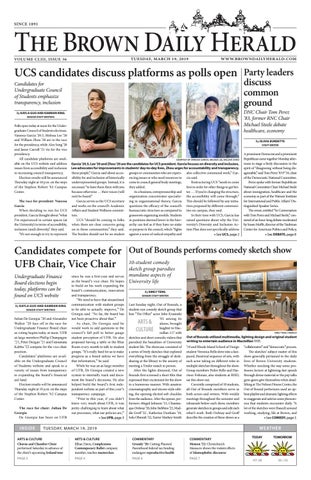
UCS candidates discuss platforms as polls open Party leaders discuss common ground
Candidates for Undergraduate Council of Students emphasize transparency, inclusion
DNC Chair Tom Perez ’83, former RNC Chair Michael Steele debate healthcare, economy
By KAYLA GUO AND KAMRAN KING SENIOR STAFF WRITERS
Polls open today at noon for the Undergraduate Council of Students elections. Vanessa Garcia ’20.5, Melissa Lee ’20 and William Zhou ’20 are in the race for the presidency, while Alex Song ’20 and Jason Carroll ’21 vie for the vice presidency. All candidate platforms are available on the UCS website and address issues from accessibility and inclusion to increasing council transparency. Election results will be announced Thursday night at 10 p.m. on the steps of the Stephen Robert ’62 Campus Center. The race for president: Vanessa Garcia When deciding to run for UCS president, Garcia thought about “what I’ve experienced in certain spaces (at the University) in terms of accessibility, inclusion (and) diversity,” they said. “It’s not enough to try to represent
By OLIVIA BURDETTE STAFF WRITER
COURTESY OF VANESSA GARCIA, MELISSA LEE, WILLIAM ZHOU
Garcia ‘20.5, Lee ‘20 and Zhou ‘20 are the candidates for UCS president. Garcia focuses on diversity and inclusion, Lee advocates for improvements in students’ day-to-day lives, Zhou urges for accountability and transparency. these people,” Garcia said about acces- groups or communities who are experi- also collective communal work,” Garsibility for and inclusion of historically encing issues or who need resources to cia said. underrepresented groups. Instead, it is come to council general body meetings, Restructuring UCS “needs to come necessary “to have them there with you they added. first in order for other things to get betbecause otherwise … their voices (will As a business, entrepreneurship and ter. … If you’re changing the structure, not) be heard.” organization concentrator specializ- the accessibility will come through.” Garcia serves as the UCS secretary ing in organizational theory, Garcia This should be followed by any initiaand works on the council’s Academic questions the efficacy of the council’s tives proposed by different communiAffairs and Student Wellness commit- bureaucratic structure as compared to ties on campus, they said. tees. grassroots organizing models. Students In their time with UCS, Garcia has UCS “should be coming to folks in positions deemed lower in the hier- raised questions about why the Uniwhen there are clear concerns going archy can feel as if they have no stake versity’s Diversity and Inclusion Acon in those communities,” they said. or purpose in the council, which “fights tion Plan does not specifically address The burden should not be on student against a sense of radical empathy and » See UCS, page 2
A prominent Democrat and a prominent Republican came together Monday afternoon to stage a lively discussion in the spirit of “disagreeing without being disagreeable,” said Tom Perez ’83 P ’18, chair of the Democratic National Committee. Perez spoke with former Republican National Committee Chair Michael Steele about immigration, healthcare and the economy as part of the Watson Institute for International and Public Affairs’ Distinguished Speaker Series. The event, entitled “In Conversation with Tom Perez and Michael Steele,” consisted of an hour-long debate moderated by Susan Moffit, director of the Taubman Center for American Politics and Policy, » See DEBATE, page 8
Candidates compete for Out of Bounds performs comedy sketch show comedy UFB Chair, Vice Chair 10-student sketch group parodies Undergraduate Finance Board elections begin today, platforms can be found on UCS website By KAYLA GUO AND KAMRAN KING SENIOR STAFF WRITERS
Julian De Georgia ’20 and Alesandro Walker ’20 face off in the race for Undergraduate Finance Board chair as voting begins today at noon. UFB at-large members Phillip Champagne ’21, Peter Deegan ’21 and Fatoumata Kabba ’22 compete for the vice chair position. Candidates’ platforms are available on the Undergraduate Council of Students website and speak to a variety of issues from transparency to expanding the board’s financial aid fund. Election results will be announced Thursday night at 10 p.m. on the steps of the Stephen Robert ’62 Campus Center. The race for chair: Julian De Georgia De Georgia has been on UFB
INSIDE
since he was a first-year and serves as the board’s vice chair. He hopes to build on his work expanding the board’s communication, innovation and transparency. “We need to have that streamlined communication with student groups to be able to actually improve,” De Georgia said. “So far, the board has not been proactive about that.” As chair, De Georgia said he would work to add questions to the council’s fall poll to better gauge student perception of UFB. He also proposed having a table in the Blue Room every month to talk to student groups. “It’s really hard for us to make progress as a board unless we have that information,” he said. While he was an at-large member of UFB, De Georgia created a new system to internally track and document the board’s decisions. He also helped build the board’s first independent website as part of this year’s transparency campaign. “Prior to this year, if you didn’t know very much about UFB, it was pretty challenging to learn about what our processes, what our policies are,” » See UFB, page 3
mundane aspects of University life By EMILY TENG SENIOR STAFF WRITER
Last Sunday night, Out of Bounds, a student-run comedy sketch group that lists “The Office” actor John Krasinski ’01 among its alums, brought laughter to Macmillan 117 with sketches and short comedic videos that parodied the banalities of University student life. The showcase consisted of a series of lively sketches that explored everything from the struggle of desksharing at the library to the anxiety of meeting a Tinder match in person. After the lights dimmed, Out of Bounds first screened a short film that expressed their excitement for the show in a humorous manner. With amateur cinematography and sitcom-style editing, the opening elicited soft chuckles from the audience. After the opener, performers Abigail Johnson ’21, Chautauqua Ordway ’20, John Stebbins ’22, Maddie Groff ’22 , Katherine Dunham ’19, Solu Obiorah ’22, Xavier Markey-Smith
ARTS & CULTURE
EMILY TENG / HERALD
Out of Bounds utilized multimedia, lighting design and original student writing to entertain audience in Macmillan 117. ’19 and Rhode Island School of Design student Veronica Bello dove into a fastpaced, theatrical sequence of sets, with each actor taking on different roles in multiple sketches throughout the show. Group members Pedro Bello and Harrison Fishman, also students at RISD, sat this show out. Currently comprised of 10 students, all Out of Bounds members serve as both actors and writers. With weekly meetings throughout the semester and rehearsals before each show, members generate sketches in groups and edit each other’s work. Both Ordway and Groff describe the creation of these shows as a
“collaborative” and “democratic” process. The sketches’ subject matter of this show generally pertained to the daily lives of Brown University students. Whether mocking the way some professors lecture at lightning-fast speeds through dense material or the pep talks gym-goers give themselves when deadlifting at The Nelson Fitness Center, the Out of Bound performers used an upbeat playlist and dramatic lighting effects to exaggerate and satirize some phenomena that students encounter daily. “A lot of the sketches were (based) around working, studying, life at Brown, and » See COMEDY, page 3
WEATHER
TUESDAY, MARCH 19, 2019
ARTS & CULTURE Chorus and Chamber Choir performed Saturday in advance of the choir’s upcoming Ireland tour
ARTS & CULTURE Jillian Davis, Complexions Contemporary Ballet company member, teaches masterclass
COMMENTARY Grundy ’20: Cutting Planned Parenthood federal tax funding endangers reproductive health
COMMENTARY Memon ’22: Christchurch Massacre shows the violent effects of Islamophobic discourse
PAGE 3
PAGE 4
PAGE 6
PAGE 7
TODAY
TOMORROW
47/ 28
50 / 35
NEWS
PAGE 2 • TUESDAY, MARCH 19, 2019
» UCS, from page 1
said.
ability in the same way that it does gender and ethnicity. “We need to continue progress in the DIAP,” Garcia said. “There’s this sense that we’re done now that we have this, but that could not be further from the truth.” Garcia also said that student groups should consider how to best incorporate the values of the DIAP in their organizations in a way that is not unduly formalized but still ensures implementation. As president, Garcia would prioritize compiling both quantitative and qualitative data to do due diligence on the council’s initiatives and ideas. Garcia applies this standard to their own projects, including a UCS Academic Affairs initiative concerning the academic trajectory for students who complete their degrees midyear. If elected president, “I want to be able to provide a sense that the person that can be the face of UCS … (is) not infallible. They’re always working on themselves, with others, for others, behind others,” Garcia said. “I’m really curious to understand what it means for someone who is disabled to be in the highest position of leadership, and why that is somehow a contradiction for some people,” they added, referencing their own identity as a person who is disabled. Garcia’s values of vulnerability and empathy would guide their approach to the UCS presidency. “I really do want to listen, especially if I can hear narratives or lived experiences … that are coming from positionalities that I don’t possess or live with,” they said. Garcia will also be voting in favor of the Brown Divest referendum. “I realized that while I humanized both sides and did listen to both sides, … I would hope that (the referendum) would create action to divest,” Garcia
The race for president: Melissa Lee As president, Lee hopes to build on her work as chair of Campus Life in making UCS relevant to students and improving day-to-day amenities. Issues that fall under the Campus Life committee’s purview, including residential life, meal plan costs and transportation, are “things that students feel on a daily basis,” Lee said. “I spent a lot of time talking to students on the ground level, seeing what their day-today experience was.” In her year as chair of Campus Life, Lee worked on initiatives such as advocating for hydration stations in every dorm building, beginning a long-term plan to include restaurants on Thayer Street in meal plans and creating an airport shuttle service to lower transportation cost barriers. Lee is working with the University Resources Committee to institutionalize the airport shuttles and also hopes to develop a partnership with Lyft to provide nighttime transportation for all students, she said. “Even though these big-picture initiatives are … of the utmost importance,” the “little things … increase your overall happiness,” Lee said. “Having improvements for students’ day-today lives” has been one of one of Lee’s priorities this year, she said. Lee also hopes to incorporate UCS resources into an app that Computing and Information Services is piloting “so that UCS can also be at students’ fingertips,” she said. Internally, Lee would work to increase general body participation as president. UCS struggles to retain general body members because “when people come and feel like they don’t have work to do or their work isn’t being valued, (they) kind of have an inclination to stop coming to these meetings.” To make UCS more accessible to student groups, Lee proposes
Brown University Community Council
Wednesday, March 20, 2019 4 – 5:30 pm Path to a Carbon Neutral Campus Overview of Performing Arts Center and Lacrosse & Soccer Facility
Meetings are open to members of the Brown community. Meeting will be held in the Stephen Robert ’62 Campus Center, Kasper Multipurpose Room To learn more about the Community Council visit: brown.edu/go/council
THE BROWN DAILY HERALD appointing general body members as representatives for every housing cluster, Category III student group or major project, she said. Category III student groups may apply for funding above a $200 baseline from the Undergraduate Finance Board. These representatives would attend group meetings and serve as liaisons in communicating the resources UCS can offer, Lee added. Though Lee emphasized that she does not want to force any group’s involvement with UCS, “UCS does have a direct line of conversation with (the administration), and being able to help in any way possible without overstepping our bounds would be facilitative,” she said. The council also lacks cohesion among its various committees and projects, Lee said. As president, she would work to enable communication between committee chairs and the executive board. “There would be more student voices involved in these projects, and that might also help facilitate and drive change on campus as well,” she added. As chair of Campus Life, Lee is “constantly playing a facilitative role, but also pushing for initiatives to be heard,” she said. If elected, Lee would strive to directly include groups with “lived experiences” in relevant conversations and rely on their expertise in shaping various initiatives, she said. Lee will also be voting in favor of the Brown Divest referendum. While condemning any personal harm students experienced as a result of the referendum, Lee said “it’s extremely important for us to address any human rights violations in Palestine … and hold the University accountable to a higher moral standard.” The race for president: William Zhou
Currently UCS vice president, Zhou has been involved with UCS for the past three years, previously as the co-chief of staff and chair of student activities. “Those experiences have really given me an opportunity to work …with students, student groups and administrators to be able to create some positive change on campus, and I’m really motivated to … continue that work,” Zhou said. Zhou is running for president to hold the administration to “higher transparency, equity and accountability” standards. His campaign also focuses on increasing council’s proactivity in reaching out to and supporting student groups and communities, particularly “identity- and culture-based groups,” he said. This semester, Zhou helped develop Campus Conversations, an initiative that has brought administrators like Provost Richard Locke P’18 and Vice President for Institutional Equity and Diversity Shontay Delalue to UCS general body meetings. “What I really wanted to do was create spaces in which students could bring up their priorities to administrators who have a lot of influence in the University,” Zhou said. As president, Zhou would “ prioritize channels for students to be involved and give feedback” and make the council more transparent and representative. To achieve this, he hopes to appoint UCS liaisons to all Category III student groups to “form continued relationships.” Zhou also hopes to “continue strengthening resources for student organizations because oftentimes they are the source of where activism happens on campus,” he said. To do so, Zhou would expand the council’s New Initiatives Fund, which the Council allocates to student groups who are not eligible to receive funding from UFB. In addition, Zhou wants to “increase
institutional support as well as UCS support for … students who hold historically marginalized identities” by implementing a special UCS committee “focused on supporting these groups (as they) deal with unique challenges that they face,” he said. In his time on UCS, Zhou has worked on the policy writing and implementation of the Campus of Consent bill, changes to the University’s bias incident reporting system and mechanisms for student groups to better address harm within their communities in collaboration with the Title IX Office. Zhou has also worked with the Undocumented, First-Generation College and Low-Income Student Center, other first-generation college student groups and the Office of Sustainability on the FLi Into Brown program, which helps ease the moving process for firstgeneration and low-income students. “Because I acknowledge the limitations of my personal experiences, I have been very motivated to actively seek out and listen to students with different perspectives and experiences than I have and … work together to create initiatives,” he said. As a volunteer with EcoReps, a student group that has merged with Green Events, and a member of the Meiklejohn Peer Advising Leadership Committee, Zhou has had “the opportunity to … form relationships with both students and administration and work across communities to motivate change.” Zhou will be voting yes in the Brown Divest referendum on this year’s ballot. The University should not be “complicit in perpetuating human rights abuses in the Israel-Palestine conflict,” he said. “No matter what its intentions with its investments, it should be held accountable for the impacts that they create.”
Joanna Howard Rick Moody read from their fiction Tuesday, 19 March 2019 at 7 pm McCormack Family Theater 70 Brown Street [please use Fones Alley entrance] Hosted by Literary Arts at Brown
NEWS
TUESDAY, MARCH 19, 2019 • PAGE 3
THE BROWN DAILY HERALD
» UFB, from page 1 he said. As vice chair, De Georgia helped create the board’s first financial aid fund in collaboration with Assistant Dean for Financial Advising Vernicia Elie and the Student Activities Office. The fund pays for low-income students to attend certain events on campus. De Georgia’s platform also rests on fostering innovation within the board. “We need to set aside time to think about bigger-picture issues, to reevaluate policies that student groups are upset about,” he said. The board could set up an additional weekly meeting designated to addressing concerns, De Georgia said. De Georgia also hopes to continue UFB’s transparency campaign. The board allocates over $2 million annually. “Every undergraduate student pays into that fund” through the student activities fee, he said. “Students have a right to know where that money goes.” UFB Chair Lisa Schold ’19 and De Georgia worked to publish the board’s first budget report in November. “If we have all of the information published in a way that’s digestible by the student body, … we’d get a lot of feedback.” De Georgia said, “I also think that it would help hold the board accountable.” As part of his work as vice chair, De Georgia advocated to tie future increases in the student activities fee to inflation to reduce sporadic change, The Herald previously reported . Though the board does not need to
increase the fee every year, “if we do need to increase it, then it should be tied to inflation,” he said. “We need to be more cautious about how we are allocating the money.” “That’s why I’m pushing for chair,” he said. “I’ve been on the board for a long time. I know how we operate. I’ve seen a lot of the problems that we have. And I think I’d be able to help us move forward in the right direction.” De Georgia will be voting yes on the Brown Divest referendum. “The divest coalition has raised a very valid critique of Brown’s investments in companies that are complicit in human rights violations,” De Georgia wrote in a statement to The Herald. He also expressed support for greater transparency surrounding the University’s investments. The race for chair: Alesandro Walker If elected UFB chair, Walker would draw on his three years as an at-large member and experiences interacting with the board as a representative of a student group, he said. When Walker was treasurer of the Black Student Union, he gained an understanding of “how intimidating (UFB) can be,” he said. As chair, he would hope to “improve UFB in a way that would allow groups to feel comfortable in that space and fully defend” their proposed budgets. “Making sure that the (representatives) are fully preparing their groups” to present to the board makes student groups more comfortable engaging with UFB, he said. “Training the reps
so that they know how to do their jobs is essential.” In his time on UFB, Walker designed a curriculum for representatives that covers the board’s constitution, rules, precedents and processes. He hopes to add the curriculum to the board’s constitution so that “every chair and vice chair is responsible … to train all new reps in the fixed curriculum,” he said. Walker’s platform partially rests on the expansion of the board’s financial aid fund, which was a “kind of pilot program this year,” he said. Walker wants to work with Elie and the Office of Financial Aid, as they have legal access to students’ financial information, in order to “code all that information so that we can have all the access we need to set up the financial aid fund in a way that’s equitable and accurate,” he said. Coding the data, Walker said, will allow UFB to legally access the financial information without invading students’ privacy. An expanded fund could better fund and subsidize Spring Weekend tickets for students with financial need, Walker said. Last year, the board covered the cost of attending one day of Spring Weekend for highest-need students, but many students still could not afford to attend the event, he added. “I want to work with (Brown Concert Agency) and SAO to look at where all of our money as a collective three … is going,” Walker said. Specifically, he hopes to focus on how the organizations could “put (money) back into allowing more students to
COURTESY OF JULIAN DE GEORGIA
COURTESY OF JULIAN DE GEORGIA
Candidates Alesandro Walker ‘20 (left) and Julian De Georgia ‘20 (right) will face off for the position of UFB Chair in elections beginning today. fully participate in a wider Brown experience, which Spring Weekend is very emblematic of.” Walker would also aim to increase transparency by posting the board’s funding precedents on its website to ensure that “all groups understand everything that a board member like me … would know so that way they’re not at a disadvantage,” he said. He also wants to create a UFB Instagram account in order to make the board more approachable and disseminate information to student leaders. Further, Walker said he believes increases in the student activities fee should be tied to inflation. “That way, there’s no reason to
actually increase the burden on students. … The only reason that we should be increasing the student activities fee is that costs went up, and inflation is the best way to measure that,” he said. Walker’s favorite part of UFB is working with and helping student groups. “I (would) just really want to continue that, and expand that, in my new role as chair,” he said. Walker will also be voting in favor of the Brown Divest referendum. “Brown should always be careful with its investments, in terms of ‘how is Brown money being used in potentially harmful ways?’” he said.
Chorus, Chamber Choir sing across centuries of music U. Chorus, Chamber Choir perform with string quartet at Central Congregational Church By JANGO MCCORMICK SENIOR STAFF WRITER
The elaborate domed ceiling of Central Congregational Church lent the University Chorus and Chamber Choir an air of both visual and acoustic grandiosity during their performance Saturday evening. The effect was heightened by the student string quartet that accompanied the voices of the choir, a pairing that enabled the musicians to take on an assortment of pieces ranging from 16th-century Spanish motets to a song cycle by a 1968 graduate of Pembroke College. Director of Choral Activities Frederick Jodry runs the Chorus and conducted both the singers and the string quartet during the concert Saturday. Jodry described the combined task of conducting both the chorus and the string quartet as “twice as fun,” adding
» COMEDY, from page 1 that is often the case (with our sketches),” said Groff, who joined Out of Bounds in her second week at the University. Although the show did not have a theme, Groff explained that many ideas for the sketches stemmed from experiences that group members had while studying — so that naturally became a subject that pervaded the commentary. Groff noted that Out of Bounds
that with the quartet there “it’s fancier, it’s more elaborate, it’s more interesting — there’s more color and more texture.” The smaller Chamber Choir within the 50-singer Chorus is set to embark on a performance tour of Ireland over spring break, but before leaving the continent it will deliver a free final concert at 8:00 p.m. Wednesday, March 20 in Grant Recital Hall. The tour is the latest in a decades-long legacy of trips by the University Chorus, a group primarily made up of University undergraduate students, as well as a few graduate students and local alums. The string quartet will tour Ireland alongside the Chamber Choir, in part to perform “The Golden Harp,” a cycle of Nobel Prize-winner Rabindranath Tagore’s poetry set to music by composer Gwyneth Walker ’68. Walker was one of six composers whose work was featured in the Saturday concert; the performance also included pieces by Ola Gjeilo, Tomás Luis de Victoria, Charles Ives, Ildebrando Pizzetti and Gustav Holst. Jodry said that he likes to program
pieces from different eras for the sake of “variety and contrast,” as was seen in the concert’s arc from Victoria’s nearly 450-year-old “Two Motets” to the works of living composers like Walker and Gjeilo. “I think of it like balancing a meal,” Jodry said of arranging a program. “You want something sweet and something savory.” The tastes of the chorus members themselves had a range about as broad as the program. Zachary Schapire ’21 most enjoys performing contemporary works with “rich chords that sound good in a space like this, with a lot of reverberation,” he said, gesturing to the vaulted ceilings of the Congregational Church. Others appreciated the older pieces. “I just really like singing classical music,” said Davis Tantillo ’19, adding that he also generally enjoys singing with the chorus. “It’s really methodical. It’s work, but it’s directed by someone else,” Tantillo said. John Rush ’20 agreed, pointing to a similar virtue in his own involvement. “It’s not relaxing, but it’s kind of a reset,” he said. “I see it as a nice break in my
members use the same brainstorming exercises and structural format as the writers of “Saturday Night Live,” riddling their sets with comedic repetition, absurd circumstances and “blackout gags,” which are a rapid-fire slapstick bit. Residential Life Staff and audience member Brittney Merritt particularly enjoyed the recurring joke of the “Hag at Brown,” a role played by Markey-Smith, who gave mock advice regarding the housing lottery and meal plan system
at the University. In between live sketches, the show also featured a video sketch that parodied a commercial for a public law firm called “McDouglas & Sons.” “Live comedy is really cool in that we can be reacting to the audience, and it can be a really living, breathing thing. … Video is really special because you can use cuts, and you can use angles and different shots to make jokes. You can do a lot of visual gags that you won’t
COURTESY OF FREDERICK JODRY
The Saturday concert featured music ranging from a 16th-century choral piece to a poetic song cycle composed by a Pembroke College alum. day. Even if I have a really busy day, (I) carve out two hours for chorus.” The Chorus members often engage in academic pursuits far removed from music. Schapire studies chemistry, but said he finds the chorus to be educational in itself. “I’ve gotten way better at being able to read music,” Schapire said, “because the pace is much faster than any sort of music learning I’ve ever
had before.” Jodry noted that talented singers seem to appear with every new class, and he appreciates his students’ diligence in their musical pursuits. “Even though Brown is not a school which aspires to be a conservatory, the level of music-making is often extremely high,” he said. “And that’s what makes it really fun to be here.”
be able to do on stage,” Out of Bounds member Ordway said. “Even though no one in the group really had experience writing sketches before, … we all come together and learn with each other,” Groff said. Members of Out of Bounds also spend time together outside group meetings, said Ordway. With the addition of four new freshman this year, a number that is unprecedented in the group’s history, he added that “it’s a different
energy.” “When you’re at Brown, you start to see things through a similar lens because you’ve just been around the same people and the same place for a while. So we’re getting really fresh perspectives because we have people who are from different areas of the country and have completely different backgrounds coming in to write these jokes with us, which is great,” Ordway said.
NEWS
PAGE 4 • TUESDAY, MARCH 19, 2019
THE BROWN DAILY HERALD
Ballet masterclass unites people of different backgrounds, levels Complexions Contemporary Ballet member leads class for students, community By GRAYSON LEE SENIOR STAFF WRITER
Last Wednesday, Jillian Davis of Complexions Contemporary Ballet led students and community members with mixed levels of dance experience through a ballet masterclass. FirstWorks, a Providence-based arts organization, co-hosted the class with Artists and Scientists as Partners, a University project focused on interdisciplinary cooperation, especially between scientists and dancers. The masterclass was one installment of the ASaP 2019 Symposium, which included several days of events focusing on “what it means for artists and scientists to be partners — where’s the overlap and where’s the disconnect and why don’t we do more things together,” said Julie Strandberg, distinguished senior lecturer in theatre arts and performance studies and founding director of dance at the University. The symposium events, which included Davis’ masterclass, aimed to build partnerships, Strandberg said.
“There are people in so many silos that are all doing great things, … so we’re really trying to bring people together,” she said. Complexions is a contemporary ballet company based in New York City, and Davis has performed with them as a company member for five years. She also teaches masterclasses several times throughout the year. The Complexions website defines the company’s mission as removing boundaries: “Whether it be the limiting traditions of a single style, period, venue, or culture, Complexions transcends them all, creating an open, continually evolving form of dance that reflects the movement of our world — and all its constituent cultures — as an interrelated whole.” Davis described working with Complexions as “the end goal” of her career, stating that the athleticism of the dancers and fusion of styles make the company special. Throughout the class, Davis taught poses and routines, helping the attendees of various experience levels follow along. “My intention for today is to give everybody a taste of Complexions. …It’s not just ballet or it’s not just modern, it’s a little bit of everything combined,” Davis said. She explained that one reason she enjoyed teaching masterclasses was that everyone interprets her teaching
COURTESY OF FIRSTWORKS
Jillian Davis, company member of Complexions Contemporary Ballet, taught a masterclass last Wednesday as part of the Artists and Scientists as Partners 2019 Symposium. differently. “Certain things that I say will click with certain people, and maybe saying the same thing a slightly different way will click with other people,” Davis said. The Complexions company members will perform their piece “From Bach to Bowie” at the Providence Performing Arts Center April 17, an event also hosted by FirstWorks. Kathleen Pletcher, founder and executive artistic director of FirstWorks,
explained that she wanted to bring Complexions to Providence because of the nature of the company and the piece they will be performing. Half of “From Bach to Bowie” features the music of Johann Sebastian Bach, while the other half is a tribute to David Bowie. Davis described the piece as “a celebration of music” and a celebration of Complexions’s 25th anniversary. In the second half of the piece, “we just go through a
catalogue of (Bowie’s) songs from all different eras to show what kind of artist he was and how he morphed himself into different people with each of these songs,” Davis said. “And everyone loves David Bowie — you can’t go wrong with that.”
Interdisciplinary panel discusses China’s ‘Past, Present and Future’ Four University professors present research on space, environment, displacement, politics By CORRINE BAI SENIOR STAFF WRITER
On Monday night, University professors came together to examine China through four distinct lenses: space exploration, environmental science, politics and history. The panel, titled “The Rise of China: Past, Present and Future,” featured James Head, professor of geological sciences, Rebecca Nedostup, associate professor of history, Edward Steinfeld, director of the Watson Institute for International and Public Affairs and dean’s professor of China studies and Tongzhang Zheng, professor of epidemiology. While moderating the panel, Provost Richard Locke P’18 spoke about the event’s inclusion in the University’s “Building on Distinction” lecture series, which allows faculty members to discuss their research and highlights the University’s work. “Building on Distinction” underscores the University’s distinctive teaching approach, which “combines intellectual rigor with interdisciplinary inquiry,” Locke said, adding that the panel was also “emblematic” of this approach by featuring four professors from different fields. To begin the conversation, Head, who joined the conference via video, spoke about China’s progress in space exploration. Space projects are a way of demonstrating national power, boosting pride and prestige, enhancing national security and asserting international leadership as well as national legitimacy, Head said. With the support of a
multitude of other institutes, the Chinese National Space Agency oversees the country’s space program, he added. “One of the keystones (of China’s space exploration) is the Chinese Lunar Exploration Program,” which recently landed a significant project on the far-side of the moon, Head added. In the end, Head summarized the importance of China’s space endeavors by quoting President Xi Jinping, who said “there is no end to space exploration.” Steinfeld then presented on the sociopolitical change China has experienced since the Chinese Communist Party took over. He started his talk by reflecting on his personal experiences in China; when living in the country 30 years ago, Steinfeld said it was unimaginable to predict the emergence of advanced social media apps, the extensive use of smartphones and online payment platforms. Steinfeld also highlighted the recent rise of strong-man politics following Xi’s abolishment of term limits and the incarceration of ethnic Uighurs in Xinjiang. But, despite the enormous transformation, Steinfeld remarked that “authoritarianism is not definitional of China.” Since the student protests that took place during the May Fourth movement of 1919, China has undergone “unbelievable experimentations” and a selfaware process of change, Steinfeld said. After going through periods of Maoist spiritual utopia and radical market revolution, China has entered a period of showcasing its national identity. At the same time, China now experiences heavy-handed state suppression of civil society. Following Steinfeld’s remarks, Nedostup spoke about the displacement of Chinese people during the Second Japanese War and Chinese Civil War
BENJI TORUÑO / HERALD
‘The Rise of China: Past, Present and Future’ featured professors Head, Nedostup, Steinfeld and Zheng. This installment of the University’s “Building on Distinction” series was moderated by Provost Locke on Monday. period. During these times, roughly a Chinese culture. improve the environmental conditions quarter of the entire Chinese population Zheng concluded the panel by in the country. Investments in renewwas displaced, Nedostup said. However, talking about the environmental re- able energy and electric cars have grown “this is something we don’t usually hear percussions of China’s rapid economic significantly in the past decade, and the about in the global history of refugees,” development. China’s GDP increased government is also trying to restore forshe added. significantly from 1979 to 2009, but dur- ests, Zheng said. Nedostup attributed this “lost his- ing this period, the government paid After their presentations, the four tory” to “two silences” — the silence little attention to public health and dam- professors answered questions from Profound within historical writings on refu- age to the environment, Zheng said. vost Locke, as well as from the audience. gees as well as the personal silence of During this period, heavy metals and Andrew Steinberg ’22 thought the panel displaced families. She pointed to pho- other chemicals polluted more than 60 “explored a lot of interesting ideas of tographs of wooden boats as evidence million acres of farmland to the point China’s past and future.” Steinberg was confirming China’s refugee history; the where they could not be used for farm- especially intrigued by the panel’s menphotos showed wooden boats carrying ing anymore, he added. Besides caus- tion of scientific collaboration between the coffins of displaced individuals, re- ing environmental degradation, China’s U.S. and Chinese researchers despite the turning their bodies from the wartime unchecked industrial development also prevalence of rhetoric labelling “China capital of Chongqing to their homes in greatly damaged public health — every as an adversary.” Xinyue (Jennifer) Xu other cities such as Shanghai and Bei- year, there are 400 million cardiovas- ’20 praised the panel but commented jing. Among the few historical records cular disease or stroke patients in the that it could benefit from including some were newspaper ads for these boat trips, country, he added. But, since 2009, experts not affiliated with the University. showing the significance of reburial in the Chinese government has sought to
TODAY
TUESDAY, MARCH 19, 2019 • PAGE 5
THE BROWN DAILY HERALD
sudoku
b r o w n b e a r s e m e r g e f r o m h i b e r n at i o n
RELEASE DATE– Monday, January 21, 2013
Los Angeles Times Daily Crossword Puzzle c rNorris o s sandwJoyce o rNichols d Lewis Edited by Rich
ACROSS 1 Furry foot 4 Sign of healing 8 Affectedly trendy 14 Earth Day prefix 15 Corn Belt state 16 Muzzleloading aid 17 Chinese dog with a blue-black tongue 19 Pierce with a point 20 Ward on TV 21 New York’s __ Island 23 26th of 26 24 NBA position 26 Doctor whom Captain Kirk calls “Bones” 29 Love, Italian-style 31 Tot’s toy on a track 34 Doo-wop syllable 35 College football’s Famous __ Potato Bowl 37 Molecule parts 38 Adds color to 40 Cup edge 41 Sensitive spots 42 Texas A&M athlete 43 Port west of Paris 45 __-Caps: candy 46 “Make it snappy!” 48 Walks without going anywhere 50 Red giant in the night sky 51 “Sting like a bee” boxer 52 Chicken __ king 54 Winner’s gesture 57 A dime a dozen, e.g. 61 One-named Tejano singer 64 “Bottoms up!” 66 Pennsylvania home of Lafayette College 67 Steaks and burgers 68 Off-road ride, briefly 69 Mambo cousin 70 Pell-__: hastily 71 Dim sum sauce
DOWN 1 Bench-presser’s pride 2 Aleve target 3 What daydreamers gather, metaphorically 4 [Not a typo] 5 Made logical sense 6 Troop truant 7 Cry like a baby 8 Big name in cooking oil 9 It’s often smoked 10 Little troublemaker 11 Victor at Little Bighorn 12 Swiss cheese feature 13 Nantes notion 18 City SSW of Dallas 22 Announcement while coming through the door 25 Divide in threes 27 By the seashore 28 Septi- plus one 29 End on __ note 30 Fruit-based chip dip
31 Tweet 32 Broken mirrors, to some 33 __ buco: veal dish 34 Opp. of legato, in music 36 Shady spots 39 Helpful hints 44 Brittany or cocker 47 Largest city of the West Indies 49 Cosmo concern: Abbr.
52 “Hang on __!” 53 Rachel’s sister 55 SALT subject 56 Indian butter 58 “Got it!” cries 59 Longtime Yugoslav president 60 Green emotion? 62 And so on: Abbr. 63 Japanese drama 65 Org. with Giants and Titans
xwordeditor@aol.com
01/21/13
ANSWER TO PREVIOUS PUZZLE:
DANIELLE EMERSON / HERALD
Students and visitors gathered in front of Stephen Roberts ‘62 Campus Center steps to mill about and enjoy the rare winter sun. Hopefully, our biggest star will shine more often when spring officially begins this Wednesday.
Q U O T E O F T H E D AY
“There are people in so many silos that are all doing great things, … so we’re really trying to bring people together.
”
— Julie Strandberg, senior lecturer in theatre arts and performance studies
See complexions on page 4. By C.C. Burnikel (c)2013 Tribune Media Services, Inc.
01/21/13
c o m i c : f r e n c h 500
calendar TODAY Breath and Bliss Yoga 12:00 P.M. Alumnae Hall, Crystal Room
Quantum Science Brown Bag 12:00 P.M. 170 Hope Street, Room 108
Study Abroad 101 Information Session 12:00 P.M. Page-Robinson Hall, Room 420
Introduction to Interviewing 4:00 P.M. CareerLAB 1st Floor
TOMORROW
RÉMY POISSON / HERALD
Growth Lab Lunch — Jose Belmar 12:00 P.M. Robinson Hall, Room 301
Talk: Rasmus Kyng, Harvard University 12:00 P.M. CIT, Room 368
Art + Feminism Wikipedia Edit-athon 2:00 P.M. Sarah Doyle Center, Lounge
Classics Department Open House 3:00 P.M. Macfarlane House, Room 102
COMMENTARY PAGE 6 • TUESDAY, MARCH 19, 2019
THE BROWN DAILY HERALD
New Trump rule threatens Planned Parenthood MIRANDA GRUNDY Staff Columnist At the end of February, the U.S. Department of Health and Human Services issued a new rule known was the “domestic gag rule,” which will severely impact the availability of family planning resources in the United States, particularly for low-income individuals. The rule affects the Title X Family Planning Program, which was first enacted under the Nixon administration in 1970 and provides funding for basic primary and preventative reproductive health needs. The federal grant program alots funding toward health clinics such as Planned Parenthood for wellness exams, cancer screenings, birth control, contraception education and testing and treatment for sexually transmitted diseases. But President Donald Trump released the final draft of a new HHS regulation that will cripple these service providers. The regulation, which will go into effect in about a month if its enactment is not slowed by legal challenges, will bar federal tax funding to Planned Parenthood — which serves more than 4.9 million people annually — and similar women’s health clinics who offer abortions, or abortion counseling and referral, unless they completely separate their abortion businesses from their other family planning services. This would mean separating infrastructure, staff and resources, essentially rebuilding the over 800 existing affiliate Planned Parenthood
health centers across the country or risking the loss of all Title X funding that gives socioeconomically marginalized women access to reproductive healthcare. Whether or not one is pro-life or supports a woman’s right to choose, everyone should care about access to necessary healthcare. We cannot let bureaucratically imposed policies like this rule alteration further disenfranchise individuals already struggling to access the basic right to healthcare. As a campus of young adults who claim promote awareness of privilege and work to better the lives of low-income communities, we should do all we can to prevent the erosion of the progress made thus far to support affordable healthcare for all Americans. This rule change is supported by pro-life conservatives who object to their tax dollars going to clinics that provide abortions. But contrary to popular misconception, there is no direct federal funding allocated to Planned Parenthood or similar clinics. Instead Medicaid and Title X funding works like insurance for individuals who must rely on these social programs, reimbursing these clinics for the medical services they provide. This funding is crucial to Planned Parenthood, as over 60 percent of their patients don’t have private health insurance. Thus, the misleading political slogan “defund Planned Parenthood” wrongly implies that Planned Parenthood was ever granted direct subsidies. Further, clinics are never reimbursed by the federal government for abortion services. This regulation is an attack on the primary reproductive health clinics in the nation, simply because abortion is one of the services they provide.
This rule puts the reproductive health and futures of so many of our country’s already marginalized women, particularly low-income women of color, into the hands of privileged male politicians. These politicians — who don’t directly face the consequences of the policies they create — should not have the primary say in deciding which procedures and resources women have access to. The realities of low-income life in the United States are harsh, and the government’s role should be to alleviate hardship where they can. Not only does Planned Parenthood provide necessities like birth control, cancer screenings and STI testing, but they also offer important learning resources about healthy intimacy to young men and women who may not normally have access to such knowledge. They also offer emergency contraception and rape recovery counseling, which are rape crisis services essential to all people and should not be denied due to financial restrictions. It is estimated that Planned Parenthood health centers help prevent over 500,000 unintended pregnancies annually. In addition, when Texas passed legislation in 2011 that drastically cut family planning spending, it caused 82 clinics in the state to close and increased the costs for birth control pills, intrauterine devices and other primary care. In doing so, low-income women lost access to valuable resources. Limiting access to reproductive healthcare isn’t productive and only leads to higher rates of unintended pregnancy, sexually transmitted infections and undiagnosed cancers. In response to the rule change, Planned Parenthood and the American Medical Association have
decided to sue the Trump administration. They assert that the rule “will politicize the practice of medicine and the delivery of healthcare” and “cause patients to lose faith in their providers and the health care system as a whole.” Low-income individuals, especially minority populations and non-English speakers, already often feel like they cannot trust medical professionals — a key barrier to receiving healthcare. Policies like this will only worsen healthcare disparities. The potentially disastrous effects of this rule make clear we should not appease antiabortion political groups, and we must make sure to push against their political imperatives by amplifying the voices of the marginalized who will feel the concrete impacts of this policy. Access to reproductive health is not a distant political fight to many students here. As young adults, these programs are directly valuable to us, and barring federal funding from them may also have disastrous impacts on the reproductive health of members of our own communities. For example, the health fees Brown students pay do not cover STI testing; because STI tests can be very expensive, Planned Parenthood and similar clinics are important resources for students. We must work to challenge this rule for the sake of not only the futures of the disadvantaged in distant communities but also for ourselves and our peers.
Miranda Grundy ’20 can be reached at miranda_grundy@brown.edu. Please send responses to this opinion to letters@ browndailyherald.com and op-eds to opinions@browndailyherald.com.
LETTER TO THE EDITOR
LETTER TO THE EDITOR
Two state solution
Investment Office’s response to divestment is misleading
referendum is preferable to divestment To the Editor: In Kyle Price’s ’20 recent op-ed, the author opposes the Boycott, Divestment, Sanctions movement against Israel. As a Jew, I’m reluctantly against BDS and fearful that it could become a camouflage for blatantly anti-Semitic activities. That said, Price’s article is shockingly oblivious to the existential problem that propels radical solutions like BDS. Notwithstanding the op-ed’s vigorous defense of the allegedly equal status of Palestinian-Israelis, it is a smoke screen to avoid peering into the abyss — the status of about five million Palestinians who reside in the West Bank and Gaza. For over 50 years these individuals have been occupied or blockaded by the Israeli state. Their numbers exceed the population of 27 states in the United States. This population is stateless, lacks freedom of movement and has grossly inadequate access to water, electricity and medical care. It is consigned to poverty. Though one can build walls so you can’t see them and pretend they don’t exist, they profoundly exist to me. I have visited and shared meals with them and heard about their aspirations and frustrations. I have felt love and fear for their children. Like many of us, they awake each morning, take their kids to school and go to work. They love their children no less than we love ours. Yet for many of them, the future is beyond bleak. The thought that some people are worth less than others is the root of our worst problems. The separation wall and
blockade against Palestinians entering Israel makes it seem as if Israel believes Palestinians are less deserving than Israelis and Jews. We cannot be oblivious to the inhumane desperation of five million souls and still think we are civilized. Empathy is the oxygen of morality. It is unproductive to play the blame card. There’s plenty of blame on both sides. We cannot change the past. Let’s create a better future. In Israel’s 1948 Declaration of Independence, it identifies itself as a Jewish, democratic State. Right now, it is not fully either. Only the establishment of a Palestinian state can fulfill this promise. The current Israeli government has fought every attempt at a two-state solution. The Knesset moving closer to annexing the West Bank, which may follow Israel’s April elections. Israel is pursuing an unconscionable path that will lead to more moral indignation and international isolation. Increasingly it will be termed an apartheid state. The radicals will gain adherents until a two state solution is agreed and enacted. Thus, the UCS referendum should be refocused to provide a resolution supporting a two State solution, rather than one promoting BDS and the dangerous precedent it sets. Stephen Robert ’62 P ’91 LHD (hon.) 2004, former chancellor of Brown
To the Editor: In their recent op-ed, Dowling, Dietze and Kennedy ’97 argue that it is infeasible for Brown to divest because of the complicated nature of managing the endowment. This claim is concerning, considering the fact that Brown University has claimed to divest from tobacco, genocide in Darfur, and HEI Hotels and Resorts. This is an especially striking claim coming from administrators, whose job is to execute the divestment resolutions of the Advisory Committee on Corporate Responsibility in Investment Policies and the Corporation, the University’s highest governing body. If the University has been unable to effectively divest, we must take a deeper look at our endowment management practices. Brown claims to have an ethical endowment; the ACCRIP exists precisely for this purpose — it ensures that the University’s investments live up to its ethical values. It is the institution tasked with ensuring that our endowment is socially responsible and consistent with Brown’s goals and principles. The ACCRIP charter states the organization’s responsibility to “consider issues of moral responsibility in the investment policies of Brown University.” Moreover, the charter states that ACCRIP will “recommend divestiture … when divestiture will likely have a positive impact toward correcting the specified social harm, or when the company in question contributes to social harm so grave that it would be inconsistent with the goals and principles of the University to accept funds from that source.” The ACCRIP recommends divestment to the Corporation, which votes on whether to adopt the measure. On three occasions, a divestment proposal by the ACCRIP has been accepted by the University. The first came in 2003, when
the Corporation voted to “exclude from Brown’s direct investments, and require Brown’s separate account investment managers to exclude from their direct investments, those companies that manufacture tobacco products and that the Investment Office share with all investment managers the University’s desire to adhere to this investment philosophy.” Then, in 2006, the committee advised divestment from companies profiteering off of genocide in the Darfur region of Sudan. Again, the Corporation voted to “exclude from Brown University’s direct investments, and require the University’s separate account investment managers to exclude from their direct investments” any company seen as complicit. Most recently, in response to the work of Brown’s Student Labor Alliance, the ACCRIP recommended divestment from HEI Hotels and Resorts. Brown Divest’s demand to “divest all stocks, funds, endowment, and other monetary instruments from companies complicit in human rights abuses in Palestine” is in line with previous acts of divestment by the ACCRIP and the Corporation. In fact, the ACCRIP’s stated policy on investments related to human rights violations is as follows: “Support resolutions seeking reports and codes of conduct on investment in countries where there are pervasive violations of human rights.” Thus, Dowling, Dietze and Kennedy do not provide a logically sound argument against divestment; in fact, their piece bolsters calls for increased financial transparency like the demand included in the Brown Divest referendum item. Brown Divest’s proposal to “establish a means of implementing financial and student oversight of the University’s investments” would ensure that gestures such as divestments are being carried out effectively.
With additional transparency and student oversight, hopefully we can be more confident that the University will actually divest when it says it will. ACCRIP claims that divestment is possible and has been implemented in the past. We must ensure that recommendations for divestment are being effectively carried out by administrators like Dowling, Dietze and Kennedy, who are responsible for following the guidelines set by the University (guidelines that are explicitly referenced in the verbiage of Brown Divest’s referendum item.) Lastly, it is deeply irresponsible for the editorial board of The Brown Daily Herald to publish pieces like the op-ed by Dowling, Dietze, and Kennedy without acknowledging that divestment is part and parcel of Brown University’s institutional history, through the ACCRIP and the aforementioned divestment actions by the University. In submitting this piece, I demand that the editors of The Herald include an editorial comment in Dowling, Dietz, and Kennedy’s op-ed acknowledging that Brown University has, in fact, divested in the past, and that the ACCRIP’s charter explicitly references the University’s responsibility to divest when University values are at stake. I cannot say whether the editors will make the changes I have suggested. If it is true, as Dowling, Dietze, and Kennedy suggest, that the Investment Office is not carrying out the University’s own approved divestment resolutions, this beckons a serious inquiry into the Office’s ability to carry out Brown’s goals and principles. This would make a great article for any self-respecting student publication. Tal Frieden ’19.5
COMMENTARY TUESDAY, MARCH 19, 2019 • PAGE 7
THE BROWN DAILY HERALD
The audacity of the scam REID SECONDO staff columnist On March 12, Operation Varsity Blues exposed your run-of-the-mill C-list celebrities, financiers, Division 1 coaches and educational consultants as a motley coterie of fraudsters and racketeers that spun a scheme of idiotic deceit all because some parents wanted their unqualified kids to attend some elite universities and said “sure, let’s commit some crimes.” This may read like a tabloid-ready tale with a week-long shelf life at the grocery store checkout line, but it is a complex narrative that fuses the sad state of American public life with the rot of self-entitlement and the deterioration of elite apparatuses: This is a scandal befitting our time. We are living in a renaissance of the American scam. Large-scale scams, from Bernie Madoff ’s infamous Ponzi scheme to the dumpster fire of Fyre Festival, regularly captivate the collective American conscience while perpetually dominating social media feeds and news cycles. Meanwhile, more quotidian scams, like mounting credit card fraud to Nigerian prince solicitations, are normative aspects of the digital age. At the gravitational center of the college admission scams is a zeitgeist of cor-
rupted capitalism and a status-driven economy enabled by technological disruption. Reality distortion tools like Instagram have fueled the murky influencer ecosystem, turning an anybody into a somebody one #sponsorship and VSCO filter at a time. Getrich-quick tech methods like cryptocurrency initial coin offerings are notoriously fraud-prone but attract billions in funding. The most fitting emblem of this moment is the snake
ing of such worth and more. Over the millennia, every major economic and technological revolution has exacerbated this pre-existing stratification of human society. From the first divisions of labor along the ancient shores of the Tigris and Euphrates to the Second Industrial Revolution, each round of labor and class segmentation driven by economic development further stratified disparities of wealth and social capital that
As a beneficiary of this system, I’ve seen firsthand in my home community and social circles how it allows for gross self-entitlement to persist beyond the headlines: ghostwritten personal statements on college applications, dropped DUI charges, covered up assault. Elitist scamming and grifting is a flagrant dismissal of social ethics and a betrayal of the people who play by the rules and earn their way regardless of where they start.
It is by virtue of such privilege that causes the switch to flip for some of its recipients: the dictum of ‘because of I earned it’ is corrupted into ‘because I can.’
oil salesman sitting in the Oval Office. This portrait of scam renders core tenets of the idealized American ethos — hard work, merit and respect for the rules — as optional. The question is: optional for whom? Perhaps it’s not so much a question of who rather than what lead such behavior to become available to some people. This phenomenon of self-entitlement is fundamentally rooted in inherent human inequity; those who are of greater worth as defined by the social metrics of the time are enabled to believe they are deserv-
translate into inequities of power and access. The current iteration of society in the United States is a direct descendant of this legacy. Deeply widening disparities in health, wealth and education outcomes reinforce notions of worthiness and deservingness by virtue of privilege in class, race and geography. And it is by virtue of such privilege that the switch flips for some of its recipients: The dictum of “because of I earned it” is corrupted into “because I can.” The elitist system enables this rot.
The college admissions scandal perpetrators are cheats whose actions most heinously undermine the actual merits of families and students — true scholars, athletes and artists of authenticity — that are where they are because of what they achieved. As a former college athlete, it is demeaning to hear your sport — a lifelong passion and dedication — be dragged through this scandal and degraded as a boutique activity because a spineless coach sold out the sport’s reputation to line his pockets from parents of silverspooned YouTubers. It is no sur-
prise that the backlash of elitist structures and the people who abuse them is a global cause célèbre. Changes are needed at the top, but rooting out elite corruption starts first by forcing accountability and excision. The indictments and complaints against fifty people charged in the largest college admissions bribery scandal in United States history is a start. There cannot be selectively applied legal and ethical codes in our criminal justice system based on status or class — equal protection means equal treatment. The people who are unfortunate witnesses must speak truth to power and reject association, even at risk of personal alienation. Institutions, particularly those of higher education (University included) and business firms, must improve their due diligence in verifying qualifications and holding accountable those who commit fraud. The scam against American norms stops when principled ethics and honest work are celebrated while those who cheat and abuse the system are exposed; let’s get to work.
Reid Secondo ’16 GS can be reached at reid_secondo@ brown.edu. Please send responses to this opinion to letters@browndailyherald. com and op-eds to opinions@ browndailyherald.com.
An attack in New Zealand, an ideology in the West BILAL N. MEMON
op-ed contributor In the eighth circle of Hell, Dante describes the fate of the beloved Prophet Muhammad (may peace be upon him): “His guts hung between his legs and displayed his vital organs.” Dante goes further to paint, in lurid detail, the prophet’s immense pain and physical deformities. The Inferno’s contemptuous view of Islam was informed by the brutal Crusade of the 11th, 12th and 13th centuries. Roman Catholics sought to ‘recover’ the Holy Land from the Muslims, murdering thousands in their wake. (In fact, Dante boasted that his great-great grandfather died fighting as a crusader.) This is all to say that ideological and physical violence against Islam is nothing new in Western history, but as deeply rooted as the Homeric epics and perhaps even the Bible itself. Aware of such historical context, I nevertheless awoke with fresh shock and horror upon checking my phone Friday morning. My eyes glazed over the fated headline, “49 Dead in Terrorist Attack at New Zealand Mosque.” I re-read the sentence a few more times until reality finally set in: During Friday Jumu’ah last week (the Muslim equivalent to Sunday church service), a twenty-eight-year-old gunman stormed two mosques in Christchurch, New Zealand and fired indiscriminately. He live-streamed the massacre on Facebook and released a 74-page manifesto highlighting an array of role models: racist mass murderers, the 20th century British fascist Oswald Mosley and U.S. President Donald Trump. A man at the door of the Al Noor Mosque greeted the killer — “hello, brother” — moments before the killer opened fire with a
semiautomatic rifle; “brother,” an acknowledgement of humanity and dignity, was the last word to leave the devout man’s lips. It is all too easy to call the New Zealand terrorist attack an aberration — the deranged machinations of a psychopath. It is harder to acknowledge that the Islamophobic discourse that motivated the killings is mainstream in the West. From Brexit to Marine Le Pen to the Alternative for Germany party to the Freedom Party of Austria to Donald Trump, far-right na-
continued to be vilified. “As always, left-wing politicians and the media will rush to claim that the causes of today’s shootings lie with gun laws or those who hold nationalist views,” wrote Australian Senator Fraser Anning. “But this is all cliched nonsense. … The real cause of bloodshed on New Zealand streets today is the immigration program which allowed Muslim fanatics to migrate to New Zealand in the first place.” Ignoring the immense human suffering, Anning attempts to reassert the Muslim’s subhumanity,
It is all too easy to call the New Zealand terrorist attack an aberration — the deranged machinations of a psychopath. It is harder to acknowledge that the Islamophobic discourse that motivated the killings is mainstream in the West.
tionalism is on the rise. The nationalist — particularly the European nationalist — centers the Muslim heavily. White supremacy of any flavor requires an ‘other’ to degrade. In the current political milieu, with economic anxiety, rising inequality and turmoil in the Middle East — often perpetuated by Western imperialism — the Muslim becomes a convenient scapegoat. Those who propagate such an ideology contrast European rationality and enlightenment with Islamic barbarism and cruelty; Muslim immigration thus threatens the Western order. Even after the Christchurch shooting, Muslim immigrants
capturing the rhetoric of a transnational nativist movement.Senator Anning lies on the extreme of a continuum occupied by many white liberals. From Iraq to Palestine, this tradtional white liberal simultaneously condescends and demonizes the Muslim. To paraphrase Edward Said’s “Orientalism,” he paints with a broad brush that ignores the complexities of Islam and Muslim life; the Muslim is denied every opportunity to represent himself, as the myriad of false stereotypes proliferate. The recent terror attack shows that such representations lead to real violence. Every pundit and politician who uses lazy and divisive
rhetoric to stoke the flames of fear and anger now has the blood of 49 Muslims on their hands. The killer’s engagement with internet troll culture further demonstrates the extent to which discourse creates violence. His manifesto and live-stream contain common internet themes. He writes, “Spyro the dragon 3 (a popular video game for children) taught me ethno-nationalism … Fortnite trained me to be a killer and to floss on the corpses of my enemies.” While these rantings are difficult to analyze beyond their abhorrent cruelty, they reflect a discursive style common among the emergent alt-right. Other terrorists, including Robert Bowers, responsible for the Pittsburgh synagogue massacre, and Elliot Rodger, who killed six people in Isla Vista, California, were also steeped in internet culture. The trajectories of these men show that violence is never arbitrary and random but is instead cultivated through insidious language and communities. The tragedy of the New Zealand attack is still raw — in Christchurch, in the Muslim community and beyond. Unfortunately, like any unnecessary loss of life, we are too quickly faced with the same recurring question: How can we prevent this from happening again? The first and most important step is to recognize that, like all terrorism, the New Zealand attack was built atop an ideology — a vicious Islamophobia that is as old as the West itself.
Bilal N. Memon ‘22 can be reached at bilal_memon@brown.edu. Please send responses to this opinion to letters@ browndailyherald.com and op-eds to opinions@browndailyherald.com.
» DEBATE, from page 1 followed by questions from the audience. Perez and Steele disagreed on some of the United States’ most pressing political issues, especially healthcare. “I believe that healthcare can and should be a right for all, and frankly we’re about 90 percent of the way there because of the Affordable Care Act,” Perez said. “If states expanded Medicaid who aren’t expanding Medicaid, we would be closer to 95 percent of the way there.” Steele took a different approach, contending that American political culture will not allow for Democrats and
Republicans to get what they want in terms of healthcare legislation, as their views of healthcare policy will never fully align. Instead, he said the closest we will get to a perfect healthcare bill is one that both parties “weren’t that crazy about.” “The future rests in the hybrid,” Steele said, in which citizens have a choice between the Medicare system or the private market. Despite their differences in ideology, both Perez and Steele agreed that American politics have become more polarized. Perez, a former advisor to late Democratic Senator Ted Kennedy, pointed to a 1996 immigration bill on which Kennedy
worked extensively with former Republican Senator Alan Simpson. “There were elements of the bill that Senator Kennedy didn’t like, there were elements of the bill that I’m confident Senator Simpson didn’t like,” Perez said. “And yet, in the aggregate, they came together around the notion of principled compromise.” In the current Republican Party, which Perez called the “Party of Trump,” bipartisan efforts like those between Kennedy and Simpson “aren’t allowed to be discussed.” Steele, a self-proclaimed Lincoln Republican, also sees a problem in the current political leadership’s unwillingness
to compromise. “You have to recognize that sometimes a zero-sum attitude is not going to win the day for you,” he said. “You’re going to have to make some tough decisions, and you’re going to have to prioritize.” Perez sees hope for the future in increased political participation. “The election of 2016 awakened people to the fact that democracy cannot be a spectator sport,” he said. “When I come here to Brown, the energy I see on this campus gives me incredible cause for optimism.” Sydney Smith ’22 and Kimberly Collins ’22, who participate in Perez’s and Steele’s study groups for undergraduates,
came to hear the differences between two political minds at opposite sites of the spectrum. Smith emphasized the importance of knowing what “major players in the political game are thinking, even if you don’t necessarily agree with them. It’s good to know the ideas that are circulating so you can better fine-tune your own.” Collins saw value in Perez and Steele’s attention to political history. “We can’t singularly look at any one period of time,” she said. “We have to both look at what came before and what may be coming after in order to get the best evaluation of our political circumstances.”
The Presidential Faculty Award Lecture
March 19, 2019 4:30 p.m. John Carter Brown Library Professor of Computer Science, Co-director of the Humanity Centered Robotics Initiative
Michael L. Littman will deliver the Presidential Faculty Award Lecture
Making Machines That Can Behave in the Real World
Find us online! facebook.com/browndailyherald
BDH browndailyherald.com SINCE 1891
THE BROWN DAILY HERALD
@the_herald
Location: 195 Angell St., Providence, R.I. www.browndailyherald.com
@browndailyherald
youtube.com/browndailyherald
Editorial Leadership
Sections
Multimedia & Production
Business
Editor-in-Chief Emily Davies
Arts & Culture Editors Elise Ryan Annabelle Woodward
Design Editors Kyle Cui Bilal Ismail Ahmed Dylan Tian Julie Wang
General Managers Ravi Betzig Nicholas Masiakowski
Managing Editors Anna Kramer Priyanka Podugu Senior Editors Anita Sheih Sarah Wang
Metro Editors Colleen Cronin Sophie Culpepper Celia Hack
Editorial Page Editors Grace Layer Krista Stapleford
News Editors Katherine Bennett Jacob Lockwood Melanie Pincus Allie Reed
post- magazine Editor-in-Chief Anita Sheih
Science & Research Editors Cate Ryan Chris Schutte Sports Editors Alexandra Russell Alex Smolar COMMENTARY Opinions Editors Rebecca Aman Emily Miller Derek Simshauser
Head Photo Editors Tiffany Ding Benjamin Turuño Copy Desk Chief Kelley Tackett Illustrations Editor Daphne Zhao Video Editor Victoria Caruso Max Dekle Graphics Editor Sarah Martinez
Office Manager Diane Silvia Directors Sales: Bersabel Yifru Finance: Rudra Srivastava, Reynaldo Blandon Strategy: Edwin Farley
Editorial contact: 401-351-3372 herald@browndailyherald.com
Advertising contact: 401-351-3372 advertising@browndailyherald.com
Submissions: The Brown Daily Herald publishes submissions in the form of op-eds and letters to the editor. Op-eds are typically between 750 and 1000 words, though we will consider submissions between 500 and 1200 words. Letters to the editor should be around 250 words. While letters to the editor respond to an article or column that has appeared in The Herald, op-eds usually prompt new discussions on campus or frame new arguments about current discourse. All submissions to The Herald cannot have been previously published elsewhere (in print or online — including personal blogs and social media), and they must be exclusive to The Herald. Submissions must include no more than two individual authors. If there are more than two original authors, The Herald can acknowledge the authors in a statement at the end of the letter or op-ed, but the byline can only include up to two names. The Herald will not publish submissions authored by groups. The Herald does not publish anonymous submissions. If you feel your circumstances prevent you from submitting an op-ed or letter with your name, please email herald@browndailyherald.com to explain your situation. You can submit op-eds to opinions@browndailyherald.com and letters to letters@browndailyherald.com. When you email your submission, please include (1) your full name, (2) an evening or mobile phone number in case your submission is chosen for publication and (3) any affiliation with Brown University or any institution or organization relevant to the content of your submission. Please send in submissions at least 24 hours in advance of your desired publication date. The Herald only publishes submissions while it is in print. The Herald reserves the right to edit all submissions. If your piece is considered for publication, an editor will contact you to discuss potential changes to your submission. Commentary: The editorial is the majority opinion of the editorial page board of The Brown Daily Herald. The editorial viewpoint does not necessarily reflect the views of The Brown Daily Herald, Inc. Columns, letters and comics reflect the opinions of their authors only. Corrections: The Brown Daily Herald is committed to providing the Brown University community with the most accurate information possible. Corrections may be submitted up to seven calendar days after publication. Advertising: The Brown Daily Herald, Inc. reserves the right to accept or decline any advertisement at its discretion. The Brown Daily Herald, Inc. is a financially independent, nonprofit media organization bringing you The Brown Daily Herald, BlogDailyHerald and Post- Magazine. The Brown Daily Herald has served the Brown University community daily since 1891. It is published Monday through Friday during the academic year, excluding vacations, once during Commencement and once during Orientation by The Brown Daily Herald, Inc. Single copy free for each member of the community. Subscription prices: $200 one year daily, $100 one semester daily. Copyright 2019 by The Brown Daily Herald, Inc. All rights reserved. Periodicals postage paid at Providence, R.I. Postmaster: Please send corrections to P.O. Box 2538, Providence, RI 02906.