SINCE 1891
THE BROWN DAILY HERALD TUESDAY, MARCH 12, 2019
VOLUME CLIII, ISSUE 31
WWW.BROWNDAILYHERALD.COM
MSNBC’s Reid discusses media, politics, 2020 IMPULSE News host speaks on media propaganda, pops, advises upcoming Democratic groups locks, drops By JACKSON TRUESDALE SENIOR STAFF WRITER
Joy-Ann Reid, an MSNBC host and political commentator, began her Monday evening talk at the Watson Institute for International Relations and Public Affairs by stressing that “it is very hard to unseat an incumbent president.” David Corn ’81 P’21, the Washington bureau chief for Mother Jones, editor for the Nation and on-air analyst for MSNBC, moderated the discussion about the 2020 elections, President Trump and today’s media. Corn first steered the conversation toward the 2020 elections as Reid discussed the lessons from the 2016 Democratic primary that should help inform the Democratic Party’s approach to 2020. “I want (the Democrats) to fight,” she said. Reid argued that the Democratic presidential candidates in 2016 would have been better prepared for the general election if former Secretary of State Hillary
Student-run hip-hop dance group stuns audiences with complex routines By ANNABELLE WOODWARD ARTS & CULTURE EDITOR
BENJI TORUÑO / HERALD
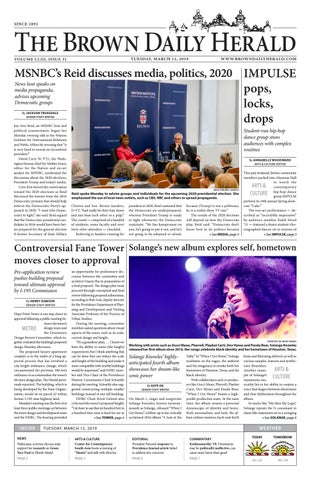
Reid spoke Monday to advise groups and individuals for the upcoming 2020 presidential election. She emphasized the use of local news outlets, such as CBS, NBC and others to spread propaganda. Clinton and Sen. Bernie Sanders, D-VT, “had really let their hair down and just beat each other to a pulp.” The crowd — comprised of a handful of students, some faculty and over forty other attendees — chuckled. Referring to Sanders running for
president in 2020, Reid cautioned that the Democrats are underprepared, whereas President Trump is ready to fight whomever the Democrats nominate. “He has kompromat on you, he’s going to put it out, and he’s not going to be ashamed or afraid,
because (Trump) is not a politician, he is a reality show TV star.” The results of the 2020 elections will depend on how the Democrats play, Reid said. “Democrats don’t know how to do politics because » See MEDIA, page 3
This past weekend, Brown community members packed into Alumnae Hall to watch the contemporary hip-hop dance group IMPULSE perform its 16th annual Spring showcase “Cake.” The two-act performance — described as “incredibly impressive” by audience member Kaleb Hood ’21 — featured a dozen student-choreographed dances set to remixes of » See IMPULSE, page 3
ARTS & CULTURE
Controversial Fane Tower Solange’s new album explores self, hometown moves closer to approval Pre-application review pushes building proposal toward ultimate approval by I-195 Commission By HENRY DAWSON SENIOR STAFF WRITER
Hope Point Tower is one step closer to approval following a public meeting between the tower’s design team and the Downtown Design Review Committee, which together evaluated the building’s proposed design Monday afternoon. The proposed luxury apartment complex is in the midst of a long approval process that has involved a city height ordinance change, which circumvented the previous 100-foot ordinance to accommodate the tower’s 46-story design plan, The Herald previously reported. The building, which is being developed by the Fane Organization, would sit on parcel 42 within former I-195 state highway land. Monday’s meeting was the first of at least three public meetings set between the tower design and development team and the DDRC. The hearing provided
METRO
INSIDE
an opportunity for preliminary discourse between the committee and architect Gianni Ria in preparation of a final proposal. The design plan must proceed through conceptual and final review following proposal submission, according to Bob Azar, deputy director for the Providence Department of Planning and Development and Visiting Associate Professor of the Practice of Urban Studies. During the meeting, committee members asked questions about visual aspects of the tower, such as its scale, current design and height. “It’s a grandiose plan. … I know we have the ability to waive (the height) requirement, but I think anything that can be done that can reduce the scale and height of the building and make it more compatible with nearby buildings would be important,” said DDRC member and Vice-Chair of the Providence Historic Commission Clark Schoettle during the meeting. Schoettle also suggested constructing multiple smaller buildings instead of one tall building. DDRC Chair Kristi Gelnett also criticized the tower’s proposed height: “I do have to say that six hundred feet in a hundred-foot zone is hard for me to » See TOWER, page 4
COURTESY OF NEON TOMMY
Working with arists such as Gucci Mane, Pharrell, Playboi Carti, Dev Hynes and Panda Bear, Solange Knowles released her first album since 2016. Her songs celebrate black identity and her hometown of Houston, Texas.
Solange Knowles’ highlyanticipated fourth album showcases her dream-like sonic power By KATE OK SENIOR STAFF WRITER
On March 1, singer and songwriter Solange Knowles, known mononymously as Solange, released “When I Get Home,” a follow-up to her critically acclaimed 2016 album “A Seat at the
Table.” In “When I Get Home,” Solange meditates on the vague, the ambient and the imaginary to invoke both her hometown of Houston, Texas, and the black identity. With collaborators and co-producers like Gucci Mane, Pharrell, Playboi Carti, Dev Hynes and Panda Bear, “When I Get Home” boasts a highprofile production team. At the same time, the album weaves a personal dreamscape of identity and home. Both minimalistic and lush, the album utilizes mantras, back-and-forth
ARTS & CULTURE
WEATHER
TUESDAY, MARCH 12, 2019
NEWS
beats and liberating delivery as well as various samples, features and synthesizer flourishes. Another example of Solange’s oxymoronic musicality lies in her ability to conjure a voice that lingers between elusiveness and clear deliberation throughout the album. In tracks like “My Skin My Logo,” Solange repeats the G consonant in chant-like statements set to a swinging » See SOLANGE, page 4
Politicians, activists discuss state support for research on Green New Deal in Rhode Island
ARTS & CULTURE Center for Contemporary South Asia hosts screening of “Manto” and talk with director
EDITORIAL President Paxson’s response to Providence Journal article failed to address key concerns
COMMENTARY Krishnamurthy ’19: Divestment may be politically ineffective, can cause more harm than good
PAGE 2
PAGE 3
PAGE 6
PAGE 7
TODAY
TOMORROW
43 / 23
44 / 34
ARTS & CULTURE PAGE 2 • TUESDAY, MARCH 12, 2019
THE BROWN DAILY HERALD
Nandita Das shares motivation behind ‘Manto’ biopic Screening, discussions with director investigate issues of identity, humanity, violence By GRAYSON LEE SENIOR STAFF WRITER
“A story humanizes the other. … Suddenly you see that unknown, and it’s a person,” said Nandita Das, director and writer of the 2018 biopic “Manto,” last Thursday evening at the Center for Contemporary South Asia’s screening of the film. At the event, Das discussed questions of truth, identity and artistic expression relating to “Manto,” which follows Urdu writer Saadat Hasan Manto in the years surrounding the partition of India and Pakistan. Leela Gandhi, interim director of CCSA, introduced Das as “an artist of tremendous conscience and conviction,” highlighting Das’ directional work in addition to her acting roles in over 40 films. Along with her numerous awards, Das became the first Indian to be inducted into the Hall of Fame of the International Women’s Forum. According to Gandhi, “Manto” follows many of the themes of Das’ earlier work
ARTS & CULTURE
around gender, hyper-nationalism and violence. The first half of “Manto” takes place in Bombay (now Mumbai) in 1946. Manto, a non-practicing Muslim, works as a scriptwriter in the film industry, where he has established a network of friends, both Hindu and Muslim. Manto also writes short stories, columns and essays for various other publications. After India gains independence, and India and Pakistan are partitioned in 1947, the film follows Manto as he decides to move to Pakistan because of HinduMuslim tensions. Following his move to Pakistan, Manto encounters turbulence in both his personal and professional life. The plot of the film concludes with his departure for rehabilitation. The final scene of the film after Manto’s departure shows one of his short stories, “Toba Tek Singh.” Four of Manto’s other short stories punctuate the film, engaging with issues of gender, prostitution and violence. Another of the short stories depicted, “Thanda Gosht,” which translates to “Cold Meat” in English, allows the audience to better understand the charges of obscenity that led to Manto’s trial in the second half of the film. All of the short stories frame and provide further insight into the main story line through Manto’s writing. Lakshmi Padmanabhan AM ’14
PhD ’18, junior fellow at the Dartmouth Society of Fellows, moderated the discussions with Das before and after the screening. She remarked that the film “blends different kinds of truth” in its efforts to portray Manto’s stories, narrate him as a character and stay authentic to the time period. Das explained that films often blur the lines between fiction and non-fiction; for example, people sometimes attribute quotes from her script to the historical individual of Manto, she said. “I put words in Manto’s mouth, but I have a feeling he’s going to forgive me,” said Das. Identity develops as a major theme throughout “Manto,” initially drawing Das to Manto’s story and ultimately allowing her to “engage with the issue of identity without making it didactic,” she said. Manto’s identity as a Muslim, even a non-practicing one, shapes much of the story in the film. At Monday’s event, Das expressed her frustration with the ways that divisive politics polarize and thrust identities upon people. In Manto’s writing, she continued, he discusses identity by talking about humanity. “In many of Manto’s stories, you can interchange the religion, and it wouldn’t change anything because they are really about human beings,” Das said. Das described her vision for the film as a response to issues of identity, humanity and violence. She continued to
GRAYSON LEE / HERALD
Nandita Das and Lakshmi Padmanabhan PhD ’18 discussed “Manto,” which follows a controversial writer amid the partition of India and Pakistan. explain how, in all of her work, she is motivated by the message over form. For Das, art functions as a means to an end, and she feels compelled to tell the truth, like Manto, she said. Another theme that resonated deeply with Das in the story of Manto was that of artistic expression. Das mentioned her experiences
with censorship committees and described the pressures that people face not only with official censors but also with “other elements that have taken it upon themselves to be the censor, … the self-proclaimed custodians of culture who are telling us what to wear, what to eat, what to watch,” she said.
Seminar sparks discourse on decolonizing museums Academics discuss methods for restitution, reparation of African art in Western museums By EMILY TENG SENIOR STAFF WRITER
University community members packed the Joukowsky Forum last Wednesday to atte nd “D e colonizing the Mu s e u m : A Teach in,” which saw academics and University-affiliated museum directors give lectures on Felwin Sarr and Bénédicte Savoy’s report to the French government that addressed “the nature and future of looted art held in public museum,” according to a press release for the event. The event specifically focused on the restitution of African cultural heritages to the continent. Organized by Ariella Azoulay, a professor of comparative literature and modern culture and media, Yannis Hamilakis, a professor of archaeology and modern greek studies and Vazira Zamindar, an associate professor of history, the event featured 14 lectures. Speakers presented their unique perspectives on the report and its implications for museum practices. Released November 2018, the report criticizes the French government for looting art from sub-saharan Africa and offers methods to return the items to their original homes. “This report should not only be read, it should also be used to engage with existing claims, to initiate others and to negotiate people’s rights to and in objects,” Azoulay said in her
ARTS & CULTURE
EMILY TENG / HERALD
Scholars and directors of University-affiliated museums volunteered to share their perspectives on a recent report regarding legal and ethical avenues for the French government to repatriate stolen African art. opening speech. During the event, speakers noted how the report challenges government relationships with objects housed in museums. For instance, Sheila Bonde, a professor of history of art and architecture, said “governments would have to change existing laws and change attitudes toward property.” “Who is authorized to study the legacy (of specific cultures), to tell stories about it, to make art about these issues? These questions are embedded in art historical practice,” she added. Itohan Osayimwese, a professor of history of art and architecture, spoke
about an ancestral shrine from Benin City, Nigeria and further advocated for the restitution and repatriation of stolen art from African countries. “Reliance on foreign expertise limits the potential that academic scholarship on African art can contribute productively to local African knowledge of these histories and the heritage,” she said. Q&A sessions were offered between lectures, and many evolved into lively conversations about privilege, reparative measures and methods to initiate dialogue between Western institutions and “claimant groups,” or groups of people whose objects were plundered
by imperial powers. The event was part of the Pembroke Research Seminar, a research opportunity where University faculty members, postdoctoral fellows and students gather to engage with its annual themes, according the center’s website. This year’s theme touches on human rights and imperial origins. Pembroke faculty fellows, Azoulay, Hamilakis and Zamindar felt inspired to organize the event on the report after it was published last fall. “There was tremendous excitement and energy and we knew we had to have a conversation about the report,” said
Zamindar. While the three organizers hail from different fields, Azoulay said that they have been invested in the question of restitution “separately and together in the last couple of years.” To incorporate more perspectives in the forum, they issued an open call for speakers and received a positive response from the wider academic community, Hamilakis said. While most of the event’s speakers were Universityaffiliated, the Rhode Island School of Design and Yale also sent representatives. Hamilakis emphasized that it was important to include them in the conversation. “The point was not to each echo one shared conclusion, … but to continue the discussion further,” he said. “Deconstructing the Western power structures within the museum is really crucial to the entire issue … (but) we don’t really know what the best way is to achieve these goals. I think this open dialogue between professors and students is really important in kind of trying to create a path or direction in which the museum and the institutions need to go, and how academia can assist in that,” said Brenna Pisanelli GS, a graduate student in the American Studies program and an attendee of the event on Wednesday afternoon. All three organizers expressed hope that this event would advance a conversation around restitution following the report’s publication. “This is not the first instance where such demand for restitution for African heritage has been made. Yet all three us of felt this: The report is an opening and it’s now up to us to generate a conversation, to think together, to mobilize and be able to act together,” Zamindar said.
NEWS
TUESDAY, MARCH 12, 2019 • PAGE 3
THE BROWN DAILY HERALD
State moves to support research on R.I. Green New Deal » IMPULSE, from page 1
CELIA HACK / HERALD
Members of Sunrise Rhode Island, politicians and other activists gathered at the State House in support of a Green New Deal for Rhode Island. House Resolution 5665 would support research on economic, social and environmental progress in the state. A matching Senate resolution will be introduced shortly.
Rhode Island Green New Deal Research Council to gather data for statewide environmental package By ALEX REICE SENIOR STAFF WRITER
Promises of a Green New Deal at the national level trickled down to the Ocean State Thursday, when politicians and community activists alike gathered in the Rhode Island State House to announce plans to research the possibilities for a state Green New Deal. House Resolution 5665, introduced Thursday and sponsored by Rep. Chris Blazejewski, D-Providence, would support research on economic, social and environmental factors to inform a state-wide legislative agenda to address climate change, modeled off of the national proposal of a Green New Deal. A matching Senate resolution will be introduced shortly, said Sen. Louis DiPalma ScM’89 P’08, D-Little Compton, Middletown, Newport
METRO
» MEDIA, from page 1 they think there are rules. And they don’t understand that the Republicans don’t believe in the rules, because they don’t believe in government.” Reid also referenced foreign influence in the 2016 election, suggesting that Russian interference disenfranchised American voters. She called on citizens to stand up for their rights to vote in the face of this new form of manipulation, alluding to Civil Rights and women’s suffrage movements of the past: “We’re willing to fight other Americans to vote, but you’re not willing to fight the Russians?” What’s at stake, according to Reid,
and Tiverton, a sponsor for the Senate resolution. If passed, the Council must provide the information found through its study to the legislature by May 15, said Michael Roles, project manager of Rhode Island Green New Deal Research Council. The Council, funded by the University’s Climate and Development Lab, plans to conduct the research regardless of whether or not the resolution passes, DiPalma said. The resolution would signal that the legislature understands and appreciates the study and “wants to see the results,” he added. Through studying existing data and employing activists on the ground to gather information relating to how people “interact with various parts of the economy,” the Council hopes to provide information on what Rhode Islanders might need from a Green New Deal to simultaneously address economic, equity and climate concerns in the state. “We’re taking a look at how Green New Deal related ideas would fit within Rhode Island’s economic and social sectors,” Roles said. “The resolution is not an endorsement of the Green New Deal,” but rather connects
the Council’s work of figuring out what a Green New Deal could look like in Rhode Island to decision makers at the state level, he added. The Council is working in tandem with Sunrise Rhode Island, which has been “mobilizing the people power” to move this kind of resolution forward, said Lauren Maunus ‘19, a leader of the Sunrise RI Movement. While the Research Council will focus on data and possible policy formulation, Sunrise will handle much of the community engagement and activism — “making the important noise that needs to happen,” Roles said. Members of Sunrise RI traveled to Washington, D.C. last month to bring attention to national climate change policy and protest Senate Majority Leader Mitch McConnell’s acceptance of fossil fuel money, The Herald previously reported. While there are efforts, spearheaded by Rep. Alexandria Ocasio-Cortez D-NY and Sen. Ed Markey, D-MA, to enact large-scale legislation to address climate change at the national level, some experts believe state-level action is a more realistic first step. “Right now, given the resistance in Washington to
the Green New Deal,” the state of Rhode Island must “work on what we can do here,” said Ken Payne, policy expert and former head of the Office of Energy Resources. “States are the laboratories of democracy,” he added, and “there’s nothing that precludes Rhode Island from ramping up our commitment to renewable energy.” Roles identified two primary vulnerabilities in Rhode Island that he believes a new state-level climate plan could address: rising sea levels as the “Ocean State” and recessions. Rhode Island tends to be the “first to fall into a recession, and the last to climb out of them,” Roles added. While hurricanes and recessions are “inevitable,” a Rhode Island Green New Deal could ensure that the state’s “bottom doesn’t fall out” when they occur by strengthening the economy, Roles said. The state has taken steps to address climate change, so Payne sees the new legislation as “not necessarily new terrain. It’s familiar terrain that needs to be bolstered, amplified, taken to the next level.” Maunus hopes the research will result in policy in 2020.
is “the fundamental idea of America.” “Yes, we’ve had racism and sexism and horrible things in our past, but there’s something about the construction of this particular multiracial democracy that makes it work uniquely in all the world.” Going forward, Reid believes Americans must recognize the injustices of the United States’ past and not “confuse knowledge with … selfindictment.” Reid also discussed the relationship between media and partisanship, referencing a fraction of the country that “will never listen to us” and asserting that “all you can really do is try to explain what’s happening to the
people who are open to hearing it.” While Trump’s base may prefer certain media outlets, Trump himself is familiar with a range of sources. “He used to draw a paycheck from the same people who pay me,” Reid said. “He worked for NBC. He knows how we think. … He understands what we will cover. … He really knows how to manipulate our medium, TV.” In short, Reid added, “He’s a TV guy.” Toward the end of the talk, Reid’s focus turned local. She referenced telecommunications conglomerate Sinclair Broadcasting Group, known for its affiliation with the Trump agenda, and its proliferation
throughout American households. Sinclair Broadcasting owns Channel 10 in Providence and requires pro-Trump, “must-run” segments in the channel’s daily programming, the Providence Journal reported. “The most powerful, influential entity in the media business is not MSNBC, … it’s not CNN, it’s not Fox. It’s local news,” Reid said. “Because you’re getting something as simple as traffic from them, you trust them. … So when that person is telling you propaganda, that’s more dangerous than Fox. … They’re mixing it in with your traffic and weather. They’re in your homes as ABC, as NBC and as CBS.”
well-loved hits by artists like Beyoncé, Ariana Grande and 50 Cent. Founded in 2003, IMPULSE is a 23-member, entirely student-run dance operation. While primarily a hip-hop group, IMPULSE prides itself on incorporating elements of other dance disciplines in its numbers and “encouraging choreographers to share whatever style they’re most comfortable in,” said Megan Gessner ’20, who has been involved with the group since her freshman year. Though the group is known for its intense, multi-round audition process — and several of the current members are interested in dancing professionally — Gessner emphasized that IMPULSE dancers hail from a wide range of experience levels and dance backgrounds. “Some hadn’t danced before coming to Brown or (Rhode Island School of Design), and some were members of Elements before joining IMPULSE,” she said, referencing the IMPULSE-directed educational workshop and performance team that aims to provide Brown and RISD students with a “…collaborative outlet for (those) interested in hip hop dance.” IMPULSE rehearsed for a full year — up to 12 hours a week — to perfect the dance numbers in “Cake,” and it showed. Each mesmerizingly complex number was inspired by a different theme. “Haunted Fem,” choreographed by dancers Carlos Tejada ’22 and Mindy Ng ’19, offered audiences what the program described as a “juxtaposition of spooky and powerful feminist vibez.” “Confidence,” choreographed by Gessner, delivered a masterful exploration of three instances of confidence, “the groundedness that comes from knowledge, wisdom and time, the power that comes from embracing femininity and sensuality and the growth that comes from pain, heartbreak and experience,” according to the show’s accompanying program. Group dances were regularly punctuated by creative interludes like “College Hill” and “40days40nights” — the former a sketch satirizing one RISD group member’s 20-minute commute to College Hill, and the latter a haunting solo performance by Eve Zelickson ’19 replete with fastpaced pops and body isolation moves. On Friday and Saturday night, members of Elements performed dances they honed in a 5-week performance workshop directed by IMPULSE members Ng, Tafari Williams ’20 and Nkemdilim Ugwu ’20. “As the years go on, I feel like they try to make it more and more inclusive, both in the number of people they recruit and the support they give us, which is really nice,” said Celina Sun ‘20, a Herald copy-editor and post- managing editor for narrative who has been involved with Elements since her freshman year. Gessner also emphasized IMPULSE’s culture of support and inclusivity. “Our seniors and upperclassmen have been carrying on the tradition that they learned from those who came before them — bringing in the newbies and creating a really supportive environment. I’m really going to miss our seniors, it’s their last show and they made my experience on IMPULSE really special,” she said.
NEWS
PAGE 4 • TUESDAY, MARCH 12, 2019
THE BROWN DAILY HERALD
» SOLANGE, from page 1
HENRY DAWSON / HERALD
The Downtown Design Review Committee met with Fane Tower’s lead designer on Monday for a pre-approval review of the building proposal.
» TOWER, from page 1 swallow, and it’s way too tall for the location. … If it does happen, I would like it to be not such a complete departure from the character of the city itself.” When asked if a market study had been performed to evaluate demand for the building, Ria responded that his “responsibility was to provide a building that has enough flexibility to be successful without designing for a single market.”
Since the DDRC meets monthly, Fane must finalize its design proposal within the next month or risk waiting longer for the Committee’s final decision. But the DDRC’s decision is only advisory, as the proposed site of the tower is also on land overseen by the state-run I-195 Commission. Following design review, the Committee will make a recommendation to the I-195 Commission, which, under special state-legislative privileges, has the final say over the tower’s design.
While there was no time allotted Monday for public comment, dozens of people attended the meeting, including President of the Fane Organization Jason Fane. Charles Denby, who is involved with the Avenue Concept, a Providence non-profit that creates outdoor and public art, attended with a cardboard sign reading: “Out of Place, Out of Scale, Out of Character.” The next DDRC meeting is scheduled for April 8.
beat. As Gucci Mane interweaves short phrases with Solange’s rhythmic lines, the track becomes a sublime soundscape that draws the listener into the image of Houston she creates throughout her album. The repetition, resembling a broken record, drills Solange’s message about branding and materialism as it relates to identity into the listener’s memory. In the fan favorite track “Almeda,” named after a location in Houston, Solange elaborates more on the concepts of familiarity and self through her lyrics. Solange casually sings “brown skin, brown face / brown leather, brown sugar… / black skin, black braids / black waves, black days.” Accompanied by the lax, freeflowing verses of Playboi Carti and The-Dream, the artists’ sounds meld into an intricate artistry, illustrating a stylistic homage to Houston rap and an acclaim to black identity. Solange’s creative prowess in cultivating a complete album is further exemplified in the seamless interludes interspersed throughout the album. In the leading track, “Things I Imagined,” Solange introduces the gray area
between the Houston of her memory and that of reality by repeating “I saw things I imagined.” Following immediately, “S McGregor (interlude)” references a Houston street while sampling a well-known reading of the poem “On Status” by Vivian Ayers-Allen, a Pulitzer prize-nominated black woman poet from Houston. These snippets of spoken word, voiced by Ayers-Allen’s daughters Phylicia Rashad and Debbie Allen, masterfully paint Solange’s personal Houston in a way that allows her home to seem familiar to listeners. The sketch of Houston that Solange paints through her transcendent lyrics and surreal sound is simultaneously ambiguous and exact. Bare voice and 90s-esque beats characterize the singer-songwriter’s mastery in evoking human memory through music. Perhaps Solange best describes the multi-layered sonic space of her album in “Can I Hold The Mic (interlude),” during which she confidently states to the listener: “I can’t be a singular expression of myself / there’s too many parts, too many spaces / too many manifestations, too many lines / too many curves / too many troubles / too many journeys, too many mountains / too many rivers, so many.”
The Presidential Faculty Award Lecture
March 19, 2019 4:30 p.m. John Carter Brown Library Professor of Computer Science, Co-director of the Humanity Centered Robotics Initiative
Michael L. Littman will deliver the Presidential Faculty Award Lecture
Making Machines That Can Behave in the Real World
Want daily headlines or weekly Brown Bites in your inbox? linktr.ee/browndailyherald
TODAY
TUESDAY, MARCH 12, 2019 • PAGE 5
THE BROWN DAILY HERALD
sudoku
still here with a powerful story
RELEASE DATE– Wednesday, October 30, 2013
Los Angeles Times Puzzle c r o sDaily s w oCrossword rd Edited by Rich Norris and Joyce Nichols Lewis
ACROSS 1 Big name in big trucks 5 Gunk 9 TVʼs Dick Van __ 13 When doubled, a Northwest city 14 Give a makeover 15 Line holder 16 Home sound system 18 Texts: Abbr. 19 Decline from disuse 20 Some Beethoven works 22 “Veni, vidi, vici” man 23 Memorable “Rocky” line 26 Little Leaguer, say 27 Automated intro? 29 __ del Fuego 30 Stay a step ahead of 32 Many millennia 33 Eloquent 38 “__ baby!” 39 Zapped 40 Rapper who played Left Ear in “The Italian Job” 43 Software test version 44 Agnus __ 47 Reason to pile onto the team bus 49 Promoting 51 Botanistʼs study 52 Nostalgic souvenir 53 River in a 1957 Best Picture title 55 Hero whose catchphrase begins 16-, 23-, 33- and 47Across 57 Work on, as a popsicle 58 Q.E.D. part 59 Levels 60 Tiny arachnid 61 “Gadzooks!” 62 Puts the kibosh on
DOWN 1 Fruity cocktail 2 Butler in the Batcave 3 Awards for ads 4 “How Life Imitates Chess” author Garry 5 Earl with a tea 6 Above, to Keats 7 Start of some Keats titles 8 Having little talent for 9 H.G. Wellsʼ island physiologist 10 “Darn tootinʼ!” 11 Small cask 12 Golf star Ernie 13 Off, in mobspeak 17 Royal seat 21 Exiled Amin 23 Google-owned video site 24 Yank since 2004 25 Bert Bobbseyʼs sis 28 Hot-sounding European capital 31 Elbow
33 Tuck away 34 “Iʼve got proof!” 35 Elegantly feminine 36 Infernal 37 Greeting from Down Under 38 Physiciansʼ org. 41 Id controller 42 Chris of “Tommy Boy” 44 Dented
45 Keys in 46 Stravinsky and Sikorsky 48 Native New Zealander 50 Enclose, as pigs 52 Parcel (out) 53 Airline to Amsterdam 54 Xbox 360 competitor 56 Quick snooze
xwordeditor@aol.com
10/30/13
ANSWER TO PREVIOUS PUZZLE:
ROSLYN CORIZ / HERALD
Flowers bloom on a building in downtown Providence, where the mural titled “Still Here” highlights the story of the Narrangansett people. The portrait of two women remind residents of the tribe’s history.
Q U O T E O F T H E D AY
“Many in the United States ... feel like the chorus on an ancient Greek stage, watching in horror as the
”
protagonist marches inexorably towards tragedies.
— Chas W. Freeman Jr., former acting assistant secretary of state for African Affairs, By Jeff Chen (c)2013 Tribune Content Agency, LLC
See freeman on page 6.
10/30/13
m o d e r n a r c h a e o lo g y
calendar TODAY Panting Your 3D model 12:00 P.M. Rockefeller Library
Coffee & Conversations with the Deans 1:00 P.M. 121 South Main Street
Houria Bouteldja & Samia Henni 4:00 P.M. Pembroke Hall
Reading: Ulf Stolterfoht 7:00 P.M. McCormack Family Theater
TOMORROW Assertive Speaking 9:00 A.M. South Street Landing
Law School Info Panel 12:00 P.M. Watson Institute
Brown Bag Presentation 12:00 P.M. 121 South Main Street
Artist Talk: Cecilia Vicuna 5:00 P.M. List Art Building
Enjoying this free paper? Support The Herald RÉMY POISSON
www.browndailyherald.com/donate
NEWS
PAGE 6 • TUESDAY, MARCH 12, 2019
THE BROWN DAILY HERALD
Former U.S. ambassador argues for foreign policy change in Middle East Freeman discredits popular justifications for intervention, criticizes U.S. relationship to Israel By KAMRAN KING SENIOR STAFF WRITER
When the United States implements ineffective foreign policy, the government instinctually pushes more resources and energy toward that failing policy, a tendency that has proven detrimental in the Middle East, said Chas Freeman Jr., former acting assistant secretary of state for African affairs and former ambassador to Saudi Arabia, in a lecture at the University Monday. His talk, “Order in Turmoil: Making Sense of Kaleidoscopic Change in the Middle East,” focused on the ramifications of U.S. foreign policy in the region and ways the policy should change in the future. During the event, Freeman, who is also the former U.S. assistant secretary of defense and a senior fellow at the Watson Institute for International and Public Affairs, called for policies that better address and protect the United States’ interests in the Middle East than those currently in place. Specifically, Freeman urged recognition of America’s diminishing stake and influence in the region and espoused using the military to support diplomacy. As factors challenging the United States’ involvement in the Middle East, Freeman cited the United States’ waning reliance on Middle Eastern oil, growing popular dissatisfaction with its intervention in the region and the total failure of counterterrorism efforts. For instance, Freeman argued that the United States no longer needs to rely on Middle Eastern support to meet domestic oil demand, as U.S. oil and gas production and oil reserves from the northern hemisphere and western Africa could instead meet domestic need. In recent years, public support
for strong U.S. intervention in the region has also declined, Freeman said. “Americans view both Israel and Saudi Arabia with increasing distaste” and their ability to “buy support in Congress … does not buy such approval” more broadly, he added. While speaking about the weaknesses of the United States’ involvement in the Middle East, Freeman pointed out the flaws in U.S. strategies for tackling terrorism in the region. The United States’ tactics are “based on the dubious theory that the best way to avoid being stung by hornets is to saddle up to their nest and poke them,” he said. “Current U.S. policies … prolong wars, disturb its and other nations’ domestic tranquility (and) corrupt the rule of law.” Along with its decreasing economic stake in the region, the United States’ political influence has declined significantly, Freeman said. “Most countries in West Asia and North Africa no longer see much reason to defer to foreign nations,” he said. Therefore, the United States should “seek to leverage the diverse players in the region, not proceed unilaterally.” In order to accomplish our goals, “American diplomacy must be redesigned … by joining our capabilities with others’ capabilities,” Freeman said. The United States “should be talking to all parties” in the region, “not labeling some and ruling out dialogue with them, as we’ve done with Hamas, Hezbollah and Iran,” he said. “Without talking to Iran, the United States can constrain neither its nuclear program nor its politics,” he added. Freeman also discussed the U.S. government’s habitual reliance on military action, as well as what he called its ineffective use of diplomacy. “Our military should support our diplomacy, not the other way around,” he said. Freeman also critiqued the United States’ individual diplomatic relationships with Israel, Saudi Arabia and the United Arab Emirates. As Saudi Arabia and the UAE have aligned with Israel
COURTESY OF BROWN UNIVERSITY
Former acting assistant secretary of state for African affairs and former ambassador to Saudi Arabia discussed the ramifications of U.S. foreign policy in the Middle East, highlighting challenges to U.S. involvement in the region. against Iran, these Gulf states have capitalized on the power of pro-Israel lobbyists in American politics, he said. In addition, Freedman said that the United States’ support of Israel, Saudi Arabia and the UAE “has facilitated a series of unspeakable humanitarian disasters in West Asia, including Israel’s quasi-genocidal siege of Gaza, the multi-national vivisection of Syria and the devastation of Yemen.” Vera Old, one of the event’s attendees, said she had heard Freeman speak over a decade prior and was particularly
Find us online! facebook.com/browndailyherald
browndailyherald.com
@the_herald
Location: 195 Angell St., Providence, R.I. www.browndailyherald.com
@browndailyherald
youtube.com/browndailyherald
Editorial Leadership
Sections
Multimedia & Production
Business
Editor-in-Chief Emily Davies
Arts & Culture Editors Elise Ryan Annabelle Woodward
Design Editors Kyle Cui Bilal Ismail Ahmed Dylan Tian Julie Wang
General Managers Ravi Betzig Nicholas Masiakowski
Managing Editors Anna Kramer Priyanka Podugu Senior Editors Anita Sheih Sarah Wang
Metro Editors Colleen Cronin Sophie Culpepper Celia Hack
Editorial Page Editors Grace Layer Krista Stapleford
News Editors Katherine Bennett Jacob Lockwood Melanie Pincus Allie Reed
post- magazine Editor-in-Chief Anita Sheih
Science & Research Editors Cate Ryan Chris Schutte Sports Editors Alexandra Russell Alex Smolar COMMENTARY Opinions Editors Rebecca Aman Emily Miller Derek Simshauser
Head Photo Editors Tiffany Ding Benjamin Turuño Copy Desk Chief Kelley Tackett Illustrations Editor Daphne Zhao Video Editor Victoria Caruso Max Dekle Graphics Editor Sarah Martinez
interested in his lecture because she had lived in the Middle East. Although she felt “overwhelmed and pessimistic about the future because it looks more and more complicated as we are connected by modern social technologies,” she thought the talk effectively covered lots of information in a short time period. Edward Steinfeld P’20, director of the Watson Institute, commented on Freeman’s ability to discuss difficult topics in a productive way. “It is … a statement about the kind of people
Office Manager Diane Silvia Directors Sales: Bersabel Yifru Finance: Rudra Srivastava, Reynaldo Blandon Strategy: Edwin Farley
in this community, the kind of learning that goes on and strong statements that are made, but also the willingness to exchange ideas in a civil and civic fashion.” In closing, Freeman said that current foreign policy practices are “severely eroding American moral standing.” Right now, “many in the United States have started to feel like the chorus on an ancient Greek stage, watching in horror as the protagonist marches inexorably towards tragedies they cannot foresee,” he said.
Editorial contact: 401-351-3372 herald@browndailyherald.com
Advertising contact: 401-351-3372 advertising@browndailyherald.com
Submissions: The Brown Daily Herald publishes submissions in the form of op-eds and letters to the editor. Op-eds are typically between 750 and 1000 words, though we will consider submissions between 500 and 1200 words. Letters to the editor should be around 250 words. While letters to the editor respond to an article or column that has appeared in The Herald, op-eds usually prompt new discussions on campus or frame new arguments about current discourse. All submissions to The Herald cannot have been previously published elsewhere (in print or online — including personal blogs and social media), and they must be exclusive to The Herald. Submissions must include no more than two individual authors. If there are more than two original authors, The Herald can acknowledge the authors in a statement at the end of the letter or op-ed, but the byline can only include up to two names. The Herald will not publish submissions authored by groups. The Herald does not publish anonymous submissions. If you feel your circumstances prevent you from submitting an op-ed or letter with your name, please email herald@browndailyherald.com to explain your situation. You can submit op-eds to opinions@browndailyherald.com and letters to letters@browndailyherald.com. When you email your submission, please include (1) your full name, (2) an evening or mobile phone number in case your submission is chosen for publication and (3) any affiliation with Brown University or any institution or organization relevant to the content of your submission. Please send in submissions at least 24 hours in advance of your desired publication date. The Herald only publishes submissions while it is in print. The Herald reserves the right to edit all submissions. If your piece is considered for publication, an editor will contact you to discuss potential changes to your submission. Commentary: The editorial is the majority opinion of the editorial page board of The Brown Daily Herald. The editorial viewpoint does not necessarily reflect the views of The Brown Daily Herald, Inc. Columns, letters and comics reflect the opinions of their authors only. Corrections: The Brown Daily Herald is committed to providing the Brown University community with the most accurate information possible. Corrections may be submitted up to seven calendar days after publication. Advertising: The Brown Daily Herald, Inc. reserves the right to accept or decline any advertisement at its discretion. The Brown Daily Herald, Inc. is a financially independent, nonprofit media organization bringing you The Brown Daily Herald, BlogDailyHerald and Post- Magazine. The Brown Daily Herald has served the Brown University community daily since 1891. It is published Monday through Friday during the academic year, excluding vacations, once during Commencement and once during Orientation by The Brown Daily Herald, Inc. Single copy free for each member of the community. Subscription prices: $200 one year daily, $100 one semester daily. Copyright 2019 by The Brown Daily Herald, Inc. All rights reserved. Periodicals postage paid at Providence, R.I. Postmaster: Please send corrections to P.O. Box 2538, Providence, RI 02906.
COMMENTARY TUESDAY, MARCH 12, 2019 • PAGE 7
THE BROWN DAILY HERALD
Divestment has severe costs — and nobody is talking about them ANUJ KRISHNAMURTHY staff columnist Last week, the Undergraduate Council of Students agreed to include in its March elections ballot a referendum asking students if the University should divest from corporations purportedly “complicit in human rights abuses in Palestine” and subject the endowment to greater transparency and student oversight. The coalition of students responsible for the referendum, Brown Divest, opposes the “University’s investment in the disenfranchisement, displacement and death of Palestinians,” per its statement of demands. This effort to imbue the University’s investment philosophy with moral and ethical considerations is certainly noble and well intentioned. I believe fully in the importance of standing up for human rights and international law, and agree that identifying specific instances of injustice is essential to combating injustice everywhere. But it is not clear that Brown Divest has reckoned with the enormous opportunity costs of divestment, should their demands be formally adopted. Irrespective of one’s views on Israel — I’m not taking a position here — divestment is extremely expensive in foregone investment returns, enacts virtually no material improvement in the lives of Palestinians and seriously undermines the University’s financial well-being. Let’s first be very clear: Divesting from public companies involved in the repression of Palestinians, or any social ill, will not actually hurt those companies. A single institutional investor like Brown selling shares in a public company will not drive that company’s share prices down. Some other investor, perhaps one with fewer moral reservations, will immediately snap up those same shares. Furthermore, stocks are sold on the secondary market; when an investor purchases a company’s stock, the proceeds of that sale go to the current owner of that stock, not the company itself. As a result, forcing Brown’s endowment to sell off shares in highly profitable businesses, without inflicting any meaningful pressure on those businesses, amounts to pointless self-flagellation. And the companies singled out by Brown Divest, like Motorola and Boeing, belong to profitable industries that generate attractive returns for shareholders. According to the MSCI World Aerospace and Defense Index, defense and aerospace corpo-
rations boast a 5-year annualized return of 14.13 percent, compared to the 6.53 percent return delivered by the whole global stock market. In general, “sin stocks”— shares of companies in industries like alcohol, gaming and tobacco — outperform their more wholesome peers by 2.5 percent per year. This may not sound like much, but as of June 30, 2018, close to $1 billion of the University’s endowment was invested in stocks. If the University has invested just $100 million of its portfolio in sin stocks, a foregone 2.5 percent return would mean forfeiting nearly $2.5 million dollars, enough to cover tuition, housing and other expenses for 33 students. When it comes to preserving the University’s capacity to provide aid and fund academic and extracurricular programming, small differences in asset performance and portfolio diversification matter. The trade-off here is clear: Selling shares
returns are indispensable to the financial viability of the University: Last year, one-sixth of the University’s operating budget came from endowment returns. Maximizing the endowment’s performance becomes all the more urgent in the context of broader macroeconomic forecasts. The Federal Reserve Bank of Cleveland estimates a 30 percent chance of recession in February 2020. During the previous recession, Brown’s endowment plummeted by 26.6 percent. Now is the time for the University to grow the endowment so that it can withstand an imminent downturn, not for students to call for measures that will compromise the endowment’s ability to support the University. Activists often point to South Africa as a shining example of the efficacy of divestment campaigns. In the 1980s and early 1990s, college students across the world demanded that their uni-
Reformulating Brown’s portfolio will not fill Palestinian stomachs; it will not boost Palestinian wages; it will not spare innocent Palestinians from blockades, bulldozers and bullets. in profitable companies might make us feel better about ourselves and our moral footprint in the world, but it won’t make a meaningful difference to the targets of our activism, and it will meaningfully hurt low-income students relying on sustained endowment returns for financial aid. Relatedly, the demand that the University be more transparent about its investments and allow students to monitor them is ill-conceived. First, the University’s professional investment managers should spend their time doing their jobs, evaluating fruitful opportunities and making investments, instead of gathering disparate information on the social and moral soundness of the thousands of companies in which the endowment is invested. Second, portfolio managers cautiously safeguard the specifics of their investments to maintain their competitive advantage over other investors also seeking profitable opportunities. If the University shared its investments publicly, competitors could easily replicate them, eroding the return potential for those opportunities. Proponents of divestment might argue that even purely symbolic support for human rights outweighs a cold and calculating emphasis on Brown’s endowment performance. As I briefly mentioned earlier, however, healthy endowment
versities divest from companies doing business in South Africa, and more than 150 institutions of higher education complied. By 1994, following years of student activism, international condemnation and grassroots political mobilization, the story goes, Nelson Mandela won the presidency of South Africa and state-sanctioned apartheid ended. But the facts of divestment do not match this neat narrative. Evidence suggests that pressure from shareholders and legislators seeking to bar investments in South African firms had little effect on the valuations of those firms and the country’s financial markets. There is, in fact, substantial debate about what precise role divestment played in shifting public opinion about South Africa. Instead of assailing the University’s investments, Brown Divest could better advance its agenda by focusing on Rhode Island’s elected leaders, who have enthusiastically voted for increased aid and arms transfers to Israel. In 2016, R.I. Congressman David Cicilline ’83 introduced a bill that promotes cybersecurity cooperation between Israel and the United States and cosponsored a 2017 bill that would allow state and local governments to cease doing business with entities engaged in boycott, divestment and sanctions-related activities. (Neither bill has become law yet.)
In 2016, R.I. Congressman Jim Langevin sponsored the United States-Israel Advanced Research Partnership Act, now a law, that encourages coordinated homeland security and counterterrorism research. More recently, in early February, R.I. Senator Sheldon Whitehouse voted for a Senate measure that would bolster defense assistance to Israel, among other security initiatives. Changing the minds of Cicilline, Langevin and Whitehouse, in light of their voting records, should be the real objective of student activists critical of Israel. Even local legislators have jumped on the Israel bandwagon: In 2018, Rhode Island’s House of Representatives passed a resolution reaffirming the “bonds of friendship and cooperation which have existed between Rhode Island, the United States, and Israel for the past 70 years.” My point here is not that divestment campaigns can never do good. In practice, though, they’re exceedingly costly, both for the potential performance of Brown’s endowment and for the students who must expend large sums of time and energy to advance them. Activists promoting divestment must squarely confront the strategy’s limitations as a means of reforming corporate behavior. In reality, divestment works optimally in tandem with concrete demands for changes in policy. Given the avid fondness for Israel exhibited by Rhode Island’s congressional and local representatives, it makes vastly more sense for critics of Israel to devote their time and energy to changing the minds of legislators, not to reshaping Brown’s investment philosophy. Reformulating Brown’s portfolio will not fill Palestinian stomachs; it will not boost Palestinian wages; it will not spare innocent Palestinians from blockades, bulldozers and bullets. But it will hurt low-income, marginalized students dependent on endowment returns for financial aid and the University’s ability to carry out its educational mission.
Anuj Krishnamurthy ’19 has written this piece in a personal capacity, and his views do not represent those of the Elections Board of the Undergraduate Council of Students, of which he is a member. He can be reached at anuj_krishnamurthy@brown. edu. Please send responses to this opinion to letters@browndailyherald.com and other op-eds to opinions@browndailyherald. com.
EDITORIAL
Toward more equitable and inclusive donor-student relations On Feb. 24, the Providence Journal published an article by student journalists exposing exclusive dinners hosted by trustee emeritus and major University donor Marty Granoff P’83 and facilitated by University administrators in the Advancement Office. The news unsettled many students and prompted conversations around campus about privilege at Brown. Two days later, President Christina Paxson P’19 published the University’s response to the story in a letter to the Journal. Paxson denied knowledge of the University’s involvement in supporting the dinners and questioned the reporting’s validity. Paxson also wrote that University logistical aid for these dinners will not continue. While we support the University’s decision to end official involvement in these dinners and appreciate the generous funding of donors, we view the Advancement office’s original affiliation as a practice that is inherently contrary to Brown’s expressed value of advancing equity. Rather than critically analyzing
the relationship between donors and students and suggesting alternative avenues for more inclusive student-donor interaction, the University’s response only exacerbates the problem, leaving Brown community members unsure of the role donors play in the overall framework of this institution. We acknowledge that the Granoff dinners are not a new phenomenon and are part of a larger pattern of behavior that privileges the wealthy. But just because these dinners are not surprising does not mean they are not harmful. Exclusive events have occurred at Brown and institutions like it for generations, situating privileged students apart from their peers and further isolating first generation or low-income students from accessing the same opportunities. While donors will likely continue to hold private events, it is inappropriate for the Advancement office to provide the logistical support to facilitate them, excluding students in the process. Paxson’s letter ending official University support for these events was an
essential step toward breaking down an inherently elitist structure. Nonetheless, we were disappointed with the response. It did not adequately address the concerns of many students who felt harmed by these events and did not provide constructive solutions to move forward. For instance, while Paxson mentions the University’s legitimate efforts to support firstgeneration and/or low-income students in her letter, she neglects to recognize that the University must also work to diminish the exclusivity and elitism that exist on campus. In addition, the response fails to acknowledge that the student reporters provided the community with an important opportunity for reflection. Instead, Paxson focused on critiquing the reporting for containing “no data or facts,” without mentioning that the student reporters made a concerted effort to contact her before the story’s publication, as Executive Editor of the ProJo Alan Rosenberg asserts. While the story might contain flaws, the students still illuminated a problematic activity
that the University facilitated, which the President then publicly devalued through her letter. All this being said, we cannot overstate our appreciation for donors’ generosity. Their dedication to the University has benefited generations of Brunonians through funds for scholarships and essential infrastructure, such as the Perry and Marty Granoff Center for the Creative Arts. We see potential for the University to create alternative events to engage donors with the entire student population, which could preserve the positive aspects of donor involvement with the University without perpetuating exclusivity. Rather than providing opportunities for donors to connect with wealthy students, the University could facilitate events open to any students, such as meet and greets at various venues on College Hill. These gatherings, which would replace events like the Granoff dinners, could be advertised to all students through avenues like Today@Brown. By hosting more transparent, open events, the University would allow donors to
interact with students of all backgrounds who make incredible contributions to this campus. While we are glad the University has ended its official support for the Granoff dinners, Paxson’s letter reflects the University’s lack of understanding of the inherent problem in hosting events such as these. The University has an obligation to acknowledge the implications of its involvement with the Granoff dinners and respond by rethinking the framework faciliting student-donor interactions. In doing so, the University can correct the contradiction that currently exists between its statements on equity and the actions it supports. We hope these changes can create a more inclusive campus in all aspects of student life. Editorials are written by The Herald’s editorial page board: its editors, Grace Layer ’20 and Krista Stapleford ’21, and its members, Elisheva Goldberg ’22, Eduard Muñoz-Suñé ’20 and Riley Pestorius ’21. Send comments to editorials@ browndailyherald.com.
The Rise of China: Past, Present and Future Featuring: James W. Head III Louis and Elizabeth Scherck Distinguished Professor of the Geological Sciences
Rebecca A. Nedostup Associate Professor of History
Edward S. Steinfeld Dean’s Professor of China Studies Director of the China Initiative, Howard R. Swearer Director of the Thomas J. Watson Institute for International and Public Affairs
Tongzhang Zheng Professor of Epidemiology
Moderated By: Richard M. Locke Provost
Monday, March 18, 2019, at 5 p.m. To request special services, accommodations or assistance for this event, please contact the University Event & Conference Services Office at universityevents@brown.edu or 401-863-3100
Watson Institute for International and Public Affairs Stephen Robert ’62 Hall, Room 101 280 Brook Street Reception to Follow
Building on Distinction: Integrative Scholarship at Brown Featuring the Watson Institute for International and Public Affairs