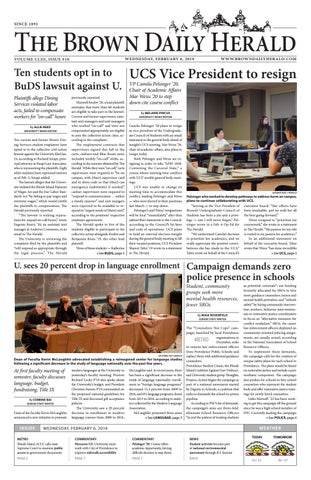
SINCE 1891
THE BROWN DAILY HERALD WEDNESDAY, FEBRUARY 6, 2019
VOLUME CLIII, ISSUE #10
WWW.BROWNDAILYHERALD.COM
Ten students opt in to UCS Vice President to resign Camila Pelsinger ’20, BuDS lawsuit against U. VP Chair of Academic Affairs Plaintiffs allege Dining Services violated labor acts, failed to compensate workers for “on-call” hours By ALLIE REED UNIVERSITY NEWS EDITOR
Ten current and former Brown Dining Services student employees have opted-in to the collective civil action lawsuit against the University filed Jan. 24, according to Richard Sinapi, principal attorney at Sinapi Law Associates, who is representing the plaintiffs. Eight other students have expressed interest as of Feb. 5, Sinapi added. The lawsuit alleges that the University violated the Rhode Island Payment of Wages Act and the Fair Labor Standards Act “by failing to pay wages and overtime wages,” which would entitle the plaintiffs to compensation, The Herald previously reported. “The lawsuit is seeking reparations for unpaid on-call hours,” wrote Eugenie Boury ’20, an assistant unit manager at Andrews Commons, in an email to The Herald. The University is reviewing the complaint filed by the plaintiffs and “will respond as appropriate through the legal process,” The Herald
previously reported. Maxwell Kozlov ’20, a lead plaintiff, estimates that more than 60 students are eligible to take part in the lawsuit. Current and former supervisors, assistant unit managers and unit managers who worked “on-call” and were not compensated appropriately, are eligible to join the collective action class, according to the complaint. The employment contracts that supervisors signed this fall in the carts, cashiers and Blue Room units included weekly “on-call” shifts, according to documents obtained by The Herald. While they were “on call,” carts supervisors were required to “be on campus, with (their) supervisor card and in dress code so that (they) can emergency (substitute) if needed,” cashier supervisors were required to “respond to communication … within a timely manner” and unit mangers were expected to be available to respond to “urgent needs of (their) unit,” according to the positions’ respective employee agreements. The Herald spoke to five of the students eligible to participate in the collective action alongside Kozlov and Benjamin Bosis ’19, the other lead plaintiff. Three of those students — Katherine » See BUDS, page 3
Mar Weiss ’20 to step down cite course conflict By MELANIE PINCUS UNIVERSITY NEWS EDITOR
Camila Pelsinger ’20 plans to resign as vice president of the Undergraduate Council of Students with an email statement to the general body ahead of tonight’s UCS meeting. Mar Weiss ’20, chair of academic affairs, also plans to resign today. Both Pelsinger and Weiss are resigning in order to take “AFRI 1030: Contesting the Carceral State,” a course whose meeting time conflicts with UCS’ weekly general body meetings. UCS was unable to change its meeting time to accommodate this conflict, leading Pelsinger and Weiss — who were elected to their positions last March — to step down. Pelsinger’s and Weiss’ resignations will be final “immediately” after they submit their statements to the Council, according to the Council’s by-laws and code of operations. UCS plans to hold an internal election tonight during the general body meeting to fill their vacated positions, UCS President Shanzé Tahir ’19 wrote in a statement to The Herald.
JASMINE RUIZ / HERALD
Pelsinger who worked to develop pathways to address harm on campus, plans to continue collaborating with UCS. “Serving as the Vice President of executive board. “Her efforts have Brown’s Undergraduate Council of been invaluable, and we wish her all Students has been a joy and a privi- the best going forward.” lege — one I will never forget,” PelWeiss resigned to “prioritize my singer wrote in a Feb. 6 Op-Ed for coursework,” she wrote in a statement The Herald. to The Herald. “My passion for my role “We understand Camila’s decision is rooted in my passion for academics.” to prioritize her academics, and we In an additional statement on really appreciate the positive contri- behalf of the executive board, Tahir butions she has made to the UCS,” wrote that Weiss “has done incredible Tahir wrote on behalf of the Council’s » See UCS, page 3
U. sees 20 percent drop in language enrollment Campaign demands zero
police presence in schools
Student, community groups seek more mental health resources, fewer SROs By MAIA ROSENFELD SENIOR STAFF WRITER
The “Counselors Not Cops” campaign, launched by local Providence organizations in December, seeks to remove law enforcement officers from Providence Public Schools and replace them with additional guidance counselors. Providence Student Union, the Rhode Island Coalition Against Gun Violence, and University student group Thoughts, Prayers, Action began the campaign as part of a national movement started by Dignity in Schools, a coalition that seeks to dismantle the school-to-prison pipeline. According to PSU’s list of demands, the campaign’s aims are three-fold: eliminate School Resource Officers “to end the pattern of treating students
METRO
VICTORIA YIN / HERALD
Dean of Faculty Kevin McLaughlin advocated establishing a reimagined center for language studies following a significant decrease in the study of language nationally over the past few years.
At first faculty meeting of semester, faculty discusses language, budget, fundraising, Title IX By CORRINE BAI SENIOR STAFF WRITER
Dean of the Faculty Kevin McLaughlin announced a new initiative to promote
INSIDE
modern languages at the University in yesterday’s faculty meeting. Provost Richard Locke P’18 also spoke about the University’s budget, and President Christina Paxson P’19 commented on the proposed national guidelines for Title IX and discussed gift acceptance policies. The University saw a 20 percent decrease in enrollment in modern language courses from 2009 to 2018,
McLaughlin said. In recent years, there has been a significant decrease in the study of language nationally: enrollment in “foreign language programs” decreased 15.3 percent from 2009 to 2016, and 651 language programs closed from 2013 to 2016, according to statistics collected by the Modern Language Association. McLaughlin presented three areas » See LANGUAGE, page 3
as potential criminals”; use funding formerly allocated for SROs to hire more guidance counselors, nurses and mental health providers; and “rethink safety” by hiring community intervention workers, behavior interventionists or restorative justice coordinators to focus on “alternative measures for conflict resolution.” SROs, the career law enforcement officers deployed on community-oriented policing assignments, are usually armed, according to the National Association of School Resource Officers. To implement these demands, the campaign calls for the creation of unique safety plans for each school in Providence. The plans would be based on restorative justice and include a peer mediator component. The campaign also pushes for schools to hire school counselors who represent the student body and offer restorative justice trainings for newly hired counselors. Gabe Mernoff ’22 has been working to get this campaign off the ground since he was a high school member of PSU. Currently leading the campaign » See POLICE, page 4
WEATHER
WEDNESDAY, FEBRUARY 6, 2019
METRO Rhode Island ACLU calls state Supreme Court to examine public access to government documents
COMMENTARY Meszaros GS: University must work with City of Providence to improve sidewalk accessibility
COMMENTARY Pelsinger ’20: Course offers academic opportunity, forcing difficult decision to step down
NEWS Student activists become part of national environmental movement through R.I. Sunrise
PAGE 2
PAGE 7
PAGE 7
BACK
TODAY
TOMORROW
41/ 32
40 / 37
METRO
PAGE 2 • WEDNESDAY, FEBRUARY 6, 2019
THE BROWN DAILY HERALD
Rhode Island ACLU highlights exemption in access to public records R.I. Supreme Court not expected to hear case, Morgan v. Kilmartin, for months By JACKSON TRUESDALE SENIOR STAFF WRITER
The American Civil Liberties Union of Rhode Island has challenged the state’s Supreme Court to overturn a lower court ruling that upheld an exemption allowing the state to withhold certain government documents from the public. The R.I. ACLU filed the appeal for a reinterpretation of the state’s Access to Public Records Act on behalf of former House Minority Leader Patricia Morgan Jan. 22. The case comes almost a year after Morgan filed an APRA request for documents pertaining to the state’s recent settlement with Google in an attempt to find how former Attorney General Peter Kilmartin spent the $59 million his office received from the case. In response to her request, Morgan received documents with “hundreds of redactions,” according to the R.I. ACLU. The redactions highlighted a provision in the APRA that exempts from public status “preliminary drafts, notes, impressions, memoranda, working papers and work products.” Now, the R.I. ACLU is disputing the Attorney General’s interpretation of the scope of documents exempted from disclosure by the APRA. “We believe that the Attorney General’s interpretation of the law has no basis,” R.I. ACLU Executive Director Steven Brown told The Herald, calling it“overreaching and an interpretation that we’ve never heard anybody else raise in 40 years since APRA was adopted.” Brown is particularly concerned with the provision’s inclusion of the memoranda category. Since “government business is routinely conducted via memoranda,” exempting all memoranda from release is “a direct assault on transparency in, and the very concept of, open government,” stated R.I. ACLU’s press release about the complaint. Newly elected Attorney General Peter Neronha initially took the same position as his predecessor — the APRA permits memoranda redactions. But recently, Neronha’s office called the R.I. ACLU and “said that they are reviewing all the documents that (the Attorney General’s office has) provided in order to determine whether additional information should be disclosed” pertaining to the Morgan case, Brown said. “This administration does not take the position that memoranda, simply because they are memoranda, may be withheld from disclosure under APRA,” said a spokeswoman for Neronha, according to the Providence Journal. The conversation surrounding
DAPHNE ZHAO / HERALD
public access to records in the state comes as a similar case arises at the federal level. On Dec. 28, less than a week into the recent partial government shutdown, the Department of Interior filed a proposed rule that would limit public access to the Department’s records. Proponents of the rule argue that it would “ensure more equitable and regular access to federal records for all requesters,” while those in opposition are concerned that it would allow for “unlimited discretion to deny FOIA requests,” CNN reported.
Senior Fellow in International and Public Affairs Timothy Edgar articulated the importance of transparency at all levels of government. “There’s an effort in some parts of the Rhode Island state government to keep the public out, and that’s a mistake,” Edgar told The Herald. “It may help in the short term … but it’s going to come out, and you’re better off … exposing yourself to that kind of scrutiny because then it’s a way of catching mistakes.” The DOI closed public comment on the rule Jan. 29. Next steps include
further agency consideration before the DOI can make the proposed rule final, according to the Office of the Federal Register. Meanwhile, the R.I. Supreme Court is not expected to hear Morgan v. Kilmartin for months, according to Brown. Linda Lotridge Levin, professor emerita of journalism at the University of Rhode Island and president of ACCESS RI, urged students to take an active approach to support freedom of information. “Some years ago one of my
journalism classes at URI and a poli sci class at Brown worked together to conduct an audit of government agencies in all 39 cities and towns in Rhode Island” Levin wrote in an email to The Herald “We found multiple violations of APRA.” Brown expressed similar sentiments, saying that concerned students can contact their state representatives and senators to let them know of their interest in seeing the open records law, “not only enforced properly but strengthened.”
NEWS
WEDNESDAY, FEBRUARY 6, 2019 • PAGE 3
THE BROWN DAILY HERALD
» LANGUAGE, from page 1 of focus to promote modern languages, which include “establishing a reimagined center for language studies, … enhancing capacity to support the expansion of scholarship” of East Asian and Middle Eastern languages and “enhancing doctoral education.” Moving forward, the University plans to assign faculty to working groups to promote the integration of language studies and related scholarships, and recruit small groups of PhD students to the University to study languages. McLaughlin also tentatively proposed a language requirement if the majority of faculty members show approval. The study of language is fundamental to higher education, McLaughlin said, as it preserves the “ethos of critical reflection and clarity of thought that marks the well-educated person.” At the meeting, Paxson also discussed policies on gift acceptances in response to recent concerns regarding one of the University’s donors whose company produces tear gas and other protective gear for the military. “The power of accepting gifts lies in the Brown University Corporation,” Paxson said. Gifts shouldn’t be considered as “quid pro quo,” which would produce immediate returns, she added. Although the University doesn’t have the capacity to check the “moral stance” of every donor, it rejects all gifts or funds that are obtained through illegal means, require extra expenditures or compromise the academic freedom and mission of the University, Paxson added. Locke also spoke at the meeting to discuss the University’s financial planning. In light of the upcoming corporation meeting, Locke touched on issues surrounding the University’s budget, which were first brought up in a 2016 report. The University’s expenses grow at a faster rate than its revenue, and compared to peer institutions, the University is more reliant on tuition and fees, Locke said. In response to these issues, the University froze the incoming class size in 2017 and increased the tuition by 4 percent. The University also decreased endowment payout, formed a more comprehensive budget plan and aligned the growth of financial aid and tuition, Locke said. Since these measures were taken, “things have been going better than predicted,” Locke said. With Paxson’s successful fundraising efforts and careful budgeting, the deficit is projected to stay at around $5 million out of the University’s total budget of $1.1 billion per year, Locke added. Paxson also pointed out some specific concerns about the proposed regulations for Title IX from the Department of Education. Paxson submitted public comments to the DOE to recommend changes to the guidelines on Jan. 29, The Herald previously reported. She questioned the effectiveness of “onesize-fits-all” requirements that would be implemented across universities and colleges. For example, the regulations “make the hearing process akin to criminal and civil trials,” and the expense of an attorney discourages students from coming forward due to the cost of legal counsel. Moreover, the proposals do not provide specific regulations for sexual harassment and assault incidents that happen while a student is off-campus or in a study abroad program.
CAMERON CHALEFF / HERALD
The plaintiffs in the BuDS lawsuit are seeking compensation for time employees spent “on-call” for work. The lawsuit looks to address an alleged violation of state labor law, citing intentional underpayment and stringent rules for “on-call” workers.
» BUDS, from page 1 Jiménez ’20, a carts unit manager, Alec Brown ’19, a former cashiers supervisor, and a former member of the student management team who requested anonymity for fear of professional repercussions — are among those who plan to join the lawsuit. They believe BuDS took advantage of them and that they are owed compensation for time they spent “on call.” “There was a systemic effort to underpay us,” the former member of the student management team said, adding that this effort “is not only unacceptable, (but) it must be corrected. It represents a threat to low-income students.” The “threat must be eliminated through class action lawsuits,” he added. “Personally, there’s so much pain and trauma from on call, so many hours taken from me that I’ll never get back,” Jiménez said. “I spent a year or so having my time being taken from me without my consent.” “It was just a cycle of abuse and
» UCS, from page 1 work in her time as the Chair of Academic Affairs, and we appreciate her sustained efforts towards bettering the Brown community.” The student body elected Pelsinger vice president last March after a campaign that emphasized community building and developing informal pathways to address harm on campus, The Herald previously reported. In her time as vice president, Pelsinger has worked to advance the
exploitation, and it just really wasn’t okay,” she said. “And I think I deserve compensation for that.” However, not all the students eligible for the lawsuit have similar experiences under Dining Services. Mathilde Barland ’21, a Blue Room assistant unit manager, stated that “there are parts (of the lawsuit) I agree with and some I feel don’t apply to me.” The agreement for Blue Room supervisors, assistant unit managers and unit managers was less demanding in terms of expectations for “on-call workers,” Barland said. “Yes, I had on-call hours, but I didn’t have to be in dress code, ready to go” like other units did, Barland said. Furthermore, the Blue Room unit gave supervisors 30 minutes to come to work when they were called in, which allowed for more flexibility for those “on call,” Barland added. A source who requested anonymity for fear of professional repercussions agreed that the Blue Room unit provided more flexibility for students in leadership positions. “I love my job and have never had
an issue with on call,” the source wrote in an email to The Herald. “Was it at times stressful? Yes. But I signed up for the job of supervisor knowing full well about the conditions and time commitment that would be asked of me and never felt like any of this interfered with my ability to be a student.” The student and Barland are still unsure whether or not they will choose to join the lawsuit. “If I can get paid for the on-call hours, I’ll take the money,” Barland said. “But it’s not truly money I deserve, because (while on call) I’d be with my friends, doing homework.” Dining Services has since eliminated these shifts and “created a voluntary readiness list for students to accept or decline a request to work outside of scheduled work hours,” Vice President for Communications Cass Cliatt wrote in an email to The Herald. This new system is one of many changes Dining Services has made in recent months, The Herald previously reported. The origin of the term and practice of “on call” in BuDS is unclear. “The students were provided latitude
in designing practices to effectively recruit, retain and manage student dining workers,” wrote Brian Clark, director of news and editorial development, in an email to The Herald. “In their guides and handbooks relating to their work at BuDS, Dining Services student workers described the manner in which student workers would be sought to fill open work shifts at certain Dining Services units,” Clark wrote. This practice has been an “expectation” for student workers for many years, the former member of the student management team said. While he is unaware of who created the original supervisor and unit manager agreements, “multiple people had access to the sheet that was titled ‘the on call sheet,’” including Dining Services administrators. “Not only did they use this document, they referenced it repeatedly in communications,” he added. “The execution (of on-call), and the reason for its existence were all put upon us by management as far as I can tell.”
Campus of Consent Bill, a UCS initiative that organizes mandatory harm prevention trainings for Category III student groups. UCS organized pilot trainings that were attended by representatives from 61 student groups last semester, The Herald previously reported. “I was involved with that since its inception in January 2017,” Pelsinger said. “Being able to be part of the implementation in the first semester was really exciting.” Pelsinger said she will continue to
work with UCS Chair of Student Activities Alex Song ’20 “to keep working on this project.” Among other projects, Pelsinger has also worked with Tahir to develop “a new initiative to expand institutional resources for community accountability and healing,” she wrote in the Op-Ed. “I know that whoever the UCS general body elects to succeed me will … do exceptional things,” Pelsinger said. Weiss is in her second year as Chair of Academic Affairs. In her time as
chair, the committee has worked on establishing cash awards for peer advisors and advocated for student representation on the University’s disciplinary hearing committee, among other initiatives. “I intend to see through the projects that I have started and continue to serve as a student advocate on campus,” Weiss wrote. “I wish my successor and UCS the best of luck in all future endeavors to continue to improve the Brown experience.”
METRO
PAGE 4 • WEDNESDAY, FEBRUARY 6, 2019
» POLICE, from page 1 for TPA, Mernoff became involved with the movement last summer with community partners before he arrived at the University. The campaign has found many allies in its efforts to increase mental health support in schools, but it has encountered opposition toward its push for the removal of SROs, Mernoff said. Meetings with the Providence Police Department and the Providence Teachers’ Union suggested that “they were for the counselors part, and not for the cops part,” he said. There is some disagreement on this issue even among the coalition behind the “Counselors not Cops” campaign, Mernoff added. “It’s still being sort of fleshed out on what we want the relationship between cops and schools to be, even though the official stance of the campaign is no cops,” Mernoff said. Another challenge for the campaign will be securing funding to hire additional mental health professionals. He explained that the campaign organizers will address the obstacle of funding once they’ve written legislation to complement their demands. That process began Tuesday, when campaign leaders met with a city solicitor to draft legislation, which Mernoff expects to be released in the coming months. Aleita Cook — a student activist and senior at Providence Career and Technical Academy — is one of PSU’s organizers for the “Counselors Not Cops” campaign. She estimated
there are over 15 high school students currently working on the campaign, including members of PSU, Alliance of Rhode Island Southeast Asians for Education and Providence Youth Student Movement. “We’re just taking baby steps right now,” Cook said. “(We’re) just asking (school administrators and the police) to hear us out.” When PSU met with Providence Public Schools, the district asked the group for evidence of the campaign’s success in other school districts of a similar size, Cook said. Conversation with Providence Police Department was less promising. “The police department’s not a big fan of the ‘Counselors Not Cops’ campaign,” Cook said. “First we were asking if maybe we could … keep the police, but remove the guns off the police officers.” The Providence Police Department could not be reached for comment by press time. It is likely that the campaign’s proposed legislation will be modified, potentially giving up on the elimination of police officers and their weapons, Mernoff said. “I’m cautious to say exactly what parts may or may not be amended,” he added. “If we want it to be successful, and we saw that the cops part was holding us back from being able to get anything done, then … we would respond as necessary. … I could certainly see a situation where that ends up being some sort of compromise, or training for police officers rather than total removal of them.”
THE BROWN DAILY HERALD
REBECCA HO / HERALD
The list of demands from organizations in the “Counselors not Cops” campaign includes removing police officers from schools. Currently, a contract supports an eight-person SRO presence that rotates through the school system. Currently, a contract between the Providence Police and Providence Public Schools supports an eight-person SRO presence that rotates through the school system, according to PSU. Providence Public Schools defended this law enforcement presence in a statement following the campaign’s launch:
“The safety and security of our students (is) our top priority in the Providence Public School District. We rely on the specially trained School Resource Officers not only to ensure a safe environment in emergency situations but also to build strong, positive relationships with our students. They are valued members of our community.”
Not every student feels comfortable with armed police officers patrolling their schools, Cook said. “It’s about our mental health state … it’s about how we feel,” Cook said. “We’re in school with (an) eight hour period (for) five days a week; we should get a say in how comfortable we feel.”
MEAL PLAN
changes
STEP ONE:
Choose a Meal Plan. VIEW OPTIONS AT BROWN.EDU/FOOD
REMINDER:
T DAY THE LASEA L PLAN
TO MAKE M EDNESDAY, CHANGES IS W
FEB. 6!
• You can ADD a new Meal Plan at any time during the year • You can make one CHANGE per semester. The deadline for spring semester changes is Wednesday, Feb. 6. • Meal Plan CANCELLATIONS are not available during the spring
STEP TWO:
Let us help!
EMAIL DINING_SERVICES@BROWN.EDU OR CALL 863-3343 WITH QUESTIONS
• Changes may be made in person weekdays from 9:00AM to 4:00PM at the main Brown Dining office located at 144 Thayer Street (Sharpe Refectory).
TODAY
WEDNESDAY, FEBRUARY 6, 2019 • PAGE 5
THE BROWN DAILY HERALD
menu
flags on the river
SATELLITE DINING ANDREWS COMMONS
Grinder, Po’ Boy, Steamed Fish with Papaya Salad, Lemongrass Jasmine Rice, Assorted Roasted Mushroom Pizza JOSIAH’S
BLUE ROOM
Empanada Bar, Quesadilla Station, Grill
Hearty Country Vegetable Soup, BYO Bread Bowl, Burrito Bowl
DINING HALLS SHARPE REFECTORY LUNCH
DINNER
Sambal Chimichurri Chicken, Cavatini, Tortellini Angelica, Lemon Squares
Chicken Gumbo Soup, Honey Wheat Bread, Grilled Italian Herb Chicken, Pound Cake
VERNEY-WOOLLEY LUNCH
DINNER
Ratatouille, Pasta Bar, Crinkle Cut French Fries, Hummus, Lemon Snack Squares
Italian Chicken Parmesan, Vegetable Risotto, Broccoli Pasta Alfredo, Honey Wheat Bread
sudoku
BILAL ISMAIL AHMED / HERALD
Flags facing away from the flowing river flutter and flit in the fleeting February zephyr. Foliage-free birches abound amicably alongside assorted almost-amorous amblers as buildings break through background.
Q U O T E O F T H E D AY
“It was just a cycle of abuse and exploitation.” — Katherine Jiménez ‘20
crossword
See BuDS on page 1. CORRECTION An earlier version of the Feb. 4 article, “Archaeology students showcase history of Providence,” stated that ‘The Year of the City: The Providence Project” was a year-long series of events hosted by the University. In fact, the event is a city-wide collaboration with events taking place all over Providence. The Herald regrets the error.
C L A R I F I C AT I O N An earlier version of the Feb. 5 article, “‘Space Horizon’ boosts research for life beyond life” stated that Lynn Rothschild PhD ’85 helped conduct biological experiments on a satellite in space, testing cell growth rate and other processes as a member of the team on the Eu:CROPIS mission. In addition, Rothschild is also the Principal Investigator for the PowerCell payload. The Herald regrets the error.
calendar TODAY
FEBRUARY
S
3
M
4
T
5
W
6
Th
7
F
S
1
2
8
9
Artist Talk: Joyce Scott 5:00 P.M. List Art Building
Sustainable Food Initiative Meeting 6:30 P.M. Page-Robinson Hall
Fondue Night 7:00 P.M. Caswell Hall
Game Night 7:00 P.M. King House
TOMORROW
10
11
12
13
14
15
16
17
18
19
20
21
22
23
24
25
26
27
28
AlChE Liquid Nitrogen Ice Cream Event 12:30 P.M. Engineering Research Center
Turkish Tea 3:30 P.M. 195 Angell St.
Reading: Orlando White 5:30 P.M. McCormack Family Theater
How to Write a Cover Letter by CareerLAB 6:00 P.M. CareerLAB First Floor
COMMENTARY PAGE 6 • WEDNESDAY, FEBRUARY 6, 2019
THE BROWN DAILY HERALD
Find us online! facebook.com/browndailyherald
browndailyherald.com
@the_herald
Location: 195 Angell St., Providence, R.I. www.browndailyherald.com
@browndailyherald
youtube.com/browndailyherald
Editorial Leadership
Sections
Multimedia & Production
Business
Editor-in-Chief Emily Davies
Arts & Culture Editors Elise Ryan Annabelle Woodward
Design Editors Kyle Cui Bilal Ismail Ahmed Dylan Tian Julie Wang
General Managers Ravi Betzig Nicholas Masiakowski
Managing Editors Anna Kramer Priyanka Podugu Senior Editors Anita Sheih Sarah Wang
Metro Editors Colleen Cronin Sophie Culpepper Celia Hack
Editorial Page Editors Grace Layer Krista Stapleford
News Editors Katherine Bennett Jacob Lockwood Melanie Pincus Allie Reed
post- magazine Editor-in-Chief Anita Sheih
Science & Research Editors Cate Ryan Chris Schutte Sports Editors Alexandra Russell Alex Smolar COMMENTARY Opinions Editors Rebecca Aman Emily Miller Derek Simshauser
Head Photo Editors Tiffany Ding Benjamin Turuño Copy Desk Chief Kelley Tackett Illustrations Editor Daphne Zhao Video Editor Victoria Caruso Max Dekle Graphics Editor Sarah Martinez
Office Manager Diane Silvia Directors Sales: Bersabel Yifru Finance: Rudra Srivastava, Reynaldo Blandon Strategy: Edwin Farley
Editorial contact: 401-351-3372 herald@browndailyherald.com
Advertising contact: 401-351-3372 advertising@browndailyherald.com
Submissions: The Brown Daily Herald publishes submissions in the form of op-eds and letters to the editor. Op-eds are typically between 750 and 1000 words, though we will consider submissions between 500 and 1200 words. Letters to the editor should be around 250 words. While letters to the editor respond to an article or column that has appeared in The Herald, op-eds usually prompt new discussions on campus or frame new arguments about current discourse. All submissions to The Herald cannot have been previously published elsewhere (in print or online — including personal blogs and social media), and they must be exclusive to The Herald. Submissions must include no more than two individual authors. If there are more than two original authors, The Herald can acknowledge the authors in a statement at the end of the letter or op-ed, but the byline can only include up to two names. The Herald will not publish submissions authored by groups. The Herald does not publish anonymous submissions. If you feel your circumstances prevent you from submitting an op-ed or letter with your name, please email herald@browndailyherald.com to explain your situation. You can submit op-eds to opinions@browndailyherald.com and letters to letters@browndailyherald.com. When you email your submission, please include (1) your full name, (2) an evening or mobile phone number in case your submission is chosen for publication and (3) any affiliation with Brown University or any institution or organization relevant to the content of your submission. Please send in submissions at least 24 hours in advance of your desired publication date. The Herald only publishes submissions while it is in print. The Herald reserves the right to edit all submissions. If your piece is considered for publication, an editor will contact you to discuss potential changes to your submission. Commentary: The editorial is the majority opinion of the editorial page board of The Brown Daily Herald. The editorial viewpoint does not necessarily reflect the views of The Brown Daily Herald, Inc. Columns, letters and comics reflect the opinions of their authors only. Corrections: The Brown Daily Herald is committed to providing the Brown University community with the most accurate information possible. Corrections may be submitted up to seven calendar days after publication. Advertising: The Brown Daily Herald, Inc. reserves the right to accept or decline any advertisement at its discretion. The Brown Daily Herald, Inc. is a financially independent, nonprofit media organization bringing you The Brown Daily Herald, BlogDailyHerald and Post- Magazine. The Brown Daily Herald has served the Brown University community daily since 1891. It is published Monday through Friday during the academic year, excluding vacations, once during Commencement and once during Orientation by The Brown Daily Herald, Inc. Single copy free for each member of the community. Subscription prices: $200 one year daily, $100 one semester daily. Copyright 2019 by The Brown Daily Herald, Inc. All rights reserved. Periodicals postage paid at Providence, R.I. Postmaster: Please send corrections to P.O. Box 2538, Providence, RI 02906.
COMMENTARY WEDNESDAY, FEBRUARY 6, 2019 • PAGE 7
THE BROWN DAILY HERALD
My time at UCS CAMILA PELSINGER op-ed contributor Serving as the Vice President of Brown’s Undergraduate Council of Students has been a joy and a privilege — one I will never forget. This semester I have a class, “AFRI 1030: Contesting the Carceral State,” that conflicts with UCS general body meetings and could not be accommodated logistically. General body meetings are mandatory for all members of the Council and serve as a forum for our Executive Board and various members of the Brown administration to gain student input on future and ongoing projects. As taking this class restricts my ability to attend these meetings, I am unable to fulfill all of the administrative duties of the VP, and thus have made the difficult decision to step down. “Contesting the Carceral State” is the first course I have found at Brown that focuses on alternatives to incarceration; and it is central to my thesis research. I plan to write my International Relations thesis on alternatives to punitive systems of justice on a domestic and global scale and this class will equip me to do so with a semester-long, in-depth study of the topic. The addition of this class to the Brown curriculum should be celebrated. In fact, the ethos behind it aligns with the reason I ran for UCS
in the first place. I decided to run for the position of UCS Vice President with the distinct goal of wanting to create alternative systems of healing and accountability for those in our community who have experienced harm. I learned firsthand that students were taking it upon themselves to try and repair their communities, without any institutional support. This is an undue burden to bear for any individual student, regardless of how passionate or well-intentioned they are — Brown needed an institu-
our efforts. After many focus groups and meetings with administrators, we were able to gather a better picture of what resources students seek and what programs already exist. At the end of last semester, we were able to build an exciting program that fills the aforementioned resource gap. In the coming weeks, UCS will update the campus community on a new initiative to expand institutional resources for community accountability and healing. I am proud of what we have accomplished, and I
ordinator, I will continue the group’s partnership with UCS on the Campus of Consent trainings for student groups. Last semester, I worked with the UCS Student Activities Committee to organize this first set of workshops hosted by SAPE, Masculinity Peer Educators and Peer Mental Health Advocates. I have been involved in shaping this initiative since its inception in 2017, and it was an honor to work on the first semester of its implementation. I will also continue to work on initiatives to expand re-
I am unable to fulfill all of the administrative duties of the VP, and thus have made the difficult decision to step down.
tional mechanism outside of formal complaints. Advocating for University-wide resources that address harm outside of the punitive system became the cornerstone of my platform for UCS, and I was fortunate that the student body was receptive and encouraging of this charge and elected me as Vice President of UCS. Once elected, UCS President Shanzé Tahir and I shaped our outreach efforts to hear directly from students about how to best focus
believe this program will address student need in a meaningful and transformative way. This project was one of the most important undertakings for us this year, and I would not have felt comfortable stepping down had I not seen it through to the finish line. Though I will not be able to serve in the role of Vice President, I look forward to continuing to work through other means on two main projects I spearheaded this year. As a Sexual Assault Peer Education Co-
sources for community accountability in my role as a Community Dialogue Student Coordinator under the Office of the Vice President of Campus Life. Specifically, I will be helping to develop and implement a program that empowers students to navigate conflict through skill building, education and, when necessary, mediation and facilitation. I am stepping down to offer the position of VP to someone who can bring the availability that the role de-
mands. I know firsthand the work this position entails, and it would be unfair to the rest of the Executive Board to have to operate around the logistical limitations my class schedule presents. I am so proud of what UCS has been able to accomplish this year and I look forward to working on these initiatives in other capacities on Brown’s campus. I am confident that whomever UCS elects to succeed me will join the Executive Board to accomplish remarkable things that improve the lives of students on Brown’s campus. I am so grateful to have had the platform to advocate for this institutional expansion of resources, and I look forward to continuing to work on this effort outside of my official position of VP. Though this decision means that I will no longer officially serve in my role, I will continue to work with the Executive Board on our projects through the transition period and beyond. Meanwhile, “Contesting the Carceral State” will allow me to further explore avenues for community accountability and healing that fall outside of the existing punitive system, which I hope to bring to my work on and off campus.
Camila Pelsinger ’20 can be reached at camila_pelsinger@ brown.edu. Please send responses to this opinion to letters@browndailyherald.com and op-eds to opinions@ browndailyherald.com.
University must improve sidewalk safety and accessibility E.L. MESZAROS staff columnist On the first day of classes, I walked to campus up to College Hill on sidewalks that had seen little shoveling or salting. On many occasions it seemed safer to walk on the plowed and salted streets, which put me in danger of automobile traffic but limited my chances of slipping and falling. On sidewalks that are already hazardous from breaks and obstructions, pedestrian commuting can be made significantly more dangerous by winter weather. The University and the City of Providence should do more to ensure that sidewalks are navigable and accessible, especially in the winter. Ice-lined sidewalks are unsafe to walk on and may prevent students from making it to class. Uncleared ramps and incomplete shoveling may also prevent access. Even without winter weather, parts of our sidewalks can still be dangerous. Many of the brick-paved sidewalks in Providence prove slippery not just in icy conditions, but in rain or even when covered with fallen leaves. Uneven sidewalks, broken by tree roots or just wear and tear, create impassable conditions for many students. Additionally, much of Providence has stone curbs, rather than concrete curbs, which are particularly dangerous, as they are both slippery and nearly indistinguishable from their concrete counterparts. While broken sidewalks are outside the purview of the University, they add to the difficulties of winter commuting. In addition to increasing winter maintenance, the Universi-
ty should work with the City to improve sidewalks themselves. University Facilities clearly has a lot of work to do in the winter, which should be acknowledged. But sidewalk accessibility continues to impact students. There must be ways to ensure that sidewalks are safe and accessible to all students, especially in the winter. And the winter weather is not letting up, either. With record-breaking cold snaps in
down the curb ramp. Additionally, clearing this area allows pedestrians to see potential hazards, as accumulated snow and ice may hide slippery stone curbs or a significant drop to street level. One critical issue that the University, and the City of Providence to an extent, must recognize is that a large number of students often travel on off-campus sidewalks. With high rent prices on College Hill, students, partic-
For student safety, it is therefore not enough to salt only the paths in front of University buildings. We need to also address the many other miles of sidewalks that are a necessary part of a daily commute.
the Midwest, it’s clear that dangerous winter weather must be confronted head-on. It is critical that the University and the City of Providence take timely action to ensure safe sidewalks. In order to be truly accessible to all members of the Brown community, the areas of sidewalks at street crossings need to be shoveled and salted all the way to the curb and
ularly graduate students, are often forced to live far away from campus. For student safety, it is therefore not enough to salt only the paths in front of University buildings. We also need to address the many other miles of sidewalks that are a necessary part of a daily commute. Further, while Providence requires homeowners to manage the sidewalk in front of
their properties, members of the University should be more understanding of how offcampus sidewalk conditions impact student commutes. For instance, professors and administrators should expect students to be late or possibly absent. In the long term, the University should consider working with the city to improve winter sidewalk accessibility. Sidewalks should be renovated to remove crumbling, rolling brick hills that are difficult to shovel and even more difficult — potentially impossible — to navigate. According to the campus accessibility map, many paths are inaccessible due to slope or obstructions, and no amount of proper winter care can fix this. The City of Providence is responsible for sidewalk renovations, so it may be necessary for the University to work with the City to bring about necessary structural changes. Since little progress has been made in repairing sidewalks since the Providence City Council passed a resolution to address the matter in 2014, perhaps partnering with the University could produce positive changes. Additional difficulties include regulations surrounding registered historic locations and landmarks as well as a persistent lack of funds. Despite these challenges, the University and City must take steps to ensure sidewalk accessibility for students. In the meantime, the University should prioritize all small steps that improve winter accessibility.
E.L. Meszaros GS can be reached at e.l.meszaros@brown.edu. Please send responses to this opinion to letters@ browndailyherald.com and op-eds to opinions@browndailyherald.com.
METRO THE BROWN DAILY HERALD
WEDNESDAY, FEBRUARY 6, 2019
Student climate activist group grows under national movement RISCC changes to Rhode Island chapter of Sunrise Movement, focuses on Green New Deal By ALEX REICE SENIOR STAFF WRITER
Dozens of members from the Sunrise Movement’s Rhode Island chapter, most of them University students, civilly protested in Washington D.C. in November and December for progress on climate change policy and the Green New Deal. Several participants were arrested after hours of protests in Speaker of the House Nancy Pelosi’s office, including Sunrise Rhode Island leaders Lauren Maunus ’19 and Emma Bouton ’20. But Sunrise Rhode Island didn’t even exist last August. Instead, Maunus and Bouton led the Brown chapter of the Rhode Island Student Climate Coalition, a state coalition of various community groups focused on environmental sustainability and policy. They teamed up with relevant community partners to do both lobbying and legislative work in the state. The group made the switch from RISCC to Sunrise in September, and students “dove in,” Bouton said, adding that their numbers have since jumped from about 20 to 100 members. When the leaders of RISCC reconvened this past fall to reevaluate their structure and purpose, “Sunrise was gaining a lot of traction at the national level,” and they thought they could “jump on board and learn from their messaging and clearly defined goals,” Maunus said. The Sunrise Movement, an environmental activist organization with hubs across the country, gained attention after teaming with freshman Rep. Alexandria Ocasio-Cortez, D-NY, to bring attention to the Green New Deal. The pillars of the plan include “a transition off fossil fuels to a carbon free economy,” job creation and attention to vulnerable communities
COURTESY OF SUNRISE MOVEMENT
Sunrise Rhode Island leaders were arrested while engaged in civil protest in Washington D.C. last November and December. Members now advocate for the Green New Deal, which is legislation fighting for a transition to clean energy and protection for communities at risk from climate change. who will be the hardest hit by climate change, said J. Timmons Roberts, a professor of environmental studies. Ocasio-Cortez and Sen. Ed Markey, D-MA, are set to release a resolution “probably later this week” regarding the deal, Maunus said. With “all the mobilization that happened around the Green New Deal this fall,” it seemed to be the perfect time to transition from RISCC to Sunrise, Bouton said. Under RISCC, “it didn’t seem like we had a real clear purpose,” Maunus added. “We were elevating other community groups’
efforts and campaigns and showing up at events at the statehouse,” but they were missing a mission of their own. “It just ebbed and flowed contingent on other groups’ energy,” while lacking students who were invested and energized, she said. Under RISCC, students worked with community partners such as No LNG in PVD to fight the construction of a liquefied natural gas plant in Providence and Energize Rhode Island Coalition to push for carbon pricing legislation, Bouton said. RISCC also actively works with the Environmental
Council in Rhode Island, which was heavily involved in the passage of the Resilient Rhode Island Act in 2014. While University students have “continued a lot of that under Sunrise,” they now have a larger focus, Bouton said. With the “urgency of the climate change,” work at the national level is imperative, Roberts said. “I do think it’s appropriate to be focusing nationally,” especially on pressuring Congress to take action, he added. Being a part of a national organization gives activists at the state level more direction and insight into the broader
COURTESY OF SUNRISE MOVEMENT
With the transition to Sunrise Movement, University students shift their focus to national issues. Student members of Sunrise staged and participated in sit-ins Speaker of the House Nancy Pelosi’s office in Washington D.C. to advocate for increased action on climate change.
policy discussion, he said. Last semester, Sunrise Rhode Island gathered about 40 people who were “willing in the middle of finals to go down to D.C. and even risk arrest for the cause,” Maunus said, emphasizing the energy present around climate activism. The group staged sit-ins, alongside other Sunrise chapters, in Speaker of the House Nancy Pelosi’s office demanding democratic action on climate change, returning to D.C. about three weeks later for a second show of protest. On the national level, “Sunrise is building a movement, creating political power,” Roberts said. Sunrise Rhode Island is currently calling on the state’s congressional delegation to come out in support of the plan “as soon as possible,” she added. Rep. David Cicilline, D-RI, pledged his support for the policy in December, while Sen. Sheldon Whitehouse, D-RI, Sen. Jack Reed, D-RI, and Rep. Jim Langevin, D-RI, have not, as of December, ecoRI reported. sSunrise is also demanding that Democratic nominees for president both champion the bill and reject money from fossil fuel executives, Maunus said. Bouton and Maunus hope their arrests in D.C. compel politicians to “take this crisis as seriously as we do,” Maunus said. “I knew I had to make this sacrifice.” While students are “notoriously hard to organize,” Bouton said, and their group has grappled with a lot of turnover, they aim to build on a history and legacy of youth protest. “There’s still the narrative of young people rising up and fighting for our future. … We didn’t create all of this destruction, but we are going to face the most severe consequences of adult decision makers,” Maunus said.