SINCE 1891
THE BROWN DAILY HERALD THURSDAY, APRIL 14, 2016
VOLUME CLI, ISSUE 49
WWW.BROWNDAILYHERALD.COM
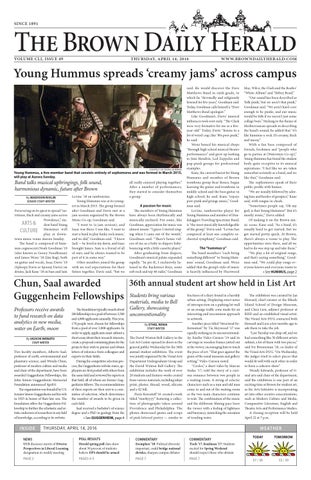
Young Hummus spreads ‘creamy jams’ across campus
COURTESY OF YOUNG HUMMUS
Young Hummus, a five-member band that consists entirely of sophomores and was formed in March 2015, will play at Aurora Sunday. all really enjoyed playing together.” Band talks musical upbringings, folk sound, After a number of performances, harmonious dynamic, future after Brown they started to consider themselves Levine ’18 on tambourine. a group. By MADISON RIVLIN Young Hummus was at its youngSENIOR STAFF WRITER est in March 2015. The group formed A passion for music Persevering on its quest to spread “nu- after Goodman and Davis met at a The members of Young Hummus tritious, thick and creamy jams across jam session organized by the Brown have always been rhythmically and Providence,” stu- Music Co-op, Goodman said. musically inclined. For some, like dent band Young “I went to (a jam session), and Goodman, appreciation for music was Hummus will Isaac was there. I was like, ‘I want to almost innate: “I guess I started singplay at down- start a band to play funky rock music,’ ing when I came out of the womb,” town music venue Aurora Sunday. and we did,” Goodman said. “I knew Goodman said. “There’s home vidThe band is composed of hum- Jack — he lived in my dorm, and Isaac eos of me as a baby in diapers babymus cognoscenti Noah Goodman ’18 brought James. Sam is a friend of all bouncing with a little cassette player.” (also known as Gooey Noodleman) of ours, and he always wanted to be After graduating from diapers, and James Wenz ’18 (Jim Bag), both part of it in some way.” Goodman’s musical palate expanded on guitar and vocals, Isaac Davis ’18 Other members joined the group rapidly. “In pre-K, I exclusively lis(Sploopy Davis or Spoony Davis) on with no real expectations for their tened to the Backstreet Boys, some drums, Jack Kane ’18 on bass and Sam future together, Davis said, “but we soft rock and top 40 radio,” Goodman
ARTS & CULTURE
said. He would discover the Dave Matthews Band in sixth grade, to which he “devotedly and religiously listened for five years,” Goodman said. Today, Goodman calls himself a “Dave Matthews Band apologist.” Like Goodman’s, Davis’ musical influences took root early. “The Clash were very formative for me as a fiveyear-old.” Today, Davis “listens to a lot of weird crap, like ’80s post-punk,” he said. Wenz honed his musical chops “through high school musical theater performances” and grew up looking to Jimi Hendrix, Led Zeppelin and pop-punk groups for professional examples. Kane, the current bassist for Young Hummus and member of Brown trombone group Bear Bones, began learning the guitar and trombone in middle school and the bass guitar in high school, he said. Kane “enjoys post-punk and grunge music,” Goodman said. Levine, tambourine-player for Young Hummus and member of Daudalaggio’s Traveling Spacetime Band, is “the most musically knowledgeable of the group,” Davis said. “Levine has composed at least one complete orchestral symphony,” Goodman said. The “hummus-y” The band members “each bring something different” to Young Hummus’ sound, Goodman said. Wenz added that the group’s style of music is heavily influenced by Fleetwood
Mac, Wilco, the Clash and the Beatles’ “White Album” and “Abbey Road.” “Our sound has been described as ‘folk punk,’ but we aren’t that punk,” Goodman said. “We aren’t hard-core enough to be punks, and our music would be folk if we weren’t just some college boys.” Sticking to the theme of Mediterranean spreads in describing the band’s sound, he added that “it’s like hummus-y rock. It’s creamy, thick and messy.” With a fan base composed of friends, freshmen and “people who go to parties at (Watermyn Co-op),” Young Hummus has found the student body quite receptive to its musical aspirations. “I feel like we are taken somewhat seriously as a band, and we like that,” Goodman said. The sophomores speak of their public profile with humor. “We are usually followed by adoring fans and hordes of groupies,” Kane said, with tongue in cheek. “Sometimes people say, ‘Oh my god, is that Young Hummus?’ But it’s mostly ironic,” Davis added. Of making it on the Brown music scene, Kane said, “As a band, it’s usually hard to get started, but we got started pretty quick. At Brown, there’s always a venue to play. The opportunities were there, and all we had to do was step up and take them.” “We play a lot of original songs, and that’s saying something,” Goodman said. “We could play songs everyone knows and everyone wants to » See HUMMUS, page 2
36th annual student art show held in List Art Chun, Saal awarded bring various Guggenheim Fellowships Students materials, media to Bell Professors receive awards to fund research on data analytics in new media, water on Earth, moon By UGOCHI IHENATU STAFF WRITER
Two faculty members, Alberto Saal, professor of earth, environmental and planetary science, and Wendy Chun, professor of modern culture and media and chair of the department, have been awarded Guggenheim Fellowships, the John Simon Guggenheim Memorial Foundation announced April 6. The organization was founded by U.S. Senator Simon Guggenheim and his wife in 1925 in honor of their late son. The foundation offers the Guggenheim Fellowship to further the scholastic and artistic endeavors of researchers in any field of knowledge, according to its website.
INSIDE
The foundation typically awards about 200 fellowships to a pool of between 3,500 and 4,000 applicants annually. This year, 178 people were chosen for fellowships from a pool of over 3,000 applicants. In order to apply, applicants must submit a short essay about their research interests, create a proposal containing plans for the projects they wish to pursue and obtain letters of reference from colleagues and experts in their fields. During the competitive selection process, the Guggenheim website states, applicants are first pooled with others from the same field and reviewed by experts in that field, all of whom are former Guggenheim fellows. The recommendations of these experts are then sent to a committee of selection, which determines the number of awards to be given in each field. Saal received a bachelor’s of science degree and a PhD in geology from the » See GUGGENHEIM, page 4
Gallery, showcasing unconventionality By ETHEL RENIA STAFF WRITER
The David Winton Bell Gallery in the List Art Center opened its doors to the general public Wednesday for the 36th annual student exhibition. The event was jointly organized by the Visual Arts Department Undergraduate Group and the David Winton Bell Gallery. The exhibition includes the work of over 20 students and features works created from various materials, including inkjet print, plaster, thread, wood, silicone and a $2 bill. Pierie Korostoff ’16 created a work titled “murkyyyy” featuring a collection of photographs taken around Providence and Philadelphia. The photos showcased quotes and scraps of pink-lettered poetry — similar to
fractures of a diary found in a harshly urban setting. Displaying sweet notes of introspection on a parking lot wall or an orange traffic cone made for an interesting and uncommon approach to artwork. Another piece titled “Structural Deformation” by Tia Heywood ’17 was equally striking in its unconventionality. Emilio Vides-Curnen ’19 said its carvings in wooden frames jutted out at the viewer, encouraging him to touch the piece of art. “That goes against the grain of the usual museum and gallery setting,” Vides-Curnen noted. “Circles,” a short video by Marcus Sudac ’17, told the story of a curious romance between two people in a waiting room. A string of eclectic characters such as a nun and old man come in and out of the waiting room as the two main characters continue to wait. The combination of the music and the deliberate filming pace leave the viewer with a feeling of lightness and buoyancy, mimicking the sensation of treading water.
The exhibition was curated by Jan Howard, chief curator at the Rhode Island School of Design Museum, and Clara Lieu, adjunct professor at RISD and an established visual artist. The Visual Arts DUG contacted both Howard and Lieu a few months ago to ask them to take the job. “Last Tuesday was drop-off, and we had something like 50 different artists submit, a lot of them with two pieces,” said Ivy Brenneman ’16, co-leader of the Visual Arts DUG. “On Wednesday, the judges tried to select pieces that would fit well with each other in order to form a cohesive show.” Wendy Edwards, professor of visual arts and chair of the department, said the exhibition is one part of an exciting time at Brown for student art, as the Arts Initiative is incorporating art into other creative concentrations, such as Modern Culture and Media, Comparative Literature, English and Theatre Arts and Performance Studies. A closing reception will be held April 22 at 7 p.m.
WEATHER
THURSDAY, APRIL 14, 2016
NEWS UCS discusses merits of Diverse Perspectives in Liberal Learning designation in weekly meeting
POLL RESULTS Herald spring poll data show about 50 percent of students believe DPS should be armed
COMMENTARY Esemplare ’18: Political diversity important, could bridge national divides, sharpen campus debates
COMMENTARY Tisch ’17, Kaufman ’17: Students excited for Spring Weekend should respect those who abstain
PAGE 2
PAGES 4-5
PAGE 7
PAGE 7
TODAY
TOMORROW
57 / 38
52 / 39
ARTS & CULTURE PAGE 2 • THURSDAY, APRIL 14, 2016
» HUMMUS, from page 1 hear, but we get a lot of satisfaction from playing songs we’ve written even if people don’t know them.” The Hummus dynamic Despite a few instances of creative friction, the members of Young Hummus maintain a very close relationship and have experienced few challenges as a group. “The biggest challenge has been that we have been playing too many shows,” Wenz said. “A douchey complaint,” Davis joked. “We’ve also experienced certain difficulties in transporting drum sets.” Members have maintained a positive relationship outside of the group by bonding over shared interests. “We are all big Mac DeMarco fans,” Wenz said.
“I’d like to be him, but shower more and smoke less. Or smoke not at all, maybe,” Davis added. When not meeting to practice, the group can be found making “squad appearances at Jo’s,” Kane said. The band’s knack for repartee gave rise to its name, which resulted from Davis’ mispronouncing Wenz’s nickname, “Young James.” “I made it up as a joke, and then everyone really liked it not as a joke,” Davis said. Aged Hummus Since the band’s formation last spring in the members’ first year at Brown, Young Hummus’ sound and the band itself have evolved, Goodman said. “We’ve gotten a lot tighter, we’ve learned a lot more and we don’t play ‘Max Can’t Surf ’ by FIDLAR, so
THE BROWN DAILY HERALD that’s an accomplishment.” “We are getting to know each other better as musicians and slowly figuring out how to fit our voices in at the same time,” Wenz said. The group’s members are also learning “how we can contribute to songs so that they’re not just some chords and singing,” Wenz added. After Brown, the band members’ ideas about the future of Young Hummus vary. “I want to record and promote an album. … That’s my only concrete plan,” Goodman said. “We would probably go on tour and make millions,” Kane joked. For now, Young Hummus is concentrating on the here and now. “It’s like a college relationship. We don’t want to prognosticate about the future because we should focus on the present,” Wenz said.
UCS debates value of DPLL designation Reps say label marginally shapes student course choices, fails to ensure engagement with issues By MATTHEW JARRELL STAFF WRITER
The Undergraduate Council of Students debated the effectiveness of the Diverse Perspectives in Liberal Learning course designation in a discussion with members of the Task Force on Diversity in the Curriculum at the UCS general body meeting Wednesday. Dean of the College Maud Mandel, Associate Professor of Engineering and Senior Associate Dean of the Faculty Janet Blume, Professor of Economics David Weil and student representative Ryan Lee ’17 listened to feedback on the DPLL designation from general body members, who expressed a range of views on the topic. DPLL appears on the course descriptions of certain classes on Courses@Brown, the online platform on which students register for courses. The course designation is one of various initiatives designed for “moving diversity-related intellectual questions to the center of the curriculum,” according to the task force’s charge on its website. The designation was introduced in 2002 after a reevaluation of its predecessor, the American Minorities Perspectives courses, Mandel said. It was decided that a course label with a more global focus, as opposed to the domestically oriented model in use at the time, would better position the designation to accomplish its goal, she added. A major concern with the current model is its lack of specificity, Mandel said. After the Ray Kelly protest in 2013, the DPLL designation went through another round of reviews.
“The version they settled on is so broad that almost any class would fall under it,” she said. Under the current system, any faculty member can request that his or her course fall under the designation. UCS Treasurer John Brewer ’17 suggested changing the way the DPLL designation relates to course offerings in order to address the fact that many students do not use it when choosing their courses. “Perhaps we can look at using this title not as just a way to find classes but as a way to create classes that bring diversity to the curriculum,” he said. Community and Business Relations Liaison Ryan Lessing ’17 spoke similarly of DPLL’s impact on course choices. The designation is “not something that fits into” his search for courses every semester, he said. “I use it more as a validator than a search tool,” said Chief of Staff Elena Saltzman ’16. She noted that when shopping two or more classes with similar subject matter, the DPLL designation often helps her decide which one to take. Academic and Administrative Affairs Chair Tim Ittner ’18 expressed concerns with the concept of labeling courses in general and noted that the DPLL mark can be something more akin to the writing requirement than a promoter of diversity. “I don’t think it gets at issues of foundational knowledge,” he said. “Issues of diversity become tangential to the curriculum.” General body member Christine Mullen ’16 agreed, raising the idea that every course could have some kind of diversity component embedded within its material. UCS also categorized two student groups on appeal at the meeting. Brown Trading Club was constituted as a Category I group and Hospice Volunteering Club as a Category S group.
TODAY
THURSDAY, APRIL 14, 2016 • PAGE 3
THE BROWN DAILY HERALD
menu SATELLITE DINING ANDREWS COMMONS
Pizza: Na’cho, Spicy Five Cheese and Garlic, BBQ Bam Bam Make-Your-Own Pasta Station JOSIAH’S
BLUE ROOM
Quesadillas
Turkey Chili, Fire Roasted Veggie Chicken Tikka Masala
DINING HALLS SHARPE REFECTORY LUNCH
DINNER
Italian Chicken Parmesan, Beef and Andouille Burgers, Vegan Oatmeal Cranberry Cookies
Chicken Broccoli Pasta Alfredo, Cajun Baked Fish, Slow-Braised Tomatoes, Marble Cake
VERNEY-WOOLLEY LUNCH
DINNER
Country Wedding Soup, Asian Sesame Chicken Salad, Vegan Oatmeal Raisin Cookies
Vegetarian Cream of Mushroom Soup, Baked Chicken, Tofu Parmesan, Marble Cake
sudoku
RELEASE DATE– Thursday, April 14, 2016
Los Angeles Times Daily Crossword Puzzle c rNorris o s sandwJoyce o rNichols d Lewis Edited by Rich ACROSS 1 Tousle 5 F and G, e.g. 10 Soaks (up) 14 Bad thing to be caught in 15 Spells 16 Virginie, par exemple 17 “Need You Tonight” band 18 Start of an old news announcement 20 Frequent Lemmon co-star 22 Chimney 23 Dublin-born poet 24 AWOL trackers 26 Tiny 27 Shine, in Cambridge 29 Ammunition dumps 31 Request to Sajak 32 Stipulation on le menu 34 Numerical prefix 36 Progressive pitcher? 37 When there’s no turning back 41 Where gas and lodging may be found 46 Tulsa sch. 47 Brings to light 50 Pitcher, for one 52 Cambodia’s Lon __ 53 Enzyme suffix 54 Moisten, in a way 55 Northeastern octet 57 Old but coveted 60 Nachos, e.g. 64 Peach __ 65 Landed 66 Ken Jenkins’ “Scrubs” role 67 CVI halved 68 Old map divs. 69 “Dallas” Miss 70 North-of-theborder gas DOWN 1 Injure badly 2 Radius neighbor 3 Historic Chicagoto-Santa Monica route 4 Largish combo
5 Proctor’s concern 6 Infiniti competitor 7 No. after a phone no. 8 Not agin 9 Fed. benefits agency 10 Stimulating message 11 Senators’ home 12 Part of UPS 13 Betting specifications 19 County bordering Suffolk 21 Dwell annoyingly (on) 24 “Fantastic” Dahl character 25 Initials on a radial 27 “Well, __-di-dah!” 28 Lyon article 29 Weigh station counts 30 Composer Rorem 33 “__ shoe fits ... ” 35 Literary assortment 38 When translated to English, beer brand that hints at the common feature of the five other longest puzzle answers
39 “We __ Marshall”: 2006 film 40 Brynner of filmdom 42 Wipe off 43 Some Cadillacs 44 Scott classic 45 Try 47 Hall of Fame Colts quarterback 48 Grisham output
49 Potion 51 Suppress 54 Low voices 56 First responders, initially 58 Israeli arms 59 Opera star Pinza 61 Classic Jag 62 “Small Wonder” state: Abbr. 63 In need of treatment
Q U O T E O F T H E D AY
“Sometimes people say, ‘Oh my god, is that Young Hummus?’ But it’s mostly ironic.” — Isaac Davis ’18, drummer for Young Hummus
ANSWER TO PREVIOUS PUZZLE:
See young hummus on page 1. calendar TODAY
APRIL
S
xwordeditor@aol.com
By Mike Peluso ©2016 Tribune Content Agency, LLC
04/14/16
04/14/16
M
T
W
Th
F
S
1
2
3
4
5
6
7
8
9
10
11
12
13
14
15
16
17
18
19
20
21
22
23
24
25
26
27
28
29
30
Breaking Broken Windows 12:00 P.M. Watson Institute
Reproductive Justice and Women’s Voices 12:00 P.M. 121 South Main, Room 245
SPEC Carnival 5:00 P.M. Main Green
Goldman Sachs — People, Capital and Ideas 6:00 P.M. CareerLAB
TOMORROW Goldman Sachs — Empowering Women 12:00 P.M. CareerLAB
On the Whiteness of Food Movements 1:00 P.M. Dyer House
Hebrew Language Week: Sing-a-long 3:00 P.M. Salomon Center, Room 203
Black Lavender Experience Conference 7:00 P.M. Rites and Reason Theatre
POLL RESULTS PAGE 4 • THURSDAY, APRIL 14, 2016
THE BROWN DAILY HERALD
Half of students say Hillel sponsorship of Mock lecture acceptable Slightly more than three quarters of students say diversity training should be mandatory for faculty By LAUREN ARATANI NEWS EDITOR
The Herald’s spring undergraduate poll, conducted April 6, 7 and 11 in J. Walter Wilson, the Faunce Campus Center and the Sciences Library, found that about half of students polled disagreed that Brown/RISD Hillel should not have sponsored a talk by Janet Mock, a transgender rights activist, because of the organization’s ties to the state of Israel. A petition advancing this argument, signed by over 200 students, led Mock to cancel her talk last month. Of the students who strongly agreed that Hillel should not have sponsored the talk, about 8.6 percent said they felt informed about events on campus while 27 percent felt uninformed. The poll also found that about 46 percent of students approve of how President Christina Paxson P’19 is handling her job — about a 3 percentage point increase from last semester — while about 19 percent of students
polled disapprove. About 57.1 percent of students who strongly disapproved of Paxson indicated that they feel very informed about events on campus, while 32.1 percent of students who strongly approved of Paxson felt very informed. The Diversity and Inclusion Action Plan states that voluntary diversity training has been proven to be more effective than mandatory training in promoting diversity and inclusion. Despite this statement, more than 75 percent of students agreed that diversity training should be mandatory for faculty members. Despite the assault of a Dartmouth student during the Latinx conference in November, 75.4 percent of students agree that the Department of Public Safety makes them feel safe; just slightly more than 8 percent of students disagreed. But students are more divided over the arming of DPS officers: Over 50 percent of students agreed and 28.2 percent disagreed that DPS officers should continue
to be armed. Of students who strongly agreed that DPS officers should continue to be armed, 28.4 percent feel very informed about events on campus. Of those who strongly disagreed that DPS should be armed, 37.2 percent said they feel very informed. Nearly 80 percent of students said they go to athletic events in their entirety or close to their entirety no more than once or twice a semester. About 30 percent of those who go to athletic events at least once or twice a month are legacy students. Legacy students constituted 14.3 percent of poll-takers. About 80 percent of students attend artistic events — such as theater productions, comedy shows or music performances — at least once or twice a semester. The percentage of women who attend an artistic event at least once or twice a month was higher than the percentage of men who do the same — 46 percent compared to 37.5 percent. In addition, a higher percentage of white students attend artistic events more frequently. Around 44 percent of students who
said they had never attended an artistic event identified as white, though white students made up about 58 percent of students polled. About 28 percent of students who used no resources — such as professional or student tutoring, preparation books or free resources — to gain admission to college identified themselves as first-generation students, who made up only 17 percent of poll-takers. On the other hand, legacy students were more likely to have used paid professional testing tutors or paid student testing tutors when applying to college. About 22 percent of the students who used these tutoring resources were legacy students. Of students concentrating in business, entrepreneurship and organizations or economics, about 81 percent indicated that passion for the subject influenced their concentration choice. In contrast, for students in every other field, more than 90 percent indicated that passion was a factor. About 77 percent of students concentrating in BEO or economics indicated chances of employment as
a factor in choosing their concentration. About 68 percent of physical science concentrators also designated chances of employment as a factor. Just 31 percent of humanities concentrators indicated the same. About 25 percent of students marked that they have never hooked up with anyone at Brown. The poll defined “hooking up” as “making out or more intimate encounters including those in relationships.” Just 8.6 percent of athletes marked that they have not hooked up with anyone at Brown, while 26.8 percent of non-athletes polled indicated they had not hooked up with anyone at Brown. In addition, the higher their class year, the more likely students were to have hooked up with someone at Brown. About 33 percent of first-year students indicated that they had not hooked up with anyone at Brown, compared to just 12.9 percent of seniors. Just 8 percent of BEO or economics concentrators indicated they have not hooked up, compared to 38 percent of physical science concentrators and 29 percent of life science concentrators.
APRIL 6, 7 & 11 POLL RESULTS AND ME THODOLOGY 1. Do you approve or disapprove of the way Christina Paxson is handling her job as president of the University? 8.3% Strongly approve 37.8% Somewhat approve 34.2% No opinion 17.4% Somewhat disapprove 2.2% Strongly disapprove 2. How informed do you feel about events on campus? 16.7% Very informed 63.2% Somewhat informed 10.9% Somewhat uninformed 2.7% Very uninformed 3. What factors have impacted your concentration choice? (Circle all that apply.) 92.5% Passion for subject 50.8% Chances of employment after graduation 23.3% Influence of faculty memberes 18.8% Influence of peers 25.1% Influence of family
4. Do you agree or disagree that all students should be required to take a course with the Diverse Perspectives in Liberal Learning designation before receiving an undergraduate degree from Brown?
29.6% Strongly agree 28.8% Somewhat agree 19.9% No opinion 13.6% Somewhat disagree 8.1% Strongly disagree
5. The University’s Diversity and Inclusion Action Plan includes the opportunity to participate in diversity training programs for faculty members but does not require them to participate. Do you agree or disagree that diversity training should be mandatory for faculty members? 49.4% Strongly agree 26.3% Somewhat agree 11.2% No opinion 8.7% Somewhat disagree 4.5% Strongly disagree
6. How often do you attend Brown athletic events in their entirety or close to their entirety? 3.5% More than once a week 5.7% Once a week 11.6% Once or twice a month 21.8% Once or twice a semester 20.3% Once a year 37.1% Never 7. How often do you attend artistic events (theater,
comedy, music, etc.) in their entirety or close to their entirety? 3.2% More than once a week 8.2% Once a week 30.8% Once or twice a month 38.1% Once or twice a semester 11.7% Once a year 7.9% Never
8. Do you agree or disagree that the Department of Public Safety makes you feel safe? 24.5% Strongly agree 50.9% Somewhat agree 15.8% No opinion 6.6% Somewhat disagree 2.1% Strongly disagree 9. Do you agree or disagree that DPS should continue to be armed? 22.6% Strongly agree 28.4% Somewhat agree 20.8% No opinion 18.1% Somewhat disagree 10.1% Strongly disagree 10. What resources did you use when preparing to apply to college? (Circle all that apply.) 29.4% Professional testing tutor (paid) 6.6% Student testing tutor (paid)
21.5% Testing classes (paid) 69.1% Preparation books 45.1% Free resources offered by community or school 11.8% No resources 11. Do you agree or disagree that Brown/RISD Hillel should not have sponsored a talk by Janet Mock, a transgender rights activist, because of its ties to the state of Israel? 3.9% Strongly agree 6.2% Somewhat agree 39.0% No opinion 17.6% Somewhat disagree 33.3% Strongly disagree 12. How have you met the people with whom you’ve hooked up (meaning: making out or more intimate encounters including those in relationships) during your time at Brown? (Circle all that apply.) 12.0% Dating apps 26.4% Classes 48.0% Mutual friends 18.9% Housing arrangements 50.4% Parties and other social gatherings 27.6% Extracurricular activities 9.1% Other 24.5% I have not hooked up with anyone at Brown
Methodology The results come from 937 surveys that were collected at J. Walter Wilson, the Stephen Roberts ’62 Campus Center and the Sciences Library over the course of three days — April 6-7 and April 11. The margin of error is 2.95 percent with 95 percent confidence. The margin of error for specific subsets are as follow: 3.95 percent for females, 4.53 percent for males, 5.8 percent for first-years, 5.13 percent for sophomores, 6.28 percent for juniors, 6.74 percent for seniors, 4.36 percent for students who receive financial aid and 4.03 percent for students who do not receive financial aid. The sample of students who took the poll is demographically similar to the undergraduate student body. The sample was 43.4 percent male, 55.6 percent female and 1 percent other. First-years made up 25.9 percent, sophomores 31.9 percent, juniors 22.2 percent and seniors 20.0 percent of the poll. Of students who receive financial aid represented in the poll, 4.3 percent receive just loans, 17.8 receive grants and loans, 15.8 percent receive grants covering some costs, 8 percent receive grants covering all costs and 54.1 percent receive no loans. Varsity athletes made up 12.6 percent, while non-athletes made up 87.4 percent. Of students surveyed, 81.6 percent identify as heterosexual, 6.1 percent as gay, 7.9 percent as bisexual and 4.4 percent as other. Students reported all of the races/ethnicities they identify with — 57.9 percent of students
»GUGGENHEIM, from page 1 Universidad Nacional de Córdoba and a PhD in oceanography from the Massachusetts Institute of Technology/Woods Hole Oceanographic Institution. His research entails examining volatile elements in moon dust collected from the Apollo missions. This dust may indicate the existence of water both on the surface and within the Earth and moon
at the time of their formation. A French group disagrees with Saal’s hypothesis, arguing that water came to Earth and the moon at a much later date. “I thought: One way to solve (the disagreement) in a civil way is to work together … and they said yes,” Saal said. The prospect of working with his French colleagues — and the financial capital he would need to do so — prompted Saal to apply for the Guggenheim Fellowship.
identify as white, 29.9 percent as Asian, 11.5 percent as Hispanic, 9.1 percent as black, 1.1 percent as American Indian/Alaska Native, 1.4 percent as Native Hawaiian/Pacific Islander and 4 percent as other. Students also marked the concentration area(s) that they are in — 29.9 percent are in the humanities/arts, 13.1 percent in business (business, entrepreneurship and organizations and econ), 19.8 in social sciences (not including BEO or econ), 24.5 percent in life sciences and 32.3% in physical sciences. Of students polled, 14.3 percent of students are legacy students, meaning they have a parent, grandparent or sibling who attended Brown, and 85.7 percent are not. First-generation students make up 16.9 percent and non-first-gen students made up 83.1 percent of the sample. Statistical significance was established at 0.05 level. All cross-tabulation are statistically significant. News Editor Lauren Aratani ’18, Sports Editor Taneil Ruffin ’17 and Senior Staff Writers Kasturi Pananjady ’19, Alex Skidmore ’19, Shira Buchsbaum ’19, Suvy Qin ’19, Julianne Center ’19 and Jackson Chaiken ’19 coordinated the poll. Herald section editors, senior staff writers and other staff members conducted the poll. Over the next several weeks, The Herald will publish a series of articles about individual poll questions. Find results of previous polls at thebdh.org/poll.
Using his fellowship, Saal plans to spend a year-long sabbatical in France trying to obtain concrete proof to support his hypothesis. “I wanted funding that would give me some level of independence,” Saal said. Chun, who has a bachelor’s degree in engineering and a PhD in English literature, works to tie these two fields together in order to analyze digital media. Chun applied to the Guggenheim
Fellowship in order to fund her sabbatical and follow in the footsteps of the many talented scholars and artists who have earned the honor before. “You send out an application never expecting to receive the fellowship, so it was a surprise,” Chun said. Chun intends to use the fellowship to start a project looking at the ways that race, class, gender and sexuality are reemerging in data analytics. The project
will reveal assumptions underlying supposedly neutral machine-learning algorithms that group individuals based on certain identifiers and will create strategies to disaggregate these assumptions. “Usually (the fellowship) goes to someone who works on more traditional things such as film, radio and television, and my work is in the field of new media,” Chun said. “I’m very grateful, and it’s a wonderful opportunity.”
POLL RESULTS THURSDAY, APRIL 14, 2016 • PAGE 5
THE BROWN DAILY HERALD
Do you agree or disagree that all students should be required to take a course with the Diverse Perspectives in Liberal Learning designation before receiving an undergraduate degree from Brown? Strongly disagree: 8.1%
How have you met the people with whom you’ve hooked up (meaning: making out or more intimate encounters including those in relationships) during your time at Brown? (Circle all that apply.) 50 percent
50.4%
48.0%
40
Somewhat disagree: 13.6%
30 Strongly agree: 29.6%
No opinion: 19.9%
24.5%
20 10
Somewhat agree: 28.8%
27.6%
26.4% 18.9%
12.0%
9.1%
0 Dating apps or websites
Mutual friends Housing arragnements
Classes
Parties and other social gatherings
Other Extracurricular activities
Source: Spring 2016 Herald Poll
I have never hooked up with anyone at Brown
Source: Spring 2016 Herald Poll
EMMA JERZYK / HERALD
EMMA JERZYK / HERALD
Hooking up and class year
Do you agree or disagree that the Department of Public Safety should continue to be armed?
First-year students were significantly more likely to have never hoooked up (meaning: making out or more intimate encounters including those in relationships) with anyone at Brown. The percentage of people who have never hooked up with anyone at brown decreases with each successive class year.
35 percent
Strongly disagree: 10.1
33.2%
30 Strongly agree: 22.6%
27.1%
25
Somewhat disagree: 18.1
20.5%
20 FIRST-YEAR
15
SOPHOMORE
12.9%
10
No opinion: 20.8%
Somewhat agree: 28.4%
JUNIOR SENIOR
5 0
Source: Spring 2016 Herald Poll
Source: Spring 2016 Herald Poll EMMA JERZYK / HERALD
Approval of President Christina Paxson P’19
Self-reported student awareness and approval of Christina Paxson Of the students who indicated that they are very or somewhat informed about campus events, almost 50 percent approve — strongly or somewhat — of the way Paxson is handling her job as the president of the University.
60 percent 50
56.7%
40 Somewhat approve No opinion
30
30
10
50 percent
48.9%
40
20
EMMA JERZYK / HERALD
30.7%
APPROVE
28.3%
20 Somewhat disapprove
20.4%
NO OPINION
15.0%
10
DISAPPROVE
Strongly approve
0
0 Very or somewhat informed
Very or somewhat uninformed Source: Spring 2016 Herald Poll EMMA JERZYK / HERALD
Strongly disapprove Fall 2013
Spring
Fall 2014
Spring
Fall 2015
Spring 2016 EMMA JERZYK / HERALD
COMMENTARY PAGE 6 • THURSDAY, APRIL 14, 2016
THE BROWN DAILY HERALD
R O L A N D H IG H
comic A Horse of Any Other Name | Zach Silberberg
Find us online! facebook.com/browndailyherald
browndailyherald.com
@the_herald
Location: 195 Angell St., Providence, R.I. www.browndailyherald.com
@browndailyherald
youtube.com/browndailyherald
Editorial contact: 401-351-3372 herald@browndailyherald.com
Business contact: 401-351-3260 gm@browndailyherald.com
Submissions: The Brown Daily Herald publishes submissions in the form of op-eds and letters to the editor. Op-eds are typically between 750 and 1000 words, though we will consider submissions between 500 and 1200 words. Letters to the editor should be around 250 words. While letters to the editor respond to an article or column that has appeared in The Herald, op-eds usually prompt new discussions on campus or frame new arguments about current discourse. All submissions to The Herald cannot have been previously published elsewhere (in print or online — including personal blogs and social media), and they must be exclusive to The Herald. Submissions must include no more than two individual authors. If there are more than two original authors, The Herald can acknowledge the authors in a statement at the end of the letter or op-ed, but the byline can only include up to two names. The Herald will not publish submissions authored by groups. The Herald does not publish anonymous submissions. If you feel your circumstances prevent you from submitting an op-ed or letter with your name, please email herald@browndailyherald.com to explain your situation.
Editorial Leadership
Sections
Visuals & Production
Business
Editor-in-Chief Emma Jerzyk
Arts & Culture Editor Jaclyn Torres
Managing Editor Joseph Zappa
News Editors Lauren Aratani Agnes Chan Sandra Lifshits Kate Talerico
Design Editors Meryl Charleston Sonia Geba Andrew Linder Assistants: Nicola Ho, Jessica Yu
General Managers Moniyka Sachar Joshua Tartell
Senior Editors Andrew Flax Caroline Kelly POST- MAGAZINE Editor-in-Chief Yidi Wu
Sports Editors Matt Brownsword Taneil Ruffin Multimedia Features Editor Baylor Knobloch COMMENTARY Opinions Editors Margaret Hu Lainie Rowland Editorial Page Editors Emma Axelrod Emma Jerzyk
Photo Editors Head: Eli White Sam Berube Marianna McMurdock Matteo Mobilio Web Producer Harsha Yeddanapudy Copy Desk Chief Bonnie Henry Illustrations Editor Roland High
Directors Sales: Henry Ritter Finance: Neil Wathore Finance: Benjamin Wesner Business Dev.: Abraham Galindo Sales Managers Antonia Alvarez Erin Lueck Matthew Meyer William Welland Finance Managers Collections: Reena Zhan Collections: Varun Narayan DIGITAL Director of Audience Development Marcy Huang
You can submit op-eds to opinions@browndailyherald.com and letters to letters@browndailyherald.com. When you email your submission, please include (1) your full name, (2) an evening or mobile phone number in case your submission is chosen for publication and (3) any affiliation with Brown University or any institution or organization relevant to the content of your submission. Please send in submissions at least 24 hours in advance of your desired publication date. The Herald only publishes submissions while it is in print. The Herald reserves the right to edit all submissions. If your piece is considered for publication, an editor will contact you to discuss potential changes to your submission. Commentary: The editorial is the majority opinion of the editorial page board of The Brown Daily Herald. The editorial viewpoint does not necessarily reflect the views of The Brown Daily Herald, Inc. Columns, letters and comics reflect the opinions of their authors only. Corrections: The Brown Daily Herald is committed to providing the Brown University community with the most accurate information possible. Corrections may be submitted up to seven calendar days after publication. Advertising: The Brown Daily Herald, Inc. reserves the right to accept or decline any advertisement at its discretion. The Brown Daily Herald, Inc. is a financially independent, nonprofit media organization bringing you The Brown Daily Herald, BlogDailyHerald and Post- Magazine. The Brown Daily Herald has served the Brown University community daily since 1891. It is published Monday through Friday during the academic year, excluding vacations, once during Commencement and once during Orientation by The Brown Daily Herald, Inc. Single copy free for each member of the community. Subscription prices: $280 one year daily, $140 one semester daily. Copyright 2016 by The Brown Daily Herald, Inc. All rights reserved. Periodicals postage paid at Providence, R.I. Postmaster: Please send corrections to P.O. Box 2538, Providence, RI 02906.
COMMENTARY THURSDAY, APRIL 14, 2016 • PAGE 7
THE BROWN DAILY HERALD
Redefining diversity NICHOLAS ESEMPLARE staff columnist
Over the course of the current academic year, perhaps no topic has been more in the consciousness of the Brown community than diversity. Diversity is a common buzzword on college campuses, and we all have at least some sense of what it represents. Whether you have joined in a protest this semester or not, you’ve probably at least considered what diversity means and how it affects the University. At Brown and across other campuses, diversity has come to be narrowly defined as the representation of certain marginalized groups. Indeed, attracting these groups to Brown’s campus is an important aspect of making Brown the type of diverse community that it strives to be. The purpose of such diversifying efforts is twofold: On a societal level, access to a college education has a meaningful effect on the opportunities open to individuals. Providing equitable access to higher education can thus serve as a tool to combat systemic social issues. On the university level, such diversifying efforts also aim to create an enriching environment on campuses, fostering various perspectives that reflect a large breadth of experience. We expend a great deal of energy addressing the first purpose of diversity in uplifting marginalized groups but sometimes overlook important factors that help us achieve the second purpose — to create a campus environment with truly diverse perspectives. As a result, we limit the meaning of the word diversity in both concept and action and are unable to reap its full benefits.
While I support the effort to advocate on behalf of historically marginalized groups, I do find it interesting and sometimes frustrating that, at Brown and campuses across the country, we often have difficulty imagining what diversity would look like beyond this narrow definition of the word. Indeed, to call for increased diversity on campus is essentially shorthand for calling to increase representation of marginalized groups. In literal terms, this significantly narrows the word’s true meaning. In no trivial sense, we have redefined diversity as the need to combat marginalization. This is not to dismiss the value of one definition of diversity but to call attention to both definitions.
pus survey from this past fall states the matter more clearly: The leading Republican candidate for Brown students at the time was U.S. Sen. Marco Rubio, R-FL, with the support of 1.6 percent of the student body. That number is staggeringly low, even for a liberal campus. In fact, cumulatively only 4.2 percent of students supported any of the three Republican candidates listed in the survey. Think of it this way: In a representative sample of 100 Brown students, you would expect to find about four who supported a Republican candidate at the time. That’s a diversity problem. As stated above, one of the common arguments of those who support, for example, racial diversity, is that the ex-
guage can be used to perpetuate marginalization. Nothing about the topic bothered me, and I felt that the workshop was well-intended and well-run. But I was bothered by the workshop’s inability to distinguish diversity from marginalization because the workshop, in truth, was not about “telling diverse narratives” in any sense, not if we consider diversity’s broader definition. Over the course of the workshop, it was impossible not to be struck by the fact that there was a very clear general air of agreement in the room as to what was right and wrong. Liberal values were, by the general consensus, correct, and the word “conservative” was occasionally used interchangeably with “unaccept-
As a progressive student at a liberal university, I receive almost no conservative opposition to my social views. This can be comforting, but it is also patently dangerous. But I have more than a linguistic qualm with the word diversity’s modern usage. While the current connotation is consistent with my progressive values, I am still frustrated by the extent to which intelligent people fail to consider that diversity can exist outside the realm of historically marginalized groups. One area of this issue that Brown students would benefit by paying particular attention to is political diversity on campus. While Brown proudly boasts its minority enrollment as diversity, anyone who has attended the school knows that to call Brown a diverse community is to blatantly ignore the lack of diversity of political thought on its campus. Most people who have heard of Brown know its stereotype — a recent Forbes list of college rankings mentions Brown’s reputation as the most liberal Ivy. A cam-
posure to a variety of different cultures and opinions helps improve educational experiences for all students. Using this logic, how can Brown be so complacently uniform in terms of its political orientation? If diverse opinions are what we are after, and if diversity is worth a $165 million investment, how can the campus’s current state of political uniformity not be harmful to education? Regardless of the party you vote for, it is necessary to come into contact with and exchange ideas that differ from your own. If Brown is a liberal bubble, it is to the detriment of the education it attempts to provide. Earlier this semester, I attended a workshop run by the Brown Center for Students of Color entitled “Telling Diverse Narratives” for The Herald. The workshop was informative and addressed, among other topics, how lan-
ing.” While the discussion centered on how language can be used to perpetuate marginalization, it often focused on language used specifically by Republicans. As an Independent with socially progressive views, it was easy to stay silent during these proceedings and be comforted by the like-mindedness of the group. But looking back, the uniformity of thought in that room diminished the conversation’s value. What could have been an educated debate was, due to a lack of diversity of political representation, reduced to a onesided discussion that lacked an alternative perspective. As a generally progressive student body, it is tempting to collectively decide that Brown’s liberal nature is explicitly good. Socially liberal ideologies are frequently deemed more accepting and inclusive than conservative
ones, and liberal students in general are thus often convinced that a progressive campus indicates the type of inclusivity that Brown fosters. Nonetheless, if the workshop’s purported goal is to be achieved, one must first recognize that liberalism still does not represent diversity in any meaningful sense. My qualm is not truly with the workshop, but with its title, which neglects the meaning of diversity outside of marginalized groups. Brown students often express a breed of snobbish ignorance when they chastise Fox News for its political bias but can’t seem to see their own. As a progressive student at a liberal university, I receive almost no conservative opposition to my social views. This can be comforting, but it is also patently dangerous. People are often quite sure that the opposition should hear their opinions but far less certain that they have any use for the opposition’s. This problem is not new to Brown, but perhaps this lack of diversity feels more alarming in light of the polarized political environment in our country. Compromise is an afterthought in a political system that revolves around ideological warfare. Our presidential debates are contemptuous. In its current state, Brown serves only to perpetuate this divide that, more than any crisis of national defense, threatens the demise of our nation. Indeed, we can only become the solution to this national emergency if our campus is a politically pluralistic environment and its students are comfortable and wellversed in the healthy exchange of disparate views.
Nicholas Esemplare ’18 can be reached at nicholas_esemplare@brown.edu.
Spring Weekend is not for everyone CHARLOTTE TISCH STEFANIE KAUFMAN op-ed contributors Spring Weekend hype hits Brown like a tidal wave after spring break. Invitations for punny pre-games and large after parties circulate social media, CustomInk boxes filled with tank tops inundate the mail room, and Brown finally turns into that wild state school you so admire. Students obsessively check Weather.com hoping that with every refresh of the page, the percent chance of rain (or maybe even snow — who knows at this point?) will drop. We race to get a week ahead on our assignments so we can enjoy what is often referred to as “the best weekend of the year.” For as much time and energy as we students put into getting ready for Spring Weekend, we seldom consider that the weekend itself can be a tremendous source of stress for other individuals who are part of our community. Students who live with mental health disorders or mental illnesses, have a physical disability, have dealt with addiction or substance abuse or feel threatened or unsafe on this campus may have a vastly different Spring Weekend experience than what makes it onto the Ivy League Story on Snapchat. It has been estimated that one in four collegeaged students lives with a diagnosable mental health disorder, and living with such a disorder
may impact one’s ability to enjoy Spring Weekend. Anxiety disorders like social anxiety, panic disorder and agoraphobia are among the most common mental health diagnoses among college students and can be triggered by aspects of concerts that seem benign to people who do not live with these disorders. People with obsessive compulsive disorder or a sensory processing disorder may also feel uncomfortable during Spring Weekend, as they are unable to control their surroundings or factors such as crowds or volume. Post-traumatic stress related to loud, crowded situations and events may also be triggered by
abilities are forced to be extra conscious not only of their own bodies but of everyone else’s. It is also important to note that students who experience seizures may not be able to attend the concerts due to the lighting. There is a hyperbolic notion that everyone goes to Spring Weekend, which is not actually the case. For students who have felt threatened by or unsafe as a result of another member of this community for any reason — including sexual assault or violence — the Main Green’s concert environment can feel like a dangerous place. This can be exacerbated by the common experience
With an event that permeates all corners of campus, it is important to be especially aware, conscious and considerate of our peers for whom this weekend may cause additional anxiety, stress or difficulty. events like Spring Weekend. In addition, much of the language around the Spring Weekend hype involves consuming alcohol and other substances — for students recovering from addiction or dealing with substance abuse, this environment can feel triggering and unavoidable. Students who are able-bodied find it difficult enough to navigate the crowds on the Main Green throughout the concert and much of the weekend. But for students with any form of physical injury or disability, it is even more challenging. Personal space is rarely respected at the concerts, so students with injuries or physical dis-
of losing the friends with whom you entered the concert or strangers entering your personal space and touching your body without consent. It is hard enough feeling isolated in a highly stimulating environment; actively avoiding a threatening person alone in a loud, dark and crowded space adds a whole new level of stress. Students who do not go to Spring Weekend may feel isolated and disconnected, as no one wants to make his, her or their friends skip “the most fun weekend of the year,” and it appears that everybody is attending these events. The concert music is audible in many campus dorms and
common spaces, making it almost impossible to ignore. Though there are alternative events during Spring Weekend sponsored by the Student Activities Office, none of the events take place during the concerts themselves. It would be nice if in lieu of attending Spring Weekend, the University planned workshops, community service projects or a retreat with other students who opt out of the festivities. Spring Weekend is not a problem or bad in any inherent way. We are not writing to serve as the Grinches Who Stole Spring Weekend. We simply believe that with an event that permeates all corners of campus, it is important to be especially aware, conscious and considerate of our peers for whom this weekend may cause additional anxiety, stress or difficulty. Try not to assume a person is going to Spring Weekend, and if it turns out they’ve decided not to, don’t make it a big deal. For someone who may have difficulty attending Spring Weekend, maybe offer to go with them or be a “safe person” who will assist if anything goes awry. These people are a part of our community and our Brown family. Offering these small efforts will not ruin “the best weekend of the year” and can make someone feel safer.
Charlotte Tisch ’17 and Stefanie Kaufman ’17 can be reached at charlotte_tisch@ brown.edu and stefanie_kaufman@ brown.edu. Brown Project LETS’s Facebook page has more information regarding alternative Spring Weekend events.
NEWS THE BROWN DAILY HERALD
THURSDAY, APRIL 14, 2016