SINCE 1891
THE BROWN DAILY HERALD WEDNESDAY, JANUARY 27, 2016
VOLUME CLI, ISSUE 1
WWW.BROWNDAILYHERALD.COM
Paxson elected to Federal Reserve Bank of Boston board of directors Role entails representing higher education, private sector interests in implementing Fed policy By SHIRA BUCHSBAUM SENIOR STAFF WRITER
President Christina Paxson P’19 was elected to the board of directors of the Federal Reserve Bank of Boston, the Boston Fed announced Jan. 12. She will serve a three-year term on the nine-person board representing member banks and the public. Paxson’s responsibilities will include attending monthly meetings and conference calls, during which the board will review administrative business, oversee local implementation of federal policy and advise the president of the bank on its organizational structure, Paxson said. Paxson’s experience as both a researcher and administrator makes her a good fit for the role, said Darin Contini, assistant secretary of the Board of Directors. “Most significantly, she’s written on so many economic topics,” he added. In her role on the board, Paxson represents the business sector and contributes to the group’s geographic and gender diversity, he said. Paxson will serve as a Class B
director at the Boston Fed. Both Class B and C directors represent the public, while Class A directors represent the member banks, Contini said. Paxson noted that the distinction between the classes brings diversity to the decision-making process during board meetings. “After receiving a formal nomination from a member bank, Class B directors are elected by a subset of the 63 First District member banks,” wrote Nick Brancaleone, senior communications consultant at the Boston Fed, in an email to The Herald. Class B and C directors have “less substantive knowledge because we’re not bankers,” Paxson said, but they represent various industries, including higher education, agriculture and health. “The board, by design, has members that represent the public who are drawn from a wide range of industries,” Paxson said. “Higher education in New England is a major sector of the economy.” “I do not represent an entity that is regulated by the Federal Reserve. My responsibility is to make sure, to the extent that I can, that the Boston Fed is doing what (it) should,” Paxson said. Several board directors have gone on to be chairmen or presidents of their respective regional banks, but most return to their primary
MATTEO MOBILIO / HERALD
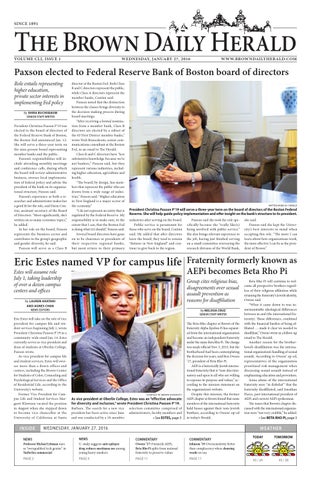
President Christina Paxson P’19 will serve a three-year term on the board of directors of the Boston Federal Reserve. She will help guide policy implementation and offer insight on the bank’s structure to its president. industries after serving on the board. Public service is paramount for those who serve on the board, Contini said. He added that after directors leave the board, they tend to remain “fixtures in New England” and continue to give back to the region.
Paxson said she took the role specifically because she “really like(s) being involved with public service.” She also brings relevant experience to the job, having just finished serving on a small committee overseeing the research division of the World Bank,
she said. Paxson said she kept the University’s best interests in mind when accepting this role. “The more I can learn about how organizations work, the more effective I can be as the president of Brown.”
Eric Estes named VP for campus life Fraternity formerly known as AEPi becomes Beta Rho Pi
Estes will assume role July 1, taking leadership of over a dozen campus centers and offices
Group cites religious bias, disagreements over sexual assault prevention as reasons for disaffiliation
By LAUREN ARATANI AND AGNES CHAN NEWS EDITORS
By MELISSA CRUZ SENIOR STAFF WRITER
Eric Estes will take on the role of vice president for campus life and student services beginning July 1, wrote President Christina Paxson P’19 in a community-wide email Jan. 14. Estes currently serves as vice president and dean of students at Oberlin College, Paxson wrote. As vice president for campus life and student services, Estes will oversee more than a dozen offices and centers, including the Brown Center for Students of Color, Counseling and Psychological Services and the Office of Residential Life, according to the University’s website. Former Vice President for Campus Life and Student Services Margaret Klawunn vacated the position in August when she stepped down to become vice chancellor at the University of California at Santa
INSIDE
COURTESY OF BROWN UNIVERSITY
As vice president at Oberlin College, Estes was an “effective advocate for diversity and inclusion,” wrote President Christina Paxson P’19. Barbara. The search for a new vice selection committee comprised of president has been active since June administrators, faculty members and and was conducted by a 10-member » See ESTES, page 3
The Beta Rho chapter at Brown of the fraternity Alpha Epsilon Pi has separated from the international organization and become an independent fraternity under the name Beta Rho Pi. The change was made official Nov. 3, 2015, but the brotherhood had been contemplating the decision for years, said Ben Owens ’17, president of Beta Rho Pi. AEPi is a historically Jewish international fraternity that is “non-discriminatory and open to all who are willing to espouse its purpose and values,” according to the mission statement on the organization’s website. Despite this mission, the former AEPi chapter at Brown found that some members of the international fraternity held biases against their non-Jewish brothers, according to Owens’ op-ed in today’s Herald.
Beta Rho Pi will continue to welcome all prospective brothers regardless of their religious affiliation while retaining the fraternity’s Jewish identity, Owens said. “What it came down to was insurmountable ideological differences between us and (the international fraternity). Those differences, combined with the financial burden of being affiliated … made it clear we needed to disaffiliate,” Owens wrote in a follow-up email to The Herald. Another reason for the brotherhood’s disaffiliation was the international organization’s handling of sexual assault. According to Owens’ op-ed, representatives of the organization prioritized risk management when discussing sexual assault instead of emphasizing education and prevention. Some alums of the international fraternity were “in disbelief ” that the fraternity disaffiliated, said Jonathan Pierce, past international president of AEPi and current AEPi spokesman. The issues that Brown’s chapter discussed with the international organization were “not very credible,” he added. » See BETA RHO PI, page 3
WEATHER
WEDNESDAY, JANUARY 27, 2016
NEWS Professor Michael Littman stars as “overqualified tech genius” in TurboTax commercial
NEWS U. study suggests anti-epilepsy drug reduces marijuana use among young heavy smokers
COMMENTARY Owens ’17: Formerly AEPi, Beta Rho Pi splits from national fraternity to preserve values
COMMENTARY Johnson ’19: Oversensitivity better than complacency when choosing words we use
PAGE 2
PAGE 4
PAGE 11
PAGE 11
TODAY
TOMORROW
43 / 24
43 / 28
NEWS
PAGE 2 • WEDNESDAY, JANUARY 27, 2016
THE BROWN DAILY HERALD
Resident ‘genius’ Littman empowers taxpayers in commercial TurboTax ad featuring computer science professor to air during Super Bowl, reaching over 100 million By RACHEL SACHS STAFF WRITER
Brown students watching NFL playoff games over break may have noticed a familiar face during the commercials. Michael Littman, professor of computer science, starred in a television commercial for TurboTax that first aired in January. The advertisement is part of the tax software company’s latest campaign to show consumers that “it doesn’t take a genius to do your taxes.” Each 30-second ad has a similar plot. The scene opens with a user navigating the TurboTax app on a smartphone. A narrator explains that the user thinks it takes a certain form of expertise to do taxes correctly. Next, a famous expert in the referenced field appears to offer help. But ultimately, each expert does little more than read directly off the app’s interface, demonstrating to the user in the commercial and the audience that taxes can be done easily and correctly with the TurboTax software. In the case of Littman’s commercial, a character named Anna believes you need a PhD to do your own taxes. When Littman enters the frame, his credentials appear: “Dr. Michael L. Littman, Computer Scientist, Brown University.”
But it’s more than just his academic credentials that allowed Littman to land his starring role. “We wanted different types of geniuses in terms of their personalities, and Michael had a fun personality that the director liked,” said Scott Kaplan, one of the creative directors on the campaign. Kaplan, who worked for Wieden+Kennedy — the Portlandbased advertising agency known for its Nike, Old Spice and now TurboTax commercials — is also a family friend of Littman. Last spring, Kaplan and his daughter visited campus and sat in on Littman’s class, CSCI0080: “A First Byte of Computer Science.” At the time, Kaplan and his partners were searching for exceptional people to fill their genius roles. During the visit, Kaplan asked Littman for a list of colleagues who would be a good fit. “I kind of slipped my name into that list,” Littman said. After narrowing down the possibilities based on availability during the filming period, the commercial’s director, Randy Krallman, determined that Littman was the best option. The production company watched several videos of Littman on YouTube, including ones of Littman singing and dancing with his wife and children, educational music videos and a video of Littman performing in the University’s 2015 Dancing with the Profs event, which influenced their decision, Kaplan said. That fall, the agency paid for
Littman to travel to New York and stay in a hotel. Oct. 21, he was picked up and driven to a New Jersey neighborhood where a house had been rented for filming, and specialized trucks lined the otherwise typical suburban street, he said. “Apparently they call this particular part of New Jersey ‘Hollywood East,’” he added. Two commercials were filmed for the campaign that day, so all of Littman’s work had to be completed in the morning. “They end up hiring a lot of people to just make sure that everybody’s time is used efficiently,” Littman said. “So from the moment that I got there until the moment that I left, everything was all scheduled out.” Kaplan was not able to be there during Littman’s filming but said that “everyone loved him when he was there. They were actually calling me from the set.” In addition to those that appeared during the playoff games, an ad from the TurboTax campaign will air during the Super Bowl Feb. 7. While the ads have already been seen by millions, the Super Bowl ad is projected to reach an audience of over 100 million. Though Littman has yet to see his commercial on TV, several people, including some he has not talked to in years, sent him photographs of their televisions with him on screen. “The whole thing is a little bit surreal … This is not my day job,” he said. “Michael was a perfect choice as an overqualified tech genius,” said Ugur
COURTESY OF MICHAEL LITTMAN
Professor of Computer Science Michael Littman took a selfie in costume and on set in New Jersey for his role in the TurboTax commercial. Cetintemel, professor of computer science and chair of the department. “He was simply being himself. He is a natural.” “Forty-one different people from all parts of my life have reached out to say that they saw it,” Littman said.
As for another role with TurboTax in the future? “My sense is that this was a one-time thing,” Littman said. But, he is still open to new roles, he said. “When I left the set I did say explicitly to them, ‘I’m here if you need me.’”
NEWS
WEDNESDAY, JANUARY 27, 2016 • PAGE 3
THE BROWN DAILY HERALD
» ESTES, from page 1 undergraduate and graduate students. “The process of identifying candidates was very thorough,” wrote Nancy Barnett, chair of the committee and professor of behavioral and social sciences in an email to The Herald. “We recognize how important this position is for the campus as a whole and were very focused on serving the community well by identifying the candidates who we thought would bring thoughtful leadership.” Paxson thanked MaryLou McMillan, senior director for planning and student engagement, and Mary Grace Almandrez, associate dean of the College, for their ongoing service as interim assistant vice presidents for campus life and student services during the vice presidential vacancy this academic year. Estes holds a bachelor’s degree from Trinity College and a PhD in
history from Syracuse University. Before his move to Oberlin, Estes lectured at Duke University, where he chaired the president’s task force on LGBT issues and served on the President’s Commission on the Status of Women, according to Oberlin’s website. “Eric has the experience, vision and drive that will serve the division very well,” Barnett wrote. “As a faculty member who works closely with Campus Life on issues of behavioral health, I am delighted that he will be coming to Brown and look forward to having him as a close colleague.” Estes joined Oberlin in 2004 as associate dean of students and director of the Multicultural Resource Center, Paxson wrote. At Oberlin, Estes was an “effective advocate for diversity and inclusion,” Paxson wrote. He has earned professional certification in affirmative action and social justice mediation.
» BETA RHO PI, from page 1 There is no official process to disaffiliate as a fraternity, nor do chapters have the right to do so, Pierce said. Each individual member must request disaffiliation and will be subsequently expelled. “We have a long and proud tradition at Brown. I was disappointed the guys weren’t willing to work with us,” Pierce said. The international organization’s hope is to reinstate AEPi at Brown by working with either current Beta Rho Pi members or other interested students, he added. “AEPi’s mission is to develop leaders of the Jewish community,” Pierce said. Benefits of being a part of the international fraternity include recognition and inclusion in major Jewish organizations, leadership-building opportunities and alumni connections, he added.
“As an undergrad, it’s hard to recognize that you’re a part of a bigger thing,” Pierce said. Being a member of AEPi is something special, and Brown’s chapter “didn’t value that,” he added. Despite the international fraternity’s reaction to the disaffiliation, the decision was made collectively, and the brotherhood did what it thought was best for its members, Owens said. Beta Rho Pi’s doors remain open to alums of the chapter, he added. “Every person who has been in (the chapter) is still our brother. I believe our connections will be just as strong,” Owens said. “We have an alumni chair to strengthen bonds between (the) brotherhood and (alums), and that’s not going to change.” Beta Rho Pi will continue the philanthropic work it had been doing before the transition and will remain a part of the Greek Council, Owens said. “At this point, we’re excited for the upcoming semester and can’t wait to open our doors for rush,” he said.
Follow Us! twitter.com/ the_herald
NEWS
PAGE 4 • WEDNESDAY, JANUARY 27, 2016
THE BROWN DAILY HERALD
Drug may reduce marijuana dependency Half of medicated participants drop out due to adverse side effects, experts doubtful of results By ELENA RENKEN SENIOR STAFF WRITER
A University study released earlier this month suggests that an anti-epilepsy drug is effective in reducing the amount of marijuana smoked by young adults, but not necessarily the frequency of smoking. Yet some scientists doubt the validity of the results, in part because half of the study’s medicated participants dropped out before the study concluded — some due to adverse side effects from the drug. The study, published in the journal Addiction Biology, tested the effects of topiramate on heavy cannabis users ages 15 to 24. Topiramate was administered to 40 of the study participants, who also received three 50-minute sessions of motivational enhancement therapy, in which patients learn strategies to reduce their usage. The remaining 26 participants received only the therapy over the trial’s six weeks, in addition to a placebo pill. The researchers used self-reports and urine toxicology to measure rates of marijuana use. Participants reported the amount of marijuana used on a particular day by weighing out oregano as an estimate, according to the study. “In both conditions in the study, we saw significant reductions in how quickly people used,” said Robert Miranda, associate research professor of
psychiatry and human behavior and lead author of the study. “But in the topiramate condition we also saw that when kids did smoke, they smoked less.” Ryan Vandrey, associate professor of psychiatry and behavioral sciences at Johns Hopkins School of Medicine, disagreed with that conclusion. There was no quantitative change in the amount of marijuana use by each group on days when participants smoked, Vandrey said. “There is a difference between groups, but that difference existed at the beginning.” Miranda found the results to be “promising in some ways,” he said. “The biggest drawback of the study was that a lot of people didn’t really tolerate the medication very well.” Sixty-six individuals began the sixweek trial, but only 39 finished it — 52.5 percent of the topiramate group participants and 23.1 percent of the placebo group participants dropped out of the study. Of the 21 dropouts from the topiramate group, 67 percent cited side effects as their reason for withdrawing. A multitude of side effects were reported by participants, including neurocognitive and gastrointestinal distress. “The results show that this medication has one serious drawback in that it is poorly tolerated, and that’s something that has often been reported for topiramate,” said Margaret Haney, professor of neurobiology and co-director of the Substance Use Research Center at Columbia University Medical Center. “It certainly showed some interesting findings with a decrease in
marijuana use, so that was encouraging. But the dropout rate would seem to make it a non-starter.” In future research, Miranda would like to investigate who tolerates topiramate best and possibly direct the treatment toward that group, he said. “I’m not sure what our next steps will be,” he added. These findings illustrate that further research could examine how antiepileptic drugs influence marijuana dependence, Haney said. “Anti-epilepsy drugs have shown promise for a lot of drugs of abuse, so there’s no reason not to pursue it for marijuana.” Miranda is currently investigating topiramate’s possible impact on alcohol abuse. The study is expected to conclude later this year. In her lab, Haney has studied a few drugs that could have potential as treatment for marijuana dependence, such as tetrahydrocannabinol agonists. These medications behave somewhat like THC, so they can “reduce the withdrawal and decrease the desire to use marijuana” without the same risk of abuse. Still, the Food and Drug Administration has yet to approve any medication for treating cannabis dependence, Miranda said. In treatment for marijuana dependency, a psychosocial intervention, such as the motivational enhancement therapy involved in the study, is used more commonly. “Lots of good scientists have been trying lots of medications, and we haven’t found one that works really well yet,” Vandrey said. “Exactly what those medications are is kind of the golden goose right now.”
Spotlight on the Statehouse BY KATE TALERICO, NEWS EDITOR
Building up Rhode Island Gov. Gina Raimondo has approved over $9 million in tax credits and grants to incentivize construction in Rhode Island and support the state’s research and development efforts, according to a Tuesday press release. “These programs are working together to put shovels in the ground, reenergize vacant developments and bring more highskill, high-wage jobs to our state,” Raimondo said in the release. The program comes as a saving grace to several developers in Providence, including the Procaccianti Group. The company has proposed the development of an upscale 154-room hotel on the current site of the Fogarty Building, which has been abandoned since 2003. This project would play a vital role in the development of Providence’s downtown, Mayor Jorge Elorza said in the release.
Assisting opioid addicts More than 215 health care providers came together Jan. 23 to learn how to treat opioid-use disorders. The training session is a vital component of Raimando’s Overdose Prevention and Intervention Task Force, which was created to combat Rhode Island’s “overdose crisis,” according to a Friday press release from the State House. The physicians, nurse practitioners and dentists who completed training will be able to administer medication-assisted treatment for patients with opioid-use disorders. The treatment entails both cognitive behavioral techniques and buprenorphine. The event was co-sponsored by the Rhode Island Department of Health and the Rhode Island Department of Behavioral Healthcare, Developmental Disabilities and Hospitals. “Right now we have approximately 150 prescribers who can provide medication-assisted treatment,” said Nicole AlexanderScott, director of the RIDOH. “We need that number to be closer to 750.” This event preceded legislation approved by the House and Senate Tuesday that would ensure that legal action could not be taken against a person seeking medical treatment for someone experiencing an opioid overdose. Raimondo is expected to sign the bill into law today.
Sparking growth Despite General Electric’s choice to move its headquarters to Boston instead of Rhode Island, Raimondo said she is “still very much in talks with them” about bringing certain jobs to Rhode Island, the Providence Journal reported Tuesday. In July, Raimondo traveled to Fairfield, Connecticut to meet with executives from the company and convince them to move their business operations to the Ocean State. Yet her incentives package — which would have offered over $100 million to the company — was not competitive enough to sway the company to Rhode Island.
NEWS
WEDNESDAY, JANUARY 27, 2016 • PAGE 5
THE BROWN DAILY HERALD
Dean of Admission Jim Miller ’73 to retire after decade of service Departing at year’s end, Miller leaves legacy of diversified, competitive applicant pool By KATE TALERICO NEWS EDITOR
After more than 10 years at Brown, Dean of Admission Jim Miller ’73 will retire later this year, Provost Richard Locke wrote in a community-wide email Tuesday. Miller has worked in financial aid and admissions for the last four decades across several universities, including Harvard and Bowdoin College. He stepped into his current role at the University in 2005. During his tenure, Miller has admitted over 28,000 students and has played a crucial role in shaping Brown’s campus culture and community. “I have tried very hard over my career to make the places I have worked accessible to as many people as I can,” Miller said. “I have tried to bring to those places people from all backgrounds and all experiences — to try to build student bodies that represent America and the rest of the world.” Since the start of his service, the University’s applicant pool has doubled in size, peaking at a record 32,000 applicants for the Class of 2020. Brown has become a more selective school under Miller’s leadership. While the acceptance rate for the
COURTESY OF BROWN UNIVERSITY
Dean of Admission Jim Miller ’73 will retire later this year after four decades of work in admission and financial aid. During the 10 years in his current role, he has admitted over 28,000 students to the University, significantly bolstering diversity of matriculating classes. Class of 2010 was 13.8 percent, last year’s rate for the Class of 2019 came in at 8.5 percent. Miller has also overseen an increase in student body diversity, as the number of students of color matriculating has jumped by 40 percent during his decade-long tenure. “Brown is a very different place now from the one I attended 40 years ago,” Miller said. “That didn’t happen by accident.”
Throughout his time at the University, Miller has spearheaded substantial changes to the way prospective students apply. He led Brown to adopt the Common Application in 2007 and helped forge its partnership with the Coalition for Access, Affordability and Success this year. He has moved Brown’s application and evaluation processes online and played a major role in reshaping the alumni interviewing program, Locke wrote.
“Working in admissions, you spend your life going 100 miles per hour on the inside lane,” Miller said. “I want to be on the outside lane now.” Yet, Miller said he still wishes to remain in higher education, without completely resigning himself to “a beach sipping rum drinks with umbrellas” for the rest of his life — though he says that wouldn’t be too bad, either. A search committee will be formed
within the next few weeks to find Miller’s successor, and it will seek both internal and external applicants, Locke told The Herald. The University has not yet decided whether it will staff the search itself, or require the use of an external search firm, he added. “Jim did an amazing job here,” Locke said. “We want someone who can continue his legacy of recruiting the very best students out there.”
NEWS
PAGE 6 • WEDNESDAY, JANUARY 27, 2016
THE BROWN DAILY HERALD
New year brings changes to Thayer’s restaurant scene Kung Fu Tea, managed by Den Den leadership, to replace SnoTea Caffè in early March By KATHERINE DAJANI SENIOR STAFF WRITER
MEETING ST.
Winter break changes to Thayer Street
Thayer Street saw two closures over winter break. SnoTea Caffè closed permanently, and Skewer’s closed, though The Herald was not able to confirm whether it closed for good. EUCLID AVE. OLIVE ST.
THAYER ST.
Over the past month, Thayer Street eateries SnoTea Caffè and Skewers have closed, with SnoTea closed permanently. The Herald could not confirm that Skewers will not reopen, though the restaurant’s windows remain shrouded in brown paper. Neither restaurant has announced the reasons behind its decision. “We apologize to our loyal customers, but our establishment at this location is CLOSED,” SnoTea wrote on its Facebook page Jan. 5. “We are grateful to all your patronage in the past year and hope to serve you once again in the future.” To many students, SnoTea’s closing came as a disappointment. “It was one of my favorite places on campus to lounge
around at, whether it was to hang out with friends and play board games or to power through writing papers,” said Jonathon Schlafer ’17. In contrast, Skewers could be seen empty most nights towards the end of last semester. While the restaurant maintained an average rating of 4.5 on TripAdvisor, its reviews on Yelp were mixed. On the other hand, SnoTea, which served a variety of shaved ice creams and bubble teas, received consistently high reviews. Min Cheung, owner of Den Den Café Asiana, wrote in an email to The Herald that her cafe has taken over SnoTea’s space and is currently renovating it. “We are bringing in a national franchise named ‘Kung Fu Tea,’” Cheung wrote. It “will be owned and operated by Den Den management, and its targeted opening date is (the) first week of March.” Cheung acknowledged the difficulties of owning her small business on Benefit Street in the Providence area. Formerly a general manager at
ANGELL ST.
Skewer’s FONES ALLEY
SnoTea
ST. WATERMAN EMMA JERZYK / HERALD
a restaurant in California, she said that she and her team focus on trying to create an environment that is open
to all clients — both students and local residents. Den Den started with a 90 percent student clientele, but after
almost two years of business, it is now evenly split between students and local » See THAYER, page 7
NEWS
THE BROWN DAILY HERALD
» THAYER, from page 6 residents, she said. While Thayer may have lost one of its several Mediterranean eateries in Skewers, others like local favorite East Side Pockets remain up and running. “East Side Pockets is convenient for a quick bite as it’s not too far from campus,” said Filip Montgomery ’18. “But Skewers and East Side Pockets served very similar food, so I guess it oversaturated the market.” Paul Boutros, who manages East Side Pockets with his family, explained the ups and downs of managing a business on Thayer. “Since we opened (the restaurant) 19 years ago, a lot of places have
left Thayer Street, and a lot of new places have opened up,” Boutros said. “Last winter was tough for a lot of people. It was a long winter, the economy was bad, and there was a parking ban in the area. Also, they were doing a lot of construction around Brown ... (and) business dropped almost 25 to 30 percent.” Despite challenges, Boutros said that “anything we face now, we’ve been there before.” His main concern is trying to keep up East Side Pockets’ sterling reputation while continuing to cater to many Brown, Rhode Island School of Design and Johnson and Wales University students, he said. “That’s the hardest part, to keep it the way it’s been — the recipe, the service, the cleanliness,” Boutros said.
WEDNESDAY, JANUARY 27, 2016 • PAGE 7
NEWS
PAGE 8 • WEDNESDAY, JANUARY 27, 2016
THE BROWN DAILY HERALD
Students fall victim to phishing despite U. assistance Hackers use compromised University accounts to request users’ information through emails By JACKSON CHAIKEN SENIOR STAFF WRITER
As the spring semester kicks off and students return to checking their University email accounts every day, some will encounter phishing emails — messages from hackers meant to steal private information, such as usernames and passwords. Despite defensive tools provided by Google and the University, 141 University community members saw their accounts compromised to hackers in September, said Ravi Pendse, vice president for computing and information services and chief information officer. Though phishing emails arrive
in the mailboxes of students, faculty members and staff all year, many are neutralized by University security tools and Google’s spam filter. CIS’s Phish Bowl, an online archive of phishing emails sent to students, can help students questioning the validity of emails to identify phishing attempts. Through CIS, the University also offers students opportunities to boost their knowledge about phishing scams. Last semester, CIS ran the BEar AWARE challenge, a series of quizzes intended to bolster awareness about phishing throughout National Cyber Security Awareness Month, Pendse said. Students submitted nearly 700 quizzes during the challenge,
he added. Before even landing in community members’ mailboxes, most conventional phishing emails are blocked by Google’s spam filter, which catches an average of 785 million spam and phishing emails every day, Pendse said. Google also prevents phishing through its two-step verification process: When someone logs into an account from an unknown computer, the two-step verification asks for more information that can be obtained through a text message or phone call to the user’s phone number, making it harder for phishers to successfully gain access to an account. Still, successful hackers have bypassed these defense systems by using compromised University accounts, Pendse added. Pendse said participation in an
“open culture” typical of university communities makes students and faculty members easy targets for phishing. “We openly communicate with people and openly share information,” he added. “We often times will get emails from people we do not know.” Phishing emails come disguised as requests for information. A common example requires the user to provide information to prevent her account from being deleted. One email told faculty and staff members they could only get a pay raise if they entered their username and password, Pendse said. According to the University’s IT Knowledge base, phishing emails often include features that make them seem official, like the University’s seal. But clues such as misspelled words and attachments can identify
them as phishing attempts. For first-year students new to the University, these emails have become easier to spot with one semester of age and experience under their belts. “As you get older, you simply learn about phishing (and) scam emails and what they are. It becomes easier to distinguish between legitimate messages and ones that are just spam,” said Tomi Onabanjo ’19. Jewel Brown ’19 said she simply uses her intuition to determine whether an email is legitimate. If it does not look right, she does not respond. Pendse said he hopes everyone will adopt two-step verification to maintain their account integrity, adding that it is important for everyone to know that “CIS will never ask for your username and password.”
TODAY
WEDNESDAY, JANUARY 27, 2016 • PAGE 9
THE BROWN DAILY HERALD
menu
winter sunset
SATELLITE DINING ANDREWS COMMONS
Pizzas: Honey Boo Boo, Pizza Bianco, Polynesian Teriyaki JOSIAH’S
BLUE ROOM
Gourmet Grilled Cheese
Beef Chili, Hearty Vegetable Soup, Naked Burritos
DINING HALLS SHARPE REFECTORY LUNCH
DINNER
Bourbon BBQ Chicken, Garlicky Green Beans, Baked Ham, Sugar Cookies
Beef Shish Kabobs, Parslied Rice, Chicken Artichoke Pasta Medley, Garlic Bread, Banana Cake
VERNEY-WOOLLEY LUNCH
DINNER
Turkey and Wild Rice Soup, Chicken Fajitas, Steak Fries, Vegan Burrito, Sugar Cookies
Italian Chicken Parmesan, Szechwan Veggie Stir Fry, Wild Risotto, Banana Cake
sudoku
MATTEO MOBILIO / HERALD
A view from the John D. Rockefeller Library shows a winter sunset over the Providence skyline. Remaining snow left over from the weekend blizzard greeted students returning to campus after break.
comics Cat Ears | Najatee’ Mcneil RELEASE DATE– Tuesday, January 26, 2016
Los Angeles Times Daily Crossword Puzzle c rNorris o s sandwJoyce o rNichols d Lewis Edited by Rich ACROSS 1 Zen garden growth 5 Arthur of tennis 9 Toss back and forth, as words 14 __ and for all 15 Fishing line holder 16 Be wild about 17 What buck passers “play” 19 JCPenney competitor 20 Former baseball commissioner Bud 21 Holiday song first popularized by Eartha Kitt 23 Hits gently 25 Arrest 26 Maiden name intro 27 Holiday threshold 28 Weeping, perhaps 30 In disagreement 33 __ meat 34 “A bit of talcum / Is always walcum” poet 37 God of love 38 You might stand pat in it 41 Auth. unknown 43 Back of the neck 44 Navig. tool 47 Some stoves 49 Tailor 51 Insistent knock 52 Drill insert 53 “Mazel __!” 56 Italian deli sandwich 58 Navy stunt pilot 62 One with wanderlust 63 Countesses’ spouses 64 Drill sergeant’s directive ... and, literally, what the ends of 17-, 21-, 38- and 58Across can each have 66 Rhubarb unit 67 Island near Corsica 68 Masterful tennis server 69 Monica of tennis 70 Ultra-fast jets 71 Brewed beverages
DOWN 1 Many a character in “The Godfather” 2 Temporarily not working 3 Sold for a quick profit, as tickets 4 Loading dock trucks 5 Chile neighbor: Abbr. 6 Salty waters 7 Muscle beach dude 8 Court colleague of Ruth and Sonia 9 The Crimson Tide 10 Very little 11 “Impossible” 12 Signs of prolonged drought 13 “I completely agree!” 18 Showbiz clashers 22 “Check back later,” in a sked 24 Grandma 29 Light before sunup 31 Concert shirt 32 Bobby of hockey 35 Mother’s Day indulgence
36 Short plane trips 38 Crime family leader 39 Genetic letters 40 “__ your chin up!” 41 “Have we started yet?” 42 Without additives 44 Pained expression 45 It’ll cure all ills 46 Little web masters 47 Convent overseer
48 LIRR stop 50 Desire 54 Fairy tale baddies 55 Bridal shop buys 57 Jack Sprat’s restriction 59 InStyle competitor 60 Poses a question 61 Pride parade letters 65 Owns
Ampersand | Wasita Mahaphanit
ANSWER TO PREVIOUS PUZZLE:
xwordeditor@aol.com
calendar
01/26/16
TODAY
JANUARY
S
3
M
4
T
5
W
6
Th
7
F
S
1
2
8
9
Publishing for Impact 12:00 P.M. CIT 241
Carry the Love 7:00 PM Pembroke Field House
Peer Advisor Open Hours 1:30 P.M. CareerLAB
JCB Weekly Afternoon Talk 4:00 P.M. John Carter Brown Library
TOMORROW
By C.C. Burnikel ©2016 Tribune Content Agency, LLC
10
11
12
13
14
15
16
17
18
19
20
21
22
23
24 01/26/16
25
26
27
28
29
30
MLK Remembrance Forum 4:30 P.M. Smith-Buonanno 201
CLAB 0010: Unpacking Career Lab 6:00 P.M. CareerLAB
Open Meeting for Brown Christian Fellowship 7:00 P.M. Wilson 101
Jewish Journeys: A Conversation 7:30 P.M. Salomon 101
COMMENTARY PAGE 10 • WEDNESDAY, JANUARY 27, 2016
THE BROWN DAILY HERALD
EDITORIAL
The Herald turns 125 This year, The Herald turns 125. On this anniversary and with the beginning of a new editorial board, we strive to improve the paper, reflect on its past and lay the foundation for a better future. Since 1891, The Herald has published a daily paper intended to inform the Brown community and hold members of the community accountable for their actions. But The Herald also serves another purpose: It aims to reflect the current state of the Brown community as it operates day to day. In another 125 years, when people want to know what it was like at Brown — to be a student, a staff member, a professor, an administrator — one of the first places they will look is The Herald. This is a heavy responsibility, and the leadership and staff of The Herald do not take it on lightly. We acknowledge that this power can lead to grave consequences. Given that we live in a world strapped with inequality — we sit on a campus paid for by the slave trade on Narragansett and Wampanoag land — implicit biases inevitably play a role in our publication. At times, unequivocal prejudices have tarnished the pages of our paper. But we strive to be objective in our reporting by resisting those biases. We strive to be representative of our community in the ideas we propagate through our section. We do not always live up to this goal. And while we cannot change our past, we are reflecting on our errors and will do better in the future. Given that The Herald is a reflection of the entire Brown community, every member of the community is a stakeholder in The Herald; all members of the Brown community have a right to a platform for their voices and ideas. The Herald remains the best venue for communicating thoughts and suggestions to administrators, students and alums every day. We invite all members of the community to use The Herald as it is intended: to hold others in the community — including The Herald — accountable for their actions. Write us letters; submit op-eds; email us; join The Herald, if you’re so inclined. This editorial is an open hand extended to our readers as an appeal to engage. We are not shy, and we are not faint of heart. We want to hear it all because The Herald should be a platform for us all. We believe that our values and standards as an organization are exemplary. We have not always lived up to these values and standards, and for that we can only apologize and improve. But our values and our standards remain steadfast even though our adherence to them has faltered. We ask not that you trust us, but that you let us show you that we take the responsibility of representing our community seriously and will shoulder the work to do so — every day.
I VA N A L C A N TA R A
Q U O T E O F T H E D AY
“The whole thing is a little bit surreal. … This is not my day job.” — Michael Littman, professor of computer science
See littman commercial on page 2.
Editorials are written by The Herald’s editorial page board: its editors, Emma Axelrod ’18 and Emma Jerzyk ’17, and its members, Eben Blake’ 17, Aranshi Kumar ’17 and Leeron Lempel ’19. Send comments to editorials@ browndailyherald.com.
Letters, please! letters@browndailyherald.com
Editorial Leadership
Sections
Visuals & Production
Business
Editor-in-Chief Emma Jerzyk
Arts & Culture Editor Jaclyn Torres
Managing Editor Joseph Zappa
News Editors Lauren Aratani Agnes Chan Sandra Lifshits Kate Talerico
Design Editors Meryl Charleston Sonia Geba Andrew Linder Assistants: Nicola Ho, Minah Seo
General Managers Moniyka Sachar Joshua Tartell
Senior Editors Andrew Flax Caroline Kelly BLOG DAILY HERALD Editor-in-Chief Jacob Koffler
Sports Editors Matt Brownsword Taneil Ruffin
POST- MAGAZINE Editor-in-Chief Yidi Wu
COMMENTARY Opinions Editors Margaret Hu Lainie Rowland
DIGITAL Director of Audience Development Marcy Huang
Editorial Page Board Editors Emma Axelrod Emma Jerzyk
Photo Editors Head: Eli White Sam Berube Marianna McMurdock Matteo Mobilio Ashley So Web Producer Harsha Yeddanapudy Copy Desk Chief Bonnie Henry Illustrations Editor Roland High
Directors Sales: Henry Ritter Finance: Neil Wathore Finance: Benjamin Wesner Business Dev.: Abraham Galindo Sales Managers Antonia Alvarez Erin Lueck Matthew Meyer William Welland Finance Managers Collections: Reena Zhan Collections: Varun Narayan
facebook.com/browndailyherald
Location: 195 Angell St., Providence, R.I. www.browndailyherald.com
@the_herald
Editorial contact: 401-351-3372 herald@browndailyherald.com
browndailyherald.com
Business contact: 401-351-3260 gm@browndailyherald.com
Corrections: The Brown Daily Herald is committed to providing the Brown University community with the most accurate information possible. Corrections may be submitted up to seven calendar days after publication. Commentary: The editorial is the majority opinion of the editorial page board of The Brown Daily Herald. The editorial viewpoint does not necessarily reflect the views of The Brown Daily Herald, Inc. Columns, letters and comics reflect the opinions of their authors only. Letters to the Editor: Send letters to letters@browndailyherald.com. Include a telephone number with all letters. The Herald reserves the right to edit all letters for length and clarity and cannot assure the publication of any letter. Please limit letters to 250 words. Under special circumstances writers may request anonymity, but no letter will be printed if the author’s identity is unknown to the editors. Announcements of events will not be printed. Advertising: The Brown Daily Herald, Inc. reserves the right to accept or decline any advertisement at its discretion. The Brown Daily Herald (USPS 067.740) is an independent newspaper serving the Brown University community daily since 1891. It is published Monday through Friday during the academic year, excluding vacations, once during Commencement and once during Orientation by The Brown Daily Herald, Inc. Single copy free for each member of the community. Subscription prices: $280 one year daily, $140 one semester daily. Copyright 2016 by The Brown Daily Herald, Inc. All rights reserved. Periodicals postage paid at Providence, R.I. Postmaster: Please send corrections to P.O. Box 2538, Providence, RI 02906.
COMMENTARY WEDNESDAY, JANUARY 27, 2016 • PAGE 11
THE BROWN DAILY HERALD
Why we disaffiliated from AEPi BY BEN OWENS op-ed contributor
Dear fellow Brunonians, We are proud to announce that Nov. 3, 2015, we made the decision to disaffiliate from the Alpha Epsilon Pi National Fraternity and reestablish ourselves as the independent Greek organization, Beta Rho Pi. We, as brothers of Beta Rho, wish to be a positive force in the Brown community, and by moving beyond our association with AEPi National, we feel more prepared than ever to be one. The first and perhaps most important reason for our decision to disaffiliate is AEPi’s rhetoric and actions concerning sexual assault. We were appalled that a portion of our dues went directly to lobbying for AEPi’s and the North American Interfraternity Conference’s interests in Congress. A number of these interests directly contradicted the values we hold as a brotherhood. This included a particularly troubling piece of legislation that ad-
dressed how colleges should handle cases of sexual assault on campus. We are not satisfied with the way AEPi National, as an individual organization, appears to understand the issue of sexual assault on college campuses. For example, at national conventions, it seemed to us that representatives of the national organization characterized sexual assault as an issue of “risk management” rather
merely shaking hands with a woman could get us in trouble. Tonguein-cheek or not, that comment disturbed us. We know that such claims are egregiously incorrect and believe that they perpetuate rape culture. Our brotherhood believes we must make every effort possible to prevent sexual assault, and as an organization we have taken measures to ensure we provide a safer space to
the end, part of our decision was made because we could not, in good conscience, continue to support an organization that takes stances so contrary to our values. Another issue we faced was the demeaning way some representatives of AEPi National treated our non-Jewish brothers. A national representative told one of our presidents that a non-Jewish person could never be his brother. In addi-
We, as brothers of Beta Rho, wish to be a positive force in the Brown community, and by moving beyond our association with AEPi National, we feel more prepared than ever to be one.
than one of education and prevention. At a 2013 convention, one representative stated, while speaking to every attendee, that the majority of reported sexual assaults are false accusations. In another instance, a different representative seemed to compare real acts of sexual assault with the harmlessness of a handshake when he warned us that
Brown’s community. This includes ensuring every single one of our brothers receives training in bystander intervention via Sexual Assault Peer Education training every year, not simply the requisite 80 percent for each Greek organization. We will also be further incorporating discussions of sexual assault into our pledge program. In
tion to the attitude such a comment seems to underpin, we took issue with AEPi National’s singular focus on the number of Jewish brothers in our chapter. In one particular instance, our National sent us an email with stereotypically Jewish last names to search for during the rush process. It was clear to us that we were being asked (via an offen-
sive cultural stereotype) to discriminate against non-Jewish rushes. While we pride ourselves on being a Jewish house and intend to retain our Jewish identity, Beta Rho Pi will continue to be an inclusive organization, unimpeded by AEPi National. This is a house that will be shaped by Jewish values and traditions but will never discriminate on the basis of religion. Additionally, by removing the burden of National dues from every present and future brother, we are strengthening our efforts to ensure that financial issues will never bar someone from becoming a member of our community. Moving forward, we hope to positively contribute to the Brown community by continuing to foster a safe social environment. We look forward to supporting discussions about sexual assault, improving our philanthropic efforts and working to better Brown’s Greek system as a whole. Sincerely, The Brothers of Beta Rho Pi
Ben Owens ’17 is the president of the Brown chapter of Beta Rho Pi.
Words and their weight BY GRACE JOHNSON staff columnist
Words carry weight and have impact. Our generation’s vocabulary is a significant part of our culture, and everyone contributes. Words have history and baggage that are too often ignored. Meanings of words change, often incredibly slowly, so using a word now can mean that you are implicitly using all of its past meanings. Using that word can take you back to its origin and render you a contributor to the degradation it was meant to cause. To some, Brown and many other campuses appear to represent a generation overly concerned with political correctness. To me, Brown is a refreshing environment where people value language. I realized how different that environment was over winter break when I heard people use the word “rape” as a verb in various contexts and criticize women’s interactions with men in using the word “slut.” The majority of people I have heard use that kind of language don’t comprehend that it fuels misogyny and rape culture, both very abstract concepts with harmful mental and physical effects. Continuing to use those words in any
context holds women’s sexuality held to a double standard. Most of the women I hear using that language don’t understand that they limit the progress of gender equality and encourage others to use the same language unthinkingly. At Brown, I find peers that not only care about the effects of our small actions and daily choices on culture, but want to voluntarily change that culture for the better.
bel those who fell outside society’s heteronormative expectations. Those who were targeted have reclaimed that word to have a positive meaning, strengthening their community. The word’s past meaning — once meant to expose difference — is now used to embrace difference. The unifying force of reclaiming “queer” has not been present in other communities’ attempts to reclaim labels. Attempts to reclaim
Campuses are criticized for oversensitivity, but I prefer that to complacency. But we also use words to stand up for ourselves because they can be a powerful force for good. We legalize changes on paper and rebuild our vernacular. We write down our history so we can evolve. We create art with poetry and stories. Imagine if we conveyed the most powerful expressions with as much precision as poets. The reclaiming of certain words has had varying outcomes. The word “queer,” for example, was once used as a derogatory term to la-
“slut” and “bitch” as words of empowerment for women have not succeeded in building a community or diminishing the negative use of the words in the mainstream. A recent Guardian article explained that the meanings of words don’t come from their definitions but rather from their usage. The Oxford English Dictionary’s example for the word “rabid” is “rabid feminist.” The article argued that because the meanings of words are found in the context we use them, the dictionary was
literally defining sexist stereotypes. In the same way, we must be aware that how we use a word defines its meaning. If words alone are meaningless without context or cultural history, then we are responsible for constantly defining what they mean. Campuses are criticized for oversensitivity, but I prefer that to overcomplacency. It is entirely possible to state a well-informed opinion without using unnecessary, hurtful language, just as it is entirely possible to be exposed to and learn from contrary arguments. The continuous free speech argument is not always appropriate to focus on, especially when considering speech that may be misinformed and slanderous. There are undeniable benefits from exposure to differing viewpoints and challenging ideas, but there is a difference between civil discourse and using the concept of free speech to justify oppression. Cries to “face reality” seem to deny the truth that there is no universal reality and that we have a responsibility in how we define others’ realities. As students at an elite institution, we should represent all perspectives but should choose the right words to represent them all justly.
Grace Johnson ’19 can be reached at grace_johnson@brown.edu.
Got something to say? Leave a comment online! Visit www.browndailyherald.com to comment on opinion and editorial content.
NEWS THE BROWN DAILY HERALD
WEDNESDAY, JANUARY 27, 2016
University’s cybersecurity program to begin this fall Master’s program aims to foster much-needed leaders in cybersecurity with interdisciplinary approach By JULIA CHOI STAFF WRITER
The University announced the inauguration of its Executive Master in Cybersecurity program Jan. 20. About 35 students — professionals with five to 15 years of experience in business, education, health care and other industries — will begin the 16-month program in online data protection in mid-October 2016, said Timothy Edgar, academic director of the program and senior fellow at the Watson Institute for International and Public Affairs. The program will not create
“people who can fight hackers,” said Ravi Pendse P’17, chief information officer and vice president for Computing and Information Services. Instead, it aims to foster “leaders — people who can be at policy discussions, can drive how laws are created” and who understand and can effectively communicate about cybersecurity on an interdisciplinary level, he said. The program — which covers human factors and behavior, economic trade-offs and risk management as well as policy and privacy — will take a collaborative approach, said Alan Usas, the program’s director. Participants will learn from faculty members in
the Department of Computer Science and the Watson Institute, as well as local attorneys and professional consultants. Other departments at Brown may also contribute to the program in the future, Usas added. While program students will not be on campus for the majority of the 16 months, they will spend five weeks together, allowing them to share perspectives as professionals from different industries, Usas said. An external advisory committee will also be assembled, giving the program further guidance and perspective. “One of the problems with cybersecurity is that people have viewed it as a technical issue ... but that approach doesn’t work,” Edgar said. By contrast, the University’s program will approach
cybersecurity in a more comprehensive way that emphasizes communication and leadership. As the only Ivy League university with a cybersecurity program, Brown “stands alone in focusing on leadership and strategic vision,” Usas said. Edgar emphasized the strength and acclaim of Brown’s computer science department. “We’ll get a lot of buzz and interest,” he said. Since the start of the recruitment campaign last week, the program has received “a very healthy response,” Usas said. Usas emphasized the underrepresentation of cybersecurity as a general field. “There is a huge demand for people to be trained and knowledgeable in the industry,” he said. With the
increase in technology, hackers and available online data, threats to cybersecurity continue to mount against a deficit of leaders in the field, he added. “What we’re trying to do in this program is respond … to what is clearly a growing demand for people who can provide leadership,” Usas said. The program will primarily bring in working professionals who are looking for the next step in their careers, he said. Pendse echoed these sentiments, noting that about two million cybersecurity professionals will be needed worldwide by 2019. “We have to communicate effectively, work together and have smart policies” to strengthen cybersecurity, he said. “Human ingenuity can never be replaced.”
www.browndailyherald.com
STAY UP-TO-DATE. FOLLOW US ON FACEBOOK. FACEBOOK.COM/BROWNDAILYHERALD