SINCE 1891
THE BROWN DAILY HERALD FRIDAY, MARCH 20, 2015
VOLUME CL, ISSUE 41
WWW.BROWNDAILYHERALD.COM
Engaged Scholars program concentrations to expand
As program encompasses 10 departments, U. to hire assistant director, bolster advising resources By KATE TALERICO SENIOR STAFF WRITER
The Engaged Scholars program will expand to five more concentrations next year, adding to the five concentrations piloting the program this year, said Kathleen McSharry, associate dean of the College for writing and curriculum. Business, entrepreneurship and organizations and contemplative studies, along with three other concentrations to be determined, will offer concentrators the opportunity to become Engaged Scholars. Due to its growth, the Engaged Scholars program will also take on a new assistant director, who will begin by fall 2015, McSharry said. Director of Engaged Scholarship Allen Hance said the new hire will play a critical role in developing the curriculum for the Engaged Scholarship program in collaboration with both the dean of the College and the Swearer Center for Public Service. The University hopes to make an offer within the next month, he added. This spring, sophomores have been able to enroll in the Engaged Scholars program as part of declaring
a concentration in anthropology, engineering, environmental studies, public policy and theater arts and performance studies, said Kate Trimble, acting director of the Swearer Center. The program merges community involvement with academics, she added. “Over time, we hope to have as many as 40 concentrations in the program,” Dean of the College Maud Mandel said, adding that she is unsure of the timeline along which the program will grow. “We need to be able to build an infrastructure around it,” she said. “We need to be able to support the students with really good advising and opportunities.” As the program develops, common experiences will shape the background of each Engaged Scholar. For example, each Scholar will be required to commit 250 hours to a community involvement project, which can be completed during the summer or as a sustained experience during the academic year, Trimble said. The University will “decide fairly soon” which other three concentrations will be offered next year, Mandel said. She added that “a number of departments have expressed interest” in joining the program. As the University makes this decision, it must carefully consider » See SCHOLARS, page 3
BRITTANY COMUNALE / HERALD
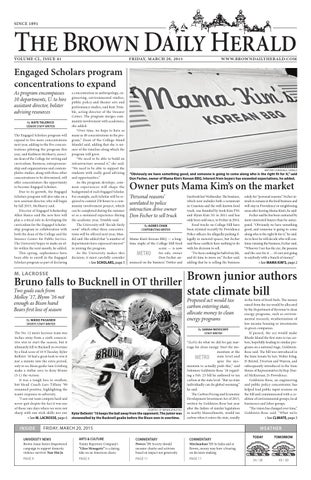
“Obviously we have something good, and someone is going to come along who is the right fit for it,” said Don Fecher, owner of Mama Kim’s Korean BBQ. Interest from buyers has exceeded expectations, he added.
Owner puts Mama Kim’s on the market ‘Personal reasons’ unrelated to police interaction drive owner Don Fecher to sell truck By AGNES CHAN CONTRIBUTING WRITER
Mama Kim’s Korean BBQ — a longtime staple of the College Hill food scene — is now for sale, owner Don Fecher announced on the business’ Twitter and
METRO
Facebook last Wednesday. The business, which now includes both a restaurant in Cranston and the well-known food truck, was founded by Sook Kim P’01 and Hyun Kim ’01 in 2011 and has only been sold once, to Fecher in 2014. Food trucks on College Hill have been stymied recently by Providence Police officers for allegedly parking illegally in metered spaces, but Fecher said these conflicts have nothing to do with his decision to sell. “I’ve been cooking for half of my life, and it’s time to move on,” Fecher said, adding that he is selling the business
solely for “personal reasons.” Fecher intends to remain in the food business and will stay in Providence or neighboring areas after leaving Mama Kim’s, he said. Fecher said he has been contacted by more interested buyers than he anticipated. “Obviously we have something good, and someone is going to come along who is the right fit for it,” he said. As to how he will decide who will continue running the business, Fecher said, “Whoever I see has the eye, the passion and the care for it … it’s not just going to anybody with a bunch of money.” » See MAMA KIM’S, page 2
Bruno falls to Bucknell in OT thriller Brown junior authors M. LACROSSE
state climate bill
Two goals each from Molloy ’17, Blynn ’16 not enough as Bison hand Bears first loss of season
Proposed act would tax carbon entering state, allocate money to clean energy programs
By NIKKO PASANEN SPORTS STAFF WRITER
The No. 12 men’s lacrosse team was inches away from a sixth consecutive win to start the season, but it ultimately fell to Bucknell in overtime by a final score of 10-9 Tuesday. Kylor Bellistri ’16 had a great look to win it just a minute into the extra period, only to see Bison goalie Sam Grinberg make a stellar save to deny Bruno (5-1) the victory. It was a tough loss to swallow, but Head Coach Lars Tiffany ’90 remained positive, highlighting the team’s response to adversity. “I saw our team compete hard and never quit despite the fact it was one of those rare days where we were not sharp with our stick skills nor our » See M. LACROSSE, page 6
INSIDE
By SARAH NOVICOFF STAFF WRITER
“(Let’s) do what we did for gay marriage for clean energy. Start the momentum at the state level and spur the momentum to actually push this,” said Solomon Goldstein-Rose ’16 regarding a Feb. 25 bill he authored to tax carbon at the state level. “But no state individually can fix global warming,” he said. The Carbon Pricing and Economic Development Investment Act of 2015, written by Goldstein-Rose last year after the failure of similar legislation in nearby Massachusetts, would tax carbon when it enters the state, usually
METRO
COURTESY OF BROWN ATHLETICS
Kylor Bellestri ’16 keeps the ball away from the opponent. The junior was stonewalled by the Bucknell goalie before the Bison won in overtime.
in the form of fossil fuels. The money raised from the tax would be allocated by the Department of Revenue to clean energy programs, such as environmental research, weatherization of low-income housing or investments in green companies. If passed, the act would make Rhode Island the first state to tax carbon, hopefully leading to similar programs on a national stage, GoldsteinRose said. The bill was introduced in the State Senate by Sen. Walter Felag, D-Bristol, Tiverton and Warren, and subsequently introduced in the State House of Representatives by Rep. Daniel McKiernan, D-Providence. Goldstein-Rose, an engineering and public policy concentrator, has helped lead public input sessions on the bill and communicated with a coalition of environmental groups, local businesses and labor groups. “The vision has changed over time,” Goldstein-Rose said. “What we’re » See CLIMATE, page 3
WEATHER
FRIDAY, MARCH 20, 2015
UNIVERSITY NEWS Brown Asian Sisters Empowered campaign to support domestic violence survivor Nan-Hui Jo
ARTS & CULTURE Trinity Repertory Company’s “Glass Menagerie” is a daring take on an American classic
COMMENTARY Powers ’15: Society should measure charity and activism based on impact not generosity
COMMENTARY Mirchandani ’15: In India and at Brown, money may have a bearing on decision-making
PAGE 4
PAGE 4
PAGE 11
PAGE 11
TODAY
TOMORROW
34 / 28
45 / 30
UNIVERSITY NEWS PAGE 2 • FRIDAY, MARCH 20, 2015
THE BROWN DAILY HERALD
Panelists debate social justice implications of Michael Brown shooting Various scholars offer views on American response recent police violence, discrimination By LAUREN ARATANI STAFF WRITER
“Mike Brown is no Rosa Parks, and he ain’t Emmett Till either,” said Glenn Loury, professor of economics, at a discussion on “Black Communities and the Police: The Meaning of Ferguson” at the Watson Institute for International Studies Thursday night. Approximately 30 graduate students, faculty members and community members converged in the Joukowsky Forum to grapple with policing of black individuals in the wake of the shooting of unarmed black teenager Michael Brown. Loury’s Jan. 5 piece in the Boston Review, entitled “Ferguson Won’t Change Anything. What Will?,” inspired the forum. In his article, Loury questioned the use of Michael Brown as a “poster child for a social justice movement.” Loury said Michael Brown’s death is not an appropriate catalyst for a “movement aimed at addressing the problems that are serious and definitely need to be addressed.” “The temptation to draw this analogy of black bodies abused and black lives not mattering is a mistake in categorization of the actual circumstance that we have,” Loury said. Police discrimination against blacks “should be protested,” but that will not solve deeper structural problems, such as “failed schools” or “urban space that is organized in a certain way because it suits the interests of people in power,” he said. Khali Muhammad, director of the New York Public Library’s Schomburg Center for Research in Black Culture, agreed with some of Loury’s argument but disagreed with many aspects of his essay. Loury “is invoking a standard of dignity and respect that I do not think reflect policing that happens in most
» MAMA KIM’S, from page 1 Though tensions with Providence Police officers have not had a significant impact on Mama Kim’s business, Fecher expressed disappointment with the way city officials have dealt with the situation. “I wish they would have handled it in some capacity, and I don’t feel like they have done anything,” he said. “I’ve been doing business in this city for nearly five years, and I feel that they should have our back a little bit more. I’ve called and tried to reach out and see what I can do, and I haven’t really
RYAN WALSH / HERALD
Panelists included Director of the New York Public Library’s Schomburg Center for Research in Black Culture Khali Muhammad, Rutgers University Professor of Political Science Lisa Miller, Director for the Center for the Study of Race and Ethnicity Tricia Rose and Professor of Economics Glenn Loury. communities if we listen to the people who live in those communities,” Muhammad said. “It’s the leadership, not the officer that is the problem.” Policing in affluent communities is “low intensity” and “individualized,” Muhammad said, adding that it is based on the assumptions that members of these communities have moral respectability “regardless of what happens behind closed doors.” Communities with the most policing tend to include low-income families and have a “disproportionate political influence on the shaping of policy,” Muhammad said. Policing is a “symptomatic way of subordinating people,” he added. Tricia Rose, director for the Center for the Study of Race and Ethnicity in America, opened with the Civil Rights movement. During that era, many blacks felt the need to act as the “perfect black person,” or someone who “does not erupt in rage at systemic
racism,” she said. Rose cited her experience at preparatory school, where she witnessed many wealthy white students committing crimes without repercussions. She noted not only that the crimes went unmarked, “but also the explanations that were made for it, like ‘Oh, his dad was never around. He’s traveling off in the bowels of capitalism.’” Rose encouraged audience members to consider who tells Michael’s Brown’s story and why, especially in relation to the media’s framing of Brown’s case. The media painted Brown as a “thug,” which is not a “race-neutral” term, Rose said, adding that the media also “disaggregated” the story by not mentioning the economic burdens blacks face due to race. “This kind of disaggregation of the story into a micro-focus personalizes the systemic forces,” Rose said. “It suggests if you’re comfortable, you should be comfortable. Because these
are the details that allow us to be reasonable from a comfortable place, not outraged.” The media’s portrayal of the story also leaves people with a lack of “recognition that we did not actually fundamentally transform the racial relationships and dynamics of this country,” she added. “We transformed the mechanisms which certain structures continued to operate.” Lisa Miller, associate professor of political science at Rutgers University, agreed that the “fixation on policing is deeply misguided,” though not incorrect. “Movements around policing or mass incarceration are not helping the problems that we want to get solved,” Miller said, adding that the problem is the “racialized state failure of American politics.” Miller cited statistics of the higher rates of homicides of black Americans than white Americans. She emphasized
that the “rise of serious, especially lethal violence no matter the source is a first-order political problem.” “Black lives matter, and the American state has failed and continues to fail,” Miller said. Loury took the opportunity to respond to the other panelists following their presentations. “The facts do matter. We can’t imagine the facts we want them to be to serve a larger political agenda,” Loury said in response to Rose. “Mike Brown is what you call the tip of an iceberg — he’s a catalyst,” Rose said. The Joukosky Forum holds a series of seminars, workshops and teach-ins to “both understand and contemplate ways of addressing some of the world’s worst problems,” said Richard Locke, director of the Watson Institute and professor of political science and public and international affairs, who moderated the panel.
gotten much back — not from the board of licenses or the mayor’s office … or anything.” “While all this happened, I decided to make another plan to move to another city, like Pawtucket,” Fecher said, adding that the truck has been warmly received there. “I called the mayor’s office directly and one of his staff called me back the next day, saying ‘Yes, we’d love to have you in our city.’ That’s the kind of city I want to … do business in.” In the meantime, as Mama Kim’s seeks a new owner, the restaurant — but not the food truck — will re-open
Monday after closing while Fecher was on vacation. The truck will be back “sooner than everybody thinks,” Fecher said. “We’re going to be back, whether we’re in Pawtucket, or on Thayer Street or in the area.” Students remain disappointed with the reduced presence of food trucks on College Hill this semester but said they are optimistic that the trucks will make a return soon. “I think the bad weather makes it hard for the trucks to park in the right places,” said Marjorie Pang ’18. “Hopefully once it gets warmer, we will see the trucks returning to Thayer
Street.” “I do think Mama Kim’s and other food trucks will come back to Thayer Street soon,” said Christy Leung ’18. “Lots of students buy food from the trucks regularly, and I think the city will recognize that demand sooner or later.” Progress is being made to help food trucks find a place in the city, said Eric Weiner, president of Food Trucks In, a company that provides people in over 765 cities with information about food trucks. The mayor’s office and the City Council are “working at the current rules with the understanding that
changes need to be made.” “Different people’s interests need to be figured out,” Weiner said, citing restaurants’ concern regarding the proximity of food trucks to their establishments and the University’s concern over limited parking space on College Hill for students, faculty members and staff members. “It may mean that they might end up on Waterman (Street), further from the restaurants, or on Angell Street,” Weiner said, adding that “everyone is in agreement that food trucks have a home in Providence.”
Check out The Herald’s new website! Visit www.browndailyherald.com Send your feedback to herald@browndailyherald.com
UNIVERSITY NEWS FRIDAY, MARCH 20, 2015 • PAGE 3
THE BROWN DAILY HERALD
» SCHOLARS, from page 1 student interest, but faculty interest will be prioritized above all “since they are to teach the classes,” Mandel said. The two concentrations already selected to join the program next year each contained a natural bridge into the process of Engaged Scholarship. Contemplative studies “is a concentration that already has engagement embedded into what they do,” McSharry said. “When the Engaged Scholars announcement came out … it almost fit word for word a lot of what the goals are for the BEO program,” said Brendan McNally, associate director of BEO. BEO has been integrating community outreach into its programming for the last several years through its required senior capstone project, in which students design a project in conjunction with a community organization, he added. Seniors interested in business, economics and social entrepreneurship have worked on capstone projects, including data analysis and recommendation writing for the Boys and Girls Club of Rhode Island as well as strategic partnership development for a local technology startup, McNally said. Only students on track to graduate in 2018 or later will be granted the opportunity to declare as an Engaged Scholar in BEO, contemplative studies or one of the to-be-determined concentrations piloted next year, McSharry said. While the program is still taking shape, it has come a long way since President Christina Paxson’s P’19 term began. Paxson strongly encouraged the Engaged Scholars initiative and put it “at the forefront” of the University’s capital campaign, McSharry said. “Every president has their signature initiatives — this is hers.”
» CLIMATE, from page 1 trying to do is protect Rhode Island from the impacts of global warming.” J. Timmons Roberts, professor of environmental studies and sociology, coordinates a team of seven student interns and three outside consultants on the Energize Rhode Island project — the initiative to develop and eventually implement the carbon tax. He sees
RYAN WALSH / HERALD
As the Engaged Scholars Program expands to include five additional concentrations next year, the University will hire an assistant director of the program to develop new curricular initiatives. “We hope to have as many as 40 concentrations in the program,” Dean of the College Maud Mandel said. While the University has researched similar programs at other schools such as Cornell, Penn and Tulane University, Brown’s program “appears to be different from all the other programs in that it’s embedded in the concentrations,” McSharry said. “There’s a tremendous opportunity at Brown because of the open curriculum and because of the spirit of students,” Hance said. Concentration advisers will continue to help students from within their departments, but the Swearer
Center will also act as a resource for students as they establish connections between Brown and Providence, Trimble said. Alan Harlam, adjunct lecturer in public policy and director of social entrepreneurship at the Swearer Center, teaches “PPAI 1910: Social Entrepreneurship” and “PPAI 1701Q: Leading Social Ventures — Social Entrepreneurship in Action.” The curricula of these courses enable students to apply classroom concepts to reallife community problems, he said. “We teach about theory of change
and logic models. Once we have students doing a number of readings about how these topics work … and why they’re important to social change, students then create a logic model for their own venture,” Harlam added. “The beauty of the projects is that they’re really varied,” said Andrew Kaplan ’15, a teaching assistant for Leading Social Ventures. One venture, “Rhymes with Reason,” uses hip hop to help high school students study vocabulary in preparation for standardized tests, he said. Another,
called “Tiny Homes,” uses a model to build low-cost, smaller homes in Providence for homeless people, Kaplan added. “I’m personally excited about the opportunity for students to have access to more and more classes that allow them to apply what they’re learning from within their department to real problems that exist in the world,” Harlam said. “I’m excited that my class is one of those opportunities that allows students to bridge the gap between Brown and their communities.”
the bill as a chance for the state to be a national leader while simultaneously improving its own economy. “We don’t produce any fossil fuels here at all, and so any dollar we spend on fossil fuels just goes straight out of the state. So the more efficient we can be in using the fossil fuel, the less money we’re wasting,” Roberts said. “The act is projected to raise about $150 million in its first year, which
could fund some really important things.” Roberts led a group of students and consultants last year in passing the Resilient Rhode Island Act, creating emission reduction targets for the state. He said he sees the Carbon Pricing Act as a natural step and an incredible tool to meet those ambitious targets. The bill was most recently referred
to the finance committees in both legislative chambers. Roberts and Goldstein-Rose both anticipate it leaving the committees in June — once the state budget is finalized — and hopefully passing a floor vote and being signed by Gov. Gina Raimondo before the end of the legislative session in late June. “You can’t understand how public policy is made unless you make it
yourself. And this is why I love teaching at Brown. The students want to make the world a better place, and they don’t want to wait until they graduate to do so,” Roberts said. Goldstein-Rose expressed a similar sentiment. “Being students in such a small state, we really can have an impact on state policy, and we can upand-start something like this, which has been amazing,” he said.
UNIVERSITY NEWS PAGE 4 • FRIDAY, MARCH 20, 2015
THE BROWN DAILY HERALD
BASE letter campaign aims to support victim of domestic violence Brown Asian Sisters Empowered calls on Brown community to contact Nan-Hui Jo By ZACK BU SENIOR STAFF WRITER
“I stand with Nan-Hui because our women and children should be protected and supported at all costs.” These are just some of the words of empowerment that Brown Asian Sisters Empowered collected from Brown community members during its four-day #DearNanHui letterwriting campaign. Other tributes included “I stand with Nan-Hui because domestic violence is never okay” and “I stand with Nan-Hui because I’m tired of victim blaming.” Spending the first day in J. Walter Wilson and migrating to the Blue Room for the remainder of the campaign, the group advocated the rights of Nan-Hui Jo, a victim of domestic violence, and called attention to the social injustice surrounding her case. BASE called upon Brown community members to write letters of support to Nan-Hui to display campus solidarity with her plight. The group will compile pictures of community members holding up these messages in both English and Korean on whiteboards and send them to Nan-Hui. Nan-Hui, a single mother, fled from the United States to Korea with her 6-year-old daughter Vitz Da in 2009 to escape physical and emotional abuse by her previous partner. But when she returned to the United States in July 2014, she was immediately arrested and has since been imprisoned and separated from her daughter. Nan-Hui now faces charges of child abduction and the possibility of deportation. According to the American Bar Association, approximately 1.3 million women and approximately
COURTESY OF TAYLIN IM
Brown Asian Sisters Empowered will send Nan-Hui Jo photos of Brown community members holding messages of solidarity written in English and Korean. Nan-Hui spent seven months in jail, and she faces charges of child abduction and the possibility of deportation. 835,000 men are physically assaulted by an intimate partner in the United States each year. Under international legal agreements, when parents take their children across international borders, the parents become vulnerable to charges of abduction. “The best form to present our support is through letter-writing, so that she can feel that there are actually a lot of supporters rooting for her,” said Juhee Kwon ’14, an alum who helped organize the campaign. The campaign is especially
relevant to Brown’s campus, where many students are first- or secondgeneration immigrants, said Jea Sim ’17, BASE president and one of the event’s organizers. “A lot of people at Brown that I know are survivors of emotional and physical abuse — it happens within the campus,” Kwon added. After spending seven months in jail, Nan-Hui will await her sentence for another 30 days, Kwon said. Though many people show their support for the single mother, the words
of encouragement often do not reach her in jail, she added. Besides the letter-writing campaign, other avenues exist for students to get involved, such as petitions, open letters, tweets and phone calls that support Nan-Hui’s cause, Sim said. Soyoon Kim ’18, who wrote a message as part of the campaign, said she “wanted to stand in solidarity with someone who I sort of relate to ethnically and culturally as a Korean person.”
COURTESY OF TAYLIN IM
Mia Gold ‘17 stands in solidarity with Nan-Hui Jo, who faces child abduction charges after fleeing the U.S. for Korea in 2009 with her six-year-old daughter Vitz Da to escape emotional and physical abuse. Nan-Hui was immediately arrested upon her return to the U.S. in July 2014.
Kim said she wrote her message entirely in Korean, Nan-Hui’s native tongue, adding that she “felt like (Nan-Hui) would appreciate support from the community.” Kwon said she hopes the campaign will evoke self-reflection on interactions within the Brown community. “Each one of us has an inherent way of how we are violent towards other people,” she said. “It’ll be a really great opportunity for folks to think about the ways they enact violence on other people.”
ARTS & CULTURE FRIDAY, MARCH 20, 2015 • PAGE 5
THE BROWN DAILY HERALD
Trinity Rep takes risk with Tennessee Williams classic Experimental set, casting powerfully represent themes of familial dysfunction, strife By SHIRA BARTOV CONTRIBUTING WRITER
Profound probes into human memory and dysfunctional family relationships have lodged “The Glass Menagerie” in many hearts since its 1944 premiere. This exploration echoes with particularly disjointed, frenzied energy in Trinity Repertory Company’s inventive interpretation of Tennessee Williams’ play, which runs through March 29. Director Brian Mertes’ creative risks spur the production toward psychological poignancy, and if it occasionally falls short of his vision, this is due only to his overeager approach. Predominant among the imaginative elements that bring a broken atmosphere to the play is its music. The original compositions, written and performed by Phillip Roebuck, resound with a chaotic mix of piano, organ, guitar, fiddle and iron bells as Roebuck wanders, dizzied, around and across the stage. Now and then the melancholy notes turn to light-hearted jingles, with jarring effect: The humor of tunes such as “Let’s All Go to the Movies,” in which the cast bursts suddenly into song and kazoo-blowing, mingles ironically with the weight behind the words. Protagonist and narrator Tom
REVIEW
Wingfield, performed by Brian McEleney, usually includes heavy drinking in his nightly trips “to the movies,” representing his bitterness and frustration with life. The set design adds an array of subtle and not-so-subtle metaphors for the consciousness of each character. Below the stage, a piano doubles as a staircase that clangs dissonantly when Mia Ellis, as the limping Laura Wingfield, trips on its keys. Tom’s metal bed rises in the air on a pulley and transforms into a fire escape, where he and his mother wish on the moon. An overhead projector serves as the table on which Laura plays with her glass animals, presenting the audience with a magnified image of her slow, gentle hands on the wall behind. These detailed combinations provoke not just audience members’ eyes, but also their senses of hearing and touch — the same faculties that plunge Tom, their retrospective guide, into the recesses of his memory. Not every component of the set is quite as successful. Some haphazard props, including tissue-paper flowers and an inflatable giraffe, seem superfluous. At moments it is difficult to discern whether the musical interruptions contribute more distraction than constructive interpretation to the raw power of the script. Yet these features are soon forgotten in the shadow of an impressive cast. Mia Ellis shines as Laura, a girl whose body fetters and shames her before the social world. As an older Tom, who is in his 20s during the heart of the story, McEleney highlights his
COURTESY OF TRINITY REPERTORY COMPANY
Trinity Repertory Company’s production of Tennessee Williams’ “The Glass Menagerie” opened Feb. 26. The production runs until Mar. 29 and features a cast assembled irrespective of the performers’ ages and races. character’s cyclical loss of himself to the future as a young man and to the past as an aging one. Anne Scurria as Amanda Wingfield and Dennis Kozee as Jim O’Connor also bring fascinating
interpretations to their roles, leading the audience to reward them with a standing ovation. Leaving Trinity Rep at the end of the show Thursday night, audience
members had some difficulty navigating a large crowd absorbed in a heated debate over the cast’s portrayal of a divisive plot point. It was that sort of production.
SPORTS
PAGE 6 • FRIDAY, MARCH 20, 2015
THE BROWN DAILY HERALD
SOFTBALL
Bears prepare for Ivy League schedule with trip to Golden State Improved pitching, upgraded offense spark Bears’ hopes for better conference play By ANDREW FLAX SPORTS EDITOR
The softball team hit rock bottom last season, compiling an abysmal 4-34 record that included a 28-game losing streak. But in the third season of Head Coach Katie Flynn’s tenure, the Bears (2-3) boast a youthful roster — only three of the team’s 15 players are upperclassmen — and have their eye on winning. “Having a young team allows us to play with energy,” said captain Trista Chavez ’15. “We just need to continue to play with the same energy, confidence and focus, and I strongly believe that we are going to have a great season.” Bruno’s season is off to a solid start, with wins over Army and Bucknell in Myrtle Beach, S.C. as part of a five-game series at the end of February. But with the weather-related cancellation of a trip to Towson, the Bears have yet to show they are any different than last year’s team, which also started 2-3. Nevertheless, the team already looks different in one crucial area: offense. Through five games, Bruno is hitting a healthy .284/.348/.454 and is averaging 5.4 runs per game. In contrast, it hit .214/.258/.290 over all of last season and averaged a shade over two runs per game. The Bears also hit six home runs in their last weekend of play, as compared to just 10 all of last season and just two over its first five games in 2014.
» M. LACROSSE, from page 1 decision-making,” Tiffany said. “We have been fortunate to not feel the sting of a loss until now, but I know this group of men will realize the mistakes made with their approach to this game and grow from it.” Despite the missed opportunity at the end of the game, Bellistri had an impressive day, leading the Bears’ offense with three goals and extending his season total to 14. Dylan Molloy ’17 and Henry Blynn ’16 each added two goals as well. Molloy was recently named to the watch list for the Tewaaraton Award, given annually to the best male and female lacrosse players in the country. On the defensive side, Jack Kelly ’16 made 11 saves, while Alec Tulett ’17 picked up four ground balls and caused three turnovers. The Bears’ offense had no trouble getting going Tuesday. After conceding an early goal, Bruno went on a 5-0 run in a span of just over five minutes. The scoring spree was highlighted by Molloy, who assisted on three of the goals and scored twice on his own. Unfortunately for the Bears, the Bison fired right back and went on a run of their own. While keeping the Brown offense at bay, Bucknell rattled off six straight goals to turn an early four-goal deficit into a two-goal lead.
COURTESY OF BROWN ATHLETICS
Two weeks away from Ivy play, Brown heads to California for a few tune-up games. First-years have stepped in and have had an immediate impact for Bruno: Katie Orona ’18 looks like an ace, while Yeram Park ’18, Grayson Metzger ’18 and Annie McGregor ’18 have all hit home runs this season. “We have power throughout the lineup and do not have to rely only on one player to be able to produce runs,” Chavez said. “We have a solid mix of power and speed on this team.” As one might suspect from the makeup of the roster, the team’s firstyears have made the biggest impact. Three of those home runs came from first-years, and Yeram Park ’18 leads the team with three walks despite ranking ninth on the team with 12
plate appearances. On the pitching side, Katie Orona ’18 has emerged as the team’s ace. In three outings, she has struck out 24 batters over 16 innings and has compiled a sterling 2.63 ERA. Leah Nakashima ’17 and Jessica Cherness ’15 were Bruno’s two main pitchers last season, though they had ERAs of 4.40 and 5.17, respectively. They combined to strike out just 95 batters in 174.2 innings.
It was not until around the seven-minute mark that Bruno finally got back to its attacking ways, with Blynn tallying his first of the day. Both teams would remain scoreless for the rest of the quarter until Bellistri connected with 49 seconds left to send the game into halftime tied 7-7. The second half proved to be a true defensive stalemate, with both teams scoring just two goals each. In the third quarter, it took over 12 minutes for either team to find the back of the net before Blynn scored his second of the day to send the lead back to the Bears. Bellistri followed just 20 seconds later to push the margin to two. At the start of the fourth quarter, it looked like Bruno was well on its way to a win, but the offense faltered down the stretch. The Bison brought out their best defensive efforts to shut out the Bears and grabbed two goals along the way to send the game into overtime. Bucknell had a chance to win at the end of regulation, but after some questionable clock management, it was unable to get a clean shot off in time. The Bears’ first possession in overtime was promising, as Molloy made a beautiful pass to Bellistri at the top of the circle, but a great save kept the Bison alive. On the ensuing possession, Thomas Flibotte fired a shot past Kelly, sending Bruno to its
first loss of the season. It may have been a heartbreaker, but Tiffany and Blynn were quick to point out the lessons that could be taken away from the defeat. “With each practice and game, we learn more and more about ourselves — the staff included,” Tiffany said. “We made some mistakes and we are going to rectify them. Preparing for our next game, we recognize that our more offensive-minded midfielders have to play more. We have to be willing to slow our offense down to ensure that we don’t play such a lopsided amount of defense.” “Our offense was on fire early, but then we stopped doing simple things like catching and passing accurately, and our play became sloppy,” Blynn said. “With all the turnovers, Bucknell was able to hold on to the ball for too long.” The Bears will gear up to take on Manhattan College (0-8) Saturday, with hopes of rebounding from the tough loss. Blynn expressed confidence in the team’s ability to get back on track. “We are going to focus on the little things, such as fundamentals and regaining that confidence that we had going into Bucknell,” he said. “These next couple days before Manhattan, we can digest the loss and work on all of our weaknesses to ultimately turn them into strengths.”
Orona was quick to credit her coaches and teammates for her success. “We have some really good coaches,” she said. “My catcher has been a big help,” she added, referring to Julia Schoenewald ’17. With a pair of wins in their pocket and a much more talented roster than last year’s, the Bears are ready to prove themselves. They begin the break with a seven-game set in California
before opening Ivy play on the road against Cornell and Princeton. “Our team motto for this season is to win the day,” Chavez said. “We strive to win games, but we strive even harder to get better each day. … If we as a team are constantly striving to improve our skills and better ourselves, the wins will come.” “If we win every day, we should set ourselves up for success in the future,” Orona said.
STAY UP-TO-DATE. FOLLOW US ON FACEBOOK. FACEBOOK.COM/BROWNDAILYHERALD
SPORTS
FRIDAY, MARCH 20, 2015 • PAGE 7
THE BROWN DAILY HERALD
W. LACROSSE
Hunt ’17, Hudgins ’18 lead Bruno into tilts with Cornell, Colgate Brown looks to avenge last year’s heartbreaking loss to Cornell, beat nonconference foe Raiders By LAINIE ROWLAND SENIOR STAFF WRITER
The women’s lacrosse team will seek to avenge last season’s 11-10 overtime loss in its contest against Cornell this weekend. Bruno will follow up the Ivy League rematch with a non-conference game at Colgate Tuesday. Kerianne Hunt ’17 excelled against the Big Red (5-2, 2-0 Ivy) last season, netting a hat trick to power Bruno’s offense to the close loss. Five of the 10 goals scored in the game came from players who are on this year’s roster. Notably, Cornell dominated the draw control last year. The Bears (4-2, 0-2) cite draw controls as one of their greatest strengths — a facet of play they hope may shift the results in their favor. “We’re a really fresh team this year, so we’re more focused on what we need to do as the 2015 Brown team against the 2015 Cornell team,” said Head Coach Keely McDonald ’00. But earlier this season, the Big Red defeated Yale — a squad that trumped Bruno last weekend by a score of 8-3. The Bears’ inability to finish in that game and capitalize on possessions doomed them. Future success depends on their ability to overcome such inertia. “It just boils down to this group following a game plan for 60 minutes,” McDonald said. One of four undefeated Ivy squads, the Big Red boasts a fierce offense. The trio of Catherine Ellis, Amie Dickson
COURTESY OF BROWN ATHLETICS
Alyssa Dibona ’15 carries the ball, looking for an open teammate. Bruno has fallen to the first two Ivy foes it has faced — lowering the Bears’ national standing — but looks to recover against Cornell and take down Colgate in its trip to the Empire State. and Lindsay Toppe has netted a total of 52 goals on the season, while Bruno’s offense has scored 59 overall. “We match up nicely with them,” McDonald said. “It will really come down to little things and both teams playing a good, clean game of lacrosse.” In goal, Cornell’s Renee Poullott has recorded a save percentage of 42.4, ranking her near the bottom of conference goalies and behind the 50.5 save percentage of Kellie Roddy ’15. But the Big Red makes up for it with offensive
output and high-scoring games. Cornell scored a whopping 22 goals earlier this season over Binghamton. “Each player owns what she needs to do within the defensive system,” McDonald said. “It has to be all eight people working as one so that we can shut down a strong offense.” Bruno will continue its upstate New York campaign with a contest at Colgate early in the week. The Raiders have competed against two Ivy teams so far this season, ousting Columbia
by a wide margin and falling to Cornell. While the non-conference action will be less competitive and have lower stakes than the Ithaca matchup, Colgate (4-3, 1-1 Patriot) will certainly provide a challenge for Bruno, as well as an opportunity to step back from heated Ivy play. “Colgate has been doing well in the Patriot League and they’re a strong program,” McDonald said. “It’s really an opportunity to get two great opponents in.”
The Raiders make half of their shots and have scored 66 goals in six games this season. Megan Ark, Haley O’Hanlon and Emily Peebles have each scored 10 or more goals and taken 19 or more shots. Goalie Jennie Berglin has posted a 53.2 save percentage, rivaling Roddy’s 50.5. But Colgate is not accustomed to top Ivy teams’ elite level of play. Bruno’s conference losses this season, however disappointing for the team, have clearly illustrated its ability to go play-for-play with top squads.
BASEBALL
Bears look to capitalize on trip to Washington, D.C. Georgetown, George Mason obstruct Bruno’s quest for second win, first series triumph By MATT BROWNSWORD SENIOR STAFF WRITER
COURTESY OF BROWN ATHLETICS
Robert Henry ’17 takes a cut at a pitch. The sophomore has been the Bears’ best offensive player, batting .447 with 10 RBIs.
While many college students and sports teams alike will be traveling to warm, sunny beaches in destinations like Florida and California over spring break, the men’s baseball team will stay a little farther north, landing in Washington, D.C. to take on Georgetown and George Mason. Brown (1-10) has yet to register its second win of the year after getting swept by North Florida and losing to the University of Rhode Island. But the Hoyas (7-8) — like Bruno — have yet to play a home game due to inclement weather. George Mason (6-9) has played four games at home this year, going 2-2 with losses to Manhattan and Yale. Jake Kuzbel and Nick Collins spearhead the Hoyas’ offense as two of its three leaders in batting average. Kuzbel has the most total bases on the team, while Collins is third in runs batted in. Georgetown’s offense is based on power, as it has six players with six RBIs or more and five with more than 15 total bases. Even Brown’s relatively high-powered offense features only four players with
six or more RBIs. “We’re going to be aggressive and try to attack the strike zone as a pitching staff,” said Taylor Wright ’15. “We try to stick to our process no matter who we are facing.” Matt Smith and Jack Vander Linden lead a Georgetown pitching rotation that is substantially better than the Bears’. Both have sub-four ERAs, and Smith recorded a 2.22 ERA in four starts. Another weapon on the mound for the Hoyas is David Ellingson, who has appeared in 10 games this year, registering a 0.90 ERA. Georgetown as a team has a strikeoutto-walk ratio of about 2:1 — not typically considered great. But compared to the Bears, who have recorded more walks than strikeouts, it is excellent. “We have confidence in our guys offensively,” Wright said. “They can take on anyone, and we have seen some good pitching so far, so our guys are prepared.” Facing that trio of pitchers will be Brown’s 1-2 combo of Robert Henry ’17 and Noah Shulman ’16. Henry was recently named Ivy Player of the Week, and he is batting .447 on the young season. After those two, the Bears have had little individual success, but Brown’s offense has been fairly explosive at times this year. “Rob has been huge for our offense as a table setter,” Wright said. “When he’s always on it gives us early momentum in
the game. He gives our offense a lot of confidence by putting pressure on their pitcher early.” George Mason has had a lack of success similar to Georgetown, with its pitching and offense fluctuating game by game. The Patriots’ lineup features five players batting over .300 this year, with Kent Blackstone and Tyler Nelin leading the RBI category. Blackstone’s run production comes from his power — he has hit three home runs already this season — but Nelin is more of an all-around hitter. Nelin has two homers — good for second on George Mason — but also hits .320 and ranks second on the team in slugging percentage. The Patriots do not have dominant starting pitchers like Georgetown, but they do have a plethora of pitchers who have done well in spurts this year. John Williams, who has won four of his five starts, leads the team’s starters with a 2.56 ERA, and two of George Mason’s relievers — both of whom have appeared in seven or more games this year — have sub-two ERAs. The Patriots have an even better strikeout-to-walk ratio than the Hoyas — a stat that does not bode well for a streaky Brown offense that often relies on walks to start big innings. The Bears’ trip to the nation’s capital precedes the start of Ivy League play. Brown will take on Princeton and Cornell in two weekends.
SPORTS
PAGE 8 • FRIDAY, MARCH 20, 2015
THE BROWN DAILY HERALD
SPORTS COMMENTARY
Cinderellas in the Big Dance: this year’s upset predictions BY JOE DIEHL sports columnist
Nationwide, it is estimated that 40 million Americans will spend $9 billion betting on March Madness brackets this year. With so much money in the pool, I attempted to make the upset picks that will win brackets. As I write this, none of the games have started. My picks are based on a combination of worshipping KenPom.com, obsessively reading bracketology articles on ESPN and watching every March Madness game possible for many years. Yet people who pick their brackets based on mascot preferences still seem to beat me every year. That is why it’s called March Madness. Category one: Upsets that will happen No. 11 Texas Longhorns over No. 6 Butler Bulldogs Texas is actually ranked four spots higher than Butler on KenPom’s index. Furthermore, the Longhorns are 3-6 in games decided by six points or fewer. They also lead the nation at defending in the paint — they limit opponents to 37.8 percent shooting on two-point attempts. The Longhorns’
roster is capable of much more than their underachieving team has shown so far, leading to a potential underseed and dangerous underdog. Sound familiar? Kentucky was in a similar position as a seven-seed last year. We all know how that worked out. No. 11 Ole Miss Rebels over No. 6 Xavier Musketeers The Rebels showed their potential on Tuesday, dominating BYU during the second half. Though the Cougars had a 17-point lead at halftime due to phenomenal three-point shooting, the Rebels came back with ferocious fast breaks and inside play. Xavier is a well-rounded team but doesn’t do anything particularly well, which could hurt it in this game. Ole Miss also has a better power rating than many higher-seeded teams. On the subjective side, the Rebels made me a believer as I watched them come back with such tenacity. No. 11 Dayton Flyers over No. 6 Providence Friars First of all, congratulations to Brown for beating a number-six tournament team this year. That being said, Providence’s loss that day exposed some of its weaknesses as a team. It struggled on defense and couldn’t get its offense going. Dayton has a stellar defense, and
if its offense performs well both on the glass and on the perimeter, which have been relative strengths, Providence could be going home early. Furthermore, Dayton’s dramatic onepoint win over Boise State in its playin game gives the Flyers momentum going into this matchup. No. 13 Harvard Crimson over No. 4 North Carolina Tar Heels Just kidding. In your dreams, Harvard. Go ’heels! Category two: Upsets that are plausible No. 13 UC Irvine Anteaters over No. 4 Louisville Cardinals The Anteaters, making their tournament debut, boast 7-foot-6 center Mamadou Ndiaye, who limited opponents to a 42.3 field goal percentage in the paint during the regular season. Louisville ranks 95th in offensive efficiency, the worst major-conference mark in the entire field. Since losing Chris Jones, the Cardinals have lost five of their last 10 games and have not played well. However, Rick Pitino is a tough coach to bet against and that’s what keeps this matchup from the “will happen” category. No. 13 Valparaiso Crusaders over No. 4 Maryland Terrapins According to the Wall Street
Journal, this is the most likely upset at 53.6 percent. Despite the Journal’s impeccable news coverage, sports aren’t its domain. ESPN has this upset in a more likely neighborhood of 12.6 percent. Maryland struggles to steal possessions on defense and extend possessions with offensive rebounds, which might allow Valparaiso to hang with them and increase their upset capability. Maryland is also 11-1 in close games this year, which shows luck has been going its way during the regular season. Yet this luck tends to go away at some point in the tournament. No. 12 Buffalo Bulls over No. 5 West Virginia Mountaineers History tells us there will be at least one No. 12 vs. No. 5 upset this year. Though Stephen F. Austin is the popular upset pick, I will side with the president and say Buffalo has the best chance of any 12-seed. West Virginia forces a lot of turnovers, but Buffalo takes care of the ball and rebounds well, setting up a battle of strengths. The one concern for the team is the fact that it doesn’t convert chances well, ranking 177th in two-point shooting and 179th from downtown. Final word: An upset that will definitely not happen
No. 12 Stephen F. Austin Lumberjacks over No. 5 Utah Utes Call me crazy, but I do not see this upset happening. Though Utah has lost four of its last seven games, it still ended the season as KenPom’s number eight-ranked team. The Lumberjacks run a very efficient offense and score effectively. They have also won 28 of their last 29 games, which puts them in very good form. But Utah’s defense and offense have both been fantastic this season. It’s one of seven teams that make KenPom’s top 20 lists for both adjusted offensive and defensive efficiency ratings. And though the Lumberjacks also do a good job of forcing turnovers, Utah — led by top-tier point guard Delon Wright — takes care of the ball. It will advance to the Sweet Sixteen and face Duke. Fun fact: Utah beats Duke in 51 percent of ESPN’s computer simulations of the matchup. There you have it. I will foolishly publish these picks on Friday morning, leaving myself at the mercy of every pick I get wrong. Let the Madness begin!
Joe Diehl ’18 hails from Salt Lake City, Utah. Reprimand his homerism at joseph_diehl@brown.edu.
Follow Sports! twitter.com/bdh_sports
TODAY
FRIDAY, MARCH 20, 2015 • PAGE 9
THE BROWN DAILY HERALD
a wild articuno appeared!
menu SATELLITE DINING JOSIAH’S Gnocchi, Made-to-Order Quesadillas BLUE ROOM Naked Burritos Soups: Clam Chowder, Minestrone, Beef with Bean Chili ANDREWS COMMONS Asian Tacos Pizzas: Bacon Cheeseburger, Buffalo Chicken, Harvest
DINING HALLS SHARPE REFECTORY LUNCH
DINNER
Vegan Lentils with Roasted Vegetables, Falafel, Grilled Reuben Sandwich, Onion Rings
Swiss Broccoli Pasta, Carrot Coin Vichy, Salmon Teriyaki, Cajun Apple Cake, Hummus Bar
VERNEY-WOOLLEY LUNCH
DINNER
New England Clam Chowder, Breaded Chicken Fingers, Cream Cheese Brownies
BBQ Boneless Chicken, Squash Quesadillas, Corn Cobettes, Vegan Chana Masala
RYAN WALSH / HERALD
In a brazen effort to reclaim a sterile civic space, an anonymous but daring street artist spraypainted a depiction of the Pokemon. The piece will be on display until Facilities Management inevitably erases it.
sudoku
comics Comic Sans | Neille-Ann Tan ‘18
Cat Ears | Najateé McNeil ‘17 RELEASE DATE– Friday, March 20, 2015
Los Angeles Times Puzzle c r o sDaily s w oCrossword rd Edited by Rich Norris and Joyce Nichols Lewis
ACROSS 1 Shoot the moon 6 “Say from whence / You __ this strange intelligence?”: Macbeth 9 Word of possibility 14 MDX maker 15 __ Pacis: altar of Peace 16 Tough test metaphor 17 Where shirts may be lost? 19 Dish man? 20 Measurement for Sagan 21 One sending out bills 23 Field guard 24 Bolivian president Morales 25 Denounce unmercifully 27 Natl. debt unit 28 Mountain __: soft drinks 30 White 31 Galileo’s birthplace 32 California Marine Corps base 35 Snowboarding gold medalist White 38 Begins 39 Realm of some self-help books 45 Easy pace 46 Idle colleague 47 Conan Doyle, for one 51 “Love __ Rose”: Neil Young song 52 At sea 54 LAX stat 55 Fade out 57 Film with six sequels 58 Muse for Sagan 60 Equals 62 Update 64 Kovacs of early TV comedy 65 Tao follower? 66 “JFK” director 67 Late bloomer? 68 Skid row woe 69 Prepares for recycling
DOWN 1 Suddenly inspired 2 Staff span 3 Underground shelter 4 Camera component 5 Is visibly thunderstruck 6 Sturdy tree 7 Encircle 8 Like 3-Downs 9 Place for an X, perhaps 10 “That’s dubious” 11 Go for lunch, say 12 President who signed the Sherman Antitrust Act 13 Travel agent’s suggestions 18 Razor man? 22 Patch 26 Venomous snake 29 Informal pardon? 31 1666 London fire chronicler 33 “__ luck?” 34 Two-by-four source
35 Soup variety, and a feature of five puzzle answers 36 Classic 1986 sports movie 37 Obvious 40 Makers of many skeds 41 Started one’s family, casually 42 Grey area? 43 Small, made smaller
44 Get ahead of 48 Fixture at Rosh Hashanah services 49 Put on course 50 Masonry and such 53 Metallic waste 56 City on its own lake 59 In the matter of 61 Sun. delivery 63 Acute care initials
ANSWER TO PREVIOUS PUZZLE:
calendar FRIDAY
MARCH 20
11:00 A.M. FREE HIV TESTING
As part of Sex Week at Brown, Sojourner House, a nonprofit that assists victims of abuse, will offer HIV tests to students. Screenings will be free, fast and confidential. Faunce 321 7:00 P.M. CINEMA RITROVATO: MARRIAGE ITALIAN STYLE
The Department of Italian Studies will present “Marriage Italian Style,” a 1975 film directed by Italian legend Vittorio De Sica. Giacomo Manzoli, professor of film studies at the University of Bologna, and Massimo Riva, professor of Italian studies, will introduce the film. Granoff Center for the Creative Arts, Martinos Auditorium
SATURDAY xwordeditor@aol.com
03/20/15
MARCH 21
11:00 A.M. #DEARNANHUI LETTER-WRITING CAMPAIGN
Nan-Hui Jo, a single mother who left the United States with her daughter to flee her abusive partner, has been detained without bail for seven months. As she prepares for her April 1 sentence, Brown Asian Sisters Empowered will host a letter-writing campaign to show support for Nan-Hui. J. Walter Wilson Lobby 8:00 P.M. WBRU ROCK HUNT SEMI-FINALS
The third of three semi-finals, this concert will pit local artists Forest Fires, Southpier and S. Walcott against each other as they compete to be the headliner in the WBRU Summer Concert Series. This event will 21+ and cover will $5 at the door. The Parlour SUNDAY
MARCH 22
8:30 A.M. “THE LAMPHERE CASE: THE SEX DISCRIMINATION LAWSUIT THAT CHANGED BROWN”
Featuring research through the archives alongside oral histories, this exhibit examines the Louise Lamphere case and how it drove feminist activism that changed Brown. Pembroke Hall 4:30-5:30 P.M. GUYTALK By Jeffrey Wechsler ©2015 Tribune Content Agency, LLC
GuyTalk will offer a space for students who identify as queer and male or masculine of center to meet and engage in 03/20/15
discussion. Faunce, LGBTQ Resource Center
COMMENTARY PAGE 10 • FRIDAY, MARCH 20, 2015
THE BROWN DAILY HERALD
IN CASE YOU MISSED IT
Brown Bites: March 14-20 BY MARCY HUANG, ONLINE EDITOR
A downhill slope? The possible demotion of the women’s varsity ski team to a club sport made headlines this week. The team is one of the most winning at Brown with 40 straight division race wins. According to the members, the skiers were asked to raise $1.5 million in only a few weeks in order to keep their varsity status. In a recent meeting with the team, however, Christina Paxson P’19 cited safety instead of monetary concerns as the primary reason for possible demotion — a drastic difference from what the team had heard in other meetings. . Though The Herald article marked the first time many students had heard of a Brown ski team, the future is still uncertain as to whether it will be the last. Hard in the paint Spring Weekend should have something for everyone this year with a lineup featuring indie, hip hop and EDM music. Friday will be kicked off with the experimental indie band Yeasayer, followed by Waka Flocka Flame and producer Hudson Mohawke. Saturday brings the fourth consecutive performance by What Cheer? Brigade, as well as performances by Kelela, Pusha T and Modest Mouse. The Brown Concert Agency released the news of Waka Flocka’s appearance last week after rumors circulated throughout campus about his tour dates popping up on Google. Music from the upcoming concerts will be blasted in dorm rooms nonstop for the next month, leading students everywhere to lie about knowing the song their roommates are playing.
Q U O T E O F T H E D AY
“Mike Brown is no Rosa Parks, and he ain’t Emmett Till either.” — Glenn Loury, professor of economics
See panel on page 2. CORRECTIONS The headline of an article in Wednesday’s Herald (“Racial controversy over poem ends conference early,” March 18) incorrectly implied that controversy ended the entire conference, not an event during the conference, early. The Herald regrets the error. An article in Thursday’s Herald (“Paxson endorses Act4RJ policy demands,” March 19) misstated that President Christina Paxson P’19 endorsed Act4RJ’s demands. In fact, she only endorsed Act4RJ’s demands of a policy nature. A previous version of this article also misidentified Paxson’s two policy suggestions for the task force as a mechanism for addressing conflicts of interest and a move to an independent investigator model. In fact, they were addressing issues of confidentiality for both complainants and respondents and examining additional ways of handling conflict of interest cases. The Herald regrets the errors.
Shrinking stacks Floors five through nine of the SciLi are slated to be renovated this summer to accommodate the Instructional Technology Group, the Language Resource Center, the Social Sciences Research Lab, the Laboratory for Educational Innovation and the Sheridan Center for Teaching and Learning . While the mezzanine, basement, and lobby will remain untouched — aside from the addition of a handicap-accessible bathroom — floors three through 13 will have their heating, ventilation and air-conditioning upgraded. Though architects will work on creating open spaces and classrooms, the layout of the SciLi might cause some issues in design. As Associate Provost David Paine said, “The SciLi is a challenging space.” Many students might have to agree with Paine there. Stuck in the elevator A malfunctioning elevator in Health Services trapped a custodial staff member between the second and third floors of Andrews House Tuesday around 2:30 p.m. The building was evacuated because of smoke “from an elevator motor which activated the fire alarm,” Lynn Dupont, associate director of Health Services, wrote in an email to The Herald. But those with recurrent trappedin-an-elevator nightmares needn’t be alarmed — the Fire Department quickly rescued the staff member, and Health Services resumed service by 3:30 p.m. Conference controversy The “Interrupt” conference aiming to explore art and digital culture at the Granoff Center this week ended early amidst controversy. Acclaimed poet and RISD graduate Kenneth Goldsmith performed a piece entitled “The Body of Michael Brown,” in which he projected Brown’s high school graduation photo while reciting Brown’s autopsy report. Many attendees and performers expressed discomfort with the performance. Fifth-year Dual Degree student Rachel Ossip ’15 said Goldsmith “is enacting a history of violence and appropriation of marginalized bodies.” Goldsmith has since asked Brown to “not make public the recording of my performance. … There’s been too much pain for many people around this and I do not wish to cause any more.”
Editorial Leadership
Sections
Visuals & Production
Business
Editors-in-Chief Michael Dubin Maxine Joselow
Arts & Culture Editors Eben Blake Gabrielle Dee
General Managers Sarah Levine Winnie Shao
Managing Editors Kiki Barnes Jillian Lanney
Metro Editors Alexander Blum Emma Jerzyk Drew Williams
Design Editors Loren Dowd Carlie Peters Taylor Schwartz Assistant: Meryl Charleston Assistant: Andrew Linder
Senior Editors Camilla Brandfield-Harvey Isobel Heck Molly Schulson
Science & Research Editors Andrew Jones Steven Michael
BLOG DAILY HERALD Editor-in-Chief David Oyer
Sports Editors Andrew Flax Alex Wainger
Managing Editors Deena Butt Jacob Koffler
University News Editors Emma Harris Caroline Kelly Joseph Zappa
POST- MAGAZINE Editor-in-Chief Adam Asher DIGITAL Online Editor Marcy Huang
COMMENTARY Editorial Page Editors Alexander Kaplan James Rattner Opinions Editors Megan GrapengeterRudnick Kate Kiernan Evan Sweren
Photo Editors Head: Brittany Comunale David Deckey Katie Liebowitz Arjun Narayen Ashley So Ryan Walsh Graphics Editors Avery Crits-Christoph Emma Jerzyk Web Producers Joe Stein Harsha Yeddanapudy Abdullah Yousufi Copy Desk Chief Madeline DiGiovanni Illustrations Editor Angelia Wang Video Editor Richard Flores
Directors Sales: Moniyka Sachar Sales: Jess Urrutia Finance: Josh Tartell Alumni Relations: Marley Rafson Business Dev.: Yuta Inumaru Sales Managers Matthew Meyer Henry Ritter Gulmira Hamit Taylor Casey
facebook.com/browndailyherald
Location: 195 Angell St., Providence, R.I. www.browndailyherald.com
@the_herald
Editorial contact: 401-351-3372 herald@browndailyherald.com
browndailyherald.com
Business contact: 401-351-3260 gm@browndailyherald.com
Corrections: The Brown Daily Herald is committed to providing the Brown University community with the most accurate information possible. Corrections may be submitted up to seven calendar days after publication. Commentary: The editorial is the majority opinion of the editorial page board of The Brown Daily Herald. The editorial viewpoint does not necessarily reflect the views of The Brown Daily Herald, Inc. Columns, letters and comics reflect the opinions of their authors only.
Finance Managers Collections: Neil Wathore Collections: Benjamin Wesner Operations: Carin Papendorp
Letters to the Editor: Send letters to letters@browndailyherald.com. Include a telephone number with all letters. The Herald reserves the right to edit all letters for length and clarity and cannot assure the publication of any letter. Please limit letters to 250 words. Under special circumstances writers may request anonymity, but no letter will be printed if the author’s identity is unknown to the editors. Announcements of events will not be printed.
Business Dev. Manager Project Leader: Kaden Lee
Advertising: The Brown Daily Herald, Inc. reserves the right to accept or decline any advertisement at its discretion. The Brown Daily Herald (USPS 067.740) is an independent newspaper serving the Brown University community daily since 1891. It is published Monday through Friday during the academic year, excluding vacations, once during Commencement and once during Orientation by The Brown Daily Herald, Inc. Single copy free for each member of the community. Subscription prices: $280 one year daily, $140 one semester daily. Copyright 2015 by The Brown Daily Herald, Inc. All rights reserved. Periodicals postage paid at Providence, R.I. Postmaster: Please send corrections to P.O. Box 2538, Providence, RI 02906.
COMMENTARY FRIDAY, MARCH 20, 2015 • PAGE 11
THE BROWN DAILY HERALD
Effective altruism
ANDREW POWERS opinions columnist
When one lists the defining characteristics of an archetypal Brown student, “socially conscious” is a phrase that inevitably comes to mind. Brown students have a long history of protesting anything and everything as well as a seemingly insatiable thirst for increasing the University’s social responsibility, whether it be through divesting from coal, shutting down speakers whose with whom they disagree or enforcing Title IX standards. The Main Green wouldn’t be the same without the occasional rally. Though not a member of Brown’s community, Jason Trigg — a young MIT graduate — commits to making the world a better place by donating half his salary. Trigg works for a highfrequency trading firm and — defying society’s image of the amoral finance worker — practices what is termed “effective altruism.” Like any other form of altruism, effective altruism is the use of one’s time or resources to help others. In particular, it entails optimizing this process through empirical investigation. Of course, many will say that we should help everyone we can, not just
those who are most effectively helped. Naive idealism is alive and fashionable as ever at Brown. And while such idealism might make us sound more socially conscious, it prevents us from actually solving problems. Like many effective altruists, Trigg was inspired by Australian Moral Philosopher Peter Singer, who, in his paper “Famine, Affluence, and Morality,” asserted that “if it is in our power to prevent something bad from happening, without thereby sacrificing anything of comparable moral importance, we ought, morally, to do it.”
demonstration of his suffering. And of course it’s not about saving one child — or all of them. It’s an unfortunate reality that there are more individuals to save than resources to save them. Choosing to give effectively is more important than choosing to give in the first place. GiveWell is a nonprofit organization that helps quantify these differences — using empirical data to measure the relative efficacy of various charities. Its top-rated charity, the Against Malaria Foundation, estimates that it costs an average of
When it comes to effective altruism, there are four exclusive and exhaustive categories of moral behavior into which all Brown students fall. There are, of course, those who actually do engage in effective altruism. Acceptance of Singer’s argument morally entails striving to be in this category. Of those who do not engage in effective altruism, there are those who openly admit that they consider helping others unimportant. They either reject Singer’s case for morality or simply admit moral bankruptcy. It
Making videos of dumping cold water on ourselves might make us feel good, but morality isn’t about how good we feel. It’s about how much good we do. In the same paper, Singer introduced one of the most famous thought experiments in moral philosophy. Imagine you see a child drowning and could save him at the cost of ruining your clothes. It seems indisputable that you are morally obliged to save the child. But not donating money to save a starving child in the developing world is no different than not saving the drowning child. We cannot discriminate against the child in the former simply because he has no means to provide an emotionally compelling
$3,340 to save one life, primarily through purchasing mosquito nets. Last summer we all heard about the ALS Ice Bucket Challenge, which raised over $100 million. In all likelihood, this will save no lives. There are few charitable organizations less monetarily — and thus less morally — efficient than those that treat and research chronic, incurable diseases. But as it turns out, like the drowning child, small numbers of Americans suffering from rare diseases run better ad campaigns than entire malariaravaged countries in Africa.
probably seems unconscionable that any individual might say he would not feel morally obliged to save the drowning child. Thirdly, there are those who do not engage in effective altruism, who claim that helping others is an important factor in their conception of morality but are unaware that their methods are inefficient. If you’ve read to this point, it’s impossible for you to be a member of this category. Finally, there are those who do not engage in effective altruism, claim that helping others is an important
factor in their conception of morality and are hypocritically aware that their methods are inefficient. The vast majority of individuals fall into these last two categories. This is due to social incentives. Ignorant individuals don’t become effective altruists because society rewards generosity itself rather than impact. While it’s easy enough to educate the ignorant, combating the resulting socially rewarded hypocrisy is a more difficult task. The Christian imagery of self-sacrifice is pervasive in our culture. We romanticize emotionally reactive acts of charity and denigrate mathematically optimized morality as “heartless.” The prevalent notion that ruining our clothes — rather than saving drowning children — is what gets us “moral points” demonstrates a narcissistic preoccupation with self-image more than anything else. Making videos of dumping cold water on ourselves might make us feel good, but morality isn’t about how good we feel. It’s about how much good we do.
Andrew Powers ’15 can be reached at andrew_powers@brown.edu and rejects Singer’s case for morality.
The myth of the Brown bubble RIA MIRCHANDANI guest columnist
By the time I came to Brown, I was not a child who took everything her parents said at face value; to their dismay, I never really was. “See Ria, this would never happen in America,” my father would tell me when I was younger, fuming at a taxi driver who had just run a red light and almost knocked over the helmetless family of five crammed onto a single motorcycle. This is a regular scene in India, where people almost outnumber trees and where many men value women less than cows. India is a country of paradoxes, and the contradictions of this developing nation are ingrained in its identity. Even my father — in my opinion, the most upright, law-abiding man in South Mumbai — can be called out for his hypocrisy. He’s the type of person who would happily write a fat check for a piece of art, even if his driver, a commoner, could have used the same money to purchase essentials for his family, such as a stove. And that family of five — they might have skimped on buying helmets in order to joyfully blow a month’s earnings on celebrating one of the many birthdays of the many gods they believe in. Growing up in this environment, the question I asked was not “is it right to bribe?” but rather “how much?” This is India, my country, where the existence of a law is relative to the size of your bank account. It is a homeland I did not choose, but it is mine nonetheless. But alma maters are not like home countries; we at Brown had some agency over where we went to college — as we darn well should have. We did, after all, spend hours perfecting standardized test scores, taking the hardest classes our schools had to offer and, for many, spending a large sum of our parents’ hard-earned dough to be here. I knew that America, despite its noble founding values, had its share of red light runners and
non-conformists — even on our very own Thayer Street. I did, however, have higher expectations for Brown. Money talked at Brown long before we started placing the hashtag in front of it. With the recent date-rape drug and sexual assault cases resulting in sanctions for Phi Kappa Psi, many were once again reminded of money’s vocality. Despite growing up surrounded by shocking wealth disparity, I did not truly realize the full breadth of wealth’s purchasing capacity. At Brown, I realized that it could buy you the privilege of living off campus even during your sophomore year. It could get you invited to select professors’ homes to schmooze over potential ways in which your father could fund their research, as I’ve observed. And, as some have accused, it may get you the privilege of escaping hearings that others would
ships over 23 Hindu goddesses, some politicians were quick to blame the woman for not submitting herself to the rapists as is expected of a woman, for not abiding by Indian culture and staying indoors after dark. BBC recently released a documentary containing interviews with the rapists and their lawyers, and within a few hours, the same politicians who had condemned rape as a “heinous crime” banned it under the pretext that it gave the wrong image of our country. I began exploring ways to stay on at Brown for an extra semester. Many would ask, “Why do you want to stay in the Brown bubble?” I had come to the conclusion that this cocooned environment provided the most conducive environment for learning, which I wasn’t ready to stop doing. My childhood discovery that Santa Claus did not exist was not half as painful as witnessing
Money isn’t talking anymore, it’s screaming. Screaming loud enough to silence all victims, loud enough to justify any criminal offense. be subjected to. I bought my metaphorical one-way ticket to the United States in December 2012, after a 23-year-old girl was raped on a bus while returning home from an 8 p.m. movie one Sunday evening in New Delhi. She was with her male friend. Not to imply that any kind of rape is anything but savage, but the brutality of this incident goes beyond human imagination. The victim has since had 95 percent of her intestines removed as a result. It took hours for passers-by to finally assist the victim, who had been abandoned, naked, by the roadside. There were protests and nationwide uproar. It took days for politicians to finally pass a statement and months for the trial to get underway. It was my fault for thinking that, in light of the inhumanity of the situation, perhaps the hypocrisy that characterizes Indian politicians would not surface. Ironically enough, in a culture that wor-
the slow unraveling of the Brown bubble myth, which my classmates and I experienced as the events of the recent date-rape drug and sexual assault cases have unfolded. It was shocking to learn that two students on our campus reported having symptoms that closely resembled the effects of date-rape drugs, though the lab results later came back inconclusive. And it was equally shocking to see the same institution that had only a year ago condemned the alleged sexual assault in the Lena Sclove case now find the student accused of sexual assault not responsible and not proceed to a hearing for the student accused of spiking a drink with GHB. While my sociology professor was preaching the demerits of economic inequality, somewhere on this campus, someone was perhaps walking away free of charge. It all sounded too familiar, reminding me of India and its hypocrisy, which I had hoped to leave behind when coming to Brown. Yet for
some strange reason, despite the morbidity and frequency of rape cases in India in any year versus on our campus, I had excused India — it is still an evolving country. When a documentary exposing the mindset of the rapists and lawyers involved in the 2012 Delhi case is released — India’s Daughter, 2015 — the Indian government throws a tantrum like an immature child and bans it. But Brown is an institution of higher learning with hand-selected scholars. While it was by chance that I was born into the Indian community, I chose to come to Brown. In the past few weeks, the world outside the Van Wickle gates has blended with the world within, which is in the most ironic, depressing way exactly what I needed with two months left to graduation. My fellow seniors who are feeling disappointed with the state in which they will be leaving Brown — cheer up! Brown has just done us the biggest favor. It has prepared us for the real world without us even realizing. It has proved that the “bubble” we so often complained about but secretly took comfort in never really existed. I won’t deny that I was looking forward to that bittersweet moment when I walked out of the Van Wickle gates, pulled out my metaphorical needle and burst the metaphorical bubble for good. The realization that the bubble may have never really existed has left me with a feeling that’s more bitter than sweet, yet so much more confident that I am prepared for the injustices that abound in the “real world.” In light of recent events on campus, how much worse could they get? Money isn’t talking anymore, it’s screaming. Screaming loud enough to silence all victims, loud enough to justify any criminal offense. Screaming like it does in this hyper-mystified world beyond the Van Wickle gates. All we can do is listen, no matter which side of the gates we’re on.
Ria Mirchandani ’15 is clearly disillusioned by the world, both on and beyond College Hill. Tell her why she’s wrong (or not) at ria@brown.edu.
SPORTS THE BROWN DAILY HERALD
FRIDAY, MARCH 20, 2015
ATHLETE OF THE WEEK
Larken Kemp ’17 anchors Bruno’s stubborn defense Sophomore leads nation in caused turnovers per game, helps Bruno to win over Harvard By EMILE BAUTISTA SPORTS STAFF WRITER
The men’s lacrosse team started the season red-hot, rattling off a five-game winning streak which was capped off by a stellar 14-9 victory over then-No. 10 Harvard. The Ivy League’s secondranked defense has been anchored by Larken Kemp ’17, who turned in a stellar performance against the Crimson. Kemp leads the nation in caused turnovers per game at a solid 3.60. He tallied a school-record eight caused turnovers in addition to four ground balls and a goal in the fourth to help wrap up the win over Harvard. As a result of his fantastic play, he was recognized as Ivy League Co-Player of the Week and as the United States Intercollegiate Lacrosse Association National Defensive Player of the Week. For his record-breaking performance that has already earned him several accolades, Kemp has also been named The Herald’s Athlete of the Week. Herald: What made you start playing lacrosse and how long have you played? Kemp: Growing up in Greenwich, Connecticut, it’s a lacrosse hotbed. It’s the normal — everyone’s doing it. My dad got me into it. I was probably four or five. I was playing in the town leagues and evolving from there. I was a big hockey player growing up, so I actually didn’t play too much lacrosse until later in high school and college. How did the team feel after getting that first Ivy win against Harvard? It was huge. Any time you beat Harvard, it’s an emotional high, regardless
DAVID DECKEY / HERALD
Larken Kemp ’17 and Brown’s defense have been crucial to the Bears’ success so far, though Dylan Molloy ’17 and Bruno’s offense have gotten all of the attention. The sophomore was named the Ivy Co-Player of the Week and the USILA National Defensive Player of the Week. of if you’re undefeated or 0-4 heading into the game. We always say that we play six games that really matter: the league games. It’s why you come to Brown, for a chance to knock off a team like a top-10 Harvard team. It was a culmination of a lot of hard work and earning it. What was the team’s reaction to the huge crowd at the game? The crowd was unbelievable. You know, it might not have been the biggest crowd in terms of actual attendance, but it was so great to see our friends and family and people who care about Brown and Brown lacrosse come out in pretty horrible weather. It was
great that they were loud and got us going. We really fed off that energy. It’s little things like that that can turn an 8-7 ballgame to a 10-7 one. What does it mean to you to be named Ivy League Co-Player of the Week? I’d be lying if I said it didn’t mean something. At the same time, especially for a defensive player, it’s a testament to what the six of us — seven including goaltender Jack Kelly ’16 — were able to do on a possession-by-possession basis. Causing turnovers and picking up ground balls has a lot less to do with one player. The five players behind you trust you and put you in a position to be
able to take risks and try to make a play. Moving forward, what are the team’s goals for the rest of the year? Expectations are high, and they should be. You don’t come to Brown to be mediocre — you want to try to win Ivy League championships and win every game you play. Our goals haven’t changed. We compete every day, get better, find out more about ourselves. And hopefully, at the end of the day, the wins will take care of themselves and we’ll find ourselves competing for an Ivy League — and NCAA — playoff berth. Do you have any superstitions or
DIVINE PROVIDENCE
SADIE HOPE-GUND / HERALD
The First Baptist Church steeple appears striking against a clear blue sky. The church and much of the city have been greeted by refreshingly warm temperatures and rays of welcome sunlight.
pregame rituals? Yeah, I listen to the same music, tie my left cleat before my right, tape my stick butt end up first and throw off the same wall before games. If you could play any other sport, what would it be? Definitely hockey. I love the sport, and I love the pace. It’s very comparable to lacrosse: It’s the fastest game on two feet versus the fastest game on ice. On top of that, I just love the guys. I’m friends with a bunch of the Brown hockey guys. — This interview has been edited for clarity and length