Daily
Herald
the Brown
vol. cxxii, no. 45
Friday, April 6, 2012
Since 1891
Hofstra athletic director to replace Goldberger Petition calls for financial aid reform By Ethan McCoy Sports Editor
By ALexandra Macfarlane Senior Staff Writer
A petition circulating campus is calling for a renewed commitment by President-elect Christina Paxson to improving the University’s financial aid policies. Brown for Financial Aid, a student group advocating financial aid reform, has already received about 500 signatures on the petition, said Amit Jain ’12, the group’s co-founder. Addressed to the University’s highest governing body, the Corporation, along with Provost Mark Schlissel P’15 and Paxson, the petition implores administrators to make fundraising for increased financial aid a top priority in the coming years, according to the BFA website. The petition also asks administrators to outline a path in the next decade to improve the individual tenets of financial aid at Brown, such as need-blind admission for all applicants, the ability for all students to apply each year for financial aid, a decrease in the debt accrued by students, a clear program for work-study and a larger student presence in on-campus dialogues about financial aid. continued on page 2
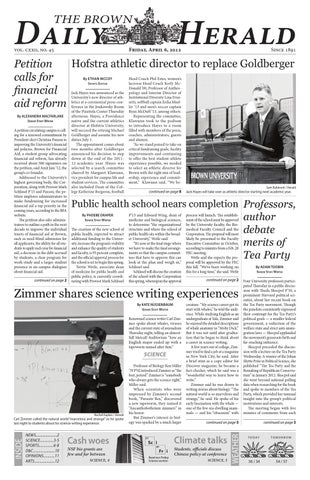
Jack Hayes was announced as the University’s new director of athletics at a ceremonial press conference in the Joukowsky Room of the Pizzitola Center Thursday afternoon. Hayes, a Providence native and the current athletics director at Hofstra University, will succeed the retiring Michael Goldberger and assume his new duties July 1. The appointment comes about two months after Goldberger announced his decision to step down at the end of the 201112 academic year. Hayes was selected by a search committee chaired by Margaret Klawunn, vice president for campus life and student services. The committee also included Dean of the College Katherine Bergeron, football
Head Coach Phil Estes, women’s lacrosse Head Coach Keely McDonald ’00, Professor of Anthropology and Interim Director of Institutional Diversity Lina Fruzzetti, softball captain Erika Mueller ’13 and men’s soccer captain Ryan McDuff ’13, among others. Representing the committee, Klawunn took to the podium to introduce Hayes to a room filled with members of the press, coaches, administrators, guests and alumni. “As we stand poised to take on critical fundraising goals, facility improvements and continuing to offer the best student-athlete experience possible, we needed to select an athletic director for Brown with the right mix of leadership, experience and commitment,” Klawunn said. “We becontinued on page 8
Sam Rubinroit / Herald
Jack Hayes will take over as athletic director starting next academic year.
Public health school nears completion Professors, By PHOEBE DRAPER Senior Staff Writer
The creation of the new school of public health, expected to attract additional funding to the University, increase the program’s visibility and enhance the quality of students and faculty, is 95 percent complete, and the official approval process for the school is set to begin this spring. Terrie Wetle, associate dean of medicine for public health and public policy, is currently coordinating with Provost Mark Schlissel
P’15 and Edward Wing, dean of medicine and biological sciences, to determine “the organizational structure and where the school of public health sits within the broader University,” Wetle said. “It’s now at the final stage where we have to make the final arrangements so that the campus committees that have to approve this can look at the plan and weigh in,” Schlissel said. Schlissel will discuss the creation of the school with the Corporation this spring, whereupon the approval
process will launch. The establishment of the school must be approved by the University faculty, the Biomedical Faculty Council and the Corporation. The proposal will most likely be presented to the Faculty Executive Committee in October, according to minutes from a Feb. 28 FEC meeting. Wetle said she expects the proposal will be approved by the FEC this fall. “We’ve been working on this for a long time,” she said. Wetle continued on page 2
creature. “My science career got its start with whales,” he told the audience. While studying English as an undergraduate at Yale, Zimmer said he enjoyed the detailed descriptions of whale anatomy in “Moby Dick.” But it was not until after graduation that he began to think about a career in science writing. A few years out of college, Zimmer tried to find a job at a magazine in New York City, he said. After a brief stint as a copy editor for Discover magazine, he became a fact-checker, which he said was a “wonderful way to learn how to write.” Zimmer said he was drawn to writing stories about biology. “The natural world is so marvelous and strange,” he said. He spoke of his early fascination with the whale — one of the few sea-dwelling mammals — and his “obsession” with
science
Rachel Kaplan / Herald
inside
Carl Zimmer called the natural world “marvelous and strange” as he spoke last night to students about his science writing experience.
news.........................2 Science................3-5 sports.................6-8 D&C..........................10 Opinions.............11 arts........................12
Professor of Biology Ken Miller ’70 P’02 introduced Zimmer as “the best, period.” Zimmer is “somebody who always gets the science right,” Miller said. When scientists who were impressed by Zimmer’s second book, “Parasite Rex,” discovered a new tapeworm, they named it “Ancanthobothrium zimmeri” in his honor. But Zimmer’s interest in biology was sparked by a much larger
continued on page 5
continued on page 3
Cash woes
Climate talks
science, 4
science, 5
NSF bio grants are few and far between
Students, officials discuss Chinese policy at conference
weather
Renowned science writer Carl Zimmer spoke about whales, viruses and the current state of journalism Thursday night, telling an almostfull Metcalf Auditorium “how an English major ended up with a tapeworm named after him.”
By Adam Toobin Senior Staff Writer
Four University professors participated Thursday in a public discussion with Theda Skocpol P’10, a prominent Harvard political scientist, about her recent book on the Tea Party movement. Though the panelists consistently expressed their contempt for the Tea Party’s political goals — a smaller federal government, a reduction of the welfare state and strict anti-immigration laws — Skocpol applauded the movement’s grassroots birth and far-reaching influence. Skocpol preceded the discussion with a lecture on the Tea Party Wednesday. A winner of the Johan Skytte Prize in Political Science, she published “The Tea Party and the Remaking of Republican Conservatism” in January 2012. Skocpol said she went beyond national polling data when researching for the book and spoke to members of the Tea Party, which provided her unusual insight into the group’s political motivations and interests. The meeting began with five minutes of comments from each
Zimmer shares science writing experiences By Kate Nussenbaum Senior Staff Writer
author debate merits of Tea Party
t o d ay
tomorrow
56 / 34
54 / 37
2 Campus News
Public health program to become school
calendar Today
April 6
NOON
ToMORROW
The Brown Daily Herald Friday, April 6, 2012
April 7
continued from page 1
11 p.m. Get Crafty
Hip Hop Workshop
The Underground
TF Green Hall, Room 205
9:30 p.m.
4 p.m. Asian Arts Festival
Euna Lee: 140 Days in North Korea
List 120
Kassar House, Foxboro Auditorium
menu SHARPE REFECTORY
VERNEy-WOOLLEY DINING HALL LUNCH
Cavatini, Bulgur Stuffed Pepper, Broccoli Rabe, Roasted Red Potatoes with Shallots
Breaded Chicken Fingers, Vegan Nuggets, Rice Pilaf with Zucchini, Rice Krispie Treats
DINNER Pasta with Fresh Basil Pesto, Orange Teriyaki Salmon, Baked Sweet Potatoes, Baked Acorn Squash
Baked Stuffed Pollock, Pasta Primavera, Baked Summer Vegetables, Stir Fried Tofu
Sudoku
Crossword
has worked closely with the FEC throughout the process and has taken input from faculty from an array of departments. The transformation of the public health department into a standalone school has been in the works since Wetle was recruited as dean in 2000. In 2004, Wetle worked with thenprovost Robert Zimmer to plan expansion. “That’s when it really got rolling,” Wetle said. Since that time, the public health department has made regular reports to the biomedical advisory department, bringing the school’s establishment into the broader conversation. That establishment has met some delays. The proposal was slated to go before the FEC at the end of last semester, but the presentation was pushed to this spring or next fall, Wetle said. Schlissel, who became provost last year, wanted to understand the “ins and outs” of creating the school, Wetle said. Schlissel is “being very careful to understand all aspects” of the issue and is “identifying the most appropriate structure” for the future school, Wetle said. “It’s a complicated matter,” Schlissel said, adding that the presidential search also delayed the process. Wetle said she believes Presidentelect Christina Paxson supports the creation of the school. “Although Princeton doesn’t have a school of public health, she has focused on public health-relevant issues in her own research,” Wetle said. “I’ve spoken with her, and she is enthusiastic
Sam Kase / Herald
Becoming a school would allow the program to attract high-caliber faculty and students and receive additional funding.
about working with us.” The process has passed several milestones along the path to accreditation. The program in public health has enlarged its academic programs, adding five master’s degrees and a third doctorate program to its academic offerings. The number of tenured faculty has increased to 32, with five additional recruitments underway, Wetle said. Last year, the program created four distinct departments: epidemiology; behavioral and social sciences; biostatistics and health services, policy and practice. The program has made these changes to meet school accreditation requirements set by the Council for Education in Public Health, Wetle said. With official accreditation behind its name, the new public health
school will act as a “recruitment magnet” for undergraduates, she said. In addition, the school’s formal accreditation will appeal to graduate students and “recruit and retain the highest quality faculty,” Wetle said. Formal accreditation will open up funding opportunities as well, as some federal grants can be obtained only by accredited schools, Schlissel said. For students who advocate the University’s increased involvement in the public health arena, the school’s formal accreditation is “the first step in the right direction,” said Nihaal Mehta ’14, a health and human biology concentrator focusing on global health. “It will help Brown more generally in its visibility among its peers,
Financial aid petition gains 500 signatures continued from page 1 Currently, the University is not need-blind for international, transfer or Resumed Undergraduate Education students. Those students are also not eligible to apply for financial aid if they do not do so in their first year, and international students’ packages cannot be readjusted to accommodate changes in need. The ultimate goal of the petition is to make administrators aware of the student dialogue about financial aid, Jain said, adding that he would like to see Paxson, Schlissel and members of the Corporation sign the petition, too. The group wants “to get everyone in the same
Daily
the Brown
room and have a public push for financial aid advocacy,” he said, adding that members intend to present the petition to the Corporation at its meeting in May. Jain and members of BFA are looking to get at least 1,000 signatures, he said. Though the petition is currently circulating online, the group will also start canvassing in person in the next few weeks, Jain said. The president of Brown is the school’s ambassador to the outside world and should be the ultimate fundraiser, said Tim Natividad ’12, another co-founder of the group. The group does not want the University to reallocate current funds but rather to increase the endow-
Herald
www.browndailyherald.com 195 Angell St., Providence, R.I.
Claire Peracchio, President Rebecca Ballhaus, Vice President
Danielle Marshak, Treasurer Siena DeLisser, Secretary
The Brown Daily Herald (USPS 067.740) is an independent newspaper serving the Brown University community daily since 1891. It is published Monday through Friday during the academic year, excluding vacations, once during Commencement and once during Orientation by The Brown Daily Herald, Inc. Single copy free for each member of the community. POSTMASTER please send corrections to P.O. Box 2538, Providence, RI 02906. Periodicals postage paid at Providence, R.I. Subscription prices: $280 one year daily, $140 one semester daily. Copyright 2011 by The Brown Daily Herald, Inc. All rights reserved. editorial
(401) 351-3372 herald@browndailyherald.com
Business
(401) 351-3260 gm@browndailyherald.com
ment to focus more resources on financial aid, he said. After this semester, the group will expand upon the research and reports it has begun collecting about financial aid, said Anthony White ’13, another group co-founder. “Expect to see more publicity,” he said. “Financial aid policy affects everybody at Brown,” said Kara Kaufman ’12, who signed the petition. Because of the issue’s relevance to all students, it should be a top priority going forward, she added. Jain and Natividad were roommates their freshman year and formed BFA after discussing the condition of financial aid at Brown and spending time in programs such as the Minority Peer Counselor Program. The pair realized that, despite the success of the Boldly Brown fundraising campaign President Ruth Simmons spearheaded, there are still “a lot of students who were left out” of the need-blind admissions policy, Natividad said. They wanted a way to have “enough money to put someone through the Brown experience to the fullest,” he said, adding that current financial burdens prevent some students from partaking in certain Brown experiences. Equal financial aid opportunities are “embedded in the DNA of what students are supposed to be,” Natividad said. “It’s in the mission statement.”
Science Friday 3
The Brown Daily Herald Friday, April 6, 2012
Implants with nanofeatures may provide breast cancer therapy By Whitney Eng Contributing Writer
It’s simple mechanics — going through a doggy door is not a challenging task for a tiny puppy, but it is fairly difficult for a larger human. Associate Professor of Engineering Thomas Webster and Lijuan Zhang GS have found an important application of this simple fact, creating surfaces that prevent cancer cells from growing on the body’s tissues but allow healthy cells to thrive. In this scenario, in which cancer cells are the large humans and healthy cells are the puppies, healthy cells can navigate through areas that stiff and rigid cancer cells cannot. In a paper published last month in the journal Nanotechnology, Webster and Zhang describe the application of nanotechnology, the development of extremely small materials one billionth the size of a meter, to novel therapies for breast cancer. According to the American Cancer Society, one in eight women in the United States will develop some form of breast cancer. Eleven percent of these women have a recurrence of their cancer within five years and 20 percent have one within 10 years. These women often
undergo various forms of surgery to remove the tumor, including removal of one or both breasts. Many women choose to undergo breast reconstruction at some point after their surgery, often with the use of implants. Webster and his team decided to modify existing materials for breast implants by changing the patterns on their surfaces. They have developed implants with novel “nanofeatures” — small lumps and bumps of selected height and width — that are hostile to tumor cells but friendly toward healthy cells. By modifying the architecture of the implants, Webster and his team have been able deter cancer cell growth. Webster said the idea for creating these nanofeatures came from observing trends in nature. Prior to coming to Brown, Webster studied patterns of natural surface of tissues in human cadavers. “The body constantly creates natural nanoparticles,” Webster said. “Oftentimes, the biomaterials we implant into patients, such as hip implants, look nothing like natural tissue on the nano scale. These artificial implants have a smooth texture, but natural tissue is bumpy.” Webster and Zhang sought to
recreate the body’s natural bumpy surfaces by using polystyrene beads 23 nanometers in diameter and polylactic-co-glycolic acid, a federally approved biodegradable polymer. The surfaces they created had “nooks and crannies” that healthy cells were flexible enough to navigate through, but stiff cancer cells could not. “The surfaces we created kept stiff cancer cells levitating above the surface, allowing pliable healthy cells to grow underneath,” Webster said. “Healthy cells love the environment we’re creating, but cancer cells don’t.” Webster and his team have had similar successes in cancer cells of both lung and bone, and the group’s research on selective death of cancerous cells using breast cancer implants has been ongoing for the past four years. Ryan Wylie, a researcher at the Laboratory for Biomaterials and Drug Delivery at Children’s Hospital Boston in conjunction with the Langer Lab at the Massachusetts Institute of Technology, called Webster and Zhang’s research “a new spin on nanotechnology for cancer.” Though most research is focused on the delivery of drugs using nanoparticles, “these researchers
Webster Lab / Brown University
The implants’ bumpy surface does not allow stiff cancerous cells to survive.
have shown that nanotechnology will be useful to treat cancer beyond the traditional methods commonly discussed in the field,” Wylie said. “Cancer cells usually win. We’re turning the tide in the opposite direction, and healthy cells now have an advantage,” Webster said. Webster said the next step is to test the nanofeature implants in animals and partner with industry to take the technology to the next level. Webster’s group is also planning on testing other polymers, such as silicone, to see if they yield similar results in decreasing cancer cell growth. There are a variety of materials federally approved for implantation and reconstruction in humans, and Webster hopes to
change the surface patterns of each using nanotechnology. “A lot of people think that nanotechnology is foreign and new, but we are finding that natural nanostructures have been around as long as Earth itself,” Webster said, adding that nanostructures exist in everything from asteroids to coral reefs. Webster said the idea to use nanoparticles specifically for breast cancer was Zhang’s idea. The team had to educate themselves about current implant materials and faced challenges in “getting up to speed with breast cancer biology.” In the future, the group plans to examine smaller nanostructures, with the belief that the smaller the structure, the more effective it might be.
Discussion explores Tea Party’s grassroots influence continued from page 1 professor, during which they could ask Skocpol any questions about the Tea Party or her work. Professor of EcoNewnomics Glenn Loury opened by asking, “Where is the left?” He said he does not understand how the right side of the political spectrum has formed such a powerful movement with grassroots support, media encouragement and billionaire backing — the key underpinnings of the movement, according to Skocpol — while the left remains seemingly immobile. The left has shown it has the power to mobilize its members several times in past years, Skocpol responded, citing the 2008 presidential election and the battles over collective bargaining power for public sector unions in Wisconsin and other states. The problem, she said, is that these movements are not new, so they do not receive the same attention from the media as the Tea Party. Billionaires who support Democratic policies also often focus a lot of their donations on encouraging discussion and increasing participation instead of “cracking the (ideological) whip” like conservative donors — for example, the Koch brothers — often do, she said. Peter Evans, senior fellow at the Watson Institute for International Studies, said he was concerned with some of the Tea Party’s economic policies’ potential to pose a threat to democracy. He framed the issue as the “capitalism problem,” in which a government can be so constrained by capitalistic financial demands, such as the repayment of debts, that it becomes unresponsive to
the needs of its citizenry. He added that capitalism sets up an unequal distribution of wealth that results in billionaires becoming the only individuals with clout in government. As a result of these institutional problems, Evans said the left needs to coalesce around an agenda focused on reversing the Supreme Court decision Citizens United v. Federal Election Commission, employing strict regulation of campaign contributions and instituting a comprehensive public election funding procedure. In response to Evans’ questions, Skocpol admitted to not having spent too much time on the foundational aspects of the capitalist system while researching for her book, though she agreed that there can be significant tension between the forces of capitalism and democracy. Both Professor Emeritus of Sociology Dietrich Rueschemeyer and Professor of Sociology Patrick Heller asked about the Tea Party’s role in the recent growth of farright, anti-immigrant movements around the world. In particular, political parties in Finland, Germany and India have all received significant electoral support for policies restricting immigration. Heller asked Skocpol how she interprets
the rise in identity politics that has occurred even after political regime changes in the late 20th century seemed to signal the triumph of social democracy. Support for the Tea Party derives from generational resentment and not necessarily anti-immigrant sentiment, Skocpol said. The older generation supporting the Tea Party has paid into welfare programs their entire lives and now perceives President Obama as threatening these benefits. When she spoke to individual members of the Tea Party, she said they were frustrated by the current administration’s advocacy for young people and immigrants to the detriment of older generations. Tea Party members are less concerned about the role of government and spending than they are about the government’s perceived indifference to their plight, Skocpol said. The true danger, she said, arises when a third-party “nativist resentment party” takes over a major party, because traditional Republicans do not realize the party they have always voted for has turned so extreme. Voters in 2010 did what they always do during economic downturns — they gave the other party a chance to be in charge — but they did not realize
how far right today’s Republican Party has shifted, she said. Women are waking up and realizing this new version of the party, instead of just offering a contrast to the Democrats, is threatening to take away their birth control, she added. After the discussion with the panelists, Skocpol and the professors fielded questions from the audience. In response to one question about the effect of the com-
ing presidential election on the Tea Party movement, Skocpol said she thought Mitt Romney is the perfect Tea Party candidate. “The media won’t treat him like (a member of the Tea Party movement), but he will govern like one,” she said. But if Obama wins the presidential election, Skocpol predicted the Tea Party could push the Republicans even further to the right.
4 Science Friday
The Brown Daily Herald Friday, April 6, 2012
Study examines military reserve alcohol abuse By Kate Nussenbaum Senior Staff Writer
Many studies have shown that alcohol abuse is common among active members of the military, but a new study led by Assistant Professor of Epidemiology Brandon Marshall shows that alcohol problems are common within the reserve population as well. Alcohol problems are especially prevalent among individuals who develop either depression or post-traumatic stress disorder upon returning from deployment, the study finds. The research paper is available in the online edition of the journal Drug and Alcohol Dependence and will likely be published in print next month, Marshall said. The study, which Marshall led as a post-doctoral student at Columbia, is part of a larger study investigating mental health within the Ohio Army National Guard. Terry Keane, the director of the Behavioral Science Division of the National Center for PTSD, said Marshall’s study is important because it was one of the first group of studies to examine alcohol abuse in the National Guard. The findings will help to highlight areas of focus for the
promotion of “healthy lifestyles post-deployment,” he said. Marshall’s team looked at a group of around 1,000 National Guard soldiers, more than 100 of whom screened positive for alcohol abuse after returning from deployment. Only 7 percent of soldiers without depression or PTSD abused alcohol, whereas nearly half of those who suffered from both disorders abused alcohol. These results were surprising, Marshall said, because he originally hypothesized that people with depression or PTSD prior to deployment would have the highest risk of developing alcohol problems. But the study revealed that those individuals had no elevated risk. Instead, the most vulnerable group included individuals who developed depression or PTSD after returning from deployment. Marshall warned that more research must be done before any conclusions can be reached. He said it is possible that people with mental health problems may not have been deployed in the first place, so they may have been excluded from the sample. It is also possible that those individuals
received more support and treatment that could have “buffered their risk” of developing alcohol problems. Keane called this finding “anomalous” and said it will require replication in other samples. But in general, the study’s findings did not surprise him, he said. “Alcohol use is very high, and it’s probably exacerbated by experiences in war zones.” Another finding of Marshall’s study is that married men developed alcohol abuse at a significantly lower rate — 8 percent — compared to those who were never married or had been divorced, 16 percent of whom developed alcohol problems. He attributed this trend to the additional emotional support marriage offers. “Having people to reach out to is an important piece of the puzzle,” Marshall said. Marshall said his study points to the importance of improving access to mental health services for National Guard soldiers. Given that alcohol abuse and mental health problems occur together at such high rates, “integrated treatment interventions” could be effective, Marshall said. In conducting the study, “what
Courtesy of Brandon Marshall
Professor of Epidemiology Brandon Marshall is researching the prevalence of alcohol abuse in reserve military members.
struck me was just the level of alcohol abuse,” Marshall said. “Some people were clearly struggling”
and turned to alcohol “even if they had never had alcohol problems in their past,” he said.
NSF protocol heightens competition for grants By Hannah Kerman Senior Staff Writer
In recent years, funds for science research have been stretched thin, with the number of researchers growing faster than the number of dollars. Though it was created in response to this competitive climate, a new proposal procedure at the National Science Foundation has posed additional challenges for research faculty, especially junior members. In January, the NSF changed
the proposal procedure for the biology division to include only one submission date per year. In the past, two proposal deadlines “meant two different days when the money could start flowing,” said Mark Bertness, biology professor and chair of the department for ecology and evolutionary biology. Now, the process of receiving money has significantly slowed, which may delay scientists hoping to begin testing new and innovative ideas. In addition to reducing the pro-
posal process to a single deadline, the new NSF process also calls for each proposal to be preceded by a pre-proposal, a four-page overview of the project. A very small number of the pre-proposals will be funded, Bertness said. The NSF instituted these changes in order to reduce administrative burden, according to the NSF website. In the last decade, the number of proposals submitted increased dramatically, while the number of awards given shrank, making it more difficult for the best projects to be discovered and funded. The new system should help to address the “intensifying competition for limited funds” by eliminating a large number of proposals, according to the website. But each eliminated proposal represents a scientist now forced to wait a year or find a new avenue for funding. “Most everyone I know thinks this is a bad idea, but we as scientists depend on public funding,” said Stephen Porder, a junior faculty member in the ecology and evolutionary biology department. “Our society is making decisions about its priorities, and despite the huge payback of funding science, our society is not willing to pay the amount it would take to support all researchers participating in high
levels of science.” Bertness, who gets grants from the division of oceanography — which was not affected by the change — and division of environmental biology, said there is about a “seven percent chance any pre-proposal will be funded.” “But my work has been funded continuously since 1982, so I can’t complain,” he added. Bertness traveled to Sardinia over spring break to conduct research, a project he hopes will eventually be funded by an NSF grant. “The pre-proposal has been submitted,” he shrugged. “We’ll see what happens.” Bertness is currently using NSF grants to analyze the relationship between recreational fishing and salt marsh collapse in Cape Cod and Long Island Sound. Recreational fishing is depleting the shallow water of all the top predators, and this allows purple marsh crab populations to grow unchecked and begin consuming the salt marshes. But less renowned junior faculty members cannot be as cavalier about rejection. “This is going to bias the NSF towards funding researchers with established research programs,” Porder said. “It’s very hard to explain a novel idea in four pages.”
Follow the Science section on Twitter @bdh_science
“Tenure packets are due after six years, and Brown looks at grant support as a measure of junior faculty success,” Porder added. Under the new system, it will take much longer for new ideas to get funded, and a rejected idea will have to wait an entire year to re-enter the NSF system. Faculty members trying to make names for themselves will have less time and money than those who came before. These new parameters have also stifled collaboration, Porder said. Updated NSF rules state that scientists may only have their names on two proposals at a time, so Porder was forced to quit his third project. He was asked to provide specific expertise for another team of scientists but had to decline. “I couldn’t let it interfere with my primary work,” he said. Porder is a biochemist who analyzes the geology of tropical forests, attempting to understand how these carbon dioxide-absorbing systems affect thewarming planet. He has been used to an influx of two to three grants a year but is now expecting one or two. The NSF and University biologists acknowledge the shortage of funding as a serious roadblock for generating innovative science. “Funding of basic research and development will continue to come primarily from the federal government,” said Regina White, associate vice president for research. “The challenge for Brown, and for all research institutions, will be to diversify funding sources among the federal government, state and local governments, foundations, corporations and other private sources to meet their research funding needs.”
Science Friday 5
The Brown Daily Herald Friday, April 6, 2012
Climate lab reports on UN negotiations Researchers explore water players” and conduct interviews for at today’s conference, but it may be in past Martian climates their research theses, Roberts added. beneficial on a larger scale, Roberts By Phoebe Draper Senior Staff Writer
The Climate and Development Lab, an environmentally savvy group of 15 undergraduate and graduate students, released the Brown Report from Durban today. The report brings to light the details of the lab’s trip to the 2011 United Nations climate change negotiations in Durban, South Africa. Many of the trip’s 10 participants will present the report at the China, Climate Change, Security and the Developing World conference on campus this afternoon. The conference draws representatives from China, the United States, international organizations and environmental groups from many universities for a day of discussions and collaboration. It provides the “wonderful opportunity for Brown students to get caught up on what’s happening in the world of climate politics,” said Spencer Fields ’12, who attended the “eye-opening” Durban negotiations last year. Discussion in Durban
“I learned more in a day of negotiations than I did in a semester of class,” Fields said. The annual UN-sponsored negotiations bring together politicians, scientists and other leaders to develop solutions and coordinated responses to global climate change. “It’s the biggest time of the year when international action can happen,” said Graciela Kincaid ’12, who attended the Durban negotiations. “It’s the one time of the year when climate change gets a little bit of press.” Held last year from Nov. 28 to Dec. 10, the negotiations are a “critical moment” in deciding whether “humanity will fall to climate change,” said J. Timmons Roberts, professor of sociology and environmental studies and director of Brown’s Climate and Development Lab. “Durban represented an important crossroads — whether we’re going to have a serious treaty … or an adequate one,” he said. For students involved with the lab, the negotiations offered a unique opportunity to “meet clear
As an immersive learning experience, the negotiations offered “the chance to hear it from the horse’s mouth,” Fields said. Bureaucratic shock
“The sheer bureaucracy of it all was mind-boggling,” Fields said. Sitting in on a discussion between European Union representatives and delegates from the Least Developed Countries group, Fields said that the delegates went “back and forth, back and forth” over the wording in one paragraph of an agreement. “They were talking right through each other,” he said. Staying in a small bed and breakfast outside Durban, the travelers would wake up early and “try to get there before everything started,” Fields said. The conference occurred at a “huge venue” with a convention center and country-specific pavilions, which hosted side events. One of the group’s main activities was drafting a series of briefings for the Least Developed Countries group. “We hope we’re having an impact,” Fields said. “It’s neat to be there and see whether we actually are.” Pinned with NGO badges, the students were allowed to observe public sessions of negotiations, though Kincaid said most of the action occurred “behind closed doors.” Observing the “excruciatingly slow process that the United Nations is” was a unique learning experience, Kincaid said, but the more meaningful interaction took place on the personal level. She asked a question to Jonathan Pershing, a top U.S. negotiator, who met with her afterward and shook her hand. Kincaid said she was thrilled — “I’m a total nerd,” she beamed. A time for reflection
“Durban was a whirlwind,” Fields said. “It just flew by in a split second.” Writing “The Brown Report from Durban” offered the chance to process what the group had learned and reflect on the progress made in Durban, he said. The report’s immediate purpose is to focus some of the discussion
said. “There’s a fairly limited number of groups globally that do a sort of wrap-up of what happened in these negotiations each year, so we hope to make some contribution to the discussion about what the talks meant,” he said. On a global scale, the Durban conference may have been a “turning point,” Roberts said. All of the represented countries agreed to a “last-minute, middle-ofthe-night” commitment to reduce their emissions by 2020, Kincaid said. “This is huge,” Roberts said. The agreed outcome may finally allow the U.S. to “overcome its resistance to taking on a binding commitment,” he said. Querying Qatar
Roberts said he hopes to turn the trip into its own course and apply for formal funding through the University. While the Climate and Development Lab received some funding from the Watson Institute and the deans of graduate and undergraduate studies, students raised the bulk of the $2,200 per-student cost themselves. “We went with the begging ball,” Roberts said. “Lots of scrounging.” It remains undecided if students will attend the 2012 negotiations, held in Qatar. For now, the Climate and Development Lab is working from its home base — writing for its blog, conducting research and trying to bring climate change into the general conversation. Today’s conference will examine the dynamics of China’s environmental policy in the context of the country’s rapid economic growth. “The future of climate change globally really rests with China and how the United States responds to China,” Roberts said. “The two sides need to understand each other better.” This understanding is “paramount, especially for seniors such as myself who are moving into the job world,” Fields said. “Expecting to enter the market domestically and not having to have global awareness is just impossible.”
By Adam Asher Contributing Writer
Many people wonder if there has ever been water on Mars. But researchers from the Department of Geological Sciences have a few more questions — What did the water contain? How long might it have been there? Last month, department researchers presented a study of ancient lakes on Mars at the Lunar and Planetary Science Conference in The Woodlands, Texas that sought to answer some of these questions. The study, published online last month in the journal Icarus, focuses on sedimentary deposits in former Martian lake beds and may have implications for future rover missions, said the article’s chief author Timothy Goudge GS. The research group, led by Professors of Geological Sciences James Head and Jack Mustard, Goudge and post-doctoral research student Caleb Fassett, studied 226 lake beds in order to determine the existence and makeup of their sedimentary deposits — which would indicate the past presence of water — and the geological processes at work in forming them. “The whole question is, ‘What’s going on in early Mars climate history?’” Head said. The debate in the scientific community, he said, is whether Mars was warm and wet or cold and dry, “like Antarctica,” in the past. By looking for sedimentary deposits, the researchers hoped to get closer to answering this question. The researchers found that roughly a third of the lake beds had sedimentary deposits. Of these, 10 had clay deposits, which are good at preserving signatures of life, such as fossils, Goudge said. These clay deposits would provide good landing spots for future rovers seeking evidence of past and present life on the planet, he said. Additionally, the lack of interaction between lava and water indicates that any water that may have been on Mars in the past “didn’t stick around for very long,” Head said. Goudge said the researchers used two main methods to study these
lake beds: satellite imagery and nearinfrared spectroscopy (NIRS). The former method used pictures taken by NASA- and European Space Agency-operated satellites, such as the Mars Reconnaissance Orbiter, to determine which geological processes took place in a given spot. For example, volcanic flows are characterized by visible ridges and sedimentary deposits by a “delta” shape, Goudge said. NIRS is used to assess the chemical makeup of deposits by analyzing the light reflected off of them, examining not only visible rays but also infrared. “Colors only tell you part of the picture,” he said. The researchers found the most common geological process in these lake beds was volcanic flow. This presented one of the major challenges of the study, as “it can be really difficult to assess the composition of the deposits” underneath volcanic flows, Goudge said. Beyond rover missions, the study has various implications for future research. It raises questions about the presence of clay in Martian lake beds and why there is not as much of it as there is on Earth. Goudge sees two possible scenarios — that the chemistry of water on Mars is different from that on Earth or that water was not flowing on Mars for as long as it was on Earth. Goudge and Head said future research will try to resolve which is more likely. “We’ve known that craters on Mars supported lakes of water, but this study supports the notion that these wet periods were probably transient, as opposed to long-lived bodies of water,” said Lee Saper ’12, who has participated in past research on Mars’ geology but was not involved in this study. “Besides being important in our understanding of the geologic evolution of the planet and its hydrology, this also has implications for the astrobiological relevance of crater lakes on Mars as potentially habitable locations.” Saper added that the information found in the study helps to inform the work the Mars Science Laboratory, a rover landing at Gale Crater in August, will perform in investigating lake bed mineral deposits.
Science writer addresses misinformation on the web continued from page 1 parasitic wasps. “You can’t not write about things like this,” he said. He said he became a science writer at a very exciting time — the past 20 years have seen a revolution in biology, with advancements in genetic sequencing that enable a deeper understanding of the world of viruses. The sheer number of viruses — 10 to the 31st — is hard to communicate, he said. If you stacked every virus on Earth, the stack would extend for 100,000,000 light years. “I have triple-checked this,” he said to an incredulous audience. “As a science writer, you try to come up with metaphors and just
try to find ways for people to understand our very weird world,” he said. As science has changed, journalism has, too, Zimmer said. The Internet, especially Craigslist — which has stripped newspapers of almost all classified revenue — has turned a once “thriving industry” into a “shadow of its former self,” he said. The Internet also perpetuates a dangerous cycle of scientific misinformation, he said. Zimmer displayed a chart that showed how scientific language has different meanings for scientists and the general public. For example, non-scientists may interpret “manipulation” to mean “illicit tampering,” when scientists mean “data
processing.” Zimmer spoke of Oxford University neuroscientist Susan Greenfield, who made the unsubstantiated claim that sites such as Twitter and Facebook are causing an increase in autism. “I point to the increase in autism, and I point to Internet use. That’s all,” she told the Guardian. “Journalists,” Zimmer said, “have a hard time resisting the Greenfield catnip.” But the Internet and social media sites “can actually be used to help rectify some of the misunderstandings that are out there,” Zimmer said. He posted a tweet mocking Greenfield with the hashtag “greenfieldism” and within a few days, there were around 1,000
similar tweets posted. “Twitter is not the downfall of journalism,” he said. Zimmer ended his talk by playing a clip of an interview he did for Radiolab, a creative podcast that integrates interviews with scientific experts, commentary and entertaining noises. In response to a question about the future of science journalism, Zimmer said, “We need people to be creative with the kind of tools that there are.” Students were largely impressed by his talk. Anastasia Rahlin ’12 said she has considered becoming a science writer and has gone to a number of presentations about the field before. “I think he’s one of the best science writers in the
field right now,” she said. Both Rosalyn Price-Waldman ’14 and Pathikrit Bhattacharyya ’14, who said they want to pursue biology, said it is great to know that there are people as talented as Zimmer covering the work in their field. “I feel like he is just sort of living the dream,” Price-Waldman said. “He’s making this passion accessible to everyone, which is incredible.” Bhattacharyya, a Herald photographer, agreed. “Our eyes light up when we look at that stuff,” he said referring to some of the biological images Zimmer displayed. “When we can talk about it and see that same light in someone else’s eyes, it’s so much more amazing.”
6 Sports Friday
The Brown Daily Herald Friday, April 6, 2012
Glenn ’14 picks up speed in Seattle, looks to Olympic trials By maria acabado Sports Staff Writer
Swimmer Tommy Glenn ’14 competed in his first NCAA Division I Championships last week in Seattle, Wash. Glenn represented Brown in both the 100 and 200 butterfly events and earned AllAmerica Honorable Mention honors after finishing 13th overall in the B Finals 200 fly with a time of 2 minutes, 24.60 seconds. Looking ahead, Glenn will continue training for the 2012 United States Olympic Team Trials which will be held in Omaha, Neb., at the end of June. For his strong performances at the NCAA Championship, The Herald has named Glenn Athlete of the Week. Herald: What has been your biggest or most important race so far? Glenn: I would say the 200 fly at Ivies in the finals just because it was such a different thing, and it got me top eight in the country, and it just sort of set the bar as being completely different than anything I’ve ever done. Can you talk about your preparations for the 2012 U.S. Olympic Team Trials? Well, as a lot of the team is sort of taking a break right now, I’m back in the water already, training. I mean, the trials are in late June so I’m treating it sort of as a midseason meet because I’ll be training until end of August, or mid-August for the U.S. Open, and the trial’s just sort of a good halfway point. Basically, I get into pretty heavy training, and then after trials I’ll start resting a little bit before the Open. How do you try to keep yourself from feeling too much pressure before meets? Honestly, that’s always something that’s just come natural to me. I always see swimming in races as the same as swimming in practice — it’s the same thing you do everyday, so it’s just something that should come naturally, and it usually does. Do you have any pregame rituals or superstitions?
Yeah. When I make finals, before I swim, I always have a Big Mac, a chicken sandwich and a large strawberry shake from McDonald’s. It’s actually true — I eat it before every finals. I even have a shirt — it says “The Big Mac” lyrics on it. What influenced your decision to swim for Brown as opposed to anywhere else? My brother was a member of the class of ’08, and he swam, so it was honestly just a pretty good starting off point. I went on my recruiting trip to Columbia before Brown, but when I came to Brown, the team was just a perfect fit and everything you could ever want in a school. Where is your favorite place to swim? I mean, I’ve kind of been swimming in crappy pools my whole life. The temporary pool here is nicer than the pool at home, you know, so in about a week or so I’ll have a new favorite place because the new pool is going to be open.
Courtesy of Brown Athletics
After a strong showing at the NCAA Division 1 Championships, Tommy Glenn ‘14 placed 13th overall.
When you’re not swimming or studying, what are you usually doing? Playing Super Smash Brothers in my room with my roommates. I honestly don’t really do much. So what’s your Karaoke Night go-to power song? Oh, man — I just can’t sing. I’ve never been in that position. Probably, if my roommate was there, “Something About Us” by Daft Punk. So have you thought any more about your plans after Brown? Right now my plans are pretty much business or law school. This summer, after U.S. Open, I’m doing an internship with my roommate’s father who’s a federal judge in Nashville. It’s sort of a broad thing, you know, if I continue to improve, the Olympics in 2016 could be actually a relative possibility. It’s just a long ways off. I just have to see how the next two years shape up, swimming and academic-wise. So this is your first time doing
Emily Gilbert / Herald
Tommy Glenn ‘14 is in the top eight in the country for the 200-meter butterfly.
Olympic-level swimming? Yeah. I’ve never seen people swim anywhere near as fast as they did at NCAAs last week. I’ve never seen anyone swim that fast, ever. I’ve been to meets with (Michael) Phelps and all the Olympians, but this is by far the fastest I’ve ever seen, which is so crazy. While I
was at the meet the two fastest miles ever were swam — it’s just so crazy to see. How does it feel to witness history being made and getting to be a part of it? It’s just so awesome because coming to Brown, all I wanted to
do was help make a fantastic team, and it’s now awesome to see all these kids interested in coming to our school and swimming for us. I’m getting a ton of emails from kids who are interested in our school now. Things are definitely changing, and it’s so awesome to be a part of it.
Cease and Assist
Dave Deckey / Herald
Albeit the Bears’ 10-9 loss to Bryant, Sam Hurster ‘14 was very effective scoring 3 goals and adding an assist.
Sports Friday 7
The Brown Daily Herald Friday, April 6, 2012
baseball
Bears win two in first conference games By lewis pollis Sports Staff Writer
The baseball team returned from its spring break West Coast trip to win two of its first four conference games of the season April 1 and 2. The Bears (4-18, 2-2 Ivy) went 1-7 in their road matchups against University of the Pacific (9-19), Santa Clara University (17-9) and San Jose State University (12-13) March 24-28. Bruno’s lone win was a 6-4 victory in the second game of the San Jose State doubleheader, the team’s final game in California. Overall, the Bears were outscored 71-29 in the eight-game trip. The team was “a little disheartened” after losing so many games on the road trip, but co-captain Kevin Carlow ’13 said the Bears were encouraged by the one win — their first spring break trip victory in three years. “We started hitting our stride right into the first Ivy weekend,” he said. After the scheduled conference-opening doubleheader at Penn (12-10, 3-1) was rained out March 31, Bruno played its first Ivy games of the season at Columbia (10-14, 3-1) April 1. In game one, the Bears took a 3-1 lead in the fourth inning on first baseman Mike DiBiase’s ’12 and right fielder Will Marcal’s ’15 home runs, then added an insurance run on center fielder John Sheridan’s ’13 RBI double. Starting pitcher Anthony Galan ’14 threw a complete game, holding the Lions to three runs while racking up five strikeouts in seven innings of work to give Bruno a 4-3 victory. Things did not go as well for the Bears in game two. Bruno opened up an early 2-0 lead thanks to designated hitter Cody Slaughter’s ’13 first-inning RBI single and Sheridan’s second-inning RBI groundout. The Bears then added three more via a passed ball and an error in the fourth, but Columbia rallied and tallied a staggering 14 runs. The Bears added another run on Marcal’s RBI single in the seventh but Bruno fell 14-6. In their makeup doubleheader
against Penn April 2, the Bears got off to a great start. Bruno sent 15 men to the plate and scored 10 runs in the fourth inning, including a three-run double by shortstop Graham Tyler ’12. The Bears scored again in the fifth on DiBiase’s solo home run and in the sixth via second baseman J.J. Franco’s ’14 RBI single. It was more than enough run support for starting pitcher Heath Mayo ’13, who took a shutout into the seventh inning and threw a complete game, holding the Quakers to two runs on seven hits with six strikeouts. Things did not go as well for Bruno in game two. Penn opened the scoring with two runs in the bottom of the first. The Bears responded with three runs in the third as Tyler hit another threerun double and two more in the fourth via left fielder Matt DeRenzi’s ’14 two-run single to take a 5-3 lead. The Quakers came back and tied the game in the sixth inning before taking a 7-5 lead in the eighth. The Bears’ bats were silent in the ninth, giving Penn the victory. Carlow said the Bears’ spring break trip helped them prepare for the first weekend of conference games. “We purposely schedule difficult opponents early on,” he said. Carlow noted that most of the non-Ivy schools they faced had “bigger programs” and “deeper teams.” “The nice thing about travel … it allows your team to really grow as a group,” Carlow said. The Bears then hosted Siena (7-20) in a doubleheader April 4. Bruno dropped both of the games as the Saints won by scores of 9-5 and 8-6. Despite the losses in California and against Siena, Carlow said the Bears’ wins against Columbia and Penn have given the team confidence. “We’re going to compete,” he said. “We’re going to have a chance to win every game from here on out.”
Author reflects on Brown’s baseball past By sophie flynn Contributing Writer
Brown has a significant place in baseball history, holding the fourth oldest written record of the game: an 1827 diary entry by Williams Latham 1827, a Brown student at the time, according to Rick Harris, author of “Brown University Baseball: A Legacy of the Game.” When baseball started at Brown, it was played where the Main Green is today, he said. Harris, also the executive director of Rhode Island’s chapter of the National Association of Social Workers, spoke to a small audience yesterday evening at the Brown Bookstore. Sporting a baseball cap and a tie decorated with baseballs, Harris said that his social work has largely influenced the writing of both his current and past work, which includes “Rhode Island Baseball: The Early Years.” He considers himself primarily a storyteller who is more interested in individual stories than statistics. “I don’t care about the most famous. I care about the everyday people who played baseball,” he said. “Us non-famous people — that’s what the world is made of.” Harris centers his book on the stories of Brown baseball players and where they ended up after graduation. John Richmond 1880 pitched the first perfect game in Major League Baseball in the same year he graduated. David Lewis
Fultz 1898 began the Fraternal Order of Baseball Players, an organization that represented minor and major league players and established a minimum wage. Forty MLB players have hailed from Brown since the inception of the major leagues. The last player from Brown to go into the majors was in 1974. Included in the book is a description of the gentleman’s game from which baseball at Brown originated. In the team’s early days, Harvard traveled to Providence the night before, and the two teams shared a fancy dinner together, Harris said. Until about the 1890s, baseball scores in the 50s and 60s were common because of the number of fielding errors by the players. At the time, gloves were not worn. First basemen and catchers could be identified by their broken fingers, Harris said. Harris said he got hooked on baseball in 1992 when his eightyear-old son’s team showed up for their picture day but did not have a coach. He took on the role, and became more interested in the sport. “I wanted to keep it old, and I wanted to keep it local,” he told The Herald . He started writing about what he found. “There are very few things in life you have total control over,” he said, so he originally started writing about baseball with no specific direction, not know-
ing he would one day publish two books on the subject. At the talk, Harris spoke of other quirks in baseball history. In 1868, James Butler “Wild Bill” Hickok filled in for an umpire that was beaten up on the field, and he tamed rowdy fans by shooting their hats off, Harris said. Dale Rogers P’12 P’14, from nearby Pawtucket, attended Harris’s book signing and talk. Rogers said that he came in good spirits because the Boston Red Sox have not disappointed yet this season. Rogers was interested in what Brown baseball players did after they graduated from college, and he said he especially enjoys learning about the social aspects of baseball. Rogers blamed the lack of Pawtucket residents at the talk on last night’s Pawtucket Red Sox home opener. In his nine years of research on baseball in Rhode Island, including significant research at the John Hay Library, Harris has collected a huge database of local players and statistics. He assists families in learning about relatives who played in Rhode Island. “Everything in my life connects back to baseball,” Harris told The Herald. He dedicated his book to his late mother, Katie “Home Run” Hudson, who was offered a contract in the All-American Girls Professional Baseball League, a fact he did not learn until late in her life.
8 Sports Friday
The Brown Daily Herald Friday, April 6, 2012
Gambino, Gronk and a self-aware generation By sam sheehan Sports Columnist
With all due respect to the Walkmen and my sophomore year of high school, the must-see act of this Spring Weekend is without a doubt Childish Gambino. With all due respect to Cam’ron and the Internet meme “you mad!” he started with his epic taunting of Bill O’Reilly, the most pop-culturally significant act will definitely be Gambino. I’m not exactly the most objective person when it comes to this subject. I’ve gone on record in this column before discussing how excited I would be if Gambino were our Spring Weekend act. I was horribly disappointed when I found out he was playing Coachella and similarly ecstatic when I found out he would be our Spring Weekend headliner. This is all fine and dandy, but what does Childish, real name Donald Glover, have to do with sports? An excellent question. In today’s day and age of the Internet, knowledge and information are in abundance. It’s relatively easy for some guy in his basement to sort through minor league baseball statistics and discover who his team should call up to the big leagues. As
I’ve written about before, the exposure of sports is at an all-time high, as the plethora of sports bloggers, “analysts” and reporters who prod and poke at every possible angle of every possible story attempt to produce a story. I’m doing it right now. I’m attempting to establish some sort of credibility with you, the reader, by pretending that I possess the unique ability to step away from the sportswriting world and look down my nose at the invasive scavengers who flit about the feet of athletes, praying that a scrap of original perspective falls to them. In reality, I’m just another one of the vultures, pushed to the outside of the circle due to my lack of access and forced to vomit back up anything I notice from thumbing through John Hollinger’s advanced statistics. The truth is that this type of exposure is absolutely crushing to the modern athlete. They can’t hide any aspect of themselves from constant scrutiny in a system where it’s someone’s job to give continual updates on someone’s life to an audience that can never be satiated. For better or for worse, we as fans want to empathize with and understand our favorite professional athletes because they represent us collectively on a grand stage. Boston wants to know how remorseful Josh Beckett is about drinking and eating chicken in the clubhouse last year. New York wants to know what Jeremy Lin and Carmelo Anthony think of each other. Chicago wants to know if Matt Forte
feels betrayed by the Chicago Bears. What’s an athlete to do? There are two options. The first is to be yourself. This is a risky maneuver. When you are a sports star, everyone loves you for the physical gifts you have on the court, ice or field. But this has nothing to do with who you are as a person. Someone who is a fan of you could totally hate your views on politics, your type of work ethic or even your sense of humor. Rob Gronkowski, Rajon Rondo and Kevin Garnett are three of my favorite athletes. I’d probably push a couple of six-year-olds down just to shake their hands. But if these guys didn’t have their athletic ability, would I want anything to do with them? Rondo has been described as moody, Gronkowski is a notorious partier and Garnett is so competitive that even his friends hate to be around him sometimes. I’d be totally embarrassed if I went out to trivia night with these guys and Rondo sulked in the bathroom all night, Gronkowski ran up a $300 tab and Garnett constantly screamed at the other teams. The other, more common option for athletes is to be exactly who their fans want them to be. This is usually a pretty smart move because you can help your “brand” by becoming incredibly popular. Dwight Howard is exceedingly aware of how everyone views him, and his decisions on whether to leave Orlando this past year have been indicative of that. Dwight saw firsthand the
backlash LeBron James faced leaving Cleveland. So, with the care of a minesweeper, Dwight carefully navigated the pitfalls of the press, trying to say exactly what he needed to in order to garner the public’s affection and remain his happy, smiley giant self. An athlete either needs to be absolutely confident in himself and his decisions or possess a high level of self-awareness to survive the constant media exposure of largerthan-life celebrities. Now, back to Gambino. What makes him so perfect — and why I am certain he is destined to be a huge success — is that he possesses a perfect mix of both of the aforementioned attributes. So much so, that he reminds me of another exceedingly confident, intelligent, aware rapper — Kanye West. The similarities are so striking that the Pitchfork writer who reviewed Gambino’s debut album went on an unmistakably emotional tirade, frustrated that anyone would dare share attributes with one of the most transcendent musical talents of our time. Gambino’s image is built on the marginalization he feels about being caught between the rap world and being, as he says in one of his songs, “the only black kid at a Sufjan concert.” Successful fame in our generation is produced by being talented, hard-working and able to properly wield self-awareness to survive the white-hot scrutiny of today’s information era. This is going to be the legacy of our generation. Gambino
— like Kevin Durant, Derrick Rose, Derek Jeter, Peyton Manning and other universally popular athletes — is self-aware and knows what he must do to be liked. He’s just up front about it. That’s why I and so many others love him. In today’s society of information, we penalize the ignorant. There is a weird protection that comes from calling yourself out on something that didn’t exist a generation ago. This entire column is a giant example. Here I am playing psychoanalyst to men I’ve never met in my life, throwing my fellow sportswriters under the bus and making sweeping accusations about how our generation sees the world, when really I’m just protecting myself from someone being able to email me and point out something that I might not know. I have to tell everyone that I’m aware of that possibility. I just did it again. That’s what sports are moving toward, and that’s the place where all of our information and exposure are pushing us. Pretty soon, we will be left with perfect little athlete robots that all act exactly as we want them to. But until that happens, I’m going to enjoy Gronk being Gronk. Sam Sheehan ’12 is now rethinking it, and maybe he wouldn’t mind Gronk running up that tab. Call him out by emailing him at sam_sheehan@ brown.edu or follow him on Twitter @SamSheehan.
New athletic director heads to Brown from Hofstra continued from page 1 lieve that Jack Hayes is the right person for this job.” Hayes’ roots in Providence run deep. He attended high school at Providence Country Day School, where he played lacrosse, football and basketball and was named to the school’s athletic hall of fame in 2004. He did not have to go far for college — he enrolled at Providence College, where he played varsity lacrosse and graduated in 1989. After commencement, Hayes had his first stint with Brown’s athletic department, interning for a year with the sports information office. Hayes stressed that the relationship between academics and athletics is critical to the undergraduate experience and cited his year in the Brown athletic office as integral for instilling those beliefs in him. “I was so fortunate that first year out of school to come to Brown,” Hayes said. “I learned in the short period of time I was here … about an atmosphere that is about academics first, but where athletics is important, and I left after that one year believing that philosophy and incredibly impressed by what the Ivy League had to offer. To be able to come back 22 years later is a great feeling.” “For me, athletics have always been an important part of the
education process,” Hayes added. “To complement academics, which should always be the priority, with something like athletics, to me, can always benefit an education.” After his year at Brown, Hayes worked in sports administration at Fairfield University, St. John’s University and Fordham University. In 2001, he earned his first major appointment as associate athletic director at UConn. At UConn, Hayes “was responsible for fundraising, the annual fund, major gifts, working with donors and coordinating a capital campaign,” Klawunn said. “That’s one of our big challenges right now, and we’re very pleased that he’s going to help us to meet that challenge.” In 2004, Hayes was hired to his first athletic director job at the age of 37 by Hofstra, a NCAA Division I member of the Colonial Athletic Association. Hayes thanked the President of Hofstra, Stuart Rabinowitz, for “taking a chance on me” and said he is leaving “a school that I liked very much.” “I enjoyed my time at Hofstra, and it is a wonderful place,” Hayes said. “But this was an opportunity that I could not pass up.” In his eight years at Hofstra, the Pride have taken home 21 CAA championships and earned berths in 26 NCAA postseason tournaments. The Hofstra men’s
lacrosse and women’s soccer teams have been especially successful recently. Seth Tierney, men’s lacrosse head coach at Hofstra, said Hayes’ departure came as a bit of a surprise but added that he wished Hayes all the best in his new position. “He’s done an awful lot for Hofstra athletics,” Tierney said. “He was a tremendous boss to work for. I know he’s going to do great things.” Hofstra women’s soccer coach Simon Riddiough said he was “sad and disappointed” that Hayes was departing and that Hayes’ presence at nearly every home game will be missed. One of the biggest developments in Hofstra athletics history came in 2009 during Hayes’ tenure, when the university eliminated its football program because of financial constraints. The decision, which meant the $4.5 million annually committed to football was reallocated for academics and scholarships, brought to an end a 72-year old program that had recently sent star wide receiver Marques Colston to the National Football League. “It was an unfortunate situation, but one from which I certainly gained a lot of experience in how to deal with a situation that was a hot-button issue, that was certainly being viewed by the public and that involved the wel-
fare of student-athletes,” Hayes said. McDuff said the decision to cut football was one of the tough decisions Hayes had to make while at Hofstra, and that those experiences as a sitting director “made him an interesting candidate.” Hayes cited three main reasons — “Brown’s reputation, Brown’s tradition and Brown’s potential” — for why he accepted the job offer and went on to stress that improving the student-athlete experience at Brown will be one of the priorities in his mission as athletic director. Hayes said he believes that rivalries and tradition in college athletics are starting to dissipate, but that the sense of tradition and importance of every league game in the Ivy League was something he wanted to be a part of. “When you have an outstanding reputation of excellence, and you have tradition, the opportunities are there for great potential,” Hayes said. “I want to work every day to make sure that the coaches are in a position where they can succeed, and the student-athletes are in a position where they can succeed.” One of Hayes’ first major appointments will be filling the men’s basketball head coaching vacancy. Under Goldberger, the department decided to not renew the contract of Jesse Agel
at the conclusion of the team’s seventh place finish in the Ivy League. One possible candidate is Interim Head Coach T.J. Sorrentine, a Pawtucket native who has been on the coaching staff for four years and was named associate head coach at the start of the season. Hayes said conducting the search is something he wishes to start as soon as possible. Goldberger said the hiring is one of the department’s highest priorities, and that he will help Hayes in any way he might be able to, but the decision on how to proceed will be Hayes’. But before he pursues any specific goals, Hayes said he will first simply acclimate himself to the University community. “I think one of my first challenges is to get to know Brown,” Hayes said. “I know the position of director of athletics having done that at another school. I know the community aspect having grown up in Rhode Island and having gone to high school and college in Providence, but I spent only one year at Brown 22 years ago. That’s my challenge, and that’s what we’ll get after right away.” Hayes will assume his post at the same time that President-elect Christina Paxson takes over for President Ruth Simmons, both of whom Hayes said he met with continued on page 9
Arts & Culture 9
The Brown Daily Herald Friday, April 6, 2012
Black Lavender gives voice to marginalized playwrights By robert webber Contributing Writer
This week, the Department of Africana Studies is presenting the Black Lavender Experience, a festival of work by black queer playwrights. With four days of performances, staged readings and discussions, the festival aims to give exposure to a group whose voices are often underrepresented in national discussions of sexuality. “The Black Lavender Experience has given us the ability to gain an insight into an often overlooked and often marginalized and an often discriminated-against aspect of African diasporic peoples and of our sexuality,” said Corey Walker, chair of the department. Elmo Terry-Morgan ’74, associate professor of Africana studies, explained that black queer playwrights often have difficulty finding venues because they “can’t even rely upon the traditional black playhouses to do their work.” The Africana studies department, with its 40-year-old theater company, has facilitated the growth of black queer theater in the United States, introducing emerging playwrights to veterans of the field, showcasing work that rarely gets performed and helping bring together a scattered community, Terry-Morgan said. Terry-Morgan began to search
for black queer playwrights in 1998 in response to the requests of many of his students. At first, he was not sure any of these artists existed. “I had no idea if we could even find anything,” he said. He was able to create the only course in the country that specifically examines black queer theater. Despite under-enrollment problems, he said he has kept the course alive over the past 15 years because of his conviction that black queer voices need to be heard. Three years ago, Terry-Morgan began to consider the possibility of a festival specifically devoted to black queer theater. “I was very pessimistic because I didn’t think I could get financial resources,” he said. “I didn’t know if I could get support from Africana studies.” But Terry-Morgan received encouragement from his colleagues, and now the Black Lavender Experience is in its fourth year. Wednesday night, the festival opened with solo performances by two queer people of color. D’Lo, dressed in black high-tops, a dorag and a gray baseball cap, joked about his traditional Sri Lankan parents and the difficult experience of coming out as a lesbian and then as a transman. In a touching scene, D’Lo donned lipstick and a sari, impersonating his own mother. The mother character expressed disappointment with
her daughter’s development and teared up at the thought that she would never have grandchildren. D’Lo was followed by Q-Roc — a nickname that stands for “Queer rocks!” — a mohawked actor who played ten different characters with energy and enthusiasm. Q’Roc’s story revolved around “Bulldog Jean,” a butch lesbian who searches for love in the 1920s rural South. In a pivotal scene, Bulldog Jean attends the wedding ceremony of the woman she loves. “You are settled in the depths of me,” she cries out for all the wedding guests to hear. “It don’t matter where you go, who you with, or what you do. You is mine!” D’Lo and Q-Roc earned laughs and standing ovations from the crowd. “I thought it was really interesting to see the black gay experience,” said Colin Blake ’15. “At Brown, you can meet so many different people and hear so many different voices,” he added. Wednesday night brought Black Lavender a small but lively crowd, including a large contingent from Youth Pride, Rhode Island’s LGBTQ youth organization. Karen Baxter, managing director of the Africana studies department’s Rites and Reason theater, said she expects stronger attendance at subsequent events. “This year, we’ve really done a big push
in the community,” Baxter said. Through video conferencing, students from Tougaloo College in the Mississippi heartland are able to take part in all Black Lavender events. Tougaloo, a historically black college, has shared an academic partnership with Brown since the Civil Rights era. Tougaloo students are able to view the Black Lavender Experience from a classroom and ask questions after each event. At Thursday’s keynote address, Baxter read a thank-you email from a Tougaloo professor that said students and teachers were “reduced to tears” after the first night of performances. “We stayed around and talked afterwards,” the email read. “It was the first open discussion of sexuality at Tougaloo at a school-sponsored event.” “We have to deal with stereotypes that are not apparent in other states,” added a Tougaloo student in a question-and-answer session after the address. Today, the festival kicks off at noon with a student performance of “dyke and warrior prayers.” Writer and director Sharon Bridgforth said the piece is “a soul’s journey to learn to love.” It features three singers and dancers, and in his course syllabus, Terry-Morgan calls it “a ritual, abstract, affirmation of black lesbian identity.” At 7 p.m., the Black Laven-
der Experience presents a staged reading of “All Who Have Sinned,” written by Jamila Woods ’11 when she was in Terry-Morgan’s class. According to Woods, it is the story of a gay teenage boy, who is forced to undergo a religious exorcism following the discovery of his identity. The Black Lavender Experience hosts its first movie Saturday — the last day of the festival — at the Cable Car Cinema. Free to festival attendees, “Pariah” is the coming-out tale of a 17-year-old black lesbian in Brooklyn. The film won the 2011 Excellence in Cinematography award at Sundance Film Festival. The post-movie discussion will be attended by producer Nekisa Cooper, and the film will continue to be shown through Monday. The festival wraps up with a staged reading by Ntare Mwine, best known for playing the character Jacques in HBO’s “Treme” series. “A Missionary Position” is Mwine’s one-man show, described in the program as “a searing response to the homophobia now gripping Uganda.” Bridgforth said the structure of the festival enables black queer playwrights to form a community and get to know one another. “You get to really, really spend time with people and have deep conversations,” Bridgforth said. “It’s one of my favorite events.”
Director’s hire follows Granoff tough year for athletics installation continued from page 8
Alexandra Urban / Herald
“The Reality Effect” explores the effects of resetting life to revive the past.
Senior’s play reflects on nature of reality continued from page 12 lost in a wavering delivery. McDonald’s performance lacks the jaded maturity the character’s story demands. “At its core, it’s a love story about trying to revive the past and recover it. There is an inherent desire to return to the past,”
said director Zachery Rufa ’14. While the love story and morality play in “The Reality Effect” sometimes feel weakly developed, the play effectively examines the dangers of technology shaping and creating a new reality. This virtual world can brush over darker aspects of the original, often resulting in fatal consequences.
during the last week. Goldberger said the situation of having both an incoming president and athletic director is unique, but he is confident that the experience both bring to their respective roles will make the transition a smooth one. “President Paxson has been at Princeton, and I think is familiar with the values of what athletics at an Ivy institution ought to be,” Goldberger said. “I think Jack clearly understands and appreciates what we’re all about, so I have a feeling that it might be that great of a transition.” Hayes will be stepping into the position after what McDuff described as a “trying year” for Bruno student-athletes, citing last spring’s proposal to cut four sports and an opinions column in The Herald that promoted the idea that “athletics really had no part at Brown.” But McDuff said he thought the decision of the Athletics Review Committee not to cut the four sports and instead commit funding to athletics has “taken a step forward to reintegrate athletics back into the campus.” “I think the direction we’re going is great,” Mueller said. “After the Athletic Review Committee last year, it was recognized by everyone at the school that athletics
was one of the top priorities and that positive changes needed to be made.” Both McDuff and Mueller, who are also the co-presidents of the Student Athletic Advisory Council, expressed their excitement about the appointment. “I think the reaction of everyone involved is extremely excited,” Mueller said. “His qualifications and his vision and his ability to make tough decisions has been demonstrated throughout the search.” McDuff said the committee decided among an “impressive” group of candidates from a broad range of experiences, but in his view, it was Hayes’ personality, vision and confidence that separated him from the field and “made us confident that he was going to come in and get the job done.” It will surely be a busy few months to come for Hayes as he begins to undertake the challenges of his new post. For now, Hayes’ homecoming already has the Brown athletic community, and Hayes himself, excited for what is to come. “I am thrilled to be here at Brown,” Hayes said. “And I am thrilled to be back in Rhode Island.” — With additional reporting by Ashley McDonnell
blends arts, architecture continued from page 12
a carpet. They said they selected this particular installation because they found it worked so well with both the interior space of the Granoff Center and the surrounding outdoor space. “It’s a minimal, modernist piece that didn’t seem to fight with the building, “ Conklin said. She also cited how the light “activates the Angell Street courtyard,” especially at night, allowing the work to impact more people than just those in the building. “It’s a terrific piece, quite beautiful in its settings,” she said. In this way, the piece bridges the gap between art and architecture, something that the brothers — both formally trained architects — try to accomplish in their work. Their pieces generally attempt to “make a building speak in a very simple manner — a manner similar to architecture itself,” Jan said. “In this case, it’s color, which is an important element of architecture.” Over time, the five colors currently projected may be replaced by five more. The artists said they hope to have a Brown student design the next set of colors, making the art communicate a message even more relevant to students.
10 Diamonds & Coal Diamonds & coal
The Brown Daily Herald Friday, April 6, 2012
Editorial cartoon by lo r e n f u lto n
Coal to Brown Student Agency’s Marketplace website, which crashed for the third year in a row Wednesday morning as students attempted to buy Spring Weekend tickets. BSA attributed the crash to malicious outside activity. We think they should have expected it when Brown Concert Agency booked a band called the Glitch Mob as the Saturday headliner. A diamond to Facebook, which grouped together angry posts about failing to buy Spring Weekend tickets, indicating that students’ friends had posted about the Birmingham Small Arms Company. We don’t know how they caught wind of the unannounced new act, but BSA Co.’s pretty cool. You’ve probably never heard of them. Coal to the University librarian who said of the extensive resources the library provides, “We offer a banquet. With the Google box, all you get is dessert.” Why use the library when the Internet is at your fingertips? You should just “let them eat cupcakes” — we read online that’s what Marie Antoinette would say. A diamond to Peter Hannon, the Rhode Island resident who asked, “If you ask the people in Woonsocket right now if they want to raise taxes or sell a little marijuana, what would they want to do?” Replace “raise taxes” with “work for Dining Services,” and he has pinpointed the classic dilemma of the cash-strapped first-semester student. Cubic zirconia to renowned science writer Carl Zimmer, who in a talk Thursday night told the audience that he was going to explain “how an English major ended up with a tapeworm named after him.” If ending up with a tapeworm is how you make it as an English major, maybe it’s time to switch to engineering. Coal to Aaron Fitzsenry, Dining Services’ culinary manager for retail operations, who said, “Anywhere you bring chocolate and strawberries, you’re going to make friends.” If you had our middle school experience, you’d know sometimes it isn’t that easy. A diamond to artisan soap maker Rick Roden, who said his soap is so clean “you could eat this stuff.” That’s more of an endorsement than we’ve heard for any casserole the Ratty has ever served. Cubic zirconia to the freshman who said of the recent renovations to the Ratty, “It makes going on a Ratty date finally acceptable,” adding that the experience of eating there is now “almost intimate.” For a truly intimate end to the night, the romantics among us should consider a trip to the 13th floor SciLi bathrooms. A diamond to each of the civically minded Brunonians who has already submitted questions they’d like to ask future student leaders at the UCS/UFB Candidate Debate The Herald is sponsoring next Thursday, April 12 from 8-10 p.m. in Metcalf Auditorium. Do you, too, want a shiny reward? Email ucsdebate@browndailyherald.com or tweet @the_herald with questions or suggestions for the debate.
t h e b r ow n da i ly h e r a l d Editor-in-Chief
Managing Editors
Senior Editors
Claire Peracchio
Rebecca Ballhaus Nicole Boucher
Tony Bakshi Natalie Villacorta
editorial
Business
Arts & Culture Editor Sarah Mancone Arts & Culture Editor Emma Wohl City & State Editor Elizabeth Carr City & State Editor Kat Thornton Features Editor Aparna Bansal Assistant Features Editor Jordan Hendricks News Editor David Chung News Editor Lucy Feldman News Editor Greg Jordan-Detamore News Editor Shefali Luthra Science Editor Sahil Luthra Sports Editor Ethan McCoy Sports Editor Ashley McDonnell Assistant Sports Editor Sam Rubinroit Editorial Page Editor Jonathan Topaz Opinions Editor Charles Lebovitz Opinions Editor Jared Moffat Graphics & Photos Eva Chen Emily Gilbert Rachel Kaplan Jesse Schwimmer
Graphics Editor Photo Editor Photo Editor Sports Photo Editor
Copy Desk Chief Design Editor Design Editor Web Producer
Office Manager Shawn Reilly
Julia Kuwahara Samuel Plotner Nikita Khadloya Angel Lee
“Twitter is not the downfall of journalism.” — Science writer Carl Zimmer
Directors Sales Finance Alumni Relations Business Development
See INTERNET on page 5.
Managers Justin Lee Kaivan Shroff Gregory Chatzinoff Mahima Chawla Luka Ursic Alison Pruzan Elizabeth Gordon David Winer
Human Resources Research & Development Collections Collections Finance Operations Alumni Engagement Fundraising Marketing
Post- magazine Sam Knowles
Production Olivia Conetta Kyle McNamara Julia Shube Neal Poole
General Managers Siena DeLisser Danielle Marshak
quote of the day
Editor-in-Chief
BLOG DAILY HERALD Jennifer Bloom Matt Klimerman
Editor-in-Chief Managing Editor
C O R R E C T I O N S P olicy The Brown Daily Herald is committed to providing the Brown University community with the most accurate information possible. Corrections may be submitted up to seven calendar days after publication. C ommentary P O L I C Y The editorial is the majority opinion of the editorial page board of The Brown Daily Herald. The editorial viewpoint does not necessarily reflect the views of The Brown Daily Herald, Inc. Columns, letters and comics reflect the opinions of their authors only. L etters to the E ditor P olicy Send letters to letters@browndailyherald.com. Include a telephone number with all letters. The Herald reserves the right to edit all letters for length and clarity and cannot assure the publication of any letter. Please limit letters to 250 words. Under special circumstances writers may request anonymity, but no letter will be printed if the author’s identity is unknown to the editors. Announcements of events will not be printed. advertising P olicy The Brown Daily Herald, Inc. reserves the right to accept or decline any advertisement at its discretion.
Taking Sides 11
The Brown Daily Herald Friday, April 6, 2012
Should Brown change its motto? No
Yes
we pray,” or even “in God we pray.” These would be singular and also imperative. They would require some active observance by By Lucas Husted the member of the institution or some adOpinions Columnist herence to a specific religion. But Brown obviously doesn’t demand religious loyalty of any kind. So what is the point of our motto? I don’t think the motto “In Deo Speramus” Our motto is meant to inspire us and creshould be changed. However, I concede ate a sense of community among past and the following. Mottos should do an ade- present Brunonians. If we interpret God in a quate job of summarizing the intentions of transcendental way, as a greater good, somea group. “In Deo Speramus” does a seem- thing greater than ourselves, then it makes ingly poor job at this. We are here to learn, sense that we should hope in God. Otherand our school has no formal religious mis- wise, what is our purpose at this institution? sion. In fact, Brown Hoping in anything was the first school else seems petty in We shouldn’t fail to in the United States comparison. If we to accept students see Brown as a correcognize the value of without regard to reporation to give us tradition in maintaining the our diplomas so we ligious beliefs. “In Deo Speraget jobs, then prestige of our University can mus” combines years it would be fair to of tradition with and connecting current hope in jobs. If we words of inspiration see Brown as a fun for every Brunoni- students to past generations time for a few years an. Furthermore, the before entering the of Brunonians. motto has little at all “real world” then to do with religion it would be fair to and is in fact a powerful message that ap- hope in parties. Hoping in anything good plies directly to our education here. short of the ultimate good, God, is too small While Brown students are prone to chal- an ambition for us. lenge the status quo, we shouldn’t fail to recBrown is, and should remain, more than ognize the value of tradition in maintaining this. Our learning should be pursued for the prestige of our University and connect- the sake of learning alone, with open hearts ing current students to past generations of and minds. We hope that the world will be Brunonians. Only if a tradition is marred by made better because of it, thus we join thouintense controversy should it be discarded sands of other Brown grads in saying that it so glibly. is surely “In Deo Speramus.” Though the motto presumably pays homage to our Baptist roots, it is open to a wide range of interpretations. It is not “in Christ we hope,” or “in Mohammed Lucas Husted ’13 hopes in God every day.
motto. I don’t find this argument compelling, because I don’t see why we can’t just By Spencer Gordon leave the outdated artifacts as they are, acknowledging their pre-modern provOpinions Columnist enance. Anyway, this argument amounts to “we should do things the way we’ve always done them,” regardless of the integrity I’m an atheist. I don’t believe in a God of any or adequacy of the current state of affairs. sort, nor do I place my hopes in any such While we will surely suffer immediate costs God. Thus, if I am a constituent of the sub- by changing the motto, the long-term benject of our University motto, it is false. For it efits are far greater. to be true, I — and all other non-believers If we replace the current motto with — must be excluded from the subject. The something that actually reflects the beliefs situation is thus: Brown University’s motto and attitudes of the current student body, is either false or exwe will have made a clusionary. powerful statement If we replace the current about our refusal Leaving this objection aside, the motto … we will have made to let institutionmotto has other al inertia stand in problems. Hope a powerful statement about the way of changsuggests a desire ing the world for held passively and our refusal to let institutional the better. Brown uncertainty about inertia stand in the way of has a long history its fulfillment, and of challenging traI find it strange to changing the world for the ditional practicsee this kind of ates once it became better. titude celebrated in clear that they no our motto as it is longer served the antithetical to the active pursuit of knowl- community — most notably with the adopedge encouraged by Brown. Furthermore, tion of the New Curriculum in 1969. While I see hope and faith — which implies trust replacing the motto has far less of an impact — as mutually exclusive, and I was under than replacing the curriculum, this is exthe impression that the latter was the pre- actly the kind of small step that can inspire ferred stance of a Christian and most other larger changes, that can remind us that we religious believers. If that’s the case, then the are responsible for defining our University. motto fails to adequately guide even those We should be bold, and take this chance who do believe. to decide what our motto should mean to I realize that changing the motto would us. incur significant costs, as the switch would suddenly render obsolete and incorrect reams of letterhead, tons of t-shirts and any Spencer Gordon ’14 can take other instantiation of our school seal and constructive criticism.
Gordon’s Rebuttal
Husted’s Rebuttal
Lucas Husted ’13 appeals to your sense of absurdity when he makes the claim that an objection to “in God we hope” on the basis of disbelieving in God is silly. His argument is that the presence of God in the motto is simply not worth serious consideration. I disagree. That this would be considered a legitimate argument testifies to the lack of respect given to atheism and to the way in which the status quo seems inevitable right up until the moment it is changed. Here is an analogous situation. For over a century now, proposals have been made to add a gender-neutral third-person singular pronoun to English, so that it would be possible to talk about a person without specifying a gender if it is not relevant. While no gender-neutral pronoun has succeeded in breaking into everyday usage, the discussion is taken seriously, and modern authors are exceedingly conscientious of the choices they make when writing and how they can subtly suggest norms. We take the concern over gender-neutral pronouns seriously because we accept that our choice of words makes a difference — it isn’t just semantic squabbling. This is the case as well with the presence of God in our motto. There is a difference between “we hope” and “in God we hope,” and I don’t
read the latter and automatically replace it with the former. The “Deo” in our current motto is clearly meant to refer to the supposed supernatural deity responsible for the creation of the universe. I don’t see why those among us who don’t believe in God should be reasonably expected to have a wider, secular and humanist interpretation of the motto than those who do. If we are to put atheism and belief on equal footing, then we must not let either viewpoint be default and the other secondary. As far as I can tell, the argument for keeping the motto boils down to the claim that things are okay the way they are, and we shouldn’t try to change them. This is the essence of institutional inertia and complacency, and it rules out all political and social change by refusing to give alternatives a chance to compete against the status quo. I believe that this kind of uncritical resistance to change is a moral wrong and should be resisted to the greatest extent possible. The more open we are to the complaints of others, the less likely we are to perpetuate wrongs. I ask you to imagine that we had no motto, and that we were choosing one for the very first time. Would we choose “In Deo Speramus” or something else, something that everyone could believe in?
I agree that changing the motto would come at serious immediate costs. I disagree that these costs would be outweighed by the benefits. I wonder what he would propose for a new motto? It seems Spencer Gordon ’14 thinks that change should occur for the sake of change alone. While it is certainly true that Brown students have challenged tradition in many ways, these changes have come within the context of our University and our ideals. We threw away the core curriculum because we believed it an obstacle to creative learning. We did not throw away classrooms or teachers. Our motto is not only rooted in a deep tradition, but it also serves an important role in guiding our pursuit of knowledge, which Gordon fails to acknowledge. Furthermore, Gordon makes the mistake of thinking that Brown’s motto is exclusionary. This belief relies on a narrow interpretation of God. It is no bold claim to consider God an ideal, as outlined in my opening statement. God is both a greater society and a divine state of being. A greater state of being both from within and without us is an ideal that we should hope for. Even if you do interpret the motto as a literal God, which I don’t recommend,
this statement is still not exclusionary. College is hard sometimes, and it is a noble joy to hope that some benevolent figure watches over us, even if it is not true. Such is the nature of hope. That is what makes “in God we hope” so much better than “in God we trust.” The former does not imply belief, just preference. The latter implies that we know God exists and that we put our faith in him. Hoping in God is not mutually exclusive with either atheism or religion. Belief is. Former president Francis Wayland is one of the more notable figures of Brown’s history. He, no doubt, put much thought into “In Deo Speramus.” Since Brown was founded as a school that was tolerant of all forms of religious beliefs, we can be certain that this motto was ever intended to be simple-minded or exclusionary. In fact, it contains a great deal of wisdom and can be a source of inspiration, even for the atheist. Hope leaves room for chance and it guides our mission forward, but it does not imply that we know what lies ahead. However, this path should always be in the pursuit of something greater than ourselves. This motto has inspired Brown students for nearly two centuries. There is no reason to think that it won’t continue to do so.
Daily Herald Arts & Culture the Brown
Friday, April 6, 2012
Spoken word icon performs, inspires Senior thesis play merges virtual and personal By caroline saine Contributing Writer
Anis Mojgani gave a rousing spoken word performance Wednesday night, speaking to a packed audience in Salomon 001. Mojgani’s performance, which coincides with National Poetry Month, was sponsored by Brown’s spoken word troupe Word! and the Brown International Organization. Mojgani, a two-time National Poetry Slam Champion and winner of the International World Cup Poetry Slam, last performed at Brown in 2008. Zainab Syed ’14 said Word! was excited to see Mojgani back as he “sets a standard” of spoken word that members of the troupe aspire to reach. Three opening acts preceded Mojgani’s performance. Nicole Parrish ’12 opened the show with a poem she wrote during her freshman year, the night she saw Mojgani perform. On her way back to her dorm, she said, “I was composing as I walked.” Parrish conveyed the immediacy of the writing process in her emphatic performance. “Let the words pulse onto the page / better yet, let me be your page,” she said. Syed introduced the second opener, Laura Brown-Lavoie ’10.5, as “the reason I joined Word!” Brown-Lavoie began her poem, which championed the majesty of the public library, in a whisper. “I like to pretend this is where my taxes are going,” Brown-Lavoie said of the library, eliciting laughter and snaps from the audience. Syed and Paul Tran ’14 then performed together, interweaving two disparate stories about leaving in one combined poem. The two alternated speaking except for select overlapping phrases. “Leaving has always been the easy part,” they said together, “but I don’t know if I can leave this place.” Mojgani took the stage at 9 p.m., warming up the audience with an anecdote about shopping for pants to wear at a TED Talk he gave last week. The audience responded with snaps and general enthusiasm while he performed his first poem
By Tonya Riley Staff Writer
Corrine Szczesny / Herald
Mojgani’s performance earned cheers, snaps and a standing ovation.
— a piece about a fisherman who “empties himself ” reading poems to fish about the human condition. Many of Mojgani’s poems touched deeply on questions about the place of people in our inhospitable modern world. Contrasting the harshness of contemporary society with the delicacy of nature, he said of a child, “this world hates your fingers / little like the stems of flowers.” Much of Mojgani’s poetry also dealt with nostalgia — whether for the innocence of childhood, for the glory of America and “what it once was” or for living in the same town as his friends. He spoke volubly, seasoned in translating words into meaning and alternated between pausing for effect and moving quickly past significant lines. The tone of his poetry shifted from wistfulness to reverent appreciation when Mojgani performed poems about his wife of 10 months. “This is how you make me feel / like I will live forever / like there is nothing that can harm me,” he said. In closing, Mojgani performed “Shake the Dust,” a poem which
the audience recognized and celebrated from its opening lines, “this is for the fat girls / this one’s for the little brothers.” Several members of the audience — affected by the poem — reacted audibly when Mojgani said, “for the girl who loves somebody else.” Mojgani received a standing ovation at the end of his performance. Tim Natividad ’12, a member of Word!, said good poetry is both “original and accessible,” which accounts for the reach of Mojgani’s work. Audience member Jeremy Perlman ’15 appreciated that Mojgani’s poetry was both funny and moving. Spoken word is “a good way of bringing poetry into the modern age,” he said, as the poetry seems to be “almost a dialogue between the poet and the audience.” Natividad noted the “diverse array” of poetic styles currently in practice, and the demand for exposure to different spoken word artists. Sponsoring Mojgani is exciting for Word!, he said, because “it’s important to show the rest of Brown where spoken poems can go.”
a day, giving the work a sense of change over time. This idea of changing art inspired the artists, brothers Jan and Tim Edler, who have pieces at museums and installed on buildings around the world. At a presentation Tuesday, they explained how the color shifts are designed to temporally mimic an academic year at Brown. At the beginning of the year, the light boxes are meant to project mainly images of one color, with both boxes shining with equal intensity. As the year progresses, the shifts in color become less predictable, with the screens projecting multiple colors at once and at various intensities. The light boxes become “less synchronized and more, as we like
to say, confused, as students may get confused with the progress of the academic year,” Jan Edler said. With so many different combinations of colors and light intensities, the work becomes “something where you come back the next day and think, ‘Wasn’t this different yesterday?’” he said. “But you can’t be sure.” The piece, chosen by Brown’s Public Art Committee, was purchased by Percent for Art, a program that reserves one percent of the University’s budget for all new buildings and renovations for public art installations. The Public Art Committee — composed of various faculty members and alumni — requested proposals from four artists and chose
“If the results of the video game don’t work, you can reset it, but the moral dilemma is, ‘Can you do that in real life?’” asks protagonist Peter Hayes in “The Reality Effect,” an original play by Michelle Meyers ’12 that continues its run in the Perry and Marty Granoff Center for the Creative Arts tonight and Saturday. In the play, altruistic software engineer Peter (Michael Chiboucas ’13) is forced to reexamine how far the virtual world can — and should — go to create a new reality after his wife, Isabella (Natalie McDonald ’15), suddenly dies after being hit by a car. Unable to tell his daughter, he recruits down-on-her-luck actress Natalia (also McDonald) to play Isabella. With the encouragement of Natalia and his partner Liam (Russyan Mark Mabeza ’15), Peter’s initially well-intentioned manipulation grows into the company SimuLife, which recruits starving actresses and broken widowers who yearn for rent money and replacement wives, respectively. Controversy arises over whether these new realities destroy or enliven the participants — something Natalia and Peter must come to grips with themselves. “I have always been really interested in technology and the idea of reality — what it means for something to be real versus unreal,” said Meyers, who wrote the play for her senior thesis in theater arts and performance studies. The fact that the widowers order wives within weeks is a testament to the instantaneous nature of the tech-savvy world. The show incorporates technology in a seamless way to add a persuasive new dimension. In several scenes, the actors move in time with projections of themselves to create the appearance of virtual reality. “I think that this play needs
technology, that it embraces technology,” Meyers said. “It’s not a gimmick or a directorial vision but is embedded into the story itself.” Lizzy Callas ’15, the show’s sound designer, worked with Ben Kutner ’14, a Herald contributing writer, on an original score that strangely invokes a silent film but perfectly matches the moods of the scenes. “I really like doing cathartic sound design to capture the meaning of the script,” Callas said. The confined space of the Englander Studio allows the audience to feel intimate with the actors, whose facial expressions and gestures portray just as much as their words. Casting a bluish tint, the lighting adds to the technological feel of the play, though the lighting transitions appear ill-fitting for the passage of time portrayed to the audience. Liam, played in an outstanding performance by Mabeza, counters Peter’s seriousness with a levity that genuinely evokes laughter. Instead of being a cheap foil to lighten the play, Liam shows depth, revealing darker facets brought on by his own willingness to blur the lines between the virtual and corporeal. A series of convenient plot twists attempts to give Natalia depth, but the stage time would have been better spent showing more of Peter’s emotional development. Instead, his growth is left off-stage, though as a single father and idealist his struggle to maintain his morality is complex and compelling. Though the character of Natalia shows promise for growth as she attempts to fill Isabella’s role, she quickly regresses into a somewhat manipulative, flat character. The scene where she practices saying “I love you, Peter” in the mirror by watching a home video of Isabella hints at desperation and complexity, but any additional development is continued on page 9
New color-changing installation lights up Granoff By Maddie Berg Senior Staff Writer
The new permanent installation 2x5 — created by Berlin studio realities:united and on display in the Perry and Marty Granoff Center for the Creative Arts — defies the notion of art as paintings and sculpture. Instead, it brings the creative world into the current age via kinetic light images. This light envelops the space around the Angell Street entrance to the building, taking over more than the wall containing the two large light boxes. These boxes project combinations of five different colors. The vivid colors — as diverse in tone as a warm red and a cool blue — switch two to four times
Maddie Berg / Herald
The Granoff light boxes shift colors in synchronicity with the academic year.
this work unanimously, said Jo-Ann Conklin, director of the David Winton Bell Gallery and a member of the committee. This installation marks the first time the Commit-
tee has chosen a light work, as they had previously chosen works of traditional art, a sound piece and even continued on page 9