Daily
Herald
the Brown
vol. cxxii, no. 20
Thursday, February 23, 2012
Since 1891
IvyQ conference aims to empower students
Legislation addresses plight of homeless
Third annual meeting addresses sexuality By katrina phillips Features Editor
Students from across the Ivy League — and a few from outside it — flocked to Brown’s campus last weekend for the third annual IvyQ, a conference that discussed issues of gender and sexuality. It was a weekend filled with serious dialogue, laughter and a great deal of socializing. With a schedule full of events, it was up to each participant to decide just what he or she wanted out of the IvyQ experience. The conference, originally held at Penn in 2010, had three stated goals — to educate, empower and network. While conference CoChair Alp Ozcelik ’13 advised
finding “a balance,” students could choose where they wanted their focus to lie.
By Meia Geddes Staff Writer
We are young
Through a combination of keynote speakers, panel discussions and smaller lectures, the conference provided an array of topics relating to the queer experience. The first keynote speaker, Juanita Diaz-Cotto, professor of sociology, women’s studies and Latin American and Caribbean studies at State University of New York at Binghamton, talked about becoming comfortable with one’s identity and embracing spirituality — though not necessarily religion, continued on page 2
As Rhode Island faces the highest rates of foreclosures in New England, legislators and activist
city & state
ing solely on seniority could give poorly performing teachers a free pass. “Clearly, when teacher layoffs and callbacks are based solely on
groups are advancing affordable housing legislation and a homeless bill of rights intended to bring the state’s policy to combat homelessness up to par with the rest of the nation. State Sen. John Tassoni Jr., D-Smithfield and North Smithfield, and state Rep. Scott Slater, D-Providence, have each introduced legislation to provide $12.5 million next year to the state-funded Neighborhood Opportunities Program, a program that aims to provide affordable housing to low-income individuals. NOP would use the funding to increase affordable housing for families, offer permanent, supportive housing for disabled individuals and provide grants for neighborhood revitalization. The legislation would place a bond issue on the November election ballot that would provide $75 million to the Housing Resources Commission to fund NOP. Leg-
continued on page 8
continued on page 9
Emily Gilbert / Herald
In its third year, IvyQ spurred discussion surrounding queer identity.
U. sexual Proposed firing policy faces opposition first when there is a reduction students across the state and the misconduct in student population. The bill’s country needs to know that teachamendments would expand the ing offers a definite amount of job policies A bill introduced in the Rhode criteria for firing to include “pro- security, Guthrie said. House of Representatives gram reduction or elimination or “In any job, there has to be appropriate, Island would expand the state’s current budget reduction.” The measure, some level of security,” Guthrie policy for firing teachers through proposed by state Rep. Scott Guth- said. “You shouldn’t be hired and rie, D-Coventry, is currently fac- fired at the whim of anybody.” admins say city & state ing opposition from state officials But critics have said focusBy Sona mkrttchian Senior Staff Writer
After a smattering of widely publicized sexual misconduct cases on its campus in recent years, Yale officials announced last month they will begin providing the university community with details twice each year about misconduct cases filed with the administration. Though Brown administrators said they have no plans to implement a similar policy, they said the University is already ahead of the curve. “Yale is doing this partly because there have been challenges that they have not been forthcoming with this,” said Margaret Klawunn, vice president for campus life and student services, referring to the recent scandals on Yale’s campus. Last March, a group of 16 Yale students and graduates alleged that the university failed to abide by Title IX, a federal gender equality law, by allowing sexual harassment to remain prevalent on campus. “I think we’ve done our best to be forthcoming with this information,” Klawunn added.
inside
continued on page 4
news....................2-5 U.history...........6-7 City & State..........9 editorial.............10 Opinions........11
a process that prioritizes how long they have been teaching. Under current law, teachers with the least amount of experience in a given district are fired
and local teachers’ unions. By expanding the criteria for seniority-based firing, the bill aims to reduce districts’ incentives to fire teachers based on performance. The expansion is necessary because
Proposal for civil rights library under advisement By Katherine Long Senior Staff Writer
Though Provost Mark Schlissel P’15 declined a proposal Monday to fund an on-campus Civil Rights Library for Racial Justice, he gave the project’s supporters a “detailed message of how to move forward,” said Geoffrey Eaton, president of the National Association for the Advancement of Colored People’s Mid-Manhattan branch and a supporter of the project. The proposed library, to be named in honor of Paul B. Zuber ’47 P’80 and Barbara Johnson Zuber P’80, is intended to function as a dedicated home for the University’s Africana Studies collection and other resources related to the African diaspora and civil rights
Year by year
Snapshots chronicle Feb. 23 through the decades News, 6-7
movements. Schlissel cited the pressures of “current financial circumstances and competing needs” on the University’s budget in his response to the proposal. But in his message to Samantha Jackson GS, the author of the library proposal, he laid out a comprehensive list of ways that she, the Samuel M. Nabrit Black Graduate Student Association and the undergraduate Black Student Union could move forward with the proposal, Jackson said. Schlissel advised the groups to review existing Africana Studies collections, begin fundraising on their own and increase the presence of black students in the student groups advising University librarcontinued on page 3
Home star
Rhode Island native Viola Davis heads to the Oscars city & state, 12
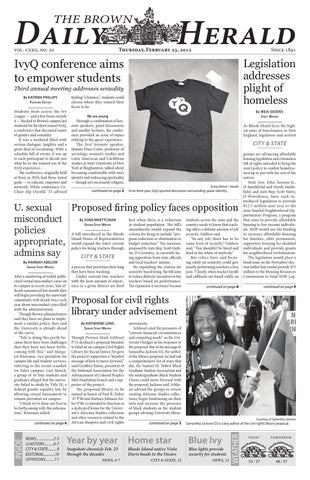
Courtesy of Samantha Jackson
Samantha Jackson GS is a key author of the civil rights library proposal.
Blue Ivy
Blue lights provide security for students News, 12
weather
By hannah abelow Senior Staff Writer
t o d ay
tomorrow
53 / 37
48 / 37
2 Campus News
The Brown Daily Herald Thursday, February 23, 2012
calendar Today
February 23
4 P.m.
ToMORROW
February 24
8 p.m. “How Scientists Think,”
The Roaring Girl,
Hunter Lab, Carmichael Auditorium
Granoff Center for the Arts, Studio 1
8 P.M.
8 p.m.
Piano Music of Mohammed Fairouz,
The Brown StorySlam,
Granoff Center
Kassar House
menu SHARPE REFECTORY
VERNEy-WOOLLEY DINING HALL LUNCH
Zucchini and Parmesan Sandwich, Falafel in Pita Bread with Tzatziki Sauce, Chicken Pot Pie
Grilled Montreal Chicken, Enchilada Bar, Cucumber Chickpea Salad, Mushroom Pasta Salad
DINNER Cheese Tomato Strata, Oven Browned Potatoes, Beef Strips Shish Kabob, Fried Tortillas
Mango Chicken with Mango Salsa, Pudim de Leite (Flan), Portuguese Sweet Bread, Vegetarian Jagacid Emily Gilbert / Herald
Sudoku
Last weekend Brown hosted the IvyQ conference, which included speakers, discussions, social events and a career fair.
IvyQ connects students across colleges continued from page 1
RELEASE DATE– Thursday, February 23, 2012
Los AngelesCrossword Times Daily Crossword Puzzle Edited by Rich Norris and Joyce Nichols Lewis
ACROSS 1 Payment option 5 The Arthur Ashe Award for Courage is one 9 Detergent target 13 Peek-__ 14 One-named singer of “Rolling in the Deep” 15 Creepy lake? 16 Joint Chevrolet/Kia vacation package? 19 Burns rubber 20 Sources of inspiration 21 Spy novelist Deighton 22 Pres. before RWR 23 Joint GMC/Hyundai vacation package? 32 Sheepshank, e.g. 33 Cleveland’s Quicken Loans __ 34 Blend 35 Elihu for whom an Ivy is named 36 Took the wheel 37 Colada fruit 38 Sidewall letters 39 Glistened 40 Feature of American paneling, but not British? 41 Joint Ford/Chrysler vacation package? 45 Chap 46 ICU workers 47 Two-time loser to Ike 50 Sought at auction 56 Joint Dodge/Toyota vacation package? 58 Clock radio letters 59 Colleague of Thomas 60 Pale-green moth 61 Homer’s tavern 62 Legendary Brazilian footballer 63 Celtic land
DOWN 1 Cleveland cagers 2 Contribute to, as a crime 3 Sound measure 4 Portable cooker 5 Site of an early exile 6 Space exploration org. 7 It’s hatched 8 Ja or da, stateside 9 Take off, as a discount 10 Malleable metal 11 Thieves’ group 12 Earl Grey et al. 14 Rice-__ 17 App downloader 18 Colleague of Clarence 22 Dick’s partner 23 Internet telephony provider 24 Jawbone of __: Samson’s weapon 25 Type of acid found in veggies 26 Mystic’s medium 27 Home to Maine’s Black Bears 28 Lowest card in klaberjass
29 Essential acid 30 Of a higher quality 31 Praise 36 Played, but not in the field, briefly 37 Ice cream truck offering 39 1992 Summer Olympics country 42 Roosters, at times 43 Lyre-playing Muse 44 Ladies’ court gp.
47 Stuck, after “in” 48 Major-__ 49 Rapper __ Fiasco 50 Pulitzer-winning WWII journalist 51 $150 Monopoly prop. 52 Carry 53 Gloomy 54 Present opening? 55 Asian flatbread 57 “The Purloined Letter” monogram
ANSWER TO PREVIOUS PUZZLE:
xwordeditor@aol.com
02/23/12
she added — through the lens of her experiences as a Puerto Rican lesbian. Diaz-Cotto recalled her coming out experience. “I was butchlooking way before I came out of the closet,” she said, adding that she felt pressured to reveal her sexuality due to others’ perception of her appearance. Keynote speaker Kate Bornstein ’69, a transgender author and gender theorist, began her address by announcing her phone number and encouraged audience members to text her and live-tweet throughout the address. “When we explode a binary, we reveal a hierarchy,” she said, stressing the need to question binaries. “The problem with hierarchies is when we get a non-agreedupon point of authority at some dreamed-up top of the hierarchy.” Bornstein also questioned the binaries implied by the LGBTQ label, suggesting dozens of potential identities — some of which she advised students to simply Google — to replace the acronym, including among them queer straights, men who have sex with men, furries and masochists. After expounding upon her own masochistic tastes throughout her address, Bornstein ended with an offer — everyone in attendance would be given a “Get out of hell free” card.
Daily
the Brown
“Do whatever you need or want to do in order to make life worth living. … Just don’t be mean,” the card reads. “Should you get sent to Hell for doing something that isn’t mean to someone, I’ll do your time in Hell for you.” Bornstein emphasized that the trade was ideal for both parties — as a masochist, she said she would be willing to take others’ time in Hell. We are family
IvyQ simply provided a venue for like-minded individuals to socialize. For many, this was more important than lectures or scheduled discussions. “I don’t think that’s necessarily a bad thing,” Ozcelik said, as long as people were able to find others with whom they could feel comfortable and supported. Ozcelik said he received feedback from a number of participants that IvyQ offered them an environment where they were able to feel more comfortable with themselves and their sexual identities than ever before — despite already being “out” at home or at school. Friday’s SexPowerQueer dance — meant to mimic the idea behind SexPowerGod — offered IvyQ attendees an opportunity to let loose with other participants. Saturday night, they were treated to a banquet at the Rhode Island Convention Center that showcased a drag
Herald
www.browndailyherald.com 195 Angell St., Providence, R.I.
Claire Peracchio, President Rebecca Ballhaus, Vice President
Danielle Marshak, Treasurer Siena DeLisser, Secretary
The Brown Daily Herald (USPS 067.740) is an independent newspaper serving the Brown University community daily since 1891. It is published Monday through Friday during the academic year, excluding vacations, once during Commencement and once during Orientation by The Brown Daily Herald, Inc. Single copy free for each member of the community. POSTMASTER please send corrections to P.O. Box 2538, Providence, RI 02906. Periodicals postage paid at Providence, R.I. Subscription prices: $280 one year daily, $140 one semester daily. Copyright 2011 by The Brown Daily Herald, Inc. All rights reserved. editorial
By Rich Mausser (c)2012 Tribune Media Services, Inc.
02/23/12
(401) 351-3372 herald@browndailyherald.com
Business
(401) 351-3260 gm@browndailyherald.com
queen performance, followed by clubbing downtown. Students seeking a calmer, more sober experience could attend Thursday night’s opening talent showcase or a late-night movie screening that represented an alternative to Saturday’s clubbing. This year, the conference established “family groups” of 20 to 25 participants that were led by conference coordinators. These groups offered a new way for attendees to branch out socially. The family groups met Friday for the Identity Open House, where they moved among several rooms in the Stephen Robert ’62 Campus Center, stopping at stations for each gender or sexual identity — including gay, straight, transgender, bi- and pansexual and none of the above. Their parent leaders facilitated discussions on each identity, allowing participants to share anecdotes and opinions or ask questions. We got the power
Participants with more pragmatic goals found their niche at the conference’s career and activism fairs. At the activism fair that concluded the conference Sunday morning, students could speak with nonprofits and other activist organizations with missions related to gender and sexuality, giving them a chance to discover how to get involved in the issues they had discussed over the weekend. The career fair gave the conference’s top corporate sponsors a venue to talk shop and seek out potential future LGBTQ employees. Some students took issue with the level of involvement these sponsors were given in the conference. They hosted a party Thursday night to express their dissent and handed out flyers stating their views. Bornstein said she spoke with a member of the dissenting group and offered them a chance to take the stage and voice their opinions at the beginning of her address. No one spoke up.
Campus News 3
The Brown Daily Herald Thursday, February 23, 2012
Higher ed by kate nussenbaum ne ws roundup senior staff writer NYPD monitors Muslim students The New York Police Department monitored the activity of Muslim students and professors at colleges throughout the Northeast including Yale and Penn from 2006 to 2007, the Associated Press reported this week. In addition to monitoring student association websites, the NYPD sent officers undercover to report on student activity, according to an article published by the Guardian. NYPD spokesman Paul Browne said the police department monitored Muslim student associations because 12 former members of such associations have been arrested or convicted on terrorism charges in the past, the Associated Press reported. New York Mayor Michael Bloomberg defended the police department Tuesday, according to the Guardian. “The police department goes where there are allegations, and they look to see whether those allegations are true,” he said. “That’s what you would expect them to do. That’s what you would want them to.” But many others, including Yale President Richard Levin were outraged by the news, the Wall Street Journal reported. In a message to the Yale community Monday, Levin wrote, “I am writing to state, in the strongest possible terms, that police surveillance based on religion, nationality or peacefully expressed political opinions is antithetical to the values of Yale, the academic community and the United States.”
Jury finds George Huguely V guilty of second-degree murder
George Huguely V was found guilty of killing his former girlfriend, University of Virginia student and lacrosse player Yeardley Love, Wednesday. He now faces up to 40 years in prison after being convicted of second-degree murder and up to 20 years in prison for larceny. The jury took nine hours to make its decision, according to ABC News. Love’s mother and sister gave testimony after the jury announced its verdict, ABC News reported. “It’s still with me every day from sunup to sundown,” Love’s mother said during her testimony. “Every single day is different. Some days it’s just unbearable.”
Rejected library proposal gains support continued from page 1 ies, among other suggestions. The proposal, which Jackson sent to Schlissel and President Ruth Simmons at the beginning of February, generated wideranging support both inside and outside the University. University Librarian Harriette Hemmasi — who noted that the new PhD in Africana Studies, instituted at the start of the academic year, requires the library to add a number of resources and take stock of existing collections anyway — has been one of the proposal’s strongest supporters. The library could be so much more than just a collection of documents, Jackson said. She described it as a tangible sign not only that the University recognizes and appreciates the contributions of its black graduates, but also that it understands its own role in perpetuating structural racism. “The names that are remembered and the names that the University holds dear are written on walls, on chairs, on plaques, above rooms,” she said. “But naming things after people who donate money is serviceable at best and
dangerous at worst, because the people who don’t have the money to donate … their histories aren’t remembered.” She cited the example of Zuber, who was a key player in the fight for integrated public schooling in New York City during the 1950s and 1960s. “Despite Zuber’s contributions to society, she said, his name is nowhere on the walls, and he is hardly commemorated as an alum. “No one at Brown knows about this,” she said. Jackson noted that other universities, including Harvard, have libraries similar to the one she proposed. She said the recent discovery of a 1961 recording of Malcolm X speaking on campus hidden in library archives highlighted the necessity for such a space at Brown. “That’s why we need a library like this,” she said. “So people can research and archive and catalog these treasures that are so important not only to African-American culture but to American culture as a whole.” “We can’t envision building a new library in the short term,” Schlissel told The Herald, adding that even renovating a space in an existing library would cost “on
the order of millions of dollars.” “But it’s a sufficiently interesting and important area that it’s reasonable to keep in our minds as we prioritize and strategize in the years ahead,” he said. “The idea that we name things after donors is the way we make the University work. But I would be very discouraged to learn that AfricanAmerican alumni felt that they were being treated differently than other alumni.” The provost’s response “looks like good news to me,” Jackson said. As a member of the civic engagement committee of the NAACP mid-Manhattan branch, Jackson is “active, very active — she has quite a spirit and a drive to advance the history and culture of our people,” Eaton said. When she brought him the proposal, he advised her not to ask for anything controversial and to present the library as an asset to the University. Eaton said he also is not disappointed by the Schlissel’s response. “It’s a huge win,” Eaton said. “You start somewhere, and once you’re able to create momentum and build it into the course structure of the University, that’s huge. It’s not an end, but a beginning.”
Spanish landlord arrested for drugging Dartmouth student A landlord in Barcelona was arrested last week after police searched his apartment, where Dartmouth junior Crispin Scott was found dead in January, according to the Daily Mail online. Scott’s autopsy revealed large amounts of sleeping pills in his system. In 2009, a different student accused the landlord of drugging him with sleeping pills and sexually abusing him, according to El Periodico. The police are trying to determine whether the man is a “serial rapist of young people.” Scott was planning to participate in a study-abroad program in Barcelona, but he died before the program began, the Dartmouth reported. “As devastated as we are by the loss of our beloved Crispin, the circumstances surrounding his senseless death add to the immense pain for us and others who cared so much for him,” Scott’s parents told the Dartmouth.
Bears of the Future
James Hunter / Herald
Students admitted Early Decision visited campus Monday to hear from faculty members and students and get a glimpse of their future home.
Follow The Herald on Twitter
4 Campus News
The Brown Daily Herald Thursday, February 23, 2012
U. clarifies sex offense policies
Ne ws in brief Chafee joins re-election team
continued from page 1 Brown regularly posts case reports on the Department of Public Safety website in compliance with the Clery Act, which requires universities to disclose information about crimes committed on campus and release an annual security report that lists all cases. The 2011 Annual Security Report listed nine on-campus forcible sex offenses in 2010, down from 10 in 2009. “We feel like we’re making the information available,” Klawunn said, adding that University adminstrators are communicating with student groups interested in information related to sexual misconduct and have regular meetings of the sexual assault advisory board, which recognizes student input. These actions accomplish many of the same goals as Yale’s new system, just in a different way, she said. Both Klawunn and Provost Mark Schlissel P’15 emailed the community this fall reiterating the University’s sexual misconduct policy, procedures and commitment to ensuring cases of sexual misconduct are properly
Julia Shube / Herald
handled on campus. Following the U.S. Department of Education’s Office for Civil Rights’ release of the “Dear Colleague” letter in April detailing Title IX guidelines, the administration made further revisions to the code this summer, though Yolanda Castillo-Appollonio, assistant dean in the Office of Student Life, said it was already “very much in compliance with the letter.”
Minor changes included revisions to the appeals process so the complainant and the respondent can both make appeals. The University also “clarified some language in the code to make sure things were understood,” CastilloAppollonio said, adding that University officials are now required to notify involved parties of their decisions in writing. Calling sexual assault “the most underreported crime across
the country,” Klawunn said sexual misconduct may be more prevalent than it seems on Brown’s campus, as some Yale students alleged of their university. “We know that there are many more incidents, and we’re only seeing the ones where someone is interested in coming forward.” The University’s sexual misconduct policy is next scheduled for review in the spring of 2015. “If there is a reason to review it before then, any member of the community can come forth and ask it to be reviewed,” CastilloAppollonio said.
President Barack Obama named Gov. Lincoln Chafee ’75 P’14 one of 35 co-chairs to his re-election campaign yesterday, multiple news organizations reported Wednesday. Gov. Deval Patrick of Mass. is the only other current governor named to the campaign, and many of the co-chairs are current or former government officials. Actress Eva Longoria was also named a co-chair. Chafee served as a Republican in the U.S. Senate with Obama, though he left the party to become an independent in 2007. Chafee endorsed and campaigned for Obama in his run for president. Though Hillary Clinton won the 2008 Rhode Island Democratic primary, Obama won the state in the general election with a 63 percent majority, one of his most substantial margins of victory. When Chafee ran for governor in 2010, Obama did not endorse the Democrat running for the office, Frank Caprio, in a show of support for Chafee. In response, Caprio reportedly said the president could “take his endorsement and shove it.” Last March, Rhode Islanders gave Obama his fifth-highest approval rating in the country at 53 percent. — Elizabeth Carr
Get The Herald delivered daily to your inbox browndailyherald.com/register
Campus News 5
The Brown Daily Herald Thursday, February 23, 2012
cheese wiz
Corrine Szczesny / Herald
Paul Shanley, deputy chief of police of Department of Public Safety, visited UCS this week to address campus safety after a rise in crimes near campus.
Admins discuss campus safety at UCS meeting By Margaret Nickens Senior Staff Writer
Due to a spike in crime near campus this semester, the University has increased police presence in the area from 23 to 36 officers, said Russell Carey ’91 MA ’06, senior vice president for Corporation affairs and governance, at Wednesday’s general body meeting of the Undergraduate Council of Students. Carey and Paul Shanley, deputy chief of police of the Department of Public Safety, attended this week’s meeting to discuss campus safety after issuing six crime alerts this school year. The University is working to reduce crime by conducting a lighting survey, Carey said. Many of the crimes have occurred in poorly-lit areas. Bratton Group, a security consulting firm, has also been hired to perform an assessment of campus safety. The University underwent a similar safety evaluation following high on-campus crime rates in 2001 and 2002, which were twice the level that they are this academic year, Carey said. In another effort to improve campus safety, campus police have been allowed to carry arms since 2006. The University is working on preventive measures since it is “rare” that a robbery suspect is actually arrested after committing a crime, Carey said. He noted that none of the perpetrators of the six instances this year have been apprehended. Carey said blue light emergency phones and surveillance cameras around campus also improve security, though he noted students rarely use the blue light phones. Since the University has hundreds of cameras, not every security feed can be constantly observed, he added. “It’s not like a Vegas operation where we have people watching all the time,” Shanley said. David Rattner ’13, vice presi-
dent of the council, announced UCS Week will be held from March 5 to March 9 and will feature the State of Brown Address with President Ruth Simmons March 8. During the week, the Campus Life Committee plans to host an event where different dining hall vendors will provide food samples to students, said Michael Schneider ’13, the campus life committee chair. Attendees can then give dining hall personnel feedback about the different samples. The event is part of the committee’s work to reduce the number of students going off the meal plan, he added. Other events during the UCS week will include a day of yoga classes in the Bear’s Lair and a screening of the “The Ides of March.” During committee updates, Mae Cadao ’13, chair of the student activities committee, said the New Leadership Orientation will be tonight at 8 p.m. in Wilson 102. The meetings will help make students “more attractive candidates” when applying for leadership positions, said Ralanda Nelson ’12, the president of UCS. Cadao also said the deadline for categorization as a student group has been extended to next Monday, Feb. 27. Rattner announced that Richard Bova, senior associate dean of residential and dining services, and Margaret Klawunn, vice president for campus life and student services, will attend the March 7 council meeting to discuss housing improvements. The council also passed a resolution supporting optional gender-neutral housing for firstyears, discussed the possibility of acquiring an online New York Times subscription for students and held a semi-annual vote of confidence in Nelson and Rattner. The council affirmed their support for the two leaders through the vote.
David Deckey / Herald
Fancheezical, which specializes in grilled cheese sandwiches, is the latest food truck to venture onto Thayer Street.
6 Today in History
The Brown Daily Herald Thursday, February 23, 2012
1952
Today in university history by sona mkrttchian senior staff writer
2000: Virtual Lab enables study of navigation A grant from the National Science Foundation allowed former Professors Michael Tarr and Leslie Kaelbling to create the Virtual Environment Navigation Lab. At 40 feet by 40 feet, the virtual facility was the largest of its kind in the world, according to William Warren, professor of cognitive and linguistic sciences. Researchers used the lab to study how individuals steer through daily obstacles. At the time, the lab represented a huge technological leap, as subjects were able to change position or orientation during experiments because of sensors that measured a subject’s acceleration. Kaelbling was interested in using the technology to improve the field of robotics.
1998: Alcohol policy deters students from bar The Underground, a campus bar, opened with a new policy to regulate underage drinking by requiring students to swipe into the bar with their Brown IDs, which electronically verified their ages with existing University records on file. This new policy was the result of an instance in December 1997 where 10 students were arrested for underage drinking at the bar. The new policy also mandated the bar only serve alcoholic beverages three nights a week, allowing for an 18 and older crowd on the remaining days. Once implemented, these changes resulted in a significant decrease in the number of patrons.
1983: Brown leads Ivy League in applications The University led the Ivy League in the total number of applications submitted after a 14 percent increase in applications for the class of 1987 was recorded. Beating out Harvard by more than a thousand applications, the University reached a then record-high of 13,250 applications. Applications to Harvard, Princeton and Yale had dropped significantly due to “the recession and a demographic slump in the 18-year-old age bracket,” admissions officers from those schools told The Herald.
1973: Senate brings back anti-abortion law The Rhode Island Senate passed legislation by a 30-vote margin to reinstate a strict antiabortion law despite a decision by federal courts striking down the state’s previous identical law as unconstitutional. Former Sen. Erich Taylor, D-Newport, sponsored the legislation that defined life as beginning at conception. This definition contradicted the U.S. Supreme Court’s decision to outlaw governing “on behalf of a fetus which is less than three months old.” Former Rhode Island Gov. Philip Noel publicly said he would veto any bill ruled unconstitutional, though he personally believed abortion was unjust.
1948: Wriston implores fraternities to become ‘examples of social grace’ Former University President Henry Wriston declared campus fraternities must “become intellectual centers” for students in order to increase their recruitment. During the war period, fraternities “received a shot in the arm,” Wriston said, as the number of members relative to the total number of students dropped from 80 percent to 23 percent. Wriston also urged fraternities to become “responsible units” and “examples of social grace” for the greater University community.
Herald File Photo
Gil Borjeson ‘52, a member of the men’s track and field team, won the IC4A championship in the 35-pound weight throw in 1952.
1972
1962
Herald File Photo
In 1962, the University petitioned to close this section of Manning Street to build what would later become Barus and Holley, a controversial decision that angered many local residents.
Herald File Photo
Right wing Mike Powers ‘73 (left) contributed greatly to the Bear’s offensive attack in this game against Yale in 1972.
Today in History 7
The Brown Daily Herald Thursday, February 23, 2012
1982
February 23 through history 1992
Herald File Photo
The Reserve Officers’ Training Corps has been a topic of campus discussion for decades. In 1982, Professor of History and Faculty Policy Group Chairman William McLoughlin (left) and Pierre Galletti (right), dean of the medical school, discussed the possibility of bringing ROTC to Brown.
2002
Herald File Photo
Members of the Corporation unanimously pledged $79 million for President Ruth Simmons’ Proposal for Academic Enrichment in 2002.
Herald File Photo
Josiah’s opened in the fall of 1991. By Feb. 23, 1992, the Ivy Room was suffering from empty tables and a lack of business due to strong competition from Jo’s.
2012
Sam Kase / Herald
Students chat, eat and study in the Blue Room, where recent renovations showcase just how much the University has changed over the years.
8 Campus News
The Brown Daily Herald Thursday, February 23, 2012
State pilots teacher evaluation process continued from page 1 seniority, student interests are not part of the process,” wrote Commissioner of Elementary and Secondary Education Deborah Gist in an email to The Herald, adding that she values educator quality over seniority in the teacher retention process. But Guthrie said he thinks teacher evaluations — the most commonly used form of measuring performance — can often be an inadequate basis for retention. “I don’t think there are poor-performing teachers,” he said, adding that teaching is a profession that involves growth and improvement over the length of a career. Often, one poorly performing student could actually be the cause of a bad teacher evaluation, he added. Teacher performance is often a widely discussed issue in the state, which was recently ranked second in the nation for its policies toward teachers by the National Council on Teacher Quality. “The single most important school-based factor in the successful education of our students is the quality of our classroom teachers,” Gist wrote. Educators are working to incor-
porate new peer-based and administrative teacher evaluations passed by the Rhode Island Board of Regents, said Frank Flynn, president of the Rhode Island Federation of Teachers and Health Professionals. In the third and final year of the evaluation’s pilot program, Flynn said districts are “trying to provide the training and support for teachers to become successful using them.” Flynn said teachers are not opposed to evaluation systems that track student growth. “It’s a model that is designed to provide feedback to the teachers and improve their craft,” he said. But Flynn said teachers have objected to the second portion of the bill, which aims to push back the date by which schools must inform teachers of layoffs. Currently, the law requires schools to inform educators on or before March 1 about layoffs. The bill would extend the deadline to May 15. Flynn said this is problematic for districts that may want to focus on resolving performance problems prior to conclusive termination. If the deadline is pushed back, teachers will receive notice of their termination later and not get the chance to attempt to improve their per-
formance, he said. The current deadline also puts districts in an awkward position because of the discrepancy between the academic year and the fiscal year, which begins in July, Gist said. “Because March 1 occurs so early in the budgeting process, districts tend to send layoff notices to a large number of teachers, most of whom they will reinstate before the close of the school year,” Gist wrote. “This notification process causes undue stress and confusion.” The proposed amendment would be just one of many changes being implemented in school districts across the state. Flynn noted that many schools are experiencing a “morale problem” because of the number of changes being enacted over such a short period of time, adding that school administrators are finding it difficult to enforce changes without the necessary personnel to do so. “People do not think they are supported at the school level,” Flynn said. “There has been some pushback lately. It’s great to have good policies, but we need to implement them on a realistic timeline.”
www.browndailyherald.com
Courtesy of Ashley Belanger
Growing student interest has led the Urban Debate League to expand.
High school students receive credit through debate league continued from page 12 ing, it became necessary to seek independence.” Christie Louie ’12, a community fellow for the league said financial cuts in the Swearer Center’s budget also led the league to become independent. “Our former executive director was one of the Swearer Center employees who was laid off when the funding was cut,” Louie said. The group was in the process of expanding when the separation occurred, she added. Brown students continue to be very involved in the league and recently created additional leadership positions for volunteers to accommodate growing interest. Louie said the league hopes to stop relying on the Swearer Center for funding
in the future but said she thinks this will not happen soon due to budget constraints. Woonsocket High School and the Juanita Sanchez Educational Complex are the two schools currently participating in the expanded learning opportunity program. Students receive academic credit for participating in the league, Belanger said. Ryan Dwyer, program assistant of the league and AmeriCorps volunteer, participated in the program as a high school student. He said the organization’s programs were transformative for him, and he is now working to make the league more sustainable in the future. “Its program goal is to alleviate poverty and get people out of poverty. I know, I believe in my heart that debating does that — just that,” Dwyer said.
The Brown Daily Herald Thursday, February 23, 2012
City & State 9
State seeks to improve conditions for the homeless continued from page 1 islation requesting a $50 million bond issue to fund NOP passed “overwhelmingly” with Rhode Island voters in 2006, Tassoni said. But over the last several years, NOP has received almost no funding, said Eric Hirsch, professor of sociology at Providence College and chair of the Homeless Management Information System Committee. The amount received last year — $1.5 million — is “completely inadequate,” he added. “I think (Gov. Lincoln Chafee ’75 P’14) is on board with the legislation,” Tassoni said. “We may not get what we’re looking for, but at least we’ll get something.” Tassoni is also sponsoring a homeless bill of rights, introduced by Jim Ryczek, executive director of the Rhode Island Coalition for the Homeless, and John Joyce, co-director of the Rhode Island Homeless Advocacy Project, to “guarantee that no person’s rights, privileges or access to public services will be denied or abridged solely because he or she is homeless,” as stated in the bill. State Rep. Chris Blazejewski, D-Providence and East Providence, is sponsoring an identical homeless bill of rights in the state House of Representatives. These bills are currently under review in the Senate Committee on Housing & Municipal Government and the House Committee on Judiciary. They would guarantee additional rights for the homeless including use of public spaces, equal treatment by police, freedom from employer discrimination, access to decent and affordable housing and the same social services provided to all other Rhode Island citizens. People normally attribute homelessness to personal failures, when it should be attributed to housing market failures, Hirsch said. Homeless people are just people who happen to be down on their luck, he said. Hirsch said he would like to see large, congregate shelters like Harrington Hall, the state’s largest emergency shelter, replaced with permanent housing for the homeless. Putting homeless people in apartments and providing basic mental health and physical services, furniture and other necessities is cheaper and a far more humane response to homelessness, he said. “It’s morally necessary for us to close those shelters,” he added. Though shelters are intended to provide for temporary crises, they have become permanent residences, housing some people for seven to eight years, Hirsch said. Leaving homeless people on the streets is expensive because they tend to use many uncompensated public services like hospitals, ambulance runs and nights in shelters, he added. “Our system of providing housing has failed dramatically,” Hirsch said.
Ensuring access to services determines whether the homeless end up “integrating back into society,” said Benjamin Eichert ’13, a volunteer with Housing Opportunities for People Everywhere, a student-run program that serves and advocates for the homeless. Housing is fundamental to “creating stability in other parts of people’s lives,” said Beth Caldwell ’12, a former coordinator for HOPE, noting that homelessness is a particular problem for women who have been victims of domestic violence. There is a common misconception that homelessness exclusively affects drug abusers and the mentally ill, Eichert said. These categories represent 10 percent and 22 percent of the 2010 homeless population, respectively, while 39 percent were families, and 23 percent were children, according to Homeless Management Information System data. This is problematic because homeless children have difficulty succeeding in school, Eichert said. “I would like to see Brown broaden its commitment to the city and potentially make addressing the issue of homelessness — especially among school-age children — part of the work that it does with the community.” Members of HOPE have been involved in advocating for increased NOP funding and the Homeless Bill of Rights, Caldwell said. They are also working with Direct Action for Rights and Equality to create legislation that would give tenants facing foreclosure greater rights, Caldwell said. To garner support for the legislation, the group has collected signatures in the home district of Speaker of the House Gordon Fox, D-Providence. Rhode Island residents have faced a significant increase in the gap between average earnings and the cost of renting a home, according to the Coalition for the Homeless. About $50,000 in annual income is necessary to afford an apartment, meaning there are at least 150,000 households that cannot afford the market rate rents, Hirsch said. Despite these problems, Rhode Island is “only one of only nine states in the country that doesn’t have a dedicated funding stream for production of affordable housing,” Eichert said. It is “really a shame that the state hasn’t been able to come together to successfully address this problem,” Eichert said, noting that many other states have proposed or successfully implemented legislation to manage homelessness. A targeted investment in housing is the best way to create economic activity that transcends the recession, Hirsch said, adding that “the General Assembly needs to start thinking about how to make those investments and not simply look at ways to further cut the programs that could revive the economy.”
Tom Sullivan / Herald
The state Senate and House are currently discussing bills intended to better the lives of Rhode Island’s homeless.
comics Fraternity of Evil | Eshan Mitra, Brendan Hainline and Hector Ramirez
10 Editorial Editorial
The Brown Daily Herald Thursday, February 23, 2012
Editorial cartoon by a n d r e w a n ta r
High stakes for Rhode Island In September 2010, the Rhode Island Board of Regents decided to increase the importance of state tests as a requirement for high school graduation. Consequently, state standardized tests, which focus heavily on English and math, now count for one-third of a student’s graduation eligibility instead of ten percent. This decision was strongly opposed by parents, teachers and union leaders, and a bill was recently filed to prevent the use of standardized tests altogether in deciding whether or not a student can graduate. Given that these tests are insufficient to judge the overall potential of a student, and considering the established link between success on test scores and income, we disapprove of the disproportionate emphasis currently placed on state tests and fully support this new legislation. The current system, known as “high-stakes testing,” is particularly problematic in Rhode Island, which has a large minority population in its schools. Studies have already demonstrated the relationship between race and income — non-whites, particularly blacks and Hispanics are more likely to belong to a lower socioeconomic status than whites — as well as the positive correlation of household income and standardized test scores. We cannot support a system, particularly in a city as diverse as Providence, that implicitly places tremendous importance on factors such as socioeconomic status and race. Another major point of concern is how high-stakes testing disadvantages English Language Learners, who make up roughly 20 percent of the state’s student body. These tests focus heavily on English, making them additionally challenging for those still learning the language. It is perfectly reasonable to expect students graduating from Rhode Island schools to be able to speak English — yet it is unreasonable to penalize students for the failings of their schools. As various groups such as the Rhode Island Teachers of English Language Learners, Children’s Policy Coalition and the LEP/ELL Advisory Council have noted, “the supports that have been mandated to assist struggling students towards proficiency are not in place.” But high-stakes testing has repercussions for all students, not only those in Rhode Island. For example, a student who succeeds in his automotive class and plans to attend a technical college may be forced to drop the class after testing below proficiency on a state test. Similarly, a cello player who is the best in her school’s orchestra may test poorly in English and therefore have to drop orchestra to make the time to study for the test again. With such a narrow focus on English and math, standardized state tests ignore the fact that the potential of many students lies in their creativity or their technical skills, rather than their knowledge of grammar or algebra. By removing standardized tests from the graduation requirements, Rhode Island would create a more productive school environment for their disabled and minority students, as well as for students for whom English is a second language. Rhode Island ought to be investing in helping students improve, rather than imposing requirements that a huge percentage of students will unfortunately not be able to meet. The lawmakers who introduced the bill, State Rep. Eileen S. Naughton, D-Warwick, and Sen. Harold M. Metts, D-Providence, proposed for “schools to notify parents when their children fall behind and put in place interventions to help those students improve.” Naughton and Metts have a solution to the problem, and it is not high-stakes testing.
Sun rises, sun sets Herald inbox waits for you Your letters, your love letters@browndailyherald.com
Editorials are written by The Herald’s editorial page board. Send comments to editorials@browndailyherald.com.
t h e b r ow n da i ly h e r a l d Editor-in-Chief
Managing Editors
Senior Editors
Claire Peracchio
Rebecca Ballhaus Nicole Boucher
Tony Bakshi Natalie Villacorta
editorial
Business
Arts & Culture Editor Sarah Mancone Arts & Culture Editor Emma Wohl City & State Editor Elizabeth Carr City & State Editor Kat Thornton Features Editor Aparna Bansal Features Editor Katrina Phillips News Editor David Chung News Editor Lucy Feldman News Editor Greg Jordan-Detamore News Editor Shefali Luthra Science Editor Sahil Luthra Sports Editor Ethan McCoy Sports Editor Ashley McDonnell Assistant Sports Editor Sam Rubinroit Editorial Page Editor Jonathan Topaz Opinions Editor Charles Lebovitz Opinions Editor Jared Moffat Graphics & Photos Eva Chen Emily Gilbert Rachel Kaplan Glenn Lutzky Jesse Schwimmer
Graphics Editor Photo Editor Photo Editor Assistant Photo Editor Sports Photo Editor
Production Olivia Conetta Kyle McNamara Julia Shube Neal Poole
Copy Desk Chief Design Editor Design Editor Web Producer
General Managers Siena DeLisser Danielle Marshak
Office Manager Shawn Reilly
Directors Julia Kuwahara Samuel Plotner Nikita Khadloya Angel Lee
Sales Finance Alumni Relations Business Development
quote of the day
“Should you get sent to Hell for doing something that isn’t mean to someone, I’ll do your time in Hell for
”
you.
— IvyQ Keynote Speaker Kate Bornstein ’69
Managers Justin Lee Kaivan Shroff Gregory Chatzinoff Mahima Chawla Matthew Hill Alison Pruzan Elizabeth Gordon David Winer
Human Resources Research & Development Collections Collections Finance Operations Alumni Engagement Fundraising Social Media & Marketing
Post- magazine Sam Knowles
Editor-in-Chief
BLOG DAILY HERALD Jennifer Bloom Matt Klimerman
Editor-in-Chief Managing Editor
See IvyQ on page 2. C O R R E C T I O N S P olicy The Brown Daily Herald is committed to providing the Brown University community with the most accurate information possible. Corrections may be submitted up to seven calendar days after publication. C ommentary P O L I C Y The editorial is the majority opinion of the editorial page board of The Brown Daily Herald. The editorial viewpoint does not necessarily reflect the views of The Brown Daily Herald, Inc. Columns, letters and comics reflect the opinions of their authors only. L etters to the E ditor P olicy Send letters to letters@browndailyherald.com. Include a telephone number with all letters. The Herald reserves the right to edit all letters for length and clarity and cannot assure the publication of any letter. Please limit letters to 250 words. Under special circumstances writers may request anonymity, but no letter will be printed if the author’s identity is unknown to the editors. Announcements of events will not be printed. advertising P olicy The Brown Daily Herald, Inc. reserves the right to accept or decline any advertisement at its discretion.
Opinions 11
The Brown Daily Herald Thursday, February 23, 2012
Rape jokes cause more damage than offense By Leigh Thomas Opinions Columnist
A friend recently asked me to define the term “rape culture.” He was grappling with claims he had observed on the Internet saying that rape jokes should be protested because they contribute to rape culture. After explaining that rape culture refers to a set of societal norms, attitudes and practices that normalize, trivialize and even condone rape, I presented a case for why people should not make rape jokes. To those of you for whom the answer might seem self-evident, bear with me. I can, for the sake of argument, give credence to opinions that no topic is above humor. I agree that censorship is not the means to address the issue, but I will make a case that rape should not be socially accepted as a category of mockery. The basis of this argument will not be that the jokes are offensive. If one is concerned with offending someone else, it should be obvious that a joke about rape — or black people, or women and so on — should not be made. I concede that, for my opponents, offensiveness by itself is not enough to condemn a brand of humor. However, there are much stronger reasons for shunning rape jokes. Let me begin by drawing attention to the statistic from the Rape, Abuse and In-
cest National Network that one out of every six American women has been a victim of sexual assault. Closer to home, according to Brown’s Sexual Assault Task Force, one in four women who attend college will be sexually assaulted during her academic career. I refer to women here to make a point about frequency, but it should not be left unsaid that 3 percent of American men have also reported an instance of sexual assault at some point in their lives.
bly an experience that they have endured. Joking about rape trivializes a traumatic event and makes the victim feel silly for thinking it’s a big deal. This contributes to a rape culture already denigrating victims in a couple of salient ways: victim blaming — “she deserved it” — and attitudes that women secretly enjoy rape, as is often depicted in pornography. Rape culture is what contributes to absurd court rulings like the one in Austra-
When you joke about rape or sexual assault in front of someone who has committed it, you are reducing his or her terrible crime down to a laughable topic.
These statistics indicate a fact that is often overlooked: When you joke about rape, there is a high likelihood that you are doing so in front of someone who has experienced it or someone who knows someone who has. This is not an issue of offending someone. It is an issue of bringing up very specific and painful memories that elicit feelings of fear and isolation. Beyond this, a rape joke invalidates the experience of the victim who potentially overhears it. For victims who have gone through the court system, this is proba-
lia that acquitted a man of sexual assault on the grounds that he could not have removed the alleged victim’s very tight jeans without her assistance. This climate causes victims to doubt their innocence in sexual assaults, producing feelings of guilt where they are completely inappropriate. If you don’t believe me that we are living in a rape culture, think again of that statistic of one in four women. Clearly not enough people think it’s wrong or that it’s punishable. This brings me to my second point.
Given the frequency of sexual assault, on campus or otherwise, there is also a high likelihood that you are speaking about it in front of someone who has committed the crime. This may seem absurd, but it is a statistically valid assumption that demands consideration. When you joke about rape or sexual assault in front of someone who has committed it, you are reducing his or her terrible crime to a laughable topic. Though it may be unintended, you are granting a small amount of tacit approval to the assailant in the room. Even if you dismiss this point completely and are so sure those around you are fully and completely aware of all implications of consent and sexual relations, can you say the same of all the people who consume the media that make these jokes? Are you so sure that everyone in this country is on the same page about respecting partners and attaining consent? Rates of domestic and partner violence would say differently. The fact is that not everyone gets that it’s a “joke.” As long as we are living in a culture where respect for women and recognition of the nature of sexual violence is so clearly lacking, we cannot expect our audience to make the connection that the content of our joke is actually a serious crime. Leigh Thomas ’15 is from Irvington, New York. She can be reached at leigh_thomas@brown.edu.
Super PACs bring out the worst in politicians By Garret Johnson Opinions Columnist
It was hailed by some as a victory for free speech. Former Speaker of the House and presidential candidate, Newt Gingrich described it as a “fight for the First Amendment rights of every American.” But the watershed Supreme Court ruling in Citizens United v. Federal Election Commission in 2010, which struck down any law that limited the amount of money that independent groups could spend in a campaign, has reminded us all of why politicians are so maligned. First, there is Gingrich. After vocally supporting the Citizens United ruling, Gingrich was absolutely pummeled with negative ads by Restore Our Future, a super PAC that supports former governor Mitt Romney. It is estimated that 45 percent of all political advertisements leading up to the Jan. 3 Iowa caucus were antiGingrich ads, the majority of which were paid for by Restore Our Future. Gingrich, who had been surging in many polls before the ad deluge, finished a distant fourth in Iowa. There’s nothing like a crushing defeat to make a politician into a crybaby. Gingrich referred to the ads as “mud” and “junk.” Frankly, if Gingrich doesn’t enjoy having tens of millions of dollars spent to derail his campaign, he shouldn’t have supported the Supreme Court ruling that made
that kind of fundraising possible. He also should acknowledge the huge amount of mud being slung on his behalf. The pro-Gingrich super PAC Winning Our Future spent $2.93 million on antiRomney and pro-Gingrich ads in South Carolina, where Gingrich achieved his only win of the primary season thus far. Technically, super PACs are forbidden from coordinating with any campaign or candidate. But when Romney and Gin-
per PACs in one state while riding them to victory in another. The super PACs are able to make both parties look bad, as President Obama learned recently. Obama was a vocal critic of Citizens United. In his 2010 State of the Union address, he expressed his belief that the ruling will “open the floodgates for special interests, including foreign corporations, to spend without limit in our elections.”
Only a politician could whine about super PACs in one state while riding them to victory in another.
grich claim, with remarkably straight faces, that they have no control over what their super PACs are doing, one has to wonder just how stupid they think we are. Restore Our Future is run almost exclusively by former Romney campaign aides. Not shockingly, the pro-Gingrich super PAC, Winning Our Future, is full of Gingrich groupies. Only a politician could whine about su-
That was 2010. But earlier this month, the president had his top surrogates lobbying their richest supporters to dump money into Priorities USA Action, a super PAC that supports him. This is pure hypocrisy. It’s akin to a company protesting federal bailouts and then demanding one for itself. According to the Obama campaign, the move was necessary in order to combat the vast quantities of money super PACs
supporting the eventual GOP nominee will raise. The president’s campaign manager Jim Messina said the Democrats cannot “unilaterally disarm” in the advertising battle against Republicans. The idea is that America needs Obama to win in order to have a chance at undoing the damage done by Citizens United, and in order to win, he must play the dirty super PAC game and defeat the Republicans who support the ruling. That all may or may not be true, but what ever happened to sticking to principles? Americans look at Washington and see nothing but division and political gamesmanship, and at a critical moment when the president could have taken a stand and looked like the adult in the room, he didn’t. Instead, he resorted to the cynical backroom Washington politics he campaigned so eloquently against in 2008. I believe the President could have gained far more than fundraising if he had stood by his principles and denounced super PACs. Americans would have respected a man who saw something that was wrong and refused to be a part of it. Instead we are left with a choice between “D” and “R.” We are left with candidates, and a president, who say one thing and do another. Thanks to the rise of super PACs, Americans are seeing the very worst of our politicians. Garret Johnson ’14 is double concentrating in biology and French and has not decided which hypocrite he will be supporting in November.
Daily Herald Campus News the Brown
Thursday, February 23, 2012
Blue lights available but rarely used By MAx Ernst Staff Writer
A number of University measures — including increased officer presence, heightened emphasis on SafeRide and blue light emergency phone installation — has contributed to a decline in on-campus crime rates in recent years, according to a Feb. 13 community safety information email sent by President Ruth Simmons. But the 151 blue light emergency phones on campus primarily give students a sense of security and are rarely used in practice, said Paul Shanley, deputy chief and executive officer of the Department of Public Safety. In the event that a student presses the emergency call button on a blue light phone, an officer is immediately dispatched to the area. The blue light phones continue to provide students with a quick way to contact the Department of Public Safety, but the system has been largely replaced by the use of cell phones, Shanley said. “The blue lights make students in the community feel safer,” Shanley said. “The system gives them a place just to press a button for assistance.” The system provides students with peace of mind, said Lisa Franklin ’14, a Safewalk supervisor. “There’s a general impression
that students can breathe a little bit easier with the blue lights around,” Franklin said. Students do not misuse the system through prank calls, Shanley said, adding that a false alarm is a rare occurrence. If no one is there when an officer arrives, the officer will check to see if the phone malfunctioned or if someone pressed the button and left. In addition to this occasional check for blue light phone malfunction, DPS works to systematically maintain the service and minimize errors. Every month, a security officer works with Facilities Management to make sure each phone is working, Shanley said. Franklin said she is also working to get an extra button installed on the blue light phones that will allow students to have Safewalk dispatched. The hope is that this will give the blue light phones an extra use, she added. “This will make approaching a blue light less intimidating, because now the impression is that police officers will flood the area,” Franklin said. As the University grows, the blue light system will continue to expand to meet the needs of students across campus, Shanley said. The University is currently installing additional lights near the new Warren Alpert Medical School
Sam Kase / Herald
Though University measures like the blue light emergency system have contributed to declining crime rates, very few students choose to use the on-campus phones in the event of an emergency.
building and in other areas where new construction is taking place. Though the usage rate for the
“It’s just another tool for students to use for safety purposes,” he said.
Big star to represent small state at Oscars
Debate league expands after U. split
By Ben Kutner Senior Staff Writer
Rhode Island could take home an Oscar this weekend, in the event that Central Falls native Viola Davis wins the statue for Best Actress for her
By Elizabeth Olsson Contributing Writer
Since gaining its independence from the Swearer Center for Public Service two years ago, the Rhode Island Urban Debate League has increased its impact and continued to create learning opportunities for high school students by allowing them to receive academic credit for debating. Though the league is now a registered nonprofit, the University continues to financially support the organization, helping it to expand to more districts and develop new programs. While the league originally split from the center two years ago, “we are kind of at (the) jumping point now” for expansion, said Ashley Belanger, executive director of the league. The league currently has four members on its Board of Directors and hopes to double the board’s size by May, Belanger added. The league also plans to engage more universities, local businesses and philanthropists as the program expands. The program currently reaches six Providence County districts. The league was created in 1999
blue light system is low, installing additional phones is “well worth it,” Shanley said.
city & State
Courtesy of Ashley Belanger
The Rhode Island Urban Debate League, formerly affiliated with the Swearer Center, gives students the opportunity to gain school credit by debating.
through a Royce Fellowship funded by the Swearer Center and became an independent nonprofit when it separated from the center two years ago. The league continues to organize debate leagues throughout the state and “engages students in policy debate programs in order to improve academic outcomes and increase college readiness,” according to its website. The center still houses the league and provides funding and resourc-
es. The league also relies on funding from the National Association for Urban Debate Leagues in order to remain an independent organization, Belanger said. “We outgrew our place at Brown,” Belanger said. “It became very, very difficult for us to fundraise within Brown and, because our budget needed to grow, because of the number of students growcontinued on page 8
role as Aibileen Clark in the film “The Help.” Though a rising star, Davis has not forgotten her roots — she gave a shout-out to middle school students in Central Falls during her acceptance speech for outstanding performance by a female actor in a leading role at the Screen Actors Guild Awards in January. “(The students) are elated that she has mentioned us,” said Angelo Garcia, director of operations at the Segue Institute for Learning, a charter middle school in Central Falls, and a childhood friend of Davis. Davis’ niece is currently a student at the school, he said. “She’s very driven as a professional and a person,” Garcia said of the actress. “As long as I’ve known her, she’s talked about being where she is now.” Davis was a frequent actress in theater productions at Central Falls High School and took advantage of acting opportunities across the state,
Garcia said. After high school, Davis studied theater at Rhode Island College before leaving the state to continue her theater study at the Juilliard School in New York City. “She’s a Rhode Island treasure,” said George Marshall, executive director of the Rhode Island International Film Festival and Davis’ former professor of communications at RIC. “How often does someone from Rhode Island get nominated for best actress?” The film festival will host a simulcast showing of the Academy Awards at the Veterans Memorial Auditorium in Providence, as well as a dinner and red-carpet event beforehand. Davis — “the ultimate American success story” — will be a principal focus of the event, Marshall said. “She is very focused on giving back to the community,” said Nicole Wielga, programming associate at the film festival. Davis donated money to the Segue Institute to start a theater program, Garcia said, and she has also donated to the Central Falls Library. Central Falls has been plagued by high poverty rates and declared bankruptcy last August. But Davis’ achievements help “get rid of the misnomer that we’re gun-toting maniacs,” Garcia said.