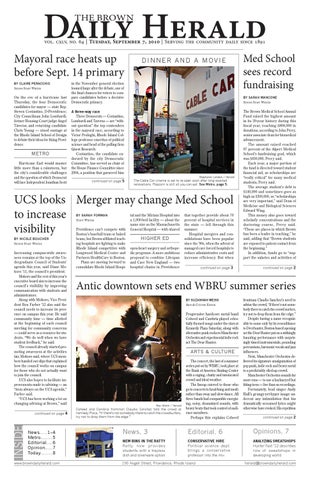
Daily Herald the Brown
vol. cxlv, no. 64 | Tuesday, September 7, 2010 | Serving the community daily since 1891
Mayoral race heats up before Sept. 14 primary By Claire Peracchio Senior Staff Writer
On the eve of a hurricane last Thursday, the four Democratic candidates for mayor — state Rep. Steven Costantino, D-Providence; City Councilman John Lombardi; former Housing Court judge Angel Taveras; and returning candidate Chris Young — stood onstage at the Rhode Island School of Design to debate their ideas for fixing Providence.
metro Hurricane Earl would muster little more than a rainstorm, but the city’s considerable challenges and the question of which Democrat will face Independent Jonathan Scott
d inner an d a mo v ie
in the November general election loomed large after the debate, one of the final chances for voters to compare candidates before a decisive Democratic primary.
By Sarah Mancone Senior Staff Writer
that together provide about 70 percent of hospital ser vices in the state — fell through this summer. Hospital mergers and consolidations have been popular since the ’90s, when the advent of managed care forced hospitals to reduce administrative costs and increase ef ficiency. But when
The Brown Medical School Annual Fund raised the highest amount in its 39-year histor y during this fiscal year, reaching $808,000 in donations, according to John Perry, senior associate dean for biomedical advancement. The amount raised reached 97 percent of the Alpert Medical School’s fundraising goal, which was $830,000, Perry said. Each year, a major portion of the fund is directed toward student financial aid, as scholarships are “really critical” for many medical students, Perry said. The average student’s debt is $140,000 and sometimes goes as high as $300,000, so “scholarships are very important,” said Dean of Medicine and Biological Sciences Edward Wing. This money also goes toward scholarly concentrations and the doctoring course, Perr y said. “These are places in which Brown has been a leader in teaching,” he said, adding that “Brown students are exposed to patient contact from the beginning.” In addition, funds go to “support the salaries and activities of
continued on page 3
continued on page 2
A three-way race Three Democrats — Costantino, Lombardi and Taveras — are “without question” the top contenders in the mayoral race, according to Victor Profughi, Rhode Island College professor emeritus of political science and head of the polling firm Quest Research. Costantino, the candidate endorsed by the city Democratic Committee, has served as chair of the House Finance Committee since 2004, a position that garnered him Stephanie London / Herald
continued on page 5
The Cable Car cinema is set to re-open soon after long-awaited renovations. Popcorn is still all-you-can-eat. See Metro, page 5.
UCS looks Merger may change Med School to increase visibility By Sarah Forman Staff Writer
By Nicole Boucher Senior Staff Writer
Increasing campus-wide awareness remains at the top of the Undergraduate Council of Students’ agenda this year, said Diane Mokoro ’11, the council’s president. Mokoro and the rest of this year’s executive board aim to increase the council’s visibility by improving communication with students and administrators. Along with Mokoro, Vice President Ben Farber ’12 also said the council needs to increase its presence on campus this year. He said community time — time allotted at the beginning of each council meeting for community concerns — could serve as a resource for students. “We do well when we have student feedback,” he said. The council already started promoting awareness at the activities fair, Mokoro said, where UCS members handed out slips that explained how the council works on campus for those who do not actually want to join the council. UCS also hopes to facilitate improvements made to advising — an “item always on the UCS agenda,” Farber said. “UCS has been working a lot on changing advising at Brown,” said
inside
continued on page 4
News.....1–4 Metro........5 Editorial....6 Opinion.....7 Today........8
www.browndailyherald.com
Providence can’t compete with Boston’s baseball team or baked beans, but Brown-affiliated teaching hospitals are fighting to make Rhode Island competitive with Longwood Medical Center and Partners HealthCare in Boston. Plans are moving for ward to consolidate Rhode Island Hospi-
Med School sees record fundraising
tal and the Miriam Hospital into a 1,000-bed facility — about the same size as the Massachusetts General Hospital — with shared
higher ed
open-heart surgery and orthopedic programs. A more ambitious proposal to combine Lifespan and Care New England — two hospital chains in Providence
Antic downtown sets end WBRU summer series By Suzannah Weiss Arts & Culture Editor
Progressive hardcore metal band Coheed and Cambria played celestially themed songs under the stars at Kennedy Plaza Saturday, along with alternative punk rockers Manchester Orchestra and experimental indie rock act The Dear Hunter.
arts & culture
Max Monn / Herald
Coheed and Cambria frontman Claudio Sanchez told the crowd at Kennedy Plaza, “If there’s not somebody there to catch the crowdsurfers, try not to drop them from the edge.”
The concert, the last of a summer series put on by WBRU, took place at the Bank of America Skating Center with a raging, chatty and intoxicated crowd and ideal weather. The lineup catered to those who go to concerts to head-bang and mosh rather than sway and slow-dance. All three bands had comparable energizing, noisy, dramatized sounds, with heavy beats that took control of audience members. Perhaps this explains Coheed
frontman Claudio Sanchez’s need to advise the crowd, “If there’s not somebody there to catch the crowd surfers, try not to drop them from the edge.” Despite having a name recognizable to some only by its resemblance to Deerhunter, Boston-based opening act the Dear Hunter put on a strikingly haunting performance with surprisingly timed instrumentals, pounding percussions, harmonic vocals and jazz influences. Next, Manchester Orchestra delivered its signature amalgamation of pop punk, indie rock and heavy metal to a predictably riled-up crowd. Manchester Orchestra sounds far more emo — to use a hackneyed but fitting term — live than on recordings. Fortunately, lead singer Andy Hull’s grungy-yet-hyper image undercut any intimidation that his dramatically screamed lyrics might otherwise have evoked. His repetition continued on page 2
News, 3
Editorial, 6
Opinions, 7
New bins in the ratty Ratty now provides students with a trayless dish and silverware option
Conservative Hire Political science dept. brings a conservative professor into the mix
analyzing sweatshops Hunter Fast ’12 describes role of sweatshops in developing world
195 Angell Street, Providence, Rhode Island
herald@browndailyherald.com
Page 2
THE BROWN DAILY HERALD
C ampus N EWS
Tuesday, September 7, 2010
“Fundraising is a science.” — Edward Wing, Dean of Medicine and Biological Sciences
Concert a memorable Fundraising goal within reach end to summer series continued from page 1
continued from page 1
of “I hope we both die, die, die, die” in the number “Turn Out the Lights” made it hard to restrain laughter. And his wide-eyed way of drilling “Don’t kill yourself to raise the dead” into the audience during a Kevin Devine cover was enough to make those who hadn’t previously considered the option contemplate it. Nevertheless, the second act was fun to listen to, even when that fun was had at the band’s expense. And some of their pieces, among them “Where Have You Been?” and “I’ve Got Friends,” elicited compulsory rocking out. Manchester Orchestra’s last piece “Turn Out the Lights,” whose lyrics repeat “the party’s over,” was misleading: After they got audience members jumping up and down, Coheed practically catapulted them out of the pavilion with electric guitars and flawlessly executed songs. The headliners opened with “In Keeping Secrets of Silent Earth:3,” also the title of the band’s 2003 album and the third chapter of Sanchez’s accompanying science fiction comic book series. Coheed and Cambria tells “an epic star-scape story in multiple genres” including music, prose and graphic novel, according to WBRU General Manager Allen McGonagill ’11. The musical and visual progression of Coheed’s songs reflected their otherworldly lyrics. Green beams of light emanated from the stage as Sanchez’s lightning bolt-shaped guitar filled the city with electrifying chords. To the audience’s delight, the quartet ended the encore with their
most well known song, “Welcome Home,” featured on the “Rock Band” video game. WBRU staff members were excited and relieved that their work had come to fruition. “It’s a whole summer of planning and a whole day of setting this stuff up,” Musical Director Sabrina Boyd ’11 said. “A lot goes into it that I didn’t realize,” said Station Manager Kelly Devlin ’11, including “weird logistic things” like dumpster permits. “The city people are always grumpy.” The lineup choice, Devlin said, is based on what the station already plays and which bands are available financially and time-wise. “We look for bands that we’re playing that are current, modern, popular bands,” Boyd said. The station also deals with some quirky requests from bands, including Coheed and Cambria’s request for several hundred feet of bubble wrap, she added. McGonagill said he had to retrieve a Wii game for the headliners and a lucky fan who won a contest to join them in the van. The only major mishap the staff had to deal with was a concert onlooker from outside the pavilion throwing a beer can at Hull as he exited the stage. But once the station apologized, he was “completely fine with it and was cracking jokes and stuff,” Promotions Director Alyssa Kichula ’12 said. On the bright side, Kichula also witnessed the Manchester Orchestra frontman’s first “man kiss,” which took place with a former WBRU member who now works for the band’s record company. She added that she felt the concert went “really, really well.”
sudoku
Daily Herald the Brown
Editorial Phone: 401.351.3372 | Business Phone: 401.351.3260 George Miller, President Claire Kiely, Vice President
Katie Koh, Treasurer Chaz Kelsh, Secretary
The Brown Daily Herald (USPS 067.740) is an independent newspaper serving the Brown University community daily since 1891. It is published MonTuesday through FriTuesw during the academic year, excluding vacations, once during Commencement, once during Orientation and once in July by The Brown Daily Herald, Inc. Single copy free for each member of the community. POSTMASTER please send corrections to P.O. Box 2538, Providence, RI 02906. Periodicals postage paid at Providence, R.I. Offices are located at 195 Angell St., Providence, R.I. E-mail herald@browndailyherald.com. World Wide Web: http://www.browndailyherald.com. Subscription prices: $319 one year daily, $139 one semester daily. Copyright 2010 by The Brown Daily Herald, Inc. All rights reserved.
professors,” Wing said, as well as towards general operating costs. It is also important to use funds to continue to develop the curriculum, Perry said, as a way of adjusting to a changing world. The amount of funds raised annually has been increasing steadily over the past few years, with the school raising $780,000 in the 2009 fiscal year, Perry said. The number of contributing donors has also increased each year, excluding a dip in donor numbers in 2009, he said. During the economic downturn, the fund had fundraising difficulties due to financial uncertainty, Perry said, but they “raised more money, despite the fact that we had a drop-off in donors.” “The trend is that we are going back up in donors,” he said, with 1,152 donors in 2009 and 1,229 donors in 2010. The Med School saw a 5 percent increase in alum donors last year and a 7 percent increase in medical alum donors exclusively, Perry said. The “largest group of donors
are alumni,” Perry said, but contributions also come from leaders of the community, people from affiliated hospitals and local businesses. “We are approaching the banks in town,” Wing said. In addition, “medical parents have given a large weight,” Perry said, with 10 percent of parents of medical students giving to the Med School. There has been “great support from parents of medical students past and present,” Perry added. The Med School staf fs an advancement office devoted to “identifying people that may be interested in funding,” Wing said. Finding donors also relies partly on word of mouth to “people that have made connections with Brown,” he added. “Fundraising is a science,” Wing said. Another fundraising group consists of medical students, who had a dance last year to help raise funds for the new Med School building, Wing said, adding that through this they were able to raise $900. “The medical students did a great job,” he said. Fundraising intended specifi-
cally for the new building has been ver y significant. At present, the Med School has raised $26.75 million — about 60 percent — of the $45 million goal that is required to complete the project, Wing said. The Med School received $1 million from the Champlin Foundation, a Rhode Island charity, toward the building of the Med School librar y, which will be named after the foundation as a result, he said. “We are ver y excited about the naming opportunities in the building,” Wing said. “People can name the whole anatomy suite” or just sections of it, he said. Certain parts of the Med School can be named for $2.5 million, he added, and Wing has already given money for a seminar room. The Med School still needs to raise the final $20 million to reach its goal, but “students are going to be in the building in August of next year,” Wing said. This will be the “first medical school building in Rhode Island,” he said, and it will “last for decades and decades and be a home for the future doctors of Rhode Island.”
Tuesday, September 7, 2010
THE BROWN DAILY HERALD
C ampus N EWS
Page 3
“It’s a small price to pay for the sake of the environment.” — Hector Ramirez ’12, on trayless dining
Local hospitals seek to compete with Boston continued from page 1 teaching hospitals like the Miriam or RIH are involved, there’s more at stake than profit margins and national rankings. Medical education is also on the line. ‘We have to be competitive’ “We need to have a strong, unified medical center,” said Edward Wing, dean of medicine and biological sciences at the Alpert Medical School. Construction in the Jewelr y District is currently under way to create that medical center, with plans for a permanent Medical Education Building, surrounded by other medical facilities and life science research centers. Combining RIH and the Miriam is “ver y important in terms of being able to have the best clinical ser vices,” Wing said, because it will reduce competition and inefficiency. “Any kind of fractionalization is usually not good for education,” Wing said, because it means duplicate services end up competing with each other both clinically and academically, instead of working to improve education or patient care. Instead, that competitive energy will be redirected outside Providence. Orthopedics will be one of the first programs to consolidate at RIH and the Miriam. Staci Fischer, director of graduate medical education, said she hopes that will mean fewer Rhode Islanders will travel to Brigham and Women’s Hospital’s new outpatient clinic in Foxborough, Mass. The 93,000-square-foot facility next to Gillette Stadium — home to the New England Patriots — offers primar y care and specialty services. Many in Providence have expressed worr y that it will take away patients who would otherwise have gone to Providence hospitals, where they would have interacted with Brown medical students and residents. “We have to make sure we have enough patients to give them a good, broad base,” Fischer said of the Brown residents and medical students she oversees. “We have to be competitive in order to be a good educational system.” If too many patients are drawn away from Brown’s teaching hospitals, then physicians in training will not have as diverse a patient load, Fischer said. Fewer patients mean “less opportunity to learn,” she said. Fur thermore, some of ficials in Providence worr y that patients who choose the Foxborough clinic will be wealthier and better insured. Patriot Place is not generally accessible by public transportation, and it is filled with high-end
shops and restaurants. “Ultimately, we depend on the financial health of the hospitals,” said Phil Gruppuso, associate dean of medical education. And while Providence hospitals would have to swallow a significant income loss before Brown’s medical education would be affected, the two are not unrelated. Already merged? Even if the merger has longterm effects on the Providence hospitals and the Med School, it probably will not make much difference in day-to-day operations for most students, residents and physicians. “We’ve done things together for a very long time,” said Fischer, explaining that for residents, RIH and the Miriam have been essentially one institution for years. The two are both part of the Lifespan network, and they collaborate on patient care and share departments. Even if some specialized departments exist only at one hospital or the other, thus changing the potential locations for some fourthyear medical students’ electives, Fischer said students will not notice any difference. Virtually all medical students spend time at both hospitals during their thirdyear rotations, she said, and they would already be familiar with both facilities. John Kastor, professor of medicine at the University of Maryland School of Medicine, said he did not see any major changes in medical education when he was completing research for a book on mergers among teaching hospitals. “It didn’t seem to have much effect on medical students,” he said. Similarly, Mathew Maurer, an assistant professor of clinical medicine at Columbia, said he did not notice any major differences in medical education in New York when the Presbyterian and New York hospitals merged in the ’90s. The two became a single facility and a major partner for both Cornell and Columbia medical schools, but Maurer said he thought the students were largely unaffected. But he said the hospital itself has improved since the merger and that it has become a “much more efficient organization” with “improved patient care.” “If the quality of ever ything around you is improving, it makes you a more engaged citizen,” Maurer said. Fischer and Wing said they hope Providence hospitals and the Med School will see a similar lift after the RIH-Miriam merger. “The educational experience, if anything happens, will actually be enhanced for those programs that do consolidate,” Fischer said.
Stephanie London / Herald
Diners can now take advantage of an entirely trayless system, reducing wasted food and water.
Ratty promotes trayless option By Alicia Chen Senior Staff Writer
Students accustomed to stacking their trays on the cart at the Sharpe Refector y were greeted with a new trayless system this semester. Diners now have the option to forgo trays altogether and place their used silver ware and dishes in marked blue bins around the Ratty. Ann Hoffman, Dining Services’ director of administration, wrote in an e-mail to The Herald that the trayless system may be only
temporary. “We are currently doing trayless in the (main dining room) on a trial basis and are evaluating it, continually looking at what works, what doesn’t work, and how to make it more efficient,” she wrote. But Ratty trays are probably still here to stay. “I don’t know if we will ever be able to transition to a totally trayless system, which would be difficult because of the way the Refectory is currently laid out, but we will advance the initiative as much as is operationally feasible,” Hoffman wrote.
Get The Herald delivered daily to your inbox browndailyherald.com/register
In 2008, trayless dining was introduced at the Verney-Woolley Dining Hall to reduce wasted food and water. Hoffman wrote that Dining Ser vices has been interested in expanding the trayless program and had heard there was interest in trayless dining at the Ratty. Many students have responded well to the new initiative. “I do it sometimes. It’s not that much more of an inconvenience,” said Hector Ramirez ’12. “It’s a small price to pay for the sake of the environment.”
Page 4
THE BROWN DAILY HERALD
C ampus N EWS
Tuesday, September 7, 2010
“I’m very excited for UCS this year.” — UCS Vice President Ben Farber ’12
George Miller / Herald
UCS President Diane Mokoro ’11 introduced President Ruth Simmons at her welcome speech Aug. 29.
On short list of UCS to-do’s: communication, advising continued from page 1
www.browndailyherald.com
Eden Castro ’12, chair of the council’s academic and administrative affairs committee. Castro worked over the summer to create an advisor y handbook to better provide orientation to the system, and she said she has been in collaboration with Dean of the College Katherine Bergeron to discuss these advising improvements. She added that they are trying to work on changing the “fundamental difference between how students were conceptualizing advising and how faculty” conceive of the process. Castro also said UCS should work on improving advising this year in light of strides made in advising by administration and other leaders last year. Newly implemented resources such as Advising Central and the Matched Advising Program for Sophomores, which was initiated by Molly Jacobson ’10, were designed to provide a more well-rounded advising experience, The Herald reported last year. With this momentum, “UCS has been working a lot on changing advising at Brown,” Castro said. “It is really the role of UCS to be the voice of the student body and administration,” Castro added. Along these lines, the council also has many goals to increase interactions with the administration and student organizations on campus in the year ahead. UCS plans to continue to engage with the Organizational Review Committee, Mokoro said. Last year, a student advisory group that included council members heard presentations from the majority of the ORC subcommittees and provided input about the proposals, which dealt largely with the University’s budget. Some of the rec-
ommendations made by the group were adopted by the committee, Farber said, calling this result an example of a “huge success” that the council took part in last year. Farber also said UCS would like to better communicate with the representatives that it appoints to University committees. After collaboration between the council’s campus life committee and the review committee’s subcommittee on athletics and physical education last year produced positive results, Farber said he hopes this communication can be expanded to other groups as well. Student Activities Chair Ralanda Nelson ’12 also called for “strengthening the bond between UCS and (the Undergraduate Finance Board).” The student council and the finance board already successfully worked together to advocate for the creation of an endowment for student activities, which should help prevent continued increases to the student activities fee, according to Farber. “It’s a better way to sustain student activities on campus,” Nelson said, adding that she is “looking for ward to raising money.” Nelson said UCS releases an agenda ever y year to provide a better sense of goals. The agenda will come out before Thanksgiving break, she said, and a later spring agenda will help determine what has been accomplished and what still needs to be done. “I’m ver y excited for UCS this year,” Farber said. “I have a lot of confidence in the chairs and confidence in our potential.” The council will be holding an information session Sept. 8 at 7:30 p.m. in place of its regular meeting. It will hold its first regular meeting the following week.
Metro The Brown Daily Herald
“I still think there’s a very high undecided vote in Providence.” — Joe Fleming, WPRI News Commentator Tuesday, September 7, 2010 | Page 5
A facelift for the Cable Car, but the love-ly seats remain By Qian Yin Staff Writer
The black leather couches at the renovated Cable Car Cinema offer the coziness of a living room back at home. But the murals on the right-hand wall — in one a red brick Providence building sinks deep into dreamy underwater blue — provide a touch of surrealism for a journey into the cinematic world. The Cable Car Cinema and Cafe will reopen Sept. 11 after three months of renovation, screening “Jean-Michel Basquiat: The Radiant Child,” a documentar y about the late graffiti artist, said Daniel Kamil, the Cable Car’s owner. The Cafe was back in business Sept. 1, temporarily serving a pared-down menu, Kamil said. The renovation that began June 4 was “necessary on many levels,” Kamil said. The Cable Car was founded in 1976 and had not gone
through a major change until recently, apart from renewal of the seats in 2008. Constructed under an old-fashioned building code, the theater had many “quirky, unusual” designs that needed to be updated, Kamil said. The renovation has been comprehensive, boosting the electrical system, the audio, the picture quality and what Kamil called “the cosmetic,” including the new murals on the walls of the theater. One goal of the renovation was to bring in Providence artists, Kamil said. The concrete countertop, the lighting and the murals, among other improvements, were all created by local artists. “We thought it’s important to give local people work” and let them “showcase their talents,” Kamil said. The Cable Car has sur vived even as a small theater. Since the VHS format became available in the 1980s, “the idea of a single-screen
theater kind of went away,” Kamil said. What has enabled the Cable Car to last in the face of multiplexes, downloading and other ways to watch movies is “the strength of its programming and the comfort of the theatre,” Kamil said. As one of the few 100-seat theatres still operating in the country, the Cable Car is “embedded in the community,” Kamil said. The cinema has also had a long relationship with Brown’s Department of Modern Culture and Media. “The Cable Car makes an invaluable contribution to the arts and culture scene in Providence,” said Richard Manning, the MCM department’s film archivist. The department’s partnership with the Cable Car came out of several MCM courses in 1988, when some class materials were only available on 35mm film. Because the University did not have the
equipment to screen this format, the department arranged with Eric Bilodeau, then owner of the Cable Car, to have the films screened there, Manning said. In the 1990s, films increasingly became available on DVD, the need to screen course material at the Cable Car became less pressing, Manning said. Moreover, the Perry and Marty Granoff Center for the Creative Arts, scheduled to open next year, will include space for the MCM department to screen 35mm films, he said. Nevertheless, the Cable Car — which hosts events such as the Providence French Film Festival, the Providence Africana Film Festival and the Magic Lantern Cinema film series — has remained connected to the University. Cafegoers may notice an uncommonlooking screen made of 14 16mm reels welded together. All the reels were donated by the MCM depart-
ment — a stamp of the partnership, Kamil said. In addition to the fixed seats in the theatre, the Cinema also provides 15 love seats that “people love,” Kamil said. As one of the first theatres in the country to have couches, the Cable Car has always counted these seats as part of its identity, he said. The traditional poster-giveaway raffles and the Cable Car’s popcorn policy — $4, all you can eat — will continue after the reopening, Kamil said. The Cable Car will be the venue for the upcoming Providence Women’s Film Festival, scheduled for Oct. 12–17 and sponsored by the MCM department. Since the renovation there has also been increased interest in hosting events other than film screenings at the Cable Car, Kamil said. For example, a fashion show will take place at the Cable Car at the end of October.
Three leading Democrats vie for votes in mayoral race continued from page 1 a central role in crafting state budgets and the recently adopted state education funding formula, which will appropriate nearly $30 million in additional funds to Providence schools starting in 2012. Lombardi has ser ved on the Providence City Council for 26 years, a stint punctuated by two terms as council president and a brief tenure as mayor in 2002 following the resignation of former Mayor Vincent “Buddy” Cianci Jr. in the wake of federal corruption charges. Taveras, who touts a “Head Start to Har vard” life stor y that took him from Providence’s South Side to the Ivy League, has a resume that includes private legal practice, an unsuccessful run for Congress and an associate judgeship on the Providence Housing Court after his 2007 appointment by Mayor David Cicilline ’83. Also in the running for the Democratic nomination is Young, a three-time candidate for mayor and an eccentric staple of local politics. Young made national news recently by proposing to Kara Russo during an Aug. 24 mayoral debate and for serenading a news anchor on a local morning show. Russo, his girlfriend and campaign manager, is running for lieutenant governor and the 1st Congressional District seat. Young was banned from Brown’s campus last November after throwing an anti-abortion video at Rep. Patrick Kennedy, D-R.I., during a University health care forum. The winner of the Sept. 14 Democratic primary will square off against Jonathan Scott, the president of a political consulting and public relations firm and a former Republican candidate for Congress. Fiscal woes and electoral foes “There’s no question that any-
where you go in Rhode Island, including the city of Providence, the number-one issue is the economy and jobs,” Profughi said. With the city’s deficit for its 201112 fiscal year projected at $52 million and its unfunded pension liability nearing $1 billion, the next Providence mayor faces a dire financial outlook that could strain the city’s schools and its ability to provide crucial services. The next top city official will also shape Providence redevelopment efforts following the relocation of Interstate 195, which freed nearly 30 acres of prime real estate and, as the candidates’ proposals envision, will promote critical economic growth. Each candidate argues that he is uniquely positioned to address the issues facing the city. Costantino points to his experience trimming state budgets as crucial for combating Providence’s debt problems. He has unveiled a plan for the development of the I-195 corridor that would establish a Corridor Development Corporation to attract businesses and oversee the area’s new construction. Lombardi credits his extensive city government experience for making him “the man who can come in on day one and know what to do,” according to press secretary Julie Ruditzky. Lombardi has proposed the Providence Main Street Business Exchange, a plan to provide “access to capital and a more streamlined licensing process” for the city’s businesses, Ruditzky said. Taveras said his humble beginnings and strong educational background would inform his actions as mayor. “What I bring is a fresh perspective and a lifetime of overcoming obstacles,” Taveras said. Taveras said he would focus on bringing labor unions to the table to solve the city’s pension problem, cutting
red tape for businesses and making Providence and its buildings more environmentally sustainable. The other two candidates in the race, Young and Scott, both cite their status as political outsiders as freeing them from being beholden to entrenched interests. Young told the Herald he would bring a farmers’ market and a public park to Providence’s waterfront area and would use the city’s leverage to prevent home foreclosures. Scott said he would reform the city’s tax code and use taxpayer funds to create “transitional housing” and provide services for the homeless. Battling for demographics While public polling data on the race is limited, Profughi sees the contest as a battle for a plurality of votes among the three leading Democrats.
“You have two candidates — Lombardi and Costantino — who have the propensity to draw support from a somewhat similar constituency,” Profughi said, citing the two candidates’ particular strength in Federal Hill, where both have roots, and with “traditional Democratic votes.” Strong support on the East Side and with the South Side’s Hispanic population gives Taveras the best position at this point in the race, he said. Yet this favorable scenario for Taveras could fail to materialize. The race’s unpredictability hinges on the strength of Taveras’ turnout on the South Side, whether Federal Hill voters unite behind the stronger of the two candidates favored in that area and whether Lombardi and Costantino make inroads on the East Side, pollster and WPRI News commentator Joe Fleming told The
Herald. Fleming said the winner of the Democratic primary is “the overwhelming favorite” to win in November. “The big factor’s going to be turnout on primary day,” Fleming said, pointing to a strong get-out-the-vote effort and campaign funds as key to gaining voters’ support. Recent campaign finance reports show Lombardi with a slight edge in fundraising, while Taveras and Costantino are second and third, respectively, in the race for the campaign cash that is vital for bankrolling television and radio advertisements aimed at swaying voters. “I still think there’s a very high undecided vote in Providence,” Fleming said. “The message these candidates get out in the next week and a half will probably determine who’s the next mayor of Providence.”
Thanks for reading!
Editorial & Letters The Brown Daily Herald
Page 6 | tuesday, September 7, 2010
corrections An article in Thursday’s Herald (“Metcalf renovations move profs to Wayland Square,” Sept. 2) incorrectly stated that Professor of Cognitive, Linguistic and Psychological Sciences William Warren’s Virtual Environment Navigation lab has decided to increase the hourly rate for its study participants by $5 to lure them in to the new location. In fact, the $5 increase is department-wide and is paid for by the University, as opposed to the individual labs. Additionally, the increase is not based on a per-hour rate, but rather per experimental session. An article in the Aug. 30 Herald (“Brown women see ‘Windows’ of opportunity”) incorrectly stated that Alexandra Schultz ’11 chose Microsoft’s internship over offers from Apple and Google. Schultz did get an offer from Apple, but retracted her application at Google after Microsoft extended its offer. Schultz was also quoted as saying that the language of computer science “opens up a world of communicating with other people.” In fact, the quote referred to language in general, not just computer science. The Herald regrets the errors.
ale x
yuly
e d i to r i a l
A step in the right direction
t h e b r o w n d a i ly h e r a l d Editor-in-Chief George Miller
Managing Editor Chaz Kelsh
Deputy Managing Editors Emmy Liss Joanna Wohlmuth
editorial Arts & Culture Editor Anne Speyer Arts & Culture Editor Suzannah Weiss Features Editor Sara Luxenberg Features Editor Brian Mastroianni Metro Editor Brigitta Greene Metro Editor Ben Schreckinger News Editor Sydney Ember Sports Editor Zack Bahr Sports Editor Tony Bakshi Asst. Sports Editor Ashley McDonnell Asst. Sports Editor Erika Mueller Graphics & Photos Graphics Editor Stephen Lichenstein Graphics Editor Alex Yuly Photo Editor Stephanie London Photo Editor Max Monn Photo Editor Hilary Rosenthal Sports Photo Editor Jonathan Bateman Asst. Sports Photo Editor Jesse Morgan Production Kelly Mallahan Julien Ouellet Gili Kliger Katie Wilson Neal Poole
Copy Desk Chief Design Editor Asst. Design Editor Asst. Design Editor Web Editor
Post- magazine Editor-in-Chief Sam Carter Editor-in-Chief Kate Doyle Editor-in-Chief Marshall Katheder
Senior Editors Ben Hyman Seth Motel
Business General Managers Office Manager Shawn Reilly Claire Kiely Katie Koh Directors Sales Kelly Wess Finance Matthew Burrows Client Relations Margaret Watson Alumni Relations Christiana Stephenson Managers Local Sales Arjun Vaidya National Sales Marco deLeon University Sales Aditi Bhatia University Sales Jared Davis Recruiter Sales Trenten Nelson-Rivers Maximilian Barrows Business Operations Business Analytics Jilyn Chao Credit and Collections Danielle Marshak Special Projects Alexander Carrere Staff Kathy Bui Opinions Opinions Editor Michael Fitzpatrick Opinions Editor Alyssa Ratledge Editorial Page Board Matt Aks Editorial Page Editor Anita Mathews Board member Tyler Rosenbaum Board member Melissa Shube Board member Gaurie Tilak Board member
Leor Shtull-Leber, Designer Kelly Mallahan, Kristina Petersen, Dan Towne, Copy Editors
A conservative activist speaking at Brown in 2008 told The Herald, “There are only one or two conservatives on your entire faculty, which is a disgrace and it did not happen by accident.” While we thought that claim was extreme, it’s no secret that Brown’s campus does indeed lean toward the political left. In a poll conducted by The Herald immediately before the 2008 election, 86 percent of students said they would vote for then-Senator Barack Obama. Brown could undoubtedly benefit from greater intellectual diversity on campus, and we are very glad to see the Department of Political Science take a major step in that direction. The department has hired renowned legal scholar Steven Calabresi to teach classes on constitutional law this year. Professor Calabresi grew up and lives in Rhode Island and is taking a leave of absence from Northwestern University School of Law. Calabresi’s conservative credentials are well established. As a student at Yale Law School, he cofounded the Federalist Society for Law and Public Policy Studies, an organization of libertarian law students, scholars and practitioners that now has 40,000 members across the country, according to its website. After law school, he clerked for Supreme Court Justice Antonin Scalia, and then went on to work in the Reagan and first Bush administrations before entering academia. Over the last twenty years, Calabresi has written dozens of law review articles and several books, many of which have been influential in conservative circles. He is one of the most significant figures in legal academia, and we are extremely excited that he will be teaching Brown undergraduates this year. Calabresi’s presence will undoubtedly increase the
diversity of political viewpoints on campus. But this is not to say that he will bring any political biases to class. As he previously told The Herald, he plans to teach in a way that introduces students to varying approaches to the law and allows them to come to their own conclusions. Still, Calabresi can present conservative theories and modes of thought from a perspective that would be impossible for some other faculty members to replicate. Additionally, Calabresi’s time here will hopefully help debunk the notion that Brown is an inhospitable environment for conservatives. We know his classroom will be a lively, open forum where ideas from across the political spectrum are subjected to thorough analysis. And left-leaning students who engage with him may even end up changing their minds on an issue or two. Other social science departments at Brown should look to follow the political science department’s lead and promote intellectual diversity. We’re pretty sure that Calabresi isn’t only the second or third conservative professor at Brown. Still, the University would benefit from additional efforts to diversify its faculty and attract noted scholars with a broad variety of views. Ultimately, we want to congratulate the political science department for its new hire and welcome Professor Calabresi to Brown. Students should seize the opportunity both to study under such an eminent scholar and to expose themselves to the diversity of viewpoints that colleges were meant to promote but often lack. Editorials are written by The Herald’s editorial page board. Send comments to editorials@browndailyherald.com.
Rebecca Ballhaus, Brigitta Greene, Sarah Mancone, Mark Raymond, Night Editors Senior Staff Writers Ana Alvarez, Ashley Aydin, Rebecca Ballhaus, Alexander Bell, Nicole Boucher, Fei Cai, Alicia Chen, Kristina Fazzalaro, Sarah Mancone, Claire Peracchio, Lindor Qunaj, Mark Raymond, Luisa Robledo, Caitlin Trujillo, Alexandra Ulmer Staff Writers Anna Andreeva, Anne Artley, Shara Azad, Casey Bleho, Sofia Castello, Amy Chen, Sarah Forman, Miriam Furst, Max Godnick, Thomas Jarus, Sarah Julian, Julia Kim, Emily Rosen, Bradley Silverman, Qian Yin Senior Sales Executives Katie Galvin, Liana Nisimova, Isha Gulati, Samantha Wong Sales Associates Roshni Assomull, Brady Caspar, Anna Cook, Siena deLisser, Begum Ersan, Tommy Fink, Ryan Fleming, Evan Gill, Rajiv Iyengar, Debbie Lai, Jason Lee, Katie Lynch, Sean Maroongroge, Zahra Merchant, Edjola Ruci, Webber Xu Senior Finance Associates Jason Beckman, Lauren Bosso, Mae Cadao, Margot Grinberg, Sajjad Hasan, Adam Fern Finance Associates Lisa Berlin, Mahima Chawla, Mark Hu, Jason Lee, Nicholas Robbins, Daniel Slutsky, Emily Zheng Design Staff Caleigh Forbes, Jessica Kirschner, Leor Shtull-Leber Web Staff Andrew Chen, Warren Jin, Claire Kwong, Michael Marttila, Ethan Richman, Adam Zethraeus Photo Staff Qidong Chen, Janine Cheng, Alex DePaoli, Frederic Lu, Quinn Savit Copy Editors Nicole Boucher, Zoe Chaves, Greg Conyers, Claire Gianotti, Aida Haile-Mariam, Victoria Hartman, Tiffany Hsu, Christine Joyce, Mrinal Kapoor, Abby Kerson, Matthew Lim, Sara Luxenberg, Alexandra McFarlane, Joe Milner, Rajan Mittal, Lindor Qunaj, Kate-Lyn Scott, Carmen Shulman, Rebecca Specking, Dan Towne, Carolina Veltri
C O R R E C T I O N S P olicy The Brown Daily Herald is committed to providing the Brown University community with the most accurate information possible. Corrections may be submitted up to seven calendar Tuesdays after publication. C ommentary P O L I C Y The editorial is the majority opinion of the editorial page board of The Brown Daily Herald. The editorial viewpoint does not necessarily reflect the views of The Brown Daily Herald, Inc. Columns, letters and comics reflect the opinions of their authors only. L etters to the E ditor P olicy Send letters to letters@browndailyherald.com. Include a telephone number with all letters. The Herald reserves the right to edit all letters for length and clarity and cannot assure the publication of any letter. Please limit letters to 250 words. Under special circumstances writers may request anonymity, but no letter will be printed if the author’s identity is unknown to the editors. Announcements of events will not be printed. advertising P olicy The Brown Daily Herald, Inc. reserves the right to accept or decline any advertisement at its discretion.
Opinions The Brown Daily Herald
TUESDAY, SEPTEMBER 7, 2010 | Page 7
Sweatshops and you: A practical analysis HUNTER FAST Opinions Columnist The Brown Bookstore’s recent cancellation of its merchandising contract with Nike has returned to prominence the debate over lowwage labor in developing countries. The cancellation stemmed from alleged illegal labor practices on the part of two Nike subcontractors based in Honduras. While severing business relationships with companies clearly engaged in activities illegal in the countries in which they occur is legitimate, this incident should not become the basis for a wider backlash against the purchase of manufactured goods from developing countries. The fact of the matter is that though sweatshops are frequently criticized, they provide the best chance for short-run alleviation of poverty and long-run economic development in their host countries. The arguments against the consumption of goods made through sweatshop labor are replete with false dichotomies. A centerpiece of this opposition is the argument that sweatshops are abhorrent because they employ child labor. While a factory in the developed world with such practices would be quickly and rightly condemned, this contention does not hold with overseas sweatshops because it relies on the assumption that children not working in sweatshops would not be working at all — an assumption that is demonstrably false.
Far from improving the plight of children previously employed in sweatshops, forced layoffs frequently relegate them to far worse circumstances. In tracking the overall welfare of thousands of children fired in Bangladesh in 1993 as a consequence of political pressure, UNICEF found that many of these children, being too impoverished not to work, had gone into prostitution and petty theft. While rescuing child laborers from dangerous conditions is a noble goal, attempts to remove sweatshops are often tragically counterproductive in this effort. Anti-sweatshop activists also point out
countries — Honduras among them — with sweatshop wages doubling the national average. In light of this, the common criticism that sweatshop workers possess little job security becomes better understood. Laborers in sweatshops are frequently fired over minor infractions for the same reason that higher worker turnover rates prevail in periods of high unemployment anywhere. When the demand for a low-skill job is high, the incentives not to fire and replace a worker are minimal. Aside from the factual inconsistencies in
While rescuing child laborers from dangerous conditions is a noble goal, attempts to remove sweatshops are often tragically counterproductive in this effort. that the wages of garment workers in sweatshops are paltry compared with those of their counterparts in the developed world. While this is true, it is irrelevant, since sweatshop workers do not possess the option to work in a developed country. The only comparison of wages that is relevant in this case is that of sweatshop workers with the average wage of home country workers. According to a 2004 study, the wages paid in sweatshops exceeded the average national income in nine out of the eleven countries examined, including four
the rationale of opposition to sweatshop-made goods, there is also an element to the rhetoric that treats sweatshop workers as if they do not possess free will or the ability to leave the sweatshop. Many anti-sweatshop arguments gloss over the point that the worker, in choosing to work in a sweatshop, sees it as preferable to the alternative, which often involves subsistence agriculture or other dangerous manual labor. While working in a sweatshop strikes anyone in a developed economy as terrible, it is for many in the developing world
a step up from the conditions in which they previously lived. Furthermore, one must remember that the United States and the United Kingdom also went through a phase of low-wage industrialization in their own economic histories, as did virtually all advanced economies that did not develop by way of oil wealth. In the late 20th century, the world saw the stratospheric rise of Japan, South Korea, Singapore and Hong Kong through the exact same process. To prevent other countries from developing along the same trajectory that wealthy nations have already taken by refusing to purchase their goods is, in effect, to punish them unfairly for coming into the game too late. While anti-sweatshop activists mean well in their efforts to raise the quality of life in poorer countries, the policies that they espouse as means to this end would have disastrous effects on the economies of the developing world if applied on a large scale. The arguments against sweatshops are based largely on appeals to emotion, with context and consequences often falling by the wayside. Until a viable alternative method of development can be offered, campaigns against sweatshops will continue to backfire, harming the very people they intend to help.
Hunter Fast ’12 is an economics concentrator who strongly supports free immigration, but that’s a topic for another column.
Climategate was no fluke DOMINIC MHIRIPIRI Opinions Columnist The mainstream alarmist posturing on climate change by the likes of Al Gore, regardless of whether it meets the demands of scientific accuracy or not, is resetting political priorities and imposing billions of dollars in costs for governments the world over. Sustained inquiry, debate and scrutiny around the dealings of those involved — from scientific practitioners to powerful policymakers — are not only inevitable, but are also absolute imperatives. The taxpayer, after all, funds most of the climate research and his life is vastly affected by the domestic and international policies that it shapes. In particular, emerging economies across the world grapple with the burden of international pressures to “green up” versus their own aspirations to fully industrialize. In that regard, the sensational November 2009 revelation of deplorable practices by leading climate change scientists cannot have been some blind chase driven by ideology, but a significant and irreversible turn in one of the greatest geopolitical debates of all time. Notwithstanding the supposed exonerations of the Climate Research Unit (CRU) scientists in question, their behavior remains unscrupulous. Moreover, for those manning the frontiers of an issue with such enormous global implications, “hiding the temperature decline” and destroying emails with critical evidence strikes me as just outright unacceptable.
Through his column, (“Scientific Misconduct,” Sept. 1), David Sheffield ’11 would have us believe that the furor that arose from clear evidence of manipulating empirical data was misplaced — because no “scientific malpractice” was found by reviews. In other words, he renders the legitimacy of any criticism to the sole discretion of those tasked to “inquire” by the status quo, or those with zero incentives for objectiveness in the issue. The implications of this approach cannot be any trickier: all we need to settle this controversy is peer review by institutions whose credentials for objectiveness in this matter are questionable.
“deniers” is a little more detailed and sharp. He tags the critics as “ideologically driven” and “anti-scientific” crowds who are out to achieve self-serving ends. But nothing, however, can be truer about the mainstream scientific consensus on climate change whose figured scientists were tainted in the scandal. No objective scientist but in fact one driven by ideology, can go to the same lengths that the CRU experts went in actively trying to manipulate highly consequential empirical data. Apologists of the status quo scientists will point to the fact that the evidence (or the lack thereof) was acquired illegally by a hacker,
To make those critical of the questionable practices of authoritative scientists appear repulsive by tagging them as “anti-scientific” borders on some sort of censorship. It should be noted that the implicated universities themselves — Penn State and the University of East Anglia — as the respective employers of the scientists in question, funded two of the supposedly independent inquiries into the CRU. Finding the scientists guilty on any count would also discredit these institutions and their status as the backbone of what Gore would like us to think as the “overwhelming scientific consensus” on climate change. Sheffield’s focus on the underlying issue is quite generic in that he merely states the outcomes of the inquiries but not the accusations in question. But his judgment on
the fact remains that the conventional climate change science is rooted in the highly secretive work of men who we now know have the capacity and sometimes, motive to tailor some of their findings to suit certain goals — or ideologies, if you wish. That climate change has become a multibillion dollar industry is not a mystery, nor is the fact that millions of “green” dollars are lining the personal pockets of those with enough clout on environmental policy. From federal grants to windfalls from energy companies, many incentives have clouded this industry and left total objectiveness wallowing away
from the top of priority lists. Therefore, with the far-reaching implications of global environmental policies, it is mandatory to keep relentless scrutiny as an indispensable part of that matrix of interconnectedness. To make those critical of the questionable practices of authoritative scientists appear repulsive by tagging them as “anti-scientific” borders on some sort of censorship. It is no wonder bigger climate change fundamentalists are quick to address anyone skeptical of their sensation-seeking rhetoric as a heretic, or in the words of Bill Nye, “almost unpatriotic”. By analyzing both in the same side of his article, Sheffield paints climate change “deniers” with the same brush as those guilty of scientific misconduct, like disgraced academics of Marc Hauser’s sort. The only problem is that while Hauser’s case presents a black-andwhite scenario whose verdict was easily delivered, the whitewash of the CRU by supposedly independent inquiries is not so simplistic. It is a mere microcosm of the fundamental global debate around global warming that is both complex, and far from over. The jury is definitely still out on the socalled Climategate, and I don’t think it is time for us here at Brown to conclusively hit that gavel yet — especially at the lead of inquiries that may have well chosen convenience over objectiveness. The enormity of the stakes worldwide does not allow us that luxury.
Dominic Mhiripiri ’12 is not relenting his hold onto the proverbial grain of salt anytime soon.
Today The Brown Daily Herald
3
The Ratty promotes limiting tray usage
5
to day
to m o r r o w
85 / 66
85 / 59
Renovated Cable Car opens this week
Tuesday, september 7, 2010
t h e n e w s i n i m ag e s
1
1 c a l e n da r Today, September 7
tomorrow, September 8
4:00 P.M. — Power Sessions: Resumes, Cover Letters, Interviewing and Networking, Career Development Center
2:30 P.M. — Climate Sensitivity and Feedbacks, Barus and Holley 190
8:00 P.M. — Project HEALTH Information Sessions, Wilson Hall 301
4:00 P.M. — Department of Cognitive, Linguistic and Psychological Sciences Colloquium, Hunter Lab Auditorium
menu Sharpe Refectory
Verney-Woolley Dining Hall
Lunch — Artichoke, Kalamata and Pepper Calzone, Italian Beef Noodle Casserole, Butterscotch Chip Cookies
Lunch — Hot Ham on a Bulky Roll, Vegetarian Pot Pie, Baked Acorn Squash, Butterscotch Chip Cookies
Dinner — Curry Chicken with Coconut, Vegan Chana Masala, Basmati Rice Pilaf, Raspberry Bars
Dinner — Roast Beef au Jus, Vegan Vegetable Couscous, Roasted Rosemary Potatoes, Raspberry Bars
crossword
5 Interested in working for the oldest, largest student group on campus? Want to see your name in black and white?
Join The Brown Daily Herald! We are recruiting reporters, opinions columnists, bloggers, copy editors, photographers, designers, web staffers, business staffers and more! Information sessions will be held on Tues., Sept. 7 and Sun., Sept. 12 at 8 p.m. at 195 Angell St. (between Thayer and Brook streets). Questions? herald@browndailyherald.com browndailyherald.com/join comics Bat & Gatz | Sofia Oritz
Dot Comic | Eshan Mitra and Brendan Hainline
The Adventures of Team Vag | Wendy Kwartin
Page 8