Daily Herald the Brown
vol. cxlv, no. 59 | Monday, July 26, 2010 | Serving the community daily since 1891
Corp. approves engineering school at May meeting
PRE-SORTED STANDARD Non-Profit org. u.s. postage paid
By Sydney Ember News Editor
permit no. 2475 Providence, r.i.
The Corporation approved the establishment of a new School of Engineering and authorized renovations to the Metcalf Chemistry and Research Laboratory at its meeting on May 28. Members of the Corporation, the University’s highest governing body, also attended a groundbreaking ceremony to mark the beginning of construction on additions to Brown’s athletic facilities, including the new fitness and aquatics centers. The Corporation also elected continued on page 9
Hicks ’11 killed on biking trip By Brigitta Greene Metro Editor
Quinn, vice president for public affairs and University relations, wrote in an April 12 e-mail to The Herald that University officials “acted appropriately in this matter.” The e-mails reveal that Carey and Simmons were in communication with the female alum’s father regarding her complaints about McCormick several days before she told administrators that McCormick raped her, and that Simmons saw the female alum in person the day before the alleged rape occurred. Simmons turned down requests from McCormick and his mother to speak on the phone and in person,
Paige Hicks ’11 was killed July 20 while leading a cross-country bike trip, raising money for affordable housing. Hicks, of Chesterfield, Mo., was struck by a tractor trailer on U.S. Highway 18 near Vetal, S.D., said Lt. David Berkeley of the South Dakota Highway Patrol. Hicks had pulled over on the side of the road to check messages on her cell phone. Berkeley said she had stopped in an area of rolling hills, near the badlands region of the state — “kind of out in the middle of nowhere.” The tractor trailer was hauling a combine, and though the driver, Scott Wenzel, tried to swerve out of the way, he did not see Hicks in time, Berkeley said. He said a final investigation of the accident is not yet complete, but charges against Wenzel are unlikely. Hicks was serving as a group leader for Bike and Build, a nonprofit
continued on page 7
continued on page 7
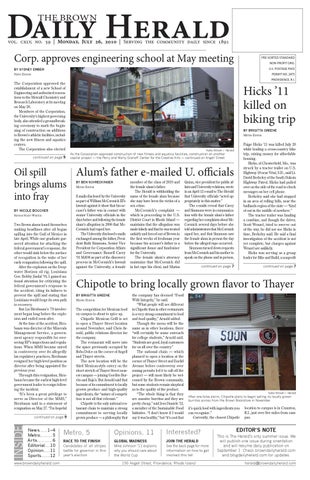
Katie Wilson / Herald
As the Corporation approved construction of new fitness and aquatics facilities, construction on another capital project — the Perry and Marty Granoff Center for the Creative Arts — continued on Angell Street.
Oil spill Alum’s father e-mailed U. officials brings alums into fray By Ben Schreckinger Metro Editor
By Nicole Boucher Senior Staff Writer
Two Brown alums found themselves making headlines after oil began spilling into the Gulf of Mexico in late April. While one graduate garnered attention for attacking the federal government’s response, the other would sink below the surface of recognition in the wake of her early resignation following the spill. After the explosion on the Deepwater Horizon oil rig, Louisiana Gov. Bobby Jindal ’91.5 gained national attention for criticizing the federal government’s response to the accident, citing its failures to prevent the spill and stating that Louisiana would forge its own path to recovery. But Liz Birnbaum’s ’79 involvement began long before the explosion and ended soon after. At the time of the accident, Birnbaum was director of the Minerals Management Ser vice, a government agency responsible for overseeing BP’s inspections and regulations. When MMS became mired in controversy over its allegedly lax regulatory practices, Birnbaum resigned her high-level position as director after being appointed the previous year. Through this resignation, Birnbaum became the earliest high-level government leader to resign following the incident. “It’s been a great privilege to ser ve as Director of the MMS,” Birnbaum said in a statement of resignation on May 27. “I’m hopeful
inside
continued on page 9
News.....1–4 Metro.........5 Arts..........6 Editorial....10 Opinion.....11 Sports.......12
www.browndailyherald.com
E-mails disclosed by the University as part of William McCormick III’s lawsuit against it show that his accuser’s father was in contact with senior University officials in the days before and following the female alum’s allegation in 2006 that McCormick had raped her. The University disclosed e-mails exchanged among the father, President Ruth Simmons, Senior Vice President for Corporation Affairs and Governance Russell Carey ’91 MA’06 as part of the discovery process in McCormick’s lawsuit against the University, a female
member of the class of 2010 and the female alum’s father. The Herald is withholding the name of the female alum because she may have been the victim of a sex crime. McCormick’s complaint — which is proceeding in the U.S. District Court in Rhode Island — maintains that the allegation was made falsely and that he was treated unfairly and forced out of Brown in the first weeks of freshman year because his accuser’s father is a significant donor and fundraiser for the University. The female alum’s attorney maintains that McCormick did in fact rape his client, and Marisa
Chipotle to bring locally grown flavor to Thayer By Brigitta Greene Metro Editor
The competition for Mexican food on campus is about to spice up. Chipotle Mexican Grill is set to open a Thayer Street location around November, said Chris Arnold, public relations director for the company. The restaurant will move into the space previously occupied by Roba Dolce on the corner of Angell and Thayer streets. The new location will be the third Mexican-style eatery on the short stretch of Thayer Street nearest campus — joining Gordito Burrito and Baja’s. But Arnold said that because of its commitment to locally grown produce and high-quality ingredients, the “nature of competition is not all that relevant.” Chipotle is the only national restaurant chain to maintain a strong commitment to ser ving locally grown produce — a philosophy that
the company has deemed “Food With Integrity,” he said. “What people will see different in Chipotle than in other restaurants is a very strong commitment to food and food quality,” Arnold added. Though the menu will be the same as in other locations, there “will certainly be some outreach for college students,” Arnold said. “Students are good, loyal customers for us all over the country.” The national chain — which planned to open a location at the corner of Thayer Street and Euclid Avenue before controversy over zoning permits led it to call off the project — will most likely be welcomed by the Brown community, but some students remain skeptical as to the quality of the product. “The whole thing is that they are massive burritos and they are pretty cheap,” said Jess Daniels ’12, a member of the Sustainable Food Initiative. “I don’t know if I would say it was healthy,” but “it’s cool that
Katie Wilson / Herald
After one false alarm, Chipotle plans to begin selling its locally-grown burritos across from the Brown Bookstore in November.
it’s quick food with ingredients you can recognize.” Currently, the closest Chipotle
Metro, 5
Opinions, 11
Interested?
Race to the finish Candidates of all stripes battle for governor in this year’s election
GLOBAL MADNESS Mike Johnson ’11 explains why you should care about the World Cup
JOIN THE HERALD See the back page for more information on how to get involved this fall
195 Angell Street, Providence, Rhode Island
location to campus is in Cranston, R.I., just over five miles from campus.
editor’s note This is The Herald’s only summer issue. We will publish one issue during orientation and will resume daily publication on September 1. Check browndailyherald.com and blogdailyherald.com for updates. herald@browndailyherald.com
Page 2
THE BROWN DAILY HERALD
C ampus N EWS
Monday, July 26, 2010
Visit www.BrownDailyHerald.com for all the news that couldn’t fit!
Rev. Mathis to lead TWC this year Rattner ’74 facing ban from securities industry By Alex Bell Senior Staff Writer
Associate Protestant University Chaplain William Mathis has stepped into the role of interim director of the Third World Center for this year. He began serving as interim director on July 1, following the departure of Dean Karen McLaurin ’74. The selection process for a permanent director is “in the works,” Mathis said. McLaurin, who headed the TWC for 17 years and is better known to the community as Dean K, plans to take a year’s leave from Brown to care for her father’s health. After that, she may return to Brown in a new role, according to a message from the Office of the Vice President for Campus Life and Student Services to the University community posted on the TWC’s website. “Dean K has been an icon of a person as well as an administrator who has taken the Third World Center to enormous heights,” Mathis said, acknowledging that McLaurin leaves behind big shoes to fill. “But I thank God she is going to be around and we stay in constant communication, so I don’t necessarily have to fill her shoes — I can kind of walk beside what she’s done.” Mathis emphasized his commitment to maintain the Minority Peer Counselor and Third World Transition programs, which he called “cornerstones” of the center.
He said this year’s TWTP, a program for incoming first-years that takes place in the days preceding orientation, has already exceeded its goal of enrolling 200 students, out of about 500 incoming underrepresented minority students. Another of the Third World Center’s activities is supporting student cultural organizations and developing their coordinators as student leaders, Mathis said. He hopes to reach out more to these organizations to provide additional support in developing their members’ leadership skills and to involve them more with the whole campus. Eventually, the center will try to create a possible student leadership institute, Mathis said. Mathis first joined Brown as associate chaplain after working as a pastor at two Protestant churches in New Haven, Conn. Mathis attended Morehouse College, an all-male and historically black college in Georgia, and after graduation spent several years working for a congressional committee on narcotics abuse and control. He later attended law school at Boston College and earned a master’s of divinity degree from Harvard. Mathis is not the only new arrival in the TWC. He is joined by Rosario Navarro, formerly a project manager in the Office of the Vice President for Campus Life and Student Services. Navarro is filling a new position in
the TWC as associate director of diversity initiatives at the Third World Center. As Navarro moves to the TWC, she will bring with her diversity programs that she led in her former position, including a group for firstgeneration college students and a mentoring program for students from racial and ethnic minority groups. She said administrators are also considering moving advising groups for Latino and black students from the Office of Student Life into the TWC, though that will not happen this year. “I think I speak for myself and others when I say we’re really looking forward to working with Reverend Mathis,” Navarro said, praising Mathis’ energy. The creation of Navarro’s position comes as Associate Dean for Orientation and Diversity Programs in the Office of Student Life Kisa Takesue ’88, a coordinator for the TWC, leaves her position to become the new director of the Stephen Robert ’62 Campus Center and Student Activities. Anjali Sridhar will remain the TWC’s assistant director. “I’m looking forward to an exciting year and for the TWC to go to even higher heights as we prepare for the new director,” Mathis said. He said he plans to return full-time to his position as the University’s associate Protestant chaplain at the end of the year, a function he will continue to serve while directing the TWC.
By Sydney Ember News Editor
The Securities and Exchange Commission is seeking to ban Corporation fellow Steven Rattner ’74 P’10 P’13 from working in the securities industry for three years. The move follows an investigation that uncovered a corrupt investment deal between the Quadrangle Group — a private investment firm which Rattner co-founded in 2000 — and New York state pension fund advisers, the New York Times reported on June 2. The SEC’s decision to pursue the severe penalty against Rattner stems from accusations that Rattner refused to accept the SEC’s stipulation that he cease working on Wall Street as part of the firm’s agreement with state and federal officials, according to the article. None of the executives from other investment firms who participated in corrupt investments that were exposed during the investigation have been banned from Wall Street, according to the Times article. In April, Quadrangle agreed to cooperate with the New York attorney general’s office during its ongoing investigation into a kickback scheme involving several investment firms and the state’s pension fund system. As part of the agreement, Quadrangle paid $7 million to the state and $5 million to the SEC as penalties for its role in locking up a $100 million investment from the New York State Common Retirement Funding in return for giving $1 million in middleman fees to the top adviser for Alan Hevesi, the state’s former comptrol-
ler, according to statement released by the SEC on April 15. According to the release, Rattner had previously orchestrated a deal to distribute a low-budget DVD produced by David Loglisci, the former state’s deputy comptroller, and his brothers. “This pay-to-play scheme resulted in the retirement fund’s assets being invested with Quadrangle for the hidden purpose of enriching a political operative and the Deputy Comptroller’s brother,” said David Rosenfeld, associate director of the SEC’s New York regional office, in the release. In a press release from New York Attorney General Andrew Cuomo’s office, Quadrangle took a hard stance against Rattner, stating, “We wholly disavow the conduct engaged in by Steve Rattner,” adding that the firm found Rattner’s conduct “inappropriate, wrong and unethical.” The SEC and the attorney general’s office limited their investigation to “actions of former Quadrangle employees,” as part of the settlement, according to a statement released by Quadrangle after the agreement was finalized. “Quadrangle neither admitted nor denied any allegations,” the firm stated. According to the Times article, Rattner is refusing to accept the SEC’s penalty. Jamie Gorelick, Rattner’s attorney, said in a statement that her client shared the goal of eliminating corrupt deals involving the state’s pension fund. “Mr. Rattner does not agree with the characterization of events continued on page 8
sudoku
Daily Herald the Brown
Editorial Phone: 401.351.3372 | Business Phone: 401.351.3260 George Miller, President Claire Kiely, Vice President
Katie Koh, Treasurer Chaz Kelsh, Secretary
The Brown Daily Herald (USPS 067.740) is an independent newspaper serving the Brown University community daily since 1891. It is published Monday through Friday during the academic year, excluding vacations, once during Commencement, once during Orientation and once in July by The Brown Daily Herald, Inc. Single copy free for each member of the community. POSTMASTER please send corrections to P.O. Box 2538, Providence, RI 02906. Periodicals postage paid at Providence, R.I. Offices are located at 195 Angell St., Providence, R.I. E-mail herald@browndailyherald.com. World Wide Web: http://www.browndailyherald.com. Subscription prices: $319 one year daily, $139 one semester daily. Copyright 2010 by The Brown Daily Herald, Inc. All rights reserved.
Monday, July 26, 2010
THE BROWN DAILY HERALD
C ampus N EWS
Page 3
“Economics as a discipline has many important things to say about the world we live in.” — Professor Roberto Serrano, department chair
Economics’ popularity on the rise New perspectives for By Amy Chen and Suzannah Weiss Staff Writer and Arts & Culture Editor
After years of biology, history and international relations topping the charts, economics has become the most popular concentration at Brown the last two years, according to recent data from the Office of Institutional Research. Including double-concentrators, more than 9 percent of 2009 graduates were awarded bachelor’s degrees in economics. The concentration usurped the first-place spot previously occupied by biological sciences — a category that comprises biology and interdisciplinary biology programs such as human biology, biophysics, marine biology and applied math-biology. University Registrar Robert Fitzgerald said the same pattern continued with the class of 2010, with about 10 percent of students receiving degrees in economics.
Associate Dean of Biological Sciences Marjorie Thompson’74 PhD’79 P’02 P’07 P’09 disagrees with the conclusion that economics now tops biology and other traditional favorites in popularity. If neuroscience, biomedical engineering and community health are grouped together as biological sciences, she wrote in an e-mail to The Herald, “econ doesn’t come close.” According to the Annual Report of Biology Undergraduate Affairs for 2008-09, biomedical concentrations — including those listed in the Office of Institutional Research report plus community health, neuroscience, biomedical engineering, biochemistry and computational biology — accounted for about 17.5 percent of students. “It becomes an issue of who considers what to be underneath what,” Fitzgerald said, adding that if each concentration is viewed individually, “econ is by far and away the most popular.” While there are different in-
terpretations of the data on which major takes the lead, economics undoubtedly has seen its own popularity on the rise. In 2006, the number of concentrators was 68, according to the Office of Institutional Research. Since then, the number has more than doubled to 180. Business economics, which had 85 concentrators graduating in 2006, is now a track in Commerce, Organizations and Entrepreneurship. “Economics as a discipline has many important things to say about the world we live in,” Roberto Serrano, professor of economics and chair of the department, wrote in an e-mail to The Herald. “For instance, the current crisis is affecting everyone, and I bet many students want to understand what’s going on a little better.” Serrano added that “economics teaches a set of very useful tools on how to analyze practical problems. These have been traditionally helpcontinued on page 4
Rice appointed chair of medicine By Sarah Mancone Senior Staff Writer
Effective Sept. 7, Louis Rice will be taking on the positions of chair of the Department of Medicine at Alpert Medical School and chief of medicine at Rhode Island Hospital and the Miriam Hospital. Prior to this appointment, Rice served as professor of medicine and chief of medical service at the Cleveland V.A. Medical Center for 20 years, in addition to being chairman of the department of medicine at the University Hospitals of Cleveland. Rice will be replacing Professor of Medicine Lance Dworkin, who served as interim chair for twoand-a-half years, Rice said. Dworkin had replaced current Dean of Medicine and Biological Sciences Edward Wing, who was the chair of medicine for 10 years. “I am thrilled with the appointment of Lou Rice. He is a seasoned researcher, clinician and educator. His appointment is another important step in raising the profiles of the hospitals and the medical school nationally,” Wing said in a press release. “His reputation and experience as an expert researcher in infectious diseases, combined with his work with the National Institutes of Health, make him a tremendous asset to our students and faculty.” Provost David Kertzer ’69 P’95 P’98 wrote in an e-mail to The Herald that the new hire would help the University continue to develop the Med School. “Louis Rice is an internationally respected educator and researcher in infectious diseases and an experienced medical administrator,” Kertzer wrote. “His arrival in September as chair of our Department of Medicine continues a period of robust growth in medical education, biomedical research, and the
provision of top quality care to the people of Rhode Island.” While it is fortunate that both Dworkin and Wing will be around to help when he starts, Rice said, he has “big shoes to fill.” There are “absolutely terrific people working there,” he said. There was a lot of growth under previous chairs, he added, and there is “a lot of potential to get better.” Rice will also be appointed as executive chair of the Providence V.A. Medical Center, Women and Infants Hospital of Rhode Island and Memorial Hospital of Rhode Island. As executive chair of medicine, Rice will be responsible for educational and training programs as well as academic programs, and performing tasks such as promoting faculty, he said. “I think it’s great,” Rice said of his position at the hospitals. “There will be plenty to do,” he added. “I will never get bored.” Rice will be the president and chairman of the board of University Medicine Inc., a business organization for many of the doctors of internal medicine at Rhode Island Hospital. This will be the business end of Rice’s new appointments and will be “a big responsibility,” he said. He said he hopes to “organize the practice in a way that is satisfactory to the doctors.” Although the medical academic year begins this month, Rice elected to assume his position in September. “I needed time to tie things up,” Rice said, which includes packing up his laboratory and saying goodbye to people at Case Western Reserve University. After some vacation time, Rice will be moving to Providence in the second week in August, he said. Rice said that he did not think that it would be too difficult to start late in the year. He will still have
to take time to figure out where everything is and who everyone is, but “the people managing right now are terrific,” he said, adding that he plans to contribute what he can. His wants to enhance the growth of the Med School and get more research funding, he said. He will “identify areas of excellence” and “be fully engaged in the hospital,” Rice added. Another goal is to “make clinical programs nationally known,” he said, as well as to make the academic programs even better. Rice said that he intends to use his experience at the Cleveland V.A. Medical Center to achieve his goals. “The V.A. system is wellknown around the country,” he said, and he plans to bring a lot of what he has learned over the past ten years to the system in Rhode Island. “I am absolutely thrilled to be coming to Brown,” Rice said. “I am very grateful for getting offered this opportunity.”
political science dept.
By Nicole Friedman News Editor
Brown’s Department of Political Science will continue to give undergraduates a taste of law next year when Steven Calabresi, a renowned professor at Northwestern University School of Law and a conservative legal scholar, joins the department as a visiting professor. Calabresi will teach a constitutional law course in the fall and a comparative constitutional law class in the spring while continuing his research in collaboration with the Political Theory Project. Calabresi’s family lives in Providence, and he typically commutes to Illinois each week to teach at Northwestern. “I was very interested in being back in this area,” said Calabresi, who grew up in Rhode Island. “Naturally, I’d like to do something constructive with the time that I have in Providence.” Calabresi is taking a leave of absence from Northwestern next year to teach at Brown. Calabresi started teaching at Northwestern in 1990. Before that, he served in various positions in the George H.W. Bush and Ronald Reagan presidential administrations, according to his curriculum vitae. As a law student at Yale, Calabresi co-founded the Federalist Society for Law and Public Policy Studies, a “conservative and libertarian intellectual network” that now has more than 250 law school and professional chapters, according to the society’s website. The Depar tment of Political Science was “particularly delighted” about this hire, said Associate Professor of Political Science Ross Cheit, who called Calabresi a “really big name in legal academic circles.” The hire is also “part of the new emphasis that political science is placing on law,” Professor of Political Science James Morone, chair of the department, wrote in an e-mail to The Herald. “When I took over as chair, I talked to a lot of undergrads about what they’d like to see in political science,” he wrote. “The answer I
got most often was courses in law. We have been building our offerings in law ever since.” The department has been hiring adjunct professors from the nearby Roger Williams University School of Law to teach law-related courses for “at least three or four years,” Cheit said. Courtney Cahill, a Roger Williams professor of law who has taught at Brown in past years, will also teach a course this spring, according to Morone. Taking law courses at the undergraduate level is “terrifyingly intimidating” but helpful to students considering law school, Kathy Do ’12, a member of the Pre-Law Society executive board, wrote in an e-mail to The Herald. But adding more law courses might make prelaw students feel pressured to take them all “to do whatever they can to prepare themselves for law school” rather than focus on undergraduate studies, she wrote. Calabresi said he is excited to adapt his law courses for undergraduates and participate in events on campus. “I didn’t know how very bright undergraduates would compare to very bright law students,” he said, but the Brown students he met at a Janus Forum event and at a class last semester to which he gave a guest lecture were “as good as the best students I’ve had.” Terrence George ’13, president of the Brown Republicans, said he hopes that Calabresi can “add some balance to the conversation” of political viewpoints on campus. Brown students “tend to have a caricature of what it means to be a conservative in their head,” he said. “Perhaps being in an environment with an established conser vative intellectual will help them to break free of their prejudice and be more educated.” Calabresi said he tries to teach students how to approach constitutional law from all viewpoints in order to find the one they think is best, regardless of his own views. He added that arguing against one’s own beliefs is “part of what one has to do as a lawyer.”
Page 4
THE BROWN DAILY HERALD
Monday, July 26, 2010
Unpaid internships — and funding — in high demand
Summer program goes global
C ampus N EWS
By Jessica Liss Staff Writer
Whether it is due to the difficulties students face in landing a paid summer job or their desire to learn more about a potential career path, the number of undergraduates seeking internships has increased. In response to the growing interest, the Career Development Center is looking to hire an internship coordinator to oversee the center’s internship-related resources, said Andrew Simmons, the center’s director. The coordinator will also work with faculty, staff and alums to oversee and expand the opportunities available, he said. “Experiential learning is an important type of learning that happens outside of the classroom,” said Jennifer Slattery-Bownds, assistant director of professional programs at the Taubman Center for Public Policy and American Institutions. Alicia Ambers ’11, who works in the finance department of the Democratic National Committee helping with fundraising, event planning and donor development said, “I was willing to take the unpaid internship because this is something I really wanted to do.” High demand for political internships coupled with organizations’ restricted budgets left few paid positions in her field of interest, Ambers said. Samantha Dweck ’13 teaches a class of second-graders through Heads Up, a nonprofit organization that runs literacy programs at struggling Washington, D.C., schools. “The kids are awesome, and there is a definite need for this type of work here,” Dweck wrote in an e-mail to The Herald.
Some Brown students have been able to offset costs and take advantage of funding from programs through the career center or academic departments, such as the Brown Internship Award Program. The CDC’s Brown Internship Award Program — which will now be run by the new internship manager, according to Simmons — provides money for students with unpaid or low-paying summer internships. With a 21 percent rise in the number of applications, the center awarded an additional nine grants this year, The Herald reported on April 28. The application’s requirements included a description of the internship organization and position, as well as a statement from a summer supervisor. Some students reported that they were not far enough along in their internship search to meet the March 22 BIAP application deadline. Certain departments are also making a concerted effort to provide counseling and financial support for concentrators. The Taubman Center has its own career counselor and awards stipends to students as part of the Happy and John Hazen White Sr. Internships program, said award recipient Michelle Un ’11, who is currently working at the Rhode Island Center for Law and Public Policy. On the application, the center asks students to list options they are considering for the summer but does not require specific job details until May 18, Slattery-Bownds said. Finding and securing internships is a lengthy and in-depth process, she said. “It involves a lot more netcontinued on page 8
By Alicia Chen Senior Staff Writer
Stepping onto Wriston Quadrangle, where many Summer@Brown students choose to relax, a visitor is likely to hear strains of Italian, shouts of Turkish and murmurs of Mandarin mingling with the chatter of English. The diverse course selection and pre-college programs that Brown offers not only attract high school students from around the country, but also students from around the globe. Turkey, China and Hong Kong are the most represented foreign countries among the program’s population, according to John Caron, associate dean for summer session. Over 300 international students are participating in University summer programs this year, a number that is steady year to year. Seventy-four of these students chose to enroll in four-week intensive English courses, though the majority of international students take more traditional pre-college courses.
Pietro tre Volta, a student from Italy, said he originally chose to study at Brown this summer because he was interested in attending college in the U.S. in the future. “Leadership Institute was amazing,” he said, of the two-week course he took. Most international students hear about Summer@Brown online or through word-of-mouth. Alessandro Rapana, another student from Italy, said, “One of
FEATURE my friends told me that he was here three years ago and that it was great.” “I think it (Summer@Brown) supports the academic plan on internationalization by increasing opportunities,” Caron said of the Plan for Academic Enrichment, also noting that the international Summer@Brown students will raise the visibility of the University when students go back home and share their experiences. Volta mentioned that Brown is known in Italy mainly for its mem-
bership in the Ivy League, and Rapana originally heard about the University from the television show “The O.C.” Hazal Sabah, a Turkish student, said many of the Turkish students attending the program knew each other before. “Only the private schools who give an English education” promoted the program to its students, she said. “Because we have so many Turkish students in the program, I have found that those students maintain their friendships from home. I have not seen as much integration of those students (with) all participants of the program,” said summer resident adviser Liana Nisimova ’12. Exposure to international students also helps to broaden the perspectives of the American students. “The international students on my floor contributed a lot to discussions about their culture,” Nisimova said. “Most of the girls became friends by the end of the program. I think it’s cool that some of my residents can maintain contact with people abroad.”
About 10 percent concentrate in econ continued from page 3 ful for students to go on the job market.” The department is “lucky to have some of the best teachers on campus, with extremely positive teaching evaluations,” Serrano wrote. Billy Fallon ’12, who doubleconcentrates in economics and math, said he thinks the rising popularity of economics degrees is to due to the department’s con-
nections with other concentrations at Brown, including applied math and international relations. The department is “also very accessible,” Fallon said, in some cases requiring only seven courses for concentration fulfillment and thus allowing students to explore other fields. The economics department has “really amazing faculty” who are very well-known in their areas of study or expertise, he added. “The professors I’ve had so far
have been excellent,” Eric Ho ’11, another economics concentrator, wrote in an e-mail to The Herald. Still, with the popularity of economics courses, “it is sometimes difficult to get personal attention.” Fallon said he doesn’t think a concentration’s popularity influences students’ academic decisions. But those numbers can impact how departments are perceived and how resources are allocated to them, Thompson wrote. The Academic Priorities Committee, which makes suggestions to the University administration regarding allotment of funds and resources, “will be very interested in the enrollment and concentration trends in economics over the last several years,” Nancy Dunbar, associate provost and committee member, wrote in an e-mail to The Herald. “Popularity per se should not be our aim,” Serrano wrote. “But the best possible outcome is to end up being popular without having compromised on the quality of the program and the difficulty of the concentration requirements.” Increasing education in economics “is a positive development,” he added, “in terms of producing more sophisticated citizens, capable of making better decisions in their households, firms or countries.”
The Herald: Your source for news, five days a week
Metro The Brown Daily Herald
Monday, July 26, 2010 | Page 5
R.I. governor’s race Central Falls district moves forward heats up in time for fall BY Caitlin Trujillo Senior Staff Writer
By Claire Peracchio Senior Staff Writer
Despite its liberal reputation, Rhode Island has picked a Republican governor in seven of the last nine election cycles. One Republican whose name won’t be on the ballot — term-limited Gov. Donald Carcieri ’65 — will leave his successor the top job in a state saddled with double-digit unemployment, a $400 million budget shortfall and ballooning entitlement spending. The frontrunners in the race are both familiar faces to Rhode Island voters. Independent Lincoln Chafee ’75 was mayor of Warwick and spent seven years as a U.S. senator from Rhode Island before losing a 2006 reelection campaign to Sheldon Whitehouse. Chafee officially became an independent in 2007 while serving as a visiting fellow at Brown’s Watson Institute for International Studies. The other top contender, Democrat Frank Caprio, has served as state treasurer since 2006, a position that garnered him the high-profile role of shepherding the state’s finances through the 2008 financial crisis. Caprio’s bid for the Democratic nomination took a fortuitous turn when state Attorney General Patrick Lynch ’87 withdrew from the race on July 15. Lynch’s exit clears the way for Caprio to assume the party’s mantle unopposed and allows him to mobilize the support of party bigwigs like former President Bill Clinton, who will headline a rally for Caprio on Thursday. “Too often in election cycles, Rhode Islanders have gotten the wrong leadership because of divisive, costly primary battles,” Lynch said in a video about his decision to leave the race and endorse Caprio. Lynch’s campaign foundered in the face of lagging fundraising, the loss of the state Democratic establishment’s endorsement to Caprio and disappointing poll numbers, including a Rasmussen poll that showed him trailing Chafee as well as Republican candidates John Robitaille and Victor Moffitt. In contrast, Caprio ran neck and neck with Chafee in a similar hypothetical matchup and finishing well ahead of both Republicans. A Rasmussen poll last week showed Chafee with a 3 or 7 percent lead over Caprio, depending on the hypothetical candidate. Both Republican candidates finished behind the two in hypothetical scenarios. With Republicans fielding record numbers of candidates for statewide office this year, a strong showing by the party’s gubernatorial candidate could provide a boost further “down ballot,” Associate Professor of Political Science Wendy Schiller wrote in an e-mail to The Herald. Robitaille, a former adviser for Carcieri, will face Moffitt, an accountant and former state representative, in a September primary. Moderate Party candidate Ken Block — who founded the Rhode Island third party and has already spent $350,000 of his own money on the race — could be a spoiler for Chafee in the contest for unaffiliated voters, Schiller wrote.
Julien Ouellet / Herald; Rasmussen
With a margin of error of 4.5 percent, polls show Lincoln Chafee ’75 and Frank Caprio nearly tied.
With a crowded field of candidates from across the political spectrum, the race will come down to “a fight for the middle,” said Jennifer Duffy, senior editor for the Cook Political Report. A bid as an independent, however, is usually launched by incumbents who can demonstrate their governing credentials during the campaign and places additional emphasis on the candidate’s public persona, “which has not been strong in the past” for Chafee, according to Schiller. Chafee’s gamble is whether he can build on name recognition as the heir to his family’s political brand — one that fielded three past Republican governors, including his father, John — while carving out a separate identity as a pragmatic, post-partisan thinker who can enact the difficult solutions needed to solve the state’s problems. “Candidates still really shy away from ‘Elect me, and the first thing I’m going to do is raise taxes,’ ” Duffy said. But Chafee’s economic plan advocates almost that. In tandem with spending cuts, he has suggested an expansion of the state’s sales tax that would nominally increase the cost of food, clothing and, as his opponents at the Democratic Governors Association are quick to point out, equipment allowing amputee veterans to drive. Chafee said this measure would raise roughly $90 million for the state. Defying the “tax and spend” label that has plagued many in his party, Chafee’s Democratic opponent is running on a small-business platform that champions fiscal responsibility. Caprio has vowed to “hold the line against tax increases” and is proposing lowering the tax burden on small businesses and taking measures to increase their access to capital, said Caprio spokesman Nick Hemond. The struggling economy has also taken center stage for Republicans, who argue that the current climate makes conservative arguments for smaller government and lower taxes especially compelling. “When you talk to people, they don’t want to talk about whether you’re pro-choice,” said Robitaille campaign spokesman Michael Napolitano. “What they’re concerned about is whether they have a job.”
Two months after school officials agreed to rehire teachers and faculty who lost their jobs at Central Halls High School, the district is preparing to rehabilitate the underperforming school for the upcoming academic year. The mass firings that sparked national headlines originally came in the wake of Central Falls being labeled one of the poorest performing schools in the country. School officials and the teachers’ union agreed to terms and pay, and the school’s fired teachers have been rehired. The terms include lengthening the school day by 25 minutes and eliminating the 15-minute homeroom period, said Victor Capellan, the district’s deputy superintendent of transformation, recently hired to reform the school system. Other obligations include weekly one-hour tutoring lessons, 90-minute planning and professional development sessions and lunchtime with students, said Central Falls Teachers’ Union President Jane Sessums. The teachers also met with Capellan and newly hired co-principals Evelyn Cosme-Jones ’87 and Sonn Sam in June for a week of professional development, Sessums said. The teachers are expected to meet again the week of August 23. The teachers will be compensated at $30 per hour for the summer
professional development weeks and receive an annual stipend of $3,000 for the weekly development sessions during the school year, according to the settlement agreement. The union and the district have also agreed to create teams and committees to accommodate the changes expected in the school, including a scheduling committee that will aim to create a permanent daily schedule. Sessums said one problem the school and its students have struggled with in the past is a turbulent schedule that changes yearly. According to Capellan, the administrators, teachers and guidance counselors at the school have submitted their ideas on how to restructure the schedule, which has yet to be finalized. The district has also formed the School Improvement Intervention Team to explore further changes within the schools. Both the district and the union have three appointees each to the team, Sessums said. According to the May settlement agreement, the team will be composed of three administrators and three teachers appointed by the union. The appointees will report to the superintendent once a month and the Board of Trustees quarterly. The district also hired Capellan, formerly an assistant superintendent and chief academic officer in Fall River, Mass., to serve as deputy
superintendent of transformation. Capellan said his job entails working with the principals and other leadership figures at the high school to oversee the transformation process. He is also responsible for submitting the final transformation plan — which has yet to be finalized — to the Rhode Island Department of Education by Aug. 13, Capellan said. Sessums said she is still waiting to hear back about everything that will be included in the final transformation plan. Though all 93 teachers and administrators who were initially fired were rehired, some administrators have been moved to other schools in the district, such as former principal Elizabeth Legault, who will serve as principal of Calcutt Middle School in the fall. The teachers who returned reapplied for their jobs and went through a screening process, including an interview and a short sample lesson, Sessums said. Though pay for the additional work was part of the issue that led to the disagreements, Sessums said, the conflict was never about objecting to it on principle. “We were never opposed to additional time,” she said. “We just needed to know how much was necessary.” Apart from the teachers’ retencontinued on page 7
Page 6
THE BROWN DAILY HERALD
A rts & C ulture
Monday, July 26, 2010
“It was kind of like catching lightning in a bottle.” — Stephen Karam ’02 on his play’s success
Playwright Stephen Karam’s ’02 success: Not up for ‘debate’
By Kristina Fazzalaro Senior Staff Writer
Four years after his play “Speech and Debate” was originally staged at the Brown/Trinity Playwrights Rep Theatre, Stephen Karam ’02 is looking forward to seeing his work on the big screen. The studio responsible for “Men Who Stare at Goats” and Michael Moore’s “Capitalism: A Love Story,” Overture Films, has hired Karam to write the screenplay of the film adaptation of his play.
“Speech and Debate” is about three teenagers in Salem, Ore., linked by a sex scandal that has swept their town, Karam said. The community they subsequently form is the focus of this play, which the New York Times hailed as “funny and cliche-free.” Though entitled “Speech and Debate,” the play centers on the way the three leads — high school misfits Solomon, Diwata and Howie — support, blackmail and test each other to get what they want.
The speech and debate squad they form is a way to finally express themselves, especially for Diwata. Karam wrote “Speech and Debate” while working on “Columbinus,” a play incited by the 1999 events at Columbine High School, exploring the complex relationships among high schoolers. But this production “took such a long time to come to fruition, I started an original story about teenagers,” Karam said. He had finished writing this new project’s original script by the
time “Columbinus” arrived in New York, but had no agent to generate interest. Karam then contacted Lowr y Marshall, professor of theatre, speech and dance, with whom he worked on his play “Girl on Girl” at Brown. “She very graciously agreed to have me back to work on ‘Speech and Debate,’ ” he said. The following summer, Karam was back on College Hill, watching his play slowly come to life. “Providence seems like a much safer place to develop a play,” Karam said. “It was the perfect setup because it was far from the critical eye.” Providence also allowed Karam to reconnect with the Brown community during the production, which he described as “one of (his) best professional experiences” and “a joy from start to finish.” “It felt like I hadn’t left Brown,” he added. “We were in our own little bubble in Providence. It was where the play found its voice.” Karam said he needed to see and hear the play before he was completely satisfied. This allowed him to do various rewrites and shape the roles to fit the actors. The cast members from Brown “blew me away,” he said. “I feel like there is an inordinate amount of talent up there.”
By opening night, Karam had acquired an agent, who attended one of the performances. This time, things moved quickly: In a little over a year, the play arrived in New York City at the off-Broadway theater Roundabout Underground. “I had to do very little; things just kind of happened instead of me having to make them happen,” he said, attributing the play’s success to Marshall’s and the actors’ talents. It was during this run at the Roundabout that some of Karam’s producers optioned the play to Overture Films, he said. The studio hired Karam to write the screenplay, and Dan Harris, who has written screenplays for “Superman Returns” and “X2,” to direct. “It’s a really fun creative combo,” Karam said. The movie is now in that “lingering stage,” Karam explained, as details are finalized before filming begins. Though back in the waiting game, Karam is “beyond thrilled” with the success of “Speech and Debate” so far, he said. Any playwright feels grateful just to find an audience and get a production, he added. “I don’t let myself dream beyond,” he said. “I felt total and complete contentment in Leeds Theater.” “It was a unique experience, and I don’t expect it to happen again,” Karam added. “It was kind of like catching lightning in a bottle.”
Page 7
THE BROWN DAILY HERALD
Monday, July 26, 2010
Hicks ’11 ‘enthusiastic and motivating,’ ‘friends with everyone’ continued from page 1
program that raises money for affordable housing. She was one of four leaders of the 31-person group biking from Providence to Seattle. Hicks was “someone who was friends with everyone,” said Jesse Cohn ’10, a close friend who participated in a Bike and Build trip in 2008. She describing Hicks as incredibly “enthusiastic and motivating.” She had an amazing ability to get people excited about things, said Haley Hicks, Paige’s older sister. Haley said that the Bike and Build program brought together athleticism and social activism — two values that Paige held strongly — and noted how important friendship and community were to her sister. Friends and family members repeatedly described Hicks as passionate and driven, pursuing her interests with a unique positivism, confidence
and spirit. She was a human biology concentrator, but pursued a strong interest in medieval and religious studies, Haley said. Hicks played on Brown’s Ultimate Frisbee team, a “very closeknit community,” said Cohn, Hicks’ teammate. About 40 team members flew out to St. Louis this weekend to attend memorial services, Cohn said. Teammates also held a dinner in Providence shortly after receiving news of the accident, and wore commemorative purple ribbons on their jerseys at a tournament on Saturday. “She was always wanting to make sure everyone was having a good time,” Cohn said of Hicks. When members of the Ultimate Frisbee team could not attend the traditional Gala dance this spring due to tournament scheduling, Hicks planned an alternative formal party, making sure that people did not feel they had
Court filings show e-mails from father to Simmons continued from page 1 said Michael Burch, a former assistant wrestling coach who acted as McCormick’s adviser in the disciplinary process. In an e-mail sent to Simmons after the female student had accused McCormick of rape, the female alum’s father wrote, “Ruth … I am working to resolve the matter with the student who attacked (the female student) — the goal is to have him withdraw from Brown and not have a University hearing. This will enable (her) and the other students to avoid having to come in contact with the student and face questioning from his advocate.” He also indicated in the e-mail that he wanted to meet in person with Simmons. The University has not disclosed any reply from Simmons to the father’s e-mail. But in an October 17, 2006, e-mail to deans at the Office of Student Life, Vice President for Campus Life and Student Services Margaret Klawunn wrote, “We will let McCormick know that medical withdrawal will be acceptable, but if by 5 pm tomorrow we do not have signed agreement, we will have to send a letter scheduling the hearing.” McCormick withdrew from Brown the next day, citing medical reasons. He enrolled a year later at Bucknell University without any reference to the alleged rape on his Brown transcript. “It would be irresponsible to com-
Central Falls teachers settle continued from page 5 tion of their jobs, the controversy has another upside, Sessums added. “Through this disagreement we’ve been able to get that teacher voice back,” she said. Capellan said the discord brought to light how much everyone — including teachers and district and union officials — has invested in the district. “I think you see people here who are interested and willing to make it work,” Capellan said.
ment on any individual document or communication,” Quinn wrote in a July 22 e-mail to The Herald. “These records were shared in a timely and responsive way with the court, and are meant to be reviewed thoughtfully, guided by professional standards, as part of a legal process.” The University’s disclosures also included various other communications among University employees, phone and card swipe records, and witness statements from students — several of which attest that McCormick became visibly angry when he noticed that the female alum had left him at the annual orientation superhero dance. After the parties to the lawsuit complete the rest of the document disclosure round, they will take depositions of McCormick and the female alum, among others, before proceeding to trial.
missed out. The Bike and Build program originally sparked Hicks’ interest with the promise of physical challenge, according to a letter she wrote on the program’s website while abroad in Spain last fall. “I like to earn my views, so these tour buses and trips
up the Pyrenees in cars are killing me,” she wrote. But over the course of her first trip last summer, she became more interested in housing policy and history. “What I want to learn more about are some of the root causes of homelessness and how we could
work to attack the problem from the base up,” she wrote. President Ruth Simmons sent an e-mail notifying the University community of Hicks’ death on July 22. A memorial service for Hicks will be held on campus in the fall, Simmons wrote.
Page 8
THE BROWN DAILY HERALD
S ports S ummer
Monday, July 26, 2010
“I felt unbelievably lucky to be a part of the program.” — Ali Mittelberger ’13, women’s crew member
With top-five national finishes, crew teams continue legacy
By Erika Mueller Assistant Sports Editor
The men’s and women’s crew teams continued their recent national dominance this season, but neither group was able to capture the overall title, with the women placing fifth and the men placing three squads in the top five. Women’s crew dominates The women’s crew team — which has won six national championships in the past 14 seasons — placed fifth overall at the Division I Women’s Rowing Championship this spring at Lake Natoma in California. With Brown’s second varsity eight taking the gold, the team racked up 71 points overall, but fell to first-time champion
University of Virginia. The Cavaliers scored 87 points to capture the crown, followed by the University of California, Princeton and Stanford. Twelve days before traveling to nationals, the women’s team hit the water at the EAWRC Sprints in Camden, New Jersey. There, the squad rowed to a third-place finish. The first, second and third varsity four boats and the third varsity eight each won their heats. Racing was not the only thing on the rowers’ minds, though. “A lot of people had to reschedule finals,” said rower Ali Mittelberger ’13. “A bunch of people took their finals the morning after Eastern Sprints.” Some even took them on the bus. While the majority of Brown students were recovering from finals and
beginning their summer holidays, the crew team was still very much in season. “After finals, we continued to seat race to make the fastest boats,” said Mairi McKellop ’13. “That included two-a-day practices up until the day that we left for California.” Nationals spanned May 28–30, with races each day. The Bears’ second varsity eight dominated all weekend and cruised to the gold with a time of 6:25.30. The next closest boat was from Stanford, nearly five seconds behind at 6:29.91. “I felt unbelievably lucky to be a part of the program,” said Mittelberger, a rower on the gold-medal-winning second varsity eight. In the varsity eight races, Brown fell second to Michigan State. The
Bears clocked in at 6:32.60 behind the Spartans at 6:28.53. Brown’s varsity four took a fifthplace finish. The Bears have placed in the top five in all 14 NCAA Division I Rowing Championships since 1997. They took first in 1999, 2000, 2002, 2004, 2007 and 2008, and they also accumulated three second-place finishes in that time. Men thrive at nationals The men’s crew team finished its season successfully, as well. In their final race at the IRA National Championship Regatta in Camden, N.J., the team placed four boats in the top six in the country, with the second varsity eight earning a silver medal. Bruno finished the season with an undefeated track record against the Ivy League and a third-place finish at EARC Sprints. As a result, they earned a bid to nationals, and were up against entirely new competition. After day one of racing on June 3, all five Brown boats advanced to the semifinals. “The racing is very competitive across the board, and there are a lot of good teams here in every event,” Head Coach Paul Cooke ’89 told Brown Sports Information. Four Brown boats survived day two. The open four qualified for the
grand finals with a come-from-behind race. Varsity four earned its bid by making the finals cut-off just 0.2 seconds in front of the next boat. The second varsity eight boat battled the University of Washington for the top spot, only to come up one second short. But it was still enough to make it to the next day. In an incredibly close race, the semifinal that included the varsity eight resulted in a photo finish. The top four boats all crossed the line within a second of each other, as Brown finished second to Harvard. “A lot of our boats were in very close races today, and the team showed great character and resolve to finish where it did,” Cooke told Brown Sports Information. “I felt like our guys really influenced and inspired each other, and everyone on the team had a part in our energy today.” The Bears’ second varsity eight earned the silver on the final day on the water. The varsity eight rowed its fourth race in three days to finish fifth. The open four placed fourth, and varsity four finished sixth. “I thought it was a good regatta this weekend overall,” Cooke told Brown Sports Information. “The highlights for us were the second varsity’s final and the varsity semi; those were both terrific performances.”
Both track squads shine continued from page 12 petitor representing Brown at the championship meet. Brynn Smith ’11 finished 18th in the hammer throw (180-3), Grunloh finished 21st in shot put (50-10.75), men’s co-captain Br yan Powlen ’10 finished 17th in the discus (173-3) and men’s co-captain Duriel Hardy ’10 finished 21st in the 10,000-meter run (30:04.19). All of this success comes after former coach Craig Lake resigned earlier this year and was replaced by throwing coach Michelle Eisenreich, who started with the Bears in 2000.
In the athlete’s march to the national championship meet, Smith broke the all-time hammer record for the Ivy League (199-8) and Grunloh set a shot put meet record at the Ivy Championships (53-3.75). These athletes did not just have success in athletic competition. Hardy, Kinsley and Smith each earned a spot on the Academic All-Ivy League Team. The men’s and women’s track and field teams combined to earn the most Academic All-Ivy League titles of any sport at Brown. Both Kinsley and Smith will return for the 2010-2011 season with hopes of repeated success.
Rattner ’74 fights SEC continued from page 2 released today, including those contained in Quadrangle’s statement,” she said in the statement. Rattner, a former editor-in-chief of The Herald, joined the Brown Corporation in 1994. He left Quadrangle in February 2009 when President
a BLOG brought to you DAILY by The HERALD the go-to source for up-to-the-minute updates on everything Brown-related www.BlogDailyHerald.com think you have the moxie to blog for us? e-mail us: blog@browndailyherald.com
Barack Obama appointed him to the position of “car czar,” charging him with the task of advising the Treasury Department on the automobile industry bailout. Rattner stepped down last summer after the SEC and the attorney general’s office announced the result of their investigation into the kickback scheme.
Interns receive experience, but not always money continued from page 4 working than just applying to things online,” she said. “I have never found career services particularly helpful. However, I have had professors who were willing to take the time to meet with me and advise me on how to get
an internship,” Ambers wrote in an e-mail to The Herald. Un, the only undergraduate intern among mostly law students, also emphasized that reaching out to people with similar interests, hearing about their experiences and sharing contacts is one of the best strategies for finding an internship.
Monday, July 26, 2010
THE BROWN DAILY HERALD
Birnbaum ’78 resigns following oil spill
Corporation approves renovation plans
continued from page 1 that the reforms that the Secretary and the Administration are undertaking will resolve the flaws in the current system that I inherited,” she added. Birnbaum declined to comment for this article and has not been granting interviews. Rise to the top Birnbaum took a unique path to become MMS’s director, and the circumstances surrounding her withdrawal from the top job prove as murky as the Gulf waters today. Birnbaum proved her ability to distinguish herself and think critically even during her career at Brown, according to Professor of Cognitive Linguistics and Psychological Sciences Pauline Jacobson, who instructed Birnbaum in the completion of her honors thesis. “I would say that she was still one of maybe a dozen students whose honors work stands out in my mind,” Jacobson wrote in an e-mail to The Herald, adding that Birnbaum’s thesis showed “she was very talented.” Bir nbaum graduated from Brown magna cum laude with a degree in linguistics, which was its own department at the time. Following her time at Brown, Birnbaum headed to Harvard Law School, where her passion for the infusion of law and environmental policy manifested for the first perceivable time when she served as editor-in-chief of the Har vard Environmental Law Review. She then went on to a career that combined law and resource management, ser ving as counsel for the National Wildlife Federation water resources division and for the House Committee on Natural Resources. Under President Bill Clinton, she assumed her first federal appointment as associate solicitor for mineral resources, a role that brought her legal savvy to the forefront as she helped council MMS, in addition to the Bureau of Land Management. Following these experiences in natural resource management, President Barack Obama appointed her director of MMS in July 2009. Eradicating corruption Birnbaum assumed the role of director at a time when the agency had already been cited for corrupt practices by President Obama, CBS News reported. Though Birnbaum had not worked before with oil or gas companies, Secretar y of the Interior Ken Salazar said in a statement announcing her appointment that Birnbaum’s wide range of experience with resource management would be a crucial element in reshaping the country’s energy plan. But less than a year into her service, oil began pouring into the Gulf. In the aftermath of the largest spill in the nation’s history, questions about Birnbaum’s capability to enact change floated to the surface. Officially, Salazar still cited Birnbaum’s leadership as a positive influence at MMS, an agency which
Salazar, Obama and Birnbaum all argued was already corrupt when they assumed leadership positions, according to several statements released in the spring. But some advocacy representatives say she did not do enough, given her position as director, to fix the pervasive problems, the New York Times reported the day before her resignation. Top officials said she did not work hard enough to collaborate and build connections to alleviate the issues persisting in the agency, according to the report. Yet other leaders, such as Rep. Nick Rahall, D-W.Va., chairman of the House Committee on Natural Resources, defended Birnbaum, saying, “the most serious allegations occurred prior to her tenure” of 11 months in an agency recognized for its corruption, according to a CBS News report. The question of individual versus agency-wide culpability in the spill remains unanswered at this point. The ‘cleanup’ stage Just as the true source of blame remains in question, ambiguity surrounds the resignation of Birnbaum. Conflicting media reports — about whether she resigned willingly or was pressured out — emerged simultaneously carrying different statements about her departure. Reports included claims that she was fired, a general belief that she resigned under pressure and the official statement released by Salazar that she resigned of “her own volition.” The recent reorganization of MMS into three agencies by Salazar, which would have lessened Birnbaum’s role as director, according to the Times, may also have played a role.
continued from page 1 three new fellows and six new trustees, including Eric Rodriguez ’08, the second young alum trustee, at the meeting. The Corporation voted to transform the University’s Division of Engineering into a School of Engineering, officially endorsing the proposal that the faculty approved on April 6. The creation of the school will enhance the University’s established engineering program by attracting new faculty and expanding programs in areas such as bioengineering and nanoscience, said Provost David Kertzer ’69 P’95 P’98. An advisory committee, composed of six faculty members and chaired by Kertzer, began an international search for a dean on July 20, Kertzer said, adding that the University intends to complete the search by next summer. Professor of Engineering Rodney Clifton will serve as interim dean of the school until the University names someone to the position permanently. “We’re hoping to move along as quickly as we can,” Kertzer said. “In terms of expanding, we’re waiting for the new dean.” The proposal for the school — which carried a total price tag of $100 million, including hiring new faculty and initiating new research programs — also called for a new science building, Kertzer said. Brown has yet to receive a substantial gift to fund the new school, but University officials intend to set up a committee in the next month to begin the planning process and spur fundraising efforts. “The building would require significant fundraising, but we’re not holding off on planning,” he said. Having a plan for a state-of-theart-building, however preliminary,
Page 9
will hopefully attract funding, as well as entice new faculty to the school, he added. Though the University had to abandon its original plans for a new brain sciences building and separate fitness and aquatics centers due to budget considerations, construction on two major capital projects is finally moving forward. Renovations to Metcalf Lab began a week after a Corporation committee approved construction. The construction will provide space for Brown’s new Department of Cognitive, Linguistic and Psychological Sciences and will significantly alter the building’s interior. The Corporation initially approved the capital project in February 2009 after budgetary constraints forced the University to scrap plans for an entirely new brain sciences building. The renovation project is slated for completion in fall 2011, and the building’s laboratory space is set to open in the beginning of 2012. The $42 million project includes plans to update the building’s existing auditorium and make the space wheelchair-accessible, said Michael McCormick, assistant vice president for planning, design and construction. The planned renovations also include a new roof and balustrades and retrofitting the building with energy-efficient windows, McCormick said. The University is emphasizing increased energy efficiency for all its capital projects, he said. Soldiers Arch has been temporarily closed for the summer to allow for the transportation of construction materials, though it will be reopened at the start of the fall semester, he added. The University also intends to turn the space behind the building, which is currently used to store mechanical equipment, into a court-
yard that will serve as a space for discussions among faculty and students. Despite being forced to ditch its vision for a new building, the University managed to preserve many of the initially desired elements — including more classroom space and more accessible public venues — with the Metcalf renovation project, said Richard Spies, executive vice president for planning and senior adviser to the President. The biggest compromise resulting from the change in plans was the availability of lab space, he said. Because the University is renovating laboratories that were already in use rather that creating new space, faculty members who worked in Metcalf have been forced to temporarily relocate to Wayland Square until the renovation’s completion, Spies said. “I don’t think there is any expectation that the building will be even partially usable by the fall,” he said. “There’s not much ‘swing space,’ if you will, anywhere in the University.” Before Metcalf’s renovations got underway, Corporation members attended the groundbreaking for additions to Brown’s athletic facilities. The $46.6 million additions include the combined Katherine Moran Coleman Aquatics Center and the Nelson Fitness Center, the David Zucconi ’55 Varsity Strength and Conditioning Center and the Ittleson Quadrangle, which will replace the parking lot in front of Meehan Auditorium and the Olney-Margolies Athletic Center. The University is hoping to finalize design plans for the quadrangle by the end of the summer, and the athletic complex project is scheduled to be completed in January 2012, said Stephen Maiorisi, vice president for facilities management.
www.browndailyherald.com
Editorial & Letters The Brown Daily Herald
Page 10 | Monday, July 26, 2010
Sun rises, sun sets, Herald inbox waits for you — Your letters, your love.
letters@browndailyherald.com
A lex Y uly
e d i to r i a l
Free to work
t h e b r o w n d a i ly h e r a l d Editor-in-Chief
Managing Editor
George Miller
Chaz Kelsh
Deputy Managing Editors Sophia Li Emmy Liss Joanna Wohlmuth
editorial Anne Speyer Suzannah Weiss Brian Mastroianni Hannah Moser Brigitta Greene Ben Schreckinger Sydney Ember Nicole Friedman Zack Bahr Tony Bakshi Ashley McDonnell Erika Mueller
Arts & Culture Editor Arts & Culture Editor Features Editor Features Editor Metro Editor Metro Editor News Editor News Editor Sports Editor Sports Editor Asst. Sports Editor Asst. Sports Editor
Graphics & Photos Graphics Editor Stephen Lichenstein Graphics Editor Alex Yuly Photo Editor Nick Sinnott-Armstrong Asst. Photo Editor Max Monn Sports Photo Editor Jonathan Bateman Production Copy Desk Chief Kelly Mallahan Design Editor Marlee Bruning Asst. Design Editor Anna Migliaccio Asst. Design Editor Julien Ouellet Web Editor Neal Poole Post- magazine Editor-in-Chief Marshall Katheder
Senior Editors Ben Hyman Seth Motel
Business General Managers Office Manager Shawn Reilly Claire Kiely Katie Koh Directors Sales Kelly Wess Finance Matthew Burrows Client Relations Margaret Watson Alumni Relations Christiana Stephenson Managers Local Sales Arjun Vaidya National Sales Marco deLeon University Sales Aditi Bhatia University Sales Jared Davis Recruiter Sales Trenten Nelson-Rivers Maximilian Barrows Business Operations Business Analytics Jilyn Chao Credit and Collections Danielle Marshak Special Projects Alexander Carrere Staff Kathy Bui Opinions Opinions Editor Michael Fitzpatrick Opinions Editor Alyssa Ratledge Editorial Page Board Matt Aks Editorial Page Editor Anita Mathews Board member Tyler Rosenbaum Board member Melissa Shube Board member Jonathan Topaz Board member
Chaz Kelsh, Designer Nicole Boucher, Sydney Ember, Abby Kerson, Lindor Qunaj, Copy Editors Senior Staff Writers Ana Alvarez, Ashley Aydin, Alexander Bell, Nicole Boucher, Alicia Chen, Kristina Fazzalaro, Sarah Forman, Talia Kagan, Sara Luxenberg, Sarah Mancone, Claire Peracchio, Goda Thangada, Caitlin Trujillo Staff Writers Anna Andreeva, Anne Artley, Shara Azad, Rebecca Ballhaus, Casey Bleho, Fei Cai, Sofia Castello, Amy Chen, Claire de Boer, Brielle Friedman, Miriam Furst, Max Godnick, Anish Gonchigar, Thomas Jarus, Sarah Julian, Julia Kim, Jessica Liss, Ben Noble, Lindor Qunaj, Mark Raymond, Luisa Robledo, Emily Rosen, Bradley Silverman, Anne Simons, Qian Yin Senior Sales Executives Katie Galvin, Liana Nisimova, Isha Gulati, Samantha Wong Sales Associates Roshni Assomull, Brady Caspar, Anna Cook, Siena deLisser, Begum Ersan, Tommy Fink, Ryan Fleming, Evan Gill, Rajiv Iyengar, Debbie Lai, Jason Lee, Katie Lynch, Sean Maroongroge, Zahra Merchant, Edjola Ruci, Webber Xu Senior Finance Associates Jason Beckman, Lauren Bosso, Mae Cadao, Margot Grinberg, Sajjad Hasan, Adam Fern Finance Associates Lisa Berlin, Mahima Chawla, Mark Hu, Jason Lee, Nicholas Robbins, Daniel Slutsky, Emily Zheng Design Staff Caleigh Forbes, Jessica Kirschner, Gili Kliger, Leor Shtull-Leber, Katie Wilson Web Staff Andrew Chen, Warren Jin, Claire Kwong, Michael Marttila, Ethan Richman, Adam Zethraeus Photo Staff Qidong Chen, Janine Cheng, Alex DePaoli, Frederic Lu, Quinn Savit Copy Editors Nicole Boucher, Zoe Chaves, Greg Conyers, Claire Gianotti, Aida Haile-Mariam, Victoria Hartman, Tiffany Hsu, Christine Joyce, Mrinal Kapoor, Abby Kerson, Matthew Lim, Sara Luxenberg, Alexandra McFarlane, Joe Milner, Rajan Mittal, Lindor Qunaj, Kate-Lyn Scott, Carmen Shulman, Rebecca Specking, Dan Towne, Carolina Veltri
Just as students and employers began to finalize summer plans last spring, the New York Times decided to burst their bubbles. In April, the Times ran a piece suggesting that many unpaid internships at for-profit companies may be illegal. Now that students have settled into summer pursuits that are hopefully both enriching and lawful, we wanted to consider the topic of unpaid internships and how they can be better regulated. As the article explains, the issues surrounding unpaid internships are trickier than one might expect. On the one hand, unpaid interns distort the normal functioning of the labor market and could displace paid employees. Further, employers may dangle the possibility of future employment in order to exploit student workers. At the same time, internships are often valuable educational experiences that yield economic benefits in the long term. Government and businesses alike have an interest in promoting hands-on learning in the workplace. An even more fundamental, egalitarian concern underlies the entire debate: Only some students are able to forgo the opportunity to earn money during the summer. Unfortunately, the current regulations make little effort to balance all these very legitimate points. Instead, they stringently limit the student’s workplace activities, barring interns from performing “the routine work of the businesses” and mandating that the employer “derives no immediate advantage” from the presence of the intern. The result, as the president of Northeastern University recently noted, is that many internships are robbed of the “experiential learning” element that makes them valuable. And as one Labor Department official told the Times, there “aren’t going to be many circumstances” in which unpaid internships are legal. The main problem with the current set of rules is that it fails to carve out any unique legal status for interns. Rather, the rules imply that companies
have only two acceptable options: Allow students to observe for free or hire them as regular employees subject to normal wage and overtime requirements. We propose a new middle ground that more effectively accounts for the competing interests. Under a new legal status, interns could be exempt from some of the standard labor requirements but would have to be paid at least a stipend for housing and transportation. This change will give employers clarity and allow them to offer students opportunities without incurring the full burden of hiring a young inexperienced worker. A stipend minimum would also help ease worries that unpaid internships are only realistic options for the wealthiest students. Existing regulations also prohibit employers from using unpaid internships as a “trial period for individuals seeking employment.” But interns will inevitably wonder about their eventual job prospects, and companies will undoubtedly want to attract talented individuals who might one day become productive employees. Rather than treat the possibility of future employment as a taboo subject, businesses should have to be more transparent about interns’ chances of landing a paid position. In particular, regulations should encourage companies to disclose how many previous interns were offered full-time jobs. The Times piece tells several horror stories about employer abuses, but notes that students may be silent for fear of losing out on a future job offer. The current regulations do not offer much protection — students treated unfairly may have been working illegally in the first place. Luckily for Brown students, the Career Development Center’s online Summer Experience Database can be a place to vent. Until the current approach to regulating internships can be improved, we encourage students to log on and speak up. Editorials are written by The Herald’s editorial page board. Send comments to editorials@browndailyherald.com.
C O R R E C T I O N S P olicy The Brown Daily Herald is committed to providing the Brown University community with the most accurate information possible. Corrections may be submitted up to seven calendar days after publication. C ommentary P O L I C Y The editorial is the majority opinion of the editorial page board of The Brown Daily Herald. The editorial viewpoint does not necessarily reflect the views of The Brown Daily Herald, Inc. Columns, letters and comics reflect the opinions of their authors only. L etters to the E ditor P olicy Send letters to letters@browndailyherald.com. Include a telephone number with all letters. The Herald reserves the right to edit all letters for length and clarity and cannot assure the publication of any letter. Please limit letters to 250 words. Under special circumstances writers may request anonymity, but no letter will be printed if the author’s identity is unknown to the editors. Announcements of events will not be printed. advertising P olicy The Brown Daily Herald, Inc. reserves the right to accept or decline any advertisement at its discretion.
Opinions The Brown Daily Herald
Monday, July 26, 2010 | Page 11
Why we should care about the World Cup MIKE JOHNSON Opinions Columnist Depending on where you’re reading this issue of The Herald, the event could be called the “Coupe du Monde,” “Il Mondiale,” “Dunya Kupasi,” “Wereldkampioenschap voetbal” or even just plain old “El Mundial.” Regardless of what it’s called, everyone in the world watches it. Everyone. If you didn’t watch even a single match last month, it must have been because your television was broken, you were at work and the television there was broken or you lived under a rock for the second half of June and the first half of July. Thirty-two national teams compete in the event, but pretty much every nation that can scrounge up 11 men willing to not kill each other on the pitch fields a squad (and even this is pushing it, sometimes). The result is an international display that, every four years, rivals the viewership of the Olympics — though NBC has still neglected to try to snatch up the exclusive rights. It dwarfs the Super Bowl in scope, the World Series in actually involving the world and the Stanley Cup in, well, not actually having a cup as a trophy. In most nations, the men who compete in the World Cup are heroes. Where we have Jeter, Ortiz and Greinke; they have Henry, Rooney and Messi. To the rest of the world, Maradona did not sing “Like a Virgin,” the “Hand of God” is not what drives capitalism and Pele is not a typo of what you
do to a potato. Why, then, are we hopelessly ignorant when it comes to the beautiful game? Some claim that it’s the low final scores. Others claim that it’s the non-stop play, which prohibits commercials. (What, if Coors isn’t telling me to grab a brew every three minutes, then I’m not watching?) Still others claim that it’s a game for “fairies,” citing the fact that there is little physical contact. But in reality, the reason is just that we just haven’t been any good at it. For decades,
you discount this as “blame America first, left-wing, hippie nonsense,” take a peek at the very large chip on the American population’s collective shoulder. In American culture, soccer is often derided as “lame,” “stupid” or “boring.” In actuality, it’s those arguments that are “lame,” “stupid” and “boring.” Soccer is a wonderful game, an exhilarating experience. The Slovenia game had me expecting to see an invasion of Mali the next morning, with Americans everywhere, from Alexi Lalas to Andy Roddick, crying foul. The Algeria game
Without a true “star player,” the red, white and blue reached the top 16 and was disappointed.
Americans tried to play the sport and failed miserably. But there have been flashes of brilliance. This year’s anticipated redux of the 1950 “Miracle on Grass” turned out to be anticlimactic, but the U.S. forged the greatest comeback in World Cup history to come back from a 2-0 halftime deficit against Slovenia, only to have it knocked down to a draw by poor officiating. Landon Donovan hammered home the winner against Algeria to rightfully place the nation among the top 16. Our lack of continued success, in true American fashion, has led to apathy. Before
had my heart pounding so fast that I nearly jumped through the roof in stoppage time. The World Cup is one of the only times that soccer is put on display in America, and, well, we are pretty good. While we still tend to lay an egg sometimes, that’s no reason to discount soccer in the U.S. While I shudder to stoop to the level of those who will only watch when we win, I hope they’ve woken up — we’re winning now. American-style soccer is different from the European or South American styles. We play more of a team-oriented, speed-based
game, doubling up on the ball carrier and striking back hard when threatened. Donovan’s stoppage-time goal was on a 120-yard counterattack, and his comeback-sparking goal was simply “I’m going to kick it as hard as I can at the keeper’s face because I’m so infuriated right now.” Nothing is more American than that. For one month, this nation took notice of a little white ball bouncing around South Africa. We watched as France imploded; we watched as Donovan grew up; we watched as Christiano Ronaldo spit at the camera; we watched Wayne Rooney fall all the way back to his own penalty area in frustration trying to get the ball. This World Cup was not the year of the star player — Mueller won the Golden Boot, for crying out loud — and that’s all right for this nation. (How do you make Christiano Ronaldo bad at soccer? Hand him a Portugal uniform.) Without a true “star player,” the red, white and blue reached the top 16 and was disappointed. So yes, we should care about soccer, because World Cup 2014 is right around the corner, and soccer in this country isn’t going away. We’re good at it now, and the world is taking notice. Shouldn’t you?
Mike Johnson ’11 thinks Steven Weber should play Diego Forlan in the World Cup 2010 movie.
The dog days of summer MICHAEL FITZPATRICK Opinions Editor For those Brown students who are not native Rhode Islanders, even a short trip home during the school year is a major affair. My three-day visit this past weekend was no different, as I interrupted a rather taxing internship in New Mexico to take care of some business as home. Our family pet, a grizzled old Labrador retriever, had fallen ill and seemed unlikely to survive until my return in mid-August. For 12 years out of 20 I have known this dog, so to say that I love him like a brother is no exaggeration. Although I have been half-expecting him to shuffle off the mortal coil for over a year, I simply could not pass up the chance to say goodbye in person. As hundreds of rising freshmen are presently discovering, the summer that separates high school from college is partly spent enjoying the company of one’s family before diving headfirst into the waters of higher education. By the time freshman orientation rolls around, most (if not all) will be saying goodbye to parents, grandparents, siblings and their pets. Compared to farewells to human relatives, a farewell to a cherished childhood companion can be strange and awkward. Pets, especially those one has known for many years, seem almost as deserving of a goodbye hug as a younger sibling. Yet the concept of a farewell is simply beyond them, and it almost seems
selfish to shower them with an expression of endearment (more for our own comfort than for their sake) when they cannot understand the context in which it is given. They cannot promise to call or write, wish us well or ask when we will be coming back. They can only sit and smile obliviously as one promises to return home soon. While some species (e.g. fish) will never notice an owner’s absence, many others do
my room altogether. Sadly, his days of seeking sanctuary from the thunder were numbered. While I was enjoying my first taste of college life, he was slowly resigning himself to old age. Joints once young and flexible became stiff, and the fur around his face turned white. By the time I returned for my first winter break, he could no longer climb the stairs. If saying goodbye to a young or middle-
An elderly pet that one returns home to visit is never the same pet that one left behind.
become aware of this, sometimes only shortly after the fact. Two months into my freshman year, my mother told me (much to my surprise) that my dog would often scramble upstairs during late-night thunderstorms. He would peek inside my room, thinking I might be sleeping there, and then wander into my brother’s room down the hall when he found my room vacant. In time, he learned to skip
aged pet is strange or awkward, parting with an elderly pet is even more difficult. Although one hopes that he or she will remain in good hands and good health, one has a persistent worry that one’s pet is living on borrowed time. Each semester begins with a hope and a wish that the pet, like a grandparent or elderly friend, will survive four short months apart. Yet unlike grandparents, who can call, send
letters, or email and Skype (if they’re techsavvy), a dog or cat can only wait patiently, receiving one’s love and care by proxy. Even if he or she is fortunate enough to endure one more semester, an elderly pet that one returns home to visit is never the same pet that one left behind. The processes of aging that are normally too gradual to notice, from graying fur to stiffening joints and hearing loss, seem to strike suddenly as each passing visit grows briefer and further apart from the last. The dog I left at home at the start of my second semester at Brown could no longer climb stairs, but the one that I returned to in May could barely walk around the block. Now, one year later, I am still shocked to find that my dog is nearly deaf and sleeps more hours of the day than those he spends awake. Of the masses of eager young freshmen, I would make only one request: while your final days of summer will be filled with shopping, travel, packing and merry-making with friends and family alike, don’t neglect to spend quality time with your pets; the chance may not come again.
Michael Fitzpatrick ’12 has added “Marley and Me” to his summer reading list. He can be contacted at michael_fitzpatrick@brown.edu
Sports The Brown Daily Herald
2
Rattner ’74 faces securities industry ban
3
to day
to m o r r o w
86 / 63
89 / 67
More law for political science dept.
Monday, July 26, 2010
Page 12
Former R.I. star quarterback Coen to coach QBs Kinsley ’11 wins nat’l track title
By Tony Bakshi Sports Editor
When the 2010 football season rolls around, All-Ivy quarterback Kyle Newhall-Caballero ’11 will be under the tutelage of a coach who has had his own share of success in Rhode Island football. Liam Coen — a native of Warwick, R.I., and a former star high school player at La Salle Academy in Providence — was named the new quarterbacks coach by Head Coach Phil Estes in late June. Coen built on his successful high school career at the University of Massachusetts, where he racked up an impressive set of achievements as a four-year starter. Coen was a National Player of the Year candidate as a senior in 2008, and left the program holding career records in almost all UMass passing categories. In his new role, Coen will rely on his playing experience to assist Newhall-Caballero, who put up impressive statistics of his own as a first-time starter last season. Newhall-Caballero led the Ivy League with 2,709 passing yards and was ranked 10th in total offense in the Football Championship Subdivision. “Kyle’s a very bright kid who can make all the throws,” Coen said. “He’s crafty and does a lot of great things on the football field.” But Coen still sees room for improvement in Newhall-Caballero’s game, especially in terms of on-field
By Zack Bahr Sports Editor
Jesse Morgan / Herald File Photo
All-Ivy quarterback Kyle Newhall-Caballero ’11 will lead the football team this fall with Rhode Island native Liam Coen as quarterbacks coach.
leadership. Newhall-Caballero was named one of three captains for the 2010 team. “We’re going to look for him to be more of a vocal competitor and a leader of our program,” Coen said. “We want him to work on knowing everything that’s going on around him, and be able to lead the team with a field general, point guard-type mentality.” Coen is following in the foot-
steps of his father, Tim, a mainstay in Rhode Island high school football who coached his son at La Salle. Coen will bring that familial knowledge of the Rhode Island football world to the Bears. “I have a connection with some of the high school coaches in the area,” Coen said. “I know where some of the talent looms.” “Brown’s done a great job of recruiting Rhode Island players as it
a c r o s s to b e a r No Presh
Jonah Kagan andNo Natan Last by Natan Last ’12 and Jonah Kagan ’13 Presh ACROSS 1 2 3 4 5 6 7 8 9 10 11 12 13 1 Axe Hypnotic or ACROSS Dark Temptation, 1. Axe Hypnotic or Dark 14 15 16 e.g. e.g. Temptation, 6 portion Clump of notes? 6. Dip 17 18 19 9 “___ like Donkey 9. "___ like Donkey Kong!" Kong!” 14. It's read at a bar or bat 20 21 22 23 24 14 It’s read at a bar or 15. Mad-___ Moody bat? 16. Actress Tierney of "ER" 25 26 27 28 15 Mad-___ Moody 17. Enemy of the Fire Nation, 16 Actress Tierney of 29 30 31 32 33 in toondom “ER” 19. Gym Leader specializing 17 Enemy of the Fire 34 35 36 in water-type Nation, Pokémon in toondom 20. Boys <3 them (or so they 37 19 Gym Leader 38 39 40 say): specializing abbr. 21. Wordinwith nickel or dime 43 41 42 44 45 water-type 22. Making out where you Pokémon can made say: 46 47 48 49 20be Boys <3out, them (or abbr. so they say): abbr. 50 51 24. Grinder's instrument 21 Word with nickel or 25. Lethaldime nerve gas 54 55 56 57 58 59 27. Black, in poetry 22 Making out where 52 53 29. Videoyou game canwith be amade 60 62 61 63 64 out,2010 say:film abbr. botched 24 Grinders work adaptation 65 66 67 them? 34. Like many a Ratty meal 25tank Lethal nerve gas 35. Big 68 69 70 27 with Black, poetry 36. Dpt. theinclass 29 Video game with a "Johnny, Are You Queer: © 2010 botched 2010and film 60 Superman, back on 18 Cop dealers hate 47 Rocker with the Narratives of Race thirdNegative “D” of votesbackup band 47. theRocker with the backup adaptation 67.Krypton Hooker's command 23 The 13. Sexuality" in 62 Fake survival show “3-D” Congress Pharmacists 34may Likeneed manyone a Ratty 68. Tasty alternative pizza band the Pharmacists 37. You to 65 Name for a one25 “There is no ___ 48 Clark : meal sauce find your way to class at 18. Cop dealers hate legged woman, in a except stupidity”: Superman :: 48. Clark : Superman :: Miley 35 Big tank 69.joke Leetspeak article : ___ first 23.Wilde The third "D" ofMiley "3-D": ___ Oscar 36 Dpt. with the class 70.“Straight Annihilated, as a n00b 49. Former Minnesota 38. Word that can come 25. "There ___ except 66 Outta 26 Squirting flower,is no49 Former “Johnny, Are You Congressman Martin ___ before the starts of 17-, stupidity": Oscar Wilde Compton” group say Minnesota Queer: Narratives Sabo 29-, 46-, and 62-Across 26. be Squirting say DOWN 67 Hooker’s command 28 It might found flower, Congressman of Race and 52. 40. Professor ___ (Pokémon 28. It might be found in a 1997alternative movie with the 681.Tasty in a huge lode Martin ___ SaboRelative of Reverse, in Sexuality” Uno researcher) huge lode 52 Relative of tagline, "A bachelor party pizza sauce 29 Led Zeppelin’s 37 You may need one 53. Dorothy's last name in 41. Org. to forfind women Led Zeppelin's Reverse, lead article lead 29. singer in Uno goes horribly awry when yourwho way to 69 Leetspeak knowclass how to a and 30 Many “8singer Mile” 53 Dorothy’s last "The Wizard of Oz" a stripper isas injured athandle first balls 70 Annihilated, 43. Co. popularized 30. Many "8 Mile" scenes n00b scenes name in “The55. "Juliet" singers 38that Word that can come her escort is killed" IMing before the starts of 31. Musical notes before 31 Musical notes Wizardsols of Oz”57. French for "nothing" DOWNhood 2. Chain-mail 58. Brown program for some 44. Spawn 32. "How ___ the Night," before sols 55 “Juliet” singers 17-, 29-, 46-, and 1 3.Harry’s Patronus, Effs up 32 “How ___ French for doctors-to-be: abbr. 46. "I'm late. Don't wait." melancholy 57 lullaby 62-Across one as a crook 4.for Hook, “nothing” 59. Carded 50. First-year, for one (most 2 5.Chainmail composed by Marvin the 40 Professor ___ hoodCreek" the Night,” "Up On Cripple melancholy 58 Brown program 61. Treebeard, for one likely)(Pokémon Paranoid Android 3 Effs up singers for doctors-to-be: 4 6.Hook, as afate crook 63. What we all feel in the 51. W.W.researcher) II conference site 33.composed Crosslike Egyptian Frequent for Ed, Eddlullaby by Marvin the abbr. 41Pepper Org. for women 5 “Up On Cripple presence of Ruth 52. ___ symbol and Eddy Paranoid Android who know how to singers Simmons 54. 43-Across service 34. Fancy rides59 in Carded Jay-Z's 7.Creek” Sparrow's assent 33 Crosslike 61 Treebeard, for handle 6 8.Frequent fate for 64. General dir. of Sal 56. ___ King Coleballs "Imaginary Player" "___ de ___" (sound Egyptian symbol one 43 Co. that popularized Ed, Edd and Eddy Paradise's trip across 57. N.Y. techie univ. 38. Young deer made by Rob Schneider 63 Feeling inspired America in "On the IMing back on 7 Sparrow’s assent? 34 Fancy 60. Superman, 39.rides French for "king" in "South Park") in Jay-Z’s by President 44 Spawn 8 9.“___ de ___” Road" Krypton 42. "___ you nervous?" Repetitive Black Eyed “Imaginary Ruth Simmons 46 “I’m late.show Don’t (sound made by 62. Fake survival 44. Game requiring a tennis Peas hit Player” 64 General dir. of wait.” Rob Schneider in 65. Name for a one-legged ball and a wall 10.“South Brittany Murphy's role38inYoung deer Sal Paradise’s 50 First-year, Park”) woman, in a jokefor one 45. for "Let's make ___ true "Clueless"Black 39 French “king” trip across (most likely) 9 Repetitive 66. "Straight Outta Compton" daily double, Alex" 11. The Invisible Woman's 42 “___ you America in “On 51 W.W. II conference Eyed Peas hit group realchi name nervous?” the Road” site 10 ___ 12.The Food scraps 44 Game with a ball 52 ___ Pepper 11 Invisible and a wall Solutions and 54 43-Across service Woman’s real name 45 “Let’s make ___ archive can be 56 ___ King Cole 12 Food scraps true daily double, found online at 57 N.Y. techie univ. 13 Negative votes in Alex” blogdailyherald.com Congress
is. If I can help in any aspect, that would be great,” he said. More than anything, Coen seems excited to return to his old stomping grounds to begin his coaching career. “It’s more of a pride thing, being from around the area,” he said. “I’m going to take a lot of pride in representing the University and the state itself.”
EUGENE, ORE. — Oregon’s Hayward Field is by far the track and field capital of the United States, if not the world. At the self-proclaimed “Tracktown, USA,” Olympians have been born, world records have fallen and, for Craig Kinsley ’11, a Division I national title in the javelin with a throw of 250 feet, 3 inches. Kinsley, who placed third last year at the NCAA national meet, became the first Bear to capture a track and field title since Gilbert Borjeson’s ’52 win in the hammer throw 58 years ago. This title was only fitting, as Kinsley finished an undefeated season, capturing his third Ivy League title in just as many years of competition. He was also named Northeast Region Field Athlete of the Year with teammate Danielle Grunloh ’10, captain of the women’s team. “It was the goal to get back to nationals,” Kinsley told the Fairfield Citizen. “I definitely expected to get back there.” Kinsley was not the only comcontinued on page 8
HEY FRESHMEN! Like what you see? Want to write, copy edit, take photos, design, blog, develop business plans, opine and more?
Want to join the oldest, largest student group on campus — its independent newspaper? Come visit us at the Fall Activities Fair on Thursday, Sept. 2 to learn more.
We will be holding information sessions on Monday, Sept. 6 and Tuesday, Sept. 7 at 8 p.m. at 195 Angell St. (between Thayer and Brook, near Tealuxe) for anyone interested in joining The Herald. More info session dates and details to come. E-mail herald@browndailyherald.com or visit www.browndailyherald.com/join