Daily Herald the Brown
vol. cxlv, no. 57 | Wednesday, April 28, 2010 | Serving the community daily since 1891
Faculty continue heated tenure debate By Goda Thangada Senior Staf f Writer
At an occasionally rowdy meeting Tuesday, following an equally tense debate at an April 13 forum, faculty discussed proposed changes to tenure policies preceding a May 4 vote on the proposal. Provost David Kertzer ’69 P’95 P’98 called the faculty to the discussion, which was moderated by the ad hoc Committee to Review Tenure and Faculty Development Policies. The committee’s recommendations include extending the probation period for tenure candidates from seven to eight years, soliciting external letters about candidates by the Dean of the Faculty and increasing the provost’s role in appointing faculty to the Tenure, Promotions and Appointments Committee. The University is reviewing its tenure policies in response to a New England Association of
news in brief
Senior assaulted on Brook St. did not see attacker
inside
A senior was assaulted on Brook Street near Fones Alley Monday at 8:30 p.m, according to a Providence Police report. The victim, who wished to remain anonymous, was carrying a large cello home from Orwig Music Library. He told The Herald he did not see his attacker or have warning of the assault. Jara Crear ’12, who was walking on Fones Alley toward Brook Street, said the attacker was walking so close to the victim she thought they were together, until she heard a loud “slapping sound,” and looked up to see the victim on the ground. According to the report, Crear saw a “thin white male” fleeing the area and jumping into a large white vehicle, possibly a Ford Crown Victoria parked at 204 Angell St. Nothing was taken from the victim, who said he received only minor abrasions on his face and hands. — Alex Bell
News.....1–6 Sports.....7–8 Nation........9 Editorial....10 Opinion.....11 Today........12
www.browndailyherald.com
Schools and Colleges report that criticized the high rate of tenure at Brown, though not all the recommendations are aimed at reducing the tenure rate. Sharon Krause, professor of political science and a member of the ad hoc committee, opened the discussion by saying, “We invite questions of all sorts.” Each member of the committee presented an element of the proposal that was individually discussed — or, more often, criticized. Susan Alcock, professor of archaeology and classics and a member of the ad hoc committee, presented changes in the recommended procedure for election to TPAC. With the changes, the provost will finalize the nominations for appointments in consultation with the faculty. “We would also like to note, the final decision remains by faculty continued on page 2
E as y, T i g ress
by Heeyoung Min Senior Staf f Writer
nomic climate. “These are opportunities that students value,” he said. “And this increasing interest started long before the economy turned.” To apply for a BIAP grant, students had to write an essay about how the internship would serve as a stepping stone for their
President Ruth Simmons will deliver the keynote address at the Rhode Island School of Design’s commencement ceremony June 5. Simmons, who will also be awarded an honorar y Doctor of Fine Arts degree, was chosen to speak “for her distinguished career pursuing educational activism and excellence,” said RISD spokesperson Jaime Marland. The topic of the keynote address is still in the works, Simmons wrote in an e-mail to The Herald. “I am still writing my speech, so I can’t tell you yet what it is likely to be,” Simmons wrote. “RISD has asked that I address some dimension of the Brown-RISD relationship in light of our recent efforts to increase collaboration between RISD and Brown.” The design school’s selection committee for honorary degree recipients and commencement speaker — which includes representatives from RISD’s faculty, student body, Board of Trustees, the RISD Museum of Art and the library — reviewed nominees who were not trained in the traditional art and design fields, Marland said. The committee “placed an emphasis on including a broad range
continued on page 2
continued on page 2
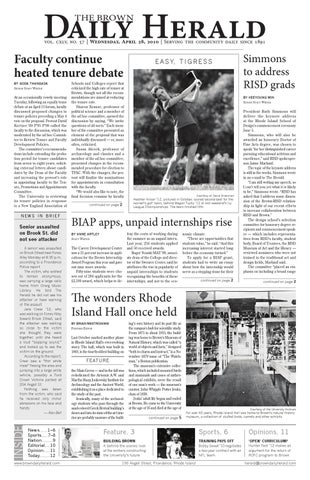
Courtesy of David Silverman
Heather Arison ’12, pictured in October, scored second-best for the women’s golf team, behind Megan Tuohy ’12 at last weekend’s Ivy League Championships. The team finished fifth.
BIAP apps, unpaid internships rise By Anne Artley Staf f Writer
The Career Development Center saw a 21 percent increase in applications for the Brown Internship Award Program this year and gave out nine more awards. Fifty-nine students were chosen out of 284 applicants for the $2,500 award, which helps to de-
Simmons to address RISD grads
fray the costs of working during the summer as an unpaid intern. Last year, 234 students applied and 50 received awards. Roger Nozaki MAT ’89, associate dean of the College and director of the Swearer Center, said he attributes the rise in popularity of unpaid internships to students recognizing the benefits of these internships, and not to the eco-
The wonders Rhode Island Hall once held By Brian Mastroianni Features Editor
Last October marked another phase in Rhode Island Hall’s ever-evolving story. The hall, which was built in 1840, is the fourth-oldest building on
Feature the Main Green — and in the fall was rededicated the Artemis A.W. and Martha Sharp Joukowsky Institute for Archaeology and the Ancient World, establishing it as a place dedicated to the study of the past. Ironically, many of the archaeology students who pass through the sand-colored Greek Revival building’s doors and into its state-of-the-art interior are probably unaware of the build-
ing’s own history and its past life as the campus’s hub for scientific study. From 1871 to about 1915, the building was home to Brown’s Museum of Natural History, which was called “a world of objects and facts,” designed “both to charm and instruct,” in a November 1879 issue of “The Watchman,” a Boston publication. The museum’s extensive collections, which included mounted birds and mammals and cases of anthropological exhibits, were the result of one man’s work — the museum’s curator, John Whipple Potter Jenks, class of 1838. Jenks’ adult life began and ended at Brown. He came to the University at the age of 16 and died at the age of
Courtesy of the University Archives
continued on page 5
For over 40 years, Rhode Island Hall was home to Brown’s natural history museum, a collection of stuffed birds, camels and other exhibits.
Feature, 3
Sports, 6
Opinions, 11
Building Brown A behind-the-scenes look at the workers constructing the University’s future
training pays off Bobby Sewall ’10 negotiates a two-year contract with an NFL team
‘open’ curriculum? Hunter Fast ’12 makes an argument for the return of ROTC program to Brown
195 Angell Street, Providence, Rhode Island
herald@browndailyherald.com
Page 2
THE BROWN DAILY HERALD
C ampus N EWS
Wednesday, April 28, 2010
“Power relations can affect how things can play out.” — James Green, professor of history
Faculty votes on tenure policy in May continued from page 1
Nick Sinnott-Armstrong / Herald
President Ruth Simmons will speak at RISD’s commencement and receive an honorary degree this June.
RISD to honor Simmons, Granoff, Spiegelman P’13 continued from page 1 of honorar y degree recipients,” Marland said, “to reflect their recognition that contemporar y artists and designers are working and vital in all areas of society.” “Their focus was on selecting nominees who embody RISD’s most prized values and aspirations, regardless of the field in which they choose to express them,” she added. Simmons wrote that “ultimately” the focus of her speech is “likely to be on the importance of bringing art and design to bear on a wide range of fields of endeavor.” Others who will be honored at the ceremony include illustrator
and graphic designer Seymour Chwast, art collector and philanthropist Paula Granoff and comic and graphic artist Art Spiegelman P’13, who lectured at Brown April 14. Past RISD commencement speakers include Gore Vidal, Laurie Anderson, Ken Robinson, Kurt Andersen, Dave Hickey and Henry Louis Gates Jr., Marland said. Simmons will also be awarded an honorar y degree from Wesleyan University May 23. She holds honorar y degrees from more than 25 institutions, including Amherst College, Princeton, Har vard, Dartmouth, Columbia and Spelman College.
sudoku
ballot,” Alcock said. The provost’s role in TPAC would resemble his role in appointing members of the Academic Priorities Committee and the University Resources Committee, she said. “I don’t see the problem with adding the chief academic officer into the mix,” Alcock said. “The provost’s role is not a veto role,” Krause said. “This is an individual who has a unique perspective on the University as a whole.” Repeating a sentiment that had been expressed at the faculty forum, Professor of Comparative Literature and French Studies Michel-Andre Bossy said, “Having a set of proposals that gives much more power to the administration is something that strikes at the heart of faculty governance.” “Power relations can affect how things can play out,” said James Green, professor of history. “There is significant, sincere and honest concern from the faculty about these measures, and we’re not being listened to in this regard. I have not seen this in the six years I’ve been here.” The proposal recommends that candidates for TPAC meet the threefold criteria of strong scholarship, citizenship and teaching ability. Sheila Blumstein, professor of cognitive and linguistic sciences and a member of the committee, said the provost could enforce these standards. She asked, “Is it the case that consistently 100 percent of the members of TPAC meet the criteria? I think that has not been the case.” The committee also discussed recommended changes to the tenure review process. Changes from the last proposal stipulate that the dean of the faculty can only add, and not elimi-
nate, names of external evaluators and would reduce the minimum number of letters from 10 to eight. Candidates for tenure will still not be informed of the list of letterwriters nor of the vote tally. “I find it ver y, ver y disturbing that this is being proposed,” Bossy said. “It increases the role of secrecy in the process.” One of the few faculty members supportive of the proposal, Professor of Geological Sciences Tim Herbert, said the discussion was devolving and pitting faculty against the administration. “It’s not a democratic process. It’s not an open election, it never has been,” he said of tenure review. Assistant Professor of Judaic Studies Marcy Brink-Danan said the faculty may seem paranoid because they were envisioning the “worst-case scenario” of a petty and vindictive dean. Even generally, she said, “I don’t think the dean has the knowledge to recommend the right field of candidates for writing the letters.” Professor of Judaic Studies Ross Kraemer rejected the recommendation that the candidate not see the final list, even if the department can. Scholars encounter a number of peers with whom they have differences or even grudges, she said. Members of the department “may know where the professional ones are, but not where the personal ones are,” she said. Professor of Philosophy Charles Larmore noted that candidates would be able to list scholars from whom they would not want recommendations. “It would be difficult for me to imagine a person losing track of all the personal enemies they have or whose spouses they stole,” he said. The discussion moved on to the issue of extending the probationar y period for tenure candidates
from seven years to eight years. “What research did you consult to come up with this magical number?” asked Associate Professor of Africana Studies Corey Walker. Krause said the number of years was raised by one to accommodate scholars in the sciences who may need more time to establish themselves. A year can make a difference, she said. Finally, Larmore spoke about the division of TPAC into two subcommittees of seven members, one covering the sciences and the other the humanities and social sciences. Professor of Cognitive and Linguistic Sciences Jim Morgan said that some scholars, like himself, researched in a gray area that could fall into either discipline. “I think the principle behind this is well-founded, but the execution is poor,” he said. The point of the change, Larmore said, would be to “concentrate expertise and knowledge in the decision-making process.” This would benefit the candidate, he said. Several professors expressed concern that dividing TPAC would split the sciences and humanities across the University. Joan Richards, professor of histor y and TPAC chair, recommended that ad hoc committees be convened for evaluating individual candidates or that TPAC be divided into two subcommittees that separately evaluated promotions and tenures. Professor of Comparative Literature Dore Levy suggested that the tenure review process be staggered and spread throughout the year for different fields of candidates. Despite the many new recommendations raised by faculty at the forum, the committee’s recommendations will go to a faculty vote May 4.
New guidelines for unpaid internships continued from page 1
Daily Herald the Brown
Editorial Phone: 401.351.3372 | Business Phone: 401.351.3260 George Miller, President Claire Kiely, Vice President
Katie Koh, Treasurer Chaz Kelsh, Secretary
The Brown Daily Herald (USPS 067.740) is an independent newspaper serving the Brown University community daily since 1891. It is published Monday through Friday during the academic year, excluding vacations, once during Commencement, once during Orientation and once in July by The Brown Daily Herald, Inc. Single copy free for each member of the community. POSTMASTER please send corrections to P.O. Box 2538, Providence, RI 02906. Periodicals postage paid at Providence, R.I. Offices are located at 195 Angell St., Providence, R.I. E-mail herald@browndailyherald.com. World Wide Web: http://www.browndailyherald.com. Subscription prices: $319 one year daily, $139 one semester daily. Copyright 2010 by The Brown Daily Herald, Inc. All rights reserved.
future goals and include a letter from their potential supervisor stating that they were being strongly considered for the internship or had already been hired. Winners of this year’s awards will work in a variety of fields, including law and education. Sarah Schuster ’11 said she plans to utilize her passion for music during her internship with a nonprofit music school in Harlem, N.Y. This summer, she said, she wants to form a liaison among this school and other performing arts schools in Harlem that are struggling to stay afloat. Though she does not want to pursue a career in music, she said she hopes her experience will give her background as a future attorney. “I wanted to see how I felt about working in a nonprofit organization, and I hope to understand the legal implications in the commu-
nity,” Schuster said. The CDC developed the BIAP program in the late 1990s because of the rising trend of unpaid internships, according to its Web site. The program separately waives the summer earnings requirement for some students who receive financial aid. According to an April 2 New York Times article, the number of unpaid internships, and students participating in them, is increasing across the countr y. In a 2008 study, the National Association of Colleges and Employers discovered that 50 percent of college graduates had held internships, compared to 17 percent in 1992. According to the ar ticle, New York state officials are concerned that employers are using college students as free labor and have staged investigations into their internship programs. Guidelines for unpaid internships released in April by the U.S.
Depar tment of Labor require, among other considerations, that the intern must not take the place of regular employees and that the internship should be more for the benefit of the intern than the employer. Nozaki said CDC staff members are reviewing the new criteria “to see what the implications are for our students.” Despite the benefits of unpaid internships, not all parents are thrilled at the prospect of a summer spent working without an income. “My parents were not happy that I might work the summer unpaid,” said Kathy Do ’12, another winner of a BIAP grant, who is interning at the Commission for Human Rights in Rhode Island. “But the most worthwhile law internships go to law students, and I knew from the description that I could grow and learn a lot, even though it’s unpaid.”
Wednesday, April 28, 2010
f eature
THE BROWN DAILY HERALD
Page 3
“I was born a builder.” — James Sisson, senior construction manager
For local contractors and workers, ‘Building Brown’ a boon
By Ashley Aydin Senior Staff Writer
The site of the new Perry and Marty Granoff Center for the Creative Arts building is bustling with sound, and there are hard hats everywhere. Inside the construction site office, a sign reads: “The Five Stages of a Construction Project: Enthusiasm — Disillusionment — Panic — Search for the Guilty, Punishment of the innocent — Praise and honors for the non-participants.” Near this sign, a long sheet of paper plastered along the wall reads: “27 weeks to go.” Construction has been omnipresent on campus since many of us arrived — and is slated to continue long after many of us are gone. ‘Born a builder’ The passion that James Sisson, senior construction manager for the University, has for building began with the influence of his grandmother, who was the daughter of a ship builder. Sisson began his career during college, and “it evolved after that to where it is now,” he said. Sisson facilitates the University’s capital projects and supports project managers. “I mitigate the disruptions caused by construction such as traffic, dust and noise,” he said. Sisson, a resident of Providence for most of his life, has 35 years of experience in all kinds of construction. “I was a born a builder,” he said. Work for Sisson and the construction workers he supervises usually starts at 6:30 a.m. and runs until 6:30 or 7 p.m. When a work site is close to a residence hall, Sisson said starting time is moved back to 8 a.m. to “diminish the noise levels for students who want to sleep.” If he’s not monitoring various projects or overseeing building progress, Sisson is making sure people can get from point A to point B. “I update maps on the Web site so people can navigate their way through campus. I make sure everything is going along smoothly,” he said. Still, construction doesn’t come without its obstacles. “The biggest challenge for me personally is not so much the technical aspects of the job but getting people to work together well enough to bring the project to completion,” he said. Sisson said the “human factor” is also difficult to supervise, whether it is managing money, dealing with contractors or making sure everyone is cooperating with each other. “We’re trying to put more people to work to finish projects on budget, on time and within reason,” he said. Though the University is already “a destination,” Sisson said Brown’s building initiative is also making the campus “more beautiful.” To Sisson, a career in construction is both fun and gratifying. “For me, it’s knowing that you’re part of something significant. The most enjoyment I get is when I see buildings being used for their designed intent. It’s satisfying when you see people using the spaces,” he said.
Coming home to the Hill For Michael Guglielmo, assistant director of project management, College Hill is no foreign turf. The Rhode Island School of Design graduate, trained in architecture, “ended up at Brown as a marriage between the design side and contracting side,” he said. As any young architect, Guglielmo said, his goal as a young student was to design skyscrapers. Now, with more than 20 years of experience in construction, Guglielmo manages and controls phases of project design and construction management. “This can involve hiring the architects, soliciting architects, soliciting construction mangers and working with agencies such as the fire department and the building department. I also work with facilities operations and the guys and girls who will maintain the facility once it’s constructed,” he said. Guglielmo’s time in the office consists of a minimum of 50 to 55 hours a week, where he spends the majority of his days in meetings related to construction budget, design and schedule. Outside the office, though, Guglielmo finds himself working through his BlackBerry. “There is always constant communication,” Guglielmo said. Guglielmo said the University does a lot of outreach with community groups such as the Building Futures program, which has brought several young construction workers to projects at Brown. “The Building Futures program allows younger individuals who want to get into the building trade to gain experience. They learn the responsibility and safety involved with working on constr uction sites,” he said. With an aging workforce of the most skilled workers nearing retirement, Guglielmo said that programs such as Building Futures are crucial to “transfer knowledge to the next generation of workers.” The new generation Tim Sanders and Orlando Gomez, who have lived in Rhode Island for most their lives, are two of the many young workers participating in the Building Futures program. The program — designed to provide career training opportunities in construction for low-income adults in urban areas, and specifically from Providence — has partnered with Brown since the renovation of J. Walter Wilson, and has remained for work on the Joukowsky Institute for Archeology and the Ancient World and the Granoff Center projects, Marisa Quinn, vice president for public affairs and University relations, wrote in an e-mail to The Herald. Quinn also mentioned that the University will continue this partnership through the construction of the new Medical School building in the Jewelry District, the Metcalf Chemical Laboratory building renovation and construction of the Katherine Moran Coleman Aquatics Center and the Jonathan Nelson ’77 Fitness Center. “I always worked with my hands,”
Gomez said. He worked in construction independently before going to school and the Building Futures program then helped him get into the union, he said. Sanders became involved in construction through dif ferent programs. “I got into construction through a program called Youth Build. The people who worked in Youth Build also worked with the program Building Futures,” he said. Star ting at age 16, Sanders worked on roofing and then moved on to carpentry. He also worked on interiors in banks. “I was trying to get into the union at that time and then found myself here,” he said. Gomez, a pipe fitter, and Sanders, a laborer, are both in their twenties and have already begun to learn the rules of the trade. “In the beginning, I was doing excavations and digging the hole for the (Creative Arts) building. Now I’m doing whatever the general contractors need,” Sanders said. The University has allowed Gomez and Sanders to earn the experience necessary to succeed in the construction trade. Both young workers are currently continuing their labor at the Creative Arts Center building site. Under the Building Futures program, both Gomez and Sanders said their ultimate goal was to be well-rounded in all facets of the construction trade. Putting people to work Sisson emphasized that the
Ashley Aydin / Herald
James Sisson, senior construction manager, on the site of the new Creative Arts building.
University plays a significant role in terms of local employment with its ongoing construction initiatives. “In the institutional market, including hospitals, universities and the bio-med field, there’s not a lot of building going on. Through careful decision-making, the Corporation kept these projects on line and adjusted to the economy,” he said. According to its Web site, the University is the sixth-largest private employer in the state. Of the
$67 million spent on construction last year, $35 million went to Rhode Island-based contractors. Sisson said the University not only provides employment within the state but draws workers from Massachusetts and Connecticut. “It not only goes for the guys on the ground,” Guglielmo said. “It’s also the suppliers and people who work in the supply houses. It could be the iron shop or the roofing contractors. The initiative keeps a lot of people busy.”
Page 4
THE BROWN DAILY HERALD
C ampus N EWS
“It’s really great to see that wide spectrum of students.”
WiSE program takes tips from Meiklejohns By Anne Artley Staff Writer
The WiSE Mentoring Program for women in science and engineering is being revamped to make it more accessible and to keep more students involved. The program was originally created to provide one-on-one guidance for female first-years from upperclassmen. Next year, however, two or three science or engineering concentrators will lead groups of 10–12 first-years, said Science Program Coordinator Jodie Gill, who oversees WiSE. Mentors, who in the past have not received formal training, will attend a one-day session during the summer. Gill wants to model the new structure after the Meiklejohn peeradvising program. “I think (the group structure) will take the pressure off a one-on-one
relationship,” Gill said. “It might be easier for three mentors to bounce ideas off each other, and the mentees will feel more comfortable asking questions in a group.” The new structure will also allow for more flexibility for first-years whose interests change during the school year. “Someone may sign up who is interested in (chemistry), and we will match them with a chemistry concentrator, but then they may change their mind and decide they are interested in geology, and their mentor will not have the resources to help them,” said Program Coordinator Katie Roberts ’10. The coordinators are also instating an application process for next year’s mentors to make sure they stay committed to the program, Gill said. “We found that, over a month or
two, that mentees lose interest or the mentor is overcome with other responsibilities,” Gill said. There will be about 30 mentors next year, she added. Roberts said that next year the coordinators will schedule mandatory monthly meetings but will leave it up to the groups to decide if they want to meet one-on-one. They are also continuing the discussion series, during which a faculty member leads a discussion about their research or on the issues women face in the fields of science and math. One thing the group wants to maintain is the strong connection between the mentors and the mentees. “One fear I have is that we’ll lose the level of personal contact if we don’t meet one-on-one,” Roberts said. “But we feel that the groups will still have that feeling even though it’s a larger group than before.”
More undergrads drawn to neuro by Casey Bleho Staf f Writer
The number of undergraduate concentrators in neuroscience has grown enormously in recent years, signaling increased interest in the subject. In the class of 2009, 47 students concentrated in neuroscience, up from 18 concentrators in the class of 1989, according to the department’s 2009 annual report. The Department of Neuroscience teaches and conducts research on the various functions and diseases of the ner vous system, according to its Web site. Because most concentrators intend to continue to medical school — and the concentration incorporates many of the prerequisites for medical school — the interest in the relatively new
field has increased substantially, according to Professor of Medical Science Barry Connors. “Neuroscience is a relatively new field. It’s generally become popular at all levels of education,” Connors said. As a result, the program remains extremely interdisciplinary, as concentrators study elements of neurobiology, psychology, cognitive science, physics and mathematics, he said. “Ever yone is fascinated with why we do the things we do, and why we think the things we think,” he said. “ The interdisciplinary nature of the department is perhaps one of the elements that make it so appealing to undergraduate students of all areas of study, Connors said. The first-rate research conducted by neuroscience faculty provides
Wednesday, April 28, 2010
students with first-hand experience that likely acts as incentive as well, Connors said. Unlike at other universities, the Brown neuroscience faculty spend more time teaching and advising undergraduate programs, he said, balancing this with research that gives students opportunities to work hand-in-hand with professors. “I think there has always been a great commitment to undergraduate students,” said Professor of Medical Science Edward Hawrot. In classes like NEUR 0010: “The Brain: An Introduction to Neuroscience,” the number and variety of students showing an interest in the subject have become evident, he said. “As a faculty member,” Connors said, “it’s really great to see that wide spectrum of students.”
— Barry Connors, professor of medical science
higher ed roundup by sarah forman senior staff writer
Reed’s president tells students to lay off drugs If students at Reed College are caught using any sort of illegal drugs, they will face disciplinary action within the college and may see criminal charges, according to an e-mail Reed President Colin Diver sent to students, faculty and staff on April 23. According to the e-mail, undercover police will patrol the campus this weekend at Renn Fayre, an annual festival at the Portland school — analogous to Spring Weekend — with three days of music, art and relaxation. The celebrations will start on Friday when classes end for the semester and will have a Jersey Shore theme. Reed has a history of drug use, and two students have died recently of heroin overdoses, including senior Sam Tepper in March and freshman Alejandro Lluch in 2008. “We cannot, and we will not stand by if Renn Fayre is a repeat of years past — where even in the wake of Alejandro Lluch’s death drug use and distribution were allegedly rampant,” wrote Dwight Holton, U.S. Attorney of Oregon, and Michael Shrunk, district attorney for Multnomah County, in a separate e-mail to the Reed community. Universities book same artists for spring concerts Even though Snoop Dogg proudly wore a Brown jersey when he performed on Saturday, he has been making the rounds to several other colleges for spring shows. On Sunday, he rapped at Trinity College in Connecticut, and on Friday he was at a fraternity house at Indiana University, according to his Web site. The University of Pennsylvania even hooked him for their Spring Fling last week, along with Kid Cudi and Schwayze, according to the event’s Web site. Harvard booked Kid Cudi the same weekend for its annual Yardfest, according to the Harvard Crimson. Also headlining the event was hip-hop act Wale, who came to Brown for Spring Weekend. Gambling in bars may support Colorado scholarships In the search for higher education dollars, Colorado lawmakers have proposed a bill that would expand gambling opportunities. The bill would legalize the use of Keno video games in bars and restaurants, and the estimated $100 million in revenue would fund college scholarships, CBS News in Denver reported last week. “We need to think of creative ways to keep education affordable,” State Sen. Chris Romer, D-Denver, said in a Denver Post article last week. Romer said that he supports the plan to allow the game — which is similar to the lottery and has relatively low odds of winning — in bars and restaurants. If two-thirds of Colorado’s state legislators approve the bill, voters will have a chance to pass the measure in November. Rhode Island legislators are also considering several different measures to expand gambling in the state in the hopes of securing more revenue, the Providence Journal reported earlier this month.
Page 5
f eature
THE BROWN DAILY HERALD
Wednesday, April 28, 2010
“The whole atmosphere was as full of meteors as of snowflakes in a snowstorm.” — John Jenks 1838, museum curator
Birds, camels, sharks — dedicated curator stuffed R.I. Hall zoology portion of the museum after him. Jenks would later use his own money to fund a skylight and install 30 new cases.
continued from page 1 75 at the steps of the museum where he spent many years of his career. He lived and breathed science in an era of Darwin, and became as much of a fixture on campus as the museum itself. While he dedicated his life to science and the study of the natural world, nothing of his mark remains on the building that once housed his life’s work. A shooting star Jenks was born in 1819 in West Boylston, Mass. The sixth child and eldest son in his family, Jenks lived a quiet, small-town life. In Jenks’ unpublished autobiography, he recounts one instance where his love of the natural world showed an early spark. In 1833, the self-proclaimed “student of science” woke up to find a meteor shower streaking across the sky above his home. “The whole atmosphere was as full of meteors as of snowflakes in a snowstorm,” Jenks wrote, describing brilliant colors lighting up the sky. Excited by what he saw, Jenks rushed through his home to wake his family and then proceeded to shout to every open window in the town. As he called out to each window, his neighbors poked their heads out of their windows and walked out into the street to view the sight. For that one brief moment, Jenks shared his love for the natural world with his neighbors and family — a memory that would stay with him for the rest of his life, he wrote. “Fifty years later I received the thanks of some citizens for arousing them from their slumbers to see the glorious sight,” Jenks wrote. That same year, Jenks was accepted as one of the 45 members of Brown’s class of 1838 — the youngest member of his class. Jenks’ undergraduate years at Brown were filled with hard work, as he held down odd jobs — including wheeling compost for President Francis Wayland from the hog pen and cow yard where Wilson Hall now stands to Wayland’s personal Prospect Street garden — to pay for his room and board. He took a class on natural philosophy with future University President Alexis Caswell that would later influence Jenks’ own work as an educator. At 19, Jenks graduated ninth in his class and spent two years teaching in Georgia before marrying the wellconnected Sarah Tucker. Because of his new family connections, Jenks took over the failing Pierce Academy in Middleborough, Mass., which was founded by Tucker’s grandfather. Under his tenure, the school expanded from 15 to 300 students, and Jenks began the work that would form the foundation for his contributions to Brown’s science curriculum in the second half of his life. The path back to Brown At Pierce, Jenks assembled a cabinet containing specimens such as dried plants and bird skins to teach his students about natural history. To expand his knowledge of natural science, Jenks enrolled in a taxidermy course in Boston and embraced the
Nick Sinnott-Armstrong / Herald
The recently-renovated Rhode Island Hall was once home to a museum of natural history curated by John Whipple Potter Jenks, class of 1838.
art of stuffing animal hides as a new hobby. Jenks woke up each morning before class to obtain new specimens, ignoring the advice of his instructor to “preserve (his) first and (his) hundredth bird and throw away all the rest,” he wrote. Jenks soon amassed a large collection of specimens, and increased his knowledge of zoology by going out on excursions with Harvard professor Louis Agassiz to study turtle embryology. For the study, Jenks “planted” 600 different varieties of turtle eggs in his garden to study their incubation periods. At the end of the experiment, Jenks found a growing interest in living the life of a scientist and gained a new kindred spirit in Agassiz. By the 1870s, an emphasis on private education shifted to public schools across Massachusetts. Looking for a career change, Jenks wrote to Caswell, his professor-turned-president, describing his displeasure with what he perceived to be Brown’s outdated science curriculum. In the 1871 letter, Jenks wrote, “While it is one of the oldest Institutions in the country, there is not one hardly half as old that has not better facilities for illustrating any branch of Natural Science and I am positively ashamed of my Alma Mater.” In the letter, Jenks asked to return to Brown to establish a museum on campus, asking Caswell for a display room consisting of “three cases of 23 and a half feet long, and five and a half feet wide” for specimens that Jenks would collect himself. Caswell wrote back to Jenks informing him that the University did not have enough funding for his display. Jenks replied with a promise that if Caswell could raise enough funding in two weeks to pay for two cases of minerals, fossils and shells, in addition to one for mounted birds, he would fill the cases at his own expense. Caswell agreed, and Jenks spent his remaining three weeks of his time at Pierce shooting birds and trapping mammals. The Corporation did not raise any money for the museum’s installation at Rhode Island Hall, but Caswell managed to raise $110 in private donations, enough to hire Jenks without a title and pay him “the lowest Professor’s salary in the institution,” Jenks
wrote. A one-man show Jenks increased the fledgling museum’s collections almost singlehandedly. He procured a large collection of 4,125 bird skins — giving 1,500 of those to his friend Agassiz — built cases, mounted birds and mammals and picked out quirky finds, including a large-scale stuffed lioness that he won in an auction, according to his autobiography. Though small, the museum was aesthetically pleasing. Photographs housed at the John Hay Library show fish skins lining the ceiling above long cases of stuffed birds and butterflies. There was also a back room filled with stuffed sharks and stingrays on one side, and stuffed camels standing in front of a giant stuffed walrus on the other. A domed arch connected the rooms, with big block letters reading “Jenks Museum of Zoology.” In the south corner of Rhode Island Hall’s basement, Jenks created a dissecting room, where he taught students taxidermy. Jenks would continue to add to the museum’s collection, describing in his autobiography yearly trips to Florida, where he gathered new specimens. Jenks found some obstacles in funding throughout his time at Brown, but was granted one special wish in 1890 — the University named the
The twilight years Jenks’ heart was never far from the museum he created, even in his final years. In a 1893 letter to the Corporation, he willed $2,822.26 to the museum to arrange “the Zoological and Anthropological specimens in separate rooms, and each in cases more especially adapted to their respective characteristics.” A year later, Jenks was not in the best of health. On September 26, 1894, he walked across campus to Rhode Island Hall with “sluggish steps,” according to Reuben Aldridge Guild during Jenks’ 1895 memorial address held at Brown. At 3:00 p.m. passersby shouted to each other on the Main Green as they found Jenks lying unconscious on the steps of Rhode Island Hall. Jenks had died of heart failure, sprawled in front of the museum that housed his life’s work. A faded legacy The museum floundered after Jenks’ death. Mismanagement and growing disinterest in the natural sciences let the museum fade on the University’s list of primary concerns. According to the 1900 President’s report, a fire did considerable damage to the west room of the museum, which gave the University an excuse to remove some of Jenks’ old displays. By 1915, the growing biology department moved out of Rhode Island Hall and into Arnold Laboratory, and the hall was named the new home of geology and philosophy, according to the President’s report of 1915. Jenks’ museum was now no more. His collections were stored in various locations around campus, but the University searched in vain for a permanent home for his specimens. What would happen to the museum? In a twist of fate, the University stayed true to its promise that the collection would stay on Brown property. According to the President’s report of 1915, 92 truckloads of Jenks’ prized collections were transferred to a dump on the banks of the Seekonk River — land that was owned by the University.
‘Wanna be on top?’ Talley ’73 already is Fei Cai Staff Writer
Andre Leon Talley MA’73, contributing editor and former editor-atlarge of Vogue magazine, recently became a judge for the 14th season of hit CW TV series “America’s Next Top Model.” Talley, who earned his master’s degree in French at Brown, is replacing J. Alexander and judging alongside Nigel Barker and Tyra Banks.
Arts & Culture He told Women’s Wear Daily that Banks wanted him to be a judge for the show’s first season, but he refused because he “wanted to see where (the show) goes.” After 13 successful cycles, he finally agreed, telling the magazine, “I just felt that it was a way to step out of the box and associate myself with a very important American success story, a very important brand — Tyra Banks.” Talley has been incredibly influential in the fashion world. He was ranked number 45 in Out magazine’s “50 Most Powerful Gay Men and Women in America.” In 2008, he introduced Michelle Obama to designer Jason Wu, from whom she bought her dress for the inauguration. On “Top Model,” Talley is sometimes brutally honest and pays great attention to detail. On the April 21 episode “Big Hair Day,” he blatantly told a model, “What bothers me is the stereotypical point of the toe on the left leg, which could be sort of cliche.” But when he loves a picture, he lets the model know. In the same episode, he told another contestant, “The way you have your feet positioned, it’s high fashioned, it’s couture. … I would think Alexander McQueen might have put this in his runway show. It would end up on the page of W magazine, and we would think, this is a killer dress. I applaud you.”
Page 6
THE BROWN DAILY HERALD
Wednesday, April 28, 2010
C ampus N EWS
Panel confronts Goldman execs with evidence of fraud
H ei controvers y
By GREG GORDON & CHRIS ADAM McClatchy Papers
WASHINGTON — A Senate investigations panel confronted Goldman Sachs executives Tuesday with evidence that the firm peddled subprime mortgage securities its traders considered to be “crap” as they secretly made huge bets on a housing downturn.
World & Nation
Alex Bell / Herald
Jose Landino, a cook at the Hilton Long Beach in California, holds up what he called one of many “letters of intimidation” he received from his employer for trying to organize workers. The Student Labor Alliance invited Landino to speak to its members Tuesday afternoon in Arnold Lounge about next steps following President Ruth Simmons’ letter last month to HEI Hotels and Resorts stating that if allegations of unfair labor practices against the company are found true, “this would be a matter of deep concern and contrary to our standards for investing.”
Ratty or V-dub? We decide so you don’t have to www.blogdailyherald.com
Sen. Carl Levin, a Michigan Democrat, culminated more than 10 hours of often-contentious testimony by telling Goldman’s top officer, chief executive Lloyd Blankfein, that the firm had “a fundamental conflict” with its clients’ interests as it exited the home mortgage market in 2006 and 2007. “And it raises a real ethical issue,” said Levin, the chairman of the Senate Permanent Investigations Subcommittee. Blankfein, whose company is facing civil fraud charges from the Securities and Exchange Commission over one of its subprime deals, declined to give ground. He denied that Goldman made massive “short,” or negative, bets on subprime mortgage securities. Further, he said, Goldman had no obligation to divulge its short bets in its role as a market maker for sophisticated institutional investors. “The investors we’re dealing with ... know what they want to acquire,” Blankfein said. If they raise questions about a deal, he said, “then the salesman owes them an honest answer.” The subcommittee reviewed 2 million subpoenaed Goldman documents during an 18-month investigation of the world’s most prestigious investment bank, which has become
a poster child for Wall Street’s role in fueling the housing bubble that burst the global economy. Levin and his subcommittee colleagues spent much of the day questioning four current and former Goldman traders and the company’s chief financial and risk officers about more than 170 company e-mails and documents describing how the firm escaped the subprime market. Levin contended that Goldman racked up billions of dollars in profits in 2007 by making exotic, insurance-like bets on a housing collapse — sometimes wagering against securities in offshore deals that Goldman actually designed. In one deal, which Levin raised again and again, a Goldman executive labeled the mortgage securities “shitty.” Levin recounted for Blankfein a litany of failed deals from 2006 and 2007 that totaled $3.5 billion in which he said that “clients lost, Goldman profited.” At another point, Levin repeatedly attacked Blankfein’s contention that the firm was only modestly betting against the housing market. “You were short like crazy,” he said. “You came out ahead in a market that crashed.” Levin also attacked the firm’s trustworthiness. “You want to be trusted. I’m glad you want to be trusted, but I think you can understand why there’s a lot of folks who have some real doubts.” The panel barely noted that Goldman also reaped nearly $15 billion during the past two years from additional bets with American International Group against mortgage securities in deals based in the Cayman Islands. Most of those bets, Goldman says, offset credit protection it wrote for investors who took short positions on those deals.
SportsWednesday The Brown Daily Herald
Wednesday, April 28, 2010 | Page 7
Two football players drafted from College Hill to the NFL Walk-on Howard ’09.5 takes unlikely path By Dan Alexander Spor ts Editor
Jonathan Bateman / Herald
After months Bobby Sewall ’10 has been drafted by the NFL.
Sewall ’10 trained for months before contract with Titans By Dan Alexander Spor ts Editor
The first Monday after New Years Day, Bobby Sewall ’10 walked into Mike Boyle’s strength and conditioning gym for his first day of high-intensity training for the NFL. The top football talents in New England came in with him — from Boston College, the University of Massachusetts, the University of New Hampshire, Harvard and Holy Cross. The players all had the same New Years’ resolution: to make it to the NFL. The workouts were a struggle for all of them, even though they were some of the most physically fit, successful football players in the region. “Kids were puking the first day,” Sewall told The Herald in Januar y. “It hasn’t been easy.” The workouts were, at times, unconventional because they tried to simulate in-game tests of strength. Sewall pushed 400-500-pound sleds like he was blocking a linebacker, squatted with just one leg like he was springing up for a ball while in midstride, and did intense core workouts so that he could take the brunt of a hit and keep motoring — but never, ever, did a sit up. “The only time you’re ever going to do a sit up in a game is when you’re getting off of the ground,” Sewall said. “It has certainly been a little bit of a shock to my body, and I like it.” But what it all comes down to, the commitment — five hours a day, four days a week for eight weeks — was mainly training to jump one inch higher in his vertical leap or run a few fractions of a second faster in the forty-yard dash.
NFL teams ask prospects to perform a number of different drills — most famously, the vertical leap, 225-pound bench press and 40-yard dash — as a baseline test of their athleticism. “The combine drills are kind of like an SAT,” said Colin Cloherty ’09, a tight end for the Indianapolis Colts who trained at Mike Boyle’s gym when he was in Sewall’s shoes a year ago. “But just like the Kaplan or the Princeton review that you can take to beat the test, I went to Boyle’s to learn how to beat the test.” Sewall, who ran a 4.50 40-yard dash as a junior, eventually got his 40 time down to a 4.41. It may not sound like much, but nine-tenths of a second is enough to make the difference between beating a defensive end to the sideline and being tracked down for a four-yard loss in the backfield. But more importantly for Sewall, nine-tenths of a second may mean the difference between being overlooked by the NFL and signing a contract. In addition to his 4.41 40-yard dash, Sewall had a 41-inch vertical leap and did 16 bench press repetitions. Most Ivy League wide receivers don’t even make NFL scouts look up, but Sewall’s numbers were enough to turn heads in the NFL. “Ever y little test matters,” Sewall said. “Ever y little full step.” It wasn’t just his numbers that drew in the NFL scouts. Sewall was a three-time All-Ivy selection and was half of one of the best receiving duos in the nation with 2009 Ivy League Player of the Year Buddy continued on page 8
David Howard ’09.5 slept zero hours the night before day three of the NFL draft. He didn’t yet know the Tennessee Titans would select him in the seventh round. He didn’t know which NFL city, if any, would be his next home. He didn’t know if the last four months of high-intensity training — after a lifetime of preparation — would pay off. “I tried to put through ever y possible situation and every possible scenario” while lying in bed, Howard said. “I can’t even really begin to tell you what was going through my mind. It was too much.” Still exhausted from the sleepless night, Howard received a phone call in the middle of the seventh round from the Titans. It took him until midway through the conversation to realize that the team had just drafted him. “Great feeling,” he said. “It was wild.” Indeed, his long road to the NFL cer tainly wasn’t conventional. Howard never dreamed of playing in the NFL as a child. “I never really thought I was good enough for this,” Howard said. “I always thought that professional athletes were beyondthis-world athletes. I didn’t think I was capable.” In fact, he didn’t even come to Brown to play football. After verbally committing to play football at Delaware, the Brown track and field program recruited Howard at the last minute. His older brother — who had played football at Harvard — and his dad — who was a high school guidance counselor for 30 years — convinced him to head to the Ivy League. Once on campus, Howard didn’t go unnoticed by the Brown football team for long. On the day he arrived, he found an e-mail in his inbox from one of the assis-
tant coaches of the football team, tr ying to recruit him to hit the gridiron. It took him a year before he finally accepted the coach’s offer, but when he did, he made an immediate impact on the field. Howard had 4 1/2 sacks his sophomore year, the third-most in the Ivy League. The same year, he became a two-time shot put Ivy League champion, but after the track season, he dropped track in favor of football. Football “was just more fun,” Howard said. “Football is a team sport. Track is not a team sport, so you don’t get that camaraderie.” He didn’t realize at the time that he was making a career choice, too. It wasn’t until his junior year that playing in the NFL began to seem like a real possibility. “Scouts started coming around and agents would come up to me after games and tr y and talk to me,” Howard said. “At that point in time, I was like, this is something that I want to do. If this is possible, I’m going to do it.” The scouts started noticing the 6-foot-3-inch, 295-pound senior when he earned first team All-Ivy honors and had 30 tackles, including 13 for loss, 6 1/2 sacks, three fumbles forced and five quarterback hurries. He had an extra year of NCAA eligibility because he hadn’t played football his freshman year, so Howard took off his senior spring and interned at Gilbaine, a Providence construction company. It was during this time that the first NFL team expressed explicit interest in him. On the Sunday after the 2009 Draft, a representative from the Cleveland Browns called him. But when Howard told the Browns that he was coming back to Brown for a fifth fall, the conversation ended. “I think they were going to invite me to a camp,” Howard said. The Browns representative “didn’t really say it, but there was no other reason for him to be call-
ing me.” The economics major returned to the classroom for a fifth fall and again dominated the trenches on the football field. Despite being double-teamed on what he estimated was 85 percent of the snaps, Howard had 29 tackles, including six for losses and one sack. He also led the team in quarterback hurries with eight. Throughout the season, the NFL scouts kept taking notes. “I can’t think of a team that hasn’t been in to at least watch film, talk to my coaches,” Howard told The Herald in November. “I talk to a good number of them. I don’t get a chance to talk to all of them.” On draft day, it all came down to the Baltimore Ravens, Oakland Raiders, Dallas Cowboys and — at the last minute — the Titans. “It was kind of hectic getting calls from scouts and teams” during the draft, Howard said. “I was just looking for the team that would give me the best chance to make the roster.” His journey is far from over now. As the 241st overall selection in the draft, Howard will head down to Tennessee rookie minicamp Thursday to begin the battle for a spot on the Titans 53man roster. It’s a challenge Howard has been looking forward to for a long time. “I don’t think I’ve ever been challenged to that level,” Howard told The Herald in November. “In high school, I played varsity as a freshman. I was just bigger and a better athlete, wherever I went. And you know, coming here I started playing and starting as a sophomore, making an impact as a sophomore. I kind of want to go in when I’m an underdog and see what I’m made of.”
Page 8
THE BROWN DAILY HERALD
Wednesday, April 28, 2010
S ports W ednesday
“Time to go to work.” — Bobby Sewall ’10 W. Golf
Bears rally to finish fifth in Ivy Championship
By Chris Williams Spor ts Staf f Writer
Jocelyn West / Herald
Bruno was off and running at Sunday’s invitational, scoring big for the track team.
Track
Throwers and distance runners shine By Ben Noble Staf f Writer
With another meet comes another personal record for standout thrower and quad-captain Danielle Grunloh ’10. Her shot put of 15.93 meters last Sunday at Brown’s Springtime Invitational solidified her place at the top of the Ivy League rankings. Br ynn Smith ’11, currently second in the league on the shot put list, closely followed Grunloh. Grunloh and Smith are ranked 18th and 31st nationally in the event. The duo has collectively held the Ivy League shot put title over the past year. Smith was victorious last spring but Grunloh won the indoor championship in February. Grunloh said it will be a “toss up” between the two this spring. The entire men’s and women’s track teams posted strong performances on Sunday with less than two weeks until the Ivy Heptagonal Championship at Princeton. The meet did not feature team scoring. “We’re really starting to fire on all cylinders,” said Interim Head Coach Michelle Eisenreich. “We’re very excited about our prospects
for Heps.” Grunloh dominated the discuss throw with freshmen Victoria Buhr ’13 and Lacey Craker ’13 following right behind for a Brown 1-2-3 sweep. Smith also picked up a second win for Brown in the hammer throw. The women had a number of other victories on Sunday, including Samantha Adelberg ’11 in the 800-meter, Shannon Stone ’10 in the long jump and Hannah Wallace ’13 in the pole vault. Susan Scavone ’12 won the 100-meter hurdles in a personal best of 14.29. She is currently ranked second in the Ivy League in that event. The Bears also had several outstanding performances in the distance events. Megan Fitzpatrick ’11 won the women’s 3000-meter by over 16 seconds with four Brown athletes following her in the top seven. Lauren Pischel ’11, a former Herald staff writer, and Ari Garber ’12 placed first and second, respectively, in the 5000-meter. Brown swept the triple jump once again, with Gabriela Baiter ’13, Rachel Biblo ’11 and Shannon Stone ’10 placing 1-2-3, all with jumps of over 11 meters. On the men’s side, All-American
Craig Kinsley ’11 won the javelin with a 64.21-meter throw, ranking him 14th in the country. Brian Powlen ’10 and Daniel Smith ’13, placed first and second, respectively, in both the shot put and the discus. However, it was the male distance runners who collectively achieved arguably the most dominating performances of the day. Brown placed nine men under four minutes in the 1500-meter, led by seniors Brian Schilder ’10, John Loeser ’10 and Duriel Hardy ’10, who each ran 3:51. Then in the 5000-meter, Brown placed eight in the top nine, with freshman Austin Snyder ’13 winning in 14:51.67. Quad-captain Colin Brett ’10 credited Eisenreich and the entire coaching staff for the team’s recent success. “Across the board, this is the best I’ve seen in my three and a half years here,” he said. Grunloh also praised Eisenreich, who became interim head coach after Craig Lake abruptly resigned in February. “We think she would make an absolutely fantastic head coach for next year,” Grunloh said. “She puts her entire life into it.”
The women’s golf team finished fifth at the Ivy League Championships last weekend, held at famed Baltusrol Country Club in Springfield, N.J. The Penn Quakers captured their first-ever league championship, dominating the field en-route to a 22-stroke victory. For the Bears, Megan Tuohy ’12 once again turned in the team’s top score, shooting 78-81-84 — 243. Heather Arison ’12 played three consistent rounds, shooting 81-81-84 — 246 to finish with the second-best score for the Bears. Captain Susan Restrepo ’11 shot a three-day total of 257, while Carly Arison ’12 and Sarah Guarascio ’11 shot 259 and 260, respectively, for the Bears. Head Coach Danielle Griffiths said she was especially pleased with Tuohy’s performance, praising her for “consistently being our top performer all season.” Griffiths also lauded Heather Arison’s play, noting “she did a great job of staying in the present.” Griffiths said she was definitely happy with her team’s overall performance, highlighting that “we finished one place better than last year. Every semester we have been improving.” The team prepared all season for the fast and difficult greens at
Baltusrol, and their work certainly ser ved them well, according to Griffiths. “We were emotionally prepared for six and seven-footers for par,” Griffiths said. The team as a whole also did a “good job of staying positive and in the present,” which had been one of Brown’s goals heading into the championship, she said. But Tuohy noted that the hard and fast greens still did provide some difficulty for the team. Tuohy also remarked that “we need to work on finishing strong and not focus on the outcome.” Nevertheless, she shared her coach’s general sentiment, noting that the championship was “overall a positive experience.” Tuohy also said that “the competition in the Ivy League is really improving,” which will “encourage our team to work really hard this summer.” The Bears said they were thankful for the opportunity to play at Baltusrol and hope the Ivy League Championships will return there in 2011. Looking ahead to next season, Griffiths said she wants her players to “play lots of tournament golf.” Moreover, she said she hopes all of her players will “work out and work with their swing coaches.” If her players do so, she said she is confident they will all “come back ready to play in the fall.”
Sewall ’10 negotiating contract with Titans continued from page 7
Farnham ’10, who earned a tr yout with the Tampa Bay Buccaneers this weekend. Brown Head Coach Phil Estes said it also didn’t hurt that ever y time a scout came to see Sewall, Farnham, David Howard ’09.5 or James Develin ’10, they got to see all four prospects on the same film. Apparently the Titans liked what they saw. As the Titans were selecting Howard with the 241st overall pick in the seventh round of the NFL draft, they called Sewall to begin negotiating what ended up being a two-year free-agent contract. “It basically means that I’ll be in camp come August, and I’ll get a chance to earn my spot,” he said. The phone call ended a scar y period of waiting when Sewall said
he didn’t know if any team would want him. Sewall said he “just said a prayer and knew that somebody would be out to hopefully show some interest in me or take a chance on a receiver from Brown.” The Titans did, and Sewall will report to minicamp on Thursday. He may not be a receiver for the team. He might have to become a special teams player like former Ivy League Player of the Year Sean Morey ’99, who became an All-Pro special teamer. “They were talking to me about returning some kicks and punts as well as even holds, too,” Sewall said. “I’ll do anything that makes me valuable to the team. But I’m just so excited and really grateful for the opportunity.” “It’s time to make the most of this opportunity,” he added. “Time to go to work.”
www.browndailyherald.com
World & Nation The Brown Daily Herald
Wednesday, April 14, 2010 | Page 9
Colleges debate: is American Sign Language a ‘foreign’ language? By Angie Leventis Lourgos Chicago Tribune
CHICAGO — Twenty students are holding several animated smallgroup discussions, but no one in this Northern Illinois University classroom utters a word. Their fingers weave in complex patterns as they converse in American Sign Language, which the university has declared an official foreign language. To the students, the new label is fitting: They say that American Sign Language is distinct from spoken English and that its coursework provides a new perspective akin to the cultural immersion they’d experience in French, Spanish or other traditional language classes. “It shapes how you view the world around you,” said Christine Theobold, a sophomore from Streamwood, Ill., who is taking the most advanced sign class at NIU. “I guess it’s how you view the word ‘foreign.’ ” But the practice of awarding foreign language credit for American Sign Language coursework has been fiercely debated at universities across the country. Some educators argue an indigenous language by definition can’t be considered foreign. Others say a language must have literature
Lane Christiansen / Chicago Tribune
Arthur Wagoner, left, signs with classmate Krista Springer during their class at Northern Illinois University
for proper study. The University of Michigan-Flint several years ago denied a student’s request of foreign language credit for American Sign Language proficiency, but the school reversed its stance in the past year after about 14 months of debate. Students at Boston University are now able to apply American Sign Language credits in this manner, but for years some school officials were against the practice because they said it lacked the same elements of culture as other foreign language courses. “It’s not a foreign language,” said
Robert Belka, a former chair of the foreign language department at Weber State University in Ogden, Utah. Belka, who is now retired, long opposed requests for American Sign to count as a foreign language, though he said the university eventually acquiesced. “These are people ... dependent on the English language,” he said. American Sign Language “is not sufficient to sustain a culture.” The Pizza Hut at NIU is loud during dinnertime, but one table of two dozen students is conspicuously quiet.
The patrons don’t speak. They order by pointing at the menu. This is a “silent dinner,” one of many extracurricular events American Sign Language students attend for additional practice. Their instructor Sara Bianco, who is deaf, said these events give students a taste of deaf culture. Kelsey Borg, a sophomore from Maple Park, Ill., is in the beginning American Sign Language class and described her first silent dinner as a bit nerve-racking. Signing felt different in public and she became lost
when more advanced students had intricate conversations, she said. “APPEAR tooth equals PAIN (plus sign)(plus sign)BAD DENTIST GO NEED” This is written in gloss, a transcription of American Sign Language, and essentially means, “It seems I have a toothache; I need to go to a dentist.” While the sentence seems convoluted to most people who can hear, it makes sense to Joe Lellman, an NIU senior from Buffalo Grove, Ill. He uses the sentence to show how different American Sign Language grammar is compared with spoken English. Lellman is considered legally deaf, but with a hearing aid, he can hear about two-thirds as well as the average hearing person. He was taught in a deaf school until third grade, when he entered regular public school. Though he continues to think in American Sign Language, he lost many of his signing skills and is now relearning much of the language at NIU _ and embracing a part of himself that was lost. American Sign Language is the fourth-most studied language other than English at colleges across the country, according to a 2006 Modern Language Association study.
Editorial & Letters The Brown Daily Herald
Page 10 | Wednesday, April 28, 2010
l e t t e r to t h e e d i to r
Modern music has merits, too To the Editor: While it has a somewhat valid premise, David Sheffield’s ’11 column (“Time for the Glorious Recapitulation,” April 26) about the “decrepit music” that is pervasive in modern society is a bit narrowminded. As an avid listener and player of jazz and classical music, I can understand his perspective on the simplicity and repetitiveness found in much of today’s music. Attempting to compare classical music to more modern music, however, is like comparing apples and oranges. Both are legitimate art forms but are intended for different audiences and convey different emotions. Snoop Dogg, for example, captures primal, instinctive emotions
— dealing with girls, having sex and getting wasted or high — in a way that one of Strauss’s waltzes never could (or would). Additionally, is there no value to simplicity? Yes, the beat behind “The Next Episode” (the song Snoop opened with) isn’t particularly complex, but that doesn’t mean that it sounds bad or didn’t require a painstaking amount of thought, inspiration, and talent to create. While it would be nice if more people indulged in jazz and classical music, condemning all modern music for — at least according to Sheffield — sounding bad and not being complicated enough is over the top. Dan Morgan ’10 April 26
A le x Y uly
e d i to r i a l
Cuts at the Swearer Center
t h e b r o w n d a i ly h e r a l d Editor-in-Chief
Managing Editor Chaz Kelsh
George Miller
Deputy Managing Editors Sophia Li Emmy Liss
editorial Anne Speyer Suzannah Weiss Brian Mastroianni Hannah Moser Brigitta Greene Ben Schreckinger Sydney Ember Nicole Friedman Dan Alexander Zack Bahr Andrew Braca Han Cui
Arts & Culture Editor Arts & Culture Editor Features Editor Features Editor Metro Editor Metro Editor News Editor News Editor Sports Editor Asst. Sports Editor Asst. Sports Editor Asst. Sports Editor
Graphics & Photos Graphics Editor Stephen Lichenstein Graphics Editor Alex Yuly Photo Editor Nick Sinnott-Armstrong Asst. Photo Editor Max Monn Sports Photo Editor Jonathan Bateman Production Copy Desk Chief Kelly Mallahan Design Editor Marlee Bruning Asst. Design Editor Anna Migliaccio Asst. Design Editor Julien Ouellet Web Editor Neal Poole Post- magazine Editor-in-Chief Marshall Katheder
Senior Editors Ellen Cushing Seth Motel Joanna Wohlmuth
Business General Managers Office Manager Shawn Reilly Claire Kiely Katie Koh Directors Sales Kelly Wess Finance Matthew Burrows Client Relations Margaret Watson Alumni Relations Christiana Stephenson Managers Local Sales Arjun Vaidya National Sales Marco deLeon University Sales Aditi Bhatia University Sales Jared Davis Recruiter Sales Trenten Nelson-Rivers Maximilian Barrows Business Operations Business Analytics Jilyn Chao Credit and Collections Danielle Marshak Special Projects Alexander Carrere Staff Kathy Bui Opinions Opinions Editor Michael Fitzpatrick Opinions Editor Alyssa Ratledge Editorial Page Board Matt Aks Editorial Page Editor William Martin Board member Melissa Shube Board member Gaurie Tilak Board member Jonathan Topaz Board member
Marlee Bruning, Gili Kliger, Katie Wilson, Designers Greg Conyers, Tiffany Hsu, Carmen Shulman, Copy Editors
Two weeks ago, The Herald reported that the Swearer Center for Public Service is being forced to make significant budget cuts. The Swearer Center will lay off four of its nineteen employees, according to the Providence Journal’s news blog. The full impact of the cuts is still being determined, and programs may be eliminated or restructured in the weeks and months ahead. The Swearer Center is one of Brown’s most important institutions. It facilitates a wide variety of local ser vice opportunities for students and other members of the Brown community. Over the years, the Swearer Center has paired thousands of Brown students with projects and organizations in Providence and throughout the state. The budget cutbacks are unfortunate primarily because they will hamper efforts that benefit area residents. But the cuts are also disappointing because public ser vice is crucial to our identity as an institution. Brown prides itself on having a student body that is deeply concerned about the welfare of others and eager to change society for the better. And the Swearer Center is an essential element of this commitment. The Swearer Center acts as a vital liaison between Brown and members of the community around us — senior citizens, inner-city students, and victims of the recent flood, to name just a few examples. By working with the Swearer Center, students remain in touch with the world beyond Brown and gain experience that is different from anything they might learn in a classroom. Many in the Brown community have already voiced opposition to the cuts. The Journal’s news blog reported that over 250 alums sent a letter to
President Ruth Simmons expressing their disapproval. Students, alumni and others have started a Facebook group to show support for the Swearer Center. And last week, a group of students assembled on Main Green to discuss the recent announcement. We certainly admire this passion for the Swearer Center and are glad to see that such an important institution is cherished here on campus. The Swearer Center’s budget is funded primarily through its own endowment, which is separate from the University’s, Roger Nozaki MAT ’89, associate dean of the College and director of the Swearer Center, wrote in an e-mail to the editorial page board. Advocates for the Swearer Center must keep this in mind when approaching administrators to discuss solutions for keeping the Swearer Center at maximum strength. Although the financial structure of the University and its affiliated institutions can sometimes be tricky, the need for immediate action in this case is clear-cut. The Swearer Center is simply too important to lose significant resources. While we understand that the University is itself in a tough financial situation and money is tight ever ywhere, we urge the administration to help plug the gap. We also strongly encourage prospective donors to consider giving to the Swearer Center. Ultimately, someone or some group must step up and ensure that the recession will not be allowed to compromise a core aspect of Brown’s institutional identity. Editorials are written by The Herald’s editorial page board. Send comments to editorials@browndailyherald.com.
Alex Bell, Sydney Ember, Sarah Mancone, Night Editors Senior Staff Writers Ana Alvarez, Ashley Aydin, Alexander Bell, Nicole Boucher, Alicia Chen, Kristina Fazzalaro, Sarah Forman, Talia Kagan, Sara Luxenberg, Sarah Mancone, Heeyoung Min, Claire Peracchio, Goda Thangada, Caitlin Trujillo Staff Writers Anna Andreeva, Anne Artley, Shara Azad, Rebecca Ballhaus, Casey Bleho, Fei Cai, Sofia Castello, Amy Chen, Claire de Boer, Brielle Friedman, Miriam Furst, Max Godnick, Anish Gonchigar, Thomas Jarus, Sarah Julian, Julia Kim, Jessica Liss, Anita Mathews, Ben Noble, Lindor Qunaj, Mark Raymond, Luisa Robledo, Emily Rosen, Bradley Silverman, Anne Simons, Qian Yin Senior Sales Executives Katie Galvin, Liana Nisimova, Isha Gulati, Samantha Wong Sales Associates Roshni Assomull, Brady Caspar, Anna Cook, Siena deLisser, Begum Ersan, Tommy Fink, Ryan Fleming, Evan Gill, Rajiv Iyengar, Debbie Lai, Jason Lee, Katie Lynch, Sean Maroongroge, Zahra Merchant, Edjola Ruci, Webber Xu Senior Finance Associates Jason Beckman, Lauren Bosso, Mae Cadao, Margot Grinberg, Sajjad Hasan, Adam Fern Finance Associates Lisa Berlin, Mahima Chawla, Mark Hu, Jason Lee, Nicholas Robbins, Daniel Slutsky, Emily Zheng Design Staff Caleigh Forbes, Jessica Kirschner, Gili Kliger, Leor Shtull-Leber, Katie Wilson Web Staff Andrew Chen, Warren Jin, Claire Kwong, Michael Marttila, Ethan Richman, Adam Zethraeus Photo Staff Qidong Chen, Janine Cheng, Alex DePaoli, Frederic Lu, Quinn Savit Copy Editors Nicole Boucher, Zoe Chaves, Greg Conyers, Claire Gianotti, Aida Haile-Mariam, Victoria Hartman, Tiffany Hsu, Christine Joyce, Mrinal Kapoor, Abby Kerson, Matthew Lim, Sara Luxenberg, Alexandra McFarlane, Joe Milner, Rajan Mittal, Lindor Qunaj, Kate-Lyn Scott, Carmen Shulman, Rebecca Specking, Dan Towne, Carolina Veltri
C O R R E C T I O N S P olicy The Brown Daily Herald is committed to providing the Brown University community with the most accurate information possible. Corrections may be submitted up to seven calendar days after publication. C ommentary P O L I C Y The editorial is the majority opinion of the editorial page board of The Brown Daily Herald. The editorial viewpoint does not necessarily reflect the views of The Brown Daily Herald, Inc. Columns, letters and comics reflect the opinions of their authors only. L etters to the E ditor P olicy Send letters to letters@browndailyherald.com. Include a telephone number with all letters. The Herald reserves the right to edit all letters for length and clarity and cannot assure the publication of any letter. Please limit letters to 250 words. Under special circumstances writers may request anonymity, but no letter will be printed if the author’s identity is unknown to the editors. Announcements of events will not be printed. advertising P olicy The Brown Daily Herald, Inc. reserves the right to accept or decline any advertisement at its discretion.
Opinions The Brown Daily Herald
Wednesday, April 28, 2010 | Page 11
The case for ROTC at Brown Hunter Fast Opinions Columnist Since the height of the Vietnam War, the Reserve Officers’ Training Corps has been absent from Brown’s campus, as it has from the campuses of Harvard, Yale and Columbia. Much of the current opposition to the existence of a Brown ROTC chapter stems from the policy of “don’t ask, don’t tell” — DADT — wherein non-heterosexual soldiers are not allowed to express their sexual orientations freely. While this restriction represents a violation of these soldiers’ rights, the best way to confront this and effect change for the better is not by maintaining the expulsion of ROTC from campus, but rather by giving Brown students the ability to join the leadership of the military and contribute to change from within. Many, including former Herald executive editor Chris Gang ’11, argue that the existence of DADT precludes a Brown ROTC chapter outright because of extant anti-discrimination policies. Gang wrote in a letter to the editor to The Herald (“No ROTC with ‘don’t ask, don’t tell’ policy,” Feb. 18, 2009) that, “We cannot allow (ROTC) on campus, just as we wouldn’t allow a whites-only organization to operate here (even if Brown’s involvement might make it more progressive).” While this is an unfair comparison for a number of reasons, the fact remains that without any new, progressive influence on military culture, a potential repeal of DADT is likely to cause a reversion to the state of affairs that preceded it. Indeed, as things currently stand, a plurality of troops oppose allowing homo-
sexuals to serve openly, with officers having even higher rates of opposition. Another poll conducted by the Military Times reported that 10 percent of troops would leave the military if DADT were repealed, with another 14 percent reporting that they would consider such an action. Though similar threats of desertion occurred when Canada and Britain opened their armed forces within the past 20 years (with no such consequence), these polls still demonstrate that for the repeal to have substance,
Thus, while Brown’s ROTC would itself only produce a few new officers, the result from other universities’ subsequent adoption of the program would be transformative. Although a strict interpretation of Brown’s anti-discrimination policies for campus groups is inconsistent with the existence of DADT, this ignores the fact that increased interaction between the Ivies and the military can be a means by which discriminatory recruitment policies can be ended once and for all. While the presence of ROTC on elite col-
In the administration’s determination of which academic pursuits hold value, the exclusion of military science is not only arbitrary, but it also severely limits Brown students’ ability to pursue a noble cause at a time when national service is needed most. there must be an internal cultural transformation — especially among the ranks of officers — to accompany the external political processes surrounding the end of DADT. Gang also argues that the effect of a Brown ROTC chapter would be negligible because only “a handful of Brunonian officers” would participate in the program. This is only half true. Due to the overhead costs associated with the ROTC program, there exists a crisis of confidence among upper echelon institutions vis-à-vis its return. A successful implementation of ROTC at Brown or another Ivy would be a powerful force in persuading others to follow.
lege campuses can serve to increase the effectiveness of a repeal of DADT, this is far from the only reason why ROTC should return. Currently, Brown students who wish to serve in ROTC must arrange their own transport to Providence College in the early mornings for training. Furthermore, according to the Web site of the Dean of the College, “Credits earned in ROTC programs do not transfer back to Brown.” Given that Brown’s New Curriculum is designed to give “students the right to choose … and above all the freedom to direct their own education,” the resounding lack of support that the University gives to those who
wish to further their education through military service demonstrates that, in this regard, the administration is indifferent at best and hypocritical at worst. In the administration’s determination of which academic pursuits hold value, the exclusion of military science is not only arbitrary, but also severely limits Brown students’ ability to pursue a noble cause at a time when national service is needed most. Therefore, short of the full return of ROTC to Brown, the least the administration can do is provide some modicum of support to prospective student cadets in the form of transportation to PC and credit for military science classes. While a full ROTC chapter at Brown would be most effective in persuading other universities to resume their own programs, reducing the logistical barriers to student participation is sufficient to keep Brown consistent with the philosophy of the New Curriculum. Despite the existence of DADT, it is imperative that Brown and other prestigious institutions support those students who wish to advance their education while training to serve in the armed forces. Indeed, the contribution of some of the nation’s brightest minds to the officers’ corps will only hasten DADT’s end. It is shameful that in light of all the diverse beliefs and ways of life on campus, to serve one’s country in uniform is officially treated as an alternative lifestyle.
Hunter Fast ’12 also thinks that taking a military science class at Brown would be really cool, even if he isn’t in the ROTC. He can be reached at hunter_fast@brown.edu.
Staff Appreciation Day: ‘Like’ NIDA ABDULLA Opinions Columnist I was really pleased with the Undergraduate Council of Students and the Office of Campus Life and Student Services’ effort in coordinating Staff Appreciation Day. The staff appreciation buttons were really cute, and it didn’t seem condescending at all to present them to our favorite Brown staffers. It felt kind of like giving my mom flowers on Mother’s Day, but you know what moms say on Mother’s Day: “Every day is Mother’s Day.” So it should be with the staff. Someone wise once gave me good advice when I told them I was feeling homesick at school. They told me I should view the staff like my family away from home. I’m gladdened, and I can’t help but be grateful when I see those smiles of recognition from them. I love sharing good news with them, shooting the breeze, and getting to know little things about their lives. These relationships are a crucial part of my experience here, and I urge other students not to miss out. They make us nicer, more considerate people. We would think twice before insulting the food (sometimes within earshot of the staff) if we cared about the people who prepared it. The exit signs would certainly take less of a beating if students forged a relationship with the
custodians and other members of Facilities Management. We would smuggle less food from the Ratty if we thought of the Dining Services workers as our family. We would be more concerned about the 60 layoffs if more of us knew the people who were being fired. I have passed Stephen Gervais, a door guard at the Rock — you know, the one with the long, dirty-blonde hair — many times and not given a thought to him. Now, as he is slated to be laid off, I learn that he is in a band, a professional artist and an actor! (“Staff members share, reflect on their experiences,” Apr. 8)
ages to disappear. I’m not advocating a mass rebellion because people are cleaning up after us — let’s just make it easier on them. Also, let’s not allow them to feel invisible. We do a decent job in terms of acknowledging Dining Services workers and custodians, but what about landscapers, Facilities Management, event coordinators, etc.? These people shouldn’t be invisible to us while they are on our turf, no more than we would like to be invisible to them if we were on their turf. Those of us who aspire for social equality, and apply to programs like Teach for America,
These people shouldn’t be invisible to us while they are on our turf, no more than we would like to be invisible to them if we were on their turf.
A friend recently told me that, as students, we are great multi-taskers, but she realized it is largely because we have so many people working to streamline our lives. We can grab our food at the Ratty and read while we eat and we never have to worry about cleaning up our hallways and stairwells after we stomp in with muddy boots. Have you seen the first-floor entrance of Wilson Hall when it rains? It’s a mess of mud and water, but it always man-
certainly want to be acknowledged and appreciated even when we work amongst those who are in a different social class. To realize these ideals, starting at home is always best. If we made Brown the model society that we want to see the world become, it would have a better chance of being realized than if each of us try to make a difference as individuals. I would also like to propose that students should do more work around campus — for
instance, we could shovel the walkways after a big snowfall or perhaps organize a clean-up brigade on Sundays. Someone at a Student Labor Alliance community meeting suggested that the Brown University workers take a weekend off so that students can see how messy it gets. I believe a better idea would be for students and workers to switch places for a day, “Freaky Friday” style. Let them go to our classes and eat in the dining hall, and we’ll handle the clean up and dining services. How sweet would that be? Of course, they would also have to do some of our homework, they couldn’t just sit out on the Main Green all day throwing Frisbees and tanning. This might seem a bit puerile and unnecessary, but the sooner we change our attitudes toward the workers, the better. It will serve us well later in life and make us less likely to ignore the little people when we are the big bosses in companies. I wonder if the people who messed up the economy on Wall Street were friendly with the workers and staff at their colleges. If their attitudes towards investors and their money are any indication, I would have to guess that they weren’t. So, in conclusion, Staff Appreciation Day and buttons: Like.
Nida Abdulla ’11.5 is an English concentrator from New Jersey. She can be contacted at nida_abdulla@brown.edu.
Today The Brown Daily Herald
4
WiSE strives for accessibility
8
to day
to m o r r o w
50 / 40
63 / 44
W. golf finishes fifth in championships
Wednesday, April 28, 2010
t h e n e w s i n i m ag e s
b lo g da i ly h e r a l d
Today on the blog Check out BlogDailyHerald.com for the story behind Snoop Dogg’s Brown jersey Saturday, tips on wasting time and more! Plus, vote in our poll and tell us who stole the show at Spring Weekend.
12 c a l e n da r Today, april 28
tomorrow, april 29
12:00 p.m. — Applying to Law School Information Session, Career Development Center
7:00 P.M. — Palestine in Crisis: What We Can Learn from Ghandi, Barus and Holley 168
9:30 p.m. — LGBTQ Grad/Undergrad Social, Graduate Center, Graduate Lounge
8:00 P.M. — Ecological Intelligence: The Hidden Impacts of What We Buy, MacMillan 117
comics Dot Comic | Eshan Mitra and Brendan Hainline
menu Sharpe Refectory
Verney-Woolley Dining Hall
Lunch — Pepperoni, Spinach and Feta Calzone, Bruschetta Mozzarella, Raspberry Sticks
Lunch — BBQ Beef Sandwich, Falafel in Pita, Sugar Cookies
Dinner — Curried Beef Tips, Vegan Chana Masala, Bismati Rice Pilaf, Oatmeal Apple Crisp
Fruitopia | Andy Kim
Dinner — Salt and Pepper Jerk Chicken, Egg Foo Young, Curried Shrimp or Tofu with Coconut Ginger Rice, Oatmeal Apple Crisp
crossword Hippomaniac | Mat Becker
Island Republic | Kevin Grubb
Classic Deep-Fried Kittens | Cara Fitz Gibbon
Page 12