Daily Herald the Brown
vol. cxlv, no. 56 | Tuesday, April 27, 2010 | Serving the community daily since 1891
Sledgehammers in hand, Med School breaks ground TWC By Alex Bell Senior Staf f Writer
An abandoned jewelr y factor y seemed an odd venue for a gathering of University officials, politicians, alums and lab-coat-clad medical students on Monday afternoon. The old factor y’s floor was hidden under sheets of cardboard taped together, and the bright orange spray paint on the walls stood out against the white sheetrock. But with a few swings of a sledgehammer by President Ruth Simmons and Dean of Medicine and Biological Sciences Edward Wing, the building was on its way to becoming the new home of the Alpert Medical School in Providence’s former Jewelr y District. The groundbreaking celebration itself was held in what is to become a lecture hall, though you wouldn’t have guessed it from being there. “The importance of this building really can’t be overstated,” said Wing, who presided over the groundbreaking celebration. “We haven’t had a home.” The building is expected to be transformed by August 2011. In addition to providing newer
resources for the Med School, the building will allow each class to grow from 96 to 120 students. The new home will also enable the school to institute an academy system, in which each student is assigned to an academy of 40 students from differing years for the purposes of mentorship and fostering a sense of community. Simmons agreed that the building has been a long time coming. “When I first arrived at Brown, I had a wonderful meeting with the medical students and they said one thing to me,” Simmons said. “And that is: We need a home.” In explaining how that goal is being realized and reflecting on her recent trip to India, Simmons emphasized the impor tance of strong community partnerships. “We have a partnership here in this countr y where private donors, public of ficials, corporations, foundations — so many different individuals — see the need for outstanding education and they come together to make it happen,” Simmons said. “We understand the value of that here at Brown.” Simmons added that the Uni-
art f or sa l e
director takes leave By Ana Alvarez Senior Staf f Writer
order to coordinate a response to the flooding. They met with a group that included faculty, staff and a student in order to organize and facilitate University response efforts. According to the most recent community-wide, flood effort– related e-mail from Carey and Quinn, the University is offering assistance in several ways. First, Brown is providing dona-
Dean Karen McLaurin ’74 announced Monday that she will step down from her position as director of the Third World Center on June 30. McLaurin, better known to the Brown community as Dean K, will take a year-long leave to care for her father’s ailing health, according to an e-mail to be sent to the community Tuesday by Vice President for Campus Life and Student Services Margaret Klawunn and Senior Director for Student Engagement Ricky Gresh. According to the email, McLaurin plans to “transition into a new role at Brown” after her leave. Klawuun said there are “no plans” so far for finding McLaurin’s replacement, but regardless of what decisions are made, the strength of the TWC will be “preserved and grown.” A plan for “insuring continuity, program support and leadership” of the center will also be announced in the coming weeks, Klawunn and Gresh wrote in the e-mail. McLaurin, who has ser ved as director of the TWC for 17 years, directed the center during a period of “significant growth and expansion,” Klawunn and Gresh wrote. Beyond her work at the center, McLaurin “has built a commitment among Brown students to advancing issues of diversity at Brown and beyond,” according to the e-mail. “Dean K is a Brown institution,” Klawuun said. “She is a treasure, and her departure will be a big loss for Brown.” McLaurin said she looks for-
continued on page 2
continued on page 3
Alex Bell / Herald
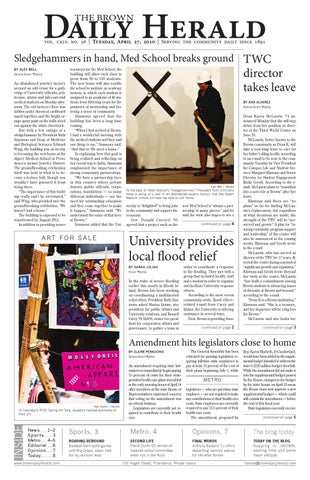
To the beat of Peter Gabriel’s “Sledgehammer,” President Ruth Simmons takes a swing at a wall in an abandoned jewelry factory that the Alpert Medical School will soon be able to call home.
versity is “delighted” to bring jobs to the community and support the economy. Gov. Donald Carcieri ’65 agreed that a project such as the
new Med School is “always a partnership of many pieces,” and he said the state also hopes to see a continued on page 4
University provides local flood relief By Sarah Julian Staf f Writer
In the wake of severe flooding earlier this month in Rhode Island, Brown has been working on coordinating a multifaceted relief effort. President Ruth Simmons asked Marisa Quinn, vice president for public affairs and University relations, and Russell Carey ’91 MA’06, senior vice president for corporation affairs and governance, to gather a team in
Amendment hits legislators close to home By Claire Peracchio Senior Staff Writer
Max Monn / Herald
inside
At Saturday’s RISD Spring Art Sale, students hawked examples of their art.
News.....1–2 Spor ts.....3 Metro.....4–5 Editorial....6 Opinion....7 Today........8
www.browndailyherald.com
An amendment requiring state lawmakers to immediately begin paying 15 percent of costs for their stateprovided health care plans was tabled in the early morning hours of April 14 after members of the state House of Representatives expressed concern that voting on the amendment was an ethical violation. Legislators are currently not required to contribute to their health care.
The General Assembly has been criticized for passing legislation requiring full-time state employees to pay at least 15 percent of the cost of their plans beginning July 1, while
METRO legislators — who are part-time state employes — are not required to make any contributions to their health care costs. State employees are currently required to pay 13.5 percent of their health care costs. The amendment, proposed by
Rep. Karen Macbeth, D-Cumberland, would have been added to the supplemental budget intended to address the state’s $220 million budget shortfall. While the amendment did not make it into the supplemental budget passed by the House, changes to the budget by the state Senate on April 15 mean the House must now approve a new supplemental budget — which could still contain the amendment — before the end of this fiscal year. State legislators currently receive continued on page 5
Sports, 3
Metro, 4
Opinions, 7
The blog today
roaring rebound Baseball team splits games with Big Green, stays tied for Ivy division lead.
Second Life David Quinn GS serves on Seekonk school committee when not in the Rock.
Final words Anthony Badami ’11 offers departing seniors advice for life after Brown.
Today on the blog Napping in JWOWW, wasting time and some major attitude.
195 Angell Street, Providence, Rhode Island
herald@browndailyherald.com
Page 2
THE BROWN DAILY HERALD
Tuesday, April 27, 2010
C ampus N EWS
U. volunteers pitch in for flood relief Bears split BASEBALL
continued from page 1
tions to relief agencies. In the immediate aftermath of the flooding, the University donated $50,000 to the Rhode Island Flood Recovery Fund, which was established by the United Way of Rhode Island. According to Clay Wertheimer ’10, president of the Undergraduate Council of Students, the benefit of giving to an organization like the United Way is that, as an established organization, it has low overhead cost and thus aid goes directly to the community. In addition to this donation, student groups are working on more fundraising efforts. Colleen McDonald ’12, the student representative on the group that met with Quinn and Carey, said she and UCS Vice President Diane Mokoro ’11 made an announcement on stage at Saturday’s Spring Weekend concert asking for donations. UCS volunteers then passed baskets around the crowd, collecting a total of $350. McDonald said it was meant to be just a “drop in the bucket.” Wertheimer said this event was
“really low key, but I think it was a nice opportunity to remind people and get them engaged.” A lot of students want to help, but are “not exactly sure how,” according to Wertheimer. He said the main goal of UCS is to help “keep them informed about other opportunities.” An additional $200 were raised in donations taken at the past two men’s lacrosse games, according to Patrick Walker, travel and promotions coordinator for the Athletics Department. Other efforts have aimed at gathering groups of volunteers. The University has been involved in two projects through Ser ve Rhode Island. First, the organization asked for a group of four individuals to provide assistance to elderly residents in Olneyville, Quinn wrote in an e-mail to The Herald. “Given the time and the limited number of individuals needed, we asked Facilities Management if there would be individuals interested.” Twenty staff members from Facilities expressed interest, and four assisted with the project.
The second project took place in Westerly, R.I. Twelve students and staf f members traveled to Westerly, where they were assigned a street that had suffered significant damage. They went from house to house of fering assistance in cleaning out basements and yards. McDonald, one of the student volunteers, said the project was “easy with a group of people” but that she could see how it would be overwhelming for residents to have to sort through their water-damaged items and throw them away. She said that some residents helped her group with the cleaning, but that others were not present. “Some people preferred not to really deal with it,” she said. McDonald has also been contacting student groups about organizing other fundraisers and group service events. Details have not been finalized, but McDonald said she has spoken with Greek organizations, athletic teams and program houses about potential projects. The University is also encouraging students to undertake sum-
mer work, primarily through the Swearer Center, to assist in the recover y. “In terms of summer efforts, there have been a few students expressing interest so far, and a few preliminar y ideas for possible projects,” Roger Nozaki MAT’89, associate dean of the college and director of the Swearer Center, wrote in an e-mail to The Herald. According to Nozaki, the goal is to ensure that projects are driven by what the community needs, which means gathering input before undertaking projects. “The students who’ve come for ward to date regarding the summer haven’t proposed ideas, but were just expressing interest if projects came together,” he wrote. The e-mail from Quinn and Carey also said the University hopes to respond “to needs that the governor’s office identifies as important.” The governor’s office is working with the Federal Emergency Management Agency to coordinate statewide responses. Once these needs are evaluated, Carey and Quinn wrote, “we anticipate that there will be much help needed in the coming weeks and months.” Finally, Carey and Quinn mentioned Brown efforts to help employees and families impacted by the flood. “The Emergency Grant committee has streamlined the application process to make seeking funds as simple as possible and has put information about the new process on the web. Several applications have been made to date and all have been approved,” they wrote in the community-wide e-mail.
weekend doubleheader By Tony Bakshi Sports Staff Writer
After two wild back-and-forth battles, Brown and Dartmouth’s baseball teams are still deadlocked atop the Rolfe Division of the Ivy League. The Bears (12-25 overall, 9-5 Ivy) and the Big Green (19-13 overall, 9-5 Ivy) split two games at Brown’s Murray Stadium on Saturday afternoon. Dartmouth eked out a victory, 7-6, in the first matchup. But Brown came back to take the second, 9-5, behind a strong performance from starting pitcher Will Weidig ’10, who stepped up on a day when he said the team “really needed the win.” Dartmouth 7, Brown 6 Bruno had victory in its grasp, but could not hold on in the final inning. Brown took a 5-3 lead into the seventh frame, helped by Kevin Carlow’s ’13 strong pitching and Matt Colantonio’s ’11 third-inning grand slam. But the Dartmouth bats pounced on Carlow’s reliever, Matthew Kimball ’11. A leadoff walk and some shaky play in the infield by Ryan Zrenda ’11 loaded the bases with one out. Dartmouth third baseman Ezra Josephson cut the lead to 5-4 with an infield hit, and the Big Green then took the lead on Brett Gardner’s tworun single. Centerfielder Jake Carlson drove in Gardner with a single of his own, capping Dartmouth’s big continued on page 3
sudoku
Daily Herald the Brown
Editorial Phone: 401.351.3372 | Business Phone: 401.351.3260 George Miller, President Claire Kiely, Vice President
www.browndailyherald.com
Katie Koh, Treasurer Chaz Kelsh, Secretary
The Brown Daily Herald (USPS 067.740) is an independent newspaper serving the Brown University community daily since 1891. It is published Monday through Friday during the academic year, excluding vacations, once during Commencement, once during Orientation and once in July by The Brown Daily Herald, Inc. Single copy free for each member of the community. POSTMASTER please send corrections to P.O. Box 2538, Providence, RI 02906. Periodicals postage paid at Providence, R.I. Offices are located at 195 Angell St., Providence, R.I. E-mail herald@browndailyherald.com. World Wide Web: http://www.browndailyherald.com. Subscription prices: $319 one year daily, $139 one semester daily. Copyright 2010 by The Brown Daily Herald, Inc. All rights reserved.
Tuesday, April 27, 2010
THE BROWN DAILY HERALD
S ports
Page 3
“I think when you look at brains, it’s the end game.” — Chris Nowinski, president of Sports Legacy Institute
Baseball Panel discusses concussion research, policies team makes comeback By Chan Hee Chu Spor ts Staf f Writer
continued from page 2 four-run inning. That insurance run turned out to be huge, as the Bears made their own comeback effort in the bottom of the seventh. Zrenda ripped a triple to right field to lead off the inning and later scored on a groundout by Daniel Rosoff ’12. But the Bears could not muster up another run and fell by a one-run margin, 7-6. Brown 9, Dartmouth 5 In the second game, the Bears got out to another early lead, and made sure to keep it until the final pitch was thrown. Brown led, 4-0, after two innings, due to home runs from Pete Greskoff ’11 and Chris Tanabe ’10. They added four more in the bottom of the fifth, grabbing a commanding 8-1 advantage on a solo home run from Mike DiBiase ’12 and a two-run single from Cody Slaughter ’13. The Big Green bats were quiet until the bottom of the ninth inning, due to Weidig’s dominance on the mound. Weidig hurled eight innings and was charged with just three earned runs. “I was able to mostly just a throw a fastball to both sides of the plate and keep them off balance that way,” Weidig said. “With the offense getting us out to a big lead, it’s easier to go out there and pitch to contact.” But again, when Brown went to its bullpen in the latter stages of the game, Dartmouth was able to mount a rally. The Big Green scored four runs total in the ninth, but left-hander Brad Kottman ’13 was finally able to shut the door. Kottman struck out pinch-hitter David Turnbull to end the game, ensuring that the two teams would be tied in the standings until the second set of doubleheaders on Wednesday. “If we stay within our abilities, then we should be in good shape to have a couple of good games,” Weidig said.
Chris Nowinski, once known as the only Harvard graduate in professional wrestling, spoke as part of a panel in front of an almost full Salomon 101 Monday night. Nowinski spoke to both the personal effects and scientific research concerning concussions at Monday’s event, which was part of a colloquium on the danger of concussions in sports. Nowinski had his professional wrestling career cut short after sustaining six concussions and then became the co-founder and president of Sports Legacy Institute. The other speakers were Robert Cantu, a leading medical expert on concussions; Professor of Orthopaedics J.J. Trey Crisco, a researcher in athletic concussions; Sean Morey ’99, a current NFL player and the co-chair of the NFL Players Association Traumatic Brain Injur y Committee; and Alyssa Blood ’11, a former basketball player at Brown whose career was cut short by concussions she sustained while playing. “Where do you start?” Nowinski said. “I think when you look at brains, it’s the end game. You look at these guys in their 30s and 40s, and they have ruined their lives.” Nowinski first became seriously interested in the potential harm caused by concussions after learning of former NFL star Andre Waters’ suicide at age 44. Believing that the player’s depression was a
result of head trauma sustained during Waters’ NFL career, Nowinski began to research the subject and speak out about the dangers of concussions — eventually testifying before Congress on the NFL’s policies on concussions. The other panel members credited Nowinski’s efforts as helping to persuade the NFL to adopt new rules to better protect players and take responsibility for the harms caused by the game. Blood and Morey told their personal stories about concussions to a crowd that included Brown athletes, coaches and members of the local medical community. “You don’t need to play football to get concussions,” Blood said. “I had concussions playing tennis, softball and basketball. I guess it goes to show that although the research is geared towards football and boxing, it is a huge problem” across all sports. In light of the increasing information demonstrating the risk of taking hits, Morey spoke of his current efforts to better protect NFL players. Morey recently met with the NFL competition committee at the NFL Combine to discuss possible rule changes designed to limit dangerous blows. Still, despite the inherent risk involved, Morey said eliminating concussions altogether is unrealistic. “Contact spor ts provide an opportunity to learn leadership skills, accountability,” Morey said. “It builds character.” In contrast to the personal accounts provided by Blood and Morey, Cantu and Crisco gave
McLaurin to take year off continued from page 1 ward to her return to Brown and the center’s future under new leadership. “I have high hopes for the growth and development of the center,” McLaurin said. “The TWC can and will, hopefully, remain in the hearts and minds of the University.” According to the e-mail, details of a celebration of McLaurin’s achievements at Brown, to be held in early May, will soon be announced.
www.browndailyherald.com
more scientific perspectives on concussions. Despite the increase in concern about concussions over the last few years, Cantu said there was a relative lack of knowledge concerning concussions. “Statistics say there are two to three million each year but we don’t know,” Cantu said. Though Cantu conceded that concussions and head trauma varied greatly on an individual basis, he still advocated extreme caution
for everyone. Agreeing with Cantu’s approach, Crisco proposed the possibility of limiting the number of traumatic hits in contact sports as pitch-count limits have been enforced in Little Leagues across the country. Crisco also spoke of the need to better understand what exactly causes concussions — a question he hopes his research involving athletes at Brown and elsewhere will help to answer.
Metro The Brown Daily Herald
“My goal is to eventually become an administrator, but not until I really know what makes a good teacher” — David Quinn GS Tuesday, April 27, 2010 | Page 4
Attending — and governing — the schools By Anne Artley Staf f Writer
David Quinn GS is leading a double life. A Brown graduate student currently earning his Master of Education by day, he serves on the Seekonk, Mass. school committee by night. He was elected on April 5 in an uncontested election. To win the position, he had to run a “sticker campaign” in which voters filled in his name in a blank space on the ballot, Quinn said. Quinn received over 350 votes. “I was immersed in my studies and never thought of running, but when I heard two people had stepped down I thought it would be a good opportunity,” Quinn said. Quinn, a Seekonk native, also student teaches at Seekonk High School and has worked as a behavior intervention coordinator and as
a baseball coach at Hurley Middle School in Seekonk. Quinn said that his dual roles allow him to apply material from the classroom to a real-world setting. Studying while serving on the school committee creates a “symbiotic relationship,” he said. The principles he is learning in his EDUC 1130: “Economics of Education” class with John Tyler, associate professor of education, economics and public policy, have been especially useful in planning the school funding formulas, solving budgetar y issues and spending money efficiently. Quinn described his platform for the school committee as a three part plan to cost-effectively bring 21st century education to the schools, to ensure programs have “clear and measurable results” and to serve as a bridge for ideas between taxpayers and school administrators.
As a newcomer to local politics, Quinn got his name out to Seekonk voters by reaching out to local media, going door to door and putting up signs. He also handed out stickers bearing his name on Election Day so voters would remember his name to write it in on their ballots. “I had to run as if there was another candidate,” he said. “The write-in puts you at a disadvantage because people have to remember your name to vote for you.” Fran Creamer, who also serves on the committee, said that as a grad student, Quinn has already proven himself to be a valuable asset to the board. “He’s only been on the board a short time, but there have already been at least two different occasions where he has brought back things he has learned through his studies at Brown,” she said. Quinn has found that learning to balance his studies with his new responsibilities has been a smooth transition and that the arrangement has “worked out nicely,” he said. After he finishes his master’s, Quinn said he wants to continue teaching in Seekonk or the surrounding area. “My goal is to eventually become an administrator, but not until I really know what makes a good teacher,” Quinn said.
U., community partner in new Med School building continued from page 1 new nursing school built adjacent to the new Med School to support existing nursing programs at the University of Rhode Island and Rhode Island College. Providence Mayor David Cicilline ’83 said the new building would help the economy by providing some 500 construction jobs and 57 permanent jobs. He also said it would help Providence institutions compete for research grants while encouraging companies like Isis Biopolymer to locate in the area. “There is now developing a critical mass of new companies that are coming into the Knowledge District,” Cicilline said. “The presence of this great medical school from a spectacular university will add to that significantly.” Patrick Worth MD’11, president of the Medical Student Senate, called the new building an “inspiration and a call to action,” rather than a reward to be taken for granted by future students. Michael Sabitoni, president of the Rhode Island Building and Construction Trades Council, praised the University for utilizing the Building Futures
Program for the Med School’s construction. The program stipulates that Providence residents will perform 15 percent of the construction hours on the project, and successful workers on the project will be eligible to enter a building trade apprenticeship program that will put them “well on their way to a solid, family-supporting career path in the construction industr y,” according to Sabitoni. “Needless to say, Brown University’s commitment in these difficult times is second to none,” he said. “Brown is clearly distinguishing itself from its local institutional peers by not only continuing to invest in our economy — when it would have been easier for them not to — but also making an affirmative commitment to use local labor and Providence residents on all of these construction projects.” After a shor t video, Wing and Simmons had a surprise in store. To the beat of Peter Gabriel’s “Sledgehammer,” they each grabbed a sledgehammer and — after Cicilline jocularly handed Simmons a hard hat in the spirit of safety — they got to work on a wall of the abandoned jewelr y factor y.
www.browndailyherald.com
Page 5
M etro
THE BROWN DAILY HERALD
Tuesday, April 27, 2010
“We live in a political world.” — Sen. Rhoda Perry P’91, D-Providence
Health-care amendment tabled for ethics concerns continued from page 1 free health care, which can cost up to $18,061 for a family and $6,463 for an individual annually. Most legislators willingly pay part of their health costs. Lawmakers who choose to forgo stateprovided care may also choose to take a waiver valued at $2,002. After an April 19 Providence Journal article published the names of lawmakers who receive free health care, three legislators on that list have decided to either contribute to their care or accept a waiver payment. This is not the first time legislation to mandate that legislators contribute to their care plans has been proposed. A 2008 bill, which was introduced by Rep. Amy Rice, D-Portsmouth, Middletown and Newport, and required lawmakers to pay 10 percent of their health care costs, passed in the House in 2008. The proposal was not taken up by the state Senate at that time. Ethics of a vote Legislators have cited concerns about the ethical implications of the amendment, particularly because its language required that the payment changes take effect instantly. “The leadership agreed that we should look into whether it affected us personally and therefore we shouldn’t vote on it,” said Rep. Edith Ajello, D-Providence. Ajello currently contributes 10 percent of the cost of
her health insurance. While the Rhode Island Ethics Commission would have recommended that any changes to benefits for legislators take effect after the November elections, ethical ramifications of a vote on the amendment would not be subject to the commission’s punitive authority, according to Jason Gramitt, a staff attorney with the commission. The commission lost this power in a Rhode Island Supreme Court case against former state Senate President William Irons, who was accused of a conflict of interest in his legislative dealings regarding CVS, one of his insurance clients. The court decided that the state constitution’s “speech in debate” clause prevented the Ethics Commission from taking action against lawmakers for their votes. “In the wake of the Irons case, legislators are free to vote on any kind of proposal without worrying about whether it’s a conflict of interest, without regard to whether or not there is a financial benefit for themselves or their family members or business associates,” Grammit said. Members would likely have been aware of this lack of jurisdiction because House Speaker Gordon Fox has proposed legislation to offer a referendum asking voters to choose whether the power of the Ethics Commission over the legislature should be restored, according to Grammit.
The verdict of the Irons case is “widely reviled,” according to Rep. David Segal, D-Providence, who proposed a 2009 constitutional amendment to restore the power of the Ethics Commission and one of the legislators whose name was published in the April 19 Providence Journal article. Segal has begun contributing 20 percent of the cost of his care after his name was published as a legislator paying nothing for care. “I understand why people have felt pressure to contribute,” Segal said. He added that legislators can also forgo perks such as parking spaces and mileage reimbursement that add to a sum comparable to voluntarily contributing to health-care costs. Segal said even though the Ethics Commission can no longer prosecute legislators for their votes, many lawmakers still make an effort to hold themselves to the ethical standards endorsed by the commisson. He said he would support the amendment if its changes took effect after statewide elections. To pass or not to pass Both of the legislators representing College Hill — Ajello and state Sen. Rhoda Perry P’91 — also said they would support the amendment, assuming it went into effect after the November election. But the amendment raises important issues for both.
“I think it’s kind of interesting that Rep. Macbeth is introducing legislation that really wouldn’t affect her at all because she is insured through her day job as a school principal,” Ajello said. Prior to the publication of the April 15 Providence Journal article, Macbeth opted to take the waiver payment even through she currently receives full health benefits through her job at a Woonsocket public school. Macbeth has since announced that she will no longer take the waiver payment, according to Monday’s Providence Journal. Ajello said that politicians often find opportunities to “make themselves look good in the public eye” while failing to address systemic problems that lead to inequities in the health care system. Perry — who currently voluntarily pays 10 percent of her health care plan costs — said she is not averse to contributing 15 percent. But she
said that “in a position which is not full time, it is hard to make an analogy” between state employees and parttime legislators who have a different pay structure, she said. “Nevertheless, we live in a political world and I understand that it is important for the legislature to try to emulate the general public,” Perry said. Legislators’ response to the amendment calls into question whether the General Assembly is serious about reforming how members pay for health care, according to John Marion, executive director of Common Cause Rhode Island, a nonprofit that advocates for transparent government. “Instead of offering reasons why this shouldn’t be done, this spurious issue of violating the code of ethics came up,” he said. “I don’t see that there’s any desire on behalf of the leadership of the General Assembly to allow this vote to take place.”
Editorial & Letters The Brown Daily Herald
Page 6 | Tuesday, April 27, 2010
l e t t e r to t h e e d i to r
Crimes against Jews shouldn’t justify crimes against Palestinians To the Editor: I am an ethnic Jew from Budapest, Hungary, where Theodor Herzl was born. Reading Dr. Jack Schwartzwald’s column in Thursday’s Herald (“Remembering Theodor Herzl,” April 22) upset me in a number of ways. Here is why: Schwartzwald seems to think that the existence of Israel is necessary because of anti-Semitism. For instance, there is a 17 percent-strong openly racist and anti-Semitic party in Hungary. Yet there is no institutional anti-Semitism: Being Jewish does not disadvantage us in any way. Being a Roma would, so is there a case for a Roma state? Even if anti-Semitism were threatening us, it would be immoral to choose to live in Israel at the price of causing more suffering to Palestinians. There are plenty of alternatives to Israel. If I really felt threatened in Eastern Europe, I could always choose to emigrate to countries like the United States or Germany. Imre Kertész, survivor of Auschwitz and Buchenwald, who was awarded the
Nobel Prize in Literature for his book “Fatelessness,” notably chose to live in Berlin instead of in Budapest. I disapprove of American youth choosing Israel and the Tzahal as their new home. The idea of Israel is diametrically opposed to the idea of the United States. The United States is a country where people can find their homes, regardless of their race, ethnicity or religion. Israel wants to be the state of ethnic and religious Jews, even if it reluctantly accepts the presence of others. If there is anything that we should take away from the Holocaust, the defining experience of my grandparents who survived it, it is that when we start differentiating among people based on religion, race, ethnicity, sexuality and so on, we get very, very bad results. The long history of anti-Semitism and racism should teach us that we should not commit crimes against Palestinians. Daniel Prinz ’13 April 24
t h e b r o w n d a i ly h e r a l d Editor-in-Chief
Managing Editor Chaz Kelsh
George Miller
Deputy Managing Editors Sophia Li Emmy Liss
editorial Anne Speyer Suzannah Weiss Brian Mastroianni Hannah Moser Brigitta Greene Ben Schreckinger Sydney Ember Nicole Friedman Dan Alexander Zack Bahr Andrew Braca Han Cui
Arts & Culture Editor Arts & Culture Editor Features Editor Features Editor Metro Editor Metro Editor News Editor News Editor Sports Editor Asst. Sports Editor Asst. Sports Editor Asst. Sports Editor
Graphics & Photos Graphics Editor Stephen Lichenstein Graphics Editor Alex Yuly Photo Editor Nick Sinnott-Armstrong Asst. Photo Editor Max Monn Sports Photo Editor Jonathan Bateman Production Copy Desk Chief Kelly Mallahan Design Editor Marlee Bruning Asst. Design Editor Anna Migliaccio Asst. Design Editor Julien Ouellet Web Editor Neal Poole Post- magazine Editor-in-Chief Marshall Katheder
Senior Editors Ellen Cushing Seth Motel Joanna Wohlmuth
Business General Managers Office Manager Shawn Reilly Claire Kiely Katie Koh Directors Sales Kelly Wess Finance Matthew Burrows Client Relations Margaret Watson Alumni Relations Christiana Stephenson Managers Local Sales Arjun Vaidya National Sales Marco deLeon University Sales Aditi Bhatia University Sales Jared Davis Recruiter Sales Trenten Nelson-Rivers Maximilian Barrows Business Operations Business Analytics Jilyn Chao Credit and Collections Danielle Marshak Special Projects Alexander Carrere Staff Kathy Bui Opinions Opinions Editor Michael Fitzpatrick Opinions Editor Alyssa Ratledge Editorial Page Board Matt Aks Editorial Page Editor William Martin Board member Melissa Shube Board member Gaurie Tilak Board member Jonathan Topaz Board member
Anna Migliaccio, Designer Claire Gianotti, Abby Kerson, Alexandra McFarlane, Carolina Veltri, Copy Editors Ana Alvarez, Nicole Boucher, Sarah Forman, Ben Schreckinger, Night Editors Senior Staff Writers Ana Alvarez, Ashley Aydin, Alexander Bell, Nicole Boucher, Alicia Chen, Kristina Fazzalaro, Sarah Forman, Talia Kagan, Sara Luxenberg, Sarah Mancone, Heeyoung Min, Claire Peracchio, Goda Thangada, Caitlin Trujillo Staff Writers Anna Andreeva, Anne Artley, Shara Azad, Rebecca Ballhaus, Casey Bleho, Fei Cai, Sofia Castello, Amy Chen, Claire de Boer, Brielle Friedman, Miriam Furst, Max Godnick, Anish Gonchigar, Thomas Jarus, Sarah Julian, Julia Kim, Jessica Liss, Anita Mathews, Ben Noble, Lindor Qunaj, Mark Raymond, Luisa Robledo, Emily Rosen, Bradley Silverman, Anne Simons, Qian Yin Senior Sales Executives Katie Galvin, Liana Nisimova, Isha Gulati, Samantha Wong Sales Associates Roshni Assomull, Brady Caspar, Anna Cook, Siena deLisser, Begum Ersan, Tommy Fink, Ryan Fleming, Evan Gill, Rajiv Iyengar, Debbie Lai, Jason Lee, Katie Lynch, Sean Maroongroge, Zahra Merchant, Edjola Ruci, Webber Xu Senior Finance Associates Jason Beckman, Lauren Bosso, Mae Cadao, Margot Grinberg, Sajjad Hasan, Adam Fern Finance Associates Lisa Berlin, Mahima Chawla, Mark Hu, Jason Lee, Nicholas Robbins, Daniel Slutsky, Emily Zheng Design Staff Caleigh Forbes, Jessica Kirschner, Gili Kliger, Leor Shtull-Leber, Katie Wilson Web Staff Andrew Chen, Warren Jin, Claire Kwong, Michael Marttila, Ethan Richman, Adam Zethraeus Photo Staff Qidong Chen, Janine Cheng, Alex DePaoli, Frederic Lu, Quinn Savit Copy Editors Nicole Boucher, Zoe Chaves, Greg Conyers, Claire Gianotti, Aida Haile-Mariam, Victoria Hartman, Tiffany Hsu, Christine Joyce, Mrinal Kapoor, Abby Kerson, Matthew Lim, Sara Luxenberg, Alexandra McFarlane, Joe Milner, Rajan Mittal, Lindor Qunaj, Kate-Lyn Scott, Carmen Shulman, Rebecca Specking, Dan Towne, Carolina Veltri
E R I K S T AY T O N A N D E VA N D O N A H U E
e d i to r i a l
Talking tenure On April 14, faculty members and administrators gathered to discuss a set of proposed changes to the University’s policies governing tenure. At this meeting, four undergraduates were kicked out because they attended without permission, The Herald reported. It is unfortunate that these students did not have the opportunity to voice their concerns and learn more about the proposals under consideration. We too are worried that students’ interests are not being taken into account as the University updates its process for granting tenure. The recent meeting focused mainly on a report issued in March by the ad hoc Committee to Review Tenure and Faculty Development. The committee’s recommendations touched on many aspects of the tenure review process, including the timeline and the roles of relevant administrative bodies. The report also highlighted the importance of teaching as one of several criteria in determining a faculty member’s suitability for tenure. “As teachers, candidates should have a strong record of effectiveness in the classroom and evidence of commitment to mentoring students,” the committee wrote. We liked the committee’s vision of Brown as a “university-college” that “prizes both graduate and undergraduate education and strives for excellence in teaching as well as research.” Yet, none of the committee’s specific proposals pertain directly to ensuring that newly tenured professors are up to par as teachers and as advisers. Last semester, when the discussion about tenure was just
beginning, we argued that departments should take a more proactive role in soliciting student feedback. Now, we want to offer another suggestion: Tenure candidates should have to get letters of support from a handful of former students and advisees. The tenure review process already relies on input from many sources, and we see no reason to exclude students. Our suggestion would allow tenure candidates to demonstrate that they have made a positive impact on some students while avoiding the problems associated with anonymous feedback forms. We imagine that in most cases, the student testimonials will be positive and serve to further document Brown’s excellence. Of course, teaching is one of several criteria to be considered. The professor’s research and scholarly work are of primary importance to a university that strives to be among the best in the world. Nonetheless, some tenure candidates will have been at Brown for as long as eight years. If a candidate cannot call on just a few former students for support, then it should raise a red flag. The committee clearly appreciates the notion of a “university-college” and the importance of preserving a faculty that is dedicated to undergraduate education. Indeed, this ideal is central to Brown’s identity as an institution. As the process moves forward, we just want to see a concrete improvement that codifies respect for students’ interests and input. Editorials are written by The Herald’s editorial page board. Send comments to editorials@browndailyherald.com.
correction A column in Monday’s Herald (“White people have a tortured relationship with the Ivy League,” April 26) incorrectly stated that every Supreme Court justice except John Paul Stevens graduated from either Harvard or Yale Law School. In fact, Justice Ruth Bader Ginsburg graduated from Columbia Law School, a fact stated elsewhere in the column. The same column also incorrectly stated that Judge Diane Wood graduated from the University of Chicago Law School. In fact, she graduated from the University of Texas School of Law. Due to an editing error, a headline in Monday’s Herald (“Mock Trial team wins 11th nationally,” April 26) incorrectly implied that a Brown mock trial team was ranked 11th in the nation. In fact, the team placed 11th in its division, one of two at a national tournament. The Herald regrets the errors. C O R R E C T I O N S P olicy The Brown Daily Herald is committed to providing the Brown University community with the most accurate information possible. Corrections may be submitted up to seven calendar days after publication. C ommentary P O L I C Y The editorial is the majority opinion of the editorial page board of The Brown Daily Herald. The editorial viewpoint does not necessarily reflect the views of The Brown Daily Herald, Inc. Columns, letters and comics reflect the opinions of their authors only. L etters to the E ditor P olicy Send letters to letters@browndailyherald.com. Include a telephone number with all letters. The Herald reserves the right to edit all letters for length and clarity and cannot assure the publication of any letter. Please limit letters to 250 words. Under special circumstances writers may request anonymity, but no letter will be printed if the author’s identity is unknown to the editors. Announcements of events will not be printed. advertising P olicy The Brown Daily Herald, Inc. reserves the right to accept or decline any advertisement at its discretion.
Opinions The Brown Daily Herald
Tuesday, April 27, 2010 | Page 7
I am embarrassed ANTHONY BADAMI Opinions Columnist I first encountered the work of Noam Chomsky, professor of linguistics at the Massachusetts Institute of Technology, as a wide-eyed freshman in high school. My inchoate intellectual views were just starting to take shape, and I had developed a keen interest (nay, an obsession) with political philosophy and foreign affairs. When reading the Economist or skimming the pages of the New York Times, I felt that I had my finger on the pulse, the pumping lifeblood, of global society. One banal day of literary perusing, I stumbled upon a copy of Manufacturing Consent in the current events section of my local library. I had heard the name “Chomsky” somewhere before but could not place it. After reading just a few pages, I was hooked. My intellectual journey since has been tumultuous indeed. From Chomsky, I moved on to other thinkers, both public and academic. But I always returned, especially when jaded, to lap up what refreshment I could from his reviving commentary. I am sure that many in the Brown community have a special place in their hearts and minds for Chomsky. There is no need for me to preach to the choir, to beat a dead horse, to implement a hackneyed metaphor. Brown students get it. Or not. As I sat through the question and answer period of last week’s lecture (featuring youknow-who), I was appalled, startled and ut-
terly embarrassed: Is this all that the Brown intellectual population can offer? The exchange, if it can be called that, was littered (pun intended) with uninformed, vague and repetitive questions. Had no one read a single work, article, book or interview of Chomsky’s before the lecture? Do we really need to be asking a commentator of his stature, “What can we as students do?” Must this question be asked twice? Yet this is not the worst part. Not a single Brown student asked a challenging, provocative or formidable question. Brown Students
your job to man the mic and direct questions. Chomsky was left up at the podium, uncomfortably and awkwardly, for nearly a minute before anyone even got in line for questions. How deflating. And I will not go into the shameless bit of political self-promotion that occurred as well — the crowd spoke for itself. Suffice to say, it exemplified the general tone of the night — do not criticize, do not inquire, try to protect your hide and let this batty old nut speak his deranged message. When Chomsky exits this earth, we will
As I sat through the question-and-answer period of last week’s lecture, I was appalled, startled and utterly embarrassed: Is this all that the Brown intellectual population can offer? for Israel, are you asleep at the wheel? Did you have a mandatory meeting running concurrently with the lecture? The man said that he doesn’t believe Israel should exist. You should be haranguing! I do not reserve my criticism solely for the questioners — I take serious issue with Common Ground as well. Applause for securing arguably the most important intellectual alive, but could you not give this deity a more stimulating introduction? It was dry, colorless and minimal. Furthermore, the question-and-answer session was sloppy and unorganized. Tip: When a speaker has finished speaking, it is
certainly have a prolific collection of political, social, economic and philosophical commentary left behind. But all of this is accessory. Chomsky often wrote on unfashionable topics, and much of his political writing will be irrelevant centuries from now. However, what can endure, if we let it, is his spirit of tireless critique of power and privilege, which will always exist. I have myriad differences and disagreements with Chomsky’s work, especially his Manichean treatment of foreign affairs and his unelaborated opinions on morality, which he seems to take for granted. But I still respect his ability to transcend traditional academic
structures, both in breadth and depth, to offer powerful evaluations of the way that power operates. For our departing seniors, much from Chomsky can be applied here. As you escape the embrace of Brown, you will face, most likely for the first time, the need to provide for your own subsistence, your own survival. To gain income, to feed yourselves and your families, you will need to play an institutional role, whether it be for a law firm, a financial company, academia, a non-governmental organization, the government, etc. But you need not relent totally: Be aware of the implications your institutional actions can have on the personal lives of real people. You may be able to justify your transgressions on the small scale, in the short run, but just know that, once upon a time, you were a wideeyed freshman as well, and you too had ideals and principles. I end, of course, with a quotation from Professor Chomsky: “To speak truth to power is not a particularly honorable vocation … It is a waste of time and a pointless pursuit to speak truth to those who exercise power in coercive institutions.” Why? They already know the truth, as do you. Thus, I charge you always to question those who claim to know absolutely, whether it be in a million-dollar board meeting or a college lecture hall. Au revoir, seniors. It’s been real.
Anthony Badami ’11 is a political theory concentrator from Kansas City, Mo. He can be reached at anthony_badami@ brown.edu
The case for markets Kshitij Lauria Opinions Columnist
In the last few weeks, the Brown community was faced with several issues that are connected by a single thread, and barely a day goes by when a glance through The Herald does not turn up something that economic thinking could greatly clarify. This alone does not surprise me, for, like the ancient Chinese game of Go, in economics one can find a metaphor for every aspect of life. And, quite like Go, even though the general problem of economics remains unsolved, we have been able to develop strategies and techniques that offer insights in almost any given situation. Put very simply, economics addresses the problem of the allocation of scarce resources. The beauty of economics lies in the fortunate fact that we can draw substantial conclusions even from abstract assumptions, which then apply to a wide range of situations. Sometimes the assumptions capture most of the essential aspects of what we’re trying to study, and then we are in luck. But the usefulness of economics lies in the fortunate fact that we can be wiser by its application even when the fit is not perfect. In today’s column, I discuss perhaps the least controversial issue for which economics has good answers. Consider tableslips. The Undergraduate Finance Board recently voted to end funding for tableslips in dining halls (“UFB will end funding for tableslips after break,” March
17). Tableslips are a useful but flawed way of advertising events on campus: they are disproportionately useful to underclassmen, who often have no other good ways of finding out; they are environmentally unfriendly and costlier than electronic alternatives; they require no action on the part of the advertisee, who literally sees them next to the napkins; and so on. Economics suggests that the best solution is usually not all or nothing — there is likely a happy medium between the two extremes. There are those that benefit from tableslips:
them now. And of course the UFB would like to spend its money as wisely as possible for the benefit of all. In short, there are preferences and there are resources. Without knowing any more about the situation, I can make two quick predictions: that the cost of tableslipping is likely too low, and that the people who benefit from it aren’t the ones who are paying. Let’s take these one by one. What does it mean for the cost of tableslipping to be “too low”? There is of course the actual monetary price. This gives us a great
Without knowing any more about the situation, I can make two quick predictions: that the cost of tableslipping is likely too low, and that the people who benefit from it aren’t the ones who are paying. underclassmen, asocial people, student groups that target them, people who like making paper airplanes from tableslips, etc. There are others that derive no benefit from and may even object to tableslips: upperclassmen, people off meal plan, people concerned about the environment (although worrying about tableslips is a spectacularly inefficient use of your time and energy), student groups that target them, etc. The same group of people may have different opinions at different times: a frat might not care about tableslips except when it throws a party; I won’t care about them next semester, but I certainly support
tool for limiting tableslipping to desired levels by charging for the privilege (analogous to the tax on cigarettes). This policy tool is both simple and flexible: we can tweak things as the time and place demands. But my bigger concern here is the cost of not using that money elsewhere. Other uses could range from close substitutes — other forms of advertisement — to entirely different things, like pizza for meetings. In the worst case, the opportunity cost is zero — that is, if there is special funding earmarked for this use only. There is then no incentive to be prudent, and no way for a student group to make wiser
spending decisions by weighing alternative uses for each spent dollar. Once we adjust the opportunity cost of tableslipping to more accurately reflect reality, we have also partially shifted the burden of payment to where it more properly belongs. Now the tableslip fund is no longer “free money”; instead, each student group spends in proportion to the benefit it perceives in tableslipping. The other side of the equation is the student body that is being served by this whole business and that pays for the whole thing. While there are good arguments to be made for students not being the ultimate decision-makers for every dollar that is spent on their behalf, we should have that power where student groups are concerned. In a very egalitarian way, we can then vote with our pockets to encourage behavior we like, and vice-versa. It also gives student groups valuable information: it tells them precisely who wants them the most, and what they want from them. You have now seen in action yet another meta-benefit of economic analysis: it is fair, presupposes nothing, and values no viewpoint over another. It allows us to turn unproductive discussion about morals into a productive one about preferences and resources. And although its conclusions are positive (“what is”), they are invaluable in making judgments that are normative (“what should be”).
Kshitij Lauria ’13 supports Doing Things Right™.
Today The Brown Daily Herald
3
Bears and Big Green split doubleheader
4
to day
to m o r r o w
54 / 36
53 / 38
Building med school will be community effort
Tuesday, April 27, 2010
t h e n e w s i n i m ag e s
Page 8
comics Cabernet Voltaire | Abe Pressman
1
Dot Comic | Eshan Mitra and Brendan Hainline
c a l e n da r Today, April 27
tomorrow, April 28
4 P.M. — Douglas Blackmon — A Persistent Past: Grappling with out Troubled Racial History in the Age of Obama, Sayles Hall
12 P.M. — Applying to Law School Infor mation Session, Career Development Center Library
7 P.M. — “Jihad for Love” Film and Discussion, List Art Building 120
9:30 P.M. — LGBTQ Grad/Undergrad Social, Graduate Center Lounge
menu Sharpe Refectory
Verney-Woolley Dining Hall
Lunch — Green Chili Chicken Enchiladas, Vegan Tacos, BBQ Chicken Pizza, Magic Bars
Lunch — Shaved Steak Sandwich, Bruschetta Mozzarella, Sunny Sprouts, Magic Bars
Dinner — Orange Turkey, Acorn Squash with Curried Rice and Chickpeas, Au Gratin Potatoes
Dinner — Pot Roast Jardiniere, Linguini with Tomato and Basil, Curry Chicken Saute, Parsley Rice
crossword
Hippomaniac | Mat Becker
Island Republic | Kevin Grubb
Classic How to Get Down | Nate Saunders
Never miss a day. comics.browndailyherald.com