Daily Herald the Brown
vol. cxlv, no. 53 | Wednesday, April 21, 2010 | Serving the community daily since 1891
How BCA looks for an A-plus
Chomsky: U.S. policies hurt Mideast relations
By Suzannah Weiss Ar ts & Culture Editor
By Kristina Fazzalaro Senior Staff Writer
It starts in September. The first words on everyone’s lips after the obligatory “Hey, how was your summer?” undoubtedly revolve around a single topic: Spring Weekend. What makes or breaks that long-awaited event is Brown Concert Agency’s success — or failure — in acquiring the best artist lineup to satiate Brown students’ musical thirst.
Fifty Years of Spring First in a four-part series This year commemorates 50 years of Brown students showing off their musical zeal and partying on the Main Green — in ways other schools can only dream about. Past artists have included some of the greatest musical acts of all time, including Ray Charles, U2, Bob Dylan and Wyclef Jean. As always, speculation about this year’s show started early. Whispers of Kid Cudi and Animal Collective could be heard at parties, on the Green and in the Ratty. When the lineup was finally released on March 10, the hype had approached a breaking point, with students trading supposed inside information faster than they could spend a flex point. continued on page 2
Max Monn / Herald
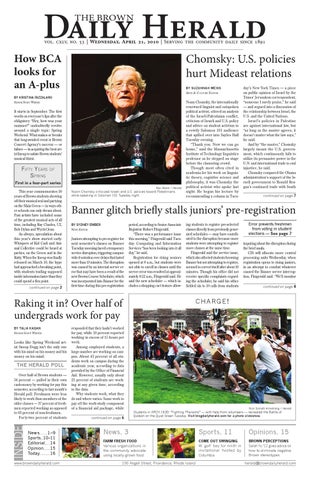
Noam Chomsky criticized Israeli and U.S. policies toward Palestinians while speaking in Salomon 101 Tuesday night.
Noam Chomsky, the internationally renowned linguist and outspoken political activist, offered an analysis of the Israeli-Palestinian conflict, criticism of Israeli and U.S. policy and advice on student activism to a rowdy Salomon 101 audience that spilled over into Sayles Hall Tuesday evening. “Thank you. Now we can go home,” said the Massachusetts Institute of Technology linguistics professor as he stepped on stage before the clamoring crowd. Though most often cited in academia for his work on linguistic theor y, cognitive science and philosophy, it was Chomsky the political activist who spoke last night. He began his lecture by recommending a column in Tues-
Looks like Spring Weekend artist Snoop Dogg isn’t the only one with his mind on his money and his money on his mind.
The Herald Poll
inside
Over half of Brown students — 56 percent — pulled in their own cash-money by working for pay this semester, according to last month’s Herald poll. Freshmen were less likely to work than members of the older classes — 37 percent of freshmen reported working as opposed to 63 percent of non-freshmen. Forty-two percent of students
News.....1–9 Sports..10–11 Editorial....14 Opinion.....15 Today........16
www.browndailyherald.com
continued on page 7
Banner glitch briefly stalls juniors’ pre-registration By Sydney Ember News Editor
Juniors attempting to pre-register for next semester’s classes on Banner Tuesday morning faced a temporary service disruption, triggering campuswide frustration over delays that lasted more than 10 minutes. The disruption was caused by an internal server error that may have been a result of the new Brown Course Scheduler, which was incorporated into Banner for the first time during this pre-registration
period, according to Senior Associate Registrar Robert Fitzgerald. “There was a performance issue this morning,” Fitzgerald said Tuesday. Computing and Information Services “has been looking into it all day,” he said. Registration for rising seniors opened at 8 a.m., but students were not able to enroll in classes until the server error was resolved at approximately 8:12 a.m., Fitzgerald said. He said the new scheduler — which includes a shopping cart feature allow-
ing students to register pre-selected classes directly from previously generated schedules — may have contributed to the disruption because more students were attempting to register more classes at the same time. Fitzgerald said the service issue, which also affected students browsing Banner but not attempting to register, seemed to correct itself after about 10 minutes. Though his office did not receive specific complaints regarding the scheduler, he said his office fielded six to 10 calls from students
Raking it in? Over half of undergrads work for pay By Talia Kagan Senior Staf f Writer
day’s New York Times — a piece on public opinion of Israel by the Times’ Jerusalem correspondent, “someone I rarely praise,” he said — and segued into a discussion of the relationship between Israel, the U.S. and the United Nations. Israel’s policies in Palestine are against international law, but “as long as the master agrees, it doesn’t matter what the law says,” he said. And by “the master,” Chomsky largely meant the U.S. government, which continuously fails to utilize its persuasive power in the U.N. and international trade to end injustice, he said. Chomsky compared the Obama administration’s support of the Israeli government to Ronald Reagan’s continued trade with South
responded that they hadn’t worked for pay, while 10 percent reported working in excess of 15 hours per week. Among employed students, a large number are working on campus. About 43 percent of all students work on campus during the academic year, according to data provided by the Office of Financial Aid. However, usually only about 25 percent of students are working at any given time, according to the data. Why students work, what they do and where varies. Some work to pay off the work-study component of a financial aid package, while continued on page 6
Error prevents freshmen from voting in student elections — See page 7 inquiring about the disruption during the brief snafu. CIS will allocate more central processing units Wednesday, when registration opens to rising juniors, in an attempt to combat whatever caused the Banner server interruption, Fitzgerald said. “We’ll monitor continued on page 4
C h ar g e !
Nick Sinnott-Armstrong / Herald
Students in ARCH 1630: “Fighting Pharaohs” — with help from volunteers — recreated the Battle of Qadesh on the Quiet Green Tuesday. Visit blogdailyherald.com for a photo slideshow.
News, 3
Sports, 11
Opinions, 15
farm fresh food Various organizations in the community advocate using locally-grown food
come out swinging W. golf ties for ninth in invitational hosted by Columbia
Brown perceptions Sarah Yu ’11 gives advice on how to eliminate negative Brown stereotypes
195 Angell Street, Providence, Rhode Island
herald@browndailyherald.com
Page 2
THE BROWN DAILY HERALD
50 Years Of Spring
Wednesday, April 21, 2010
“Brown is the king of individuality.” — James Hinton ’11, booking chair for BCA
With eyes on the forecast, U. preps for Spring Weekend continued from page 1
“I was so excited,” remembers Sam Barney ’12. “I saw my friend’s status on Facebook, immediately researched to make sure it was correct, and then ran upstairs to tell my friends.” This year’s lineup combines musical legends and up-and-coming artists. Headlining the shows this weekend are MGMT on Friday and Snoop Dogg on Saturday. The concerts will also feature the Black Keys, Wale, Major Lazer and Last Good Tooth, a local student band. That makes six artists, two days and one agency to make it all come together. With 6,013 undergraduates to please, it’s hard to fathom how BCA tackles the process of artist selection — but somehow it does. Capturing the zeitgeist With 50 years of successes behind Spring Weekend, BCA started with a bit of modern technology its forerunners would have jumped over the moon for — iTunes. To find out what Brown students are listening to at the moment, BCA takes a “loose and dirty sampling of about 12 students’ iTunes accounts” off of the Brown network of shared iTunes libraries, said BCA booking chair James Hinton ’10. The agency is “trying to capture the zeitgeist,” Hinton said. Though this year marks the 50th anniversary of the concerts, BCA chose not to change its methods for finding and selecting artists because the system has been successful in the past, Hinton said. The agency begins its search at the beginning of the year by compiling a list of 100 to 200 possible headliners, Hinton said. This year’s list totaled 145 potential artists and bands.
In November, the Undergraduate Council of Students’ poll goes online. Students are asked to write in their top five choices for Spring Weekend performers — not only to help out BCA, but also for the chance to win tickets to the concerts, an incentive for students to take a few minutes to fill out the form. Hinton explained that BCA uses these results to generate a histogram displaying the amount of times students mentioned each artist. The “super-popular” results, generally the top 20 or so, are automatically checked for their availability. Then, the negotiations begin. Booking Brown “The polls don’t dictate our decisions, but they do serve as a good barometer for student interest,” said Alex Spoto ’11, BCA’s administrative chair. Negotiations generally come down to scheduling, money and availability, he added. This is especially true when responses like Lady Gaga pop up over and over again. “Someone who could sell out Giants Stadium could never be booked by any college,” Hinton said. In negotiations, BCA does hear a lot of no’s, Hinton said, but it’s not for a lack of trying on their part. This year, BCA almost secured both the Beastie Boys and Missy Elliot, but due to health reasons and scheduling conflicts, respectively, both had to decline. “To move a group of that caliber, you need a lot of pull,” Hinton said of the Beastie Boys. “I was honored that they even talked to us.” The problem with many big artists is that they are very “routed,” meaning that they are following specific tour routes either across or circling the
sudoku
Daily Herald the Brown
Editorial Phone: 401.351.3372 | Business Phone: 401.351.3260 George Miller, President Claire Kiely, Vice President
Katie Koh, Treasurer Chaz Kelsh, Secretary
The Brown Daily Herald (USPS 067.740) is an independent newspaper serving the Brown University community daily since 1891. It is published Monday through Friday during the academic year, excluding vacations, once during Commencement, once during Orientation and once in July by The Brown Daily Herald, Inc. Single copy free for each member of the community. POSTMASTER please send corrections to P.O. Box 2538, Providence, RI 02906. Periodicals postage paid at Providence, R.I. Offices are located at 195 Angell St., Providence, R.I. E-mail herald@browndailyherald.com. World Wide Web: http://www.browndailyherald.com. Subscription prices: $319 one year daily, $139 one semester daily. Copyright 2010 by The Brown Daily Herald, Inc. All rights reserved.
country, Hinton said. Consequently, BCA makes sure to check which artists are going to be near either New York City or Boston before beginning negotiations. Hinton added that it’s easier to schedule smaller artists who mostly book gigs one at a time and don’t have tour schedules they must follow. This year’s selection was part luck, part work. “Snoop was a very lastminute opportunity,” Hinton said. “He got a cancellation, and we got really lucky.” MGMT was at the top of BCA’s poll this year, Spoto said, and the organization moved early on to get them. Once the headliners are in place, the agency has more freedom in determining the rest of the line-up, Hinton said, allowing the group to focus on finding a variety of musical acts. However tricky the negotiations might be, Brown has garnered a certain standing in the music industry. “Brown is a really desirable place to be,” Hinton said. Spring Weekend has earned the reputation of being a kind of festival, Hinton said. Compared to other colleges and universities, Brown is a very musically conscious campus, he added. “At other schools, you have to get over the ‘Who’s that?’ factor,” Hinton explained. “You don’t have that at Brown.” Busting the budget A deciding factor when booking an artist is the price. BCA is funded by the Undergraduate Finance Board, and this year there were rampant rumors running around campus about huge increases in BCA’s budget. “BCA has historically received the most money of student groups over the years,” said Jose Vasconez ’10, UFB Chair. In the past BCA has received around $100,000, Vasconez said, adding that this year the agency received substantially more because it is the concert’s 50th anniversary. BCA’s sizable budget reflects the importance of Spring Weekend to the Brown community. “Brown is the king of individuality. For Brown, this is a last thread of community,” Hinton said. “We don’t have chapel anymore. … We don’t go to football games. With the money that I paid for the Student Activities Fee, I can’t imagine a better use for it.” “I feel like it was worth it,” said Justin Wolfe ’12. “I like the idea as long they keep getting good bands.” Austin Peters-Miller ’12 was more skeptical. “We spent a lot of money on big names and not necessarily good music,” he said. “BCA is high on money but low on creativity.” “Spring Weekend is the only event that brings most of Brown students together,” Vasconez said, adding that the event inspires community-building among students in ways other Brown events do not. Surviving the speakeasy Absent from this year’s pre-Spring Weekend event schedule was BCA’s annual Battle of the Bands. Each year, bands from the Brown community have traditionally competed for a spot on the Spring Weekend stage.
Do you approve or disapprove of the Brown Concert Agency’s choices to play at Spring Weekend? Don’t know/ no answer 8.0%
Strongly disapprove 2.7%
Disapprove 9.7% Strongly approve 42.4%
Approve 17.4%
Katie Wilson/Herald
The Herald poll was conducted on March 22 and 23 and has a 3.5 percent margin of error with 95 percent confidence. A total of 714 Brown undergraduates completed the poll, which The Herald administered as a written questionnaire to students in the lobby of J. Walter Wilson during the day and in the Sciences Library at night.
But this year, BCA decided early on that they had not seen enough groups at the Battle of the Bands competition, Hinton said. Consequently, a subgroup of BCA, called The Agency, hosted “Speakeasy Sessions” throughout the year. The shows featured three times as many bands as Battles had in the past, he said. It was never clearly stated that the bands would be up for a spot on the Spring Weekend stage, said Agency chair Akshay Rathod ’10. The sessions included a panel of judges from BCA, much like the Battle of the Bands had, but the concerts took place over a longer period of time. “Last Good Tooth emerged as a very strong group,” Rathod said. Though BCA administrative chair Spoto is currently in Last Good Tooth, Hinton said the band was under consideration for the Spring Weekend spot before Spoto became a member and that he was not part of the decision-making process. Hinton said Last Good Tooth has a large following both at Brown and at the Rhode Island School of Design, which influenced BCA’s decision. According to Rathod, there were two rounds of auditions at the beginning of each semester to be in one of the four Speakeasy shows. The selective process allowed BCA to see how serious the bands were about performing. Some students said they were displeased with this method of choosing a student band to play at Spring Weekend. “I don’t think it’s the most appropriate way of doing things,” said Jamilya Ramos-Chapman ’11. “Battle of the Bands just sounds more epic. They survived. They won this contest. They deserve to play at Spring Weekend.” According to Gabriel Doss ’10, emcee of last year’s Battle of the Bands winner, Doss the Artist and the PGA Tour, the status of the Battle of the Bands was unclear until recently. “On the whole, we were disappointed with the lack of transparency,”
he wrote in an e-mail to The Herald. “But we’ve played a show with Last Good Tooth, they’re a good band and we think it’s awesome that they get a turn to shine this year.” In tune with the times? According to a Herald poll conducted last month, the majority of students — 79.7 percent —approve of BCA’s selections. But 12.4 percent of students said they disapproved of the final artist lineup. Several students interviewed by The Herald said they felt that BCA was a little bit behind the times in their choices. Ramos-Chapman said she had some doubts about the effectiveness of the UCS poll results. “Snoop Dogg popped up a lot? I mean, he was the stoner of 2001.” “We got U2 in the ’80s when they were big. Now we get Snoop 10 years too late,” added Shawn Patterson ’12. Patterson also said he felt that Snoop Dogg didn’t best represent Brown. “I don’t think he raps about things Brown students support,” he said. Other students are excited to see the rap legend. Brittany King ’12 said, “From what I’ve heard about Snoop Dogg, he’s an amazing performer.” Drew Kunas ’12 said he is just “glad there’s a lot of grass on the Main Green.” MGMT has also garnered mixed reviews. According to Kunas, “the only thing that could make Chicken Finger Friday better is MGMT.” On the other hand, Amanda Kim ’12 said she thought BCA “could have done a lot more with the money they got,” calling MGMT “so two years ago.” Still, the air is full of enthusiasm for this year’s Spring Weekend. “I’m pro-Spring Weekend regardless,” said Jenny Bloom ’12. “It’s sheer excitement just for Spring Weekend.” With the excitement continuing to build — and 50 years of performances to live up to — one question remains: Will BCA be able to deliver?
Wednesday, April 21, 2010
THE BROWN DAILY HERALD
C ampus N EWS
Page 3
“I liked the feeling of community.” — Molly Bledsoe ’12, intern and volunteer at Farm Fresh RI
Eating local, from farms to College Hill Fewer pre-frosh mark
By Brielle Friedman Staf f Writer
It’s 10:30 a.m. on a Sunday morning. Most students would want to crawl back under the covers and go back to sleep. But thoughts of research papers, problem sets and chemistr y labs due the next week force students to pull themselves out of bed, throw on their jeans and brace the morning rain. The Sharpe Refectory is crowded with students who are still hungover from the previous night’s activities. Some watch Jose as he flips and spins ID cards through the air. Students look around the dining hall, trying to decide which line is most worth it, and their eyes settle on the omelet bar–– the line has already begun to creep around the corner. Students sometimes complain about the dining hall’s long lines and the quality of food in the Ratty, but how many take the time to think about where all the food in the dining hall comes from? Or about the ef for t it takes to get those ingredients from the farm to Ratty plates? Local food for more people There are several organizations within the community that work to increase access to locally grown sustainable food. Farm Fresh Rhode Island is one of them. The organization was started by Brown students in 2004, and, although the organization is not associated with the University, Jennifer Baumstein ’08, who is working at Farm Fresh as a year-long volunteer with AmeriCorps VISTA, said Brown has nevertheless been a strong suppor ter of the organization’s mission. For example, each year Brown Dining Ser vices hosts the Local Food Forum in Andrews Dining Hall and supports the Wriston Farmers’ Market in the fall. Until last November, the Center for Environmental Studies held the organization’s offices. Farm Fresh’s offices are now located in Pawtucket, in the same building as the winter farmers’ market, a location change Molly Bledsoe ’12, an intern and volunteer with the organization, said is
mutually beneficial. Looking for something worthwhile to do over break, Bledsoe started volunteering with Farm Fresh last December. She liked working with the organization so much that she interned over the summer through a grant from the Swearer Center for Public Ser vice and continued her involvement when classes began again in the fall. “I liked the feeling of community, of getting to know the farmers and the customers,” Bledsoe said. Though Bledsoe said Farm Fresh does not have enforceable product standards, she said the organization uses the 60/40 rule for all produce farmers sell in the markets — 60 percent of the products have to be from the farmer’s own farm, while the other 40 percent can be from farms in Massachusetts, Connecticut or Rhode Island. “It diversifies the market but keeps it regional,” Bledsoe said, adding that such a rule is helpful especially because Rhode Island is such a small state. Baumstein said part of Farm Fresh’s goal is to distribute local food to as many people as possible, not just those that visit farmers’ markets. Because only a few Rhode Island farmers sell wholesale, Baumstein said Farm Fresh tries to encourage large institutions, like hospitals, universities and other schools, to “buy into the idea that local food is better for the community and better for your health.” She said the size and influence of these institutions enable them to create large and lasting changes within the community. And it appears these changes are having a substantial effect. Bledsoe said Farm Fresh’s Market Mobile –– a distribution program that brings locally produced vegetables, fruit, yogur t and cheese to organizations and individuals –– has “grown 10 times faster than we thought it would” during the course of the program’s pilot year. As par t of the organization’s initiative to connect low-income people with better access to local, healthy and fresh food, Farm Fresh
accepts food stamps at many of its farmers’ markets. Wholesome Wave Foundation and the Rhode Island Foundation provide the funding for the organization’s Bonus Bucks program. Through Bonus Bucks, the amount each consumer spends using an electronic benefit card is doubled up to $10. Bledsoe said the organization is also working to increase the amount of food corner stores order from Farm Fresh, with the idea that many of these stores primarily ser ve low-income members of the community. Small farms disappearing Bringing local food directly from farmers to customers is also a goal of Little Rhody Foods Inc., a Rhode Island food distributor. Eli Berkowitz, president and owner of the company, said Little Rhody is tr ying to help local farms sur vive by making sure farmers receive the majority of their products’ profits. Berkowitz said small farms have almost disappeared. “There’s no one left,” he said. “It’s not a ver y lucrative business to be in.” He said the majority of farms today are either ver y large or ver y small, something he said he feels is true for most businesses in the United States, and a fact that makes companies like Little Rhody increasingly more important. “You need to support local businesses because it supports local jobs,” Berkowitz said. “The con is that people are going to pay more for it.” To compete with larger companies like Garelick Farms, Berkowitz said Little Rhody focuses on having quality products. All of its milk is processed through cold separation, a technique Berkowitz said ensures a better taste than other methods of milk production. He said this process gives Little Rhody’s milk a thicker, creamier taste, making its “skim milk taste more like Garelick’s 1 percent.” Though Little Rhody Foods has been around for about six years, Berkowitz said he is always surprised by how many people in Rhode Island still don’t know it continued on page 4
‘undecided’ for 2014 By Clare de Boer Staf f Writer
Do 97 percent of admitted freshmen really know what they want to concentrate in? Statistics released by the University indicate that only 3 percent of students admitted to the Class of 2014 chose “undecided” as their concentration. But Dean of Admission Jim Miller ’73 wrote in an e-mail to The Herald that the number, which is lower than last year’s, reflects a wording change on the undergraduate application. “The decrease this year in the percentage of applicants choosing ‘undecided’ is a function of the way we asked the question about intended concentrations, not a change in the way students are thinking about their Brown academic careers,” Miller wrote. Unlike in past years, the application for next year’s freshman class asked students to “characterize (their) level of commitment to this field of study” by selecting one of three options. Incoming students who applied as “decided” expressed a range of certainty in their direction of study, according to Miller. “We suspect the new language led people who were really undecided to select several potential concentrations and then choose the ‘interested, but open to other possibilities’ level of commitment (the lowest on the continuum), which was another way of saying ‘I’m pretty undecided,’ ” Miller
wrote. Many incoming students said they didn’t think applying as “decided” would change their chances of admission. “As an applicant, it was made ver y clear to me that whatever concentration I chose at the beginning was by no means permanent, so I think there were probably a lot of applicants just filling in any box that sounded interesting,” wrote Will Peterson ’14 in a message to The Herald. “I think I knew that it was better to indicate some sort of concentration to give my application some context.” “Even though I’m pretty undecided about what I’m going to study, I didn’t apply as undecided,” he added. “I’m pretty sure that I said I wanted to go into Media, Publishing and Journalism, or whatever that area was. I might have possibly marked Linguistics.” Marjorie Palmeri ’14 wrote in a message to The Herald that she has always been interested in science, so she listed biology as her primar y concentration. Though her mind could change in the future, she wrote, “as of now, that is the direction I want to take.” Some admitted students said they felt it was better to put something than to put nothing. “Even though Defense Against the Dark Arts is a competitive field, I feel that putting it on my application helped, if only a little,” wrote admitted student Tim Balcavage in a message to The Herald.
Page 4
THE BROWN DAILY HERALD
C ampus N EWS
Wednesday, April 21, 2010
“Real food is something that is really important.” — Emily Viggiano ’12, BDS Real Food Initiative progress coordinator
Juniors frustrated by With purchases, U. seeks ‘real food’ mishap on Banner continued from page 3
continued from page 1
it in the morning and see what happens,” he said. “Hopefully, nothing happens, and it’s a non-event.” Students said they were able to log in to Banner and navigate to the screen that would allow them to add or drop classes, before being directed to a window indicating an internal server error. Neither refreshing the page nor attempting to navigate to the previous page alleviated the problem, said Arune Gulati ’11. “I opened up two browsers, and that didn’t work,” he said, adding that Banner continued to redirect him to the error page for about 20 minutes. “It happened to a bunch of my friends, too.” Ariel Hudes ’11 said she logged in to Banner to register for a specific, capped class, only to find that the site was not working. “I started yelling through the walls making sure it wasn’t just my computer malfunctioning,” she said. After her suitemates confirmed the server disruption, she said she decided it would be safe to wait until later in the morning to register. Students also said the frustration induced by the error page — evident on many social networking sites — brought to mind last month’s server error that inhibited many students from purchasing Spring Weekend tickets. Though he was ultimately not shut out of classes he intends to take next fall, Gulati said he thought the people in charge of Brown’s servers would have “learned from the mistake of Spring Weekend tickets.” And though the server disruption did not affect him directly because
he did not attempt to register until after the problem had been resolved, Marc Firestein ’11 also said he was concerned with the malfunctioning servers. “I was one of those people who sat through the Spring Weekend fiasco,” he said. “It’s interesting that they kind of allowed it to happen” again. Though the scheduler was the only new feature on Banner, Fitzgerald said both the registrar’s office and CIS were not sure the program was the source of the service problem. During the first hour of the preregistration period, there were 882 students who recorded registrations, Fitzgerald said, adding that this was a dramatic increase from previous years, when about 500 rising seniors enrolled in classes. Though there is no way to determine whether students registered through the traditional Banner process or by using the new scheduler, he said Banner recorded more simultaneous registrations, indicating more students were registering classes at one time yesterday than during past registration periods. Before yesterday’s registration opened, more than one-third of students had already started organizing their schedules through the scheduler’s shopping cart, Fitzgerald said, adding that many of the carts were “pretty substantial.” Though unrelated to yesterday’s error, the scheduler also experienced service disruptions last weekend, when it was taken down for a “minor tweak” to the suggestion link on the Web site, which proved incompatible with students’ Gmail accounts, Fitzgerald said.
exists. Berkowitz said people often get into specific habits while shopping in supermarkets. Consumers often blindly buy certain products without considering how what they buy affects their community, he added. He said that’s one of the reasons companies color code different versions of products, such as eggs, so that shoppers can easily identify each product without having to stop and take the time to actually read the labels.
Improving sustainability Emily Viggiano ’12 was hired in November by Dining Ser vices as a Real Food Initiative progress coordinator. “Real Food’s mission is to use the purchasing power of college dining facilities to support food that is locally and community based, fair, ecologically sound and humane,” she said. As an intern, Viggiano’s role is to do “an assessment of our current purchases and to get baseline data on how much we’re currently purchasing that is ‘real.’ ” She said she is also looking into ways Dining Ser vices can make more “real food” purchases. Brown also has two community har vest interns who focus on facilitating more local food into the dining halls and eateries on campus. According to Viggiano, Brown is currently purchasing about 65 percent of its milk from Little Rhody Foods and the rest of the purchases from Garelick. Ann Hoffman, director of administration for Dining Services, wrote in an e-mail to The Herald that it is difficult to know exactly what percentage of food is purchased locally because the term “local” does not currently have an agreed-upon definition. But she wrote that according to the College Sustainability Report
Card, Brown partners “with more than 20 local farms and 31 local processors.” Hoffman also wrote that the University regularly purchases items from farms such as Barden Orchards, Hill Orchards and Mello’s Farm. Brown isn’t the only university that has begun to buy a greater percentage of its food locally. Berkowitz said Providence College, Johnson and Wales University and the Rhode Island School of Design all buy products from Little Rhody Foods. According to Pierre St-Germain, RISD’s executive chef, about 30 percent of what its dining halls buy and serve is local. He said the chicken that RISD uses in its entrees all comes from Wellington Farms in western Massachusetts, and that whenever possible, all apples are purchased locally. “We tr y and incorporate as much of that as possible into our daily menus,” St-Germain said. He said there is a higher cost associated with certain meat products, like chicken or hamburger, because of what is required to raise the animals naturally and without ar tificial feed. He also said the cheese RISD purchases from Narragansett Creamer y tends to be more expensive because it is “artisan cheese,” though in his mind it is “definitely worth” the extra cost. But other products, especially certain fruits and vegetables such as apples, are actually less expensive if bought locally. St-Germain also said that purchasing local food has become “leaps and bounds easier” with Farm Fresh’s Market Mobile. “We’ve been able to streamline the products we get each week,” he said. He said RISD tries to make thoughtful choices whenever its dining ser vices purchases food for the campus community. For example, he said the dining halls
“went to great lengths” to find locally produced soy milk because of the item’s popularity among students. “I think we have an exceptional dining ser vice,” St-Germain said, adding that he encourages Brown students to take a walk down the hill to tr y one of RISD’s eateries, which is now easier than ever since Brown students can add RISD meal credits directly onto their meal plans. Beyond the Ratty In high school, Viggiano said she was involved with environmental and social justice work, but nothing directly related to sustainable food. She said the real food movement is something she’s learned about pretty recently in college. “It’s a ver y optimistic issue to work on,” Viggiano, said. In the sustainable food movement, “there’s an image of what could be,” she added. This year, Viggiano, along with the other three members of her Graduate Center suite, went off meal plan. She said they get the majority of their food through the market share program, which is run by Farm Fresh’s Market Mobile during the winter and spring months. “Each of us cooks once a week on the weekdays,” she said. Despite the inconveniences of sharing a communal kitchen, Viggiano said it is fun to cook with her friends. Cooking and eating together is something she said is culturally impor tant, and her participation in the market share program makes her feel as though she’s living more by her values. “Real food is something that is really impor tant,” Viggiano said. “It’s healthier, better for the local environment and the local economy.”
The other BDH blogdailyherald.com
Page 5
THE BROWN DAILY HERALD
C ampus N EWS
Wednesday, April 21, 2010
“We work on a case-by-case basis.” — Elizabeth Gentry, assistant vice president of financial and administrative services
This semester likely the Progress on S&J recs remains steady last for pre-reg waiver By Warren Jin Contributing Writer
By Mark Raymond Staff Writer
The University is extending a policy allowing students with unpaid tuition balances of over $1,000 to pre-register for classes, but this will likely be the last semester of the program, according to Elizabeth Gentry, assistant vice president of financial and administrative services. Approximately 100 students will utilize this waiver program during the current pre-registration period, which began Tuesday, Gentry said. This is less than half the number of students who took advantage of the program last registration period. The waiver program was originally put in place during the preregistration period of fall 2008, and has been available each semester since then. “In most of the time I’ve been here, we haven’t had to do anything like this,” Gentry said, “But the financial situation we faced in 2008 warranted the University taking some unusual steps to help families in need.” Gentr y said that while she is not precisely sure why some families have had trouble paying, the economic crisis has increased the number of families that could not pay their bills on time. “Some families have the money and are just late to pay, while others are actually in need of assistance,” Gentry said. Regardless of the reasons for families’ inability to pay, the University felt it necessary to keep this program going through this current pre-registration period, though
the Office of the Provost did not formally announce this extension, as it had in previous semesters, Gentry said. According to Gentry, this lack of a formal announcement is in part due to the fact that the University does not plan to extend this policy to the next pre-registration period. “We’re reaching out to affected students to let them know it’s available, but we’re also letting them know that this is probably the last time,” Gentry said. “We haven’t been seeing the level of difficulty we had initially anticipated, so it’s not likely that we will continue offering the waivers.” Gentry added that a final decision has not been made and that, given certain circumstances, the program could be extended once again. Even without this waiver in place, the University plans on continuing its outreach to families in need and ensuring that there is communication between both parties. “Generally when working with families, we work on a case-bycase basis,” Gentry said. “We were communicating with families about their financial difficulties even before this program was initiated.” Gentry said the effects of the 2008 crisis left many families unsure of their financial situations, but some of that initial confusion is gone now. “As things have started settling down, families have had time to adjust their financial packaging in order to meet their needs,” Gentry said.
In the three-and-a-half years since the University Steering Committee on Slaver y and Justice issued its report on Brown’s former links to the slave trade, steady progress has been made on its recommendations — which included creating a slaver y memorial, a center for the study of slaver y and justice and a $10 million fund to help support local public schools. The committee also recommended expanding the Africana studies program at Brown. The work of the highly publicized committee has sparked similar investigations at other institutions into their roots, said Marisa Quinn, vice president for public affairs and University relations. “There has been this other influence for other institutions to take on this same kind of endeavor,” Quinn said. “These are significant and lasting initiatives.” Contemplating a memorial The University’s Public Ar ts Committee, tasked with commissioning a memorial commemorating Brown’s and Rhode Island’s ties to the slave trade, met in February to discuss locations for the memorial, said Jo-Ann Conklin, director of the David Winton Bell Galler y and a member of the University’s Public Arts Committee. Potential locations include the main campus as well as the Jewelr y District, though the committee is leaning towards placing it on Brown’s main campus, Conklin said. The committee, which consists of seven permanent members and a few temporar y members invited
for “diversity and historic background,” will meet again in May, and expects to choose an ar tist and have a proposal by December, Conklin said. “It needs to be an inviting space for contemplation and thought,” she said. Though the committee will choose among artists’ proposals, the final product will be up to the artist to decide. “I really think it’s best to leave this to the artist to come up with,” she said, though it is important that the memorial “reflect the findings of the report.” A new center’s creation Minor progress has been made toward a new center for the study of slaver y and justice since an advisor y committee reported its recommendations for the center, said Provost David Ker tzer ’69 P’95 P’98. The 2008 report from the advisor y committee proposed the creation of the Institute on Slaver y and Justice to promote the study of issues related to slaver y, genocide, human trafficking and other crimes. The committee recommended the creation of an endowment and a dedicated space to support the institute. In a collaborative effort between the histor y, American civilization and Africana studies departments, the University has been looking for a director to head the center, Kertzer said. Though an offer was recently made to a historian, negotiations fell through, Kertzer said. Nonetheless, he said the University will re-launch the search. “We hope to identify someone in the coming year to join us in the
summer of 2011,” he said.
Local Education Programs suppor ting local education inspired by the steering committee’s repor t include the education depar tment’s Urban Education Fellows program and the University’s Fund for the Education of the Children of Providence. The Urban Education Fellows program is a tuition-free program that requires fellows to work for a minimum of three years within the Providence school system either teaching or determining policy, with the goal of enriching local public schools, said Chair of the Education Department Kenneth Wong. Six fellows will graduate this year, compared to the nine that graduated last year, Wong said. “From my perspective, that’s the most significant investment,” Wong said. “Human capital.” The fund — for which the University has currently raised only $1.5 million, of an intended $10 million — disbursed grants last year that included a grant to provide graphing calculators to all secondar y students in Providence, Wong said. But he said the fund is not likely to award more grants of that size in the near future. “This is an ongoing initiative,” Wong said. “We will probably wait for another year to make a significant investment in that regard.” Brown is also working with local government and schools in various other ways, including teacher education and revising Rhode Island policy, Wong said. “Instead of looking back, we should be thinking about the future,” he said.
Page 6
THE BROWN DAILY HERALD
C ampus N EWS
Wednesday, April 21, 2010
“We’re unique in the amount of responsibility we place in students.” — Ann Hoffman, Brown Dining Services
Fewer freshmen working, but ‘uptick’ in on-campus jobs continued from page 1 others just want a little extra pocket money. Some shelve books in the Rockefeller Library basement, others hem costumes for the theater department and some even take off all their clothes for art classes. Work it out On-campus student employment has stayed relatively steady for the past decade, according to Tracy Frisone, senior assistant director at the Office of Financial Aid. But she said there has been a “slight uptick” in employment numbers during the past two academic years, which she attributed in part to the current economic climate. “There are certainly more students seeking employment,” she said, cautioning that it is not a particularly large increase. Those who are working are not necessarily working more hours, she said. An average work week for an on-campus student employee is between eight and 10 hours, a rate that has remained steady for the past several years, according to Director of Financial Aid James Tilton. This is the target amount of hours that his department hopes students will work, he said. “We really don’t want them to work, if we can help it, more than 10,” he added. Roughly 41 percent of all students received need-based financial aid from the University for this academic year, according to Tilton. There is a work-study expectation, partially funded by the federal government, included in all financial aid packages, he said. An additional 100 students qualified for federal work-study but not need-based scholarships, Frisone wrote in an
e-mail to The Herald. The University’s new financial aid initiatives, begun last year, have given families more options for tuition payment, according to Tilton. Financial aid options might help explain why fewer freshmen are working. Beginning with the class of 2007, Brown stopped requiring first-years to work, giving them the option of taking out loans. As of last year, students on full financial aid receive a University Work Scholarship for their first year in lieu of their work-study expectation. Students receiving partial aid or who otherwise qualify for work-study do not receive this scholarship. But students are not required to work on campus to fulfill this requirement. “At least 40 percent of the students who receive workstudy in their financial aid don’t work (an on-campus job),” Frisone said. They may instead choose to rely on outside scholarships, summer savings, off-campus jobs or loans, she added. Freshmen might also choose to wait to begin working until they feel comfortable and adjusted to Brown, according to Frisone. Money munchies Brown Dining Ser vices is the largest on-campus employer, with a current employee count of roughly 300 students, according to Ann Hoffman, Dining Services’ director of administration. That number does not include the student groups who work group shifts at satellite eateries in order to raise money for their organization. Hoffman said she has noticed a recent increase in student demand for employment, which is “ver y much consistent with the downturn in the economy.”
This fall “was the first time BuDS had a waitlist in seven or eight years,” said BuDS General Manager Melanie Masarin ’12. But anecdotally, Hoffman said she finds students working fewer hours than they used to, which she attributed in part to a change in the pay-raise structure several years ago. BuDS currently requires workers to work a minimum of eight hours per week, but more people have been requesting exceptions, Hoffman said. The department has considered changing the policy and will continue to examine the issue, but “if you go too low, you risk losing the commitment and level of engagement,” she said. Masarin has a more involved job than most. She generally works about 15–20 hours a week, though that number can climb to 25 during busy periods, she said. Masarin, an international student, started working for BuDS in part because she wasn’t legally allowed to work off campus her freshman year, she said. The large time commitment has helped her learn to organize her time better, she said. Though there are sacrifices — “it comes in conflict with my sleep more than my schoolwork,” she added. “We’re unique in the amount of responsibility we place in students,” Hoffman said. Other large on-campus employers include the Department of Athletics and the divisions of engineering and biology and medicine, Frisone said. Cash money On-campus minimum wage is $8.20, which is above both federal and state minimum wage, Tilton said. But the majority of students — 95 percent — are making more than that, he said. Brown’s student salaries are generally comparable to other urban institutions, Tilton added. Among those working oncampus, average yearly earnings are roughly $1,500, according to Frisone. The level of pay usually correlates to the level of skill and responsibility involved, she said, adding that many of the higher-paid jobs tend to involve web development. The diversity of pay and employment type is apparent on the Student Employment Web site, which includes both on-campus and offcampus job listings. On Monday, salaries offered in the on-campus division ranged from the minimum of $8.20 per hour, for a Third World Center program coordination position, to a maximum of $30 per hour, for an instructor in pilates, yoga and aerobics. However, “working for pay” at Brown might not even entail a set hourly wage. Baxter DiFabrizio ’13 hasn’t worked a job this year, in part because he doesn’t want the “rigidity” of a steady work schedule. But he has earned some money by participating in several psychology and Brown University Social Science Experimental Laborator y experi-
On average, how many weeks have you worked for pay this semester?
Anna Migliaccio / Herald
A majority of students have worked for pay this semester, with 9.5 percent of undergraduates working a weekly average of 15 or more hours.
ments, which have more flexible schedules. BUSSEL, which is run by the department of economics, runs experiments in which the amount of money students earn depends in part on the decisions that they and other students make during the course of the experiment. In some cases, students can walk away with $40 cash after little over an hour. In some, they might walk away with nothing. DiFabrizio’s motivation to participate depends on the department. “With psychology, it’s the experiment. With econ, it’s definitely the money,” said the intended psychology concentrator. Beyond Brown Some students turn to multiple jobs to bolster their paychecks. Michelle Norworth ’10 started working at Brown the second semester of her sophomore year, checking IDs at Meehan Auditorium. After working as a part-time transcriptionist for an off-campus firm last summer, she continued that job — whose hours can vary from zero–10 hours a week — while returning to her shifts as BuDS cart worker. This semester, she has worked up to 30 hours in one week when she had a full schedule for both jobs, but otherwise works 20–25 hours a week, she said. Last week, Nor wor th began an additional on-campus job. She said this full work schedule is only possible because she is a senior enrolled in three easy classes who already has a job for next year — and she isn’t writing a thesis. Other students choose to work solely off campus. Rebecca Smith ’12 began working at Blue State Coffee last month in large part because she liked the atmosphere and already spent a good deal of time there — something she hasn’t found on campus, she said. Many of the off-campus employers listed on the student employment Web site are parents looking
for babysitters. Providence resident David Shikiar wanted a college student babysitter because students are young, ambitious and curious “about the wider world,” he said. Takin’ care of business But Kayla Urquidi ’11, who works at the Student Activities Office, prefers the convenience of an on-campus job location, selecting hours that with the breaks between her classes, she said. She also appreciates that the University employers are understanding of a student’s schedule, letting her leave early for class and not expecting her to work during vacations. When it comes to student jobs, some — like nude modeling — are more exotic than most. Daniel Stupar, adjunct lecturer in Visual Art, coordinates the hiring of nude models for visual arts classes. He was very surprised with the volume of applications he received after the job was posted in Morning Mail — about 40 applications for only eight to 10 spots, he said. He sought models with sports, yoga, or martial experience to ensure that they had the stamina to hold poses for up to 20 minutes. While some might worr y it would be awkward to model for fellow students, Stupar said that those applying knew what they were signing up for, and were “really casual about it.” Still, he added, “It’s probably one of the strangest jobs you could have at Brown.” The Herald poll was conducted on March 22 and 23 and has a 3.5 percent margin of error with 95 percent confidence. A total of 714 Brown undergraduates completed the poll, which The Herald administered as a written questionnaire to students in the lobby of J. Walter Wilson during the day and in the Sciences Library at night. For the sample of just freshmen, the margin of error is 6.8 percent. For the sample of non-freshmen, the margin of error is 4.0 percent.
Page 7
THE BROWN DAILY HERALD
C ampus N EWS
Wednesday, April 21, 2010
“My main regret is I was much too mild.” — Noam Chomsky
Error disenfranchises many first-years Research board aims for efficiency, accessibility By Nicole Boucher Senior Staf f Writer
The polls for the student government elections opened on MyCourses for the student body Tuesday at noon — at least for non-freshmen. Most members of the class of 2013 were not able to vote because their names were apparently not added to the access list, according to Undergraduate Council of Students President Clay Wertheimer ’10. The Elections Board released its plan Tuesday evening to accommodate for the student population left out of the first day of voting for members of UCS, the Undergraduate Finance Board and class boards. According to the established policy codes of the Elections Board, all students must be given 24–48 hours to vote, said board member Sarah Rutherford ’12. Ruther ford said the options are contingent on the capabilities of MyCourses. Plan A, she said, would be to extend voting time beyond Thursday at noon for only the students affected so that they could have a “concrete 48 hours” to vote. In this scenario, the polls would close at different times, but all students would have the same amount of time to vote. Rutherford said this plan depends on whether
MyCourses will allow only the affected students to vote longer. But if MyCourses cannot be configured to do this, then the board will resort to one of two “all or nothing” scenarios, Rutherford wrote in an e-mail to The Herald. If the problem is resolved before noon on Wednesday, then the voting time for all students will end as initially planned, which would still allow the affected students a 24-hour window in which to vote. But if the problem cannot be resolved before noon on Wednesday, the Elections Board would extend voting for ever ybody, Rutherford said. In that final case, the Elections Board would violate its established code by providing more than 48 hours for the majority to vote. Rutherford wrote that the board would prefer giving some people ample time to vote rather than giving certain students under 24 hours. The way the polls are set up on MyCourses, Wertheimer said, students must be enrolled in a “UCSUFB Elections” course in order to access the ballot. But Wertheimer said some or all of the current freshman class were not added to the course list this year. “I got a call from a student around 4 (p.m.)who didn’t have the
course listed,” said Wertheimer, adding that other freshmen called him later. It is difficult to determine yet if the whole freshman class is affected because Wertheimer said he can only check the interface to determine enrollment one name at a time. The mix-up appears to be affecting only first-years, he said. Wer theimer said he initially hoped to resolve the problem Tuesday, but UCS’s contact at Computing and Information Ser vices did not have control of adding names to the course. By the time the issue was sent to the MyCourses systems administrator, that administrator had already left for the day. Wertheimer said he hopes the issue will be resolved and full access to the polls will be provided by Wednesday morning. Elections Board Chair Kening Tan ’12 said the board encourages all students to vote as soon as they can rather than rely on an extension. She added that the board is still determining whether campaigning will be extended. Members of the Elections Board sent e-mails to first-years and the candidates Tuesday evening to notify them of the problem. “We will wait until ever ything is resolved to send a campus-wide e-mail” that announces the new voting plan, Wertheimer said.
Chomsky weighs in on Middle East continued from page 1 Africa under apartheid in the 1980s. “As long as they had that one vote, the world could be disregarded,” he said of the U.S.’s vote against sanctions on South Africa. As long as the U.S. government backs Israel’s violations of the Geneva Convention, the Israeli-Palestinian conflict will not be resolved, he said. Chomsky said the U.S. backs not only Israel, but also India and Pakistan — the two other countries that refused to sign the Nuclear Non-Proliferation Treaty. “The U.S. is not supported by the world on this,” he added. If the U.S. overestimates the world’s approval of its foreign policy, it is because the phrase “international community” in American press often “refers to Washington and whoever else agrees,” he said — a category which excludes most Americans, who “agree with the world outside the international community.” One way the U.S. could exert positive influence on the real international community, he said, is to support Egypt’s goal of creating a weapons-free zone in the Middle East, as discussed at a recent meeting in Tehran. Chomsky also called for a termination of arms shipments to Israel. During the question-and-answer session, Chomsky addressed foreign policy issues across the board. The misperceptions held by Ameri-
can politicians, press and public are all culprits of the ignorance surrounding oppressive policies in the Middle East and elsewhere, he said. “They don’t hate us because they hate our freedoms. They hate us because they want their freedoms,” he said of Middle Eastern populations under U.S. “neocolonialism,” addressing George W. Bush’s confusion over their objections to the U.S. government. But Chomsky did not let Obama off the hook either. He criticized the president’s opinion on Egypt’s authoritarian government: that he doesn’t want to label “folks.” When a politician uses the word “folks,” Chomsky said, “get ready for the next series of lies.” Chomsky added that a countr y requires awareness to examine its own mistakes. “It’s pretty hard to look in the mirror, but it’s crucial if you want to understand the world,” he said. He also emphasized that ending American support of corrupt regimes begins with groups like the students he spoke to. “Ever y step forward in history comes the same way,” he said. “People like you do something about it.” He suggested protesting, gathering information and spreading awareness. “The task of those of us who care,” he said, is to “let people know.” When asked what he would change if he could go back to his own early years of activism during the Vietnam War, Chomsky said, “My main regret is I was much too
mild,” adding that his opponents would say just the opposite. The student group Common Ground: Justice and Equality in Palestine/Israel sponsored Chomsky’s visit. Member Lucas MasonBrown ’13 came up with the idea, he said, because Chomsky “voices an opinion, which is absent from mainstream discourse.” But this was not Chomsky’s only recent interaction with the Brown community. On April 18, he wrote a letter to Brown Students for Justice in Palestine endorsing its campaign for the University’s divestment from corporations benefitting “criminal and brutal actions.” “It is hard to imagine a more defensible stance,” he wrote. Lindsay Goss GS, a member of Brown Students for Justice in Palestine, said she valued Chomsky’s take on “some of the ways the conflict gets talked about” that “don’t reflect the reality of the situation.” Ruhan Nagra ’10 said she appreciated “Chomsky’s support for student activism throughout the countr y.” Associate Dean of the College for Science Education David Targan, who posed a question at the lecture about student involvement, said he hopes Chomsky helped Brown students recognize their influence in the political process. “You have access to people that can really effect change,” he said, referring to state representatives. “You can see them from the Rock.”
by Casey Bleho Staff Writer
The University’s Research Advisory Board received its latest round of human research protocol submissions March 31, following efforts to increase accessibility and enhance communication between the researchers, students and University administration. Given the efforts to increase communication between the Institutional Review Board, the Research Protections Office and researchers, the review board has undergone significant changes in the way it handles protocol submissions. “My experience with RPO is that they have been quite helpful in terms of guiding different project investigators to think about some of the ways they can consider IRB concerns. They have been more proactive,” said Kenneth Wong, professor of education, chair of the department and vice chair of the advisory board. The number of studies approved by the review board will depend on the number of graduate student projects proposed this year that involve human subjects, he said. Over the past few years, the advisory board has been trying to instigate various reforms aimed at making the review process of the Institutional Review Board more accessible and efficient. The review board examines all research protocols that require the use of human subjects to make sure these protocols observe federal, state and local requirements and laws.
Potential reforms to the review process that have already been discussed include streamlining the Web site of the Research Protections Office, which is in charge of organizing and regulating the institutional review of human and animal research at the University, as well as removing restrictions on social science research that, in the past, made it difficult for students to get approval for their research, Wong said. The protections of fice has undergone additional steps to increase communications between faculty, chairs and students of the department, Wong said. The changes allow students to increase the amount of support they receive from advisers and faculty in these areas. Whereas two years ago, faculty advisers would likely redirect student questions to the department Web site, the review board is looking to increase communication and contact within the department, Wong said. “We’re trying to make it more personal,” he said. Other possible changes to the review process include making the review board more efficient by holding campus-wide forums aimed at collecting feedback from students and faculty, as well as increasing the number of meetings held by the boards. “They are trying to institutionalize,” Wong said. “In the last year, what we have accomplished is a good framework. I’m hoping to see more of the implementation now — campuswide forums are an example of this, as is working more closely with the administration.”
Page 8
Higher Ed in d epen d ence d ay
THE BROWN DAILY HERALD
UCs spend millions on bottled water By Heeyoung Min Senior Staf f Writer
Max Monn / Herald
Brown students protested Palestinian deaths outside Brown/RISD Hillel, coinciding with the 62nd anniversary of Israel’s independence.
Wednesday, April 21, 2010
Despite the University of California’s recent budget cuts and substantial hike in student fees, the school system has spent about $2 million in recent years on bottled water, the New York Times reported April 15. The San Francisco campus has paid the Arrowhead drinking water company $250,000 to $320,000 each year since 2004, while the Berkeley campus paid a total of $522,215 to Arrowhead in the past three fiscal years, the Times reported. The San Francisco campus’s bottled water budget is at odds with the local government’s ban on bottled water for its employees, according to the San Francisco Gate. Prior to 2007, the City of San Francisco — despite producing some of the world’s most pristine drinking water — spent almost $500,000 on bottled water per year, the Gate reported. The Task Force on Bottled Water at Brown was established last year to reduce the use of bottle water on campus, The Herald reported Jan. 29. “Although the task force hasn’t set a timeline yet, we hope to make significant changes happen ver y quickly and work towards the
complete elimination of bottled water distribution on campus,” Ari Rubenstein ’11, a member of the task force, told The Herald in Januar y. Celebration cuts class time, ruffles Duke faculty The day after Duke’s men’s basketball team clinched its fourth national championship title, Blue Devil fans cut class to celebrate in a packed Cameron Indoor Stadium. But the campus-wide ceremony breached a 2006 internal Duke contract that celebrations of athletic victories would not cut into class time, the New York Times reported April 8. Duke’s Vice President for Student Af fairs Larr y Moneta sent an e-mail to the undergraduate student body the day before the championship game to remind them that classes would be in session regardless of the game’s outcome, the Duke Chronicle reported April 7. But Moneta’s e-mail did not stop fans from skipping class to attend the midday celebration, which included a speech from men’s head basketball coach Mike Krzyzewski. Duke math professor Richard Hain, who initiated the contract,
told the Times that this year was the first since the agreement was made that the basketball team climbed to the Final Four –– and “the agreement was completely ignored.” The professor, who fought for four years to curtail celebrations to after-class hours asked, “How can somebody schedule a major event that wipes out basically all undergraduate courses the whole afternoon, without talking to the provost?” Hot or not? A new Web site, called Is My Thesis Hot or Not, allows students to post their thesis statements online for approval or criticism, the Chronicle of Higher Education reported April 16. But the Web site, part of the graduate student community GradShare, gives no criteria for assessment, and there are only two categories for voting: hot or not. Voters can also anonymously add comments to clarify why a thesis is hot or not. Many voters pointed out that the statements posted for voting are topics or titles, rather than theses. The Web site, launched last week, had about 75 theses posted and 5,000 votes as of April 16, the Chronicle of Higher Education reported.
Page 9
THE BROWN DAILY HERALD
C ampus N EWS
Wednesday, April 21, 2010
“Being a Brown student has opened up a lot of doors.” — Jason Donahue ’05
Alums market alarm clock ‘coach’ for better sleep cycles By Margaret Yi C ontributing Writer
Three alums are now selling the product they first thought of as undergraduates — the Zeo Personal Sleep Coach, an alarm clock that monitors and analyzes sleep patterns to wake sleepers up when they feel least groggy. The alarm clock has been available for sale since late 2009. The inventors — Jason Donahue ’05, Ben Rubin ’05 and Eric Shashoua ’05 — formed Zeo, Inc. in 2003 with the idea of creating an alarm clock that would wake users up “at an optimal point in their sleep schedule,” Donahue said. Since then, Zeo has grown to offer personalized sleep coaching and sleep advice, according to its Web site. The process of building the product began in Brown’s engineering laboratories, where the founders set up experiments with friends, parents and professors as test subjects, Rubin said. According to Donahue, the three spent countless nights in the lab per fecting the technology, which took two-and-a-half years to develop. Their idea also won the founders second place in the Brown University Entrepreneurship Program Competition, which provides funding for student business plans, Donahue said. “Being a Brown student has opened up a lot of doors,” Dona-
hue said. Many professors — including some specializing in sleep research and engineering — offered not only scientific instruction, but also business advice, Shashoua said. After graduating, the founders still faced some years of business development before they launched Zeo, Shashoua said. They formed a board of directors, which today includes the CEO of iRobot Corporation, the former president of Bose Corporation and Zeo’s cur rent CEO, Dave Dickinson, according to the company’s Web site. In addition to Brown faculty, Zeo’s founders have also relied on the exper tise of a scientific advisor y board, which includes sleep exper ts from Har vard Medical School and other institutions, according to Zeo’s Web site. Zeo uses SoftWave sensor technology, which the founders created to measure sleep patterns and determine users’ sleep phases, according to its Web site. Users wear headbands while they sleep to collect and measure electrical signals from their brains and transmit the data to displays by their beds. Users’ sleep information can be uploaded online onto a sleep journal. The Zeo Bedside Display has a Smar tWake alarm feature that tries to wake up the user at an optimum time — namely, when the sleeper is transitioning in and out of certain sleep phases, according
Courtesy of Zeo
The “personal sleep coach” created by three members of the class of 2005 is meant to wake sleepers up at just the right time to minimize grogginess.
to its Web site. Since the product went on sale in 2009, the founders have continued to play integral roles in the company — Donahue as vice
president for brand management, Rubin as chief technology of ficer and Shashoua as vice president for global business development, according to the Zeo Web site.
The founders’ plans for Zeo include an upcoming MyZeo iPhone application and improved hardware and software, Donahue said.
SportsWednesday The Brown Daily Herald
Wednesday, April 21, 2010 | Page 10
W. Tennis
Bears lose at Harvard, then return home and defeat Dartmouth By Han Cui Assistant Spor ts Editor
The No. 65 women’s tennis team battled two higher-seeded Ivy League opponents, No. 53 Harvard and No. 48 Dar tmouth, this past weekend. After falling to the Crimson, 5-2, on Friday in Cambridge, Mass., the Bears came home two days later and defeated the Big Green by taking the doubles point and the four straight singles matches for a 5-2 victory. Brown 2, Harvard 5 Head Coach Paul Wardlaw P’13 said both competitions were “winnable,” and in tight competitions, “usually the team at home wins.” The competition at Har vard did not start well for the Bears as they lost No. 1 and 2 doubles. “Without the doubles point, you will have to win four of the six singles,” Wardlaw said. But the Bears did have their chances to come back. In the No. 3 singles, Misia Krasowski ’13 lost a close first set, 7-5, and eventually lost the match with a 6-0 second set. In the No. 6 singles, Emily Ellis ’10 forced the match into a third-set tiebreaker after coming back in the second set, 6-4, but fell short in the end at 10-3. Brown 5, Dartmouth 2 With the loss, the Bears re-
turned to Brown on Sunday to begin their last homestand of the season against Dartmouth. The Bears got the momentum on their side first by taking the No. 2 and 3 doubles matches. “We won the doubles point,” Wardlaw said. “That was ver y important.” But the first round of singles did not bode well for the Bears, as they lost four of the first six sets. As a result, five of the six singles matches went into the third-set tiebreaker. “The momentum swing came from Bianca (Aboubakare ’11)” at No. 2 singles, Wardlaw said. “She lost a close first set (7-5), but came back and took 12 of the next 14 games.” Aboubakare’s teammates followed suit. In the No. 4 singles match, Julie Flanzer ’12 won in a similar three-set fashion, dropping a close first set, 7-6 (5), then taking the next two sets, 6-3 and 6-2. Krasowski and Marisa Schonfeld ’11 won their matches in three sets also in the No. 3 and No. 5 spots, respectively, to give the Bears a 5-2 come-from-behind victory. The Bears will travel to New Haven, Conn., for their last game of the season on Saturday at noon against Yale. Both teams currently stand at third place in the Ivy League with a 4-2 record.
Courtesy of Ingrid Pangandoyon
The women’s water polo team’s 14-10 victory over Harvard Sunday earned the group a trip to Eastern Championships later this month.
W. Water Polo
Brown clinches spot at Easterns By Katie DeAngelis Contributing Writer
After an overtime loss to No. 11 Hartwick on Saturday, the women’s water polo team bounced back to beat Har vard, 14-10, at home on Sunday. With the victory over Harvard — who had beaten Brown just the week before — the Bears clinched an automatic berth to the Eastern Championship. The win was especially sweet for seniors and captains Stephanie Laing, Sarah Glick and Lauren Presant, as it was the last home game of their careers. “It was apparent when we started the game that we were going to win it,” Glick said. “Ever yone played hard from the start, and we played really well together as a team.” After the first eight minutes, the Bears had a 3-1 lead over Harvard. They continued to dominate, and
with 2:23 left in the first half they were up comfortably, 7-1. But in the final minute of the half, Har vard managed two quick goals, leaving Brown up four at halftime. “There were some lapses in the defense at some points in the game,” Glick said. “But we were able to overcome those lapses by scoring more goals.” The Bears didn’t let Harvard’s small rebound at the end of the half disrupt their momentum. Both teams netted two goals in the third quarter, bringing the score to 9-5. Har vard continued to give Brown a fight, scoring five goals in the fourth quarter. But the Bears retaliated with five of their own, finishing the game ahead four goals, the same margin they had at the end of the first half. Glick led Brown’s offense with five goals and three assists, and earned the Women’s Varsity Northern Division Player of the Week
award. Herald Senior Editor Joanna Wohlmuth ’11 was also a strong contributor to the Bears’ offense, scoring three goals. Avery Mosser ’13, Claudia Ruiz ’13, Brittany Westerman ’13 and Presant each had one goal as well. Laing had another impressive game in the net, making seven saves. She was named Defensive Player of the Week for the sixth time this season after making 46 saves over three games, an average of 15.3 saves per game. The Bears will next travel to the University of Maryland to compete in the Eastern Championships on April 30. Between now and then, the Bears will continue preparing. “We’re going to keep working on our issues, like the occasional lapses in defense,” Glick said. “We’re just going to keep practicing hard.”
M. Golf
Weather blows Bears off leaderboard By Chan Hee Chu Contributing Writer
After a difficult showing at the New England Championship, the men’s golf team sought to rebound at the Yale Invitational this weekend. But the Bears’ plans were derailed by strong winds which Head Coach Michael Hughes said hit an inexperienced Brown team especially hard. “We struggled this weekend. There were very difficult conditions. The wind was blowing, especially
the first day, and we were also a bit overmatched by the course. A few of our players aren’t used to playing in those kinds of conditions,” Hughes said. In part due to the strong wind, the Bears finished eighth of nine teams with a total score of 660. Penn won the event with a score of 612. Despite the disappointing finish, Hughes focused on the positives. “Michael Amato (’11) and John Giannuzzi (’10) played well. They had
been struggling a bit but I thought they did well considering the conditions,” Hughes said. Amato shot a 157 while Giannuzzi shot a 166. The three freshmen on the team — J.D. Ardell ’13, Chris Williams ’13 and Jack Mylott ’13 — scored 165, 172 and 179, respectively. The Bears will look to improve at the Ivy League Championships at Baltusrol Golf Club in Springfield, N.J.
Page 11
THE BROWN DAILY HERALD
S ports W ednesday
Wednesday, April 21, 2010
“When she plays well, the team plays well.” — Danielle Griffiths, women’s golf head coach
M. Lacrosse
Against winless PC, Bears win inaugural Ocean State Cup By Zack Bahr Assistant Spor ts Editor
Providence College came into the men’s lacrosse game against Brown with no wins on the season. PC had nothing to lose. The Bears, (5-5, 2-2 Ivy) were looking to gain momentum going into key Ivy League contests. In a game that included a broken stick, an unsportsmanlike conduct penalty and a number of shots off the crossbar, Bruno prevailed with a 14-7 win to claim the first-ever Ocean State Cup. With the Bears coming off a hard loss to Ivy foe Yale, it was important that they come out ready to play, said midfielder David Hawley ’11. “We did a really good job coming out early and playing strong from the start,” Hawley said. “We kind of got punched in the mouth by Yale, but we scored first this game and played well early.” The Friars, in their first year in the Big East conference, started with strong defense, holding Brown to just two goals in the first and earning one goal of their own. The defense star ted strong for both teams, as attackman Rob Schlesinger ’12 landed a hard shot on a PC player in the first quarter
— before his stick snapped in the second quarter. “I really appreciate, as a coach, how we came out and played,” said Head Coach Lars Tiffany ’90. “We saw another opportunity to prove ourselves as men and as a team. You could see me on the sidelines. I was an angry coach even in the second half. I didn’t want us to lull.” And lull they would not. Bruno found the goal 14 times during the game behind game leading scorer Andrew Feinberg ’11, who found the back of the net five times and scored his 94th career goal. One area that Brown lagged in was faceoffs. Bruno only captured 8 of 24 against a Friar team that averages 41 percent on the season. The Friars capitalized on the extra possessions. It was only the third time this season that PC scored more than five goals in a game. “Moving early and not winning the ball, that was frustrating to me.” Tiffany said. “Seth Ratner (’11) stepped up in the second half, though. There was a silver lining. I challenged Seth, and the next time he went in, he got three of four faceoffs.” With time running out in the game, frustrated PC Head Coach Chris Burdick was called for un-
W. Golf
Bears tie for ninth of 14 at N.Y. invitational By Chris Williams Contributing Writer
Competing for the first time in two weeks, the women’s golf team finished in a tie for ninth place in the 14team Roar-ee Invitational this Friday and Saturday. The event, hosted by Columbia, took place at Spook Rock Golf Course in Mamaroneck, N.Y., located outside of New York City. The Bears posted a two-day score of 645, shooting an impressive 316 on the first day. “The team goal is to break 320, and we definitely played very well on Friday,” said Head Coach Danielle Griffiths. Though the Bears did not finish as strongly on Saturday, shooting a 329, Griffiths remained happy with her team’s overall performance, noting the event was “definitely an improvement” over the Bears’ last tournament, the Hoya Invitational. Sarah Guarasico ’11, competing as an individual, led the way for the Bears in New York, finishing ninth overall with a two-day score of 152. Guarasico played exceptionally well on Saturday, shooting an even-par 72. Megan Tuohy ’12 continued her season-long strong effort for the Bears, playing consistently both days on her way to 77-79 — 156. Griffiths was pleased with Tuohy’s effort, noting that she has “been our top performer this spring” and
that “when she plays well, the team plays well.” Heather Arison ’12 finished third for the Bears, shooting 78-84 — 162. Close behind her were Susan Restrepo ’11 at 164 and Carly Arison ’12 at 165. Claire Straty ’13 also saw action for the Bears, shooting a twoday total of 170. The Bears will compete at the Ivy League Championships this weekend, held at renowned Baltustrol Golf Club in Springfield, N.J. Baltustrol has played host to 16 national championships, including the 2005 PGA Championship. In preparation for the event, Griffiths will have her team working hard on its mental and short game. The Bears have been practicing these parts of their game all season, and though Griffiths has certainly seen significant progress, she feels there is still room for improvement. Above all, Griffiths said she wants her players to take the tournament “one shot at a time” and stay “very neutral mentally.” The Bears are very excited for this weekend’s tournament, Griffiths said. “It should be an amazing event, and we are very lucky and fortunate to be able to play there,” she said.
Jonathan Bateman / Herald
Andrew Feinberg ’11 fires a shot on goal in the game against Providence College. Feinberg led the Bears in goals, scoring five times and bringing his career total to 94 goals.
sportsmanlike conduct, adding to what would become 5:30 worth of penalties for the Friars. Brown will be on the road Saturday at 1 p.m. against a tough
Cornell team in a game that will help decide if Brown makes the postseason Ivy Tournament. “Cornell is a huge game and the Ivy tournament is really our
ticket to the NCAAs,” Hawley said. The team “beat them last year, so hopefully we can come out like we did today, get an early lead and finish it.”
World & Nation The Brown Daily Herald
Wednesday, April 21, 2010 | Page 12
Paper and pencils are old school with iPads in the classroom By Donna Jones Santa Cr uz Sentinel
SANTA CRUZ, Calif. — At Monte Vista Christian School, histor y textbooks could soon be a relic of the past. Ditto for tomes on biology and English literature. And spiralbound notebooks and pens — who needs them? They’re so old school when you have a 16GB iPad, and Monte Vista has 60 of the latest must-have technology from Apple for use in classrooms. The iPads were introduced Thursday to advanced placement students who will participate in a pilot project. If all goes well, Headmaster Stephen Sharp anticipates replacing heavy and expensive textbooks with cheaper, interactive e-versions. Sharp believes the school is among the first to adopt iPads, but it won’t be the last. “There are many academic advantages,” he said. “They provide new access to photos, videos, daily newspapers and resource material that enhance the curriculum.” English teacher Marcus Schwager showed his students how with a click they could look up unfamil-
iar words in Shakespeare’s “The Tempest,” discovering the meaning as well as the pronunciation. Science teacher Cynthia Armstrong led her students through an interactive display of a cutaway view of the female body, demonstrating the zoom function for closer looks. “It has lots of bells and whistles you don’t have in a print textbook,” she said. “I’m really new to it but I’m super-excited to use the iPad,” histor y teacher Greg Davis told his sophomore advanced placement students. Do his students want to copy a graph he draws on the board? There’s an app for that. How about checking comprehension with a pop quiz? Students find out immediately whether they answered correctly, and an explanation is just a click away. If he’s lecturing, they can type their notes using the flat-screen keyboard, and if he’s talking too fast and a student misses something, well, there’s an app for that too. SoundPaper gives students the ability to record the lecture for listening later at home. Sitting at tables, iPads propped before them in black cloth cases,
Robinson Kuntz / Santa Cruz Sentinel
Students Becca Wynn, center, and Maureen Mendoza, left, test out the new Apple iPad as a study tool.
students tapped icons to bring up pages. “It’s a little easier to use,” said sophomore Alyssa Villanueva, 15, comparing the iPad to a textbook. “You can really focus on where you’re studying.” For now, students will have to e-
mail their notes to an account they can access at home since the iPads are for classroom use only. Students also will use their accounts to access e-textbooks at home. The tablets retail for $499 each, but Apple provided a $50 school discount, he said. Electronic text-
books, which are increasingly available, cost about a third of print versions. Apple also has a program to train teachers to use the technology, Sharp said. “The kids are going to be able to educate us too,” he said.
Research hopes to shed Gates: look again at community college light on space sickness By Linda Shaw The Seattle Times
By Olga Kuchment San Jose Mercur y News
SAN JOSE, Calif. — A sneeze knocks an astronaut into a wall, leaving droplets of saliva spinning in mid-air. Call it the microgravity flu. Astronauts tend to get sick —15 of the 29 astronauts who flew on Apollo missions in the 1960s and 70s came down with infections during flight or immediately after — and Millie HughesFulford has been on a mission to find out why. The University of California-San Francisco molecular biologist and former astronaut anxiously awaits the imminent return of 16 mice from a two-week stay aboard the space shuttle Discover y, as par t of an experiment she designed to study how their immune cells handle spaceflight. The scheduled landing: 8:51 a.m. EDT Monday at Florida’s Kennedy Space Center. NASA Ames researcher Eduardo Almeida also sent millions of mouse stem cells on the same shuttle flight, hoping to find clues about a constellation of space-travelers’ maladies: weakened bones and muscles, and compromised immune systems. Both projects aim to help humans sur vive years-long journeys to Mars and beyond. The work might also have implications for
health problems on Earth. The astronauts’ maladies are similar to muscular-skeletal diseases in paralyzed or comatose patients on Earth, Almeida said, and to the weakening of the immune system with aging, according to Hughes-Fulford. She has seen young astronauts come down with shingles, which commonly occur in people past the age of 60. “Over the years I’ve been able to do several experiments on the shuttle,” Hughes-Fulford said. “We’ve found that the immune system is suppressed when it doesn’t have gravity.” The research is set up differently than when Hughes-Fulford traveled to space herself, on a 1991 shuttle mission devoted to science. Almeida’s team poured millions of the cells in culture into 12 six-inch-long reactors, to fly in the comfort of a mid-deck locker. Over time, the cells grow into various tissues — muscle, liver, neurons. Under the microscope, the researchers can even see tiny glimmers of twitching heart tissue. When the cells return, the team will track the genes and biochemical pathways that were active during flight, and compare those to the activity in stem cells that remained on Earth. Dvorochkin said completing the analysis will take roughly a year.
SEATTLE — For years, the Bill & Melinda Gates Foundation in Seattle has pushed high schools to work harder to graduate more students. Now it is prodding community colleges, which educate about half of the nation’s college students, to pay more attention to their graduation rates, too. Melinda French Gates, speaking Tuesday at the American Association of Community Colleges conference in Seattle, said the foundation estimates that only 25 percent of students who enter community college leave with a diploma or certificate. While acknowledging that number is controversial because many community-college students don’t intend to earn a degree, she said there’s agreement that the number needs to rise. And at the conference Tuesday, six national organizations representing nearly 1,200 community colleges signed a commitment to increase student-completion rates to 50 percent over the next decade. “Community colleges led the way with college access,” Gates said. “I really think now is the time to have the conversation about college completion.” Gates said she and her husband, Bill Gates, are often moved by the sacrifices many community-college students make to get an education. She talked about a North Carolina man she met who works all night,
goes to school all morning, and sleeps just a few hours in between. “We owe them the same tenacity in return,” she said. She pledged another $57 million to help community colleges improve remedial classes, which about 60 percent of community-college students take. In the foundation’s view, she said, the best way to raise graduation rates is to help students get through remedial classes more quickly and cheaply, before they run out of money or get discouraged. The foundation already has given about $53 million to such efforts, including about $5.3 million in Washington state. Gates singled out Washington state’s I-BEST program, started in 2004, as an example of the kind of innovative program that the Gates Foundation wants to expand. I-BEST, which stands for Integrated Basic Education and Skills Training, are classes that combine remedial and college-level work, so that students finish much faster than if they had to do the remedial work separately. A recent study showed that students in I-BEST classes earn a certificate at much higher rates than their peers. Community colleges became a major focus of the Gates Foundation in November 2008, when it shifted its education giving. In the high-school arena, the foundation moved away from breaking up big schools into smaller ones, and focused more on defining and
rewarding effective teaching. At the same time, it expanded its education giving into community colleges, largely because that’s where so many college students are. Community colleges, she said, serve about 11 million students. “The line between the haves and the have-nots runs right through your institutions,” Gates said. Local community-college leaders said Tuesday that they welcome the attention they’re receiving from the Gates Foundation and President Barack Obama, who has also mentioned Washington’s I-BEST program in some of his speeches, and proposed putting an additional $12 billion of federal money into community colleges, which Congress later cut to $2 billion. “It’s wonderful to be in the spotlight,” said Jill Wakefield, chancellor of Seattle’s four community and technical colleges. Although community colleges have and will always believe in providing access to everyone, she said, “we’re realizing that access doesn’t just mean getting in the door.” Charles Earl, executive director of the Washington State Board for Community and Technical Colleges, said Washington state community colleges are already working to improve student outcomes. Over the past few years, for example, the colleges have undertaken a number of efforts to increase the number of students who complete basic-skills classes, finish remedial work, and complete degrees.
Page 13
THE BROWN DAILY HERALD
Wednesday, April 21, 2010
World & Nation
Report calls for mandatory reduction of salt in food By Tony Pugh McClatchy Newspapers
WASHINGTON — America’s long and dangerous love affair with salty food may be coming to an end. After more than 40 years of failed efforts to reduce salt in processed and restaurant food voluntarily, a new report calls on the Food and Drug Administration to establish mandatory standards that gradually reduce sodium content in the nation’s food supply. The report by the Institute of Medicine recommends that the FDA, working with the food industr y, limit the amount of salt that restaurants, food manufacturers and food ser vice companies could add to their products. In a statement, the FDA said it hadn’t decided whether to move on the report. “Over the coming weeks, the FDA will more thoroughly review the recommendations of the IOM report and build plans for how the FDA can continue to work with other federal agencies, public health and consumer groups and the food industry to support the reduction of sodium levels in the food supply,” the statement said. “The Department of Health and Human Ser vices will be establishing an interagency working group on sodium at the department that will review options and next steps.” Health officials say it’s a matter of life and death. Eating too much salt can lead to hypertension, or high blood pressure, which is a major risk factor for heart disease, kidney failure and stroke. One in three U.S. adults — nearly 75 million people 20 or older — suffer from hypertension,
and another 50 million adults suffer from pre-hypertension. “The vast majority of the U.S. population is consuming sodium at levels that are simply too high to be safe,” said Jane E. Henney, a professor of medicine at the University of Cincinnati and the chair of the Institute of Medicine committee that authored the report. “... This is an urgent public health problem.” About 88 percent of the U.S population age 2 and older consumes more sodium each day than is recommended. On average, Americans ingest about 3,400 milligrams of sodium each day, or about 1.5 teaspoons of salt. Experts have said they should consume no more than 2,300 milligrams, or 1 teaspoon a day. People older than 50 should ingest even less. However, lowering daily sodium intake even further, to 1,500 milligrams, would prevent more than 100,000 deaths a year and save billions in medical costs, Henney said. The new recommendations would reduce sodium content and consumption incrementally without sacrificing flavor that consumers love. If it’s done correctly over the course of several years, most people won’t even notice the change in their diets, Henney said. Under the Institute of Medicine plan, acceptable sodium levels set by the FDA would var y by food groups such as meats, breads and grains, beverages, soups and condiments. Since most dietar y salt is consumed through prepared meals and processed or packaged foods, the recommendations are directed at food manufacturers and food-
preparation industries. The report calls for increasing FDA staff and funding to implement the changes and monitor compliance with the new initiative. “The committee recommends that the FDA expeditiously begin the process of gathering information and initiating” action on the proposal, Henney said. The Grocer y Manufacturers Association, which represents the world’s leading food and beverage companies, applauded the proposal and said the food industry had been working for several years to reduce sodium in products and provide consumers with healthier food choices. In a statement, the group said, “We look for ward to working with the U.S. Food and Drug Administration to develop a national sodium reduction strategy that will help consumers.” The National Restaurant Association praised the proposal’s incremental approach, saying consumers would suffer if drastic recipe changes were mandated quickly. “Without customer acceptance, there will be no measurable change in consumer behavior,” said Scott DeFife, the association’s executive vice president. Lori Roman, the president of the Salt Institute, which represents salt producers, bashed the proposal, however, saying it ignored the medical benefits of salt for some people. Roman said the FDA should conduct clinical trials before implementing the plan. “They’re talking about limiting sodium for an entire population and there’s no clinical evidence to support that, and they have refused to do randomized clinical trials to get the support and sci-
entific evidence they would need to take such drastic measures,” Roman said. The Institute of Medicine plan would modify salt’s status with the FDA as “generally recognized as safe” at any level of use. The agency would set maximum sodium levels that — if exceeded — no longer would meet the “generally recognized as safe” standard. The report calls on the food in-
dustr y to reduce salt voluntarily in its products in advance of the new standards. It also advises the FDA and the U.S. Department of Agriculture to revise nutritional product labeling for sodium to reflect lower suggested levels of consumption. Henney said no timetable had been set for implementing the changes, and that it would take years to carr y out fully.
Editorial & Letters The Brown Daily Herald
Page 14 | Wednesday, April 21, 2010
l e t t e r to t h e e d i to r
U. flood donation laudable To the Editor: As a Brown alum, I was proud to see the University’s rapid and generous response to the floods that have devastated the lives of so many Rhode Islanders (“U. donates $50,000 for flood relief,” April 15). As President and CEO of The Rhode Island Foundation, I was delighted that Brown added $50,000 to the $100,000 each contributed by the Foundation and
the United Way of Rhode Island, in order to help the Rhode Island Flood Recover y Fund reach more than $500,000. Working together, we can accomplish a great deal to help individuals and businesses affected by the flood get back on their feet. Many thanks to the University for showing the leadership that will inspire others to give to this important effort. Neil Steinberg ’75
A le x Y uly
e d i to r i a l
Unplugged
t h e b r o w n d a i ly h e r a l d Editor-in-Chief
Managing Editor Chaz Kelsh
George Miller
Deputy Managing Editors Sophia Li Emmy Liss
editorial Anne Speyer Suzannah Weiss Brian Mastroianni Hannah Moser Brigitta Greene Ben Schreckinger Sydney Ember Nicole Friedman Dan Alexander Zack Bahr Andrew Braca Han Cui
Arts & Culture Editor Arts & Culture Editor Features Editor Features Editor Metro Editor Metro Editor News Editor News Editor Sports Editor Asst. Sports Editor Asst. Sports Editor Asst. Sports Editor
Graphics & Photos Graphics Editor Stephen Lichenstein Graphics Editor Alex Yuly Photo Editor Nick Sinnott-Armstrong Asst. Photo Editor Max Monn Sports Photo Editor Jonathan Bateman Production Copy Desk Chief Kelly Mallahan Design Editor Marlee Bruning Asst. Design Editor Anna Migliaccio Asst. Design Editor Julien Ouellet Web Editor Neal Poole Post- magazine Editor-in-Chief Marshall Katheder
Senior Editors Ellen Cushing Seth Motel Joanna Wohlmuth
Business General Managers Office Manager Shawn Reilly Claire Kiely Katie Koh Directors Sales Kelly Wess Finance Matthew Burrows Client Relations Margaret Watson Alumni Relations Christiana Stephenson Managers Local Sales Arjun Vaidya National Sales Marco deLeon University Sales Aditi Bhatia University Sales Jared Davis Recruiter Sales Trenten Nelson-Rivers Maximilian Barrows Business Operations Business Analytics Jilyn Chao Credit and Collections Danielle Marshak Special Projects Alexander Carrere Staff Kathy Bui Opinions Opinions Editor Michael Fitzpatrick Opinions Editor Alyssa Ratledge Editorial Page Board Matt Aks Editorial Page Editor William Martin Board member Melissa Shube Board member Gaurie Tilak Board member Jonathan Topaz Board member
Marlee Bruning, Gili Kliger, Katie Wilson, Designers Greg Conyers, Rajan Mittal, Carmen Shulman, Dan Towne, Copy Editors Alex Bell, Sydney Ember, Sarah Mancone, Night Editors Senior Staff Writers Ana Alvarez, Ashley Aydin, Alexander Bell, Nicole Boucher, Alicia Chen, Kristina Fazzalaro, Sarah Forman, Talia Kagan, Sara Luxenberg, Sarah Mancone, Heeyoung Min, Claire Peracchio, Goda Thangada, Caitlin Trujillo Staff Writers Anna Andreeva, Shara Azad, Rebecca Ballhaus, Casey Bleho, Fei Cai, Brielle Friedman, Miriam Furst, Max Godnick, Anish Gonchigar, Thomas Jarus, Sarah Julian, Julia Kim, Jessica Liss, Anita Mathews, Ben Noble, Lindor Qunaj, Mark Raymond, Luisa Robledo, Emily Rosen, Bradley Silverman, Anne Simons, Qian Yin Senior Sales Executives Katie Galvin, Liana Nisimova, Isha Gulati, Samantha Wong Sales Associates Roshni Assomull, Brady Caspar, Anna Cook, Siena deLisser, Begum Ersan, Tommy Fink, Ryan Fleming, Evan Gill, Rajiv Iyengar, Debbie Lai, Jason Lee, Katie Lynch, Sean Maroongroge, Zahra Merchant, Edjola Ruci, Webber Xu Senior Finance Associates Jason Beckman, Lauren Bosso, Mae Cadao, Margot Grinberg, Sajjad Hasan, Adam Fern Finance Associates Lisa Berlin, Mahima Chawla, Mark Hu, Jason Lee, Nicholas Robbins, Daniel Slutsky, Emily Zheng Design Staff Caleigh Forbes, Jessica Kirschner, Gili Kliger, Leor Shtull-Leber, Katie Wilson Web Staff Andrew Chen, Warren Jin, Claire Kwong, Michael Marttila, Ethan Richman, Adam Zethraeus Photo Staff Qidong Chen, Janine Cheng, Alex DePaoli, Frederic Lu, Quinn Savit Copy Editors Nicole Boucher, Zoe Chaves, Greg Conyers, Sarah Forman, Claire Gianotti, Aida Haile-Mariam, Victoria Hartman, Tiffany Hsu, Christine Joyce, Mrinal Kapoor, Abby Kerson, Matthew Lim, Sara Luxenberg, Alexandra McFarlane, Joe Milner, Rajan Mittal, Lindor Qunaj, Kate-Lyn Scott, Carmen Shulman, Rebecca Specking, Dan Towne, Carolina Veltri
Some of Brown’s courses are retreating from the digital age. Last Thursday, The Herald reported on professors who discourage or outright prohibit laptop use in their classes. When Associate Professor of International Relations Nina Tannenwald taught POLS 0400: “Introduction to International Politics,” she did not allow students to have their laptops open during her lectures. Reactions were mixed: Some found this approach refreshing and engaging, others felt deeply inconvenienced. Tannenwald thinks her policy is the wave of the future, and she has received limited agreement from other faculty members. But we believe that if the ban spreads it would detract from the University’s learning environment. Laptops’ power to enhance the education of smart, academically committed adults outweighs their potential for distraction. Nobody should need to be reminded that computers can allow for more effective note-taking than pen and paper, whether a student is a deft calligraphist or a pre-med whose doctorly scrawl is already in an advanced stage. Students can quickly record, rearrange and highlight text, giving them more time to listen and think rather than merely scribble. The case holds if Word isn’t the only application open — and when is it, really? Internet browsers offer a dizzying array of irrelevant pursuits, but they are also an unrivaled source of information to supplement lectures. Students can procure reporting and commentary on the topic at hand, and even correct professorial mistakes that might otherwise have been accepted as gospel. In classes with heavy reading loads broken up into many digital articles or selections, computers in class can save paper and enable students to efficiently move between pages and documents. And in fast-paced courses with detailed slides posted online, laptops let students get their heads around lecture portions that they find particularly complex.
Smaller settings are somewhat different, as Associate Professor of History Seth Rockman pointed out in last Thursday’s article. Certainly, when a discussion seminar is concentrated on a single rich document, professors should expect students to close or set aside their computers. But laptops can still be vital tools during more wide-ranging discussions, bringing in fresh information and arguments. The laptop skirmish is part of a broader battle. Many members of older generations have crowed over a study published at Stanford University last August that found a strong link between multi-tasking habits and incompetence in processing information. Here, at long last, was the proof that we whippersnappers are rotting our brains with all that e-mailing and Web-surfing and Facebooking. But, as the researchers themselves pointed out, the results may simply reflect pre-existing parallel penchants for both hopping between pursuits and fumbling information. Still, the study and Tannenwald’s misguided ban are both reminders that we all have to use laptops’ potential responsibly. This really amounts to remembering why you’re in the classroom in the first place. Shopping sites, sports blogs and other inapposite trivia are bad enough — a waste of your time, but easy for your classmates to ignore. Games, videos and gaudy images, however, are beyond the pale. They’re guaranteed not only to hold your attention, but to draw the notice of those around you. Remember that motion or bright colors on your screen will distract your classmates’ eyes. Otherwise we may soon lose the considerable upsides of laptops in class along with the small downsides.
Editorials are written by The Herald’s editorial page board. Send comments to editorials@browndailyherald.com.
C O R R E C T I O N S P olicy The Brown Daily Herald is committed to providing the Brown University community with the most accurate information possible. Corrections may be submitted up to seven calendar days after publication. C ommentary P O L I C Y The editorial is the majority opinion of the editorial page board of The Brown Daily Herald. The editorial viewpoint does not necessarily reflect the views of The Brown Daily Herald, Inc. Columns, letters and comics reflect the opinions of their authors only. L etters to the E ditor P olicy Send letters to letters@browndailyherald.com. Include a telephone number with all letters. The Herald reserves the right to edit all letters for length and clarity and cannot assure the publication of any letter. Please limit letters to 250 words. Under special circumstances writers may request anonymity, but no letter will be printed if the author’s identity is unknown to the editors. Announcements of events will not be printed. advertising P olicy The Brown Daily Herald, Inc. reserves the right to accept or decline any advertisement at its discretion.
Opinions The Brown Daily Herald
Wednesday, April 21, 2010 | Page 15
For the right reasons Sarah Yu Opinions Columnist I had the fortunate experience last Friday to sit in the Olney-Margolies Athletic Center, manning a lonely stall for the A Day on College Hill Activities Fair with nothing to occupy me but a can of diet soda and a pending sense of doom for an upcoming thesis proposal deadline. Many pre-frosh, too shy to stop and chat and not curious enough to inquire about the foreign flag hanging above my head, avoided making eye contact with me and continued on their way toward the performances in the middle of the space. Seeing hundreds of pre-frosh on Brown’s campus for the Third World Welcome and ADOCH last week has inevitably made me think about my own pre-frosh days. In under two weeks, commitment cards with final college decisions are due for high school seniors, and a lot is at stake for them to make the right decision. For me, having applied to Brown by early decision from overseas without ever attending ADOCH, I did not spend the month of April scrambling to weigh options in order to pave out my future — instead, I went through a few months’ worth of pulse-racing anxiety, hoping never to find any new information that could make me regret my binding decision. I have recently been contacted by a colleague of my mother’s whose son has been accepted to several top-tier colleges in the United States, including Stanford, Columbia and the University of Pennsylvania. After offer-
ing her a genuine congratulations on her son’s success, I proceeded to answer her questions regarding what I thought would be the best college for her son to attend. I outlined a few areas to look into for each of the colleges that I felt should factor into one’s college decision. Availability of advising, geographical location of the college and research opportunities for undergraduate students are areas to consider that are easily overlooked by parents and students applying from overseas. I wanted to make sure that this pre-frosh was making the right college decision because of
ing trend or here to stay?” April 19) names some popular perceptions and stereotypes about Brown perpetuated by the media — the most common, that of Brunonians being affluent, liberal hippies. I can see, fairly easily, how some of our good reasons for coming to Brown can be transformed into bad reasons for coming to Brown — for example, students may, thanks to the New Curriculum, face the danger of lacking academic focus and ambition, or, at the other extreme, never be challenged to step outside their comfort zones. The New Cur-
Although I often become indignant when others attempt to dismiss Brown as a quality institution due to popular negative stereotypes, I realize that there are some areas that we can improve on, institutionally and as students, to ensure that such concerns do not affect our overall image. the right reasons, and not just because of the persuasiveness of the U.S. News and World Report college rankings. What would be good reasons to choose Brown? There’s the open curriculum, our reputation for being the college with the happiest students and, important for me, a liberal and diverse student body. These reasons sound like good starting points for a strong argument for Brown — however, we also have to contend with some other perceptions of our school that might not be so positive. A recent Herald article (“Is Brown’s popularity a pass-
riculum may call into question Brown’s actual academic rigor. The happy majority of students might just be overshadowing a less content, conservative minority. Some classmates from my high school chose not to apply to Brown simply for its reputation as “too liberal.” These concerns, among others, can be the decisive factor between a high school senior deciding between Brown and colleges higher up on the U.S. News and World Report list. Although I often become indignant when others attempt to dismiss Brown as a quality institution due to popular negative stereotypes,
I realize that there are some areas that we can improve on, institutionally and as students, to ensure that such concerns do not affect our overall image. Some academic programs can certainly work on improving their curricula to be more comprehensive and increasing advising opportunities for students. The vast differences in courseload and requirements from concentration to concentration can also be more standardized, to dispel any notions of the rigor and legitimacy of a degree from Brown. As for the negative implications of Brown’s being “too liberal,” students can perhaps be more aware of the hegemony of the liberal end of a political spectrum. If, like the media portrays, students are indeed deterred from applying to Brown because of a discrepancy in political attitude, I would suggest that we turn away from any obsession for each member of the community to be “progressive” and instead work more on being “accepting.” We may consider turning away from the reputation as a “hippie” school, which, in addition to having negative connotations, is oversimplifying our demographic. I would like to tell those interested in applying to Brown an even better truth about our college than what we have right now. I would like to tell them, “I chose Brown for the right reasons, and you should, too.”
Sarah Yu ’11 can assure you that she does not regret accepting Brown’s binding decision. She can be reached at xia_yu@ brown.edu.
On being Catholic LAUREN CRAPANZANO & JOSH RODRIGUEZ-SREDNICKI Guest Columnists We write with humility at the challenge placed before Catholic students at Brown University. Though it may not be obvious to the general University population, Catholicism plays a large role in the lives of hundreds of students on campus. Each week, over two hundred people gather in the upper room of Manning Hall to celebrate Mass. In fact, the Brown-RISD Catholic Community is the largest religious community on campus. In light of recent opinions columns that have appeared in the Brown Daily Herald, we feel the need to speak out about our lives as faith-filled students. While we do not claim to speak on behalf of all Catholics on campus, we do offer insight into our own personal experience as members of the BRCC. Most of us in the BRCC were born into Catholic families. However, we are not Catholic because of the environment in which we were raised, the customs, beliefs and traditions in our daily lives, or the pressure to be Catholic imposed by adults, peers or role models. Belonging to the Catholic Church is not simply a matter of voluntarism, but a matter of faith with roots that run deep in our personal histories and the global histor y of the Church and apostles. In understanding the broad, even over whelming, context for our personal faith development and individual choice to be Catholic, we can begin
to explore the more specific aspects of our religion. Although there are problems with the human Catholic Church — many that we certainly agree need to be addressed and in fact are being addressed — our motivation to practice Catholicism originates outside of this. These issues cannot be assumed to characterize all of the followers of this large branch of faith. With over 1.1 billion members of the Catholic Church worldwide, we do not pretend that our unity comes from unanimous
community cannot be overlooked. For us, the BRCC serves as an encouraging foundation as we live our faith with its distinctive challenges. We are given the opportunity to gather and pray together several times a week as a community of believers. Through our service to our local community in Providence, the greater United States and populations abroad, we embody Catholic social teaching, which insists on the Gospel’s call to a society based on justice and human dignity. Informally, we have established friendships that transcend our unique identity
Standing strong and refusing the easy solution of dismissing Catholicism or religion as a whole because of hardship in the Church and misinterpretation of doctrine and beliefs deserves gratitude. agreement of all members of the Church; rather, it is our belief in God that unites us. We are not Catholic because we agree with ever y action of the Church hierarchy or of individual Catholics, but because we assent to the idea that the Catholic Church, guided by the Holy Spirit, has something revelator y to say about the crucifixion and resurrection of Jesus Christ. Our hope is in this redemption story found in our tradition and Scripture. In this continuous process of examination and inquir y, the importance of a supportive
at Brown as Catholics and found ways to incorporate our faith and tradition into our personal vocations whatever our specific field of interest may be. A recent Herald column (“Toward a more productive dialogue on the Catholic Church and religion,” April 19) clarifies several aspects of the Catholic religion that were misrepresented in previous opinions columns. We offer sincere thanks to Adrienne Langlois ‘10 for discussing many of the challenges Catholic students face and offering rational advice for moving forward. Standing strong
and refusing the easy solution of dismissing Catholicism or religion as a whole because of hardship in the Church and misinterpretation of doctrine and beliefs deser ves gratitude. This struggle is one we all inevitably face as people of faith. Lastly, we invite all members of the Brown community to attend Mass, to speak with the more than 900 Catholics on campus and to participate in any of our many service projects in the community, in order to obser ve Catholicism in action and witness the diversity within the Church. Projection of criticism towards an international body is acceptable and sometimes painfully necessar y, but one must be careful not to judge a group of individual believers on campus as a result. One of our favorite aspects of Brown is the genuine concern of the student population for various social issues, both close to home and worldwide. Our nearly uniform goal at Brown to help create a world in which all people are equal and treated with genuine respect gives us hope. Just as we have been challenged continuously throughout our lives because of our faith, we now challenge the Brown community. Perhaps working toward tolerance among ourselves is a great step toward the justice we feel all people deser ve.
Lauren Crapanzano ’12 and Josh Rodriguez-Srednicki ‘12 are members of the Brown-RISD Catholic Community.
Today The Brown Daily Herald
7
Glitch keeps first-years from voting
9
to day
to m o r r o w
69 / 48
65 / 43
Alums marketing smart alarm clock
Wednesday, April 21, 2010
t h e n e w s i n i m ag e s
Page 16
text
Today on BlogDailyHerald Check out our slideshow of more photos of the Battle of Qadesh reenactment — plus, we count down to Spring Weekend, and as always, your calendar of events and Ratty vs. V-dub.
11
www.blogdailyherald.com
c a l e n da r
comics Cabernet Voltaire | Abe Pressman
Today, april 21
tomorrow, april 22
12:00 P.m. — Thinking about taking time off?, J. Walter Wilson 310
4:30 P.M. — A Reading by Four Iranian Writers, McCormack Family Theater, 80 Brown St.
7:30 P.M. — Brown Degree Days Event: Independent Concentrations after Brown, J. Walter Wilson 411
7:00 p.m. — Brown Degree Days Event: Community Health, List 110
menu Sharpe Refectory
Verney-Woolley Dining Hall
Lunch — Polynesian Chicken Wings, Vegan Stir Fry Vegetables with Tofu, Chocolate Frosted Eclairs
Lunch — Hot Roast Beef on French Bread, Eggplant Parmesan Sandwich, Chocolate Frosted Brownies
Dinner — Fried Calamari, Cheese Quesadillas, Lime Jello
Dinner — Bourbon BBQ Chicken, Whipped Cream Peach Cake
Dot Comic | Eshan Mitra and Brendan Hainline
crossword Fruitopia | Andy Kim
Hippomaniac | Jintao Huang
Classic How to Get Down | Nate Saunders