Daily Herald the Brown
vol. cxlv, no. 47 | Tuesday, April 13, 2010 | Serving the community daily since 1891
Civil case against U. unsealed
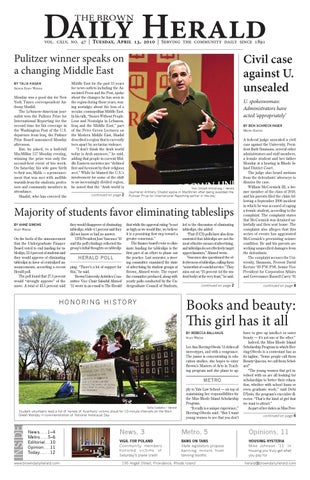
Pulitzer winner speaks on a changing Middle East By Talia Kagan Senior Staf f Writer
Monday was a good day for New York Times correspondent Anthony Shadid. The Lebanese-American journalist won the Pulitzer Prize for International Repor ting for the second time for his coverage in the Washington Post of the U.S. departure from Iraq, the Pulitzer Prize Board announced Monday afternoon. But, he joked, to a half-full MacMillan 117 Monday evening, winning the prize was only the second-best event of his week. On Saturday, his wife gave birth to their son, Malik — a pronouncement that was met with audible warmth from the students, professors and community members in attendance. Shadid, who has covered the
Middle East for the past 15 years for news outlets including the Associated Press and the Post, spoke about the changes he has seen in the region during those years, waxing nostalgic about the loss of a secular, cosmopolitan Middle East. In his talk, “Stones Without People: Loss and Nostalgia in Lebanon, Iraq and the Middle East,” part of the Peter Green Lectures on the Modern Middle East, Shadid described a region that is currently torn apart by sectarian violence. “I don’t think the Arab world today is Arab anymore,” he said, adding that people in current Middle Eastern societies are “defined first and foremost by their religious sect.” While he blamed the U.S.’s involvement for some of the shift to an increasingly divided region, he noted that the “Arab world is
Nick Sinnott-Armstrong / Herald
continued on page 2
Journalist Anthony Shadid spoke in MacMillan after being awarded the Pulitzer Prize for International Reporting earlier in the day.
U. spokeswoman: Administrators have acted ‘appropriately’ By Ben Schreckinger Metro Editor
led to the discussion of eliminating tableslips, she added. “Past (UCS) polls have also demonstrated that tableslips are not the most effective means of advertising, and tableslips do not effectively target upperclassmen,” Ahmed wrote. Vasconez also questioned the effectiveness of tableslips, calling them “somewhat of a useful service.” They miss out on “25 percent (of the student body) at the very least,” he said.
A federal judge unsealed a civil case against the University, President Ruth Simmons, several other administrators and staff members, a female student and her father Monday at a hearing in Rhode Island District Court. The judge also heard motions from the defendants’ attorneys to dismiss the case. William McCormick III, a former member of the class of 2010, and his parents filed the claim following a September 2006 incident in which he was accused of raping a female student, according to the complaint. The complaint states that McCormick was detained unlawfully and then sent home. The complaint also alleges that this series of events has aggravated McCormick’s preexisting seizure condition. He and his parents are seeking unspecified damages from the defendants. The complaint accuses the University, Simmons, Provost David Kertzer ’69 P’95 P’98, Senior Vice President for Corporation Affairs and Governance Russell Carey ’91
continued on page 2
continued on page 4
Majority of students favor eliminating tableslips By Anne Simons Staff Writer
On the heels of the announcement that the Undergraduate Finance Board voted to end funding for tableslips, 52.4 percent of students said they would approve of eliminating tableslips in favor of centralized announcements, according a recent Herald poll. The poll found that 27.3 percent would “strongly approve” of the move. A total of 43.5 percent said
they would disapprove of eliminating tableslips, while 4.1 percent said they did not know or had no answer. UFB President Jose Vasconez ’10 said the poll’s findings reflected the group’s initial thoughts on tableslip-
HERALD POLL ping. “There’s a lot of support for this,” he said. Brown University Activities Committee Vice Chair Salsabil Ahmed ’11 wrote in an e-mail to The Herald
that while the approval rating “is not as high as we would like, we believe it is a promising first step toward a greater consensus.” The finance board’s vote to eliminate funding for tableslips is the first part of an effort to phase out the practice. Last semester, a steering committee examined the state of advertising by student groups at Brown, Ahmed wrote. The report the committee produced, along with yearly polls conducted by the Undergraduate Council of Students,
Books and beauty: This girl has it all
H onorin g H istor y
By Rebecca Ballhaus Staff Writer
Lee Ann Herring-Olvedo ’11 defies all stereotypes, and with a vengeance. The junior is concentrating in education studies, she hopes to enter Brown’s Masters of Arts in Teaching program and she plans to ap-
METRO
Sofia Castello / Herald
inside
Student volunteers read a list of names of Auschwitz victims aloud for 10-minute intervals on the Main Green Monday in commemoration of National Holocaust Day.
News.....1–4 Metro......5–6 Editorial....10 Opinion.....11 Today........12
www.browndailyherald.com
ply to Yale Law School — on top of maintaining her responsibilities for the Miss Rhode Island Scholarship Program. “It really is a unique experience,” Herring-Olvedo said. “But I want young women to see that you don’t
have to give up intellect or outer beauty — it’s not one or the other.” Indeed, the Miss Rhode Island Scholarship Program in which Herring-Olvedo is a contestant has as its tagline, “Some people call them Beauty Queens, we call them Scholars!” “The young women that get involved with us are all looking for scholarships to better their education, whether with school loans or even graduate work,” said Debi D’Iorio, the program’s executive director. “That’s the kind of girl that we want to attract.” As part of her duties as Miss Provcontinued on page 6
News, 3
Metro, 5
Opinions, 11
Vigil for Poland Community members honored victims of Saturday’s plane crash
Bans on Tans State legislators propose banning minors from tanning booths
Housing hysteria Mike Johnson ’11: In housing you truly get what you pay for
195 Angell Street, Providence, Rhode Island
herald@browndailyherald.com
Page 2
THE BROWN DAILY HERALD
C ampus N EWS Shadid gives candid account of his time in the Middle East continued from page 1
complicit.” While Shadid won this year’s Pulitzer for his incisive reporting, Monday night’s talk was far more personal than most other lectures he has given, he said. He spoke about his experience rebuilding his grandmother’s house in Lebanon after it was destroyed by years of violence and neglect, a project he completed a year ago. This personal project is the focus of the book he is currently working on, slated to be published next spring, he told The Herald. Rebuilding the house that his grandparents left in the 1920s was an expensive, labor-intensive project that took over a year and a half, according to Shadid. Reconstructing the house involved a lot of “nitty-gritty” details, work that sometimes led to interesting encounters with unscrupulous tile-sellers. He came to see this reconstruction as a symbol for the restoration of the old Middle East, he told The Herald. Shadid hoped to avoid the “formulaic” conventions often used to discuss the Middle East in his talk, he said. Instead, he relied on stories to “tell something grander,” he said. The first-person vantage point of his stories marked his retelling of events. Shadid often lingered over vivid details, such as the blue pacifier of a baby killed by a bomb strike, or the image of a man killed with his pants half-on
while he attempted to run away. Writing and reporting on this miser y is “what I both love and hate,” he said. “You wonder, as a reporter, when you become a voyeur.” He punctuated such descriptive scenes with his own commentary. “Cosmopolitanism can never be conflated with globalization,” he said. In the question-and-answer session that followed Shadid’s lecture, audience members broached specific policy issues and shared personal responses to his talk. One woman said she related to his nostalgia for Lebanon — she personally felt it for Beirut of the 1960s and 70s. But, she said, the current factionalism that Shadid discussed existed in the Lebanon he was nostalgic for, though underneath the surface. Shadid acknowledged the danger of glossing over the past’s problems, but again emphasized that the region has become increasingly divided over the past 15 years. Baghdad has been destroyed “to a degree I think most Americans don’t understand,” he said. Anthony Thomas, a local resident, came to the lecture because of Shadid’s impressive reputation. He said he enjoyed the lecture, noting that though it was “ver y dramatic,” Shadid “speaks with his heart.” That, Thomas said, is “probably why he’s such a good writer.”
sudoku
Daily Herald the Brown
Editorial Phone: 401.351.3372 | Business Phone: 401.351.3260 George Miller, President Claire Kiely, Vice President
Katie Koh, Treasurer Chaz Kelsh, Secretary
The Brown Daily Herald (USPS 067.740) is an independent newspaper serving the Brown University community daily since 1891. It is published Monday through Friday during the academic year, excluding vacations, once during Commencement, once during Orientation and once in July by The Brown Daily Herald, Inc. Single copy free for each member of the community. POSTMASTER please send corrections to P.O. Box 2538, Providence, RI 02906. Periodicals postage paid at Providence, R.I. Offices are located at 195 Angell St., Providence, R.I. E-mail herald@browndailyherald.com. World Wide Web: http://www.browndailyherald.com. Subscription prices: $319 one year daily, $139 one semester daily. Copyright 2010 by The Brown Daily Herald, Inc. All rights reserved.
Tuesday, April 13, 2010
“Tableslips are a part of Brown culture.” — Kelly Fennessy ’13
Many underclassmen favor tableslips continued from page 1
A new system of more centralized advertising could target all students equally, he added. Advertising events online takes advantage of the fact that people already use electronic methods to advertise, Aida Manduley ’11, BUAC secretary, said. One problem with this method is that it is not portable like tableslips are, she added. Student leaders have received limited response to UFB’s decision. Ahmed wrote that the reaction from students was “mixed.” Very few people came to the panel on advertising, Manduley said. The few who attended raised concerns that were discussed, she added. After the announcement of UFB’s decision to end funding, a few more responded by e-mail to student leaders, Manduley and Vasconez said. In the e-mails, students complained there was no need to eliminate tableslips and that they were a Brown tradition, Vasconez said. “Tradition doesn’t necessarily mean it’s a good thing,” he said. He added that there does not seem to be an “organized movement” against the elimination of tableslips. According to The Herald’s poll, 50.1 percent of underclassmen disapproved of the elimination of tableslips, compared with 35.5 percent of upperclassmen and 43.5 percent of the overall population. Vasconez said he expected more disapproval from freshmen and sophomores because they use the dining halls regularly, as opposed to upperclassmen who may no longer be on a meal plan. Students have had mixed reactions to the potential elimination of tableslips. “Tableslips are a part of Brown culture,” Kelly Fennessy ’13 said. While she said they do not necessar-
Would you approve or disapprove of eliminating dining hall tableslips in favor of centralized announcements, either elsewhere on campus or on the Internet?
Anna Migliaccio / Herald
ily influence her to attend events, they are “entertainment.” Jordan Taylor ’13 said he would find the elimination of tableslips “really upsetting.” Stephanie Tin ’13 said that fiddling with tableslips in an awkward situation can be useful, but that she would not be particularly upset if they were eliminated. Some heralded the positive environmental effect of eliminating tableslips. Lucy Boltz ’12, who said she was “really supportive” of eliminating tableslips, said tableslips are a drain on resources. She said she works a dinner shift at the Verney-Woolley Dining Hall, after which she has to
clean up all the tableslips by throwing them away instead of recycling them. Eliminating tableslips would be more “ecologically conscious,” she said. Questions of effectiveness were also on students’ minds. Boltz said she felt that tableslips were an ineffective method of advertising. People come to events because of personal interest, she said, and direct marketing would be more effective. But some students wondered if the new ways of advertising online would be effective since they require students to seek out information. Robbie Nelson ’12 said “tableslips are a lot more passive” than other forms of advertising like Morning Mail, which he said he does not read. Reading tableslips requires no action on his part, Taylor said, adding that he probably would not visit a Web site to find events. “For the portion of the population that does go to dining halls, (tableslipping) is the most effective way by far,” Taylor said. Tin said she was “pretty sure” she would never check a Web site that listed events on campus. She added she could not think of an alternative that would approximate the same effect on students. The decision to completely eliminate tableslips has not been made. The issue will probably be discussed next year, but “that is the direction that we’re heading in,” Manduley said. The Herald poll was conducted on March 22 and 23 and has a 3.5 percent margin of error with 95 percent confidence. A total of 714 Brown undergraduates completed the poll, which The Herald administered as a written questionnaire to students in the lobby of J. Walter Wilson during the day and in the Sciences Library at night. For the sample of just freshmen and sophomores, the margin of error is 4.7 percent. for the sample of just juniors and seniors, the margin of error is 5.2 percent.
Tuesday, April 13, 2010
THE BROWN DAILY HERALD
C ampus N EWS
Page 3
“This is our tragedy.” — Janet Cooper Nelson, University chaplain
higher ed news roundup jessica liss contributing writer
University of Wisconsin ends Nike contract The University of Wisconsin is ending its apparel licensing agreement with Nike because of concerns about displaced workers from factories used by the company in Honduras, Chancellor Biddy Martin told UW’s Labor Licensing Policy Committee on April 9, according to a news release. After the factories Hugger de Honduras and Vision Tex closed in January 2009, Nike allegedly failed to pay its former laborers the over $2 million owed in required severances, the release stated. The university’s Code of Conduct, which details required labor practices and conditions, holds Nike responsible for its subcontractors though it does not own the factories. Brown, like UW, is a member of the Workers Rights Consortium, whose mission is to “combat sweatshops and protect the rights of workers who sew apparel and make other products sold in the United States,” according to its Web site. The Brown Student Labor Alliance recently led a campaign focusing on the University’s ties to Nike and the situation in Honduras, The Herald reported April 8.
College health plans inadequate, N.Y. AG says Many colleges’ student health plans fail to provide adequate coverage, New York State Attorney General Andrew Cuomo said in a release Thursday. “Many of the sponsored health care plans looked at during our investigation leave students at risk while providing massive profits for insurance companies,” he said in the release. The American College Health Association found that 57 percent of colleges require that students have health insurance, mandating that students either purchase collegesponsored private plans or use comparable personal plans, according to the Chronicle of Higher Education. In letters that Cuomo sent to colleges, he encouraged them to offer plans that include coverage for prescription drugs. He wrote that schools should avoid plans that impose annual caps and deny coverage to students with pre-existing conditions, according to the Chronicle.
UC professor’s tenure challenged after sit-in A University of California professor’s tenure is in jeopardy after he staged a “virtual sit-in” opposing budget cuts and tuition increases throughout the UC system, according to Inside Higher Ed. During the sit-in — organized by Ricardo Dominguez, associate professor of visual arts at the University of California at San Diego — 400 faculty and students simultaneously logged into the Office of the President Web site, overwhelming the system, according to an April 6 San Diego Union-Tribune article. The Web site included a message that claimed that the president’s office had no transparency, the newspaper reported. “I wanted to alert the UC Office of the President to the growing concern and critique of its policies,” Dominguez told the Union-Tribune. The school is now investigating Dominquez for a “distributed denial-of-service attack,” Micha Cardenas, a visual arts lecturer at UCSD, told Inside Higher Ed. Dominguez is also being investigated for his Transborder Immigrant Tool. The tool uses cell phones with a location tracking feature to give people crossing the border from Mexico information about water supplies and border patrols, the Union-Tribune reported.
Got tips? herald@browndailyherald.com
Sofia Castello / Herald
Mourners lit candles for the Polish government officials who died in Saturday’s plane crash.
Community honors killed Polish officials By Sofia Castello Contributing Writer
Candles flickered Monday in the palms of the 18 people who came to commemorate the plane crash that killed Polish President Lech Kaczysnki and numerous Polish government officials on Saturday. The afternoon vigil was held in Manning Chapel. “As someone whose great-grandfather was killed in the Katyn massacre that (on) Saturday victims were flying to commemorate ... I felt
this whole thing struck very close to home,” wrote Sara Weschler ’10, during the silent vigil. Members of the Polish government were flying in memory of the massacre of Polish soldiers in the Katyn forest during World War II, the very forest that the plane went down in. “The dark, dark symbolism of the whole situation — the weight that Katyn already carries in the Polish national memory — it’s all too much somehow… as though that place were truly cursed for us,”
Weschler wrote. The chords of a piano punctured the silence that reigned between remarks from University Chaplain Janet Cooper Nelson and Michael Kennedy, director of the Watson Institute for International Studies. “We’re connected, in ways that I think are probably surprising. So, this is our tragedy,” Cooper Nelson said, mentioning not only the Polish citizens who reside at Brown, but the role Poland plays in academcontinued on page 4
Page 4
THE BROWN DAILY HERALD
C ampus N EWS
Tuesday, April 13, 2010
“It seems like the complaint is still a mess.” — District Judge William Smith
Federal case against U. now public record continued from page 1 MA’06 and several other University employees of acts “tantamount to criminality,” breach of contract, false imprisonment, libel and six other counts of civil misconduct. The complaint also alleges that the University was guided by “financial self-interest” when handling the incident because the female student’s father, an alum, has donated and raised large sums of money for Brown.
District Judge William Smith had placed the case under seal after a motion on behalf of the female student and her father. The reasons for the request to seal the case were given to the judge in private, according to the motion. Until Monday, there was no publicly available record of the case. “The University and its officers have acted appropriately in this matter,” Vice President for Public Affairs and University Relations Marisa Quinn wrote in an e-mail to
The Herald late Monday. “As in all instances, the University respects and maintains the confidentiality of student and employee records.” The plaintiffs’ motion to unseal the case, filed March 29 by their lawyer, J. Scott Kilpatrick, argued that the public had a right to know about the case and that the family of the female student did not have the right to seal the case. “This case has been somewhat atypical,” said Steven Richard, the lawyer representing the University and its 15 employees named as defendants, at the hearing held in front of Smith. After granting the plaintiff’s motion to unseal the case, Smith heard motions to dismiss several charges by both Joseph Cavanagh, the lawyer for the female student and her father, and Richard. The Herald is withholding her name because she may have been the victim of a sex crime. Though Richard said he acknowledges “the case can go for ward,” he challenged several counts and attacked the McCormicks’ complaint for naming all 15 Brown defendants and the University collectively in each count of which they are accused, “without identifying who did what” and which charges apply to whom. He said the involvement of at least one Brown employee named
as a defendant was limited to a single meeting with the female student. Kilpatrick responded that in some instances the specific Brown defendants to whom a count applied would be unclear until more information is obtained through discovery. He said access to internal University records would be required to determine each individual’s specific involvement. Richard said the parties had already agreed that the count of breach of contract, which previously accused the University and the 15 Brown defendants, would proceed only against the University. Kilpatrick said he had agreed to drop the count of acts tantamount to criminality and conceded that “we might lose defendants.” “It seems like the complaint is still a mess,” Smith told Kilpatrick, calling it “too all over the place.” He advised Kilpatrick to “get focused” on “three or four viable counts,” such as breach of contract and negligence against the University and top administrators. Both Cavanagh and Richard declined to comment. Kilpatrick could not be reached for comment. Smith said he would consider the motions and issue a ruling promptly.
Polish students mourn loss at Monday’s vigil continued from page 3 ics and the ancestr y of people at Brown. “I tried for a minute on Saturday to think what would happen if Air Force One had gone down,” Cooper Nelson said. “The nation would be plunged into not just despair, fear.” “We are without words to capture all that this tragedy means for those in Poland and beyond,” Cooper Nelson said. “Let us pray this tragedy does not rehearse a repertoire of mistrust among nations,” Kennedy said, referring to troubled relations between Russia and Poland. Kennedy hopes to see “mornings of grief turned into days of peace,” he said. “I came because I feel detached from my friends and family back home,” wrote Kasia Sierzputowska ’13. “I feel that by coming I’m honoring the lives of those who perished in the crash.” “The last few days my heart been very much in Warsaw,” Weschler wrote. “I really appreciate that the University organized this vigil for us to come together. It means a great deal.”
Metro The Brown Daily Herald
“People will invest in someone they think will win.” — Wendy Schiller, associate professor of political science and public policy Tuesday, April 13, 2010 | Page 5
Cicilline’s fundraising outpaces opponents’ Bill would ban tanning for minors By Bradley Silverman Staf f Writer
By Caitlin Trujillo Senior Staff Writer
Minors in Rhode Island will be unable to use tanning salons, even with their parents’ permission, if a bill under consideration in the Rhode Island Senate passes. The bill, which would amend the Tanning Facility Safety Standards Act, would prohibit those under the age of 18 from using tanning facilities. Current law stipulates that minors may use the facilities if a parent or guardian signs a consent form in the presence of a facility staff member, according to Department of Health regulations. Sen. Rhoda Perr y P’91, DProvidence, is sponsoring the bill along with Senators Joshua Miller, D-Cranston and Warwick, Harold Metts, D-Providence, Michael McCaffrey, D-Warwick, and V. Susan Sosnowski, D-New Shoreham and South Kingston. The Rhode Island Medical Society’s Steven DeToy and the Rhode Island Dermatological Society’s Elizabeth Welch asked Perry to sponsor the bill, she said. Perry, who is also the Health and Human Services Committee chair, said research showed that indoor tanning was linked to certain types of skin cancer in a way that was “statistically frightening.” According to the Food and Drug Administration, research from the International Agency for Research on Cancer showed that indoor tanning was closely associated with certain kinds of carcinoma and melanoma. Perry said that young women were “thinking less with their brain and more about what they look like.” Furthermore, Perry said, minors who use tanning beds are exposing themselves to radiation early on in their lives, increasing the amount of
Weather, menus, and news you can use blog daily herald .com
skin damage they undergo. Bill proponents and sponsors also researched other options for restricting minors’ use of tanning beds. Some states, Perry said, have mandates that require a pediatrician to sign off on consent forms, but Perry said the Rhode Island Medical Society and Dermatological Society disliked this option. She added that she did not know if this regulation was successful in the jurisdictions that enforce it. Nick Liakos, the owner of Soma Tans at 224 Thayer St. and another salon in Somerset, Mass., thinks the proposed restriction is unfounded. Though Liakos does not anticipate that his business will be affected, since he serves mostly college students, he said parental permission should be enough to allow minors to tan. “I think if somebody’s parents are fine with it, then it’s okay,” he said. Perry cited as encouragement for the bill’s chances a recent FDA panel discussion in which many panel members approved of placing age restrictions on the use of tanning beds, with a minority favoring mandatory parental consent similar to Rhode Island’s current regulations. Another possibly beneficial development, Perry said, was the 10 percent federal tax on tanning salons included in the health reform bill passed in March. The bill is set for an April 14 hearing in the Senate Health and Human Services Committee. If the bill passes the committee and the Senate, it will move on to the House, Perry said.
In the past two months, Mayor David Cicilline ’83 has amassed almost three-quarters of a million dollars to fund his bid for Rhode Island’s first congressional seat. According to a statement on his campaign Web site, Cicilline has raised roughly $725,000 since entering the race to succeed Rep. Patrick Kennedy, D-R.I., on Feb. 13, two days after Kennedy announced he would not be seeking re-election. “We exceeded all our expectations,” Cicilline wrote in the statement. “You have sent a message that you want a representative with a proven record of delivering results for hard-working Rhode Islanders.” The announcement came on April 5, 10 days before the filing deadline for first-quar ter congressional fundraising results for 2010. Cicilline’s main primary opponent, former state party chairman William L ynch, announced he has raised $230,000, including $100,000 of his own money, according to L ynch campaign spokesman Bill Fischer. Fischer said that, as a nonelected official, L ynch’s smaller haul was due in part to lower name recognition among first district voters, as well as Cicilline’s ability to tap donors who had contributed to his mayoral run. “We anticipated this,” he said in regard to Cicilline’s fundraising numbers. “We’re not worried. People don’t know Bill as well as they know David.” Fischer said that over the next several months the campaign will unveil a strategy to introduce
Lynch to voters who are not aware of him. Because Cicilline cannot transfer funds from his mayoral re-election account to his congressional account, he has returned contributions from donors to his mayoral campaign and then asked them to donate those refunds to his congressional race, according to Wendy Schiller, associate professor of political science and public policy. Schiller said that at this point in the election cycle, fundraising is important as a way for candidates to show voters that they are serious about winning. “It’s a signal about how wellconnected candidates are,” she said. “People invest in someone they think will win.” The Cicilline campaign could not be reached for comment by The Herald. In recent weeks, Cicilline was endorsed by a number of prominent statewide Democratic organizations, including the Association of Democratic City and Town Chairs and the Smithfield
Democratic Town Committee. Meanwhile, the L ynch campaign has been touting its recent endorsement from the United Food and Commercial Workers Union, Local 328. Schiller said that many in the state party are gravitating toward Cicilline because of his higher national profile and contact network, and because of his greater name recognition. Actions L ynch may have taken as chairman might also be a factor, she said. “When you’re chairman, you sometimes have to piss people off,” Schiller said. John Loughlin, the state House minority whip and likely Republican contender for Kennedy’s seat, has not yet officially released his fundraising totals, but his campaign manager said that he will report around $100,000 in firstquarter fundraising, with approximately $135,000 cash on hand. “We’re thrilled to be in six figures,” Cara Cromwell, Loughlin’s campaign manager, said. continued on page 6
Page 6
M etro
THE BROWN DAILY HERALD
Tuesday, April 13, 2010
“Beauty pageants are more than just wearing a sash and a crown.” — Lee Ann Herring-Olvedo ’11
Beauty queen promotes scholarship and service continued from page 1
idence County, Herring-Olvedo has initiated an on-campus book drive to benefit students at two Providence elementary schools. Herring-Olvedo said she chose to run the book drive — “Bears Care” — to “advocate literacy” in schools where more than half of third and fourth graders fall behind adequate literacy levels because they didn’t have enough books. The books — ideally new to gently worn ones in English or Spanish for kindergarten through the fifth grade — will be collected in bins placed throughout Brown’s campus and donated to William D’Abate and Asa Messer Elementary Schools in Providence. Herring-Olvedo is running the book drive in conjunction with the Swearer Center, whose Classroom Program organizes Brown students to visit these elementary schools as literacy tutors. Herring-Olvedo, who joined the program this year, currently mentors a first-grade girl at Asa Messer. “What I love about it is seeing so much energy,” she said. “Being a college student we can lose sight of the fun of learning, and these first graders have so much passion and energy.” She described her mentee’s transformation from someone who did not like books to an avid reader. “It’s great to see that she’s not willing to give up,” she said. “And it’s a great message — if a first grader’s not willing to give up, neither should we” be willing.
Herring-Olvedo has also forged a connection between the two Providence elementary schools and two schools from Texas, her home state. The Texas schools will contribute books as well as raising money, and students from Providence and Texas will be matched as pen pals. “I created this program because I think it’s important that we promote literacy and the idea of reaching out on both local and state levels,” she said. “Literacy is such an important issue. It promotes the ideas of starting early, as well as of success and scholarship.” In addition to the book drive, Herring-Olvedo — who manages the Brown football team — is working on organizing an initiative called Touch Down Champs, which aims to “empower youth through literacy and athletic engagement in their community.” The initiative, Herring-Olvedo said, “combines (her) two passions — literacy and athletics.” She added in an e-mail to The Herald that it promotes the ideas of “leadership, teamwork and success in and beyond the classroom.” D’Iorio said the pageant’s focus on community service tends to attract contestants with a strong sense of civic responsibility. “Most of the time when the gals pick a platform, it’s based on some kind of personal experience,” she said. She named the 2008 winner, Francesca Simone, as an example: Simone chose Alzheimer’s research and awareness as her cause, since one of her grandparents was a victim of the disease.
Loughlin reaches sixfigure mark continued from page 5
Courtesy of Lee Ann Herring-Olvedo
Lee Ann Herring-Olvedo ’11 is championing children’s literacy as part of her duties as Miss Providence County.
Herring-Olvedo visibly beamed as she recounted her plans. It is evident that D’Iorio was right in gushing that she is “just so dedicated to her platform.” And, Herring-Olvedo explained, this is very much the product of having participated in beauty pageants since the age of five. “I love being able to advocate any platform,” she said. “Beauty pageants are more than just wearing a sash and a crown — they give you the chance to act as an ambassador, to give back to the
community. So many little girls look up to you.” Two other Brown students in the past have participated in the Miss Rhode Island pageant, one of whom won a $1,000 scholarship. “Brown is the perfect place to do something like this,” Herring-Olvedo said. “Here, you can be typical and atypical at the same time.” “We’re all passionate about something here. I’m just passionate about this,” she said.
Before Kennedy dropped out of the race, his low approval numbers fueled speculation that Loughlin could unseat him. Loughlin was able to attract conservative donors from across the countr y motivated by a desire to take down a member of the legendary political dynasty. Kennedy’s departure from the race was a major blow to Loughlin, Schiller said, because it made it impossible for him to tap into the anti-Kennedy sentiment felt by many Republicans nationwide. Cromwell said that Kennedy’s retirement, however, has not impeded Loughlin’s fundraising efforts. She said it has allowed donors who had been reluctant to oppose a Kennedy to contribute to his campaign. She also said that the conditions of the race — an open-seat battle to succeed a Kennedy in office — now more resemble those of the Massachusetts Senate race earlier this year in which Sen. Scott Brown, RMass., defeated Democratic Attorney General Martha Coakley to replace Patrick Kennedy’s father, the late Sen. Ted Kennedy. “This race is about John, not Patrick Kennedy” Cromwell said.
World & Nation The Brown Daily Herald
Conan O’Brien going to TBS in a return to late night By Joe Flint and Maria Elena Fernandez Los Angeles T imes
LOS ANGELES — First Oprah, now Conan. In the latest sign that the field has leveled between broadcast and cable television, former “Tonight Show” host Conan O’Brian has decided to make his latenight comeback this fall on TBS, a cable network that has largely been synonymous with old network reruns and Atlanta Braves baseball. “This is the day the last brick wall fell down between broadcast and cable,” said Steve Koonin, president of Turner Entertainment Networks. O’Brien, who was dumped by NBC as host of “The Tonight Show” in favor of his predecessor Jay Leno just four months ago, will return in November on TBS with an 11 p.m. ET/PT show. Comedian George Lopez, who just launched his own late-night show in that same time slot on TBS last year, has agreed to move to midnight. In sardonic fashion, O’Brien had his own spin on the news. “In three months I’ve gone from network television to Twitter to performing live in theaters, and now I’m headed to basic cable. My plan is working perfectly,” he quipped in a statement. For TBS, one of the countr y’s oldest cable channels, snaring O’Brien is the culmination of a
Thanks for reading!
decade-long ef fort to transform a network that launched 30 years ago with “The Andy Griffith Show” reruns into a cutting-edge channel on par with Comedy Central, USA, FX and TNT. “This is a seminal moment for TBS,” Koonin said. While TBS, which doesn’t produce a lot of original shows, may seem like an odd fit for O’Brien, the cable channel’s evening lineup includes reruns of “The Office” and “Family Guy” that play to O’Brien’s core audience of young adults. O’Brien’s move to TBS is a big blow to Fox, which had been actively wooing the comedian and was seen as the odds-on-favorite to land him. While Fox was enthusiastic about getting back into the latenight game with O’Brien, that sentiment was not echoed by its affiliates. Most Fox stations carr y reruns of comedies in late night and would have taken a financial hit if they had to replace those shows with O’Brien. Complicating the situation for Fox is that O’Brien would have aired in var ying time periods among affiliates around the countr y for at least a year, undercutting ratings and advertising. TBS initially indicated it had little interest in pursuing O’Brien when he and his representatives began casting about for a new continued on page 8
Tuesday, April 13, 2010 | Page 7
Surviving members of Polish political elite work to rebuild country’s leadership By Megan K. Stack Los Angeles Times
WARSAW, Poland — The surviving members of the Polish political elite turned their attention Monday to the delicate task of reconstituting the country’s leadership after a plane crash killed President Lech Kaczynski, heads of key institutions, lawmakers and military chiefs. It was a delicate, often distasteful, task. The Polish people are still mourning streets littered with dying flowers and slick with puddles of hardened candle wax. Kaczynski’s body was brought back to Poland, but remains of the other 95 dead were taken to Moscow for identification. The chamber of the Sejm, or lower house of parliament, sat empty Monday. Bunches of red and white flowers marked the deserted seats of the 14 dead lawmakers, and the golden nameplates on their office doors were crossed out with black ribbons. Surviving lawmakers bustled through the halls and ducked into closed-door meetings with their party members. “The situation is extraordinary. I don’t think anybody in Poland knows how to act,” said Grzegorz Napieralski, chairman of the Democratic Left Alliance. “People say these halls are the halls of death.” Political observers have turned their attention to Bronislaw Komorowski, the speaker of the Sejm. In Poland’s ravaged leadership structure, Komorowski has been shoved into multiple, overlapping roles: He is acting president, as stipulated by the constitution; speaker of the parliament; and the only survivor out
of the three main candidates for the presidency. Komorowski is due to start consultations with the parties Tuesday, and is then expected to set the date of the election for June. Polish officials said Monday they would investigate whether someone on the plane had directed the pilots to try to land at Smolensk despite warnings by flight controllers of bad weather. Russian officials said there were no problems with the plane, an aging Soviet-made Tupolev 154. The Polish delegation was on its way to a memorial service for Polish prisoners by Soviet secret police in 1940. Despite the sense that it is tacky to talk politics at a moment of national grief, there was an undertone of worry among the other parties. Komorowski is a political ally of the prime minister, Donald Tusk, and is considered the likely winner in forthcoming elections. His party, Civic Platform, has clashed bitterly with the dead president’s Law and Justice Party in recent years. Kacazynski had taken a harder line with Europe, and pushed a social agenda that included intolerance of gay rights and the persecution of onetime communists. Komorowski and Tusk’s party,
by contrast, has been eager to bring Poland closer to Europe and switch to the euro, and takes a slightly more liberal stance on social issues. Distrust runs deep and, on Monday, slivers of acrimony were creeping in. “I’m concerned about the situation in Poland,” said Jolanta Szczypinska, a leading lawmaker from the Law and Justice Party. “I’m worried about the actions of Komorowski, that he’ll step outside of his obligations and do certain things that are above him.” Szczypinska wore all black, and her eyes repeatedly clouded with tears as she spoke. “The loss of the president is unimaginable to us,” she said. “But now elections are coming up, and we have to make good decisions. We have to find our candidate for the presidency.” Tusk’s Civic Platform Party shouldn’t cement its power, she said. “Our president had a totally different vision than Tusk,” she said. “He wanted a strong Poland, honored by the other European countries. He wanted national interests above all. Tusk lacks this vision.” continued on page 8
Page 8
THE BROWN DAILY HERALD
Tuesday, April 13, 2010
w orld & N ation
Conan to be on TBS after quick deal is made continued from page 7 home earlier this year. For starters, the network appeared committed to Lopez at 11 p.m., and Koonin assumed Fox had a lock on O’Brien. But when no deal with Fox emerged, Koonin sprung into action, reaching out to the comedian’s camp only a little more than a week ago. But while there was interest, O’Brien also made it clear that he didn’t want to take away
Lopez’s show by having Lopez suffer the same ironic fate that befell O’Brien at NBC, where the network bumped him aside for Leno. Koonin then talked with Lopez, who then called O’Brien to tell him he was on board with the plan. Once that was all done, it only took about 72 hours to get a deal in place. Indeed, with O’Brien as a lead-in, it may only help Lopez in the ratings. Now O’Brien becomes the lat-
est star to abandon broadcast for cable. Late last year, Oprah Winfrey announced she was leaving daytime television to focus full time on OWN, the cable network she is launching in partnership with Discover y Communications. The fact that TBS landed a major player in late night, traditionally the turf of the broadcast networks, “says that anybody can be a player,” said Brent Poer, managing director of the Los Angeles offices of MediaVest, a media buying firm whose clients include Wal-Mart and Procter & Gamble. “It’s not about cable versus broadcast. I don’t think consumers think that way. It’s about good programming versus bad programming.” O’Brien’s audience on cable will probably be smaller than it was on NBC or would have been
if he went to Fox. He will face off against Comedy Central’s Jon Stewar t, who attracts almost 2 million viewers each night, and Stephen Colbert, who draws about 1.4 million people. Lopez has been averaging just over a million viewers in that hour. Even though O’Brien was pulling in more than $12 million annually from NBC, he stands to earn even more on cable. That’s because O’Brien will own his show, similar to the way Johnny Carson did with his “Tonight Show,” but which would have been tougher for him to get on broadcast television. TBS, meanwhile, will be able to charge the cable systems that carr y its channel higher fees if O’Brien delivers solid ratings, generating greater revenue for the network.
www.browndailyherald.com
Poland seeks new leadership after crash continued from page 7 Poland’s leading leftist party was also gutted. The presidential candidate, Jerzy Szmajdzinski, was killed, along with its most prominent lawmakers. “I have no imagination of how it will be, because everything has changed now,” said former Prime Minister Jozef Oleksy. “I don’t know, honestly, if we will find a new candidate from the left.” Meanwhile, decisions were pressing. Komorowski will have to set elections for the three regions that lost lawmakers in the upper house of parliament. Important institutions are also in need of leadership. The crash killed the heads of the central bank and the deeply sensitive National Remembrance Institute, the archives containing evidence of spying, betrayal and arrests of communist times. New directors have to be chosen by parliament and approved by the president, but the parties were reluctant to make any decisions before filling all the empty seats. “It’s a very delicate problem,” said Napieralski. “Because we did not yet bury the victims, and we have to discuss who’s going to replace them.”
Page 9
THE BROWN DAILY HERALD
Tuesday, April 13, 2010
w orld & N ation
Palin speech draws attention to foundations linked to universities By Carla Rivera Los Angeles T imes
LOS ANGELES — An invitation to former Alaska Gov. Sarah Palin to speak at California State University, Stanislaus’ 50th anniversary gala is generating controversy and raising questions about the foundation that is paying her. The nonprofit is refusing to divulge her speaking fees. The foundation’s secrecy has raised scrutiny over the financial dealings and clout of that group and scores of others like it that are associated with California’s public universities. The foundations raise billions of dollars for scholarships and other programs, run student organizations and bookstores and perform other crucial campus functions. But they are set up as private entities and are not subject to state law that requires public agencies, including schools, to disclose information about how money is raised and spent. Among recent incidents drawing attention: A Sonoma State foundation made a $1.25 million loan to one of its former board members, who then defaulted on the loan. A nonprofit at Cal State Sacramento is being audited by the attorney general for loans made to the university president. Foundations at San Francisco City College, Cal State Fresno and the San Jose/Evergreen Community College District have also been em-
broiled in controversy over financial decisions, according to state Sen. Leland Yee, who is looking into the activities. Concern about the foundations comes amid broader questions about how public universities spend taxpayers’ dollars. This includes recent disclosures about the use of funds meant for classrooms and students to cover real estate and construction costs and other business pursuits. The California Faculty Association and the California Newspaper Publishers Association, among others, are pressing for more transparency from the foundations and other auxiliary groups. They are supporting a state bill that would require these groups to adhere to California’s Public Records Act. Last year, a similar bill was vetoed by Gov. Arnold Schwarzenegger, who said some of its provisions would have a “chilling effect” on the support of donors and volunteers if their names were disclosed. The new bill would protect the privacy of donors except in cases in which contributors are given a gift of $500 or more. It has passed the state Senate and awaits an Assembly hearing. Yee has asked California Attorney General Jerry Brown to investigate Cal State Stanislaus for failing to provide documents relating to Palin’s fundraising appearance.
Yee said the Stanislaus Foundation is housed on the campus, staffed by university employees, uses university e-mail accounts, telephones, computers and other resources and is headed by university President Hamid Shirvani. “The Stanislaus situation provides the clearest evidence of the collusion between the foundation and the state university, the clearest evidence of the relationship between the two and that they are, in fact, not independent of each other,” Yee said. “The larger issue is that I believe the state universities have been shifting some of their state responsibilities over to the foundations for the sole purpose of hiding transactions involving millions of dollars from the public.” Universities and colleges argue that much financial information is already available to the public in annual tax filings and audits that are frequently posted on campus Web sites. But critics contend financial decisions — such as investments and loans — are made out of sight and hold the potential for misuse. For example, without a full accounting of the Palin fee, they argue, it would be hard to ascertain whether the event raises money for the foundation. In the 23-campus Cal State system, more than 90 foundations and auxiliaries control $1.34 billion,
about 20 percent of the universities’ $6.7 billion budget, according the chancellor’s office. In the 10-campus University of California system, 10 major campus foundations hold about $4 billion in assets. State law allows foundations and other nonprofits to provide some essential services that contribute to the educational mission of the university. At Cal State, for instance, campus radio stations, recreational sports activities and food services typically are funded and operated by auxiliary groups rather than the university. The organizations are self supporting and use no general fund monies. Shirvani, at Cal State Stanislaus,
declined to discuss the issues surrounding Palin’s June 25 appearance, a $500-a-plate, black-tie affair. In a statement, Matt Swanson, president of the foundation, cited government code that exempts auxiliary organizations from the Public Records Act. He said that the Washington Speakers Bureau, which represents Palin, requires that financial terms of speaker appearances remain confidential. The Speakers Bureau did not return calls for comment. “I can assure you that no public funds are being used to support this event,” Swanson said. “All funds used have been given for the express purpose of putting on this event in order to raise money to benefit university programs and student services.”
Follow The Herald on Twitter twitter.com/the_herald
Editorial & Letters The Brown Daily Herald
Page 10 | Tuesday, April 13, 2010
l e t t e r to t h e e d i to r
Rower apologizes to Harvard To the editor: In my column that appeared in Monday’s sports section (“Ben Dann ’12: Athlete’s notebook,” April 12), I included a comment questioning the sportsmanship of the Harvard men’s crew team and their Head Coach Harry Parker. I apologize for those comments. I also apologize to those who have been offended. I realize that those comments were wrong. It was not my intention to disrespect
those who give me the opportunity to compete, whether they are coaches, competitors, teammates, or others involved. As a varsity athlete at Brown, my words not only have consequences for me, but for my team and my school. I want to clarify that my comments do not personify the opinions of Brown Crew or the University, and that I take full responsibility for what I said. Ben Dann ’12
Does this bohter you? Come copy edit! herald@browndailyherald.com
t h e b r o w n d a i ly h e r a l d Editor-in-Chief
Managing Editor Chaz Kelsh
George Miller
Deputy Managing Editors Sophia Li Emmy Liss
editorial Anne Speyer Suzannah Weiss Brian Mastroianni Hannah Moser Brigitta Greene Ben Schreckinger Sydney Ember Nicole Friedman Dan Alexander Zack Bahr Andrew Braca Han Cui
Arts & Culture Editor Arts & Culture Editor Features Editor Features Editor Metro Editor Metro Editor News Editor News Editor Sports Editor Asst. Sports Editor Asst. Sports Editor Asst. Sports Editor
Graphics & Photos Graphics Editor Stephen Lichenstein Graphics Editor Alex Yuly Photo Editor Nick Sinnott-Armstrong Asst. Photo Editor Max Monn Sports Photo Editor Jonathan Bateman Production Copy Desk Chief Kelly Mallahan Design Editor Marlee Bruning Asst. Design Editor Anna Migliaccio Asst. Design Editor Julien Ouellet Web Editor Neal Poole Post- magazine Editor-in-Chief Marshall Katheder
Senior Editors Ellen Cushing Seth Motel Joanna Wohlmuth
Business General Managers Office Manager Shawn Reilly Claire Kiely Katie Koh Directors Sales Kelly Wess Finance Matthew Burrows Client Relations Margaret Watson Alumni Relations Christiana Stephenson Managers Local Sales Arjun Vaidya National Sales Marco deLeon University Sales Aditi Bhatia University Sales Jared Davis Recruiter Sales Trenten Nelson-Rivers Maximilian Barrows Business Operations Business Analytics Jilyn Chao Credit and Collections Danielle Marshak Special Projects Alexander Carrere Staff Kathy Bui Opinions Opinions Editor Michael Fitzpatrick Opinions Editor Alyssa Ratledge Editorial Page Board Matt Aks Editorial Page Editor William Martin Board member Melissa Shube Board member Gaurie Tilak Board member Jonathan Topaz Board member
Anna Migliaccio, Hyojin Nati Kim, Designers
E rik S tayton and E van D onahue
e d i to r i a l
Not forgotten and not forgiven We want to believe that most alums recognize the major contributions Brown makes to the surrounding community. And we would hope that this is particularly true of anyone who graduated from Brown and went on to serve as mayor of Providence. Unfortunately, Providence Mayor and congressional candidate David Cicilline ’83 hasn’t been a friend to Brown lately — far from it. Now that he’s seeking a seat in the House of Representatives, he absolutely shouldn’t plan on any support from the University or its students. Last year, the General Assembly considered two bills that targeted Rhode Island’s private colleges and universities, The Herald reported July 19. One bill would have allowed localities to charge schools a $300 per year fee for every out-of-state student. The other bill sought to end the property tax exemption traditionally accorded to large not-for-profits like Brown. According to The Herald, the two proposals “originated” in Cicilline’s office. At the time, we opined that Cicilline and other supporters of the tax increases were blatantly ignoring the fact that the University and its students already spend hundreds of millions of dollars locally each year. Moreover, students at Brown give up countless hours to volunteer in public schools and other community organizations. Cicilline could have worked collaboratively with Brown to find new ways for the school to give back to the city. Instead, he actively encouraged the state legislature to impose an additional financial burden that undoubtedly would have fallen on Brown’s students and employees. Fortunately, neither of the proposed bills has become law. But that doesn’t mean members of the Brown community should sit by as Cicilline pursues
the seat being vacated by Rep. Patrick Kennedy, DR.I. Indeed, if Cicilline wasn’t a loyal alum during his time at City Hall, then he probably won’t be an ally on Capitol Hill. The “Students Against Providence Student Tax” Facebook group still has over 1,000 members. Each member of this group — and all others who would have been impacted by the proposals — should consider making a donation to Cicilline’s opponents in the primary or general election. Cicilline initially wanted to impose the $300 per year fee directly on out-of-state students themselves, rather than the institutions they attend, WPRI reported last May. So even a small contribution to another candidate would be a worthwhile investment to keep Cicilline from becoming a member of congress. Politicians throughout the state are certainly watching Cicilline’s candidacy closely. Brown and Rhode Island’s other private colleges and universities need to stand up for themselves now, at least to send a message that institutions of higher education in this state are important constituencies whose interests can’t be ignored. Cicilline overlooked one of the virtues of Brown students — namely, their strong commitment to volunteering in the community. Now, he probably won’t be able to benefit from another one of our virtues: forgiveness. Let’s send a message that politicians shouldn’t try to squeeze a little extra tax revenue from college students.
Editorials are written by The Herald’s editorial page board. Send comments to editorials@browndailyherald.com.
correction
Claire Gianotti, Abigail Kerson, Alexandra McFarlane, Carolina Veltri, Copy Editors Ana Alvarez, Nicole Boucher, Sarah Forman, Night Editors Senior Staff Writers Ana Alvarez, Ashley Aydin, Alexander Bell, Nicole Boucher, Alicia Chen, Kristina Fazzalaro, Sarah Forman, Talia Kagan, Sara Luxenberg, Sarah Mancone, Heeyoung Min, Claire Peracchio, Goda Thangada, Caitlin Trujillo Staff Writers Anna Andreeva, Shara Azad, Rebecca Ballhaus, Fei Cai, Miriam Furst, Max Godnick, Anish Gonchigar, Thomas Jarus, Sarah Julian, Julia Kim, Anita Mathews, Lindor Qunaj, Mark Raymond, Luisa Robledo, Emily Rosen, Bradley Silverman, Anne Simons, Qian Yin Senior Sales Executives Katie Galvin, Liana Nisimova, Isha Gulati, Samantha Wong Sales Associates Roshni Assomull, Brady Caspar, Anna Cook, Siena deLisser, Begum Ersan, Tommy Fink, Ryan Fleming, Evan Gill, Rajiv Iyengar, Debbie Lai, Jason Lee, Katie Lynch, Sean Maroongroge, Zahra Merchant, Edjola Ruci, Webber Xu Senior Finance Associates Jason Beckman, Lauren Bosso, Mae Cadao, Margot Grinberg, Sajjad Hasan, Adam Fern Finance Associates Lisa Berlin, Mahima Chawla, Mark Hu, Jason Lee, Nicholas Robbins, Daniel Slutsky, Emily Zheng Design Staff Caleigh Forbes, Jessica Kirschner, Gili Kliger, Leor Shtull-Leber, Katie Wilson Web Staff Andrew Chen, Warren Jin, Claire Kwong, Michael Marttila, Ethan Richman, Adam Zethraeus Photo Staff Qidong Chen, Janine Cheng, Alex DePaoli, Frederic Lu, Quinn Savit Copy Editors Nicole Boucher, Zoe Chaves, Greg Conyers, Sarah Forman, Claire Gianotti, Aida Haile-Mariam, Victoria Hartman, Tiffany Hsu, Christine Joyce, Mrinal Kapoor, Abby Kerson, Matthew Lim, Sara Luxenberg, Alexandra McFarlane, Joe Milner, Rajan Mittal, Lindor Qunaj, Kate-Lyn Scott, Carmen Shulman, Rebecca Specking, Dan Towne, Carolina Veltri
The editorial cartoon in Thursday’s Herald (April 8) was misattributed to Alex Yuly. In fact, the cartoon was drawn by Richard Stein and Paul Tran. The Herald regrets the error.
C O R R E C T I O N S P olicy The Brown Daily Herald is committed to providing the Brown University community with the most accurate information possible. Corrections may be submitted up to seven calendar days after publication. C ommentary P O L I C Y The editorial is the majority opinion of the editorial page board of The Brown Daily Herald. The editorial viewpoint does not necessarily reflect the views of The Brown Daily Herald, Inc. Columns, letters and comics reflect the opinions of their authors only. L etters to the E ditor P olicy Send letters to letters@browndailyherald.com. Include a telephone number with all letters. The Herald reserves the right to edit all letters for length and clarity and cannot assure the publication of any letter. Please limit letters to 250 words. Under special circumstances writers may request anonymity, but no letter will be printed if the author’s identity is unknown to the editors. Announcements of events will not be printed. advertising P olicy The Brown Daily Herald, Inc. reserves the right to accept or decline any advertisement at its discretion.
Opinions The Brown Daily Herald
Tuesday, April 13, 2010 | Page 11
Home is where the heart is MIKE JOHNSON Opinions Columnist
These are the days of panic and desperation, of poring over floor plans searching for the secret spot no one has found before. It’s Housing Lottery season, that magical time when freshmen simultaneously pray they don’t get waitlisted and jealously plot the downfall of the groups ahead of them that have their eyes set on those few remaining Caswell doubles. Even some upperclassmen get into the frenzy, too. Each group searches with vigor for the room with the hidden kitchen, or the suite with the common room that doesn’t cost the apartment rate. By now we all should know that nothing comes for free, and that if something seems too good to be true, then it probably is. We are, after all, world-weary and cynical Brown students — why should we get our feathers ruffled over a simple housing reshuffle? But every April, the floor plans go online, and the Residential Council Web site is bombarded like it’s selling Spring Weekend tickets, as inquisitive freshmen try to sneak a peek at the mysterious Minden Hall or the apartment-sounding 111 Brown Street. Upperclassmen delve through floor plans and listen to whispers about outrageous rumors like “fresh paint” and “new lounge.” But the
reality is, there are no hidden tricks — the Office of Residential Life has seen to that, making sure that when it comes to housing, we get what we pay for. Confronting students when they open up the spreadsheet containing the list of available rooms are the menacing words “apartment rate.” What does this mean, exactly? Well, to be honest, it’s a closely guarded secret. I’ve pored over the Housing Lottery Web site, and it’s not on there. It seems fairly conspicuous, and as
room and board, for the 2010-11 academic year. That amounts to $1,171.11 per month in what is effectively rent for the nine-month academic calendar. On top of that, if any groups of seniors wish to enjoy their final year at Brown relaxing on a couch in the common room, then they need to pay an extra fee for the privilege. For that exorbitant rent, students are frequently presented with faded and cracked paint, or sometimes outright dirty rooms on
The most exclusive class in Brown history, in terms of admission, will walk through the Van Wickle gates next fall, and waiting for them are shabby rooms with totally inadequate lighting, heating or ventilation. such, would garner some mention. However, there is no explanation in the “Room Info” or “General Info” tab. Similarly, I was unable to find the phrase “apartment rate” at all on the ResLife Web site. Regardless of the specific fee — which should be clearly delineated on the Lottery page, given its own link and surrounded in flashing lights — the very existence of one seems to me egregious. Every student who enters into the lottery must pay $10,540 for
move-in day. I had a field day filling out my Room Condition Report this year, noting particularly exciting things like paint chipped down to the plaster, and the peculiarly bedframe-shaped hole that ran the length of my wall. Facilities Management and ResLife dutifully issue fines for damage not noted in the Room Condition Report, but where do those fines go, if not to fix the actual damage? The most exclusive class in Brown history, in terms of admission, will walk through the
Van Wickle gates next fall, and waiting for them are shabby rooms with totally inadequate lighting, heating or ventilation. Instead of renovating the rooms we already have, it seems the University is more intent on saddling current students with superfluous fees and making sure lounges have pool tables. Caswell Hall received a lovely new kitchen, a large flat-screen TV and new furniture in its basement, which replaced the concrete floor, three couches, a ping-pong table and a poorly functioning TV that served as a “lounge” last year. It seems as though there is an incredible disconnect between the money Brown students’ families are paying for them to live at this University and the services students are provided with. If the University is going to continue charging a premium price to live in the residence halls, and continue to increase that fee at a 2.5 percent clip annually, then it’s time they updated the services they provide. I’d be willing to sacrifice a pool table to ensure that my desk didn’t need to be propped up with old notebooks, or that I can’t hide a wiffle ball bat inside the hole in my wall. I suppose that after examining all of the evidence of the Great Housing Heist of 2010, it’s no wonder why the University forbids underclassmen from applying for off-campus housing, and limits the number of upperclassmen eligible. If they didn’t, we’d all move out.
Mike Johnson ’11 would only publish this column after the lottery numbers were released.
With gods, everything is permitted DAVID SHEFFIELD Opinions Columnist
The Roman Catholic Church has recently suffered from another round of revelations regarding clerical rapists and institutional cover-ups. Notably, evidence has surfaced of Pope Benedict XVI’s role in the protection of these priests while head of the Congregation for the Doctrine of the Faith. Some people have been rightly disturbed by this, and as a result Dominic Mhiripiri ’12 wrote a column (“Of scandals, religion and forbidden sex,” Apr. 8) distancing other sects of Christianity from the Catholic church’s public-relation problems. I understand why anyone would want to distance himself or herself from Catholicism, but I don’t entirely get why this recent wave is such an issue. Obviously, this is the first time the Vatican’s big cheese has been involved, but it certainly wasn’t unexpected. However, in the grand scheme of things, this is not a major ethical blemish for the Catholic Church. After all, this is merely the rape and physical abuse of hundreds of children. Please don’t think that I’m being insincere and understating what has happened for some rhetorical effect. I am quite serious. Suppose that the University employed a number of rapists, who were systematically moved from department to department to try to cover up the abuse of undergrads. That would certainly be a major issue for Brown
— a massive blemish on its record. But we’re talking about the Catholic Church, an organization with a dubious ethical record. As one commentator said, this is like Al Capone finally getting sent to jail for tax evasion instead of bootlegging or murder. Even ignoring historical abuses like inquisitions, crusades and its close relation to fascism, this abuse pales in comparison with the harm caused by other church policies. Two million people died of AIDS-related causes in 2008, and almost three million people contracted
campaign against their use. During Benedict XVI’s 2009 trip to Africa, where roughly twothirds of all people infected with HIV live, the Supreme Pontiff made the outlandish claim that condoms might make the AIDS epidemic worse. Obviously, the international abuse of countless children at the hands of Catholic clerics is bad, but I do have to give them credit for at least not killing the children. Meanwhile, the Catholic Church is responsible for death on a massive scale in other parts of the world.
The international abuse of countless children at the hands of Catholic clerics is bad, but I do have to give them credit for at least not killing those children.
HIV. At the same time, the church hampers efforts in preventing the virus’s spread. According to Paul VI’s encyclical, “Humanae Vitae,” the use of contraceptives is verboten. Condoms, in addition to greatly reducing the risk of transmitting HIV, prevent pregnancies, so they’re a big no-no for the Catholic Church. After all, if priests can abstain from sex (cf. sexual abuse scandals), so can people likely to get infected. Not only does the Catholic Church disregard the well-being of the millions they put at risk with their prohibition, they actively
I’m not saying that the Catholic Church is solely responsible for the AIDS epidemic or even for all cases of unsafe sex — they are not. Nonetheless, this does not excuse them for responsibility in the death of anyone who contracted HIV after being told by the church to avoid proper protection. As terrible as the sexual and physical abuses might be, causing the death of many more people is far worse. This brings me back to Mhiripiri, who wishes to distance his religion from Catholicism and its “virgin” priests. Despite doctrinal differences — and presumably fewer rapists
in cassocks — his religion suffers from the same fundamental ethical issue. As the famous but apocryphal Dostoyevsky quote goes, “If God does not exist, everything is permitted.” In reality, the opposite is true. If gods are allowed to dictate morality and ethics, you can justify anything you want. The Catholic Church’s stance on contraceptives does not come from a careful analysis of their benefits and detriments. Its policy of covering up child abuse does not come from considering the best interests of victims. They are in place because that’s what the Church thinks its god wants. The same goes for any religion that claims its ethical declarations come from gods — including Mhiripiri’s religion. It is permissible to kill a police officer because some god wants us to bring on the End Times. It is permissible to take this land because some other god promised it to us. It is permissible to execute homosexuals because another god doesn’t like them. Anyone who believes he or she is in contact with a god that dictates morality is able to claim anything he or she wants. When has an imaginary friend ever said no? It is essential that any ethical system be based on reality. Most people will be restrained by their human morality from coming to the previous ethical conclusions, but ultimately any ethical system based on fantasy suffers the same fundamental problem.
David Sheffield ’11 is a math-physics major from New Jersey, who recieves ethical guidance from Sutekh. He can be reached at david_sheffield@brown.edu
Today The Brown Daily Herald
5
Bill proposes ban on underage tanning
6
3
c a l e n da r tomorrow, april 14
12:00 P.M. — The Role of Passions and Fear in Contemporary World Politics, Watson Institute
6:00 P.M. — Building America: Who Should Control Urban Growth?, Salomon 001 7:00 P.M. — Panel: The Unrule of Law in the Occupied Territories: Prison and Human Rights, Kassar House, Foxboro Auditorium
4:00 P.M. — “Mikhail Kuzmin and Anti-Gay Censorship in Russia,” Marston Hall
comics Cabernet Voltaire | Abe Pressman
menu Sharpe Refectory
Verney-Woolley Dining Hall
Lunch — Italian Beef Noodle Casserole, Savory Sauteed Spinach, Vegan Stuffed Acorn Squash
Lunch — Beef Tacos, Vegan Burritos, Grilled Rotisserie Chicken, Fudge Bars
Dinner — Curry Chicken with Coconut, Vegan Chana Masala, Basmati Rice Pilaf, New York Style Cheesecake
Dinner — Roast Beef au Jus, Chicken Broccoli Pasta Alfredo, Vegan Vegetable Couscous
58 / 39
64 / 40
Tuesday, April 13, 2010
1
Today, April 13
to m o r r o w
Republican vies for vacant House seat
t h e n e w s i n i m ag e s
1
to day
Dot Comic | Eshan Mitra and Brendan Hainline
crossword Excelsior | Kevin Grubb
Fruitopia | Andy Kim
Hippomaniac | Mat Becker
Page 12