Daily Herald the Brown
vol. cxlv, no. 34 | Wednesday, March 17, 2010 | Serving the community daily since 1891
Council addresses safety, violence By Jessie LaFargue Contributing Writer
Tuesday’s Brown University Community Council meeting focused on the community’s safety concerns and the repercussions for student misconduct. A committee of students, faculty and public safety officers has started reviewing pedestrian safety on campus, said Russell Carey ’91 MA’06, senior vice president for Corporation af fairs and governance. The University formed the new panel after the fatal Februar y car accident at the intersection of Hope and Thayer streets, The Herald reported earlier this month. Though accidents are usually low-speed and low-injury, intersections — such as the one at Brown and Waterman streets — and signal
crossings are being evaluated for safety, Carey said. The University will be working this spring with the city of Providence to coordinate the signal lights on Waterman Street to reduce traffic. Educating students, faculty, drivers and officers and emphasizing personal responsibility is key in this issue, according to Carey. Installation of more blue light phones, Zipcars and bicycle racks, has increased pedestrian safety, according to Carey. Carey also discussed steps to prevent on-campus violence. Warning signals have often presented themselves before previous violent incidents, at Brown and at other campuses, he said. “If you have a concern, we would like you to let someone know,” Carey said.
President Ruth Simmons said Brown’s policies on violence “are pretty clear,” and “if something is threatening, harmful or harassment,” then it “requires action.” Awareness, prevention and education are the main ways to ensure campus safety, Carey said. Because all armed Brown police officers have now undergone intensive training, officers have made more reports on violence, which Carey said shows “the more education and discussions we have, the better.” Margaret Klawunn, vice president for campus life and student ser vices, also presented a report on the recent review of the Standards of Student Conduct, which is conducted ever y three years. The continued on page 2
Nick Sinnott-Armstrong / Herald
The Brown University Community Council discussed campus safety and its policies for non-academic misconduct during its meeting Tuesday.
UFB will end funding for tableslips after break U. begins last phase of capital campaign By Alex Bell Senior Staf f Writer
Student leaders discussed the future of tableslipping at Brown — or the potential lack thereof — before a small group in MacMillan 117 on Tuesday night. The forum, hosted by the Undergraduate Council of Students and the Brown University Activities Council, invited leaders of
student groups to weigh in on the Undergraduate Finance Board’s recent decision to deny funding for tableslips for Category III student groups — the category of groups that receive funds from UFB — after spring break. The decision will be announced to the organizations’ leaders later this week, according to UFB Chair Jose Vasconez ’10. He said that in the interest of
fairness, groups may receive UFB funding in the next two weeks to tableslip for events that will occur after spring break, but funds will not be given out after spring break for tableslipping. “There will be a lot of money and trees saved with this initiative,” said BUAC Vice Chair Aida Manduley ’11, who represents the Queer Alliance on the council. Manduley said there is also
By Han Cui Assistant Sports Editor
Interim Head Coach and former Assistant Coach Patrick Laughlin found out Tuesday morning that he is the new men’s soccer coach at Brown.
Sports The announcement came after a three-month-long nationwide search following the resignation of the former Head Coach Mike Noonan, who left to take the head coaching position at Clemson. “It is very exciting,” Laughlin said. “It is a great opportunity to work for the Brown program.” Laughlin joined Brown for the 2009 season, in which the Bears finished with an 11-3-5 record, 5-2 in the Ivy League. Before coming to Brown, he
Jonathan Bateman / Herald
inside
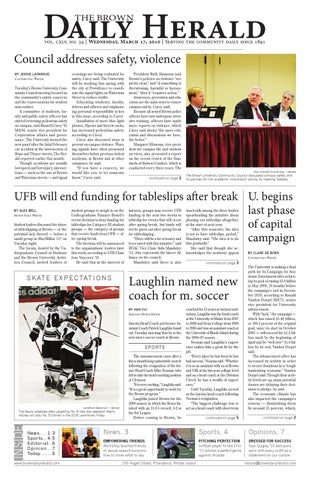
The Bears celebrate after upsetting No. 6 Yale last weekend. Men’s hockey will play No. 9 Cornell in the ECAC semifinals Friday.
www.browndailyherald.com
continued on page 3
By Clare de Boer Contributing Writer
coached for 15 years at various institutions. Laughlin was the head coach at the University of Maine from 2007 to 2009 and Dean College from 2000 to 2006 and was an assistant coach at the University of Rhode Island during the 2006–07 season. Noonan said Laughlin’s experience makes him a great fit for the job. “Every place he has been he has had success,” Noonan said. “Whether it is as an assistant with us at Brown and URI, at the two-year college level and as a head coach at the Division I level, he has a wealth of experience.” Until Tuesday, Laughlin served as the interim head coach following Noonan’s resignation. “The biggest challenge was to act as a head coach with short-term
The University is making a final push for its Campaign for Academic Enrichment after achieving its goal of raising $1.4 billion in May 2009, 19 months before the campaign’s end in December 2010, according to Ronald Vanden Dorpel MA’71, senior vice president for University advancement. With “luck,” the campaign — which has raised $1.48 billion, or 106.2 percent of the original goal, since its start in October 2005 — will exceed the $1.5 billion mark by the beginning of April and be “well over” $1.6 billion by its end, Vanden Dorpel said. The advancement office has increased its activity in order to secure donations in a “tough fundraising economy,” Vanden Dorpel said. Though their activity levels are up, many potential donors are delaying their decisions to pledge, he said. The economic climate has also impacted the campaign’s returns — diminishing them by around 15 percent, which,
continued on page 5
continued on page 2
Laughlin named new coach for m. soccer
S kate e x pectations
News.....1-3 Spor ts...4-5 Editorial..6 Opinion...7 Today........8
much talk among the three bodies spearheading the initiative about phasing out tableslips altogether at the start of next year. “After this semester, the idea is not to have tableslips, period,” Manduley said. “The idea is to do this gradually.” She said that though she acknowledges the aesthetic appeal
News, 3
Sports, 4
Opinions, 7
empowering friends Workshop teaches friends of sexual assault survivors how to know what to say
pitching perfection Softball player Kristie Chin ’11 pitches a perfect game against Arcadia
Dressed for success Sean Quigley ’10 sees jeans worn with every outfit as a statement on our culture
195 Angell Street, Providence, Rhode Island
herald@browndailyherald.com
Page 2
THE BROWN DAILY HERALD
C ampus N EWS
Wednesday, March 17, 2010
“We need to educate people on what Islam is.” — Maryam Al-Khawaja GS
BUCC seeks changes to conduct code continued from page 1
code, which covers non-academic actions, had been reviewed for over a year. Klawunn proposed a new specification in the code’s Sexual Misconduct Policy, which would break up the offense into two tiers to eliminate confusion and differentiate potential disciplinar y actions. The lower tier would include “non-consensual physical contact of sexual nature,” she said. The other tier would encompass “penetration, violent physical force or injur y,” which usually would lead to a punishment of “separation from
the University,” she added. Klawunn concluded with a recommendation to install an office of student conduct to manage all academic and non-academic offenses as a way to handle both types of incidents in the same office. The meeting concluded with a report from Vice President for Research Clyde Briant in which he emphasized continuing to build partnerships with private institutions such as IBM as well as other universities and hospitals. This kind of par tnership is “the research bond that brings people together,” Briant said.
Nick Sinnott-Armstorng / Herald
Assistant Professor of Religious Studies Nancy Khalek and Hussein Banai GS discussed Islam on Monday night.
Gift campaign buoyed Middle East experts advocate nuance by ‘great momentum’ By Jessica Liss Contributing Writer
continued from page 1 according to Vanden Dorpel, is “not bad compared to peers, who are down 25 to 30 percent.” The University’s cash on hand is “holding up reasonably well,” showing a drop of only 2 percent, according to Vanden Dorpel. With nine months until the campaign’s end, Vanden Dorpel says that the University will continue to seek funding for the “four F’s” — financial aid, faculty chairs, facilities, and the Annual Fund — that are central to its mis-
sion. The University still needs to raise money for various projects, including the renovation of Metcalf Chemistry Laboratory and the Medical Education Building. Beppie Huidekoper, executive vice president for finance and administration, expressed her gratitude to the advancement office for working “so hard,” and to all those donors “who have been willing to step up” in this challenging economic climate. She said that the campaign has “great momentum” and is “building up a little extra steam to get to the finish line.”
sudoku
“We would be hard-pressed to come up with a distinctly Muslim value,” said Nancy Khalek, assistant professor of religious studies, at “Islam and Governance: The Political Future of the Middle East,” a Janus Forum-sponsored panel held Tuesday in Barus and Holley 166. Khalek spoke with Hussein Banai GS, a doctoral candidate in the Department of Political Science, about the difficulty of defining distinctly Muslim values, the role of Islam in the Middle East’s political development and their own negativity toward radical Islamic movements. Kelly Mallahan ’11, Janus Fellows director and Herald copy desk chief, said the event’s topic “is on the minds of a lot of students, especially politically-minded students, and is something that often gets glossed over.” Banai underscored a point Khalek made about the many forms of Islamic identity. “You need to recognize that not
all of us get up in the morning and pray five times a day,” he said. He emphasized pluralism in Islamic society, saying that one must “balance various identities and religious backgrounds, and above and beyond that, ethnic backgrounds.” He also said Islamic values are influenced by time and place. Politics is “about the intersection of the universal and the particular,” Banai said, and Khalek agreed. Banai said that though “particularized orthodox ideas” exist, they are difficult to find in the modern Middle East. He cited as an example the green movement in Iran, which involves a group of individuals that is both “youthful, Western-oriented” and “very locally adept.” Khalek examined the relationship between Islamic scriptures such as the Quran and the actions of Islamic governments, speaking about traditional Islamic tenets found in several nations. “When it comes to contemporary politics,” she said, countries have vastly different ideas of how to implement certain aspects of Islamic law.” Po-
litical Islam and Islamic government are not the same, Khalek said. Both Khalek and Banai expressed criticism of radical Islamic movements, which Khalek called “severe simplification of facts on the ground.” “It is A-B-C Islam,” she said. Ultimately, it is “easy to sell to the disenfranchised, easy to package,” Khalek added. These movements are responses to outside forces, as opposed to a nation’s domestic tribulations, Khalek said. This is “spent force,” Banai said. These groups claim they are responding to hostile actions, Khalek said. In actuality, “al-Qaida has killed more Muslims than it has killed Westerners,” Banai said. “I think that it is always the wrong questions being asked,” said Mar yam Al-Khawaja GS, a Fulbright non-degree graduate student, after the event. “Before we start educating people on what’s happening now, we need to educate people on what Islam is.”
youn g an d restless
Daily Herald the Brown
Editorial Phone: 401.351.3372 | Business Phone: 401.351.3260 George Miller, President Claire Kiely, Vice President
Katie Koh, Treasurer Chaz Kelsh, Secretary
The Brown Daily Herald (USPS 067.740) is an independent newspaper serving the Brown University community daily since 1891. It is published Monday through Friday during the academic year, excluding vacations, once during Commencement, once during Orientation and once in July by The Brown Daily Herald, Inc. Single copy free for each member of the community. POSTMASTER please send corrections to P.O. Box 2538, Providence, RI 02906. Periodicals postage paid at Providence, R.I. Offices are located at 195 Angell St., Providence, R.I. E-mail herald@browndailyherald.com. World Wide Web: http://www.browndailyherald.com. Subscription prices: $319 one year daily, $139 one semester daily. Copyright 2010 by The Brown Daily Herald, Inc. All rights reserved.
Alex Bell / Herald
Chris Young, center, campaigned for mayor of Providence Tuesday afternoon outside of the Brown Bookstore with girlfriend and campaign manager Kara Russo, despite the order not to trespass the University issued him in December. The duo said University administrators allowed Young to stay there as long as he kept his distance from the building.
Wednesday, March 17, 2010
THE BROWN DAILY HERALD
C ampus N EWS
Page 3
“Lots of good people don’t know how to respond.” — Trish Batakis-Glover, workshop facilitator, on sexual assault
Screws, signs missing from SciLi The following summary includes all major incidents reported to the Department of Public Safety between Feb. 4 and March 4. It does not include general service and alarm calls. The Providence Police Department also responds to incidents occurring off campus. DPS does not divulge information on cases that are currently under investigation by the department, PPD or the Office of Student Life. DPS maintains a daily log of all shift activity and general service calls which can be viewed during business hours at its headquarters, located at 75 Charlesfield St.
missing at some point between Dec. 20 and Jan. 25.
to police headquarters to retrieve her property.
Feb. 17 9:55 p.m. A faculty member reported that he parked his car at 7:45 a.m. on Bowen Street and Lloyd Avenue and returned to it at around 9:30 p.m. When he returned he found the passenger front side window broken and his cell phone missing. Providence Police responded and took a report.
Feb. 6 9:27 a.m. A student in West Andrews Hall reported that she went to bed with the door unlocked around 1:00 a.m. When her roommate returned around 9:00 a.m., she found both of their laptops missing as well as an iPod.
Feb. 25 12:05 p.m. A student reported that she parked her vehicle at 8:50 a.m. on Meeting Street. She returned to her vehicle at 11:53 a.m. to find the passenger front side window broken and a bag containing $500 worth of medical supplies missing. PPD responded to take a report, and she was later notified that the bag had been recovered. 1:19 p.m. A employee parked her vehicle at 10:30 a.m. on Meeting and Brown streets. She returned to her vehicle at 11:53 p.m. and found the passenger front side window broken and her GPS stolen. She was informed that PPD already apprehended the subject and was told to respond to police headquarters to retrieve her property. 6:47 p.m. A employee parked her vehicle at 10:30 a.m. on Prospect and Bowen streets. When she returned to her vehicle at 6:40 p.m., she found the passenger front side window broken and her phone charger missing. She was later informed that PPD had apprehended the subject and was told to respond
Feb. 27 11:16 p.m. A student stated he obser ved three subjects tr ying to open doors on the third floor of Chapin House. The subjects opened one door, and two entered the room. The student approached them, at which time they fled from the room, ran out of the building and sprinted down Thayer Street. The resident of the room stated that she had left her door unlocked with her laptop plugged in on her desk, and when she returned to the room her laptop was unplugged, but nothing was missing.
Feb. 7 12:47 p.m. A student stated that he hid his camera bag in the bushes in front of Caswell Hall and then went with his friends to shoot a film on the lower green. When he returned, he noticed his bag was missing. Inside the bag were a batter y charger and videotapes. Feb. 11 12:13 p.m. A student reported that she left her laptop unattended in Smith-Buonanno Hall for two minutes and saw that it was missing when she returned. Feb. 12 2:20 p.m. It was reported that a large steel grate that covered the fireplace in Harkness House went
Crime Log
Feb. 28 5:36 p.m. A student reported that on Feb. 26 he locked his bike to the “Do Not Enter” sign at the corner of Waterman and Thayer streets with a chain and combination lock. When he returned at 5:00 p.m. on Feb. 28, his bike was missing. PPD responded to take a report. March 2 10:51 a.m. An employee reported that since the beginning of the first semester unknown persons have taken signs and screws from the Sciences Librar y. March 4 10:05 p.m. An employee turned in a wallet to a PPD officer that had been initially turned over by a coach in the Olney-Margolies Athletic Center. The wallet was identified as belonging to a student and returned to him. The student stated that the wallet was missing 40 or 60 dollars.
Tableslipping will be phased out continued from page 1 of tableslips, as well as their portability and convenient location when people have little to do in the dining halls, they do have their drawbacks. For example, not all students are on a meal plan, and tableslips can be wasteful when student groups make too many copies or don’t distribute all the copies they make. Manduley added that she has two years’ worth of UCS poll data showing a strong desire among students for a centralized location
for announcements. Alternatives to tableslips include Brown’s online events calendar, bulletin boards and postering. UCS President Clay Wertheimer ’10 said the Web site “does the job pretty nicely.” The new campus center, expected to open in the fall, will also serve as a physical center for event announcements, complementing online resources, according to Manduley. “It’s hard to get people to use these other methods when tableslips are still available,” Man-
duley said. Wertheimer called UFB’s withdrawal of funding for tableslips a “pilot program” to test the feasibility of eventually phasing out tableslips in the dining halls, which could be accomplished through a joint decision by UCS, UFB and BUAC. “We don’t want to end the tableslipping system immediately,” Vasconez said. The start of next semester could be a good time to make the switch so that the new class of freshmen become used to a more centralized system upon their arrival, he said.
Attention student groups: See this blank space? Your ad could be here! The Herald is now offering prices as low as $15 to student groups. For more information, e-mail studentgroups@browndailyherald.com
Nick Sinnott-Armstrong / Herald
Trish Bakaitis-Glover leads a workshop on supporting friends who have experienced sexual assault as part of Sex Week.
Workshop advises friends of sexual assault survivors By Clare de Boer Contributing Writer
In a cozy room in the Sarah Doyle Women’s Center Tuesday evening, students with all levels of background knowledge gathered to participate in a workshop on sexual assault as part of Sex Week. The workshop, titled “I’ll Only Tell a Friend: Learning the Best Ways to Help Someone Who’s Been Hurt by Sexual Assault,” was led by Trish Bakaitis-Glover, the University’s sexual assault response and prevention program coordinator, who emphasized the importance of understanding how to react and offer support to a friend “in an empowering way.” According to Bakaitis-Glover, one in six women and one in 23 men experience sexual assault or an attempt at sexual assault, and two-thirds of these people choose to tell a friend. Bakaitis-Glover said that, due to the complexity of the subject, many
“generalities” would be used to cover the topic “in a small period of time.” She discussed common myths about sexual assault before speaking about safety, information, empowerment, empathy, support and barriers to communication and answering questions on those topics. “Lots of good people don’t know how to respond” when a friend opens up about sexual assault, BakaitisGlover said. It is key to “let them define what they need, then help them get that,” she said. “Accepting a friend in that moment can be simple and powerful.” Attendees were given an outline describing different ways to help a friend and a pamphlet describing the resources available on- and offcampus. “The more positive experiences people have (when they tell a friend), the more likely they are to get further help,” Bakaitis-Glover said in closing. “That’s why we are here.”
SportsWednesday The Brown Daily Herald
Wednesday, March 17, 2010 | Page 4
Equestrian
Squad places second at JWU and Trinity By Zack Bahr Assistant Spor ts Editor
This weekend, the equestrian team knew what had to be done. It had to place high, like it has all season, to maintain its lead in the region. The squad did just that, finishing second at both Johnson and Wales and Trinity College. With damp weather, the conditions were less than favorable for riding. At Johnson and Wales on Saturday, Bruno finished just one point from first place. Liz Giliberti ’10 started the day earning second place in the Open Fences while point rider Rebecca McGoldrick ’12 also earned second place in the Intermediate Fences to give Brown 10 points through two events. Giliberti continued her success earning a blue ribbon in the Open Flat, giving her team seven points and putting herself back in the lead for the individual Cacchione Cup. Imani Tisdale ’12 finished in second place on the day for the Bears in the Walk Trot, earning five points. The team finished the day in second
place behind co-winners University of University of Connecticut and University of Rhode Island. “Saturday’s showing was disappointing,” said Cara Rosenbaum ’12. “Sunday was more like our team, and we were much more pleased.” Sunday’s show at Trinity brought out some of the younger talent on Brown’s squad, led by Kelsey MacMillan ’12, who earned first place in the beginner Walk Trot Canter. Katy Eng ’11 had a nice ride in the Intermediate Flat, placing third and nabbing four crucial points. Tisdale, once again, acted as cleanup crew, earning her second high finish of the weekend and boosting the Bears from fifth to a tie for second with 30 points. The Bears’ final regularseason show will be Saturday at Windcrest Farm in Hebron, Conn. Br uno currently has a 20-point lead in the region and will look to solidify its lead heading into championship season. “We have to go strong into this weekend,” Rosenbaum said. “Then we will be in a good spot for Zones and Nationals.”
Jonathan Bateman / Herald
The softball team had a dominant weekend at Hampton, winning five games and the championship.
Softball
Chin ’11 pitches perfect game By Ashley McDonnell Sports Staff Writer
Though the softball team (7-3) lost the first game of the Lady Pirate Classic in Hampton, Va., they went on to win the next five games — including the championship game against the host school, Hampton (7-16). Central Connecticut State 6, Brown 5
The Bears started off slowly on Friday morning and allowed Central Connecticut State (4-5) to jump out to an early 2-0 lead. The Blue Devils stole two bases, including home, during the first inning and capitalized on a fielding error by Brown. “Our energy level wasn’t as high as it usually is,” said Avery Silverstein ’13. “Errors allowed them to score runs they shouldn’t have.” It wasn’t until the bottom of the seventh, when Brown trailed 6-1, that the Bears picked up their energy level. Brown scored four runs that inning, but it wasn’t enough to overcome Central Connecticut State’s lead.
Brown 12, Coppin State 1 Later that Friday, the Bears maintained their energy level from the end of the previous game and dominated Coppin State (9-5). “We just came out really ready to play,” said Alyssa Caplan ’13. “We were ready, we came out and we all hit.” In the top of the third, Brown scored seven runs by hitting hard and capitalizing on four Eagle errors. With the bases loaded, Katie Rothamel ’10 hit a double that brought home Silverstein, Caplan and Herald Sports Staff Writer Erika Mueller ’13. Rothamel later hit a home run with two of her teammates on base, bringing her RBI total on the day to six. Brown 12, Hampton 2 After rain on Friday night, Brown’s early game on Saturday was canceled due to poor field conditions. But the Bears didn’t let the rain dampen their spirits in their game later that day against Hampton. Kate Strobel ’12 led Brown offensively with a single, a triple and a home run. She scored three times, had two RBI and stole two bases. “We took all the opportunities we could,” Silverstein said. “The offense was really on.” With a record of 2-1 in the tournament, Brown entered the elimination bracket on Sunday in second place overall. Brown 7, Arcadia 0 “We improved every game and we wanted to go 3-0 on Sunday,” Silverstein said. “We had confidence that we
could, we just had to keep the energy level high and stay confident.” The Bears continued to improve in the first elimination game against Arcadia (1-5). The star of the game was Kristie Chin ’11, who pitched a perfect game and struck out eight batters with a flawless defense at her back. Offensively, the Bears continued to hit solidly, led by Rothamel with three hits, two runs and two RBI. Brown 1, Coppin State 0 Brown’s rematch against Coppin State turned into a pitchers’ duel. Liz DiMascio ’13 allowed only one hit in seven innings, and the Eagles’ pitcher gave up two hits and one unearned run in the first inning. The lone run, scored by Kate Strobel ’12, clinched the game and sent the Bears to the championship. Brown 5, Hampton 4 (eight innings) The Bears’ rematch against Hampton likewise proved to be a tough battle. “We knew that they were going to be really pumped up because they had just beaten Central Connecticut (State), who was ranked higher than them,” Silverstein said. “They definitely came in with a lot more offensive power than we had seen in the game before.” Hampton scored first with a run in the opening inning. The score remained 1-0 until the sixth inning, when Caplan singled and brought home Stephanie Thompson ’13 to tie the game. In the top of the seventh, Hampton scored three runs to take a late 4-1 lead, but the Bears managed to answer with three runs of their own to tie the game and go into extra innings. “We stayed really focused,” Caplan said. “The conditions were awful, it was raining. But we shut them down.” After holding Hampton scoreless in the top of the eighth, Brown scored to win the game. Rothamel tallied the game-winning run on a rare walk-off passed ball. “We were really happy with how we played,” Silverstein said. “We’re improving every game.”
Page 5
THE BROWN DAILY HERALD
S ports W ednesday
Wednesday, March 17, 2010
“We battled hard each game.”
— Marek Drabinski, baseball head coach
Interim head named to Still positive after three straight losses coach m. soccer team
Baseball
By Chan Hee Chu Contributing Writer
A week after pulling an unlikely upset over Pepperdine, the Bears (1-6) traveled to the University of South Carolina (11-4) to take on another perennial power. The Gamecocks, ranked 19th by Baseball America heading into the weekend series, handed the Bears three straight losses. But despite losing all three games, Head Coach Marek Drabinski remained positive. “We battled hard each game,” Drabinski said. “We hit very well, and we fielded well, and I believe our relievers and starters did well for the most part. Even though we are now 1-6, I believe we have taken a lot from each game. I don’t know of any other team in the Northeast who has played as tough a schedule as us.” After the opening game on Friday was washed away, the Bears faced the Gamecocks in a doubleheader on Saturday. In the first game, the Gamecocks took an early lead in the bottom of the second and never looked back as they were able to knock out Brown starting pitcher Mark Gormley ’11 after only three innings. The Bears’ offense was stifled throughout the game, mustering only four hits. Shortstop Tyler Graham ’12 led the way for the Bears with two hits and two RBI. In the second game, the Bears jumped out to an early 6-2 lead, thanks to a pair of two-run homers by first baseman Mike DiBiase ’12 and right fielder Josh Feit ’11. But the Gamecocks answered with
continued from page 1
Courtesy of David Silverman
The University of South Carolina handed Brown three straight losses this weekend.
seven runs in the bottom of the fourth to take a 9-6 lead. The two teams traded runs in the later innings, and the Gamecocks prevailed, 10-7. Kevin Carlow ’13 pitched effectively in relief over 4 1/3 innings to keep the Bears within reach throughout the game. On Sunday, the Bears suffered another tough loss to the Gamecocks after forcing extra innings. Brown starter Rob Wilcox ’10 turned in a superb effort on the mound, lasting 6 1/3 innings while giving up only four earned runs. Left fielder Pete Greskoff ’11 led the Bears offensively, crushing his second home run of the year. Center fielder Chris Tanabe ’10 also contributed with a huge RBI single in the top of the seventh as part of a tworun inning, giving the Bears a 4-3 advantage.
But South Carolina answered with two runs of its own to take a 5-4 lead. The Bears rallied in the ninth, thanks to a clutch RBI single off the bat of second baseman Ryan Zrenda ’11. But the Gamecocks pushed across a run in the bottom of the tenth on a walk-off single to right field. Despite the losses, the Bears said they believe the way they battled bodes well for the future. “We know that USC is a very talented team, and the way that we stuck with them shows the strength of our team,” catcher Matt Colantonio ’11 wrote in an e-mail to The Herald. “We are really looking forward to our spring break trip and the start of the Ivy League season.” The Bears return to action on the Thursday at Holy Cross before heading to Alabama for a four-game series against Troy.
goals,” Laughlin said. “It’s good to have that stability right now.” After hearing the news, Laughlin told his players that he would be sticking around at Brown for longer than just the interim. “He has been with us throughout the fall and winter,” said defenseman Dylan Remick ’13. “I know him as a person and a coach, so I was very excited and happy for him.” The relationships Laughlin built with the players this past season will help make the transition easier for the team, Remick said. “Having a familiar face gives the guys some relaxation,” Remick said. “We won’t have to change everything as we would in the case of a new coach from outside.” Laughlin said Noonan’s legacy is “woven in the fabric of Brown’s
Courtesy of Sports Information Office
New men’s soccer head coach Patrick Laughlin.
soccer,” but he is ready to start a new legacy with the players. “We will push as far as we can to make the program as good as we can,” Laughlin said. “Our challenge will be to create a new legacy for the future.”
Add your event to our calendar on BlogDailyHerald.com
Editorial & Letters The Brown Daily Herald
Page 6 | Wednesday, March 17, 2010
A le x Y uly
e d i to r i a l
Getting schooled
t h e b r o w n d a i ly h e r a l d Editor-in-Chief
Managing Editor Chaz Kelsh
George Miller
editorial Anne Speyer Suzannah Weiss Brian Mastroianni Hannah Moser Brigitta Greene Ben Schreckinger Sydney Ember Nicole Friedman Dan Alexander Andrew Braca Han Cui
Senior Editors Ellen Cushing Seth Motel Joanna Wohlmuth Business General Managers Office Manager Shawn Reilly Claire Kiely Katie Koh
Deputy Managing Editors Sophia Li Emmy Liss
Arts & Culture Editor Arts & Culture Editor Features Editor Features Editor Metro Editor Metro Editor News Editor News Editor Sports Editor Asst. Sports Editor Asst. Sports Editor
Graphics & Photos Graphics Editor Stephen Lichenstein Graphics Editor Alex Yuly Photo Editor Nick Sinnott-Armstrong Asst. Photo Editor Max Monn Sports Photo Editor Jonathan Bateman Production Copy Desk Chief Kelly Mallahan Asst. Copy Desk Chief Jordan Mainzer Design Editor Marlee Bruning Asst. Design Editor Anna Migliaccio Asst. Design Editor Julien Ouellet Web Editor Neal Poole Post- magazine Editor-in-Chief Marshall Katheder
Directors Sales Kelly Wess Finance Matthew Burrows Client Relations Margaret Watson Alumni Relations Christiana Stephenson Managers Local Sales Arjun Vaidya National Sales Marco deLeon University Sales Aditi Bhatia University Sales Jared Davis Recruiter Sales Trenten Nelson-Rivers Maximilian Barrows Business Operations Sales Analytics Jilyn Chao Special Projects Alexander Carrere Staff Kathy Bui Opinions Opinions Editor Michael Fitzpatrick Opinions Editor Alyssa Ratledge Editorial Page Board Matt Aks Editorial Page Editor Debbie Lehmann Board member William Martin Board member Melissa Shube Board member Gaurie Tilak Board member Jonathan Topaz Board member
Marlee Bruning, Gili Kilger, Katie Wilson, Designers Greg Conyers, Tiffany Hsu, Rajan Mittal, Carmen Shulman, Copy Editors
Brown is the only member of the Ivy League that does not refer to its engineering division as a school of engineering. Fortunately, efforts are well underway to change this and align Brown more closely with its peers. The faculty plans to vote April 6 on a proposal to establish an engineering school, and the Corporation will make a final decision in May. We hope both the faculty and the Corporation approve the measure. The change in nomenclature will have a symbolic impact that will help Brown recruit the most talented students and faculty. Indeed, outsiders currently considering Brown’s engineering program are likely puzzled about why it lacks the school designation. The resolution currently under consideration by the faculty is relatively straightforward. It approves school status for the engineering division and holds that the change will not affect the usual processes for student admissions and faculty appointments. The resolution also endorses the search for a new dean of engineering who will be given the “latitude to shape many details of the current proposal” — including fundraising, new space for engineering activities, additional faculty hires and collaboration with other science departments. This resolution is much less detailed than a blueprint for expansion originally written in 2008 by several members of the engineering department and recently amended. The latest version of the blueprint puts forth a $100 million plan — funded mostly by donations — to add 12 new faculty and six new staff, start additional programs and build 35,000 square feet of new space. We are also supportive of this more ambitious plan for development. Engineering plays a central role in creating innovations that spur economic growth and solve societal problems, and Brown should seek to have an engineering program that is among the very
best. The introduction to the blueprint noted that Brown’s engineering faculty is smaller than engineering faculties at most peer institutions and that no new research space for engineering has been created or acquired since Barus and Holley was completed in 1965. The proposed expansion strikes us as not just worthwhile but overdue. However, the more detailed, ambitious plan drew criticism at a recent faculty meeting, The Herald reported earlier this month. Faculty members voiced concern that a major expansion in engineering might come at the expense of the other sciences. Several professors also criticized particular details of the engineering department’s blueprint. Many of these issues are specific to the implementation of the plan, the particulars of which are not yet finalized. As long as professors believe they will have adequate opportunity to voice their concerns as the implementation process plays out, they should not delay matters now by voting against the resolution. As for the question of whether boosting engineering takes away from other areas, the current leadership in the Division of Engineering has said that it hopes the expansion will facilitate collaboration and cooperation between engineering and the other sciences. And since engineering techniques are essential to research across the sciences, it makes sense that the benefits of a larger engineering program will accrue to a wide variety of disciplines. Brown might be the last Ivy to have a school of engineering, but it was the first one with a civilian engineering program. Establishing a school of engineering and encouraging its growth is an important next step in this proud historical progression. Editorials are written by The Herald’s editorial page board. Send comments to editorials@browndailyherald.com.
correction Due to an editing error, an article in Friday’s Herald (“Three’s the charm in PW show,” March 12) gave the incorrect year for costume designer Alexander Crane ’12. The Herald regrets the error.
Alex Bell, Sydney Ember, Sarah Mancone, Night Editors Senior Staff Writers Ana Alvarez, Alexander Bell, Alicia Chen, Max Godnick, Talia Kagan, Sarah Mancone, Heeyoung Min, Kate Monks, Claire Peracchio, Goda Thangada, Caitlin Trujillo Staff Writers Anna Andreeva, Shara Azad, Nicole Boucher, Kristina Fazzalaro, Miriam Furst, Anish Gonchigar, Sarah Julian, Matthew Klebanoff, Sara Luxenberg, Anita Mathews, Mark Raymond, Luisa Robledo, Emily Rosen, Bradley Silverman, Anne Simons, Sara Sunshine Senior Sales Staff Katie Galvin, Liana Nisimova, Isha Gulati, Alex Neff, Michael Ejike, Samantha Wong Design Staff Caleigh Forbes, Jessica Kirschner, Gili Kliger, Leor Shtull-Leber, Katie Wilson Web Staff Andrew Chen, Warren Jin, Claire Kwong, Michael Marttila, Jeffrey Matteis, Ethan Richman Photo Staff Qidong Chen, Janine Cheng, Alex DePaoli, Frederic Lu, Quinn Savit Copy Editors Nicole Boucher, Sarah Forman, Claire Gianotti, Tiffany Hsu, Christine Joyce, Sara Luxenberg, Abigail Kersen, Alexandra Macfarlane, Joe Milner, Lindor Qunaj, Carmen Shulman, Carolina Veltri
C O R R E C T I O N S P olicy The Brown Daily Herald is committed to providing the Brown University community with the most accurate information possible. Corrections may be submitted up to seven calendar days after publication. C ommentary P O L I C Y The editorial is the majority opinion of the editorial page board of The Brown Daily Herald. The editorial viewpoint does not necessarily reflect the views of The Brown Daily Herald, Inc. Columns, letters and comics reflect the opinions of their authors only. L etters to the E ditor P olicy Send letters to letters@browndailyherald.com. Include a telephone number with all letters. The Herald reserves the right to edit all letters for length and clarity and cannot assure the publication of any letter. Please limit letters to 250 words. Under special circumstances writers may request anonymity, but no letter will be printed if the author’s identity is unknown to the editors. Announcements of events will not be printed. advertising P olicy The Brown Daily Herald, Inc. reserves the right to accept or decline any advertisement at its discretion.
Opinions The Brown Daily Herald
Wednesday, March 17, 2010 | Page 7
Appropriate for the occasion Sean Quigley Opinions Columnist It has been said that during the period in which King Edward VII of the United Kingdom reigned (1901-1910), humanity last knew a proper attention to sartorial choices. Yes, His Majesty’s approach was perhaps a little too fastidious, but in a time when jeans are king, especially on college campuses, one cannot but admire a man who matched his clothes to every occasion so scrupulously. Odious as the political forms of his day may be to some, though certainly not all, must we repudiate the taste and discipline of the Belle Epoque? Who could honestly say that he was unmoved, in one way or another, by Barbara Tuchman’s magnificent rendering of the royal assemblage at the King’s funeral in her magisterial “The Guns of August”? Since World War I, it may sadly be the case that we have not known beauty. Surely I am not the first to notice the contemporary lack of attention to decent attire at the appropriate occasions. In an article for National Review more than 50 years ago, William Buckley, Jr., using language curiously resembling the Declaration of Independence, remarked, “Does not insistence on a minimal standard of dress reflect a decent respect for the opinions of mankind?” Lamenting that arguments for democracy (as well as economy) were in large supply against the simple matter of wearing a coat
and tie to college dinners, Buckley criticized what he saw as mere “affectation and laziness” masquerading as “personal independence.” A brief look at a photograph of MIT’s 1956 graduating class, posted on Dec. 16 at IvyStyle.com — a gloriously habit-forming blog for those who choose not to live in 2010 — reveals especially how far the mathematics and science types have fallen. Moreover, as the post notes, there was still plenty of room for creativity within the standard academic attire.
demning the perpetual youth culture endemic since the 1960s and even World War II. Men just want to be boys, and fairly dull boys at that. Not wanting to brave the uncertainties and challenges of a world where greatness, if not beauty, is still possible, many young lads prefer the lackluster benefits of a basement. The dress code for such a profession? Why, jeans and a T-shirt, of course. “See, I don’t care!” With petty ambitions come petty drapings.
With petty ambitions come petty drapings.
I ask the jeans-and-T-shirt philosophers to riddle that one for me. How could, in an age of supposed liberation and individualism, basically any Brown student be replaceable with the next Beat eating in the front cave of the Ratty? In large part, two disgusting trends of the last several decades may serve as guiding reasons. First, there is the onslaught of what, in a recent Newsweek piece, George Will termed “The Basement Boys” syndrome. Referring to the alarming number of young men who still live with their parents after (or in lieu of) college, Will spent considerable time con-
Yet, since we are at Brown, it is likely the case that most terrible clothing choices are the result of the second nefarious trend of late: pure neglect, or just plain lack of concern. Whereas Victoria’s offspring might have labored over the various clothes that he would wear over the course of the day — morning coat or dark suit at first, a blazer later for leisure activities and finally, either evening dress or a dinner jacket at night — Homo contemporaneus is bland all day. In class, jeans; at a club meeting, jeans; at dinner, jeans. With the recent creation of a vulgar jeans-sweatpants item, he may also
wear jeans to bed. It is probable that most do not truly appreciate the novelty of this phenomenon. In the intelligent and historically minded AMC drama, “Mad Men,” the discerning viewer will notice the frequent diversity in dress, as late as 1963. Don Draper wears a business suit during a workday, typically a sports jacket, button-down or polo on a weekend and always matching pajamas at night. And that attention to detail, that conception of life as demanding certain dress for certain occasions, is completely lost on the modern bore. All he knows is denim and vile sweatpants. What he misses are no less than his own humanity and the discipline of the civilization that, in its prosperity, permitted his neglect. Here we are, we lovers of comfort and possessors of phony independence. We like to think that we are at the pinnacle of history, yet we are more accurately no better than the barbarian whose dress is a loincloth and whose culture is a pit of primitive preferences. There we go, rain or shine, into sartorial perdition, all the while thinking that what our democracy produces could surpass even the refuse of an age not far removed. Well, if we ever do program a life more virtuous, I am sure that we shall look proletariat in doing so. Without even knowing it, the Communists won.
Sean Quigley ’10 wrote this column in his pajamas and robe.
Campaigning to win Sarah Yu Opinions Columnist A few weeks ago, I was walking through the lobby of the Sciences Librar y after a late evening of intense readings about political theory. A group of friendly freshmen stopped me as I was leaving and asked me to watch their video entry for the housing lottery first pick contest. Feeling an urge to participate in the community after long hours of solitude, I agreed. It was a fun video to watch, entertaining, shot in various locations around campus and put together with some clever editing. I logged in under my Brown ID, voted for them and, to my surprise, received a Reese’s Peanut Butter Cup as a thank-you present. I walked back to my dorm feeling good about myself. I read about this group’s victory in The Herald’s March 8 article, “First-pick contest causes controversy,” not expecting that campaign ethics had been introduced into the debate. The controversy surrounded the campaigning techniques of participant group Insourced, the above-mentioned freshmen of my anecdote. Insourced was accused of breaking campaigning rules in order to attract voters and more attention to its video. They won, say some other contestants, not because of the superior quality of their entry, but because of the aggressiveness of their methods. It’s a natural and practical action for any
group participating to attempt to get as many votes as possible. Creating a Facebook group and inviting friends to vote is just the first level of active campaigning, but Insourced clearly attempted to reach a wider audience with its campaign. Before I go any further in discussing the ethics of campaigning for the first pick contest, I would first like to commend Insourced on the amount of energy and time they dedicated to the contest. For busy college students with a multitude of conflicting
became more aware of the sensitivities and ugliness of election campaigning, even when sheltered inside Brown’s cocoon. Unlike last year’s UFB incident, however, the housing lottery first pick contest did not have any guidelines or rules against methods such as those used by Insourced, and thus advertising and campaigning were to be at the discretion of each participating group. Insourced didn’t break any “rules,” and they certainly did not decrease or consciously damage other contestants’ chances in the
Campaigns can become brutal, and any contest that is based on popularity can ultimately become controversial.
priorities, Insourced’s elaborate strategies to increase their chances of winning were a sure sign of positive dedication. Campaigns can become brutal, and any contest that is based on popularity can ultimately become controversial. The first pick contest, by nature of its online voting system, definitely has the potential to turn its focus from the videos to the votes. I remember last spring, when it was “suggested” that a candidate for the position of Undergraduate Finance Board vice chair position withdraw from the election when he was caught tearing down opponents’ posters. I think we all
process. Really, in more absolute terms of competitive campaigns in general, all of this is relatively tame. Furthermore, I would be surprised if other contestants were not aware of Insourced’s campaigning presence in the dining halls and at the libraries before online voting ended. It is hard to believe they did not predict the possible larger number of votes Insourced could have attained through their unconventional methods. Even if Insourced’s strategies had been largely ignored by the wider student population at Brown, they would inevitably have drawn a considerable amount of atten-
tion, especially from upperclassmen and those not personally acquainted with the participants of the contest, such as myself. I agree that it is unfortunate that much of the competition, or at least the voting process, can focus on the campaigns more than the actual content of the entries. Perhaps there are some structural changes that can be implemented to improve the system, such as those suggested by the March 12 letter to the editor, “Don’t discontinue first-pick contest — improve it.” I can also think of a few suggestions off the top of my head: a ceiling of how much time and money contestants can spend on the contest to regulate “unfair measures” and offering a “judges’ choice award” for quality entries that may be overshadowed by others’ popularity. For now, I would like to ask students indignant at the outcomes of the contest to think of this as a part of our preparation for entering the real world (or at least for the actual housing lottery), where we will undoubtedly be exposed to much more aggressive tactics than these. Putting aside any negative attitudes towards campaign strategies, perhaps we can even agree that Insourced has given us some interesting recommendations about creative and useful methods for making ourselves known. After all, participants enter a contest with the ultimate goal of winning, and a large part of any competition is based on how well the contestants try to win.
Sarah Yu ’11 is an international relations and history concentrator from Sydney, Australia. She can be reached at xia_yu@ brown.edu.
Today The Brown Daily Herald
2
Forum discusses definition of Islam
4
comics
Dot Comic | Eshan Mitra and Brendan Hainline
c a l e n da r tomorrow, march 18
12:00 P.M. — Main Green Sex Week 2010 Extravaganza, Main Green
4:00 P.M. — State of Brown address with President Ruth Simmons, Salomon 101
7:00 P.M. — Rosa Clemente: Politics, Race and Gender, Puerto Rican Identity Week opening convocation, Salomon 101
5:30 P.M. — Fires of Spring: Irish Customs and Folklore of the Spring Season, List 120
menu Sharpe Refectory
Verney-Woolley Dining Hall
Lunch — Beef Tips with Curry, Vegetable Enchiladas, Polynesian Ratatouille, Raspberry Sticks
Lunch — Hot Ham on a Bulky Roll, Pizza Rustica, Raspberry Sticks
Dinner — Corned Beef, Vegetable Turnover with Cheese, Colcannon Potatoes, Decorated Cupcakes
Excelsior | Kevin Grubb
Dinner — Corned Beef, Vegetable Turnover with Cheese, Jamaican Pork or Tofu and Apricot Saute, Decorated Cupcakes
crossword
58 / 31
61 / 41
Wednesday, March 17, 2010
Cabernet Voltaire | Abe Pressman
Today, March 17
to m o r r o w
Softball pitcher hurls perfect game
t h e n e w s i n i m ag e s
5
to day
Fruitopia | Andy Kim
Hippomaniac | Mat Becker
STW | Jiantao Huang
Page 8