Daily Herald the Brown
vol. cxlv, no. 27 | Monday, March 8, 2010 | Serving the community daily since 1891
Charges dropped, but Young still banned from campus By Alex Bell Senior Staf f Writer
The city prosecutor has dismissed disorderly conduct charges against Chris Young, the mayoral candidate’s lawyers announced on Friday. Young was arrested in November at a health-care forum in Andrews Dining Hall during which he tossed a pro-life video at Rep. Patrick Kennedy, D-R.I., and refused to relinquish the microphone at the request of the forum’s moderator and police officers. “I’m a free man again,” Young said. “It’s been a hard battle.” Young said he is “seriously considering” pursuing civil charges against the University.
s u nn y si d e u p
“They’ve obviously violated my freedom of speech rights and freedom of religion rights, but also they’ve suppressed speech that is based on issues that involve race,” he said. “That is a constitutional violation that can’t be overlooked.” Young said he is hoping to take action against the University under a federal law that allows for the prosecution of anyone who causes a citizen’s constitutional rights to be violated. Young said the University has not yet contacted him about its December order that he not enter University property. The order was issued in a “retaliatory manner” for his vocal opposition to the arming of continued on page 3
Nick Sinnott-Armstrong / Herald
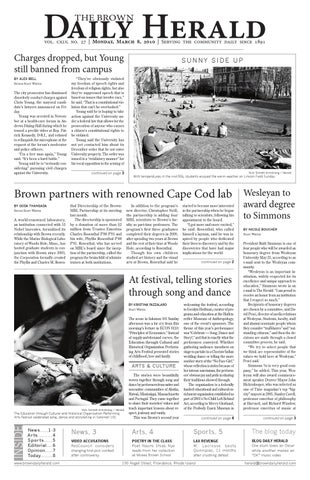
With temperatures in the mid-50s, students enjoyed the warm weather on Lincoln Field Sunday.
Brown partners with renowned Cape Cod lab Wesleyan to By Goda Thangada Senior Staff Writer
A world-renowned laborator y, an institution connected with 53 Nobel laureates, formalized its relationship with Brown recently. While the Marine Biological Laboratory of Woods Hole, Mass., has hosted graduate students in conjunction with Brown since 2003, the Corporation formally created the Phyllis and Charles M. Rosen-
thal Directorship of the BrownMBL Partnership at its meeting last month. The directorship is sponsored by a donation of more than $2 million from Trustee Emeritus Charles Rosenthal P’88 P’91 and his wife, Phyllis Rosenthal P’88 P’91. Rosenthal, who has served on MBL’s board since the inception of the partnership, called the program the brainchild of administrators at both institutions.
In addition to the program’s new director, Christopher Neill, the par tnership is adding four MBL scientists to Brown’s faculty as part-time professors. The program’s first three graduates completed their degrees in 2009, after spending two years at Brown and the rest of their time at Woods Hole, according to Rosenthal. Though his own children studied art history and the visual arts at Brown, Rosenthal said he
started to become more interested in the partnership when he began talking to scientists, following his appointment to the board. “I got more and more excited,” he said. Rosenthal, who called himself a layman, said he was inspired by people who dedicated their lives to discovery and by the discoveries that have had major implications for the world.
The scene in Salomon 101 Sunday afternoon was a far cry from this morning’s lecture in ECON 0110: “Principles of Economics.” Instead of supply-and-demand curves, the Education through Cultural and Historical Organization Performing Arts Festival presented stories of childhood, love and family.
ARTS & CULTURE
Nick Sinnott-Armstrong / Herald
inside
The Education through Cultural and Historical Organization Performing Arts Festival celebrated song, dance and storytelling in Salomon 101.
News.....1-3 Ar ts.........4 Spor ts.....5 Editorial....6 Opinion.....7 Today........8
www.browndailyherald.com
The stories were beautifully woven together through song and dance by performers from native and non-native communities of Alaska, Hawaii, Mississippi, Massachusetts and Portugal. They came together to share their societies’ values and teach important lessons about respect, jealousy and vanity. This was Brown’s second year
By Nicole Boucher Staf f Writer
welcoming the festival, according to Geralyn Hoffman, curator of programs and education at the Haffenreffer Museum of Anthropology, one of the event’s sponsors. The theme of this year’s performance was “Celebrate — Song, Dance and Story!,” and that is exactly what the performers conveyed. Whether gathering audience members on stage to partake in a Choctaw Indian wedding dance or telling the more somber story of the “No Face Girl,” whose reflection is stolen because of her intense narcissism, the performers’ obvious joy and pride in sharing their traditions showed through. The organization is a federally funded educational and cultural enrichment organization established as part of 2001’s No Child Left Behind Act, according to Merry Glosband, of the Peabody Essex Museum in
President Ruth Simmons is one of four people who will be awarded an honorary degree from Wesleyan University May 23, according to an e-mail sent to the Wesleyan community. “Wesleyan is an important institution, widely respected for its excellence and unique approach to education,” Simmons wrote in an e-mail to The Herald. “I am proud to receive an honor from an institution that I respect so much.” Recipients of honorary degrees are chosen by a committee, said David Pesci, director of media relations at Wesleyan. Students, faculty, staff and alumni nominate people whom they consider “trailblazers” and “outstanding citizens,” and then the decisions are made through a closed committee process, he said. “We tr y to select people that we think are representative of the values we hold here at Wesleyan,” Pesci said. Simmons “is in very good company,” he added. This year, Wesleyan will also award commencement speaker Denver Mayor John Hickenlooper, who was selected as one of Time magazine’s top “bigcity” mayors in 2005. Stanley Cavell, professor emeritus of philosophy at Harvard, and Richard Winslow, professor emeritus of music at
continued on page 4
continued on page 3
continued on page 2
At festival, telling stories through song and dance By Kristina Fazzalaro Staff Writer
award degree to Simmons
News, 3
Arts, 4
Sports, 5
The blog today
video accusations ResCouncil considers changing first-pick contest after controversy
poetry in the class Poet Naomi Shiab Nye reads from her collection at Moses Brown School
lax revenge W. L a c r o s s e b e s t s Quinnipiac, 11 months after crushing defeat
blog daily herald One alum loses an Oscar while another makes an “OK” music video
195 Angell Street, Providence, Rhode Island
herald@browndailyherald.com
Page 2
THE BROWN DAILY HERALD
C ampus N EWS
Monday, March 8, 2010
“Good deals are good deals if both parties benefit.” — Charles Rosenthal P’88 P’91, trustee emeritus
New partnership marries research and education continued from page 1 A better bargain for both The joint venture, which enrolled its first students in 2003, was meant to strengthen Brown’s graduate programs in science as part of President Ruth Simmons’ plans for furthering the sciences at Brown, he said. “MBL had a distinguished histor y and pedigree,” he said. “It was and is the oldest private lab in the U.S. and, I suspect, the world. Brown, on the cheap, happened into world-renowned science.” As with any ambitious academic initiative, the commitment to building a relationship with another institution involved the approval of administrators, faculty and Corporation members. Because the process involved two independent institutions, efforts needed to be doubled. “It takes two,” Rosenthal said. While other schools, including Harvard, have full-fledged independent programs in the ecological sciences, Brown was looking to bolster its own program — with the limited resources at hand. Still, the partnership is not a coup for just Brown. “Good deals are good deals if both parties benefit,” Rosenthal said. As a “soft-money” institution running primarily on grants won by individual scientists, MBL does not offer tenured appointments. Through Brown, MBL has access to additional sources of funding. Also, MBL is not a degree-granting institution, and prior to the joint program’s creation, students studied there only sporadically and through a summer program.
“This all fits together,” Rosenthal said. The partnership will proceed with the input of researchers, but the catalyst for the program’s development was the administration. “The real impetus came from the highest levels at Brown and MBL,” Neill said. But given this top-down process, “the people who are doing this have stepped up,” Neill said, referring to the researchers. Next steps The partnership’s inaugural director is Neill, an MBL senior scientist studying ecosystems, who said he was offered the job in late November. While his new position is a joint appointment split evenly between the two institutions, four MBL scientists will hold part-time appointments at Brown. Three of the four will belong to the Department of Geology, Neill said. The establishment of the directorship puts the program “under one roof,” said Neill, whose own appointment will be with the Department of Ecology and Evolutionary Biology. Though he began traveling to Brown twice a week in January, Neill said he expects to settle down and acquire a permanent office in the coming months. The ultimate shape of the program is open-ended, and the pace of growth depends on those who participate in the program, Neill said. “The program is not looking to grow explosively,” but “quite steadily,” Neill said. There is not necessarily a set research agenda, but the four joint appointments are intended to foster interaction between specific profes-
sudoku
sors at both institutions, he said, adding that scientists will need to take the initiative to begin collaborating no matter how much infrastructure the partnership’s administration develops. Immediate steps include building the graduate program’s curriculum, especially by creating upper-level courses in ecosystems and ecology. The newly expanded partnership will also benefit Brown’s undergraduates — scientists from MBL will offer new courses and provide them with research opportunities, Neill said. One of the program’s goals, Neill said, was “to develop a broader umbrella for environmental research” by integrating different academic disciplines. For example, MBL — a biological institute — could not draw on work in geology and the social sciences before its partnership with Brown. “Now, MBL is more of a player in that sort of discussion,” Neill said. “It was a partnership that seemed logical,” he said. An odd couple Though he has advocated for expanding the program, the major impetus for the program came from the administration, according to Mark Bertness, professor of biology and the chair of the Department of Ecology and Evolutionary Biology. The partnership was “kind of like an arranged marriage,” Bertness said. “It’s absolutely mutually beneficial,” he said. MBL’s scientists rely on grants to fund their work, while at Brown, “we don’t have the weird mentality of wondering where the next dollar is coming from,” he said. When the partners first began to interact, Bertness said, there were “massive cultural dif ferences.” MBL’s unique quality is that it is a field laboratory — creating a trade-
off, Neill said, between the desire to educate and the desire to focus on research. Among the scientists at MBL, there are some who are “not involved, not interested,” he said. But younger scientists are “much more open to diversifying the work they do and the way they go about doing it.”
“If it goes the way we envisioned, we’ll look back on this as something that changed the prospects for Brown.” Mark Bertness Professor of Biology and Chair of the Department of Ecology and Evolutionary Biology This choice must be an individual one, Neill said. “Each person at MBL is free to choose the level of engagement.” “We had to spend a few years letting the cultures grow together,” Bertness said. After a few years, “things were going well enough that we needed to institutionalize.” Hugh Ducklow, who runs MBL’s Ecosystems Center, said that despite the institutions’ distinct cultures, there are “lots of other intellectual reasons” for the partnership. For example, Ducklow said, he appreciates the fact that MBL scientists can advise graduate students. Ducklow has mentored students in the joint graduate program and taken a Brown alum with him on a research expedition to Antarctica. “There are synergies between research and education,” he said. Shelby Hayhoe GS, a third-year doctoral candidate in ecology and evolutionary biology, is writing her
thesis under two advisers, Neill and Assistant Professor of Biology Stephen Porder. “Only in this collaboration can I do the project I’m doing now,” said Hayhoe, who studies the conversion of rainforest to soybean agriculture in South America. Though she primarily works with Neill in the field and with Porder while she is at Brown, Hayhoe said the open communication between all three of them made the project work, despite the risk that a student might get lost in the shuffle between two institutions. “I’m psyched about it,” Hayhoe said about the new directorship. “Expanding and becoming more organized can only be a good thing.” Competing for resources The partnership is developing at a time when other projects in the sciences are coming to the University’s attention — and Brown has considerably fewer resources to fund them all. In fact, investment in the partnership was not approved at last February’s Corporation meeting, according to Bertness. There is “massive competition for resources,” he said. Brown’s emphasis on investing in the sciences is positive, he said, but it should not come at the expense of the humanities. “You have to pick and choose,” Rosenthal said, noting that the partnership is not very expensive. Instead of draining resources, Rosenthal said, the program will likely attract more investment. “The tools are there,” he said. For scientists and students, the partnership already represents a productive research collaboration. “Over time they will grow much closer together,” Bertness said. “If it goes the way we envisioned, we’ll look back on this as something that changed the prospects for Brown.”
Daily Herald the Brown
Editorial Phone: 401.351.3372 | Business Phone: 401.351.3260 George Miller, President Claire Kiely, Vice President
Katie Koh, Treasurer Chaz Kelsh, Secretary
The Brown Daily Herald (USPS 067.740) is an independent newspaper serving the Brown University community daily since 1891. It is published Monday through Friday during the academic year, excluding vacations, once during Commencement, once during Orientation and once in July by The Brown Daily Herald, Inc. Single copy free for each members of the community. POSTMASTER please send corrections to P.O. Box 2538, Providence, RI 02906. Periodicals postage paid at Providence, R.I. Offices are located at 195 Angell St., Providence, R.I. E-mail herald@browndailyherald.com. World Wide Web: http://www.browndailyherald.com. Subscription prices: $319 one year daily, $139 one semester daily. Copyright 2010 by The Brown Daily Herald, Inc. All rights reserved.
www.diamondsandcoal.com
Monday, March 8, 2010
THE BROWN DAILY HERALD
C ampus N EWS
Page 3
“I have had no due process whatsoever.” — Chris Young, on being barred from University property
First-pick contest causes controversy Ambassador program
pushed back to Sept.
By Jonathan Chou Contributing Writer
Last week’s announcement that Insourced — a group of eight freshmen — won the Residential Life first pick contest led to multiple accusations of illegitimate campaigning and guideline violations, sparking heated debate among students. The winners were accused of violating campaign guidelines, as well as making their video longer than three minutes and 30 seconds, the maximum length allowed by the rules. Both accusations are false, though, according to members of the Residential Council. ResCouncil Chair Ben Lowell ’10 and Housing Lotter y Committee Chair Jillian Robbins ’11 both confirmed there were no preexisting regulations on campaigning, and that the actual footage of all videos was within the time limit. The accusations against Insourced stemmed mainly from the group’s campaign strategy. The group gave out candy in exchange for votes, roamed around dining halls and libraries soliciting votes and walked around campus in apparel that advertised the video, said Daniel Lowry ’12. Some first pick contestants exchanged e-mails discussing Insourced’s strategies after the group’s win was announced, said Anish Sarma ’12, another contestant in the first pick contest. All the teams “could’ve done the same thing,” Sarma said. “The bottom line was that they got the most votes.” Lowry said that he “wasn’t surprised” that Insourced won, since the competition is no longer “about
By Sarah Julian Staff Writer
Nick Sinnott-Armstrong / Herald
A group’s campaign to win this year’s first pick contest upset other contestants.
the best video, it is about who is most aggressive.” These tactics were not unheard of in previous years, Robbins said, adding that to a degree, every group campaigned, at the very least by creating a group on Facebook. Robbins said it is hard to believe contestants thought “making a Facebook group was sufficient.” She added that Insourced had no way of actually forcing people to vote, because students had to input their usernames and passwords before they could vote. “Voting can be informed or uninformed,” Robbins said. The first pick contest “is a voting competition,” Lowell said, and campaigning is expected and allowed. Thus, the debate about the way Insourced campaigned did not
worry ResCouncil so much as the general attitude with which contestants approached the competition, he said. “Over the past few years, this year and last, it’s become less fun and friendly,” Lowell said. “People have gotten more serious and acrimonious.” The purpose of the contest is to encourage the students to get excited about the housing lottery and “to generate buzz,” Robbins said. Because students are losing their focus on the contest’s purpose, there is a possibility that the first pick contest may not take place next year, she said. “The more trouble it gives the Residential Council, the less they’ll want to continue the contest,” Sarma said.
The start of the 2010 Ambassador Program has been postponed from January to September of this year because the program requires a significant amount of time from participants and the featured departments, according to the Brown and the Economy Web site. The Ambassador Program was created to provide faculty and staff with the opportunity to learn more about Brown. It is application-based, and if accepted, University employees spend one day each month learning about a new facet of life at Brown. This might mean spending a day at the Sharpe Refectory learning about how food is prepared, or traveling to the Admission Office to get an up-close view of the application process. “During this time of change … we feel that it would not be appropriate to ask colleagues for this kind of time commitment,” a post on the Web site said. The year-long program will now coincide with the academic year, rather than the calendar year. Judith Nabb, a coordinator for the program, said she and the Center for Staff Learning and Profes-
sional Development are taking the time until the new start date to evaluate the program. According to Nabb, the program was initially given three years of funding. Because 2010 marks its third year, Nabb and her colleagues have to “make (their) case in terms of benefits,” she said. “We think it has a good case.” “I think it reenergizes people and makes them feel connected,” Nabb said. For this reason, she said, she loves “watching folks go through it and seeing how they draw inspiration from it.” Adjunct Lecturer in Public Policy Jennifer Slattery-Bownds, a 2008 ambassador and manager for career and employment development , said the program “has a lasting impact” on her “daily work activities.” Slattery-Bownds said she understands the challenges the economy created for the University, but she called the program a “vital” part of professional development. “I am more effective in my roles at Brown because I am an ambassador,” she said. “In times like this, it is more important than ever to keep employee programs that … keep up morale and maintain loyalty. Brown’s Ambassador Program does just that.”
Banned, Young may press charges of his own continued from page 1 Brown police and the University’s tax-exempt status, Young said. “Their agenda, clearly, is also tied to my desire to investigate Ruth Simmons and her role with Goldman Sachs as well as her role on the Council on Foreign Relations and why these university presidents are making so much money,” he said. Now that the case is dismissed, Young said he feels the University should rescind the notice not to trespass that has prohibited him from entering Brown’s campus and any building or property owned or leased by Brown.
In January, Vice President for Public Affairs and University Relations Marisa Quinn told The Herald the restriction would continue “until the Department of Public Safety deems that the individual is no longer a threat to the safety and security of the campus.” “The charge against me was dismissed,” Young said, adding that the University no longer has grounds to prohibit him from entering University property. “I have had no due process whatsoever when it comes to this order against me. Clearly, I am not guilty of anything. I committed no crime, and I am a political candidate who has the right
to campaign, but they’ve restricted me from one-third of the city.” The no-trespass order remains in effect, Quinn wrote in an e-mail to The Herald. “This issue will not disappear just because we won this case,” Young said. “There needs to be an example set in regards to policies that stop free speech in public forums like this and that violate the ability of a candidate to campaign in a city.” Young said he will be “going onto the property adjacent to Brown University” later this week to see if police arrest him, but he declined to share more details.
Simmons one of four awarded hon. degrees continued from page 1 Wesleyan, will also be honored, according to the Wesleyan community e-mail. The four recipients are all distinguished in their fields for contributions to public policy or scholarship, Pesci said. Simmons “has the respect of just about anyone in academia for her leadership,” he added. This is not the first honorary de-
gree that Simmons has received. She has been the recipient of honorary degrees from over 25 institutions, including Harvard, Princeton and Amherst College, according to her biography on the Brown Web site. Still, Simmons wrote that she considers this and “any such award” to have meaning because it serves as recognition of Brown’s excellence. “Just as Brown often honors individuals for the success of the
institutions they lead, so do others,” she wrote. Dean of the College Katherine Bergeron wrote in an e-mail that she was “thrilled” her undergraduate alma mater was celebrating Simmons. “It seems just right that Wesleyan should honor a woman who has stood for the same kind of free and freeing liberal education that Wesleyan itself has fostered through many years in its history,” she wrote.
www.blogdailyherald.com
Arts & Culture The Brown Daily Herald
Anthro dept. features rare folk performances continued from page 1 Salem, Mass., who has helped organize the national tour. Ten years ago, one of the organization’s members from Hawaii suggested storytelling performance, which evolved into the festival of today, she said. “We provide them with a theme and they bring their own stories,” Glosband said. Cast members from around the country “spent only two weeks in Alaska making the script and then began a nationwide tour.” “One of the board members saw the performance they did in New Bedford last year and loved it,” Hoffman said. “So we got them to come to Brown. It was wonderful and we invited them to come again.” Last year’s cast included Nitana Hicks ’03, Glosband said. “Nitana said that her first day as a freshman at Brown was spent in this auditorium,” Glosband said. “With her family and friends here,” performing in the show in Salomon “was like coming home for her.” The festival had an intimate, familial feel about it. The performers had a warm rapport among them that spilled over into the small group of Brown students and Providence families that attended the event. Jose Manuel Vinagre, a Portuguese man from the fishing village of Buarcos, opened with a powerful song about his boyhood. The song set the tone for the entire production. As a boy, he said, he was mischievous but loving. “How wonderful it was to be a boy, how wonderful it was to have a family and to have hope in the future,” he sang. “It was like having a sun always shining on you.” Even though each scene represented a different culture, the performers conveyed their stories seamlessly to audience members. Traditional music and instruments, such as the Hawai-
Monday, March 8, 2010 | Page 4
Famous poet comes to Moses Brown School By Sarah Mancone S enior S taf f Writer
Nick Sinnott-Armstrong / Herald
Sunday’s festival combined elements of the native and non-native communities of Alaska, Hawaii, Mississippi, Massachusetts and Portugal.
ian nose flute — which, the audience learned, is used to send messages between loved ones — created transitions from one speaker to the next. “Answer me, my love. Let there be no words between us, only breath, only truth,” sang Ani Lokomaika’i Lipscomb to illustrate how the instruments would work. The festival was equal parts entertainment and education. The performers drew audiences in with their words and dances and, in doing so, shed knowledge on communities that are generally left out of the limelight. “This performance was representing a lot of communities that don’t get a lot of representation on campus,”
said audience member and Hawaiian Kai Morrell ’11. “It was nice to see people and culture from where I’m from.” The performance ended with a rapping recap of the lessons audience members should have learned. Allison Warden of the Inupiaq Eskimos, also known by her rap name AKU-MATU, summed up the performance by incorporating traditional beats and sounds with modern rhymes. Ending the festival on a note of continuity, Warden encouraged audience members not only to learn about these cultures but also to experience them in everyday life and ensure their continued appreciation.
Award-winning writer and educator Naomi Shihab Nye will present her poetr y in the free and public event, “Ever ything Comes Next — Daily Rebir th Through Reading and Writing,” hosted by Moses Brown School, in the school’s Alumni Hall, March 11 at 7 p.m. Nye has written and edited more than 25 volumes and has been recognized by the Guggenheim, Librar y of Congress, Academy of American Poets and Pushcar t Prizes. “Naomi has visited our campus in the past,” said Sandi Seltzer, Moses Brown’s communications director. This will be Nye’s second visit to the Moses Brown Annual Spring Poetr y Reading, after her last appearance eight years ago, she added. M oses Brown has been hosting readings from well-known poets for over a decade, she said. Nye was selected by the students for this event. “We host a poet ever y year,” Seltzer said. “The students help pick a poet who is usually of some note.” Previous featured poets include Taha Muhammad Ali, Lucille Clifton, Mark Doty, Toni Blackman and Billy Collins. Cultural Connections, an organization that coordinates events relating to the ar ts, asked Nye to come to Providence. But Nye’s visit does not just consist of a poetr y reading. On the day of the reading, she will
“spend a day in the classroom” with students and will “look at their poems and work with them as well,” Seltzer said. Cur rently, students are in “pairs working on Naomi’s brand of poetr y,” Seltzer said. As Nye draws from her Palestinian-American heritage in her writing, her lesson will “ask students to draw from their own heritage,” Seltzer said. “We think she’s terrific,” she added. “We enjoy the time she spends with our kids.” Thursday night, the public is invited to come, enjoy the reading “and share in something that is educational and ar tistic,” she said. This event is also par t of “Raise Your Voice: Examining Culture, Clash, Community and Change,” a four-month project that uses ar tists, poets and scholars to spread Mar tin Luther King, Jr.’s work toward tolerance and nonviolent conflict resolution throughout secondar y schools and adult education classes. “Raise Your Voice” began at the University of Rhode Island, Seltzer said, and the project is working with a number of schools throughout Rhode Island “teaching King-ian nonviolence.” “Nonviolent conflict resolution is ver y impor tant to us,” she added. The reading is sponsored by Moses Brown, Cultural Connections, the International Institute of Rhode Island, the Rhode Island Council for the Humanities and the National Endowment for the Humanities.
Sheep graze at Sarah Doyle Women’s Center — in artwork By Sara Chimene-Weiss Contributing Writer
Terry Gips’ work hangs in the Smithsonian American Art Museum and the National Museum of Women in the Arts in Washington, D.C. Now, some of it resides in a location more convenient for most Brown students: the Sarah Doyle Women’s Center Gallery. The show, “Sheep of Many Colors,” is part of a larger project, called “The Dolly Project,” which Gips has been working on for about ten years, she said. The exhibit came about as the result of her fascination with
sheep, furthered by her interest in Dolly, the sheep cloned in 1996 at the Roslin Institute in Scotland. Dolly captured the world’s attention: She was on magazine covers and all over the news, raising questions about the ethics of cloning and technology. Gips, at the time a professor at the University of Maryland, said she was struggling with parallel issues in the art world. Art professors and students were dealing with the questions raised by digital art. In particular, she said she saw the connection between Dolly and what it means to be able to duplicate an image a hundred times with little effort.
The work on display at the center represents a range of styles and mediums. This includes classic, water-based monotypes such as “Two Sheep: Observations,” as well as multimedia works such as “Sheep’s Clothing,” pigmented prints of sheep stitched into the shape of clothes and displayed along with found items of clothing. Other work displayed includes small three-dimensional houses constructed of prints of sheep. Some of the other prints on display are Gips’ own photography, taken in Ireland, Scotland, England and the United States.
The largest piece on display is called “While Shepherds Watched,” which covers almost an entire wall. The piece is a tapestry of pigmented prints of sheep, text, yarn, wool and rope. Gips explained that the text is a list of known breeds of sheep — some now extinct — and the photos are of sheep from old British catalogues from the late 19th century. Gips said this work represents “an indication of what has been.” The show, on display through March 24, is one of the three professional artist shows this semester at the gallery. According to Brooke Hair ’10, a visual arts concentra-
tor and the gallery’s coordinator, a board — composed of faculty and staff from Brown, Providence College and the University of Rhode Island and a professional artist — sends out a yearly call for submissions. The group usually receives 60–80 submissions a year, and from those chooses five or six to display throughout the year, Hair said. Just as the collection is unique, the Sarah Doyle Women’s Center Gallery is not a typical white-walled gallery, but a former house with a fireplace, Hair added. “It can be a challenge, but also a way for artists to make different work.”
Attention student groups! See this blank space? Your ad could be here! The Herald is now offering prices as low as $15 for student groups, with discounts for ads on multiple days. For more information, contact studentgroups@browndailyherald.com
SportsMonday The Brown Daily Herald
M. HOCKEY
Monday, March 8, 2010 | Page 5
W. LACROSSE
Brown upsets RPI, advances in ECAC playoffs Bears avenge The Engineers got on the scoreboard first, and Volpatti evened the score, 1-1, before the period ended. But with the score tied, 1-1, late in the second period, RPI scored two goals 1:35 apart. Chase Polacek — the nation’s leading goal-scorer — netted another in the third period to give RPI its final 4-1 lead.
By Dan Alexander Sports Editor
The stakes couldn’t have been any higher. With Brown leading, 3-2, in the last moments of the final contest in a three-game playoff series and the Rensselaer goaltender pulled in favor of an extra attacker, Brown goalie Michael Clemente ’12 needed to deny every shot that came his way in order for the Bears to extend their season. He relished the pressure. “They had four or five shots at the end,” Clemente said. “That was the best part of the game.” It was especially nice for Clemente since no pucks got behind him and the Bears sealed the 3-2 victory and the series. Brown won, 3-1, Friday and lost, 4-1, Saturday. The third game extended Brown’s season at least another week. The Bears will take on No. 6 Yale, the top team in the ECAC, in a three-game series in New Haven starting Friday night. Brown 3, RPI 1 Brown’s weekend didn’t start as happily as it ended. Trailing 1-0 heading into the third period on Friday night, the Bears struggled to solve RPI goalie Allen York, who stopped everything coming his way in the first two periods. But just 1:40 into the final frame, Jarred Smith ’12 got the Bears on the board. And only 1:13 after Smith’s
Jonathan Bateman / Herald
Having defeated Rensselaer, the Bears will next face Yale in a best-ofthree quarterfinals matchup.
goal, Bobby Farnham ’12 also beat York to give Brown a 2-1 lead. RPI players and coaches complimented the Bears on their aggressive style in the battle. “They play a very meat-and-potatoes style of game,” Paul Kerins, who scored RPI’s lone goal on the night, told the Daily Gazette of Schenectady, N.Y. “There’s not a lot of flash to it.” Tri-captain Aaron Volpatti ’10 added an empty-net goal with 1:05 remaining to extend Brown’s lead
to 3-1. RPI 4, Brown 1 Brown’s win on Friday night meant it was do-or-die for RPI on Saturday. “I was ner vous,” RPI Head Coach Seth Appert told the Daily Gazette. “We talked about having our backs against the wall. It was more like having our backs against the cliff.” The Engineers played like their lives were on the line.
Brown 3, RPI 2 No one in Brown’s locker room was happy with the intensity in Saturday’s game. “The whole team decided to come back today with more intensity and more drive,” Clemente said. Volpatti got Brown going with his third goal of the series 7:05 after the puck dropped. The Bears made it a 2-0 lead midway through the second when Jack Maclellan ’12 scored on a five-onthree power play. And Chris Zaires ’13 gave the Bears some high-premium insurance with his goal just 18 seconds into the final frame, making the score 3-0, Brown. But it wasn’t over yet. RPI scored two third-period goals to narrow the gap to just one goal, but they couldn’t get another one by Clemente and the Bears skated off with a win. “It feels awesome,” Maclellan said. “We’re enjoying it for now, and probably enjoying it the rest of the night, and then focusing on Yale tomorrow.”
M. BASKETBALL
Despite double weekend loss, seniors receive ovation By Tony Bakshi Sports Staff Writer
This weekend was supposed to be all about Brown’s two seniors. But it was the opposing teams that ended up celebrating on the Bears’ home court both Friday and Saturday night. The Cornell Big Red (27-4, 13-1 Ivy) clinched its third-straight Ivy League title with a 95-76 victory, and the Columbia Lions (11-17, 5-9 Ivy) defeated Brown, 65-56, sending Matt Mullery ’10 and Steve Gruber ’10 home without a win on their last weekend as collegiate players. Cornell 95, Brown 76 Cornell is ranked first in the nation in three-point shooting percentage, and the team showed that against the Bears. In the first three minutes, the Big Red jumped out to a 9-0 lead on threes from forward Jon Jaques and guard Chris Wroblewski. But the Bears were not fazed and hung in the game with some sharpshooting of their own. Garrett Leffelman’s ’11 jumper from beyond the arc closed the deficit to five, 14-9. Another three-pointer by Peter Sullivan ’11, who finished with a game-high 23 points, gave Bruno its first lead of the game midway through the first half.
Cornell responded, continuing to drain jumpers from all corners of the court on its way to a 47-36 lead with 4:10 remaining. For the half, the Big Red shot an astounding 11 of 16 from three-point range. But again, Brown stormed back, cutting Cornell’s halftime lead to four, 51-47. Brown entered the locker room with an impressive statistic of its own, shooting 16 of 27 — 59 percent — from the field. “It was a sensational first half,” said Head Coach Jesse Agel. “Our guys were tremendous.” The game turned around in the opening minutes of the second half. Cornell continued its hot shooting, and Brown was unable to stay with the Big Red. A 14-4 run by Cornell — again marked by threes from Jaques and Wroblewski — extended the lead to 63-51 with 16:30 remaining. “We have a ton of shooters,” said Jeff Foote, Cornell’s center and reigning Ivy Defensive Player of the Year. “If they all get hot at the same time, it’s real tough to stop.” Those shooters carried the Big Red to a comfortable victory in the second half. Foote and his teammates received the Ivy League trophy after the final buzzer, to the delight of the Big Red fans who had made the trip to Providence.
Jonathan Bateman / Herald
Cornell and Columbia beat the Bears on Bruno’s home court last Friday and Saturday during Brown’s final regular-season weekend.
Columbia 65, Brown 56 On Senior Day, both Mullery and Gruber made their presence known on the court. After the pregame ceremony honoring both players, Gruber joined Mullery as a starter and logged five assists in 28 minutes. Mullery — who had three rows of family and friends in the stands wearing red-and-black “Mullery #45” T-shirts — scored 19 points, and passed Russ Tyler ’71 P’00 P’02 for 16th on Brown’s alltime leading scorer list with 1,134 career points.
But the Bears could not grab the victory. Both the Bears’ and the Lions’ players looked sluggish throughout the game, with the exception of Columbia senior forward Niko Scott, who drained six three-pointers on the way to a game-high 22 points. Brown trailed by three, 26-23, at halftime, and ultimately lost by nine. Regardless, the Pizzitola crowd gave Mullery a standing ovation as he left the court for the final time with 6.2 seconds to go, a fitting end for his memorable career spent manning the paint for Brown.
defeat after long wait By Tory Elmore Contributing Writer
Eleven months ago, the women’s lacrosse team left Quinnipiac visibly disappointed by a resounding 11-6 defeat. But what a difference a year can make. Sunday, the Bears walked off their home turf with a different story written on their faces. A late run gave them a 13-10 victory over the visiting Bobcats, avenging their loss last season. The score was close throughout the game, with Quinnipiac leading at several points. But Brown refused to let the game slip away. “Every game is a battle,” said Paris Waterman ’11, who scored twice for the Bears. “Our confidence in one another is what pulls us out of tight games.” Just four days earlier, the Bears let a one-goal lead at halftime versus Boston University slide, eventually losing, 9-5. “I think it shows how much we can grow in just a matter of days,” Waterman said. “We let BU go on Wednesday, but today we did everything we could and held on. I’m so proud.” Waterman was just one of seven goal-scorers, including up-and-comer Lindsay Minges ’13 with three goals and Kaela McGilloway ’12 with four goals and two assists. Head Coach Keely McDonald ’00 was also pleased with her team’s performance. “We needed to stay composed today, and we did. It was the key to our success,” she said. Indeed, the Bears stayed poised, even in the final minutes as their opponents made several strong runs at goal. The defense, anchored by tri-captain Kiki Manners ’10 and standout freshman Sidney Jacobs ’13, held its own until the very end, forcing offensive mistakes and feeding the Bears’ offense throughout the entire game. “It was close, but in the end, we panicked and they stayed calm,” said Quinnipiac Head Coach Danie Caro. “Brown deserved to win.” That’s not to say her team didn’t put up a good fight. Marissa Caroleo was fierce on offense, scoring four times for the Bobcats, while Kaitlyn Kelly also stood out with seven draw controls, two of which resulted in goals. Brown improves to 2-1 on the season as the team approaches its Ivy League opener next Saturday versus Princeton. The Tigers are ranked ninth nationally, one of three Ivy League schools, including Penn and Dartmouth, in the top 20. Brown needs to finish in the top four of the Ivy League to qualify for the first-ever Ivy Women’s Lacrosse tournament. “Princeton is a great team,” McDonald said. “But we can’t think about them. If we just focus on our game, we can win.” “We’re going to have lots of close games,” Waterman added. “In the end, we just have to get the job done.”
Editorial & Letters The Brown Daily Herald
Page 6 | Monday, March 8, 2010
l e t t e r to t h e e d i to r
Phi Beta Kappa should require more breadth To the Editor: As chair of the Physics Department, my attention was naturally drawn to Tyler Rosenbaum’s recent column (“No physicists need apply,” March 3). What activity or organization would not welcome physicists with open arms? Imagine my surprise when I read of Rosenbaum’s concern about Phi Beta Kappa’s possible discrimination against science students. In fact, of the 40 juniors (representing less than 3 percent of the junior class) selected for membership in Phi Beta Kappa this year, four (i.e. 10 percent) are physics concentrators. This remarkable achievement by our students is testament not only to their academic excellence but also to the breadth of their studies, given the rules of our Phi Beta Kappa chapter, as outlined in Rosenbaum’s column. This latter characteristic is shared by the
majority of our concentrators, whom we encourage from the start of their studies at Brown to explore a variety of disciplines, gain a broad liberal education and, most importantly, hone their writing skills. Unfortunately, many non-science concentrators do not exhibit similar breadth in their course choices, taking one or no science classes. Maybe our Phi Beta Kappa chapter should institute a minimum requirement for science classes. In fact, one might posit that the inclusion of a basic science or math requirement, similar to the recently established writing requirement, would serve to strengthen the liberal education offered at Brown. ABE PRESSMAN
Chung-I Tan P’95 P’03 Chair, Physics Department Chair, Faculty Executive Committee March 5
Letters, please! letters@browndailyherald.com
t h e b r o w n d a i ly h e r a l d Editor-in-Chief George Miller
Managing Editor Chaz Kelsh
Deputy Managing Editors Sophia Li Emmy Liss
editorial Arts & Culture Editor Anne Speyer Suzannah Weiss Arts & Culture Editor Features Editor Brian Mastroianni Features Editor Hannah Moser Metro Editor Brigitta Greene Metro Editor Ben Schreckinger News Editor Sydney Ember News Editor Nicole Friedman Sports Editor Dan Alexander Asst. Sports Editor Andrew Braca Asst. Sports Editor Han Cui Graphics & Photos Graphics Editor Stephen Lichenstein Alex Yuly Graphics Editor Nick Sinnott-Armstrong Photo Editor Max Monn Asst. Photo Editor Jonathan Bateman Sports Photo Editor production Copy Desk Chief Kelly Mallahan Jordan Mainzer Asst. Copy Desk Chief Marlee Bruning Design Editor Anna Migliaccio Asst. Design Editor Julien Ouellet Asst. Design Editor Neal Poole Web Editor Post- magazine Editor-in-Chief Marshall Katheder
Senior Editors Ellen Cushing Seth Motel Joanna Wohlmuth
Business General Managers Office Manager Shawn Reilly Claire Kiely Katie Koh Directors Sales Kelly Wess Finance Matthew Burrows Client Relations Margaret Watson Alumni Relations Christiana Stephenson Managers Arjun Vaidya Marco deLeon Aditi Bhatia Jared Davis Trenten Nelson-Rivers Alexander Carrere Kathy Bui
Local Sales National Sales University Sales University Sales Recruiter Sales Special Projects Staff
Opinions Opinions Editor Michael Fitzpatrick Opinions Editor Alyssa Ratledge Editorial Page Board Matt Aks Editorial Page Editor Debbie Lehmann Board member William Martin Board member Melissa Shube Board member Gaurie Tilak Board member Jonathan Topaz Board member
Marlee Bruning, Leor Shtull-Leber, Designers Sarah Forman, Aida Haile-Mariam, Carmen Shulman, Dan Towne, Copy Editors Nicole Friedman, Heeyoung Min, Goda Thangada, Suzannah Weiss, Night Editors Senior Staff Writers Ana Alvarez, Alexander Bell, Alicia Chen, Max Godnick, Talia Kagan, Sarah Mancone, Heeyoung Min, Kate Monks, Claire Peracchio, Goda Thangada, Caitlin Trujillo Staff Writers Anna Andreeva, Shara Azad, Nicole Boucher, Kristina Fazzalaro, Miriam Furst, Anish Gonchigar, Sarah Julian, Matthew Klebanoff, Sara Luxenberg, Anita Mathews, Mark Raymond, Luisa Robledo, Emily Rosen, Bradley Silverman, Anne Simons, Sara Sunshine Senior Sales Staff Katie Galvin, Liana Nisimova, Isha Gulati, Alex Neff, Michael Ejike, Samantha Wong Design Staff Caleigh Forbes, Jessica Kirschner, Gili Kliger, Leor Shtull-Leber, Katie Wilson Web Staff Andrew Chen, Warren Jin, Claire Kwong, Michael Marttila, Jeffrey Matteis, Ethan Richman Photo Staff Qidong Chen, Janine Cheng, Alex DePaoli, Frederic Lu, Quinn Savit Copy Editors Nicole Boucher, Sarah Forman, Claire Gianotti, Christine Joyce, Sara Luxenberg, Abigail Kersen, Alexandra Macfarlane, Joe Milner, Lindor Qunaj, Carmen Shulman, Carolina Veltri
e d i to r i a l
Safe walking Just a few days ago, a member of the editorial page board was about to cross the street at Thayer and Waterman when the light changed. Several students ignored the flashing red hand and continued to walk, causing an exasperated driver to roll down his window and yell, “You got a 1400 on your SAT? You don’t even know how to cross the street.” Regarding the estimated SAT score, the driver was a little off. Many of us beat 1400 on the 1600 scale, and if we’re considering scores on the 2400 scale, then a 1400 isn’t exactly Brown material. But his claim that Brown students seem sometimes not to know how to cross the street was far from erroneous. Indeed, many of us are often reckless and impatient pedestrians. On weekdays, students flood the streets when classes end. The street in front of J. Walter Wilson in particular tends to fill with students, causing an awkward dance between distracted pedestrians and hurried drivers. Look around other parts of campus, and you’re likely to see students blatantly disregarding traffic rules and texting or e-mailing while they walk. As many can attest, the driver we mentioned earlier certainly isn’t the first to have a few choice words (or gestures) for student jaywalkers. We want to see students to take greater individual responsibility for their own pedestrian habits. The rules of the roads and sidewalks are simple, and we can all do a better job of following them. Of course, even the most careful pedestrians can still face dangers. The Brown community continues to mourn the death of Avi Schaefer ’13, who was hit by a driver subsequently charged with drunk driving. Our call today for greater student responsibility on the sidewalks isn’t a response to the events that caused
Schaefer’s death, a tragedy that was the fault of one unconscionably reckless motorist. Nonetheless, Schaefer’s death has brought issues of pedestrian safety to light and played a large role in prompting the University to create a pedestrian safety review committee. The Herald reported Thursday that the new committee will consider fixes for dangerous spots, promote awareness of pedestrian safety issues and coordinate with local law enforcement. The creation of this committee is a positive step, and we want to highlight several problematic spots for members to consider. — The Hope and Thayer intersection where Schaefer was killed has long been considered dangerous and rightly deserves to be among the committee’s top priorities. — The Waterman and Brown intersection near Faunce Arch and J. Walter Wilson could use a stop sign. As we mentioned earlier, the pedestrian crossing there is extremely busy and the existing yield-to-pedestrian sign is not enough to ensure an orderly flow of traffic. — The Charlesfield and Brook intersection lacks a stop sign and creates a hazard for residents of Barbour Hall, Young Orchard Apartments and Perkins Hall. — Drivers frequently ignore the yield-to-pedestrian sign on Hope Street in front of the Olney-Margolies Athletic Center. This sign needs to be enforced. With the combination of heightened individual effort and improved traffic rules for a few specific spots, our campus can become a safer place to walk and a less stressful place to drive. Editorials are written by The Herald’s editorial page board. Send comments to editorials@browndailyherald.com.
correction A column in Friday’s Herald (“B.A. — D.O.A.,” March 5) incorrectly stated that the Tiger Grotto recreation center is located at the University of Mississippi. In fact, it is located at the University of Missouri. The Herald regrets the error. C O R R E C T I O N S P olicy The Brown Daily Herald is committed to providing the Brown University community with the most accurate information possible. Corrections may be submitted up to seven calendar days after publication. C ommentary P O L I C Y The editorial is the majority opinion of the editorial page board of The Brown Daily Herald. The editorial viewpoint does not necessarily reflect the views of The Brown Daily Herald, Inc. Columns, letters and comics reflect the opinions of their authors only. L etters to the E ditor P olicy Send letters to letters@browndailyherald.com. Include a telephone number with all letters. The Herald reserves the right to edit all letters for length and clarity and cannot assure the publication of any letter. Please limit letters to 250 words. Under special circumstances writers may request anonymity, but no letter will be printed if the author’s identity is unknown to the editors. Announcements of events will not be printed. advertising P olicy The Brown Daily Herald, Inc. reserves the right to accept or decline any advertisement at its discretion.
Opinions The Brown Daily Herald
Monday, March 8, 2010 | Page 7
Everybody hit the floor Manas Gautam Opinions Columnist The minimum wage is defined as the lowest wage that an employer is legally allowed to pay. This concept was first brought to power by the Fair Labor Standards Act in 1938 and has been enforced ever since. Currently, the minimum wage for Rhode Island is $7.40 per hour and most employers, including the University, must adhere to it. But why are private academic institutions in the United States not exempt from minimum wage? Can we ever get rid of the minimum wage entirely? Brown utilizes a graded approach to employment, and the associated hourly rate is based on the level of responsibility and skills required to perform the job. Students paid under employment grade A receive $8.20 to $9.55 per hour; B, from $8.45 to $10.05; C, from $8.70 to $10.55; D, from $8.95 to $11.05; and E, above $9.20. The grade is determined using a simple, single-page form that ascertains the level of expertise a job requires with regard to skill, supervisory requirements, work flow, decision making, scope of work and confidentiality requirements, etc. Not only is this form ambiguous in determining the real requirements and pressure of the job, but it is ineffective. If we let the free market within the campus determine the job’s pay, it would not only be highly effective, but also fair. Most students employed by Brown would cringe at the idea of no minimum wage, since this could lead to lower pay and more com-
petition. Their fear of lower pay is only so reasonable. For jobs that require special skills, such as programming, fewer students will be willing to devote time to such a job for less pay. As a result, the salaries will have to rise to attract potential employees with well-honed skills. On the other hand, jobs that require less specialized knowledge will find many applicants, and so a fear of lower pay is justifiable in this situation.
namely, job satisfaction — with greater weight in the decision-making process. Employers are then left with a dedicated, productive work staff instead of employees who simply squat in their position and are paid more than they deserve because of seniority and raises. I would also like to mention that removal of the minimum wage, a form of price floor, does not always lead to reduction of pay. In fact, it is purely meritocratic in nature and evolves with
A minimum-wage exemption would also ease funding restrictions that prevent Brown employers from hiring more employees.
A minimum-wage exemption would also ease funding restrictions that prevent Brown employers from hiring more employees. This could potentially reduce competition by expanding positions, allowing more students to work. Higher student employment in turn will lead to more research and giving more back to the community. A lowered pay rate also gives students who have next-to-no experience a chance to apply to various jobs and discover which career suits them best. Because new recruits would get entry-level jobs with inconsequential pay, their decision to commit or quit may be made without taking a substantial salary into consideration, leaving the truly important criteria —
the type of student body. If, for example, in a certain year students do not wish to work for Brown Dining Services because it involves a lot of mental and physical stress, BuDS would increase the pay rate by a moderate amount to attract students. If an employer tries to exploit the employee by paying next-to-nothing wages, then there would be fewer applicants. Miles Goldman ’11, the Lab Supervisor for the 3D Shape Perception Laboratory (in the Department of Cognitive and Linguistic Sciences) received strong applications from 30 people who applied for a single Research Assistant position in the lab. Let’s analyze this situation — as the pay rate is $9, only one student could be employed. The rest
were left wondering why they weren’t good enough. Now, if the salary was $4.50 per hour, two assistants could have been hired, which would lead to a higher distribution of work, more efficiency and competition amongst the employees for a raise. Furthermore, having more employees offers a safeguard against absences, such as those caused by illness and schoolwork-related commitments. By having individually assigned raises, employers can make sure that their employees are keen and effective. Getting a raise would also positively affect the morale of the employees and make sure the job remains merit-based. If this idea of there being no (or less) minimum wage works for private academic institutions, I am sure it will lead to the Fair Labor Standards Act being repealed altogether and more employment in this recessive, jobless economy (where the teen unemployment rate is 25.5%, the highest since 1948). The minimum wage, after all, has the worst effects on vulnerable workers that include teenagers, blacks and women with limited skills. Thomas Sowell, an American economist whose research shows that increasing minimum wages for workers in the sugar industry of Puerto Rico led to a rise of unemployment in that particular industry, famously quoted, “The real minimum wage is zero.” I believe he is right.
Manas Gautam ’12 gives lessons in fishing and does not create fake jobs by spending billions of dollars. He can be reached at manas_gautam@ brown.edu.
Therapeutic narcissism Sarah Yu Opinions Columnist I’m refreshing my Firefox page again. The event listing now says 11 confirmed guests and two maybes. “One more confirmed guest!” I cry out triumphantly to the other people sitting in the living room. I am answered with enthusiastic “yay’s” from my companions. The thrill of this exercise is getting to us all. I feel that this is something all Brown students experience at some point in our busy extracurricular lives: creating a Facebook event for a party, lecture or fundraiser, and subsequently spending a considerable amount of time trying to will as many invitees as possible to RSVP “attend.” It is striking that over just the past four or five years, Facebook has not only begun to facilitate our social lives, but also our emotions. Being “poked” by a possible romantic interest, receiving a “friend request” from an elementary school jungle gym buddy or having a particularly witty status “liked” is enough to make a Brown student’s day just that much better. These days, we have even more than just the regular, old Facebook to keep ourselves occupied at the expense of schoolwork — there’s BrownFML, SpottedatBrown and the new and incredible BlogDailyHerald. They’re catered to students at Brown specifically, helping us devote our Internet time to access-
ing the most up-to-date information, directly relevant to our college lives. Maybe some members of an older generation could accuse us of being too reliant on technology and being sucked into the addictive and destructive grandeur of the Internet. We can call it a plague of the 21st century, with images of zombie-like (zombies: yet another fascination of our generation) young people stuck to their computers, but I think
sanity during midterms or finals. It can be, I believe, the make-or-break psychological motivator towards a good academic attitude and a bad one. Facebook, for its technical glitches, insensitive weight-loss advertisements and threats of fees, makes us happy. As we post about our personal tragedies on BrownFML, we seek comfort from those fellow students with a few extra compassionate words to share. Actually,
Facebook, for its technical glitches, insensitive weight-loss advertisements and threats of fees, makes us happy.
it’s something not quite so malevolent. Imagine this: a Brown student is stressing out over an overdue paper at eleven o’clock at night. He or she logs onto a favorite procrastination Web site. This Brown student sees a mention in a recent post on SpottedatBrown that may be directed towards him or her, and feels the vain surge of recognition. Though a little “creeped out” at the prospect of being “stalked,” the typical Brown student will nevertheless be mostly flattered that he or she had been noticed beyond the daily monotony of college life. That little sense of self-esteem can go a long way in maintaining a student’s
the mere evidence of having an FML approved for publication on the Web site is a sign that one’s life still has hope. Those who post and those who reply to console will all ultimately feel better about themselves as responsible members of the Brown community — if you really think about it, “liking” a status or sending a sympathetic comment is equivalent to some kind of micro-level community service on the morale front. One would willingly say “Happy Birthday” to an old acquaintance long forgotten outside of cyberspace, and the Internet forum allows us the freedom of extending courtesies with
the utmost ease. Perhaps our social interactions over an Internet forum can be called superficial, but it’s arguably much friendlier to send a Facebook wall post with a simple message of greeting than to feel obligated to stop and chat in person about nothing in particular. When we are communicating through the indirect channel of our computers or hand-held devices, there is less of an urge to let the harsh, frustrated tone of college student life take over our messages. It is also more cost-effective than long- and short-distance calling. So maybe our social interactions are changing, and perhaps it does need to be criticized that young people nowadays no longer find it necessary to engage in the deep, intellectual person-to-person bonding that our psychology textbooks tell us we need. But technology really is, however cliche, bringing us closer to everyone else. It’s free therapy for college students, by college students — mass companionship in times of need. I propose that we restrict the use of the negative term “procrastination” when we surf our favorite online forums. Let’s break any stigma against using the Facebook, BrownFML, etc., as a means of keeping ourselves entertained and sensible, and embrace the psychological benefits that the Internet has to bring.
Sarah Yu ’11 thinks that she was Spotted at Brown. Whether or not she is mistaken, she can be reached at xia_yu@brown.edu.
Today The Brown Daily Herald
4
Poet presents at Moses Brown
5
comics
Cabernet Voltaire | Abe Pressman
c a l e n da r tomorrow, march 9
6:30 P.M. — “The History of White People,” by Nell Irvin Painter, Salomon 001
4:30 P.M. — “Blue Vinyl” Film Screening, Smith-Buonnano 106
7 P.M. — “Thinking Critically About Death Row,” Wilson 102
6 P.M. — “Escribir Desde La Sombra” Lecture on Cuba, McKinney Conference Room
Frutopia | Andy Kim
menu Sharpe Refectory
Verney-Woolley Dining Hall
Lunch — Vegan White Bean Casserole, Flame Grilled Veggie Patties, Krinkle Cut Fries, Lemon Bars
Lunch — Honey Mustard Chicken Sandwich, Baked Macaroni and Cheese, Butterscotch Cookies
Dinner — Jumbo Couscous, Grecian Style Beef, Country Wedding Soup
Dinner — Tuscan Pork Roast, Fettucini, Roasted Herb Potatoes
crossword
55 / 31
49 / 32
Monday, March 8, 2010
Dot Comic | Eshan Mitra and Brendan Hainline
Today, march 8
to m o r r o w
Bears beat Bobcat rivals in w. lacrosse
pro g rammatic
Nick Sinnott-Armstrong / Herald Local high school students crowded into the Science Center Saturday afternoon to cool off after a three-hour programming contest.
to day
Hippomaniac | Mat Becker
Island Republic | Kevin Grubb
Island Republic | Kevin Grubb
Page 8