Daily Herald the Brown
vol. cxlv, no. 6 | Wednesday, February 3, 2010 | Serving the community daily since 1891
U. to cut $14 million from next year’s budget By Jenna Steckel Senior Staff Writer
Max Monn / Herald file photo
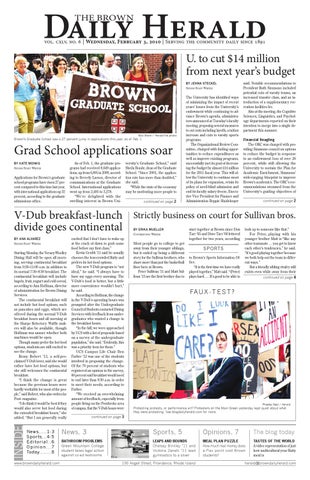
Brown’s Graduate School saw a 27 percent jump in applications this year, as of Feb. 1.
Grad School applications soar By Kate Monks Senior Staff Writer
Applications for Brown’s graduate school programs have risen 27 percent compared to this time last year, with international applications up 32 percent, according to the graduate admissions office.
As of Feb. 1, the graduate programs had received 8,649 applications, up from 6,805 in 2009, according to Beverly Larson, director of communications at the Graduate School. International applications went up from 2,485 to 3,278. “We’re delighted with the swelling interest in Brown Uni-
versity’s Graduate School,” said Sheila Bonde, dean of the Graduate School. “Since 2001, the application rate has more than doubled,” she said. “While the state of the economy may be motivating more people to continued on page 2
The University has identified ways of minimizing the impact of recent years’ losses from the University’s endowment while continuing to advance Brown’s agenda, administrators announced at Tuesday’s faculty meeting, proposing several measures to cut costs including layoffs, a tuition increase and cuts to varsity sports programs. The Organizational Review Committee, charged with finding opportunities to reduce expenditures as well as improve existing programs, successfully met its goal of decreasing the budget by almost $14 million for the 2011 fiscal year. This will allow the University to continue most of its plans for expansion, retain its policy of need-blind admission and end its faculty salary freeze, Executive Vice President for Finance and Administration Beppie Huidekoper
said. Notable recommendations to President Ruth Simmons included potential cuts of varsity teams, an increased transfer class, and an introduction of a supplementary recreation facilities fee. Also at the meeting, the Cognitive Sciences, Linguistics, and Psychology departments reported on their intention to merge into a single department this summer. Financial finagling The ORC was charged with providing Simmons council on options to reduce the budget in response to an endowment loss of over 26 percent, while still allowing the University to sustain the Plan for Academic Enrichment, Simmons’ wide-ranging blueprint to improve Brown’s academics. The ORC’s recommendations stemmed from the University’s guiding objectives of continued on page 2
V-Dub breakfast-lunch Strictly business on court for Sullivan bros. divide goes continental By Erika Mueller Contributing Writer
By Ana Alvarez Senior Staff Writer
inside
Starting Monday, the Verney-Woolley Dining Hall will be open all morning, serving continental breakfast from 9:30–11:00 a.m. in addition to its normal 7:30–9:30 breakfast. The continental breakfast will include bagels, fruit, yogurt and cold cereal, according to Ann Hoffman, director of administration for Brown Dining Services. The continental breakfast will not include hot food options, such as pancakes and eggs, which are offered during the normal V-Dub breakfast hours and all morning at the Sharpe Refectory. Waffle makers will also be available, though Hoffman was unsure whether both machines would be open. Though many prefer the hot food options, students are still excited to see the change. Remy Robert ’13, a self-proclaimed V-Dub lover, said she would rather have hot food options, but she still welcomes the continental breakfast. “I think the change is great because the previous hours were hardly workable for most of the people,” said Robert, who also writes for Post- magazine. “I do think it would be best if they would also serve hot food during the extended breakfast hours,” she added. “But I am generally really
News.....1-3 Spor ts...4-5 Editorial..6 Opinion...7 Today........8
www.browndailyherald.com
excited that I don’t have to wake up at the crack of dawn to grab some food before my first class.” Kevin Grubb ’11 said he usually chooses the less-crowded Ratty and prefers its hot food options. The new V-Dub program is “not ideal,” he said. “I always have to have my eggs every morning. The V-Dub’s food is better, but a little more convenience wouldn’t hurt,” he said. According to Hoffman, the change in the V-Dub’s operating hours was prompted after the Undergraduate Council of Students contacted Dining Services with feedback from undergraduates who wanted a change in the breakfast hours. “In the fall, we were approached by UCS with a list of proposals based on a survey of the undergraduate population,” she said. “Evidently, this was a priority item for them.” UCS Campus Life Chair Ben Farber ’12 was one of the students involved in proposing the change. Of the 70 percent of students who registered an opinion in the survey, 60 percent said breakfast would need to end later than 9:30 a.m. in order to meet their needs, according to Farber. “We received an overwhelming amount of feedback, especially from people living on the Pembroke area of campus, that the V-Dub hours were
Most people go to college to get away from their younger siblings, but it ended up being a different story for the Sullivan brothers, who share more than just the basketball floor here at Brown. Peter Sullivan ’11 and Matt Sullivan ’13 are the first brother duo to
start together at Brown since Don Tarr ’65 and Dave Tarr ’66 lettered together for two years, according
Sports to Brown’s Sports Information Office. “It is the first time we have really played together,” Matt said. “(Peter) plays hard. … It’s good to be able to
look up to someone like that.” For Peter, playing with his younger brother Matt is “like any other teammate … you get to know each other’s tendencies,” he said. “It’s good playing together because we both help out the team in different ways.” But a friendly sibling rivalry still exists even while away from their continued on page 4
fa u x - test ?
Phoebe Neel / Herald
Protesting protests, or performance art? Protesters on the Main Green yesterday kept quiet about what they were protesting. See blogdailyherald.com for more.
continued on page 3
News, 3
Sports, 5
Opinions, 7
The blog today
Bathroom problems Green Mountain College student takes legal action against co-ed restrooms
Leaps and bounds Chelsey Binkley ’11 and Victoria Zanelli ’11 lead gymnastics to a silver
Meal plan Puzzle How much real money does a Flex point cost Brown students?
Tastes of the world A video representation of just how multicultural your Ratty meal is
195 Angell Street, Providence, Rhode Island
herald@browndailyherald.com
Page 2
THE BROWN DAILY HERALD
C ampus N EWS
Wednesday, February 3, 2010
“It makes sense to just sort of stay in school for now.” — Sarah Huebscher ’10, on applying to grad school
Bigger transfer class, cuts to sports teams on U.’s horizon continued from page 1 maintaining, if not improving, both the academic programs offered by the University and the student experience, Huidekoper said. She told the faculty that the committee’s goal was to minimize any negative impact on faculty and student experience, and especially to avoid cutting jobs. The ORC was
divided into 12 teams, each of which focused on one aspect of the University, including teams devoted to academic administration, libraries, athletics and student services, according to Huidekoper. Simmons supported most of the committee’s recommendations, which will be presented to the Corporation, the University’s highest governing body, for its approval at its
meeting later this month, according to Huidekoper. The recommendations included changes to reduce expenses in every area of the University. The events management team, for example, recommended merging existing events planning resources into one program that could manage different kinds of events and conferences to increase efficiency. The continuing education team focused on methods to add revenue rather than cut expenditures, suggesting an increase in enrollment in summer programs as well as an expansion of existing online and certificate programs coupled with the creation of new ones. The athletics team, the only one of the 12 that did not meet its savings goal, recommended eliminating several varsity sports, though the teams and a schedule for their elimination have yet to be determined, Huidekoper said at the meeting. The committee is unsure of whether they are ready to enact these changes immediately, but feels that altering the number and variety of teams offered could improve the overall program, she said. In addition, the athletics group suggested a mandatory recreation fee for students and a revised fee for faculty and staff use of the planned Nelson Fitness Center, she said. The University has attempted to cut jobs with as few firings as possible by allowing positions to remain vacant and by offering an early retirement program to staff last year, Huidekoper said. One hundred thirty-nine staff members have opted for the early retirement
plan, which, along with the approximately 100 pre-existing vacancies, will minimize the extent of eventual job loss, she said. But the University still estimates that some layoffs will be needed, though the number will be determined by the Corporation, Simmons told the meeting. Improving while cutting Provost David Kertzer ’69 P’95 P’98 presented the recommendations of the University Resources Committee, which recommended ways to allocate resources that would allow the University to continue to advance the Plan for Academic Enrichment. An additional focus of the URC was to keep Brown competitive with its peers in attracting faculty and students by offering comparable salaries and financial aid payments, Kertzer said. The URC suggested that increasing the size of the transfer class by 50 students could serve as a source of revenue, he said. While increasing the incoming freshman classes might lead to strains on housing, first-year seminars and introductory chemistry classes, current efforts to improve the transfer orientation program should allow an increased class to successfully integrate into the Brown community, Kertzer said. The URC also recommended raising undergraduate tuition, though exact figures are yet to be determined and will be affected by market conditions, he said. Last year, Brown was at the bottom of its peer group in tuition hikes, he said. The University plans to cut jobs
while maintaining a competitive edge in attracting faculty and graduate students by increasing graduate student stipends and faculty salaries, Kertzer said. The University currently pays stipends to 703 graduate students, and the URC recommended offering stipends to an additional 10, while raising the amount awarded. The University also plans to end the freeze on faculty salaries it began last year, he said. The plan called for an increase in the number of faculty to 700, and there are now 686 faculty members, Kertzer said. But this year is the first since the plan’s implementation began that the University will not grow its faculty, he said. Merging departments William Heindel, associate dean of the Grad School and professor and chair of psychology, and William Warren, professor of cognitive and linguistic sciences, formally announced a motion to integrate the Department of Psychology and the Department of Cognitive and Linguistic Sciences into a single cohesive Department of Cognitive, Linguistic, and Psychological Sciences. The programs, which will formally merge July 1, will occupy a newly renovated Metcalf Chemistry and Research Laboratory in fall 2011. While Associate Professor of Psychology Ruth Colwill expressed concern that the merger would impede the process of faculty promotion, impact research and increase class size, Simmons said the change “should in no way disadvantage those on the path to promotion and tenure.”
Economy leads to 27 percent rise in apps sudoku
continued from page 1
Daily Herald the Brown
Editorial Phone: 401.351.3372 | Business Phone: 401.351.3260 George Miller, President Claire Kiely, Vice President
Katie Koh, Treasurer Chaz Kelsh, Secretary
The Brown Daily Herald (USPS 067.740) is an independent newspaper serving the Brown University community daily since 1891. It is published Monday through Friday during the academic year, excluding vacations, once during Commencement, once during Orientation and once in July by The Brown Daily Herald, Inc. Single copy free for each members of the community. POSTMASTER please send corrections to P.O. Box 2538, Providence, RI 02906. Periodicals postage paid at Providence, R.I. Offices are located at 195 Angell St., Providence, R.I. E-mail herald@browndailyherald.com. World Wide Web: http://www.browndailyherald.com. Subscription prices: $319 one year daily, $139 one semester daily. Copyright 2010 by The Brown Daily Herald, Inc. All rights reserved.
apply to graduate school, we also think Brown has carved out a better position from which to attract highly qualified students,” Bonde said. In a recent survey by the nationwide Council of Graduate Schools, domestic enrollment in American graduate schools was up by 6 percent in the last year. But the rate of international enrollment to American graduate schools remained stagnant, making 2009 the first year since 2004 in which there was not a national rise in the number of matriculating international graduate students. The rise in students enrolling in graduate school correlates with an increase in the number of people choosing to take graduate school entrance exams each year. The Graduate Record Examinations saw a 13 percent increase in test-takers,
according to Educational Testing Services, which administers the test. The Graduate Management Admissions Council also reported a small rise in Graduate Management Admission Test takers. Dick Spies, executive vice president for planning and senior adviser to President Ruth Simmons, said improving the quality of the graduate school “has been an important objective” of the Plan for Academic Enrichment, which was released in 2004. “The Plan for Academic Enrichment is all about improving the quality of education for all students,” Spies said. “People are more aware of the incredible research programs here.” Hiring new faculty and providing them with more research support are among the ways the University has tried to increase its capacity as
a research institution. Spies said this year’s rise in graduate school applications has continued the pattern of growth in the past few years. “We are quite consciously trying to compete with the best for the best grad students,” he said. With the current economic recession, many may also see graduate school as a way to avoid entering into the workforce. Sarah Huebscher ’10, who is applying for a fifth-year master’s in the Division of Engineering’s Program in Innovation Management and Entrepreneurship, called the choice to continue to graduate school “a popular decision” among students she knows. “The state of the economy has made me want to continue my education now and enter the workforce later,” Huebscher said. “It makes sense to just sort of stay in school for now.”
Wednesday, February 3, 2010
THE BROWN DAILY HERALD
C ampus N EWS
“Men will use the toilets without closing the door.”
Vt. student sues over same-sex bathrooms By Heeyoung Min Senior Staf f Writer
Jennifer Weiler, a first-year at Green Mountain College, filed a lawsuit last month against the Vermont Department of Public Safety for failing to provide separate restrooms in her dormitor y for men and women — a mandate in all public buildings in Vermont where restroom facilities are available — according to the civil complaint. Weiler, and many students who have approached her, said they feel uncomfortable by the co-ed bathrooms, according to Pamela Moreau, Weiler’s lawyer. At Brown there are many “single-user” gender-neutral or unisex restrooms on campus, including in dormitories, said Associate Director of Housing and Residential Life Thomas Forsberg. There are fewer co-ed “multiple-user” restrooms, defined as restrooms used by men and women at the same time, he added. Gender-neutral and co-ed restrooms were introduced to Brown gradually “over the course of the past three or four years” when a group of about 20 students approached the administration with the request, he said. The administration responded with a “pilot program of tr ying a few gender-neutral bathrooms,” Forsberg said. “There were no complaints or dif ficulties, and there was interest in expanding (the program), so we moved for-
ward.” But Brown students who are uncomfortable with co-ed restrooms can also avoid them. In ever y building with a co-ed restroom, there are also all-female and all-male alternatives, Forsberg said. Weiler and her peers at Green Mountain College do not have that option. All dormitor y bathrooms at the college are coed, Moreau wrote in a e-mail to The Herald.
HIGHER ED Though Weiler requested a room on a single-sex floor, the school placed her on a co-ed floor, with a co-ed bathroom that has “no doors on the showers, just flimsy plastic curtains,” the complaint states. “Men will use the toilets without closing the door.” Kevin Coburn, director of communications at Green Mountain College, declined to comment on Weiler’s case, but said, “The (co-ed) bathroom situation here is common and can be found on many other campuses.” In the past, the administration has worked with students to find bathroom accommodations that are “agreeable to ever ybody,” he said. When the Vermont Depar tment of Public Safety told Green Mountain College that it was mandated to have separate bathroom facilities in September, the school designated a female restroom on Weiler’s floor — but male
Page 3
students, including the floor’s resident assistant, continued to use the female restroom, the suit said. The public safety department did not take further action on Weiler’s behalf. It argues, according to the suit, that the college is not required by law to comply with the code because the plumbing in its buildings has not been changed or altered since the codes were mandated. Through its communications office, the Vermont Department of Public Safety declined to comment on the case. But Moreau finds the department’s argument “problematic” because a new building at Green Mountain College would be prohibited from having co-ed bathrooms, she wrote. “It seems strange to us that the school’s defense would be, ‘We realize that the code prohibits co-ed bathrooms but we can do it in an old building as long as the plumber doesn’t show up with his wrench,’ ” she added. Though co-ed restrooms exist on many campuses, Moreau wrote that she is not aware of any “published legal precedent on this precise issue.” There are no data available on the percentage of colleges that have co-ed bathrooms, James Baumann, communications director for the Association of College and University Housing Officers-International, told Inside Higher Ed in a Dec. 21 article, but “it grows in its commonality each year.”
— Jennifer Weiler’s civil complaint
V-Dub breakfast to be 90 minutes longer continued from page 1 not ‘college-friendly,’ ” he said. Representatives from UCS discussed the feasibility of different options with Dining Services — including the V-Dub’s need to set up for lunch — before settling on the continental breakfast setup. “We figured that a continental breakfast would be feasible in terms of logistics and it would meet the needs of the students,” Farber said. Hoffman welcomed the proposition, and Dining Services found that the change would work financially. “It was determined we could do this with a very small additional cost,” she said. Those additional costs, she added, would come primarily from adding extra student cashier shifts during the new operating hours. Anna Hsu ’10 welcomed the continental breakfast, but she said she hopes the continental breakfast will expand eventually. “I could see why they would be hesitant to start with everything,”
she said. “It’s probably not costefficient for them right now.” Farber said he was pleased to hear that Dining Services would be enacting the change, thanking the office for its responsiveness to students’ needs. “My committee and I are extremely excited that Dining Services is gong to implement this change. I believe I speak for all of us when I say that we feel very privileged to attend a university where students really just feel listened to by all of the administrators, especially by those from Dining Services,” he said. Farber said UCS plans to gather feedback from students once the new plan is enacted. Matt Mettler ’13, a Pembroke campus resident and V-Dub eater, said he is ready to make use of the continental breakfast. “I’d say it’s a step in the right direction,” he said. “I have never actually been to V-Dub breakfast because it closes so early, so this is a pleasant change that I’m sure I’ll take advantage of before morning classes.”
A diamond to you www.diamondsandcoal.com
SportsWednesday The Brown Daily Herald
Wednesday, February 3, 2010 | Page 4
Forty years later, another brother duo continued from page 1 hometown of Wilmette, Ill. For instance, when asked how one-on-one contests go or even who was taller, older brother Peter was quick to respond. “I always win, every single time,” Peter said. When further comparing himself to his brother, Peter confidently said Matt is an inch shorter than he is, contrary to what the Brown roster might read. “He’s a tall 6-5, and I’m a short 6-5,” Matt agreed. Matt also added that their teammates say he is “the less intense version” of his brother Peter. Peter and Matt are the first from their family to attend Brown, but they agreed it would be great if either of their younger siblings ended up choosing the same route. Off the court, the two eldest siblings still spend plenty of time together through social events on campus. Peter said one of his favorite things about Brown is the closeness of the community and how he and his brother are able to share many friends. In addition to enjoying the distinctive curriculum, Matt said he chose
Jonathan Bateman and Charlie Fischl / Herald
Matt Sullivan ’13 (left) and brother Peter Sullivan ’11 have been playing side-by-side with each other for the first time in their careers.
Brown because “it felt like home.” Of course, this could have something to do with part of his home — Peter — already being here. But Matt said joining a team that already featured his brother was not completely ideal. “If you would ask me what one of the harder things about playing with (Peter) was, it would be the expectation that he had such a good
freshman year,” Matt said. During his freshman season, Peter posted impressive numbers. He scored double figures in 11 games, was the second-leading scorer among Ivy freshmen with an average of 8.7 points per game and was named Ivy League Rookie of the Week four times. This season, Matt has started in 20 games as guard and received
Rookie of the Week honors for his performances during the week of Nov. 23 that helped Brown to win two of their three games, averaging 10.3 points and 4.7 assists in that stretch. So far on the year, tri-captain and All-Ivy forward Peter has started in all 21 games. He registered his first career double-double against American on Jan. 2. The star siblings also bring quite a fan base to the basketball games, whether they are at Brown or another location on the East Coast, where many family members live. Peter explained that this adds to the fun. “It’s really nice to have our family come out over the last two years,” he said. “There has been someone at almost every game, it seems like.” For the remaining games, the Sullivans just want to play solid basketball. “We would obviously like to win more games,” Peter said. “Every single game is so crucial in the Ivy League.” “I would like to see us do better than last year,” Matt said. “We are tougher than what we have been in the past.”
s p o rt s i n b r i e f
Squash teams find success in two weekend matches up north The No. 14 men’s and No. 8 women’s squash teams both took on Bowdoin and Bates this weekend, looking to get on the right track after tough losses to perennialpowerhouse Trinity last week. It was a successful weekend, as both squads got moving in the right direction. The men’s team opened the weekend by beating No. 13 Bowdoin, 5-4. But after making the short drive from Bowdoin to
Bates, the team fell, 6-3, to No. 11 Bates. In this well-played match, the Bears lost two heart-breaking tiebreakers, which proved to be the difference. On the weekend, both Adrian Leanza ’11 and Chris Holter ’13 won both of their matches for the Bears. Overall, it was a very successful weekend for the women’s team, as they beat No. 13 Bowdoin, 9-0, and No. 12 Bates, 7-2. On the weekend, eight Bears, Sarah Beresford ’13,
Nikoo Fadaifard ’12, Erika Kohnen ’12, Sarah Roberts ’10, Kali Schellenberg ’10, Sophie Scherl ’11, Lydia Smith ’13 and Carolyn Tilney ’11, won both of their matches. The Bears next home match is Feb. 6 when they take on No. 3 Yale and No. 22 George Washington at the Pizzitola Center. — Jesse Frank
Wrestling
Wrestlers fall at home dual meet By Han Cui Assistant Sports Editor
The wrestling team hosted its first home dual meet on Saturday against Army. Despite the home advantage, the Bears did not come out on top in close matches and lost the dual, 27-6. “We couldn’t get out from bottom,” said Head Coach Dave Amato. “We lost four matches like that.” Riding time was a decisive factor. The matches at 141 lbs. and 197 lbs. were tied at the end of regulation, but because the Black Knights had accumulated enough riding time, they earned one extra point and therefore won the matches. Army Assistant Coach Ryan Wilman also acknowledged the importance of the riding time in his team’s victory. “We spent a lot of time working on top (position)” in practice, Wilman said. The first Bear to halt the Black Knights’ momentum was 165-pounder Jeff Lemmer ’12. Trailing 3-2, Lemmer earned four points by twice taking down his opponent and winning the match, 6-4. The match that drew the loudest cheers from the home crowd was between 184-pounders Bran Crudden ’10 and Collin Wittmeyer of Army. Crudden was aggressive from the beginning and scored the first points with a takedown. He never let up, even when his opponent relaxed — thinking they were both out of bounds. But Crudden seized the opportunity and scored another takedown at the edge of the mat. Crudden provided the Bears’ other victory, 10-5. Though Army won the dual meet by taking eight out of the 10 weight classes, Wilman was not pleased with his team’s overall performance. “I don’t think we wrestled all that well,” Wilman said. “The guys got the job done winning the cheap points, but we didn’t produce much offense.” Amato said the Bears improved in certain technical areas. “We did a better job on defense on our feet, which we practiced a lot,” he said. The Bears have already been bitten by the injury bug several times this season. Two starters, Steven DeLorenzo ’10 and Bryan Tracy ’10, were out of Saturday’s lineup due to injury, but fortunately for the Bears, both are expected to return to the mat this weekend. Amato said injury alone is not an excuse for defeat. “You wrestle with who you have,” he said. “Hopefully, this weekend will be a turnaround.” This weekend will feature four dual meets, starting Friday at noon in the Pizzitola Center, when two old rivals, Boston University and Drexel, come to town. The next day, the Bears will kick off the Ivy League season against perennial powerhouse Penn at 10 a.m., which will be followed by a meet against Princeton.
Page 5
THE BROWN DAILY HERALD
Sports Wednesday
Wednesday, February 3, 2010
“Ivies are anyone’s game.” — Gymnastics Head Coach Sara Carver-Milne
Swimming & Diving
M. swim evens Ivy League record By Sahar Shahamatdar Contributing Writer
Jocelyn West / Herald
Despite several strong individual performances, the gymnastics team fell to Bridgeport last weekend.
Gymnastics
Duo vaults past former Olympian in close loss By Victoria Elmore Contributing Writer
The gymnastics team is no stranger to Olympic athletes. Though U.S. gymnast Alicia Sacramone left the Pizzitola Center two years ago for Beijing, an Olympian re-entered the arena on Sunday, this time as an opponent. But Monica Mesalles, a member of the 2004 Spanish Olympic gymnastics squad and now a freshman at Bridgeport, could not edge out beam standouts Chelsey Binkley ’11 and Victoria Zanelli ’11, who finished third and fourth, respectively — ahead of the Olympian, who tied for sixth. Despite efforts by Binkley — who finished in first place on the floor — Zanelli, Lauren Hall ’13 and Carli Wiesenfeld ’12, the Bears finished behind Bridgeport in the three-team home competition.
“We started strong and finished strong,” said Brown Head Coach Sara Carver-Milne. “I think we lost focus a little in the middle, but our floor team came through at the end.” Bridgeport Coach Byron Knox commended his athletes on their first-place finish, noting an “exceptional performance” by Lorraine Galow, the meet’s all-around high scorer, who finished first on vault and second on both beam and floor. Tristan Poirier, head coach of third-place Rhode Island College, was less enthusiastic about his team’s performance. “We’re always just looking to improve,” he said. As the Brown squad moves forward, it will be looking ahead to the Ivy Classic, at which the Bears finished second last year. But this season, the competition will be held on Brown’s home turf. “Ivies are anyone’s game,” CarverMilne said.
Men’s Swimming & Diving On Friday, the men’s swimming and diving team out-swam Columbia by 30 points — in its adopted home pool in Lowell, Mass. — in the most exciting meet of the season to bring its record to 2-2 in the Ivy League, said Head Coach Peter Brown. The Bears started the meet with solid second-place finishes, and led the Lions by five points after the first five events. Tucker Wetmore ’10 picked up the momentum and won Brown’s first gold medal of the night in the 200-yard freestyle event with a time of 1:42.91. The rest of the meet was packed with close events. John Hug ’13 barely out-touched Columbia’s Sean Mackenzie to win gold in the 500yard freestyle, and Ryan Kikuchi ’11 crossed the line just .09 seconds
ahead of teammate Ian Slater ’13 in the 200-yard backstroke. “A couple of events came down to the last five yards, and unfortunately we did not win enough of them,” said Columbia Head Coach Jim Bolster. Brown finished the meet on a high note — winning the 400-yard freestyle relay by more than two seconds — and went on to defeat Columbia, 168-138. “This meet was one of the best in a couple years, and I am very proud of (the team),” Brown said. “We were competing well and supporting each other, and that is necessary for success.” The team will take on Yale on Wednesday in its home pool in Lowell. Women’s Swimming & Diving It all came down to the final relay in the women’s swimming and diving meet, and Columbia finished just
1.12 seconds ahead of Brown to win the race and the meet, 156-144, this past Friday in Lowell. “The meet was extremely close and competitive, and it was the best team effort this year by far,” said Head Coach Peter Brown. The dual meet started with the 200-yard medley relay, and Bruno crossed the finish line more than a full second ahead of the Columbia squad. The Lions answered back by taking gold in the 1000-yard freestyle, and the ping-pong matched continued, as neither team ever had a deficit greater than eight points. Columbia finished the meet 12 points ahead to extend its winning streak to five meets. Despite the loss, Brown applauded the team, noting that his squad “has good momentum and is competing well.” The Bears will swim against Yale in a dual meet on Wednesday.
Editorial & Letters The Brown Daily Herald
Page 6 | Wednesday, February 3, 2010
l e t t e r to t h e e d i to r
Numeric illiteracy to blame for typo To the Editor: In Hunter Fast’s recent column (“In defense of Ruth,” Jan. 28), he erroneously states that the Brown endowment lost $800 billion during the financial meltdown. In fact, the endowment lost $800 million. I’m sure Fast simply made a typographical error, but I worry about the fact that this mistake was overlooked by editors. I think this is symptomatic of a larger problem: people have trouble comprehending very large numbers and the relationships between them. Imagine a news story stating that Apple’s new iPad was expected to be priced around $500,000. This would be a ridiculous and obvious error, yet it is proportionally as large as misusing billion for million. The ratio between $800 million and $800 billion is the same as the ratio between the cost of a used bicycle and the cost of a new BMW. The ratio between a million and a trillion is the same as the ratio between the cost of a gumball and the cost of a new house. Large-number literacy is important — not just for writing annoying letters to college newspapers, but for understanding legislative proposals and economic issues. When politicians attack each other for wasteful spending, it is important to know that $5 million wasted is completely insignificant compared to something like the $787 billion stimulus bill — a pair of shoes compared to a private jet. I promise that will be the last analogy, but they surprise me every time. And that’s the problem. We aren’t built to understand these orders of magnitude. Everyone has a good sense for the difference between 2 and 7, but 2 billion and 7 trillion are much harder to pin down. Still, we need to try to understand the relationships between these numbers if we are going to hold politicians accountable and have a reasonable sense of the impact of our actions. In fact, if you counted to a million, one number a second, it would take about 11 days. If you had to count to a trillion… Never mind. Sam Loomis ’10 Feb. 1
This space is yours. Fill it. letters@browndailyherald.com
t h e b r o w n d a i ly h e r a l d Editor-in-Chief George Miller
Managing Editor Chaz Kelsh
Deputy Managing Editors Sophia Li Emmy Liss
editorial Arts & Culture Editor Anne Speyer Suzannah Weiss Arts & Culture Editor Features Editor Brian Mastroianni Features Editor Hannah Moser Metro Editor Brigitta Greene Metro Editor Ben Schreckinger News Editor Sydney Ember News Editor Nicole Friedman Sports Editor Dan Alexander Asst. Sports Editor Andrew Braca Asst. Sports Editor Han Cui Graphics & Photos Graphics Editor Stephen Lichenstein Alex Yuly Graphics Editor Nick Sinnott-Armstrong Photo Editor Max Monn Asst. Photo Editor Jonathan Bateman Sports Photo Editor production Copy Desk Chief Kelly Mallahan Jordan Mainzer Asst. Copy Desk Chief Marlee Bruning Design Editor Anna Migliaccio Asst. Design Editor Julien Ouellet Asst. Design Editor Neal Poole Web Editor Post- magazine Editor-in-Chief Marshall Katheder
Senior Editors Ellen Cushing Seth Motel Joanna Wohlmuth
Business General Managers Office Manager Shawn Reilly Claire Kiely Katie Koh Directors Sales Kelly Wess Finance Matthew Burrows Client Relations Margaret Watson Alumni Relations Christiana Stephenson Managers Arjun Vaidya Marco deLeon Aditi Bhatia Jared Davis Trenten Nelson-Rivers Alexander Carrere Kathy Bui
Local Sales National Sales University Sales University Sales Recruiter Sales Special Projects Staff
Opinions Opinions Editor Michael Fitzpatrick Opinions Editor Alyssa Ratledge Editorial Page Board Matt Aks Editorial Page Editor Debbie Lehmann Board member William Martin Board member Melissa Shube Board member Gaurie Tilak Board member Jonathan Topaz Board member
Marlee Bruning, Katie Wilson, Designers
A le x Y uly
e d i to r i a l
Sober solutions More positive alterations are in the works for Rhode Island’s developing cannabis laws. State Reps. Joseph Almeida and John M. Carnevale are seeking to streamline the distribution of medical marijuana and discourage abuse of the substance. The state already allows patients with chronic pain or their registered caregivers to grow the plant for its pain-dulling properties, which many sufferers prefer over traditional painkillers. Rhode Island also plans to sanction three privately run medical marijuana dispensaries, and a panel convened by the state Senate is examining the possibility of decriminalizing the possession of small quantities of the drug even without medical authorization. The representatives’ bill would impose commonsense restrictions on the state’s system of private cannabis growers. The legislation would forbid those convicted of capital offenses or felony drug charges from registering as caregivers, ensuring that sufferers of chronic conditions would not have to rely on people who have demonstrated their irresponsibility. It would also forbid growers from sharing their semi-legal produce with non-cardholders, ensuring that the modest amount of the drug that each individual is allowed to cultivate is reserved for those who need it most. Finally, Almeida and Carnevale propose to eliminate the status of caregiver as the dispensaries commence operations and provide a more reliable and controllable source of the substance. The end of the caregiver system means that the dispensaries must be stringently focused on providing for chronic sufferers only, and the bill would give the state police the means to ensure that they are. It would allow them to conduct unannounced inspections of distribution centers, a crucial tool to prevent sales to recreational users and the concomitant risk of shortages for those who rely on access to drug. The police would also take over the task of reviewing dispensaries’ sale records from the Department of Health, allowing them to better track evidence of inappropriate distri-
bution. While this would be a positive development, lawmakers must remember that some officers may be accustomed to treating marijuana possession purely as a criminal offense and an unequivocal problem; the approval of this law entails the responsibility to monitor police oversight for evidence of overly aggressive behavior towards dispensary staff and customers. Another common-sense provision of the new legislation would allow out-of-state residents to serve on the boards of Rhode Island dispensaries. Other states have had extensive experience with the operation of dispensaries. If their better-qualified residents want to help similar projects succeed in Rhode Island, they should be encouraged rather than prohibited. Unfortunately, Almeida and Carnevale are considering an additional measure that their bill is better off without. Last week, they told the Providence Journal that they were weighing an attempt to eliminate a provision currently on the books that legally shields those arrested for marijuana possession if they subsequently secure a card authorizing medicinal use. The potential for abuse by recreational users claiming severe conditions is obvious. But a doctor’s certification of medical need obtained before an arrest is no less likely to be disingenuous than one obtained afterwards. Furthermore, eliminating this defense would create an unfortunate double standard, penalizing those without the knowledge or connections to quickly obtain a card. The current bill, however, represents significant progress for Rhode Island’s approach to medical marijuana. Overall, the changes that Almeida and Carnevale have proposed are sensible and well-tailored, and they exemplify the mix of modest liberalization and careful oversight that may make Rhode Island’s forays into cannabis policy an example for the entire country. Editorials are written by The Herald’s editorial page board. Send comments to editorials@browndailyherald. com.
Jordan Mainzer, Kelly Mallahan, Carmen Shulman, Copy Editors Alex Bell, Sydney Ember, Sarah Mancone, Night Editors Senior Staff Writers Ana Alvarez, Alexander Bell, Alicia Chen, Max Godnick, Talia Kagan, Sarah Mancone, Heeyoung Min, Kate Monks, Claire Peracchio, Jenna Steckel, Goda Thangada, Caitlin Trujillo Staff Writers Shara Azad, Nicole Boucher, Kristina Fazzalaro, Anish Gonchigar, Sarah Julian, Matthew Klebanoff, Anita Mathews, Kevin Pratt, Luisa Robledo, Emily Rosen, Anne Simons, Sara Sunshine, Dana Teppert, Connie Zheng Senior Sales Staff Katie Galvin, Liana Nisimova, Isha Gulati, Alex Neff, Michael Ejike, Samantha Wong Design Staff Caleigh Forbes, Jessica Kirschner, Gili Kliger, Leor Shtull-Leber, Katie Wilson Web Staff Andrew Chen, Warren Jin, Claire Kwong, Phil Park, Ethan Richman Photo Staff Qidong Chen, Janine Cheng, Alex DePaoli, Frederic Lu, Quinn Savit Copy Editors Nicole Boucher, Sarah Forman, Claire Gianotti, Christine Joyce, Sara Luxenberg, Alexandra Macfarlane, Joe Milner, Lindor Qunaj, Carmen Shulman
C O R R E C T I O N S P olicy The Brown Daily Herald is committed to providing the Brown University community with the most accurate information possible. Corrections may be submitted up to seven calendar days after publication. C ommentary P O L I C Y The editorial is the majority opinion of the editorial page board of The Brown Daily Herald. The editorial viewpoint does not necessarily reflect the views of The Brown Daily Herald, Inc. Columns, letters and comics reflect the opinions of their authors only. L etters to the E ditor P olicy Send letters to letters@browndailyherald.com. Include a telephone number with all letters. The Herald reserves the right to edit all letters for length and clarity and cannot assure the publication of any letter. Please limit letters to 250 words. Under special circumstances writers may request anonymity, but no letter will be printed if the author’s identity is unknown to the editors. Announcements of events will not be printed. advertising P olicy The Brown Daily Herald, Inc. reserves the right to accept or decline any advertisement at its discretion.
Opinions The Brown Daily Herald
Wednesday, February 3, 2010 | Page 7
Please. Mr. Obama is not black
Dominic Mhiripiri Opinions Columnist Recently, the United States marked the first anniversary of Barack Obama’s historic ascent to the apex of American politics. For a candidate who electrified a whole generation of American youth and whose promise gave the whole world great expectations, the man’s image borders on the divine. At least, it did one year ago. Since then, America has basked in some sort of self-congratulatory-slash-too-good-to-be-true euphoria. It’s because Obama’s election comes in a different context — namely, a very historic one. It’s because he is the first black president of the United States. Wait. Really? Black? Obama’s Kenyan heritage is an established fact. His father (also an Obama of the Barack sort, with a keen intellect like his son) grew up in Kenya. In the late 1950s, after obtaining a scholarship, he sojourned to the land of the free — eventually attending Harvard some three decades before his son would train as an attorney at the same university. In early 1961, he married Stanley Ann Dunham, a white woman from Arkansas, and later that year, Barack Obama Jr. was born to them. So there you go: Obama’s mother is white and his father is pitch-black. In southern Africa, Obama would be called a colored man — nothing more or less. Obama is as much white as he is black, and neither one of them exclusively. The United States made history in November 2008 — electing the first biracial
president in its history, and quite possibly the history of anywhere else in the world. In the past, no black man has come anywhere close to becoming a major presidential candidate in America, Jesse Jackson and Al Sharpton notwithstanding. In an understandable but nevertheless misplaced assertion, the U.S. is trying to convince itself, primarily through Obama’s election, that it has attained the cherished ideal that Martin Luther King Jr. and many others fought for in their illustrious civil rights movement: a postracial America.
and Senate Majority Leader Harry Reid, D.Nev., certainly had grains of truth embedded in their comments about race in the context of Barack Obama’s presidency. First, Carter said the popular perception of Obama as a black man (albeit factually wrong) is a source of discomfort for many Americans, and drives some of them to extremes that border on the pathological. This is a fact. And true to the sentiments echoed by Reid, Obama’s success as a politician as well as his acceptance by the American electorate is very significantly correlated to his demeanor of a mixed biracial (as
In an understandable but nevertheless misplaced assertion, the U.S. is trying to convince itself, primarily through Obama’s election, that it has attained the cherished ideal that Martin Luther King Jr. and many others fought for in their illustrious civil rights movement: a post-racial America. Even though at Brown I wallow in the rank and file of a small minority, here I am paying no attention to the sensitivities that surround discourse on race in America. Many a time political correctness is overly misplaced or exaggerated, which impedes on fruitful discussion and exchange. In fact, when many people in the recent past tried to be as forthright as they could in articulating race in America, their words did not manage to escape the brutal aftermath of controversy in the media. I mean neither to justify nor condemn their statements. Former President Jimmy Carter
opposed to black) man. Obama is light-skinned and has a white mother and a somewhat unique accent. This is not to explicitly say that these qualities in Obama are more desirable or better — but that Americans embraced those qualities more than they have warmed up to those in men as black as Jesse Jackson. This is a fact that people should simply get over. Those with experiences outside of mainstream American issues of race (like myself) know that colorism exists in almost every culture. Colorism shapes people’s perceptions of
others and (however sad it may be) often skews equality issues surrounding the distribution of resources and opportunities. Light-skinnedness is a virtue that many black women in Africa obsessively pursue. Darker-skinned people often get higher sentences in jail than their light-skinned counterparts. Furthermore, research shows that in many non-white ethnic groups, a fairer shade of the skin is correlated to a higher income. Within the same construct, I would like to assert that the U.S. is not ready to elect a black candidate like Michael Steele or Alan Keyes to the White House. Inasmuch as I strongly want to perfectly “identify” with Obama — I am as black as they come, for the record — simple fact is that we’re close but not quite there. His experiences and his story might be very similar to those of many African-American men, but does not exempt the world from taking him for who he really is: a biracial man. Proclaiming that he is a “black man” takes something away from all mixed-race people in the world. I believe “biracial” should be maintained as a separate and important entity, and if you want to think of Obama’s election as a victory for anyone, then it is a victory for this group more than any other. The world needs to acknowledge that. Post-racialism is a still a distant hope in the horizons of America, and I eagerly look forward to the day when the country will elect its first black president.
Dominic Mhiripiri ’12 does not really care what you think. However, he can be reached at dominic_ mhiripiri@brown.edu
Eating a hole in our wallets ANDREA MATTHEWS Opinions Columnist I love hosting prospective freshmen. Last semester, I showed a delightful young woman from New York City around campus. I took her through the Main Green, to Jo’s for a late night snack and, the next morning, to the Ratty for breakfast. (I figured it would be honest to expose her to our most lovable eatery early on in her visit.) Given my penchant for swiping meal planless friends into the dining halls, I anticipated that I would be out of guest credits. But I was not concerned — given the whopping 50-something meal credits I had at the end of last year, I knew I would have more than enough to spare on my guest. I was correct on two out of three counts: my guest credits were toast. My regular meal credits, however, were in abundant supply. “Excellent,” I said. “May I just swipe my guest in with one of those?” Apparently, I could not. My poor prospective student stood there, mortified, as I exhausted my powers of persuasion: “Wait… really? “But… they’re my meal credits. “Please, just this once? “I don’t understand! They’re MY meal credits!” It only got worse from there. “You could pay with dollars,” the harangued card-swiper suggested. But I couldn’t pay the six dollars that supposedly equal a meal credit at venues like Jo’s and the Gate. No, breakfast at the Ratty would cost me $9.30. With my poor prospective
freshman’s resolve to attend Brown disintegrating by the moment, I slapped the money down and shuffled away. The prohibition on using my meal credits, which I paid for, to feed someone else strikes me as fundamentally unfair. The only logical explanation for Brown Dining Services’ policy is to save money at the expense of student choice. Whether one is on a weekly plan, in which the credits expire at the end of the week, or a Flex plan, in which they carry over through the end of the year, unused credits allow Dining Services to keep your payment without delivering a product. This may seem like a neg-
nario: Just purchase a smaller meal plan. But this is a disingenuous option that in the end still cheats students out of their money. Let us look at the difference in costs and benefits between the largest meal plan and the next one down: Weekly Plan A costs $3,920 for 20 meals per week and 200 points per year. Weekly Plan B costs $3,690 for 14 meals per week and 150 points per year. Valuing each meal credit at $6, and assuming 28 weeks in the academic year, the “dining dollars” value for plan A is $3,560 while Plan B is worth $2,502. That’s a loss of $1,058 in “dining dollar” benefits for a savings of only $230 in
The people who benefit from this fee structure are not the students, but Dining Services, which formulates a coercive meal system to encourage over-subscription, and then creates huge savings when students fail to utilize all the meals they paid for. ligible amount — what’s a few credits here and there? But say person A is on the 20-meal-perweek standard plan, and misses three meals per week for all 28 weeks in the school year. Valued at $6 per meal (which is actually a low amount, given that the Ratty charges $9.30 for breakfast, $12.15 for lunch, and $14.25 for dinner), this person loses the equivalent of $504 “food dollars” per academic year. In other words, BDS saves the rough equivalent of $504 by charging you for what you don’t eat. There seems to be a quick fix to this sce-
real dollars. Given the sharp decline in benefits for these relatively modest savings, who would switch? Only those who are absolutely sure of their consumption habits, or are less risk-averse than they are eager to save the $230. Another interesting figure to look at is how much real money every “dining dollar” costs. With every meal plan, each meal credit or Flex point “dollar” costs more than an actual dollar. What is interesting is that each plan gets “cheaper” as one moves up the scale. The smallest weekly meal plan gives you
$1,246 in benefits for $3,058 in real cash. That means you’re paying $2.45 in real money for every $1 of “dining dollars.” The next plan up costs you $1.88 per “dining dollar,” followed by $1.47 and finally $1.10 for the 20 meal per week plan. Given the relatively high value per dollar of the largest meal plans, it would not be surprising to find that many Brown students are on meal plans larger than they need. The people who benefit from this fee structure are not the students, but Dining Services, which formulates a coercive meal system to encourage over-subscription, and then creates huge savings when students fail to utilize all the meals they paid for. It is plausible that Dining Services could benefit from economies of scale, in which the more food they produce, the cheaper each unit of food becomes. Respecting both this and the need for Dining Services to have some rough estimate of the amount of food it will have to produce over the year, what solutions can we find? Perhaps Brown could offer meal plans with both smaller tiers and more reasonable changes in price for changes in the value of plans. Alternately, Brown could let its students do what they want with their own money, and relax its rule on the free use of meal credits. Either way, Dining Services has an opportunity to sweeten the deal for students, who deserve a fairer meal plan structure than what’s currently on the table.
Andrea Matthews ’11 does, however, congratulate the Ratty on implementing an additional omelet station.
Today The Brown Daily Herald
3
Co-ed bathroom controversy hits college
Brown team out-swims Columbia
4
to day
to m o r r o w
35 / 21
37 / 18
Wednesday, February 3, 2010
Page 8
The Herald wants YOU. Info session TONIGHT. Today, Wednesday, 8 p.m., 195 Angell St. between Thayer and Brook Reporting, copy editing, design, sales, accounting, Web, photography, blogging, comics, opinions More info sessions: Wed., Feb. 10 and Mon., Feb. 15, 8 p.m. Business-only info session Thu., Feb. 11, 8 p.m.
comics
c a l e n da r Today, February 3
tomorrow, February 4
10:00 A.M. — Interviewing Mock-aThon, Career Development Center
5:00 P.M. — MLK Lecture: Tavis Smiley, American Talk Show Host and Author, Salomon 101
7:00 P.M. — Community Service Opportunities Fair, Faunce House
Cabernet Voltaire | Abe Pressman
10:00 P.M. — Party for Haiti, Blu Bar and Lounge
menu Sharpe Refectory
Verney-Woolley Dining Hall
Lunch — Polynesian Chicken Wings, Vegan Stir Fry Vegetables with Tofu, Chocolate Frosted Eclairs
Lunch — Italian Sausage and Peppers Sandwich, Vegetable Strudel, Molasses Cookies
Dinner — Cheese Quesadillas with Sour Cream and Salsa, Sweet ‘n’ Sour Shrimp, Whipped Cream Peach Cake
Dinner — Spicy Herb Baked Chicken, Thai Basil Pork, Thai Basil Tempeh Stir Fry, Frosted Marble Cake
Dot Comic | Eshan Mitra and Brendan Hainline
crossword Excelsior | Kevin Grubb
Hippomaniac | Mat Becker
STW | Jintao Huang