The Brown Daily Herald T hursday, A pril 3, 2008
Volume CXLIII, No. 44
THE HERALD POLL
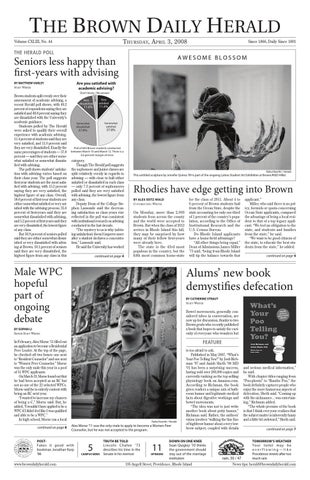
Seniors less happy than first-years with advising
aw e s o m e b l o ss o m
Are you satisfied with academic advising?
By Matthew Varley Staff Writer
Don’t know / No answer Very dissatisfied
11.0%
2.0%
Brown students split evenly over their assessment of academic advising, a recent Herald poll shows, with 49.2 percent of respondents saying they are satisfied and 48.8 percent saying they are dissatisfied with the University’s academic guidance. Students polled by The Herald were asked to qualify their overall experience with academic advising. 11.4 percent of students said they are very satisfied, and 11.0 percent said they are very dissatisfied. Exactly the same percentages of students — 37.8 percent — said they are either somewhat satisfied or somewhat dissatisfied with advising. The poll shows students’ satisfaction with advising varies based on their class year. The poll suggests first-year students are the most satisfied with advising, with 15.2 percent saying they are very satisfied, the highest figure of any class. Overall, 58.6 percent of first-year students are either somewhat satisfied or very satisfied with the advising process. 35.6 percent of first-years said they are somewhat dissatisfied with advising, and 5.2 percent of first-years said they are very dissatisfied, the lowest figure of any class. But 56.9 percent of seniors polled said they are either somewhat dissatisfied or very dissatisfied with advising at Brown. 18.1 percent of seniors said they are very dissatisfied, the highest figure from any class in this
Very satisfied
11.4%
Somewhat satisfied
Somewhat dissatisfied
37.8%
37.8%
Poll studentsconducted conducted Pollofof643 643Brown Brown students between March 1010 and March 12.2008. There is a between Mar. and Mar. 12, 3.6 percent margin ofoferror. There is a ± 3.6% margin error.
category. Though The Herald poll suggests the sophomore and junior classes are split relatively evenly in regards to advising — with close to half either satisfied or dissatisfied in each class — only 7.3 percent of sophomores polled said they are very satisfied with advising, the lowest figure from any class. Deputy Dean of the College Stephen Lassonde said the decreasing satisfaction as class years rise reflected in the poll was consistent with institutional research on advising conducted in the last decade. “The mystery to us is why (advising satisfaction) doesn’t improve more after a student declares a concentration,” Lassonde said. He said the University has worked continued on page 4
Rahul Keerthi / Herald
This untitled sculpture by Jennifer Quiroa ‘09 is part of the ongoing Latino Student Art Exhibition at Brown/RISD Hillel.
Rhodies have edge getting into Brown By Alex Seitz-Wald Contributing Writer
On Monday, more than 2,000 students from across the county and the world were accepted to Brown. But when the class of 2012 arrives in Rhode Island this fall, they may be surprised by how many of their fellow first-years were already here. The state is the 43rd most populous in the country, but the fifth most common home-state
Male WPC hopeful part of ongoing debate
applicant.” Miller, who said there is no policy, formula or quota concerning Ocean State applicants, compared the advantage of being a local resident to that of a top legacy applicant. “We feel an obligation to the state, and students and families from the state,” he said. “We want to be good citizens of the state, to educate the best students from the state,” he added. continued on page 4
By Catherine Straut Staff Writer
Bowel movements, generally considered taboo in conversation, are now up for discussion, thanks to two Brown grads who recently published a book that hopes to satisfy the curiosity of everyone who wonders but
FEATURE
In February, Alex Morse ’11 filled out an application to become a Residential Peer Leader. At the top of the page, he checked off two boxes: one next to “Resident Counselor” and one next to “Women Peer Counselor.” Morse was the only male this year in a pool of 51 WPC applicants. On March 19, Morse found out that he had been accepted as an RC but not as one of the 22 selected WPCs. Morse said he is entirely content with being an RC next year. “I wanted to increase my chances of being a C,” Morse said. But, he added, “I wouldn’t have applied to be a WPC if I didn’t feel like I was qualified and able to be a WPC.” In high school, Morse ran a local
Rahul Keerthi / Herald
Alex Morse ‘11 was the only male to apply to become a Women Peer Counselor, but he was not accepted to the program.
PostFakes it good with bookman Jonathan Karp ’86 www.browndailyherald.com
for the class of 2011. About 4 to 6 percent of Brown students hail from the Ocean State, despite the state accounting for only one-third of 1 percent of the country’s population, according to the Office of Institutional Research and the U.S. Census Bureau. Do Rhode Island applicants have a home-field advantage? “All other things being equal,” Dean of Admissions James Miller ’73 said, “being from Rhode Island will tip the balance towards that
Alums’ new book demystifies defecation
By Sophia Li Senior Staff Writer
continued on page 8
Since 1866, Daily Since 1891
5
CAMPUS NEWS
Truth be told Lincoln Chafee ‘75 describes his time in the Senate in his memoir
11
OPINIONS
is too afraid to ask. Published in May 2007, “What’s Your Poo Telling You?” by Josh Richman ’97 and Anish Sheth ’98 MD ’01 has been a surprising success, having sold over 200,000 copies and currently ranking as the top selling physiology book on Amazon.com. According to Richman, the book gives readers a unique mix of bathroom humor and legitimate medical facts about digestive workings and bowel movements. “The idea was not to just write another book about potty humor,” Richman said. Rather, the authors’ vision involves “walking the fine line of highbrow humor about a very lowbrow subject, coupled with details
down on one knee Sean Quigley ‘10 thinks the government should stay out of the marriage institution
195 Angell Street, Providence, Rhode Island
rain, 50 / 47
and serious medical information,” he said. With chapter titles ranging from “Poo-phoria” to “Rambo Poo,” the book definitely captures people who enjoy the more humorous aspects of defecation, Sheth said. “Coming up with the nicknames ... was entertaining,” Richman added. “The whole premise of the book is that I think everyone realizes that the subject matter is inherently funny and a little bit awkward,” Sheth said. continued on page 7 tomorrow’s weather Your toilet may be o v e r f l o w i n g — l i k e Providence streets after too much rain
News tips: herald@browndailyherald.com
T oday Page 2
Thursday, April 3, 2008
THE BROWN DAILY HERALD
Menu
But Seriously | Charlie Custer and Stephen Barlow
Sharpe Refectory
Verney-Woolley Dining Hall
Lunch — Cajun Fettuccini, Pepperoni Spinach Feta Calzone, Hot Turkey Sandwich with Sauce, Cupcakes
Lunch — Chicken Caesar Salad Wrap, Eggplant Parmesan Grinder, Baked Potato Bar, Molasses Cookies
Dinner — Mexican Cornbread Casserole, Honey Dipped Chicken, Savory Rice Pilaf, Brazilian Chocolate Cake
Dinner — Meatloaf with Mushroom Sauce, Cheese Souffle, Mashed Red Potatoes with Garlic, Brazilian Chocolate Cake
Dunkel | Joe Larios
Sudoku Fill in the grid so that every row, every column and every 3x3 box contains the digits 1 through 9.
Enigma Twist | Dustin Foley
© Puzzles by Pappocom
RELEASE DATE– Thursday, April 3, 2008
Los Angeles Times Puzzle C r o sDaily s w oCrossword rd
Free Variation | Jeremy Kuhn
Edited by Rich Norris and Joyce Nichols Lewis
ACROSS 1 PD target 5 Doing mil. dishes 9 County Clwyd country 14 Pump, for one 15 “The Waltons” actor 16 Whirlpool subsidiary 17 CIS predecessor 18 Word for a loser? 19 “Lou Grant” reporter 20 Type of poker 23 “Wouldn’t It Be Loverly?” singer 25 Ins. providers 26 Needing assembly, briefly 27 Dawson of the NFL 28 Easy shots 31 What emoticons help convey 32 Office distribution unit 34 “Dallas” family 36 Dos times tres 37 Turns up in the garden? 38 Showman’s trait 41 Fad of the ’50s 45 “Joy is __ of love by which you can catch souls”: Mother Teresa 46 Ends 48 Article in El País 49 Nipper’s co. 50 __ about 51 Fragrant compound 53 Temporary electrical connector 57 English pottery town 58 Stead 59 Cosmo rival 62 Lauder with scents 63 Oklahoma city 64 Crazy (over) 65 Diagnostic aids 66 Desires 67 Once-over giver DOWN 1 Sch. that serves ice cream in a Peachy Paterno flavor
2 Lukewarm opinions 3 “William Tell” composer 4 Bandleader Prado 5 Look impolitely 6 “No, Heinrich!” 7 McDonald’s freebie 8 Signal strengthener 9 Guardians’ charges 10 Famous cookie man 11 Puzo novel, with “The” 12 Coming after 13 Responded to one on his knee, to his delight 21 Alaska Pipeline terminus 22 Reddish rash 23 Stately tree 24 Place to graze 29 Petrified Forest site 30 Casual greetings 31 Mrs. Addams, to Gomez 33 Future atty.’s exam
35 Noted popper 37 Warm welcome 38 Castle feature 39 Where a zoom gets you 40 Fanatics 41 Scarlett, for one 42 Perform better than 43 Ace’s value, at times 44 Goal for a hole 47 Varied
50 Curved moldings 52 Ongoing trouble 54 “__ a Song Go Out of My Heart” 55 Equestrian’s control 56 Chewed things 60 Bigger than med. 61 Where you might see the last word of 20-, 32-, 41and 53-Across
ANSWER TO PREVIOUS PUZZLE:
Vagina Dentata | Soojean Kim
xwordeditor@aol.com
4/3/08
War and Peas | Eli Jaffa and Linda Zhang
T he B rown D aily H erald By Stella Daily and Bruce Venzke (c)2008 Tribune Media Services, Inc.
4/3/08
If you do one thing on College Hill today... “Graffitize” the List stairwell with the Visual Arts Department at 9 p.m.
Editorial Phone: 401.351.3372
The Brown Daily Herald (USPS 067.740) is an independent newspaper serving the Brown
Business Phone: 401.351.3260
University community since 1891. It is published Monday through Friday during the aca-
Simmi Aujla, President
once in July by The Brown Daily Herald, Inc. POSTMASTER please send corrections to
Ross Frazier, Vice President Mandeep Gill, Treasurer Darren Ball, Secretary
demic year, excluding vacations, once during Commencement, once during Orientation and P.O. Box 2538, Providence, RI 02906. Periodicals postage paid at Providence, R.I. Offices are located at 195 Angell St., Providence, R.I. E-mail herald@browndailyherald.com. World Wide Web: http://www.browndailyherald.com. Subscription prices: $319 one year daily, $139 one semester daily. Copyright 2007 by The Brown Daily Herald, Inc. All rights reserved.
M etro Thursday, April 3, 2008
Page 3
THE BROWN DAILY HERALD
Local politicians jump New school leader after surprise resignation on Facebook bandwagon By Sara Sunshine Contributing Writer
By Nandini Jayakrishna Senior Staff Writer
According to his Facebook profile, his interests are the “arts, going to the gym, photography, horseback riding, riding my Harley, cycling.” His favorite music: Andrea Bocelli, Bruce Springstein (sic), Coldplay, Michael Buble, Kate Nash and Mika. Like many Facebook users, he has “too many” favorite movies to list. But he isn’t just any ordinary Facebook user. He is the mayor of Providence, David Cicilline ’83. The city’s 36th mayor, who took office in 2003, decided to create a public Facebook profile in February to “reach out to more people,” said Karen Southern, Cicilline’s press secretary. The profile allows Cicilline to connect with young people who are more likely to use the internet for information than television or newspapers, Southern said. Instead of friends, Cicilline currently has 123 supporters on his profile, some of whom are college students. One supporter appreciated Cicilline’s taste in music, writing on his Facebook wall, “The fact that you list Mika in your favorite music just makes the world spin that much smoother.” The profile informs visitors that Cicilline is a superdelegate to the 2008 Democratic National Convention and president of the National Conference of Democratic Mayors. It lists Cicilline’s educational history at Brown and Georgetown University’s law school and his work history as an attorney, an adjunct law professor at Roger Williams University School of Law and a state legislator for four consecutive terms. Cicilline’s profile also has two photo albums. The first, labeled “International,” includes Cicilline’s pictures with the presidents of Liberia and the Dominican Republic. The second album, called “A Day at Work,” displays pictures from his inauguration ceremony last January and of him sitting at his desk and checking his email. It also has more informal pictures — one of a Cicilline family reunion and another of the mayor wearing a bicycle helmet with the caption “Bike
Couresty of Brown.edu
Mayor David Cicilline ’83 to Work Day.” The profile also has a video of Cicilline’s 2006 campaign advertisement. In the past, other Rhode Island politicians, like Democratic congressmen Sheldon Whitehouse and James Langevin, have created Facebook profiles to “start building long-term relationships with young voters,” said Matt Jerzyk ’99, founder of the liberal political blog Rhode Island’s Future. Jerzyk, one of Cicilline’s Facebook supporters, said the Web site gives politicians a free medium to organize voters and campaigns. “You can show people you’re cool, you’re hip,” Jerzyk said. But having a public profile could also bring negative publicity. A comment that was previously on Cicilline’s profile’s discussion board made by a person with the name “Providence Fireman” read, “Why is it that this mayor so hates the firefighters of his city?” The comment refers to the mayor’s five-year contract dispute with the city’s firefighters union. In September, Cicilline had to resign as Hillary Clinton’s statewide presidential campaign co-chairman. He was also asked not to attend her rally at Rhode Island College in February because of a fear of protests by the firefighters, the Providence Journal reported Feb. 22. But Jerzyk said that politicians’ ability to reach out to voters free of cost through Facebook “definitely” outweighs the risk of receiving “disparaging comments.” “The Internet is the new political medium,” Jerzyk said. Politicians need it to “stay ahead of the curve.”
Tom Brady, a retired Army colonel, will become superintendent of the Providence school district starting in mid-July, after being confirmed by a vote of 9-0 at the school board’s meeting last Monday night. Brady, who now ser ves as the interim CEO of Philadelphia schools, is replacing current superintendent Donnie Evans, who announced his resignation unexpectedly last month. Evans’ announcement on March 17 that he would not seek a contract renewal came as a surprise to many, although he has faced mounting criticism in the last few months over budgetar y problems and a contract dispute with the teachers’ union. Critics point to the closure of the West Broadway Elementar y School, the increase in special education class sizes and the mismanaged response to a winter storm last December that left students stranded in their school buses for hours as examples of Evans’ faulty leadership. Evans’ resignation came two days before the school board’s deadline for a decision about his contract renewal. “I know that he had had a lot of challenges to endure over the past several months,” Christina O’Reilly, spokesperson for the district, said, adding that Evans resigned for personal and professional reasons and not because of any criticism. O’Reilly said in the wake of Evans’ resignation, the district’s focus should be on student achievement programs that were put in place under Evans. Evans emphasized such programs in his resignation letter, citing “an increase in the number of schools making annual yearly progress” and “higher percentages of students performing at grade level” as some of his accomplishments. “I am grateful to Dr. Evans for his ser vice and commitment to the children of Providence. He is a man of unquestioned integ-
rity, decency and dedication, who cares deeply about ever y student in the Providence Schools,” Mayor David Cicilline ’83 said in a March 17 press release. In the past, Cicilline has publicly criticized Evans, saying he was “ver y disappointed” in the superintendent’s handling of the snowstorm, according to a Dec. 21 Providence Journal article. Evans has been the Providence superintendent since September 2005, when a search committee led by President Ruth Simmons identified him as a finalist for the position. “He had so many incredibly relevant experiences for this position,” Simmons told The Herald in a 2005 article. Brady’s career in education started with a position as president of a high school parentteacher association in Fair fax, Va. He also has spent a year at the Broad Superintendents Academy, which trains executives with noneducation backgrounds to be urban superintendents, according to a March 26 Providence Journal article. When Brady arrives in Providence, he will find a suspicious teachers union, a $9.7 million budget shortfall, a large percentage of under-performing schools and frustrated parents. He told the Providence Journal that he believes “there are no easy answers. I’m not the Messiah of K-12 education.” In the meantime, “Dr. Evans has reaffirmed his commitment to remain and ensure a smooth transition,” O’Reilly said. Although “a change in superintendency is certainly bound to bring new ideas,” O’Reilly said, “our expectation is that schools won’t feel the impact
Courtesy of phila.k12.pa.us
Tom Brady is coming from Philly to become the superintendent of Providence schools.
of this transition.” Some frustrated school officials disagree. K.C. Perr y, principal of Feinstein High School in South Providence, said administrative discontinuity — there have been three superintendents in eight years — has been much more harmful than any of Evans’ missteps. “It is really difficult in terms of building consistent programs,” Perr y said. What school administrators and teachers really need, he added, is the resources to do their jobs. Under Evans, the schools were at least “definitely improving,” Perr y said. When asked about Brady, Perr y responded that he did not “know anything about him at all” apart from what he had seen in the media. “He hasn’t spoken to any of us. It’s hard to have an opinion about the replacement when you haven’t talked to him,” said Perry, who added that high school administrators were not consulted in Brady’s selection process.
Thanks for reading
Page 4
Students split over advising, poll shows continued from page 1 to address the problem by assigning students who do not opt for a new adviser to the adviser they had as firstyears, but added that the change was probably too recent to be reflected in the poll results. Isabel Lopez Polanco ’10 said she had a positive relationship with her first-year adviser. “She’s Spanish and so am I,” Lopez said of her first-year adviser, a professor in the Classics Department. The two continued to meet last semester, though Lopez plans to concentrate in international relations and has yet to meet with someone in her field. But some students said they felt their first-year adviser would be illsuited to continue to guide them because of their different academic interests. Tim Eisen ’11, who said he intends to concentrate in mathematics or the sciences, was matched with a first-year adviser from the Department of the History of Art and Architecture through the Curricular Advising Program. “She did tell me not to take five classes, which was good,” Eisen said of his adviser. He called his Meiklejohn peer adviser “pretty good,” but “aloof.” The University is “in the busi-
Thursday, April 3, 2008
THE BROWN DAILY HERALD
ness of firming up a lot of the parts of the advising system,” Lassonde said, noting that the Meiklejohn peer advising program and Department Undergraduate Groups fall under the advising umbrella. Since students at the University generally have concentration advisers after their sophomore year, Lassonde said communication among departments was a “long-term solution” to improved advising. He also stressed that the University was trying to communicate with students. “My concern is that we have advising available to (juniors and seniors) who don’t know they need it,” Lassonde said. He also said the independent nature of Brown students was a barrier to advising. “How do you get people to take advice when they have this ambivalent relationship to it?” Lassonde said. Sam Schmelzer ’11 described his first-year adviser as a “sounding board” for his interests and added that he is more likely to use friends than professors for academic advice. “I enjoy trying to figure out things on my own,” said Sam Schmelzer ’11. “In general, I’m not the type to talk to an adviser.” Ashley Friedman ’10, a develop-
ment studies concentrator, said her advising experience at the University has been “fine,” but noted that there is only one full-time faculty member in her field. As a result, Friedman said she has “just talked to teachers” informally about her academic work since her first year. The Office of the Dean of the College “will be introducing a number of new approaches to the mentoring of sophomores for 2008-2009,” Dean of the College Katherine Bergeron wrote in an e-mail to The Herald. She also wrote that her office and the Office of Student Life have been working to “increase opportunities for students to engage with faculty outside the classroom and after hours” through the Faculty Fellows program. The dean’s office’s recent budget increase will allow these programs to be put in place “right away,” Bergeron wrote. Though most students interviewed by The Herald did not disparage the advising system, many described sparse interactions with their advisers. Economics concentrator Ho-hin Choy ’10, who is pre-med, said he met with his first-year adviser in the Biology Department “maybe twice” and has since used friends and the Internet for advice on classes. “I felt like I knew everything he told me,” Choy said of his adviser. “He didn’t know that much about pre-med requirements and that’s what I had questions on.” Rob Hallberg ’08 said his Meiklejohn adviser was “very good” at helping him figure out “what classes to avoid and take” when he first arrived at Brown. But Hallberg, a political science concentrator, said he does not have an advising relationship with a faculty member. Instead, Hallberg said he relies on the department secretary and Web sites for choosing his classes. “(The Internet) tells you what you need to take,” Hallberg said. Osmar Olivo ’11, who said he will probably concentrate in computer science, said he talked to his first-year adviser in the engineering department “for like five minutes” — long enough to obtain a PIN number to log onto Banner and choose his own classes. “I guess since it’s Brown, you can do whatever you want,” Olivo said. “Most people I know haven’t really talked to their advisers.” The Herald poll was conducted from March 10 to 12 and has a 3.6 percent margin of error with 95-percent confidence. A total of 643 undergraduates completed the poll, which was administered as a written questionnaire to students in the Sciences Library and in the Post Office in Faunce House.
Ocean State residency gives applicants edge continued from page 1 The dean mentioned that college-bound students nationally often choose schools within 100 miles of their homes. Brown is no different, he said. Indeed, 22 percent of Brown’s class of 2011 comes from New England, while an additional 30 percent call mid-Atlantic states home, according to the OIR. Proximity was a selling point for Jeff Knowles ’10, a Middletown native, when he was applying to colleges. “I just didn’t feel like going on a long college tour,” he said. He was also attracted to Brown’s strong sailing team, he said via telephone from the Edgewood Yacht Club in Cranston, where the team practices. Knowles said he has been sailing on the Narragansett Bay “all my life,” and that he liked the prospect of continuing to sail on the bay. For Malay Khamsyvoravong ’09, however, location played the opposite role. The Barrington High School alum said she “partly didn’t want to go to Brown” because she had spent so much time in Providence and around Brown’s campus that she thought about trying something new. Ultimately, she decided to stay in Rhode Island, but for reasons unrelated to location. Pawtucket native and La Salle Academy graduate Kate Ganim ’08 expressed a similar sentiment, saying she “wished that (Brown) was farther away” when she was applying to college and refused to apply to any other school in the state. But after a year at Trinity College, in Connecticut, she transferred to Brown, unable to turn down the “quality of the school.” Yifan Luo ’09, from Charlestown, said that most of her classmates at Chariho Regional High School who applied to Ivy League schools applied to Brown. She said she knew many friends or family members who had attended Brown, but at first “kind of wanted to get away.” In the end she changed her mind. “I really love Providence,” she said, adding that her parents encouraged her to apply so she would remain close to home. Kate Goldstein ’08, who grew up “literally on the Brown campus” on George Street and attended the all-girls Lincoln School, said location didn’t play a role in her college search at first, noting that she visited 17 schools on the East Coast. Goldstein, who conducted astrophysics research at Brown during her senior year of high school, said her experience on campus made her feel the Brown offered “opportunities and openness” that other schools lacked. These Brunonians are not alone. At The Wheeler School, a private school on the East Side with about 335 students in the ninth to 12th grades, 16 members of the class of 2007 moved down the street to Brown. This was by far the most
It’s good to be from R.I. • Dean of Admission James Miller ’73 says being from R.I. will “tip the balance” for an applicant, “all other things equal” • But Director of Athletics Michael Goldberger (and former director of admission) doesn’t think Rhody athletes have an edge over athletes from around the country common choice among Wheeler seniors, according to its Web site, followed by Boston University and the University of Connecticut, which matriculated nine each. At Moses Brown, a private school located across the street from the Olney Margolies Athletic Center, Brown was the second most common college choice among its class of 2007. And at Lincoln, Brown tied for first with Boston College among last year’s graduates. None of those inter viewed thought that being from the state was much of an advantage, but some felt their college counselors encouraged them more strongly to apply to Brown than to other schools. The Office of Admission makes special efforts to reach out to Rhode Island’s college counselors through special breakfasts and events, Miller said. A preference for locals is not unique to Brown. The Yale Daily News reported in a Feb. 15 article that applicants from New Haven had a slight advantage in being accepted because of their residency. In addition to special treatment from the admissions of fice, the article reported that the local applicants’ odds of acceptance were improved because they tended to know more faculty and alumni, and were more familiar with the school than students from more distant locales. Miller said he did not think these factors were particularly influential for Brown hopefuls. While it is “hard to quantify,” Miller said, “I didn’t think that knowing faculty or having familiarity with the school is much of an advantage.” The News also found that local athletic recruits to the university had an edge over others because coaches could easily visit those athletes. Director of Athletics Michael Goldberger, formerly Brown’s director of admission, said he did not think this preference existed at Brown. “We think it’s great when students from Rhode Island come and succeed,” he said, “but I don’t really see it as an advantage.” Advantage or no, Brown may simply be more popular among Rhode Islanders than comparable schools. “I think people from Rhode Island have a higher impression of Brown than people not from” the state, Ganim said.
C ampus n ews Thursday, April 3, 2008
New memoir gives Chafee’s view of Senate By Noura Choudhury Staff Writer
Lincoln Chafee ’75, a distinguished visiting fellow at the Watson Institute for International Studies, was technically a Republican during his eight years representing Rhode Island in the Senate, but his strong criticism of the Bush administration, liberal social positions and maverick voting record made him hard to categorize. No longer a Republican, he’s reflecting on his time as a senator in a new memoir, “Against the Tide: How a Compliant Congress Empowered a Reckless President,” released Tuesday. The former “Gang of 14” member offers an insider’s view of the Senate during the early years of the Bush administration and the run-up to the Iraq War from his unique vantage point as an anti-war Republican. During his eight years in the Senate from 1999 to 2007, Chafee was the only Republican to vote against the use of force in Iraq and the nomination of Supreme Court Justice Samuel Alito. He also expressed support for same-sex marriage and federal
funding for both embryonic stem cell research and healthcare. Chafee lost his Senate seat to Democrat Sheldon Whitehouse in 2006. Since his loss, Chafee has changed his political affiliation from Republican to independent, and he recently endorsed Democratic presidential candidate Barack Obama. Chafee said he was inspired to write the book because he felt that his years in the Senate were “tumultuous times” and he wanted to put his experiences “down on paper.” His goal, he said, was to focus on the failure of Congress to stand up to what he saw as flawed Bush administration policies. Geoffrey Kirkman ’91, deputy director of the Watson Institute, said he thinks Chafee’s distinctive viewpoints are part of the book’s greatest appeal. “The book offers a really unique perspective that no one else can give and no one else will,” Kirkman said. “It is a very candid account of life in the U.S. Senate in a very difficult time, and it is ver y honest and candid with criticism not only
Chris Bennett / Herald File Photo
Lincoln Chafee ’75 of the Bush administration but of Congress itself, of his own party and the Democratic Party as well,” he said. Kirkman read and edited an early draft of the book and offered suggestions, Chafee said in his acknowl-
While his colleagues were talking, Ryan Lester ’11 was doing. The appointments chair for the Undergraduate Council of Students took council members by surprise last night at the UCS general body meeting when he announced that elections for the vacant student seat on the University Resources Committee had begun Wednesday morning. “I was just tired of hearing ever y side of the debate” over whether to hold an election for the seat, Lester told the visibly surprised council members. Lester told The Herald that members should not have been surprised by an election — they had been talking about elections for a while. “Their surprised looks weren’t because they didn’t know about it — it’s because they wanted to debate it more,” Lester said. “They were just surprised that I actually sat down and did it.” UCS President Michael Glassman ’09, the candidates and “all the people necessar y for running the election” knew about this election already, Lester added. “We’re ver y prepared,” he said. Lester also told the council that he is beginning the process of filling student seats on University committees that will become vacant at the end of the year. At the meeting, the council also decided to add a referendum for students to decide whether to abolish the Undergraduate Council of Students’ class representative position and ease the requirements to join the body. The referendum, to be added to the ballot for the April 15 to 17 election, would alter the council’s constitution to eliminate class representatives, who are currently elected by the student body.
It would allow any undergraduate to become an at-large member by gathering signatures and attending two meetings. The change was proposed by the UCS Assessment Task Force as par t of its final repor t, which will be posted on the UCS Web site shor tly, said At-Large Representative Clay Wer theimer ’10, the task force chair. The council approved the referendum after debating whether to include par ts of the proposal as a constitutional change or a change to the UCS code of operations, which is more easily changed, requiring only a council vote rather than a referendum to the student body. UCS had to suspend its normal r ules, which require the council to postpone voting on a proposal until the meeting after the proposal’s introduction, so that it could vote on approving the referendum well before this month’s election. Wertheimer said he is optimistic the referendum will pass, adding that most students he talks to suppor t opening UCS to more members. “I’m pretty optimistic that we’re setting a really good foundation,” for next year’s UCS, he said. Campaigning for the upcoming UCS election will begin Friday evening after a mandator y candidates’ meeting, Rakim Brooks ’09, Academic and Administrative Affairs Committee chair, announced at the meeting. The meeting will be held at 6 p.m. in the Upper Blue Room. At-Large Representative Michael MacCombie ’11 and Gregor y Anderson ’10, a member of Students for Sensible Drug Policy, introduced a resolution to request that the University permit kegs at Class F par ties. Voting on the resolution was postponed.
News
i n
Brief
Darrell West leaving for Brookings Professor of Political Science Darrell West has accepted a position at the Brookings Institution and will be leaving Brown after this semester. West, who currently serves as the director of the Taubman Center for Public Policy and American Institutions, will join the Washington think tank as vice president and director of governance studies. “They made me an offer I couldn’t refuse,” West said of the bid, adding that the position will give him the opportunity to engage in high-level dialogue about a variety of American policy issues. West will be leaving Brown after 26 years at the University, though he said he will continue to work with a number of doctoral students whom he advises. “It feels great,” West said of returning to Brookings, where he was a research fellow from 1980 to 1981. “I’ve always had very positive feelings about Brookings because that place helped get my professional career off to a really terrific start,” he said. Brookings president Strobe Talbott said yesterday in a press release that West will help the think tank tackle issues like political polarization, electoral systems, congressional processes and civil discourse. “We feel that under Darrell’s leadership, we are poised to have even greater impact in helping our political institutions address the major challenges facing the nation,” Talbott said in the statement. Despite his excitement about the new position, West said he will retain fond memories of Brown students. “I love Brown,” he said. “I’ve been here 26 years. It’s been incredibly good for me personally and professionally.” — Alex Roehrkasse
continued on page 6
URC elections ongoing, thanks to a maverick By Chaz Kelsh Senior Staf f Writer
Page 5
THE BROWN DAILY HERALD
BLAST FROM THE PAST
Peggy McKearney / Herald File Photo
University Hall was occupied on April 24, 1975 by disgruntled students of the Third World Coalition. Their list of 21 demands relating to student input in university budgeting decisions was mostly met by University authorities after a 38.5 hour standoff.
Thanks for reading.
Page 6
Thursday, April 3, 2008
THE BROWN DAILY HERALD
‘Against the Tide’ tells senator’s tale continued from page 5 edgements for the book. Chafee’s tone throughout the book sets it apart from other political memoirs, Kirkman said. “The viewpoints that he expresses and the honesty and candor are not the norm. Other political reviews or biographies such as this are usually tools to launch a campaign or propaganda, but this is not at all. He has a story to tell and his perspective wasn’t being told,” Kirkman said. The book begins with Chafee’s discussion of the political influences in his own life and ends with a discussion of the future of third parties in America. His book calls for people on both
sides of the political spectrum to come together to solve policy issues, said Darrell West, professor of political science and director of the Taubman Center for Public Policy, who reviewed Chafee’s book for the Providence Journal. West said he thinks Chafee’s message coincides with the general mood of the country. “I think that it is very much in keeping with the tenor of the presidential campaign,” West said. “Candidates like Barack Obama make the same pitch that it’s time to move more towards the middle of the political polarization that has characterized this country for too long. Chafee basically, I think, makes a point that is very relevant to
the current political situation.” West said he thought Chafee’s personal accounts of insider Washington meetings and personalities will especially attract media attention and readership. “(Chafee) was at the table when some of our nation’s most controversial policies were adopted, so he has the unique perspective of somebody who was actually in the room when these things were being debated. He has interesting things to say about Bush and Cheney and there are stories in the book that will attract media attention.” Chafee will be conducting a book signing in conjunction with the Watson Institute at the Brown Bookstore on April 8.
Q & A WITH LINCOLN CHAFEE ‘75 As his new book criticizing Congress and the Bush administration hit stores Tuesday, former Senator Lincoln Chafee ’75, a distinguished visiting fellow at the Watson Institute for International Studies, sat down with The Herald to discuss his inspiration for the book, his life after the Senate and the 2008 presidential campaign.
The Herald: What was your purpose in writing the book? What were your goals? Chafee: I think the main goal was (to show) the role of Congress, because it’s so easy for the public and the media to focus on the executive branches, which is one or two people. Congress is 535 people. I do feel very strongly that Congress didn’t exercise their constitutional duties to balance a rogue president, a rogue executive. ... I tried to focus on the failure of Congress to do their constitutional duty. In the book, did you attempt to explain why you changed your political affiliation? I looked at a lot of political books and too many of them wanted to tell their own personal story. I decided I wanted to do everything possible to not bore people with my own personal story. I tried to explain more of what happened in Congress during those years that I was there and the effect on the country. I don’t think I even mention in the book that I changed my affiliation. What is your take on current politics and the presidential election, and what made you decide to endorse Barack Obama? I was watching very carefully the campaigns, and I served with many of the candidates, and I just sort of saw Senator Obama
Maybe he’ll make it onto the penny one day, too.
emerge. I served with him for only two years, and I served with him on two committees. You get to know each ... other on committees. (On the campaign trail,) he acquitted himself so well. The best campaign of the bunch and the best message. (Obama’s message) was the way that I felt after enduring BushCheney. I think he represented the best message that that’s not the America that we want to present
“I still have the luxury of a few more months to think about it. ” Lincoln Chafee ’75 on running for governor in 2010
to the world. What made you decide to come back to Brown? Well, after you lose an election, as I did in 2006 ... you don’t know what you are going to do. I had several offers from universities, but this was by far the most attractive. International issues, which I like, and being close by after all the travel I’d done for the Senate back and forth. I wasn’t anxious to do that again. And (the Watson Institute) couldn’t have been better placed as students of today gravitate toward international issues. (International Relations is), I think, the largest concentration at Brown now. That’s phenomenal. What made you stay with the Republican Party for so long, despite diverging from it on so many issues?
There are two answers. We were the majority, except for the time when (Vermont Senator Jim) Jeffords left (the Republican party to become an Independent), and that had consequences for Rhode Island. I had to take that seriously. With no other Republicans in our delegation (from Rhode Island), of our four-member delegation, we wouldn’t have had any representation in the majority. That’s why it’s important for my state, which I care deeply about. The second reason was the Republican Party ... was much more comfortable here in Rhode Island, much more comfortable than the Republican Party of Washington. I had a loyalty to the party here locally. It’s a fun, good group, by and large. If you ever decided to run for office again, how do you think your chances would be affected, now that you’re an Independent? Locally here in Rhode Island, favorably. It’s so hard to run as a Republican, especially with the shadow the Bush-Cheney administration has cast. Many people say that’s why I lost (in 2006), because I was a Republican. People liked the job I was doing, so it’s just gotten exponentially harder to run as a Republican here in Rhode Island. You’ve been mentioned as a possible candidate for Rhode Island governor in 2010. Any interest? I’m just starting to think about the political opportunities (in 2010), the governor being one. You pretty much have to know by the end of this year what you want to do, with political fund raising, you need a good two years. I still have the luxury of a few more months to think about it.
Thursday, April 3, 2008
THE BROWN DAILY HERALD
Potty talk gets published continued from page 1 “What a lot of people don’t know is that you can learn a lot about your health by looking at what’s in your toilet bowl.” Richman and Sheth met as undergraduates at Brown, and though they never discussed their opinions on the book’s topic in detail, they both shared an appreciation for bathroom humor, Sheth said. “Independently, we each had this weird fascination with the subject matter,” Sheth said. After graduating, Richman and Sheth lost touch, but were reunited by Richman’s brother-in-law, who was a friend of Sheth’s in medical school. Now a gastroenterologist at Yale Medical School, Sheth said upon reconnecting, the two realized the potential of their shared interest. Richman, who works at a clean energy technology company in California, said the inspiration for the book came from general curiosity about bowel movements and years of unanswered questions. “I never seriously planned to write a book about it,” Richman said. “It was curiosity that led to the idea for the book. It was a way to get some of these questions answered.” The book came together almost exclusively by e-mail over the course of a year, Sheth said, as the two were finishing graduate school on different coasts. Sheth said the project began with writing entries and sending them to one another. “It was initially just an idea that we had fun with,” he said. Richman added that the entries were a project they worked on in their spare time because both he and Sheth have full-time jobs. “It was a lot of fun to write,” Richman said. “Sometimes I’d be writing and I’d just start laughing. It’s something that you write when you’re inspired.” As the project became more legitimate, the two said they received input from a slew of friends and colleagues. Richman said he often found the ideas behind many of the entries in brainstorming sessions with his fellow students at business school. They essentially completed the book in about a year, and soon after began shopping their work to various publishers. Richman said the book proposal process helped them refine what they wanted to write.
“Humor books are all about execution,” Richman said. “We had to really prove that we could write a book like this that could be successful.” Both Richman and Sheth said they intended to market the book towards 18- to 35-year-old males in stores like Urban Outfitters and Spencer’s Gifts. But the authors said the book has had surprising success in mainstream bookstores such as Barnes and Noble, and has found popularity with a much larger audience than expected. “The target audience has really run the entire gamut,” Richman said. The authors said the price of the book, at $9.95, has been integral for its success. “It was important for us to have it priced as an impulse buy,” Richman said, adding that the book was a popular stocking stuffer and was displayed at large bookstores on Father’s Day and around Christmas. “This book is definitely not for everybody,” Sheth said. “(But) everyone knows somebody that the book is perfect for.” Despite their success, neither Sheth nor Richman had plans to become writers during their time at Brown. “It was a personal curiosity that turned into a project that took on a life of its own,” Richman said. “I think that Brown fosters this type of creativity and unorthodoxy,” he added. Richman said he feels that the success of the book is due to its ability to be “liberating, entertaining and comical” as well as informative. “I’ve had people come up to me who you could never imagine being the type of people that would feel comfortable talking about bowel movements saying, ‘I thought that was just me!’ ” Richman said. “Suddenly they feel liberated that they’re not abnormal at all.” Sheth and Richman held a book signing at the Brown bookstore at their 10-year college reunion last May, and the book quickly sold out of copies. Since then, the two have been working on a second book, which Richman said is intended to be similar to “What’s Your Poo Telling You?” but will incorporate other bodily functions. “It’s been a very exciting ride and very fulfilling,” Richman said.
Page 7
Page 8
Thursday, April 3, 2008
THE BROWN DAILY HERALD
WPC program looks inward on question of mission, identity continued from page 1 sexual health program for youth, he said. His junior year, he lobbied in Washington, D.C., for reproductive rights and comprehensive sexual education. Morse also founded his high school’s Gay-Straight Alliance. Morse has continued to pursue his interest in gender and sexuality issues at Brown, both in and out of the classroom. He is a member of the Queer Alliance and is currently taking GNSS 0120: “Introduction to Gender and Sexuality Studies.” Morse said his WPC encouraged him to apply for the position and wrote his recommendation for the Residential Peer Leader application. It was emphasized at information sessions for prospective RPLs he attended that males could apply to be WPCs, he said. While one of Morse’s interviewers during the RPL application process was a WPC, she did not address the influence his gender identity might have on his ability to be an effective WPC. “There were never specific questions to me about my qualifications to be a WPC because I’m a male,” Morse said. “There were some general questions given to all WPC applicants.” Morse’s application reflects an ongoing debate about the WPC program’s identity and goals. While a 2006 report assessing the program said WPCs should “identify as and live their lives as women,” the report urges continual reassessment, and some WPCs and administrators have said a male applicant with the proper qualifications could become a WPC. Some students, however, said a male WPC could cause discomfort
for residents or be contradictory to the program’s goals. Natalie Basil, associate director of residential programs in the Office of Residential Life, said she hopes that RPL positions are such that students feel free to apply for any position, regardless of identity. Rosario Navarro, project manager in the Office of the Vice President of Campus Life and Student Services, who held Basil’s position last year, said she didn’t know of any male WPCs to date. But male students have applied to become WPCs in Navarro’s time with the program. “It has come up as a situation to consider,” she said. Basil said the RPL application does not ask for the applicant’s gender and that the applicants’ names and personal information are kept confidential from the selection committee, composed of students and staff members who haven’t interviewed the applicants. “I would be open to the idea of having a male WPC if he really understood the program’s goals,” said Marina Byrne-Folan ’09, a current WPC rep and a member of the selection committee. But she also said one of the most valuable components of her experience as a WPC has been the community of “strong, opinionated women” she has joined. First-years divided on male WPCs The opinions of freshmen interviewed by The Herald on going to a male WPC for guidance differed greatly. “I would be more comfortable talking to a girl about personal issues,” said Julia Goldner ’11. But she added, “Who’s to say a WPC must be a wom-
an if, in reality, a WPC is just as much of a friend to males as females?” Goldner said she thinks “Brown is the kind of place where the innovative is accepted and can thrive,” and because of that, the possibility of a male WPC can’t be discounted. She added that the approachability and friendliness of a WPC is more important than the WPC’s gender identity. Aminy Ostfeld ’11 said that if the WPC program accepted a male student and he were trained as a WPC, she would talk to him if she had to. “But I would feel weird,” she added. On the other hand, Dani Candelora ’11 said if her WPC were male, she would never come to him for counsel. Candelora said that if a woman is sexually assaulted, she doesn’t think that the woman could feel comfortable going to a male WPC for counseling after the incident. Tom Caron ’11 said he thinks a male WPC would not be “appropriate.” “I just believe the Women Peer Counselor is a woman peer,” he said. Michael Hogan ’11 said that males could be WPCs, but that he understands why female students might be uncomfortable with that. But he added, “If they had a Man Peer Counselor, I don’t think anyone would go to that.” Hogan said he feels comfortable approaching his female WPC about personal issues and that he thinks males tend to confide in females. “A girl is just a better person to open up to,” Hogan said. Andria Payne ’10, a current WPC, said she enjoys the support of her fellow WPCs but does not think a male
counselor would change the group’s dynamic if he were qualified to be a WPC. Male applicants are taken seriously if they apply seriously, she said. But, she added, “I haven’t personally come across a male who could do the job as required.” Payne emphasized that an applicant’s ability to reach out to first-years is more important than his or her gender identification. “Every single person who walks through this world looks through different lenses based on their identity — gender, identity, race, socioeconomic class,” Basil said. “Your identity absolutely influences who you are and how you lead and how you think about the world,” she said. Consequently, it is difficult to say if a male applicant would be qualified to relate to first-year students as a WPC, she added. Basil and Navarro stressed the importance of collective decisionmaking in shaping the course of the program’s future. “I don’t try to move the program or limit the program based on my own personal thoughts or beliefs, but to try to really listen to students and what they’re bringing to the table,” Basil said. Woman or Women Peer Counselor? Currently, a committee of current and former WPCs, administrators and a Residential Council member is evaluating the recommendations in the April 2006 report as well as their implementation. The 2006 committee, which included then-current and former WPCs, WPC coordinators and an RC coordinator, examined the possibility of having a male WPC, the name of the WPC program and the program’s purpose. “We have concluded that the WPC program should invite applications from individuals who identify as and live their lives as women,” the report stated. The report also established a mission statement for the WPC program that says one goal of the program is “to be a community of women who model confidence for first-year students.” The mission statement identifies other goals for the WPC program, such as encouraging discussion and promoting awareness of issues including sexism, eating disorders, sexual assault, birth control and safer sex. Another stated goal was “to be a resource to first-years and other RPLs, as well as the greater campus community.” “It certainly would be a disservice to think that males don’t benefit from their (WPCs) presence in the residential communities as well,” Navarro said. Basil agreed, saying that “the WPCs feel they serve both the male and female students on campus.” The Office of Student Life and members of the student group Brown Against Rape and Sexism founded the program in 1983, according to the WPC job description. Basil said that BARS, a group of female students, wanted to increase campus aware-
ness of women’s issues and create “a place for women to feel like they had a resource.” “I think that there are still issues that face college women today that are unique to college women,” Basil said. The 2006 report also asserted that while “WPCs seek to create a safe space for students of all gender identifications,” creating “a safe space for women as women” is an important part of what they do as well. The controversy over the name of the WPC position reflects the debate over its purpose. The 2006 report recommended the name “Woman Peer Counselors,” but the position is currently titled “Women Peer Counselor.” “Namely we are counselors who are women (Woman Peer Counselors), but not counselors just for women (‘Women Peer Counselors’),” the report said. It considered changing the name of the position, suggesting other titles, such as “gender and sexuality peer counselors, gender peer counselors and resource peer counselors.” But the name “Woman Peer Counselor” recognizes the unique issues women confront while also acknowledging that counseling for women is only one part of the program, the report concluded. The current WPC job description says that WPCs counsel “men and women at Brown.” WPCs for all Sometimes first-years don’t immediately see the job that way. “It sounds like they’re meant to be just for women,” Ostfeld said. Ostfeld also said she felt that the name of the program could have sexist implications, like that “women will need help because they’re women.” The program’s name is a frequent subject of discussion among WPCs, Byrne-Folan said, since some feel it doesn’t encapsulate all that WPCs do. But, she said, “it’s very hard to come up with an alternative name.” “I’m torn on it,” said Payne, a WPC. “We are a group of women who are peer counselors.” But in Payne’s experience, the name has caused confusion. She said the parents of one of her male first-years approached her at the beginning of the year and asked where the “Male Peer Counselor” was. “My son can’t go to you?” Payne said they asked. But, she added, the question “gives you a chance to explain what you do.” The current committee first met in January to re-evaluate the 2006 report’s recommendations, Basil said. Former WPCs and WPC reps will have a voice in any decision-making process about changing the name or how the program functions, she added. Though Navarro said she believes there are issues unique to specific generations, she added that she thinks the core of the WPC program has remained the same. “The reality is that sexism still exists,” Navarro said. “It’s important to continue to keep women’s voices at the forefront of those movements.”
Thursday, April 3, 2008
Page 9
THE BROWN DAILY HERALD
Baseball battles Quakers, W. tennis invades Army, loses to Yale tries to tackle Columbia continued from page 12
continued from page 12 Rebel Games tournament and only getting one win in four games, it was good to sweep the doubleheader and get two important wins,” Baxter said. The Bears opened up their Ivy League season against Columbia this past weekend, losing both games of the doubleheader by scores of 4-0 and 8-5. Game one proved to be a challenge for the Bears, who fell behind by three runs in the first inning and were held to only four hits the entire game. Brown got on the board first in the second game on an RBI double off the bat of Kristie Chin ’11 in the first inning. By the bottom of the third, the Lions had taken a 3-1 lead, but Anderson’s solo home run in the fifth cut the lead in half to give the Bears new life. But the Bears ran out of steam as Columbia took command of the game, scoring five runs in the final two innings. Lavine and Anderson led the Bears offense; each had three hits on the day. The Bears ended their road trip in Philadelphia against Ivy opponent Penn. In the first game Brown mustered only three hits, all of which were accounted for by Baxter and Anderson. The Quakers rushed ahead to an early lead and never looked back to defeat the Bears 4-0 in the opening game.
In the second game, Brown attempted to turn it around and scored the first runs of the game in the top half of the third inning. Chaddock scored the first run on an error and Chin singled to bring in the second run of the inning. After Brown took a two-run lead, the Quaker offense woke up and scored a run of its own in the bottom of the third before adding six more in the fourth. Baxter tried to spark the Brown offense with a solo shot to center field, but it was too late. The home run was Baxter’s second of the season. She had a solid performance at the plate last weekend, improving her batting average to third on the team at .395. “Hitting is all mental. The ability to not overthink the situation and take one pitch at a time has helped me to be successful at the plate,” Baxter said. Although Brown battled, the Quakers proved to be too much as they tacked on four more runs to defeat Brown 11-3. Bruno will take on Ivy foes Cornell and Princeton this weekend at home as they look to bag some much needed victories to stay in the Ivy League race. “In order to win this weekend, we need to produce key hits that bring in runs,” Asay said. “We have struggled getting timely hits. If we can do that, we should come out with some wins.”
Golf has stormy weekend continued from page 12 fall season, ended his first day back with a score of 80. Rounding out the pack for the Bears were Chris Hoffman ’09 and Michael Amato ’11, each shooting 82. At the end of the day Brown finished with a team score of 318, good for twelfth place. The second day, the Bears took on another 18 holes and shaved four shots off their first round score. Haertel and Giannuzzi led the Bears, finishing in a tie for 43rd with a two-day score of 157. Malloy and Hoffman each shot a 78 during the final day, bringing their two-day scores to 158 and 160, respectively. Amato struggled with a 91 on Day Two, to finish out the tournament with a total score of 173. While Hughes said the Bears showed “flashes of brilliance,” he
cited inconsistency as their pitfall. While both the coach and players felt they could have competed better, Hughes said the team is ahead of where it was this time last year. The Bears head to Louisiana next weekend for the Hal Sutton Invitational hosted by Centenary College where Haertel says he looks forward to warmer weather. “It’s another big event with some really good teams,” Hughes said. “It will be a good bench mark to see how we’ve improved.” But according to Hughes these competitions are really just stepping stones on the way to the Ivy League Championships. The Bears finished second in last year’s championships and with five golfers returning for this season, Hughes says he likes their chances.
Water polo competes on break continued from page 12 not making mistakes on offense,” Blaxberg said. The team’s biggest challenge came on Saturday against No. 2 Stanford. Despite eight saves from Laing, four steals from Stanton and a two-goal, three-assist effort from Presant, the Cardinal zoomed past Bruno 16-5. Although the final score against No. 5 Berkeley was 14-3, Brown fought hard and was only down 5-2 at the half. “Our defense was ver y good against these teams ... we had to be more careful on offense,” Blaxberg said. “Our defense is amazing being able to go one-on-one with some of the top water polo players in the country.” Leading the defense was Glick, who drew five ejections along with two steals, and Laing, who had nine
saves. Mercado also praised the efforts of two defenders. “Kat Stanton was just amazing at defense … she’s probably our most consistent defender,” Mercado said. “And if Steph (Laing) is playing well, we’ll be playing well.” Brown learned multiple lessons on the road trip. “We can now capitalize on other people’s mistakes and know how to make our mistakes have as minimal an effect as possible,” Presant said. The Bears play Connecticut College tonight in their second Northern Division match-up. They won their first against Harvard, 12-4, before their beneficial road trip. “Taking those losses and playing hard for all four quarters is ultimately going to make us better,” Mercado said. “I look forward to the rest of the season. Winning is just a by-product of what this team is doing.”
her best collegiate performance, Wardlaw said. Aboubakare said that she was able to increase her intensity while making few errors. “I always want to win, but that day, playing an Ivy match, I just felt that it was really important to do my best,” she said. No. 4 Tanja Vucetic ’10 provided the other singles victory against Yale, rebounding from a 6-3, 6-2 loss on Friday. She topped fellow Floridian Sarah Lederhandler 7-6 (4), 3-6, 6-4. “Friday wasn’t a good day for me,” Vucetic said. “I don’t think I was very focused, and I think that was
the biggest difference between the two matches.” At No. 2 singles, Mansur defeated her Army opponent 6-4, 7-6 (5), but she lost against Yale 7-6 (3), 6-0. After a tight first set against Yale, Mansur said her opponent came out swinging. “In the second set, she just pulled out really strong,” she said. “She capitalized on the short ball.” Both No. 3 Brett Finkelstein ’09 and No. 6 Emily Ellis ’10 rounded out the Yale contest, both losing 6-1, 6-1. Against Army, Finkelstein won 6-1, 6-2 and Ellis won 7-5, 6-4. Schonfeld won her match 6-0, 6-0. The team came away from the 4-3 loss encouraged about the rest of the season’s prospects.
The coaches said that their team has vastly improved since the Bears lost to Yale 6-1 last season. This weekend, the team will have an opportunity to show its growth against No. 64 Princeton (7-7, 0-1) and No. 72 Pennsylvania (6-6, 1-0). The Bears will play the Tigers on Friday at 2 p.m. and the defending champion Quakers on Saturday at noon, both at the Pizzitola Center. This weekend’s matches will do a great deal in determining if the school can contend for its third Ivy trophy. Wardlaw predicted that both contests will be close. “It’s going to come down to the last court,” Wardlaw said. It might even come down to a line.
E ditorial & L etters Page 10
Thursday, April 3, 2008
THE BROWN DAILY HERALD
Staf f Editorial
Advising advice It’s not often that ever-quirky Brown students fall neatly into two categories. But a recent Herald poll shows that, in one case, they do. The poll found that undergraduates are evenly split on their opinions of the quality of advising at Brown: 49.2 percent of respondents said they were satisfied, while 48.8 percent said they were dissatisfied with academic advising. Within each of these groups, exactly the same percentages of students — 37.8 percent of those surveyed — said they were somewhat satisfied and somewhat dissatisfied with their experiences. There are, then, two kinds of students at Brown: those who like their advising experience and those who don’t. And while the identical figures may be stunning at first, the fact that nearly half the student body falls into the latter categor y confirms what we already suspected: Advising at Brown isn’t that great. But that’s not all. The poll also revealed that students become less satisfied with advising as they spend more time at Brown. 58.6 percent of first-year students are either somewhat satisfied or ver y satisfied with the advising process. Nearly the same amount of seniors are dissatisfied with advising — 56.9 percent reported being either somewhat dissatisfied or ver y dissatisfied. Fortunately, administrators recognize the severity of this problem, and have devoted resources to tr y to solve it. The University is attempting to implement various measures regarding advising, including boosting the Faculty Fellows program, in which professors interact with students outside of an academic setting. In Februar y, the Corporation allocated $350,000 to the Dean of the College’s office specifically to supplement advising efforts. Administrators have also attempted to help students who don’t sign up for an adviser their sophomore year by re-assigning them to the adviser they had their first year. It may be that the answer doesn’t only lie in administrative overhauls. Rather, it may simply be that students should take more personal responsibility to make their advising experiences better. And when we get stuck with a professor who isn’t the resource we need, we shouldn’t sit back on our heels and dismiss advising. It may take dropping in on several professors’ office hours to find one that can help. For students looking for summer jobs or full-time jobs, the alumni network is another resource. And of course, students can help each other navigate the ins and outs of Brown nearly as much as any faculty member can. The advising experience — like ever y part of the Brown experience — is exactly what we make of it. Brown attracts independent students who make up their minds on their own. But we should understand that we’ll better make up our minds when we have a little help.
T he B rown D aily H erald Editors-in-Chief Simmi Aujla Ross Frazier editorial Arts & Culture Editor Robin Steele Andrea Savdie Asst. Arts & Culture Editor Debbie Lehmann Higher Ed Editor Chaz Firestone Features Editor Olivia Hoffman Asst. Features Editor Rachel Arndt Metro Editor Scott Lowenstein Metro Editor Michael Bechek News Editor Isabel Gottlieb News Editor Franklin Kanin News Editor Michael Skocpol News Editor Karla Bertrand Opinions Editor James Shapiro Opinions Editor Whitney Clark Sports Editor Amy Ehrhart Sports Editor Jason Harris Sports Editor Benjy Asher Asst. Sports Editor Andrew Braca Asst. Sports Editor Megan McCahill Asst. Sports Editor
Senior Editors Taylor Barnes Chris Gang Stu Woo Business Darren Ball General Manager Mandeep Gill General Manager Susan Dansereau Office Manager Alex Hughes Sales Manager Lily Tran Sales Manager Emilie Aries Public Relations Director Jon Spector Accounting Director Claire Kiely National Account Manager Ellen DaSilva University Account Manager Darren Kong Recruiter Account Manager Katelyn Koh Credit Manager Ingrid Pangandoyon Technology Director photo Rahul Keerthi Meara Sharma Min Wu Ashley Hess
Photo Editor Asst. Photo Editor Asst. Photo Editor Sports Photo Editor
post- magazine production Steve DeLucia Production & Design Editor Chaz Kelsh Asst. Design Editor Catherine Cullen Copy Desk Chief Adam Robbins Graphics Editor
Matt Hill Rajiv Jayadevan Sonia Kim Allison Zimmer Colleen Brogan Arthur Matuszewski Kimberly Stickels
Managing Editor Managing Editor Features Editor Features Editor Associate Editor Associate Editor Associate Editor
Steve DeLucia, Designer Ria Ali, Anne Fuller, Rachel Isaacs, Tarah Knaresboro, Copy Editors Chaz Firestone, Olivia Hoffman, Franklin Kanin, Emmy Liss, Jenna Stark, Night Editors Senior Staff Writers Sam Byker, Nandini Jayakrishna, Chaz Kelsh, Sophia Li, Emmy Liss, Max Mankin, Brian Mastroianni, George Miller, Alex Roehrkasse, Caroline Sedano, Jenna Stark, Joanna Wohlmuth, Simon van Zuylen-Wood Staff Writers Stefanie Angstadt, Marisa Calleja, Noura Choudhury, Joy Chua, Sophia Lambertsen, Cameron Lee, Christian Martell, Anna Millman, Seth Motel, Evan Pelz, Leslie Primack, Marielle Segarra, Melissa Shube, Catherine Straut, Gaurie Tilak, Matthew Varley, Meha Verghese, Allison Wentz Sports Staff Writers Peter Cipparone, Han Cui, Meagan Garza, Lara Southern, Nicole Stock, Katie Wood Business Staff Stephanie Cheung, Veronica Yu, Jay Guan, Jennifer Chang, Jamie Phinney, Anna Reisetter, Kartika Chourdhury, Serena Ho, Akshay Rathod, Galen Cho, Maryrose Mesa, Van Le, Maura Lynch, Grant LeBeau, Jacqueline Goldman, Dana Feuchtbaum, Geraldo Guanaes, Lauren Presant, Lindsay Walls, Lucy Wang, Ruyi Jiang, Saul Lustgarten, Diego Gomez, Laura Sammartino, Ava Amini, Charley Chen, Lee Chau, Rory Stanton, Oliver Bowers, Katherine Richards, Alison Greenberg, Lilia Royanova Design Staff Jessica Calihan, Serena Ho, Rachel Isaacs, Andrea Krukowski, Joe Larios, Joanna Lee, Alex Unger, Aditya Voleti Photo Staff Oona Curley, Alex DePaoli, Erik Maser, Kim Perley, Quinn Savit Copy Editors Ria Ali, Paula Armstrong, Kim Arredondo, Ayelet Brinn, Aubrey Cann, Rafael Chaiken, Stephanie Craton, Erin Cummings, Katie Delaney, Julianne Fenn, Jake Frank, Anne Fuller, Josh Garcia, Jennifer Grayson, Rachel Isaacs, Joyce Ji, Jenn Kim, Tarah Knaresboro, Ted Lamm, Alex Mazerov, Seth Motel, Lisa Qing, Alex Rosenberg, Madeleine Rosenberg, Elena Weissman, Jason Yum
A lexander sayer G ard - murray
L e tt e r s Column misunderstands Jewish-German relations To the Editor: As an Israeli who has worked in Berlin I was saddened by the grossly generalized accusations in the article written by Chelsea Rudman ’08 regarding the Israeli-German relationship (“Let their people go: Jews’ German grudge is counterproductive,” March 31). Rudman makes sweeping statements which anyone who knows the Israel Body Politic will recognize as not accurate. She argues that “…any suggestion that Germans have done enough already inevitably prompts Israelis to raise the specter of Auschwitz.” Yet which poll did she consult before claiming to speak for all Israelis? I’m as opposed as she is to the minority boycott of Chancellor Merkel’s speech in the Knesset by only seven Knesset members of a total of 120. However, she confused the view of a vocal minority with the view of the entire population. Not only do most Israelis hold positive views of Germany but tens of thousands of Israelis travel to Germany annually and thousands more
To the Editor: One of the most effective ways to incite bigotry against a group of people is to claim all members of that group are bigoted. Sadly, there is a long tradition in applying this tactic towards the Jewish people. The infamous “Protocols of the Elders of Zion,” for instance, is a forged document claiming that Jews look down upon all other peoples and thus feel justified in subjugating them. This document was successfully used as justification for the Holocaust and for the expulsion of 900,000 Jewish people from their homes by Arab nations. Chelsea Rudman ’08’s column (“Let their people go: Jews’ German grudge is counterproductive,” March 31), may have accidentally perpetrated this myth. The claim made is that all Jewish people, rather a minority of specific individuals, view Germans as inferior. I was raised in a Jewish family, and have parents, grandparents, aunts, uncles, and cousins who are Jew-
reside in Berlin and elsewhere in Germany (“Berlin gives young Israelis refuge from terrorism,” telegraph.co.uk, 1.4.2004). Furthermore, according to a poll conducted by the Konrad Adenauer Foundation and published in the Jerusalem Post an astonishing 67% of Israelis have a favorable view of Germany. Of all Israeli respondents who traveled to Germany, 86% hold a positive view of Germany. In fact, a majority of respondents displayed their admiration for modern day Germany by supporting its desire to play a greater role in the European Union (“Poll: Israelis like and trust Germany,” Haviv Rettig, Jerusalem Post, Feb. 21, 2007). While most Israelis do not forget the dark past they also know to differentiate between the perpetrators of the Holocaust and those who were born after the war and therefore cannot be blamed. Mistaking the opinion of a few with the majority of Israelis is simply inaccurate. Joshua Tartakovsky ’08 April 1
ish; none of them would think any less of a person for being German. I know many Jewish people from outside of my family, who also are not prejudiced in this fashion. If anything, many Jewish people’s struggle against prejudice has made them more opposed to it, as evinced, for example, in large Jewish participation in the Civil Rights movement. To be sure, Rudman’s article was exceptionally wellwritten and researched. There is no doubt that there are individuals bigoted against Germans, and I commend her for bringing this prejudice to our attention. I am sure that she did not mean that all Jews have this attitude and I think no ill of her for her article. Nevertheless, language she used in multiple places seems to indicate that all Jewish individuals are bigoted. Readers of the column should keep in mind that this is not the case. Daniel Milstein ’11 March 31
C O R R E C T I O N S P olicy The Brown Daily Herald is committed to providing the Brown University community with the most accurate information possible. Corrections may be submitted up to seven calendar days after publication. C ommentary P O L I C Y The staff editorial is the majority opinion of the editorial board of The Brown Daily Herald. The editorial viewpoint does not necessarily reflect the views of The Brown Daily Herald, Inc. Columns, letters and comics reflect the opinions of their authors only. L etters to the E ditor P olicy Send letters to letters@browndailyherald.com. Include a telephone number with all letters. The Herald reserves the right to edit all letters for length and cannot assure the publication of any letter. Please limit letters to 250 words. Under special circumstances writers may request anonymity, but no letter will be printed if the author’s identity is unknown to the editors. Announcements of events will not be printed. advertising P olicy The Brown Daily Herald, Inc. reserves the right to accept or decline any advertisement at its discretion.
O pinions Thursday, April 3, 2008
Page 11
THE BROWN DAILY HERALD
Cultural tyranny and the calamity of gay marriage SEAN QUIGLEY Opinions Columnist In a recent column my friend William Martin ’10 writes that “the process of cultural liberalization will proceed too slowly for many homosexual couples currently petitioning for access to marriage” (“Hold your horses,” Mar. 20). Indeed, if this process takes root at all, it will proceed slowly — and rightfully so. Two Anglo-Saxon traits, deeply ingrained in the American ethos, will inevitably upset the ambitions of gay marriage advocates: First, a traditional opposition to cultural tyranny and, second, a respect for marriage, the most basic institution of human social organization. Marriage logically, and chronologically, preceded government and its laws. A true marriage only requires the assent of the man and woman entering into it — a civil magistrate or a member of the clergy is dispensable, though frequently employed in legal ceremonies. Marriage is, in many ways, a purely religious institution, meant for those who accept the Creator, although atheists often partake in order to capture marriage’s positive social benefits. In Christian tradition, and under the common law of many jurisdictions, a simple affirmation that a man and a woman are married is all that is required for a marriage to have taken place. Government has no theoretical role in marriage, whatsoever. Government’s sole place in marriage, if it must have one, lies in its ability to encourage
and facilitate the pre-existing institution of marriage — after all, government has a legitimate interest in strengthening the cultural bonds that already tie a people together. Martin sets up a straw-man argument by claiming that people who oppose legal samesex marriage are simply bigoted, biblical literalists. The charge of bigotry applies equally well to those who would mischaracterize and stereotype the opposition, so evaluating the arguments on publicly accessible terms is a more constructive approach.
will have to answer to a higher power and to their communities, through social ostracization. The primary reason for opposing gay marriage is the fundamental principle that people and history, not governments, should determine culture. The argument that I would like to proffer is that governments, at all levels, in this country and others, should either maintain, encourage and facilitate proper marriage, or remove themselves from the institution altogether. A piece of paper cannot validate
The primary reason for opposing gay marriage is the fundamental principle that people and history, not governments, should determine culture. Most limited-government conservatives and culturally-conservative libertarians oppose legalizing gay marriage not for scriptural reasons, but because they see it as a disquieting form of cultural tyranny whereby the government artificially manipulates the customs of the people who united to establish it. Some of these detractors also have moral objections to sodomy and the perceived decadence of homosexuality, yet they understand that persons engaging in those behaviors
a marriage; it can only grant legal recognition to a marriage that exists independently of the law. Supposing that gay marriage is even conceptually possible, why do gay Americans demand a piece of paper? Is marriage truly their aim? What seems more likely is that they crave social sanction for their lifestyles, and attempt to effect it by demanding that legislators, judges and executives impose acceptance on society.
The gay community can enjoy many of the benefits that the average, heterosexual married couple enjoys under the auspices of a contract. For instance, upon Tom’s death, Harry can inherit Tom’s property, in accordance with a written contract or the expressed wishes of Tom, as verified by witnesses. There are, of course, other benefits that accompany heterosexual marriage (hospital visitation rights, for example). But this is, at best, a reason to get rid of policies that arbitrarily restrict certain benefits to legally married couples. The claim that “justice” and “equality” are the true ends of legal gay marriage is belied by the fact that such an arrangement is unnecessary to achieve them. I have faith that if Americans in ever y state, or the country as a whole, were allowed to confirm their culture (perhaps through voting), gay marriage would be annihilated. This might explain why the gay lobby vociferously opposes a popular vote on gay marriage in Massachusetts. They know that they will lose, and wisely — tyrannically — seek top-down governmental intervention to compel society to accept their worldview and culture. Most people, despite the pretensions of some, still adhere to long-established understandings of the appropriate places of both society and government, and of the natural imperatives which preclude the homosexual lifestyle. But Martin’s point is nonetheless well-taken: Left-wingers should proceed more cautiously, lest Americans realize what they, and their friends in the Democratic Party, truly believe.
Sean Quigley ’10 attended an all-male, Roman Catholic high school
Race in a presidential race BY amanda bauer Guest Columnist Of the hundreds of houses I’ve canvassed and phone calls I’ve made while volunteering for the Obama campaign, voters have given me any number of reasons why Obama would not get their vote. “He’s too inexperienced,” the voter might say at first. I would point out that because Obama wants to revolutionize the American governmental system, experience in that system would be pointless. The voter might reply, “Well, he’s too young,” to which I would reply that the Senator is actually older than John F. Kennedy was when he was elected to the presidency. I would then ask the voter if he has any questions about Obama’s stance on issues, to which he will probably reply, in that eastcoast colloquialism, “No, I’m all set.” By now I can tell that the voter is dancing around the real reason they will not vote for the senator, which, in some cases, is confirmed by what he says next: “Well, to be honest, I don’t want to seem racist, but I just don’t think a black man will be elected president. There are just too many people out there who won’t vote for a black person.” While I refrain from telling the voter that he does, in fact, appear bigoted by saying this, I wonder for how many voters this is in fact the main issue. Is racism still a prevalent problem in American politics today? In a historic campaign, the first ever where an African-American has a real chance of becoming the Democratic nominee and possibly president, race has never been far from
the picture. In states such as South Carolina, Obama carried as much as 80% of the AfricanAmerican vote. One of the reasons Obama is still a frontrunner in the election, however, is because he is also able to win largely white states such as Iowa. During the week of Saint Patrick’s Day (March 12 or 14, depending on whether you count the Pope’s day-change), however, Barack Obama faced the most challenging “controversy” of his campaign to date. The race issue came to the forefront when incendiary comments regarding race by his pastor, the
addressed the issue of racism in America itself, and has therefore been heralded as either a leader of the caliber of John F. Kennedy and Martin Luther King, or an astounding fool. As Obama admitted in quoting William Faulkner: “The past is never dead and buried; it is never even past.” For blacks, whites, and everyone in between, Obama pointed out, anger about race has been present in everyday life, and it is time to address an issue which we have never truly resolved. Many older African-Americans who were alive during the Civil Rights movement, for example, still may
Obama admitted that he is not so naive as to think that he could possibly resolve contemporary racial issues in one election. Rev. Jeremiah Wright, were brought up in the media. Forced to address the rampage of negative media coverage which resulted, Obama gave a retaliatory speech on March 18. But here’s the thing: his speech was not really “retaliatory” in the sense of most speeches in response to political controversy. Instead of simply disassociating himself from his pastor of many years for his racist comments, Obama
feel a lot of aggression towards whites, while some middle-class whites may believe (with reason or without) that blacks or Latinos are the reason they lost their jobs. Obama admitted that he is not so naïve as to think that he could possibly resolve contemporary racial issues in one election, but he claimed that if he had simply discounted Wright and his comments instead of addressing the bitter divisions in our country, nothing would ever
be accomplished. The press has both praised and criticized Obama for his speech, calling him either courageous or foolish for discussing race so openly in such a tight campaign. The Clinton camp seems to think that this controversy could sink Obama’s ship. Some Republicans are already gleefully planning their attack ads against Barack, hoping that he will win the nomination but lose the general election based on this controversy. But it is still to be seen whether this will ultimately help or hurt Obama’s campaign and give Clinton the nomination. However, it may be a moot point because Clinton will have a very difficult time catching up regardless of whether she wins Pennsylvania, where she leads by a considerable margin in the polls. Florida (and probably Michigan) will not have a re-vote and the loss of the delegates in those states is a large disappointment to Clinton, who carried those primaries. Without those states, it looks increasingly difficult for her to surpass Obama in delegates and overall popular vote. Another blow to the Clinton campaign was New Mexico Gov. Bill Richardson’s public endorsement of Obama on March 21. Still, the real question remains: is America ready to elect a black president? Or a woman president for that matter? If not, it looks like once again a somewhat older, white Republican will be president, and I will be moving to Canada.
Amanda Bauer ’10 doesn’t want to seem racist, but she just doesn’t think a white male has a chance at winning the Democratic nomination
S ports T hursday Page 12
Thursday, April 3, 2008
THE BROWN DAILY HERALD
Golf swings through rough weather By Anne Deggelman Sports Staff Writer
After a week of practicing in sunny Florida, the men’s golf team headed to Grasonville, Md., to kick off its spring season at the Lacrosse Homes Collegiate Invitational last weekend. The two-day tournament was held at the Prospect Bay Country Club, a par-72 course. Facing freezing temperatures and steady 30 mph winds, the Bears struggled to earn a spot in the top ten, finishing fourteenth out of nineteen teams with a total score of 632. Longwood, the only team to shoot below 600, edged out Liberty and UNC-Greensboro for the win with a total score of 598. “I’m more than happy with how the guys played,” said Head Coach Michael Hughes. “It was a good test for the kids, and they played okay for the first event out of the box.” Larry Haertel ’08, a First Team All-Ivy selection for the past two years, echoed these sentiments, saying that even though the Bears didn’t play as well as they would have liked, “it was still a good start to the season.” On day one of the competition, in four layers of clothing, Haertel led the Bears shooting at 77. John Giannuzzi ’10 was just two strokes behind with a score of 79, while Conor Malloy ’09, a First Team AllIvy selection for the 2006-07 season who was studying abroad during the continued on page 9
W. tennis match down to inches Water polo
faces sport’s toughest
By Seth Motel Staff Writer
Nobody needed to tell Marisa Schonfeld ’11 that tennis is a game of inches. But she learned Sunday at Yale that not everybody uses the same ruler. With the overall team score tied at three in the second match of the weekend’s competitions, the No. 5 seed lost a tough 1 three-set match to Army Brown 6 Yale’s Stevi Petrelli, 6-7 (5), 6-2, 6-4. The 5 1/2-hour Brown 3 conference opener 4 between the Bears Yale (9-5, 0-1) and the Bulldogs (5-8, 1-0) was capped off by a big moment of controversy. After facing two third-set match points at 5-3, 40-15, Schonfeld won four points in a row to narrow the score to 5-4. Petrelli started the next game leading 30-15 before hitting a down-the-line backhand, which Schonfeld called out. But Petrelli challenged the call and the umpire overruled Schonfeld — albeit from the other side of the court. Head Coach Paul Wardlaw was surprised that the umpire claimed he could see the ball clearly enough to overrule the player. “If you ask any ump, they will not overrule that line (because they) can’t see that line” Wardlaw said. “He based it on the fan reaction.” As the Yale fans cheered the overruling on one side of the net, the Brown players were stunned. “The entire match, the umpire had not really paid much attention to the matches,” said No. 2 singles
By Amy Ehrhart Sports Editor
needs to come around in order to win games.” In the second game, the Bears fell behind early but clawed their way back with two runs in the fourth and four in the seventh. Brown led 6-4 heading into the bottom half of the inning. Moses came in to relieve Emily Chaddock ’11 in the fifth and secured another Brown victory. The Bears finished their Florida road trip 3-3. “After losing close games in the
The women’s water polo team (6-12) made successful strides over spring break when it played five games in five days, three against teams ranked in the top 10 in the country. One-goal wins against Sonoma State and Cal State Monterey Bay last Wednesday and Thursday gave the team a confidence boost heading into a difficult last three days. Although the Bears lost their next three games to No. 10 UC Davis, No. 2 Stanford and No. 5 Berkeley, a “positive was that our power play offense and defense (had) big improvements,” said Head Coach Felix Mercado. Leading the offensive charge was Lauren Presant ’10, who scored 15 goals to earn CWPA Northern Division Player of the Week honors. “We’re all really positive; we now have the experience playing top-tier teams which helps you learn from your mistakes,” Presant said. Against Sonoma State, Brown converted on three power play goals, needing every one of them in a close 6-5 victory. Herald Senior Staff Writer Joanna Wohlmuth ’11 put in the first goal of the game, but the Seawolves returned the favor quickly. Captain Alexis Blaxberg ’08 and Sarah Glick ’10 each scored one of their two goals before the half to put Bruno up 3-2. Presant started things off in the second half, scoring on a power play to open up the third quarter. Blaxberg followed suit, and Glick put in her final goal to give Brown a 6-3 lead heading into the final period. The Seawolves scored goals with one and two minutes left in the game, but a last-second shot attempt banged off the crossbar, allowing the Bears to escape with the victory. “Sarah Glick and Lauren Presant played really offensively,” Mercado said. “They were the catalysts of the team.” Stephanie Laing ’10 had eight saves in goal and Katherine Stanton ’11 nabbed four steals on defense. The next day, Brown rode the wave of goals from Presant (six), Blaxberg (three) and Glick and Wohlmuth (two apiece) to grab a 14-13 win against Cal State Monterey Bay. Glick also dished out four assists and drew two ejections, while Stanton chipped in a goal of her own. Their journey continued on Friday against UC Davis, currently ranked No. 10 in the Collegiate Water Polo Association poll, but an early run by the Aggies kept the Bears at a distance in the 12-7 loss. Brown took its only lead when it went up 2-1 in the first quarter, but UC Davis scored eight of the next nine goals to build a 9-3 advantage. Presant cut the deficit to 9-4 with 1:56 to play in the third, and Bruno punched in three more goals in the fourth quarter, but it was too little too late. Despite the loss, many Bears put up impressive quadruple stats, Presant had four goals, Stanton had four steals, Glick had four assists once again and Laing made four stops. “They were a lot faster, so we had to pay a lot more attention to
continued on page 9
continued on page 9
Ashley Hess / Herald
At No. 2 singles, Sarah Mansur ’09 split her weekend games, beating her Army opponent on Friday before falling against Yale on Sunday.
player Sara Mansur ’09. She added, “Marisa is really generous with her line calls. I’ve never seen her make a bad line call.” Schonfeld said that her rulings throughout the match had been fair. “As far as I’m concerned, there were serves that she hit … that I didn’t call out that were a foot out,” she said.“I would not have called that ball if I hadn’t seen space between it and the line. At that angle, a referee is not even supposed to make that call from there.” However, Schonfeld was insistent that there were other points she should have won, so the overruling
was only one setback. After Friday’s 6-1 win over Army (17-6), the team’s 4-3 loss on Sunday ended its eight-match winning streak, but it featured many bright spots. Schonfeld’s rubber match was set up by two strong singles wins as well as the team’s win of the doubles point. After posting a three-set win over Army, No. 1 Bianca Aboubakare ’11 displayed a new level of mastery in her 11th consecutive win on Sunday. Her 6-1, 6-2 victory over Janet Kim, who was named First-Team all-Ivy in each of the last two seasons, was continued on page 9
Softball’s trip to Sunshine State yields mixed results By Nicole Stock Sports Staff Writer
The softball team (5-10, 0-4 Ivy) started its spring break in Florida taking on tough opponents in the Rebel Spring Games. They dropped the first two games to Wagner, 2-1, and Hartford, 4-2. In the Wagner game, the Bears stayed close but lost in the bottom of the seventh on a walk-off single by Wagner’s Ami Iwicki. In the second game of the day, against Hartford, Brown again put up a solid performance with a scoreless tie heading into the fourth inning, but could not keep the Hawks’ offense quiet, and gave up two runs in the fourth and sixth innings. The Bears finished the Rebel games by splitting the doubleheader the following day. The team pulled out a close win against Manhattan, scoring in extra innings to get the 1-0 victory. Brittany Lavine ’10 singled to right field, allowing teammate Linnea Anderson ’08 to score the game’s only run in the ninth inning. Pitcher Michelle Moses ’09 allowed only one hit in nine innings, which gave her the shutout win. The Bears caught a bad break during the game when Amanda Asay ’10 fractured her collarbone sliding into third base. The injury will leave the Bears without one of their top offensive players for the remainder of the season. “Having a season-ending injury is difficult. I wish I could do more and help the team win games,” Asay said. In the second game, Siena jumped
Ashley Hess / Herald
Linnea Anderson ’08 came up big for the Bears over break, hitting her first and second home runs of the season. out to a big early lead with an eightrun first inning. The Saints tacked on another run in the second inning, while the Bears struggled on offense and were unable to recover from the early deficit. After a tough four-game stretch in the tournament, Brown was able to recover and pick up two crucial wins in a doubleheader against WebberInternational. In the first game, the Bears were able to jump out to an early lead with a two-run double by Kelsey Wilson ’09, followed by a
two-run homer off Anderson’s bat. Not only was this Anderson’s first homer of the season, but it secured the victory for Bruno, who went on to win 4-2 over the Warriors. Moses had another strong outing, striking out 12 batters and only allowing two hits. She pitched all seven innings and picked up her third win of the season. “Our pitching has been doing really well,” said Amy Baxter ’08. “Along with defense, we have been keeping it close. Now the offense