The Brown Daily Herald T hursday, M arch 20, 2008
Volume CXLIII, No. 40
Since 1866, Daily Since 1891
Cuomo goes after U. on credit cards
Some housing to go genderneutral
By Chaz Kelsh Senior Staf f Writer
Andrew Cuomo, New York’s attorney general, has subpoenaed Brown for information on its alumni association’s credit card, the University confirmed in a statement Tuesday. Colleges and alumni associations often have partnerships with credit card providers. Cuomo and other critics have questioned whether this practice will lead universities to favor these providers when recommending lenders to students looking for loans, according to a Feb. 29 article in the Chronicle of Higher Education. “The Of fice of the General Counsel has supplied some initial information to Mr. Cuomo and is currently in the process of completing the University’s response to the subpoena,” Vice President for Public Affairs and University Relations Michael Chapman said in the statement. He declined to comment further. Cuomo has been investigating universities’ relationships with busi-
Students can pick rooms from a third of lottery doubles By Emmy Liss Senior Staf f Writer
and white-water rafting has been more popular, she added. Brown may not be alone in this trend; most American college students do not visit the “kinds of places documented in the ‘Girls Gone Wild’ series,” according to a March 14 article on Inside Higher
In time for this year’s housing lottery, the Office of Residential Life is starting a pilot program that will designate about a third of non-freshman double rooms gender-neutral. Previously only available in upper-class suites and apartments, the gender-neutral policy has been expanded in response to student requests and the research of various advisory committees. The greatest demand for genderneutral options has come from rising sophomores, said Russell Carey ’91 MA’06, interim vice president for campus life and student services. Because the majority of Brown’s housing is composed of traditional doubles, the small number of suites and apartments is usually taken by the time rising sophomores can choose in the lottery. Most of the class is blocked out from mixed-gender room combinations, he said. In the new pilot program, double rooms in Marcy House, Goddard House, Harkness House, Caswell Hall, New Pembroke #1 and New Pembroke #2 will have the option of being gender-neutral. Carey said the specific buildings were chosen because they are
continued on page 7
continued on page 6
Courtesy of Mike Da Cruz
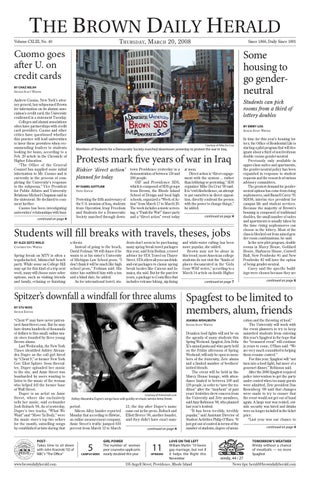
Members of Students for a Democratic Society marched downtown yesterday to protest the war in Iraq.
Protests mark five years of war in Iraq Riskier ‘direct action’ planned for today By Isabel Gottlieb News Editor
Protesting the fifth anniversary of the U.S. invasion of Iraq, students from Operation Iraqi Freedom and Students for a Democratic Society marched through down-
continued on page 4
town Providence yesterday in a demonstration of between 150 and 200 people. OIF and Providence SDS, which is composed of SDS groups from Brown, the Rhode Island School of Design and local high schools, organized a “Week of Action” from March 17 to March 20. The week includes a movie screening, a “Funk the War!” dance party and a “direct action” event today
at noon. Direct action is “direct engagement with the system ... rather than lobbying or protesting,” SDS organizer Mike Da Cruz ’09 said. It is “civil disobedience, an attempt to put ourselves in direct opposition, directly confront the person with the power to change things,” he added. continued on page 4
Students will fill breaks with travels, theses, jobs By Alex Seitz-Wald Contributing Writer
Spring break on MTV is often a tequila-fueled, bikini-clad beach party. While some on College Hill may opt for this kind of a trip next week, many will choose more sober options, such as visiting friends and family, relaxing or finishing
a thesis. Instead of going to the beach, David Fedman ’08 will dance if he wants to at his sister’s University of Michigan Law School prom. “I don’t think it will be much like high school prom,” Fedman said. His sister has outfitted him with a tux and a blind date, he added. As for international travel, stu-
dents don’t seem to be purchasing many spring break travel packages this year, said Erin Bodnar, a travel adviser for STA Travel on Thayer Street. STA offers all-you-can-drinkand-eat packages to classic spring break locales like Cancun and Jamaica, she said. But for the past few years, a package to Costa Rica that includes volcano hiking, zip-lining
Spitzer’s downfall a windfall for three alums By Stu Woo Senior Editor
“Client 9” may have never patronized AmieStreet.com. But he may have drawn hundreds of thousands of dollars to this small, online music store founded by three young Brown alums. Last Wednesday, the New York Times identified Ashley Alexandra Dupre as the call girl hired by “Client 9,” or former New York Gov. Eliot Spitzer. Soon thereafter, Dupre uploaded her music to the site, and Amie Street was bombarded by users wanting to listen to the music of the woman who helped fell the former bane of Wall Street. Dupre is an ar tist on Amie Street, where she exclusively sells her music, said co-founder Josh Boltuch ’06. As of yesterday, Dupre’s two tracks, “What We Want” and “Move Ya Body,” were the music store’s top two sellers for the month, outselling songs by established artists during that
Joanna Wohlmuth Senior Staff Writer
Courtesy of Amiestreet.com
Ashley Alexandra Dupre’s songs have sold quickly on music service Amie Street.
period. Silicon Alley Insider reported Monday that according to Hitwise, an online measurement company, Amie Street’s traffic jumped 650 percent from March 12 to March
POSTTakes time to sit down with John Krasinski ’02 of NBC’s “The Office” www.browndailyherald.com
Spagfest to be limited to members, alum, friends
5
CAMPUS NEWS
13, the day after Dupre’s name came out in the press. Boltuch and Elliott Breece ’06, another founder, said they didn’t have exact numcontinued on page 4
girl power The number of women peer counselor applicants nearly doubled this year
11
OPINIONS
Drunken food fights will not be on the agenda of many students this Spring Weekend. Spagfest, Zeta Delta Xi’s annual pasta and wine party held on the Friday afternoon of Spring Weekend, will only be open to members of the fraternity, Zete alums and a limited number of brothers’ invited friends. The event will be held in the Marcy House lounge, with attendance limited to between 100 and 120 people, in order to “save the tradition” after the “mayhem” of past years’ festivities drew concern from the University and Zete members, said Amy Robinson ’08, who planned last year’s festival. “It has been terribly, terribly popular,” said Assistant Director of Student Activities Philip O’Hara. “It just got out of control in terms of the number of students, degree of intoxi-
love on the left William Martin ‘10 favors gay marriage, but not if it helps the Right this November
195 Angell Street, Providence, Rhode Island
cation and the throwing of food.” The University will work with the event planners to try to keep uninvited students from entering this year’s Spagfest in the hope that the “treasured event” will continue in years to come, O’Hara said. “We are very much committed to helping them resume control.” For this year, Spagfest will “not turn into a food fight, but more of a gourmet dinner,” Robinson said. After the 2006 Spagfest required police intervention to get the party under control when too many guests were admitted, Zete president Dan Rosenberg ‘09 said that changes were made to try to ensure that the event would not get out of hand again. A large tent was rented, outside security was hired and drinks were no longer included in the ticket price. “Last year was our chance to continued on page 4
tomorrow’s weather Windy without a chance of meatballs — no more Spagfest
windy, 44 / 27 News tips: herald@browndailyherald.com
T oday Page 2
Thursday, March 20, 2008
THE BROWN DAILY HERALD
Menu
But Seriously | Charlie Custer and Stephen Barlow
Sharpe Refectory
Verney-Woolley Dining Hall
Lunch — Corn Souffle, Hot Turkey Sandwich with Sauce, Chicken Gouda Calzone, Sugar Snap Peas, S’mores Bars
Lunch — Pulled Pork Sandwich, Shoepeg Corn Casserole, Cauliflower, Mediterranean Bar, S’mores Bars
Dinner — Braised Beef Tips, Pumpkin Raviolis with Cream Sauce, Rice Pilaf with Zucchini, Sunny Sprouts, Tapioca Pudding
Dinner — Roast Turkey with Sauce, Vegan Roasted Vegetable Stew, Red Cabbage with Apples, Green Beans
Free Variation | Jeremy Kuhn
Sudoku Fill in the grid so that every row, every column and every 3x3 box contains the digits 1 through 9.
Enigma Twist | Dustin Foley
© Puzzles by Pappocom
RELEASE DATE– Thursday, March 20, 2008
Los Angeles Times Puzzle C r o sDaily s w oCrossword rd
Trust Ben | Ben Leubsdorf
Edited by Rich Norris and Joyce Nichols Lewis
ACROSS 1 “Prince Valiant” cartoonist Foster 4 Indiana political name 8 Friars Club event 13 Yesteryear’s senior, now 15 “Pinocchio” goldfish 16 Straight start? 17 Hand 20 Beneficial 21 Computer key with opposed arrows 22 22.5 deg. 23 Hand 27 Group with a lot of hits? 28 Walter of “Treasure Island” 32 Shadow 36 Grays 39 Con __: tenderly, in music 40 Hand 43 Enjoy a playground fixture 44 Alleviate 45 Number 10 on a table 46 Cisco Kid’s sidekick 48 Altar in the sky 50 Hand 57 Institute of Medicine std. 59 Road warning 60 Levi’s “Christ Stopped at __” 61 Hand 65 Louvre Pyramid architect 66 “Yes, here __ close to a stunted rose bush”: “Spoon River Anthology” 67 It may be raw 68 “So long!” 69 Nat or ’Stro 70 Draft org. DOWN 1 Exaggerate on stage 2 O’Connor’s successor 3 Soviet moon mission series 4 Prior to A.D.
5 Ryan’s “Love Story” costar 6 Isaac Bashevis Singer’s “Yeshiva Boy” 7 Surfer wannabe 8 Mythical predator 9 William III follower 10 Memo abbr. 11 Brake part 12 Point with a view 14 One who’s tough to budge 18 Insurance type 19 Nile wader 24 Jewish wedding staple 25 Like Bustopher Jones of “Cats” 26 Line above the equator: abbr. 29 Time division 30 Sacramento’s __ Arena 31 Sharp-edged 32 Half an oz. 33 Sony subsidiary 34 Words after pack or rub 35 Phantom portrayer, 1925 37 Troop gp.
38 Strong fiber 41 Alphabet run 42 Medical supplies 47 Estimator’s phrase 49 Genesis shepherd 51 Puckish 52 Factotum 53 Bk. after Amos 54 Bounders 55 “__ Dream”: Wagner aria
56 Cambodian currency 57 Georgia city built on seven hills 58 Cat’s-paw 61 Bradbury’s “__ for Rocket” 62 One of a semana’s seven 63 Statistical metaphor 64 Each
ANSWER TO PREVIOUS PUZZLE:
Opus Hominis | Miguel Llorente
xwordeditor@aol.com
3/20/08
Vagina Dentata | Soojean Kim
T he B rown D aily H erald By Ernie Lampert (c)2008 Tribune Media Services, Inc.
3/20/08
If you do one thing on College Hill today
Mission North Korea: Battle of the Bands 7 p.m. in Salomon 101
Editorial Phone: 401.351.3372
The Brown Daily Herald (USPS 067.740) is an independent newspaper serving the Brown
Business Phone: 401.351.3260
University community since 1891. It is published Monday through Friday during the aca-
Simmi Aujla, President
once in July by The Brown Daily Herald, Inc. POSTMASTER please send corrections to
Ross Frazier, Vice President Mandeep Gill, Treasurer Darren Ball, Secretary
demic year, excluding vacations, once during Commencement, once during Orientation and P.O. Box 2538, Providence, RI 02906. Periodicals postage paid at Providence, R.I. Offices are located at 195 Angell St., Providence, R.I. E-mail herald@browndailyherald.com. World Wide Web: http://www.browndailyherald.com. Subscription prices: $319 one year daily, $139 one semester daily. Copyright 2007 by The Brown Daily Herald, Inc. All rights reserved.
M etro Thursday, March 20, 2008
Metro in Brief Molotovs thrown at former synagogue A Molotov cocktail was thrown into the yard of the former Providence Temple Beth-El Wednesday morning. Although the vandals used the same style of firebomb as the attacker who threw a Molotov cocktail at the home of Hillel employee and Israeli emissary Yossi Knafo Saturday, police say the incidents do not seem related, according to a March 19 article on the Web site of WJAR, Providence’s NBC affiliate. The police have since arrested three teenagers from Providence and Central Falls. The juveniles were accused of breaking into and vandalizing a house and have since been charged with fifth-degree arson, breaking and entering, conspiracy and other accounts, WJAR reported. Until a court hearing on Monday, the teenagers are being held in the Rhode Island Training School. The juveniles told the police they planned to throw the firebomb into a vacant lot, but threw it on synagogue property upon seeing the police, the WJAR Web site said. The fire was discovered in the former synagogue yard when a police officer put out the Molotov cocktail flames at 12:30 a.m., the article said. The FBI and the Bureau of Alcohol, Tobacco, Firearms and Explosives are also involved in the investigation. —Jenna Stark
Page 3
THE BROWN DAILY HERALD
Graffiti arrests point to larger problem By Simon Van Zuylen-Wood Senior Staff Writer
A local college student accused of marking graffiti on a Brown building was ordered to perform 100 hours of community service and to pay for building damage in a Wednesday arraignment. He and a fellow student were arrested on March 1 and charged with malicious mischief for graffiti vandalism on March 5. Community College of Rhode Island student Nicholas Bach, 21, pleaded no contest to the charge and will pay restitution to Brown as well as complete community service under the supervision of the Providence Parks Department if he avoids arrest for the next year, said District 9 commander Lt. John Ryan. If he is arrested in the next year, however, Bach would automatically be judged guilty of malicious mischief, which could incur harsher fines and jail time, Ryan said. The other perpetrator was 20-yearold Rhode Island School of Design student Michael Todorovich. Due to complications with legal counsel, his case was continued to April 2, Ryan said. Bach and Todorovich used spray cans and black markers, the latter of which “you can’t wash off,” District 1 Lt. Michael Figueiredo told the Providence Journal on March 6. The graffiti is still visible on the outside of 121 South Main Street. The marble and glass structure lies at the base of College Hill and houses the Department of Community Health and the Center for Alcohol and Addiction Studies, among other departments. Graffiti is fast becoming a familiar and sore sight on College Hill.
“I would imagine it’s about 10 to 15 (graffiti incidents) a month,” said Stephen Maiorisi, vice president for Facilities Management. “On average in a year we spend (about) $10,000 ... in graffti removal.” Pushing for the “harshest penalty possible under the law,” Fox Point Neighborhood Association President Daisy Schnepel sent a public e-mail about the arraignment this Monday to Providence City Solicitor Joseph Fernandez and three local university presidents, including Ruth Simmons. Schnepel bemoaned not only the “permanence” of graffiti and the “countless” hours volunteers spend cleaning it, but also the fact that the criminals were college students. “Repeatedly, in our dealings with area universities we are told that higher education students are on a different plane and not responsible for this ‘juvenile crime,’” Schnepel wrote, adding, “Apparently, that is not the case.” Ryan said he believed gangs were responsible for several recent acts of graffiti, but that a Providence gang unit specialist identified the marks as non-affiliated. Local Realtor Ed Bishop, some of whose buildings have been tarnished by graffiti, said looking for vandals in gangs is a misguided approach. “A lot of people assume these are gangs putting up their symbols,” Bishop said. “Over half of the things being done have been by prep school, private school and college kids.” College Hill Neighborhood President Will Touret did not appear concerned with the identity of vandals — only Providence’s ever-growing graffiti problem. “It’s really gotten to a point where everyone is getting so disgusted,” Touret said. “You’re
starting to see references to graffiti in the newspaper by not just city people but state people.” Touret said the spread of graffiti could lead to further vandalism. “Leave any property crime unfixed (and) it’s just a matter of time before those areas become the subject of more serious crimes.” Despite Schenepel’s talk of more serious punishment in her e-mail and comments from Bishop, who called for more permanent graffiti violations to be filed as felonies instead of misdemeanors, FPNA board member John Roney said he was satisfied with the current course of action. “It’s not very often that they catch someone doing this,” Roney said. Roney, whose law office on Wickenden Street still bears graffiti from a month-old incident, said enough legal attention has been given to the matter that graffiti is no longer “looked at as some sort of prank.” Graffiti has been prevalent outside of College Hill, too, Ryan said. Last Friday, local police saw a teenager spraying graffiti in Waterplace Park and caught him in the Providence Place Mall, where he had fled. Later that day, two teenagers with markers were caught on Pittman Street on the East Side. Ryan said graffiti artists as young as 13 and as old as 27 have been caught in recent weeks but gave no word on how many of those were college students. Whatever the outcome of increased police and community attention towards graffiti, Touret sees certain Providence neighbors drawing closer. “The people who are usually fighting each other are starting to sing the same song against graffiti,” he said.
State may take over dealers’ game By Rachel Arndt Metro Editor
Like most people looking for marijuana, Bobby Ebert used to turn to a drug dealer. But unlike those who use the plant for recreation, Ebert relies on it for medication and needs a safe supply he can count on. And though he’s registered with the state as a legal medical marijuana user, he still struggles with finding a trustworthy source for his medication. Ebert, who is 48, smokes marijuana to help with pain caused by neuropathy and a bad back and to help lessen the nausea caused by his AIDS medication. He now relies on appointed caregivers for marijuana, but sometimes they don’t come through, and the variability among the plants can be tricky to navigate. But soon Ebert may no longer have to worry about tracking down his medicine from these sometimes unreliable sources. Almost two years after Rhode Island began allowing medical marijuana, the state legislature is looking for a way to get marijuana to patients without relying on the illegal drug trade. On Feb. 26, State Sen. Rhoda Perry P’91 and State Rep. Thomas Slater, both Democrats, introduced a bill that would give the state’s 357 medical marijuana patients legal access to their medication. The new bill — essentially an amendment to the Edward O. Hawkins and Thomas C. Slater Medical Marijuana Act of 2006 continued on page 7
Page 4
Thursday, March 20, 2008
THE BROWN DAILY HERALD
Spitzer case spurs traffic Iraq protestors march through downtown on alums’ music site continued from page 1
continued from page 1 bers for the traffic increase, but did see a huge bump. “We were expecting a spike — maybe not a spike as high as the one we received,” Breece said. “I think the reason was more that it wasn’t a bad track. She has a good voice.” Media outlets have given estimates that sales of the songs, which currently cost 98 cents each, may have already reached $1.4 million. Boltuch could not confirm any numbers, saying it was against company policy to release sales information for any artists. But he said Dupre, like any artist on the site, would keep 70 percent of her sales, while Amie Street would keep the other 30 percent. Boltuch added that “Move ya Body” became the fastest track in the site’s history to reach 98 cents, the top price. Amie Street has a unique pricing policy in which songs become more expensive as they become more popular. More than a dozen media outlets have written about Dupre’s connection to the music store during the past week. “With the Eliot Spitzer scandal, it got a lot of people to read about Amie Street,” Boltuch said, adding that many people who learned about Dupre learned about the
music store’s distinctive model as well. “Free press is awesome — it’s like free soup,” Breece said. “It’s so completely from left field that we definitely just got lucky.” Boltuch and Breece said the site never went down or even slowed down during the bump in traffic. Amie Street traffic is still up a week after the spike, Breece added. Breece said the small company, which has about a dozen employees, had been buzzing for the past week. They haven’t sent a thank-you note to Dupre, nor have they blared the tracks, which he described as “solid do-it-yourself pop R&B,” in their Queens, N.Y., office. But Breece said he is glad Dupre was able to make the best out of her situation. “We created a model that lets people ... leverage attention — and I won’t put any value judgment on that attention — but putting leverage into being heard and making money and, hopefully, for making a career out of music,” Breece said. Boltuch, Breece and Elias Roman ’06 founded Amie Street in 2006, naming it after Amy Street in Providence, where the three lived when they were seniors. Boltuch said this summer, the company will have 20 employees, about half of whom will be Brown alums.
No more food fighting without Zete connection continued from page 1 come back and show the University that the event could be sustainable,” Robinson said. “The party went amazingly, but the University was disapproving.” Students threw food, overturned tables and chairs and gained unauthorized access to alcohol that was supposed to be distributed at the bar, Robinson said. “In the past couple of years, Spagfest has taken on this image as an unregulated food fight despite our best efforts,” Rosenberg said. “We could do nothing to stop
it because people came expecting that environment.” Until recently, Spagfest was a “civilized, sit-down dinner party,” Rosenberg said. It remains unclear whether Zete will decide to reclaim the event’s more innocuous roots or if a more managed chaos will endure, he added. Organizers will “need to rethink how we run the event, where we get the money and how to deal with the University,” Robinson said. “We love this tradition, but it’s just not feasible this year ... We know people will be disappointed, and we are, too.”
Direct action may mean risking arrest, OIF and SDS member Kelly Nichols ’09 said. But it is important to “show that we’re willing to put ourselves out there in opposition to crimes and injustices taken by the government.” Wednesday’s event was organized by the Rhode Island Spring Mobilization Committee, a community peace group. SDS members also went to meetings to help plan the event, Nichols said. About 40 students began their march at Faunce Arch, bearing signs with, “Drop tuition, not bombs,” “Resist the War Machine” and “End the violence! Peace now!” The protestors banged empty water drums and recycling bins and were accompanied by about four people playing instruments and wearing gold-tinselwrapped top hats. The students met a larger group of protestors in Kennedy Plaza’s Burnside Park, where the Mobilization Committee had brought speakers including Paul Hubbard of the International Socialist Organization. Hubbard called for an “immediate and complete withdrawal” from Iraq and encouraged grassroots organizing to get “millions into the streets.” The protest then snaked through downtown Providence, stopping in front of several military recruitment offices as well as the national headquarters of Textron, Inc. Textron manufactures cluster bombs, which cause a high number of casualties among Iraqi civilians, Nichols said. Outside the Textron offices, protesters chanted, “Hey Textron, you can’t hide; we charge you with
genocide.” No one in the building appeared to respond. After a few minutes, the demonstrators moved on. The march ended with several speeches in front of the State House. Sam Smith, from the progressive organization MoveOn.org, encouraged the demonstrators to be independent thinkers and fight for what they believe in. “We have to be unrelenting in opposition, stand up and say, ‘We’re not taking it anymore,’” he said. He also derided the “experts who say they can’t get us out” of Iraq. “We know nothing about Iraq,” he said. “We won’t win the hearts and minds of the Iraqis. We’re hated by the people of Iraq.” He encouraged the demonstrators to “make resisting the war acceptable.” Nichols also spoke at the State House, urging protestors not to be discouraged but to continue voicing opposition to the war. “How can we go about our daily lives while every day the government does illegal actions?” she asked. Other speakers included a Green Party representative and a young woman who addressed the crowd in Spanish, she said, to represent and speak to the Latino community. Despite the cold rain, many of the demonstrators said they thought it was important to be outside protesting. “The bottom line is, we need to show that five years (of war) is five years too many,” Nichols said. “We’re disgusted with all the lives lost and all the money spent.” “It’s just a small action, but hopefully with this small action, we’ll inspire others to take direct action and stand up for their beliefs,” she added.
“I think it’s stupid,” Owen Schmidt ’10 said of the war. “The money spent on this war — we could have fixed social security, the health care system,” he said. “It will cost several trillion by the end, and it could have gone to society.” Brown student representation was not limited to current students — protestors John Glasheen ’59 of South Kingston and former Herald staffer Richard Walton ’51 of Warwick marched with the crowd. “I was American studies at Brown, and the America I studied and got to know doesn’t come out much anymore,” Glasheen said. “They’ve corrupted our values.” Glasheen, who said he was at the protest representing the Rhode Island Unitarian Universalists for Social Justice and that he had been active in the anti-Vietnam War movement, added that the war is creating an “obscene debt” that will be passed on to future generations. Susan Beaty ’10, an SDS and OIF member and one of the organizers of the week’s events, said that despite the rain, turnout was good. She also praised the Mobilization Committee for the speakers they brought in. There was a “great variety of voices represented — students, different organizations,” she said. Yesterday’s protest was mainly organized by the Mobilization Committee. On Tuesday, SDS and OIF held an event called “Funk the War,” an “anti-war dance party,” Beaty said. She said 50 to 60 students spent over an hour dancing in Kennedy Plaza to music played using an amplifier plugged into a car battery and brought downtown in a shopping cart.
Subpoena to examine ties with card companies continued from page 1 nesses for the past few months, Benjamin Lawsky, his special assistant, told Newsday on Feb. 27. Cuomo’s office subpoenaed Brown and 14 other colleges and universities in January on their relationships with study-abroad providers. The investigation has shown that “college campuses were becoming a place where big business was realizing it could basically pay its way to get to a captive audience,” Lawsky told Newsday. Cuomo’s office did not return calls from The Herald. “Affinity” credit cards, such as the one the Brown Alumni Association offers, bear a university’s logo, and issuing banks make contributions to the university when customers make purchases with the card. The University’s affinity credit card is offered by Bank of America, according to the bank’s Web site. Betty Riess, a spokeswoman for Bank of America, declined to comment on the subpoena, but said the “vast majority” of affinity cardholders are alums and “other non-students.” Vice President for Alumni Rela-
Happy Spring Break!
tions Todd Andrews ’83 declined to comment on the subpoena. Vice President and General Counsel Beverly Ledbetter did not return calls for comment. Dartmouth received a similar subpoena from Cuomo’s office on Feb. 14, and “a number of other institutions” have also been subpoenaed, Ellen Arnold, Dartmouth’s associate general counsel, told the Chronicle. “The College is currently reviewing the subpoena and will respond to the Attorney General as appropriate and required by law,” Robert Donin, Dartmouth’s general counsel, said in a statement. “While we cannot detail the terms of the arrangement ... we can confirm that the arrangement does not involve Bank of America gaining student-loan business through Dartmouth,” he said. Dartmouth’s subpoena asked about the relationship between the bank and the school or its alumni association, and the way it markets the affinity card, Arnold told Newsday. “There’s absolutely nothing that’s been going on here that I think would trigger their interest,”
she told Newsday. “So it appears to me to be part of just a broader initiative to gather information and decide whether they’re going to pursue a claim.” “Af finity programs are ver y important to alumni programs at institutions,” said Brian Flahaven, director of government relations for the Council for Advancement and Support of Education. He said universities often use the money they receive to support alumni associations or student scholarships, generating “needed support” for the programs. Cutting the programs would mean less revenue to universities in a time of concern over rising education costs, he said. Ending the programs “means resources are being diverted from other programs,” Flahaven said. Flahaven said Brown could use the subpoena as a chance to “educate and inform lawmakers and regulators” about how the affinity cards support its programs. He said CASE urges its members to clarify its relationships with banks and draw an obvious line between the service provider and the institution.
C ampus n ews Thursday, March 20, 2008
News
Page 5
THE BROWN DAILY HERALD
i n
Exhibition displays contrasts of student art
Brief
Lending a helping hair Sayles Hall was filled with tables, hairbrushes, people and the continuous sound of hair dryers Wednesday as students came by the dozens to get their hair cut for the fifth annual Wigs for Kids fundraiser. The organization weaves hair replacement systems for children who lost hair because of medical treatment or illness and cannot afford a hairpiece. Wigs for Kids wants to “make the lives of kids who experienced hair loss more enjoyable, or better,” event co-coordinator Caroline Landau ’09 said. Nineteen ponytails were cut at the event, which lasted from 10 a.m. to 4:30 p.m., totaling 228 inches of hair that will be donated. Hairdressers gave more than 112 additional haircuts, and the event raised a total of $1,576 through cash donations. Donated hair had to be in a ponytail at least 12 inches long, but students could also come in for a trim. All haircuts were free, but a donation was suggested. Sixty aspiring hairdressers from a Paul Mitchell school in Cranston, which has been affiliated with the event since it started five years ago, donated their hair-cutting skills and time throughout the day. The event was smaller this year, said Landau, because coordinators booked fewer people to get their hair cut during each time slot. In previous years, the event raised money for the Locks of Love organization, but this year the coordinators switched to Wigs for Kids, Landau said. Brown/RISD Hillel and Health Services both helped fund the event, and the Progam in Liberal Medical Education Undergraduate Senate, Office of Campus Life and the Alpha Chi Omega sorority helped in obtaining parking spaces for the hairdressers, passing out table slips, providing food for the event and making goodie bags for the hairdressers. — Allison Wentz
UCS may abolish class reps The Undergraduate Council of Students could be reformed through a student body referendum in next month’s election, Clay Wertheimer ’10, at-large representative and chair of the UCS Assessment Task Force, announced at the council’s general body meeting Wednesday evening. The proposal, which came out of the task force’s final report, would abolish class representatives and allow any interested student to join UCS after obtaining between 50 and 200 signatures and attending two body meetings. The task force was comprised of Wertheimer, At-Large Representative and Herald opinions columnist Tyler Rosenbaum ’11, Associate Member Jerry Cedrone ’11, Julie Soic ’08 and Ben Struhl ’09, who lost a September election to an at-large seat after running on a platform of reforming student government. Including more people in UCS would allow more students who want to work to improve UCS and the University to participate, Wertheimer said. “I think (the proposal) has a lot of potential” to make UCS more transparent and open, Wertheimer told The Herald, adding that it has broad support from UCS members. The proposal would include a section to punish members who do not attend meetings by suspending voting rights after one unexcused absence and expelling members for the balance of the semester after three absences. It would also maintain the current elected structure of the executive board. Treasurer Jose Vasconez ’10 suggested simply expanding UCS to include more at-large representatives if the task force wanted to allow increased participation. At-large representatives are chosen by UCS members. Rosenbaum responded that the proposed system would prevent UCS from “futilely searching” for members. The proposal will be included as a question in next month’s UCS election, Student Activities Chair Drew Madden ’10 told The Herald. The task force’s report includes other suggestions to improve UCS’ efficacy, such as requesting a written response from the University to UCS resolutions. UCS also voted to create the Brown University Activities Council, a group that would allow Category III student groups to petition UCS, the Undergraduate Finance Board and the University for changes that affect all student groups. Each Category III group will send a representative to a general meeting once per semester to elect an executive council that could meet weekly or biweekly, Madden said. The council could identify common problems between groups and recommend changes to the activities code, Madden added. The council could appoint members to UFB as well, just as UCS does, Madden said. The council would help give student activities an increased “voice” in student government, he added. — Chaz Kelsh
Thanks for reading.
By Ben Hyman Staff Writer
The 2008 Student Art Exhibition, running at the David Winton Bell Gallery until March 30, states its purpose up front. This declaration of intent comes
REVIEW in the form of Alice Malone’s ’08 pair of multimedia works, “Explosion I” and “Explosion II,” which the viewer encounters immediately upon entering the building. Both works depict the same image — a volcanic eruption, perhaps, or a detonating bomb — but here their similarities end. One is so small it might be overlooked by someone scanning the gallery. The other unmistakably
dominates the room. One is framed by a jaunty fabric border covered in feathery fringes. The other is unframed and starkly present. Most crucially, one depicts the explosion in impressionistic brushstrokes, as if seen through the haze of its own smoke, while the other uses reams of colored satin to construct a concrete and physically immediate experience. Hung beside each other, these two exceptional works — which garnered Malone one of the four Minnie Helen Hicks Prizes in Art to Women Students — create a dialogue of juxtaposition and inversion. Within the gallery space, the pieces have been grouped according to an astute interpretation of their common thematic or formal elements. The Student Exhibition invites viewers to appreciate and savor the juxtaposi-
Min Wu / Herald Timothy Simond’s ’11 work was among those in the Reject Show.
tions, the ways in which artists have tackled a variety of common challenges or subjects in different and intriguing ways. For example, works by Jesse Cohn continued on page 7
Residential peer leader applications rise By Emmy Liss Senior Staff Writer
Residential peer leader hopefuls checked their mailboxes yesterday, looking for a letter they had been waiting for since February. With the highest number of applications in recent years, administrators made offers to 95 students on Wednesday — 32 RC positions, 22 WPC positions, 33 CA positions and 8 rep positions. The RPL program moved its decision date from Friday to yesterday, needing more time to adequately review over 160 applications, said Natalie Basil, associate director of residential programs in the Office of Residential Life. The selection process took longer than
usual because each student wrote several essays, submitted two recommendations, participated in two interviews and was then reviewed by a selection committee. 55 RPLs reapplied to the program and 106 students applied for the first time, Basil said. Ninety-four of the new applicants were first-years. Last year there were 89 new applicants and 26 returners, said Rosario Navarro, project manager in the Office of the Vice President of Campus Life and Student Services, who held Basil’s position last year. Basil conducted almost twice as many information sessions this year as Navarro did last year, substantially increasing awareness of the program and application process,
Navarro said. Applications for the women’s peer counselor position reached an unprecedented level. This year, 51 students — including one male — applied to be WPCs, though some also applied to be residential counselors or community assistants, Basil said. 22 were accepted, one for each firstyear unit. Last year, 28 students applied and 22 were hired as WPCs. In 2006, only 11 students applied, making it impossible for each of the 22 freshman units to have their own WPC, Navarro said. But application numbers are up “across the board” this year for leadership roles, Basil said. continued on page 6
Movie star honors debaters Student NGO By Sara Sunshine Contributing Writer
Not long into the evening, the organizers behind the Rhode Island Urban Debate League’s annual year-end banquet realized they would need more chairs. The room was quickly filling with about 200 laughing and chattering high school debaters along with their families and coaches, leaving some guests without a seat as the program started. More fold-out chairs were quickly supplied and the event, designed to celebrate the students’ achievements during the debate season, continued. RIUDL is run by the Swearer Center for Public Ser vice, which works with community directors to establish debate programs at high schools in the area. About 140 students from eleven different schools participated this year, said Morgan Whitworth ’09, a RIUDL student coordinator. The large number of students and schools participating in RIUDL reflects an “upward slope” in the size and capacity of the program, Whitworth said. More than 30 Brown students have volunteered this year to coach the high schoolers, conduct forums about debate, chaperone trips and host and judge local debates. The RIUDL banquet took place in the Westin Providence, and featured speeches by Mayor David Cicilline ’83 and actor Nate
Parker, who is featured in the 2007 motion picture “The Great Debaters.” A screening of the film, which chronicles the ground-breaking success of an all-black debate team in the 1930s, followed the banquet. “Although ‘The Great Debaters’ is a Hollywood movie, it really is a Rhode Island story,” Will Tucker ’04, director of RIUDL and the assistant director of the Swearer Center, said in the opening speech. In the speech, Tucker also said he wanted the night to celebrate nine years of partnership between the Swearer Center and RIUDL. Tucker was followed by Cicilline, who gave a brief speech emphasizing the importance of recovering the “lost art” of debate. “This is one of the most important times in our countr y and your voices need to be heard,” Cicilline said. RIUDL “reinforces the power of words” and enables students to develop the skills that allow them to “contribute to democracy,” he said. Rosanna Castro ’04, a former RIUDL debater and cur rent Providence School Board member, presented year-end awards to students, including Courtney Dwyer, a senior at Woonsocket High School. “Because of debate, we’re more comfor table speaking continued on page 6
receives $25,000 By Colin Chazen Contributing Writer
When all the finalists had finished giving their presentations and JPMorgan announced the winner, Emma Clippinger ’09 burst into tears in a room full of dark-suited investment bankers. Her organization, Gardens for Health International, had been selected to receive a $25,000 donation. “I thought it was a shot in the dark,” Clippinger said. She and the other finalists each gave a 20-minute presentation on their business models, and then JPMorgan judges announced the winners — in reverse order, which Clippinger described as resembling American Idol — until they finally reached her organization. GHI was selected in January as the best initiative out of 101 undergraduate projects under consideration for the firm’s second annual Good Venture Undergraduate Competition, according to a company statement. Clippinger said she plans on using the grant to expand GHI’s garden project for HIV-positive Rwandans by developing the new land donated to the organization by the Rwandan government last year. Clippinger, along with Emily Morell, a student at Yale, saw that drug treatment for HIV/AIDS patients was ineffective without proper continued on page 9
Page 6
Thursday, March 20, 2008
THE BROWN DAILY HERALD
Certain non-suites designated gender-neutral continued from page 1 spread across campus so no one area can be physically identified as gender-neutral and so students won’t be restricted to a certain part of campus if they want to live in a gender-neutral room. The new policy is meant to “enhance students’ options,” said Richard Bova, senior associate dean for Residential Life. “It will create less stress for mixed groups and greater flexibility in making choices.” Bova said any students who have already submitted their lottery groups will be contacted about the new policy and will have the opportunity to alter their group if they would like. The new policy will be publicized by noon today on the Campus Life and Student Services Web site. Residential Council Chair Alexander Dean ’08 said the new policy will make the housing lottery less stressful. “Anything that will give people more options, comfort and flexibility will make (the) lottery easier,” he said. Dean said the new policy “should provide an opportunity for most anyone who wants it and should be something that makes very few people upset.” Carey said he would like to make
it clear that gender-neutral housing is a choice — “No one will be forced to live in an environment they’re not comfortable with.” Student surveys conducted last spring demonstrated that students generally support and respect issues of gender, regardless of their personal feelings, he said. “These supplemental things are accessible to everyone,” said Katie Lamb ’10, a member of the genderneutral housing working group. “But they don’t infringe on the things we already have.” The group, comprised of administrators and students, has been working to make gender-neutral housing available since 2003. “It’s an issue that has been bounced around a lot, pushed back into different committees,” Lamb said. “It’s really only this year that things have been put in motion in a practical way.” Carey said Bova and Kelly Garrett, coordinator of the LGBTQ Resource Center, have been researching gender-neutral housing at peer institutions and generating ideas for implementation at Brown since last year. Last spring, ResCouncil unanimously passed a gender-neutral housing proposal. James Reed ’09, chair of ResCouncil’s policy subcommittee, said the work done by
the gender-neutral housing working group “helped shape the discussion.” For the last three years, the head of ResCouncil has sat on the working group to keep in touch with the concerns of proponents. Reed said it’s taken a while to have the policy approved, but that he’s happy with it. “Hopefully they’ll be able to roll it out across campus,” he said. Though those working on the policy have tried to make options particularly available for sophomores, Reed said the new policy “will really open up choices for everybody.” Various other groups and committees have come into play this semester, Carey said. Garrett heads the LGBTQ subcommittee of the Diversity Advisory Board, which made recommendations to the board on gender-neutral housing. The Campus Life Advisory Board was also consulted, and the topic was then brought before the Corporation Campus Life Committee when it met in late February. Carey said he expects minimal reaction from individuals outside the community, consistent with similar changes, such as implementing gender-neutral bathrooms. For example, the University of Pennsylvania recieved little negative reaction when it expanded its gender-neutral policy, he said. Response from the various
Tai Ho Shin / Herald File Photo
New Pembroke #1 and #2 will both be included in the gender-neutral housing pilot. groups consulted on this topic has been “favorable and supportive,” Carey said. Josh Teitelbaum ’08, a member of the working group, said he appreciates the progress that has been made. “This is a big step,” he said. “A lot of change has happened since 2003. Gender-neutral was scary then, but now it’s more commonplace.” But Teitelbaum said he worries about the campus’s most “vulnerable” residents — first-years. Returning students are in a better position to advocate for themselves than new students who are afraid to cause trouble and do not know who to ask for help, he said. Carey said gender-neutral housing for new students is “some time
off,” but administrators are trying to make the housing process less intimidating for incoming first-years who may not feel comfortable with the traditional options. Margaret Klawunn, associate vice president of campus life and dean for student life, said the gender-neutral housing working group has helped revise the housing form for incoming freshmen to more clearly present them with options, she said. The core principle of the firstyear housing experience is that there are no choices involved, Carey said. Housing for upper-class students already offers choice, he said, including who they live with and where they live. Gender-neutral housing simply gives them another option.
Over 160 RPL applications received, 95 offered positions
Debaters hear from mayor, actor
continued from page 5 Susannah Kroeber ’11 said she applied to be a WPC because of the impact current WPCs have had on her freshman experience. Kroeber, a rugby player, met a number of WPCs outside her unit through the women’s rugby team, which boasts a large number of WPCs because of the “strong woman” image it promotes, she said. Her friends encouraged her to apply because of the great experience they had with their first-years and working with ResLife, she said. The huge number of applications shows “how strongly people feel about the program,” said Kroeber, who was selected to be a WPC in Bronson House next year. Basil said many of the RPL applicants cited “outstanding, motivational and inspiring RPLs” in their interviews. The high numbers this year can be attributed to the excellent job Navarro and her colleagues did in the selection process last year, she said, but also to “a really motivated first-year class.” Annalisa Wilde ’11 applied for both the RC and WPC role because she did not have a close relationship with her RPLs this year. “I’d like to be able to have more of an impact,” she said. “I’d like to be in a position to
guide people, be the default person if they need help.” Wilde said she also applied for the Minority Peer Counselor position, but was waitlisted. Josh Marcotte ’11 knew he wanted to be an RC within a month of being at Brown. “I was really attracted to the opportunity to help people start anew at school,” he said. Marcotte found out he was accepted yesterday, after checking his mailbox several times throughout the day. “I’m thrilled,” he said. “I’m just really looking forward to it. It will make my experience next year that much better.” Current WPC Sarah Magaziner ’10 was one of 12 students who applied to be an RPL rep for next year. “The (WPC) community means a lot to me and I want to continue to be a part of its growth and development,” said Magaziner, who was accepted. “It was a strenuous interview process, very much directed toward getting good answers,” Kroeber said. “The essays were useful in determining how I wanted to frame myself as a (WPC).” Navarro and Basil both said they have met many dedicated RPLs through the program. “They are concentrated on their own academics and extracurricular activities,” Basil said. “But they also have the lives of their first-years.”
continued from page 5 in public and supporting our statements well. We know more about the world,” Dwyer said. She and her par tner, Preeti Kinha, will attend the National Urban Debate Championships in Chicago in April. The room erupted with loud cheers when Parker took the stage to deliver his keynote address. Parker spoke about his experience working with fellow actor and director Denzel Washington on the film and how that spurred his involvement with debate programs. “Being an actor, I live in a fair y tale world where people don’t want to address issues that need to be addressed,” Parker said, citing the “education gap between the haves and havenots” and the “vicious cycle (of poverty) that destroys our communities” as two of those issues. Though Parker did not debate in high school, he said being in “The Great Debaters” opened his eyes to the importance of the activity and helped him see debate as more than “just arguing.” “Debate is a major step in leveling the playing field,” Parker said, before urging the high school students to “spread the good news about debate.” Before taking questions, Parker asked the participating students to stand. As they rose to their feet, he leaned towards the microphone and said, “I believe in you. We believe in you. And today we honor your achievement.”
Thursday, March 20, 2008
Page 7
THE BROWN DAILY HERALD
College Hill to go quiet State-regulated marijuana finds support without Brown students continued from page 3
continued from page 1 Ed, an online news resource. Of the 11 million college students in the United States, fewer than 100,000 will sip margaritas in Cancun, Acapulco, Jamaica or the Bahamas each year, Inside Higher Ed reported. This is not to say that Fedman and his classmates will be bored next week. Jess Majno ’08 will be visiting a friend in New Orleans who teaches in the city. Forrest Miller ’10 will also be travelling to the Big Easy, via a lengthy road trip. He and three friends plan to visit other friends studying and working there, he said. He joked that they will put a “BushCheney” bumper sticker on their car with New York plates in order to “go undercover” in the South. Jon Mitchell ’09 will be in the same city, working rather than relaxing. He will be helping to build houses in the city during the day and discussing “social justice and Judaism” at night, on a trip organized by the Brown/RISD Hillel, he said. Mitchell isn’t the only student working over the break. Okezie Nwoka ’10, who said that he was the only applicant from a Washington, D.C., public school accepted to Brown the year he matriculated, will now return to the district to conduct information sessions at public high schools for the Office of Admission. In the same city, the Brown Derbies will perform at Georgetown and George Washington universities, according to Don Flynn ’10, a member of the a capella group. Joanna Berg ’10 said she’s also going to Washington to assist the Derbies on their tour before heading to a swing dancing convention in Boston. Pleasure travelers include Julia Van de Walle ’08, who will be across the world in southern France as she visits a family friend, and Aditi Dubey ’08, who will hike and take advantage of the warm weather in Palm Springs, Calif. As it rained in
Providence, Dubey noted that her spring break destination was enjoying temperatures in the 80s. Jonathan Gordon ’11 and a handful of other first-years plan to take in the “vibrant nightlife” in Montreal and attend a Boys Noize concert, he said. A group of twenty Brunonians, including Dipal Shah ’08, look forward to the beach in Jamaica at an all-inclusive resort, Shah said. For many seniors, spring break means one thing: thesis. With deadlines shortly after the break, thesis writers will be hard at work — Aaron Cutler ’08 said he will be working in his room in Providence, writing on Orson Welles’ portrayal of a Shakespearean play. Fedman said that after the prom with his sister, he plans to focus on finishing his history thesis. Majno said she hopes she can “leave (her) thesis in Providence” when travelling to New Orleans, but added that she doubts she’ll be worry-free while on vacation. With many students abroad, traveling domestically or in their rooms working on theses, many businesses on Thayer reported that they generally experience a drop in business during the break. A hostess at Paragon said the restaurant scales back its staff over winter break, but was not sure if they would do the same for the upcoming break. Christina Cantore of City Sports and Ryan Clark of Geoff’s Superlative Sandwiches noted that Brown students are a large portion of their business and said they also notice a drop in business during breaks. Administrators will join thesiswriters on College Hill for the week. Associate Vice President of Student Life and Dean of Student Life Margaret Klawunn will continue working during the break. “I take my vacation during the summer, so I will be around here during spring break,” she said. President Ruth Simmons will also be working, but will allow herself some time for rest, according to her assistant, Marisa Quinn.
— calls for the creation of a nonprofit, Department of Health-controlled “compassion center.” The compassion center would be able to “acquire, possess, cultivate, manufacture, deliver, transfer, transport, supply, or dispense marijuana, or related supplies and educational materials” to patients and caregivers, according to the bill. To receive a license for medical marijuana today, a patient must have a doctor sign a Department of Health form stating “that medical marijuana will do more good than harm,” says Jesse Stout ’06, executive director of the Rhode Island Patient Advocacy Coalition, known as “Rhode Island’s non-profit grassroots medical marijuana community,” according to the group’s Web site. “We register patients who have specific qualifying diagnoses, and they have to be certified by their physician,” says Charles Alexandre, chief of Health Professions Regulation at the Health Department. There is no provision on how to get the marijuana, Alexandre says, so patients must use their caregivers to obtain the marijuana. A person with a license for medical marijuana can appoint two caregivers. But these caregivers can be unreliable, and the strains of marijuana can vary, Stout says. The bill was referred to the Rhode Island Senate Health and Human Services committee and the House Health, Education and Welfare committee, and hearings are set to take place within the next couple weeks, according to Perry. “We’re giving patients somewhere to go” by creating “this safe-access mechanism,” Stout says. A compassion center would give patients a “store to go to” like they would for any other medicine. They would “also have the benefit of reliability and consistency,” he says. “A lot of people end up going to street dealers,” Stout says. “We’re trying to address this by making it so sick people have a safe and regulated place to access this medicine.” Finding a source for his medical marijuana was sometimes “scary,”
says Ebert, who used to work for rock bands in New England, especially when “your own caregiver is threatening to take something from you.” One of Ebert’s caregivers was acting more like a street dealer, he says, threatening him and trying to take money from him. “He was just thinking about money.” The new legislation would also allow patients to legally give marijuana to one another and give them the option of having the Department of Health tell them about any clinical medical marijuana studies. Stout says he “envision(s) a compassion center that is able to offer reduced price or even free marijuana for patients who are poor.” RIPAC faces opposition from the governor, and Stout expects the legislation to run into a veto eventually. “Hopefully we’ll have enough time for an override,” he says. Though some may worry that medical marijuana will be approved for those who don’t really need it, “experience so far … tells me that we’re actually having the reverse problem,” Stout wrote in an e-mail to The Herald. “Some doctors have not read the law yet and won’t recommend marijuana because they still think it’s illegal.” The state police opposed the legalization of medical marijuana in 2006, Stout says. “They didn’t want to see patients go to drug dealers,” he says. Now that the legislation includes state regulation of medical marijuana, Stout expects the police to be more supportive. The history of marijuana as medicine can be traced back over 4,000 years, Stout says. “People were using marijuana as medicine … way before we had governments,” he says. But marijuana’s role in medicine didn’t fully reemerge until the 1990s when “states started passing new laws allowing medical marijuana research and use.” But Peter Friedmann, an associate professor of medicine who studies substance abuse, is not convinced of the drug’s medicinal usefulness. “I’m not sure that its benefits for pain are known even now,” he wrote in an e-mail to The Herald.
“I’m one of those folks who believes we need more studies to really know what the long-term effects are,” Friedmann says. In general, the medical community agrees with this, he says. “Within the medical community, there probably is consensus that we need more information in terms of the types of conditions for which it might be useful,” Friedman says. “But there probably are some conditions it will prove to be useful for.” Still, Friedmann worries about the potential for abuse. “For the various indications for which we would use medical marijuana, there are other compounds that are less abusive,” he says. There are “plenty of good medications” for glaucoma other than marijuana, he says. “The fact that it has psychoactive effects makes it potentially abusable, and I have concerns whether we need to make commercially available another potentially abusable substance,” Friedmann says. Stout admits that there is some possibility for addiction, but he says marijuana is only psychologically, not physically, addictive. “(It’s) true that there is some dependence potential, like any other substance,” Stout says. But he thinks getting patients effective medicine for “severe, debilitating, chronic symptoms” is more important than whether they’re using more of the drug than necessary. “It’s helped me a lot,” Ebert says. Before he started using medical marijuana, Ebert took opiate painkillers. But they “made me so sick,” he says. “Those things will mess up your life so bad — it’s phenomenal,” Ebert says. But medical marijuana is different.“It’s natural — if it’s grown right.” “It’s totally different from being addicted to those other drugs where I didn’t know where I was and I didn’t like myself,” Ebert says. “It’s a shame to see all these people messed up on drugs ... and it’s legal.” Now, Ebert is trying to build support for the new legislation. “I’ve got a lot of support behind me ... and I’m helping other people before I go.”
Reject Show allows attendees to question Student Art Exhibition continued from page 5 ’10 and Thomas Dahlberg ’09 both use grids as a formal component, but the artists’ interpretations could not be more different. In his painting, “Ad Nauseum,” Dahlberg takes an approach reminiscent of 1960s experiments in optical art: He painstakingly replicated a particular geometric pattern hundreds of times, creating rows of nearly identical cells. Consequently, minute variations in the pattern leap out as bold statements. The painting’s oppressive monotony, together with its dark, earthy color palette, seems to turn pure image into material weight, something that is actually heavy on the eyes. Cohn’s prize-winning installation, conversely, is all about lightness. Using microfilament, she has taken the grid and extended it through space. The wires’ thinness makes them almost invisible from a distance. Approaching the work and viewing it from different angles is an exciting, dizzying experience. Dahlberg’s neighboring painting gains additional substance in the context of Cohn’s piece, which itself seems even more weightless when next to “Ad Nauseum.” According to jurors Murray McMillan and Anne Tait — both artists and professors at Roger Williams Uni-
versity — these types of correspondences among the works emerged naturally in the jury process. Tait speculated that, because most of the pieces submitted for the show came out of assignments for classes in the Department of Visual Arts, certain correlations were bound to appear as individual students interpreted the same assignment in different ways. With input from Bell Gallery Curator Jo-Ann Conklin, Tait and McMillan spent hours winnowing the 150 submissions down to the approximately 40 works that appear in the show. In addition, the jury awarded the Hicks Prize to Cohn, Malone, Megan Billman ’09 and Mary MacGill ’10. The Gilbert Stuart Prizes in Art went to David Lloyd ’08, John Szymanski ’09 and Alex Rosenbaum ’08. Because the Hicks Prize can only be awarded to women, juries traditionally choose to present the Stuart Prizes only to male students. Inevitably, when jurors assemble such a selective show, many artists find themselves left out. Consequently, almost as long as there have been juried shows, rejected artists have banded together to present their work for exhibition. Student artists at Brown have been organizing their own impromptu “Reject Shows” throughout the 28-year
history of the juried exhibition. Last year, the Reject Show was held as a formal event in gallery space at Brown/ RISD Hillel, and this year, for the first time, the Reject Show is taking place in the lobby and second-floor gallery of List Art Building, concurrent with the Student Exhibition. All of the artists who had no works selected by the jury were given the opportunity to exhibit in the Reject Show. The resulting collection of some 20 rejected works, placed directly adjacent to the Bell Gallery space, could be considered the most obvious juxtaposition of all. “The whole point of the Reject Show is to say, this is what they didn’t choose, take a look, see what you think,” said Alice Nystrom ’08, who coordinated the show. “I think (the jurors) did a great job, which makes the Reject Show that much more interesting.” This year’s Reject Show is an interesting mix of pieces that would not be at all out of place in the juried exhibition and pieces that certainly would. With its powerful sense of drama, Geddes Levenson’s ’09 charcoal-and-chalk drawing, “Cleopatra’s Last Kiss,” is the most impressive example of the former, but paintings by Hope Hardesty ’08 and Kate Goldberg ’08 are also particularly strong. “I think it’s a fabulous idea,” said
McMillan, of the Reject Show. “I’m such a fan of it because it really underlines the question about judgment in curation in the first place.” The Reject Show invites viewers to challenge the judgments made by juries, which are almost always, as Tait put it, “opaque and anonymous.” It also encourages the artists themselves not to put too much stock in the
decisions that juries make about their work. “Being a participant in a juried show is learning that you don’t always know why some people choose your work, that you can’t base your ego on being included or excluded in a show,” Tait said. “Art’s not about external validation,” she said. “You have to decide for yourself why you want to make it.”
Page 8
Thursday, March 20, 2008
THE BROWN DAILY HERALD
Aboubakare sisters make a close tandem, on and off the tennis court continued from page 12 coaching from their father, Anvar. Even after they hired a coach, Anvar still worked with his daughters on their strategy as well as their speed. Bianca described standing against a fence and having her father hit balls from 10 feet away at her and her sister to increase their reaction time. Sometimes after he came home from work, Anvar would discuss what the girls did with their coach and how to improve certain tactics. After Bianca’s sophomore year, the sisters left their high school and enrolled in an online school, which gave them a more flexible, but still rigorous, schedule. Bianca traveled with Carissa all over the world to play more extensively in tournaments. The girls could avoid schoolwork during a tournament
week, but had to schedule time later to catch up on assignments. Bianca and Carissa traveled to tournaments everywhere from Mexico to Taiwan with their mother. They played together in doubles and each succeeded in singles — unless they had to face each other. “It’s not fun to watch them interact with each other the month following,” Thuy Duong said. She tried to have the tournament director put the girls on opposite sides of the bracket as often as possible, but sometimes a sister-versussister matchup was unavoidable. “Those experiences were at best very trying,” Carissa said. “It ends up not being about the tennis.” The family agreed that Bianca and Carissa usually aren’t competitive with each other, especially because their styles of play are so different. Bianca aims for long, mentally tough points, while Car-
issa likes to approach the net, Thuy Duong said. Despite the one-year age gap between the sisters, their mom didn’t see Carissa comparing herself with Bianca. “She never had a problem with tr ying to have a better ranking than Bianca,” she said. “We always taught (Carissa) to go out there and play tennis. Even if she has to meet her sister in the finals, that’s a player, that’s her opponent, not her sister.” As a doubles pair, the two said being sisters usually has been a major advantage. “Because we’re sisters, we’re able to communicate with each other in ways others can’t,” Bianca said. “We can kind of predict what the other is going to do on the court.” Sisterhood has also allowed the two to be blunt with each other on the court, and neither one shies away from constructive criticism. “Sometimes it might get a little tense,” Carissa said. “If I’m doing something wrong, she’ll let me know.” Mostly, each has been able to use the other’s competitiveness in practice as an advantage. “They use each other as a tool to stay on top,” Anvar said. “They always push each other.” At home and especially on the road, the girls’ mother provided emotional support for them both on and off the court. Thuy Duong described her role as providing “security” for her daughters, but she admitted that she was often the most nervous one once the match started. “It’s a lot more stressful when we’re at tournaments,” she said. “I always feel like I’m walking on eggshells.”
By the end of last summer, Bianca and Carissa were ranked in the lower 600s in the International Tennis Federation’s doubles rankings, playing in professional tournaments after having climbed to No. 2 in the country for juniors. Through a connection of their uncle’s, they even played a casual set against Taiwan’s Chia-Jung Chuang and Yung-Jan Chan, now ranked in ITF’s top 10 in the world. The Aboubakares lost in a tiebreaker. When it came time to look at colleges, Bianca knew she wanted to balance athletics with academics. The family agreed that she should be a true student-athlete. Although Bianca was heavily recruited by Arizona State and Texas A&M, she chose Brown for its academics. Once Bianca committed to play here, Carissa still had another year to explore her options. Although she seriously considered a few other schools, Carissa chose Brown because of the school’s academic reputation and her sister’s presence. Head Coach Paul Wardlaw and Assistant Coach Cecily Dubusker said they were struck by both girls’ commitment to tennis as well as education. Once their tennis careers are over, Bianca plans to be a doctor dealing with autism and Carissa wants to be a reconstructive surgeon. “Bianca and Carissa are really school-oriented,” Dubusker said. “You’ll see kids who will be homeschooled so they can train (several hours) a day. For them, school was first.” Wardlaw said they displayed “good character,” and Dubusker noted that both sisters appear selfless on the court.
Not to be overshadowed is the lone boy in the family, Abraham, who is a junior in high school. He is considering Brown and a few other schools to pursue his own tennis career, he said. Although Bianca claimed her brother never responds to her when she pushes him, Abraham admitted that he takes pointers from both of his older sisters. “I listen to them; I just can’t let them know,” he said. As for the baby in the family, pintsized Diana still has a long time before she has to start thinking about college. But with three tennis-playing siblings in the house, she has had no choice but to breathe tennis from a young age. Thuy Duong even recalls Diana crawling on the court and picking up tennis balls at six months old. Although there is no rush for Diana to decide her future, the coaches enjoyed the preview they saw two weeks ago. “She’s legit. We’ll offer her (a spot) now,” Dubusker joked. In the meantime, the two oldest Aboubakare children look forward to playing doubles together again next fall. Bianca said she was grateful to have her sister by her side for so many years growing up. “It was a really positive experience. We learned a lot about ourselves as a family,” she said. Now that they have conquered the junior doubles circuit, Bianca and Carissa have their sights set high for college: becoming NCAA Champions in doubles. But even if the tennis world can figure out how to stop the dominant tandem, any relief might be only temporary. After all, matching up against Bianca and Carissa is only half the battle.
Thursday, March 20, 2008
Page 9
THE BROWN DAILY HERALD
Spring sports preview: W. crew looks to maintain national dominance continued from page 12 bers of last year’s team to graduation but returns with a deep nucleus and added strong freshman class – factors that could propel the Bears to the top of the heap once again. Bruno opens its spring season at Princeton on March 29, before hosting Radcliffe, as the Harvard women’s crew is still called, on April 5. Eastern Sprints begin on May 18 and the NCAA Championships commence May 30. Women’s Golf The women’s golf team is made up of an exciting mix of veterans and newcomers. In the fall season, Brown finished in sixth place at the 14-team Dartmouth Invitational, tied for ninth at the 15-team Princeton Invitational and were fifth after the first day of the Yale Invitational, only to slide to ninth overall during a tough second day. Blythe Crane ’08 regularly leads the way, joined by fellow veteran Holly Snyder ’09. Newcomers Sarah Guarascio ’11, Susan Restrepo ’11 and Julia Robinson ’11 are solid contributors. Brown will cross the country to face San Diego State on Tuesday. The Ivy League Championship begins on April 19. Men’s Lacrosse When the men’s lacrosse team hosts Dartmouth on Saturday in its Ivy League opener, it will begin the completion of unfinished business from last year. Brown got out to a good start last year before sliding to a 1-5 record against its fellow Ivies, leaving the team at 7-7 overall. The Bears have started this season 3-2, and this time they aim to finish the job in conference play. Thomas Muldoon ’10 and newcomer Andrew Feinberg ’11 pack scoring punches, while Reade Seligmann ’09, a transfer from Duke, is a force to be reckoned with in the middle. All-Ivy and All-New England goalie Jordan Burke ’09 is the linchpin to the defense. The Bears also boast
impressive depth, which they’ll need to take the Ivy League by storm. Women’s Lacrosse After the women’s lacrosse team endured a rough 2007 season, struggling to a record of 4-12 overall and 1-6 in the Ivy League, Bruno appears to be destined for a rebound this year, returning its five leading scorers. The Bears have posted solid results leading up to their Ivy League opener on Saturday at Harvard, though their 2-4 record understates the quality of their play. Brown has racked up big wins over Sacred Heart and Stony Brook, but has also bowed to tough competition from No. 6 North Carolina and No. 14 Boston University while suffering narrow losses to Davidson and Hofstra on the road. Jesse Nunn ’09 and Lauren Vitkus ’09 are tied for the team lead in points, followed by Meghan Markowski ’10. Bruno will count on those three plus Jadie DeTolla ’08, Kiki Manners ’10 and Molly McCarthy ’10, who were each named Honorable Mention AllIvy last season, to propel the team in Ivy League play. Softball The softball team opened its season with a 2-3 record, gaining a 5-4 win over Oakland on Feb. 29 in the four-game Lady Bucs College Softball Invitational in Charleston, S.C. This year the Bears will attempt to keep rolling and finish the season strongly after last year’s team slumped from a fast 6-2 start to a 10-33 overall record and a 2-18 Ivy League mark. The pieces are in place for a dramatic improvement. Linnea Anderson ’08 and Amy Baxter ’08 swing solid bats and provide senior leadership. Andrea Browne ’10 sparks the offense from the top of the lineup, while Kelsey Wilson ’09, selected for Honorable Mention All-Ivy last year as a utility player, seems to have settled in at shortstop in the first five games of the season. Michelle Moses ’09 and Jessica Iwasaki ’10 return as Bruno’s top pitchers, joined by newcomers
Emily Chaddock ’11 and Kristie Chin ’11. Brown will open its final tune-up tournament of the season on Friday at the Rebel Spring Games in Kissimmee, Fla., then begin Ivy League play in a doubleheader at Columbia on March 29. Bruno will host Cornell in a doubleheader on April 5 in its home opener. Men’s Tennis If only the men’s tennis team could carry over its success from doubles matches to singles, it would be far better than its 9-9 record. The Bears have used several different doubles combinations, and almost all have succeeded. Brown has regularly captured the three doubles matches to earn the crucial first point and start its matches off with momentum, but has not always sealed the deal during the six singles matches. Saurabh Kohli ’08 and Chris Lee ’09 frequently compete at No. 1 and No. 2 singles. Along with Basu Ratnam ’09, some iteration of the three regularly performs as the No. 1 doubles spot. After competing against Stanford and at Boise State in sunny Idaho over spring break, the Bears will face Princeton on April 4 in their Ivy League opener. As long as the doubles tandems continue to lead the way, Brown will improve on last year’s 1-6 Ivy League record. Women’s Tennis The women’s tennis team is riding a hot streak. After starting the season 1-4, Brown has run off seven wins in a row, losing no more than a single point in any of the matches. Given that recent team-wide dominance, depth has been the key for the Bears, starting at the top, where heralded newcomer Bianca Aboubakare ’11 has been a revelation at No. 1 singles; she also teams with Marisa Schonfeld ’11 at No. 1 doubles. Sara Mansur ’09 has had a strong spring at No. 2 singles after spending the fall semester abroad. Brett Finkelstein ’09 keeps the ball
JPMorgan judges reward junior for work continued from page 5 nutrition. The organization helps alleviate this problem by creating cooperative gardens to grow nutrient-rich food for HIV-positive Rwandans. GHI provides education, training and nutritional advice to HIV/AIDS patients in Africa’s most densely populated countr y, said Clippinger. Clippinger and Morell founded GHI in August 2006 while working as interns for the Clinton Foundation HIV/AIDS Initiative in Rwanda. The organization has raised $53,000 to date prior to this latest award and now employs three fulltime agronomists who assist with the creation of new gardens. GHI works in partnership with the Rwandese Network for People Living with HIV/AIDS, which handles most of the on-the-ground logistics. Clippinger and Morell, along with Julie Carney and Hai-in-Lim, also students at Yale and the other two members of the presentation team, have been working on numerous grant applications and fundraising efforts over the past year. Clippinger was in Mali over winter break when she received notification that the organization had been selected as one of the top 10 finalists for the competition. JPMorgan covered her travel expenses to New York for her to
give a 20-minute presentation on the organization in preparation for their final selection. The competition is part of the firm’s new promotion of corporate social responsibility, according to the firm’s Web site. Rather than spending on traditional giveaways like yo-yos and frisbees, the company makes donations to non-profits chosen by undergraduate students through the firm’s Web site. As par t of this Give-It-Away program, GHI could receive an additional $30,000 if selected as the most worthy organization by the site’s visitors. Alan Harlam, director of social entrepreneurship at the Swearer Center for Public Ser vice, said he currently works with nearly a half-dozen students at Brown who helped to start public service orga-
nizations, both in Providence and around the world. Harlam said GHI reflects a growing interest in applying a liberal arts education and specific research to real world problems in the form of social entrepreneurship. “There’s a long legacy of very ambitious projects launched by Brown students,” he said. “Emma is emblematic of the kind of highquality projects that Brown students are doing that have high impact in the communities in which they work.” Clippinger plans on continuing her work with GHI, but her ultimate goal is for the project to be operated by the Rwandan government. “There’s always funding out there, but its best when (a project) can become folded under the policy of the country,” Clippinger said.
rolling at third singles. Bruno will host Army on March 28 in its final tune-up before the Ivy League season begins two days later at Yale. If they continue their distinguished level of play, the Bears are sure to improve on last year’s 4-3 mark against Ivy League competition. Track and Field Spring has coaxed the track team out of the indoor season and onto the outdoor track. The women will try to build momentum off their second place finish at the Ivy League Heptagonal Championships earlier this month, while the men will shoot to top their seventh place finish. Seven Bears earned All-Ivy honors in the winter. Nicole Burns ’09 earned First-Team honors in the 400-meter dash and Second-Team in the 200-meters, while Natasha Smith ’11 was named to the First Team in the pentathlon. Runners Samantha Adelberg ’11 and Smita Gupta ’08, high jumper Grace Watson ’11 and shot putter Danielle Grunloh ’10 each earned Second-Team honors. On the men’s side, David Howard ’09 earned First-Team honors in the shot put. The team will start its outdoor season in Boston at the Husky Spring Invitational on Saturday. Bruno will host the Brown Invitational on April 12 and the Brown Springtime Invitational on April 27 before competing in the Ivy
League Heptagonal Championships starting May 10. Women’s Water Polo The women’s water polo team has started the season with a 3-9 record, but that doesn’t reflect the strength of its play. Brown faced five non-conference teams with top-20 rankings in its first nine games, losing all of them, and played in two tough tournaments, the Triton Invitational at UC San Diego and Elite 6 Tournament at Maryland. The fierce competition has already paid off, as Bruno has begun the CWPA North season with whitewashings of Utica and Harvard and a narrow loss to Marist. The Bears lost four of last season’s top eight scorers to graduation, but haven’t missed a beat. Sarah Glick ’10, Lauren Presant ’10 and Alexis Blaxberg ’08 provide the offensive firepower as the three leading scorers. Glick leads the team in steals, and Blaxberg and Herald Senior Staff Writer Joanna Wohlmuth ’11 have each drawn 30 ejections. Stephanie Laing ’10 anchors Bruno in goal. Brown will play six games in California over spring break. The Bears have no pool to compete in on campus, but will play two “home” games in mid-April at Wheaton. Given what they’ve been through to start the season, that’s not likely to stop them.
E ditorial & L etters Page 10
THE BROWN DAILY HERALD
Thursday, March 20, 2008
Staf f Editorial
Diamonds and coal A diamond to the directors of the new student short film “The Face.” Your depiction of Rhode Island “as a post-apocalyptic world” seems dead accurate to us. A diamond to the students “funking” the war. While everyone loves a wild dance party in the name of anti-war activism, we especially applaud rolling an amplifier tied to a car battery down College Hill in a shopping cart. Now that’s post-apocalyptic Providence! Coal to the poor planning by students traveling to Montreal for spring break to attend a Boys Noize concert. Save the effort and just stand outside Sigma Chi on a weekend night. A sparkling diamond to the honest student who, after being stopped by DPS for taking a joy ride on the Main Green, explained that he “thought it would be fun.” Sir, we salute you. Coal to the graffiti artists who have apparently invaded Providence. If you’ve got some odd-looking fare you’d like to display, enter the Reject Art Show like everyone else. An amicus curiae diamond to law schools reenacting awkward high school memories. It’s good to know powersuit-clad, briefcase-carrying future lawyers still want to re-do their high school prom. A diamond to the men’s basketball team for its stellar season and to Damon Huffman ’08 for his 39 points against Ohio on Tuesday. There’s no punch-line here; we’re just proud of you.
A lexander sayer gard - murray
Cubic zirconium to former Mayor Buddy Cianci. You had enough cajones to make a joke about Ruth Simmons getting rejected from hell and also suggesting Providence consume its neighbors. So why aren’t you running again? Hot heaps of coal to eliminating trays from the dining halls, which some schools say helps students make more careful choices about consuming food. How are we ever going to win the RecycleMania competition if we’re not throwing away tons of food? Coal to whoever feeds Amie Street co-founder Elliott Breece ’06, who thinks getting free press over a squeaky-voiced call girl’s use of his Web site is like getting “free soup.” We’re not thrilled about you equating our incisive front-page coverage with one of the cheapest, most watery foods ever. Unless it’s Campbell’s Chunky soup. Then you get a diamond.
Got a beef? Don’t have a cow. Write a letter. letters@browndailyherald.com
T he B rown D aily H erald Editors-in-Chief Simmi Aujla Ross Frazier editorial Arts & Culture Editor Robin Steele Andrea Savdie Asst. Arts & Culture Editor Debbie Lehmann Higher Ed Editor Chaz Firestone Features Editor Olivia Hoffman Asst. Features Editor Rachel Arndt Metro Editor Scott Lowenstein Metro Editor Michael Bechek News Editor Isabel Gottlieb News Editor Franklin Kanin News Editor Michael Skocpol News Editor Karla Bertrand Opinions Editor James Shapiro Opinions Editor Whitney Clark Sports Editor Amy Ehrhart Sports Editor Jason Harris Sports Editor Benjy Asher Asst. Sports Editor Andrew Braca Asst. Sports Editor Megan McCahill Asst. Sports Editor
Senior Editors Taylor Barnes Chris Gang Stu Woo Business Darren Ball General Manager Mandeep Gill General Manager Susan Dansereau Office Manager Alex Hughes Sales Manager Lily Tran Sales Manager Emilie Aries Public Relations Director Jon Spector Accounting Director Claire Kiely National Account Manager Ellen DaSilva University Account Manager Darren Kong Recruiter Account Manager Katelyn Koh Credit Manager Ingrid Pangandoyon Technology Director photo Rahul Keerthi Meara Sharma Min Wu Ashley Hess
Photo Editor Asst. Photo Editor Asst. Photo Editor Sports Photo Editor
post- magazine production Steve DeLucia Production & Design Editor Chaz Kelsh Asst. Design Editor Catherine Cullen Copy Desk Chief Adam Robbins Graphics Editor
Matt Hill Rajiv Jayadevan Sonia Kim Allison Zimmer Colleen Brogan Arthur Matuszewski Kimberly Stickels
Managing Editor Managing Editor Features Editor Features Editor Associate Editor Associate Editor Associate Editor
Steve DeLucia, Chaz Kelsh, Designers Katie Delaney, Anne Fuller, Tarah Knaresboro, Ted Lamm, Copy Editors Isabel Gottlieb, Nandini Jayakrishna, Franklin Kanin, Emmy Liss, Jenna Stark Night Editors Senior Staff Writers Sam Byker, Nandini Jayakrishna, Chaz Kelsh, Sophia Li, Emmy Liss, Max Mankin, Brian Mastroianni, George Miller, Alex Roehrkasse, Caroline Sedano, Jenna Stark, Joanna Wohlmuth, Simon van Zuylen-Wood Staff Writers Stefanie Angstadt, Marisa Calleja, Noura Choudhury, Joy Chua, Sophia Lambertsen, Cameron Lee, Christian Martell, Anna Millman, Seth Motel, Evan Pelz, Leslie Primack, Marielle Segarra, Melissa Shube, Catherine Straut, Gaurie Tilak, Matthew Varley, Meha Verghese, Allison Wentz Sports Staff Writers Peter Cipparone, Han Cui, Meagan Garza, Lara Southern, Nicole Stock, Katie Wood Business Staff Stephanie Cheung, Veronica Yu, Jay Guan, Jennifer Chang, Jamie Phinney, Anna Reisetter, Kartika Chourdhury, Serena Ho, Akshay Rathod, Galen Cho, Maryrose Mesa, Van Le, Maura Lynch, Grant LeBeau, Jacqueline Goldman, Dana Feuchtbaum, Geraldo Guanaes, Lauren Presant, Lindsay Walls, Lucy Wang, Ruyi Jiang, Saul Lustgarten, Diego Gomez, Laura Sammartino, Ava Amini, Charley Chen, Lee Chau, Rory Stanton, Oliver Bowers, Katherine Richards, Alison Greenberg, Lilia Royanova Design Staff Jessica Calihan, Serena Ho, Rachel Isaacs, Andrea Krukowski, Joe Larios, Joanna Lee, Alex Unger, Aditya Voleti Photo Staff Oona Curley, Alex DePaoli, Erik Maser, Kim Perley, Quinn Savit Copy Editors Ria Ali, Paula Armstrong, Kim Arredondo, Ayelet Brinn, Aubrey Cann, Rafael Chaiken, Stephanie Craton, Erin Cummings, Katie Delaney, Julianne Fenn, Jake Frank, Anne Fuller, Josh Garcia, Jennifer Grayson, Rachel Isaacs, Joyce Ji, Jenn Kim, Tarah Knaresboro, Ted Lamm, Alex Mazerov, Seth Motel, Lisa Qing, Alex Rosenberg, Madeleine Rosenberg, Elena Weissman, Jason Yum
Courtesy of Friendseat.com
C O R R E C T I O N S P olicy The Brown Daily Herald is committed to providing the Brown University community with the most accurate information possible. Corrections may be submitted up to seven calendar days after publication. C ommentary P O L I C Y The staff editorial is the majority opinion of the editorial board of The Brown Daily Herald. The editorial viewpoint does not necessarily reflect the views of The Brown Daily Herald, Inc. Columns, letters and comics reflect the opinions of their authors only. L etters to the E ditor P olicy Send letters to letters@browndailyherald.com. Include a telephone number with all letters. The Herald reserves the right to edit all letters for length and cannot assure the publication of any letter. Please limit letters to 250 words. Under special circumstances writers may request anonymity, but no letter will be printed if the author’s identity is unknown to the editors. Announcements of events will not be printed. advertising P olicy The Brown Daily Herald, Inc. reserves the right to accept or decline any advertisement at its discretion.
O pinions Thursday, March 20, 2008
Page 11
THE BROWN DAILY HERALD
Stairway to a concertgoer’s heaven BY DAN DAVIDSON Guest Columnist Last Dec. 10, several thousand lucky music lovers got to witness an event many suspected would never happen — a reunion of rock legends Led Zeppelin. A bounty of over whelmingly positive reviews only added to my miser y over not being able to attend. There seemed to be a consensus amongst music critics that the Zep’s reunion show had been done “right”, and based on what I read I couldn’t agree more. But the use of the word “right” implies that there must also be a “wrong” way to do it, which begs the question: what ethical standards should bands performing past their heyday adhere to? Perhaps only the most obsessive music fans will spend days wrestling with this, but with a plethora of acts from the 1960s and 1970s coming out of retirement to tour in the last several years, it is certainly a question worthy of consideration. To best illustrate just what it was about the Led Zeppelin show that was right and proper, it helps to look at some glaring errors other bands have made during their comeback attempts. Material can often become a matter of contention between older bands and their fans. There’s certainly no right answer when it comes to a set list; to claim that any artist must play certain songs would be the ultimate act of snobber y. But reuniting bands should feel a distinct compulsion to make it clear in advance what fans can expect. At an
Isaac Hayes concert I attended, things got testy between Mr. Hayes and the audience when he refused to acknowledge requests for his old songs. What were we to expect when the show was billed as an evening with the Grammy Award-winning, “Shaft”-singing legend? At the other end of the spectrum, Bruce Springsteen’s Seeger Sessions Tour may have left some fans craving “Born to Run”, but the traditional folk shows were billed as such and those fans had no legitimate claim to grievance. In Zeppelin’s case, the concert was both promoted and performed as a true reunion show — a musical recapping of the
fair. But do the Rolling Stones seriously still need to be bringing in $500 a ticket to support themselves? Furthermore, since most reunion concert tickets are simply made available for sale on the internet, brokers buy them up quickly and force the real fans to cough up extraordinary amounts of money, frequently ranging into the thousands. Tickets for the Ahmet Ertegun Tribute Concert, the site of the Zep’s show, were dealt out in a ver y equitable manner. Fans entered themselves in an online lotter y that determined who could get one of the prized 20,000 seats. Not only were tickets for this historic event
What ethical standards should bands performing past their heyday adhere to? band’s storied career. Not only did they play some of their greatest hits, they did so with the originality and flair that made their live act famous during the 1970s. This artistic honesty was the cornerstone on which the success of the show rested. Absurd ticket prices are something any reuniting band should go out of their way to prevent. Obviously in this day and age it is a fact of life that concerts are an expensive af-
a mere $250, the proceeds went to charity, not Jimmy Page’s savings account. Another question bands must consider if they want to properly make a comeback is whether or not touring is appropriate. Again, the Rolling Stones are an example of what not to do. While it is doubtful they will ever lose their reputation as one of rock’s greatest bands, their insistence on playing even their most tired hits over and over again
at shows around the world has certainly diminished their image. Music fans have been craving a Led Zeppelin reunion since their 1980 breakup, but the Rolling Stones, through their excessive tour schedule, have reduced themselves from a hot commodity to a fact of life. Why get excited over a show almost certain to be repeated? That is not to say that touring is a categorical wrong for older bands. When I saw Simon and Garfunkel during their “Old Friends Tour” they wowed me with their performance, despite playing for the fifth time that week. Their style of music, however, is in many ways better suited for a reunion performance. Bands like Cream, known for their explosive volume and on-stage creativity, pushed the envelope with even a modest set of concerts in London and New York City, where fans like myself appreciated seeing the legends together on stage one last time, but lamented the fact that we could derive more listening pleasure from our copies of “Live Cream.” Which brings us back to Led Zeppelin. With rumors of a full-scale tour swelling, we fans should be wary. For much of the last six years I’ve wished for the day when I could see my favorite act on stage, but if they have any doubts about their ability to recreate the magic of their reunion show, which was replete with old hits and creative new takes, they should hang up their spurs once and for all. A failure would not only be unfair to the fans, but to the legend of the band.
Dan Davidson ‘11 still secretly hopes The Zep rambles on an American tour
Hold your horses BY WILLIAM MARTIN Guest Columnist After a brief hibernation, the issue of homosexual marriage is reemerging into prominent public debate. Last month, New Jersey Governor Jon Corzine announced that he would seek to allow official marriages for same-sex couples in his state, replacing the current policy of civil unions. These unions, meant to be equivalent to marriage in all but the name, have fallen short of expectations: Employers that afford benefits to married couples have continued to deny them to civil union partners. Roughly two-thirds of New Jersey residents would like to see the civil union policy replaced by full marriage equality. But Corzine has prudently decided to wait until after the coming presidential election to push for the new measure, recalling how the 2004 promulgation of gay marriage in Massachusetts helped mobilize right-wing sentiment and re-elect George W. Bush. For some, this isn’t fast enough. Gay rights groups that have criticized the shortcomings of civil unions are eager to rectify a statute that has placed a significant burden on the gay community. But moving ahead on this initiative before November 4 would be courting disaster for all progressive goals. To be sure, upgrading civil unions to full and equal marriage is a worthwhile endeavor. In New Jersey, homosexuals in civil unions have frequently been denied benefits that their partners’ employers extend to married couples. The result is an arbitrary and unjust burden imposed on the basis of sexual preference. Meanwhile, the arguments of gay marriage’s detractors are utterly unconvincing.
Some are still swayed by the Bible’s condemnation of homosexuality; but the injunctions of Leviticus, Romans and Genesis do not justify a legally mandated code of private personal conduct. America’s public policy rests on the needs of its citizens, not on the mores of long-dead theologians. Other foes of marriage equality have seized upon the fanciful notion that children need the influence of both a mother and a father to develop normally. They have no evidence, nor do they need any — it’s just one petty prejudice to the defense of another. The root of all this fervid opposition isn’t
marriage. Modern society doesn’t demand that we breed like rabbits, and homophobia — whether framed as gospel truth or flimsy sociological theory — is obsolete. However, the denial of marriage equality is a far less pressing issue than many others facing America. It’s certainly unfair to withhold from homosexual families the opportunities freely accorded to heterosexuals. But think of the cost of remedying the problem. The upcoming election will determine America’s approach to a likely recession and the wars in Iraq and Afghanistan. The far right, which has in past elections turned out in force to
A renewed debate over gay marriage could provide the far right just the boost it needs to mobilize once more and keep progressive and sensible aims off the national agenda. hard to discern. Thousands of years ago, it was advantageous for humans to breed feverishly: The more offspring, the better a community’s chance to survive and prosper. And since homosexuality, from a reproductive standpoint, is essentially a waste of sexual energy and material, those societies that discouraged it had the best chance to endure and to pass on their customs. And it is those customs, passed down across generations and through millennia, that motivate the detractors of gay
support mismanagement of the economy and endangerment of national security, is demoralized by its political failures and its choice of candidates. But a renewed debate over gay marriage could provide just the boost it needs to mobilize once more and keep progressive and sensible aims off the national agenda. Certainly, the reactionaries are no less rabid than they were in 2004 when they campaigned and voted enthusiastically in an election widely viewed to have been decided
on the basis of “moral issues.” And the solid majority of Americans still share their opposition to marriage equality. Though New Jersey’s homosexual families deserve equal treatment, there is far too much at stake to accommodate them immediately. That said, there is plenty of work to be done across the country to undo the pointless framework of discriminatory legislation. New Jersey’s homosexuals have been let down by civil unions, but as Americans they’re lucky to have them at all. Thirty-nine states still have no institution even vaguely approximating homosexual marriage, and only six of those thirty-nine are currently reviewing their policy. Civil unions are deficient, but they are far better than the options facing gay couples in most states, and they have the support of a majority of Americans. Another sensible objective is the repeal of the “Don’t Ask, Don’t Tell” policy, which bars openly homosexual people from military service. Most Americans oppose this antiquated measure, and it is particularly vulnerable during a time of war when useful personnel have been discharged based on the irrelevant criterion of their sexual preference. Still, gay Americans denied the right to marry can reasonably ask, “If not now, when?” America is steadily growing more tolerant, but the cruel reality is that the process of cultural liberalization will proceed too slowly for many homosexual couples currently petitioning for access to marriage. For the residents of New Jersey, it is only a matter of months; many other deserving couples may have to wait years. But the price of charging ahead to secure their rights would simply be too great to justify the gains.
William Martin ‘10 stands atop history yelling “¡Adelante!”
S ports T hursday Page 12
Thursday, March 20, 2008
THE BROWN DAILY HERALD
Sports in Brief
Gymnast makes rookie of week Victoria Zanelli ’11 earned Brown’s top floor score, a 9.625 that was three-tenths higher than her personal best, on her way to earning ECAC Rookie of the Week honors for gymnastics at Brown’s four-team home meet last weekend. She bested her previous record in the allaround with a 37.825 as well. Zanelli joins Chelsey Binkley ’11, who earned a Rookie of the Week honor in January, on this award list. The Bears take on Yale tomorrow in their final home meet of the season. The College Water Polo Association’s Northern Division Player of the Week award went to Sarah Glick ’10 after she led Brown on offense to a 12-4 victory against Harvard last Thursday. Glick scored just as many goals as Harvard did while dishing out three assists and drawing two ejections and three steals. She leads the team in numerous categories, most notably points with 56, as well as assists with 26 and steals at 18. Her 30 goals have come on a .577 shooting percentage. This is her second Player of the Week honor dating back to last year. After his 16-save performance against non-conference opponent Massachusetts last Saturday, Jordan Burke ’09 garnered the Ivy League Player of the Week award for men’s lacrosse. He held the Minutemen scoreless for 48 minutes and 19 seconds en route to a 4-3 win, the lowest scoring win for Bruno since 1933. His .696 save percentage and 12.8 saves per game leads the league heading into their Ivy opener against Dartmouth on Saturday. — Amy Ehrhart
Spring teams to defend, pursue titles Sophomore
fencers lead Brown to 20th at nationals
By Andrew Braca Assistant Sports Editor
Spring break is just around the corner, but many spring sports are already well underway. Here’s a primer for the rest of the season. Baseball Defending the first Ivy League Championship in the history of the program won’t be easy, but the baseball team has gotten good early results. Brown split a four-game series against the University of Alabama at Birmingham and then managed to win one of three games against the heavyweight University of Florida. Bruno’s 3-4 record is a considerable improvement from last year’s 1-8 start. Despite the loss of three First Team All-Ivy players, the Bears return with two other First Team selections, left fielder Ryan Murphy ’08 and shortstop Matt Nuzzo ’09, in addition to Second Team All-Ivy closer Rob Hallberg ’08. Well-rounded third baseman Robert Papenhause ’09, a tri-captain this season along with Murphy and Hallberg, will play a key role, as will speedy center fielder Steve Daniels ’09. Will Weidig ’10 will step in as the ace of the pitching rotation. Brown will head south for a series of games in North Carolina and Virginia over spring break and then begin Ivy League competition on March 29 in a doubleheader at Columbia. The Bears will return to Murray Stadium to face the University of Rhode Island in a doubleheader in their home opener on April 2. Men’s Crew The men’s crew team is primed for greatness this season. After finishing fourth at the IRA National Championships last year, the Bears capped their season by competing in the Royal Henley Regatta in England in July. They then started this year off with a strong fall season. Brown won a pair of races at the Head of the Genesee Invitational Regatta, had the varsity eight take
By Han Cui Spor ts Staf f Writer
Courtesy of DSPics.com
Will Weidig ’10 is helping the baseball team defend the first Ivy League Championship in the program’s history. third place in the prestigious Head of the Charles and then the varsity four won the Tail of the Charles. Colin Keogh ’08, Garrett Kirk ’08 and Ryan McShane ’08 formed a veteran core in the varsity eight at the Head of the Charles. Brown begins the spring season at Yale on March 29, before hosting Boston University on the Seekonk River on April 5 in the first of its three home competitions. The team will compete in the Eastern Sprints on May 18 before starting the IRA Regatta June 5.
Women’s Crew Coming off their fifth NCAA Championship in the past nine years, the women’s crew is shooting to continue its string of national dominance, and the results from the fall season merit optimism. The varsity eight took sixth place at the Head of the Charles and fourth at the Princeton Chase, while the varsity four placed second at the Foot of the Charles. Brown lost six memcontinued on page 9
Aboubakare sisters work together on, off the court By Seth Motel Staf f Writer
Ashley Hess / Herald File Photo
Bianca Aboubakare ’11 has had a stellar freshman campaign so far, drawing on years of experience playing, among other people, her younger sister Carissa.
More than 2,500 miles away from their home in Orange, Calif., the Aboubakare sisters meet at their second home of sorts: the tennis court. At the Pizzitola Center, No. 1 singles player Bianca Aboubakare ’11 had just beaten the Massachusetts No. 1 while her sisters, high school senior Carissa and sixthgrader Diana, looked on. They came with their mother to watch their big sister play, but now it’s the younger sisters’ turn to take the court for a few practice shots. They were dressed in street clothes, with Diana (potential class of 2018) wearing thick boots. Still, the two girls attempt to hit the rubber off the ball, and they raise the eyebrows of coaches and players alike. It’s as if Bianca and Carissa are Venus and Serena Williams — but with another sister. Oh, and there’s a 16-year-old brother who plays tennis, too. Bianca became fascinated
with tennis when she was eight. She watched her father, who has been a tennis player since he was young, compete on public courts. She started hitting with her father for a while and decided she wanted to compete in the sport. By age 10, Bianca would challenge 60-year-old men to friendly competitions. “At first they played with handicaps,” she said. “Then I was the one who would play with handicaps.” As she decided to take tennis more seriously, she was joined by her sister Carissa, who is also her closest friend in addition to being her sister. “They were probably twins that are 51 weeks apart,” said their mom, Thuy Duong. “They started everything together.” By the time Bianca was 12, she and her sister were playing tennis three hours a day. They still played casual practice sets against each other and received all of their continued on page 8
The fencing team tied its 2002 record by sending three qualifiers to the NCAA Championships to compete last Wednesday through Saturday. Adam Pantel ’10, in men’s foil, led the trio qualifying in sixth-place, followed by Randi Alevi ’10, in women’s saber, qualifying in eighth-place. Finally, Adam Yarnell ’10 qualified as the only at-large fencer from Brown in men’s epee. The three of them traveled to Columbus, Ohio, and competed in the NCAA Tournament at host school Ohio State University. In the women’s events, which took place on Wednesday and Thursday, Alevi placed 14th out of 24 fencers, matching her record from last year. In the men’s events on Saturday and Sunday, Pantel placed 17th in foil and Yarnell placed 20th in epee, which, combined with Alevi’s result, put Brown in 20th place out of 27 teams. The championship selections are based on a 60-40 ratio of regular season and Regional results. Pantel had a 65-20 record, which helped him qualify for the tournament for the first time. “I worked hard to get there,” Pantel said. “I thought I was competitive there and was happy with how the tournament went.” Pantel went 5-9 on Friday, including an upset victory over the sixth-place fencer in foil, Duke’s Dorian Cohen, 5-3. He won four more matches on the second day, ending his first NCAA tournament with a 9-15 record. Pantel thought it was “a great experience for him (to compete at) the great level of competition (there).” For Yarnell, who qualified for epee, it was also his first time competing at the championships. “Qualifying (for NCAA) was a big deal for me,” said Yarnell. “My goal was to be a competitor.” Like Pantel, Yarnell also went 5-9 the first day. He upset two higherplaced opponents with one-point victories, first defeating fifth-seeded fencer Peter French of Air Force 4-3, then winning against seventhseeded Tommi Hurme of Princeton, 5-4. The next day, he captured three more victories, which put him in 20th place with an 8-16 mark. Yarnell was happy with his performance. While there were moments when things could have gone the other way, he thought that there were more times when he made the matches go in his favor. “I think having the right sports mentality really helped me this season,” Yarnell said. On the women’s side, Alevi was the only qualifier. In the sabre, Alevi split 7-7 the first day, then went 3-6 the following day, which placed her in 14th place out of 24 fencers in her event. The combined result of the three Bears put Brown at 20th place, four spots below their 2002 finish. For Pantel and Yarnell, the NCAA championships were an exciting experience and they both want to go back next year. “I want to qualify again next year and hopefully do better,” Yarnell said.