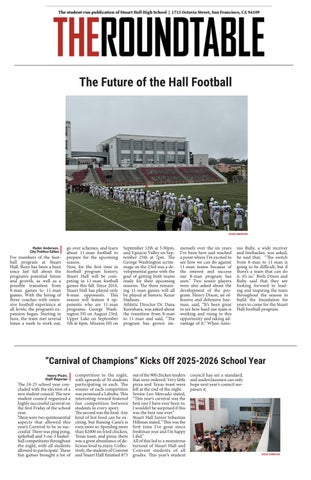

The Future of the Hall Football
Ryder Anderson, City Politics Editor
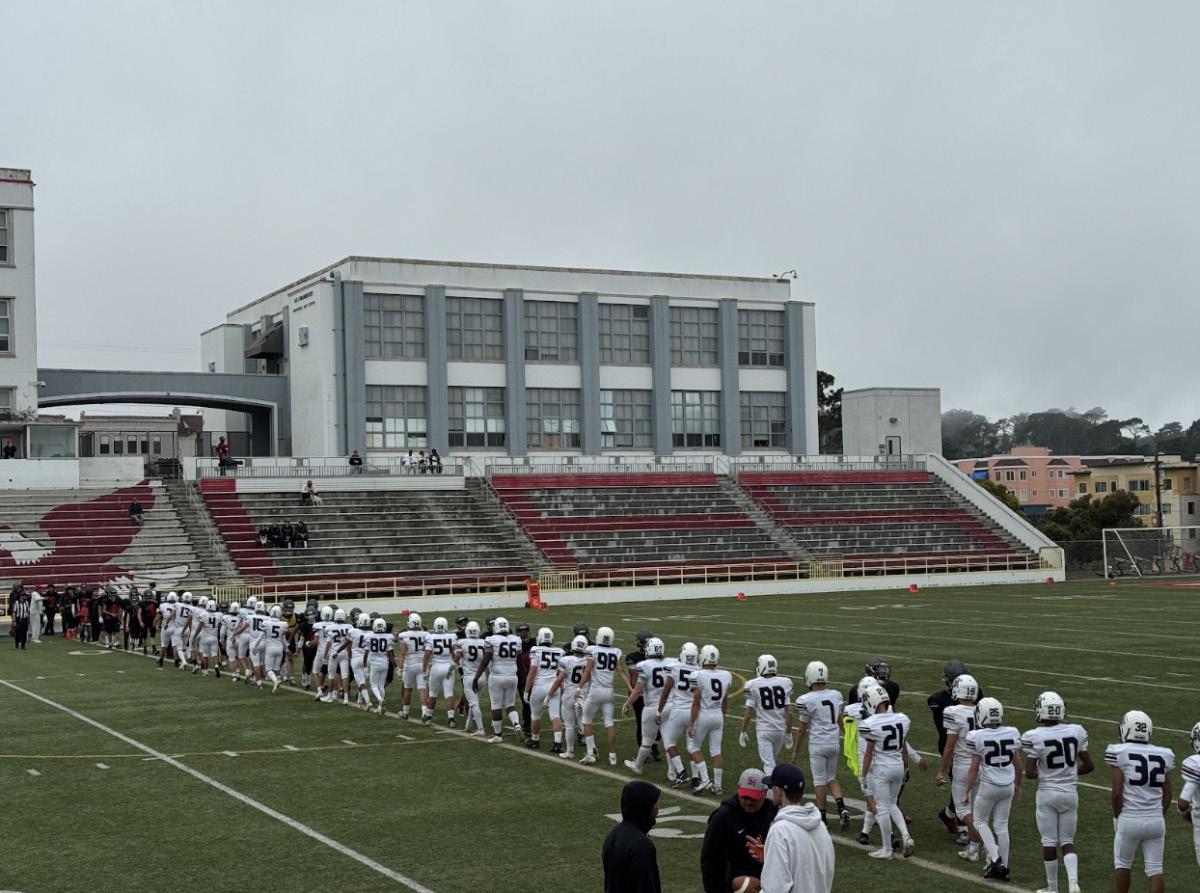
For members of the football program at Stuart Hall, there has been a buzz since last fall about the program’s potential future and growth, as well as a possible transition from 8-man games to 11-man games. With the hiring of three coaches with extensive football experience at all levels, the program’s expansion began. Starting in June, the team met several times a week to work out,
go over schemes, and learn about 11-man football to prepare for the upcoming season. Now, for the first time in football program history, Stuart Hall will be competing in 11-man football games this fall. Since 2010, Stuart Hall has played only 8-man opponents. This season will feature 4 opponents who are 11-man programs: George Washington HS on August 23rd, Upper Lake on September 5th at 6pm, Mission HS on
September 12th at 5:30pm, and Ygnacio Valley on September 25th at 7pm. The George Washington scrimmage on the 23rd was a developmental game with the goal of getting both teams ready for their upcoming seasons. The three remaining 11-man games will all be played at historic Kezar Stadium.
Athletic Director Dr. Dana Kuwahara, was asked about the transition from 8-man to 11-man and said, “The program has grown im-
mensely over the six years I’ve been here and reached a point where I’m excited to see how we can do against 11-man teams because of the interest and success our 8-man program has seen.” Two senior players were also asked about the development of the program. Henry Dixon, an offensive and defensive lineman, said, “It’s been great to see how hard our team is working and rising to this opportunity and taking advantage of it.” When Anto-
nio Ruby, a wide receiver and linebacker, was asked, he said that, “The switch from 8-man to 11-man is going to be difficult, but if there’s a team that can do it, it’s us.” Both Dixon and Ruby said that they are looking forward to leading and inspiring the team throughout the season to build the foundation for years to come for the Stuart Hall football program.
“Carnival of Champions” Kicks Off 2025-2026 School Year
Henry
Pluim,
Staff Reporter
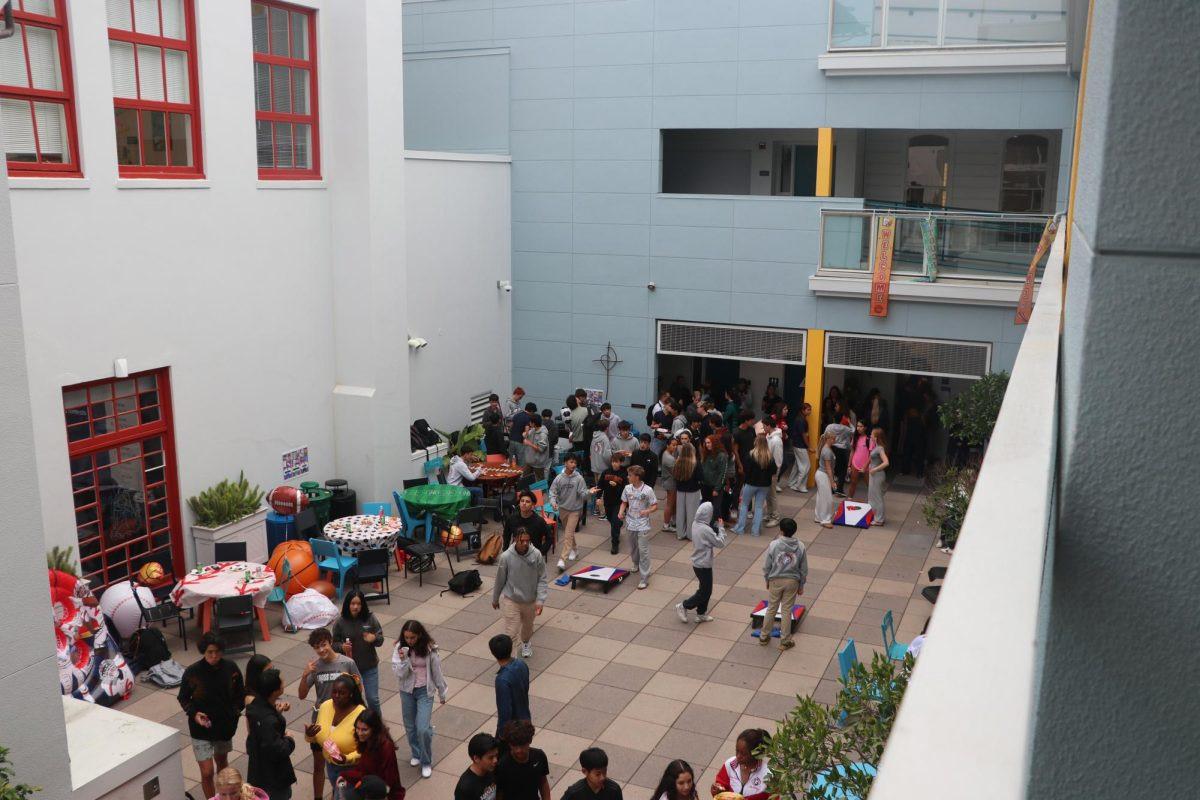
The 24-25 school year concluded with the election of a new student council. The new student council organized a highly successful carnival on the first Friday of the school year. There were two quintessential aspects that allowed this year’s Carnival to be so successful: There was ping pong, spikeball and 3-on-3 basketball competitions throughout the night, with all students allowed to participate. These fun games brought a lot of
competition to the night, with upwards of 30 students participating in each. The winner of each competition was promised a Labubu. This interesting reward fostered fun competition between students in every sport. The second was the food. Any kind of hot food can be exciting, but Raising Cane’s is even more so. Spending more than $2000 on fried chicken, Texas toast, and pizza, there was a great abundance of delicious food to enjoy. Collectively, the students of Convent and Stuart Hall finished 875
out of the 900 chicken tenders that were ordered. Very little pizza and Texas toast were left at the end of the night.
Senior Leo Mercado stated, “This year’s carnival was the best one I have ever been to. I wouldn’t be surprised if this was the best one ever.”
Stuart Hall Junior Sebastian Hillman stated, “This was the first time I’ve gone since freshman year and I’m happy I did.”
All of this led to a monstrous turnout of Stuart Hall and Convent students of all grades. This year’s student
council has set a standard, and underclassmen can only hope next year’s council surpasses it.
RYDER ANDERSON
DIEGO FERRUFINO
Alex Akel, Editor-in-Chief
This summer, from the National Guard in LA, to the uptick in ICE raids across the country, to the federal takeover of D.C., the people of the United States witnessed an increase in controversial actions from the Trump administration.
One ongoing controversy has been the redistricting battle. In July, President Trump called Gov. Greg Abbott of Texas and requested that he redraw the congressional maps mid-decade to give the Republicans a five-seat advantage in Congress.
On Aug. 20, the redistricting bill passed the Texas House of Representatives in an 88-52 Republican win, following the return of the Texas Democrats to the state after a two-week walkout. The Senate similarly followed suit, and Abbott signed the bill into law.
“Doing it [redistricting]
The Redistricting Battle
now calls into question the motives for doing it. It seems more nakedly political. That, to me, is where the danger to the system lies,” said history teacher Jay Konik.
At the same time, California Gov. Gavin Newsom signed a redistricting proposal this August for California in an attempt to nullify any Republican gains in Texas. This is going on the California ballot in November for the people to vote on.
“They fired the first shot in Texas. When all things are equal, [when] we’re all playing by the same set of rules, there’s no question that the Republican Party will be the minority party in the House of Representatives next year,” Newsom said at the signing ceremony.
The map redraws the lines of California’s 1st, 3rd, 22nd, 41st and 48th districts — mostly districts away from coastal Democratic control and currently
controlled by Republicans. The lines will be redrawn to include large Democratic concentrations to give them an advantage, similar to Texas, where the current Democratic districts will be redrawn to become +50 Trump districts.
“If the districting in that state does not reflect the actual makeup of that state, then it is not doing its job,” said history teacher Thomas Apel. Other states are expected to join this standoff. For the GOP, Indiana, Missouri and Ohio are all expected to redraw their maps. According to The New York Times, with all these advantages being given to the Republicans, the 2026 midterms would not be an automatic win for the GOP, but the race would certainly be more competitive. The Democrats would need to have a 2- to 3-point lead in the national popular vote, with current polls suggesting they hold a 4-point lead in the generic
congressional ballot. All over the country right now, with the Epstein controversy still lingering and the passage of the “Big, Beautiful Bill,” many are upset with the Trump administration’s handling of the country. This is shown in the town hall meetings many GOP representatives are having with their constituents.
In Chico on Aug. 11, U.S. Rep. Doug LaMalfa — whose seat is currently in jeopardy for the 2026 midterms based on the new map — had a meeting with his constituents where, for nearly 90 minutes, they constantly interrupted him with comments on the new cuts to Medicaid, which affect many in his district. “I wish the courts would offer a decisive answer and guideline for how it should be done. It is definitely going to benefit Republican states more than the blue states,” Apel said. Ever since this battle over redistricting began, nu-
merous lawsuits have been filed on claims of racial discrimination by organizations like the League of United Latin American Citizens (LULAC), the NAACP and the Mexican American Legal Defense and Educational Fund (MALDEF), all claiming the new map violates the Equal Protection Clause of the U.S. Constitution.
“The state’s intent here is to reduce the members of Congress who represent Black communities, and that, in and of itself, is unconstitutional,” said Derrick Johnson, president and CEO of the NAACP. While this battle is unprecedented, the bottom line is that democracy depends on equal representation. If redistricting becomes a political tool, then the people’s power to rule themselves is at stake.
Grade Wars: SHHS Students Face Off in Dodgeball, Hula Hoop and Tug-ofWar
Matthew Zeitz, Senior Reporter
One Stuart Hall tradition that has remained constant is intergrade competitions. Last Wednesday, all the grades faced off, showing their athleticism and prowess in games of dodgeball, hula hoop and tug-of-war.
The dodgeball victory went to the sophomores,
but it came down to the wire with the defeat of the impressive Aaron ToyLim, who later showed his hula hoop skills in the next competition.
The second event was the hula hoop. The competition came down to a showdown between Toy-Lim and junior Oliver George, with the crowd watching at the edge of their seats to
see who would drop first. “Oh my gosh, at one point when it started dropping they started spinning even faster. I kind of thought they were showing off,” said senior Leo Mercado, referring to the skill of both Toy-Lim and George. Ultimately, George pulled out the victory for the juniors. Nonetheless, both finalists gave an impressive
display of skill to last that long with the hula hoop. Tug-of-war was where the seniors finally shone. In the first round, the seniors faced the juniors and the sophomores faced the freshmen. In the finals, it was the seniors vs. the sophomores. The seniors won in less than 30 seconds. “That senior vs. sophomore was not really
a fight,” Mercado said, hoping maybe next time to see juniors vs. seniors. Tallying all the points, there was no clear winner. Instead, there was a threeway tie: freshmen 0, sophomores 1, juniors 1 and seniors 1 point each. May the next competition be just as exhilarating!
New Student Council Kicks Off Year with Carnival and Revival of Knights Advice
Ross Tulley, Lead Photographer
After a strong run from last year’s student council, there was a lot of pressure on the new cabinet. But they are off to a great start.
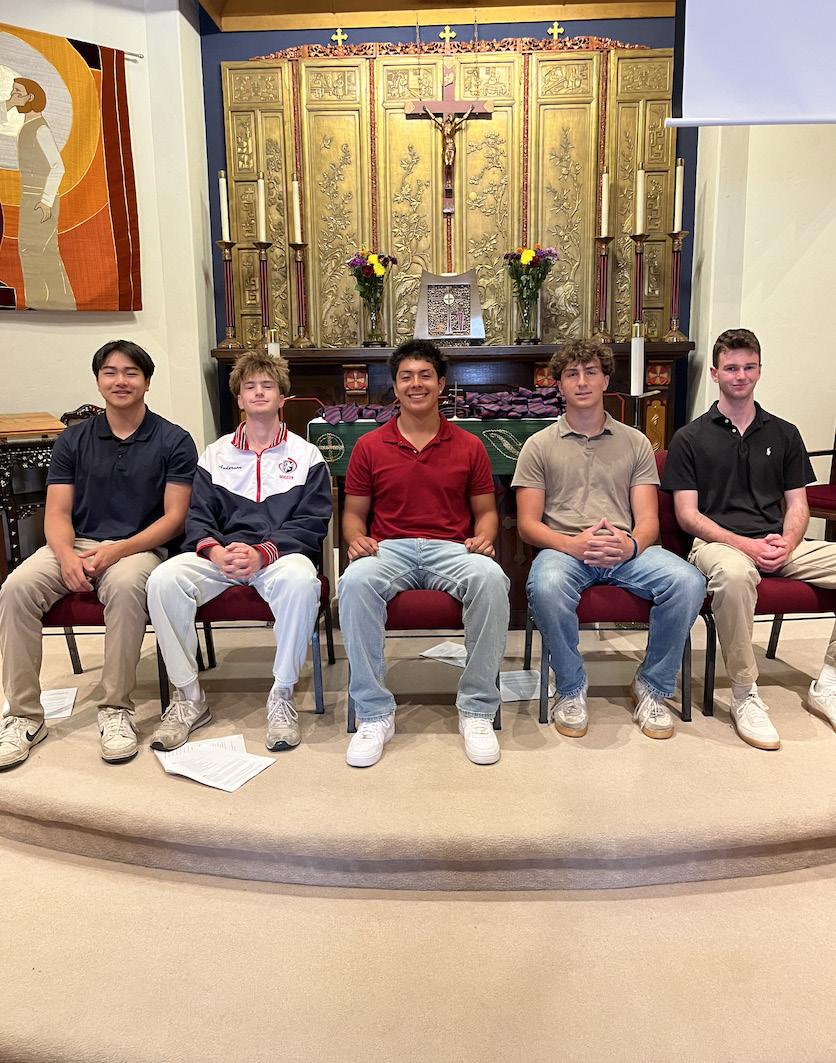
President Christian Rodriguez, with the assistance of Vice President Nico Rivera, Operations Officer Julian Anderson and Financial Officer Andrew Kim, as well as the Convent student council, successfully organized one of the most enjoyable carnivals in the past four years.
After the loss of the previous Knights Advice, there was outrage from the student body. Where were they going to find out all the things a Stuart Hall student needs to know? Most importantly, what’s
for lunch, and where are the memes? Fortunately, this new administration has answered the call.
Under Operations Officer Julian Anderson, the once-loved Knights Advice account has returned. “I’m very excited to bring it back and to revive a staple in the community,” he said. They have made a strong start to the year with the return of occasions such as Hawaiian Wednesday and lunch posts. What’s more, the account has brought back the popular lunch memes that the student body missed last year.
The carnival featured sports events such as 3-on3 basketball, cornhole and ping pong, as well as food from Raising Cane’s. The prize? A coveted Labubu
for the winner of each tournament. The turnout for the carnival was unlike any before, leading to great enjoyment not just from the senior class but from all others as well. Many seniors said it was the best of their four years. The year is off to a good start, but with roughly nine months left, there are many more opportunities for student events for all to enjoy. Future events such as homecoming, prom, Congé and Spirit Week are sure to be some of the best the school has seen, and school spirit will be at an all-time high. Future student councils are going to have a tough time living up to the exemplary year the Class of 2026 executive council is having.
Henry Hudson, City Life Editor
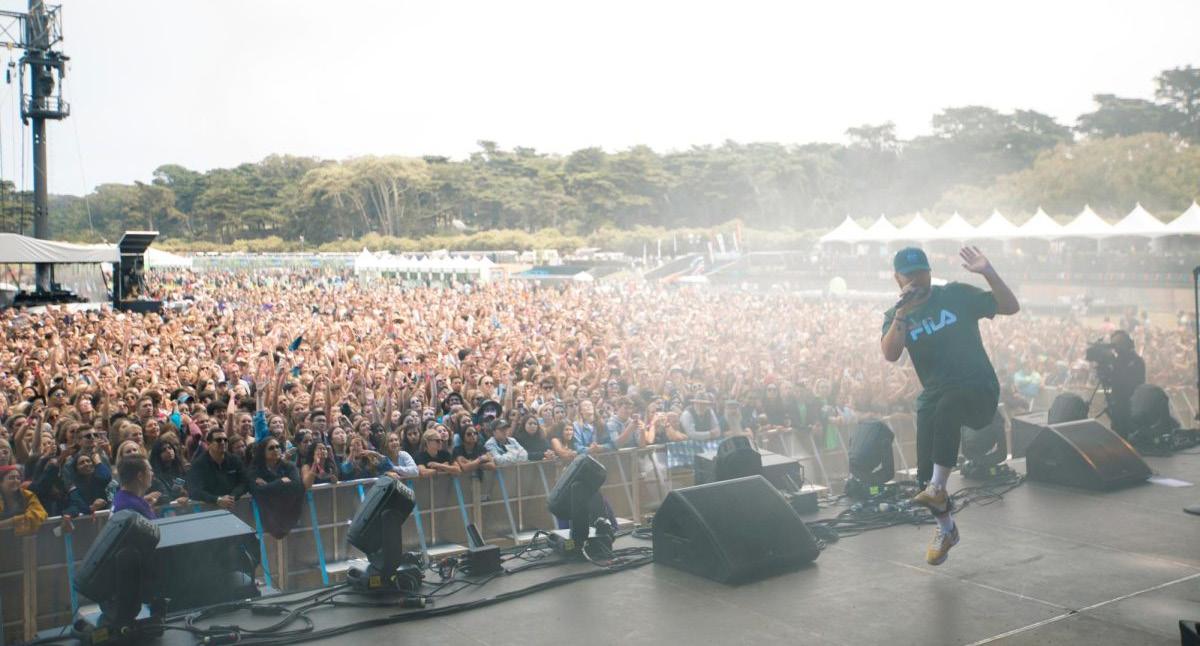
It turns out that August was a pretty big month for big draws in San Francisco: music, food, fun, and tourists. What started with Dead & Company, followed by Outside Lands, and then Zach Bryan, August offered an economic lift of $150 million to the City. Via an Instagram video, Mayor Daniel Lurie celebrated the strong month by saying the concerts have been “an incredible boon for our city.” In three con-
San Francisco’s Summer Soundtrack
secutive weekends, Dead & Company, a group that includes original members of iconic sixties band The Grateful Dead, drew 180,000 attendees to the City, Outside Lands drew 225,000, and Zach Bryan drew 55,000. Hotels were full, restaurants were full, and people’s ears were filled with headliners and hidden gems.
Starting the month from August 1-3, Dead & Company performed in Golden Gate Park to soldout crowds. The music cel-
ebration marked the 60th anniversary of the Grateful Dead at Golden Gate Park, turning the City into a party for tie-dyed Deadheads. Then, one weekend later, Outside Lands, considered one of the prime music festivals in San Francisco, delivered a mix of musical performers from August 8-10. From Ludacris belting out Justin Bieber’s “Baby” to Tyler, The Creator performing fresh tracks from Don’t Tap the Glass, big names hit the main stages, but smaller, maybe quieter
acts, were not to be missed either. Irish singer-songwriter Hozier’s encore “Cherry Wine” closed out the weekend, bringing the festival back to its rock roots. In between there was something for everyone from emerging artists to established performers, rap, pop, DJs, indie rock and electronic music.
Closing out the three weekends of performances, Zach Bryan took to the Polo Fields, joined by the Kings of Leon, Turnpike Troubadours, and Noeline
Hoffman, for a one-day show hosted by Another Planet Entertainment, the concert promoter behind Outside Lands. With fog sliding in, Bryan ended a spectacular month for music lovers, highlighting the best of San Francisco with live music in an iconic park. Music for the heart and soul. Only in San Francisco.
SEAL Team 6’s Leaked DPRK Mission
On a dark, cold winter night in 2019, a team of eight Navy SEALs from the elite SEAL Team 6, Red Squadron, the same unit that killed Osama Bin Laden in 2011 in Pakistan, crept out of the water in North Korea’s territorial waters onto DPRK soil. The objective of this highly secretive mission was to plant a high-tech electronic listening device to allow our intelligence agencies to intercept and listen to communications between North Korea’s leader, Kim Jong Un, and other world leaders such as China’s Xi Jinping or Russia’s Vladimir Putin. This operation was personally ordered and greenlit by President Donald J. Trump. The SEALs, fully aware of the high stakes and the potential impact of their mis-
sion, rehearsed for months to ensure that every detail would go according to plan. The mission was scheduled to take place three weeks before the historic summit between U.S. President Donald J. Trump and North Korea’s Supreme Leader Kim Jong Un to discuss North Korea’s nuclear weapons program. This device, if planted according to plan on North Korean soil, would allow the U.S. to receive valuable intelligence on North Korea but also enable the U.S. to have more valuable leverage points during talks between the two leaders behind closed doors. However, the New York Times journalists uncovered the newly leaked information about the secretive operation. Although the White House declined to comment or confirm the mis-
sion’s occurrence, the New York Times reported — through interviews with former first-term Trump administration officials, members of U.S intelligence agencies and the U.S. military — that several of those people were talking about the mission details because they were worried that the failures of Special Operations are often obscured by the government’s secrecy. If the public and policymakers become aware only of high-profile successes, such as the raid that killed bin Laden in Pakistan, they may underestimate the extreme risks that American forces undertake,” the Times reported. The newly revealed details about the operation show that it didn’t go exactly as planned. Once the SEALs disembarked from their underwater deliv-
ery vehicles and swam to shore, they encountered what they suspected to be possible North Korean border guards, which led to the SEAL team opening fire upon the vessel, killing all possible hostiles on board. Once the SEAL team had neutralized the suspected DPRK soldiers, members of the SEAL team swam over to the boat, where they discovered that what they thought to be DPRK soldiers were actually local North Korean fishermen. This prompted the SEALs to stab all deceased North Korean fishermen in the lungs to ensure they would sink to the bottom of the bay. Once they killed all members aboard the fishing trawler, the SEALs promptly exited North Korean soil and waters to ensure their already compromised mission would
not further affect U.S. geopolitical policies in the region and the upcoming summit between the two nations. The operation prompted an investigation by the U.S. Department of Defense (DOD) and U.S. Special Operations Command (SOCOM) into whether the killing by the SEALs met the Rules of Engagement (ROE) of the operation. The investigation concluded that the Special operators acted within the boundaries of their ROE to protect operational secrecy and safety while also ensuring the safety of American service members. Although this operation didn’t lead to further escalation in regional tensions, it still reveals a stark reality of U.S. foreign policy and the measures the government will take to gather information on its adversaries.
JCMF2018 VIA WIKIMEDIA COMMONS
Quinn Harrell, Politics Editor
US Federal Government Acquires 10% stake in Intel: Strategic Investment or Step Towards Socialist Market Economy?
In a historic intervention, the U.S. government under President Donald Trump has taken a 9.9% equity stake in Intel, a technology company that builds and sells computer components such as central processing units and related products. This move marks a significant departure from American free-market principles, and some even argue that it is a destabilizing shift toward state-managed capitalism akin to that of China. The investment totals $8.9 billion: $5.7 billion from previously allocated but unpaid CHIPS Act Grants and $3.2 billion from the Secure Enclave program. Additionally, the government received a five-year option to purchase an extra 5% of Intel shares at $20 per share, which can only be exercised if Intel’s foundry business falls below 51% ownership.
Intel CFO David Zinsner announced that the funds were delivered on Wednesday, cementing the deal. The U.S. is now one of the largest shareholders, although the government holds no direct board representation. Rather, it agreed to vote alongside Intel’s board except in narrowly defined scenarios.
Intel’s share price has shown mixed reactions. It climbed 5 to 6% during regular trading, but dipped 0.8% by Thursday’s close to around $24.64. This financial move is meant to prop up Intel’s foundry arm amid escalating competition and financial difficulties.
Strategically for President Trump, this decision is meant to boost U.S. technological sovereignty. With Intel lagging behind the global leaders of
the semiconductor industry such as Taiwan’s TSMC, the administration has framed the move as a taxpayer-neutral transaction that boosts domestic chip manufacturing, especially amid tensions surrounding China and Taiwan. The administration ultimately seeks to ensure that Intel maintains its competitiveness in the global market. This announcement has incited a wide range of opinions and discourse.
In an interview with Politico, Gov. Gavin Newsom (D-Calif.) asserted that “It sickens me to the core you just socialize and nationalize Intel.”
Newsome went on to add that the “nationalization of private industries is something they’re pretty good at in China.”
Criticism has not only come from the left. Many GOP members have voiced concern over the deal. “If socialism is the government owning the means of production, wouldn’t the government owning part of Intel be a step toward socialism?” Sen. Rand Paul (R-Ky.) expressed on X. “Terrible Idea.”
IB Global Politics teacher Dr. Jorgensen states, “I think the federal government partnering with private companies such as Intel is a deviation from the norm in America. This is something we see in other countries but not something that has been normalized here. It is not necessarily bad in the way that it has been likened to China. Countries like France do it, but it is unusual for it to happen here.”
I believe that the federal government should not take large stakes in private companies, as it has done with Intel. This idea of direct government investment in individual businesses
undermines America’s enduring commitment to laissez-faire principles, where market forces—not state intervention—decide success or failure.
Such arrangements spur “too big to fail” scenarios: when a company starts to fail, the government, which is now a shareholder, will be incentivized to pour endless taxpayer money into the struggling firm to protect its investment. This leads to a federally subsidized, publicly traded company that is solely reliant on political backing. The company’s reliance on government subsidies erodes any sense of accountability, insulating the company from bad decisions. Additionally, once the government becomes a shareholder, politics will inevitably trump proper business judgment. Government actors will be able to continue subsidizing losses in the name of policy priorities rather than profitability.
Unlike government contracts or tax incentives, which support companies without giving the federal government any ownership or control, taking equity makes the government a partial owner. With contracts, companies remain accountable to the market, and business failure is borne by private investors. Equity stakes, on the other hand, create potential for politicization in company decisions. It will also reduce the discipline that market competition generally enforces.
Furthermore, private investors (i.e. when Donald Trump still operated in the private sector) assume the risk of their own ventures. If a company fails, they are the ones to pay. However, if the federal government

invests in a company like Intel, it is the American taxpayers who will end up paying the price of failure.
President Trump has floated the idea of emulating this move with other prominent American companies, thus creating a sovereign wealth fund similar to that of Middle Eastern potentates or resource-dense countries like Norway. This is a bad idea. America is not built on state-owned resources; its strength comes from private enterprise and open competition. A sovereign wealth fund would stymie innovation by protecting companies from risk while placing the financial burden of failure on taxpayers.
This decision ultimately underscores a broader problematic trend of the centralization of power within the executive branch. In this and many other cases, Trump unilaterally made economic moves without congressional approval. Such actions undermine the core tenets of the constitutional republic and defy the original vision of the Founding Fathers. I worry that this move, in particular, may mark a step away from free market capitalism and a step towards cronyism.
Christopher Chow, Finance Editor
REUTERS/VIA SNO SITES/DADO RUVIC