OSU Medicine
Hospital Resuscitation Nearly $25 million in renovations to the OSU Medical Center have been completed since 2009 with more coming soon.
30
Winter 20 12
PHOTO / Ryan Jensen
When flooding damaged OSU Medical Center in August 2011, the emergency room was added to a growing list of hospital facilities in dire need of renovation. “OSU Medical Center is considered a safety-net hospital in Tulsa and northeastern Oklahoma,” says Howard Barnett, president of OSU-Tulsa and the OSU Center for Health Sciences. “It provides services for many people who cannot afford health insurance, and a trip to the emergency room is often the only medical care they receive.” Upgrading the Tulsa hospital is a top priority for the OSU Medical Center Trust, a public trust created by the city of Tulsa, since it gained ownership of the facility in 2009. Since then, the medical center has completed nearly $25 million in renovations with more improvements coming. “The hospital had been through some transitions and saving it, not upgrading it, was the priority when the city acquired the downtown facility,” says Barnett, who was among those who worked to keep the medical center open. “With the future of the medical center secured, the trust began to upgrade these facilities, including significant remodeling and modernization, extensive new state-of-the-art equipment and the addition of a number of new physicians in a variety of specialties.” The emergency department received $1.3 million in renovations, including updates to patient rooms, doctor and nurse stations, security and the lobby and waiting areas, which were completed in early 2012. The upgrades also allowed for a fasttrack system to separate patients needing emergency and nonemergency care. “The OSU Medical Center is the teaching hospital for our medical students,” says Dr. Kayse Shrum, OSU-CHS provost and dean of the College of Osteopathic Medicine. “Having a facility with the best resources we can offer is essential to providing an educational experience that will produce the top-quality doctors we want here in Oklahoma.” Renovations to the 600,000-square-foot facility include new vital equipment and upgrades to infrastructure. “OSU Medical Center remains focused on the future and is concentrating on areas of the hospital to improve patient care and organizational efficiencies,” says Diane Rafferty, OSUMC interim chief executive officer. “We also want to provide the best learning facility for OSU medical students and residents.” In addition to emergency department upgrades, OSUMC has invested in resources for interventional radiology and the cardiology departments. The Tulsa Wound and Hyperbaric Center also was expanded from five to nine rooms. The center received new flooring, walls and a waiting-room expansion. “Residents and medical students spend long hours at the hospital,” Rafferty says. “Providing them with a facility where
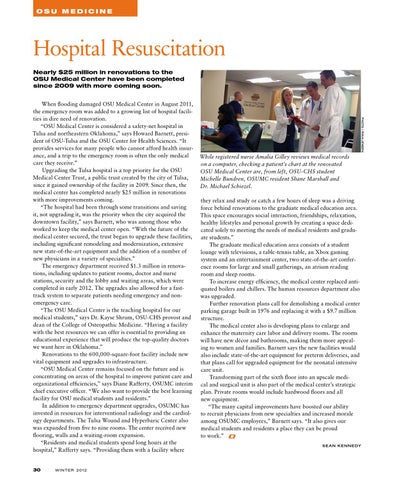
While registered nurse Amalia Gilley reviews medical records on a computer, checking a patient’s chart at the renovated OSU Medical Center are, from left, OSU-CHS student Michelle Bundren, OSUMC resident Shane Marshall and Dr. Michael Schiezel. they relax and study or catch a few hours of sleep was a driving force behind renovations to the graduate medical education area. This space encourages social interaction, friendships, relaxation, healthy lifestyles and personal growth by creating a space dedicated solely to meeting the needs of medical residents and graduate students.” The graduate medical education area consists of a student lounge with televisions, a table-tennis table, an Xbox gaming system and an entertainment center, two state-of-the-art conference rooms for large and small gatherings, an atrium reading room and sleep rooms. To increase energy efficiency, the medical center replaced antiquated boilers and chillers. The human resources department also was upgraded. Further renovation plans call for demolishing a medical center parking garage built in 1976 and replacing it with a $9.7 million structure. The medical center also is developing plans to enlarge and enhance the maternity care labor and delivery rooms. The rooms will have new décor and bathrooms, making them more appealing to women and families. Barnett says the new facilities would also include state-of-the-art equipment for preterm deliveries, and that plans call for upgraded equipment for the neonatal intensive care unit. Transforming part of the sixth floor into an upscale medical and surgical unit is also part of the medical center’s strategic plan. Private rooms would include hardwood floors and all new equipment. “The many capital improvements have boosted our ability to recruit physicians from new specialties and increased morale among OSUMC employees,” Barnett says. “It also gives our medical students and residents a place they can be proud to work.” S ean K ennedy