Adapting the Story Work:
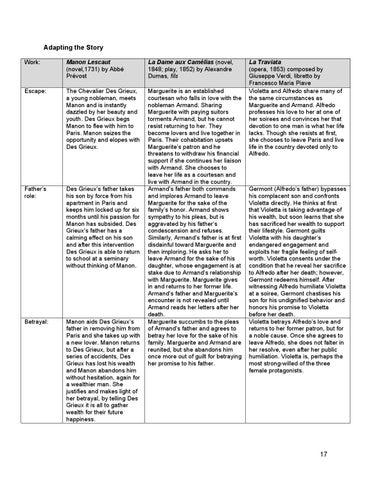
Manon Lescaut (novel,1731) by Abbé Prévost
La Dame aux Camélias (novel, 1848; play, 1852) by Alexandre Dumas, fils
Escape:
The Chevalier Des Grieux, a young nobleman, meets Manon and is instantly dazzled by her beauty and youth. Des Grieux begs Manon to flee with him to Paris. Manon seizes the opportunity and elopes with Des Grieux.
Father’s role:
Des Grieux’s father takes his son by force from his apartment in Paris and keeps him locked up for six months until his passion for Manon has subsided. Des Grieux’s father has a calming effect on his son and after this intervention Des Grieux is able to return to school at a seminary without thinking of Manon.
Betrayal:
Manon aids Des Grieux’s father in removing him from Paris and she takes up with a new lover. Manon returns to Des Grieux, but after a series of accidents, Des Grieux has lost his wealth and Manon abandons him without hesitation, again for a wealthier man. She justifies and makes light of her betrayal, by telling Des Grieux it is all to gather wealth for their future happiness.
Marguerite is an established courtesan who falls in love with the nobleman Armand. Sharing Marguerite with paying suitors torments Armand, but he cannot resist returning to her. They become lovers and live together in Paris. Their cohabitation upsets Marguerite’s patron and he threatens to withdraw his financial support if she continues her liaison with Armand. She chooses to leave her life as a courtesan and live with Armand in the country. Armand’s father both commands and implores Armand to leave Marguerite for the sake of the family’s honor. Armand shows sympathy to his pleas, but is aggravated by his father’s condescension and refuses. Similarly, Armand’s father is at first disdainful toward Marguerite and then imploring. He asks her to leave Armand for the sake of his daughter, whose engagement is at stake due to Armand’s relationship with Marguerite. Marguerite gives in and returns to her former life. Armand’s father and Marguerite’s encounter is not revealed until Armand reads her letters after her death. Marguerite succumbs to the pleas of Armand’s father and agrees to betray her love for the sake of his family. Marguerite and Armand are reunited, but she abandons him once more out of guilt for betraying her promise to his father.
La Traviata (opera, 1853) composed by Giuseppe Verdi, libretto by Francesco Maria Piave Violetta and Alfredo share many of the same circumstances as Marguerite and Armand. Alfredo professes his love to her at one of her soirees and convinces her that devotion to one man is what her life lacks. Though she resists at first, she chooses to leave Paris and live life in the country devoted only to Alfredo.
Germont (Alfredo’s father) bypasses his complacent son and confronts Violetta directly. He thinks at first that Violetta is taking advantage of his wealth, but soon learns that she has sacrificed her wealth to support their lifestyle. Germont guilts Violetta with his daughter’s endangered engagement and exploits her fragile feeling of selfworth. Violetta consents under the condition that he reveal her sacrifice to Alfredo after her death; however, Germont redeems himself. After witnessing Alfredo humiliate Violetta at a soiree, Germont chastises his son for his undignified behavior and honors his promise to Violetta before her death. Violetta betrays Alfredo’s love and returns to her former patron, but for a noble cause. Once she agrees to leave Alfredo, she does not falter in her resolve, even after her public humiliation. Violetta is, perhaps the most strong-willed of the three female protagonists.
17