The Evolution of Female Roles in Opera
During the 17th and 18th centuries, many female singers were kept by noblemen, royalty, and men of wealth as courtesans. Their vocal abilities were secondary to their good looks and youthfulness. Many young women who could not afford a dowry chose to be bought as courtesan-singers over life in a convent, one of the few options for an unmarried woman of the time. With the financial support of their patron, female singers did not need exceptional talent to succeed and careers in singing became thin, socially acknowledged façades for “up-scale” prostitution.
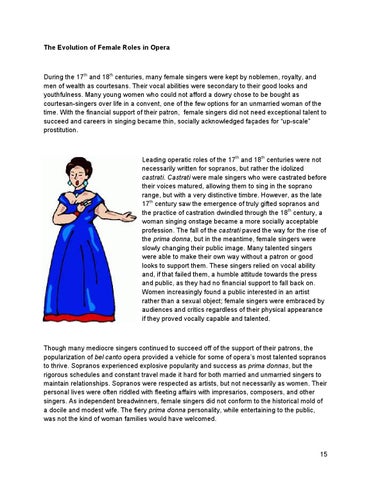
Leading operatic roles of the 17th and 18th centuries were not necessarily written for sopranos, but rather the idolized castrati. Castrati were male singers who were castrated before their voices matured, allowing them to sing in the soprano range, but with a very distinctive timbre. However, as the late 17th century saw the emergence of truly gifted sopranos and the practice of castration dwindled through the 18th century, a woman singing onstage became a more socially acceptable profession. The fall of the castrati paved the way for the rise of the prima donna, but in the meantime, female singers were slowly changing their public image. Many talented singers were able to make their own way without a patron or good looks to support them. These singers relied on vocal ability and, if that failed them, a humble attitude towards the press and public, as they had no financial support to fall back on. Women increasingly found a public interested in an artist rather than a sexual object; female singers were embraced by audiences and critics regardless of their physical appearance if they proved vocally capable and talented.
Though many mediocre singers continued to succeed off of the support of their patrons, the popularization of bel canto opera provided a vehicle for some of opera’s most talented sopranos to thrive. Sopranos experienced explosive popularity and success as prima donnas, but the rigorous schedules and constant travel made it hard for both married and unmarried singers to maintain relationships. Sopranos were respected as artists, but not necessarily as women. Their personal lives were often riddled with fleeting affairs with impresarios, composers, and other singers. As independent breadwinners, female singers did not conform to the historical mold of a docile and modest wife. The fiery prima donna personality, while entertaining to the public, was not the kind of woman families would have welcomed.
15