TECHNOLOGY
Accessible audio for everyone
op ha pr m se AV
H m
PP sp wi si br co m se fe an di de
Per Persson
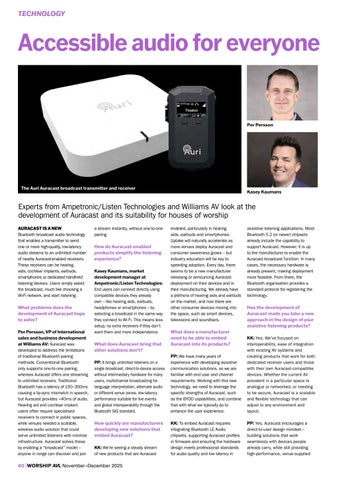
The Auri Auracast broadcast transmitter and receiver
K of lis de fe be pr lis
Kasey Kaumans
Experts from Ampetronic/Listen Technologies and Williams AV look at the development of Auracast and its suitability for houses of worship AURACAST IS A NEW Bluetooth broadcast audio technology that enables a transmitter to send one or more high-quality, low-latency audio streams to an unlimited number of nearby Auracast-enabled receivers. These receivers can be hearing aids, cochlear implants, earbuds, smartphones or dedicated handheld listening devices. Users simply select the broadcast, much like choosing a Wi-Fi network, and start listening.
What problems does the development of Auracast hope to solve? Per Persson, VP of International sales and business development at Williams AV: Auracast was developed to address the limitations of traditional Bluetooth pairing methods. Conventional Bluetooth only supports one-to-one pairing, whereas Auracast offers one streaming to unlimited receivers. Traditional Bluetooth has a latency of 150–300ms causing a lip-sync mismatch in speech, but Auracast provides <40ms of audio. Hearing aid and cochlear implant users often require specialised receivers to connect in public spaces, while venues needed a scalable, wireless audio solution that could serve unlimited listeners with minimal infrastructure. Auracast solves these by enabling a “broadcast” model – anyone in range can discover and join
a stream instantly, without one-to-one pairing.
How do Auracast-enabled products simplify the listening experience? Kasey Kaumans, market development manager at Ampetronic/Listen Technologies: End users can connect directly using compatible devices they already own – like hearing aids, earbuds, headphones or smartphones – by selecting a broadcast in the same way they connect to Wi-Fi. This means less setup, no extra receivers if they don’t want them and more independence.
What does Auracast bring that other solutions don’t? PP: It brings unlimited listeners on a single broadcast, direct-to-device access without intermediary hardware for many users, multichannel broadcasting for language interpretation, alternate audio or different venue zones, low-latency performance suitable for live events and global interoperability through the Bluetooth SIG standard.
How quickly are manufacturers developing new solutions that embed Auracast? KK: We’re seeing a steady stream of new products that are Auracast-
enabled, particularly in hearing aids, earbuds and smartphones. Uptake will naturally accelerate as more venues deploy Auracast and consumer awareness grows – but industry education will be key to speeding adoption. Every day, there seems to be a new manufacturer releasing or announcing Auracast deployment on their devices and in their manufacturing. We already have a plethora of hearing aids and earbuds on the market, and now there are other consumer devices moving into the space, such as smart devices, televisions and soundbars.
What does a manufacturer need to be able to embed Auracast into its products?
assistive listening applications. Most Bluetooth 5.2 (or newer) chipsets already include the capability to support Auracast. However, it is up to the manufacturer to enable the Auracast broadcast function. In many cases, the necessary hardware is already present, making deployment more feasible. From there, the Bluetooth organisation provides a standard protocol for registering the technology.
Has the development of Auracast made you take a new approach in the design of your assistive listening products?
PP: We have many years of experience with developing assistive communication solutions, so we are familiar with end user and channel requirements. Working with this new technology, we need to leverage the specific strengths of Auracast, such as the BYOD capabilities, and combine that with what we typically do to enhance the user experience.
KK: Yes. We’ve focused on interoperability, ease of integration with existing AV systems and creating products that work for both dedicated receiver users and those with their own Auracast-compatible devices. Whether the current AV prevalent in a particular space is analogue or networked, or needing to be secure, Auracast is a scalable and flexible technology that can adjust to any environment and layout.
KK: To embed Auracast requires integrating Bluetooth LE Audio chipsets, supporting Auracast profiles in firmware and ensuring the hardware design meets professional standards for audio quality and low latency in
PP: Yes. Auracast encourages a direct-to-user design mindset – building solutions that work seamlessly with devices people already carry, while still providing high-performance, venue-supplied
40 WORSHIP AVL November–December 2025
WAVL Pg40-41 Tech AUDIO.indd 40
25/09/2025 10:19
Th
ca no a de th ch th en al do lis en is an
H yo pr w
PP fit W fo se th in co