AV LIGHTING SOUND REINFORCEMENT RECORDING STAGE SOUND BROADCAST November–December 2025 November–December 2025
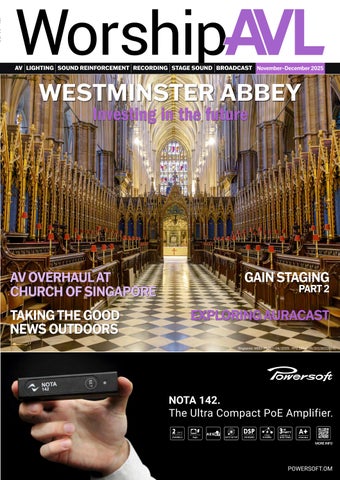
WESTMINSTER ABBEY Investing in the future
MDDI (P) 067/04/2025 PPS 1644/05/2013(022954)
AV OVERHAUL AT CHURCH OF SINGAPORE TAKING THE GOOD NEWS OUTDOORS
GAIN STAGING PART 2
EXPLORING AURACAST Singapore: MDDI (P) 067/04/2025 PPS 1644/05/2013(022954)
www.worshipavl.com
NOTA 142. The Ultra Compact PoE Amplifier. MORE INFO
POWERSOFT.OM
WAVL Front Cover.indd 1
25/09/2025 09:28
Untitled-1 12
25/09/2025 11:17
Contents Issue 95
November–December 2025
Editor’s Letter Before the advent of electricity, churches relied on natural light and candles. Sunlight filtered through stained glass, casting colourful patterns that conveyed biblical stories and spiritual symbolism. Nowadays, lighting fixtures can be used to accentuate architectural forms, highlighting arches, vaults and altars, drawing the eye towards focal points of worship. Marco Miglioli has spent his career focusing on the relationship between light and architecture. His work consists of illuminating an architecture by trying to interpret it, to tell a story and suggest emotions, and therefore choose what to put in light and what to put in shadow. In his Showlight 2025 presentation titled
COMMENT
4 Casey Hawkins 6 Kevin Yague 8 Samantha Potter
12
SPECIAL REPORT
“Things Change Depending on How They Are Illuminated”, he discusses how a lighting upgrade at Milan Cathedral has brought light to the side aisles, made the vault visible and highlighted the vertical thrusts of the Gothic architecture (p.44). In more modern buildings, lighting still plays a central role – it helps guide focus, stir the imagination and create a sense of sacredness. On page 38, John Black considers how creative lighting can be one of the most impactful tools in a worship setting, particularly at Christmas. Thoughtfully designed lighting can immerse a congregation in wonder, focus attention and reinforce the message of hope, peace and joy. I hope you enjoy the issue.
10 E ncouraging Christmas visitors to return
PROJECTS
20
12 Good Shepherd Church 16 Westminster Abbey 20 Suncoast Church 22 Good News Church 24 Church of Singapore 28 Vietnam case studies
24
KNOWHOW
34 Gain staging part 2 36 The moiré effect
28
38 Celebrating Christmas through light
TECHNOLOGY
40 Exploring Auracast 42 Maximising efficiency in videowalls
36
44 Blending light with architecture Email: kwallace@worshipavl.com Follow us on social media @WorshipAVLMagazine
NEW PRODUCTS
46 The industry’s latest product news
TECH VIEW
44
58 Johannes Rogge
Contact us Richard Lawn
Sue Gould
Carolyn Valliere
Simon Luckhurst
Caroline Moss
Bea Meikle
rlawn@worshipavl.com
sgould@worshipavl.com
cvalliere@worshipavl.com
sluckhurst@worshipavl.com
cmoss@worshipavl.com
bmeikle@worshipavl.com
Nick Smith
Chris Yardley
Jack Stennulat
Adrian Baker
Jo Pugh-Jones
Marne Mittelmann
nsmith@worshipavl.com
cyardley@worshipavl.com
jstennulat@worshipavl.com
abaker@worshipavl.com
jpj@worshipavl.com
circulation@worshipavl.com
General manager
Digital media manager
Advertising director
Video editor
Sales associate
Digital content creator
Senior reporter
Production editor
Contributing editor
Production manager
News editor
Circulation manager
PUBLISHED BY:
LICENCES: Singapore: MDDI (P) 067/04/2025 PPS 1644/05/2013(022954) CIRCULATION: circulation@worshipavl.com
Spa House, 18 Upper Grosvenor Road, Tunbridge Wells, Kent TN1 2EP, United Kingdom
All rights reserved. No part of this magazine may be reproduced or transmitted in any form or by any means, electronic or mechanical, including photocopying, recording or by any information storage and retrieval system, without prior permission in writing from the copyright owners.
Tel: +44 (0) 1892 676280
COVER: Westminster Abbey PRINTER: Times Printers Singapore
Web: www.worshipavl.com
November–December 2025 WORSHIP AVL 3
WAVL Pg3 Contents.indd 3
25/09/2025 14:37
COMMENT
“That is why we do this”
T to sa vie wh pr no jo S wh sp pe br an joi th wi S pe pe ho Pe ou lis an we to lo cr an it’ an M wh fir
Casey Hawkins considers the importance of making the best quality online content you can – and doing it consistently I REMEMBER HEARING OUR minister of communications say one day back in the mid-1990s that we should produce a 30-minute version of our normal hour-long TV programme, which would include only the sermon and perhaps a quick song, to air late night when he figured bar hoppers and other people who need saving would be stumbling home because that was when those people were going to stumble across our content and that was when they were going to get saved. I guess I believed him back then. After all, I was only in my teens. So, he handed me this project: to edit our normal hour-long programme down to 30 minutes for this new time slot. I’m not sure what kind of response that shorter programme received on that late nighttime slot, and I’ll never know. What I do know today, at 46 years old, is that most likely nobody stumbling home from the bar when our programme was airing late night was tuning in and watching us. That’s just an educated guess at this point.
GABC has 8,400 weekly online viewers – but who exactly is watching?
So that makes me wonder, who does watch our programme and when? We have been on local TV here in East Texas since 1982 on the same channel and almost the same time slot on Sunday mornings. We started at 9am and now we are at 10am. Something at the station made us change by that hour several years ago. But today, we average 8,400 viewers per Sunday morning per the TV ratings system. That is a nice
number because it is more than our in-person attendance, across all campuses, plus all of our live online viewership, combined. Our TV broadcast audience is our largest real-time campus. And it is our largest single campus by far. So, I have to make the assumption that with that time slot, and with that known number of viewers and with a legacy of being on TV since 1982, that there have been many decisions of faith just by people
watching our TV programme. But, how would you know? You don’t. Until they tell you. Yesterday, our discipleship pastor Jason Humphrey sent an email to me and the senior leadership telling us the story of two men, a father and son, who had been watching our TV programme for a while and how they recently made a decision to join our church. Here is the paraphrase of that email story. A 69-year-old man has been faithfully worshipping with his 89-year-old father every Sunday morning as they watch our services on TV. Both men are widowers, and this time of worship together has become a meaningful part of their week. One of them filled out our online contact form this past Sunday. Jason followed up with them and invited them to our regular Starting Point event, which is where we serve a meal to prospective members and we share our church history and beliefs and just try to make them feel welcome.
4 WORSHIP AVL November–December 2025
WAVL Pg4-5 Casey Hawkins.indd 4
25/09/2025 09:22
COMMENT This was so exciting for me to hear! Even though it is not a salvation story, it is a story of viewers in a unique situation in life who have found comfort in our TV programme so much that they are now planning to visit and possibly join our church. So maybe you might be wondering why this is so special. It is so special because it is so rare to have people tell us how they used our TV broadcast and how meaningful it was and is to them. Regardless of if they join the church or not, I’m confident that they will continue worshipping with us on TV each week. So, who is watching? 8,400 people. That is enough to include people in prison. People who hope for a chance for redemption. Perhaps there is an abused person out there that gets to watch or listen to our broadcast each week and that is their lifeline… their weekly hope that they can escape to a better life. Maybe it’s just a lonely person who won’t join a large crowd but likes our worship style and our pastor’s preaching. Maybe it’s someone who lost everything and they need a message of hope. Maybe it’s just the same old person who has been watching since our first telecast in 1982 and they
have never moved and we are their church. The fact is, we never know what our efforts reap these days in the digital world where the walls of our churches are gone. People can watch any church anywhere. What can you do to be different? Earlier this year, we started shooting an intro and an outro for our TV programme. We use the same person each week. His name is Hixon Frank. He has a great personality and, so far, I hear he’s started being recognised around town. That has to mean something. But this gives our audience someone to relate to. I recommend doing that. This person gives a “call to action” in every broadcast by asking the viewer to fill out our contact form either on our website or via our texting services. He invites the viewers to join us in-person and he does that in his own way. I know these guys didn’t start watching our TV programme because we have this piece of equipment or that kind of carpet… they started watching because they had the need and we had a solution. But they contacted us because we simply asked them to. We invited them to join us. If you
We shoot an intro and outro for our TV programme with Hixon Frank every week
don’t ask your viewers to engage with you, then so far, I have learned they probably won’t. 8,400 people watch each Sunday morning. What could you do with that? It is a hefty responsibility. Each week you provide those people with something special that they seek each week and you rarely ever know what that is exactly, until they tell you. Make the best quality product you can and do it consistently and make the effort to connect to your viewer. You won’t hear from them all. In fact, you
won’t hear from most. But when you do, make the effort to engage with them. Regarding the father and son who contacted us this week and who have been invited to our Starting Point event, I have asked our pastor Jason to let me know when they attend so that I can make sure that the broadcast ministry can be there to welcome them, because I believe it is important to get to meet those who come to our church by way of television or livestream… because “that is why we do this”.
or
e
s
o re
e.
November–December 2025 WORSHIP AVL 5
WAVL Pg4-5 Casey Hawkins.indd 5
25/09/2025 09:23
COMMENT
Low-budget, high-impact upgrades for church sound Audio engineer Kevin Yague considers it’s not about how much money is spent on a upgrade, it’s about how wisely the money is spent budget might suggest. Sometimes, the best “upgrade” is a Saturday workshop with your team. 5. Creative workarounds for livestream mixes Post-pandemic, many churches are still figuring out hybrid worship. A polished livestream doesn’t always require a second console or broadcast room. Options include using a matrix or aux send to feed a livestream mix, adding a budget 2-channel interface to process audio through a laptop or recording a simple multitrack and assigning someone to remix and upload later. These approaches help avoid the common problem of sending a “room mix” online, which often sounds unbalanced.
Instruct preachers on proper mic positioning MOST CHURCH LEADERS DREAM of crystal-clear worship mixes, broadcastready livestreams and seamless Sunday production. But there’s one common challenge: budget. The majority of churches don’t have access to six-figure AV upgrades. They’re often working with ageing gear, volunteer-driven teams and budget lines that compete with every other ministry need. The good news? Excellence in worship sound doesn’t always require major spending. Strategic, low-cost upgrades can dramatically improve the listening experience both in the room and online. After years of designing systems and training volunteers, I’ve seen time and again that small, intentional changes often create the biggest impact. Here are five areas where budget-conscious churches can make high-impact improvements.
1. Start with the room, not the gear It’s tempting to shop for consoles or microphones, but the most overlooked “piece of gear” in every church is the room itself. Poor acoustics can make even the most expensive PA sound muddy. Budget-friendly acoustic fixes include hanging curtains or drapes over reflective surfaces; adding rugs to concrete or tile floors; building simple DIY panels with rockwool and fabric; or repositioning speakers for more even coverage.
One church I worked with was prepared to buy new speakers because they struggled with clarity. Instead, we adjusted the angle and height of their existing boxes and added inexpensive absorbers. The result was dramatic – for less than the price of a single microphone. 2. Microphone choices and placement The right mic in the wrong place will always sound worse than the “wrong” mic in the right place. Churches can get more value by focusing on placement and technique. Affordable wins include dynamic handhelds that work for both vocals and spoken word; clip-on condensers for choirs or ensembles; or sturdy mic stands and clips that prevent drift. Training is just as important. Teaching pastors how to handle a mic or reminding vocalists about proximity effect can often make a bigger difference than new gear. 3. In-ear monitoring on a budget Many worship teams want in-ear monitors (IEMs) but assume they’re unaffordable. Full wireless systems can be expensive, but there are creative alternatives, such as wired IEM packs fed from an aux send, splitters for headphone amps, allowing multiple performers to share or quiet stage setups, where amps are
Wired IEMs can be a cheaper alternative
isolated or replaced with modellers. These solutions not only cost less, but they also reduce stage volume and bleed, giving the congregation a much cleaner mix. 4. Prioritise the console and training If there’s budget for one upgrade, it should often go towards the console. Today’s affordable digital mixers provide multiple monitor mixes, built-in EQ, compression and effects, and tablet or phone control for both engineers and musicians. But gear alone doesn’t solve problems – training does. Some of the most significant improvements I’ve seen happened not after buying equipment, but after a day of volunteer training. Teaching gain structure, EQ and compression can unlock clarity and consistency far beyond what the
Conclusion: stewardship over spending The heart of church production isn’t about money – it’s about stewardship. We’re called to excellence with whatever resources we have, whether that’s a state-of-the-art line array or a pair of budget-friendly powered speakers. By focusing on the room, using microphones wisely, exploring affordable IEMs, prioritising consoles and training, and handling livestream mixes creatively, churches of any size can take meaningful steps forward. In the end, it’s not about how much money is spent – it’s about how wisely it’s spent. When we make intentional choices, even the smallest upgrades can create the biggest impact in worship.
6 WORSHIP AVL November–December 2025
WAVL Pg6-7 Comment Kevin.indd 6
25/09/2025 09:26
Precision. Power. Purity. N O W B U I LT F O R A B I G G E R S TA G E .
It’s lightweight, compact and pound-for-pound our most powerful point source yet. No need for multiple systems and amps. Just one, easy-to-rig loudspeaker that brings the most immersive audience experiences to life. meyersound.com/ultra-x80
Untitled-1 12
25/09/2025 11:44
COMMENT
Nailing reverb on a song might give you joy, but does it change someone’s life?
Our unimportance is our greatest key Allen & Heath’s commercial audio manager, Samantha Potter, argues that just showing up is better than not showing up at all I GET INTO HEADSPACES, JUST like any of us, where I begin to wonder if all the effort and strife and scrimping and saving and pivoting and adjusting is all worth it. Personally, I get into these sprints of intensity that can go on for a few months, sometimes a couple of years where I’m pushing hard and able to juggle everything and eagerly (not just happily) taking on new tasks. It fuels me. It scratches the part of my brain where my value is derived. I imagine a lot of you reading this are the same way. I mean, you’re here, reading and trying to improve. Welcome. Birds of a feather, eh? But what goes up must come down. Eventually, I require a recalibration – a reset, if you will. I’m suddenly more sensitive to certain inconveniences. I can become indignant, and I fight
off being pedantic. Is any of this resonating with you, reader? Working in houses of worship can sometimes feel like a breeding ground for burnout. The whole premise is sort of revolving around giving and sacrifice. That’s what I’d like to focus on in this article. Does the selflessness and long hours and sacrificial weekends add up to something worth not just the recovery process, but the continuation?
We’re not important Every year, my colleagues and I usher in a new class of cohorts for our teachings that are built around merging technology and theology (shameless plug: it’s called TheoTechnics).
The effort is worth it if we can change people’s experiences of worship
8 WORSHIP AVL November–December 2025
WAVL Pg8-9 Sam Potter.indd 8
25/09/2025 10:43
F Is as 90 ar ou a ob S Is im fo “fe sa th ar te po co pr we re As is W ha nu wh ag ex M se wo do pe Di ou an im
H im
Th we els ou of no re bu ou T ye be be ex W in ha be th bu life ps bu W as a an
p
COMMENT For the beginning-of-the-year lecture, I squash many of their fears (which we ask them to submit beforehand). Some 90% of all cohorts’ concerns revolve around the fear of being singled out, misquoted or intruded upon by a nefarious person looking to type obscene words into the stream chat. So, I’m going to share with you what I share with them: you are not that important. I’m also not that important, for the record. This has been a real “feel good” read so far, right? I’m saying this because sometimes, those of us who love our work and are willing to give continuously, we tend to inflate our value. “They can’t possibly make it without me,” we convince ourselves. But that’s a lot of pressure. It builds over time and when we don’t give ourselves the chance to recombobulate… the veneer cracks. As the saying goes, though, everyone is replaceable. I hate this saying. We puff ourselves up and we work hard and grind ourselves down to a nub and then sit there troubleshooting why the pastor’s mic is crackly yet again and let out a great sigh of exasperation. Maybe we just have an acoustic set this weekend. Is XDM-print.pdf that really the WAVL_halfpage_quelle 1 worst possible thing? We’re still
doing “the thing”: sharing and helping people connect to a higher power. Disappointment comes when we put our own expectations on other things and other people. We’re not that important, remember?
Hooray, we’re not important! Things don’t have to look exactly like we expect or exactly like someone else’s for it to be valuable or achieving our goals. If we let go of this idea of our own importance, we end up not only having a much healthier relationship with the world around us, but (to stay on-brand here) also with our worship and production. To answer my initial questions: yes. All this effort is worth it. But not because of “us”! The effort is worth it because we can help change people’s experiences with their community. Which can lead them down different interpersonal paths. And, hopefully, a happier and more fulfilling life that can be rooted in their local church. Nailing the reverb on a song might give us joy, but will that reverb change someone’s life? I guess you could make a psychoanalytical argument about this, 15.09.25 13:36 but let’s not get lost here.
Sometimes working in a house of worship can feel like burnout We should be taking our unimportance as a gift. We aren’t the focus. We’re a tool of a greater production (literally and spiritually). Our value to worship is cumulative. Nothing is perfect and no one person is that important. If we can shift our perspective in the right way, we can avoid burnout and focus our efforts in the right area. If you approach each task understanding you’re going to give it your best effort, that’s plenty. Some days it’s efficient and you can just
solve problems before they become problems. Other days just typing in our password drives us to the edge. Take this same approach to working with other people. They’re probably giving it their best effort that they can at that time, given their own set of circumstances. Love what you do, even if you can’t show up in the perfect way every time. You’re not that important and therein lies our greatest key: showing up can be better than not showing up at all.
THE ONE BOX THAT C
M
Y
CM
MY
CY
CMY
K
Box clever. Be smarter.
Works with any Dante or MADI system 16 analogue or 8 stereo digital outputs Built-in redundancy with dual power and backup network Converts both ways: Dante <> MADI, with passthrough Simple remote control via the KLANG:app Compact 1U rack design for touring or tight spaces
WAVL Pg8-9 Sam Potter.indd 9
KLANG.com/XDM
25/09/2025 09:41
NEWS: SPECIAL REPORT
Turning Christmas visitors into lifelong members Engage both in-person and online attendees
While Christmas services are bright and colourful, they also need to be meaningful
Steve Kaminsky, channel manager at Resi Media, looks at how to keep first-time guests engaged after the holiday season CHRISTMAS IS ONE OF THE MOST widely attended church services of the year. While it brings in a large number of visitors, including those who may not regularly attend church, it also presents a unique opportunity for increased engagement over time. If approached intentionally, your Christmas service can serve as the beginning of a person’s faith journey with your community, not just a onetime experience. At my church, our pastor closes each Christmas service with a simple invitation: “If this is not your church home, come back for the next four weeks. Just give us four Sundays.” This “four-week challenge” works because it creates an approachable on-ramp for newcomers. It sets expectations and invites them into a rhythm of church life beyond the grandeur of Christmas. Holiday services can be spectacular – lights, sound, choirs, big crowds – but also intimidating. If a visitor’s first experience is an over-the-top production with the audio up full and bright lighting, they may assume that’s the norm and feel they can’t keep up. That’s why churches
should design Christmas services with approachability in mind. Use the opportunity to showcase your community’s authenticity and the rhythm of weekly worship. Make it something visitors will want to re-experience in January and beyond. Think about key moments like Christmas Eve or Christmas Day services. Most attendees arrive early, which creates a unique opportunity to build community before the service even begins. Consider using your church’s screens or videowalls to run lighthearted video snippets during the pre-service loop to spark laughter and set the tone.
Christmas begins sooner than you think For many churches, Christmas planning doesn’t begin after Thanksgiving – it starts much earlier in the autumn. A Christmas engagement strategy will begin months in advance, with churches planning how they will use their AVL setup. Production and worship teams need to consider how many services to hold. What elements will make this year’s services special?
With livestreaming now a staple for many churches – roughly 87% in fact – your online audience deserves the same level of engagement as those sitting in the pews. Start by embedding your livestream directly on your website and consider personalising it with a warm welcome video from the lobby. Use this moment to include online viewers in traditions like candle lighting or to invite them to participate via chat. You could also consider assigning a personal livestream host, so that viewers have a tailored online experience that’s relatable and for them specifically – all from the comfort of their own home. QR codes can further amplify these touchpoints. They can be overlaid directly onto livestreams, allowing viewers to seamlessly access a connect card, scripture, event signup or survey without leaving the stream. The key is to make the next step as easy and accessible as possible, something they can do with a single tap.
Measure what matters: engagement
Steve Kaminsky Will you consider hiring in additional equipment or how will you use the video/lighting elements in your church? And, most importantly, how will you make it easy for guests to say “yes” to returning?
Create holiday nostalgia The season is already emotionally charged. Use that to your advantage. Lean into nostalgia and memory-making. Small details like using cameras for a family photo booth can leave lasting impressions. Even music plays a role. Creating a temporary AV setup in the lobby and inviting a jazz trio to play holiday classics will create a welcoming ambience. These intentional touchpoints matter. They communicate care, warmth and a sense of belonging – especially for first-time guests.
When it comes to gauging success, look beyond attendance spikes. Also, monitor livestream viewership stats. If you’re seeing midweek replays, that’s a sign people are staying engaged. Look at what video content is resonating – evaluate what clips are being watched, shared or commented on in order to map your next step of communication.
Volunteers are the secret sauce From members of your AV team to chat hosts on your website, volunteers set the tone. A smiling volunteer helping a stressed-out parent find their child’s classroom can shape the entire experience. Make sure your volunteer team is trained, empowered and wellsupported. Likewise, your follow-up team should have clear expectations and tools to take next steps. Assign specific people to check in with new guests, and don’t let connection cards sit untouched. Follow-ups aren’t just admin work – it’s ministry. www.resi.io
10 WORSHIP AVL November–December 2025
WAVL Pg10-11 Special report.indd 10
25/09/2025 09:43
ATEM Mini Extreme ISO G2 lets you broadcast worship services globally! ATEM Mini Extreme ISO G2 makes it easy to create professional multi camera productions for live streaming! Simply connect ATEM Mini Extreme and you can live switch up to 8 high quality video camera inputs for dramatically better quality images. You can even sync your recording to Blackmagic Cloud, so you can edit your live production with DaVinci Resolve anywhere in the world!
Share Internal Storage with Multiple Users
Build the World’s Most Amazing Broadcast Studio!
The Most Advanced Broadcast Quality Control Panel
The ATEM Mini Extreme ISO G2 is ideal for building a high-end broadcast studio
The front panel has buttons for selecting sources, triggering transitions, and
as it offers all the ATEM Mini features plus extra features! It has a professional
setting video effects. It also features an innovative audio mixer control area
style control panel with amazing input buttons. It has 3 independent video
with live metering on a Fairlight style HDMI status output. You get buttons for
outputs that can be routed. The built-in Thunderbolt offers live video capture
recording, streaming, and dedicated output buttons for changing outputs
and playback, enabling real-time effects software or live action replay.
between the 8 cameras, program, preview, multi-view, or Fairlight status.
Get Powerful Broadcast Replay with DaVinci Resolve Blackmagic Replay uses the ISO files recorded by ATEM Mini Extreme ISO G2 to do replay in DaVinci Resolve. The ISO files are recorded to a CFexpress card which DaVinci can access via Ethernet. You can use multi-view in the cut page to view all cameras in DaVinci Resolve at the same time. The files will even continuously upload as you’re recording so you can edit live!
www.blackmagicdesign.com/sg
ATEM Mini Extreme ISO G2 is not just a switcher, it’s also a shared network disk using the 10G Ethernet port to the internal CFexpress memory card or external USB disk! CFexpress cards are extremely fast so they can keep up with recording multiple ISO video files while external network users all work on separate computers for editing, color correction, VFX and audio post production.
ATEM Mini Extreme ISO G2 S$2,545
Learn More!
SRP is Exclusive of Taxes.
Untitled-4 12
26/09/2025 13:55
PROJECTS
Accurately Aimed at Good Shepherd Aimed has upgraded the two-decades-old speaker system at Seongnam’s Good Shepherd Church CONTINUING TO PLAY AN active role in the local community, Good Shepherd Church in Seongnam is frequently involved in extensive homeless care programmes including food-sharing schemes for people with lower incomes. In return, its generous congregants are exposed to best-in-class audio, video and lighting capabilities. The latest audio upgrade drew acclaimed house of worship systems integrator Aimed to the lower-level sanctuary to replace the loudspeaker system that had served for two decades. In addition to a Friday evening gathering at the Methodist Christian church, there are a total of five services throughout each Sunday. Having served at Good Shepherd Church for 18 years, lead sound engineer Hyunsuk Kim is supported by a dedicated team of experienced technicians, including Sung Kyoung Choi (director), Enoc Esteban Hwang and another 10 broadcast staff, in addition to several volunteers. The church’s busy schedule and the need to elevate the church experience for the congregation ensures upgrades are piecemeal and partial rather than lengthy and abrupt.
L–R: EunOh Cho, Aimed’s DongHun Lee, Enoc Esteban Hwang, Yeon Woo Kim, GSC head sound engineer Hyunsuk Kim, Sung Kyoung Choi and Sangwon Park Consecrated in 2004, the technical equipment in the 2,500seat sanctuary has been extremely well-maintained and serviced over the years. The original analogue console performed mixing duties for 15 years, before a decision to upgrade to digital was made in 2018. A special church task force would eventually settle on an 80-in/30-out Yamaha Rivage PM10 system being installed at front of house. Having improved the quality of the audio mix, all the services
are broadcast live on the internet and simultaneously recorded from the Dante network straight into Nuendo or Pro Tools for the larger worship band recordings. As well as sermons, the church has a range of performances from worship bands and choirs, with instrumentation ranging from rock drums, bass, gongs, guitars and keyboards through to a grand piano and acoustic strings. Musicians sit either side of the stage, leaving the main stage area for the pastor
and singers. Outside the sanctuary, another 15 meeting rooms are equipped with audio and video feeds from the main hall so they can be used for various activities or as overfill rooms during peak periods. Over 20 years of degradation led the church committee to approve the budget for a new loudspeaker system, with three major international brands invited to provide demonstrations. Ultimately, a KSLi loudspeaker system
12 WORSHIP AVL November–December 2025
WAVL Pg12-15 Good Shepherd Church.indd 12
25/09/2025 09:45
Untitled-1 12
25/09/2025 11:47
PROJECTS provided by d&b audiotechnik Korea amassed the most votes, pleasing Aimed managing director Yeon Woo Kim (David). “Aimed have been a loyal supporter of d&b audiotechnik loudspeaker systems for many years and we are very familiar with their products.” However, Kim was under no impression that the new loudspeaker system on its own was the answer to the tricky venue acoustics. To overcome this challenge, Aimed worked in close collaboration with d&b audiotechnik Korea and Sangwon Park (Decide Corporation) to identify and implement the most effective solution. “Being a subterranean setting, the architectural acoustics are poor,” Kim explains. “Owing to the sanctuary’s layout, a wide dispersion system was required with tightly controlled pattern control. Naturally, we could not reconstruct the hall, but we could improve intelligibility by enhancing the electroacoustics, with a combination of software and hardware. For this, we promoted d&b audiotechnik’s Array Processing technology.”
L-R arrays of d&b audiotechnik KSLi, Yi8 and SL-SUB units
The wide characteristics of the 2,500-seat sanctuary required secondary hangs of KSLi arrays
The design is based around flown left-right arrays of d&b audiotechnik KSLi modules and SL-SUBs. The eight-per-side system provides excellent coverage throughout the entire sanctuary but required secondary hangs of six Yi8 cabinets to fulfil full side-fill coverage. Providing low-frequency control
role of the speaker designer is to position the arrays in the optimal position,” comments d&b audiotechnik Korea senior engineer, Henry. Before the speakers could be flown, an architect was appointed to authorise a safety certificate for the upgraded works. “Perhaps the biggest challenge of the project was to find the optimum position for the loudspeaker hangs,” explains Aimed project manager, EunOh Cho (Dean). “Following loudspeaker simulations, we were forced to create new rigging points for the arrays. Although the actual loudspeaker weights were virtually the same as those from the previous system, it was far from a formality given the limited time we had to complete before the Friday night service.” As is standard for HOW AV contractors, Aimed had to work around the church’s packed schedule of services. “With the church conducting five Sunday services, we had to work night and day over four whole days to lower the existing system, change the loudspeaker points and hang the new line array. We would need to stop work on Friday afternoon and prepare for the church’s weekend services.” Before the loudspeakers could be installed, Aimed oversaw the laying of the cabling infrastructure between the loudspeaker components and the amplifier rack located in a rear stage left room. An AES/EBU input signal from the Yamaha PM10 console is received by the d&b audiotechnik 40D and D80 amplifiers. In the same rack, two DS10 audio network bridge interfaces interconnect the Dante
Sleek d&b M6 monitors are preferred by the worship leaders For the loudspeaker simulations, Aimed was assisted by d&b audiotechnik Korea who used the proprietary ArrayCalc software. “We concluded that a KSLi line array system would provide the required SPLs, exceptional pattern control and optimal coverage across the wide dispersion plain,” continues Kim. “To enhance the design, d&b audiotechnik’s Yi8 dual 8-inch speakers fill the gaps. The combination of the KSLi arrays and Yi8s ensures that there is a 3dB SPL differential at most from front to rear. Rear wall reflections are a thing of the past.”
down to 33Hz (±5dB), three triple 21-inch SL-SUB subwoofers per side are flown behind each of the main KSLi arrays at a downwards angle of 15° in cardioid mode. This results in minimised low frequencies emitting onstage and a more even LF distribution for the audience. The pastor and worship leaders now monitor themselves on compact d&b audiotechnik M4 speakers. Designed to be physically aligned with the main L-R and sidefill arrays, the subwoofers are suspended behind these arrays to create an even dispersion. “Naturally, you can add delays to align speakers, but the primary
networks and AES3 digital audio signals from the front of house and monitor mixes, in addition to distributing Ethernet control data. When applied to the main L-R and side L-R speakers, the addition of ArrayProcessing within the d&b ArrayCalc simulation software creates an even audio consistency throughout the venue. The optional software function determines tailored filters to control the behaviour of a line array system. When switched on, an analysis process is triggered that examines the performance of an array at numerous receiver points along all listening planes within its coverage. For every receiver point, the sound of every loudspeaker is calculated across 249 individual frequency bands, with the optimisation process evaluating a predefined target frequency response, userdefinable settings for level over distance and processing emphasis. The result is a combination of FIR and IIR filters for each individual cabinet in the array to achieve the targeted performance, with an additional latency of only 5.9ms. “My first impression was when I heard the Audix D6 kick drum – it was so clean and distinct,” comments Hyunsuk Kim. “With d&b’s ArrayProcessing, we can control both the power and dispersion.” Expertly and seamlessly installed between services, the d&b audiotechnik upgrade may have eluded the attention of the worshippers, but the audio quality has not gone unnoticed. www.aimed.or.kr www.dbaudio.com
14 WORSHIP AVL November–December 2025
WAVL Pg12-15 Good Shepherd Church.indd 14
25/09/2025 09:46
SPECTERA
The wait is over. First units shipping.
The future of wireless pro audio is here — and it’s bidirectional. Featuring up to 64 channels (32 in/32 out) in a single rack unit, Spectera is the world’s first wideband, bidirectional digital wireless ecosystem and gives audio professionals unparalleled capability and flexibility. Spectera solves the complexity and hassle of frequency coordination once and for all, using a single wideband RF carrier to accommodate an entire production. Learn more at www.sennheiser.com/spectera
Sennheiser_Spectera_210x297_WAVL_GLB.indd 1 Untitled-1 12
15.05.25 16:04 25/09/2025 11:48
PROJECTS
Investing in the future Whitwam AVI has elevated broadcasting capabilities at Westminster Abbey with a 4K streaming solution
Westminster Abbey now has a broadcast-standard, 4K-capable streaming system WESTMINSTER ABBEY IS A place that’s touched the lives of kings, queens and statesmen, along with soldiers, poets, priests, heroes and villains since 960AD. It has been the coronation church since 1066 and is the resting place of more than 3,000 great Britons. The abbey recently completed a major upgrade to its technology infrastructure. For over a thousand years, it has stood as a beacon of tradition and ceremony. Yet, behind its famous Gothic vaults and royal tombs, the building’s AV and broadcast systems have quietly evolved through decades of incremental upgrades. The goal of the most recent project was to implement a broadcaststandard, 4K-capable streaming system to meet modern demands without compromising the building’s UNESCO-listed fabric. Whitwam AVI was entrusted to design and deliver the system, ultimately furnishing the Westminster Abbey team with the
tools to better leverage their digital presence. “We’ve been collaborating with Westminster Abbey since 2009 in the lead-up to the Royal Wedding [of Prince William and Catherine Middleton]. Since that time, we have been continually evolving the abbey systems as technologies and demands have moved forward,” explains Andrew Pymm, director at Whitwam AVI. “Each upgrade has needed to be sensitive to both the building and the many important services and events Westminster is responsible for hosting.” Previous interventions, from the 2015 organ video relay system to the 2020 AV control room relocation to the triforium, have laid the groundwork for this latest, most ambitious transformation. Through a highly collaborative and consultative process, which involved several abbey departments, including the clergy, works, vergers, music, estates,
The upgrade involved the commissioning of a new broadcast control room engagement and institute teams, the project aligned Whitwam’s technical work with internal needs at all stages of the journey. In 2023, the abbey welcomed a new head of communications and digital, Adrian Harris, to lead the
Digital Abbey programme, which aimed to reach and engage a wider global online audience. In 2023, the abbey team commissioned extensive research in the UK and US to understand how to reach and engage audiences and identify the
16 WORSHIP AVL November–December 2025
WAVL Pg16-19 Westminster Abbey.indd 16
25/09/2025 09:46
Customized cable and connection solutions from a single source High-quality cables in accordance with the latest standards Clear pictured price list for planners and installers Shop selector and online configurator Modular housing systems for wall, table and floor mounting Individually configurable connection solutions
Cat.8.1 patch cable 40 Gbit/s 2000 MHz
Individual desk connection solutions
HDMI 2.0a Install up to 50 m
USB 3.2 Gen 2.1 up to 15 m
CAT.8 - B2ca GHMT-certified
Installation & Conference
Broadcast Solutions
Professional Studio
Event Technology
SOMMER CABLE based in Straubenhardt/Germany was founded in 1999 and is now one of the leading suppliers of professional high-quality cable and connection technology with a focus on the audio, video, broadcast, studio and media technology sectors. The product range including the in-house brands HICON, CARDINAL DVM and SYSBOXX covers cable bulkware, connectors, connection cables, individually adaptable distribution systems and electronics. A B2B shop with over 25,000 products is available 24/7.
REQUEST YOUR FREE INSTALLATION CATALOG!
www.sommercable.com • info@sommercable.com
Anz-PLANER-M3-B210xH297-EN-WS-20250828.indd 1 Untitled-1 12
28.08.25 15:02 25/09/2025 11:50
PROJECTS kinds of content viewers find most meaningful. The research revealed that people want to learn more about the abbey and its history, as well as watch and actively engage with its services, especially those who cannot visit the abbey in-person. “Our goal was to share the breadth of our regular and special church services and our varied events with a global audience,” says Harris. “This could only be achieved by making a significant investment in cameras, audio and commissioning a new broadcast control room.” The development of robust video streaming capabilities to bring this
Multiple Panasonic AW-UE160 4K PTZ cameras have been installed throughout the nave, quire, organ loft and sacrarium. These cameras, supported by custom mounts and levellers, allow operators to achieve professional framing without intruding on the building’s protected architecture. Placement of the cameras to obtain a cinematic view along the centre line of the abbey, from the nave to the quire, was an important step in achieving the highest, broadcast-level livestream content the abbey team desired. While this coveted shot was once reserved for national broadcasters,
abbey’s archival systems. On the audio side, the upgrade introduced high-fidelity capture across the abbey. Schoeps MK2H, CLC1 and K30L and DPA 4006 microphones cover the nave and sacrarium, while Neumann KM184 microphones focus on the organ. A Pyramix digital audio workstation from Merging Technologies, paired with a Five HAPI networked audio interface, allows multitrack recording at 192kHz over a RAVENNA/AES67 network. Audio bridging between RAVENNA and Dante ensures compatibility and flexibility. “The aim was to capture the choir, the organist and the abbey ambience in the highest possible quality,” explains Pymm. “The benefit of setting up the network to bridge from RAVENNA to Dante is that the abbey can have the best of both worlds: super high-quality audio for special uses and musical recording, plus the flexibility of a Dante network for everyday use.” Some of the project’s most innovative solutions addressed the abbey’s unique architectural challenges. Microphones suspended from the lantern, a central focal
Protecting the fabric of the UNESCO World
The PTZs have been placed to obtain a cinematic view along the centre line of the abbey goal to fruition required significant improvements to the abbey’s technical infrastructure. In early 2024, Westminster Abbey engaged Whitwam AVI to provide consultancy on these improvements, beginning with an assessment of the existing systems, a detailed gap analysis and a roadmap for future upgrades. Working alongside Matthew Dilley of About Sound, a specialist in location recording and live sound and streaming, and filmmaker David Hinitt, owner and recording engineer at Classical Films, Pymm led the project team, leveraging his extensive experience of the abbey’s AV systems to present a clear case for the upgrades. Much of 2024 was spent refining this plan and, by August, the abbey committed to moving forward with the project, which would run from September 2024 through to Easter 2025. The project brief was exacting, with the aim of upgrading the abbey streaming system to a fully 4K streaming infrastructure with broadcast-quality audio, while maintaining intuitive operation for staff and vergers, and a higher level of control for professional use.
the abbey now has access to this viewpoint during their own livestreams. “We also needed to accommodate visiting broadcasters, so we installed custom bracketry, commissioned by Gravity Media, in this spot for high-profile events,” adds Pymm. “Through collaboration with Gravity Media and the BBC, we’ve ensured that the equipment can be adjusted or easily swapped out in case of visiting broadcasters during the abbey’s most prestigious services.” Signal distribution demanded extensive work. Westminster Abbey’s network infrastructure transitioned from Cisco switches to Netgear AV Line, with fibre-optic links connecting remote cameras via AJA FIDO transmitters and receivers. “We had to add a lot of fibre for the upgrade from HD to 4K,” recalls Pymm. “Overall, there are a total of 34 network switches for audio, video and control.” Mini-converters and AV routing infrastructure, including Blackmagic Videohub and ATEM video mixers, provide routing and live production control. Epiphan Pearl 2 encoders handle high-quality 4K video encoding to multiple destinations, including YouTube for livestreaming and the
Custom bracketry was used to affix the PTZs point of services, required custom Igus cable reelers, capable of 30m drops. The microphone reelers provide precise audio pick-up while preserving sightlines and avoiding any permanent disturbances to the historic architecture. Other innovations include custom ACS pressure-mounted camera brackets, used to discreetly install a camera within the decorative architecture of the choir screen vault. For system operation, a dual-layer approach was required. Clergy and vergers interact with a user-friendly 15-inch Crestron TS-1542-TILT-C-B-S touchscreen, custom-developed by Whitwam to act like a portable vision mixer. This allows for a simplified preview of cameras, feed selection and video routing management for the abbey’s existing display screens.
Professional engineers operate the full broadcast suite from the triforium. A dual-layer approach ensures both simplicity for staff and professionallevel control for live productions. “We needed a system that could be intuitive for our staff, yet powerful enough for broadcast engineers,” confirms James Doherty, streaming manager at Westminster Abbey. “The Royal College of Music [RCM] has partnered with us to provide support for livestreaming and manage the onsite operations. Much of the broadcast control room is modelled on the studios at the RCM, so we are applying the expertise of one of the world’s best music institutions to our streaming.” The new broadcast control room in the abbey’s triforium enables professional vision and sound mixing,
18 WORSHIP AVL November–December 2025
WAVL Pg16-19 Westminster Abbey.indd 18
25/09/2025 09:47
Herit
ra an op ch all se th pu ex ce an wh up so a th W an ne cr W un po “P is pr AV ca re th L Ab sy cr sh th pl its th
SCO World
.
ve
t ge
s
ne to
Modular, centralized LED power control
Heritage building was a top priority raising the overall broadcast quality and unlocking a world of content opportunities for the abbey’s online channels. “The recording capabilities allow us to capture a wide range of services and events and maximise this content for many different purposes,” continues Harris. “For example, our operators can capture certain sections of a service or event, and send them to our content archive, where our digital team can pick these up and repurpose them as engaging social media clips, helping us to reach a much wider audience, especially in this era of short-form content.” Whitwam AVI’s experience and expertise in the unique needs of heritage sites proved critical. “Working in a UNESCO World Heritage site requires an understanding of what is and isn’t possible,” emphasises Pymm. “Protecting the fabric of the building is always our top priority. This project shows how world-class AV and broadcast technology can coexist alongside the most renowned historic architecture in the UK.” Looking ahead, Westminster Abbey plans to extend the 4K system to St Margaret’s Church, creating further opportunities to share services and events. With the technical infrastructure now in place, the abbey is poised to share its services, music and heritage with the world in broadcast-quality clarity.
WAVL Pg16-19 Westminster Abbey.indd 19
“We now have the confidence, technology and team to bring the abbey into a digital age,” confirms Doherty. “Working with Whitwam has been excellent. They know the building and our team and can work autonomously to get the job done to a very high standard. Everyone has been impressed with the system so far, and the quality and performance of our broadcast output is vastly improved.” With two livestreamed services shared each week since September 2025 and strong engagement on YouTube, the abbey’s reach is already extending well beyond its historic walls. The global audience is spread across a range of countries, with more than a third of viewers under the age of 45, with many choosing to watch the streamed services on a television, rather than on mobile or desktop, a sign of high-quality, meaningful engagement. Whitwam’s role has been pivotal, not only in delivering the technical vision but also in engaging stakeholders and coordinating departments throughout. “This project has proved to be instrumental in our digital evolution and a forward-looking success,” confirms Harris. “Thanks to Whitwam’s expertise and deep knowledge of the abbey, the journey has been highly collaborative, efficient and in alignment with the values of Westminster Abbey and its people.”
etcconnect.com/F-DriveRX
etcconnect.com
www.whitwamavi.co.uk
25/09/2025 09:49
PROJECTS
be co su ea als st CS in th po Fo On T ch wo it to so de el a up M th pa lin wi co flo re su pe
From passive to powered Eight IS5C lip fills have been installed on the edge of the stage
LOCATED ON A FORMER 23-ACRE pineapple farm on Kiel Mountain Road in the glorious Sunshine Coast area of Queensland, Suncoast Church shares the site with Suncoast Christian College. The church and college both have a history dating back more than 40 years, when the founders purchased land consisting of a large pineapple packing shed, a family home, other outbuildings and an abundance of sub-tropical vegetation. Suncoast Church offers a contemporary style of worship with full production values and live music. Weekends include youth services that require significant low end and SPL, while the auditorium is also used by the college for dance,
Mooloolaba Music has selected a powered Adamson CS- and IS-Series speaker and subwoofer setup for Queensland’s Suncoast Church
music and drama lessons during the week. The previous speaker system was installed over 18 years ago and, since then, the auditorium has grown in terms of capacity, its layout and the level of production for its Sunday services. The church felt it was time to invest in a new PA system with better coverage and higher SPLs for the 1,200-capacity sanctuary. “The coverage was poor across the venue and the system over time had had drivers replaced with some mismatched components,” explains Scott Mathison, business development manager at Mooloolaba Music. “Getting balance from the system in this space was challenging. As the venue is used by the church,
the adjoining school and frequently hired out, it was time to replace it with something that could handle the various demands but also deliver consistency in coverage across the space.” Mooloolaba Music has been in business for nearly 35 years both as a musical instrument retailer and also a pro audio systems integrator. “A lot of the worship team and musicians at Suncoast Church have been long-time patrons of our store,” adds Mathison. “We take the approach that we can supply you every step of the way – from a guitar right up to a full PA system. The church came to us because they were specifically interested in an Adamson solution.
They’d compared other manufacturers and some fixed curvature systems, but they felt that the Adamson solution would provide better coverage and higher SPLs.” With Lee Stevens (Adamson’s sales director, APAC) and Carlos Sallaberry (Adamson’s head of education and applications engineering APAC) in town, Mathison took them to meet the church staff and have a look at the venue. “Having Lee and Carlos’s help to put together the designs and our proposal really gave the church the confidence that this was the best option for the venue.” The PA setup consists of eight Adamson CS10 speakers flown each side, with two IS119 subwoofers flown
20 WORSHIP AVL November–December 2025
WAVL Pg20-21 Suncoast church.indd 20
25/09/2025 09:51
Su co
“ th wi ce co of ch co clu de th gr en ov fir su
PROJECTS behind the L-R hangs in a front-to-back configuration. A further two IS119 subs have been ground-stacked on each side. Eight IS5C lip fills have also been installed on the edge of the stage. Adamson’s Bridge enables the CS-Series models to be integrated into the existing infrastructure, while the new subs and fill speakers are powered by Lab Gruppen amps. For power distribution, a complete OneStage solution was deployed. The layout of the stage provided a challenge as any kind of sub array wouldn’t fit in the centre, nor was it visually appealing to the church to fly a sub array. “So, to overcome some of the low-end challenges, the decision to split the subs to a flown element behind the main arrays and a spaced ground cluster L-R cleaned up a lot of the low end,” continues Mathison. “The other flexibility was the ability to mix and match the install passive IS-Series subs with the CS10 line array. After some consultation with Adamson, and taking into consideration the requirement for flown cardioid subwoofers, they recommended to use the IS119 subwoofers over the CS subs with no performance loss.
as the IS subs have grilles on the front and back, so this means that when they’re hung and we’ve done a cardioid configuration, they look the same from the front, which makes for a clean finish. The church was really impressed with the way the Adamson speakers cover the entire auditorium with ease.” Switching from a passive to a powered system, everything was run back to a centralised rack. “For cabling, we ran power to the main arrays along with network, which carries AVB Milan audio and a separate analogue signal run as a redundancy,” describes Mathison. “Then subs, being passive, are cabled straight from the Lab Gruppen amps in the rack. Although there’s three times as much cabling, this gave us flexibility and ultimately the best result. The backbone of the system is having Array Optimization on the CS10 left and right arrays while having the finesse and sleek look of the install series subs.” A blend of powered and passive technology was the preferred choice as the church wanted the Array Optimization in the CS-Series to
o
rs
s y
t
h wn
Suncoast Church wanted a new PA system that would provide better coverage and higher SPLs “We didn’t need any fill boxes for the outer wings as the throw was wide enough and still covered the centre,” he adds. “Then we used concentric speakers to fill some of the imaging at the front. The church requested a left-right sub configuration rather than a mono cluster. We were able to adjust the design by hanging two subs behind the rear left and right arrays and ground-stacking two more to provide enough SPL but not so much that it’s overpowering for those sitting in the first few rows. We flew the passive subs behind the powered arrays
help smooth out the acoustics in the room. “However, the IS subs were better suited to the actual physical installation, so there’s a mixture of the IS-Series with our Bridge which is the AVB Milan off-ramp into AES which then feeds the Lab Gruppen amplifiers,” continues Stevens. “It was actually very simple linking everything into one architecture, and came together well.” The venue measures roughly 40m x 30m (WxD) with a slightly sloping floor, meaning that intelligibility and clarity across every seat was an important consideration. “Trying to
The setup consists of eight Adamson CS10 speakers and two IS119 subwoofers each side control the incline with the original designed fixed curve solution would’ve been a challenge,” says Stevens. “We were dealing with nearly a 0.75m difference in listening height from front to back so we were trying to keep a linearity of the SPL from the first seat to the last. Being able to optimise all the speakers in the array together meant that we could ensure the coverage is even across the space. The horizontal dispersion also works really well for the shape of the room. Mixed with the Array Optimization, it really stood out as the best solution.” Mathison used the onboard Array Optimization tool for the eight L-R array speakers. “We can control every box individually but treat it as one system, giving us total refinement of the entire system, right down to optimising a troublesome frequency,” he explains. “That really helped us smooth out the performance and make it linear from front to back. You can do that with a traditional passive amplified system but there isn’t as much finite control.” Suncoast Church is part of the Australian International Network of Churches (INC) and held the association’s annual conference shortly after the installation was completed. “The INC team was absolutely blown away,” continues Mathison. “They brought in their own [Allen & Heath] dLive consoles for the conference, so we had to bring in a gateway to interface with their system, but everything worked seamlessly.” INC’s production manager and front of house engineer Nate Balderston was impressed with the new system. “With the CS-Series, you get a lot of PA for the size of the speaker cabinet. I love that you get a large cohesive sound without a large
footprint. The Adamson products make it very easy to have a large, full band sound and still have a tight, clean, crisp vocal, without a lot of effort. For modern worship music where you have a lot happening sonically, it can handle a lot of inputs within a certain frequency range without losing tonality and resolution, along with being very musical down to a very low point. The ability to manage SPL but have a consistent tonal quality across the room is exceptional.” Mathison has worked with most of the top-tier audio brands over his career, but is full of praise for the way that the Adamson engineers ensure that every system is designed exactly according to the needs of the space. “The result from the install is phenomenal,” he exclaims. “The coverage, power and clarity from the system is unparalleled, making Suncoast a leading venue as far as PA systems go in southeast Queensland. I can see why so many houses of worship are choosing Adamson as their preferred brand – the vocal and speech intelligibility are astounding, lifting engagement and enjoyment for every member of the congregation.” At Suncoast Church, the space has achieved less than 2dB variance with Adamson’s Y weight across the listening space – the magic midrange and vocal clarity – and less than 3dB variance in A weight across the listening space. “This was made possible through good design and then onsite finesse with Adamson’s Array Optimization tool – it’s now a FOH engineer’s dream. You can make mix decisions with confidence.” www.adamson.ai www.mooloolabamusic.com.au
November–December 2025 WORSHIP AVL 21
WAVL Pg20-21 Suncoast church.indd 21
25/09/2025 09:52
PROJECTS
Taking the Good News outdoors CTS AVL has deployed a full AVL system for Good News Church’s new outdoor front porch WHAT DO YOU DO WHEN YOUR church has reached full capacity and there’s no more room at the inn? Or there isn’t enough space to house everyone for special services such as Christmas and Easter? The obvious answer is to extend outdoors. Good News Church in Santa Rosa Beach, Florida, has created a beautiful gathering space designed for overflow seating and special church events. The HOW turned to specialist integrator CTS AVL to deliver a comprehensive AVL solution for the space, featuring d&b audiotechnik speakers, an E-Lite Displays LED videowall and lighting from Chauvet Professional and Elation. “This was our first project with the church,” explains Neal Watson, CTS AVL vice president of integration. “When selecting AVL equipment for an outdoor space, it is essential to specify gear that is properly outdoor-rated to withstand weather and environmental conditions while maintaining high performance and longevity. We also needed to consider equipment that delivers reliable results in an unpredictable environment.” The integrator selected a stereo distributed point source system including mains and subs with fills to provide high-energy, directional audio coverage for the church’s services. A secondary DSP preset uses the fills as general distributed audio for background music during weekdays and regular services. The main audio setup consists of L-R mains of one d&b audiotechnik 12S-D and one Yi-SUB flown behind each L-R main. Six L-R pairs of 5S speakers have been distributed down the length of the space. Amplification is courtesy of d&b 40D and 5D digital amplifiers, with DSP via a QSC Core 8 Flex with QIO accessories. A Q-SYS system also provides system power control, preset recall for various usage scenarios and more granular user interface access. Portable FOH audio mix/control with connectivity has been provided at multiple locations around the new area for flexibility based on service and/or event needs. CTS AVL selected an Allen & Heath SQ-5 with AR-2412 and Dante connectivity for local connectivity and also for
The setup consists of d&b audiotechnik 12S-D and 27A-SUB boxes the main worship centre for use as overflow. The integrator also specified three new channels of Shure QLX-D wireless microphones with handhelds and bodypacks along with three new channels of Shure PSM 1000 wireless in-ear monitors. “Although the area is not especially large, the speaker system needed to provide consistent coverage from front to back at SPL levels sufficient to overcome ambient outdoor noise, all while preserving frequency balance, warmth and musicality,” adds Watson. “Additional considerations for an
outdoor venue are directionality of the speaker system, influences from any surrounding physical/architectural elements and evaluation of sound impact on surrounding businesses or residential areas. It’s critical to build the systems to provide audio coverage and intelligibility at the highest level to those in the seating area.” The outdoor space at Good News Church is a covered pavilion-style building with no walls. However, it is adjacent to buildings that are a part of the church facility and a local highway. The church campus is also close to other businesses and a residential area. “In considering these circumstances and surroundings, the speaker system had to be pin-point accurate,” describes Watson. “Any primary or secondary reflections needed to be recognised to ensure that noise bleed to surrounding areas would be incredibly minimal. We used the same software to evaluate speaker and acoustic design concepts as we would for an indoor system. On this project, we primarily used d&b’s ArrayCalc for speaker design and EASE for an evaluation of the acoustic impact.” The video system is built around an upstage centre LED wall with graphics delivery from a portable FOH position. The main LED wall measures 5m x 2.4m (WxH) and consists off E-Lite Displays EL-FA2.6-E panels with a 2.6mm pixel pitch and a 1920x960 (WxH) pixel resolution. Processing is courtesy of a Novastar VX600 controller, with input
connectivity via QSC network video endpoints strategically located for flexibility. “The LED wall – while not particularly large – needed to offer enough brightness and contrast to ensure a clear image, whether during the midday sun or in low-natural light conditions at night,” explains Watson. The project also included a new lighting system to deliver an even front wash for clear visibility, along with backlighting to add depth and vibrant colour to enhance the stage’s visual impact. For front lighting, CTS AVL has installed eight Chauvet Professional Ovation E-260WWIP ellipsoidals, along with 12 Chauvet COLORdash LED Par H12 IP wash fixtures for back lighting. Control is provided by an Elation Obsidian EN12 Ethernet to DMX gateway. Despite the uncertainty of international import tariff changes at the beginning of 2025, the project was completed successfully and in time for the church’s first outdoor event. “In new construction projects, there are always going to be challenges that arise somewhere. However, one of the most important components of a project is how you respond,” concludes Watson. “We always work with our manufacturers and the client to find the most efficient solutions to these realities.” www.ctsavl.com www.goodnewschurch.life
22 WORSHIP AVL November–December 2025
WAVL Pg22-23 Good News Church.indd 22
25/09/2025 09:54
C
M
Y
CM
MY
CY
CMY
K
Untitled-1 12
25/09/2025 11:51
PROJECTS
Convincing with everlasting quality
cl vo ch Ja si co m co AV T se ca ov
Church of Singapore has turned to acoustic consultant Robert Soo and Concept Systems Technologies for an overhaul of its audio and video setup
Th
LONG-SERVING, AND EXPERIENCED with good ears, the technicians at Church of Singapore (COS) have displayed a knack for specifying the best in audiovisual technology available on the market since 1992. This was the year when the doors to the newly rebuilt four-storey church opened and, despite hosting multiple contemporary services each week, the main loudspeaker system only needed to be upgraded on one occasion over a third of a century. With the extended run of intelligible audio and saved budgets coming to an end in 2024, the same technicians turned to an experienced AV and lighting consultant to extend their envied legacy. “My design motto since starting my consultancy in 2010 has been ‘Because Everyone Matters’,” comments Cogent Acoustics’ audio, video, lighting and acoustics consultant, Robert Soo, following his appointment for the planned upgrade works. “The goal is everyone gets to enjoy an equally
good aural and visual experience, be it a worshipper in a church or an audience in a theatre, so technically there are no bad or cheap seats in the house.” Implying “convincing, clear, relevant, well-grounded and incisive”, his works accurately follow the company name’s definition. The Marine Parade landmark welcomes a diverse group of locals to its multilingual services. A local independent church with numerous full-time staff in addition to some lay co-workers, COS’s congregation draws a mixed group that not only widely varies in age and profession, but also in ethnicity. The Sunday services are conducted in parallel at 8.30am, 10.45am and in the evenings in the main chapel (in English and bilingual), Bethel (Mandarin and Hokkien), Galilee (Cantonese and Filipino) and Antioch (Myanmar) halls. The church is contemporary and charismatic in nature, with a band and choir central to all services. Dedicating their time to providing their fellow worshippers with first-
47 2an on to co in co dV dV W di co th al Ri th fro fu ch oc al ho “ th th ac “M 1. go m yo an
Centrally fixed dual KS21i 21-inch subwoofers
24 WORSHIP AVL November–December 2025
WAVL Pg24-27 Church of Singapore.indd 24
25/09/2025 09:55
PROJECTS class AV, the long-term technical volunteers have grown up with the church. Although multi-coordinator Jane Chin has been with the church since the Marine Parade site was consecrated, she remains openminded in terms of technology to continued changes to improve the AV presentations. The loudspeaker systems in the second-storey chapel have been carefully maintained and serviced over the years. For the original JBL
The Church of Singapore is located on Marine Parade
such an LED solution, with left-right screens showing different content.” Measuring 6,400mm x 3,360mm (WxH), a central wall located at the rear of the stage comprises 70 640mm x 480mm AOTO 2.5mm LED display panels. Fixed to the left and right walls on either side of the stage, 4,480mm x 2,880mm displays each comprise 42 of the same LED panels. A Blackmagic ATEM 2 M/E desktop control panel receives various inputs including
The AOTO P2.5 central LED measures 6,400mm x 3,360mm (WxH) 4770A FOH and MR805 monitor 2-way loudspeaker systems, Chin and her colleagues initially mixed on an analogue console. The switch to an Allen & Heath iLive112 digital console in 2007 coincided with the installation of two L-R hangs each comprising four L-Acoustics dV-DOSC modules and a single dV-DOSC subwoofer. With no vertical beams either disrupting the view of the stage or complicating the sound dispersion, the 700-seat hall appears to tick all the right boxes acoustically. Rising gently towards the rear, the intimate chapel also benefits from window drapes, carpet and furnishings. Having visited the church as a guest on numerous occasions in the past, Soo was also wary of its limitations, however. “There was no reason to change the internal façade, because the room has a good balance acoustically,” observes Soo. “Maintaining a reading of around 1.2, the room is not dead, which is good for both modern contemporary music and speech intelligibility. If you have live music, with drums and percussion, you need to control
The upper-level production suite hosts a Blackmagic Design video solution and lower the reverberation time but, once you lower it too much, it becomes too dead for the church.” Prior to the audio upgrade, the church opted to replace the L-R visual projector setup that had been in situ for 15 years. Head of media, Zhi Rong, requested Concept Systems Technologies (CST) to demonstrate an AOTO left-right and central LED solution. “Since Covid, we have relied on livestreaming video content. Having witnessed an AOTO setup with a moveable screen in the Hilton Singapore ballroom, the committee became more convinced to install
SDI feeds from the PC, Pro Proclaim lyrics by Logus and pre-existing Datavideo PTZ camera feeds via Blackmagic 4K streaming encoders to be archived onto a Hyperdeck Studio 4K Pro video recorder. With the addition of a Blackmagic card, 4K signals are also broadcast internally via four independent SDI connectors. “The initial design had single inputs for both the left and right projectors, but the church decided they wanted something more flexible, outputting different content from various inputs onto the screens,” explains Rong. “The larger central LED at
the rear of the stage almost goes down to floor level and is generally used as a backdrop for stage and virtual productions. This setup works well for training, conferences and seminars. Additionally, the independent screen control allows us better flexibility in designing content for our multilingual services. We couldn’t offer such services 20 years ago!” Although the church had wanted to upgrade the visual projections to an LED solution for several years, it was only during acoustic and audio discussions with Soo that a decision to make an investment was made. Rather than combine the audio and video projects, the church initially designated two separate phases of works, which Soo was keen to red flag. “It would have been better to combine the projects, because audio and video interacts physically and in terms of placement, whereby the audio can obstruct the visuals,” he explains. “Because audio and video share the same infrastructure and cabling networks, a single systems integrator is a more efficient use of manpower, coordination and costs.” Having agreed to Soo’s request, CST was called to site to execute the video design initially. “The project timeline was over two months, but we were restricted to four- and five-day periods in which we had to remove existing and install new audio and video systems, including the equipment racks,” comments CST project manager Tony Ritter. “By carefully coordinating our efforts with the sub-contractors, we could re-connect the new cabling to the production area mixers, ensuring the whole system was operating for the weekend. Owing to the condensed time limits, our engineers preterminated some cabling at our office over the weekend so that we could carry on where we left off on Monday morning.” Cabling is routed to two racks, one of which includes three Novastar VX165 processors backstage with another located upstairs in the video editing suite loaded with the Hyperflex recorder and projection switches. Furman CN-3600S E power sequencers were also added to provide remote control of the entire AV network. Given the scale of the challenge, Ritter explains that the video works were divided over a three-week period. “We removed one existing projector, installed the LED frame and casing before integrating the LEDs during the second week. For that next service, the left wall was adorned with an
November–December 2025 WORSHIP AVL 25
WAVL Pg24-27 Church of Singapore.indd 25
25/09/2025 09:56
PROJECTS LED display and the right wall still had a projector.” A loudspeaker assessment followed in which four suppliers were asked to demonstrate flown systems before an audience of musicians, committee and congregation members. “This is not a deep hall but, with a low ceiling height of just 5.86m, the front of house speakers must cover a 30m distance with minimum loss to the rear section,” furthers Soo. During the demonstration, Soo explained a current trend in loudspeaker technology. “In the past, we used to highlight driver size and dispersion characteristics, especially with point source technology such as 12-inch, 2-way, 90° x 60° dispersion. This approach is no longer relevant, and so today I normally specify frequency response, coverage and SPL power. Manufacturers have advanced their small driver and cabinet designs, so that a dual 8-inch can sound a lot deeper than a single 15-inch. The performance, behaviour and loudspeaker characteristics are now more important than the physical size.” Working closely with Ritter and programmer James Pithouse at CST, Soo adopted L-Acoustics’ proprietary Soundvision software as the initial guide. However, he would discover that the “Because Everyone Matters” mantra could not be adequately fulfilled. “After reviewing multiple plots sent by James, I suggested that we should relocate the delay speakers,” explains Soo. “The results were encouraging with a tight measured coverage of +1dB or –1dB A-weighted throughout the room. Because the subs are over 30m away from the mix, the C-weighted readings were just a little shy of that.” Assured that excellent sound levels could be attained, Soo focused on tonality changes. “SPL simulations and measurements do not tell us everything,” he says. “Different locations within the audience area can have similar readings, but the respective listeners are receiving different tonal and imaging experiences altogether. Tonal variations in the chapel are now practically indiscernible, with a sonic consistency extending all the way to the mix position.” Adopting an L-Acoustics A15i design, the CST loudspeaker proposal ultimately accrued the most points. Based on Soundvision software, each left-right array interconnects two A15i Focus
L–R: Robert Soo, Zhi Rong, Jane Chin, Tony Ritter and CST’s Gerald Fong 15-inch enclosures above a single A15i Wide with hardware including links and bumps. With the A15i Focus and Wide cabinets emitting 10° and 30° vertical dispersion respectively, Soo further adjusted the individual cabinet parameters. To better control the low-frequency dispersion, the dual KS21i 21-inch subwoofers are positioned in the centre between the arrays. “Owing to the low ceiling height and the LED wall onstage, we were limited with placement as we did not want to create any obstruction,” adds Soo. “The Concept Systems team did a great job with the alignment and avoiding obstructions, because it’s very tight.” Despite the locations of the preexisting arrays being optimal, the central subwoofer array required a new fixture as Ritter highlights. “The weight threshold was fine, but the height was a problem as it could restrict the view of the rear 3.36m-high LED. We solved this by installing Hilti channel wedge anchors with checkout chains and, by adopting turnbuckles, the subwoofers are virtually kissing the ceiling.” Soo’s demand for hiring one AV installer seemingly vindicated with one piece of engineering. Positioned approximately 15m in front of the main FOH speakers, the left-right dual A10i delays were carefully configured in advance. Although the presence of AC ducting and other services above the ceiling limited the locations of where the A10i delays could be fixed, the CST team eventually struck audio gold. “I inverted the delays, because that controls the frequency spectrum with more even lows,” comments Soo. “Although this was something that Soundvision didn’t reveal, I knew it would work better by moving the load
Following that, I had to combine all the SMAART measurements, a lot of critical listening, shifting loudspeaker positions, tilt angles, adjusting parameters on equalisation, time delay, gain and other parameters to individual loudspeaker cabinets, and having all these processes on a continuous loop until you finally arrive at the right point.” Having previously installed the stage lighting system in 2022, CST removed an inventory of Martin ERA lighting including four moving heads, six PARs and 10 washes. Installing an extra 12m lighting bar, the reintegrated Martin fixtures are now joined by eight Silverstar Frenzo ED light sources. Lighting
The main L-Acoustics’ audio solution combines A15i Wide and Focus arrays with KS21i subwoofers driver to the centre. I’m happy with the results that the delays provide to front of house.” The loudspeaker cabling runs are carefully concealed through the ceiling from the front of house location, together with the delay and FOH speakers to the amplifier rack behind the stage. The left and right A15i clusters and the central array of KS21i subwoofers are powered by individual LA4X amplified processors. A lower-rated LA2Xi serves two smaller delay arrays. Having recorded readings between 0.76 and 0.81, the STIPA measurements further reassured Soo that intelligibility was almost excellent. “In my experience, the initial simulations only help us to start the journey,” he explains. “Then, you must calculate how to reach the desired destination. For COS, this involved understanding the loudspeaker system’s characteristics and behaviour.
control is performed on a ChamSys QuickQ 20 console. Works in progress include audio, data and video inputs together with a new audio console and PTZ cameras. Serving as a temporary fill for six months, the Allen & Heath Qu-32 console has presets loaded for the different services with 32 channels for mixing. “The added stress of having to complete phased work programmes between services ensured there was less disruption for the congregation,” comments Ritter. Having played a significant role in the creation of this powerful AV system, Ritter and the CST team can take comfort in the knowledge that the next upgrade at COS will probably not be for another 15–20 years. www.cogentacoustics.com www.concept-systems.com.sg www.cos.org.sg
26 WORSHIP AVL November–December 2025
WAVL Pg24-27 Church of Singapore.indd 26
25/09/2025 09:58
THE REFERENCE SINCE 1928
The New Reference For Close Miking Instruments The Miniature Clip Microphone system (MCM) delivers true Neumann sound on stage for wired and wireless operation. Flexible mounting options, fully modular, ultra durable. TAKE YOUR LIVE EXPERIENCE TO A NEW LEVEL.
Explore the MCM sound samples recorded with the artists at neumann.com/mcm
Neumann_MCM_print_ad_210x297_EN.indd 1
03/09/2025 13:41
Untitled-1 12
25/09/2025 11:52
PROJECTS
Harmony in Hanoi UPSV has specified Bose Professional and Powersoft solutions for three religious venues in Hanoi, Vietnam VIETNAM’S CAPITAL CITY HANOI is renowned for its centuries-old architecture and rich culture, blending together a mixture of Buddhist temples and Catholic and Protestant places of worship. Ageing sound systems at Khai Nguyên Pagoda, Cat Thue Church and Thai Ha Church have all been recently updated to improve intelligibility for worshippers and visitors. For all three projects, Sao Mai Audio, a leading integrator specialising in church installations in northern Vietnam and the official dealer of UPSV – Universal Procurement Systems Vietnam (Powersoft’s authorised distributor in Vietnam) – was selected to lead the design and installation, working closely
with UPSV to find the optimal solution for each venue. Khai Nguyên Pagoda, located in Son Tay town, is one of the largest and most impressive religious landmarks in Vietnam. The pagoda is renowned for housing the tallest Amitabha Buddha statue in Southeast Asia, standing 72m tall with a base diameter of 1,200m². The Great Hall itself is monumental, measuring 91m x 91m x 48m (LxWxH), making it one of the most expansive religious venues in the country. This vast scale presented unique challenges in designing and installing a professional sound system that could deliver clear and powerful audio throughout the space.
The Great Hall at Khai Nguyên Pagoda presented unique design challenges
The vaulted ceiling at Thai Ha Parish Church caused reverberation issues The size and unique architecture of the Great Hall required a highly specialised sound system design. Speaker placement was restricted by the sacred architecture, and the hall’s reverberation time (RT60) ranged from 3–4s, demanding precise engineering. UPSV specified a lineup of 66 Bose Professional MA12 loudspeakers arranged in 22 triple-stacked columns to maximise throw distance and ensure speech intelligibility. These are complemented by 20 Bose Professional MB210WR subwoofers and 10 Bose Professional AMU208 weather-resistant loudspeakers for outdoor coverage. Driving this
Khai Nguyên Pagoda features MA12 loudspeakers arranged in 22 triple-stacked columns
extensive loudspeaker setup are 19 Powersoft T902A amplifiers. Tran Xuan Hien, CEO of Sao Mai Audio, shares: “The biggest challenge was the temple’s architecture. There were no suitable positions for evenly distributing loudspeakers without compromising sightlines or the sacred aesthetics. Additionally, the hall’s reverberation time of 3–4s further complicated matters. Ultimately, we found the ideal solution by deploying triple-stacked MA12 loudspeakers powered by Powersoft amplifiers.” “The pagoda’s primary requirement for amplifiers was compactness due to the limited rack space, along with energy efficiency, ease of management and long-term durability,” adds Nguyen Luong Niem, technical manager at UPSV. “We confidently recommended Powersoft amplifiers because their Class-D technology offers ultra-compact design, outstanding energy savings and powerful performance. All amplifiers were configured and managed using ArmoníaPlus System Design software, which integrates DSP, limiter and delay processing, eliminating the need for additional outboard DSPs.” The Khai Nguyên Pagoda project was completed successfully within a short timeframe. The combination of Bose Professional loudspeakers and Powersoft T902A amplifiers has reportedly provided a reliable, high-quality sound system that ensures clarity for daily ceremonies and large religious gatherings. The abbot, the temple council and the Buddhist congregation expressed their
28 WORSHIP AVL November–December 2025
WAVL Pg28-31 Powersoft.indd 28
25/09/2025 09:59
The future is
Untitled-1 12
ARA-P12 ARA-P28
More at dasaudio.com
25/09/2025 11:53
PROJECTS satisfaction with the professionalism of the installation and the quality of the audio system. Meanwhile, Cat Thue Church is a striking landmark located on the outskirts of the city, measures 41m x 12.6m (LxW) and features a bell tower reaching 36m high. The sanctuary was consecrated in early 2007 and has since served as a spiritual hub for the local community. After years of relying on a legacy sound system, the church faced daily challenges. Frequent malfunctions and poor intelligibility during services, particularly sermons and choir performances, prompted parish leaders to seek a complete audio upgrade. UPSV selected 14 Bose Professional MA12 column speakers, carefully chosen for their ability to deliver consistent vocal clarity in reverberant environments,
Cat Thue Church faced daily challenges with its ageing sound system reverberation time (RT60) of 3–4s, posing challenges for speech intelligibility. After decades of use, the church’s previous sound system could no longer meet the parish’s needs: speech was often unclear and technical failures disrupted daily mass. The parish priest and pastoral council decided to fully upgrade the audio system, demanding both high quality and respect for the sacred space. Following acoustic surveys and design studies, the new system was again built around Powersoft T904A amplifiers combined with
onboard DSP for signal processing and fine-tuning. “The reason for choosing the T904A is clear: four high-power channels, fully integrated DSP with EQ, limiter and delay, all controlled via the ArmoníaPlus software platform,” says Nguyen. “With just two T904A amplifiers, we were able to drive all 16 loudspeakers, ensuring efficiency, stability and long-term performance.” The main challenge was to maintain the architectural integrity of the church while controlling its high reverberation. Engineers needed a solution that was powerful yet discreet, avoiding obstruction of sightlines or disruption to the sacred atmosphere. The upgraded system has been designed to deliver consistent sound throughout the church, both indoors and outdoors. Parishioners can fully engage in mass with improved intelligibility and immersive sound. “The biggest challenge was to achieve even coverage without compromising the church’s sacred architecture,” describes Tran. “By combining the MA12 column speakers with the T904A amplifiers, we achieved exceptional clarity and powerful sound while preserving the visual harmony. Despite a tight installation schedule, we successfully delivered on time thanks to our strong collaboration with UPSV.” “We have trusted Sao Mai Audio for years and know their expertise well,” comments a Thai Ha Parish Church parish priest. “This is the first time
T904A and T902A amplifiers at Cat Thue Church paired with Powersoft T904A and T902A amplifiers. “We understood the church’s needs: daily services, larger gatherings on weekends and the demand for durability against Hanoi’s changing climate,” explains Tran. “Reliability, long warranty coverage and the prestige of a world-class brand were crucial. That’s why we selected the T904A and T902A amplifiers. With the ability to operate at 2Ω, these amps provide flexible, efficient configurations while ensuring robust performance. The five-year warranty further strengthens confidence.” Despite the challenge of completing the installation in just three days, due to the church’s ongoing service schedule, the coordination between Sao Mai Audio and UPSV ensured delivery and installation were on time. “The Powersoft T Series amplifiers feature powerful integrated DSP that can be managed directly through ArmoníaPlus software,
eliminating the need for external DSP units,” adds Nguyen. “This streamlined the installation process, saving both time and resources, while giving us full control over EQ, delay, limiting and system optimisation.” The upgraded system now delivers clear and consistent audio, perfectly suited for the church’s acoustics, where reverberation times (RT60) average between 3–4s. Parishioners, clergy and the pastoral council expressed their satisfaction with the professionalism of Sao Mai Audio and the quality of the audio setup. Back in the centre of Hanoi, Thai Ha Parish Church was established in 1928 and consecrated in 1935. Measuring 46m x 14m (LxW) and with a soaring vaulted ceiling, the church serves as both a religious hub and an architectural icon, and is one of Hanoi’s most notable Catholic landmarks. However, its tall, vaulted roof and reflective surfaces result in a natural
Four Bose Professional AMU208s serve the external areas at Thai Ha Parish Church Bose Professional MA12 column loudspeakers. Twelve MA12 column loudspeakers have been installed inside the sanctuary, ensuring clarity and consistent coverage for speech, with four AMU208 loudspeakers added outside to serve the external areas. The entire system is powered by two T904A amplifiers, with
we’ve used Powersoft amplifiers, and the sound is truly impressive – powerful, reliable and backed by a five-year warranty. With Italian origin, we feel completely reassured about the system’s quality.” www.boseprofessional.com www.powersoft.com
30 WORSHIP AVL November–December 2025
WAVL Pg28-31 Powersoft.indd 30
25/09/2025 09:59
Untitled-1 12
25/09/2025 11:55
SPECIAL REPORT
SPONSORED BY
Choosing the right speaker system for your worship space Is an active or passive solution the right decision for your sanctuary? operates independently, a single failure doesn’t compromise the entire system. Passive systems, by contrast, rely on centralised amplification – meaning a single amp failure could affect multiple speakers. Scalability is another key consideration. Active systems like the JBL SRX900 Series offer modular components that can be configured for small gatherings or large worship events. From pole-mounted speakers to 16-box line arrays, the SRX900 Series adapts to your space and audience size. Its advanced DSP suite includes tools for gain, delay, EQ and calibration – ensuring optimal sound quality across the venue. A JBL SRX900 sound system has been deployed at St Matthew-in-the-City, New Zealand IN TODAY’S WORSHIP environments, sound plays a pivotal role in creating immersive, inspiring experiences. Whether it’s a soaring choir, a heartfelt sermon or a contemporary worship band, the clarity and impact of your audio system can elevate the spiritual atmosphere. But when it comes to choosing the right loudspeakers, many churches face a critical decision: active or passive? This guide explores the key differences between active and passive loudspeaker systems, helping worship leaders, AV technicians and facility managers make informed choices that align with their ministry’s needs.
Understanding the basics Passive loudspeakers are traditional speaker systems that require external amplification. They contain no internal electronics, giving users the flexibility to pair them with amplifiers and signal processors tailored to their specific performance goals. This modularity is ideal for churches with experienced AV teams who want granular control over their sound system. Active loudspeakers, on the other hand, are self-powered. They include built-in amplifiers and digital signal processing (DSP), offering a streamlined “plug-and-play” setup. For many worship spaces – especially those with limited technical staff – active systems provide a reliable and
easy-to-use solution that delivers consistent results with minimal setup.
Why it matters for worship Churches are unique venues. They host a wide range of events – from Sunday services and weddings to youth nights and community gatherings. Each event demands a sound system that’s versatile, scalable and easy to manage. Active systems shine in environments where simplicity and speed are essential. For example, portable PA setups for youth ministries or satellite worship services benefit from the reduced cabling and quick deployment of active speakers. These systems are also ideal for ballrooms, multipurpose rooms and temporary worship spaces where infrastructure may be limited. Passive systems, meanwhile, are well-suited for permanent installations in sanctuaries and auditoriums. Their modular nature allows for precise tuning and integration with existing amplification infrastructure. Passive speakers also tend to have higher IP ratings, making them more durable in outdoor worship settings or venues exposed to humidity and weather.
Installation and maintenance Active systems typically require only a power source and input signal,
32 WORSHIP AVL November–December 2025
WAVL Pg32-33 Harman.indd 32
simplifying installation. Advanced models may include network connectivity for remote monitoring and control, which is especially useful for tech teams managing multiple zones or rooms. Passive systems demand more planning. They require amp racks, DSP units and careful matching of power and impedance. While setup may take longer, passive systems offer greater flexibility for large-scale worship productions and complex acoustic environments.
Reliability and scalability One concern with active systems is that a failure in the built-in amplifier or DSP can render the entire speaker unusable. However, because each speaker
Spotlight: JBL SRX900 Series For churches seeking a highperformance active system, the JBL SRX900 Series stands out. It combines powerful DSP, efficient amplification and premium transducer technology adapted from JBL’s flagship VTX line. Whether you’re outfitting a small chapel or a large sanctuary, the SRX900 offers the flexibility and ease-of-use that modern worship environments demand. With factory-tuned presets and realtime monitoring via JBL Performance Software, even novice users can achieve professional-grade sound. The system’s scalability – from compact setups to full line arrays – makes it a futureproof investment for growing ministries.
Making the right choice Ultimately, the decision between active and passive loudspeakers depends on your church’s technical capabilities, budget and long-term goals. Active systems offer simplicity and speed, ideal for portable or multi-use spaces. Passive systems provide customisation and durability, perfect for permanent installations and complex acoustic needs. By understanding the strengths of each approach, worship leaders can choose a sound system that enhances their message, supports their music ministry and fosters a deeper connection with their congregation.
pro.harman.com
25/09/2025 10:01
A True Workhorse Long-throw Luminaire
No compromise IP65/66 high-output low footprint LED WashBeam and FollowSpot
DISCOVER MORE
Untitled-1 12
25/09/2025 12:01
KnowHOW
Gain structure: mastering the entire signal chain Sound engineer Erwin Balangue considers balancing the rest of the signal chain in the second part of this series IN PART 1 OF THIS SERIES, WE focused on gain staging at the console – setting proper input levels to ensure clarity, headroom and consistent response from EQ and dynamics. Now, in part 2, we’ll zoom out, because even the best console gain staging can fall apart if the rest of the signal chain isn’t balanced. In this article, we’ll walk through the complete live sound signal path – from microphone to speaker – and break down how to maintain healthy gain structure throughout. Whether you’re a tech volunteer, staff engineer or team leader, this guide will help you spot trouble, avoid distortion and deliver clean, consistent sound.
What is a signal chain
Fi
3. Weak DI box or instrument signals If your acoustic guitar or keyboard is barely hitting the input meters, the console may be working harder (and noisier) than it should. 4. Overloading speaker processors Digital speaker controllers, similar to those inside powered speakers or external DSP units, can clip internally even when your mixer isn’t distorting.
in live sound?
Erwin Balangue
A signal chain is the path that audio travels from the sound source to the audience. Each point along the way introduces a new prospect for gain issues – or a chance to get it right.
(too hot), the whole flow suffers. Our job is to keep that signal flow clean and controlled.
Signal chain Every link in this chain has an input gain and output adjustment. And they all need to be balanced correctly. Think of your signal like water flowing through a pipe system. If any one section is too narrow (low gain) or overloaded
Even with solid console gain staging, gain problems can sneak in elsewhere. Here are the top traps in a church setup:
Common gain structure pitfalls
1. High wireless receiver sensitivity Pro audio wireless microphone
5. Compensating at the wrong place If the amps or speaker controller are underpowered, sound operators often push the console’s output level too far. Or add output gain on the main bus compressor to boost the level, inducing distortion upstream. transmitters have input gain level adjustments. It is recommended to adjust this to provide the transmitter circuit with a robust signal-to-noise ratio and ample headroom, as it may require adjustment for loud and dynamic speakers or quiet ones. 2. Hot wireless receiver outputs Many wireless mics allow you to boost the output level. If it’s set too high, you’ll clip the console input preamp before it even sees the trim knob.
6. No reference level Without a known reference point such as pink noise or a calibrated tone, there’s no way to know if your system’s gain structure is properly optimised. Here is a real-world example: your worship leader complains, “It’s not loud enough”, but you’re already in the red at the console and the limiter light is flashing on the speakers. You don’t need more volume – you need to properly set your gain structure.
Fi B
H b
Le sig
1. M m in m A 12 wi in ap an an
2. ou Fo ap on re (a th pe ba sp ou ap lig inp
3. As un wi po
4. If th Co
Figure 1: Typical signal chain Microphone/DI box/wireless receiver → mixer → digital signal processor/controller → amplifier → loudspeaker
34 WORSHIP AVL November–December 2025
WAVL Pg34-35 KnowHow AUDIO.indd 34
25/09/2025 10:02
KnowHOW
Figure 2: Wrong gain structure
rd s,
rs Figure 3: Proper gain structure Both audio chains may have the same output level, but Figure 2 will sound noisy and distorted, while Figure 3 will sound clean and clear
ur
How to build a clean, balanced gain structure Let’s walk through each link of the signal chain and see how to set it right.
r
r
d
e
1. Microphone source level Microphone choice, proper microphone placement and vocal/ instrument micing technique all matter. I couldn’t stress this enough. A soft singer with a dynamic mic 12 inches away? You’re starting with a low signal and potentially inducing feedback. Tip: choose the appropriate microphone for the job and coach consistent mic placement and proper microphone technique. 2. Wireless receiver or DI box output For wireless microphones, set the appropriate input sensitivity level on the transmitter. Monitor the receiver’s meter during sound check (and performance) and ensure that the receiver isn’t clipping when the performer hits the high notes, or barely registering during regular speech. Likewise, set the receiver’s output level to line or mic level as appropriate. Tip: use meters or clip lights on the receiver to confirm the input level isn’t excessive. 3. Mixer input gain (trim) As covered in part 1, adjust the gain until you hit the optimal signal level without clipping. This is the reference point for all downstream gear. 4. Insert processing/plugins If you’re using a digital console, watch the plugin’s input and output levels. Compressors should reduce peaks,
not unnecessarily increase them. Tip: monitor the compressor’s gain reduction (GR) meter or input and output meter. If you’re getting 4dB of gain reduction at peaks, add the same amount of makeup gain. The goal is to compensate for the volume reduction caused by the compressor by boosting the compressor’s makeup gain, therefore preserving signal integrity. Don’t add 12dB of makeup gain to make something “louder”. It’s a shortcut to clipping. 5. Bus/group/matrix levels Your mix bus should have plenty of headroom. Don’t let channel levels add up to clip your group outputs. Tip: if you’re using subgroups (like drum or vocal groups), check their meters independently. Reduce the levels of input faders that contribute to any subgroups when the level hits the red. 6. Console main output Match your output level to the expected input of your DSP or speaker processor. Use pink noise if available to confirm a consistent reference level. Reference: often, 0dBvu on the console output equals +4dBu (line level) going into your processor. 7. DSP/loudspeaker controller input Whether rack-mounted or built into a powered speaker, the input signal should be strong, but not distorted. Tip: if the controller clips, it’s likely too late to fix the signal. Turn down the audio signal level upstream. 8. Amplifier gain/sensitivity Set amp gain according to system design – not by “feel”. Match the
amplifier input sensitivity to the controller’s output level. Warning: cranking the amp and lowering console output can significantly raise the noise floor. 9. Speaker output (final SPL check) Once your gain is balanced end-toend, confirm SPL (volume) at the audience area. If it’s too low or too hot, revisit earlier steps rather than fixing it at the master fader.
Tools to help • P ink noise or test tone (1kHz @ –18dBFS): use this to calibrate your console output and loudspeaker amplifier input. • D igital console meters: use both input and output views, ensure that your signal levels stay out of the red. • W ireless receiver meters: calibrate output trims to prevent overloading the console’s preamp. udio analysers (e.g. Smaart, • A Room EQ Wizard (REW), Open Sound Meter): use any of these software tools for checking your system’s frequency response, phase coherence, time alignment, sound pressure level and many other details regarding audio system metrics. • S PL meters: use this to monitor, measure and quantify the intensity of sound in the worship hall during the worship service. Typically, you would need to set the frequency weighting to “A” to mimic how the human ear perceives sound at normal levels, emphasising midrange frequencies and attenuating low and high
frequencies. Adjust the time weighting to “slow” for averaging sound readings over time. • C lip lights on powered speakers or DSP units: always respect these! When clip LEDs are lit most of the time, readjust levels upstream.
Practical tips for churches • L abel known good levels: on receivers, amps and processors. • D ocument your gain chain: create a chart or signal flow cheat sheet. • U se consistent wireless sensitivity and output settings: across all transmitters/receivers. • T rain volunteers to spot gain problems: for example, when to ask, “Why is the fader so low but it’s still loud?” • S chedule monthly gain checks: especially in systems used by multiple teams. Gain structure is the hidden framework that supports everything we hear. When it’s off, the whole mix suffers – regardless of your console skills. With every stage of your signal chain tuned just right, the result is powerful, dynamic and transparent. Just like order and clarity matter in how we present the message of the Gospel, they matter in how we move sound from sound source, to loudspeaker, to listener. As a church sound technician, this is also part of our ministry. Together with part 1 on console gain staging, you now have a full picture of how to set levels with purpose – from mic to speaker.
November–December 2025 WORSHIP AVL 35
WAVL Pg34-35 KnowHow AUDIO.indd 35
25/09/2025 10:02
KnowHOW
The moiré effect CTS AVL looks at how the moiré effect can impact live events and ways to prevent it THE MOIRÉ EFFECT IS AN intriguing yet often unwelcome phenomenon in digital imaging and live events. It’s the perception of patterns, such as stripes or waves, that aren’t present in the original image, often leading to distracting optical illusions. Understanding its causes and finding solutions is crucial for ensuring the quality and professionalism of any event.
What causes the moiré effect? Essentially, the moiré effect occurs when two sets of fine patterns interact, creating a third, unwanted pattern. This interference can happen when a camera’s pixel grid misaligns with a patterned subject, such as clothing or textures on an LED wall. Additionally, the effect is often intensified when an image is scaled down during video processing. As Charlie Bowker, CTS AVL’s video manager, notes, “the effect really comes from grids on top of grids and their inherent misalignment,” reminding us that even subtle misalignments can lead to pronounced visual disturbances.
Churches are increasingly using high-resolution LED walls for dynamic visual displays audience’s experience by drawing attention away from the main action onstage. The phenomenon doesn’t just distract; it can inadvertently convey a low-budget or unprofessional impression, regardless of the quality of the equipment or the event’s overall execution. For any environment, the moiré effect is a subtle detail
Thoughtful stage lighting can reduce unwanted effects Interestingly, this visual disturbance is not just limited to LED walls on camera, but it also applies to striped, checkered and plaid patterns on clothing of subjects on camera, highlighting its broad impact.
Why is it a concern for live events? In the context of live events, the moiré effect can diminish the
that can significantly affect event perception. As live events increasingly use high-resolution LED walls for dynamic visual displays, understanding and mitigating these patterns becomes paramount. The moiré effect can distort the clear, captivating visuals you’re aiming to present, leading attendees to focus on the unwanted patterns rather than the content itself.
How to avoid the moiré effect First, choose the right LED wall pitch. The distance between the LED pixels – known as pitch – can affect how the moiré effect is perceived. A general guideline is to multiply the pitch by three to determine the distance in feet a viewer should be for an image to appear seamless. Furthermore, that same distance is where the focus should fall off. Using cameras with anti-aliasing filters and adjusting the focal length can help minimise the effect. In addition, ensuring you have determined the optimal depth of field – or the depth of the plane that is in focus – will prevent the moiré effect from occurring. Collaborate closely with your AVL partner during the content design phase to ensure patterns and colours show well on camera. This proactive approach can prevent the moiré effect from arising later. Consider nonrepetitive, textured patterns on the LED wall, as solid colours are more likely to contribute to the moiré effect. Thoughtful stage lighting is essential in minimising the moiré effect. Achieving a shallow depth of field – by opening up the camera’s iris – often results in the best outcome, as a shallow focus causes pixels on the LED wall to blend together, making moiré disappear. If your lighting conditions don’t allow the iris to open wide enough, consider using a neutral density (ND) filter to achieve
the desired effect. Keep in mind: a shallow depth of field requires precision from the camera operator, as it can make keeping the subject in sharp focus more challenging. It’s a delicate balance, but the improvement in image quality is often worth the effort.
Quick fixes for moiré during events If moiré unexpectedly appears mid-event, there are a few swift strategies that can help: adjust camera angles, fine-tune depth of field or ask on-camera talent to swap out wardrobe pieces with solid or less complex patterns. Photographers and videographers can often eliminate noticeable patterns by slightly shifting their shooting perspective or adjusting focus in real time.
Consult an AVL professional To truly mitigate the risk of moiré effect and ensure your live event’s visuals are seamless and professional, involve your AVL partner early in the planning process. They should be able to help you every step of the way – from system design to live event execution – helping you anticipate and avoid potential pitfalls. When you invest in high-impact visuals, you shouldn’t have to worry about distracting patterns stealing the show. www.ctsavl.com
36 WORSHIP AVL November–December 2025
WAVL Pg36-37 KnowHow VIDEO.indd 36
25/09/2025 10:12
Hear Every Word. Feel Every Moment.
Experience worship with crystal-clear sound, direct to your hearing device or receiver. Every message, every hymn, every prayer is meant to be heard. Auri™ makes that possible for everyone. Powered by Auracast™ broadcast audio, Auri™ delivers high-quality sound straight to your hearing aid, cochlear implant, smartphone, or Auri™ receiver. No complicated setup. Just tap, connect, and immerse yourself in worship.
Accessible. Inclusive. Effortless. From the front pew to the back row, Auri™ ensures everyone can hear and participate fully—strengthening connection, community, and faith.
Learn more at: auriaudio.com/applications/worship Bringing next-generation audio access to houses of worship worldwide. The Bluetooth® word mark and logos are registered trademarks owned by Bluetooth SIG, Inc. The Auracast™ word mark and logos are trademarks owned by Bluetooth SIG, Inc. Any use of such marks by Listen Technologies Corporation is under license. Other trademarks and trade names are those of their respective owners.
Untitled-1 12
25/09/2025 12:06
KnowHOW
Celebrating Christmas through light
ch dim ca de th
In
li
John Black considers how lighting can be one of the most impactful tools a church can use during the Christmas season Traditional inspirations: candlelight and warm glow For centuries, churches have used candlelight during Christmas Eve services to symbolise Christ as the light of the world. Even in technologically advanced sanctuaries, the candlelight service remains a cherished tradition. Designers can expand upon this tradition while preserving its intimacy: • C andlelit procession – either at the beginning or end of a service, begin with the sanctuary in near-darkness and allow candles to illuminate the space gradually. This creates a powerful visual of Christ’s light spreading across the world. The congregation literally sees light overcoming darkness. • Accent lighting with candles – real or LED candles can line aisles,
Lighting can make the message of Christmas come alive CHRISTMAS IS ONE OF THE MOST significant and anticipated seasons for houses of worship around the world. Beyond the music, messages and traditions, the atmosphere of the worship space itself plays a vital role in shaping the worshipper’s experience. Among the most impactful tools churches have to transform their environment during the Christmas season is stage lighting. Thoughtfully designed lighting can immerse a congregation in wonder, focus attention, highlight themes and reinforce the message of hope, peace and joy that Christmas embodies. This article explores creative approaches to church lighting design during Christmas services, considering both aesthetic beauty and spiritual purpose. From traditional candlelit settings to modern LED washes, lighting can be more than decorative – it can be worshipful.
The role of light in worship Lighting in a worship service is not merely functional. It does
more than illuminate the room; it communicates. Just as music builds emotion and scripture offers truth, lighting design helps guide focus, stir the imagination and create a sense of sacredness. For Christmas services especially, lighting plays three key roles: • C reating atmosphere – warm glows, gentle washes and dynamic changes can transport congregants into a sense of reverence or joyful celebration. Lighting can also communicate timing, locale and other environmental information if presenting a dramatic Christmas presentation. • Storytelling – a story is not singularly conveyed through the spoken word. Lighting cues can visually support readings of the nativity story, shifting tone as the narrative progresses from anticipation to fulfilment. Lighting can portray the underlying emotions and guide congregants through the narrative. • Engagement – people are more likely to connect with the service when their senses are engaged.
•
•
•
Christmas lends itself to rich colours such as midnight blues Visual elements such as lighting can make the message of Christmas come alive in fresh ways, immersing congregants in the story. By shifting intensity, direction, colour and movement, lighting designers can underscore themes of hope, peace, joy or reverence. Light, when harnessed intentionally, becomes more than a technical tool – it becomes a storyteller in itself.
•
altars or windowsills to reinforce the timeless warmth of the season. • Subtle supportive washes – while candles offer ambience, stage lighting can quietly support them with low-level amber washes to ensure faces remain visible without overpowering the candlelight effect. The use of warm, golden tones can mimic and capture the atmosphere of older houses of worship, evoking a sense of sacred tradition. For smaller
38 WORSHIP AVL November–December 2025
WAVL Pg38-39 KnowHow LIGHT.indd 38
W is inn in of sy of th co
25/09/2025 10:17
M no lig th dis int
s:
ht
e n ss
he
ut t.
KnowHOW churches with limited equipment, simply dimming existing fixtures and letting candles carry the atmosphere can be deeply moving. This sounds simple, but there is power in its humility.
Integrating modern
lighting technology
While tradition has its place, Christmas is also a time to employ creativity and innovation to tell the story of Christmas in fresh ways. In well-equipped houses of worship, LED and automated lighting systems allow for a broad palette of colours, movement and textures that can be used to engage the congregation: • C olour palettes – Christmas lends itself to rich colours – deep reds, evergreen tones, midnight blues, warm golds and snowy whites. Designers can layer these colours to match different moments of the service. Sombre blues and purples may mark anticipation during Advent readings, shifting to bright golds and whites for the proclamation of Christ’s birth. • Moving lights – automated instruments can highlight key moments as well as fill the air with dramatic shafts of lighting, providing texture. A slow tilt upward during a scripture reading about the angels can create awe, while a sweep of golden light during “Joy to the World” adds energy. Bright white beams of broken light can be used to portray the angels when the heavenly host fills the sky singing. • Projection and gobos – breakup patterns projected onto walls or ceilings can add texture to surfaces or the air (when using haze). A moving star gobo tracing across the ceiling during the nativity reading can symbolise the star of Bethlehem leading the Magi. Architectural patterns can be used to portray the town of Bethlehem and set the scene for a dramatic presentation. • LED walls or pixel mapping – larger churches may use LED screens to display dynamic visuals such as starry skies, stained-glass windows or Bethlehem silhouettes. When synchronised with lighting, these elements immerse the congregation in the story. Modern technology, however, should not eclipse the message. The best lighting designs serve the story, not themselves. Too much spectacle risks distracting worshippers; restraint and intentionality are key.
Storytelling with light: approaches Whether working in a small chapel or a large worship centre, designers can use light to tell the Christmas story meaningfully. Here are several approaches: • Plan with the worship team – collaboration with pastors, musicians and creative leaders ensures the lighting design aligns with the service’s emotional
to keep everything uniformly lit all of the time. • Mind the congregation – in worship, people are not passive spectators. Lighting can include the congregation by washing the seating area in a soft glow during carols or letting stars appear overhead. What other ways can you use lighting to reinforce participation and the unity of the congregation, particularly during parts of the service that require their participation?
Candles can be used to reinforce the timeless warmth of the season journey. For example, if a sermon emphasises the humility of the manger, the lighting might drop to simple, soft looks before rising into bright celebration upon the birth of Christ. Similarly, certain carols such as “Gloria” and “Hark! The Herald Angels Sing” express joy and celebration that can be reinforced through bright, striking lighting looks that immerse the congregation as they sing. • Think in layers – instead of blanketing the entire stage with a general wash of light, consider using layers. Combine front light for visibility, side light for depth and backlight for atmosphere in ways that enhance what is being presented. The direction that light hits an object creates varied highlights and shadows that create depth – and thereby emotion. • Use contrast wisely – storytelling thrives on contrast. Darkness before a candlelight moment, dim blues before the angelic proclamation or stark white light symbolising revelation all reinforce narrative movement. Consider contrast between areas of light and darkness, the use of warm and cold colours, and different intensities of light. Resist the urge
• S implify when needed – not every service requires elaborate cues. Sometimes holding one static look allows worshippers to focus more deeply on scripture or prayer. Just as silence in music has power; stillness in light can too. Let’s look at an example. Consider a Christmas Eve service that begins with candlelight. The sanctuary starts nearly dark, illuminated only by the gentle glow of handheld candles. As the story of Christ’s birth is told, soft blues and whites gradually fill the space, suggesting the breaking of night. When the congregation sings “Joy to the World”, the room bursts into radiant brilliance, symbolising Christ entering the world. This sequence is not accidental – it is a crafted story arc, with lighting providing continuity and dramatic tension that moves the congregation through the journey of the Christmas story.
Practical considerations Artistry is important, but practical concerns matter just as much. Christmas services often draw
larger crowds, particularly guests who may not normally attend your services, so careful planning ensures both beauty and safety: isibility – this is one of the primary • V functions of stage lighting. Pastors, readers and musicians must be clearly lit to support communication of the story. If your service is being broadcast within the facility or livestreamed to an online audience, visibility is of utmost importance for screen audiences to be able to follow and engage with the story. • Congregational comfort – avoid strobing, overly bright lights or distracting sweeps that pull focus from worship. Remember that the goal of worship lighting is to enhance worship, not distract from it. Immersing the congregation in your lighting should almost be felt – not seen. • Budget – smaller churches may lack advanced gear, but creativity still shines. Borrowing fixtures, renting a few LED PARs or repurposing Christmas decorations can yield excellent results. Even simple clip lights with gels can add atmosphere. There is always the desire for Christmas services to be “special”, but they don’t have to break the budget. The story of Christmas is what is most important. • Safety – open flame, haze and large crowds all require attention. Just because candlelight services are traditional, it doesn’t mean you necessarily should use hundreds of open flame candles in a sanctuary. Fire codes should be respected, and LED candles often provide a safe yet convincing alternative.
Conclusion Creative church lighting design during the Christmas season is both an art and a ministry. At its best, stage lighting in a house of worship does more than make people visible – it makes God’s story visible. It helps worshippers move from spectators to participants, engaging heart, mind and spirit. Whether through the gentle glow of a candle, the dramatic reveal of a spotlight or the radiant burst of colour filling a sanctuary, lighting proclaims the Christmas story of faith in a language deeper than words. By balancing tradition and innovation, storytelling and practicality, designers can transform ordinary sanctuaries into sacred spaces of wonder. May you, through the thoughtful use of stage lighting, speak light into the hearts of your congregations this Christmas.
November–December 2025 WORSHIP AVL 39
WAVL Pg38-39 KnowHow LIGHT.indd 39
25/09/2025 10:17
TECHNOLOGY
Accessible audio for everyone
op ha pr m se AV
H m
PP sp wi si br co m se fe an di de
Per Persson
The Auri Auracast broadcast transmitter and receiver
K of lis de fe be pr lis
Kasey Kaumans
Experts from Ampetronic/Listen Technologies and Williams AV look at the development of Auracast and its suitability for houses of worship AURACAST IS A NEW Bluetooth broadcast audio technology that enables a transmitter to send one or more high-quality, low-latency audio streams to an unlimited number of nearby Auracast-enabled receivers. These receivers can be hearing aids, cochlear implants, earbuds, smartphones or dedicated handheld listening devices. Users simply select the broadcast, much like choosing a Wi-Fi network, and start listening.
What problems does the development of Auracast hope to solve? Per Persson, VP of International sales and business development at Williams AV: Auracast was developed to address the limitations of traditional Bluetooth pairing methods. Conventional Bluetooth only supports one-to-one pairing, whereas Auracast offers one streaming to unlimited receivers. Traditional Bluetooth has a latency of 150–300ms causing a lip-sync mismatch in speech, but Auracast provides <40ms of audio. Hearing aid and cochlear implant users often require specialised receivers to connect in public spaces, while venues needed a scalable, wireless audio solution that could serve unlimited listeners with minimal infrastructure. Auracast solves these by enabling a “broadcast” model – anyone in range can discover and join
a stream instantly, without one-to-one pairing.
How do Auracast-enabled products simplify the listening experience? Kasey Kaumans, market development manager at Ampetronic/Listen Technologies: End users can connect directly using compatible devices they already own – like hearing aids, earbuds, headphones or smartphones – by selecting a broadcast in the same way they connect to Wi-Fi. This means less setup, no extra receivers if they don’t want them and more independence.
What does Auracast bring that other solutions don’t? PP: It brings unlimited listeners on a single broadcast, direct-to-device access without intermediary hardware for many users, multichannel broadcasting for language interpretation, alternate audio or different venue zones, low-latency performance suitable for live events and global interoperability through the Bluetooth SIG standard.
How quickly are manufacturers developing new solutions that embed Auracast? KK: We’re seeing a steady stream of new products that are Auracast-
enabled, particularly in hearing aids, earbuds and smartphones. Uptake will naturally accelerate as more venues deploy Auracast and consumer awareness grows – but industry education will be key to speeding adoption. Every day, there seems to be a new manufacturer releasing or announcing Auracast deployment on their devices and in their manufacturing. We already have a plethora of hearing aids and earbuds on the market, and now there are other consumer devices moving into the space, such as smart devices, televisions and soundbars.
What does a manufacturer need to be able to embed Auracast into its products?
assistive listening applications. Most Bluetooth 5.2 (or newer) chipsets already include the capability to support Auracast. However, it is up to the manufacturer to enable the Auracast broadcast function. In many cases, the necessary hardware is already present, making deployment more feasible. From there, the Bluetooth organisation provides a standard protocol for registering the technology.
Has the development of Auracast made you take a new approach in the design of your assistive listening products?
PP: We have many years of experience with developing assistive communication solutions, so we are familiar with end user and channel requirements. Working with this new technology, we need to leverage the specific strengths of Auracast, such as the BYOD capabilities, and combine that with what we typically do to enhance the user experience.
KK: Yes. We’ve focused on interoperability, ease of integration with existing AV systems and creating products that work for both dedicated receiver users and those with their own Auracast-compatible devices. Whether the current AV prevalent in a particular space is analogue or networked, or needing to be secure, Auracast is a scalable and flexible technology that can adjust to any environment and layout.
KK: To embed Auracast requires integrating Bluetooth LE Audio chipsets, supporting Auracast profiles in firmware and ensuring the hardware design meets professional standards for audio quality and low latency in
PP: Yes. Auracast encourages a direct-to-user design mindset – building solutions that work seamlessly with devices people already carry, while still providing high-performance, venue-supplied
40 WORSHIP AVL November–December 2025
WAVL Pg40-41 Tech AUDIO.indd 40
25/09/2025 10:19
Th
ca no a de th ch th en al do lis en is an
H yo pr w
PP fit W fo se th in co
e
options for those without compatible hardware. It has also shifted product development towards multistream capabilities, simplified setup and integration with broader AV networks.
How do Auracast products make life easier for the user? PP: There’s no need to request special equipment – just connect with personal devices. It offers simple access, with intuitive broadcast names and a quick connection process. There’s more choice for the user, who can select from multiple languages or feeds, plus there’s greater privacy and comfort as people can listen discreetly through personal hearing devices. KK: They remove the friction of special hardware, let users listen on their preferred, personal devices and make accessibility feel like a built-in, everyday benefit rather than a separate process. Historically, assistive listening technologies in venues
discreet receiver options and the ability to offer multiple streams for sermons, interpreted messages or overflow rooms. KK: Yes. Listen Technologies and Ampetronic developed Auri, the first complete assistive listening system based on Auracast broadcast audio. Worship venues are a perfect fit for an Auracastbased system like Auri because it can serve large congregations with varied listening needs. We’ve designed solutions that integrate easily into existing sound systems and accommodate multiple audio channels for different services or translations. Regardless of the worship space, Auracast can easily integrate into any size.
Are Auracast-enabled devices inherently suitable for worship settings? KK: Auracast-enabled devices are suitable for worship settings, whether the requirement is for assistive listening, musical performance or interpretation.
y
h
e
The Infinium Auracast controller integrates smoothly into AV networks can sometimes be forgotten or not used due to the process for a user just to obtain a specific device, but being able to use the individual’s own device really changes the entire perception of this category. And due to the audio enhancements of Auracast, this is also applicable to individuals who don’t necessarily require assistive listening devices but want to enrich their audio experience. This is a technology everyone can use and that benefits everyone.
Have you developed – or are you developing – Auracast products specifically for the worship market? PP: Our Infinium product offering fits well for the worship market. Worship venues are a natural fit for Auracast because they need to serve diverse audiences, including those with hearing loss or language interpretation needs. Our designs consider ease of deployment,
It is all dependent on how the house of worship chooses to use the Auracast system. Having signage or a process for informing parishioners that Auracast broadcast streams are available will then allow the user to easily connect to that particular stream.
Will Auracast make it easier for churches to offer assistive listening to their parishioners? PP: Absolutely. Auracast eliminates the biggest barriers to assistive listening in worship spaces – equipment management, limited inventory and complex setup. Parishioners can join with their own devices, while the church can still offer loaner receivers. This reduces cost, simplifies logistics and ensures more people have access to clear, intelligible audio. www.listentech.com
Clarity meets Versatility Nettuno 10, an all in one solution for live, corporate and small venues: 120° horizontal for optimal audience coverage, 8-channel mixer with advanced EQ with the Nettuno 10 App. Mono or stereo 2.1 ready out of the box. “From speech to music, Nettuno 10 ensures clear, high-quality sound for every message that touches your soul.”
www.williamsav.com
montarbo.com
WAVL Pg40-41 Tech AUDIO.indd 41
25/09/2025 10:21
TECHNOLOGY
so co le
D s
Vo se fo ni ap te tw qu pr m do C bu an sc 3, th ba Al to na de fu gr to low vie
Making LED videowalls reliable and efficient Tingting Zhao, marketing lead at LED parts and services provider LEDScreenParts, looks at how to maximise uptime and efficiency of LED videowalls FROM SUNDAY SERVICES AND livestreams to multipurpose community events, LED videowalls are becoming central to worship experiences. This guide outlines practical steps to maximise uptime, safety and energyefficiency without sacrificing image quality or broadcast needs. Every reliable installation begins with an honest power audit. Manufacturers publish “maximum power” figures that assume a full-white image at 100% brightness, yet most worship use sits far lower. Typical services run at 25–40% of those maxima, so size your electrical infrastructure with this reality in mind while leaving headroom for special moments, hot days and future growth. A practical rule is to design for roughly 60–70% of the published maximum draw, which cushions against transient peaks and protects upstream breakers. Treat continuous loads with care. Distribution, PDUs and cabling should operate at or below 80% of their rated capacity, which reduces nuisance trips, heat and premature component ageing. Redundancy matters more than oversized ratings: where possible, deploy N+1 power supplies at cabinet and processor level, or provide dual independent A/B feeds upstream of
N u
Tingting Zhao the wall into tight recesses that trap heat; provide clear intake and exhaust paths and ensure return air actually leaves the cavity. A practical goal is to keep the temperature rise between ambient and cabinet exhaust to less than 15°C during a typical service, a target that greatly reduces stress on electronics and fans.
Coordinate early with HVAC
Setting a global brightness cap extends component life the wall’s PSUs so a single fault never darkens the whole display. Protection should target the realworld failures that sites experience. Solid earthing and bonding, upstream surge protection and appropriately selected RCBO/RCD or GFCI protection reduce the risk of damage and unsafe conditions. Keep processors and control hardware on an online (double-conversion) UPS to ride through brief brownouts; in regions with unstable mains, consider limited ride-through for the wall as well. A sequential power-on strategy
mitigates inrush trips and eases stress on supplies. Finally, document the power topology in a simple single-line diagram and label circuits clearly so volunteers can isolate, troubleshoot and restore the system quickly.
Keep it cool, keep it quiet Heat is the enemy of reliability. LED driver ICs, cabinet power supplies and modules all derate as temperatures rise, so thermal planning is as important as pixel pitch. Avoid boxing
Videowalls add a steady thermal load that rarely matches a sanctuary’s occupancy pattern. Position returns to capture cabinet exhaust rather than pulling across the congregation, and verify airflow with a mid-week rehearsal at service brightness. Leave adequate service clearance – 150–200mm behind the wall is a common minimum – so power and data cables can bend safely and convection is not choked. In reverberant spaces, design ducting and baffles so cooling paths are quiet enough not to distract during prayer or the spoken word. Brightness policy is an energy policy. Most sanctuaries are perfectly comfortable at 200–500 nits depending on ambient light. Setting a global brightness cap, often 40–60% of a wall’s maximum, cuts heat at the
42 WORSHIP AVL November–December 2025
WAVL Pg42-43 Tech VIDEO.indd 42
25/09/2025 10:23
Re ne Pl pl an fro ve m ca an da m
st
n
C
d
TECHNOLOGY source, lowers fan noise and extends component life without compromising legibility.
redundancy test for PSUs, a controlled hot-swap of one cabinet to verify field serviceability, a thermal stability run at service brightness and a measured power draw at your chosen brightness cap. These measurements anchor future troubleshooting and help leadership understand the impact of operational changes.
Drive brightness the smart way Volunteer-friendly presets keep services consistent. Create profiles for rehearsal, Sunday morning, youth nights and video shoots, each with appropriate brightness and colour temperature. This avoids ad-hoc tweaks that creep up over time and quietly inflate power consumption. Tie presets to a scheduler so off-hours modes automatically dim or power down when the building is empty. Camera compatibility should be built in, not bolted on. For IMAG and streaming, ensure refresh and scan settings are fast enough – 3,840Hz PWM or better is a common threshold – to prevent flicker and banding at typical shutter angles. Align colour temperature and gamma to your key lighting so the wall sits naturally with skin tones. Content decisions also matter: avoid stark full-white backgrounds for lyrics and UI graphics; darker themes and balanced tones reduce average picture level, lower power draw and are easier on viewers’ eyes.
Network and control for uptime Reliability improves when the control network is simple and segmented. Place processors, switchers and playout PCs on a dedicated VLAN and keep the LED network isolated from the public internet unless a vendor requires remote access. Basic monitoring pays dividends: enable cabinet and PSU health telemetry and collect status in a lightweight dashboard via SNMP, REST or the manufacturer’s tools. Early warnings,
Energy savings you can measure
Align colour temperature to your key lighting so the wall sits naturally with skin tones such as rising temperatures or a cabinet that intermittently disappears, let you fix small problems mid-week rather than minutes before a service. Change management should be deliberate. Keep a well-known configuration and a tested spare processor image on hand. Schedule firmware updates for mid-week, never Sunday morning, and ensure you can roll back quickly. Create a one-page “Sunday runbook” with the power-up order, the correct preset, a short visual test procedure and escalation contacts. Train at least two volunteers to run the whole sequence end-to-end so a last-minute sickness doesn’t become an outage.
Cabling and mechanics Visual quality begins with mechanical flatness. Mounts that hold cabinets in the same plane minimise moiré and shadowing, especially for cameras. During installation, allow time to shim and align, and revisit alignment after the first thermal cycles. Inside the wall, strain relief is cheap insurance: provide service loops, use locking connectors where possible and
avoid tight bends on power and data jumpers between cabinets. Where the platform supports it, configure redundant data paths so a single cable or module failure doesn’t cascade across a row. Label everything in plain language, from cabinet IDs to sender and receiver locations and home-run power, so a Sunday morning swap is quick and low-stress. A few minutes spent on labelling can save an entire service.
Commissioning and colour consistency Commissioning is more than “it turns on”. Begin with a uniformity pass using test patterns to match module brightness and chroma; save calibration files to an offsite backup. Align colour temperature to key lighting – many worship spaces favour 3,200–4,500K – so cameras and the congregation perceive the same whites. Verify gamma and black level so lyrics remain legible without crushing shadows, especially important when the image is also going to a livestream. Before handover, complete an acceptance sequence that includes a
Good stewardship means you can prove your savings. Three habits make the biggest difference: cap brightness to the lowest comfortable level, schedule off-hours dimming or powerdown and measure consumption. A plugin meter for processors and an inline meter for the wall feed will show week-to-week improvements and reveal anomalies early. When replacements are needed, favour high-efficiency, power-factor-corrected supplies; better conversion efficiency becomes less waste heat and a smaller HVAC burden.
Spares and maintenance A modest spares kit turns a potential show-stopper into a short pause. Keep 1–2% of modules, several power supplies, receiving cards, fans and short data and power jumpers. Maintain a tested spare processor or at least a cloned, bootable image and the right cables. Establish a light but disciplined maintenance rhythm: a five- to 10-minute weekly walk-through to scan logs, confirm the correct preset and check that intakes are dust-free; a quarterly alignment review and connector re-seat in hightraffic areas; and an annual electrical inspection, HVAC review, UPS battery test and disaster-recovery rehearsal. www.ledscreenparts.com
o
Whether you need a mic
DWR DISTRIBUTION OR A FULL TECHNICAL SOLUTION
–
ta n
PROVIDES LIGHTING, AUDIO, AND AV EQUIPMENT ACROSS AFRICA
y
a % e
www.dwrdistribution.co.za | sales@dwrdistribution.co.za
November–December 2025 WORSHIP AVL 43
WAVL Pg42-43 Tech VIDEO.indd 43
25/09/2025 10:26
TECHNOLOGY
Blending light with architecture
Marco Miglioli’s Showlight 2025 presentation in Dijon focused on how lighting in architecture transcends the mere function of illuminating spaces
GRADUATING FROM THE Academy of Architecture of Mendrisio in Switzerland, Marco Miglioli has spent his career focusing on the relationship between light and architecture. He has worked in Spain for La Fura dels Baus theatre company and later alongside lighting director Marco Filibeck at the Teatro alla Scala in Milan. One of his most recent projects involved working on the interior lighting design in Milan Cathedral. “My work consists of illuminating an architecture or a work by trying to interpret it, to tell a story and suggest emotions, and therefore choose Marco Miglioli conquering his what to put in light and what to put fear of heights in Milan Cathedral in shadow,” he explains. Miglioli’s Showlight 2025 presentation was titled “Things Change Depending on How They Are Illuminated”. “Churches have always been theatre – places where liturgy and community life unfold – and, over time, their lighting has changed according to the available technologies and the spirit of the age,” he says. “For example, in Byzantine churches, light reflected off the gold mosaics, while in Roman times, tiny windows let only dim light filter through, echoing a world of guilt and penance. Gothic cathedrals by contrast use vast stained-glass windows to flood the interior with natural light and lift the gaze towards the sky.” Before the renovation at Milan Cathedral, Miglioli specifically remembers walking into the space and feeling that the atmosphere was dark, almost depressive, with harsh floodlights pointing downwards lighting the floor, but the vertical surfaces and all the statues were lost in shadow. “The old system focused on highconsumption, high-maintenance discharge lamps,” he continues. “For the upgrade, we selected LED sources with a colour temperature of 4,000K, enhancing colour rendition and revealing the richness of the cathedral’s marble. The new system brought light to the side aisles, made the vault visible and highlighted the vertical thrusts of the Gothic The stained-glass windows project architecture. Light can now descend coloured reflections onto the marble from the highest point and gain a
tangible presence in the building. It cuts through the shadows and settles evenly on the marble floor.” The installation featured over 800 lighting enclosures in total, all varying in optics and output. The project reduced energy consumption by two-thirds and increased brightness by approximately 30% compared to the previous system. “Thanks to this boost in brightness, you can perceive far more detail in the cathedral,” Miglioli adds. “Handcarved centuries ago, the marble pillars and capitals vary in shape and alignment – since we couldn’t drill into the stone, we developed a flexible, self-locking mount. These brackets were designed to adapt to the irregular geometry of the structures and the different shapes of each pillar. They also allowed us to precisely aim the LEDs.” As the cathedral remained open during the upgrade, the installation team was unable to set up a full construction site, instead working in small local zones at a time. “Unlike a theatre or museum where light can be adjusted later on, the sheer size of the cathedral meant that this wasn’t possible,” he explains. “In addition, the geometry of the cathedral made it tricky to align the LEDs. Because we couldn’t switch off the previous lights as the cathedral remained open, the new system was installed alongside the old one. Each unit was numbered, catalogued and aimed in advance using 3D modelling.
Gothic cathedrals use vast stained-glass “Natural light through stained-glass windows is also part of the cathedral’s scenography, so we wanted that glow to be visible from the outside,” continues Miglioli. “We used fixtures that focused solely on the windows, making them shine outwards. By day, the windows project coloured reflections onto the marble, while at night they glow from the outside, making the façade appear like a lantern. The control system was designed to support different lighting scenes and can be adjusted on panels or portable tablets. Since we couldn’t run cables along the vault, the control system relies on Wi-Fi, with repeaters hidden in long narrow corridors that run alongside the nave.” Like music, Miglioli believes that light is a language. It shifts in intensity and tone, and shapes an atmosphere full
The marble pillars and capitals have been brought to life
44 WORSHIP AVL November–December 2025
WAVL Pg44-45 Tech LIGHT.indd 44
25/09/2025 10:27
wind
of Pa at “W lig
ed-glass
s to s d
TECHNOLOGY
windows to flood the interior with natural light of images and emotions. At Easter, the Paschal candle is lit for the first time at the Easter Vigil on Holy Saturday. “With the cathedral in darkness, the lighting of the Paschal candle is a
single point of light and, from this moment, illumination spreads and intensifies throughout the celebration and eventually bursts into brilliance that fills the entire space,” explains Miglioli.
“This luminous choreography reveals the Paschal mystery, representing our passage from shadow to resurrection. For Sunday Mass, there are two key moments – the liturgy of the Word
and the eucharist. For the first, light illuminates the reader while the rest of the cathedral remains in shadow. For the second, the light shifts from the ambo to the altar.” For special events such as classical concerts or operas, the cathedral becomes a theatre. Miglioli and his team installed additional profiles so these events could also be recorded and filmed. “The whole infrastructure allows for temporary stage lighting to be connected when needed, highlighting the main character within an architectural set.” Light is treated as an element that changes architecture over time. Light and time are two inseparable actors in a lighting project: actors who play in a fluid, dynamic and changeable architecture. “The Milan Cathedral is both a place of prayer and a historical and artistic monument visited by many tourists,” concludes Miglioli. “By making various light settings available, we avoid providing a single and static image of the cathedral and therefore stimulate the interest of visitors. Now, the light inside the cathedral seems to acquire a material thickness, making its way inside the shadow then touching the ground where it is evenly distributed on the marble inlays.” www.marcomiglioli.com
ar
s
n
t
DON’T JUST READ THE NEWS, EXPERIENCE IT. Our digital subscription offers exclusive video content that decodes industry news, reveals hidden trends and offers vital insights into our industry. Don’t miss out SUBSCRIBE TODAY. November–December 2025 WORSHIP AVL 45
WAVL Pg44-45 Tech LIGHT.indd 45
25/09/2025 10:29
NEWPRODUCTS
AV • LIGHTING • LIVE SOUND • INSTALLATION • BROADCAST • RECORDING
A new point of view
ETC has launched the RigPOV, a compact camera add-on for its automated luminaires THE RIGPOV streams a live view of the stage directly into control systems such as Eos v3.3 and other third-party platforms. Designed to mount directly onto fixtures including the Lonestar, Hyperstar and Halcyon series, it is said to offer lighting professionals a practical new tool for programming and followspot operation. It provides an overhead view from the rig, helping designers visualise stage dynamics without needing to scale ladders or access catwalks. Utilising NDI technology, the RigPOV delivers low-latency video-over-IP and is said to be simple to integrate with existing systems. It’s available as a factory-installed option on select ETC fixtures and carries the same warranty as standard automated units when installed from new. Expanding the Eos Apex family, the manufacturer has also launched the flexible Eos Apex FP console. Featuring the same programming surface and software as an Apex 5 but with no integrated display, users can incorporate their own monitor, tablet, laptop and camera displays via two 16mm baby pin ports. Powered by Eos control software, the console boasts the same features as other Eos Family consoles, including colour control tools, Magic Sheets
for custom programming and displays, the Augment3d 3D programming and visualisation environment, and Virtual Media Server functionality for pixel-mapping. It can mix and match DMX and show control ports on a per-show basis using customisable widgets and, in addition to standard etherCON Gigabit connections, it features SFP+ ports that are compatible with the latest high-speed copper and fibre networks. Designed for maximum versatility and minimising installation headaches, the F-Drive RX can drive a wide range of LED fixtures using a standard Cat6 cable, eliminating the need for high-voltage conduit and simplifying installation and maintenance. A 2U rack-mounted unit and a natural partner to ETC’s Navis LED fixtures, the F-Drive RX is a centralised LED driver capable of driving and controlling LED fixtures that require constant current or constant voltage. The F-Drive RX uses DMX or sACN to receive commands and features 10 hot-swappable output cards, allowing for a total output capacity of 2,800W. A 1U power supply, available in 1,800W or 2,800W versions, is also available. ETC says its centralised control means one rack can manage hundreds of fixtures, eliminating the need
Claypaky Sharpy gets even sharper REPRESENTING THE latest development in the Sharpy line and incorporating several updates aimed at improving output, colour control and reliability, Claypaky has introduced the Ultimo Sharpy, a compact IP66-rated beam moving head designed for use in high-demand production environments. The Ultimo Sharpy is built around a newly developed 250W ultra-high performance short-arc lamp, delivering a luminous output of 100,000 lux at a distance of 20m. The fixture maintains a compact footprint
similar to the original Sharpy while incorporating advanced optics to produce a sharp, halo-free beam. According to the manufacturer, the lamp offers a lifespan of up to 6,000 hours in “Pro mode”, which includes dimming algorithms designed to reduce operational stress during low-intensity cues. Motion features include fast tilt, infinite pan rotation and updated motor control. The fixture also supports a Sharpy Emulation Mode, allowing it to replicate the behaviour and timing characteristics
A–ZCONTENTS Adamson XG Integration Amplifier
52
AJA Video Systems DRM2-Plus
57
Allen & Heath Qu-5 / Qu-5D / Qu-6 / Qu-6D
54
ATEN CE980 / CE990
56
Audinate Dante Device Link
52
Audio-Technica Q-SYS plugin for System 20 PRO
54
Blackmagic Design 2110 IP SDI to HDMI 12G
56
Bose Professional Forum FC108 / Forum FC112
51
Chauvet Professional Maverick Storm 1 Flex
48
Claypaky Ultimo Sharpy
46
Clear-Com Arcadia version 4
54
Crown Audio ComTech D Series
53
Dynacord V Series Zone Audio
53
Elation OPS Series
48
ETC RigPOV / Eos Apex FP
46
Focusrite RedNet TNX
55
GLP WildBar 16
48
KV2 Audio ESD312
51
Lawo HOME 4.0 / HOME Passes
55
Listen Technologies ListenWIFI v3.2
49
Lumens BC-602 / VC-TR61N
57
Marshall Electronics CV355-27X-ND3
57
Martin Audio BlacklineQ
50
Neutrik essential Data Cable series
49
PunQtum Q310
50
Quest Engineering Qi Series
51
RCF S 19 WP / S 29 WP
50
Renkus-Heinz ICLX-48S / RHAON III
51
RØDE NDI added to RØDECaster Video
56
Sommer Cable SC-Binary 225
49
Tascam MP-800U DAB
55
Waves Clarix LB
52
Williams AV Digi-Wave T410
54
for difficult-to-access drivers in ceilings or walls, while UL 924 compliance allows for integration into emergency lighting systems. The system supports a wide range of LED types with output cards for Constant Current, Constant Voltage, Fade to Warm and the upcoming Navis Chroma family of fixtures. It is compatible with ETC’s Concert software and features an onboard UI for easy local configuration, whether pre-programmed or onsite. www.etcconnect.com
of the original model. In terms of colour control, the Ultimo Sharpy features a true CMY mixing system in place of fixed colour wheels. This is supplemented by a 14-colour wheel and a frost filter for beam-to-wash transitions. Dual rotating prisms can be controlled independently or layered with gobos and frost for more complex mid-air effects. Weighing 19.5kg and measuring 534mm in length, the fixture is designed for ease of rigging in tight or overhead spaces. Its IP66 rating makes it suitable for outdoor use, while the 140mm front lens allows for consistent beam clarity across long distances. www.claypaky.it
46 WORSHIP AVL November–December 2025
WAVL Pg46-57 Products.indd 46
25/09/2025 10:33
NXL 14-A
SMALL FRAMEWORK. MASSIVE SOUND.
COMPACT ACTIVE POINT SOURCE SPEAKER Minimal dimensions with the power of a giant. The new NXL 14-A is the most compact active speaker in the professional NXL series. It features two 6” woofers in a symmetrical configuration and the new 1.75” Precision Transducers PKX driver loaded on a rotatable TRW waveguide, all powered by a 2,100W two-channel amplifier with FiRPHASE and Bass Motion Control processing. Available in black or white finish, the NXL 14-A is designed to deliver definition, power, and portability in any live application. Perfect for vocal reproduction, ideal in compact live systems paired with SUB series subwoofers, in immersive applications, or as a fill speaker.
rcf.it #ExperienceRCF
Untitled-1 12
25/09/2025 12:05
PRODUCTS
Elation steps outdoors ELATION HAS introduced the OPS Series (Outdoor Permanent Specification), a line of lighting fixtures designed for permanent outdoor use in challenging environments. The series includes enhanced versions of existing IP65/66-rated products, tailored for installations exposed to harsh conditions. The OPS Series features upgraded materials and finishes, including corrosionresistant components, to improve durability and performance. These modifications make the fixtures suitable for both land-based and marine applications, where long-term reliability is essential. Products in the OPS Series are supported by a 5-year warranty that covers the light engine, materials, manufacturing defects and workmanship. This extended coverage is intended to provide assurance for long-term installations. Initial models in the OPS range include the Proteus
Proteus Lucius OPS Lucius OPS, Proteus Rayzor 760 OPS, SIX+ PAR S OPS and SIX+ PAR L OPS, with additional models planned. Building on the Proteus Radius with its LILI (Laser Illuminated Lighting Instrument) light engine, Elation has also released the ultra-long-throw
Proteus Atlas. Ideal for both indoor and outdoor applications, the Proteus Atlas provides 1,000,000 lux @ 20m (100,000 lux @ 100m), throwing a concentrated beam of light that can span long distances. The ultra-narrow beam projects from a 320mm front lens, while the LILI engine reportedly has a long life of 12,000 hours without significant degradation in brightness or quality. Housing a 500W LILI light engine, the fixture comes with 0.6° beam (zoomable to 8.5°), full CMY colour mixing and a 25-position colour wheel. Additional features include a selection of 13 interchangeable rotating/indexing metal gobos and 26 static-stamped metal gobos. Multiple prisms divided between overlapping planes split beams in “virtually unlimited combinations”. Beam control is provided through an ultrafast zoom and focus lens array, while dual frosts (Hot-Spot Beam, Wash FX) soften the beam when needed.
Proteus Atlas Finally, the manufacturer has added an Ultra Dimming system to its Paragon range, which uses a dual CRI LED engine and an electronic driver to provide low-level dimming control at a high refresh rate of 25kHz. Even at the lowest dimming levels and slowest crossfades, Ultra Dimming reportedly maintains optimum refresh rates to minimise camera interference. www.elationlighting.com
Maverick weathers the storm THE MAVERICK Storm 1 Flex is the latest addition to Chauvet Professional’s Maverick range. It is an IP65-rated, high-powered spot/ beam/wash combination fixture with a 520W LED source, CMY and CTO colour mixing to create a wide palette of colours, an animation wheel, two gobo wheels, two layerable prisms, large zoom range and lightweight aluminium/magnesium housing. Other features include 16-bit dimming of the master dimmer for smooth control of fades, CRI and CTB filters on the colour wheel for added flexibility, one
rotating and one static gobo wheel and a tight 2.6° narrow beam angle for focused air effects. The fixture includes seven rotating and 10 static gobos, along with DMX, CRMX, sACN and Art-Net. An integrated sun shield protects the optical path from sunlight when the fixture is off, while a USB-C slot is included for software uploads. Meanwhile, the Strike Saber 10 is an IP65 10-cell batten that can be used as a blinder, footlight or tunable warm-white wash. It has an emulated “red shift” to mimic incandescent fixtures, while 16-bit dimming control
provides smooth fades. The fixture is pixel-mappable for intense chase and strobe effects and has a built-in NFC chip. It also includes an easy-to-use OLED display, adjustable Pulse Width Modulation (PWM) and RDM (Remote Device Management) for added flexibility. The 5,959-lumen unit has a colour temperature (at full) of 2,792K, a CRI of 92.9, a TLCI of 91, a 20.9° vertical and horizontal beam angle and a 25.1° horizontal and vertical field angle. Maverick Storm 1 Flex
www.chauvetprofessional.com
Go Wild with GLP
WITH OPTIMISED colour mixing for maximum brightness and output,
the WildBar 16 from GLP is a weatherproof LED bar designed for show lighting at a variety of venues. Featuring 16 40W RGBL LEDs and weighing just 23kg, the WildBar 16
delivers 10,300 lumens and 561kcd, and combines a motorised 200° tilt with a zoom range from 4–44°. This enables users to create either ultra-parallel 4° light curtains with long reach or evenly wide washes for area illumination. GLP says its patented identical pixel pitch both within and between fixtures allows multiple bars to be seamlessly combined, making the WildBar 16 suitable for reproducing pixel pitch and homogeneous effects across multiple LED lines for largescale installations. Meanwhile, an
integrated FX engine offers a range of pattern effects that can be combined with tilt and zoom to create flowing looks. Supported protocols include DMX, RDM, Art-Net, sACN and GLP iQ.Mesh for wireless networking, and GLP says its iQ.Service App means firmware updates, service functions and device configuration can be managed via a smartphone. With a rugged metal housing and IP65 certification, the WildBar 16 is equipped for outdoor use. www.glp.de
48 WORSHIP AVL November–December 2025
WAVL Pg46-57 Products.indd 48
25/09/2025 10:34
L
LI ha a au ve pe co im sa en si su in as A is IT no ac Ad
PRODUCTS
Sommer’s SC-Binary 225 is both flexible and rugged WITH ITS soft-touch HTPE outer jacket and high-purity copper core, Sommer Cable’s SC-Binary 225 cable is attempting to prove that rugged doesn’t necessarily have to mean rigid. Said to be more than just a feel-good product, the AES/EBU and DMX cable has been engineered for use in
Despite its soft feel, the cable boasts a robust internal construction. A double layer of shielding featuring an aluminiumcoated fleece paired with dense copper braiding delivers protection from electromagnetic interference across long distances. The inner conductors, meanwhile, use
demanding environments while also offering superior handling and flexibility. Designed for use in both temporary and permanent installations, from stage setups and broadcast studios to lighting systems, the SC-Binary 225 brings a combination of durability and environmental awareness. The halogen-free, UV-resistant HTPE jacket is not only biologically safe but also recyclable and water-repellent, ensuring reliability in a range of applications.
99.99% oxygen-free copper (6N OFC), resulting in high bending resistance and an extended operational lifespan. Available in bulk or as a preassembled connection cable, the SC-Binary 225 can be paired with HICON XLR connectors housed in a conductive metal shell. An optional version featuring an integrated Relyos chip offers smart inventory tracking capabilities.
d
RI
www.sommercable.com
Essential cabling NEUTRIK HAS introduced its essential Data Cable series of HDMI and USB-C cable sets. The range includes both “passive” and “active” cable sets to provide connectivity over a range of distances up to several metres long. Two high-speed Cat3 cable set variants feature 48Gbps data transfer rates, providing for uncompressed HDMI 2.1b feature support for 8K/60Hz and 4K/120Hz UHD resolutions and fast refresh rates. The “passive” HDMI 2.1b cable sets
HDMI 2.1 are suitable for transmission lengths of 0.9–5m, while the “active” variants employ the latest AEC (Active Electrical Cable) technology and deliver the same specifications over cable runs of up to 12m. The new AEC plug-and-play technology incorporates “active” signal reconditioning chips within the standard cable connectors of a narrow
USB-C 40G gauge copper cable assembly, and provides cost and energy consumption advantages in achieving lossless high speed data rates over medium cable lengths that previously required more costintensive, higher energy-consuming active fibre-optic cables (AOC) technology. The cable sets employ three different USB specifications. The USB-C 10G AEC offers data connectivity up to 10Gbps and 60W power delivery between devices over long distances, with cable lengths ranging from 1.5–5m. The USB-IF certified USB-C 40G transmits up to 40Gbps and 240W power supply between devices with a 0.8m cable length. The USB-IF certified USB-C 480M charging cables complete the lineup, offering 480Mbps low data transfer and 240W high power transmission over cable lengths ranging from 0.5–3m. www.neutrikgroup.com
ListenWIFI update LISTEN TECHNOLOGIES has announced the release of a major update to its wireless audio platform, ListenWIFI, with version 3.2. Introducing enhanced performance, expanded network compatibility and key usability improvements, the update is said to be the most substantial enhancement to the ecosystem since its launch and is aimed at supporting more robust deployment in demanding environments such as houses of worship. Among the headline improvements is increased support for complex IT infrastructures. Version 3.2 now ensures seamless streaming across firewalls and Network Address Translators (NAT),
enhancing the platform’s flexibility in secure and restricted networks. Security has also been bolstered with critical patches, including protection against the high-profile RegreSSHion (CVE-2024-6387) vulnerability affecting OpenSSH servers. Delivering tangible improvements for both integrators and end users, the ListenWIFI mobile apps now feature more transparent permission requests in line with Android and iOS standards, while a new QR code zoom function improves channel access from a distance. The Wi-Fi Audio Receiver has also received a notable upgrade with the addition of a dedicated language button,
simplifying multilingual navigation in live settings. To further assist integration partners, Listen Technologies has introduced mobile app SDKs that allow developers to embed ListenWIFI capabilities into custom applications. The ListenWIFI Manager Software has also been refined, offering a more efficient firmware update process and smoother overall system operation. Customers are encouraged to update all system components – including server, receiver, manager software and mobile apps – to the latest versions in order to benefit from the full suite of 3.2 enhancements. www.listentech.com
November–December 2025 WORSHIP AVL 49
WAVL Pg46-57 Products.indd 49
25/09/2025 10:34
PRODUCTS
Panel beaters FOCUSING ON live events and broadcast operations, communication system specialist PunQtum has expanded its portfolio with the Q310 wall/desktop panel. Equipped with a built-in loudspeaker, microphone and headset connectors, the Q310 is a 2-channel intercom outstation designed to integrate seamlessly into an existing PunQtum portfolio. Features such as daisy-chaining devices via
PoE, programmable buttons for paging announcements, microphone mute and individual volume controls allow users to tailor requirements to meet real-time demands. It is powered via a PoE switch or PunQtum’s own speaker station, and includes GPIO for eventdriven actions, such as cueing lights or making remote announcements. www.punqtum.com
Getting down whatever the weather
S 19 WP ITALIAN SPEAKER specialist RCF has unveiled a brace of cabinets designed for outdoor use with the S 19 WP and S 29 WP high-power weatherproof subwoofers. Finished with a black, heavy-duty polyurea
coating and protected by a powdercoated metal grille, both speakers feature an acoustically transparent, water-repellent fabric discreetly embedded within the grille assembly and IP67 Amphenol Ecomate power
connectors. The S 19 WP has a 19-inch hyper-vented neodymium woofer with a 4-inch voice coil and a bass-reflex design that RCF says delivers an efficient acoustic response down to 30Hz. It can handle up to 1,500W and 139dB max SPL. Meanwhile, the S 29 WP uses a dual 19-inch cone subwoofer and delivers power handling up to 3,000W and 143dB max SPL, while its bass-reflex design ensures an efficient acoustic response down to 25Hz. Both units have an M20 pole-mount adapter on top of the cabinet, with handles on both sides. The enclosure can be ground-stacked and is cardioidarrayable for improved rear rejection.
The Italian manufacturer has also released a firmware update for the SUB 9019-AS and SUB 9029-AS. The upgrade includes full RDTap support which enables contactless programming via RDTap, a dedicated app developed for iOS and Android that allows for extensive subwoofer configuration, both as single units or as part of a grounded system (up to three SUBs). In addition, each sub has an ACE (Advanced Crossover Engine) preset bank – the new firmware fully unlocks these presets for optimal, phase-aligned matching subwoofers and one or multiple top speakers. www.rcf.it
Q and answer: COMPRISING FOUR passive 2-way point source loudspeakers, two column speakers and three passive subwoofers, the BlacklineQ Series from Martin Audio is described as “a comprehensive reimagining” of the company’s Blackline Series of loudspeakers. The series is designed to be equally at home in portable or install applications, such as portable sound reinforcement for live sound, as well as permanent installation in houses of worship. Both the full-range, 2-way point source systems and column speakers feature Differential Dispersion horns which Martin says enables wider, more consistent coverage with less energy directed to the ceiling. A cloth-backed, screw-tight steel grille provides both protection and access to the drivers, while the larger speakers feature ergonomic handles finished in recycled ABS plastic. The technology focuses the energy in the top of the waveguide into a tighter horizontal pattern for improved projection into the far-field. At the bottom, the opening angle widens out to cover the front of the audience.
In addition, a slight downward angle has been incorporated into the waveguide design to direct more of the high-frequency content down into the audience and not upwards into the surrounding walls and ceiling. The result is reportedly less energy lost into the reverberant field. Each of the Q8, Q10, Q12 and Q15 speakers can be deployed in horizontal or vertical format with
comprehensive mounting options. The 8-inch Q8, 10-inch Q10 and 12-inch Q12 all feature a 1-inch HF exit, with a 1.4-inch HF exit for the Q15. The range also marks Martin Audio’s debut in column speaker design with the 2-way passive Q44 and Q26 offering options for both portable and fixed use. Both are finished with hard-wearing black or white paint and complemented by comprehensive mounting options. The
4x4-inch Q44 has a 1-inch HF exit, a peak SPL of 119dB and 100–120° x 40° (HxV) dispersion, while the dual 6.5-inch Q26 also has a 1-inch HF exit but comes with 125dB peak SPL and 100–120° x 40° (HxV) dispersion. Finally, BlacklineQ includes a suite of subwoofers, comprising the Q210 (dual 10-inch), Q118 (single 18-inch) and Q218 (dual 18-inch), which extend low-frequency performance across the series. The enclosures feature slot ports for efficiency in design while reducing noise turbulence, and each includes an M20 1.4-inch pole-mount fitting for integration with all loudspeakers in the series. In addition, the link out socket is positioned at the top of the cabinet, providing a convenient and discreet solution for connecting the cable for a BlacklineQ loudspeaker on a pole. Finished in hard-wearing black paint as standard, the Q210 is also available in white to match the white BlacklineQ column loudspeakers. www.martin-audio.com
50 WORSHIP AVL November–December 2025
WAVL Pg46-57 Products.indd 50
25/09/2025 10:35
F m
RE th co se ra It fo m fly IC co su He am ex T th so th He is pe
A
Q re 10 pe T de is re in wh pr bo im Th im Bo T 10 im Th th 12 bo an
g
a r
or
s
a x l
0 h)
PRODUCTS
Full-range musicality RENKUS-HEINZ HAS introduced the ICLX-48S, a high-performance column subwoofer that integrates seamlessly with the full IC Live X range of modular steerable arrays. It has been designed to match the form factor of the existing ICLX modules, allowing integrators to fly or wall-mount the sub alongside ICLX arrays in a single, cohesive column using standard hardware. The subwoofer is equipped with RenkusHeinz transducers and a proprietary amplifier, and delivers low-frequency extension and musicality. The manufacturer has also released the latest version of its control software, RHAON III. Described as the brain behind the entire RenkusHeinz product ecosystem, RHAON III is built to deliver next-generation performance, scalability, usability
Passive power ICLX-48S and modularity. It integrates the manufacturer’s signature OmniBeam algorithm, while its “Snap to Audience” feature reportedly generates custom-tailored sound in seconds. www.renkus-heinz.com
A quest for integrity QUEST ENGINEERING has released the Qi Series, a range of 10 timber cabinets designed for permanent installation audio. The 2-way 5-inch Qi5 has been designed for settings where space is at a premium. Its timber cabinet reportedly enhances acoustic integrity by minimising resonance, while advanced driver technology provides precise reproduction of both vocals and music. It has a 16Ω impedance and 135W RMS power. The 2-way 5-inch Qi25 has an 8Ω impedance and 250W RMS power. Both have a 120° x 80° dispersion. The 2-way 8-inch Qi8 and 2-way 10-inch Qi10 both have an 8Ω impedance and 90° x 70° dispersion. The Qi8 has 200W RMS power, while this is 300W for the Qi10. The 2-way 12-inch Qi12 and 2-way 15-inch Qi15 both have an 8Ω impedance and an 80° x 50° dispersion. The RMS
e
power is 300W for the Qi12 and 350W for the Qi15. The IP55-rated Qi8E and Qi12E both provide 8Ω impedance. The Qi8E has a 90° x 70° dispersion and 200W RMS power, while this is 80° x 50° and 300W for Qi12E. All loudspeaker models have a rotatable horn and come with horizontal and vertical mounting brackets. The 12-inch Qi12S long-excursion and 18-inch Qi18S ultra-longexcursion subwoofers both come with 8Ω impedance. The Qi12S has 300W RMS power, but this increases to 1,000W for the Qi18S. Optimised for seamless integration with Qi Series loudspeakers and QXD amplifiers, the Qi12S and Qi18S feature dedicated DSP presets and advanced control for consistent, high-performance audio.
KV2 AUDIO’S passive ESD312 loudspeaker has joined the company’s ES, ESR and SL systems, all of which have gained popularity with live performance venues. Equipped with dual 12-inch bass-reflex-loaded woofers, a 6-inch horn-loaded midrange and a 1-inch compression driver, the ESD312 delivers 3-way versatility while utilising just one amplifier channel.
To enhance flexible deployment, the ESD312 is supported with a dedicated vertical mounting bracket for easy integration with VHD2.18J subwoofers or for standalone operation. The loudspeaker is crafted from Baltic birch and furnished with a durable polymer paint coating and heavy-duty grille. www.kv2audio.com
A professional Forum BOSE PROFESSIONAL’S Forum loudspeakers are compact, full-range, point source coaxial
they are IP43-rated for indoor and protected outdoor environments, and both come with a variety of
loudspeakers available in 8- and 12-inch models. Designed for easy installation in a range of environments, both models feature a high-excursion coaxial driver and Beamwidth Matching Waveguide technology for consistent 110° x 60° coverage, while rotatable cabinets with square grilles adapt to flexible installation requirements. The units’ fully tuned passive crossovers mean no additional processing is required,
mounting options include U-bracket, surface-mount pan-and-tilt bracket, suspension rail and optional eyebolt suspension. The Forum FC108 is an 8-inch loudspeaker and has a frequency range of 53Hz–20kHz and 122dB max peak SPL. The 12-inch Forum FC112 features a frequency range of 48Hz–20kHz and 132dB max peak SPL.
www.questaudio.com.au
www.boseprofessional.com
November–December 2025 WORSHIP AVL 51
WAVL Pg46-57 Products.indd 51
25/09/2025 10:35
PRODUCTS
Audinate extends configuration options THE DANTE Device Link from Audinate is described as a new technology for manufacturers that extends device configuration options. It is an extensible connector so that parameters such as gain, equaliser settings, phantom power enablement and fault detection can be managed through Dante Director. This allows manufacturers to broaden options for device configuration, as well as meeting objectives for cloud-based management tools. As the Dante Device Link ecosystem matures, this will enable scene-based system configurations, allowing Dante rooms to be swapped between presets; configuration templates, allowing routing and AV settings to be replicated throughout common room configurations; and recovery or replacement of AV system configurations in the case of system outages or device failures. By utilising Dante Device Link, manufacturers can take advantage of Audinate’s investment in cloudbased AV device management and extend new functionality to customers. For manufacturers who
Dante Device Link may not want to build bespoke and isolated management tools, this offers a convenient way to adopt a cloud-based strategy. For manufacturers who have already built cloud toolsets, Audinate’s cloud service features from Dante Director are easily integrated using an available API. Manufacturers such as AudioTechnica US, Elytone, Focusrite, SoundTube, Stewart Audio, Studio Technologies and Yamaha have signed on as early adopters of this
technology. Select devices from these manufacturers will be the first to support advanced control and management features. Audinate has also announced that Dante Media Encryption is now supported in the latest firmware releases for the Dante Embedded Platform (DEP) and Brooklyn 3 modules. The update brings AES256 audio encryption to a wide range of Dante-enabled products, delivering secure, manufacturer-agnostic audio transport with zero added latency.
Meanwhile, Dante Director now manages encrypted media flows with a built-in Key Management System (KMS) that securely generates, distributes and rotates keys, ensuring they’re shared only between devices actively participating in a media flow, and reducing risk through automatic, regular rotation. Administrators gain fine-grained control over how encryption is enforced, with flexible channel-level policies that support both secure and legacy devices. This allows organisations to strengthen their security posture over time without disrupting existing deployments. It’s especially valuable in environments with heightened compliance needs – such as financial institutions, public sector networks and university IT systems – where encrypted and unencrypted devices often need to operate together within the same system. In Dante Controller, users can view real-time encryption status for devices at a managed site, with clear indicators for supported endpoints. www.getdante.com
Waves releases AI-powered Power and control unite noise reduction plugin
WAVES AUDIO has announced that its Clarix LB plugin is now shipping. Designed to instantly clean ambient noise in real-time broadcast environments, Clarix LB is suitable for livestreamed worship services or any live voice capture scenario. It is compatible with the Waves SoundGrid processing platform as well as the SuperRack LiveBox, making it suited for real-time live broadcast workflows. The plugin can run on any major mixing console via Waves SuperRack SoundGrid
and SuperRack Performer, SoundGrid Rack for VENUE or on the Waves eMotion LV1 (including the LV1 Classic mixing console). The plugin’s AI noise reduction is powered by the same Waves neural networks engine that drives Waves’ latest generation of noise removal plugins for studio and live applications, such as Clarity Vx Pro. Because Clarix LB uses the manufacturer’s neural network noise removal engine in real time, it requires significant processing power. To ensure stable performance across all SoundGrid platforms, a Waves Titan SoundGrid server is required for real-time SoundGrid processing.
DESIGNED TO embody Adamson’s “vision for smart amplification, where power and control unite into a single intelligent system hub”, the XG Integration Amplifier line from Adamson is available in 1U and 2U models and in 4- and 8-channel configurations. Delivering up to 16kW of Class-D amplification in its 2U form factor, it combines native Milan-AVB for audio and control over a single
cable. XG amplifiers also feature integrated DSP, comprehensive GPIO, interactive touch displays, open-source control protocols and integrated protection and monitoring. Crucially, the company says it enables end-to-end Adamson system interoperability for a larger portion of Adamson’s product offering. www.adamson.ai
www.waves.com
52 WORSHIP AVL November–December 2025
WAVL Pg46-57 Products.indd 52
25/09/2025 10:35
S f
TH au of Da sw co 2ea 12
V
EX 4Dy zo of ca Th pla th ins T is int ou pr eig ph
PRODUCTS
Sharing is caring for flexible amplification THE COMTECH D Series from US audio specialist Crown is a flexible line of power-sharing amplifiers boasting Dante I/O, built-in DSP, Lo-Z/Hi-Z switching and an accessible web configuration interface. Available in 2-, 4- and 8-channel configurations, each model can deliver amplification of 125W per channel when all channels
are driven equally; however, power sharing enables individual output channels to scale up or down in power, distributing the total output power of the amplifier to meet the needs of its attached speakers for additional flexibility. Built-in DSP allows outputs to be tuned for every application and
dedicated contact closure to monitor these tools as well as amplifier health and power status. Meanwhile, a WebUI enables setup without additional software and is accessible via any web browser. The 2- and 4-channel models are 1U, ½-rack width devices, while the 8-channel model requires 1U of space.
provides the ability to create custom speaker tunings. ComTech D amplifiers also include a suite of monitoring tools including a source priority mixer, input pilot tone monitoring and output load monitoring to help maintain line integrity. The GPO provides a
www.crownaudio.com
V Series gets in the Zone EXPANDING ITS V Series 2- and 4-channel power amplifier family, Dynacord has created a fully featured zone audio platform with the launch of the V Series zone audio processor, call station, wall panel and web app. The company’s V Series Zone Audio platform is designed to be an out-ofthe-box solution for small to mid-sized installations. The VZX-8 8-Zone Audio Processor is equipped with I/O capabilities, internal storage, provides eight zone outputs and facilitates up to 20 processed input sources, including eight balanced mic/line inputs with phantom power. Allowing full matrix
flexibility without the complexity of an open-architecture DSP, the VZX-8 offers both standard and advanced DSP functionality including EQs, ducking, compression, Automatic Gain Control, Noise Gate, FX, room EQ and FIR-based speaker presets. Output zone levels can be managed with Ambient Noise Compensation (ANC) to adapt automatically to ambient
Designed for live paging, the VCS-8 8-Zone Call Station features a condenser microphone and can also act as a system controller, triggering stored messages, muting zones and performing user-defined functions via nine programmable buttons. Meanwhile, user operation is facilitated via Dynacord’s VWP Wall Panel Controller. Featuring a colour TFT display and push encoder for quick and easy operation, VWP provides level, zone and source input level control as well as source selection of BGM, Zone Mix and Virtual Mixer sources.
conditions, while individual delay lines and subwoofer time alignments can be configured for optimal performance in larger spaces. A virtual mixer with Automixer and FX also facilitates live mixing on any zone. Two accessory ports each support up to 500m of cable and allow the connection of up to 16 accessories to offer design flexibility in large buildings.
www.dynacord.com
Audio Training Designed for experienced practitioners looking to elevate their skillset, through in-person courses. Learn more effectively with guided sessions.
Live sound Sound system Systems 3d Audio Wireless best practices measurement engineering applications systems in course & approaches pro audio
1 to 3 day duration
ENROLL NOW!
Customized trainings
Courses with Alex Schloesser With 35+ years in pro audio, Alex brings real-world experience from live tours, broadcast, and system design across Europe and Asia.
INFO
+65 8777 2944
alex@asaudio.com
www.asaudio.de/training November–December 2025 WORSHIP AVL 53
WAVL Pg46-57 Products.indd 53
25/09/2025 13:29
PRODUCTS
S
Riding on a wave WILLIAMS AV has launched the Digi-Wave T410, a handheld microphone transceiver that delivers secure, full-duplex wireless communication, without the need for a fixed sound system. The T410 is reportedly the first portable solution to combine the power of 2-way audio with the simplicity of a familiar microphone form factor. It provides clear, natural communication in any environment, with no speakers, amplifiers or installation required. This is the third addition to the manufacturer’s Digi-Wave product line. Full-duplex 2-way audio enables users to speak and listen simultaneously without relying on a venue’s sound system, making it suitable for multilingual interpretation, dynamic training and interactive group communication in any setting. The unit includes the full feature set of Digi-Wave’s
Advanced Communication Mode (ACM) and Advanced Interpretation Mode (AIM), providing professionalgrade versatility in a compact form. Users can choose from three user access levels: Super Lock (prevents changes during handoffs), Basic Lock (shortcut access for experienced users) and Unlocked (full administrative control). The transceiver is fully compatible with all Digi-Wave 400 Series receivers and transceivers and supports both scheduled events and impromptu communication with consistent, high-quality audio. www.williamsav.com
DW-T410
Allen & Heath unveils six Qu mixers BASED ON a unified platform, Allen & Heath’s six Qu mixers deliver 38 inputs (32 mono/linkable, three stereo), 12 mixes, four matrices, six FX engines with dedicated stereo returns, plus SLink port for connection to the Everything I/O ecosystem of remote expanders. All models feature a 32x32 USB-C audio interface for DAW recording, 32-channel multitrack support via an SD card and simple stereo recording and playback through the USB-A port. The range comprises three frame sizes, each available with or without integrated Dante connectivity: the compact Qu-5 and Qu-5D offer 17 faders, 16 XLR inputs and 12 XLR outputs; the Qu-6 and Qu-6D expand that to 25 faders, 24 XLR inputs and
Qu-5D 16 XLR outputs; and the larger Qu-7 and Qu-7D provide 33 faders, 32 XLR inputs and 20 XLR outputs. The three Dante variants include an integrated 16x16 48/96kHz Dante interface. The new generation expands the “walk up and mix” ethos with four custom fader layers, more assignable SoftKeys and the option of flexible routing in addition to classic Qu 1:1 channel patching. The user interface has been refreshed with a focus on
Clear-Com expands Arcadia ARCADIA VERSION 4 is the latest addition to Clear-Com’s flagship intercom platform, delivering expanded capacity, enhanced flexibility and streamlined connectivity for a wide range of
professional AV applications. Arcadia’s latest firmware is said to bring even more value by introducing support for the V-Series IrisX panels. This allows users to deploy up to 32 panels with essential
Audio-Technica team-ups pay dividends AIMING TO streamline network configuration and control, AudioTechnica has unveiled a dedicated Q-SYS Certified plugin for its System 20 PRO digital wireless system. The development not only makes the System 20 PRO part of the Q-SYS ecosystem, but also provides it with remote monitoring and management through Q-SYS Reflect. Audio-Technica’s System 20 PRO is a self-managing, plug-andplay 2.4GHz system that is scalable to 20 channels. The company says the system overcomes challenges of conventional wireless microphones
such as frequency coordination, complex intermodulation calculations and remote antenna cabling. The Q-SYS plugin can be used to set up and monitor channel parameters in the system, individually monitor each channel, control volume and AF levels, monitor RF levels, enable/disable transmitter mute and monitor battery level and charging status. Audio-Technica has also rolled out an enhanced ES954 ceiling microphone array Q-SYS plugin to include a toggle for the tabletop ES964 microphone.
speed of navigation and ease of use, with key mixing functions either via the dedicated hands-on controls or the new touchscreen. While the mixers retain the recognisable look and layout of the original Qu series, numerous hardware improvements have been developed. Updated mic preamps and high-performance 96kHz converters reportedly ensure pristine signal integrity from input to output. Every channel now includes a display and a chromatic meter for quick visual feedback, and the new touchscreen offers improved clarity and responsiveness. All Qu mixers are DEEP Processing ready, with the upcoming V1.1 firmware offering a suite of optional add-ons from the dLive series. In addition, Qu now features the Feedback and Gain
Assistants from the CQ series to take the stress out of setup and speed up soundchecks. Building on its V2 release, Allen & Heath has announced the latest release of its dLive firmware V2.1, featuring more powerful processing and RackUltra FX, expanded wireless integration and group-to-group routing. V2.1 also expands the Actions system and means engineers can trigger an action from a scene recall or via a MIDI trigger; recall a bookmark via an action; apply relative changes to send and main levels; recall the channel processing library; and trigger actions on a dynamically selected channel or mix. dLive’s wireless integration also adds support for the Shure SLX-D microphone system, and engineers can now utilise group-to-group routing to build complex processing chains and consolidate mix busses.
features via I.V. Ports, making advanced keypanel workflows accessible without requiring a full matrix frame. For users requiring advanced configuration, Arcadia also now
www.audio-technica.com
A
www.allen-heath.com
introduces a flexible port allocation model, allowing HelixNet and I.V. Ports to be dynamically adjusted depending on system needs. This shift gives users the ability to optimise their setup with up to 32 I.V. connections, maximising system resources without adding hardware. www.clearcom.com
54 WORSHIP AVL November–December 2025
WAVL Pg46-57 Products.indd 54
FO Re th ult to Th us fro ins po At th low sc av T ch
25/09/2025 10:38
TA a co US op fe an M pl M
s
h s,
y
an e e
g. m
d
an
.V.
e.
PRODUCTS
Seeing in red FOCUSRITE HAS released the RedNet TNX, a flexible Dante interface that delivers high channel counts, ultra-low latency and audio workflows to any PC or Mac with an available Thunderbolt connection. It enables users to pass audio via Dante to and from a computer without having to install a PCIe card. Designed to handle postproduction work including Dolby Atmos and other immersive formats, the RedNet TNX’s combination of ultralow round-trip latency, easy setup and scalable flexibility makes it suitable for a variety of broadcast facilities. The interface offers 128x128 channels of low-latency, 24-bit/192kHz
audio, with the optional Dante Ready payable upgrade expanding the RedNet TNX to 256x256 channels at 24-bit/96kHz. Its single-cable connectivity makes it particularly valuable for high-channel-count workflows involving multiple users. Visiting engineers can easily patch into a Dante network, student laptops can be hot-swapped and FOH or playback engineers can integrate desktop or laptop systems into live rigs with minimal setup. The RedNet TNX also integrates with RedNet Control, allowing unified control and monitoring of all RedNet devices via a single application.
Its built-in network interface supports both audio and control data through one rear-panel Ethernet connection, while a second RJ45 port enables switched or redundant modes for added flexibility and resilience in mission-critical environments.
For broadcasters, the RedNet TNX offers support for Dante Domain Manager and the latest AoIP standards, including AES67, as well as compliance for SMPTE ST 2110 (DDM required). www.focusrite.com
Passes for precise planning HOME 4.0 is an update to Lawo’s scalable HOME platform that not only introduces a number of architectural enhancements, but more streamlined and transparent licensing with the introduction of HOME Passes. With native support for SMPTE ST 2110, AES67, NMOS IS-04/05, IEEE 802.1x, RADIUS and more, HOME serves as the central control layer for modern IP-based workflows. Built on cloud-native microservices, it allows users to connect, configure and control all HOME-native devices from Lawo and its ecosystem partners. Aiming to enable more precise planning and cost control, Lawo’s HOME Passes replace all previous HOME Core licences. One HOME Pass is required per actively managed device or HOME App in the platform’s inventory, which Lawo says is beneficial in dynamic
infrastructures grow, additional devices can be licensed easily and on demand. HOME Passes are available both as permanent licences and via Lawo’s FLEX subscription model using credits. The 4.0 update also makes the HOME software available at no cost, allowing users to deploy HOME in smaller or temporary environments without any initial licensing investment. To further streamline onboarding, all newly purchased Lawo devices and HOME Apps based on HOME 4.0 or higher now include the required HOME Passes, simplifying setup and ensuring immediate compatibility within a HOME-managed IP infrastructure. Lawo has also put an upgrade path in place for existing users who wish to transition to the new version.
HOME Passes infrastructures where system size may fluctuate, resulting in the
need for fewer physical devices and lowering licensing costs. As
www.lawo.com
All the formats, all the time
TASCAM’S MP-800U DAB is a multi-format media player that comes with support for SD cards, USB drives and Bluetooth (via an optional AK-BT2 adapter), and features a USB D/A converter and a built-in DAB/FM tuner. The MP-800U DAB boasts a range of playback features. It plays WAV, MP3 and AAC formats from its
front-panel SD and USB ports, and features USB DAC functionality for direct playback from USB-C devices like laptops and smartphones, while Bluetooth connectivity allows for wireless streaming. The MP-800U DAB includes XLR and RCA outputs, plus dedicated RCA tuner outputs. Additional features include Auto Cue, Auto
Ready and Pitch Control, while Ethernet-based remote control provides enhanced playback flexibility and system integration. It also features power-on play, incremental playback, fade in/out, direct track search and a panel lock function. Users can control the unit via a free mobile app or the optional RC-20 remote control. Fader start/ stop compatibility is provided via connectors on the rear panel, and a headphone output with independent level control allows for monitoring. With the release of firmware Version 2.2.0, the manufacturer has significantly expanded the
functionality of its Sonicview 16 and 24 digital mixing consoles, introducing new control options, streamlined signal management and enhanced integration for live sound, broadcast and installed AV environments. At the heart of the 2.2.0 update is a redesigned routing matrix, giving users a clear graphical interface to manage input and output assignments across the console. This improvement is aimed at speeding up configuration and offering greater visibility during setup and operation. www.tascam.eu
November–December 2025 WORSHIP AVL 55
WAVL Pg46-57 Products.indd 55
25/09/2025 10:38
PRODUCTS
RØDE adds NDI support to RØDECaster Video
RØDE HAS announced a firmware update for the RØDECaster Video that brings full NDI support at no additional cost. Recently launched features include PTZ camera control, advanced keying tools and enhanced workflow options. NDI (Network Device Interface) enables high-quality, low-latency video-over-IP streaming, allowing the RØDECaster Video to receive up to four NDI inputs and send one NDI output via Ethernet. This is said to make it easy to connect cameras, smartphones and other NDI-compatible devices on the same network without dedicated video cabling, offering a streamlined solution to complex productions. The update also extends NDI support to the RØDE Capture iOS app, enabling wireless integration of iPhones as professional, multi-angle NDI sources. Dual Cam functionality allows simultaneous streaming from both the front and rear cameras, either as separate feeds or combined views. Beyond NDI, the latest RØDECaster firmware update introduces full
pan, tilt and zoom control for compatible NDI cameras, allowing real-time shot framing and adjustments, plus preset saving to scenes for instant recall. With Luma Key, users can filter video based on brightness values to remove black backgrounds from input sources, while Key Mask can be used to crop keying areas to remove unwanted edges, with softness and shadow controls for cleaner, more professional chroma and luma keying. Auto Switching with RØDECaster Pro II and Duo means that users can link specific audio channels to camera angles for automatic switching during productions. Rounded is now available for all scene layers and overlays, while Layer Stretch is an additional control for all scene layers and overlays to manipulate the input or graphic. UI and routing enhancements include new grey pre-mute meters and separate mixers for HDMI and NDI outputs.
Colour monitoring BLACKMAGIC DESIGN has unveiled two 2110 IP converter models, the 2110 IP SDI to HDMI 12G and the 2110 IP SDI to HDMI 12G-10. The models are designed to allow the latest OLED TV to be used for colour accurate monitoring, such as in colour grading and edit suites. They will convert 2110 IP video or 12G-SDI video to HDMI in all SD, HD and Ultra HD video standards and include XLR analogue outputs for driving powered speakers for audio monitoring. The converters include variable gain and delay for AV sync and 3D LUTs for colour calibrating displays.
includes ergonomic physical controls so customers can search through media and play clips. It also has a large built-in 7-inch LCD touchscreen for monitoring and scopes. The HyperDeck Shuttle 4K Pro features 12G-SDI and HDMI for recording to Apple ProRes, DNx, H.264 and H.265 files in all video standards up to 2160p. With 10G Ethernet and internal M.2 media, the media player can also be used as a network storage device. That means it can share its media with large workflows of editors and colourists.
2110 IP The larger 2110 IP SDI to HDMI 12G-10 model has extra XLR analogue outputs, 10 in total, all de-embedded from the video source. All speakers can be adjusted up and down in volume using the knob on the front of the converter or via a remote volume control. In addition, all analogue audio outputs feature a customisable delay for AV sync with TVs and projectors. The front panel also includes an LCD, speaker and headphone socket. The manufacturer has also released its HyperDeck Shuttle 4K Pro, a live media player and master recorder. The design
Designed specifically for the desktop, the front panel can be operated with one hand. The gentle angle allows the hand to rest on the search dial, and the control buttons are positioned under the fingertips. The 7-inch HDR display has buttons for playback, pause and recording functions, as well as a mini playback timeline so customers can scroll through their clips. An “HUD”, or heads-up display, is included that overlays important information such as timecode, media status and audio meters. www.blackmagicdesign.com
www.rode.com
Long-range control BOASTING RESPECTIVE transmission distances of up to 300m and 10km, the CE980 and CE990 USB true 4K DisplayPort/ HDMI optical KVM extenders from ATEN International are the company’s first fibre-optic KVM extenders supporting true 4K video. Both models feature a 2-in-1 DisplayPort/HDMI combo connector to allow connections to either DisplayPort or HDMI displays at both the local and remote ends, enabling users to mix or match output
Supported audio formats include LPCM 7.1CH, Dolby TrueHD, Dolby Digital Plus and DTS-HD Master Audio. When used to manage highresolution content in broadcast applications, ATEN says the CE980 and CE990 provide stable, interference-free transmission with built-in EMI resistance, ensuring reliable and uninterrupted performance.
CE980 types. Both support the extension of keyboard/mouse control, RS-232,
USB 2.0 data, HDR10, and both stereo and embedded audio.
www.aten.com
56 WORSHIP AVL November–December 2025
WAVL Pg46-57 Products.indd 56
25/09/2025 10:39
E
D fra BC wi se up th in on en HE RT Lu us AV VI pr Et ve st ca ch Th
PRODUCTS
Marshall zooms in on the action
AJA goes mini with the DRM2-Plus AJA VIDEO Systems has unveiled the DRM2-Plus, a high-capacity 3U frame that can house up to 24 Mini-Converters. Tailored to suit a range of pro AV, live production and broadcast environments, the DRM2-Plus is available in four different models that support active or passive cooling and offer single or redundant power supplies for up to 288W of power. Building on the design of the DRM2, the DRM2-Plus includes a hinged faceplate and individual carriers that allow users to access MiniConverters for updates or to swap them in and out, without removing the frame from the rack. The added interior space and an optional DRM2-YC Y-cable accessory enable the doublestacking of 12 smaller AJA FiDO and/or D5 Series MiniConverters with Mini-Con-X power
connectors to support up to 24 Mini-Converters in a single frame. The device’s versatile design also allows users to rackmount up to 12 mid-size MiniConverters with built-in Mini-Con-X power connectors, or six larger Mini-Converters featuring the DANTE-12GAM’s new enclosure design, which includes an LCD display and a Mini-XLR power connector. Users can combine a mix of Mini-Con-X- and Mini-XLRpowered Mini-Converters within the DRM2-Plus using AJA adapter accessories. The DRM2-Plus also introduces the ability to internally mount a third-party USB hub for communication to installed MiniConverters. The DRM2-Plus and applicable accessories replace the previous DRM2 products. www.aja.com
THE CV355-27X-ND3 optical zoom NDI (NDI HX2, NDI HX3) camera from Marshall Electronics incorporates a professional-grade 8.5-megapixel sensor to capture crisp HD video up to 1920x1080 at 60fps with support for all HD formats. The design, ease of use and NDI capabilities are said to make the camera a valuable tool for a variety of broadcast and professional AV requirements. The CV355-27X-ND3 features a 27x optical zoom block that offers
video to be transferred over a standard IP network. NDI also provides access to a wide range of NDI Tools that are available to make the camera easily discoverable, controllable, adjustable and consumable into NDI workflows. It offers the convenience of NDI HX2|HX3, 3G/HDSDI and HDMI simultaneous outputs with stereo audio embedding. The CV355-27X-ND3 reportedly operates with exceptional lowlight sensitivity, providing a clear
a zoom range from 5.56–150mm, starting at 60° all the way out to 3.2° horizontal angle-of-view for maintaining image crispness from ultra-wide to long telephoto shots. The NDI video-over-IP protocol allows for high-quality, low-latency
picture in variable and challenging lighting conditions, including houses of worship, live events and other dynamic indoor and outdoor lighting environments. www.marshall-usa.com
Extending its reach with 30x zoom DESIGNED TO achieve the tightest framing over long distances, Lumens’ BC-602 box camera is equipped with a 30x lens, a high-sensitivity HD sensor that captures 1080 video at up to 60fps and flexible connectivity that makes it suitable for integration into HDMI workflows or installation on SDI or IP networks. The BC-602 encodes video to a variety of H.264/ HEVC codec formats including SRT, RTSP, RTMPS and MPEG-TS, which Lumens says makes it suitable for use in broadcast and professional AV, where the camera’s support for VISCA, VISCA-IP and ONVIF control protocols and inclusion of Power over Ethernet give installers maximum versatility. Meanwhile, its triple stream functionality enables the camera to encode three individual channels of video at different bitrates. This provides users with the flexibility
to stream live to the web, to ingest video into IP systems and to monitor a low-resolution feed via a network video app.
worship, the VC-TR61N combines a 30x optical zoom with AI-driven tracking to follow presenters from more than 18m away.
BC-602 Meanwhile, the manufacturer has also expanded its professional camera portfolio with the VC-TR61N, a 4K PTZ model featuring NDI HX3 and motion tracking capabilities over extended distances. Designed for larger venues such as houses of
With dual-camera architecture, the VC-TR61N pairs a robotic PTZ lens with a secondary panoramic sensor to deliver two simultaneous video streams. These can be output independently to production equipment or combined in-camera
for picture-in-picture compositions, enabling multi-angle capture from a single device. The inclusion of NDI HX3 allows for integration into IP-based workflows, offering low-latency streaming, remote configuration, PoE and full compatibility with both Lumens’ control panels and third-party software. Video output is supported via SDI, HDMI, USB and IP, giving integrators a range of options for connectivity and deployment. Suitable for both upright and inverted mounting, the VC-TR61N is designed to offer versatility in installation. Its flexible control protocols, quad video outputs and support for multiple streaming formats ensure it can adapt to needs in a variety of professional settings. www.mylumens.com
November–December 2025 WORSHIP AVL 57
WAVL Pg46-57 Products.indd 57
25/09/2025 10:39
THE TECH VIEW
Broadcasting to the masses
Johannes Rogge is responsible for planning and organising the Catholic Archdiocese of Berlin’s own devotional broadcasts, which are broadcast on the RBB and national TV stations Johannes Rogge Image courtesy of Walter Wetzler
JOHANNES ROGGE IS THE Catholic broadcasting and station representative for the Rundfunk Berlin-Brandenburg (RBB) and also media integration lead for St Hedwig’s Cathedral in Berlin, having taken an active role in the major upgrade of the audio equipment at the cathedral. After studying media and communications at the university of Leipzig, Rogge worked for various radio stations and the Jesuits in Frankfurt-am-Main, before moving with his family and taking on the responsibility for religious programming for both national and private broadcasters for the Catholic Archdiocese of Berlin. “The majority of the content we produce is for radio – we have small,
St Hedwig’s has recently undergone a major renovation
Rogge outside St Hedwig’s Cathedral in Berlin allocated slots across the week, for example our Worte für den Tag [Word of the Day] which is a 2-minute, 30-second programme that’s broadcast every morning on three different RBB radio stations. Then every week on Radio 3, we use an OB van to broadcast services from a different church in the area – both in Berlin but also Frankfurt Oder and other cities in the state of Brandenburg – and this content switches from Catholic one week to Protestant the next week. I am responsible for organising which Catholic churches we broadcast from. In total, we are given 2.5 hours of programming across the week. We also create content for several private
radio stations such as Radio Paradiso and Schlager Radio, and this is really interesting because these stations have a different audience and you have to use different topics.” Rogge is also responsible for planning special services across the year that are not only broadcast on the RBB but also on Germany’s ARD television network. For example, this year a special service will be broadcast from St Hedwig’s in Berlin, the city’s main Catholic church, which has recently undergone a major renovation of its interior and its sound system. “Like our weekly services, these special programmes also switch from being Catholic one year to Protestant
the next,” adds Rogge. “I plan the content of all of the Catholic events, with the RBB providing all the technical equipment and staff to run the OB van that moves around each week.” However, with budgets being cut and anticipating a future where religious airtime on public broadcasters may become less guaranteed, the recent upgrade at St Hedwig’s has given Rogge the opportunity to promote the use of the new AV system by the RBB and other broadcasters. “I suggested to the cathedral that we could use the upgrade as an opportunity to create our own programming whenever we want to, without being constrained by the allocated slots and times we are given on the RBB,” he explains. “We have people that live far away from Berlin who can’t come to St Hedwig’s for our services, so I could see that there was an interest in us producing our own stream from the cathedral. We’re also making it easier and cheaper for a TV station to broadcast from St Hedwig’s by using our equipment rather than them having to bring in their own. Everything in St Hedwig’s matches their broadcast standards.” With everything running over Dante, the RBB is able to take the audio
from the new microphones in the cathedral and route it to the OB van. “They don’t need their own microphones or cabling – everything is set up and ready. For example, following the death of Pope Francis, ZDF [Zweite Deutsche Fernsehen] was able to come in and broadcast from St Hedwig’s using parts of our new setup. The Holoplot line arrays and the new microphones are so well hidden that if a TV station brought in their own equipment, it would disturb the whole clean aesthetic of the cathedral’s renovation. By using our equipment, we are helping the RBB – or any radio or TV broadcaster – to reduce their costs.” The new setup at St Hedwig’s is designed to complement the established system of fixed broadcast slots for proclamation programmes on public channels, which alternate between Catholic and Protestant services. Rogge believes this allows the archdiocese to produce its own content, on its own schedule. “For special services, such as the ordination of new priests, we won’t always have an available slot within that rigid framework,” he explains. “Now, we are able to produce longer content that isn’t restricted to the 59 minutes that we’re typically given on the RBB.” For Rogge, the primary value of the partnership with public broadcasters is the ability to reach a broad, largely secular audience – a benefit he is keen to preserve. “Only about 10% of the RBB’s listeners will be Catholic,” he adds. “It’s fundamentally important that we don’t lose this connection. Therefore, promoting our new equipment is a strategic move to secure this partnership for the future. By reducing the overheads for broadcasters, we are hopefully encouraging them to use the cathedral on a more regular basis.” www.erzbistumberlin.de/rundfunk
58 WORSHIP AVL November–December 2025
WAVL Pg58-59 Tech View.indd 58
25/09/2025 10:31
Untitled-1 12
25/09/2025 12:07
L-Acoustics_Sound Forward_ WorshipAVL_297x210mm.indd 1 Untitled-1 12
16/12/2024 11:03:13 25/09/2025 12:08