EB_2025 Winter_Leseprobe

Page 1


• Recombinant Proteins • Monoclonal Antibodies

Europe’s moment: We could be the heroes of biotech

ANTOINE PAPIERNIK, Chairman & Managing Partner at Sofinnova Partners, has been an initial investor and active board member in a number of publicly listed companies, including Actelion, ProQR, NovusPharma, Movetis, and Shockwave Medical. Antoine is one of the few European and life science investors to have appeared on the Forbes Midas List, an annual ranking recognizing the world’s top venture capital investors. Sofinnova Partners is a deeply established venture capital firm in Europe, with 50 years of experience backing over 500 companies. Today, Sofinnova Partners has over €4 billion under management.

Capital is tight and patience is being tested. Yet Europe’s life sciences sector continues to deliver. Innovation doesn’t stop when markets turn; it adapts and matures.

At Sofinnova Partners, we’ve seen this firsthand: we raised €1.5 billion over the past twelve months, including €650 million for Sofinnova Capital XI, our flagship fund, with more to come as momentum builds, and Europe strengthens its place on the global stage.

These milestones are more than financial. They reflect confidence in European science and the power of early innovation. Even in uncertain times, life sciences remain at the core of what our societies need most. Large pharmaceutical companies depend on a steady flow of breakthrough ideas from biotechs, and that need keeps our ecosystem moving forward.

It is Europe’s moment to lead. For too long, life sciences have been undervalued compared to other industries, despite being the engine behind medical progress and healthier societies. Europe has the scientific excellence, the talent, and the vision to lead globally. Leadership requires ambition. We could be the heroes of this industry, championing innovation that matters most.

To do that, Europe must combine its strengths with the best of others: harnessing U.S. entrepreneurial drive and China’s speed, while building on our own deep scientific foundations. This is not about imitation; it is about integration and creating a uniquely European model that accelerates discovery and scales impact.

Across the continent, the signs of maturity are clear: serial entrepreneurs are returning to build again, experienced executives are leading new ventures, and collaboration between academia, industry, and investors is stronger than ever.

Momentum alone isn’t enough. Europe needs deeper financing across all stages–from the earliest company formation to the most ambitious late-stage scaling–along with more cross-border collaboration and policies that turn science into economic and societal value.

The opportunity is real. Europe can do it. If we continue to back science with conviction, Europe’s life sciences sector will not just weather the storm, it will emerge stronger and ready to set the pace for the next decade of global innovation. ■

Taking the laurels in the bispecifics race

Bispecific antibodies are drawing a lot of attention these days. Their ability to deliver targeted treatments through a dual-binding mechanism – engaging two antigens or epitopes simultaneously – has made them an attractive option for drug developers. That’s reflected in a series of recent big financing rounds, deals and acquisitions between pharma majors and biotech developers, many of them based in China. A close look at the market aspects of the race.

INSIGHT EUROPE

6 NATO elevates biotech to defence priority

8 EU t rilog nears deal on CRISPR crops

10 EU Commission unveils new bioeconomy strategy

50 UK hikes drug prices af ter pharma exodus

ECONOMY

18 MorphoSys acquisition by Novartis t akes an unexpected path

20 EIB fosters European VC, starts with Angelini Ventures

21 UK sets ambitious course to phase out animal testing

23 Up date on clinical trials

32 Interview: Ruth Shah, Head of Bayer Co.Lab Berlin

35 BioSpain: What US investors are s eeking in Europe

36 BIO-Europe: Europe’s early innovation crunch

38 Drug delivery services: New vectors on the bloc

40 SLAS focus: Why CDMOs are racing to automate quality control

42 Selecting a CDMO for custom-activated PEGs

44 Vienna rebuilds its capacities in translation

45 miRNA discovery & development platform

46 PL BioScience: Pioneering the future of cell culture

SCIENCE & TECHNOLOGY

47 New target kills IBD-causing bacteria in the gut

48 Melatonin effective against ageing and Alzheimer’s; Shielding salivary glands; Metabolic syndrome triggers Parkinson’s disease

49 CDX2 knock-out improves liver organoids

PICK & MIX

60 News from associations

65 Company index/Survey

66 Encore

Help us shape the future of our magazine!

Participate now –Scan this QR-Code and share your feedback.

IMPRINT European Biotechnology (ISSN 2364-2351) is published quarterly by: BIOCOM Interrelations GmbH, Jacobsenweg 61, D-13509 Berlin, Germany, Tel.: +49-30-264921-0, Fax: +49-30-264921-11, Email: service@european-biotechnology.com, Internet: www.european-biotechnology.com; Publisher: Joachim Eeckhout; Editorial Team: Thomas Gabrielczyk (Editor in Chief), Derrick Williams (Co-editor), Dr. Georg Kääb, Uta Mommert, Maren Kühr, Advertising: Oliver Schnell, +49-30-264921-45, Christian Böhm, +49-30-264921-49, Andreas Macht, +49-30-264921-54; Distribution: Nancy Weinert +4930 -264921-40; Graphic Design: Michaela Reblin; Production: Martina Willnow; Printed at: Königsdruck, Berlin; European Biotechnology Life Sciences & Industry Magazine is only regularly available through subscription with a BIOCOM CARD. Annual subscription BIOCOM CARD Europe: €80 for private individuals (students €40) incl. VAT, €120 plus VAT for corporates. Prices includes postage & packaging. Ordered subscriptions can be cancelled within two weeks directly at BIOCOM AG. The subscription is initially valid for one calendar year and is automatically renewed every year after. The subscription can be cancelled at any time and is valid until the end of that calendar month. Failures of delivery, which BIOCOM AG is not responsible for, do not entitle the subscriber to delivery or reimbursement of pre-paid fees. Seat of court is Berlin, Germany. As regards contents: individually named articles are published within the sole responsibility of their respective authors. All material published is protected by copyright. No article or part thereof may be reproduced in any way or processed, copied, and proliferated by electronic means without the prior written consent of the publisher.

Cover Photo: © Maren Winter - stock.adobe.com; ® BIOCOM is a registered trademark of BIOCOM AG, Berlin, Germany.

STATISTICS

1st spin-outs report

Europe is giving much of its deep tech and life sciences know-how to the US – that’s the conclusion reached by the world’s first Europe-wide market analysis of university deep tech and life sciences spin-outs. While 86% of firms’ seed funding came from Europe, 48% of their late-stage financing and almost 61% of exits took place across the Atlantic.

Europe’s early innovation crunch

Europe’s early-stage biotech ecosystem is entering one of its most challenging periods in more than a decade. Panelists at BIO Europe in Vienna warned that financing the earliest innovation has become increasingly difficult.

EDITORIAL

Biofairs

52 World ADC Europe 2026, London, UKl

54 BIO-Europe Spring 2026, Lisbon, Portugal

56 GMP Pharma Conference, Wiesbaden, Germany

58 BIO:CAP, Berlin, Germany

Waiting for the turn

If there were one word to capture the mood of the biotech industry going into 2025, it would be uncertainty.

And yet, the outlook at the start of this year wasn’t nearly as bleak. Had geopolitical tensions and the US election cycle not reshaped the narrative midway through, 2025 could well have become a record year.

Biotech has always moved in cycles. This year, we found ourselves deep in a downward phase. But cycles turn. The recent wave of pharma acquisitions is a reminder that capital eventually finds its way back into the ecosystem. As founders exit and reinvest, today’s consolidation can plant the seeds of tomorrow’s innovation.

That rebound, however, will take time and meanwhile, early-stage startups will continue to feel the strain. The M&A surge of recent months sends a clear signal: Pharma is seeking lower-risk, nearmarket assets, and investors are aligning around the same logic. For young companies the road ahead may be steeper than ever.

This edition of our magazine offers clues about what the next year may bring. What’s certain is that the environment will not get easier for the founders pushing new ideas forward.

But that is precisely why our role matters. In times when the path ahead is unclear, the industry needs reliable reporting and a platform that brings perspective across Europe’s biotech landscape. Trust us, we’ll be there to make sense of the signals, highlight the breakthroughs, and give a voice to those shaping the future of biotechnology BIO-EUROPE

Taking the laurels in the bispecifics race

CANCER Bispecific antibodies are drawing a lot of attention these days. Their ability to deliver targeted treatments through a dual-binding mechanism – engaging two antigens or epitopes simultaneously – has made them an attractive option for drug developers. That’s reflected in a series of recent big financing rounds, deals and acquisitions between pharma majors and biotech developers, many of them based in China. The race highlights how the industry is changing.

Anew competitive front has emerged in cancer drug development in the past few years: bispecific antibodies that simultaneously target the immune checkpoint PD-(L)1 and the pro-angiogenic growth factor VEGF-A. By merging two proven therapeutic concepts – immune activation through PD-(L)1 blockade and inhibition of tumour vascularisation via VEGF suppression – these antibodies aim to deliver genuine biological synergy that tops the combinatorial use of both antibodies with specificity for only one target. The promise? Not only better efficacy but also potentially simplified dosing and a more manageable safety profile, all within a single therapeutic product. Let’s first dive into how PD-(L)1 × VEGF-A antibodies are shaping the next chapter of immuno-oncology.

A race that’s picking up speed

Behind the growing momentum pushing PD-(L)1 × VEGF bispecifics results is a convergence of scientific rationale, early and graduated clinical validation and market dynamics. Mechanistically, inhibiting VEGF can help normalise disordered tumour vasculature, alleviating vasculardriven immunosuppression. This vascular ‘normalisation’ is thought to improve immune infiltration and enhance the impact

of the PD-(L)1 blockade. Early clinical trials seem to back this logic, with reports of encouraging anti-tumour activity across multiple solid tumour types.

Commercial considerations are just as central. Many leading PD-1 and PD-L1 monoclonal antibodies are approaching patent expiry or facing intensified pricing pressure. Bispecifics represent a powerful means of differentiation. They offer new intellectual property positions, potentially broaden label scope, and allow companies to establish new life -c ycle strategies beyond classic checkpoint inhibitors.

First – an example from Europe

A good starting point is the story of BioN Te ch, Biotheus and the late addition of Bristol Myers Squibb to the pursuit of BNT327 (pumitamig).

Also known as PM8002, BioNTech’s bispecific antibody binds PD-L1 and VEGF-A, and has rapidly become one of the most advanced western-company candidates in this class. But its source lies far to the east, and reflects a broader wave of Chinese biotech companies pursuing the same bispecific targets or building platforms that can generate nearly any combination they envision.

a global search for additions to its oncology pipeline. After renaming the bispecific BNT327/PM8002, it was apparent which firm would take the lead in further development, even though Biotheus had at that time retained commercial rights for the Chinese market. BioNTech’s collaboration with the 300-strong company in Zhuhai started with an upfront fee payment of around US$50m for the initial partnership, which already had an overall potential value of around US$1bn. To secure full worldwide commercial rights to the antibody, BioNTech was willing to pay the substantial amount required to gain access to Biotheus’ additional assets as well. These included around ten additional, blueprint-engineered antibody molecules aimed at specific cancer targets as well as inflammatory pathways. To gain full control of both those and the most promising asset, BioNTech acquired the Chinese company in late 2024, agreeing to pay US$800m up front with a further US$150m payable to Biotheus’ shareholders subject to clinical progress.

BMS billions for BioNTech

Originally, BioNTech identified Biotheus’ bispecific antibody PM8002 during ›› Read the full story in

Just half a year later, in June 2025, the story took another twist. With the announcement of a global partnership with Bristol Myers Squibb (BMS) for the development and commercialisation of

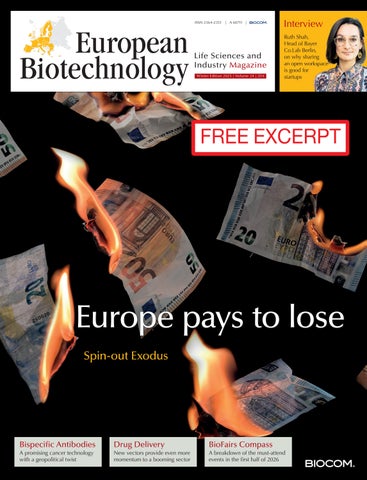
Europe is paying to lose its spin-outs

TECH TRANSFER Europe is giving much of its deep tech and life sciences know-how to the US –t hat’s the conclusion reached by the world’s first Europe-wide market analysis of university deep tech and life sciences spin-outs. While 86% of those firms’ seed funding came from Europe, 48% of their late-stage financing and almost 61% of exits took place across the Atlantic. In other words, European taxpayers are funding value creation in the US – an uncomfortable thought in today’s geopolitical climate.

Europe is finally turning its science into real companies at scale, according to Pedro Alvarez Bretones, co-founder & CEO of Ivoro Ventures in Madrid. “Most technologies die in the lab,” he says, commenting on figures from the very first independent report highlighting the growing role of European deep tech and life sciences university spin-outs in value creation. But “there is too little proof-of-concept funding in TTOs … and very limited late-stage capital,” particularly in Southern Europe. Bretones thinks “this gap is not about people – it’s about systems.”

Figures from the first-of-its-kind European Spinouts Report 2025, released in mid-November, show that 86% of all early -s tage financing rounds of up to €15m for deep tech and life sciences university spin-outs came from European funding or investment. But at later stages, the picture flips. Nearly 48% of funding rounds above US$100m – and the investments that ultimately lead to around 61% of exits through mergers and acquisitions – came from US-based venture capital firms and corporations. According to the report authored by Dealroom.co, Atlantic.vc, MITO Technology, Cambridge Innovation Capital, Oxford Science Enterprises and Northern Gritstone, keeping value creation in Europe will require closing two gaps: The first is proof-of-

concept financing when new companies are still in stealth mode, or at a Technology Readiness Level (TLR) corresponding to stage 3–4 (Proof of Concept/Lab Validation). The second is company exits. The report concludes that since 2021, th IPO window has closed and replaced by M&A (see Fig 1).

Back to reality

However, financing bottlenecks now seem to be more the rule than the ex-

ception, even for highly talented innovators. When you ask post-SeriesA university spin-outs such as in-vivo CAR-T developers from Munich or second-generation TCR-T innovators from Berlin, they’ll tell you investors in general are currently sitting on their cash. In fact, most funding this year was pumped into established players like University of Tübingen spin-out Tubulis AG (US$401m) and investor-created virtual companies building on Chinese patents, such as Verdiva Bio Ltd

Figure 1: M&A activity for Deep Tech and Life Sciences spinouts has been at its highest in 2024-2025, while IPOs disappeared after 2021. Overall, 2025 is projected to be the second-strongest year for exit value, led by six $1B+ exits. ›› Read the full story in the printed issue.

Winners & losers

EUROPE With it´s new Strategy in Bioeconomy the EU aims to become a global leader by 2040 in biotechnology, biomanufacturing, and the sustainable bioeconomy. The goal is clear: enable biotech startups and scaleups to access capital more easily, accelerate the commercial rollout of new technologies, and strengthen Europe’s position against global competitors...

EUROPE ... But If the EU remains anc hored in a more traditional vision focused on the valorisation of agricultural output and industrial waste, the whole bioeconomy strategy is missing out against China, the UK and even the rest of the US bioeconomy strategy who all see synthetic biology as a key pillar. ■

I’m in biotechnology because

“... it’s an industry that has incredible societal impact; developing medicines for patients is so fundamentally important.”

European spinouts

The combined enterprise value of spinouts from European universities and research centres has grown steadily over the past decade. The deep tech and life sciences spinouts, which we focused on in the report, account for $398 billion out of the $473 billion total, which is record high according to dealroom (see pages 26f). ■

2026 starts with Biomedical and AI

Biomedical Conference

4.2. HEIDELBERG At Life – the biomedical conference, Europe’s leading minds in the life sciences will meet each other in one of Europe’s most dynamic biotech regions. The event offers visionary keynotes, exciting cutting-edge research and new opportunities for collaboration and growth. https://biorn.org

AI Circular Economy

4.–5.3. COLOGNE/ONLINE The AI Circular Economy Conference brings together all relevant stakeholders to discuss the need for AI solutions in a circular economy in the chemical and materials sector and to match this need with technical solutions from scientists and developers.

https://ai-circulareconomy.eu

Dual use

DEFENSE On 14 November 2025, the EU published a Delegated Regulation updating the Dual-Use Control List, which entered into force the next day. The annual update aligns EU rules with multilateral regimes but, for the first time, also adds items not agreed internationally. These new “500-series” entries cover emerging technologies.

Key changes include new controls on quantum technologies, semiconductor manufacturing tools, advanced computing components, high-temperature coatings, additive manufacturing equipment –and notably peptide synthesisers. Several technical definitions and control parameters were also revised.

Companies should review product portfolios, update compliance systems, reassess transactions and supply chains... and seek guidance from authorities. ■

First issue 2026

SPRING EDITION All details about themes and special topics in E urop E an BiotEchnology MagazinE in the next year can be found via the QR Code. You can also simply call Christian Böhm (+49-30264921-49), Oliver Schnell (-45), Andreas Macht (-54); or mail us: marketing@biocom.de

››› ››› Please scan me ››› ›››

Fördergesellschaft IZB mbH

Am Klopferspitz 19 82152 Planegg/Martinsried

Tel. + 49 (0)89.55 279 48-0

Fax + 49 (0)89.55 279 48-29 info@izb-online.de www.izb-online.de

WHERE IDEAS TURN INTO IMPACT

 Site: 26,000 m2, S1 laboratories

 Real estate and facility management on site

 Faculty Club and conference rooms for up to 100 people

 Kindergarden (Bio Kids)

 Hotel CAMPUS AT HOME

 Restaurant SEVEN AND MORE, THE BOWL Food Lounge

 IZB network with more than 40 start-ups

 In the immediate vicinity are two Max Planck Institutes, faculties and facilities of the LMU, Munich University Hospital – Großhadern

Turn static files into dynamic content formats.

Create a flipbook
Issuu converts static files into: digital portfolios, online yearbooks, online catalogs, digital photo albums and more. Sign up and create your flipbook.