

Critical analysis and evaluation

School Senior Leader Level 7 Apprenticeship

School Senior Leader Level 7 Apprenticeship
(PowerPoint will be shared & a Podcast will be available for each session)




To strengthen your ability to use critical analysis and evaluation to inform strategic judgement, rather than treating analysis as an end in itself, when developing and justifying a strategic business proposal.
Objectives
•Apply critical analysis to a strategic issue by interrogating evidence, assumptions and context, rather than relying on description or accepted viewpoints (K5, S3, B3)
•Evaluate strategic options by weighing evidence, trade-offs and organisational impact, recognising that senior leadership decisions rarely involve a single ‘correct’ answer (K7, K8, S11)
•Distinguish between analysis that informs strategic judgement and analysis that delays or obscures decision-making (K5, S3)
•Justify strategic judgements in a way that would withstand senior leader or board-level scrutiny, even where evidence is partial or contested (K12, K14, S20)
Asking “What is going on here?”
Asking “So what does this mean?”
Asking “What should we do and why?”
Strategic leadership requires all three — but judgement is where accountability
sits.
…delays action unnecessarily
• Introduce yourself to the group
• Discuss the following prompts and prepare to give feedback
In your group, you will be given a short strategic scenario.
Your task is to:
• Identify the evidence typically used to justify action (e.g. data, reports, feedback, benchmarks etc)
• Surface the assumptions embedded within that evidence (what is being taken for granted, simplified or left unchallenged)
• Identify what the evidence does not tell you (gaps, uncertainties, missing perspectives)
You are not being asked to solve the issue or recommend an option yet
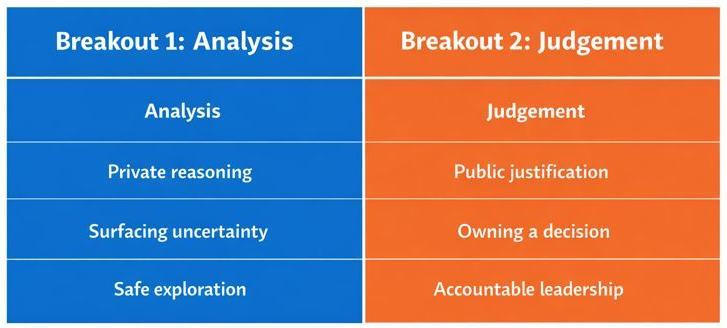
Your task is to:
• Identify the evidence typically used to justify action (e.g. data, reports, feedback, benchmarks etc)
Suggested timings:
• Surface the assumptions embedded within that evidence (what is being taken for granted/simplified/left unchallenged)
• Identify what the evidence does not tell you (gaps, uncertainties, missing perspectives)
5 minutes: reading/reflecting
7 minutes: interrogate assumptions
7 minutes: identify gaps & uncertainties
You are not being asked to solve the issue or recommend an option at this stage

…you need to know where certainty ends.
Analysis does not remove uncertainty – it helps you understand where it lies.
Your task is to prepare a short strategic presentation that:
1. States your recommended option clearly.
2. Explains the key reasoning behind your judgement.
3. Acknowledges a major risk or trade-off.
4. Explains why this remains the preferred option despite that risk. You are not defending ‘perfection’. You are demonstrating judgement under constraint.
Evaluation
Judgement is where leadership accountability sits
•Confidence in challenging evidence rather that accepting it at face value
•Greater awareness of how uncertainty and trade-offs shape strategic decisions
•Increased capability to justify strategic judgements under scrutiny
•Strong proposals do not eliminate disagreement
•They demonstrate informed, reasoned and defensible judgement
•Evidence supports decisions… …
it does not replace them
• Where does your current proposal idea rely most heavily on evidence and where will judgement be required regardless of that evidence?
• Which trade-offs or uncertainties are you most tempted to avoid and what would it mean to address them directly?
• How confident are you in explaining and defending your strategic judgement to a sceptical senior audience?
To strengthen your ability to use critical analysis and evaluation to inform strategic judgement, rather than treating analysis as an end in itself, when developing and justifying a strategic business proposal.
Objectives
•Apply critical analysis to a strategic issue by interrogating evidence, assumptions and context, rather than relying on description or accepted viewpoints (K5, S3, B3)
•Evaluate strategic options by weighing evidence, trade-offs and organisational impact, recognising that senior leadership decisions rarely involve a single ‘correct’ answer (K7, K8, S11)
•Distinguish between analysis that informs strategic judgement and analysis that delays or obscures decision-making (K5, S3)
•Justify strategic judgements in a way that would withstand senior leader or board-level scrutiny, even where evidence is partial or contested (K12, K14, S20)
How values, ethics and organisational context shape strategic judgement
Why technically ‘sound’ decisions can still fail ethically or culturally
The role of senior leaders in holding and navigating moral complexity