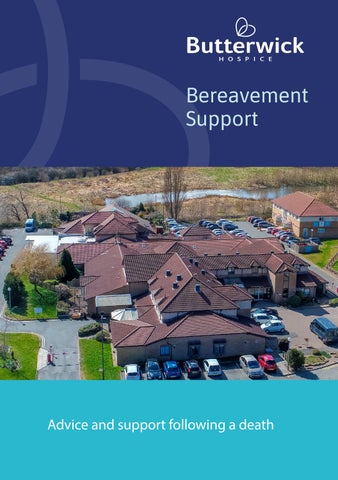
Butterwick Hospice Bereavement Booklet

Page 1


Support

Advice and support following a death

Bereavement Support At Butterwick Hospice

We can offer support for those who have been affected by the death of someone in the care of Butterwick Hospice, or in the communities we serve across our catchment area. We provide safe and confidential opportunities for you to share, express, process, and understand your grief.

We do this through:

• Ongoing, planned, regular support

• Opportunities to share experiences with other bereaved people in small managed groups

• Online resources

We understand that every child, young person or adult is unique and we offer our support responding to people’s personal circumstances, culture, faith, gender, and disabilities.

We do not charge for our bereavement support services.

What Is Bereavement?

The death of someone you know can be an emotional experience. There may be intense emotions that are not easy to cope with. Most bereaved people come through grief with the help of family and friends. For some people, extra support can be helpful. Bottling up difficult feelings can have damaging psychological, emotional, and physical consequences. Grief is not an illness. It is not a weakness. It is not a sign that you are going crazy. It is a healthy and necessary response and experience.

Remember, grieving is a normal and natural process. It may involve you needing to express your deepest feelings. It may also help you to eventually come to live with the reality that your relative, loved one, friend, or someone you knew has died. It could help you to find ways to adapt to your changed circumstances and life.

There are some feelings that are frequently experienced by many people who are bereaved, although not everyone experiences all of them.

Grieving can take many different forms, and different lengths of time for different people. Some people experience deep emotions, and others work through their grief in more practical ways.

You may experience all or some of the following:

• Shock, disbelief, denial

• Sadness and depression

• Anger and guilt

• Acceptance

Living With Grief

Grief relates to five life areas that we all live in, to one degree or another:

Emotional • Physical • Mental/Cognitive • Social • Spiritual

Emotional responses can include: Sadness, anger, guilt, relief

Physical responses can include:

Fatigue, headaches, change in appetite, disturbed sleep patterns. It’s a good idea to speak with your GP about any physical symptoms you may have.

Mental/Cognitive responses can include: Memory loss, poor concentration, indecision

Social responses can include: Feeling withdrawn, loneliness, difficulty mixing with others

Spiritual responses can include:

Loss of faith, unable to ‘make sense’ of things

As time goes on, your experience of grief may change. Grief may come over you in waves, with some days feeling better than others.

There are no timescales to grief.

Don’t be rushed by the expectations of others. There are no rules.

Do try to look after yourself. Try spending a little time with others.

Do talk about the person who has died to people who understand.

Talking To Children About Death And Grief

Many people find they naturally want to protect children from things they may find difficult. It is easy to presume that children will not understand death and bereavement, or that it will be too upsetting for them.

However, we can all too easily underestimate a child's ability to cope. Like adults, they too find it hard to understand and cope if they are not told what is happening. When information is kept from children, sometimes their imagination can make the situation far more frightening as they seek to make sense of what is happening around them. It can lead to them feeling confused, frightened, and isolated.

Some simple things to do:

• Use simple, unambiguous language, e.g. ‘died’ instead of ‘fallen asleep’ or ‘lost’

• Give them plenty of time to ask questions

• Share your own emotions too - by doing this children learn that it is good and healthy to express emotions

• Adapt your explanation to a child’s age, development, and any special needs, and to your faith / cultural circumstances

• Offer children the opportunity to participate in the funeral, cremation or memorial, if they wish to do so

How We Can Help

People don't always find it easy to talk about death. You may feel unable to express your deepest feelings and emotions with those closest to you. However, talking with someone can often be a great help. We can offer you a safe and confidential space to understand, express, and cope with your grief.

We believe that, with the right support at the right time, you can find a way to manage your grief and embrace a future where you can live and remember in a way that is helpful and positive. We can help you explore the new ways in which you can live with the changes that a person's death can bring.

If you think that having some time and space in which to have some one-to-one support would be helpful, then please contact us at the Hospice on:

Stockton: 01642 607742

butterwickhosp.stocktonfamilysupport@nhs.net

Bishop Auckland: 01388 603003

butterwickhosp.bafamilysupport@nhs.net

When You Call Us...

We will want to explore with you how best to support you. This might be through:

• 1 to 1 support

• Group support

We will ask you to provide us with some information to ensure we are the right service to support your needs.

If You Need To Speak To Someone Urgently

We are not able to provide ‘crisis’ support and we do not provide a 24 hour helpline. However, if you feel you need to speak with someone urgently, you can call any of the support lines below:

24 Hour Support Lines

Samaritans

116 123 (freephone) samaritans.org

The Silver Line

A free confidential telephone service just for over 50s 0800 470 8090

Day/Evening Support Lines

Cruse

Information and support after a bereavement

0808 808 1677 cruse.org.uk

Grief Talk

Grief Encounter’s national grief talk helpline 9am-9pm, Monday to Friday 0808 802 0111 grieftalk@griefencounter.org.uk

The Good Grief Trust

Charity run by the bereaved, helping all those suffering grief in the UK. Can help you find reassurance, advice and support. thegoodgrieftrust.org

At A Loss

The UK’s signposting website for the bereaved. ataloss.org

Hub of Hope

UK-wide mental health service database, lets you search for local, national, peer, community, charity, private and NHS support. hubofhope.co.uk

Child Bereavement UK

Support when a child is facing bereavement

0800 028 8840 www.childbereavementuk.org

What People Say About Bereavement Support at Butterwick Hospice

‘Thank you for giving me my life back and enabling me to keep going when all I wanted to do was curl up in bed and sleep until it didn’t hurt anymore.’

‘I feel like you saved me when I was falling apart after my husband died. Thank you from the bottom of my heart for your professional yet caring and compassionate nature. It means a great deal to me.’

‘Thank you for all your help and for being you! To know you care and understand means a lot. People like you, help people like me, see light at the end of a very dark tunnel. Thank you.’

‘The road ahead isn’t going to be smooth and the challenges I face are never going to be easy but I know that I now have the skills to make sure that I catch myself before any downward spiral.’

‘Thank you for believing in me and helping me find the new me, I’m growing to love her, she’s doing her best, which is all anyone can do.’

‘In my hardest days, I’ve always known you would be there.'

Practical Arrangements Following A Death

Following a death, your loved one will be referred to the Medical Examiner’s office, who will then liaise with the Hospice in arranging a Doctor to complete the Medical Certificate of Cause of Death.

Once this process is complete, the Medical Examiner will contact the next of kin to arrange collection of the Medical Certificate of Cause of Death. Please be aware that the death cannot be registered until you have received the Medical Certificate of Cause of Death and the registration of the death is required before the funeral can go ahead.

If you have any concerns or questions about this, please contact us on 01642 607742.

Occasionally there may be an unavoidable delay in the issuing of the Medical Certificate of Cause of Death. Sometimes, for legal reasons, the death has to be reported to the Coroner. The Hospice staff will advise you and keep you informed if this has to happen.

Registering the Death

The death must be registered within 5 working days of the Medical Examiner informing you that the Medical Certificate of Cause of Death is ready for collection. You will need to make an appointment with the Register Office in the district where the death occurred. Some people appreciate the support of a friend or relative. There is no charge to register a death unless a certified copy of the death certificate is purchased. You may need several copies for banks, building societies, solicitors, and other official institutions that require proof that death has occurred. There will be a charge for each copy you require.

You can register a death if you are:

A relative of the person who has died

Not related to the person who has died but you were present at their death

The person instructing the funeral director

Stockton Register Office is open:

Monday to Thursday: 8.30am to 5.00pm

Friday: 8.30am to 4.30pm

Saturday: 8.30am to 5.00pm

Contact the Stockton Register Office to make an appointment to register a death:

01642 527720

registrars@stockton.gov.uk

Nightingale House

Balaclava Street

Stockton-on-Tees

TS18 2AL

When You Speak To The Register Office

It would be helpful to have the following information to hand. Do not worry if not all the documents are available:

• Birth certificate of the person who has died

• Driving licence

• Council Tax bill

• Marriage or civil partnership certificate

• NHS Medical Card

• Passport

• Proof of address (eg. utility bill)

The Registrar will ask about:

• The date and place of death

• The full name of the person who has died and any previous names

• Their date and place of birth

• Their home address

• Their last occupation and whether they were retired

• The full name, date of birth, and occupation of surviving or late spouse or civil partner

The Registrar will register the death and give you the certificate for Burial or Cremation (unless the Coroner has already issued one), to give to the funeral director, and a Certificate of Registration of Death (form BD8 for the DWP which relates to state Pensions and Benefits)

'Tell Us Once' Service

When someone has died there are lots of things that need to be done, at a time when you probably feel least like doing them. One of these is contacting government departments and local council services that need to be told. The Register Office may provide a service called 'Tell Us Once'. If so, they will give you a unique reference code, as well as instruction on how to use it and who will be informed.

You can use this service to tell the following organisations about the death:

Local Councils

• Housing Benefit Office

• Council Tax Benefit/ Support Office

• Council Tax

• Collection of payment for council services

• Electoral Services

• Blue Badges

• Adult Services

• Children’s Services

• Council Housing Department for Work and Pensions:

• Pension, Disability and Carers Service

• Jobcentre Plus

• Overseas Health Team

HM Revenue & Customs:

• Child Benefit

• Tax Credits

• Personal Taxation

Identity and Passport Services:

• To cancel a passport

Driver and Vehicle Licensing Agency:

• To cancel a driving licence

War Pensions Scheme:

• To cancel a war pension

You will still need to contact these organisations to make any claims but you will not need to send them the death certificate.

Information You Will Need to Use

The ‘Tell Us Once’ Service

To make sure the right information is given to any organisations that the Register contacts for you, and so that you get the most out of this service, it will help if you can bring along with you the following information about the person who has died:

• Their National Insurance number and date of birth

• Their driving licence or driving licence number

• Their passport or passport number

• Name and address of next of kin

• Name, address and contact details of person or company dealing with their estate

• Details of any benefits or services they were receiving (eg. pension)

• Details of any local council services they were receiving (eg. Blue Badge)

Arranging A Funeral

A funeral can be an important event to bring family and friends together, to celebrate and to share memories. When a death occurs in the Hospice, the Funeral Director of your choice will be contacted on your behalf and will take over the care of your loved one. Funeral Directors can be contacted 24 hours a day, including weekends.

More information can be found online at: www.gov.uk/after-a-death

If you use a funeral director, you will need to give them the Certificate for Burial or Cremation ('green form') from the Register Office. They will discuss your wishes and can make all the arrangements for the funeral and burial or cremation, according to your own particular philosophy, faiths, and beliefs. If you have a minister or faith leader of your own, you may prefer to contact them yourself.

There are a growing number of funeral celebrants as an alternative to a minister of religion or faith leader, should you require this. Alongside a range of funeral celebrants are also Humanist celebrants, who are not religious and do not hold beliefs about an afterlife. There can be a bewildering array of choices to explore, but a funeral director will usually be able to recommend a minister of religion, Humanist, or one of the many other civil celebrants with varying backgrounds, who will provide a ceremony to suit your needs.

The British Humanist Association offers advice on non-religious ceremonies.

If you do not wish to use a funeral director, you can contact the Cemeteries and Crematorium Department of the Council to arrange a funeral yourself.

In planning the funeral service, where possible it is important to honour the wishes of the person who has died, as well as thinking of your own feelings and those of others.

The person who arranges the funeral is usually responsible for meeting the costs. These can be met from the estate of the person who has died, or any funeral scheme they may have subscribed to.

Funerals can be expensive and, although basic costs tend to be similar, the final cost can vary considerably. Do not be afraid to mention your budget or obtain estimates from several funeral directors. Financial help may be available if you receive certain benefits. Contact the Department for Work and Pensions (DWP) before making any arrangements.

All funeral directors are legally required to publish a price list for a standardised set of products of services, which should be found on their website and in the window of the funeral directors offices.

This is to help you think through your options and make choices, and to let you compare prices between funeral directors (because prices can vary).

Help for people on low income: Funeral Expenses Payment

You could get a Funeral Expenses Payment (also called a Funeral Payment), if you receive certain benefits and need help to pay for a funeral you are arranging.

To understand more about this option, please visit the following website: www.gov.uk/funeral-payments or call the Bereavement Service Helpline: 0800 151 2012

Public Health Funerals

Public Health Funerals are provided by local authorities for people who have passed away and have no next of kin, or whose next of kin, relatives or friends are unable or unwilling to make the necessary arrangements for a funeral. They are designed to protect public health and are important in ensuring that all individuals are treated with dignity and respect, regardless of their circumstances.

If you or your loved one requires a public health funeral, Butterwick Hospice will liaise with Stockton Council who will make the necessary arrangements.

The deceased person will be transferred to Stockton Council’s contracted funeral director (at time of writing this is Colin McGinley Funeral Directors). Prior to the transfer, Butterwick Hospice will make every effort to ensure the deceased person is treated with care and dignity and where possible, will support and facilitate any faith practices or last wishes as requested by the individual or their loved ones.

The preferences of the deceased person for burial or cremation will be taken into account. Loved ones are able to attend the funeral but will not be able to choose the date – this will be arranged by the Funeral Director.

A celebrant will be appointed to conduct the service, and the faith of the deceased person will be taken into account and respected. Flowers and order of service are not routinely provided, but attendees may provide these if they wish. A coffin will be provided and displayed at the memorial service, however viewings of the deceased person at the Funeral Director’s will not be available.

If no family or friends of the deceased person are able to attend the funeral, Stockton Council appoints someone to attend as a mourner. Butterwick Hospice will also make every effort to send a member of staff to show respect to the deceased person.

Just as the Butterwick Hospice ethos is to support our patients to live well before they die, we also want to ensure their memory is respected after death. If you have any concerns or questions about care after death the team is always happy to support and work with you and your loved ones to honour the individual.

Bereavement Benefits

You may be eligible for some bereavement benefits, depending on your circumstances. Further information is available in a DWP booklet 'What to do after a death in England and Wales' and online at www.gov.uk

Probate And Legal Advice

If you have difficulty in dealing with the property of the person who has died, or with matters such as the guardianship of their children, it is advisable to get advice from a solicitor or the Citizens Advice Bureau as soon as possible. If there is no Will, speaking with a solicitor may be helpful. Some solicitors are prepared to offer up to half an hour of legal advice free.

Further information is available at:

www.gov.uk/wills-probate-inheritance/ if-the-person-left-a-will

www.gov.uk/wills-probate-inheritance/ if-the-person-didnt-leave-a-will

www.citizensadvice.org.uk

Who Needs To Be Told About The Death?

You will probably want to let the family, friends, and neighbours know of the death right away. If the person who died was living alone, you may need to ensure that their home is secure and remove all signs that indicate that the house is empty. You may wish to collect spare keys from other relatives, friends, and neighbours.

You may also wish to inform the following:

Priest, Vicar, Minister of Religion, or Faith Leader

Family Doctor

Dept. for Work & Pensions (pensions, benefits, etc)

if you have not used the 'Tell Us Once' service

Bank, Giro, Credit Cards, Building Society

Social Services (home helps, home care)

Schools, College or University attended

Place of work (occupational pension)

Executors of Estate (Will)

Solicitor

Insurance Companies

Library

Inland Revenue (if you have not used the ‘Tell Us Once’ service)

Residential or Nursing Home Landlord, Housing Department Council Tax Office (if you have not used the ‘Tell Us Once’ service)

Electricity, Gas, Telephone, Water Companies

Post Office (redirect mail)

Driving Licence Centre (DVLA)

Careline/Warden Call

Cancel any appointments

Arrange the return of any equipment

Coroner & Post-mortem Examinations

Cases referred to the Coroner

Coroners are independent judicial officers who investigate someone’s death.

Coroners investigate deaths that have been reported to them if they think that:

• the death was violent or unnatural;

• If the death was caused by industrial disease (such as an Asbestos related disease);

• the cause of death is unknown or uncertain; or,

• the person died in prison, police custody or another type of state detention e.g. an immigration removal centre or while detained under the Mental Health Act 1983.

Where possible, if we think there is potential for the coroner’s involvement, we will discuss this with you in advance, however in some cases the medical examiner’s office may decide to refer to the coroner’s office if they have concerns following scrutiny of the deceased’s records.

When a death is reported to a coroner, they:

• decide whether an investigation is needed; and if it is, investigate to establish the identity of the person who has died; how, when, and where they died; and any information they need to register the death; and,

• use information discovered during the investigation to help prevent other deaths.

The Coroner will look at the circumstances of the death and decide what happens next. This may take some time. The Coroner’s Office will contact you directly to advise of the next steps.

For more information, please refer to: www.gov.uk/government/publications/guide-to-coroner-services-andcoroner-investigations-a-short-guide

Support for old coal miners and families of former coal miners: If the deceased had worked as a coal miner, we recommend that you contact the Coal Industry Social Welfare Organisation (CISWO) on telephone 01623 625767. The staff at CISWO will advise you on a number of issues and are also happy to liaise with the Coroner’s Office on your behalf if necessary.

The outcomes of a report to the Coroner

1. A certificate issued. The Coroner’s Officer will contact you to discuss and ascertain whether you have any concerns about the death. Once the Coroner is satisfied that there are no concerns, the doctor will be instructed to issue a certificate and the Coroner’s Officer will issue a Green Form A / 100A. This informs the registrar that they are aware of the death but no further investigation is necessary and permission has been given to the doctor to issue the Medical Certificate to the Registrar of Deaths.

2. The commencement of an investigation, which may or may not result in an inquest. In these circumstances there will not be a post-mortem examination, and the Coroner’s Office will keep you informed of developments, including when the deceased can be released from the hospital.

3. A post-mortem ordered to determine the exact cause of death. If the Coroner orders a post-mortem examination it becomes a legal obligation, and although you can raise any objections that you may have, there is no right to refusal. If the Coroner has ordered a post-mortem examination but there is no requirement for an inquest, the Coroner will send a Pink Form B / 100B directly to the registrar. This is instead of the Medical Certificate from a doctor.

Once the results of the examination are known, and if an inquest is not required, a certificate to register the cause of death will be issued by the Coroner’s Office and sent directly to the registering office. The Registrars’ Office will contact you directly to arrange an appointment to complete registration.

Some Advice You May Find Useful

Bereavement Support Payment

You may be able to get Bereavement Support Payment if your partner has died. It has replaced the following benefits:

• Widowed Parent’s Allowance - if you already get this, your payments will continue until you’re no longer eligible

• Bereavement Allowance (previously Widow’s Pension)

• Bereavement Payment

Bereavement Support Payment is not means-tested. This means what you earn or how much you have in savings will not affect what you get. Check the full eligibility requirements.

It’s usually paid as a one-off payment followed by up to 18 monthly payments. This may change depending on when you make your claim.

For the most current information relating to this, please visit the following website:

www.gov.uk/bereavement-support-payment or call the Bereavement Service Helpline: 0800 151 2012

Citizens Advice: Stockton and District

Location

Wellington Square Shopping Centre, Stockton-on-Tees, TS18 1RH

Advice session times:

Monday to Friday - 9.00am to 5.00pm

Contact Us

support@stockton-cab.co.uk

Advice Line: 01642 833877

Citizens Advice: County Durham

Location

Four Clocks Centre, 154A Newgate Street, Bishop Auckland, DL14 7EH

Advice Line:

0808 278 7281

Monday to Friday - 10.00am to 4.00pm

Reference: Butterwick Hospice Bereavement Booklet

Publication Date: October 2025

Review Date: October 2027

The Hospice would like to thank RNS Publications for publishing this information and the following pages contain some features from services o ering their help at this time.

Whilst the Hospice is grateful of their support it does not endorse or recommend any of the services that they provide.

STOPPING JUNK MAIL

Do you need help with Probate?

You may need help, support or advice on what to do when someone dies in relation to probate. It may not always appear obvious if it will be required.

We offer free guidance on the legal and financial aspects of bereavement including your responsibilities and whether probate is required.

You may need to establish whether a property is held in joint names or tenants in common, we can perform a simple check at no cost to establish the title deeds.

Turn static files into dynamic content formats.
Create a flipbook
Issuu converts static files into: digital portfolios, online yearbooks, online catalogs, digital photo albums and more. Sign up and create your flipbook.
Butterwick Hospice Bereavement Booklet by bereavementadvice - Issuu