Peer Collaboration
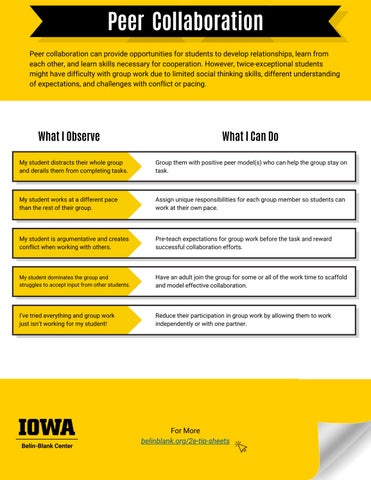
Peer collaboration can provide opportunities for students to develop relationships, learn from each other, and learn skills necessary for cooperation. However, twice-exceptional students might have difficulty with group work due to limited social thinking skills, different understanding of expectations, and challenges with conflict or pacing.
WhatIObserve
My student distracts their whole group and derails them from completing tasks.
My student works at a different pace than the rest of their group.
WhatICanDo
Group them with positive peer model(s) who can help the group stay on task.
Assign unique responsibilities for each group member so students can work at their own pace.
My student is argumentative and creates conflict when working with others.
Pre-teach expectations for group work before the task and reward successful collaboration efforts.
My student dominates the group and struggles to accept input from other students.
Have an adult join the group for some or all of the work time to scaffold and model effective collaboration.
I’ve tried everything and group work just isn’t working for my student!
Reduce their participation in group work by allowing them to work independently or with one partner


Group work is a consistent area of concern for many students, especially twice-exceptional students whose talents and challenges can make it difficult to identify true peers in their classroom. For many of these students, their social skills weaknesses and social-emotional immaturity may make it hard to work with peers who are more socially skilled, while their strong cognitive and academic abilities may limit their patience for working with peers who are less academically advanced.
Grouping
When assigning students to work in groups, be intentional about matching twiceexceptional students with peers who will be positive models for desired behavior and who can provide scaffolding of desired behavior kindly and supportively. Anxious students may benefit from being grouped with a friend, who can help them feel safer to share and participate. It is especially important to be aware of negative social dynamics within the classroom and avoid grouping 2e students with peers with whom they have negative or unhelpful interactions. For some students, partner work is a better option, as it still requires some collaboration but reduces the amount of social input they must navigate. Finally, it is important to balance academic and social-emotional learning objectives with students’ needs and readiness; for some students, required participation in collaborative work is a barrier to growth in other areas, and independent work may be a more appropriate method for demonstrating their skills.
Group Work Expectations
Assigning clear group roles can help many students who struggle with group work, including those who work at faster or slower paces than peers, those who argue with others, and those who dominate the group discussions. Washington University’s Center for Teaching and Learning offers resources for using roles in group work.
Social Skills for Group Work
For some students, working collaboratively with peers is simply not feasible due to skills deficits. It is important to balance the academic learning objectives of a given lesson with the social-emotional learning objectives of collaborative work, and determine which element is the priority for students who struggle with group work. If academic learning is the priority, it may be best to remove the group work expectation to focus on academics. If building collaboration skills is the priority, some students will likely require targeted instruction to succeed. The Watson Institute offers some helpful tips on teaching skills for group work