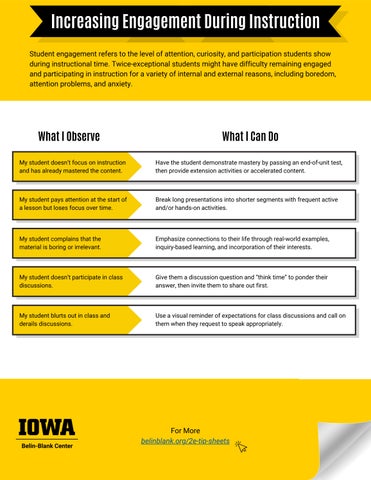
IncreasingEngagementDuringInstruction
Student engagement refers to the level of attention, curiosity, and participation students show during instructional time. Twice-exceptional students might have difficulty remaining engaged and participating in instruction for a variety of internal and external reasons, including boredom, attention problems, and anxiety.
WhatIObserve
My student doesn’t focus on instruction and has already mastered the content.
My student pays attention at the start of a lesson but loses focus over time.
WhatICanDo
Have the student demonstrate mastery by passing an end-of-unit test, then provide extension activities or accelerated content.
Break long presentations into shorter segments with frequent active and/or hands-on activities.
My student complains that the material is boring or irrelevant.
Emphasize connections to their life through real-world examples, inquiry-based learning, and incorporation of their interests.
My student doesn’t participate in class discussions.
Give them a discussion question and “think time” to ponder their answer, then invite them to share out first.
My student blurts out in class and derails discussions
Use a visual reminder of expectations for class discussions and call on them when they request to speak appropriately


Accelerated Learning and Twice-Exceptional Students
One of the guiding principles of serving 2e students is to prioritize strengths first and accommodate weaknesses second. While some 2e students do benefit from grade-based acceleration, subject-based acceleration options like curriculum compacting can be more appropriate due to 2e students’ asynchronous (i.e., uneven) development and need for domain-specific strategies. Teachers can use pre-assessment with individual students or, preferably, with the whole class, to determine mastery. There are not firmly established criteria for what score should constitute mastery, but in general, 85 to 90 percent correct (not 100 percent!) is a good rule of thumb. Once a student has demonstrated mastery, they can take on extension activities within established classroom norms. For more on how to apply curriculum compacting, see Teaching Gifted Kids in Today’s Classroom
Break Up Long Presentations
When students have difficulty sustaining attention over time, it is helpful to reduce the length of instructional periods by incorporating checks for understanding, like informal quizzes, class or group discussions, or hands-on application of a skill or concept (as described by this Edutopia article).
Make It Meaningful
All students, but especially twice-exceptional students, need to understand the meaning and relevance behind the materials they’re learning. Many twice-exceptional students seem especially prone to avoiding work that they feel is boring or irrelevant. Linking instruction with student interests and life experiences will increase students’ motivation to engage with the material. Inquiry-based learning processes such as the 5E Model of Instruction offer a formal and universal way to make learning more meaningful, but informal and individualized approaches like asking an individual student about their interests and strategically connecting those interests to the content can also be effective.
Classroom Discussion
Discussion is another aspect of learning that can be challenging for students to engage in appropriately Twice-exceptional students may tend to withdraw from class discussions due to anxiety or need for more processing time, or to over-participate due to enthusiasm about the content, impulsivity, and reduced awareness of social norms. In either case, establishing clear and consistent expectations is an essential starting point. For underparticipators, create opportunities to facilitate low-stakes participation, like smaller group discussions or specific questions directed only to the target student. For over-participators, use nonverbal signals to remind students of expectations and “catch them” when they meet the expectation for appropriate participation.