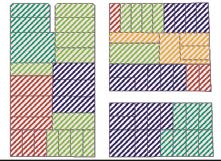
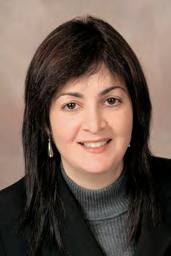
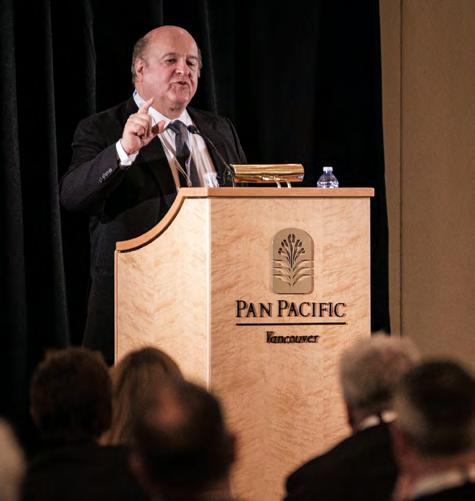
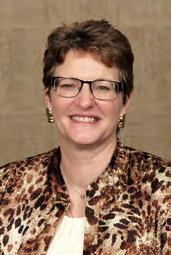
Have you received your 2014 property assessment notice?
If not received in your mail by January 17, call toll-free 1-866-valueBC (1-866-825-8322)
If so, review it carefully
Visit www.bcassessment. ca to compare other property assessments using the free e-valueBC service
Questions? Contact BC Assessment at 1-866-valueBC or online at www.bcassessment.ca
Don’t forget...if you disagree with your assessment, you must file a Notice of Complaint (appeal) by January 31, 2014
The MiX
The Scrivener: What’s in a Name?
“A professional penman, a copyist, a scribe . . . a Notary.” Thus the Oxford English Dictionary describes a Scrivener, the craftsman charged with ensuring that the written affairs of others flow smoothly, seamlessly, and accurately. Where a Scrivener must record the files accurately, it’s the Notary whose Seal is bond.
We chose The Scrivener as the name of our magazine to celebrate the Notary’s role in drafting, communicating, authenticating, and getting the facts straight. We strive to publish articles about points of law and the
for the education and enjoyment of our members, our
and the public.
Editor-in-Chief
To send photographs to The Scrivener, please see the Editor's column on page 11.
All rights reserved. Contents may not be reprinted or reproduced without written permission from the publisher. This journal is a forum for discussion, not a medium of official pronouncement. The Society does not, in any sense, endorse or accept responsibility for opinions expressed by contributors.
CaNaDa PoST: PuBLICaTIoNS maIL agREEmENT No. 40010827
Paid at Vancouver, BC
SCRIVENER@SoCIET y.NoTaRIES.BC.C a The Scrivener email: scrivener@society.notaries.bc.ca Website: www.notaries.bc.ca/scrivener
V6C
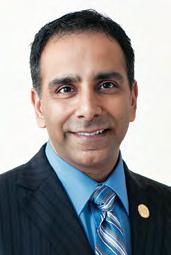
a kash Sablok goals are Dreams with a Deadline
akash was born in the State of Punjab.
Just shy of his fourth birthday, the family emigrated to Vancouver. He received his education in Richmond schools and in his father’s Notary office. Tarlok Sablok became a BC Notary in 1977. Akash grew up in the Notary environment and enjoyed every minute of it.
Newspaper-carrier was his first paying job and he opened a bank account at age 11. At 14, he worked after school at a Home Hardware, in charge of equipment repairs and some sales. By Grade 11, he had started a food wholesale business, importing beans, spices, and other food products from India and reselling them to wholesalers.
After graduating, Akash opened a warehouse and began wholesaling his products to retail outlets, too. He was a one-man operation—selling, unloading, loading, cleaning, accounts payable, accounts receivable, and marketing while attending BCIT to earn his Business Law Diploma.
“I have always been willing to work extra hard to achieve my goals in life,” he says.
In the early 1990s, he started in construction, building a few residential properties and two commercial buildings. He also took CAIBC
Insurance Course Levels 1 and 2 and the Real Estate and Submortgage Brokers Course.
In 1995, Akash sold his businesses and entered the BC Notaries’ education course. During the day, he worked with his father in the busy Notary practice and studied his lessons in the evening.
I have always been willing to work extra hard to achieve my goals in life
In June 1998, he obtained his Notarial Seal for the District of Vancouver. Akash and his father practise on Fraser Street.
“The East Side of Vancouver has grown considerably since I started practising and continues to do so,” notes Akash. “New young families are prospering. We have a long-term client base and feel proud that the children of clients are now coming to us for their Notarial needs.
“I wanted an exciting, everchanging, performance-oriented career where I could meet interesting people. In the Notary profession, we have the opportunity to assist the public with their noncontentious legal requirements. Being able to identify their needs and provide them with a solution is one of the most satisfying feelings there is. Seeing the smile and excitement of first-time home buyers—when they realize they now
own their own home—is a great moment.”
In his ongoing community service, Akash is a founder and Board member of the Fraser Street Business Improvement Association (BIA) where owners of local businesses, properties, and residences come together to help make the local shopping area safe, clean, and inviting.
He volunteers at the local temples and has assisted with programs for the Canadian Diabetes Association. He is the current Vice Chair of the BC Children’s Hospital Foundation “A World of Smiles” Telethon.
Akash’s hobbies are technology, automobiles, and journalism. He has written for many publications, appeared for 5 years on Driver’s Seat, and is a regular guest on CityTV’s Breakfast Television (Vancouver), Omni’s Punjabi News Hour, and The Rush (Shaw) and he occasionally talks about Tech on CBC News Now and CTV Morning Live (Vancouver). In his spare time, he plays racquetball and coaches and plays ice hockey.
A huge fan of technology, Akash truly believes any innovation or development that improves our daily lives is essential. “My office like many other BC Notary practices has embraced the electronic age. We are moving toward a completely paperless office to reduce costs and negative impact on the environment.
“As Notaries practising today in British Columbia, we are part of history in the making.” s
Tarlok Sablok
Land
In grade 8, I played a game called adventure on the school’s new a pple IIe computer.
The object of the game was to build up your profile from a peasant on the land to becoming king. You worked on the land and eventually were rewarded the designation “Sir” before your name. The better you took care of the land and the people around you, the higher your rank became. You went from Sir to Knight to Earl to Duke— and more in between—and eventually you ascended the throne.
The game was less show —no graphics or fancy photos—and more know. You had to decide how much water, seeds, and supplies you would need to grow your crops and feed your fellow villagers. You learned that land is much more than location and size; it is how you develop the benefits of the land itself.
For the process of buying land in British Columbia, very competent professionals such as Realtors, Financial Advisors, Notaries, and Lawyers assist people with the various aspects that are involved.
Before you purchase land, it is essential that you determine exactly how you intend to use it. For example, if you know that one day you will build the swimming pool that you and your family have wanted for years, ensure that the land you are buying does not have an easement in the rear. An easement for power lines can be placed by a local utility authority such as BC Hydro. While your backyard will still be large and beautiful, not being able to use it for the purpose you intended is an expensive and disappointing proposition.
On the other end of the spectrum, you may wish to buy just the smallest portion of land that you need to build a little home with no yard maintenance. If you dislike cutting the grass, you could pave the backyard . . . but that’s not so pleasant for the knees of the little ones playing there.
Before you purchase land, it is essential that you determine exactly how you intend to use it.
Points to Consider when Purchasing Land
• Intent of use
Is the land zoned for what you would like to do on it? If you want to keep chickens—you can do that legally in the City of Vancouver, is that permitted on the property?
• Size of the Property
If you are buying a vacant lot, check with your legal professional and the municipality to confirm what you are allowed to build and how large it can be. Cities have setbacks—left and right, front and back—that will affect the completed size of a structure.
• Location Location IS important. Is the property near a school, work, transportation, shopping?
• Future Development
That waterfront lot may become backstreet property if there is potential for a structure to be built between you and the water.
• Price Price should be considered only after the above are confirmed.
Mark Twain said, “Buy land; they’re not making anymore.” I’ll modify it slightly: “Buy land; they’re not making anymore— and buy it wisely.” s
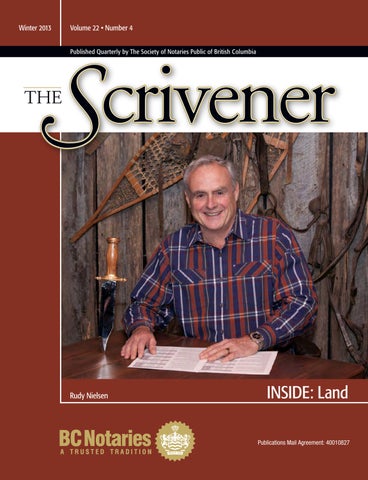
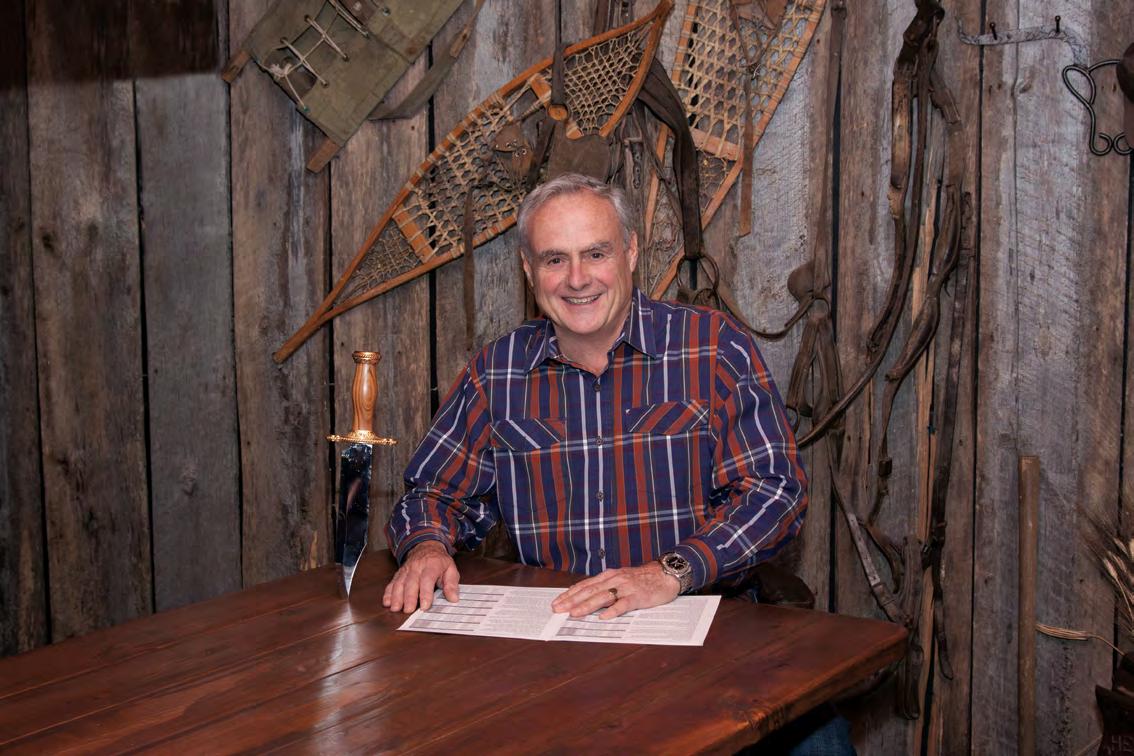
Our Cover Story features Rudy Nielsen, a larger-than-life personality with larger-than-life companies—the NIHO Land and Cattle Company, the Landcor Data Corporation, and LandQuest Realty Corp.
I first met Rudy in the late 1960s when we worked together in the northwest part of British Columbia. The firm we worked for—an investment group called Northern Securities Ltd.— owned real estate offices, insurance offices, movie theatres, golf courses, and travel agencies and did some land developing and residential home construction.
The idea for the formation of Northern Securities had come from a couple of local businessmen who went out and enlisted a number of very successful logging contractors to invest in the idea of a diversified portfolio of small companies in those various fields.
The company had holdings and offices all over the north west including Terrace, Kitimat, Prince Rupert, the Hazeltons, Smithers, Burns Lake, Vanderhoof, Prince George, and McBride. They also owned a restaurant on Hornby Street in Vancouver called The Red Fox.
Rudy was brought in to run the real estate company; I was brought
in to run the insurance part of the operation as the Terrace insurance manager. We were both in our 20s and very eager to be part of the business community and to help make the venture successful for our owners.
I remember I was struck by Rudy’s tenacity and vision. I also recall he told all the real estate salesmen, “I will never ask you to do anything, try to sell anything, or list any property that I haven’t looked at or that I haven’t researched.”
Rudy is the type of guy that whatever he turns his hand to, he wants to be number one, even if it is a simple game of golf, a game of cards, or dice!
Rudy Nielsen
We worked hard and also played hard. On Wednesday nights at the Thornhill Golf course that was owned by our company, we would gather and play golf. Following our golf game, we would enjoy dinner, then have a few drinks and play a dice game we called “liar dice.” Rudy was always so competitive. Most nights, he would go home with our money.
Rudy is the type of guy that whatever he turns his hand to, he wants to be number one, even if it is a simple game of golf, a game of cards, or dice!
Many BC Notaries use Landcor Data Corporation’s various products. When assisting a client with a private (residential) purchase, many Notaries will use one or more of Landcor’s Appraisal products. The use of Rudy’s products provides assurance to the purchasers that they are obtaining value for their money.
The Fraud products available through Landcor solutions are also invaluable for private purchasers. Reports can be developed for Notaries’ clients within hours, not days, and the information generated is always accurate and dependable.
I know when Rudy created Landcor, he had a vision of using accurate data from BC Assessment plus data from many other sources and putting them all together in an electronic format for his clients. If you visit Landcor’s website today,
Val Wilson
Rudy has contributed to the British Columbia Real Estate Industry in a significant way.
you will see the numerous analytic products available. If you don’t see what you are looking for, all you need to do is call Rudy and he will put something together for you! www.landcor.com
Landcor recognized there was a need for a fast, accurate system of valuating and analyzing properties without physically having to inspect each and every one; its direction was aimed at filling that void.
Today, Landcor is building the best source of real estate data and analytic tools available on the Internet. It acquires comprehensive, accurate, and current information and develops sophisticated programs to allow a wide range of users to use the data to make swift and reliable real estate decisions.
Landcor’s analytical tools have been developed and tested over a 3-year period by a multidisciplinary team including the following.
• Urban land economists
• Appraisers
• Experts in statistical analysis
• Real estate consultants
• Software developers
• Academics
• Website designers
Rudy has contributed to the British Columbia Real Estate Industry in a significant way. I am certain we have not heard the last of Rudy Nielsen and his ideas for the development of data and information for BC real estate and economics. Ever since the day I met Rudy over 40 years ago, his mind has always been at work on the next useful development and product.
The only other advice I have for our readers is Don’t play cards or dice with Rudy! s
ILand minds
was excited to attend the REIBC President’s luncheon at the Four Seasons in Vancouver on December 5.
The depth of “Land” knowledge and experience in the room was vast; the camaraderie and goodwill genuine.
The keynote speaker was Rudy Nielsen, our Cover Story personality in this issue. Rudy credits his success to a number of factors—especially his RI(BC) designation.
The BC Notaries were one of the sponsors of the event. Members from The Society of Notaries included CEO/
Secretary Wayne Braid, Alex Ning, and Directors John Eastwood, Pat Wright, and Filip de Sagher.
Among the many familiar faces I spotted were REIBC’s President Mandy Hansen; Scott Ullrich, our Summer Cover Story interview for the “Stratas” theme; Realtors Judi Whyte and Robbi-Layne Robertson; Professor Emeritus Stanley Hamilton, André Gravelle, and Dave Moore of the Sauder School of Business at UBC; and Janice O’Brien from AIC – BC. REIBC’s Executive Officer Brenda Southam and her staff were welcoming and on point.
The depth of “Land” knowledge and experience in the room was vast; the camaraderie and goodwill genuine.
The theme articles that follow focus on land in BC and beyond.
Enjoy! s
From left: Brenda Southam, Rudy Nielsen, Mandy Hansen, Wayne Braid, John Eastwood
Filip de Sagher
Land: a moving Subject
on a daily basis, BC Notaries help land move from one pair of hands to another.
That happens via conveyancing— a client buys or sells land—and via a Will—someone is set to inherit a piece of land.
We tend to focus on the nuts and bolts of the transaction itself. That is our job.
Clients tend to focus on the value of that asset.
But what is the value of land? What is it worth to you?
James Michener’s fascinating description of the genesis of land in one of his earliest works, Hawaii, has always stayed with me. The book starts with a volcano majestically breaking the deep blue ocean’s surface, catching the last rays of a setting sun. A solitary coconut gets stuck on some rocks, debris drifts around, and an exhausted migratory bird lands to catch its breath.
Over time—lots and lots of time, enough “matter” sticks around and grows and, yes, land is created. Fascinating stuff but it gets better, because then people arrive.
And value is created. Suddenly the land becomes special and labelled with a price depending on how people use it. In our times, land can become even more valuable if left untouched and not used at all.
It is this relationship between land and people that has determined the value of land throughout history on every continent.
They determine each other, especially when the balance tilts more to land than to people (rural areas) or more to people than land (urban areas).
Land is indeed disappearing as the world’s population is growing exponentially.
Land is indeed disappearing as the world’s population is growing exponentially. National Geographic magazines beautifully reflect this tension and make us wonder where it will lead us.
Vancouverites have only to stand at the tip of Canada Place and look over the Burrard Inlet toward the North Shore mountains and imagine being surrounded by the buildings— and 7 million people—of Hong Kong. Is that the future we want, we need, or that will just happen? Is it disaster or salvation?
How many zeros can we add to the value of Vancouver real estate?
Communities all over the world have always entrusted this valuable asset to a Notary Public. We don’t inherit land from our parents; we hold it in trust for our children. That is value. And that moves me. s
Filip de Sagher and his wife
Hilde Deprez have their Notary office, Deprez & a ssociates, in Point grey. Telephone: 604 221-4343 www.notarydeprez.com www.fdsimmigration.ca
The Racketeer
by John grisham
Here is a timely, highly recommended read!
The main character is a lawyer who represents a crooked buyer in a real estate transaction.
On closing day, instead of transferring the agreed purchase price of $450,000 into the trust account of the lawyer’s firm, the buyer—who asked his lawyer to put the new property into a numbered Caribbean company—transfers $4,500,000. And then another $3 million.
The lawyer does not know how to get rid of it. One thing leads to another and, yes, our lawyer is found guilty of money-laundering. Ten years of federal prison follow and in the words of the lawyer, that is not the place to be.
That is only the beginning of an intelligently written, long twisting-and-turning story that will hold your attention until its surprising end.
I always found John Grisham law novels a bit on the technical side but this one kept me engrossed—not in the least because it’s about sweet revenge against the people who allegedly “caught him” money-laundering.
Editor’s
Prefer Paperless?
Want to read The Scrivener online, quarterly? We will be pleased to add you to our private notification list. Contact scrivener@society. notaries.bc.ca or visit www.notaries.bc.ca/scrivener.
The MiX
The MiX showcases articles on a variety of timely topics. Before submitting an article, please contact scrivener@society. notaries.bc.ca.
To send photographs to the magazine, please . . .
• go to www.graffiki.ca, and click on “Send A File.”
• From the top box, delete the words “Your e-mail.”
In British Columbia it is a result of good governance, public infrastructure, and the market. On less developed continents, basic “land rights” are only now being understood as the key to human well-being, economic growth, and stability.
Democratic Institutions
Many British Columbians take the value of their property for granted. For some, the mantra “location, location, location” simplistically explains why the value of their property increases.
In BC, property rights are supported by the rule of law, democratic institutions, and a wholly transparent system of identifying, deeding, valuing, taxing, and transferring property. Institutions such as the Land Title and Survey Authority, BC Assessment, and the BC Notaries Public are examples of institutions that support land value.
The quality of community services, primarily governed locally by municipalities and regional governments, also impact market value. The quality of bridges, traffic patterns, hospitals, schools, recreational facilities, police and fire protection, good water, and sewerage all contribute to residential, business, and industry value.
Many British Columbians take the value of their property for granted.
Infrastructure Investment
Future infrastructure and other public/ private development also impact a property’s value.
Government planning for public infrastructure in concert with commercial development portends a climate of investment, mortgaging, and communities desirous of building forms of wealth both in real estate and in quality of life.
Surrey, Maple Ridge, and Pitt Meadows are considered the hottest cities for high-growth commercial and real estate markets in the Fraser Valley, according to the Langleybased research company Real Estate Investment Network.
The current and “potential” values in those cities can be traced through examining the development of public infrastructure that connects both sides
of the great Fraser River. We have only to ask what were the values of property in Surrey and area “before and after” the following were built.
• The Patullo Bridge in 1936, 1937
• The first Port Mann Bridge in 1964
• The Alex Fraser Bridge in 1986
• The Skybridge (Translink) extending the Expo Line in 1990 to the King George Station, the eastern terminus in 1994
• The Golden Ears Bridge connecting Langley with Pitt Meadows and Maple Ridge in 2009
• The new Port Mann Bridge in 2012
While those were key drivers for property wealth, the value of Lower Mainland properties and quality of life will continue to improve with future infrastructure development.
For instance, as detailed in the Fall 2013 edition of The Scrivener, Port Alberni Port Authority’s proposed new terminal on Vancouver Island— dedicated to container trans shipment and short sea shipping—will be part of the ongoing infrastructure solution to the Lower Mainland’s growing pains, again helping to increase the region’s property value by using the Fraser for the transportation of goods up-river.
Securing Property Rights
Internationally
While property owners in our province benefit from secure land rights, good governance, sound infrastructure investment, and the economic development it affords, the majority of people on other continents are less fortunate. Karol Boudreaux, director of investments for the Omidyar Network, states, “Some 70 percent of the world’s people…live without formal, documented rights to land.”
In South America and Africa where large tracts of land are being acquired in so-called “land-grabs” for resource extraction and other forms of development, land rights are only starting to be recognized for many local communities and indigenous populations.
Last year, in an effort to improve the lives and livelihoods of small-farm holders and their families, the United Nations Committee on World Food Security endorsed new Voluntary Guidelines of Tenure of Land, Fisheries, and Forests in the context of food security. This furthered a growing international campaign aimed at helping governments safeguard respective forms of customary, public, and freehold land rights of people to own or to access land, fisheries, and forests.
According to the Food and Agriculture Organization of the United Nations, the guidelines “were developed through a broad global partnership of international, regional, and national organizations of different types that work together to achieve global changes in governance of tenure. The development followed an inclusive process involving a series of consultations and negotiation.”
“Inadequate and insecure tenure rights increase vulnerability, hunger, and poverty, and can lead to conflict and environmental degradation when competing users fight for control of the resources. The governance of tenure is a crucial element in determining if and how people, communities, and others are able to acquire rights and associated duties, to use and control land, fisheries, and forests.”
The document also recommends “safeguards be put in place to protect tenure rights of local people from risks that could arise from large-scale land acquisitions,” while also making the case for protection of “human rights, livelihoods, food security, and the environment.”
The stability of land rights and governance in British Columbia contributes to individual and collective property wealth.
The guidelines address a wide range of other issues.
• Recognition and protection of legitimate tenure rights, even under informal systems
• Best practices for registration and transfer of tenure rights
• Making sure that tenure administrative systems are accessible and affordable
• Managing expropriations and restitution of land to people who were forcibly evicted in the past
• Rights of indigenous communities
• Ensuring that investment in agricultural lands occurs responsibly and transparently
• Mechanisms for resolving disputes over tenure rights
• Dealing with the expansion of cities into rural areas
The stability of land rights and governance in British Columbia contributes to individual and collective property wealth.
As land rights are established in other countries, Canada can expect more trade and secured international prosperity. s
Nigel Atkin, ma, is an international development consultant and university instructor.
Natkin2020@gmail.com
Services a BC Notary Can Provide
Notarization/Documents
• affidavits for all Documents required at a Public Registry within BC
• Certified True Copies of Documents
• Execution/authentications of International Documents
• Notarizations/attestations of Signatures
• Personal Property Security agreements
• Statutory Declarations
Personal Planning
• Estate Planning
• Health Care Declarations
• Powers of attorney
• Representation agreements
• Wills Preparation
• Wills Searches
Travel
• authorization of minor Child Travel
• Letters of Invitation for Foreign Travel
• Passport application Documentation
• Proof of Identity for Travel Purposes
Business
• Business Purchase/Sale
• Commercial Leases and assignment of Leases
• Contracts and agreements
Property Matters
• Easements and Rights of Way
• Insurance Loss Declarations
• manufactured Home Transfers
• mortgage Refinancing Documentation
• Purchaser’s Side of Foreclosures
• Refinancing
• Residential and Commercial Real Estate Transfers
• Restrictive Covenants and Builder’s Liens
• Subdivisions and Statutory Building Schemes
• Zoning applications
Marine
• marine Bills of Sale and mortgages
• marine Protestations
Some BC Notaries provide these services.
• marriage Licences
• mediation
• Real Estate Disclosure Statements
Over 300 Notaries to Serve You!
For the BC Notary office nearest you, please call 1-800-663-0343 or visit www.notaries.bc.ca.
Tom O’Brien
M APPING BC
gIS is Essential to a nalyzing Land for Property a ssessments
as a Crown corporation, BC a ssessment’s mandate is to assess the value of all properties within British Columbia.
BC Assessment’s challenge is to constantly keep pace with new and changing inventory throughout a vast and varied province. With limited resources and a relatively fixed number of employees, we are focused on a responsibility for nearly 2 million properties that are continually growing in number and complexity. British Columbia has many different property classes to assess and a large array of property information to maintain. Property data is collected through building permits, onsite appraisals, photo updates, and other innovative strategies, then compiled at BC Assessment to generate annual property assessment notices for each property owner.
This multifaceted property information is as complex as British Columbia’s diverse geography—there are jagged coastal shores on Vancouver Island, the southern and northern Gulf Islands, the Haida Gwaii, the Inside Passage, and in the complex inlets all the way north to Alaska.
There are dense urban areas surrounded by agriculture and shipping ports in Metro Vancouver and Fraser Valley.
There are high altitudes in the Coastal Ranges in the southwest, Cassiar Ranges in the northwest, Columbia Ranges (the Kootenays)
in the southwest, and the shared Rocky Mountain border with Alberta. Interior BC goes from the oil- and gas-rich Peace River, through the forests and rangeland of the Chilcotin and Cariboo, to the vineyards of the Okanagan.
Finally, there is the huge geographic expanse of the sparsely populated northwest, bordering with the Yukon Territory.
As an organization that is in step with BC’s growing population and development while keeping our staffing levels constant, BC Assessment has quickly learned to use mapping technology and imagery data to maintain an accurate inventory. Mapping has become an essential tool to review property data.
This multifaceted property information is as complex as British Columbia’s diverse geography…
A Geographic Information System (GIS) is used to tie mapped properties to their assessment data for spatial analysis. Using a map, an appraiser can readily visualize how property attributes are applied across properties within a neighbourhood.
With the advent of online publicly accessible maps (such as Google Earth), the general public has been provided online tools to discover the world from a satellite’s perspective. This technology raises the bar, setting the expectations of the spatially curious wanting to see imagery of land anywhere on the planet that is, at most, only a few years old, if not months.
By now, anyone with an Internet connection has likely gone online to access a satellite view of his or her own home. Most recently, we have been able to virtually “drive” down almost any street on the planet and see buildings and the natural environment from a street-level perspective—no different than if we were actually on site.
With those tools and technology, GIS has evolved into one of the most innovative and efficient ways to understand property within our province.
To meet specific requirements, BC Assessment has captured much of its own street front and aerial imagery to be able to update its inventory in high density residential areas throughout Metro Vancouver, Fraser Valley, Vancouver Island, and the Okanagan, with the intent to continue throughout the rest of BC. Some of the imagery was captured through cost-sharing agreements with local governments, further strengthening those valued relationships.
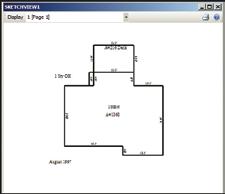
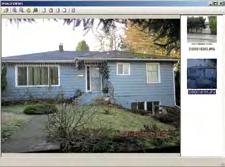
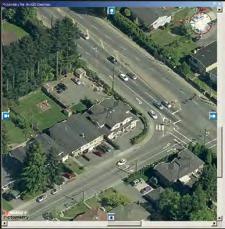
Combining technologies at the appraiser’s desktop, BC Assessment appraisers can review property data, aerial imagery, street front photos, building sketches, and property data within a map.
With a click of a button, the information is synchronized based on the property being reviewed—Figure 1. BC Assessment classifies the building sketches based on how closely they match the aerial photo imagery. They can then be reviewed within the mapping software for “red-flags,” such as large renovations or additional buildings on a property that were not previously captured in the system.
1.
Spatial data is also crucial for reviewing certain aspects of property information. BC Assessment strives to have fair and equitable property assessments, but errors do make it into the system. A quick and easy way to review some property attributes is through a map.
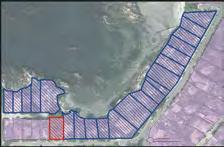
Everyone knows that waterfront properties are often worth more than others. Using GIS, this coding can be audited in a digital map with oceans or lakes visible. Any properties that are incorrectly coded for waterfront will be immediately noticeable and can be corrected from the desktop (Figure 2). The same type of review can also be done with other property attributes such as being adjacent to busy roads or next to a park.
By utilizing a GIS, BC Assessment is constantly improving the quality and accuracy of its assessment data. In turn, property tax revenues for communities are optimized, which equates to better funding for our roads, schools, community centres, and police and fire departments.
Figure 2. A spatial review of property attributes, such as waterfront
With so many different property attributes to maintain, monitoring trends for crucial insight can also be mapped out. Quality assurance statistics are commonly used to determine how well properties, neighbourhoods, or jurisdictions are doing based on actual sales (Figure 3).
A commonly used statistic is Assessment-to-Sales Ratio (ASR). That gives BC Assessment the ability to review properties that may be assessed significantly higher or lower than market value.
An ideal ASR would be 1.0. Lower values indicate a lower assessment than market, and higher values indicate a relatively high assessed value. Viewing this data in a map enables decisionmakers at BC Assessment to see trends in areas and regions that could not otherwise be seen in a table or report.
Comparable sales can also be rendered in a map, using GIS. Properties with similar attributes and values can be visualized spatially
to see how comparable sales relate based on where they are located.
A final illustration of how GIS analysis improves the quality of data at BC Assessment is doing a spatial comparison. One example is the Agricultural Land Reserve (ALR).
The ALR was created by the provincial government to protect current and potential arable land from being developed.
BC Assessment uses codes for ALR land on a property-by-property basis. By overlaying the official ALR boundary with BC Assessment’s mapped properties, appraisers are able to see where properties may require ALR coding and the tax exemptions associated with it. By overlaying all that information with aerial photos, appraisers can further determine land use on those properties.
British Columbia is a diverse province with an ever-increasing number of properties. BC Assessment must make the most of GIS technology and the spatial data available, such as aerial photography, to fulfill its public commitment of being fair and equitable in its assessments.
As expectations for more mapbased access to data and information continue to grow, so too will BC Assessment continue to use and explore cutting-edge GIS technology to deliver its mandate. s
Tom O’Brien is Senior geographic Information Systems (g IS) analyst for BC assessment. a graduate of Royal Roads university, he has over 15 years of experience with British Columbia mapping.
tom.obrien@bcassessment.ca www.bcassessment.ca
Figure
Desktop review of multiple datasets synchronized by property
Figure 3. Reviewing property statistics for spatial trends
Liza Aboud
The 2013 International Land Title Conference
AND OTHER I MPORTANT N EWS FROM THE LTSA
The LTSa team has been busy this year managing the following projects.
2013 International Land Title Conference
From October 2 to 4, 2013, the LTSA hosted the 2013 International Land Title Conference. The Conference brought together the annual meetings of the Canadian Conference of Land Title Officials and the Australasian Registrars of Title Conference.
The event was a resounding success on all fronts, and the LTSA appreciated the support of The Society of Notaries Public as an event sponsor. Conference attendees were welcomed from across Australia, New Zealand, Hong Kong, Singapore, Canada, Scotland, Ireland, Northern Ireland, England and Wales, Trinidad and Tobago, and Tanzania.
Topics included the Sovereign Citizen’s movement and mortgage fraud—both courtesy of Ron Usher’s engaging presentations, and presentations were made by delegates on the development of Queensland’s new cadastre; the evolution of land title service delivery models in British Columbia, Saskatchewan, and Manitoba; e-conveyancing and e-registration; and many others.
The Canadian Council on Geomatics Cadastral Committee’s
An unexpected outcome of these achievements was the LTSA being recognized by BC Business magazine as one of the top 20 most innovative companies in BC.
meeting of Surveyors General and Directors of Survey across Canada was co-located with the conference; the Committee met with Canadian land title officials in a joint session.
A total of 240 LTSA stakeholders and core conference attendees heard the compelling conference keynote discussion by economist Hernando de Soto on how the lack of property rights sparked the Arab Spring. The ensuing insightful Q&A session focused on the empowerment of indigenous cultures.
Subsequent keynote panel presentations included an overview of the Indian Act by professor Paul Salembier, a discussion of the Nisga’a Land Title Registry by registrar Diane Cragg, and a discussion about the community engagement in land titling in Tanzania by land title executive Seraphia Mgembe.
The LTSA is part of a working group to ensure that the conference leaves a lasting legacy by establishing
a forum for international dialogue on issues of land registration.
e-filing
It’s been just over 1 year since the successful conclusion of the LTSA’s Business Modernization Initiative and the implementation of the last major phase of Required E-filing.
Over 90 percent of applications to the land title are now e-filed; about 40 percent of those applications are automatically examined by the LTSA’s ASTRA system. An unexpected outcome of these achievements was the LTSA being recognized by BC Business magazine as one of the top 20 most innovative companies in BC.
The LTSA also won the Team of the Year award from the BC Technology Industry Association. In turn, the LTSA acknowledges the support of its stakeholders.
myLTSA Customer Portal
The new myLTSA customer portal will integrate the LTSA’s existing Electronic Search and Filing Services with new mailbox functionality and account, payment, and support services. BC OnLine will continue to operate and offer the other services hosted on its portal. The myLTSA portal will be accessed via www.ltsa.ca and will be fully operational May 1, 2014.
A preview of portal functionality can be seen in the recently launched
myLTSA Inbox that improves service delivery through longer document retention periods for documents and other customer-friendly features.
The LTSA will begin to transition different customer groups to myLTSA in a phased manner in early 2014 and instructions will be communicated to each group in advance of the transition process. To ease the transition, no significant changes are planned for the initial release of core Search and Filing services.
A new, simpler way to pay for title searches is being created for the over 3000 LTSA customers who conduct less than 20 title searches per year and don’t order any other LTSA services; myLTSA will accommodate those customers by enabling them to order title searches using a PID or title number, and to pay using a credit card.
The LTSA extends many thanks to Notaries Public, lawyers, land surveyors, registry agents, Realtors, and other stakeholders for providing ongoing input into the design of myLTSA and testing new functionality before it is released.
ParcelMap BC
The LTSA will develop and operate ParcelMap BC (PMBC), creating a single, complete, trusted, and sustainable electronic map of all titled parcels and surveyed provincial Crown land parcels in BC. The resulting framework will form a complete visual portrayal of parcels connected with information in the Land Title Register and Crown Land Registry.
While the provincial government and many local governments have individually compiled portions of a provincial parcel fabric, BC as a whole is lacking in its ability to provide easy and effective access to land title and Crown land information geographically.
The several disparate parcel fabrics that exist today are maintained on a “best efforts” basis that does not address the clear industry and government need for a single, complete, trusted, and sustainable map of all titled parcels and surveyed provincial Crown land parcels.
A Request for Proposals to build PMBC was sent to pre-qualified proponents in Summer 2013. It is expected that development of PMBC will begin in mid-2014 with the first operational release scheduled for early 2015. An incremental approach to parcel fabric compilation will be employed, with completion and full operational capability expected in 2016.
The LTSA is working in close partnership with the Province, BC Assessment, the Integrated Cadastral Information Society, and the Association of BC Land Surveyors in the development of PMBC.
The LTSA will begin to transition different customer groups to myLTSA in a phased manner in early 2014…
upcoming Changes to the Electronic Filing System
Authorized Subscriber Register
The Authorized Subscriber Register (ASR) is the LTSA’s register of statutory officers and BC Commissioners who have been approved by the Director of Land Titles to be subscribers for the purpose of electronically signing land title documents.
Many of these documents are currently manually filed; switching to the use of certain electronic forms that contain specific natures of interest in land will increase security over current manual filing processes.
To become a subscriber, an individual and the organization for which the person works must apply to the LTSA for membership in the ASR and must specify the land title forms and natures of interest needed to be signed electronically to continue carrying out the organization’s business or mandate.
Form C – Charge, Form C –Release, and Form 17 will be the forms most commonly electronically filed by ASR members. Examples of electronic filing by ASR members include a public utility registering
or removing their lease or statutory right of way from title, the Province registering liens for child maintenance payments in arrears, a local government registering notices of permit, and a bank registering Form C – Releases to discharge mortgages from title.
Applications for ASR membership are reviewed by the LTSA for compliance with the Director’s Requirements. ASR members and their organizations must adhere to the Director’s Requirements for membership and must renew their memberships annually.
Exemptions from Requirements to e-File
When the three phases of Required E-filing were implemented in 2011–2012, the Director’s Requirements to File Land Title Forms Electronically contained a number of exemptions from e-filing for certain classes of applicants or application types. These exemptions were created to provide the LTSA with time to consult stakeholders to develop a mechanism to permit new classes of subscribers to electronically file what they currently manually file with the Land Title Office. These new classes of subscribers are statutory officers and certain BC Commissioners for Taking Affidavits appointed under section 56 of the Evidence Act.
Over time, as the ASR becomes broadly available for applicants who are currently exempt from e-Filing Requirements, and after consultation with affected stakeholders, the Director will remove the current exemptions for government and regulated public utility, telecommunications, and oil and gas companies.
Electronic Submission of Releases of Mortgage
For many years, a hardcopy Form C –Release of Mortgage has been listed as a supporting document that can be scanned as a PDF image and attached to an electronic Form 17. This method of electronic submission brought some efficiency to applicants, who did not have to deliver the originally signed
George E.H. Cadman, Q.C.* 604 647 4123 | gehcqc@boughtonlaw.com
With over 30 years’ experience, George makes the complex simple to resolve your real estate or corporate disputes.
*Member of the Notaries Public Board of Examiners
We Value Canada
With the recent introduction of automated examination processes at the Land Title Office, there is an increased reliance on machinereadable electronic forms.
Form C – Release to the Land Title Office. Of course, the preferred (and more common) method of submitting a Form C – Release of Mortgage is to submit the electronic version of the form.
With the recent introduction of automated examination processes at the Land Title Office, there is an increased reliance on machinereadable electronic forms. When a hardcopy Form – C Release of Mortgage is submitted as a supporting document, it cannot be examined using those automated processes.
The Director of Land Titles is considering changes to electronic forms that will result in the elimination of a hardcopy Form C – Release of Mortgage as a supporting document. These changes will mean that all applications to release a mortgage submitted by lending institutions or legal professionals will have to use the electronic Form C – Release. s
When the market’s changing, whom can you trust? Call the experts: AIC professionals.
We’re Canada’s leading authority in real property valuation. Designated AIC members can help you make smarter choices with in-depth analysis, market insights and practical solutions.
• Acquisition • Management • Development • Portfolio Diversification
Look for members who hold the AACI, P.App, or CRA designation.
Liza Aboud, m Ba, aBC, is Vice President, Business Development and Communications, for the LTSa. She oversees new business initiatives, strategic partnerships, product management, and communications. Prior to joining the LTSa in November 2007, Liza was the National Director of marketing at a full-service law firm. She has over 20 years of strategic marketing, communications, and investor relations expertise gained in the legal, technology, utilities, and advertising sectors. Liza has a Ba in Economics and an m Ba in marketing and International Business, both from mcgill university. She is accredited by the International association of Business Communicators.
liza.aboud@ltsa.ca www.ltsa.ca
Business To Business
Patricia Wright
The Land Title System in Peru
WITH H ERNANDO DE SOTO, I NTERNATIONAL L AND ECONOMIST
Iwas fortunate to attend the LTSa luncheon at the International Land Title Conference 2013 in october that featured Hernando de Soto as keynote speaker.
Mr. de Soto is an economist from Peru, included by Time magazine as one of the 100 Most Important People of The New Millennium. He has advised many world leaders including Bill Clinton, George W. Bush, Ronald Regan, Vladimir Putin, Vicente Fox of Mexico, and Hamid Karzai in Afghanistan.
Mr. Clinton believes de Soto is the world’s greatest living economist. De Soto and his Institute for Liberty and Democracy have set some 400 initiatives and laws into the Peruvian system. The economy in Peru has since soared. His zest for speaking is infectious and his storytelling skills make him a most interesting speaker.
Forbes magazine named de Soto 1 of 15 innovators who will change the future. He believes that capitalism can distribute wealth. He focuses on the underground economy that operates in developing countries. He believes the poor accumulate assets in their shanty homes and small businesses but, because they have no property rights without officially recorded ownership, they cannot access credit or have protection through the Courts to safeguard their assets.
He discussed how under the feudal system in many countries, the common person did not own land. The change that has broken the poverty cycle in developed countries is the creation of property rights. De Soto said that in Peru, once property titles were given to more than 1.2 million families, the people felt more secure about their homes and were ready to make improvements or leverage their homes for investment in business or in education.
The economy began to flourish.
He notes that all developed countries have gone through a transformation to a formal legal title system. It allows us to own, mortgage, and sell our property and leverage it into wealth.
Hernando de Soto
Photo credit: Ramsay Bourquin
Manny Jules
Of particular interest is his friendship with Manny Jules, Chief of the Kamloops Indian Band for 16 years and a proponent of the First Nations Property Ownership Initiative. When Mr. Jules came to the microphone, he stated that we hold something he could never have. We can sell and mortgage title to our land and he cannot.
Jules and de Soto are great friends. Jules recognized that the arguments de Soto made mirrored his own thoughts and he travelled with de Soto to the Peruvian jungles to meet with the indigenous peoples in the Amazon. They talked about title and how title could benefit the people through corporate revenues generated from oil and gas on their lands. Property rights ensure control by affirming the rightful owner of the real estate or resource.
The indigenous people had ancestral rights to the territories but did not hold title to their lands, similar to our First Nations. Jules was also instrumental with the Nisga’a Final Agreement that allowed for private ownership of native land, a huge accomplishment for the people of Nisga’a.
If you have the chance to see Mr. de Soto speak, I encourage you to do so. His presentation brought to light issues that many of us had not considered and he is a thoroughly enjoyable speaker. It made me very proud to be a Notary Public with our history of assisting with the recording of titles.
I look forward to following Mr. de Soto’s pursuits and reading about his future successes. s
Patricia Wright is a Notary Public with 30 years of experience. She practises in downtown Vancouver. Her focus is real estate conveyancing and mortgage work.
please contact Diane Haarstad at 1-888-663-3033 or dhaarstad@bcchf.ca.
Brenda Southam
COLLABORATION & CONNECTIONS
BC Land Summit 2014
In 2000, the Professional Education Round Table was formed by representatives from several professional land use organizations.
It was agreed that a joint conference is one of the best approaches to share professional development opportunities.
The Primary Objectives
• Create a conference that is interactive and encourages networking between and among professionals.
• Create a broader and richer event than any one professional organization.
• Share knowledge between and among professional organizations.
• Enjoy the synergy of a shared major event.
• Collaborate and foster awareness of the interdisciplinary nature of the professions.
• Showcase best practices and collaborative solutions and case studies that highlight working solutions.
• Generate ideas and a future professional vision for land use and management in BC.
• Incorporate an interdisciplinary trade show profiling products and services.
From that round table discussion, the 2004 BC Land Summit was born. The inaugural summit Working Together for Better Results was held May 12 to 14 at UBC. It was the first time five professional land use organizations worked together to create one conference.
The Partners in 2004
• Appraisal Institute of Canada – BC
• BC Institute of Agrologists
• BC Society of Landscape Architects
• The Planning Institute of BC
• The Real Estate Institute of BC
The 2014 BC Land Summit—Collaboration & Connections—is being held May 14 to 16 at the Sheraton Vancouver Wall Centre in downtown Vancouver.
In 2009, the second BC Land Summit was held—A Better Future: Adapting to Change May 20 to 22, at the Telus Whistler Conference Centre. A sixth organization, BC Land Trust Alliance, joined the partnership as a one-time partner. Despite widespread global economic uncertainty, about 850 delegates attended.
During the years that followed, the five partner organizations were
in discussion regarding the next Land Summit conference. In 2012, the BC Land Summit Society (BCLSS) was formed and incorporated under the Society Act of BC, to enable the organizers of the 2014 BC Land Summit to function as a society, purchase insurance, hold contracts, and so on.
The 2014 BC Land Summit Collaboration & Connections— is being held May 14 to 16 at the Sheraton Vancouver Wall Centre in downtown Vancouver. The major sponsor is the Real Estate Foundation of BC. The Mayor of Vancouver Gregor Robertson has declared May 14 BC Land Summit Day.
The BC Land Summit Society is excited to hold this inaugural event under the newly formed organization. We anticipate 1000 to 1200 delegates will attend. There is something for every professional who works in land use in BC.
There will be four streams of educational opportunities across the five professional organizations that are members of the BCLSS.
• Water and the Land
• The Law and the Land
• Agriculture
• The Natural and Built Environment
The BC Land Summit Society is excited to hold this inaugural event…
The lineup of keynote speakers is amazing.
Wade Davis Anthropologist, Author, Explorer
Chris Hadfield Astronaut, Former Commander of the International Space Station
Louise Mandell Queen’s Counsel, Doctor of Laws (Hon.)
Catherine Murray Co-Host and Anchor for BNN, Former VP at Deutsche Bank
The rest of the program is in the development stage. As in 2009, the BC Landscape Architects will take the lead on the logistics of a Showcase of Products and Services.
Exhibitor space is available to allied nonprofits. Because the other members of BCLSS do not traditionally include a trade show as a conference component, the BC Society of Landscape Architects will take the lead.
There are sponsorship opportunities for everyone to participate. For further information on the program, speakers, sponsorship, and so on, please check out the website by the end of December.
www.bclandsummit.com
We look forward to having you join us! s
Brenda Southam, C aE, is Executive officer of the Real Estate Institute of BC and Director of BCLSS.
Telephone: 604 685-3702, X 104
Douglas Janzen
Celebrating 75 years of Expertise in Canadian Real Estate Valuation!
In the 1930s, “land inspectors” from the Winnipeg area wanted an organization that would promote the exchange of ideas pertaining to land valuation and inspection; the a ppraisal Institute of Canada ( a IC) was formed in 1938.
The need was driven by the impact The Great Depression had on property values, particularly in
the Prairie Provinces. The formation of the AIC brought a code of ethics, professional standards, education, and the opportunity for interested parties to obtain an unbiased opinion of real estate value. Prior to the formation of the AIC, land value judgments were often rendered primarily by real estate brokers to facilitate a transaction. As the AIC developed and grew, the increased professionalism and objectivity of AIC members provided purchasers and lenders with greater confidence in the independent valuation of real estate.
The formation of the AIC brought a code of ethics, professional standards, education, and the opportunity for interested parties to obtain an unbiased opinion of real estate value.
While the AIC has its roots in the agricultural sector, by 1948 a new focus on urban real estate was beginning to dominate; the organization had grown nearly 10-fold from its original 146 members. Today the Appraisal Institute of Canada has over 4800 members—almost one quarter are in British Columbia.
The Appraisal Institute of Canada –British Columbia is a leader among the other provincial associations in supporting member development, education, professional standards, promotion, regulation, and advocacy. The education courses required nationally by the AIC for designation are delivered through the University of British Columbia (UBC) Sauder School of Business in Vancouver.
Today’s Appraiser must meet and maintain stringent education and continuing professional development standards to retain membership and professional designation. AIC designations (CRA for Canadian Residential Appraiser and AACI for Accredited Appraiser Canadian Institute) are recognized worldwide and set the predominant standard for appraiser accreditation in Canada.
Sharing the ideals of the Appraisal Institute of Canada founders, today’s professionals are committed to the protection of the public interest through the development and publication of professional and unbiased opinions. Modern professional appraisers often provide knowledge and information far beyond a simple opinion of value for mortgage purposes. Many of our members provide consulting services to facilitate the following.
• Land claims settlements
• Expropriation
• Land development and redevelopment
• Industrial, commercial, and residential construction projects
• Highest and best use studies
• Depreciation reports for strata councils
• Taxation consultancy
A successful appraiser is inquisitive and curious, personable and broadminded, observant, logical, and motivated. A significant amount of time is spent outside the office dealing with people, examining various property attributes, collecting and confirming data, and investigating property issues.
Appraisers often develop expertise in building construction, land development, economics, finance, business, and law. An appraiser who specializes in holiday resorts may travel the world inspecting properties; another may focus on Aboriginal issues and have the opportunity to visit remote communities throughout Canada; expertise in agribusiness may result in tours through wineries and vineyards, which are far more extensive than what is typically seen by the public.
The BC Land Summit will be held in May 2014. Attending a conference that includes members of the Appraisal Institute of Canada – BC, BC Institute of Agrologists, the BC Society of Landscape Architects, the Planning Institute of BC, and the Real Estate Institute of BC is an opportunity to learn through seminars, make new contacts, and renew old relationships with professionals in the industries on which Appraisers rely for information.
Just as the early “land inspectors” desired an organization that would foster the exchange of ideas pertaining to land value, today the organization recognizes the great benefit that conferences such as the BC Land Summit provide. s
Douglas Janzen, P ag, aaCI, a Real Estate appraiser and Professional agrologist for over 20 years, is Vice President of the appraisal Institute of Canada – British Columbia. info@appraisal.bc.ca www.appraisal.bc.ca
Jack Wong
Transforming Land use attitudes and Practices
as we approach the end of a quarter century of grant-making, the Real Estate Foundation of BC has much to celebrate.
Since the Foundation’s grants program was launched, we have awarded over $64 million to nonprofit organizations working to improve BC communities through responsible and informed land use, conservation, and real estate practices.
As a philanthropic organization, the focus of the Foundation is on projects that serve the public interest. Much like BC’s Notary Foundation and Law Foundation, the Real Estate Foundation has a provincially legislated mandate; in our case, it is to support real estate-related research, education, and law reform.
Our View of Land
The Real Estate Foundation takes a broad view of land, which ties in with our philanthropic mandate. Balancing private and public interests in landrelated policy and practice leads to social, economic, and environmental benefits for individuals, communities, and society. Understanding the relationship between nature and society and what each needs to thrive helps determine our collective well-being.
Contrary to popular belief, the viewpoints of conventional business and commons —the land’s natural capital that exists for everyone’s benefit—are not at odds. Studies have shown the following.
…the Foundation’s focus is on projects that serve the public interest.
• Residential properties adjacent to natural areas have higher market value than comparables only slightly farther away.
• People who work in green buildings have higher job satisfaction and fewer illnesses and are therefore more productive.
• Businesses that adopt sustainability practices—such as preventing waste or increasing energy efficiency—save money, which improves their profitability.
The Foundation’s Role
The Real Estate Foundation’s mission is to transform land use attitudes and practices through innovation, stewardship, and learning. We fund initiatives that enable a range of nonprofit organizations—local governments, professional associations, education institutions, community groups—and individuals to gain knowledge, adopt new policies and beneficial practices, and determine how best to implement them.
For the real estate profession, our grants support industry organizations’ research, education, and law reform initiatives, recognizing it is in the public interest to deal with informed, competent practitioners.
The Real Estate Foundation has developed a funding niche that has broad reach in British Columbia—
advancing “sustainable land use.” It has many aspects . . . vibrant downtowns, healthy watersheds, wellplanned mixed-use neighbourhoods, affordable housing, green buildings, food-secure communities . . . the list goes on. Because the topic is so broad, we have found it useful to establish focus areas for our grant program.
In 2012, after consultation with sector experts, we selected Built Environment, Freshwater Sustainability, and Sustainable Food Systems as our three granting priorities under the larger “sustainable land use” heading. Those areas are integral components of sustainable communities—and topics the Foundation has been supporting for many years.
The Foundation made a grant to help Atira Women’s Resource Society build this innovative recycled shipping container housing project in Vancouver’s Downtown Eastside. The project won the 2013 nonprofit sector Land Award.
More than Grants
Granting is just one aspect of what we do at the Foundation. We connect people, through one-on-one conversations and meetings within and across different sectors. Being a catalyst is an important aspect of our work.
Because of our broad real estate and land use mandate, the Real Estate Foundation is part of several circles and networks. Among our funding peers, we participate in Food Funders, Water Funders, and Social Purpose Real Estate Tables, coming together with organizations that have varied interests in food security, fresh water, and making property accessible to mission-based organizations for economic and social benefit.
While we approach potential projects with a “real estate/land use” lens, conversations with others who may have different perspectives or funding mandates can lead to new opportunities and collaborations.
More generally, the Real Estate Foundation’s position as a nonprofit, philanthropic organization, established by government, with industry roots, often allows us to play a pivotal role. The Foundation is quite naturally able
to link people and organizations that might not otherwise connect.
That is true in our daily business of reviewing grant requests, learning about organizations and their initiatives, and sharing outcomes of completed projects through our communications channels.
It is also true of the Land Awards, where our annual gala brings together a diverse group of people from different sectors to celebrate sustainable land use leaders—and
expands the network of people who are building knowledge and awareness about how each of us can contribute to resilient, healthy communities and natural environments wherever we live or have influence.
Back to the Land
In all its work, the Foundation aims to transform land use attitudes and practices for BC residents and future generations.
Whether it is groundwater research in Hudson’s Hope, sustainable building practices in Ahousaht, new urban farming models in Vancouver, or a strata dispute-resolution tool for all of BC, advancing sustainable land use for the benefit of British Columbians is foremost on the agenda. We are privileged to be able to contribute to this province by supporting initiatives that generate and share information, and improve policy and practice based on new knowledge. We take our responsibility very seriously.
The Real Estate Foundation of BC has seen much change in the province over the past 25 years. The increasing speed of technological change has made us even more aware of the extent to which communities are interdependent—locally and globally— both with one another and with the natural environment.
What has not changed is the fact that we depend on the land. It is up to all of us to be good stewards. s
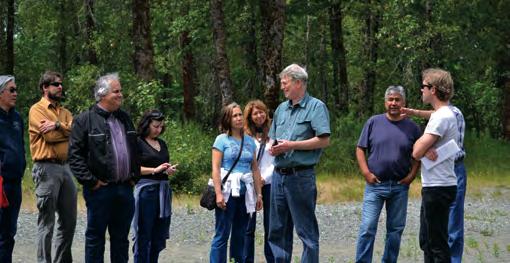
In June, the Real Estate Foundation Board and staff visited the Cowichan River in Duncan with members of the Cowichan Watershed Board to learn about local watershed issues.
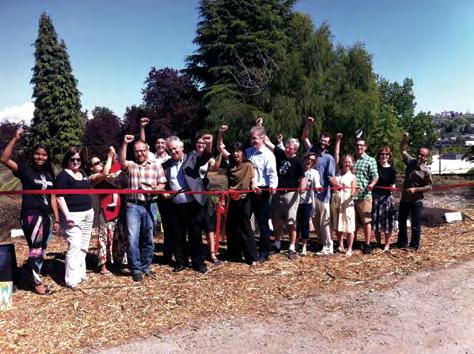
Foundation Vice Chair Scott Ullrich (centre, in blazer), participated in the Fresh Roots Urban Farm opening at Vancouver Technical Secondary School, with the farmers themselves, students, teachers, and other funders.
Jack Wong
The 2013 Land awards
on the evening of october 25, 250 people gathered at the Four Seasons Hotel Vancouver for the 2013 Land awards gala, hosted by the Real Estate Foundation of BC.
David Beers, founding editor of The Tyee, was master of ceremonies for the event and Tony Stewart, CEO of Quails’ Gate Winery, gave the keynote presentation. He spoke about his family’s history farming in the Okanagan, sustainability challenges facing the wine industry, and making choices that consider what is right for the land and the community, and for financial prosperity.
The Real Estate Foundation introduced the Land Awards to recognize initiatives demonstrating leadership, innovation, and collaboration related to the sustainable use and conservation of land. Our goal was to raise awareness of BC projects that are creating new models for sustainable land use—for planning, development, and conservation work that not only implements best practices, but also creates them.
Our goal was to raise awareness of BC projects that are creating new models for sustainable land use…
This year, the selection committee short-listed eight finalists in three categories—private, public, and nonprofit sectors, with one winner in each category. The Foundation also selected an individual award winner, our Land Champion.
This Year’s Winners
Private Sector
The Net Positive Housing Project by Lanefab Design/Build—the energysaving innovations behind emerging laneway housing developments in Vancouver
Public Sector
Solar Colwood by the City of Colwood— bringing the whole community together to reduce energy consumption and implement renewable clean energy technologies in homes and businesses on Vancouver Island
Nonprofit Sector
Container Housing Project by Atira Women’s Resource Society— transformation of recycled shipping containers into a 12-unit social housing development in Vancouver’s Downtown Eastside
Land Champion
Carol Newell—through the integration of philanthropy and investment, Carol Newell has strategically used her wealth to protect millions of hectares of land of high ecological, cultural, and recreational value.
In congratulating the winners, I want to recognize the significant contributions of all the finalists—and the projects that were nominated this year. Their work represents much
Thanks to the Sponsors of the 2013 Land Awards Gala
BC Housing
BC Notaries
BCIT School of Construction and the Environment
British Columbia Real Estate Association
Bullfrog Power
Canadian Home Builders’ Association – British Columbia
Gateway Property Management Corporation
The Globe and Mail
MNP LLP
North Growth Management Ltd.
RBC Wealth Management – PH&N
Investment Counsel
Real Estate Board of Greater Vancouver
Real Estate Council of British Columbia
Ridgewood Capital
Asset Management
River Market
Signals Design Group
UBC Sauder School of Business, Real Estate Division
250 guests attended the fourth annual Land Awards Gala, celebrating achievement in sustainable land use.
Tony Stewart of Quails’ Gate Winery gave the keynote presentation on sustainability challenges in the wine industry.
of the good work occurring in BC; we are immensely honoured to be able to share their accomplishments with a greater audience.
You can see the finalist videos and photos from the evening on our website. www.refbc.com
The Real Estate Foundation of BC provides grants to nonprofit organizations working to improve BC communities through responsible and informed land use, conservation, and real estate practices. The Land Awards Gala is one way the Foundation is able to connect with communities and organizations to share information on BC land use issues so they can best influence change in this area. s
Jack Wong, FC ma, is CEo of the Real Estate Foundation of BC.
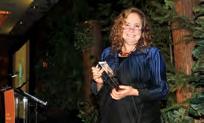
Carol Newell received the 2013 Land Champion Award
Land Champion: Carol Newell
The Real Estate Foundation of BC’s Land Champion is honoured for outstanding work in sustainable land use in the province. Ms. Newell has strategically invested her wealth to conserve millions of hectares of land. On Cortes Island, she worked with the local community to make land available for housing, parks and trails, and conservation. Ms. Newell’s innovative approach to philanthropy and investment has provided BC residents with a lasting legacy through her work in conserving land of high ecological, cultural, and recreational value. The Real Estate Foundation is proud to name her the 2013 Land Champion.
Judi Whyte RI
Pioneering in Northern British Columbia
grounds. The people came in droves, searching for their Promised Land. With us both born in Canada, we had taken all that for granted.
“give
me land, lots of land, ‘Neath the starry sky above, Don’t fence me in.”
Someone may well have been crooning that Cole Porter hit song when my husband John and I were in our respective wombs.
It wasn’t announced to us at birth or even in our childhood that we were destined to be landowners. We were in our late 20s when opportunity, standing right next to the wolf, knocked at our door.
Land was a dream that drew immigrants from all corners of the world to populate Canada. Some were promised trains from sea to sea, prosperity, and freedom from persecution on religious and political
John’s grandfather came from Holland. He stowed on a trade ship at 13 and was forced to stay and work off his passage once he was discovered on board. We had heard the stories of his success in Canada, from shovelling coal into the black puffing engines of the CN and working his way up the ladder to become the engineer on one segment of the Queen’s Tour train in 1959. Crossing the prairies on the ribbon of steel for 40 years, he’d seen many settlers, dreamers, and land purchasers come and go.
They all knew and understood that land was the key—if you could get it and afford to keep it.
We had also heard the stories of failures, of my family’s loss of their farm on the Prairies during The Depression, and how most of them turned their losses from farming into successes in other avenues. They all knew and understood that land was the key—if you could get it and afford to keep it.
We drew on the family to provide us with the first 100 acres of land and
bought it outright, built a home there, and began to log the acreage, clear the stumps, and disc and plant the fields to put us in a position to make application for agricultural leases.
To apply for leases at that time, a person had to be an “existing farmer” owning more than 80 acres with more than 80 percent under cultivation. In the early 1980s, we were excited to sign agricultural lease documents to acquire an additional four quarter-sections.
What we didn’t know was the amount of hard labour involved in changing bush land into farm land. We had very little money when we signed the leases and the clock began to tick off the 10-year time frame of the near-impossible mission of complying with the terms of the agricultural lease.
This endeavour was not out of the ordinary. For untold years, farmers had toiled to obtain land. Acre by acre we eked out a living, raising cattle and hay while teaching our children how to work hard for what they believe in and that good things come to those who wait.
The outright purchase of the agricultural leases at the end of the 10-year term was our pot of gold. Once our cattle herd increased and our land was in production, we needed more grazing land. The Crown land bordering our ranch was perfect and we began the paperwork to obtain a grazing lease.
James
Cranberry Creek Ranch
Woodlot 1495
We constructed dugouts at strategic places to hold water from the melting Spring snow. We created seeded cat trails out into the brush that would lure cattle along in search of food.
By taking advantage of the opportunity of Crown land lease, we always had plenty of grass throughout the Summer because the standing timber shaded the grass on the trails. The tame grasses grew as high as our feet in the stirrups of our saddle horses as we rode the trails checking on the stock as they drifted about. Step two in building our farm was complete.
When BC Forest Service offered new woodlots to the people of the province, we seized that third opportunity to obtain land that would provide for us. We competed on the open market under the required segments.
In our application we offered to reforest our non-arable private land and detailed our education and experience in forestry. We also lived in the closest proximity to the woodlot we wanted. After a very close race for first place, we won the competition for Woodlot 1495.
We now had the timber licence over 600 hectares of land adjacent to our farm. The timber lease also covered our grazing lease and the woodlot became another means of supporting our family.
Our “kingdom,” as we sometimes call it, was complete. We had taken advantage of every opportunity the BC Government provided to obtain land. We had been given a chance, much like the settlers who first came to this country. With hard work, we had fulfilled our dream.
In our spare time, we enjoy hunting, fishing, boating, snowmobiling, and travelling.
Recently taking some acquaintances on a tour of our ranch, grazing lease, and woodlot, they remarked, “You guys sure are lucky.” I was a bit taken back by that statement because I never considered luck had come into play.
I guess it was luck to a certain extent. We are very lucky to be living in a land that has given us so much opportunity to support ourselves and realize our dreams.
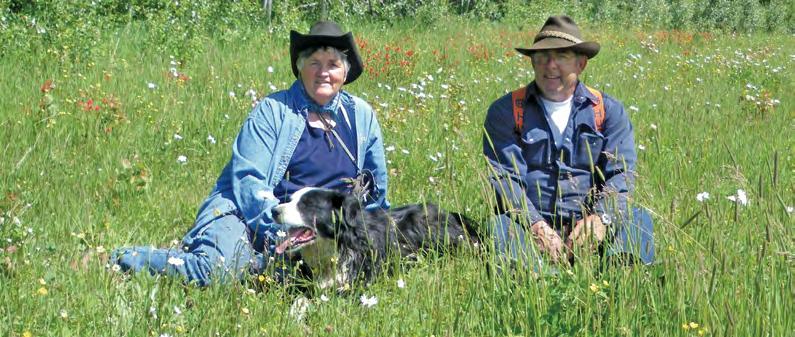
We live on the 800-acre Cranberry Creek Ranch we created in the beautiful Necoslie Valley, east of Fort St. James. We raise beef without using herbicides, pesticides, and hormonal implants. We cut our own lumber and timbers in our little sawmill from timber off the woodlot. This Fall, we were awarded
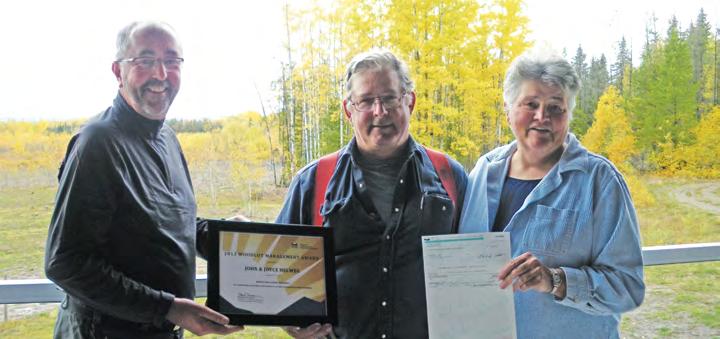
the Woodlot Management Award for the North area of British Columbia by the Ministry of Forests, Lands and Natural Resource Operations.
Most of his life, John has worked in the logging industry, operating heavy equipment. I am presently working as a Roving Notary Public.
In our spare time, we enjoy hunting, fishing, boating, snowmobiling, and travelling. We are both assisting the Woodlot Association in Scotland to set up their very first woodlots. I remain very active in community volunteer activities with the Fort St. James Community Foundation Society and the “Save the Courthouse” Historical Project but I still maintain time to work as a writer. I am presently working on a historical novel and a book of short stories.
Our Cranberry Creek Ranch business card states
Solitude or Excitement and Adventure
Depending which day you arrive.
Caution: Days are not determined which is which until sundown. s
Joyce Helweg is a Roving Notary in the province.
joyhelweg@gmail.com www.joycehelwegauthor.com
Joyce and John receiving the Minister’s Woodlot Management Award for the North at their home in Fort St. James from Mark Clark, President of the Federation of BC Woodlot Associations
Andrea Agnoloni
Deductibility of Carrying Charges of Vacant Land
Investment in vacant land has always been an attractive proposition for Canadian investors.
The typical investor sees an opportunity in a parcel of land for future development, speculation, or mere enjoyment and buys the land with cash or uses an existing line of credit. Usually, the land is kept for years. The holding costs are minimal, just property taxes and, if the purchase was financed with a loan, interest charges.
The most common question our clients ask is this: Can the interest and property taxes paid be deducted to reduce any capital gains when the land is sold?
The basic principle is found in paragraph 18(2) of the Income Tax
Can the interest and property taxes paid be deducted annually to reduce any capital gains or only when the land is sold?
Act : Interest on debt relating to the acquisition of land or property taxes paid in respect of land to a province or to a Canadian municipality is not tax deductible.
There are some exceptions to the rule.
• If the land was used at any time during the year in the course of a business, the provision of the section does not apply. For example, if the land was used at any time to store inventory as part of the business, the rule does not apply and the expenses would be fully deductible in computing income in the year. That exception
does not apply to land developers where land is held for resale or development.
• If the land was used for rental, you may deduct interest and taxes to the extent of the income from the land for the year; the expenses can be claimed to offset the rental income but no loss can be generated in any particular year by claiming the expenses.
There is some relief to the taxpayer for the lost deductibility of the expenses. Paragraph 53(1)(h) allows for the expenses denied under paragraph 18(2) to be added to the cost of the land that is capital property or that is held as inventory.
Much attention must be paid to paragraph at 53(1)(h). The additionto-the-cost basis of the land is allowed for the expenses disallowed by virtue of 18(2), in the calculation of net income from business or property. Therefore, the land must be held as part of a business or for rental purposes. In any other cases, the addition-to-the-cost basis is not allowed.
Whether a purchase of land is an adventure or concern in the nature of trade or is for investment purposes is a question of fact…
The problem is found when a taxpayer purchased a parcel of land, held it for many years, then sells it at a profit. In calculating the cost basis of the land, the taxpayer adds the interest and property taxes for all the years he or she owned it. In this case, paragraph 53(1)(h) does not apply to increase the cost because the land was not used in connection with earning income from a business or property. All the expenses are then nondeductible and are lost.
An adjustment to the cost of land is also available under paragraph 10(1.1) for land held as inventory by a developer or a dealer. In this case, any profit or loss from the sale of the land is treated as ordinary income and taxed at 100 percent, as opposed to a capital gain, which is taxed at 50 percent.
An isolated purchase of land could raise the concept of an adventure or concern in the nature of trade. Such purchase could classify the land as inventory and the disallowed expenses would be added to the cost—but any profits from the sale would be fully taxable as business income. On the other hand, any losses would be fully deductible.
Whether a purchase of land is an adventure or concern in the nature of trade or is for investment purposes is a question of fact; all the circumstances must be analyzed, such as the taxpayer’s conduct, the nature of the property, the taxpayer’s intention, and length of holding.
As mentioned earlier, the isolated purchase of land for investment purposes only may cause the carrying costs to be disallowed, although any profits will be taxed at 50 percent as capital gain. Therefore in such cases it is recommended to rent out the land to enable the costs to be deducted to the extent of rental income or at least to be added to the cost of the land.
Because of the complex nature of this subject, it is strongly recommended that you consult a legal professional and a tax accountant for assistance with this challenging topic.
The information on this article should not be used in any actual transaction without the advice and guidance of a professional adviser who is familiar with all the relevant facts. Although the information contained here is presented in good faith and believed to be correct, it is general in nature and is not intended as tax, legal, or investment advice. Furthermore, the information contained herein may not be applicable to or suitable for the individual`s specific circumstances or needs and may require consideration of other matters. s
Andrea Agnoloni, CPa, Cga, and BC Notary Public, is a Principal with EPR North Vancouver, an Independent member Firm of EPR Canada group Inc.
BC Notaries around the province offer many noncontentious legal services (see page 13) in an impressive variety of languages.
English
Arabic
Bulgarian Cantonese
Croatian Dutch Farsi
Filipino Flemish Fookien
French German Gujarati
Hindi
Italian
Japanese
Korean
Malaysian
Mandarin
Persian
Polish
Portuguese
Punjabi
Romanian
Russian
Serbian
Shanghaiese
Spanish
Swahili
Swatow
Swiss
Swiss German
Tagalog
Taiwanese
Tamil
Taoshan
Telegu
Urdu
Vietnamese
Judith Milliken
Cuban Lessons in Food Security and Sustainable a griculture
as the old saw goes,
“Necessity is the mother of invention.”
A prime illustration of that adage in play is the Cuban system of organoponics , a unique example of sustainability by necessity.
We have much to learn from Cuba’s organoponics—their system of urban agricultural production using natural products such as the biofertilizers that are their mainstay. Cuban agricultural scientist Fernando Morell has a unique expertise in those areas.
Prior to the 1959 Communist Revolution, Cuba enjoyed a thriving capitalist economy. With the US embargo that followed, Cuba became highly dependent on Russia. Mr. Morell explains that the Russians shipped over tons of chemical fertilizers, pesticides, herbicides, grains, seeds, and food products in general.
In 1989, with the fall of the Iron Curtain, Cuba was suddenly cut loose. With no money and few products to sell, Cuba experienced huge food shortages.
In 1989, with the fall of the Iron Curtain, Cuba was suddenly cut loose. With no money and few products to sell, Cuba experienced huge food shortages. The sustainable production method of organoponics had long existed in theory; with a starving population, necessity urgently required that it be put into practice.
Cuba began building organoponic beds to grow vegetables in previously little-used urban spaces. From there, Cuba has taken the science to a whole new level. According to Mr. Morell, organic matter is mixed with soil and used in raised urban beds to provide a controlled environment.
Biofertilizers, another sustainable tool, are used to permit the plants to efficiently reach and use the nutrients and water in the soil. Biopesticides help control pests naturally. Strategic crop-planting methods also assist, together with worm farms to create hummus.
An intriguing example of biofertilizers is Mycorrhizae, fungi used to colonize root systems in a highly beneficial symbiotic relationship. They become part of the plant and effectively increase and extend the root system, permitting plants to gather nutrients and water more efficiently and from a greater distance. Mycorrhizae also help protect against pests and improve soil stability.
Fernando Morell
Raised vegetable beds were just the beginning of sustainable cultivation in general; the lessons learned in organoponics spread to more than 30 similar programs, including the cultivation of forests, fruit, flowers, medicinal plants, seed production, poultry raising, and aquaculture. This new agriculture has become an important source of employment in Cuba, creating 100,000 new jobs.
Fernando Morell came to UBC originally as a doctoral student and willingly shares his unique knowledge of these systems with interested groups. He says Canada has a big advantage in the sense of huge quantities of organic matter in the form of Autumn leaves. An added advantage is our cold Winter climate that prevents the organic matter from decomposing quickly.
In Canada, our growing concern with sustainability, food security, and local food production will hopefully spur interest in this natural and sustainable system. s
Judith Milliken, QC, hails from Saskatchewan. She has practised law in BC since 1976. a former commercial lawyer then senior Crown Counsel, she is a highly experienced litigator who practises exclusively estate litigation, Wills, and trusts with Stewart aulinger, Vancouver.
judithmilliken@telus.net
Fernando Morell, m Sc Soil Science and Biofertilizer, is an expert in organoponics, Soil Change, and the use of biofertilizers to regenerate healthy soil properties.
fermorell@gmail.com
Georgina Ironmonger, AACI, P.App Owner and Manager
Wild about Nature
at The Nature Trust of British Columbia, we are wild about nature whether it’s a grizzly bear fishing in a coastal river, a herd of elk browsing along the edge of a forest in the Kootenay, a butterfly on antelope brush in the okanagan, or snowy owls perched on logs at Boundary Bay.
British Columbia is unique in its natural richness and scenic beauty. It is home to the greatest diversity of plants and animals found in only one province or territory in Canada. These habitats beautify our province and enhance our quality of life. Healthy ecosystems provide many benefits to the people of British Columbia including economic, social, and health and spiritual well-being.
Our mandate is to protect BC’s natural diversity of wildlife and plants and their critical habitats through the acquisition and management of ecologically significant land.
“I feel very fortunate to live and work in this beautiful province. As someone who loves to fish and enjoy the outdoors, I know how privileged we are to have natural surroundings that are unmatched in the world,” says Jasper Lament, CEO of The Nature Trust of BC.
Approximately 6 percent of the land base in BC is privately owned. There is a disproportionate number of species and ecosystems at risk in low elevation areas such as valley bottoms and coastal lowlands where most of the private land is located.
The Nature Trust of BC was established as a nonprofit land conservation organization in 1971 with a $4.5 million grant from the federal government in honour of the province’s Centennial. Our mandate is to protect BC’s natural diversity of wildlife and plants and their critical habitats through the acquisition and management of ecologically significant land. Land is acquired through donation, purchase, lease, or covenant.
Along with our partners we have invested more than $80 million to secure over 170,000 acres of critical habitat throughout British Columbia. Some of our key properties include
• the Adams River, renowned for its Sockeye salmon run and part of Roderick Haig-Brown Provincial Park;
• the Hoodoos in the East Kootenay, home to elk, deer, and many species of birds;
• the Englishman River on Vancouver Island, which provides habitat for Steelhead trout and a growing Roosevelt elk population; and
• Boundary Bay in Delta, which serves as a stopping point for thousands of migrating birds on the Pacific Flyway.
Robin Rivers
Englishman River
Photo credit: Graham Osborne
Photo credit: Graham Osborne
Adams River Sockeye Salmon Run
In addition to land securement, one of The Nature Trust’s major responsibilities is caring for the land. After acquiring a property, we develop a long-term management plan. The plan outlines the conservation values that need to be restored or enhanced. Overseeing that important task are land managers based in Nanaimo, Oliver, Cranbrook, and Vancouver.
Most of our on-the-ground habitat restoration activities are tackled by seasonal Conservation Youth Crews. The crews provide a safe and supervised work environment for young people interested in conservation. Activities include wildlife monitoring and research, removing invasive weeds, installing interpretive signage, and community education. Stewardship groups and fish and game clubs also assist in restoring habitat.
We have built our organization based on the principles of integrity,
Our success over many years can be attributed in large measure to our partnerships.
cooperation, and sound science. We are a nonadvocacy group that seeks a balance between sustaining our environment and sustaining our economy. The Nature Trust is governed by a volunteer Board of prominent scientists and business leaders that oversees all decisions and fiscal management.
“I am honoured to be serving this longstanding BC land trust with a reputation for quiet effectiveness. My appreciation for nature began at a very young age. Our work is critical to ensuring the next generation will have the same opportunities,” said Chair of the Board John West.
Our success over many years can be attributed in large measure to our partnerships. We rely on landowners, corporations, foundations, other conservation organizations, governments, and individuals to support our conservation of BC’s natural capital. If you would like to help, please consider these options.
• Donating to The Nature Trust of BC online www.naturetrust. bc.ca or by calling 604-924-9771
• Giving in celebration of a special occasion or in memory of a loved one
• Donating stocks or shares (capital gains exempt)
• Donating ecologically significant land (for more information, visit www.ec.gc.ca/pde-egp/)
• Leaving a gift in your Will to The Nature Trust of British Columbia s Robin Rivers is the Communications manager at The Nature Trust of BC. She has 30 years of experience in communications, mainly in nonfiction book publishing in Toronto and Vancouver. Robin joined The Nature Trust because she wanted to work for an organization where her communication skills could make a difference.
Telephone: 604 924-9771 rrivers@naturetrust.bc.ca
Snowy Owl at Boundary Bay
Photo credit: Bill Murdock
Photo credit: Graham Osborne
Okanagan grassland
Elk on the Hoodoos property
Photo credit: Andrew Klaver
Elaine Dawson
DataBC Provides Free access to geographic Data Sets
Whether they are heading into the wilderness for the weekend to hike, fish, swim, or ski, British Columbians are known for taking advantage of the natural environment.
For leisure or work, it can be tremendously useful to know how to access and use geographic data. The GPS in our cars is powered via that data, providing individuals with directions to arrive safely to their destination; emergency services use it to help pinpoint crisis locations quickly and accurately.
One of the primary ways to access BC’s extensive geographic data holdings is through iMapBC 2.0, a popular public mapping tool that can be used to visualize and analyze hundreds of geographic government datasets. Content includes regional boundaries; land use data; roads, rivers, and topography; a broad range of environmental data; and socioeconomic themes.
As a reliable source of current data, iMapBC 2.0 helps inform a broad range of industry professionals.
For example, the mapping toolkit is particularly useful to people working in land management, forestry, mining, and the oil and gas industries to see the current information on land use tenures.
Aboriginal communities, including the Maa-nulth First Nations on Vancouver Island, use iMapBC 2.0 to stay informed about hunting and fishing activity in their traditional territories.
iMapBC 2.0 helps inform a broad range of industry professionals.
When referrals are received from forestry companies about new logging plans, iMapBC 2.0 is used to view and assess planned timber-harvest areas and the location of previously logged areas.
iMapBC 2.0 and other location services available through DataBC allow people to access provincial data that can then be viewed using Google Earth and other applications.
BC prospectors use popular web map services (WMS) to locate mineral claims. Accurate geographic data also aids the work of real estate appraisers.
DataBC
Whether you are a coder looking for data for your app, a student with research questions, or you simply want to know more about the people of the province of British Columbia, DataBC provides public government data, applications, and geographic services. The intent is to encourage broad data sharing with the public and across
government with open data whenever possible.
Available since Summer 2011 and publishing an average of one new dataset every day, the DataBC catalogue now numbers over 3000 datasets including information from BC Stats. Of the thousands of datasets available from DataBC, over 500 geographic datasets are available for download without charge under the Open Government Licence – British Columbia.
DataBC is part of the continuing work to make wide-ranging government data available to the public for research, analysis, and other creative uses. Providing this data and the related platform services is a collaborate effort; the data is supplied from ministries across government.
BC has earned multiple awards for its open government efforts, including
• a 2012 GTEC Distinction Award;
• the Institute of Public Administration in Canada’s 2011 Public Sector Leadership Award;
• the Esri Special Achievement Award in geographic information systems (GIS); and
• the Stratford Institute’s numberone ranking in Canada for eGovernment in 2012.
To learn more about iMapBC 2.0 and DataBC and to see the geographic data and services available, visit http://www.data.gov.bc.ca/dbc/index. page s
Elaine Dawson is the Director of DataBC. elaine.dawson@gov.bc.ca
Wendy Holm
Food, Land, and Community
BC’s productive farm land is considered natural capital.
In limited supply in this mountainous province, it is our responsibility to add to this capital. This is accomplished through stewardship practices that enhance soil fertility, protect water resources, and ensure the resilience of the farming community, whose job it is to feed our cities. Without that, food security is impossible.
As populations increase and fossil fuels deplete, food shortages will become a problem not only for “poor” nations but for “rich” nations as well. As today’s affordable food becomes tomorrow’s economically rationed resource, communities with no farm land will be the clear losers as the new game of “find the food” spins out of control in a wildly cycling global economy. Those who can pay the most, will. Those who cannot will go hungry.
Presently, there are over 120 global funds dedicated solely to the buy-up of farm land. Canada is the number one target because our farm land is considered cheap, our infrastructure solid, and our economy stable.
As populations increase and fossil fuels deplete, food shortages will become a problem…
This silent erosion of natural capital begs the question: How will future generations feed themselves?
In 2010, an estimate of the public amenity benefits and ecological goods provided by farm land in Metro Vancouver asked residents what they were willing to pay to preserve farm land for future generations. Ten times market, they said. According to the study, such results are typical when natural capital is valued by the public.
Responsible to the public good, perhaps it’s time professionals talk amongst ourselves about ways to mandate more appropriate legal, accounting, and regulatory stewardship of natural capital. In all its forms.
Practised at protecting the capital interests of clients, we need to protect with equal vigour the legitimate interests of natural capital holders not yet in the room. In the interim (and beyond !), one excellent way to accomplish that goal is to respect and support BC’s Agricultural Land Reserve and those who farm it. s Wendy Holm, P ag, is a Professional agrologist, resource economist, and columnist who lives and writes on Bowen Island. She will graduate this Spring with a master’s of management, Coops, and Credit unions from Sobey School of Business, Saint mary’s university, Halifax.
www.wendyholm.com
Gary, Eric, and Monty
The meandering Path to the okanagan Wine Industry
Finding yourself behind a slab of maple, serving wine to potential customers, is light years from West Coast ice breakers, dredges, and tugs.
But that’s where I was July 20, 2013 at the grand opening of our new establishment, Montakarn Estate Winery in Oliver, BC.
Born on Vancouver Island, I started work on the biggest ocean, the Pacific. When I tired of sea life after 25 years, I took a seat at BCIT’s architectural program.
My biggest life-turning curve came when I walked into a laundry facility while on a diving trip to Thailand. I asked the businessowner her name and then asked if she would go out with me. Her response was a resounding NO!
With only 5 hours left in Thailand, I thought, I am going to bother this woman one more time, so I went back to her establishment and said, “Look, I have 5 hours left. Have dinner with me.” Reluctantly, Montakarn accepted my offer.
Over the next few years, we visited each other. On one of those trips we drove to the Okanagan Valley where she was impressed with the dry heat and all the orchards. So we started looking for land to buy. Montakarn had to go back to Thailand and attend her business and I had to finish school.
…she said, “I think those are the peaches over there” and I said, “No, I think they are the apricots.” We looked at each other and cried, “What have we done!”
On a weekend drive, I found a fruit farm with cherries, peaches, and apricots. It was a bit rundown but the price was right so I made an offer. Montakarn flew back to Canada in 2003 and we took possession of our farm. I remember driving up the driveway; she said, “I think those are the peaches over there” and I said, “No, I think they are the apricots.” We looked at each other and cried, “What have we done!”
If not for good neighbours, we would have crashed. That first Summer we didn’t have a tractor; all the fruit was picked into a bin on the back of a truck we drove through the orchard rows. We soon got the knack of it and through the years, packed our fruit in an old warehouse and shipped it to wholesalers. As the trees got older, we removed them and planted grapes and sold our grapes to local wineries. The wineries were doing pretty well with our grapes so we thought it was reasonable to turn our grapes into our wine.
When you make a decision with your partner to start a winery, that very instant is the cheapest, easiest moment of the whole process of turning grapes into bottled wine. There are countless stressful times on the path, such as talking to banks and dealing with antiquated bureaucracy and liquidating our investments, designing and engineering the new building, studying the equipment needed, and trying to understand costs. We had to find a winemaker, buy wine equipment, and order glass and lab supplies.
Nevertheless, there are lots of great times, too. Deciding on a name and the involvement with friends and family over the label was a highlight of the process. The winery was named after my wife. The label emblem was drawn by my nieces; the horse heads show respect to the horses that run freely on the mountainous expanse neighbouring the winery.
ballerina with legs all going in different directions. Tippy Toe became the name of our white blend.
Marketing is a steep uphill trek for small wineries. I read somewhere that there are 5 parts to making wine.
• 1 part is growing the grapes.
• 1 part is making the wine.
• 3 parts are trying to sell it.
One stormy night, a pregnant mare found a soft place to foal on a sheltered sand pile used for stuccoing our buildings. The next day, everyone was astonished to see a small white filly with black main and tail resting in the morning sunshine. When this little girl tried to walk, it was like she was on her tippy toes—a four-legged
Restaurants often told us they liked our wine but “customers won’t buy it until they recognize your name. Go get some accolades, then come talk to us.”
One stormy night, a pregnant mare found a soft place to foal on a sheltered sand pile used for stuccoing our buildings.
The first competition we knew about was the Okanagan Wine Festival so we entered our three wines. Our wine consultant called one night to say our Merlot and Tippy Toe wines had won medals.
As the song says, Two out of three ain’t bad. The meandering uphill path just got a little flatter, for now. s garymisson19@hotmail.com
A Busy Summer Day in Montakarn’s Casual Wine Shop
Montakarn’s Big Red Roof floating above the vineyards. Seen from a drive down Black Sage Road near Oliver.
Idea man of action!
BC’s Rudy Nielsen is President and CEo of the NIHo group of Companies, including the NIHo Land & Cattle Company and Landcor Data Corporation, and he is a partner in LandQuest Realty Corporation.
NIHO Land & Cattle Company is Western Canada’s leading expert in recreational real estate with more than 40 years of experience in buying, selling, managing, and developing all types of recreational property and real estate throughout the province of British Columbia.
NIHO is a family-owned and operated business owned by the Nielsen family.
www.niho.com
In Conversation with Val Wilson a s the interview progressed, court reporter Lisa godfrey and I were spellbound by Rudy’s stories and accounts of some of the events in his life. For more outstanding tales, please visit www.niho.com.
Landcor recognized a need for a fast, accurate system of valuating and analyzing properties without having to physically inspect each one. Today, Landcor is provides the best source of real estate data and analytic tools available on the Internet. It acquires comprehensive, accurate, and current information and develops sophisticated programs to allow a wide range of users to use this data to make swift and reliable real estate decisions.
www.landcor.com
ThE ScrivEnEr: You have had to start over a few times in your life. When was the first time?
Rudy: My mother and I emigrated from Holland after the Second World War. I was 9 years old. We left everything behind. I got off the boat in my jeans, a T-shirt, and the Christmas lights my grandfather had given my mother.
LandQuest Realty Corporation is a unique real estate company specializing in marketing rural, recreational, and investment real estate for sale throughout British Columbia.
Listings range from small bare-land acreages to large trophy ranches in all price ranges.
www.landquest.com
I still put up those lights every year. They’re now over 80 years old!
ThE ScrivEnEr: Please tell us about your first job.
Rudy: In my early 20s, I worked in the logging industry up north, driving a D-7 cat. After being left overnight by the crew bus in the freezing cold for the third time, I quit and changed
Rudy and Faithful Dog Duke
Photo credit: Joanne Nielsen
my career to real estate. I got my Realtor’s licence in 1964.
In those days, a Realtor had to be 50 years old, male, and an ex-banker or someone equally weighty. A 23-yearold greenhorn didn’t get much respect. After 90 days, I realized I wasn’t going to get any residential, commercial, or industrial listings through that office. I also realized that to survive, I’d have to get into an area no one else wanted—and make money at it.
That was an important lesson for me to learn. I had to go after listings no other Realtors wanted. I sat down, made a plan, and realized that at that time, the answer was vacant residential lots. I borrowed $1500 from my mum and set to work.
In those days, there were no computers. Everything was on paper. I went to City Hall’s huge ledgers, looked at the lot titles, and made a map of the City Prince George. I figured out who owned each and every vacant residential lot in the city. Using a box of coloured pencils, I colour-coded the map and created binders that referenced each colour. For example, yellow for lot owners who lived in Prince George and orange for owners living in Vancouver and so on.
Once I created the data bank, I could now say to the owners of these lots that I had more knowledge about vacant residential lots and pricing in Prince George than anyone else in the world.
In 1964, vacant single-family lots sold between $500 and $1200. The commission was 10 percent or
$50 to $120 dollars per property. I had to split that with my real estate company, so I ended up with about $30 to $70 per lot. Even in those days, that wasn’t very much. Because of the low commission, most other Realtors avoided single-family vacant lots.
At the time, the pulp mills were going into Prince George and the market started to get very active. I made my first sale, my second sale, and pretty soon I was selling 10 lots a week.
In the big crash of 1981, I lost $7 million. When the smoke cleared, I had nothing left and I owed $1.8 million.
If a contractor needed 10 lots for spec housing, I’d offer to reduce my commission and sell the lots in bulk but on the understanding that I’d get to list the spec houses upon completion. Because of that, I ended up with an inventory of newly built homes.
ThE ScrivEnEr: How were things back at the real estate office?
Rudy: Within 2 years, they started to respect me. I got my own desk and was even asked to be a junior partner. I worked very hard; my car was my second office. I was showing listings or meeting with clients every day.
I decided to go into the recreational land business in 1972 by buying some islands in the Fraser River, not only as an investment
but to teach my two sons the ways of nature and how nature relates to the business world.
At that time, I had started my own real estate businesses, Yellowhead Realty with five offices around Northern British Columbia, and the NIHO Land & Cattle Company, which was my recreational investment company.
Over the past 49 years with my real estate companies, I’ve travelled the province in helicopters, float planes, quads, and trucks, all the way from the Alaska and Yukon borders to Vancouver, the Queen Charlottes— now Haida Gwaii, Vancouver Island, and east to the Alberta border. I’ve been to every part of British Columbia looking for deals.
In the big crash of 1981, I lost $7 million. When the smoke cleared, I had nothing left and I owed $1.8 million.
I did not want to declare bankruptcy. I knew I would never be able repay everybody by selling houses and recreational land so I thought I’ve got to go after the biggest deal in BC or it’s going to take me forever to repay $1.8 million.
The biggest deal I knew of belonged to an American businessman named Bill Wineberg who had owned the largest land company in BC, with properties throughout the province. Bill had passed away and his estate wanted to sell off the remaining properties.
A few months later, I got a call from Ben Ginter, the largest roadbuilding contractor in BC at the time. He also owned a number of breweries. In the past, I had worked with Ben Ginter, providing appraisals on his properties.
So now it’s 1982. The phone rings. It’s Ginter: “Rudy, I know you’re in tough shape. There’s a return airline ticket for you at the airport. Grab the afternoon plane. I’ll pick you up. I’ve got somebody I want you to meet.”
Ben picked me up at the Vancouver Airport in his great big Chrysler and drove us to his hotel. He introduced me to a person from a big
Canadian insurance company who tells me that he wants to buy the “largest tracts of private timber properties in British Columbia.”
I knew about the Wineberg estate and now, thanks to Ben, I had a potential purchaser. I viewed the entire portfolio of properties by helicopters, float planes, and by truck. I appraised 220 properties in just 90 days and put together a package with the best deal for the potential buyer. They were impressed; they instructed me to put in an offer and close the deal on their behalf.
My net commission was $480,000. Back in 1982, that was a lot of money. I started to pay back the debt I owed.
From there I closed a number of other large deals and in 2 years, I had repaid the $1.8 million. I started buying more land for NIHO; by 1992
NIHO owned about 400 properties throughout the province.
ThE ScrivEnEr: Please tell us about Landcor.
Rudy: Through my appraising experience, I had built a system for NIHO to analyze properties. I thought I could develop an automated system for appraising a house by computer and that’s how Landcor started. To begin this process, I knew I needed the help of the professor who taught my appraisal courses at UBC. With a team of programmers, we developed
From there I closed a number of other large deals and in 2 years, I had repaid the $1.8 million. I started buying more land for NIHO…
an AVM—Automated Valuation Model—that works on hedonic regression.
ThE ScrivEnEr: What was the response to your new Landcor program?
Rudy: It was a hard sell. I was out personally arranging meetings, trying to convince financial institutions that this was a product that could assist them in their lending process.
Today we can do an AVM or AVP in less than 7 seconds. All you need is a civic address, legal description, and a PID or Roll Number and we can generate a two-page report that shows the value and other important information about that property.
Landcor has information on all properties in BC—1.9 million properties. Our data is updated with all sales on a weekly basis.
Three members of my team are always analyzing data. BC’s best
Rudy coming back from Vancouver Island after looking at five real estate deals
year for residential sales was 2007 with $64 billion worth of sales and about 162,000 transactions. The last 3 years, we’ve been running just under 100,000 transactions earning $40 to $50 billion in sales. We keep track of all that.
Landcor has almost 8 million sales going back to 1972 and provides a full list of products and services including custom reporting. We have recently incorporated mapping tools and demographics. For example, we can tell the ideal square footage for houses in a new subdivision in Maple Ridge or the best-selling condos downtown. We can calculate the square footage you should be building, the price range you should be in, and where your market is.
ThE ScrivEnEr: What important factors are driving the real estate market?
Rudy: Rapid transit is so important. There’s more land out in Maple Ridge, which means families can still find a single-family house in the right price range. Another factor is immigration, foreign buyers who are mainly Chinese.
ThE ScrivEnEr: How important is the stability of government to the value of land in BC?
Rudy: It’s very important. Remember, in British Columbia 95 percent of the land is Crown and 5 percent is private. The government isn’t selling land as it has in the past. In the Lower Mainland, land is very precious. We are bordered by rivers, mountains, and most important, the ALR—Agricultural Land Reserve. It’s not like Calgary where you can buy 100 acres and subdivide it into lots. That’s why more high rises and condos are being built instead of single-family dwellings, because of the shortage of affordable land.
ThE ScrivEnEr: What other factors make the market buoyant?
Rudy: In Canada we’ve got a majority government. We’ve got the most regulated banks in the world. In Western Canada, from Saskatchewan to BC, we have many natural resources. We’re really stable.
Here in the Lower Mainland, the only real “natural negative” is the rain. But I think we should get down on our hands and knees and kiss the
ground when it starts raining. Rain is part of our cycle. It fills the aquifers. It fills the wells. It puts snow on the mountains so your creeks run and the rivers flow in the Summer.
We have lots of water, unlike some countries where you can’t even sprinkle your lawn, let alone grow food. We’ve got all that. We have four seasons. BC is the greatest place in the world.
Water is vital. In my lifetime, I think there will be wars fought over water versus oil.
ThE ScrivEnEr: Is there a better system of land registry than the Torrens system in BC?
Rudy: No. The Torrens system came from Australia and I believe it’s the best system there is.
ThE ScrivEnEr: How would you change land ownership in BC to be more transparent?
Rudy: I would encourage the government to sell off more Crown land to make more land available to private owners.
I do believe in the Agricultural Land Reserve. I don’t think we should take that away. We need that. We’ve got to look at our own food base because there’s no doubt that there is a world food shortage is coming—more from the lack of water than anything else. What people don’t understand is that it’s not the water a person drinks. That’s 1 percent of the water. It’s the water needed to grow the grain to feed the chickens and the cows. It’s the water for the crops that we’ll eat.
The south-western States are running out of water and have tremendous water shortages. North Dakota has had a drought for 4 years. Ranchers are selling cattle at half price because they’ve got no water to produce hay.
Water is vital. In my lifetime, I think there will be wars fought over water versus oil. I just sold a piece of property, sight unseen, to a guy from LA, because it had a lake on it. He said, “I’m looking at the future. I’m buying it so I’ll have my own water supply.”
ThE ScrivEnEr: If there was one piece of infrastructure you would put in place now to benefit the economy and the growing value of land, what would it be and where?
Rudy: I’ll go back to making more Crown land available so we can have more affordable housing. The reason prices are so high in BC isn’t due to construction costs, it’s because land is so expensive.
ThE ScrivEnEr: What areas of BC do you consider prime for investment and development?
Rudy: It all depends on your pocketbook. If you are not the type of person who can take stress on money matters, don’t invest. Put your money in the bank and get RRSPs and GICs. Don’t get into real estate. Risk is what it’s all about—how much risk can you take and still sleep at night?
ThE ScrivEnEr: What areas are The Next Big Thing in BC?
Rudy: To sense the opportunities, look at where something is going to happen before it happens. Kitimat, Terrace, and Rupert are opening up. Prince George recently built the third-largest commercial runway in Canada. The Peace River is booming with the oil and gas industry.
ThE ScrivEnEr: What do you see for Vancouver Island?
Rudy: I think Vancouver Island is stable. It’s very slow right now but it will go back up again. The next couple of years in BC are going to see slow growth but then the economic climate will be better. I’d invest in BC rather than anywhere else in the world.
“Don’t wait to buy land; buy land and wait”
ThE ScrivEnEr: What is the key to success in recreational land?
Rudy: Patience. “Don’t wait to buy land; buy land and wait”
ThE ScrivEnEr: If the land business is so lucrative, why isn’t everyone in it?
Rudy: There’s a big difference between giving a person information and seeing the individual act on the information. When it comes time to write the cheque, you’ve got your house mortgaged, you’ve borrowed from your bank, or you’ve got your family involved. That separates the do-ers from the don’t-ers.
ThE ScrivEnEr: If you were advising students about investing in land in BC, what would the longterm strategy be . energy or environment?
Rudy: Energy.
ThE ScrivEnEr: How do you feel about pipelines?
Rudy: I have mixed feelings. We need the pipelines to keep the economy strong for BC, to provide good
I love northern British Columbia. There’s no place like it in the world.
infrastructures such as new bridges, roads, taking care of the homeless, schools, hospitals, and so on. It takes money and one way to get that money is to open up our ports, like Prince Rupert and Kitimat, with pipelines. That’s one side of it.
The other side is I used to hunt in those areas every year. The Spatsizi Plateau is one of the most beautiful areas in all of British Columbia. I’d go in by float plane, then hike for 2 weeks. I just love getting out there. I was sitting there one day with my feet hanging over a cliff and I heard a bunch of voices— I flew all the way in here and walked for days and I hear voices? The guys below were with the railroad. It shocked me that they were building a railroad through that beautiful park.
I’m a real outdoors guy. I love camping. I love northern British Columbia. There’s no place like it in the world. I have mixed feelings about having a pipeline go through the North with a possible oil spill. That said, a well-regulated pipeline would be very good for our economy.
But just keeping the north as a park for tourism will not make much money. If you open up Prince Rupert and Kitimat, that’s big-time stuff. Millions and millions of dollars will be added to our economy
ThE ScrivEnEr: Foreign investment?
Rudy: Foreign investment is important. We’re still such a small country; we need foreign investment and we’ve got some pretty serious players coming in here. I support keeping our doors open for foreign investment because even though we have some of the largest contractors in Canada, some of the projects we have on the go are going to take a lot of capital. Just like the United States, we need foreign investment.
ThE ScrivEnEr: And China?
Rudy: China will come in and invest in British Columbia. We already see a lot of investments from Mainland China, not only in commercial areas but in residential, as well.
ThE ScrivEnEr: Do you read?
Rudy: I am an avid reader and am often reading two books at a time. I enjoy both nonfiction and fiction. I enjoyed the book on Napoleon, his battle strategies, and how he outflanked everyone.
ThE ScrivEnEr: Are you interested in sports?
Rudy: I ran for the Vancouver Olympic Club and won Sportsman of the Year for St. George’s School in 1960. I attended coaching sessions at the University of Guelph for 2 years in a row and became qualified as a junior Olympic coach. I started the Prince George track and field club and taught kids and teachers how to do track and field. I was also nominated for Sportsman of the Year in Prince George.
In my younger years, I used to chase black bears up a tree, for sport, not to hurt them. I would be walking along with my sons or my wife; we’d see a bear and right away I’d rip open my coat or shirt. I made myself “big” and dropped down into a low position and made strange noises. The bear would look at me . . .
ThE ScrivEnEr: And then?
Rudy at a golf tournament that Landcor sponsored
Nulki Lake Sunset
Rudy: I’d run full speed at the bear, yelling, and it would run up a tree. It’s been 10 years since I last chased a bear. I had to promise my wife that I’d stop doing that.
LAUGHTER
ThE ScrivEnEr: What about horses?
Rudy: I got my love of horses at age 10 in a remote hunting and fishing lodge in Northern BC when I was a boy. My mom was working there. My job was cleaning fish and looking after the horses. I got 10 to 25 cents in tips a day from cleaning fish. I would clean maybe 200 trout a day. At that time, there were no limits on how many you could catch. I had to clean and smoke all those fish because there were no freezing facilities; I would be up half the night. Today, I can clean a trout faster than anyone.
My only relaxation was the horses. I’d sneak apples and sugar lumps to one old horse named Blackie. One day I got on his back. Every day early in the morning, the horses would head into the mountains to graze and come back at night. Pretty soon I started start feeding and riding all the horses, moving from back to back. Dynamite was always the lead horse—nobody but me could ride that damn horse.
ThE ScrivEnEr: Great name!
Rudy: I got on Dynamite—finally. No saddle, no halter, just a small piece of rope—an Indian halter. I’d use my knees to steer. It took me a week to learn how to ride him. One day I was ready to show my mom. I went galloping up to the lodge on Dynamite with the whole herd of horses thundering behind me. When my mum saw me she was so surprised, she dropped the dish she was washing.
I don’t touch the stock market. I stick with what I do best—real estate.
ThE ScrivEnEr: Please tell us about your charity work.
Rudy: I believe in giving back. I’m linked into about 12 charities including “Save the Cheetah Fund” in Kenya. I’ve donated money to one village to build two cattle dips. Cows and goats and sheep in Kenya get ticks and 25 percent of the herds die. Cattle dips kill the insects.
The dip is a big trench with water and chemicals. You push
the animal in and it’s got to swim through the trench. No more ticks. Instead of focusing on the insects and disease, the villagers were killing all the cheetahs because the cats hunted a few goats and pigs. The idea was that we would put in the cattle dips to save the cattle and in turn, they would not kill the cheetahs.
ThE ScrivEnEr: Do you invest in the stock market?
Rudy: I don’t touch the stock market. I stick with what I do best— real estate.
ThE ScrivEnEr: How do you diversify your holdings?
Rudy: I diversify by area and by price. I have different types of properties for sale ranging in price and size from small five-acre lots to large acreages and even ranches.
ThE ScrivEnEr: Might you take the Landcor model across the country?
Rudy: I don’t know if I want to expand at this stage of my life. There are more than 12 million properties throughout Canada. Ontario alone has more than 4 million properties. That’s a lot.
Rudy doing a NIHO Pano-Tour on a 180-acre parcel of oceanfront land in Cape Scott
Black bear cub
At the ranch, going for a ride on Whinnie
ThE ScrivEnEr: What has helped you to understand people in business?
Rudy: I took several courses in body language down in the States from Dr. Jody Sweet. She taught me how to “take power” at meetings and how to read people’s emotions to get the advantage.
ThE ScrivEnEr: There’s a saying: Do what you love and the money will come.
Rudy: Exactly. That is my motto because I’ve always done what I like to do. I was never really after the money. The money comes.
ThE ScrivEnEr: How do you start your day?
Rudy: I get out of bed, jump in the shower, and think about all the good things that have happened to me and all the things I have. What I don’t have, I don’t worry about. I love my wife. I love my dog. I love our home. I like everything. When I get that all settled in my mind, I’m a happy person and I leave the shower.
ThE ScrivEnEr: What if you’re having a bad day later or feeling stressed?
Rudy: I go for a walk. And I like to work in the garden. We have a oneacre lot and no gardener. I’ve planted more than 700 plants and trees. I love my hostas.
ThE ScrivEnEr: Do you record your goals?
Rudy: Yes. I did it even when I was going broke. Every Sunday night, I hand-write my goals for the day and the week in the diary at my desk. My most important item is my tape recorder, which I have with me 24/7 and use to take down notes and ideas
and record my daily, weekly, monthly, and annual goals. That information goes into my CRM system. We’ve been keeping up our contact list for over 25 years.
Everybody’s got great ideas. The difference is that I record and log all my ideas so I can carry them out. Every morning, the latest tape goes to Julie, my assistant. She enters the information into four sections: Meetings I’ve had, Things to do (including personal stuff), Marketing, and Ideas. It then goes into my “Patton plan,” as in George Patton, the American Army General who always attacked. I think the world of him. John Wayne, too!
I’ve got the best team in Canada. I enjoy coming to work and love talking with my staff. Everybody gets along; we communicate a lot to stay on top of things.
ThE ScrivEnEr: What makes you an effective leader?
Rudy: Being a CEO is one of the toughest jobs in the world. It’s a lonely job and not many people are built for it. You always have to be “up” and positive.
Part of my function is to keep everybody in a good mood. I’m dedicated to my staff because everything is teamwork. For all the years I’ve been in business—next year, it will be 50—I always say good morning to all my staff. I treat everyone here as a team player. We have lots of meetings to bounce ideas around. We look at what’s crazy and what’s good—sometimes they’re the same thing—then we follow the Patton Plan: Attack and take and hold more ground.
ThE ScrivEnEr: Please tell us about your team. How many people are on it?
Rudy: Just under 50, including Realtors around the province. I’ve got the best team in Canada. I enjoy coming to work and love talking with my staff. Everybody gets along; we communicate a lot to stay on top of things.
I pick my people carefully. They’re very loyal. Another part of my job is to make sure I earn that loyalty and that we’re all working in the same direction.
Along with excellent staff, we’re got a lot of great accounts and I do my best to be proactive. I love our clients. As much as I can, I go out with my sales manager to listen to our clients. We don’t tell them, “This is what we’re going to do or build.” We ask, “What can we build and develop to make your job easier?”
The development team takes it from there. I ask them, “Can we make this thing happen like this?” My favourite part is presenting our concept to the clients and seeing their reaction and listening to their comments.
ThE ScrivEnEr: There’s an engraved rock on your desk that says “Never, never quit!”
Rudy: I don’t. Once I take on something, I’m really dedicated. I go for it. Nothing slows me down. That’s how I close deals.
ThE ScrivEnEr: Please tell us about the beautiful 60-gallon fish tank here in your office.
: I’m a visual person. I watch my fish and see how relaxed they are and that helps me unwind a bit. They’re also a reminder that you need to be the big fish in a small pond.
One Friday night, the power went off. Monday morning, the fish were upside down, I thought they were all dead. Then I saw movement. That big carp was the only fish still alive. He’s like me. I had the whole world come down around me but I’m a survivor.
Whatever you go through in life, make sure you’re the biggest. Don’t be second or third. To me, second or third is “last.” There’s only room for one to be first. s
Rudy and son Dean, fishing the Queen Charlottes—and winning first prize in a fishing contest
Rudy
Introducing the
Reserve Fund Planning Program (RFPP)
UBC Real Estate Division is pleased to announce the new Reserve Fund Planning Program (RFPP), a national program designed to provide real estate practitioners with the necessary expertise required to complete a diversity of reserve fund studies and depreciation reports
The program covers a variety of property types from different Canadian provinces, offering both depth and breadth in understanding how reserve fund studies are prepared for condominium/stratas and other properties.
The RFPP program comprises two courses:
CPD 891: Fundamentals of Reserve Fund Planning
A comprehensive overview of the underlying theory, principles, and techniques required for preparing reserve fund studies and depreciation reports.
CPD 899: Reserve Fund Planning Guided Case Study
Guides the student through the process of completing a comprehensive reserve fund study report.
Find out more and apply to the program now: realestate.ubc.ca/RFPP
tel: 604.822.2227 / 1.877.775.7733
email: rfpp@realestate.sauder.ubc.ca
Graeme Bowbrick
Master of Arts in Applied Legal Studies
Legal Research, Reasoning, and Writing
MA ALS 602
We are nearing the end of yet another term. Students in a pplied Legal Studies 602 are now working on their final assignments.
In September, I tell students this isn’t a course simply about the mechanics of legal research or legal reasoning or legal writing; this is ultimately a course about legal problem-solving. To solve legal problems, none of the sets of skills we cover in this course will alone be enough to achieve the ultimate goal of solving legal problems.
In our first class, we consider a simple problem: Can a person insult a police officer? Of course the goal is not to get into the merits of insulting police officers—because clearly there is no merit in such behaviour—but to approach a simple-to-understand set of facts as a legal problem
We work through the problem as a class, doing the research and employing basic legal reasoning techniques to solve the problem. (If you want to know the answer, you’ll have to take the course.) At the end of the exercise, I tell the students my goal—that at the end of the course, they will be able to solve legal problems by themselves.
In the following weeks, I break down the legal problem-solving process into three components: Legal research, legal reasoning, and legal writing. Students are exposed to the basic tools of legal research and have the opportunity to learn to use the tools in a hands-on way— first by researching legislation, then by researching case law.
In September, I tell students …this is ultimately a course about legal problem-solving.
With each type of law, students learn applicable principles of legal reasoning—from the principles of statutory interpretation, to the concepts of precedent, stare decisis , ratio decidendi, and obiter dicta in relation to case law.
Later in the course, we consider the basics of good writing. While ultimately the assignments involve forms of legal writing, I emphasize that the fundamentals of good writing are the same, whatever the context. I suspect many students may begin to tire of my constant refrain that the hallmark of any professional is to always seek to perfect his or her work—a point that is underlined by the many comments I provide as feedback about students’ writing.
For me, receiving students’ final assignments is most gratifying. Before taking the course, many of the students may have had little or no exposure to the law but, by the end of the course, they are researching the law with confidence—and more important, they are able to use their research to solve a legal problem on their own and clearly express their findings in writing.
For their final assignment, students must solve a problem where a man seeks the return of an engagement ring and other gifts after an engagement is broken. If you’re wondering about the answer, you need only ask a student who has taken ALS 602. s
Graeme Bowbrick , QC, B a , LLB, LL m , currently teaches a LS 602 as a visiting professor in the SF u m aster of a rts in a pplied Legal Studies program. a lso Director of the Legal Studies program and an instructor in the Criminology program at Douglas College, he teaches as a visiting professor in SF u ’s School of Criminology. Previously m r. Bowbrick served as a m ember of the Legislative a ssembly of British Columbia (1996–2001), m inister of a dvanced Education (2000), and a ttorney g eneral of British Columbia (2000–2001). He is also a lawyer and a member of the Law Society of British Columbia since 1993.
Nelson Dias
A PPLIED LEGAL ST u DIES 602 a Student’s Perspective
Ibegan my studies in Fall 2009, part of the second student cohort to take the ma a LS course through SF u to become a BC Notary.
That first semester the courses were centred on the foundational elements of law and the Canadian legal system.
One of the courses was Applied Legal Studies 602, Legal Research and Writing, taught by Graeme Bowbrick via SFU’s Centre for Online and Distance Education (CODE). Because many of the students did not live in the Lower Mainland, the course utilized “E-Live,” a software program that allows for discussion among students and educators with ease through the use of headphones, microphones, and your personal computer to share anything related to the course.
Since the majority of Legal Research uses the Internet—online sources, websites, and databases— in using E-Live, Mr. Bowbrick was able to reveal how we could go about researching legal issues. He showed us how to search through particular statutes and case law to understand where we would begin to look for answers to legal questions and issues. E-Live was particularly effective for
this because it allowed us to follow along as he verbally explained the search; we could see the websites and the word searches and the results he achieved.
Generally speaking, class would include Mr. Bowbrick showing us a technique, then posing a legal issue. That provided ample room for discussion and practice for what he had taught us. He kept us on track by reminding us what the law says through legislation and case law.
The law is always changing. Having the ability to keep up to date is vital to us as BC Notaries.
We gave him our thoughts on issues like “public behaviour.” One instance included a discussion centred on public nudity and a man who was naked in his home with the window wide open! As many of us jumped to conclusions, the right answer to this was in the law; Mr. Bowbrick’s vast knowledge of legal research and writing guided us to understand where and how to find the appropriate answer.
The general nature of the course permitted lots of feedback and questions from students. This transformed our knowledge, understanding, and even our expression
of the law. Early course assignments focused on research; later assignments centred on writing, such as legal memoranda.
Even as a standalone course, ALS 602 would be helpful to Criminology students and those with a prospective future in the Canadian Legal System. This course was extremely useful as a foundational course for BC Notaries; even today, I research the law (commonly legislation) on a regular basis—from everyday information like Wills, Powers of Attorney, and Property Law to more specific aspects of our job such as the Strata Property Act.
The law is always changing. Having the ability to keep up to date is vital to us as BC Notaries. s
Nelson Dias is a BC Notary who practises in Vancouver with his mother, and fellow Notary, Candida Dias. after receiving his Bachelor's degree in History and Philosophy from SF u, Nelson shifted his focus to the study of Law by enrolling in SF u's ma aLS program. This education and his various years of experience working as a conveyancer built a solid foundation for Nelson, which allowed for a smooth transition from student to professional.
The navigation of communities relies on both the wisdom of Elders and the energy of youth.
Tribal governance requires the resources of both young and old. Sometimes your financial support is needed to help guide local decision-making to support traditional Aboriginal culture in the contemporary world.
Administered by The Victoria Foundation since 2008, The Elders and Youth Tribal Governance Fund provides small community grants to promote and preserve cultural practices in four areas.
If this is one of the causes people you know care about, please call Sara Neely at 250.381.5532 or email sneely@victoriafoundation.bc.ca.
* Brought to you by Nigel Atkin, Founder of the Elders and Youth Tribal Governance Fund www.victoriafoundation.bc.ca www.victoriafoundation.bc.ca
Traditional Sports Canoe Racing, Lacrosse, Soccer, and Baseball
Carving, Knitting, and Weaving Teaching of First Nations Governance Stories, Events, Dances, Drumming, and Song
THE Ex
AMINERS FOR THE BC NOTARY ST u DENTS
SECOND IN THE SERIES OF T HREE
george Cadman, QC
The Examiners are appointed by BC’s Attorney General from names put forward by The Society of Notaries Public of BC. The appointment process takes about a year.
In practice in Vancouver with Boughton Law, George Cadman has been litigation counsel for over 30 years. He serves on the Board of Directors of the Vancouver International Airport Authority and is Chief Legal Officer for the Anglican Diocese of New Westminster. George has worked with the downtown business community and serves on the Vancouver Board of Trade’s Board of Directors as Secretary-Treasurer. His law degree is from Osgoode Hall in Toronto.
In varying ways, my prime focus is on helping create solutions for clients in difficult situations.
Whether in securities litigation, risk management and compliance, business or real estate disputes, or various administrative forums— Real Estate Council, Securities Commission, professional discipline tribunals—the challenge is always to create workable solutions or strategies to solve the problem facing the client. Increasingly, that leads to mediation, arbitration, or alternate dispute resolution rather than into the courtroom.
For almost 2 decades, I have had the privilege of assisting and advising The Society of Notaries Public of BC and individual Notaries on various matters. When Professor Bob Reid decided to step back as an Examiner, it was my privilege to be asked to take his place on the Board of Examiners.
The postgraduate degree from the Simon Fraser University School of Criminology—the Master of Arts in Applied Legal Studies (MA ALS)—has been a great step forward in terms
of substantive law education for those seeking to become Notaries in BC. Working with Professor Rob Gordon, The Society of Notaries CEO/Secretary Wayne Braid, and Marny Morin—now a fellow Examiner, and others, I had the chance to be in on the “ground floor” of course design.
ultimately, we must look to the basic test—is this person ready to serve the public of British Columbia?
In my case, that was the Real Estate courses. This is an area of the law in which I have a keen interest and previously lectured at UBC, so it was a natural fit. While I am not currently teaching that course—it is in the capable hands of Richard Olson now, the advantage I had was to design the course within the broader framework of the MA ALS program to ensure an integrated course delivery model overall that produces more-educated candidates.
Because of my own background and training, as an Examiner I have responsibility for the Property Law and Conveyancing Practice exams. Where
possible, I tend to design some of the questions around key substantive law issues fundamental to the day-to-day real estate practitioner. It is my way of ensuring we meet the overarching mandate of the Board of Examiners, namely to ensure that candidates are competent in the areas of the law in which they are to practise. Ultimately, we must look to the basic test—is this person ready to serve the public of British Columbia?
Being an Examiner allows me the opportunity to get back somewhat into the academic environment that I enjoy. It also challenges me as a practitioner to stay current and on top of the changing legal landscape that all legal professionals face.
One of the goals as we designed MA ALS—and as it has been enhanced over time—was to create a more educated and talented cohort of new Notaries. I think we have come a fair way toward achieving that objective. The real challenge is that education doesn’t stop when you get your degree or your Seal. It is a lifelong journey that we all share together. s
Telephone: 604 647-4123
gehcqc@boughtonlaw.com www.boughtonlaw.com
PROFILE OF A BC NOTARY
Jacqueline Sweet, Notary in the North
Unique and relatively new, Kitimat was built in the 1950s by the Aluminum Company of Canada. It’s a one-road town. Highway 37 South is the only way in and out by car. There is ocean to the south and mountains to the east and west.
Well, not really North. The community of Kitimat is a little less than halfway up the province on the west coast.
Well, not really the coast either. Kitimat is set at the end of the Douglas Channel, about 140 kilometres from the open ocean.
Kitimat is a Tsimshian word that means “People of the Snow,” an appropriate description for our community. It has an average snowfall of over 3 metres a year. I remember days waking up to go to work and seeing only the antennae of the car. Nothing like starting the day with a shovelling workout!
Kitimat is a Tsimshian word that means “People of the Snow,” an appropriate description for our community.
Being a Notary in a small town has its benefits and its challenges. My lawyer colleague and I are the only two legal professionals offering Notarial services. We have developed a great working relationship and feel comfortable referring clients to one another.
Another benefit is knowing the clients. I have something in common with many of them. A client might be a man who attended high school with my husband or a woman whose daughter is a gymnast at the local gym where my daughter coaches or an elderly client who immigrated to Kitimat in the 1950s with my grandmother.
It is a challenge to attend the BC Notaries’ functions and training. It means a pricey 2-hour flight to Vancouver or a couple of days to drive. Even Notary Chapter meetings prove difficult—our Chapter covers over half the province’s land area.
Photo credit: Dwight Magee
Kitimat
I have lived in Kitimat for just over 18 years now. I started the Master of Arts in Applied Legal Studies at Simon Fraser University in 2012. I was worried about how difficult it was going to be to get a Master’s degree while living so far away from everyone else.
About 20 years ago, it would have been impossible to stay home and complete the program. The ability to join a virtual classroom through the Internet and a program called Collaborate made it feel as if I was sitting in the room with my classmates! The use of technologies such as online audio and video conferencing capabilities allows the students to do a lot of the required course work right from their local community. We were able to listen to lectures live and ask questions and discuss the materials in real time. I am grateful for the technology that allowed me to remain with my family, continue to work, AND attend school.
When I started on the road to becoming a Notary Public, the population of Kitimat was about 8000. It is a small, close-knit community. In the past few years, life has changed with the introduction of industrial projects such as the building of liquefied natural gas (LNG) plants, a smelter rebuild, and the possibility of an oil pipeline. A few thousand extra people are here working on those projects.
In 2009, the local pulp mill closed and took 535 jobs. The following 2 years were dismal in the housing market. Houses were empty
This year, the market is booming and housing prices have increased 50 to 100+ percent.
and the prices plummeted. In 2011, the market warmed up with the announcements of the projects. This year, the market is booming and housing prices have increased 50 to 100+ percent. Bidding wars have been reported on the sale of houses—a totally new concept for our town.
When time permits, I love to get out on the riverbank or out on the sea to go fishing. In a mere 5 minutes from my house, I can walk, drive, or take the ATV to many great fishing spots. In 15 minutes, we can be at the marina to take the boat out for a day on the ocean.
A couple of kilometres south of Kitimat, all signs of humans disappear in a beautiful display of nature. The Douglas Channel has many sights to see. There are hot springs, waterfalls, ocean life such as whales and seals, mountains, and trees as far as the eye can see. s kitimatnotary@telus.net
A couple of kilometres south of Kitimat, all signs of humans disappear in a beautiful display of nature.
A Kermode (Spirit) bear that lives in the north coast area
The view down the Douglas Channel
Clague cabin with only 4 feet of snow
A friend in front of the Clague mountain cabin. The cabin is 2 storeys and about 20 feet from ground to top of roof. We dug our way down to the door that day.
With my husband Shawn and our neighbours
Building Better Communities, one grant at a time
The Board of Governors of the Notary Foundation of BC is comprised of
• 8 members of the Board of Directors of The Society of Notaries Public of BC;
• 1 representative from the Attorney General’s office in Victoria;
• 2 Directors-at-Large, appointed by the Attorney General; and
• the Executive Officer.
The members from The Society are elected by the Directors of The Society from among their ranks, for a 3-year period.
The Current Governors
Tammy Morin Nakashima
David Moore
John
Leta
Lisa Nakamura
Filip de Sagher
G. W. Wayne Braid, Executive Officer of the Notary Foundation, is responsible for the administration of the office and staff, and the diverse investment funds of the Foundation.
The Board of Governors meets quarterly to consider applications for funding from various organizations and to set policy, review the Foundation’s financial status, and provide direction for the administration of the Foundation.
The Governors of the Foundation have the responsibility of guiding the Foundation in its mandate to disperse the funds generated by interest on BC Notaries’ Trust Accounts.
Susan Davis Akash Sablok
John Eastwood
Ken Sherk
Tammy Morin nakashima
Lisa nakamura
Leta Best
David Moore
Wayne Braid
rhoda Witherly
Filip de Sagher
Shahnaz Rahman
SPOTLIGHT ON GOOD WORKS
mothering with Disabilities
In 2012, child welfare authorities sought to remove a new-born baby immediately after birth from a couple who both had cerebral palsy.
Authorities identified that the parents would need support in caring for their child, but instead of the state providing that support, they were willing to spend significant dollars to remove the child from the home.
The mother told CBC, “We know that we need help, but we know that we are the best thing for our boy right now. We both wanted to be parents and now we are, and we don’t want to give anyone control of our family.”
That is just one example of the stigma against parents with disabilities. That stigma—that parents with disabilities are less able to parent—shows up in the way that law and policy are designed and implemented. Since we know that women disproportionately carry the burden of child care and single mothers head up the vast majority of lone parent households, this stigma against parents with disabilities is particularly borne by women.
Moms with disabilities face unique challenges in the intersection between gender and disability.
Mothers may lose their children through custody disputes or child protection proceedings because of perceptions about their abilities, rather than the best interests of their children. Women seeking to be mothers also face greater difficulties than nondisabled women in exercising their reproductive rights or accessing reproductive technology.
“We know that we need help, but we know that we are the best thing for our boy right now…”
A recent US study showed that the American legal system discriminates against disabled parents and their children. Statistics show that child-removal rates from parents with psychiatric disabilities are as high as 70 to 80 percent. From parents with intellectual disabilities, the rates range between 40 and 80 percent. No similar research exists on the Canadian legal system.
In response, West Coast LEAF is currently working on a project called “Mothering with Disabilities.” We are exploring the answers to three questions.
• What are the legal issues facing mothers with disabilities?
• What are the legal rights of mothers with disabilities and how do existing laws and policies impact these women’s rights as parents?
• And finally, how should these laws and policies be reformed to ensure
greater respect for the rights of mothers with disabilities?
Our work in this area is informed by a number of key principles, including that the voices of mothers with disabilities must form the basis for all law reform recommendations and that while decisions concerning child custody and care must always be made in the child’s best interests, very often the outcomes for children will be better when the rights of their mothers are respected.
The project has been undertaken with the hope that the research will not only shed light on the kind and extent of discrimination faced by disabled mothers, it will also help trigger a change in the way their capabilities as parents are viewed. We expect our final report to be published later next year.
We are grateful for the support of the Notary Foundation of BC on this project. s
For more information on this project, please contact Shahnaz Rahman, manager of Community outreach –Family Law Project.
familylaw@westcoastleaf.org
West Coast LE aF is currently the only organization in British Columbia that uses the law to further women’s equality. We expose, amend, and educate about discriminatory policies and practices to create a more equitable society.
www.westcoastleaf.org
Hungary?
Traditional Hungarian cooking is known for its particularly delicious dishes. The secret lies in the use of hand-picked ingredients
that are always fresh, tasty, and fragrant.
Appetizer
Stuffed Tomatoes (Toltott Paradicsom )
This appetizer is incredibly easy to make and always well enjoyed.
Preparation/Cooking Time: 30 minutes
8 medium-size tomatoes, washed
1 lb. ground chicken breast, raw ¾ cup of mushrooms (thinly sliced)
1 bunch fresh parsley (finely chopped)
1 tbsp. olive oil
1 small onion (finely chopped)
1 egg
Salt and pepper to taste
¼ cup butter
1 cup sour cream
Preheat oven to 350° F.
Prepare the tomato cases by slicing off the tops of the tomatoes near the stem. Carefully squeeze the insides of the tomatoes into a bowl. Set aside.
Cook the finely chopped onion in the olive oil until transparent. Add the ground chicken breast and mushrooms and cook, covered, until the juices are almost gone. Remove from heat and cool.
Add the egg, half the parsley, and salt and pepper and combine thoroughly.
Fill the tomatoes with the stuffing and carefully place in a buttered dish. Put the tomato flesh through a sieve and pour it on top of the tomatoes. Daub with sour cream. Cook in the preheated oven for 5 to 10 minutes. Decorate with parsley. Serve hot.
Yield: 8 servings
Main Course
Cottage Cheese Noodles (Turos Csusza )
This traditional Hungarian pasta dish is great for nights when you get home from the office and need some comfort food to wind down and relax.
Cook the noodles al dente (8 to 10 minutes) in plenty of lightly salted boiling water and drain thoroughly. Meanwhile, cook the smoked bacon in a skillet over medium heat until crisp; collect 1 tbsp. of bacon drippings and drain the remainder.
Place the noodles in a large baking dish. Stir the bacon drippings and sour cream into the noodles. Crumble the cottage cheese evenly over the top of the noodle mixture. Sprinkle with crumbled bacon; season with salt and pepper.
Bake until the cottage cheese softens and the top is crispy brown (10 to 13 minutes). Serve immediately.
Yield: 8 servings
Photo courtesy of Polska Foods, Inc.
Photo credit: Marilyn MacDonald
Dessert (or Breakfast or Main Dish)
Plum Dumplings (Szilvas Gomboc )
This unique and delicious dish is guaranteed not to last long in your home!
Preparation/Cooking Time: 1 hour
The Dumplings
5 to 6 medium potatoes
18 purple Italian plums
2 tbsp. cinnamon sugar (¼ cup white sugar + ½ tbsp. cinnamon)
1 to 2 cups flour
1 egg
1 tsp. salt
4 tbsp. butter
The Fried Bread Crumbs
2 tbsp. butter
½ cup bread crumbs
1 tsp. powdered sugar
Cook the thoroughly cleaned potatoes in their skins and peel while hot. Slit open the plums and remove the pits. If the plums are not sweet enough, add a bit of cinnamon sugar to the inside.
Rice the cooked potatoes (or use a potato masher) and place in a large bowl; add the flour, butter, egg, and salt. (Add enough flour to make a light dough—not runny.)
Stretch the dough out to ½" thickness on a floured board, then cut into 3" squares. Place a plum in the middle of each square and pull the
THE BEST ADVICE YOU CAN GIVE IS TO HELP YOUR CLIENTS GIVE WISELY.
corners together to shape into small dumplings, making sure each plum is completely covered.
Cook in ample boiling water until the dumplings rise to the surface. Continue cooking for another 3 minutes. Remove immediately with a slotted spoon.
In a skillet, brown the bread crumbs lightly in the butter. Place the dumplings on top of the bread crumbs and carefully roll round to coat. Remove the dumplings and serve warm. Sprinkle with powdered sugar.
Yield: 18 plum dumplings s
Cassandra Coolin is a Notary Public practising in maple Ridge, BC.
The Victoria Foundation is one of the oldest community foundations in Canada. With total assets of over $180 million we grant over $10 million annually to worthy causes. Recommending the Victoria Foundation as the recipient of legacy gifts offers your clients maximum flexibility to contribute to causes they care about. Learn more about how to connect people who care with causes that matter. Call Sara Neely at 250.381.5532 or email sneely@victoriafoundation.bc.ca www.victoriafoundation.bc.ca
Photo credit: Marilyn MacDonald
Elle Hunter and Leslie Todd
more than Just a Pretty Face
Home Staging is “in.”
Developers have been using the staging advantage for years! Anyone touring a well-appointed show home will instantly appreciate the visual appeal.
Home staging is not just about making the home look pretty. It is not interior design nor is it meant to cater to the seller’s personal taste. Staging is about creating a lifestyle where potential buyers can imagine themselves living in the space.
Home staging was pioneered by Barb Schwarz of Bellevue, Washington, in the ‘70s. Her goal was to reach real estate professionals and consumers with the message of marketing and merchandising their largest asset—their home.
Professionally staged properties usually sell quicker and often for more money; thus the popularity of staging has grown.
And with the strong influence of HGTV (Home & Garden Television) and the Internet, people have become familiar with this successful real estate marketing tool and have far higher standards and expectations.
Over 80 percent of potential buyers conduct their property search online before contacting a Realtor. A staged space can make all the difference, especially in MLS photographs.
Over 80 percent of potential buyers conduct their property search online before contacting a Realtor. A staged space can make all the difference, especially in MLS photographs. Great images will entice viewers to take that next step to view the property physically.
An open and airy dining room was created for cheerful family gatherings.
A warm and cozy family room is now inviting for movie and popcorn nights.
The Realtor and the professional stager will first identify the target market for the property. Next, a movein-ready look is created to appeal to the potential buyer. That is achieved by showcasing architectural details through the use of furniture placement, colour schemes, and traffic flow— redirecting the eye and visually enlarging the space.
• Without the visual clues and warm environment that staging creates, a vacant space can look cold and uninviting. Hand-selected rental furniture and accessories are brought in to suit the specific space and the demographic.
• An occupied space can read as overstuffed and too personal. Not everyone can see past the china doll collection in the corner curio cabinet. Quite often, some of the existing furnishings can be used in the staging.
Leave a Legacy in your WiLL
Leave a Legacy in Your Will
Your staging professional will work with your individual budget and needs. Some home sellers are keen DIYers who may simply want qualified recommendations; others may prefer an expert to coordinate the entire project.
In January 2013, Westland Insurance Group Ltd. and Atkinson & Terry Insurance Brokers merged to create a Western Canadian insurance leader. Together operating as one, we are now the largest independently owned insurance broker in BC, with over 50 locations across BC.
Westland Insurance provides personalized insurance services including these.
By remembering Variety - The Children’s Charity in your will, you can help children who have special needs in the province. Your generosity will provide hope, enrich lives, and build a better future for children like Xander.
By remembering Variety – The Children’s Charity in your will, you can help children who have special needs in the province.
Your generosity will provide hope, enrich lives, and build a better future for children like Xander.
For more inFormation on ho W to Leave a Legacy:
Call (604) 320-0505 or Toll-free 1(800) 381-2040 or visit our website at www.variety.bc.ca/legacy
For more info . . . Call (604) 320-0505 Toll-free 1 (800) 381-2040 Visit our website at www.variety.bc.ca/legacy.
Staging shows what is possible by creating a story and building an emotional link to the space. Staging is about how the buyer will feel living in it. That is key when selling a property. s
Elle Hunter and Leslie Todd are the owners of Refresh Home Staging Inc. Certified Redesign and Staging Specialists (CRSS), trained by the Canadian ReDesigners a ssociation (CRDa). They have taken further advanced-staging training with matthew Finlason, award-winning host of HgTV’s series The Stagers. Elle and Leslie are active members of the Real Estate Staging a ssociation (RESa) and serve on the Board of Directors for the CRDa.
• Home, Condo, & Tenant Insurance • Business Insurance
Auto Insurance (ICBC)
www.westland-insurance.com We are pleased to announce . . .
For more information, please contact us at 1-800-899-3093 or visit our website to find a location in your area!
Trevor Todd
aVietnam Has It all!
nyone who has experienced travel in Vietnam can predict it will soon be one of the world’s ultimate tourist destinations.
There are so many reasons to rave about it! It has enough things to do to satisfy the most discerning tourist. The Vietnamese as a collective people are incredibly lovely, courteous, resilient, and hard-working. The hospitality I experienced as a solo traveller was truly amazing.
From the moment I arrived in the capital Hanoi, it was apparent that the populace was working at a pace to make up for lost time. The history of Vietnam is mostly one of war and resistance, particularly from the 1000year domination by China, followed by the French army, and then the Americans.
After the Communist North victory in April 1975, the country was closed to the outside world for
the next 20 years. In 1975 there was a mass exodus of “boat people” and other desperate refugees fleeing the communist victors. Many hundreds of thousands of South Vietnamese underwent years of political indoctrination following the war.
The country officially opened its doors to tourists in 1995 and the tourism industry grew in phenomenal leaps and bounds each year.
The country officially opened its doors to tourists in 1995 and the tourism industry grew in phenomenal leaps and bounds each year. Now, Vietnam seems to be doing a very capable job of keeping up with a globetrotter’s demand for activities, while still keeping its prices low enough for anyone to have a great time. Few places in the world offer as big a variety of inexpensive, colourful experiences as Vietnam does.
I arrived in the world heritage village of Hoy An and simply fell in love with it. Most of the travel books out there will describe how each visitor will want to stay at least 3 days . or perhaps a month . . or never leave! It is a very genteel town with warm people; the vibe is suitable for a traveller looking for tailored clothing, art, fine food, and minimal hustle and bustle.
Next stop was Hue, a former provincial capital famous during the Tet Offensive of February 1968. The Imperial City is well worth seeing and in fact is where much of the Vietnam War battles took place; military remnants are still available to inspect. The food was so spicy, I thought my vegetables had given my mouth a “pizza burn.” Tourists are cautioned to check before ordering the specialty dishes of this city!
Bustling vibrant Saigon, now known as Ho Chi Minh City, was my last stop. It is simply fantastic, and again—refreshingly inexpensive.
Crossing the street at almost any time of the day, however, requires a huge leap of faith. Literally millions of small motorcycles are travelling in every direction all the time. The safest way for you to cross the street is to hire a taxi, hop in, then close your eyes until you somehow arrive safely at your destination.
There are two “must sees” in the city of Saigon.
• The famous tunnels of Chu Chi, just 1 hour outside of Saigon —tunnels literally hundreds of kilometres long. Many thousands of people lived underground in those tunnels for up to 30 years during the Vietnam War. They are as impressive as any of the world wonders I have seen in other countries.
• The Saigon War Museum. This visit had more of a profound effect upon me than even the Holocaust Museum in Berlin. From the Nazi horrors in Europe, I had a good idea of what to expect, but I was completely unprepared for the level of devastation caused by America during the Vietnam War. In a very understated yet
powerful display, the museum relates that 4 million Vietnamese were killed, another 5 million birth defects were caused due to the use of Agent Orange, and another 2 million physical disabilities of one type or another were caused. The devastations were truly shocking and stayed with me long after I left Vietnam.
I was concerned I might be mistaken as an American but apparently my concerns were irrelevant. It would not matter. Americans are now more than welcome. In fact, Vietnam is a military ally of the United States. Seventy percent of the Vietnamese are under 30 years of age and thus were born after the War. A fascinating result of this was evidence of a young generation of American Vietnamese returning to Vietnam with large amounts of money to invest in their home country.
Of the 54 countries I have visited to date, Vietnam has vaulted to number one in terms of my favourite. Do yourself a favour and experience the vibrant experiences available to you as a traveller in Vietnam. You won’t regret it. s
Louise MacDonald
Standards Program Trustmark a n Excellent Safeguard
The not-for-profit sector is increasingly under the microscope.
While charities and not-forprofits fill an essential gap in our communities, the public is often undecided about which charity to support. Donors want to know their money is being used wisely and having an impact.
Without a fair bit of research, it is often hard for the public to distinguish the work of one charity from another, whether it be an environmental group, arts organization, or social services agency. A recent survey by the Edmonton-based Muttart Foundation called Talking About Charities 2013 found 25 per cent of those surveyed disagreed that charities are honest about how they use donations and only 21 per cent said charities are doing a good or excellent job at providing information about fundraising costs.
Charities must be transparent about their work to maintain their reputation and the trust of donors, volunteers, clients, and sponsors. The new national accreditation program from Imagine Canada will help them do that.
Imagine Canada is a national charitable organization whose cause is Canada’s charities and not-forprofits. They do research and public policy advocacy and consultation
on behalf of the sector and provide information and education for members and nonmembers alike.
In May 2012, Imagine Canada publicly launched a Standards Program aimed at building organizational capacity. It offers accreditation to charities and not-for-profits that can demonstrate excellence in five key areas.
• Board governance
• Financial accountability and transparency
• Fundraising
• Staff management
• Volunteer involvement
Charities must be transparent about their work to maintain their reputation and the trust of donors, volunteers, clients, and sponsors.
The focus is on foundational standards that are relevant for all charities and not-for-profits. It does not include program or service standards that many organizations have already developed in areas specific to their work. The program is one of the first of its kind globally at a national level.
Says Marcel Lauzière, President and CEO of Imagine Canada, “The information about how to comply with
the standards as well as the tools and resources to help organizations continue to strengthen their governance practices is available free-of-charge. Our philosophy is one of open access, so that even if an organization does not wish to go through the formal accreditation process, it can still make full use of the program information to improve its practices in those key areas.”
Since the program was launched last year, 82 organizations across Canada have received accreditation, 11 of them in BC. In Victoria, they include the Victoria Foundation, The Cridge Centre for the Family, Boys & Girls Club Services of Greater Victoria, BC Cancer Foundation, and British Columbia SPCA.
More and more organizations have earned the right to display the Standards Program trustmark and the public can be assured that the process is rigorous and thorough. As an example, prior to Imagine Canada launching this program, the staff and volunteer Board of Directors of the Victoria Foundation had worked on creating and updating Foundation policies and procedures, including developing an extensive Board Governance document. Although we knew we were in good shape to proceed, we found we were missing a couple of policies and some existing policies and procedures needed additional work or revisions.
The benefits of receiving accreditation through the Standards Program are many. Says Victoria Foundation Board Chair Deirdre Roberts, “While governance is never complete or finished, as a volunteer, knowing the organization has a strong framework makes it very comfortable to step in. It provides direction for Board and staff.” Going through the program gives organizations the opportunity to update critical policies and compare their procedures against leading practices.
Grant requests and surveys of not-for-profits show that governance is one of the key challenges faced by the sector. In March 2013 the Victoria Foundation brought Ontario-based Don McCreesh to Victoria to conduct governance workshops. While Mr. McCreesh has an extensive background in the corporate sector, he also spent 40 years as a leader in the charitable and not-for-profit sectors at local, national, and international levels.
Past Chair of the Board of Imagine Canada and Chair of the Standards Council, Mr. McCreesh is considered an expert on governance, strategy, and organizational issues. While in Victoria, he conducted “Building a Strong Board” workshops for local charities where participants gained practical tools to enhance the functioning of their Boards that will result in stronger and more transparent organizations. All organizations know that they must aim for continuous improvement; workshops such as this are beneficial to both staff and volunteer Board members.
In October this year, Victoria notfor-profit organizations had the opportunity to attend an event with Dr. Michelle Gauthier, Vice President, Public Policy and Community Engagement, at Imagine Canada. She talked about the ways Imagine Canada advocates on behalf of the sector and stressed that the more professional the sector becomes, the more credibility the sector will have with government and the public.
Although the work required by the Standards Program to receive accreditation may seem forbidding, the result will enhance the reputation of participating organizations, mitigate risk, and attract quality volunteers. Imagine Canada monitors accredited organizations via spot audits and complaints-based investigations so the Canadian public can be confident that those organizations displaying the Standards Program trustmark are in compliance with the standards.
A good reputation is most important for charities and not-forprofits. Accreditation through the Imagine Canada Standards Program is another way for them to keep the hardearned confidence and trust of the public. s
Louise MacDonald is the Director, governance and Executive operations, at the Victoria Foundation, Canada’s second-oldest community foundation.
This time of year, many people are planning to head south for some Winter sun.
Before you go, ensure you have these plans in place.
• Power of Attorney
• Will
• Representation Agreement
• Advance Directive or Health Care Directive
Here are two true stories that show why it is important to act now—and not wait until a crisis occurs.
a couple set out for their annual vacation to the united States by car. The husband had a headache in the days before they left but chalked it up to stress.
On the third day, when they were well into the States, he suffered a brain aneurism while driving. Fortunately, they did not crash. The husband was admitted to hospital where he underwent several surgeries and remained in a coma.
The wife was beside herself with worry. She did not have a credit card or bank card of her own and did not know his pin numbers and thus had no access to the funds in his account. Without a Power of Attorney from him, she could not access any money.
She wanted the health care providers to keep him alive, of course, but without his Health Care Directive, the wife was unable tell the doctors for sure what he would have wanted in terms of life support.
She needed to spend every waking moment at his side and had no one to help her with the details of the car, the medical expenses, the travel insurance claim, and so on. A Representation Agreement would have named someone who agreed to assist with his situation.
Her husband was in hospital 3 weeks, then died. Fortunately, travel insurance covered the $250,000 hospital bill.
The wife did not drive so a family member flew down to take her, the car, and her husband’s ashes home. Months later, she finally got through the pile of paperwork and red tape to assume ownership of their assets.
In another sad case, a widower left on vacation to visit family in the old country. He asked a neighbour to check his house weekly during his absence.
Two weeks into the visit, he suffered a massive stroke that left him paralyzed and unable to swallow or communicate. Because his family members in the old country did not know him that well—they saw him only periodically over the years—they did not know if they should leave him on the feeding tube and ventilator. Without an Advance Directive (in any language), the doctors were bound to care for him with the assistance of those medical devices.
Back home, his bills began to pile up. He had not appointed an attorney by Power of Attorney to take care of his affairs in the event of his incapacity. There was no one to pay his bills—his home insurance, for example.
In a situation like that, someone must apply for a Committeeship Order to manage his financial matters and other responsibilities—a lengthy process that is quite expensive. If there is no one else to do it, as a last resort the BC Public Guardian and Trustee of BC will take over a person’s affairs—for a fee.
Stats
• 1 in 5 will have a heart-related event during their lifetime.
• 1 in 9 will have a stroke.
• 2 in 5 will have cancer.
The Solution
Do your personal planning ahead of an incident. Your local Notary will assist you to make the decisions and complete the paperwork.
Review your plan and your documents every few years to ensure they are still appropriate—and encourage the people around you to do the same.
You don’t want to be the person who develops a critical illness without a written plan in place—and you certainly don’t want to try to manage the affairs of someone who does not have
• a Power of Attorney,
• a Will,
• a Representation Agreement, and
• an Advance Directive or Health Care Directive. s
Laurie Salvador is a BC Notary Public practising in Sidney-By-The-Sea. laurie@salvador-davis.com
Having my recent Scrivener article about the Squamish Streamkeepers as my calling card has certainly opened a lot of doors.(www.notaries.bc.com/scrivener. archives, Spring 2013, page 58.)
I now have a list of people who want to help out with our False Creek project and I was interviewed by a film-school group. The biologist at the Vancouver Aquarium says she may try wrapping some of the pilings in the Coal Harbour Marina. Thanks for your help.
Jonn matsen
Thank you for sending me a replacement copy of the Fall Scrivener
When my initial copy dropped through my mail slot, it landed in water—and the pages stuck together when it dried. I would hate to miss out in reading this much-valued magazine; it is very informative.
Bill gravel
BC Notaries • Lawyers • Land appraisers • Land Surveyors of BC • Real Estate Professionals
• Real Estate Boards and a ssociations
• age-Friendly Designates
• m L a s and m Ps in BC
• Life Insurance Brokers and agents
• accountants
• managers of Financial Institutions
• Provincial/Federal Court Judges
• Registrars
• mayors
• government ministries
• Libraries: Public and Private, including Law Society, Legal Services, Education Facilities
• Investment management agencies
• Chambers of Commerce
• BC Housing • BC a ssessment • BC Buildings Corporation
Jonn with herring roe float line
Bill and his wife Pat with future Scrivener readers
Mark Smiciklas
Karen Cook
Is your Website Working for you?
an effective website is one of the most important marketing and branding tools for most businesses— particularly those that provide professional services.
The image your website presents is often the first impression created by you and your team. Whether you’re just starting your business, are long established and building your first website, or already have a web presence, here are a few key considerations.
Audience
Who is or will be using the website? Make sure it meets the different needs of all your current and potential clients. For example, will you be serving individuals, families, or other businesses?
Functionality
Consider all the possible information and usability needs of your audiences. What content, features, or applications will help your audiences interact with your site in the most efficient way possible?
Traffic
What marketing tactics will you use to help drive traffic to your website? Promotional tools such as email
marketing, LinkedIn, Twitter, or Facebook; search-engine marketing; and more traditional advertising and public relations could have a bearing on how your site is designed. Simply having a website does not guarantee you will get visitors. Invest some time to develop a simple plan and budget to promote the site so it gets noticed.
Simply having a website does not guarantee you will get visitors. Invest some time to develop a simple
plan
and budget to promote the site so it gets noticed.
Size
How big should your website be? Create or optimize it to meet the information needs of your audience and the needs of your business.
With those strategic points in mind, here are 12 tips to get the most from your website.
1. Focus on your headline. Within a few seconds, people visiting your website should understand what business you’re in.
2. Highlight your product or services. Visitors should quickly and easily be able to see and understand the product or services you offer.
3. Show how you can help. In addition to listing what you offer, it’s important to let visitors know the benefits of your services or the unique aspects of your product.
4. Have a clear “call to action” in place. What action do you want your visitors to take once they get to your site? Use buttons, links, and forms to make it easy for your website users to connect with you, download information, and subscribe to your email newsletter.
5. Include a great content offer. To help generate leads, offer a relevant and useful piece of content that users can download. Examples include an e-book, report or study, and user guide.
6. Provide access to free resources. Provide links to free information that will help prospects learn more about your products and services and why they need them. Educate potential clients by linking to useful internal resources such as blog articles, special web pages, and external third-party content.
7. Start blogging. Blog posts are a great way to bring important information to the forefront. Write articles or create videos that offer insight into a topic and that showcase your expertise.
8. Add sharing buttons. If you are on LinkedIn, Facebook, and Twitter, add social media buttons to your site to make it easy for your web visitors to connect with you and share your content with their social networks.
9. Build social proof. Don’t be shy about sharing positive customer feedback and other recognition such as awards. Testimonials can help build trust and demonstrate credibility.
10. Have an effective contact page. In addition to your contact information, include a dedicated contact page that allows visitors to submit an email or a form detailing their questions or requirements.
11. Make it easy to navigate. Web users in general are impatient and tend to abandon pages that are not user-friendly. Keep people on your site by making it easy for them to find the information they seek.
12. Keep content fresh. Information impacting your visitors is always changing and your website should reflect that. Make sure you have a content management system in place that allows you to make basic changes to your site, easily and often. s
Mark Smiciklas is a Digital Strategist and President of Intersection Consulting, a Vancouver-based marketing agency that helps individuals and organizations leverage Web 2.0 to connect with audiences and achieve business objectives.
Karen Cook provides communications and media relations support to BC Notaries. With over 20 years’ experience, Karen has helped some of BC’s leading organizations build their business, tell their stories, and engage clients and customers.
Help create a better future for everyone touched by cancer.
Discovery needs willing partners.
When your client remembers the BC Cancer Foundation in their will, they’ll be supporting world-renowned research in BC that is shaping the future of cancer care.
Please be sure to use the full legal name of our organization: BC Cancer Foundation
Registration Number: 11881 8434 RR0001
For more information, please contact Isabela Zabava, LL.B at 604.877.6040 or legacy@bccancer.bc.ca
Rhonda Latreille
Where Do you Want to Live when you grow up?
Why do you live where you live?
Perhaps your choice is based on
• lifestyle,
• access to amenities,
• proximity to family and friends,
• proximity to schools, hospitals, and your place of worship.
Some people thrive on the energy of downtown, while others need their back door to open into the great outdoors.
Regardless of the reasons, we know that where we live is directly related to how we live. This principle remains true as we transition through various life stages.
There is much talk about “aging in place of choice.” The key word is choice. In the Report on The State
According to CMHC, 85 percent of people age 55+ plan to stay in their own home as they age.
of Public Health in Canada, our Chief Public Health Officer offered this definition.
Aging in place of choice is the ability of individuals to choose to live in their own communities for as long as possible, and to have access to home and community services that will support this ability.
To be able to live in our own communities of choice for as long as possible serves us as individuals. It also serves our communities and ultimately provides the most fiscally responsible solution.
Aging in Place of Choice is Good for us
We all want to maintain our independence for as long as possible. According to CMHC, 85 percent of people age 55+ plan to stay in their own home as they age.
Remaining in our own home and continuing to live in our own communities supports our ongoing need for affiliation and our desire to be connected. Feeling welcome and having a sense of autonomy ultimately enables us to keep our dignity. Research shows that overall health improves when we feel secure in our community and have a sense of belonging.
Furthermore, seniors are more likely than younger people to have strong ties to and identify with their local community.
Photo credit: Gordon Roberts
Aging in Place of Choice is Good for Our Communities
Seniors are engaged in their communities and make a significant contribution. It has been suggested that if our senior community were to terminate their volunteer participation, the economy would likely collapse upon the fiscal pressure of trying to replace those functions with paid positions.
Did you know that seniors contribute the highest average annual hours to volunteer activities than any other age group? They are also more likely to get out and vote and to actively lobby for local change.
Our communities need to access the wealth of experience, knowledge, skills, and expertise of our senior population. That is called Social Capital.
Experience Counts!
Our communities need to access the wealth of experience, knowledge, skills, and expertise of our senior population. That is called Social Capital. A community’s ability to draw upon that treasure trove of assets contributes to its long-term stability and the quality of the civic vision, planning, and development.
Aging in Place of Choice is Good for Our Pocketbooks
Finally, aging in our place of choice costs less.
The Ministry of Health sponsored a national study on the cost-effectiveness of home care
in comparison to residential care. The analysis of the cost data was clear. Whether you factored in the cost for formal paid care or the cost of both formal paid care and the cost of informal family care, the results were the same. Community care costs less than residential care.
We have seen that the ability to age in place contributes to the strength and health of the individual, our community, and our fiscal pocketbook. In the next edition of The Scrivener, we’ll look at some of the current housing challenges and how to create age-friendly environments, homes, and communities to help us age in place of choice. s
Rhonda Latreille, m Ba, CPC a, is the founder of age-Friendly Business®
To find out how you can become a Certified age-Friendly Business or a CPCa, phone toll-free 1-877-272-8086.
Gifts to the Canadian Cancer Society fund research and prevention initiatives and help families like the Kents create life-changing memories at Camp Goodtimes.
Join the fight. Leave a legacy.
Did you know that a legacy gift to the Canadian Cancer Society can fight cancer and protect your estate from tax? The Estate Tax Eliminator Clause can reduce your final taxes to zero.
You can help fund the best cancer research, prevention and support programs. For your copy of the Estate Tax Eliminator Clause and a Personal Estate and Will Planning Guide, please contact Toni Andreola at tandreola@bc.cancer.ca or call 1 800 663 - 2524. cancer.ca
There are two kinds of people those who know they’re dying and those who don’t.
For those who do, it’s important to understand that palliative care is about living, not dying, says Dr. Peter Edmunds, Vancouver Coastal Health’s regional medical director for palliative care.
Dr. Edmunds spoke in late October at the Professional Advisors Breakfast hosted by the Lions Gate Hospital Foundation and sponsored by The Society of Notaries Public of BC. The professionally certified event was attended by more than 50 Notaries, lawyers, accountants, and financial advisors.
“Our program is about putting our arms around everyone who has a serious medical condition and giving them the opportunity to live their lives to the fullest,” said Dr. Edmunds. “We need to change the perception of palliative care from one about death to one about caring.”
The Lions Gate Hospital Palliative Care Program covers in-patients at the hospital and the North Shore Hospice and provides community care for those who choose, and are able, to be cared for at home. Palliative patients are typically referred through their family doctor but other professionals who encounter a client appearing potentially eligible for the Palliative Care Program are asked to encourage
“We need to change the perception of palliative care from one about death to one about caring.”
the person and the family to reach out to the program.
Edmunds explained there’s a common misconception that palliative care is only for those patients very near the end of life. In fact, patients are often referred to the program based on a particular diagnosis that may result in their passing months or even years later. Palliative care is about improving the quality of life for those patients and their families as they approach the end of life.
Dr. Peter Edmunds
Lions Gate Hospital Foundation raises funds to improve care and save lives at Lions Gate Hospital, a regional trauma hospital located in North Vancouver and 1 of 5 neurosurgery centres in British Columbia. Each year the Foundation raises close to $10 million for new equipment, research, education, and capital upgrades. On average, 25 percent of funds raised annually come from planned giving through estates. The Foundation’s planned giving program includes estate planning seminars for donors and an annual event for professional advisors. s
If you’d like to be invited to the next professional advisors event, please contact Joanne mcLellan, Director of Planned giving.
Telephone 604 904-3553
joanne.mclellan@vch.ca
For more information
The North Shore Palliative Care Program (NSPCP), Lions gate Hospital 604 984-3743
Lions gate Hospital Foundation 604 984-5785
www.lghfoundation.com
Joanne McLellan has been Director of gift Planning at Lions gate Hospital Foundation since 2007. Previously, she worked in estate and trust administration for Canada Trust and TD Waterhouse. a life-long resident of the North Shore, Joanne had her three children at Lions gate Hospital.
•
•
•
•
•
•
What is Palliative Care Estate Litigation
• Palliative care is specialized medical care for people with serious illnesses.
• It is focused on providing patients with relief from the symptoms, pain, and stress of a serious illness— whatever the diagnosis.
• The goal is to improve the quality of life for both the patient and the family.
• Palliative care is provided by a team of doctors, nurses, and other specialists who work together with a patient’s other doctors to provide an extra layer of support.
• It is appropriate at any age and at any stage in a serious illness and can be provided along with any beneficial treatment.
Trevor Todd
Dirty Little Family Secrets
at age 37, actor Jack Nicholson learned that the person he had known in his life as his sister was actually his mother and his “mother” was actually his grandmother.
By the time he learned the truth, both women had died without ever telling him the truth.
Closer to home, a Quebec-born friend who was 21 years old suddenly learned she was actually 23. Her baptismal certificate had been forged by the village priest to hide her premarital conception.
In our practice, we have had DNA cases disclosing the existence of longhidden children and recently a case where the deceased made a deathbed confession to his wife and family about his second wife and 12-year-old daughter.
It is a rare family with no skeletons in their closest.
There are myriad reasons why people decide to hide details of a shameful incident, illicit relationship, or other personal issue.
It is a rare family with no skeletons in their closest.
Many families have secrets and their nature varies considerably. They may involve infidelity, mental illness, sexual orientation, illegitimacy, substance abuse, physical or psychological abuse, or any of the other potential human frailties. The nondisclosure sometimes takes on an energy of its own. Those kept in the dark may sense something unusual but not be able to put their finger on it. Some secrets go to the grave, while others are ultimately disclosed. Family members may lose their filters through dementia or simply decide to unburden themselves at last.
Historical secrets are still emerging today—for example, President Jefferson’s impregnation of a black servant. A descendent recently came forward to break that secret, now centuries old.
The Four Types of Family Secrets
John Bradshaw, in his recent book Family Secrets , describes four different categories of secrets.
1. Secrets involving criminal activity; the more egregious the crime, the more likely the suppression.
2. Secrets involving addictions such as substance abuse, eating disorders, gambling, or chronic infidelity
3. Secrets involving family enmeshment issues that would include scape-goating individuals, infidelity, cruelty, and mental illness
4. Secrets relating to a self-perceived shame, usually relating to guilt, anxiety, cultural shame, inferior education, or socio-economic background
A History of Hidden Shame
Deborah Cohen traces family secrets in a book, Family Secrets: Living With Shame From the Victorians to the Present Day. Ms. Cohen apparently spent several years researching her book, primarily because secrets proliferated everywhere she looked, from the archives, courthouses, memoirs, personal letters, diaries, to court actions.
Times have changed; events that were branded with a dreaded stigma a century ago may hardly raise an eyebrow today. A child born “on the wrong side of the blanket” in Victorian times could shame the entire family. Indeed, until relatively recently, pregnant young women were hustled off to homes for unwed mothers. Many parents now in their ‘60s have been reunited with biological children given up for adoption as infants.
A widespread secret was sexual abuse in the home. Victims of this abuse are coming forward and being believed and validated.
With the advent of home reality shows such as Jerry Springer, it is clear the current generation shares their secrets much more freely. With the advance of social media, including Facebook and Twitter, it is increasingly difficult to keep anything secret.
Why Family Secrets Are Harmful
According to some schools of thought, secrets may damage the well-being of the entire family because they destroy trust and healthy communication. In our experience, secrets sometimes ignite feelings of betrayal and resentment that encourage estate litigation.
Family secrets may create a false sense of reality, especially among young children learning about the world through adults. When such children grow up and finally learn they have been misled all their lives, they may well feel betrayed. For example, a former client was shattered to learn
at 50 that his father was not his father at all. Perhaps worse yet was his realization that his family had lied to him all his life.
Experts believe suppressing traumatic secrets can result in stress, guilt, and anxiety leading to physical and mental difficulties. No one is immune—neither the keeper of the secret nor those who live with that person.
It seems many of our estate litigation clients come from dysfunctional families where secrets are the norm. What is especially disturbing to clients are cases where they learn after a parent’s death that a sibling has been secretly helping themselves to the parent's monies before his or her death. Those who have money to litigate often do and the courts will scrutinize the transactions very carefully.
In general terms, however, it seems the risk of estate litigation is dramatically reduced if there is open communication rather than the secretiveness that breeds a sense of betrayal and resentment.
Conclusion
While it is a rare family that does not have some form of skeleton in the closet, secrets create a vicious circle of hidden shame. Evasion is used to protect the myth. The only beneficiaries are often the lawyers hired to represent the litigants seeking redress once the family secrets are exposed. s
Trevor Todd restricts his practice to estate litigation and has practised law for 40 years. He is a past president of the Trial Lawyers a ssociation of BC, a past chair of the Wills and Trusts (Vancouver) Subsection, and a past president of the New Westminster Bar association. He frequently lectures to CLE, TL aBC, the BC Notaries, and various law, business, or general public sessions on estate law issues. Disinherited.com is 17 years old. It has hundreds of blogs and articles and currently over 5600 visitors per month, on average.
CRIMINAL & CIVIL
• DUE DILIGENCE • CORPORATE INTELLIGENCE Tel.: 604 251-2121
Fax: 604 251-2323 Toll Free: 1-866-451-2121
okaban@telus.net www.kabanprotective.com
in 63 Countries
Professional Notarial Corporation 981 Fitzgerald Avenue Courtenay, BC V9N 2R6
Tel: 250 338-6251
Fax: 250 338-5337
email: mrrutherford-notary@shaw.ca
Akash Sablok
The Latest!
An Apple A Day
iPad Air
When Apple launches a product, it makes sure it’s the best of a particular market segment. The iPad, launched in mid-2010, was a sharp-looking, powerful tablet that was easier to use and set up. There were other tablets in the market, but the iPad seemed to bypass all their shortcomings and added some great features.
Now comes the iPad Air— a thinner, faster, and more powerful version of the best-selling tablet on the market.
Screen size remains 9.7-inch with resolution of the Retina panel at 2048 x 1536—still among the best in the industry nearly 2 years after first appearing on the third-generation iPad.
While there are plenty of touchscreen tablets in the market—the Samsung Tab 3 10.1,
Microsoft Surface RT, and Amazon’s Kindle Fire HDX, to name a few— none compares to the responsiveness of the Air’s screen. Your main input is through touch.
In testing, I was able to squeeze over 11 hours of battery life, albeit without running too many videos or spending much time surfing the Net.
The battery powers a whole new engine setup. Apple’s new A7 processor—the same 64-bit chip found in the iPhone 5S and the new iPad mini—works alongside the new M7 chip. The A7 handles the power crunching, while the M7 takes care of the smaller tasks with less power consumption.
The operating system is Apple’s latest mobile platform iOS 7. A radical change from iOS 6, it has new icons, a new layout, and a new method of operation. I was not impressed at first but it won me over; the system is intuitive and fast—exactly what we need in a mobile device.
The iPad Air is thin and light but its price has crept up; the 16 GB wifi unit lists at $519 and the top-daddy 128 GB wifi/cellular edition at $949.
Comparable tablets are priced lower, but they can’t match the speed and power of the iPad Air.
** apple iPad air g B, $519 + up www.apple.ca
Click-Thump
Stanley Bostitch 02210 AntiJam Electric Stapler
Stapling is a boring, thankless task, yet our offices would be a mess if those tiny little pieces of steel didn’t bind our documents.
The Bostich B8 Stapler will not replace a night out at the movies for your weekly entertainment quota but it will make stapling easy and fun . . . make that efficient
To use, simply place your documents into the mouth of the stapler and the automatic optical sensor activates the stapling mechanism. You can place 2 pages to 20 pages and repeat that process up to 210 times using standard-size staples.
A low-staple indicator light will let you know when the fun is about to stop.
A 6-foot power cord is attached, giving you many options for placement of the device. I keep mine on a tray on top of the photocopier.
m SRP $59 www.bostitch.com
Photo credit: Jaslyn Thorne
Electric Avenue
2013 Ford Focus EV
Purchasing a pure electric vehicle (EV) is a lifestyle choice, more than simply choosing a brute SUV over a windin-your-hair convertible. Your daily commute must fit into the range of the vehicle, not the other way around.
The Ford Focus now comes in a pure electric version, standing beside a 2.0 L 4 cylinder gasoline version. What you won’t be standing beside, ever, is a gas pump. The Focus EV runs solely on battery—in this case a 23 kWh liquidcooled Lithium-Ion battery pack.
A full charge will give you a range of 150 km, which for me translated into about 110 km in real-world testing. Turn on the A/C or heater and you’ll lose about 30 km.
The included portable charger takes 20 hours for a full charge. It’s handy to have when you are out and about and can find a wall outlet for juicing up. You can purchase a higher-voltage 220-volt unit that can be hardwired into your garage or carport. The higher the voltage and amperage, the faster the EV will charge. A top - of-the-line 220 -volt 100 amp charger will have your batteries topped up in 2 to 3 hours.
Here’s where the lifestyle angle comes in. I found myself planning my day around charging. Taking my kids to the local community centre was a bonus—they have special parking for EV or plug-in hybrids with a highcapacity charger (free for now). Not only was I able to charge up, I didn’t have to compete with the other hockey moms/dads for a parking spot.
Attending a meeting downtown had me searching for a city parking lot that had a charger. Hard to find now, but I am sure it will become easier as the infrastructure improves.
Unlike the Nissan Leaf or Chevrolet Volt—both started life as pure EVs, the Focus EV is based on the conventional Focus five-door hatchback. Aside from a different grill design up front, a couple of door badges, and a charge-port door on the left-front fender, you’d never know it wasn’t a fossil-fuel vehicle.
The interior is roomy and well laid out. No design boundaries broken here, but it’s a pleasant environment. There are few option choices with the Focus EV because power-everything is standard. You can add leather seats for about $1000. Heated seats are standard.
On frosty mornings, I left the unit plugged in while I cranked the heater and defroster. A remote starter option allows you to “warm” up the EV without stepping outdoors—and there are no exhaust fumes.
Purchasing the Focus EV means you are adding about $10,000 to the equivalent gas version. You will never need fuel and the efficiency of the electric motor is rated at 2.69 L/100 km (roughly 105 mpg).
Want to recover that cost?
Don’t tell your friends it’s pure electric and bet them $5 they can’t find the exhaust. You’ll need only 2000 friends!
m SRP $35,199 www.ford.ca s
Vancouver Notary Akash Sablok, a JaC (automobile Journalists association of Canada), practises with his father Tarlok Sablok. akash writes regular technology and automotive columns for several publications across Canada and appears as a guest technology reviewer on TV programs including CityTV’s Breakfast Television (BT Vancouver), omni Television (BC), TELu S TV – myTelus: Vancouver Edition; and Shaw TV’s The Rush with Fiona Forbes He is a regular presenter on CTV’s Morning Live. akash@sablok.com
Notary Mary-Ann Mustonen-Hinds and her mom Marika on one of their many cruises together
Sadly, Marika Mustonen passed away November 3, 2013, following a short stay in hospital. She was strong, kind, and enjoyed every bit of life.
Where in the World Has The Scrivener Been?
Nanaimo Notary Rick Evans and his wife Carol at Stari Grad on the island of Hvar. In September they sailed among the islands off the coast of Croatia between Split and Dubrovnik.
West Vancouver Notary Kate Manvell and her new daughter-in-law Sarah decorated their designated Christmas tree along the Dundarave seawall walk in sparkling silver.
White Rock Notary Roy Cammack has been appointed to the Board of Directors of the British Columbia Law Institute. Roy takes over the position recently vacated by Rick Evans of Nanaimo. Roy will bring his significant Notary experience and his academic knowledge of law to this important Board.
Send your news and a photo to The Scrivener. scrivener@society.notaries.bc.ca
Hugh Craig ROBERTS
april 8, 1948, to october 19, 2013
Suddenly, on a beautiful Saturday afternoon, Hugh was launched into eternity. The son of Hugh and Marion Roberts of Winnipeg, he was educated at St. John’s Ravenscourt School and Simon Fraser University. He was a keen skier, pilot, and motorcyclist, and a world-class joke-teller. He will be sharply missed by Mary, his wife of 28 years, beloved son Colin, and many, many friends.
BC Notaries, staff, and guests will remember Hugh at the CPM Manuals’ booth at the 2013 Fall Conference trade show in Kelowna.
Burnaby Notary Rimpy Sadhra, new President of the Burnaby Multicultural Society
Rimpy says, “I work with a team of Board members who create and help maintain various programs that assist new immigrants to integrate into Canadian Society. Our great group of volunteers and staff lead programs such as introductory computer classes, ESL classes, and special programs for seniors. Our team’s focus for 2014 will be the Elder Abuse Awareness Program, to draw attention to the problems faced by seniors in all communities. A federal grant will soon be provided to our organization in support of that initiative.”