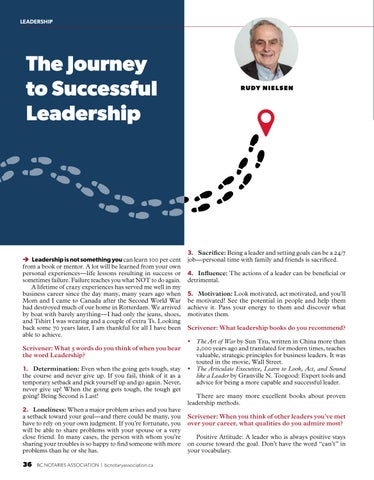
The Journey to Successful Leadership

RUDY NIELSEN
Î Leadership is not something you can learn 100 per cent from a book or mentor. A lot will be learned from your own personal experiences—life lessons resulting in success or sometimes failure. Failure teaches you what NOT to do again.
A lifetime of crazy experiences has served me well in my business career since the day many, many years ago when Mom and I came to Canada after the Second World War had destroyed much of our home in Rotterdam. We arrived by boat with barely anything—I had only the jeans, shoes, and Tshirt I was wearing and a couple of extra Ts. Looking back some 70 years later, I am thankful for all I have been able to achieve.
Scrivener: What 5 words do you think of when you hear the word Leadership?
1. Determination: Even when the going gets tough, stay the course and never give up. If you fail, think of it as a temporary setback and pick yourself up and go again. Never, never give up! When the going gets tough, the tough get going! Being Second is Last!
2. Loneliness: When a major problem arises and you have a setback toward your goal—and there could be many, you have to rely on your own judgment. If you’re fortunate, you will be able to share problems with your spouse or a very close friend. In many cases, the person with whom you’re sharing your troubles is so happy to find someone with more problems than he or she has.
3. Sacrifice: Being a leader and setting goals can be a 24/7 job—personal time with family and friends is sacr ificed.
4. Influence: The actions of a leader can be beneficial or detr imental.
5. Motivation: Look motivated, act motivated, and you’ll be motivated! See the potential in people and help them achieve it. Pass your energy to them and discover what motivates them.
Scrivener: What leadership books do you re commend?
y The Art of War by Sun Tzu, written in China more than 2,000 years ago and translated for modern times, teaches valuable, strategic principles for business leaders. It was touted in the movie, Wall Street.
y The Articulate Executive, Learn to Look, Act, and Sound like a Leader by Granville N. Toogood: Expert tools and advice for being a more capable and successful leader.
There are many more excellent books about proven leadership methods.
Scrivener: When you think of other leaders you’ve met over your career, what qualities do you admi re most?
Positive Attitude: A leader who is always positive stays on course toward the goal. Don’t have the word “can’t” in your vocabulary.
Persistence: Stay the course toward the goal despite obstacles and failures along the way. If leaders fail, they pick themselves up and go again. Be the best in the world at whatever you choose to do and work toward achieving your goal. A im high.
Scrivener: Who are the 3 most influential leaders in your life?
In my 60+ years in business, I have crossed paths with many important business men and women—leaders of industry, politics, the media, etc. While all are influential in their own right, those who have had the greatest impact on my leadership development are not household names.
A. My Headmaster at St. George’s School.
In my early years, I was quite the handful—rebellious, a troublemaker, always looking to get into trouble. I came from a sawmill/pulpmill boomtown where you had to be tough to survive.
Despite the personal attention paid me by the headmaster, I continued my troubled path that led to being kicked out of the school twice, but I always managed to talk my way back in. The third time, the outcome was much different. On my way to the bus depot in the headmaster’s car while being sent back to Prince George, I pleaded with the headmaster for one last chance. Sitting in the bus depot, I pleaded further. Just before I was to get on the bus, he asked me how this time would be different if I were able to go back to the school.
For the first time in my life, I made a commitment I really intended to keep. I promised him I would not leave the school grounds for the entire year. When not in classes, in the evenings and weekends I would focus my energy on training for the trackmeet at the end of the year and would win every event including the main trophy, “Sportsman of the Year.”
To his credit, the headmaster took a chance on me; he didn’t have to, but he did. I wanted to show him he made the right choice to give me that last chance. I was motivated as never before in my life. A clear goal had emerged—to be the best and make the headmaster proud. I would not let hi m down.
Once back at school, with limited previous track-training I trained and trained and trained! For me, the only path was the one forward; I would do my best to honour my word to the headmaster. Training kept me focused on a singular goal, and more important it kept me away from the temptation of trouble. The training went on till the end of the year, with
the help of the school coach who saw my determination. I was focused. I was com mitted.
As I promised, at the end of year I took 9 first-place trophies and broke 3 school records and won “Sportsman of the Year.” One record had stood since 1938. That was the most important event in my life.
My most memorable sports test was the cross-country race with 60 other racers. Due to a mix-up in times, I arrived late to the starting line, well after the gun went off and the runners were out of sight. The easy decision would have been to shrug my shoulders and blame someone else for telling me the wrong start time. Instead, I made the decision to go—I had given my word to the headmaster that I would do my best to win for the school.
So with no warmup, I tore off full speed. I would not start to see any runners at the back of the pack till halfway through the 3-mile cross-country run. I passed them, then came to the middle group and passed them as well. Finally, I saw the lead group and the finish line was in focus. When I thought I could not run any faster or harder, I found a way and not only caught them, but passed the first person then hurdled myself across the finish line—breaking the ribbon and the course record. For my effort, other than the first-place prize, I wound up in hospital for a week recovering from exhaustion and my dive onto the aspha lt road.
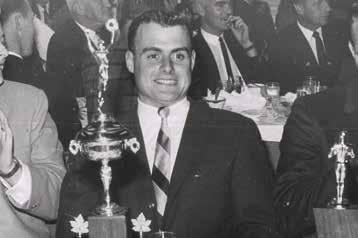
The headmaster trusted me and stood with me…and I kept my promise.
Always honour and stand by your commitments—no matter how tough that may seem. My real lessons came from the journey that began with the commitment to follow-through. A steady dose of perseverance and hard work brought me to achieving my goals. I have used that very important lesson throughout my business career.
B. The owner of the first real estate firm I worked for.
I was 23, the youngest person at the time in Prince George to have a real estate licence. I learned very early on that my age was shutting me out of opportunities for obtaining listings. How could a 23-year-old know what’s involved in selling a house and negotiating a good deal for the buyer or seller? I needed a plan. I needed to win that cross-country
race again—the pack had already taken off and I was starting at a disadvantage.
The key is to get into the race! My plan? Vacant lots in Prince George. No one was interested in selling residential lots in 1964. At about $1000 per lot, the real estate commission was 10 per cent and the company split was 60/40; no one was interested in a $60 check, even in 1964. I was determined to be the expert in that property class and to earn the trust and support of my boss.
I spent hours researching sales history, ownership, and upcoming development opportunities at city hall—going through land titles. I plotted them on a big city map using 20 coloured pencils. I wanted to be the best in the world on empty lots in Prince George.
Perseverance, commitment, and hard work began to pay off. Soon I began to be known as the “go to guy” for any information on vacant lots in Prince George and that began to change the opinions of what a 23-year-old was capable of in the real estate profession.
Sawmills and pulpmills were being built and needed employees. Employees needed homes and residential contractors needed vacant lots. I knew more about vacant lots in Prince George than anyone in the world. After I proved myself by developing a program no one had ever thought of or had ever seen before in the real estate business, the boss gave me some big responsibilities and I became his top salesman. The lesson I learned was work hard, don’t be afraid to venture into different ideas, set goals, and don’t be disappointed if you don’t reach them—just bounce back and tr
C. My Wife.
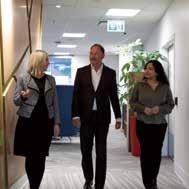
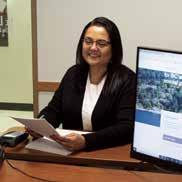
Last and certainly not least is my longest and most trusted leadership guide person. We met after the big recession in ’81 when I lost everything. I had no car and no credit cards and I had debt. I made a commitment to my creditors that I would pay them al l back.
My wife believed in me, backed me with her money and her car, and most important her positive attitude and 100 per cent support. In the 39 years we’ve been together as a team, she has shown me the value of patience and attention to detail—both things I can’t do as well as she can. She is the detailed person, whereas I am the busy, multiple-ideas guy, going in a million directions. Those differences make

A strong relationship with your spouse or partner could help create the level of success you will ultimately achieve. Leadership can often be a lonely place due to the confidentiality and sensitivity of information to which you are privy. With my wife, we are each other’s confidant—a safe spot to discuss most ideas, opportunities, challenges, and solutions. My leadership lessons are ongoing!
GOALSETTING
I set continual goals…daily, weekly, monthly, and annually. A reward for accomplishing my daily goal might be lunch out for myself or with a good friend. My weekly goal reward might be a new shirt or a gadget. My annual goal might be a nice dinner or something I can use outdoors.
Some goals take longer to achieve than planned—that’s where perseverance comes in. I remember looking the former BC Assessment CEO in the eyes when I first got Landcor started in 1999 and promising him I would not give up until my company had the best AVM in Canada. I am proud to say 23 years later with a lot of hard work and personal funding, the Landcor AVM is now recognized as the “Gold Standard”’ in the technology. (The AVM, or Automated Valuation Model, is a complex statistical algorithm that computes estimated residential valuations, based on past sales trends of similar and comparable properties.)
Be prepared for obstacles along the way to achieving your goals and don’t give up if they don’t work out. Be prepared to reset you r goals.
Scrivener: What are your favourite leadership quotes?
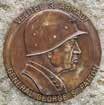
“Lead Me, Follow Me, or Get Out of My Way.”
~ General George S. Patton
“Life’s journey is not to arrive at the gravesite in a wellpreserved body but rather to skid in sideways, totally worn out, shouting…holy ----…what a ride!”
~ Hunter S. Thompson and Mark Frost
“Innovation distinguishes between a leader and a follower.”
~ Apple Founder Steve Jobs
“Everyone who's ever taken a shower has an idea. It's the person who gets out of the shower, dries off, and does something about the idea who makes a difference."
~ Nolan Bushnell
Every person comes up with great ideas during the day. Some have a few ideas, others have many. The difference is some individuals take the initiative to carry out the ideas. It takes a strong conviction and, in many cases, a good understanding partner or support team to accomplish your goal.
I went helicopter flyfishing for a few years with a very famous Hollywood producer and writer. He asked how many
ideas I come up with daily…I said at least 20. I asked him how many he came up with and he said 3. I might have 1 good idea and 19 bad ones, while he had only 3 ideas but all good ones.
Our conversation turned to the source of the ideas and while we came from different backgrounds, our ideas shared the same starting points—curiosity and passion. Those are very important traits for any leader. A leader is never satisfied with the status quo; a leader should always be asking if there is a better way to solve a challenge. I also believe a leader’s ideas come from the level of interest or passion around the topic, not measured in quantity but in terms of depth or quality.
The real secret is in the execution of the idea. In other words, can you turn an idea into action? It’s important to rough-out the idea once you have the initial thought. What are the pros? What are the cons?
For every key decision I make, no matter the complexity, I always frame it up in KISS—Keep It Simple Stupid! I take out a plain blank sheet of paper, draw a line down the middle, and put a “+” sign on one side and a “-“ on the other. Then I begin to note the idea’s various considerations in the appropriate column. Once complete, I tally the positives and negatives and make my business moves.
It’s important to seek input from others, depending on the scope of the idea because often involving others will bring different perspectives into the development of an idea. For a leader, the ability to listen and consider different opinions is key. I am often asked about my ideas. When I seek input from others, I am sometimes told “it’ll never work!” It’s not an easy road when you see the opportunity and the idea so clearly and others can’t and they do their best to convince you not to chase it. A leader, at times, must be prepared to go on alone—if the belief in the opportunity is so strong. Not following your intuition and taking the safe path may lead you to a place of regret, especially if your idea is proven successful by another.
Scrivener: What trap might new leaders fall into? What traps did you fall into and how did you get out?
My first trap was in my early 30s. I had 14 companies in Prince George…5 were real estate offices. I made a lot of money and I let it go to my head. No one could tell me or advise me on anything. I thought I knew it all. Then 1981 came and interest rates went to 19 per cent plus and I was leveraged to the max. I came tumbling down. Many friends declared bankruptcy; it was a very tough time. With creditors swooping in and taking what they could, it was a very depressing time of my life.
What stands out even today is when they seized my desk that was on a payment plan—the bailiffs took it away. I learned a very valuable lesson from that time in my life, Why did I need a $10,000 desk? In the first place, I should have invested that capital into something that made money or a good capital return. That made me humble and made me appreciate what I have and not dwell on things I don’t have. When I started to rebuild from having nothing, I swore
We specialize in helping companies of all sizes merge, downsize, and close premises.
We are proud of our work— recycling/repurposing up to 98% of all office items, furniture/equipment/stationery. . . even whole floors of office buildings.
When we are done, the office keys can be handed back to the landlord. We have diverted well over 10,000,000 lbs. from going to the landfill.
Those are all items that don’t belong in a landfill! Our 4000-ft. showroom has just about everything you need for the office—in good condition, at a fraction of the original cost.
We sell/service copiers, shredders with a warranty and other business equipment.
We have manual & electric sit/stand desks from $150 and up.

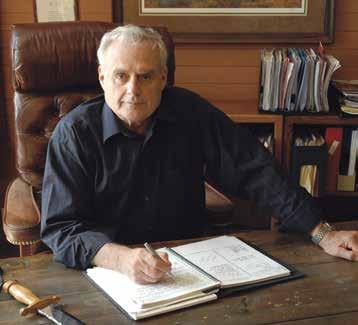
I would never have another $10,000 desk, so for the last 42 years I have had the desk a carpenter made for me with seven 2 x 6 boards nailed together…for which I paid $140. It is a great reminder not to make the same mistake again.
One thing you’ll find on my desk today is my John Wayne Bowie knife. I end each day by plunging it into the middle of my desk. To me that means my work at the office is done. When I come back the next day, I pull it out of the middle of my desk and put it into the corner…there’s work to do. It reminds me always to build a fort. Another very important part of my office is my fish tank that hosts several small fish and one big fish. It reminds me daily that whatever you decide to do, be the big fish.
While I have been fortunate to make a nice living, I am always appreciative of what I have. That is an important lesson for all to consider, not just those who aspire to be a leader. Focus on what you have, be thankful, and don’t worry about what you don’t have because you’ll never be sat isfied.
Appreciation is another key leadership quality. Whether it’s personal or team accomplishments, recognizing work well done and even noting and encouraging potential are important qualities for leaders. People will look to you for motivation and inspiration. As a leader, it’s your job to help guide them on th at path.
Scrivener: When you speak to young leaders in many forums, what question do they most often ask about leadership?
For years I have been granted the honour to speak to young businesspeople…folks who aspire to grow as leaders. Regardless of where I speak, I am often met with the question of dealing with stress. There’s no escaping stress in our lives; it’s always present—what might be stressful to you may not be to others. My key to managing stress is to find a sanctuary where you can get away from distractions and
refocus/recharge. Get rid of that stress—do whatever it takes. Stress could ki ll you.
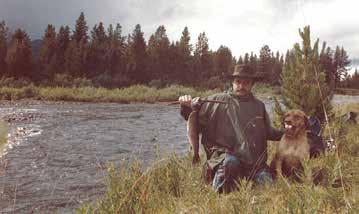
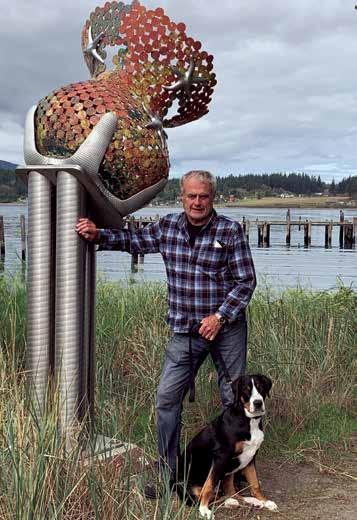
For me the sanctuary is being outdoors whether it be in my garden, extreme hiking in Northern BC, or just camping and working with nature or going for walks with my dog. If I’m really stressed out, I will walk with my dog in the park very late at night with no flashlight. I must pay very detailed attention to my memory of
y where the tr ail is,
y the sounds of my feet on the gravel pathway, and
y the sound of my dog running through the bush and onto the trail.
I know if I go off the trail I could stumble over a tree or branch or even have a branch poke me in the eye. I pay attention to the sound coming from each footstep, etc. Has it changed from gravel to dirt? Where are other noises coming from? When I finally come to the street again, I feel totally unstressed because of the concentration in walking the trails in the park. That level of scrutiny forces me to focus on the here-and-now and forget about whatever it was that was creating my “business stress.”
I find with all my focus now centred on my immediate surroundings, I can subconsciously think of new solutions to dealing with that stressful situation. I often do my best thinking outdoors when I step away from the environment where the stress is situated and I refocus on other m atters.
Don’t keep problems bottled up. Share and talk to your spouse or close friend. Don’t let a small problem become a big problem. Address it rig ht away.
LEADERSHIP LEGACY
Scrivener: What are the biggest challenges ahead for leaders in your business?
y The fast pace of daily changing technology
y Employees’ loyalty and their believing in you and the direction of the company
Scrivener: What leadership advice do you wish someone had given you earlier in your career?
Don’t let success go to your head. Be humble, listen to people who give you advice and consider/use their knowledge and experience to gu ide you.
Scrivener: How do you want to be thought of as a leader?
Honest, committed, fair…my word is my bond.
CLOSING THOUGHTS
I have been in the real estate business since 1964 and have witnessed incredible change in the profession, I have also weathered many ups and downs over that time. Despite all the change, along with ever-increasing reliance on technology, there are very important leadership qualities that will stand the test of time. I have spoken often about perseverance, hard work, commitment, and loneliness, and what those words mean to me as a leader.
Perhaps the single most important qualities a leader can have—I have saved them for the end—are Integrity and Honesty. If they are not part of your leadership beliefs, then success is a very hard goal-line to cross. At the end, in your retirement, it will never be about all the money you earned or deals closed. It’s about how many true friends you have!
RUDY NIELSEN, RI, FRI, is the founder and president of Landcor Data Corporation, based in New Westminster. Thie leader in real estate technology solutions was recently recognized for achieving ”Gold Standard” in AVM model testing, the first of its kind in Canada.
WWW.LANDCOR.COM