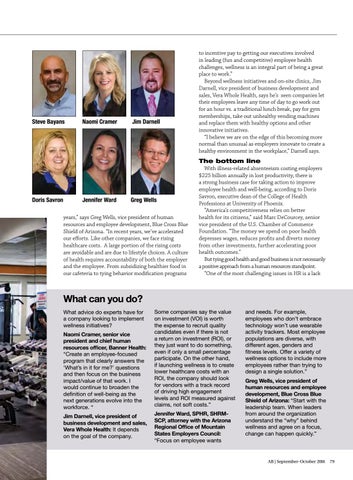
Steve Bayans
Doris Savron
Naomi Cramer
Jennifer Ward
Jim Darnell
Greg Wells
years,” says Greg Wells, vice president of human resources and employee development, Blue Cross Blue Shield of Arizona. “In recent years, we’ve accelerated our efforts. Like other companies, we face rising healthcare costs. A large portion of the rising costs are avoidable and are due to lifestyle choices. A culture of health requires accountability of both the employer and the employee. From subsidizing healthier food in our cafeteria to tying behavior modification programs
to incentive pay to getting our executives involved in leading (fun and competitive) employee health challenges, wellness is an integral part of being a great place to work.” Beyond wellness initiatives and on-site clinics, Jim Darnell, vice president of business development and sales, Vera Whole Health, says he’s seen companies let their employees leave any time of day to go work out for an hour vs. a traditional lunch break, pay for gym memberships, take out unhealthy vending machines and replace them with healthy options and other innovative initiatives. “I believe we are on the edge of this becoming more normal than unusual as employers innovate to create a healthy environment in the workplace,” Darnell says. The bottom line With illness-related absenteeism costing employers $225 billion annually in lost productivity, there is a strong business case for taking action to improve employee health and well-being, according to Doris Savron, executive dean of the College of Health Professions at University of Phoenix. “America’s competitiveness relies on better health for its citizens,” said Marc DeCourcey, senior vice president of the U.S. Chamber of Commerce Foundation. “The money we spend on poor health depresses wages, reduces profits and diverts money from other investments, further accelerating poor health outcomes.” But tying good health and good business is not necessarily a positive approach from a human resources standpoint. “One of the most challenging issues in HR is a lack
What can you do? What advice do experts have for a company looking to implement wellness initiatives? Naomi Cramer, senior vice president and chief human resources officer, Banner Health: “Create an employee-focused program that clearly answers the ‘What’s in it for me?’ questions and then focus on the business impact/value of that work. I would continue to broaden the definition of well-being as the next generations evolve into the workforce. “ Jim Darnell, vice president of business development and sales, Vera Whole Health: It depends on the goal of the company.
Some companies say the value on investment (VOI) is worth the expense to recruit quality candidates even if there is not a return on investment (ROI), or they just want to do something, even if only a small percentage participate. On the other hand, if launching wellness is to create lower healthcare costs with an ROI, the company should look for vendors with a track record of driving high engagement levels and ROI measured against claims, not soft costs.” Jennifer Ward, SPHR, SHRMSCP, attorney with the Arizona Regional Office of Mountain States Employers Council: “Focus on employee wants
and needs. For example, employees who don’t embrace technology won’t use wearable activity trackers. Most employee populations are diverse, with different ages, genders and fitness levels. Offer a variety of wellness options to include more employees rather than trying to design a single solution.” Greg Wells, vice president of human resources and employee development, Blue Cross Blue Shield of Arizona: “Start with the leadership team. When leaders from around the organization understand the “why” behind wellness and agree on a focus, change can happen quickly.”
AB | September- October 2016
79