On-site Armourer – Martin Bath | Set Construction — Rollercoaster
CREATIVE LEARNING
Associate Director — Lynne Cardy | Youth Arts Coordinator — Nicole Arrow
Teaching Artists — Rita Stone and Ella Gilbert | Education Pack Writer — Rita Stone
Education Pack Editor — Lynne Cardy
Production designs courtesy of John Verryt and Fiona Nichols
Design — Wanda Tambrin | Production Images — Michael Smith
By arrangement with
Rendered by Stuart Hoar was developed with the assistance of Auckland Theatre Company, Auckland, New Zealand.
SYNOPSIS
Rendered is set in the present day. The action moves between locations and timeframes ; from events occurring in the desert over the course of one day, to those taking place over a series of weeks between Miranda and Travis in Auckland and Las Vegas.
SCENE ONE – Al-Hamad desert, on the border of Syria, Iraq and Jordan. Major Aria from the New Zealand Defence Force and kiwi mercenary soldier Lance Corporal Jeremy Smith are in the Al-Hamad desert. They are on a secret mission for their allies, the US Army. Aria only gives Smith the information she deems necessary - that they are waiting. While they wait Aria explains that she joined the army straight out of university, was a Signals Officer and then moved into Intelligence. Smith tells her he has had SAS training, and is on this mission to protect Aria if things go wrong. He says little but swears often, and Aria doesn’t like his use of ‘profanity’. A committed Christian, she says she wants to be the first woman Chief of the NZ Army, which she will lead ‘by way of the gospel’. She aspires to do the work of Jesus by using ‘soft power’ to bring peaceful and productive rehabilitation to conflict zones and prepare for Jesus return to Earth. Aria and Smith discover that they both served in Afghanistan in 2008-2009. Aria was
part of the reconstruction team and Smith was with the SAS doing, he tells her, ‘the real work’ - protecting an American CIA base and finding Talibs to hand over to the Americans. Aria remembers a revenge raid that Smith was a part of that went wrong after the locals attacked a NZ patrol for interfering with their people. As a result, Smith says he believes the NZ Army is no better than the Americans. As the waiting continues, Aria tries to sleep.
SCENE TWO – A bar in the Aotea Centre, Auckland.
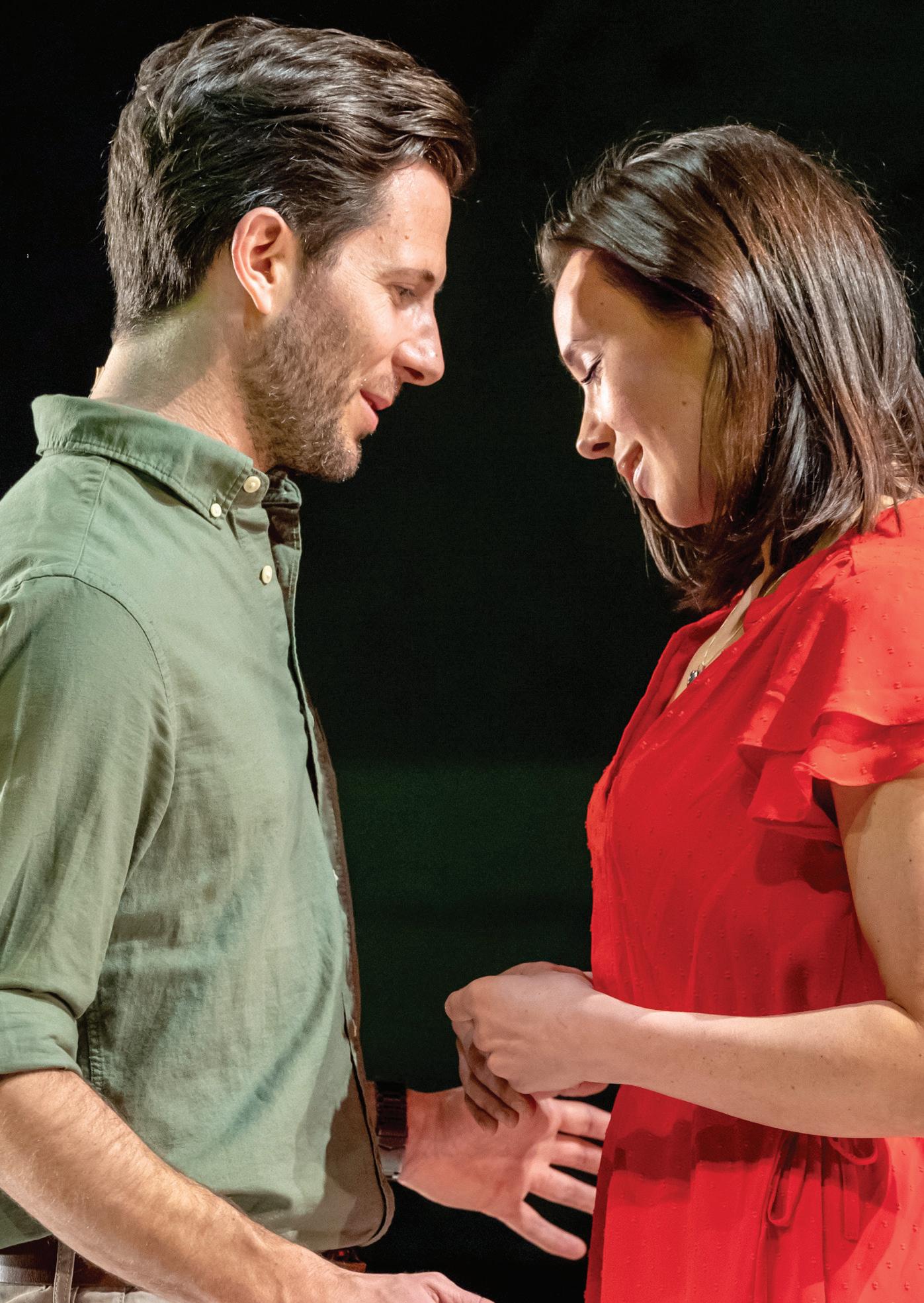
Miranda, a lover of historical fiction, is having a drink when she is approached by Travis, an American with a penchant for metaphysical poetry. They are both at the Auckland Readers’ and Writers’ Festival – him to hear a talk on his favourite poet Richard Wilbur, and her to meet her favourite historical fiction novelists, Barbara Kingsolver and Jesse Blackadder. Miranda, an early childhood centre manager, is curious about what Travis does in the US. He tells her he is a government policy adviser and after some flirting invites her to his room ‘to read poetry’ - but she declines. Their conversation continues. Travis accuses New Zealanders of not being concerned enough with world conflict and compares their ‘Pollyanna’ attitude to Voltaire’s Candide, who was taught by his tutor that “this world is the best of all possible worlds.”
SCENE THREE – Al-Hamad desert, continued.
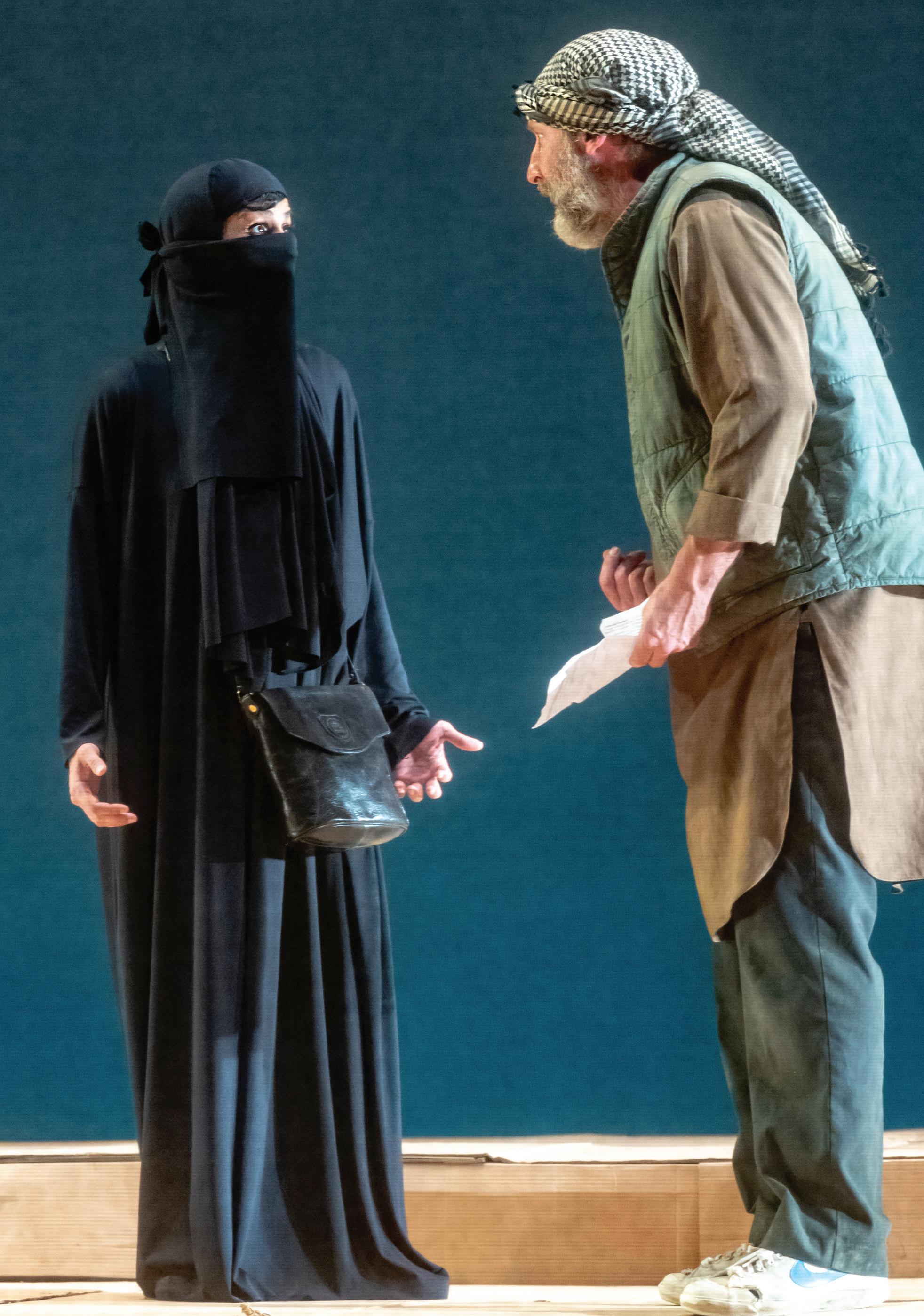
Smith sees two people approaching in the distance - a man and a woman in Arab clothing. He wakes up Aria to inform her. The Major is confused; they are only meant to be picking up a man on this mission. Smith orders both people to the ground and frisks them. He recognises the man as Taylor Grey, an ex-New Zealand soldier. Grey remembers him too – Smith was his SAS tutor – and he failed the course on the first day. Grey tells them the woman with him is Zuleikha, his wife. Aria insists that Zuleikha is not part of the mission and unlike Grey, won’t be picked up by the Americans. Grey is not keen to co-operate with American allies and insists that his wife return with him to New Zealand. Zuleikha finally speaks up, and to everyone’s surprise, she produces refugee papers, claiming that the soldiers must take her to New Zealand on a ‘Woman at Risk visa’, under the terms and conditions of the United Nations High Commission.
SCENE FOUR – The Lobby of Caesar’s Palace, Las Vegas. Miranda is in Las Vegas to meet Travis. They have been in regular communication since the writer’s festival, and when they meet in her room at Caesar’s Palace she admits that she is infatuated with him. They remember the romantic time they had together in Auckland. Miranda is smitten, but hurt that Travis didn’t meet her at the airport, or invite her to his place, and although she wants to see where he lives, Travis is reluctant to take her to his house. She wants to know what he is hiding and assumes he must have another woman at home. Despite her misgivings she spends the night with Travis.
SCENE FIVE – Al-Hamad desert, continued.
Grey is shocked that Zuleikha knows her refugee rights, has sourced the visa papers, and is willing to leave Grey behind (or even allow him to be killed) so that she can escape to New Zealand. He protests that he was promised there would be ‘no yanks’ involved and that he was simply being taken home to New Zealand.
Aria accuses him of being a terrorist, wanted by the US. Grey explains that after he left the NZ Army and became a follower of Allah, he taught English in a Syrian school where he met Zuleikha. Ever under the watch of the Brothers of the State, he claims social media posts he made burning his NZ passport were all for show. Aria reveals to him that the same posts were not geocached and led the US military to his location. He is known by Intelligence as the ‘Bumbling Jihadi’ and his carelessness led to the bombing of his school by the Russians. But Zuleikha reveals that she informed on Grey - because of something horrific he had done - in exchange for her refugee visa papers. Major Aria confirms that Grey is to be picked up by the US, where he will be detained for information, before returning to NZ. Grey now thinks escaping to Jordan will be a better future than being handed to the Americans.
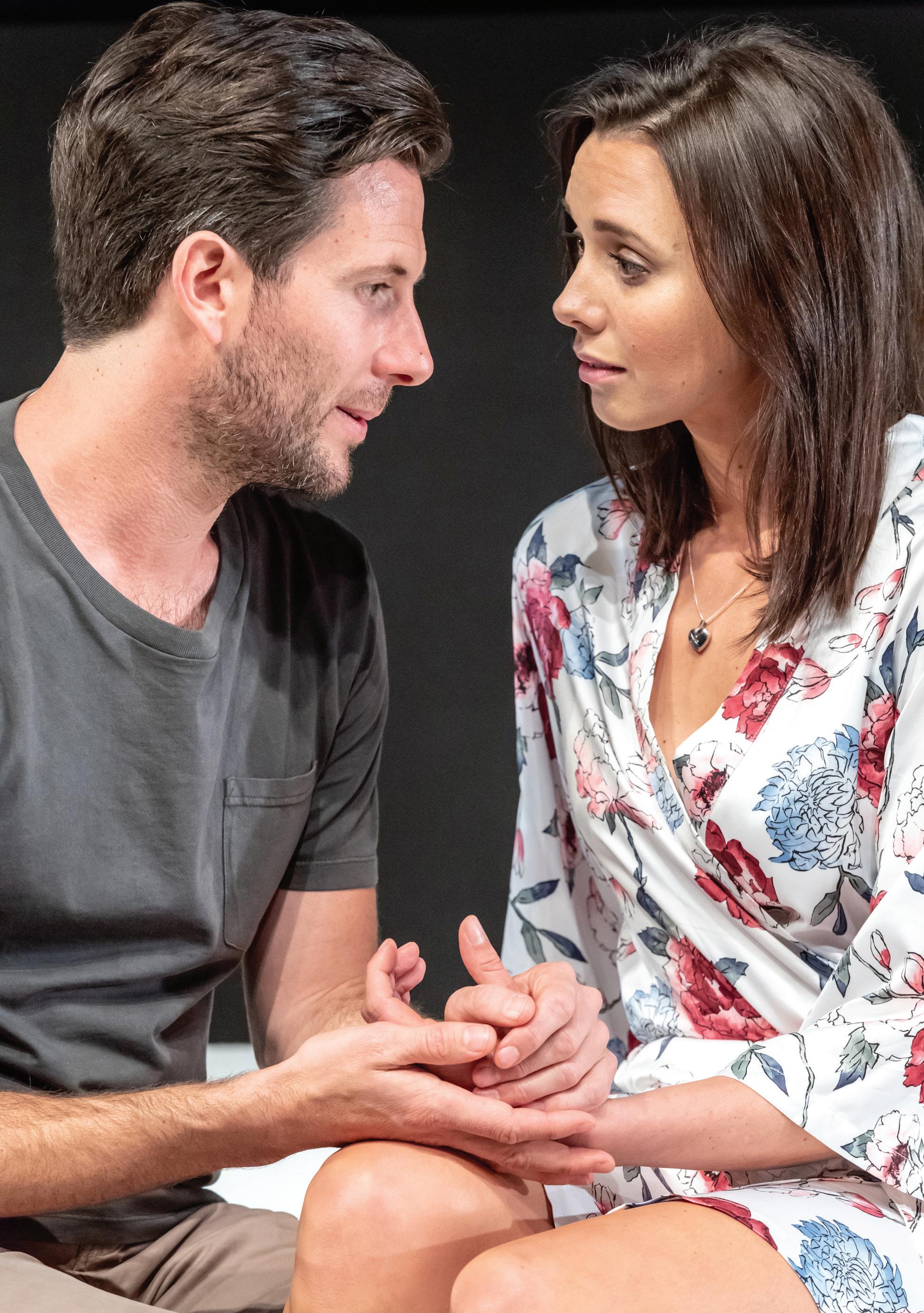
SCENE SIX – Miranda’s hotel room in Caesar’s Palace, the morning after. The next morning Travis impulsively proposes to Miranda. He reveals that the reason he won’t take her back to his home is because he lives on the Creech Air Force base – where he is a drone pilot. Miranda is horrified and cannot accept he
makes a living by killing innocent women and children in a war zone. Although they share similar political views, they differ on opinion regarding involvement in foreign wars, and Miranda wants to end the affair. She wants him gone.
SCENE SEVEN – Al-Hamad desert, continued.
Aria explains that Grey has beheaded American journalists and as a result he is wanted by the US. Zuleikha confesses she informed on Grey to the Americans in exchange for her visa. Grey insists that she is lying. She confesses that she never loved Grey, just saw him as a way out of her country. Smith and Aria must decide what to do. Should they hand one or both over to the Americans or just leave them behind in the desert to find their own escape? The Americans might torture Grey and Zuleikha may end up tortured and killed. Zuleikha explains how Grey only executed the journalists to save her life.
SCENE EIGHT – Miranda’s hotel room in Caesar’s Palace, the morning after continued.
Miranda and Travis argue further about the morality of war, and Miranda leaves him, believing that she cannot separate her feelings of love from her sense of morality.
SCENE NINE – Al-Hamad desert continued/ Miranda’s Early Childhood Centre in Westmere, Auckland.
Aria and Smith come to a final decision about what to do with their prisoners while Travis composes metaphysical poetry as he carries out a drone mission. The two stories collide to meet their tragic end.
ABOUT THE SETTING
THE
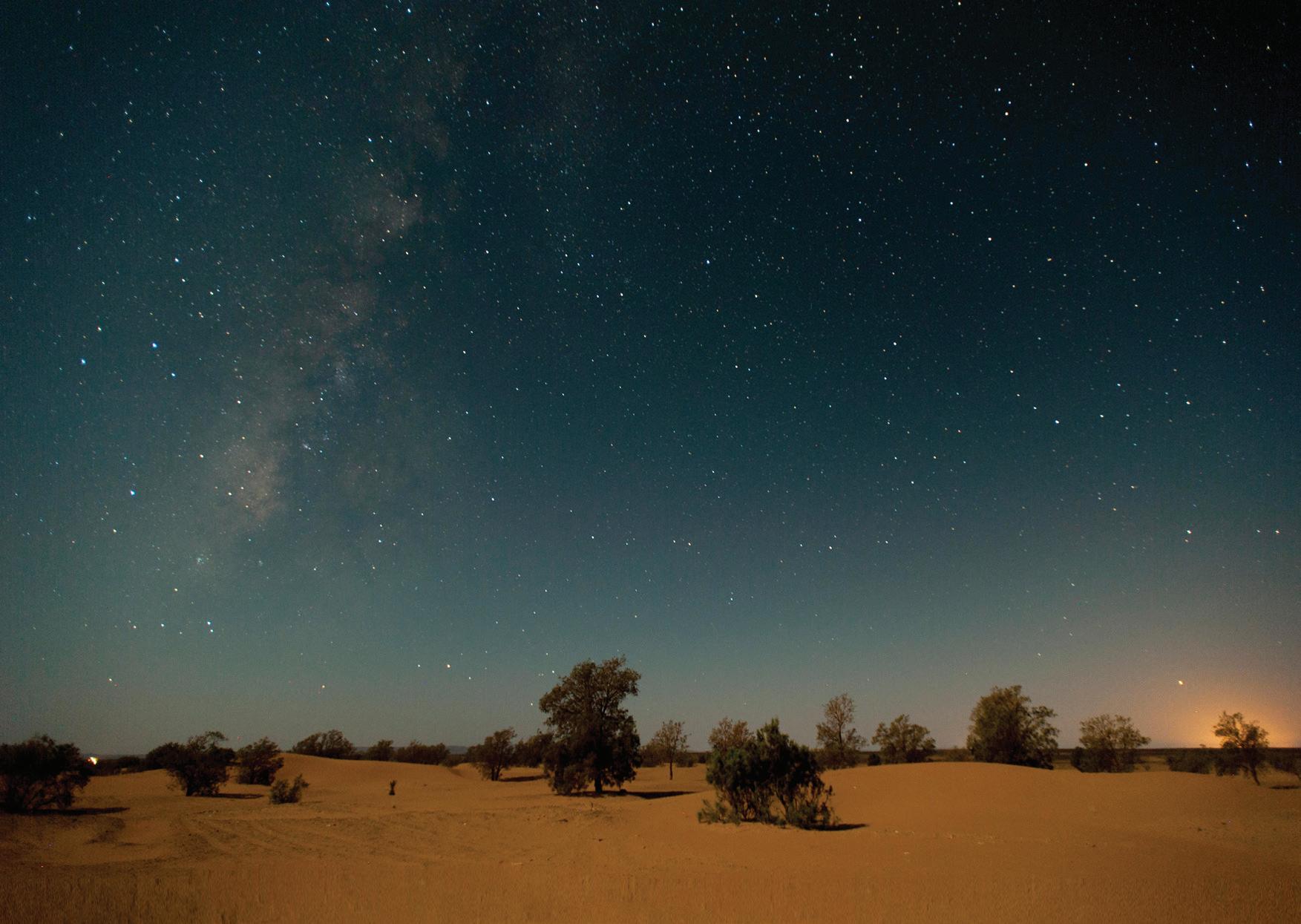
AL-HAMAD DESERT
“It’s part of the Al-Hamad, I think… there was some confusion in arriving…” – Major Aria
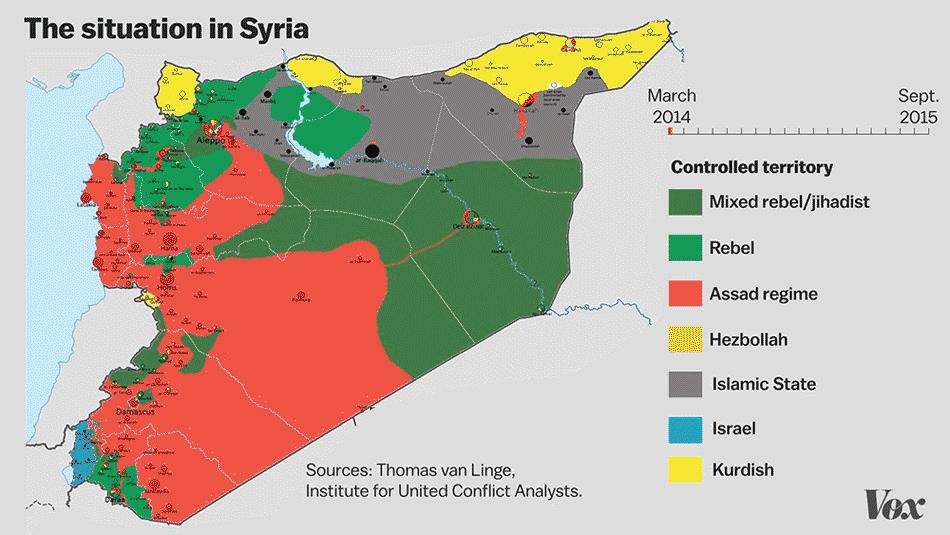
and who controls it is constantly changing and subject to interpretation.
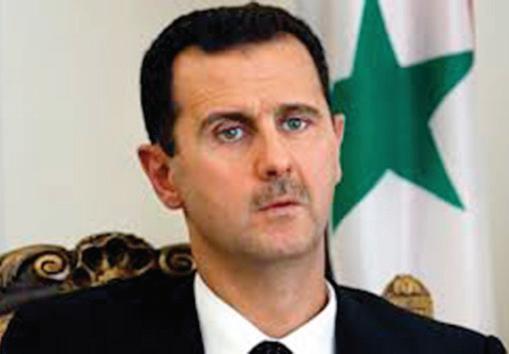
Bashar al-Assad President of Syria
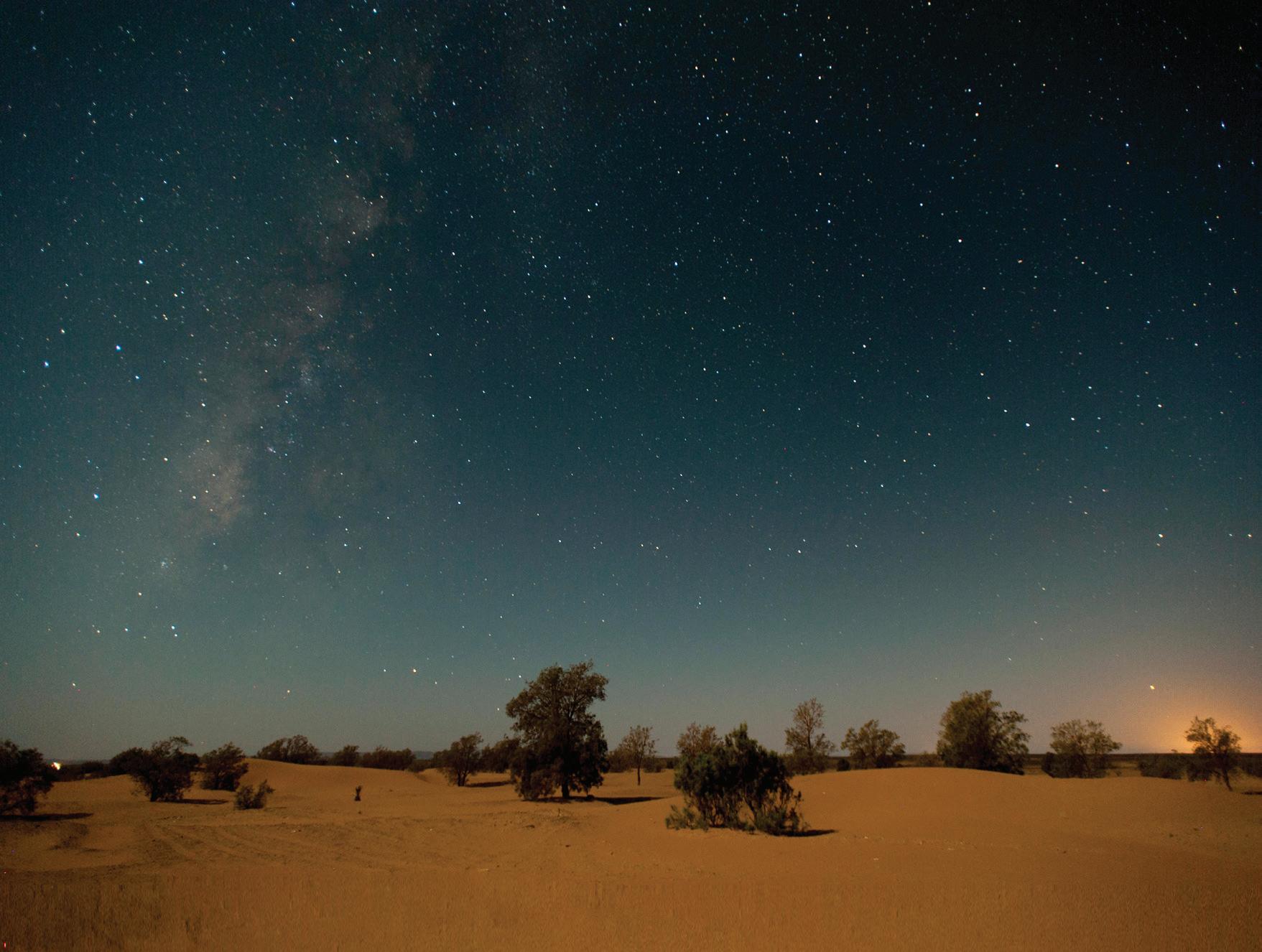
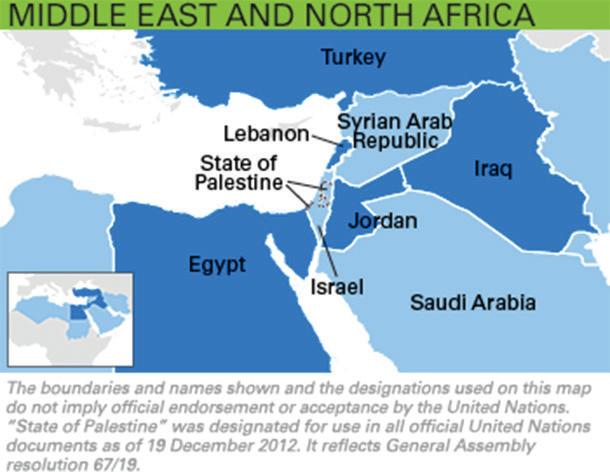
The Al-Hamad desert covers parts of Syria, Jordan, Saudi Arabia and Iraq. To the south, it merges with the Arabian Desert. Major Aria tells Smith that they are ‘on the border of Syria, Iraq and Jordan’.
THE SYRIAN WAR
(2011 – PRESENT DAY)
To date, the estimated civilian deaths in the Syrian war are around 100,000 and the total military casualties to be between 300,000 – 500,000. Over 7 million people have been displaced and over 5 million refugees have fled the war.
Around the same size as New Zealand, Syria has a population of approximately 22 million people. It shares borders with Iraq, Turkey, Israel, Jordan and Lebanon, has both fertile and desert terrain and a history stretching back to biblical times.
The Syrian War is complicated, messy and somewhat hard to understand. It’s not as simple as two opposing forces fighting a war. There are many countries, allegiances and a range of agendas involved in the conflict. A map showing the land involved,
Events in Syria evolved from the “Arab Spring” – a series of revolutions, riots, coups and foreign interventions that occurred in 2011 in response to authoritarianism, human rights violations and political corruption throughout the Middle East.
The catalyst for the Syrian war was opposition to the current PresidentBashar al-Assad - which escalated when demands to remove him were ignored. Assad’s family have ruled Syria since 1971 and are of the Alawite Muslim faith – less extreme than other Muslim factions - and the uprising against him occurred in response to his failure to deliver political and economic reforms.
The official government of Syria, headed by President Assad, is known as the Syrian Arab Republic and their allies are Hezbollah (the Lebanese political party), Iran and Russia.
The Free Syrian Army – the main rebels – is allied with Turkey but has also drawn in many Jihadists from Syria and other countries with other agendas. A third significant belligerent in the war is the Democratic Federation of Northern Syria.
THE ISLAMIC STATE (ISIS)
The Islamic State of Iraq and Levant (ISIL), or officially the Islamic State (IS), is often referred to as the Islamic State of Iraq and Syria or ISIS. In Rendered, it is also referred to as The Caliphate. Established in 1999, IS pledged allegiance to Al-Qaeda in 2004 and was designated a terrorist organisation by the United Nations in the same year.
The Islamic State has proclaimed itself a worldwide caliphate and is the fourth major player in the Syrian war.
THE CALIPHATE
“You look at the Caliphate and you see fanatical terrorists. I only saw my brothers and sisters wanting to be free.”
– Taylor Grey
The Caliphate is another way to refer to the Islamic State. A caliphate is an Islamic state ruled by a Caliph; a political and religious leader descended from the prophet Muhammad. From 2014, the Islamic State has proclaimed itself a caliphate, with power over all Muslims worldwide. Their intention is to expand their territory and rule under a radical interpretation of Sharia Law. The western perception that human rights – particularly women’s rights – are violated under Sharia Law comes from confusion around the more radical interpretations of Sharia.
“As for Sharia, the word is used once, only in the whole of the Quran, and there it means the right path of moral conduct. Being on the right path to share the peace and wisdom and love of Allah. It’s not about laws or rules or what a woman should or should not wear.”
– Taylor Grey
THE SOCIETY OF MUSLIM BROTHERS: “ISLAM IS THE SOLUTION”
“You are fighting an Imperialist war because your stupid bloated country needs oil to run its stupid bloated cars. That’s what your killing is for, Travis!”
– Miranda
The Muslim Brotherhood was formed in 1928 by Egyptian scholar Hassan alBanna.
It extends across many Arab countries and its goal is to implement the Quran (the central Islamic religious text) and the Sunnah (the teachings of Muhammad) as the “sole reference in ordering the life of the Muslim family, individual, community and state.”
The Brotherhood claims to be a peaceful organisation; they teach literacy, preach Islam, build hospitals and business ventures. However, another of the Brotherhood’s aims is to resist the impact of Western civilisation and to unify Muslim countries to preserve their way of life. They believe that Islam provides the perfect way of life, and that together they can eradicate poverty, corruption and sinful behaviour.
The Brotherhood takes a conservative approach to women; launching a campaign against “ostentatious dress and behaviour,” separating boys and girls in education, and providing girls with a different curriculum.
Since 2015 the Brotherhood has been condemned as a terrorist organisation by countries such as Russia, Syria, Egypt and Saudi Arabia.
THE WAR ON TERROR - HOW THE US AND THEIR ALLIES ARE INVOLVED
“You are fighting an Imperialist war because your stupid bloated country needs oil to run its stupid bloated cars. That’s what your killing is for, Travis!” – Miranda
The phrase ‘War on Terror’ was coined by President George W. Bush following the attacks on The World Trade Centre on 11 September 2001. Bush described America’s enemies as “a radical network of terrorists and every government that supports them.” The campaign initially had a specific focus on countries associated with al-Qaeda.
In 2013 President Barrack Obama declared the War on Terror over, and in 2014, he ended the combat role of USled troops in Afghanistan. However, the unexpected rise of the Islamic State (IS) terror group led to a new operation against terror in the Middle East and South Asia called “Operation Inherent Resolve”. According to the American Department of Defence website, “As of August 9 2017 the Coalition has conducted 13,331 strikes
in Iraq, and 11,235 strikes in Syria, for a total of 24,566 strikes total in support of Operation Inherent Resolve.”
Operation Inherent Resolve is officially involved in the Syrian War to bring down the Islamic State. In Rendered, Miranda cynically accuses the US of only being involved because of oil. The United States opposes Bashad al-Assad and his regime, and in April 2018, the US, UK and France bypassed the United Nations and launched an attack on suspected chemical weapons targets, in response to an alleged chemical attack on Syrian civilians by Assad. Russia, being Assad’s ally, condemned the US led attack, putting strain on the US-Russia relationship. NZ Prime Minister, Jacinda Ardern, said of the attacks, “New Zealand… accepts why the US, UK and France have today responded to the grave violation of international law, and the abhorrent use of chemical weapons against civilians.”
NEW ZEALAND’S INVOLVEMENT IN THE MIDDLE EAST
New Zealand troops have been stationed in Iraq since 2015. “Task Group Taji” is a combined Australian and NZ
force of around 300 Australian personnel and 110 kiwis. The seventh rotation of New Zealanders was deployed in April this year. Task Group Taji’s primary objective is to aid and support the Iraqi Army's North Baghdad Operations Command. According to Major General Tim Gall, the Commander Joint Forces New Zealand, “As a member of the global coalition of 74 countries, we have made a significant contribution to the Iraqi Government’s efforts to defeat IS and liberate parts of their country that were controlled by the terror group.” Task Group Taji is due to be reviewed in November 2018.
The New Zealand Provincial Reconstruction Team (PRT) referred to by Jeremy Smith in Rendered, was initially a twelve-month mission in Bamiyan, Afghanistan, but continued from 2003 to 2013. The PRT is not a combat unit; instead they "…provide a strengthened military observer capacity, monitoring and assessing civil, political, and military reform efforts through community engagement. In addition, they also act as liaisons for non-government organisations and other civilian organisations. In
addition, NZDF PRT personnel will visit communities, make contact with community leaders, and gather information about what they might need in terms of reconstruction. These visits will also give Bamiyan communities an opportunity to air any concerns.” –beehive.govt.nz
DRONE WARFARE
The US military’s multi-billion-dollar drone programme is evolving at a rapid rate. These unmanned air vehicles provide a huge advantage in warfare as they are operated far away from the conflict in the safety of a US airbase. Playwright Stuart Hoar describes it as “video game warfare.” Surveillance equipment on the drone feeds a murky image back to the drone pilot who makes a decision to strike based on the interpretation of the images by an Intelligence officer. The Business Insider reports that as of April this year, the US is developing Artificial Intelligence controlled drones that can spot and target vehicles and people with almost no human intervention required.
NEW ZEALAND THEATRE FORM
“The Candide-ness of New Zealanders, who think without thinking that they live in the best of all possible worlds.” – Travis
Rendered is a New Zealand play written by Stuart Hoar, who was born in New Plymouth and attended James Cook High School in Manurewa, Auckland. Although this play is set mostly in the Middle East and the US, there are two scenes located in Auckland and many references to New Zealand throughout the play. Four of the six characters are New Zealanders.
The New Zealand theatre form is constantly evolving, and any play written
TALKING POINTS
by New Zealanders, about New Zealanders fits the description. However, it is generally accepted that a typical New Zealand play has one or more of the following distinguishing features:
• A concern with New Zealand history
• An exploration of the New Zealand identity and our sense of belonging
• Tikanga Maori vs the world of the Pakeha
• Displacement or loss
• Archetypical New Zealand characters such as rugby players or farmers
• Colloquial New Zealand language and icons.
• Looking at the suggested features above, do you think that Rendered is an example of a typical or an atypical New Zealand play? Why?
• What do the references to NZ in this play suggest about our sense of identity?
• Which of the features did you see or not see in the production? Give clear examples.
• What connections can you make between Rendered and other New Zealand plays?
TALKING TO THE PLAYWRIGHT
DURING REHEARSALS, ATC teaching
artist Rita Stone talked to playwright Stuart Hoar about his fascination with drone warfare, New Zealand in the Middle East and the process of writing Rendered.
What inspired you to write Rendered ?
Firstly, I have a fascination with drones and how they work. It’s a kind of video game warfare that fascinates me. Somebody could be identified as a potential enemy of the United States of America, and then they are essentially in a courtroom drama where they are judged and found guilty as to whether they are killed or not, and then they are. Quite often, this goes all the way up to the president. That fascinates me because that person may well be an enemy of the United States, or it may well be a case of mistaken identity. It could also be
a situation that is on a completely shifting continuum; for example, the suspect could believe that what they’re doing is justified as a freedom fighter or whatever, but someone makes a judgement on the other side of the world, and if the judgement is death, then they are killed. This is twentyfirst century warfare, like a science fiction that we are barely aware of.
So, this was an idea that I really wanted to write about, and where we, as New Zealand, fit into this kind of warfare, because we have had an army involved in Iraq and Afghanistan. Even now we still have a base in Iraq and nobody is sure what they are doing there. As a taxpayer, it’s my army and I would like to know.
I have also always been fascinated by the desert, in terms of imagery. Then I remembered I had read about a New
Zealander who had been in the army before he converted to Islam. He went to the Caliphate and appeared in Raqqa, online, talking about jihad and so on, burning his passport and things like that – Mark Taylor was his name. I thought that was amazing, that we have this real-life New Zealander who disappeared. So, I just thought that’s great; that brings a New Zealander into it. ATC workshopped this play in 2014, and I must have written it before then, 2012 or 2013. Of course, the history has changed since then; while writing the play the Caliphate has come into existence and has now been destroyed (more or less). I’ve tried to keep the play up to date with external history and that has been interesting - it’s very hard to keep a play current. The two characters, Taylor Grey and Zuleikha, are refugees from Raqqa in Syria, and he wants to get out completely and his wife wants to get to New Zealand herself for her own reasons. So, it’s an episode that could happen, but we would never know about.
What are some of the themes and ideas you wanted to explore in this play?
I guess when I think about it, it is indeed about the whole idea of faith; what that means to different people in the world,
and how seriously we take it. Obviously, the Caliphate are a tiny group; they don’t represent all Muslims. In the West they represent the Muslim world which is a completely unfair representation. But then Donald Trump doesn’t represent America either. It’s much more complex and nuanced.
Another idea is about justice. What is justice? Is it something that comes down from on high, God’s avenging angel, so to speak? Millions of Americans literally believe in angels, so they would subscribe to that. The whole idea of how seriously we take religious belief – what is the difference in principle between how a tiny group of Muslims interpret Sharia, as opposed to how Americans interpret their right to kill perceived enemies of the state without a habeas corpus – a person actually there to defend themselves. New Zealand is no longer isolated. We belong to the Five Eyes, and we cannot separate ourselves from being part of this world. Of being part of this war between two religious empires, which is effectively what it is; where do we stand in that? Do we make a stand? Should we? I think we should, but what is it? The theme of how we now dispense justice, and as allies of America, that’s how we dispense justice.
STUART HOAR
Do you see this as a New Zealand play?
In what way does it look at the New Zealand identity?
The play takes the characters’ identities for granted. These are New Zealanders and they express their identity by being who they are, where they are. But it’s not something that they are concerned or unsure about; they are sure of themselves as New Zealanders. That’s not the issue, its more the pressure that is put on them, not individually, but collectively in terms of our relationship to America in the desert scenes. And then separately in relationship terms, a New Zealander and an American. I want Miranda to fend off America, the power of America - not in a defensive way - but she can stand up for herself, she’s a clever woman. Miranda wants to take a chance on Travis, but once she finds out who he is, that’s a line she won’t cross. And it’s Travis, the American, who voices the idea that New Zealanders think, “aren’t we lucky to live in this safe little country.”
But nowhere is safe in that sense. I mean should the Americans, hypothetically, decide that I am a war criminal, an aircraft carrier could be off the coast – a drone could be on its way right now. It’s totally incredible but it’s totally feasible at the same time.
Can you describe your writing process?
The process can be long and complicated, because you need other people. You need at some point to become a part of a collaborative team. I tell my students, “write your play or screen play, be patient, and in the meantime write a novel, that may come out more quickly!” These things can take years. I am up to draft 12 of Rendered, which is unusual, but that’s because we are fiddling with small text stuff now.
I absolutely love the collaborative nature of the process; Katie has a vision, and John’s set design has an impact on the writing too. This thing is no
longer mine, it’s ours, and I am writing collectively right now.
I wanted to write this play, but I had no idea if anyone was going to do it, and I wrote it, reworked it, got feedback, I thought about it, workshopped it, reworked it again, and then reworked it again. When I was told ATC was going to programme it I thought I’ll look at it again
Play texts are living things; they rely on living people to bring them to life, so they are never going to be the same. And the audience is part of that process too.
and try and tighten it up. I got feedback from Katie and Phillipa (Philippa Campbell, ATC Literary Manager) prior to that.
A play is not like a novel or short story, where you write it, you finish it, you fiddle around with it and it’s out there. When this
play goes on, the text that the actors say isn’t set in stone, because I will rethink it again afterwards. I will come up with a postproduction draft, which may include some changes. And if indeed it goes on to another production, it won’t be the same text as this one. Play texts are living things; they rely on living people to bring them to life, so they are never going to be the same. And the audience is part of that process too. It can be frustrating at times, but ultimately, it’s a blast and that keeps me coming back. After thirty years, I’m still writing plays!
TALKING TO THE DIRECTOR
DURING REHEARSALS we asked Katie Wolfe about the process of directing Rendered
What drew you to want to direct this play?
I loved this play and from the very first reading, I was excited. First and foremost, Stuart is a great writer whom I admire. And I just loved the structure – this idea that there are two parallel worlds; one that is so incredibly extreme, set in the deserts of Iraq, and one an incredibly intimate love story. So, I was attracted to the idea of how you would stage that. It’s a huge challenge to consider how to realise two such diverse pieces on stage. I’m not up to date with politics of modern geo-military power in the world, it wasn’t something that attracted me initially to the project,
but a lot of the work I do is around internal NZ politics, so to take that interest onto a global stage was attractive. I was also excited by how great it was for a New Zealand writer to look outside where we are rather than look in on ourselves.
Can you describe your process in preparation for a play like this? How much research did you do?
There is so much you can learn in terms of research for this play. I now have more insight into the New Zealand Army’s activities in the Middle East, especially around the period of 2009-2010. I also have a much greater understanding of how ISIS operated in Iraq in that time, and what they were doing, and of how people get recruited into ISIS. There is quite a lot of information out there now. You have
to be prepared to go home and do your homework and hear stories about people chopping off people’s heads and women being raped, and people having to pick up body parts off the ground. It’s utterly horrific stuff. It’s so easy to feel that we can sit here in New Zealand and pretend it’s not going on in the rest of the world.
It’s a really challenging time, and what this play is saying is that the Americans have, without impunity, been able to go around the world killing who they want with their incredibly sophisticated system of drone warfare. And that is such an eye-opener. And it seems to be such a metaphor for these times, where we choose to understand that these things are going on in the world, but there is nothing we can do about it, so we just pretend that they are not. And that America is our ally and that they are doing this for us. It’s about how you judge all this violence, and the preconceptions that we come to that judgement with. It’s obvious that we judge ISIS, but why don’t we judge America in the same way?
Metaphysics is another big idea in this play. So, in the first week of rehearsals we spent a lot of time trying to understand
what metaphysics is. It is ostensibly the study of what is real and what is not real. So in the play we are asking, “What are these people doing in the name of love?” –which is something that doesn’t exist – or does exist!
Then there’s Travis - the poetry and the pilot. I guess poetry is a way for Travis to not have to be answerable to God because he creates God in his metaphysical sense, so therefore he doesn’t have to face what he’s doing. His metaphysics is his distraction.
In terms of a process I don’t think I have ever had to do so much scoping and working out to see everything in there from every possible point of view, because I have to. Stuart’s politics are very firmly in the play, but it’s not our job to go out and hit the audience over the head with that. We have to find out what our characters believe and where they stand within the political spectrum. That’s been full-on for the actors as well, to work out where their characters stand and how it’s different from themselves. We have to find things to hold on to that make it real for us as well. And then we have to make them into people!
KATIE WOLFE
The rehearsals have been scheduled so that you work on one world in the mornings and the other in the afternoons – has that been quite deliberate?
The two worlds are just so different; there is no way we could do it together. I am having such a different experience with each play. The back play – I call it the
together for a long time – maybe not until we get down into the theatre. There will be very fast transitions, a projection on the screen between the two stages comes up and then the front play can come to life.
I want to move quite quickly between them, just to keep the pace going.
The play is really satisfying because in the desert scenes, the characters will
“I just loved the structure of the play, this idea that there are two parallel worlds; one that is so incredibly extreme, set in the desert and one an incredibly intimate love story... How you would stage that?”
Desert Play – is time-continuous. So, we can run that at as one play. The front play is made up of four different scenes that jump around a bit, so they have quite a different experience going on. We’re going to keep them separate right up until the last minute; I’m not going to bring them
be saying something to each other and it’s exactly like something Miranda has said to Travis. It will be about something completely different, but it is kind of the same argument. So, the themes are about belief, faith, and metaphysics, which is ostensibly a belief system.
How has this new script developed in rehearsal?
Stuart has been with us all through those first rehearsals, mainly to do with the clarification around the very intricate military operation in the play. Much of the rewriting or tweaking of the script has been to do with logistics and minor details. Even though it’s not necessarily important for the audience to understand, the actors still need to understand the mechanics of the military operation that they are inside. Everyone is telling lies on stage and to tell a lie, you have to know the truth. So that has been a complicated process.
What impressions do you hope to leave the audience with at the end of Rendered ?
I really hope they pick a fight in the bar! People will have strong opinions about this play. It is contentious to think that Americans have been involved in killing New Zealand citizens. With regards to American politics – we are in the middle of the circus! It’s not like we are performing
this play six months before the circus, or two years after the circus, we are in the middle of the circus right now. I’m thinking that something is going to happen in America before we open the play that could change the whole thing – anything could happen! And to leave the audience with a discussion to have, we have to be very clear with our storytelling. We are dealing with so many complex ideas, we must make sure that it is never muddy, we are never generalising about anything, and that the story is very, very clear. We must be clear about who wants what and what they are doing to get it. And these characters are extreme. Which I think is easier for the actors, in a way. At first the actors were saying, “Oh my god, this guy! I can’t believe he says this!” and I’m like, “yes, but he does say that, it’s what he believes.” And they had to get their head around it, but now they can see it’s a really great place to be, to own these people’s beliefs.
DESIGN
SET DESIGN –JOHN VERRYT
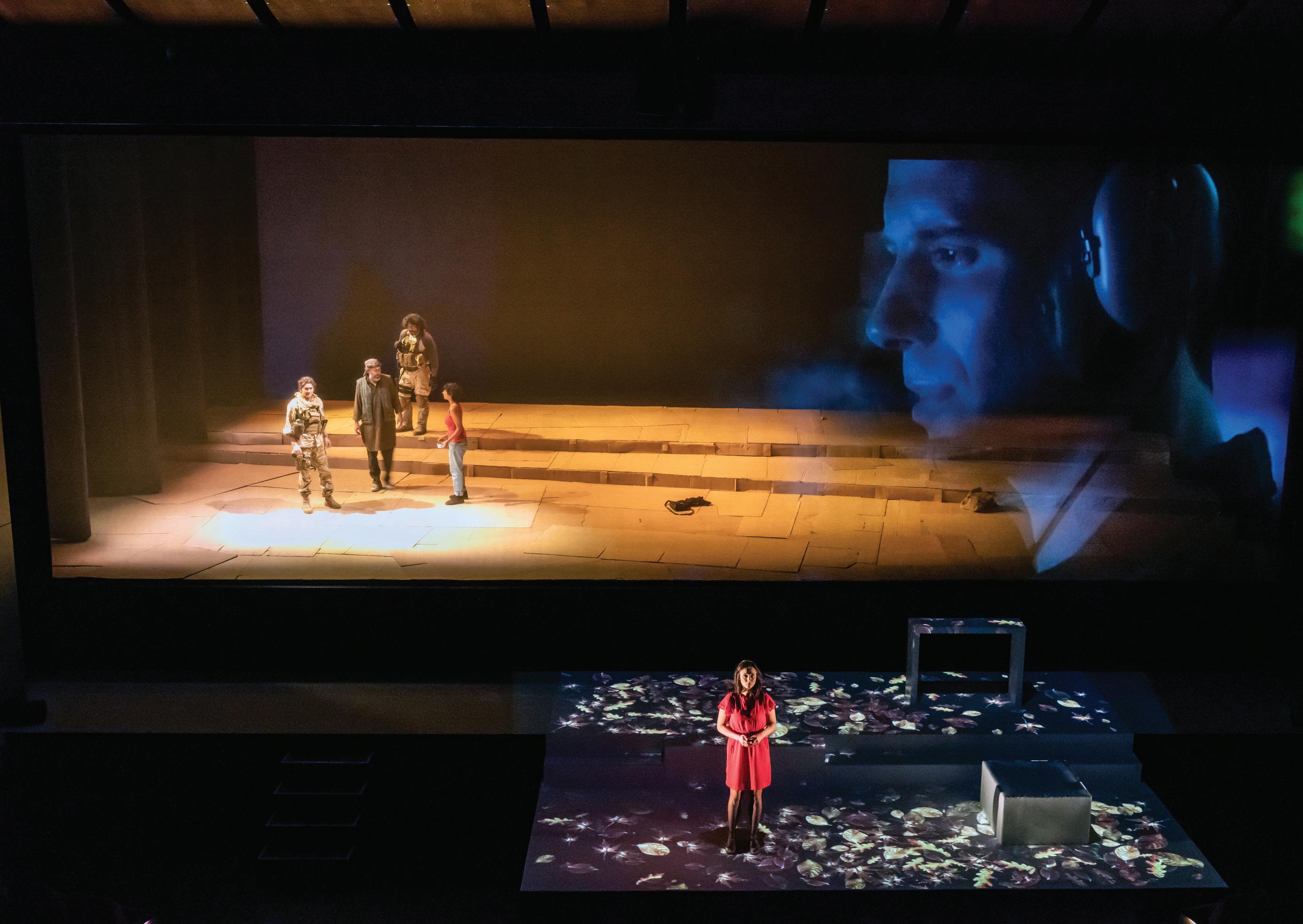
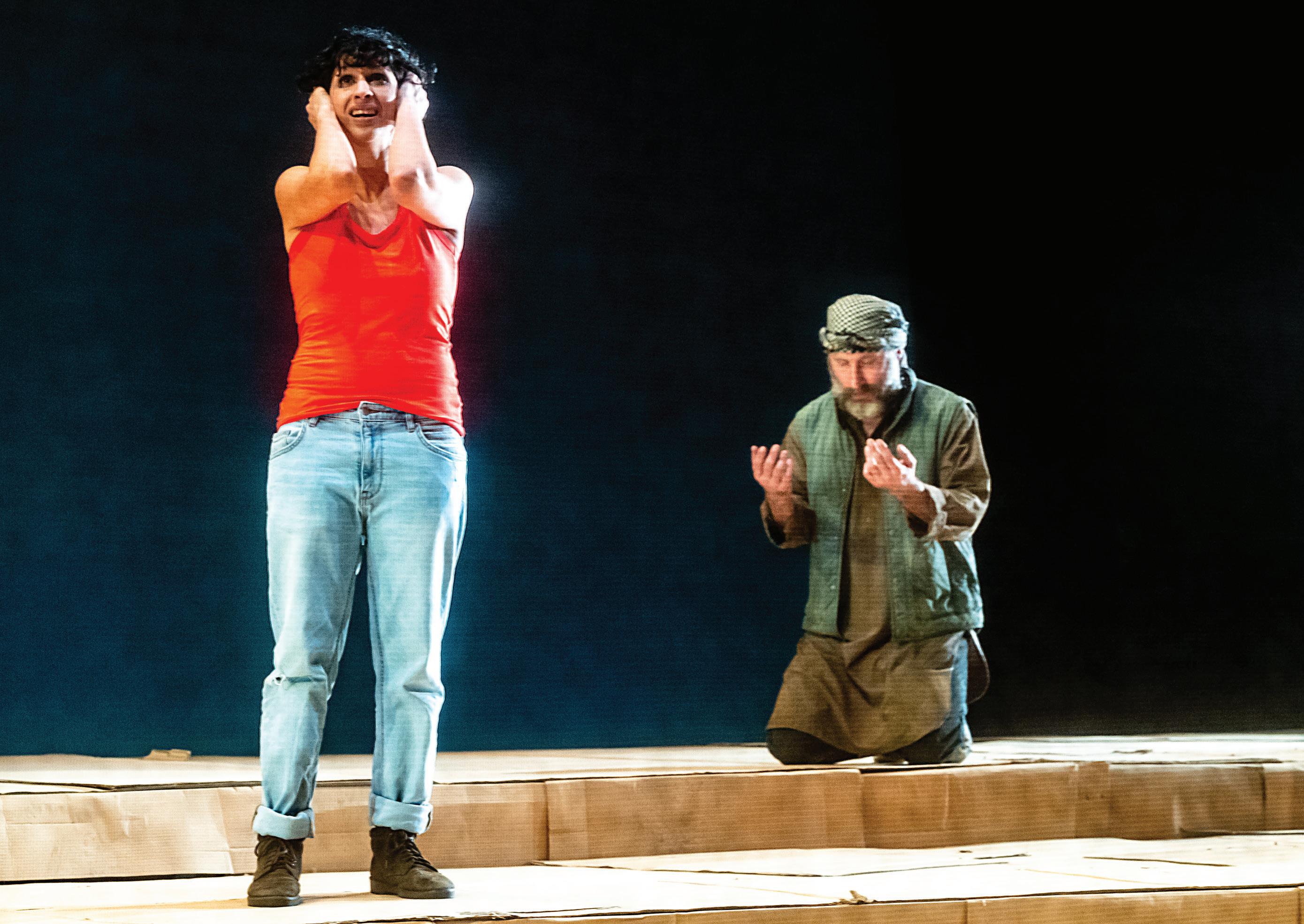
John’s first objective in designing this set was to clearly define the alternating worlds of the play. He has achieved this by splitting the performance area in two. There is a small, defined, playing space downstage on the forestage, and a vast cardboard-covered desert area upstage, which takes up most of the 7metre depth of the theatre. The two sections of the stage are separated by a black gauze. The appearance of the gauze can be manipulated through lighting to allow the upstage world to disappear and reappear, and for both spaces to come together as they need to at the end of the play.
Travis and Miranda’s space is carpeted in white. There are some blank white blocks built in to serve as furniture pieces and to aid with the blocking of the scenes. There is a place to put drinks, and a place to sit. The blank canvas look of the smaller
stage allows it to be adaptable to show the two different settings of and Auckland bar and a Las Vegas hotel room.
The desert area upstage is made from stacked risers on a raked platform covered with overlapping pieces of cardboard to give the look of textured terrain without the complication of having sand on the stage.
John is also aware of the sound when actors walk on the cardboard as opposed to sand. The design uses the full depth of the theatre to give the desert an expansive feeling.
On the first day of rehearsals, director Kate Wolfe pointed out that there is very little physical movement in Rendered which she is interested in and challenged by. For this reason, the set is stark and simple, “Nothing comes and goes.” as John explains.
TALKING POINTS
• How effective is the set design in conveying the two different worlds?
• What challenges do the actors face on this set? And what challenges does the director need to consider? How have they overcome those challenges?
• Consider your own set design for this play. Describe how you would resolve the alternating locations?
JOHN VERRYT
DESIGN
COSTUME DESIGN –FIONA NICHOLS
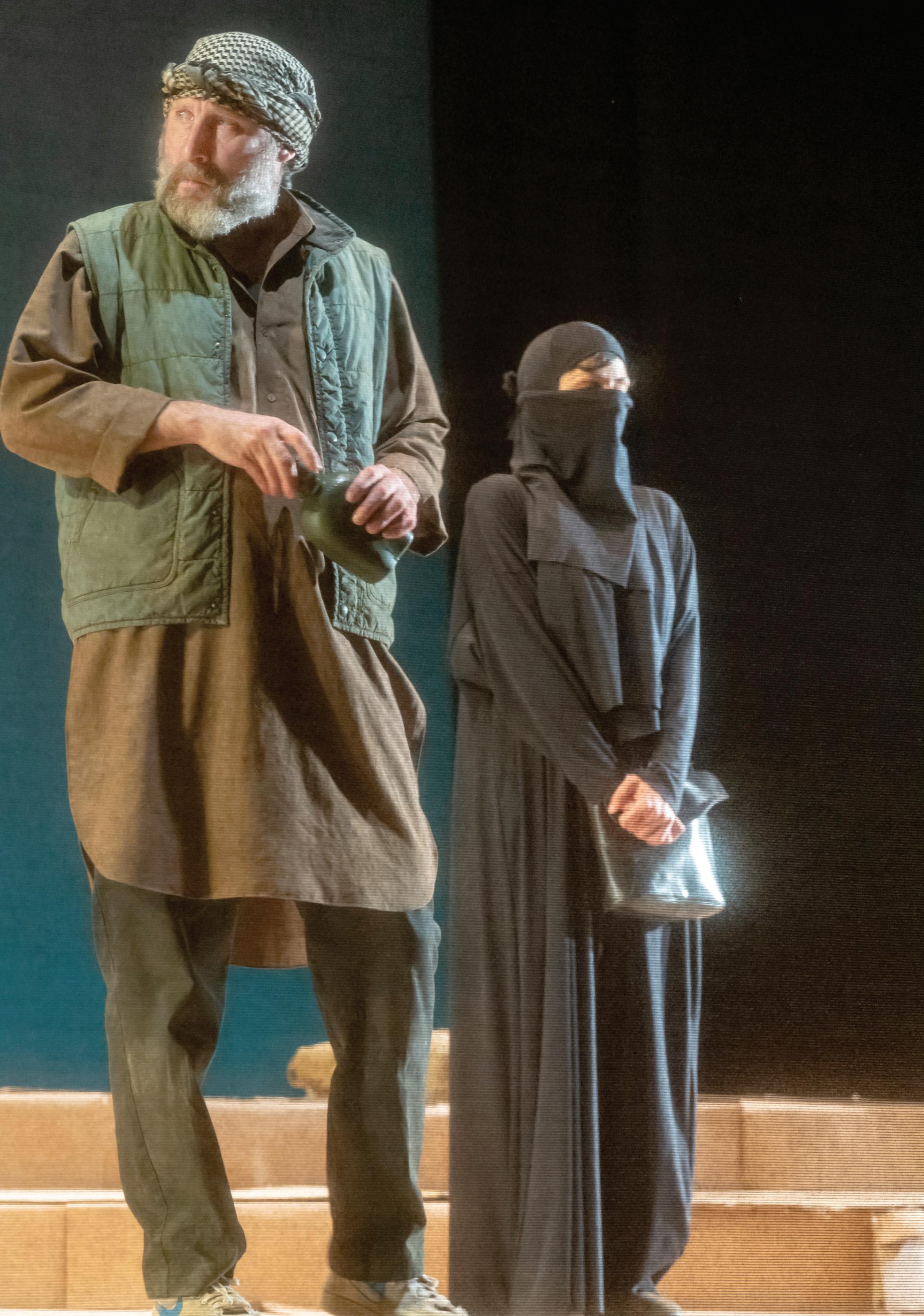
From a burqua to army boots, costume designer Fiona Nichols faced several challenges in designing the contemporary costumes of Rendered
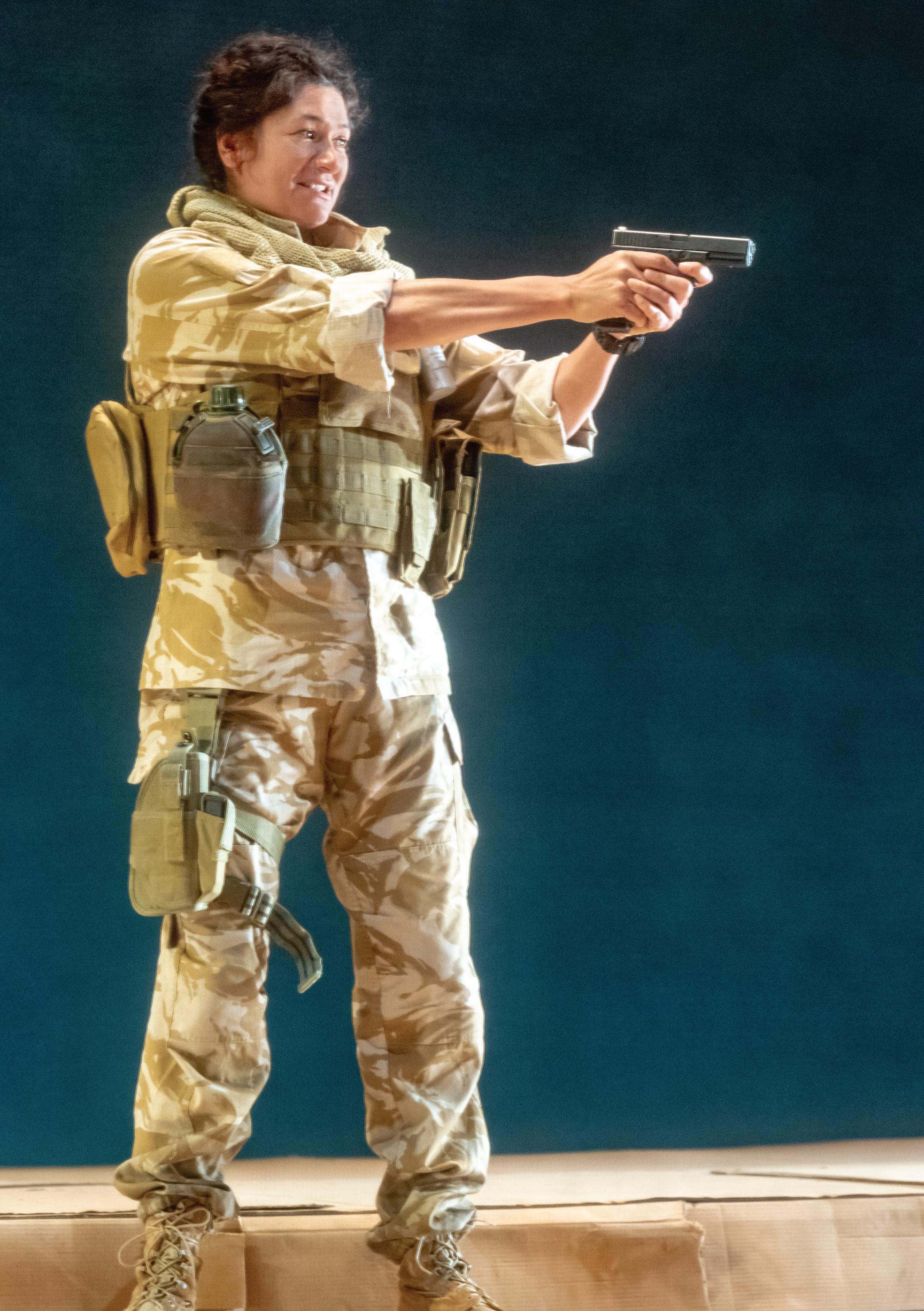
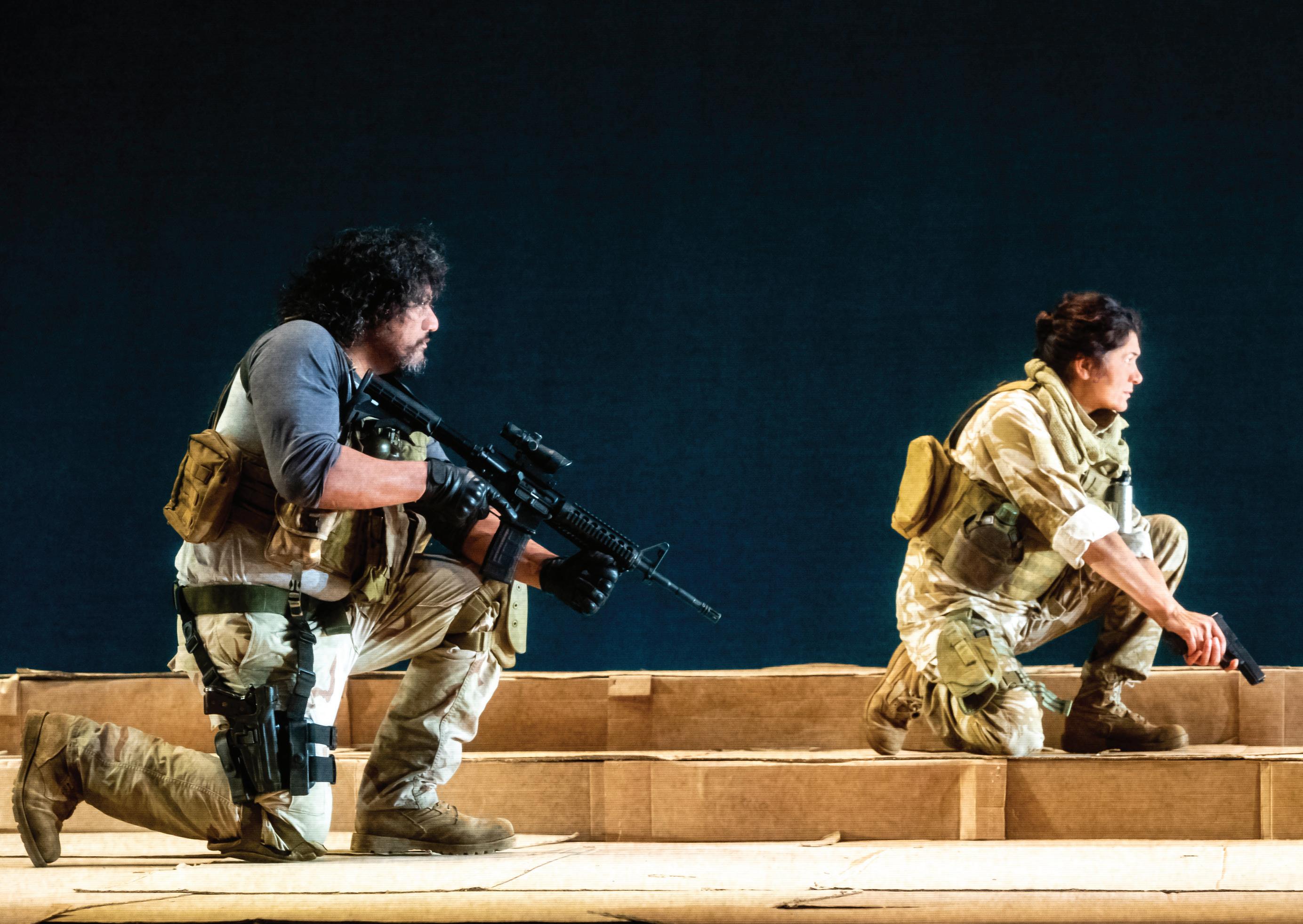
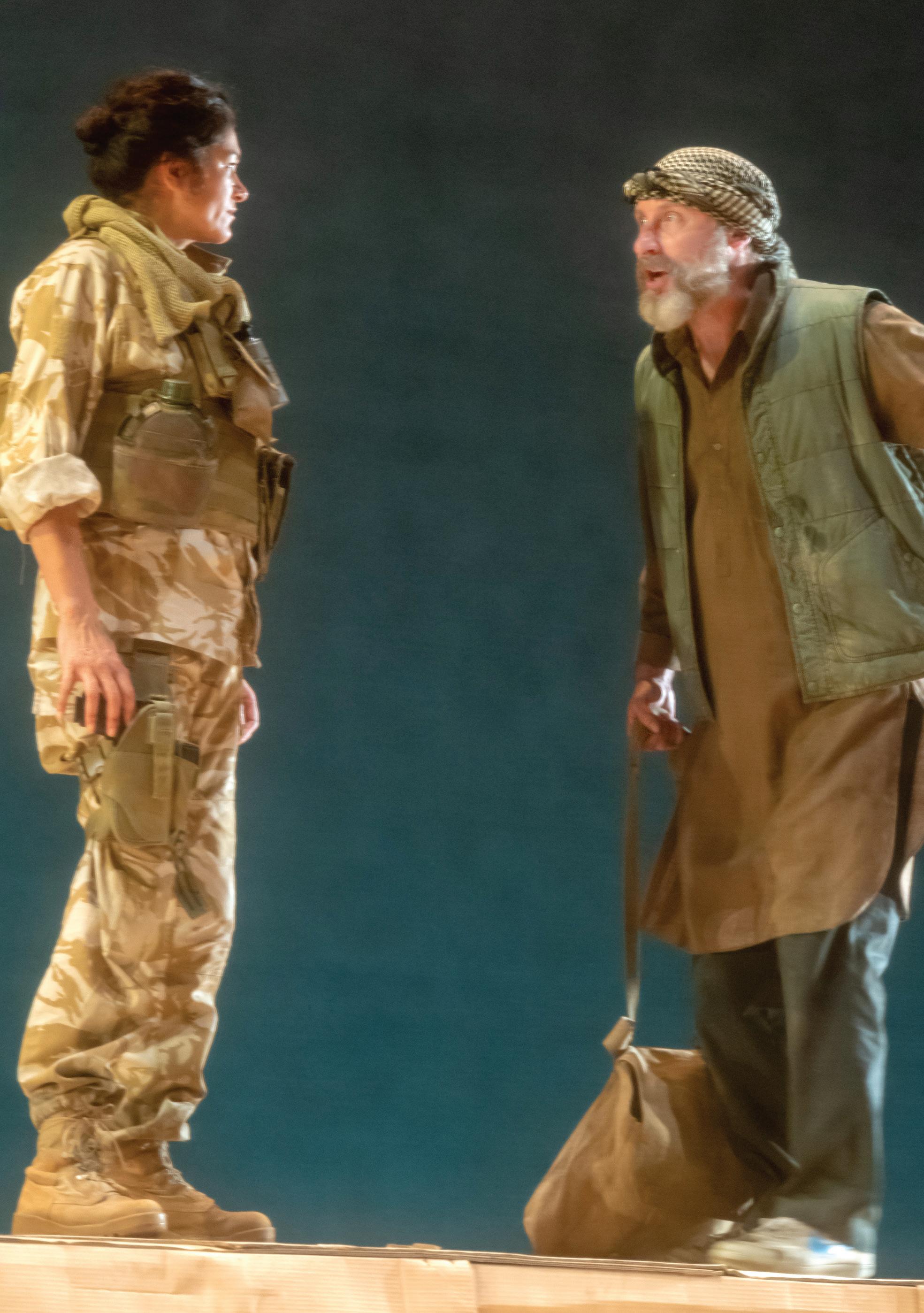
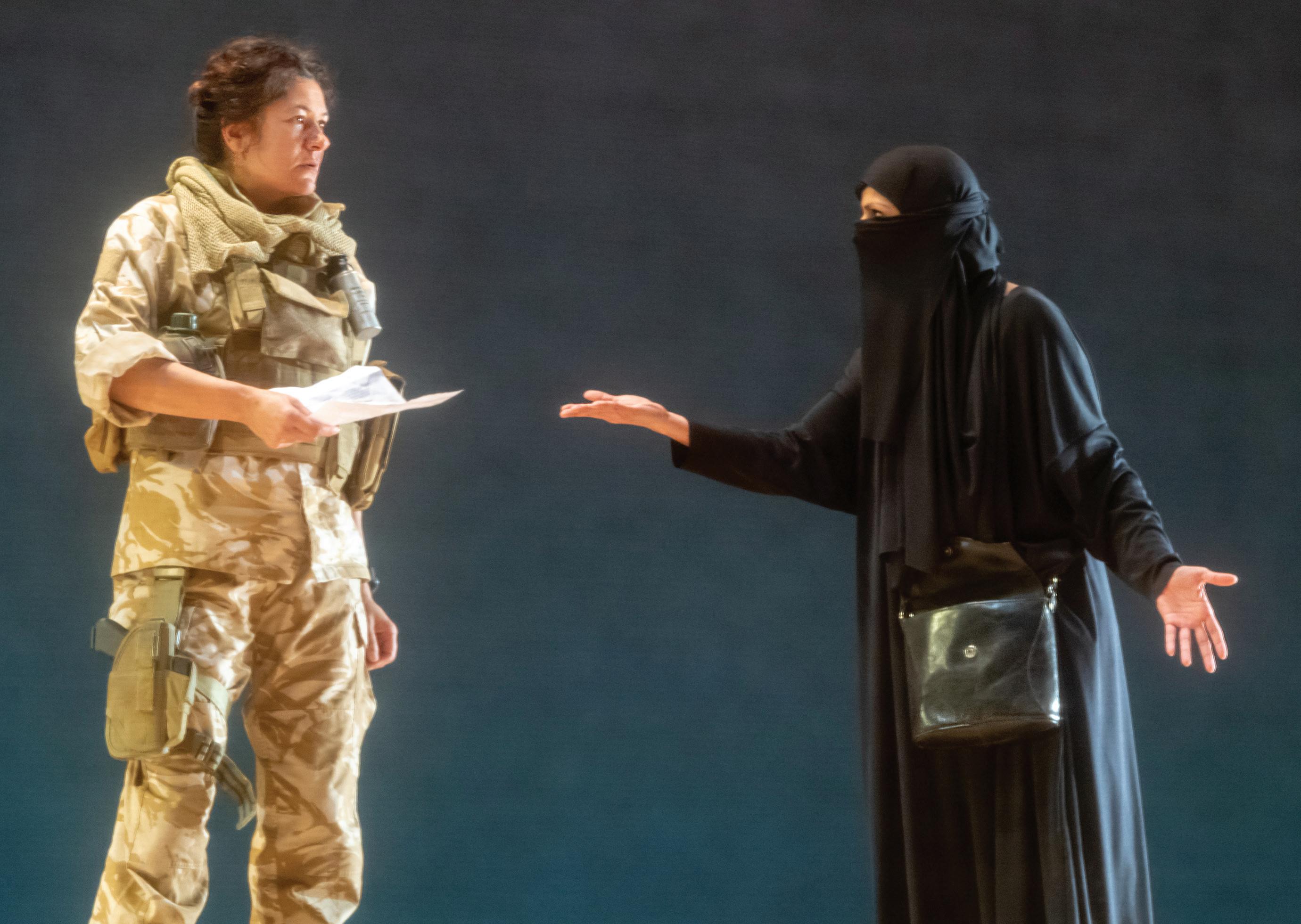
Perhaps the most time-consuming challenge was finding a way to portray the present-day New Zealand Defence Force on stage. As it is illegal to impersonate or appropriate a serving soldier’s uniform, Fiona had to find other ways to represent the uniforms so that they were recognisable and believable, but not exact replicas of the real thing. The actors
TALKING POINTS
also had to get used to the weight of their uniforms, and the weight of the weapons they carry, therefore ‘slave’ costumes (approximations of the costume) and stand in prop guns were introduced as early as possible in rehearsal.
The characters of Miranda and Travis gave Fiona more freedom in terms of design and on the first day of rehearsals she explained that these costumes could have input from the actors themselves and would evolve over the rehearsal period.
Fiona also had to consider costume changes for Travis and Miranda to signify the shift from Auckland to Las Vegas, and then to the intimacy of the hotel room.
• What observations did you make about the soldier’s costumes? Could you tell from the costumes that the soldiers were New Zealanders?
• What did you notice about the weapons? Were there differences between them and what do those differences tell you about each character’s rank or role?
• What impact did the appearance of Zuleikha and Grey have on you? What could you tell about these characters from their costumes?
• How does the costume design reflect the symbolism of war and freedom? Choose two characters and explain how they have been designed with this contrast in mind.
FIONA NICHOLS
DESIGN
LIGHTING AND SOUND
DESIGN – SEAN LYNCH
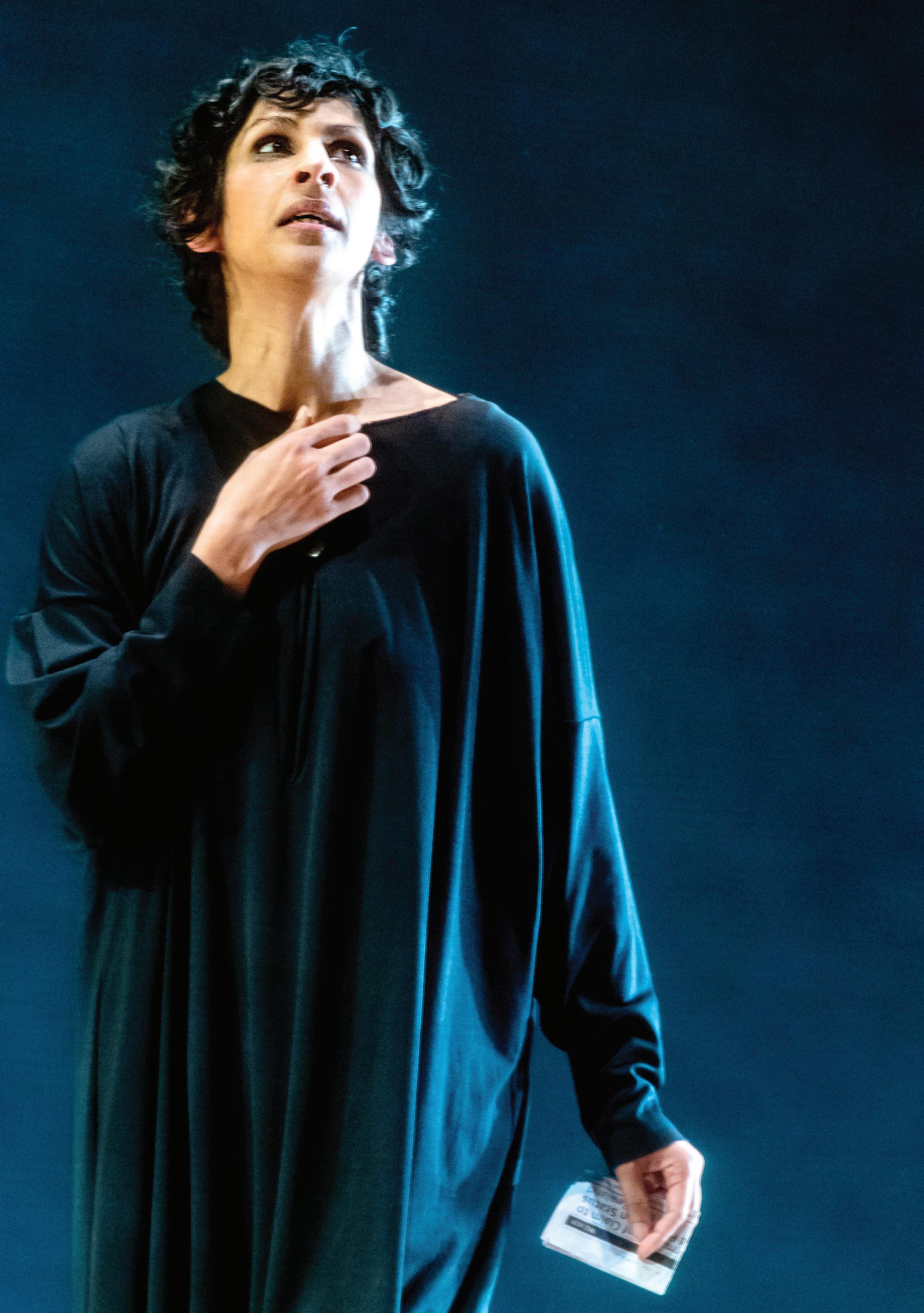
Lighting designer Sean Lynch’s biggest challenge is ensuring the two distinct spaces are well lit and separated. The gauze that separates them must disappear so that the audience can see through to the desert landscape then it needs to reappear and become a backdrop for projections for the downstage playing space and other key moments in the play.
Another challenge is having the projections on the gauze to show where Travis and Miranda are, whilst lighting the actors in this space at the same time, without losing the projection. Sean explains that much of his lighting comes from the side of stage rather than the front or the top, to keep the projections visible at the same time.
Sean’s soundscape for the desert scenes focuses on the sound of wind, as well as the specific sound of an approaching drone, which he describes as being ‘cousins’ of the same sound. Director Katie Wolfe decided to put microphones on the actors in the desert, to aid their audibility beyond the deep proscenium arch stage. During rehearsals, a decision was made to have the actors playing Travis and Miranda on the forestage area wear microphones as well to allow for a consistent amplified sound for the production.
TALKING POINTS
• How does the lighting of the downstage scenes from the side of the stage affect the actor’s blocking and movements? What did you notice about how the actors performed in this light?
• How did the microphones affect the actors’ performances? How would it have been different if the actors did not wear microphones?
• What was the effect of having the wind and the drone approaching connected as ‘cousins’? What was the designer’s intention?
SEAN LYNCH
GLOSSARY
MILITARY TERMS
Mercenary: A professional soldier hired to serve in a foreign army
Private: is the lowest ranked non-commissioned soldier (NZ)
Lance Corporal: is a non-commissioned soldier, two ranks up from a Private (NZ)
Major: There are eleven commissioned ranks in the NZ Army and the rank of Major is 7th from the top rank
Commander in Chief: the head of the Defence Force – the position currently held in New Zealand by Governor-General Dame Patsy Reddy
Brigadier: ranked 4th from the top position in the NZ Army. In January 2018, Lisa Ferris became the second New Zealand woman to rise to this rank
SAS: Special Air Service – a specialist branch of the NZ Defence Force who are tasked with combating terrorism
UH-60: A Black Hawk helicopter; the US army’s primary lift utility transport and air assault aircraft.
MFAT: NZ Ministry of Foreign Affairs and Trade
SIS: NZ Secret Intelligence Service
Drone: Unmanned Arial Vehicles (UAVs) are more commonly known as “drones” – pilotless planes that are remote controlled, often from the US. Drones are usually equipped with a camera and can also be armed with missiles. Drone strikes typically target individuals who have been placed on a “kill list.”
“Burner”: a cheap, disposable mobile phone often associated with illegal activities.
MIDDLE EAST TERMS
Muslim: Someone who follows or practices Islam
Islam: is an Abrahamic monotheistic religion teaching that there is only one God (Allah) and that Muhammad is the messenger of God.
Quran: The central religious text of Islam.
Haji: A Muslim who has been to Mecca as a pilgrim
Burqa: A full length garment that covers the face and body, worn by women in some Islamic traditions.
Talib: A member of the Taliban, a fundamentalist Muslim movement, overthrown by the US in 2001 following the September 11 attacks.
LITERARY AND HISTORICAL FIGURES
George Herbert (1593 – 1633)
Welsh metaphysical poet.
Richard Wilbur (1921 – 2017)
American poet and Pulitzer Prize winner.
(Michael) Dana Goia (1950 -)
American poet and writer, including opera.
Rumi (1207 – 1273) Persian (Iranian) poet, and Islamic scholar, Sufi Mystic and theologian.
Candide, ou l'Optimisme (1759)
A French novella – translated into English versions with titles such as Candide: or, All for the Best (1759); Candide: or, The Optimist (1762); and Candide: Optimism (1947). Readers of Candide often compare it with certain works of the modern genre the Theatre of the Absurd.
Barbara Kingsolver (1955 - )
American novelist, essayist and poet. Her work often focuses on topics such as social justice, biodiversity and the interaction between humans and their communities and environments.
Jesse Blackadder (1964 - )
Australian short story writer, freelance journalist and screenwriter.
Julie Kristeva (1941 - )
Bulgarian-French philosopher and feminist novelist
POST-SHOW ACTIVITIES
THINKING ABOUT the performance you have seen and recall which characters, scenes or specific moments stood out for you. It could be something you enjoyed, or something that confused you. What was it about it that you remember most?
• Make a list of these moments/scenes/characters/transitions.
• As a class, discuss the impact these moments had on you.
• How would you describe the play to a friend?
CHOOSE A PRODUCTION TECHNOLOGY; Set, Lighting, Costume, Props, Microphones, or specific effects (eg: AV projection) used in this production.
• How was it used?
• What impact did it have?
• If you were to re-stage a stand-out scene what would you do differently?
CHOOSE ONE CHARACTER who went through a significant change in the play.
• Describe the character.
• Make a list of how the actor used the Techniques of Drama (Voice, Body, Movement, Space)
• Choose one technique from your list and explain how the actor used that technique to illustrate the significant change for the character.
• Whose job is more important? Miranda the kindergarten teacher or Travis the Drone pilot? Explain your answer.
EXTENSION ACTIVITY: REFLECTING ON THEMES IN THE PLAY FAITH AND BELIEF
“I’m going to rise through the ranks until I have the power to run our little army. And I shall run it according to the gospel of Jesus.” – Major Aria
“I applied myself to the Quran… and when I finished reading it I was shocked at the ignorance and heresy of my brothers…. Read the holy book, all of you. Learn for yourselves the truth of Allah.” – Taylor Grey
• Major Aria and Taylor Grey both have a passionate commitment to their respective religions. Both believe that their faith has a positive role to play in how we live our lives. Do you agree? Why or why not?
• What is the playwright’s intention in drawing a parallel between these two characters and their religious views?
• Travis and Miranda also have (non-religious) beliefs about the morality of war. Miranda accuses Travis of ‘fanaticism.’ What is the playwright’s intention with this accusation?
THE MORALITY OF WAR
“I told them they were animals. They stopped stoning her and they beat me up. Then they went back to stoning her until she was dead.” – Travis.
“I’m fighting for what we both believe…. Won’t you fight for the values we both believe in? Or will you leave it just to me?” – Travis
“You’re exactly like those men who stoned that girl to death…. You can’t stop people killing people by killing people.” – Miranda.
• Reflect on these lines from Travis and Miranda –how would you explain their different moral opinions on the war? Who do you agree with and why?
• Major Aria believes she can use ‘soft power’ to bring an end to conflict. Miranda believes you can’t stop killing people by killing people. Are these women naïve or realistic? Explain your answer.
NEW ZEALAND’S PLACE IN WORLD CONFLICTS
“Ignorant kiwis? That’s us I guess.” – Miranda
“You’re a New Zealander, I guess it’s not your concern.” – Travis
“How many armies are lined up to invade New Zealand?” Miranda
How were the New Zealanders portrayed in Rendered? How did the actors use the Techniques of Drama to convey their kiwi identity?
• What is the playwright suggesting about New Zealand’s attitude to foreign wars?
• Travis compares Miranda – and New Zealanders - to the character Candide, who lived by the advice that “this world is the best of all possible worlds.” What is the playwright suggesting here? How does this idea compare with the Muslim’s Brotherhood’s slogan that “Islam is the solution”?
“The army’s job was to protect the CIA. Otherwise it was dial-a-haka.” – Jeremy
“How dare you turn your back on me when I am fighting for everything you take for granted?” – Travis
• Do you think NZ has a right or a responsibility to assist the US in foreign wars? Why or why not?
• Many refugees from the Middle East flee to the West for sanction; do they have a right to expect to find it here? Why or why not?
• Do you see a connection between these two positions the West holds? Why or why not?
METAPHYSICS
“You sit in a room and murder people on the other side of the world!” - Miranda
“I gave it up because it was unreal. Because it was metaphysical.” – Travis
• How were the Technologies of Drama (set, lighting, AV projection, sound) used in the play to bring the idea of Metaphysics to life?
• Director Katie Wolfe describes Metaphysics as essentially “the study of what is real and what is not real.” How does the Drone technology symbolise this idea?
• Travis says he gave up teaching metaphysical poetry because it was “unreal.” Look up the poem “Love calls us to the things of this world” by Richard Wilbur that he refers to. How does this poem relate to the idea of “what is real and what is not real”? How does it relate to being a drone pilot?
ATC CREATIVE LEARNING –encouraging acts of imagination
ATC CREATIVE LEARNING promotes and encourages teaching and participation in theatre and acts as a resource for secondary and tertiary educators. It is a comprehensive and innovative arts education programme designed to nurture young theatre practitioners and audiences. Whether we are unpacking a play, creating a new work, or learning new skills
we are encouraging habits of thinking that foster acts of imagination to take place.
ATC Creative Learning has direct contact with secondary school students throughout the greater Auckland region with a focus on delivering an exciting and popular programme that supports the Arts education of Auckland students and which focuses on curriculum development, literacy, and the Arts.
CURRICULUM LINKS
ATC EDUCATION activities relate directly to the PK, UC and CI strands of the NZ Curriculum from levels 5 to 8. They also have direct relevance to many of the NCEA achievement standards at all three levels. All secondary school Drama students (Years 9 to 13) should be experiencing live theatre as a part of their course work, Understanding the Arts in Context. Curriculum levels 6, 7 and 8 (equivalent to
years 11, 12 and 13) require the inclusion of New Zealand drama in their course of work. The NCEA external examinations at each level (Level 1 – AS90011, Level 2 – AS91219, Level 3 – AS91518) require students to write about live theatre they have seen. Students who are able to experience fully produced, professional theatre are generally advantaged in answering these questions.