63
MEMORIA ANUAL ANNUAL REPORT
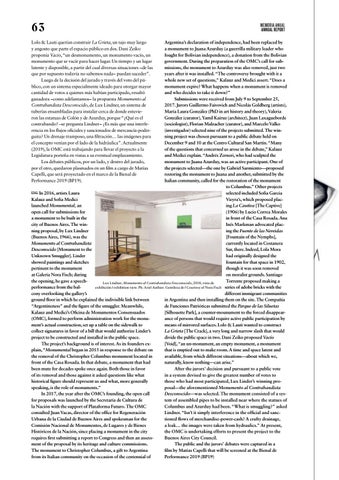
Argentina’s declaration of independence, had been replaced by a monument to Juana Azurduy (a guerrilla military leader who fought for Bolivian independence), a donation from the Bolivian government. During the preparation of the OMC’s call for submissions, the monument to Azurduy was also removed, just two years after it was installed. “The controversy brought with it a whole new set of questions,” Kalauz and Medici assert. “Does a monument expire? What happens when a monument is removed and who decides to take it down?” Submissions were received from July 9 to September 25, 2017. Jurors Guillermo Faivovich and Nicolás Goldberg (artists), María Laura González (PhD in art history and theory), Valeria González (curator), Yamil Kairuz (architect), Juan Laxagueborde (sociologist), Florian Malzacher (curator), and Marcelo Valko (investigador) selected nine of the projects submitted. The winning project was chosen pursuant to a public debate held on December 9 and 10 at the Centro Cultural San Martín. “Many of the questions that concerned us arose in the debate,” Kalauz and Medici explain. “Andrés Zerneri, who had sculpted the monument to Juana Azurduy, was an active participant. One of the projects selected—the one by Gabriel Sarmiento—proposed restoring the monument to Juana and another, submitted by the Italian community, called for the restoration of the monument to Columbus.” Other projects ENG In 2016, artists Laura selected included SofíaGarcía Kalauz and Sofía Medici Vieyra’s, which proposed placing La Cautiva [The Captive] launched Monumental, an (1906) by Lucio Correa Morales open call for submissions for in front of the Casa Rosada. Ana a monument to be built in the Inés Markman advocated placcity of Buenos Aires. The winning proposal, by Lux Lindner ing the Fuente de las Nereidas (Buenos Aires, 1966), was the [Fountain of the Nymphs], Monumento al Contrabandista currently located in Costanera Desconocido [Monument to the Sur, there. Indeed, Lola Mora Unknown Smuggler]. Linder had originally designed the showed paintings and sketches fountain for that space in 1902, pertinent to the monument though it was soon removed at Galería Nora Fisch; during on moralist grounds. Santiago the opening, he gave a speechTorrente proposed making a Lux Lindner, Monumento al Contrabandista Desconocido, 2018, vista de performance from the balexhibición / exhibition view. Ph: Ariel Authier. Gentileza de / Courtesy of Nora Fisch series of adobe bricks with the cony overlooking the gallery’s different immigrant communities ground floor in which he explained the indivisible link between in Argentina and then installing them on the site. The Compañía “Argentineness” and the figure of the smuggler. Meanwhile, de Funciones Patrióticas submitted the Parque de las Siluetas Kalauz and Medici’s Oficina de Monumentos Consensuados [Silhouette Park], a counter-mounument to the forced disappearance of persons that would require active public participation by (OMC), formed to perform administration work for the monument’s actual construction, set up a table on the sidewalk to means of mirrored surfaces. Lolo & Lauti wanted to construct collect signatures in favor of a bill that would authorize Linder’s La Grieta [The Crack], a very long and narrow slash that would project to be constructed and installed in the public space. divide the public space in two. Dani Zeiko proposed Vacío The project’s background is of interest. As its founders ex[Void], “an un-monument, an empty monument, a monument plain, “Monumental began in 2015 in response to the debate on that is emptied out to make room. A time and space latent and the removal of the Christopher Columbus monument located in available, from which different situations—about which we, front of the Casa Rosada. In that debate, a monument that had naturally, know nothing—can arise.” been mute for decades spoke once again. Both those in favor After the jurors’ decision and pursuant to a public vote of its removal and those against it asked questions like what in a system devised to give the greatest number of votes to historical figure should represent us and what, more generally those who had most participated, Lux Linder’s winning proposal—the aforementioned Monumento al Contrabandista speaking, is the role of monuments.” Desconocido—was selected. The monument consisted of a sysIn 2017, the year after the OMC’s founding, the open call tem of assembled pipes to be installed near where the statues of for proposals was launched by the Secretaría de Cultura de Columbus and Azurduy had been. “What is smuggling?” asked la Nación with the support of Plataforma Futuro. The OMC Lindner. “Isn’t it simply interference in the official and sancconsulted Juan Vacas, director of the office for Regeneración tioned flows of merchandise-power-cash? A crafty drainage, Urbana de la Ciudad de Buenos Aires and spokesman for the a leak… the images were taken from hydraulics.” At present, Comisión Nacional de Monumentos, de Lugares y de Bienes the OMC is undertaking efforts to present the project to the Históricos de la Nación, since placing a monument in the city Buenos Aires City Council. requires first submitting a report to Congress and then an assessment of the proposal by its heritage and culture commissions. The public and the jurors’ debates were captured in a The monument to Christopher Columbus, a gift to Argentina film by Matías Capelli that will be screened at the Bienal de from its Italian community on the occasion of the centennial of Performance 2019 (BP19) Lolo & Lauti querían construir La Grieta, un tajo muy largo y angosto que parte el espacio público en dos. Dani Zeiko proponía Vacío, “un desmonumento, un monumento vacío, un monumento que se vacíe para hacer lugar. Un tiempo y un lugar latente y disponible, a partir del cual diversas situaciones −de las que por supuesto todavía no sabemos nada− puedan suceder”. Luego de la decisión del jurado y través del voto del público, con un sistema especialmente ideado para otorgar mayor cantidad de votos a quienes más habían participado, resultó ganadora −como adelantamos− la propuesta Monumento al Contrabandista Desconocido, de Lux Lindner, un sistema de tuberías ensambladas para instalar cerca de donde estuvieron las estatuas de Colón y de Azurduy, porque “¿Qué es el contrabando? –se pregunta Lindner− ¿Es más que una interferencia en los flujos oficiales y sancionados de mercancía-poderguita? Un drenaje tramposo, una filtración… las imágenes para el concepto venían por el lado de la hidráulica”. Actualmente (2019), la OMC está trabajando para llevar el proyecto a la Legislatura porteña en vistas a su eventual emplazamiento. Los debates públicos, por un lado, y dentro del jurado, por el otro, quedaron plasmados en un film a cargo de Matías Capelli, que será proyectado en el marco de la Bienal de Performance 2019 (BP19).