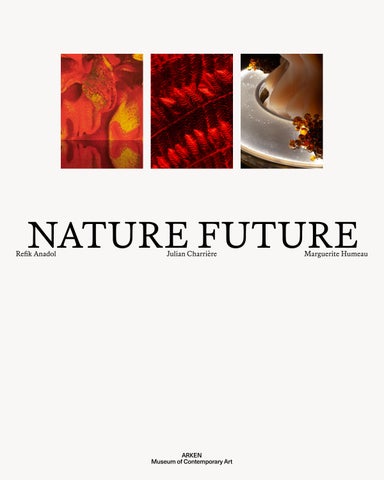
NATURE FUTURE

Page 1


NATURE FUTURE

Julian Charrière
Marguerite Humeau
Refik Anadol
Refik Anadol
Julian Charrière
Marguerite Humeau

IMAGINING MACHINES

REFIK ANADOL’S GENERATIVE ART

JULIAN

CHARRIÈRE’S ENVIRONMENTAL UNCANNY

Dehlia Hannah

MATERIAL STORYTELLING BEYOND ENDS IN MARGUERITE HUMEAU’S *STIRS

Sarah Fredholm

NATURE FUTURE

THREE EXHIBITIONS IN ARKEN’S ART AXIS 202 3–2 5

In 2023, 2024 and 2025, ARKEN Museum of Contemporary Art in Denmark presented NATURE FUTURE, a series of exhibitions focussing on humankind’s relationship with nature and technology – now and in the future. Through three exhibitions – one a year, each featuring an internationally acclaimed artist – the aim was to create artistic experiences that could spark conversations about urgent and complex questions associated with the relationship between human beings, nature and technology, questions that not only press in on our reality here and now but also reach far into the lives of generations to come. What is “nature”, and what is “the human” in an age when we not only form part of nature’s cycles but are in fact co-creators of nature and its future through our scientific and technological advances? What are the ethical, aesthetic and climate-related consequences of humanity’s position in nature and its development of technology? And how can art help us to think, sense and act within this field?

ARKEN is situated on Vestegnen, the western outskirts of Copenhagen, in Ishøj Beach Park, a scenic, artificially constructed landscape created in the 1970s. The area is dominated by kilometres of sandy beach, designed with the dunes of the North Sea coast as its model. Boasting rich birdlife and varied vegetation, the beach park is a much-loved destination for nature enthusiasts and swimmers. Thus, ARKEN is encircled on all sides by a nonnatural landscape that nature has long since reclaimed and made its own. Given this location, the museum feels a particular obligation to place the environment – and the role played by humanity within it – at the centre of its exhibition programme. NATURE FUTURE grew out of this wish to forge a link between the museum’s specific proximity to ecology and the conversations and questions about the encounter between humans and nature that have, in various ways, been raised in international contemporary art.

The exhibition series presented three significant international artists, each creating art that is both thought-provoking and engages the senses: Turkish-born Refik Anadol (b. 1985) with the exhibition Nature Dreams in 2023, French-Swiss artist Julian Charrière (b. 1987) with Solarstalgia in 2024–25 and French artist Marguerite Humeau (b. 1988) with Torches in 2025. All three artists address questions of nature, technology and science in inquisitive, exploratory ways. Over the course of the three years, and each in their own distinctive manner, they filled the expansive architecture of ARKEN’s Art Axis with art experiences that fostered dialogue on precisely these themes.

Refik Anadol is one of the most influential artists globally in the field of digital art. Anadol’s vast, spectacular installations are outcomes of his use of artificial intelligence (AI), specifically datadriven algorithms. His works arise out of collaboration between human and machine, and they pose questions that point towards a future in which human existence will be even more inextricably bound up with data and hyper-advanced computer technology. At ARKEN, Refik Anadol presented works from the series Nature Dreams , which takes as its point of departure the visual

representation of nature in the mass media – our shared ideas of what nature is and how it looks. Through the algorithms of artificial intelligence, Anadol transforms this data into new, partly abstract depictions of nature.

Taking an activist and scientific approach, Julian Charrière explores our perception of nature and how it has changed over time. In the exhibition Solarstalgia at ARKEN, his grand, all-encompassing installations invited visitors to reflect critically on humanity’s use of nature’s resources and its impact on ecosystems. Visitors could experience Charrière’s immersive environments and a selection of works that took them on a journey over the course of our planet’s history. Spanning immense stretches of time, the exhibition revealed the intricate interplay between past, present and future.

In Torches, Marguerite Humeau invited us to enter her explorations of human existence and that of other (extinct or imagined) life forms. Her sculptures and installations connect prehistoric time with the future in complex worlds where human beings are no longer at the centre. In the exhibition at ARKEN, the narratives and fabulations presented in these works offered up new ways of understanding possible forms of existence on Earth – and invited visitors to rethink our relationship with other species. What if we became beings living in close symbiosis with all other life forms? What if elephants had become the dominant species on Earth – or if life could only be sustained high up in the atmosphere? These are some of the questions raised by the works in the exhibition.

In this publication, curator and researcher Majken Overgaard focusses on Refik Anadol’s artistic practice and on his use of technology at a time when AI fascinates and provokes fear in equal measure. Curator and philosopher of nature Dehlia Hannah examines, through readings of Julian Charrière’s works Panchronic Garden (2022/2024) and An Invitation to Disappear (2018), how the artist explores the relationship between humans and nature and the idea of ‘the environmental uncanny’. ARKEN curator Sarah Fredholm takes a close look at Marguerite Humeau’s work *stirs

from Torches, examining it as a speculative mythological narrative in which life, materiality and storytelling are interwoven, paving the way for new and different sensory and cognitive relationships to the world. I would like to express my warm thanks to the authors for their insightful contributions to this publication. Finally, a warm thank you to Strandberg Publishing, editor Pernille Gøtze Johansson and graphic designer Filip Grønning for the great work on this publication.
The three artists deserve heartfelt thanks for having created some truly remarkable exhibitions for ARKEN. We are deeply grateful and delighted to have hosted millions of image files and live-generated art on the museum’s facade, to have facilitated a journey back to the fern forests of the Carboniferous Period some 300 million years ago and to have provided a caring framework for a dying elephant’s journey beyond this world.

Several foundations have contributed generous and utterly invaluable support to NATURE FUTURE, enabling us to realise the trilogy on the full and ambitious scale we envisioned. We would like to express our profound gratitude to The Obel Family Foundation, Beckett-Fonden, the New Carlsberg Foundation, the Aage and Johanne Louis-Hansen Foundation, the Augustinus Foundation, Swiss Arts Council Pro Helvetia and the William Demant Foundation.

On behalf of all of ARKEN Museum of Contemporary Art and the three exhibition teams,

Director

pp. 8–9: Refik Anadol, Nature Dreams, installation view, ARKEN Museum of Contemporary Art, 2023

pp. 10–11: Julian Charrière, Solarstalgia, installation view, ARKEN Museum of Contemporary Art, 2024–25

pp. 12–13: Marguerite Humeau, Torches, installation view, ARKEN Museum of Contemporary Art, 2025

IMAGINING MACHINES REFIK ANADOL’S GENERATIVE ART

In February 2023, ARKEN Museum of Contemporary Art opened Nature Dreams, an exhibition presenting Refik Anadol’s AI-based works. It arrived at a moment when generative technologies – popularly grouped under the label ‘artificial intelligence’ (AI) –were beginning to reshape everyday life. Only a few months earlier, the American company OpenAI had released ChatGPT, giving users access to generating text through prompts. At the same time, models designed to produce images and video were advancing at remarkable speed. Anadol’s exhibition reached Denmark amid widespread curiosity, excitement and uncertainty about what these new technologies were and how they might affect us. We are currently in a phase where our collective understanding of AI, and what it may come to mean, is still taking shape. Even so, certain things are clearer now than they were just a few years ago: we have become more aware of both the possibilities and the challenges these technologies bring. Meanwhile, the global race to develop and deploy AI is accelerating with an intensity that some have likened to the Cold War.1 Global powers are competing not only to develop the most advanced software, but also for access to the raw materials

required to manufacture the chips on which the technology depends. To this we may add conflicts over ownership of infrastructure, the struggle for public support and the question of whether regulation should be tightened or relaxed.

Ever since the processes of industrialisation gathered real momentum at the end of the 19th century, we have been both fascinated and unsettled when envisioning the potential futures brought about by technologies we ourselves invent.2 Public debate often ends up either supporting or rejecting AI. Yet when the discussion of AI is allowed to stay within a binary framework of polar opposites, poised between unqualified optimism and principled refusal, the complex social, ethical and political questions raised by the technology are obscured. Here, art plays a central role: by exploring the ambivalence embedded within our fascination and fear, it can pave the way for reflection on the technology’s potentials and its power structures alike. Engaging in such critical reflections is essential if we are to understand and act rather than merely react to the technological narratives being shaped around us. Accepting this challenge, the present article

examines the concepts of technology that emerge within Refik Anadol’s artistic practice, and how his use of technology relates to the present-day mixture of fascination and fear prompted by AI.

GENERATIVE ART

The American-Turkish artist Refik Anadol is not the first to connect art and computers. Ever since the digital computer first emerged in 1945, artists have explored its artistic qualities as collaborator, tool and medium.3 The concept of “generative art” first emerged in the 1960s, and Refik Anadol’s works belong within this tradition.4 In generative art, the artist establishes the framework for a system from which new forms and expressions are produced. The system need not be digital; all that is required is that the system possesses a degree of autonomy. One of the most significant pioneers of generative art is the Hungarian artist Vera Molnár, who worked systematically with simple rules – and later actual algorithms – to produce variations that challenged her own understanding of possible artistic processes and of the finished works themselves. Molnár referred to it as a ‘machine imaginaire’.5 For her, it was not the computer in itself that mattered, but the idea of a computer: ‘An imaginary machine, that’s an excellent concept for me because it combines machine and imaginary. Because my goal is not at all to use a computer, I don’t care about computers, but the computer is like a slave in making my dreams a reality. My imagination, if you will.’6 The relationship between our imaginings and technology is also central for Anadol. Unlike Molnár, however, what is key to Anadol is not human imaginative capacity, but rather the way in which the various technologies he brings into play – collectively termed ‘the machine’ – unfold through the unpredictable elements found within generative digital systems. Generative models do not always produce factually accurate results. You may well receive misleading answers to your questions; this is known as ‘hallucinations’ – a term Anadol also often uses when assigning titles to his works.7 He describes it as ‘the machine dreaming’.8 In contrast to Molnár,

Anadol is interested in how generative technologies produce such unexpected results, and how this output takes form in relation to the human being. He speaks of this fascination in an interview: ‘I wanted to explore several interrelated questions: Can a machine learn? Can it dream? Can it hallucinate?’9 In Anadol’s practice, the machine’s autonomy is brought into focus, driven by his special interest in the dissolution of boundaries between human consciousness and the machine’s hallucinations.10

Anadol links contemporary generative technologies with art, design and architecture, and at the same time succeeds in bringing his works to large audiences around the world. His works are large scale; he often uses entire buildings as his canvas.11 They are also frequently immersive, created to envelop and activate our bodies and senses. Refik Anadol strives to give form to something that to most people is utterly intangible: data. He has given data a physical, sensory dimension, greatly contributing to the development of data visualisation as an artistic discipline. He has developed the terms ‘data painting’ and ‘data sculpture’. As Anadol says: ‘I coined the term “data painting” when I started imagining the pigmentation of the data around us – the sound, the vision, the internet.’12

All these elements were integral to the exhibition Nature Dreams at ARKEN, which comprised three major works that jointly illustrate the different ways Anadol works with AI. One was the exhibition’s central work, Machine Hallucinations: Nature Dreams (2021), based on a dataset of 300 million photographs of nature scraped from social media and other publicly available archives.13 The second was the immersive installation Machine Hallucinations: Nature Dreams (Immersive Edition) (2023), while the third, Winds of Denmark (2023), was placed outside on the museum facade, conveying data about current weather conditions through a collaboration with the local weather station in Ishøj (where ARKEN is situated). The data from the weather station directly affected the work’s visual appearance, anchoring it in the local site. The intention was to give visitors a physical feel for the data that surrounds them in everyday life. In this way, nature became both motif and material within the generative process, and the

Machine Hallucinations: Nature Dreams, 2021. AI data sculpture. Installation view, ARKEN Museum of Contemporary Art, 2023

representation of nature through data was the exhibition’s overarching theme.

Anadol’s works in Nature Dreams induced an almost meditative state among audiences as his digital sculptures combined ambient sound with abstract forms that moved in vast, soft formations across the screen – or across walls, floors and ceilings. His works are often saturated with colour, employing bright tones that are amplified by the light of the screen or projector. They are, emphatically, a physical experience. In an interview, Anadol describes what he imagines happening to those who encounter one of his immersive installations: ‘You open a door, and time and space melts. Behind that door, there is no ceiling … there is no floor, corner, nor wall. In that room, a machine creates alternative realities, where you can step in and enjoy.’14 We are meant to be physically overwhelmed. To palpably feel, in our own bodies, the potential realities that the machine, according to Anadol, can create. He challenges the traditional conception of computerbased art: in his work, the digital is no longer bound to the screen. Rather, it is entwined with architecture, with walls and rooms, and with our bodies.

His relatable, accessible visual idiom appeals to thousands of people. Yet he is also a controversial artist. Not because he deliberately seeks to provoke: Anadol is not the sort of artist who raises questions or engages in critique. In fact, this is the very issue that some find hard to stomach. His legendary optimism on what technology has to offer and his transhumanist dream of connecting human and machine are the aspects that make him controversial today.15 Not everyone can identify with Anadol’s fascination with artificial intelligence, and it can be difficult to separate criticism of Anadol from the broader critique of artificial intelligence and the tech industry in Silicon Valley.

CONNECTIONS TO THE TECH INDUSTRY

Since the outset of his career, Refik Anadol has been closely associated with major tech companies in Silicon Valley. His breakthrough in the art world came

in the wake of his Google Artists and Machine Intelligence Artist Residency in 2016, where, among other opportunities, he was able to work with the company’s various AI models, including DeepDream.16 Today he collaborates with tech companies such as Google, NVIDIA, Microsoft, Apple, Intel, IBM, Siemens and Epson.17 He has entered into a wide range of commercial partnerships with brands and companies around the world, including the cognac brand Hennessy, 18 the car manufacturer Rolls- Royce, 19 Turkish Airlines20 and many more. In addition, he has sold digital artworks for more than 30 million dollars.21 He also appears on Time magazine’s Top 100 list of the most influential people in AI in 2025.22

Many critics point to his close ties to major technology corporations, arguing that he imports their logics and techno-optimism into his artistic practice. Yet within art and technology contexts, collaboration with companies and research institutions has long been common for a straightforward reason: this is often where the newest tools and expertise are concentrated. In many such partnerships between artists, researchers and corporations, the companies provide access to technology and specialist knowledge, while artists broaden our aesthetic and cultural understanding of what technology is – and what it might become.23 On a more general level, art and power have always been closely intertwined. Kings, churches and states have projected their chosen image through buildings, paintings and sculpture. In Refik Anadol’s case, it is not monarchs who are portrayed; rather, the subject being depicted and elevated is technology itself.

Technology has never been neutral, but these days concerns about its impact are on the rise: AI, data and digital infrastructures have increasingly become global instruments of power, shaped by geopolitical interests and ideological struggle. 24 Vast economic forces are driving the development of AI. The company OpenAI, creator of products such as ChatGPT and DALL·E, was valued at US$500 billion in October 2025 following a share sale.25 Figures of that magnitude underline that today AI is one of the world’s most capital-intensive and influential industries. Notably, AI does not exist in a  political

vacuum: it occupies a reality informed by Silicon Valley’s political mobilisation and the close ties between technological and political elites. Anadol’s works aim to give audiences spectacular artistic experiences, but they do so by means of technologies that are heavily politically charged. All this is to say that taking a closer look at Refik Anadol’s practice also involves considering the kind of ideology and imaginaries he carries forward from Silicon Valley.

UTOPIA VS. DYSTOPIA

Refik Anadol has repeatedly pointed to two major fields that have shaped him as an artist: science fiction literature and film. In interviews, he often recounts how he saw the 1982 film Blade Runner for the first time when he was eight years old: ‘That movie changed my life. I was so inspired by it, even though I didn’t know English yet. In the same year, I got my first computer. It was a huge change in my life, as you

might guess. The first sci-fi movie, the first computer in the same year, it was just a huge inspiration.’26 In other interviews he has pointed to science-fiction writers such as Philip K. Dick and William Gibson as sources of inspiration.27 Blade Runner and the literature mentioned are iconic within Western science fiction. Strikingly, these works are also profoundly dystopian, focussing on technological surveillance and distrust of gigantic capitalist corporations which, through their control of a range of technologies that includes artificial intelligence and robotics, bring about social disintegration.

Out of such pessimistic material, Anadol nevertheless draws his utopian confidence in technology’s potential. As he puts it: ‘I’m more into the opportunities. I’m an optimist. I’m interested in the more positive, utopian side of technology.’ 28 Explaining why technological utopias are his takeaway from these dystopian visions of the future, he has said elsewhere: ‘Watching a science fiction movie as a child is very different, because we don’t want to see the dystopia. As a child, we see the hope.

We see a positive world around us. I think I felt so connected with even the darkest concepts of science fiction. You can still feel beauty. You can still find the human in there.’29 There is something beautiful and innocent about Anadol’s hopeful view of technology and possible futures, which some have highlighted as a utopian break away from elitist and critical conceptions of art. 30 On the other hand, it may also seem somewhat naive to focus solely on the positive aspects of technology, at a time when large parts of the world are experiencing the consequences of generative AI in the form of lost jobs or income, ethical challenges regarding whether we can trust images, video and text – just to name a few.

Still, Refik Anadol is far from alone in his faith in technology’s potential. As early as the 1990s, Richard Barbrook and Andy Cameron described the so-called ‘Californian Ideology’ as a blend of hippie counterculture and inspiration from entertainment and media industries, fused with neoliberal market logics that cast technological progress as both inevitable and emancipatory.31 The authors criticise how this blend of idealism and faith in the free market became Silicon Valley’s dominant narrative about the transformations technology will cause. Seen in this light, Anadol’s utopian trust in technology can be read as an artistic extension of this Californian worldview – as an aesthetic reiteration and reinforcement of a narrative that promises hope even as it may be simultaneously and inadvertently concealing the dangers that also surround new technologies, in this case AI.

OUR TECHNOLOGICAL MONSTERS

The author Mary Shelley explored such contradictions within the human drive to create: a fascination with the unknown and a dread of losing control. She described the phenomenon in the novel Frankenstein, published in 1818. In it, Dr Frankenstein is captivated by the possibilities in the technologies available to him, as well as by his own ability to play God and create a living being out of flesh and electricity.32

At that point, electricity was still an enigmatic, mysterious phenomenon. Humankind had witnessed the force of lightning and static electricity and had begun experimenting with different kinds of batteries. In Shelley’s work, electricity represents what is still unknown in nature and humanity’s potential ability to harness that power. In our present day, data flows and algorithms represent the unmanageable, transformative potential of artificial intelligence. Where is this development leading us? Are we in the process of destroying our culture and society, or improving it? Several acclaimed researchers and leaders of tech companies have recommended that we stop developing AI – or at least slow down until our legislation can keep pace.33 Is that the answer? Should we halt development and artistic experimentation with AI?

In the essay ‘Love Your Monsters’ (2011),34 French scholar Bruno Latour also takes Shelley’s novel as his point of departure. He argues that Frankenstein should not be read as a warning against technological development, but rather as a warning against the absence of responsibility for what is created. The real problem, according to Latour, is not that we develop technology, nor that the character Frankenstein creates a living being, but that, over the course of the story, he becomes frightened by what he has brought into being, flees from what he now calls the ‘monster’ and refuses to take responsibility for his own creation. It is due to this failure that the monster becomes a monster. In his essay, Latour suggests that we must instead strive to care for our technological children with the same sense of responsibility we feel for our biological children. We cannot relinquish the parental role. When we bring something into the world, we must enter into an ongoing relationship of care and obligation. This perspective is particularly interesting when considering Refik Anadol, who describes his work with AI as a collaboration, calling it ‘dreaming with machines’.35 Where Frankenstein turns his back on his creation in horror, Anadol insists on connecting and entering into dialogue with technology. In this sense, Refik Anadol follows Bruno Latour’s call, and his art can be seen as creating – or creating the possibility of – an intimacy with our technological

creations. Yet his faith in technology’s utopian potentials also means that there are structural challenges he does not notice – or at least does not articulate, and thus does not take responsibility for.

TAKING RESPONSIBILITY

As AI has gained ground, we have become increasingly aware of how deeply our data is entangled in the digital economy. Generative models are trained on vast datasets, often gathered online. This means that texts, images and videos created and uploaded by ordinary users, as well as by artists, libraries and museums, are now used by commercial companies without compensation. In his own practice, Anadol has partly collected data from the web and partly relied on collaborations with major cultural institutions, local partners and other stakeholders to gain access to datasets. In this sense, his methods mirror those used by large technology companies when they assemble training corpora.

Web scraping with software bots is not new. Ever since the earliest search engines began indexing the internet, automated systems have been required to “read” web pages at scale, identifying what a site contains so it can be classified and retrieved, helping to produce more relevant search results; that automation has also underpinned many of the internet’s core business models.

Today, however, bots increasingly do more than index. They extract content so that images, text and video can be ingested into the training pipelines of generative models. Unsurprisingly, this shift has triggered intense backlash, including lawsuits and public disputes involving publishers, record labels, news organisations, artists, musicians and many other stakeholders.36 Since the 1990s we have become accustomed to technology reshaping power hierarchies and business models, and the arguments from technology companies for why these shifts should occur remain much the same: that they democratise information and create digital access for everyone. In practice, this essentially means that economic value is moved

away from artists, musicians and writers and concentrated in the hands of a small number of global corporations. In an interview with the Los Angeles Times, Refik Anadol emphasises that ‘ethical AI’ is central to his practice and that he has obtained permissions for all data used.37 The interview dates from 2024, reflecting how Anadol has developed his approach to data in step with the emergence of generative models that have reignited debate about digital rights and cultural appropriation. The way he previously scraped the internet has now largely been replaced by collaborations with collections, museums and archives that make data available. Most recently, he created what he calls Large Nature Model, which is not built on scraped data but on data sourced from national archives.38

You cannot make generative artworks without data, but several artists have developed their own methods of working with data as part of their artistic engagement with AI – and as a critique of how commercial companies collect it. One example is Myriad (Tulips) by the artist Anna Ridler, which is based on an extensive dataset consisting of 10,000 photographs of tulips, taken by the artist herself (see the following page). Every day, she took photographs of tulips and recorded their colour, shape and condition by hand; an indexing process of the kind normally carried out automatically by software or by anonymous, low-paid workers.39 By creating and categorising the images herself, she investigates how data comes into being, and how subjective choices shape the outcome. In this way Ridler makes visible the otherwise invisible, manual and time-consuming process behind the production of data, and points to how AI contains human judgement, error and bias. Such critique is not part of Refik Anadol’s world. Instead, he is keen to speak about why data matters, and what he believes data actually is.

DATA IS MORE THAN NUMERICAL VALUES

In the book Atlas of AI (2021), the Australian scholar and artist Kate Crawford describes how artificial intelligence is not a neutral system, but politically

and materially complex. For example, she notes that ‘machine learning systems are trained on images … that were taken from the internet or from state institutions without context and without consent. They are anything but neutral. They represent personal histories, structural inequities’. 40 Refik Anadol often describes publicly available data as a shared human memory that can be materialised in his works, thereby translating information into visual and sensory experiences: ‘I believe anything in life that is quantifiable can become an artwork. Data is not just numbers; it’s a form of memory

with Anadol, who likewise seeks to open up our understanding of data and to show that it can serve as a collective, poetic memory. Both positions insist that data is more than numerical values; data also carries experiences and emotion.

However, D’Ignazio and Klein also argue that data is never neutral, but always embedded within social and political contexts. As they put it: ‘Counting and classification can be powerful parts of the process of creating knowledge. But they’re also tools of power themselves. Historically, counting and classification have been used to dominate,

and can take any shape or form.’ 41 For him, data is not just information, but feelings, memories and dreams that take physical form through his works. This approach is particularly interesting when viewed in the context of both Kate Crawford and the scholars Catherine D’Ignazio and Lauren F. Klein, who in their book Data Feminism (2020) emphasise that data contains affective dimensions. According to them, data can create feelings; data is tied to memory; and it can shape the way we understand the world. 42 In this regard we see a kinship

24

discipline and exclude.’43 They stress the need to ask who owns the data, how it was produced and what power structures it is entangled in. By contrast, Anadol aestheticises and collectivises data without posing critical questions about the dataset’s origins or the structures that make its existence possible. Where D’Ignazio and Klein insist that data is affective and never neutral, Anadol primarily foregrounds its aesthetic dimension. His works create poetic spaces for reflection and sensory experience, but, unlike Crawford and Ridler, they do not engage

Anna Ridler, Myriad (Tulips), 2018.

with the power relations and struggles over rights that emerges from tech companies’ exploitation of data as a material.

NATURE AS A RESOURCE

Generative technologies have not only provoked reactions due to the tech companies’ exploitation of data; their carbon footprint has also been a major cause of concern. Not so much among the tech giants, for whom technological development itself remains the principal issue, but independent researchers, artists and activists have worked to gain an overview of how much energy generative technologies consume. 44 Over the past year, data has emerged from both Google 45 and OpenAI 46 , but as a whole the technology industry has been reluctant to release information that would enable users to understand the climate footprint of AI. 47 Kate Crawford argues that mineral extraction and the energy consumption of the many data centres around the world tie AI to a continuation of colo -

nial and capitalist logics of extraction, greatly to the detriment of the climate.48 On the one hand, then, we have a technology industry that either regards the climate movement as an outright threat or seeks to avoid the conversation about technology’s impact on the planet; and on the other we have scientists, scholars, artists and activists who document and continue to press for openness and insight into generative technologies’ consumption and their influence on the climate. Where does Refik Anadol posit himself within this?

Nature has taken on ever-greater prominence in Anadol’s practice in recent years. Beyond the exhibition at ARKEN, he has, in several projects, sought to render visible the vulnerable state of the Earth’s climate and to call attention to environmental change. One example is Machine Hallucinations – Coral Dreams (2021), in which he used millions of images of coral reefs collected from social media to create a digital ecosystem that, as he himself puts it, ‘focuses on preservation and sustainability.’49 Anadol uses data as a means of preserving and representing nature’s beauty and describes his work as an attempt to capture nature through technology: ‘I’ve

Kate Crawford and Vladan Joler, Calculating Empires: A Genealogy of Technology and Power Since 1500, 2025. Installation view,

been exploring the movement found in nature since 2010, creating simulations – or what I call “data pigmentations” – based on data related to water, wind and weather patterns … We started archiving nature data and have gathered more than four billion images of flora and fauna to date.’50 For Anadol, nature is thus separated from the human and becomes something we can experience through digital simulations, as aesthetic memories of the world we are in the process of losing. As he says: ‘As artists, we can represent nature in the digital age, so those who see our works remember how it feels to be immersed in the natural world.’ 51 While Anadol clearly seeks to create a connection between human, technology and nature, this connection is forged through his use of nature as a resource: as something that can be collected, systematised and recreated through machine learning. Returning to Bruno Latour’s call in ‘Love Your Monsters’, we might ask whether Refik Anadol truly takes responsibility for the technology he uses. He engages nature in order to point to the challenges the world faces, yet does so through technologies that themselves contribute to the very problems he thematises. When nature is reduced to aesthetic simulations, and the vast climatic and social challenges underlying the technologies are left unaddressed, the responsibility Latour advocates for is lost. Anadol’s works stage an interconnectedness between human, technology and nature, but they proceed from an understanding of both human data and nature as materials that can be used without taking a position on the consequences.

With his star status, Refik Anadol has become a powerful influence on how we imagine our possible technological futures. He communicates a vision of human-machine convergence to vast audiences through museum and gallery exhibitions, and through collaborations with corporate partners worldwide. Artists, of course, are under no obligation to accommodate every social perspective in their work. In 2025, however, it is increasingly difficult to employ generative technologies in artworks that address nothing beyond aesthetic and poetic potentials. Art provides a crucial space where we can imagine alternative futures. And if we want a public

conversation about artificial intelligence that avoids collapsing into either utopian fantasy or dystopian, paralysing dread, there is a real potential in taking responsibility for our monsters – while strengthening our capacity to envision alternative, more accountable paths of development.

MAJKEN

is an independent curator, writer and lecturer whose work explores the intersections of art and technology. She has collaborated with leading culture institutions including VEGA, SMK – National Gallery of Denmark and the National Museum of Denmark.

1 Richard Heeks and Yujia He, ‘Analysing the US-China “AI Cold War” Narrativeʼ, Digital Development Working Paper Series (2024), https://www. gdi.manchester.ac.uk/research/ publications/di/.

2 I am referring here to the first and second industrial revolutions, the growing mechanisation and the ways in which the discovery of electricity began to change the world.

3 Earlier computers include various programmable punched-card systems and mechanical computers, but ENIAC is the first digital computer, see https://lex.dk/computer. See also Christiane Paul, Digital Art (Thames & Hudson, 2023), pp. 15–16

4 Tina Rivers Ryan, ‘Dialogues with the Machine: Early Computer and Cybernetic Artʼ in; Val Ravaglia (ed.), Electric Dreams: Art and Technology Before the Internet London: (Tate Publishing, 2025), pp. 105–113.

5 Hans Ullrich Obrist, ‘Vera Molnar in conversation with Hans Ullrich Obristʼ in Hans Ullrich Obrist and András Szántó (eds.), Bookmarks: Revisiting Hungarian Art of the 1960s and 1970s (Koenig Books, 2018), p. 77.

6 ‘Vera Molnar in conversation with Hans Ullrich Obristʼ, p. 77.

7 ‘Worksʼ, Refik Anadol Studio, https:// refikanadol.com/works/.

8 Refik Anadol and Pelin Kivrak, ‘Machines that Dream: How AIHuman Collaborations in Art Deepen Audience Engagementʼ, Management and Business Review 3, no. 1 & 2 (Winter and Spring 2023), p. 102.

9 Paola Antonelli, Casey Reas, Refik Anadol and Michelle Kuo, ‘Modern Dream: How Refik Anadol Is Using Machine Learning and NFTs to Interpret MoMA’s Collectionʼ, MoMA Magazine, 15 November 2021, https://www.moma.org/magazine/ articles/658.

10 Paola Antonelli et al., ‘Modern Dreamʼ.

11 Louis Jebb, ‘An architect’s dream: Refik Anadol launches AI tribute to Frank Gehry at Guggenheim Bilbaoʼ, The Art Newspaper, 10 March 2025, https://www.theartnewspaper. com/2025/03/10/refik-anadollaunches-ai-tribute-to-frank-gehry-atguggenheim-bilbao.

12 Jebb, ‘An architect’s dreamʼ.

13 ‘Machine Hallucinations – Nature Dreamsʼ, Refik Anadol Studio, https:// refikanadol.com/works/machinehallucinations-nature-dreams/.

14 Alexandra Gilliams, ‘Augmenting Perception: An Interview with media artist, Refik Anadolʼ, XIBT, 2020, https:// www.xibtmagazine.com/2020/10/ augmenting-perception-an-interviewwith-media-artist-refik-anadol/.

15 Ahmet Oktan and Kevser Akyol Oktan, ‘Refik Anadol’s AI-Based Digital Art and Its Intellectual Connotationsʼ, Galactica Media: Journal of Media Studies 3 (2024), https:// galacticamedia.com/index.php/gmd/ article/view/478/436.

16 ‘Artists + Machine Intelligence: A Brief Historyʼ, Google Arts & Culture, https://artsandculture. google.com/story/artists-machineintelligence-a-brief-history/ VgUBQOhr6Pakeg?hl=en.

17 ‘About Refik Anadolʼ, Refik Anadol Studio, https://refikanadol.com/refikanadol/.

18 Nargess Banks, ‘Hennessyʼs collaboration with Refik Anadol: blending art and scienceʼ, Forbes, 09 Septembter 2019, https://www.forbes. com/sites/nargessbanks/2019/09/09/ rolls-royce-art-refik-anadol/.

19 Nargess Banks, ‘Man And Machine: New Rolls-Royce Artwork By Refik Anadol Uses Complex Data To Provoke Dialoguesʼ, Forbes, 9 September 2019, https://www.forbes. com/sites/nargessbanks/2019/09/09/ rolls-royce-art-refik-anadol/.

20 ‘Inner Portrait – An art project exploring the transformative power of travel on human emotionsʼ, Turkish Airlines, https://www.turkishairlines. com/en-az/innerportrait/.

21 Tharin Pillay, ‘TIME100 AI 2025: Refik Anadolʼ, Time, 2025, https:// time.com/collections/time100ai-2025/7305867/refik-anadol/.

22 Pillay, ‘TIME100 AI 2025: Refik Anadolʼ.

23 Paul, Digital Art, pp. 15–16.

24 Kate Crawford, The Atlas of AI: Power, Politics and the Planetary Costs of Artificial Intelligence (Yale University Press, 2021).

25 Krystal Hu, ‘OpenAI hits $500 billion valuation after share sale to SoftBank, others, source saysʼ Reuters, 2 October 2025, https://www.reuters. com/technology/openai-hits-500billion-valuation-after-share-salesource-says-2025-10-02/.

26 Codamo, ‘Refik Anadol’s Sci-Fi Utopianismʼ, Substack, 6 August 2019, https://medium.com/codame-arttech/refik-anadols-sci-fi-utopianism7c49c53a5cf1.

27 Gilliams, ‘Augmenting Perceptionʼ.

28 Codamo, ‘Refik Anadol’s Sci-Fi Utopianismʼ.

29 India Stoughton, ‘The Man in the Mirrorʼ, Hadara, 2025, https://

hadaramagazine.com/the-manin-the-mirror/.

30 Oktan and Oktan, ‘Refik Anadol’s AIBased Digital Art and Its Intellectual Connotationsʼ.

31 Richard Barbrook and Andy Cameron, ‘The Californian Ideologyʼ, Mute 1, no. 3 1 September 1995, https://www. metamute.org/editorial/articles/ californian-ideology.

32 Mary Shelley, Frankenstein, eller den moderne Prometheus, (Rosinante, 2014). Originally published as Frankenstein; or, The Modern Prometheus, 1818.

33 ‘Pause Giant AI Experiments: An Open Letterʼ, Future of Life, 22 March 2023, https://futureoflife.org/open-letter/ pause-giant-ai-experiments/.

34 Bruno Latour, ‘Love Your Monsters: Why We Must Care for Our Technologies as We Do Our Childrenʼ in Michael Shellenberger and Ted Nordhaus (eds.) in Love Your Monsters: Postenvironmentalism and the Anthropocene (Breakthrough Institute, 2011), pp. 19–26.

35 ‘Machine Hallucinations – Nature Dreamsʼ, Refik Anadol Studio, https:// refikanadol.com/works/machinehallucinations-nature-dreams/.

36 One of the most publicised lawsuits is that of The New York Times, which is suing OpenAI and Microsoft: Edward Helmore and Kari Paul, ‘New York Times sues OpenAI and Microsoft for copyright infringementʼ, Guardian, 28 December 2023, https://www. theguardian.com/media/2023/ dec/27/new-york-times-openaimicrosoft-lawsuit.

37 Jessica Gelt, ‘Dataland, the world’s first AI arts museumʼ, Los Angeles Times, 24 September 2024, https:// www.latimes.com/entertainmentarts/story/2024-09-24/refik-anadoldataland-ai-art-museum-the-grand-dtla.

38 Gelt, ‘Dataland, the world’s first AI arts museumʼ.

39 Anna Ridler, ‘Myriad (Tulips)ʼ, http:// annaridler.com/myriad-tulips.

40 Crawford, The Atlas of AI, p. 94.

41 Nurton.

42 Catherine DʼIgnazio and Lauren F. Klein, Data Feminism (MIT Press, 2020).

43 DʼIgnazio and Klein, Data Feminism, pp. 122–123.

44 For example, Sasha Luccioni has compared the carbon footprints of different models: ‘Hugging Face Carbon Compare Toolʼ, https:// huggingface.co/spaces/huggingface/ Carbon-Compare.

45 Cooper Elsworth, Keguo Huang, David Patterson, Ian Schneider, Robert Sedivy, Savannah Goodman, Ben Townsend, Parthasarathy Ranganathan, Jeff Dean, Amin Vahdat, Ben Gomes and James Manyika, ‘Measuring the environmental impact

of delivering AI at Google Scaleʼ, arXiv, 21 August 2025, https://services. google.com/fh/files/misc/measuring_ the_environmental_impact_of_ delivering_ai_at_google_scale.pdf,

46 ‘Environmental Impact of AIʼ, OpenAI, 22 August 2025, https:// academy.openai.com/public/clubs/ higher-education-05x4z/resources/ environmental-impact-of-ai.

47 Kate Crawford, ‘Generative AI’s environmental costs are soaring – and mostly secretʼ, nature, 20 February 2024, https://www.nature.com/ articles/d41586-024-00478-x.

48 Crawford, ‘Generative AI’s environmental costs are soaringʼ.

49 ‘Worksʼ, Refik Anadol Studio,

50 Nurton.

51 Nurton.

JULIAN CHARRIÈRE’S ENVIRONMENTAL  UNCANNY

A dark mirror entices passers-by to catch a glimpse of their own visage on its smooth black surface. Formed from the cross section of a great lump of anthracite coal, polished to a sheen, Coalface (2024) offers a flickering reflection of our own presence within the exhibition space and the Earth itself. Illuminated by the dim glow of an open flame, the lustrous stone returns our gaze, quiet witness to our witnessing. An uncanny presence accompanies viewers through much of the Swiss-French, Berlin-based artist Julian Charrière’s oeuvre, wherein we are haunted by the sound of our own footsteps and flashes of self-recognition. Traces of human activities may be found at every strata and latitude of the planet, deep within cracks in the sea floor and our own bodies. The efflux of engines burning fossil fuels distributes soot across the icecaps from Greenland to the Himalayas, leaving no place untouched. No matter where we venture, we cannot escape ourselves.1

Charrière’s practice confronts this inevitable certitude. Grounded in expeditions to signal

locations of environmental and political concern, his works mobilise ambivalent feelings associated therewith, from the comforting reassurance of human omnipresence to the shame of excess, riding waves of nausea and intoxication between the poles (affective and geographical). A hauntology of conspicuous absence may be traced across re-presentations of nuclear exclusion zones, glaciers, forests, coal seams and plantations. Within such landscapes, agencies of human desire, legacies of political conflict and scars of capitalist growth are at once magnified and repressed.

Charrière’s 2024–25 solo exhibition at ARKEN Museum of Contemporary Art in Ishøj, Denmark, titled Solarstalgia is animated by this dynamic. The exhibition title compounds the recently coined term ‘solastalgia’, meaning distress at environmental loss and destruction, with the prefix ‘solar’ relating to the sun.2 Like Buried Sunshine, a term favoured by the oil and gas industry and the title of Charrière’s 2024 exhibition at Sean Kelly Gallery in New York, Solarstalgia conjures both environmental sentiments and nostalgia for crumbling visions of progress underwritten by fossil fuels and their infrastructures of

extraction. These were also central themes of Controlled Burn, Charrière’s 2022 exhibition at the Langen Foundation in Neuss, Germany, which I curated with Nadim Julien Samman.

This essay focusses on two works within this broader constellation, the living installation Panchronic Garden (2022/2024), which reimagines an ecosystem from the Carboniferous era, and the video An Invitation to Disappear (2018), which pictures a rave party set in an oil palm plantation. This pair of imaginary landscapes bookend the exhibition at ARKEN, a juxtaposition that, I argue, brings Charrière’s preoccupation with the uncanny into focus. My analysis draws substantially upon first-hand experience as a curator and long-term collaborator of Charrière’s. It is often noted that he collaborates extensively with other artists, scientists and philosophers (such as myself), who bring together complementary technical and conceptual apparatuses. The character of those collaborations is occasionally captured in interviews and production diaries, however from an inside perspective it is clear that such shared experiences resonate through participatory public experiences of the work. Through a reconsideration of intimately familiar works, I attempt to give clarity to a feeling that, in retrospect, has haunted me all along.

II

Solarstalgia opens with Soothsayers (2021), a sculpture composed of a giant lump of coal embedded into a fine metal scaffold at adult eye level. The work invites each visitor to stick their head inside and listen for the ancient voices of fossilised beings compressed therein, only to hear the rushing of their own blood, just as a seashell holds the sound of the ocean. In the dark-looking glass of the Earth itself, we are seduced by our own (sonic) image. Such moments, in which effects are attributed to different causes than initially supposed, play a central role in Charrière’s aesthetics. The conflation of technological and other nonhuman sounds calls into question the

visitor’s perceptions within the space of the artwork, and by extension, the place of the human within the milieu. This type of confusion is characteristic of what the writer Amitav Ghosh has called the ‘environmental uncanny’, feelings of which assume prominence in the era of anthropogenic climate change and other entangled crises collected under the sign of the Anthropocene or, more recently, the ‘polycrisis’.3 Famously articulated by Sigmund Freud in his 1919 essay, the uncanny, or unheimlich (literally unhomely), names a certain anxious foreboding associated with familiar things out of place, or a vague awareness of something of which one would like to remain ignorant – to repress.4 In 1970, the Japanese

roboticist Masahiro Mori introduced the idea of the ‘uncanny valley’ in order to capture the sense of unease, fear or even revulsion that arises when robots mimic human traits too closely or seem to be alive.5 His use of an environmental metaphor, the valley, presages an era in which not only robotic limbs, bodies and voices, but also simulated worlds often figure as the locus of the uncanny. In a convergence of

meanings, the uncanny becomes associated with not feeling quite at home in a world that is itself somehow unworldly. The natural and the artificial converge too closely not merely in the figure but in the ground: the environment, which should recede into the background, instead appears in the foreground as a figure. No longer the gap between the mountains, but rather the valley itself becomes uncanny.

Ghosh grapples with this state of affairs as a novelist, before reflecting on it as a theorist in The Great Derangement: Climate Change and the Unthinkable (2016).6 The problem, he observes, is that this inversion of figure and ground feels implausible. In a literary genre dominated by realism, strange environs come off as silly. In order to be considered serious, fiction must not seem fictitious. Thus, he explains, genres that deal in things like ghosts, monsters and strange worlds are consigned to the lower ranks of literature, such as horror and science fiction. These reflections emerge by way of a biographical explanation of why Ghosh had never before found the words to write about his own encounter with a ‘freakish weather event’, a tornado that tore through Delhi from which he narrowly escaped. ‘The environmental uncanny is not the same as theuncanniness of the supernatural: it is different precisely because it pertains to nonhuman forces and beings’, he writes.7 And thus far, we might be inclined to go a step further and suggest that the environmental uncanny belongs to the spectrum of the hypernatural, long a category of fascination for students of nature’s wonders. 8 Only with the scientific revolution did the determination to extinguish the category of the rare and the anomalous from the order of nature emerge, an ethos later reflected in the stylistic conventions of the novel. This aporia leaves us doubly at a loss for words for dealing with an environmental uncanny whose aetiology is anthropogenic, the affective force of an environment that is no longer natural. Ghosh explains that ‘[t]here is an additional element of the uncanny in events triggered by climate change, one that did not figure in my experience of the Delhi tornado. This is that the freakish weather events of today, despite their radically nonhuman nature, are nonetheless animated by cumulative

human actions.’9 Despite the so-called “attribution problem”, which insists that no specific event can be directly attributed to climate change but only be said to have been made more likely, disasters no longer feel natural. This is because, continues Ghosh, ‘the events set in motion by global warming have a more intimate connection with humans than did the climatic phenomena of the past – this is because we have all contributed in some measure, great or small, to their making. They are the mysterious work of our own hands returning to haunt us in unthinkable shapes and forms.’10 The uncanny does not sit comfortably within the narrative conventions of realism. If the realist novel offers one important optic for interrogating the cultural imagination of climate change today, the visual arts have also taken up the challenge of realism about environmental issues that inspire disbelief and morbid curiosity. In the face of the ‘unthinkable’, realism must reinvent itself, setting art against both denialism and the apocalypse of business as usual.11 And in turn, the adaptation of realism to strange matters necessarily involves a renegotiation of its affective force. In his exhibition catalogue essay for Controlled Burn, Nadim Julien Samman describes Charrière’s work as a form of ‘radical ecological realism’, a key feature of which involves approaching ‘the zero-point or one-to-one relation between representation and the real.’12 Charrière’s work frequently involves closing the gap between images and the material conditions of their production. For example, for the series A Sky Taste of Rock (2016) and Buried Sunshines Burn (2023), featured in Solarstalgia, he employed a heliographic technique using a photosensitive asphalt solution to develop images of oil fields from Alberta to California, the asphalt collected from the fields depicted. More recently, Charrière’s A Thousand Worlds (2025) comprises a small mirror smudged on black glass, created by extracting silver iodide from thousands of photographs, calling attention to the mineral basis of the photographic process (see the following page) . Here we are able to recognise the other side of the dialectic of this radical ecological realism, which consists in ‘staging the inability to represent’ and, moreover, the inescapable complicity of the artist

in exacerbating the very environmental problems that the work addresses. Thus, Samman pinpoints an aporia or double bind-in Charrière’s realism. Its symptom, I argue, is the feeling of the uncanny.

Across aesthetic forms and media, the prospect of being haunted by our own shadows animates the environmental uncanny, imbuing its primal scenes (to borrow another Freudian motif) with irresistible intrigue. Solarstalgia begins and ends with two such scenes: the botanical origins of coal, in Panchronic Garden, and the ecological transformations wrought by monoculture plantation agriculture in An Invitation to Disappear . In the psychoanalytic tradition, the primal scene (Urszene ) denotes the child’s inchoate impression of (hetero-)sex between parents, a scene of origins at once fascinating and traumatic. 13 Paradigmatically, it is a scene whose fate is repression within the unconscious, awareness of which bubbles up only in the form of symptoms: slips of the tongue, habitual gestures and so forth. The uncanny erupts, here, around the edges of consciousness, where a will to see competes with a will to ignore what is right before our very eyes. Realism,

construed as an imperative to depict or convey what is, must be met with its subjective counterpart in the form of receptivity to fearsome or ‘ugly’ feelings.14 In this way, realism must go beyond truth-telling or verisimilitude, for cultivating such openness in the viewer or recipient represents a central aesthetic challenge. This involves, among other things, a capacity to dwell in the indeterminate territory of the uncanny. Indeed, for Charrière and myself, such openness lies at the basis of the creative process.

Three years ago, Charrière and I were both invited to contribute to a book titled Roadside Picnics: Encounters with the Uncanny, edited by architects Víctor Muñoz Sanz and Alkistis Thomidou. Their point of departure was a contemporary reimagination of a historical work of science fiction, Roadside Picnic (1972) by Arkady and Boris Strugatsky – the basis of Andrei Tarkovsky’s 1979 film Stalker. 15 ‘As if humanity had woken up from a night-long party full of excesses, the sudden realization of being in the Anthropocene fills many in confusion and despair’, observe Sanz and Thomidou. A collection of writings ventures into the aftermath of that party, confronting denial, avoidance and our willingness to clean up after “ourselves” (or rather, each other, in an era where blame and consequences are unevenly born by those collected under the broad swath of “Anthropos”). Each of the contributors of the book were assigned a character position mirroring the historical novel. Within narrative reconstruction, Charrière was figured as the stalker, exploring a zone of encounter with an alien condition which remains unspecified. I was commissioned to play the role of his guide or support, or mission control, stationed safely somewhere outside the mysterious zone. Written in the imperative tense, my own contribution was a phenomenological exploration of modes of openness and resistance to the unknown, negotiating trust in the senses, hallucinations and the emotional rollercoaster between ecstatic and paranoid states. My chapter precedes Charrière’s account of his own visit to the Semipalatinsk nuclear test site in Kazakhstan, the basis of an eponymous photo series deploying radioactive soil as a means of photographic exposure – perhaps the clearest example

of his radical ecological realism. In retrospect, however, my instructions may be apposite to guide us in our wanderings through the troubled landscapes that Charrière reconstructs on video and within the exhibition space:

Stop suddenly and turn as silently as you can towards the sound. Listen for its familiar repetition. Wait, a little longer than it usually seems to take to happen again. Lean with all of your senses into your blind spot without moving. Feel for something watching you. Resist the urge to shrug off a shiver across your skin. Breathe. Listen again for a response, a reaction, an echo. Was it you who made the noise? Resume your steps…16

In 2017, Charrière and I visited Mount Tambora, a volcano on the Indonesian island of Sumbawa whose 1815 eruption was felt around the world for the following next three years. Shortly after meeting in Antarctica, we discovered by serendipity that we were both engaged in projects commemorating the bicentennial of that historical episode. The largest volcanic eruption in millennia, Tambora saturated the atmosphere with dust and gasses, cooling the Earth by 1°C and wreaking havoc on global weather systems. My book A Year Without a Winter (2019) examined the mysterious climate of catastrophe that inspired Mary Shelley in her writing of Frankenstein, Or: The Modern Prometheus (1818), begun in Geneva during the frigid ‘year without a summer’ of 1816. Charrière had been commissioned to install an artwork on the Mauvoisin Dam, which stretches across the Val de Bagnes in Valais, Switzerland, the site of the “débacle du Giétroz” which took place there 16 June 1818 when a glacial lake overflowed, deluging the valleys below. Scientific consensus now attributes the glacier’s overgrowth (and susceptibility to collapse) to the lack of summer thaw for the previous three years. In an era before modern science and communications, the

cause of many and strange phenomena that occurred worldwide during that period remained a matter of speculation, from divine wrath to the dawn of another Ice Age. Indeed, Tambora was not definitively recognised as the cause of global cooling until 1991, when the eruption of Mount Pinatubo, in the Philippines, produced comparable effects. 17 Together, Charrière and I were determined to visit the geographical “ground zero” of these interconnected events. The global impact of Tambora’s eruption was so momentous that we expected to find a visitor centre or – at least – a postcard stand on the way up the mountain. Instead, the seismic monitoring station where we stayed overnight before our ascent was equipped with a portable seismograph operating out of an old suitcase, staffed by a single scientist from Indonesia’s vast network monitoring its many active volcanoes. On our journey, we learned of many historical ghosts, both human and otherwise, whose fates are entangled with particles that occluded the air, victims of the pyroclastic flows that instantly charred everything in their path, witnesses to the eruption and its local aftermath, and the rush to divide the colonial spoils of its fallout. There, I learned that ‘Tambora’ means ‘an invitation to disappear’ in one of the languages spoken by the island’s inhabitants prior to 1815 the eruption. The name might have referred to the mountain high peak’s tendency to be enveloped by clouds, or it may have been an insult cast among rival groups, like ‘get lost’ or ‘take a hike’ (our plan, as it happened). Out of range of cell phone signals and the tourism industry, we created our own set of 12 postcards, An Invitation to Disappear: Postcards from Tambora.18 Through the literary conceit of missives written to our distant lovers, we recorded our experiences and the stirrings of inspiration for Charrière’s eponymous film. Visible, at first, out of the corners of our eyes, but later consuming our whole imagination, another breed of spectre appeared to us everywhere: its telltale sign, an uncanny feeling of familiarity. Rereading those reflections, what is most striking is the shift in attention from direct line of sight to peripheral vision, and with it, our frame of reference from the volcano to the monoculture plantations of oil palms,

Julian Charrière and Dehlia Hannah, An Invitation to Disappear: Postcards from Tambora (11 – Elaeis Guineensis), 2018. Postcard, front and back, 10 × 15 cm
Dehlia Hannah

coffee and rubber trees that stretch across Sumbawa and much of Southeast Asia today. Having travelled to Tambora and hiked to its crater with our heads full of ghosts of the past, we were confronted with environs that felt haunted by forces much more contemporary. ‘Filtered through the fronds and the humid air, a dark green light penetrates to the forest floor, giving the whole place a cinematic feeling. There’s

gone to visit a volcano whose eruption reached across hemispheres, but we left ‘thinking about how to capture our absent presence amidst the oil palms…’ Half a year later, I returned to the region with Charrière for a month of filming and writing in an oil palm plantation. The following is a description of the film as understood close on the heels of this experience. Over time, new meanings have begun to emerge.

something haunting about these plantations, as though there are ghosts from the colonial era floating around…’ we wrote, struggling to make sense of the feeling.19 Later, we reached for other metaphors: ‘vampires, from the global market, sucking the oil into snacks, cosmetics, even biodiesel engines.’ But then it dawned on us, with a certain horror, that we knew the fruits of these plantations far more intimately – our own ghosts preceded us: ‘Our consumer desires are here, like the volcano was there, halfway around the world, long before anyone knew that it had saturated the atmosphere with dust.’ We had

An Invitation to Disappear (2018) is a filmic expedition into the heart of a lush dystopian landscape symptomatic of the current global derangement of ecological thinking. Entranced by a vague sense of promise, the camera slowly traverses a turbulent haze, which gives way to reveal row upon row of oil palms, heavily laden with fruit, and spreading out in every direction. As the waning light of dusk penetrates the forest’s thick canopy, the grid cast on the ground by the sun’s last flickering rays is replaced by flashes of light deep in the distance. Blending with the sounds of the forest, a low rhythmic techno beat is felt

before it is heard, inducing a sense of direction within the nauseating infinity of the grid. Drawn steadily towards a dark mirage by the rising sound, the camera moves slowly through the darkness until it happens upon a scene of jubilation. An enormous sound system is illuminated between flashes of strobe light. In the conspicuous absence of people, a party rages with mesmerising intensity. Riveted by the scene, the camera moves slowly straight through the row of palms in a seemingly interminable shot, broken only by the smothering effects of gusts from autonomous smoke machines. As the night wears on, delirium sets in; the base pounds relentlessly upon the deaf ears of the plantation, endlessly deferring an implied climax of collective consciousness. The dim light of dawn finally cuts through the palm fronds, blinding the camera momentarily in a swirling mist, through which the journey resumes in an infinite loop.

The visual quality of the film is inspired, in part, by the clouds we traversed on the historical and geographical path between Tambora and the Alps, between 1818 and 2018. Set in an oil palm plantation at an unmarked location, a nowhere that could be virtually anywhere, in Indonesia or Malaysia – where almost 90% of the world’s palm oil is now produced – the film stages a disturbing confrontation with the conflicting promises of two global monocultures. Juxtaposing industrial agriculture with rave culture, An Invitation to Disappear explores the subjection of some of the world’s most diverse rainforest ecologies to the ravages of deforestation, burning, mono-cropping and soil depletion in the shortterm interests of consumer pleasure and economic profit. Global demand for palm oil fuels forest fires that burn annually during the late-summer dry season, blanketing a vast area of the Asia Pacific region in a toxic haze and destroying an important carbon sink. A highly saturated vegetable fat that remains semi-solid at room temperature, palm oil melts in your mouth, giving snack foods their rich and silky texture. Typically appearing on ingredients lists simply as ‘vegetable fat’, palm oil is an anonymous omnipresence in almost half of all packaged foods sold worldwide, as well as cosmetics, moisturisers and cleaning products. Furthermore, due to its high

crop yields, palm oil is increasingly popular as a biofuel, promoted as a sustainable source of renewable energy. To separate this abstract festival from a concrete location would be the real violence.20

Ours was a perspective born of alienation, of an intimacy with palm oil developed largely in ignorance of oil palms and their extractive landscapes. Nonetheless, our first impressions share a certain similarity to the experiences of people who live “in the shadow of the palms”. As the anthropologist Sophie Chao describes, as rain forests have been burned to make way for plantation of oil palms native to West Africa, the trees have entered the cosmologies of the Marind peoples indigenous to West Papua as a lost species-being, one to be both pitied and feared.21 The rhetoric of haunting pervades Chao’s efforts to comprehend how the palms, and the violent political- economic regimes for which they stand in, are imagined within their lifeworld and dreamlife. For the Marind, she writes, the ‘forest had become a world of straight lines, haunted by a rapacious and foreign plant-being.’22 By contrast, in what we perceived an eerie labyrinth of straight lines, it was clear to Charrière and me that we confronted the long shadow of our own presence.

IV

Beyond imaging landscapes of extraction and ecological despoil through photography and film, Charrière has pushed further into the aesthetics of haunting – finding ways to amplify uncanny leitmotifs through immersive installations. Built around control of space and affect, these works invite – or rather demand – mental and embodied participation, as the visitor lies down or picks their way across slippery floors in darkness. Panchronic Garden (2022/2024) represents an ambitious development of Charrière’s formal practice in this regard. One of five new works commissioned as part of the year-long exhibition Controlled Burn, the first iteration of Panchronic Garden was a site-specific installation inspired by the regional history and geology surrounding its

An Invitation to Disappear, 2018. Video and soundscape. Soundtrack by Inland. 76:44 min. Installation view, ARKEN Museum of Contemporary Art, 2024–25

exhibition venue, the Langen Foundation, a private museum in West Germany. The foundation is located near Neuss in North Rhine-Westphalia, a coal-mining region at the historic centre of national industry, near the vast Garzweiler open pit mine where lignite (brown coal) has been excavated for over a century. Ventured as a sensory transport, Panchronic Garden took visitors below ground and backwards in time – ostensibly into the coal seam that runs beneath the museum (literally and figuratively), powering Germany’s electrical grid to this day.

Here, visitors entered a darkened forest of horsetail ferns, cycads and other plant species that have survived since the Carboniferous Period – so named for the rich deposits of coal that it bequeathed us. Glinting in the darkness under infrared lights, forested islands punctuated the anthracite coal floor, which seemed to stretch on forever. Under the limited light spectrum, the dense thicket of foliage appeared jet black before our eyes. The space crackled and rushed in a constantly shifting soundscape. Walking far back, or perhaps forward, in time, visitors had entered a coal seam in the process of becoming. In an occasional flash of a strobelight, the lush green of the leaves briefly returned. It was then that visitors perhaps caught a glimpse of themselves in the mirrored walls of the gallery. The contrast between the primordial darkness and overwhelming light welcomed the visitor to slip through time, travelling across millennia alongside the material history of coal, from seed to coalface.

Panchronic Garden evokes vast Carboniferous forests that grew 300 million years ago, forests that changed the composition of the Earth’s atmosphere by emitting enough oxygen to allow large animals to evolve. As philosopher Emanuel Coccia emphasises, ‘life forms do not merely adapt to fixed conditions but also shape the environments they inhabit. […] Through their transformation of solar energy into matter, plants bequeath altered environs to future generations. Their fossils have become archives of an era, releasing memories of their habitats as we burn them for fuel.’23

In Panchronic Garden lighting, sound, scale and more are orchestrated to stage a double haunting: coal, as the undead remainder of vegetal life, offered

as a material symbol of repression. Conversely, on the other side of the artist’s conceptual (black) mirror, living ferns haunt the dark scenery with their vitality. At this point of conceptual interface, viewers encounter not only the residues of ecological history but also the return of what modernity has buried: the biophysical intimacy between life and matter, growth and decay, vitality and its remains. Thus, Coccia writes, ‘Panchronic Garden (2022) is the most exact expression of the fact that the watermark of all energy is a collection of living beings. […] To see the panchronic garden is to be able to feel in every bit of energy [released by hydrocarbon] the whole subjective experience of all living things, together: oaks and butterflies, beavers and jellyfish, streptococcus and humans.’24

As part of Solarstalgia, Panchronic Garden differs in two key respects from previous installations (at the Langen Foundation and Perrotin Gallery in Paris). Instead of mirrored walls and polished coal floors, at ARKEN visitors walked in near darkness along a gravel-strewn path, accompanied by the crunch of small stones underfoot. Charrière’s custom fabricated coal terrazzo tiles are slippery, demanding heightened attention in order to maintain balance. They slow the visitor’s steps and draw their gaze downwards. Involuntarily, one might reach out one’s arms to steady oneself, in the process brushing against foliage equipped with sensors. Such slips of contact are registered in the garden’s shifting electronic soundscape, which responds in real time to motion, humidity, electrical charges in the soil and so forth. Within this subtly responsive environment, occasional flashes of light illuminate a room mirrored on all sides, such that the colour palette of the space is transformed from red and black to green and white and the irregularly placed plants become part of a symmetrical grid. Somewhere in this infinite labyrinth of straight lines, the visitor’s figure is also multiplied at regular intervals. Blinded by the strobe, impressions are fleeting, heightening a feeling of being out of place. By contrast, at ARKEN, Panchronic Garden becomes larger, darker and, it seems, more intimate. Rather than seeing one’s reflection, one hears one’s footsteps mingled

Panchronic Garden, 2022. Installation view, Controlled Burn, Langen Foundation, Neuss, 2022

with the sonification of the garden’s inhabitants, giving rise to a feeling almost of being followed. As it does in Soothsayers, sonic misrecognition also plays a key role in An Invitation to Disappear. In the fading light and rising mist of the film’s opening, a cacophony of insect chirps and buzzes signals the shift into a nocturnal regime. The interminably slow movement of the camera keeps pace with this natural period of transition, in which our eyes adjust to the darkness – so long as artificial lighting does not interrupt the process. As bat scientist Johan Eklöf describes, ‘If you remove yourself from the fast lane, sit down as an observer and let the darkness meet you, proximity to nocturnal life […] becomes more striking. Senses other than sight take hold, and slowly the sounds and smells change, the air becomes damp against your skin.’25 Gradually though, other sounds too rhythmic to arise from the creatures of the night become more insistent, giving way to complex electronic signatures. The soundtrack for Charrière’s film was created by British electronic musician Inland (Ed Davenport) and released as his debut LP An Invitation to Disappear (2018) on A-TON, a record label belonging to Berlin’s Berghain nightclub.26 Davenport’s ‘rhythmically intricate electronics and spectral, ambient techno’27 incorporated field recordings that were collected by sound designer Felix Deufel in the plantation. The plantation, however, was itself saturated by anthropogenic signatures. At one point during the filming, I asked Deufel whether its acoustic ecology suggested less biodiversity than a jungle. He answered “Yes’, observing that one could mainly hear one breed of cricket. Moreover, ‘the sounds of the generator, planes flying overhead, and the nearby highway make it almost impossible to record here’, he continued, so he would often leave the site on a motorbike, looking for quieter places to record. 28 In Davenport’s hands, these elements become part of the rhythms of an industrial jungle. The final soundtrack, the result of a creative dialogue with the soundscape of the plantation, echoes that of the club in which Inland is a regular DJ. In the album’s liner notes, I recalled another moment of sonic confusion: ‘The first explosions were heard on this island in the evening… The noise was in the

first instance attributed to distant cannon, but on the following morning, a slight fall of ashes removed all doubt as to the causes of the sound…’29 It was, of course, the eruption of Mount Tambora. Recorded in the diaries of the British officer Sir Stamford Raffles, who was stationed in Java in 1815 amid the colonial scrum to exploit the island, these observations were among the first to reach Europe and eventually, to become incorporated into a global understanding of an emerging climate crisis. A mismatch between perception and expectation may open a space for a reorganisation of experience, enabling a reconception of what is possible.

In so many ways, we encounter ourselves in Charrière’s works as the agents of environmental transformation. And yet, although we know that the outcomes are, more often than not, devastating for the beings and materials mobilised therein, the artworks are nonetheless beautiful. Sometime even ecstatic. Charrière’s environmental uncanny entrances its audience by opening a space in which ambivalent feelings and conflicting judgements are rendered tolerable and, if only temporarily, thinkable. Realism thus becomes a strobe-lit reality check.

is a curator and philosopher of nature. She is Associate Professor of Environmental Aesthetics at the University of Copenhagen.

pp. 58–59: Panchronic Garden, 2022/2024.

1 The concept of the Anthropocene and a multitude of historical antecedents and critical alternatives have been proffered to name this condition. They distribute agency and responsibility in different ways (the Capitalocene, Plantationocene) and identify different starting points for this condition, ranging from the dawn of agriculture to the trans-Atlantic slave trade to the advent of nuclear tests, plastics and fossil fuels. Yet despite a general consensus, the official scientific body tasked with evaluating the arguments for the Anthropocene ultimately rejected the proposal in 2024. This too might be construed as symptomatic of our era: we cannot name the obvious. See Alexandra Witze, ‘Geologists reject the Anthropocene as Earth’s new epoch – after 15 years of debateʼ, Nature 627 (2024), pp. 249–250.

2 G. Albrecht, ‘“Solastalgia”: a new concept in health and identityʼ, PAN –Philosophy Activism Nature 3 (2005), pp. 44–59.

3 The term ‘polycrisis’, coined several decades ago, has recently gained traction in discussions of the political economy of climate change, pandemic and conflict. See Edgar Morin and Anne Brigitte Kern, Homeland Earth: A Manifesto for the New Millennium, trans. Sean Kelly and Roger LaPointe (Hampton Press, 1999); Adam Tooze, ‘Welcome to the world of the polycrisis: today disparate shocks interact so that the whole is worse than the sum of the partsʼ, Financial Times, 28 October 2022, https://www.ft.com/ content/498398e7-11b1-494b-9cd36d669dc3de33.

4 Sigmund Freud, ‘The “Uncanny”ʼ [1919], The Complete Psychological Works XVII (Hogarth Press, 1955), pp. 217–256.

5 Originally published in Japanese in 1970, the essay was published in the English translation in 2012, by which point the concept had already gained popularity. M. Mori, K. F. MacDorman and N. Kageki, ‘The Uncanny Valleyʼ, IEEE Robotics & Automation Magazine 19 (2) (2012), pp. 98–100.

6 Amitav Ghosh, The Great Derangement: Climate Change and the Unthinkable (University of Chicago Press, 2016).

7 Ghosh, The Great Derangement, p. 32

8 See e.g. Lorraine Daston and Katharine Park, Wonders and the Order of Nature 1150–1750 (Zone Books, 1998).

9 Ghosh, The Great Derangement, p. 32.

10 Ghosh, The Great Derangement, p. 32.

11 See Josephine Berry, Planetary Realism: Art against Apocalypse (Sternberg Press, 2025).

12 Nadim Julien Samman, ‘Ecological Realismʼ in Dehlia Hannah and Nadim Julien Samman (eds.), Julian Charrière: Controlled Burn (Mousse Publishing, 2023), p. 36.

13 The concept of the primal scene is introduced in Freud’s famous case study, ‘The Wolfman’. See Sigmund Freud, ‘From the History of an Infantile Neurosisʼ, The Standard Edition of the Complete Psychological Works of Sigmund Freud [1918], vol. 17, pp. 1–124.

14 Sian Ngai, Ugly Feelings (Harvard University Press, 2005).

15 Boris Strugatsky and Arkady Strugatsky, Roadside Picnic, trans. Olena Bormashenko (Chicago Review Press, 2012). Like my own book A Year Without a Winter (Columbia Books on Architecture and the City, 2018), which looked back to the environmental conditions under which Mary Shelley’s 1818 novel Frankenstein, Or: The Modern Prometheus was written, Víctor Muñoz Sanz’ and Alkistis Thomidou’s volume of essays and creative nonfiction explores how science fiction anticipates reality, and/or frames the space of interpretation therewith.

16 Dehlia Hannah, ‘Tastingʼ, Víctor Muñoz Sanz and Alkistis Thomidou (eds.), Roadside Picnics: Encounters with the Uncanny (dpr-barcelona, 2022), p. 26.

17 Clive Oppenheimer, ‘Climatic, environmental and human consequences of the largest known historic eruption: Tambora volcano (Indonesia) 1815ʼ, Progress in Physical Geography, vol. 27, issue 2, pp. 230–259.

18 Dehlia Hannah and Julian Charrière, ‘An Invitation to Disappear: Postcards from Tamboraʼ, Dehlia Hannah (ed.), A Year Without a Winter (Columbia Books on Architecture and the City, 2018), pp. 342–365.

19 Hannah and Charrière, ‘An Invitation to Disappearʼ, p. 363.

20 Excerped from Dehlia Hannah, ‘Field Philosophyʼ in Julian Charrière – An Invitation to Disappear (Musée des Bagnes / Kunsthalle Mainz: Roma Publications, 2018), p. 16.

21 Sophie Chao, In the Shadow of the Palms: More-than-Human Becomings in West Papua (Duke University Press, 2022).

22 Chao, In the Shadow of the Palms, p. 12.

23 The foregoing two paragraphs are adapted from the printed exhibition guide to Controlled Burn, written by Dehlia Hannah and Nadim Julien Samman.

24 Julian Charrière et al., Julian Charrière: Controlled Burn (Mousse Publishing, 2023), p. 21.

25 Johan Eklöf, The Darkness Manifesto: On Light Pollution, Night Ecology and the Ancient Rhythms That Sustain Life, trans. Elizabeth DeNoma (Simon & Schuster, 2022), p. 13.

26 Inland and Julian Charrière, An Invitation to Disappear Double LP Record/Vinyl and Digital Album, A-TON (2018), https://a-ton. bandcamp.com/album/an-invitationto-disappear.

27 Hannah, A Year Without a Winter, p. 20.

28 Hannah, A Year Without a Winter, p. 20.

29 Hannah, A Year Without a Winter, p. 20.

Panchronic Garden, 2022/2024 (details)

p. 65: Panchronic Garden, 2022/2024 (detail)

pp. 66–67: Solarstalgia, installation view, ARKEN Museum of Contemporary Art, 2024–25

Solarstalgia, installation view, ARKEN Museum of Contemporary Art, 2024–25
p. 70: A Stone Dream of You, 2024. Volcanic rock and obsidian
Buried Sunshines Burn, 2023. Heliography on steel plate. Installation view, ARKEN Museum of Contemporary Art, 2024–25
p. 71: Buried Sunshines Burn, 2023

p. 76: Coalface, 2024

p. 77: Coalface, 2024

Vertigo, 2021. Onyx, motor, lamp and soundtrack. Installation view, ARKEN Museum of Contemporary Art, 2024–25

MATERIAL STORYTELLING BEYOND ENDS IN MARGUERITE HUMEAU’S *STIRS

Flickering glass spheres spread across the ceiling of the dim room. Below, a sculpture stands on the floor – a figure, perhaps some kind of guardian, with a luminous, transparent vessel before it. Small, ambercoloured glass spheres rest on top of the vessel, and more appear to sprout from the top of the figure. On closer inspection, the vessel proves to be full of fine layers of sand with green and orange blotches and, at the very top, bubbling water. The figure’s body, made of pigmented rubber, also appears to be composed of layers. From a concealed speaker within the sculpture, sounds stream out: drum rhythms mingle with unearthly, yet almost human song, and bubbling, trickling noises give way to instrumental music. Taken together, all these elements make up Marguerite Humeau’s work *stirs (2024).

*stirs is one of thirteen sculptures and installations in the French artist Marguerite Humeau’s exhibition Torches (2025) at ARKEN Museum of Contemporary Art. While most of these works are arranged along the museum’s Art Axis, *stirs is placed slightly apart, at the far end of the exhibition. In the museum’s interpretive text, the work is described as a ‘shared origins’. Even so, Torches is not laid out as a chronological

sequence, and there is no fixed route through it – no clear beginning or end.1 The glowing glass spheres found in *stirs reappear throughout the exhibition, and visitors come across them as soon as they step into the darkened rooms where the works are displayed. In Torches, Humeau’s works interweave like chapters in a larger narrative that seems to point towards other ways of being: here, humanity does not take centre stage but is simply part of a larger, interconnected whole. Marguerite Humeau describes her own artistic practice as an effort to create ‘new mythologies for our contemporary era’. 2 Her works may be understood as speculative narratives that – in the light of our present-day ecological crises – challenge anthropocentric understandings of the world and open up imaginaries: new, creative scenarios for life on Earth beyond those we know.3 Taking *stirs as its point of departure, this article will explore these speculative narratives. I wish to draw attention to the alternative, mythological story about a new ‘shared origins’ contained within the work’s unfamiliar, even alien scenario. The article homes in on the narrative devices Humeau’s mythology facilitates and on the human position the work brings into play.

pp. 82–83: *stirs, 2024. Cast rubber, sediments, pigments, acrylic vessel (containing microbial ecosystem of cyanobacteria and other photosynthetic microorganisms, filtration and heating system, turbidity and pH sensors, LEDs synchronized to the daily path of the sun), handblown glass bubbles with inclusions of biological and synthetic filaments, ash, stainless steel, aluminum, copper, sensoractivated speakers. Voice, original score composition and recordings: Kwon Songhee. Percussion: Sim Woonjung. Installation view, ARKEN Museum of Contemporary Art, 2025

*stirs is about more than just a representation of the origins of life. The work functions as a sensuous and material storytelling practice that invites the viewer to experience how life unfolds in a continuous process of exchanges that displaces the human from the centre of all things. Focussing on the material and audible dimensions of the work, the article examines how *stirs offers a space for sensing and thinking about the world in new ways – perceiving it as a living ecosystem in which the boundaries between the human and the more-than-human are fluid. The article shows how Humeau’s work articulates carebased and sensuous ways of being connected with the world. The work contains narratives that form urgent responses to the ecological crises of our time – narratives that may help us reorient ourselves in the world.

Challenging and unravelling the notion of humanity being separate from and elevated above the rest of the world has long been a central concern in ecocritical and new materialist theories that seek to rethink the relation between humans and the morethan-human.4 In this context, the American philosopher and biologist Donna Haraway is one of the most prominent thinkers. She points out how we, as humans, are always already entangled with other forms

of life, and she emphasises how the stories we tell about the world shape the ways in which we understand it and act within it.5 Haraway’s thinking is brought into play here because it offers a useful lens for considering Humeau’s works, which specifically imagine various scenarios for our relationship with the more-thanhuman and pave the way for alternative narratives for us to explore as responses to our present day.

While Haraway offers a perspective that can help illuminate the work’s narrative form and its potential, the political theorist and philosopher Jane Bennett’s new materialist conceptual framework brings a heightened attentiveness to the agency of matter itself within the work. In Vibrant Matter: A Political Ecology of Things (2009), Bennett reconsiders human relationships to the surrounding world and argues that all material entities possess a vital force – a capacity to act, to affect and to produce effects. 6 Her thinking enables us to read Humeau’s work not simply as an image of the origins of life, but as a work in which the materials emerge as active co-creators. These two related yet distinct perspectives form the theoretical framework of this article: Haraway contributes a lens for the speculative and narrative aspects of *stirs, while Bennett facilitates a

reading of the work’s material and sensuous agency. Together, they make it possible to examine how myth and matter, narrative and substance, are woven together and operate in Humeau’s *stirs. 7

The article takes its point of departure in a close reading of *stirs, in which the work’s title, form and sensuous aspects are seen as mutually interconnected. The reading then moves on to a theoretical investigation of how narrative and materiality interact in the piece. Supplementary perspectives – the American mythologist Joseph Campbell’s reflections on the form of myth and the sound theorist Salomé Voegelin’s investigation of sonic perception – are brought in to nuance the mythical, tactile and auditory dimensions of *stirs.

LAYERS AND ORIGINS

In *stirs , Marguerite Humeau unfolds a story of a ‘shared origins’, not as a single narrative, but as a sensuous and material process in which life arises, dissolves and is reconstituted in the work’s rhythms and connections. The question is what kind of myth of our present takes shape here – and how.

The title *stirs offers a hint about the work’s narrative principle. The word refers both to stere, which in Proto-Indo-European means ‘to spread’ or ‘stretch out’, and to the Ancient Greek strôma, which means ‘layer’.8 This duality points towards both movement and stratification – and thus the work’s narrative is tied to rhythmic processes as well as accumulations. In conceiving *stirs Humeau was inspired by stromatolites – fossil microbial mats that are among the earliest traces of life on Earth. They formed in layers of cyanobacteria in step with the tides around 3.5 billion years ago. With *stirs, Humeau invokes the cyclical processes of stromatolites as an image of the shared origin of all forms of life. Their movements are echoed in the deposits inside the work’s vessel: a small ecosystem consisting of layers of sand, water, bacteria and micro-organisms that continuously grow, decay and transform.9 The ecosystem mimics the emergence of the very earliest life forms. In this

way, the narrative of a ‘primal origins’ is part of the work’s very materiality – a place where different temporalities meet and are negotiated.

The title’s suggestion of movement announces that the beginning in *stirs is not a single point in time, but a generative process – a cycle in which life arises, dissolves and begins anew. One might imagine that the life contained in the vessel has bubbled over, causing the glass spheres to spread like bubbles or cells from the wellspring of life below. They can be understood as micro-universes or seeds of new worlds, germinating as they spread throughout the exhibition. The figure in the work can be seen as a guardian of the ecosystem’s nascent life.10

With its layers, it seems simultaneously to watch over the processes in the vessel and to be formed by them, as if the figure had itself sprung from the ecosystem’s deposits, as if it is kin to the microscopic life forms that grow within it, as well as to the layers of stromatolites underpinning the work. The guardian appears at once human-like and geological: it has

Torches, installation view, ARKEN Museum of Contemporary Art, 2025

something resembling a body and a head, combined with a stratified structure of the stone. Made of pigmented rubber, the hybrid guardian appears soft and malleable, yet at the same time firmly anchored in the space and in the glass spheres it helps set in motion. Moreover, the asterisk in *stirs can be seen to suggest that the work might be regarded as a footnote. The work points beyond itself and continues in other stories. There is something paradoxical to this gesture, staging a beginning while also functioning as a footnote. This duality underscores the work’s open and non-linear narrative form. The little star reminds us that *stirs does not contain a single, allencompassing story of origin, but rather holds many beginnings that unfold throughout the exhibition.

SPECULATIVE NARRATIVES WITHOUT A CENTRE

In *stirs the story of the origins of life is staged as an open exchange rather than as a linear creation narrative. This open narrative form can be understood

in light of Donna Haraway’s concept of ‘speculative fabulation’ – a storytelling practice that sustains complexity rather than seeking resolution. For Haraway, this is not only a matter of imagining other worlds, but also of forging relations between the human and the more-than-human across times and materials. ‘Speculative fabulation’ is both theoretical and sensuous in nature, a way of thinking and acting that combines science, facts and fiction to nurture new forms of coexistence.11 Storytelling is, for Haraway, not a neutral tool for describing the world, but a situated practice for making connections: ‘It matters what stories make worlds, what worlds make stories’, as she puts it.12

This is pertinent to Humeau’s *stirs, which can indeed be read as a way of thinking and sensing with the world rather than merely as a representation. It can be read as a myth in which forms of life and materiality interweave in a dynamic cycle. Across time and place, from a distant prehistory to the space of the exhibition, the elements of this artwork engage in mutual relationships with each other. Haraway’s ‘speculative fabulation’ resonates with Humeau’s practice in that she strives to interweave scientific facts with speculation and sensuous materiality.13

This is also the case in *stirs, where the references to stromatolites, the ecosystem and the work’s many and varied physical components merge into a larger whole. The staging of life’s primal origins becomes a retelling of a creation myth that does not establish hierarchies or separations, instead creating conditions for co-existence and mutual obligation across species and times.14 Seen through the lens of Haraway’s thinking, the work can be regarded as a practice that forges connections and provides fertile ground for new ways of being in the world.

What is more, in *stirs life also appears to be shaped through collective effort rather than by a single creative agency. The guardian is not a divine or heroic figure, but the result of the very processes it watches over. The organic forms of the glass spheres, the bubbling contents of the vessel and the figure’s body are all part of the same rhythmic system: a collective, processual form of creation within a network of relations. This can be read as what Haraway terms ‘sympoiesis’, a shared co-creation enacted within complex, situated systems. Such creation, becoming and thinking-with the Earth’s many species constitutes a marked contrast to the notion that something or someone stands outside, governing the world.15 In *stirs the beginning of life appears as a movement that arises and takes shape in the interaction between the work’s elements, organisms and materials, rather than occurring through the intervention of some creative authority that forms the world from outside, at a distance.

MYTHS WITHOUT HEROES

In contrast to the grand cosmogonic narratives that shape Western thought – from the Biblical creation story to the evolutionary accounts of the natural sciences – *stirs, as mentioned earlier, does not posit a single point of origin, and the human being does not occupy a central place in the work. Its narrative also differs from the heroic myths Joseph Campbell describes in The Hero with a Thousand Faces (2008).16 Here Campbell identifies a monomythic structure which he believes cuts across cultures: the story of the

hero who is separated from their world, undergoes trials and returns with renewed insight. For Campbell, hero myths and cosmogonic tales both reflect the human being’s inner journey and psychological development.17 These mythic trajectories rest on an anthropocentric and teleological logic in which a creative agent drives the story towards resolution.18 In Humeau’s origin myth, we find instead a weave of beginnings and transformations that continue in an ongoing cycle of life. The work does not revolve around a central protagonist to whom all other stories are subordinated. Rather, the centre of the narrative shifts between the work’s elements and their mutual relations19 – and between the many voices of the exhibition: the rhythmic interplay found in Torches as the sounds from the works by turn swell and fall silent like a collective breathing, underscores the cyclical structure20 in which more-than-human relations are interwoven in a larger whole without any clear ending.21 In classical hero and creation myths, Campbell identifies a cyclical structure which he calls ‘the cosmogonic cycle’, encompassing a movement from birth through death and rebirth to new insight and redemption.22 But whereas this structure points towards unity and closure, *stirs dwells instead on the ongoing cycle of becoming, a cycle without telos in which transformation does not lead to revelation and insight. In this way, *stirs can be read as an effort to shift the mythical basic structure, moving from an anthropocentric paradigm to an open, polyphonic and non-heroic form in which the movement of life is sustained by relations and material reciprocity within a more-than-human field. *stirs can thus be said to create new narrative strategies that make it possible to envision the human being-in-the-world through connections rather than through dominating the surrounding world. Such stories, Haraway reminds us, can improve our ability to act responsibly in and towards the world: ‘Why tell stories like this, when there are only more openings and no bottom lines? Because there are quite definite response-abilites that are strengthened in such stories.’23 For Haraway, narratives that point towards ongoing relations rather than promising final resolutions and redemption are crucial because they enhance our capacities to care for a shared world.

We must, she argues, pursue stories that foster unexpected configurations of species, places, times and materials. She insists that we must ‘stay with the trouble’ – stay with the difficult time we are in, in which we humans are entangled with other forms of life.24

The open-ended narrative in *stirs can give rise to a sensuous experience of being part of a larger, unfinished cycle of life. This can be felt in the encounter with the work’s rhythmic interplay of light, sound and materiality, which places the viewer within a morethan-human field: in the layers of the ecosystem where bacteria slowly form, transform and break down life, in the figure’s hybrid state between human and geological matter, and in the amber glass spheres that spread out through the exhibition like cells or new beginnings. In *stirs the movement of life has no central agent; it emerges out of connections between materials, voices and rhythms that pulse in union with the exhibition’s other works. Here life arises between the elements of the work – its origin is not a singular event. In the exhibition space this is sensed as a movement that does not revolve around one single figure or centre. Rather, the processes of life are distributed among the microscopic life of the bubbling vessel, the figure’s layered, almost sedimentary body and the scattered flashes of the glass spheres in the ceiling. The rhythmic exchange between the work’s elements means that none of them appears as the driving force. Instead, they jointly form a cyclical, shared narrative that draws the viewer in. In this way, the work invites us to care for and tend the world as a shared, living network. Here we find no idealised notions of an original state, nor any teleological movement towards an ending. What might look like a mythical moment of creation becomes instead an image of unceasing processes – a polyphonic mythology in which time, matter and life forms are integrated into an open narrative without fixed endpoints.

MATERIALISATIONS

As noted above, in *stirs the story of a ‘shared origins’ is part of the work’s materiality; it is embedded in the ecosystem’s microbial cycle which re-enacts

the slow movements of the stromatolites and propagates through the rest of the work. In her practice, Humeau has developed an experimental approach to materials – ranging from smooth, machineproduced surfaces to a tactile, almost alchemical handling of elements such as hand-blown glass, cyanobacteria, beeswax, alabaster, wasp venom and yeast.25 This composite use of materials gives *stirs a powerful material presence.

Drawing on Jane Bennett’s new materialist understanding of the agency and vitality of matter,26 we can look more closely at the material properties of *stirs and at how the tactility of the work itself seems to participate in its narrative: the deposits of the ecosystem with coloured, living zones, the hand-blown glass spheres with biological and synthetic filaments that glow and flicker across the ceiling and lend the piece its rhythm, and the malleability of the rubber, which contributes to the hybrid character of the figure.27 The elements of the work act upon one another; the shifting colours of the micro-organisms give the vessel its appearance, and the bubbles in the water gather as air pockets at its top. The fragility of the glass spheres accompanies the porosity of the rubber, and the warm light of the glass in the dark endows the whole with rhythm and a charged atmosphere.

The juxtapositions of materialities and their interrelations in the work can be read as what Bennett calls ‘assemblage’: an interplay of organic and inorganic elements, human and non-human forces, in which no central agency governs the whole and meaning arises in the encounter between materials. 28 Seen through Bennett’s lens, the materiality of *stirs appears not merely as a means but as a cocreative force in the work’s narrative, partly because the narrative of cyclical movements and complex beginnings is embedded in the work itself, and partly because the materials come across as having agency. The thematic, formal and material dimensions of *stirs emerge as a coherent field – an ‘assemblage’ in Bennett’s sense, in which meaning and life arise in the encounter between materials.

The soundtrack of the work intensifies its tactile qualities. The changing, mutable sounds – pulsing rhythms, unfamiliar vocal timbres and

organic, rippling noises29 – which seem to stream from the sculpture’s interior are not merely atmospheric background; they form a rhythmic pulse that connects and synchronises the material elements of the work. Building on Bennett’s ideas, the sound aspects of *stirs can be understood as an active force within the assemblage, binding the components together in a shared rhythm. In this regard, Salomé Voegelin offers a perspective that can further nuance this reading. 30 In Uncurating Sound (2023) Voegelin argues for a relational approach in which sound paves the way for perceiving the world through relations rather than through representation. Listening, according to Voegelin, is a physical, bodily practice that draws the listener into a field of resonance.31 Writing about Humeau’s spoken-word Weeds (2021),

she highlights how, in this work, sound creates connections between bodies, voices and stories rather than referring to fixed meanings.32 As Voegelin puts it: ‘The sonic […] refuses distance, it touches my skin.’33 She thus underlines that sound is not something we experience at a remove; we are enveloped by

it and become part of it. Sound can blur the boundaries between work and surroundings and alter the relation between human listening and more-thanhuman resonance.

On this basis, *stirs can be read as a sonicmaterial field in which the relations between material components, voices, tones and rhythms render the processes and interconnections of life sensuous – not as a closed-off, finite representation, but as an open, co-creative practice in which the viewer is entangled. While Bennett’s perspective draws attention to the inherent material agency of the work, Voegelin’s insights show how this agency can be sensed and understood through a participatory listening – in a sonic-material field that both binds and envelops the listener.34 The strange tones in *stirs can evoke a sensory experience of being woven into a dynamic field in which the distinction between the human and the more-than-human is being negotiated.

HUMAN DISPLACEMENTS

In her thinking, Bennett dissolves the sharp divide between human and world, between culture and nature, in favour of a continuum in which a reciprocal exchange between body and matter takes place. The boundaries between human and materiality thus become fluid – a movement that can also be traced in the figure in *stirs. The figure appears hybrid and without any real leading role in the work’s narrative. It seems simultaneously human-like and geological, a suggestion of a body and a head combined with the stratified structure of stone. Although the figure does not appear unequivocally human, it leaves –alongside the voices in the work’s sonic layer – a trace of something recognisable, an echo of human presence. But what place, then, is accorded to the human in Humeau’s *stirs?

Bennett writes of how ‘a touch of anthropomorphism […] can catalyze a sensibility that finds a world filled not with ontologically distinct categories of beings (subjects and objects) but with variously composed materialities that form confederations.’35

She proposes a strategic anthropomorphism – not in order to humanise things, but to make our senses receptive to the vitality of things and thereby clear a path towards the more-than-human. This path must, according to Bennett, be taken through likenesses across differences and thus also via anthropomorphic traits.36 In *stirs the hint of human qualities in the figure can serve a similar function: it draws us in, yet at the same time causes a shift in our gaze. This displacement – where something alien is sensed within the familiar – can, in Bennett’s terms, foster a more responsive and sensing position in the world.

The work does not deny the human being, but rewrites its position – bringing it into play as part of a wider exchange between species, materials and forces. In the interweaving of human-like traits, microbial and geological matter, glass, rubber and pigment, *stirs does not point towards the erasure of the human, but towards kinship – a commonality across species and materialities in which the boundaries between body and surroundings are open to negotiation. What would otherwise be understood as alien and non-human is given a voice: the materials, the figure and all the elements of the work, together with the resonance of the sound, enter into a shared circuit of which the viewer also becomes a part.

From here, *stirs opens onto a sensuous myth without a clear beginning or end. The ongoing becoming of life pulses within the work and outwards into Torches. Here the world is not something we contemplate from a distance – we are woven into it. In Marguerite Humeau’s world, the role of the human being is not to rule, but to take part, to take care. In *stirs the mythical narrative becomes a living substance – an open, polyphonic fabulation. By shifting the mythical basic structure, Humeau shows how fabulation, sensing and accountability can be connected in new, caring practices – in a story that does not seek redemption, but a continued, shared presence in the world.

is an art historian and a curator at ARKEN Museum of Contemporary Art since 2022. She most recently curated Torches: Marguerite Humeau (2025).

1 This is described in the exhibition guide.

2 This statement is often cited as part of Marguerite Humeau’s biography, see, for example, Adriana Blidaru, ‘Beyond the Limits of Empirical Knowledge: Marguerite Humeau’s New Way of Thinking and Making’, Flash Art 339 (2022), n.p.

3 Petra Lange-Berndt, ‘Spirits of Deep Time: Marguerite Humeau’s Experimental Systems’, Auguries, White Cube 2025, p. 17. Many contemporary artists address questions of ecology, the future of the planet and human existence in their scrutiny of the global climate crisis. Art holds a particular position in relation to these perspectives due to its ability to open up spaces for inquiry and new imaginaries. For an overview of this field, see, for example, Gry Hedin and Anne Kølbæk Iversen, ‘Introduction’, From a Grain of Dust to the Cosmos, ARKEN Bulletin, vol. 8 (2020), pp. 7–13. Marguerite Humeau’s artistic practice can be regarded as part of this ecocritical current within contemporary art.

4 Significant new materialist and ecocritical thinkers include Jane Bennett, Donna Haraway, Karen Barad and Bruno Latour. What unites new materialist theories is an understanding of the world as vibrant and possessed of agency – as a field of relations and forces that extends beyond the human, in which nonhuman actors also participate actively. Ecocritical theories, particularly in their more recent, materially oriented forms, share this challenge to a human-centred worldview and explore the relationship between the human and the more-than-human. See Jane Bennett, Vibrant Matter: A Political Ecology of Things (Duke University Press, 2010); Donna Haraway, Staying with the Trouble: Making Kin in the Chthulucene (Duke University Press, 2016); Karen Barad, Meeting the Universe Halfway: Quantum Physics and the Entanglement of Matter and Meaning (Duke University Press, 2007); Bruno Latour, Facing Gaia: Eight lectures on the new climatic regime (John Wiley and Sons Ltd, 2017). See also, for example, Diane Coole and Samantha Frost (eds.), New Materialisms: Ontology, Agency and Politics (Duke University Press, 2010).

New materialist theoretical currents have been criticised for erasing differences between the human and the non-human and thereby neglecting social and historical power relations that also shape the material world. For an overview of this discussion,

with particular focus on critiques from the eco-Marxist field, see, for example, Mads Ejsing, Verden er ikke længere den samme: Økologiske krisefortællinger i det antropocæne (Hans Reitzels Forlag, 2025).

5 Haraway, Staying with the Trouble, pp. 30–35.

6 Bennett, Vibrant Matter, p. 6.

7 Haraway and Bennett both seek to decentre the human and recognise non-human agency, but their approaches are, of course, different. Haraway works through speculative narratives and concepts such as ‘making kin’ and ‘response-ability’ to propose new relational and ethical ways of co-existing. Bennett’s new materialism focusses on the intrinsic force of matter and its political and ethical implications –an understanding of all the world’s materialities as vibrant and agentic. In this context, Haraway’s approach can broadly be understood as ethicalnarrative, whereas Bennett is primarily concerned with the vitality or agency of matter and with its role in a political ecology of things.

8 See the exhibition materials.

9 Nicolas Bourriaud, Jade Meli Barget, Sophia Park, Yarin Park and Maya West (eds.), Pansori: A Soundscape of the 21st Century – 15th Gwangju Biennale (Gwangju Biennale Foundation, 2024), p. 280. Marguerite Humeau’s *stirs was first shown at the Gwangju Biennale in 2024. Here the work formed part of the section of the main exhibition that, under the heading Primordial Sound, explored the origins of the universe and the non-human world in a prehistoric time. Bourriaud et al. (eds), Pansori, p. 17.

10 Several of Humeau’s other works in Torches are likewise ‘Guardians’, as their titles indicate.

11 Haraway, Staying with the Trouble, pp. 10–12.

12 Haraway, Staying with the Trouble, p. 35.

13 See, for example, Blidaru, ‘Beyond the Limits of Empirical Knowledge’, n.p.

14 In ‘Extinction et résurrection: les animaux de Marguerite Humeau, entre mythe et science’ Marie-Laure Delaporte discusses Humeau’s use of animal forms and how her practice revolves around the tension between myth and science. Delaporte reads Humeau’s imaginary animal formations as symbolic figures

of extinction and resurrection and as attempts to re-establish a connection between the human and the non-human. Delaporte writes that Humeau, like Haraway, reflects on new ways in which humans and animals might co-exist. Marie-Laure Delaporte, ‘Extinction et résurrection: les animaux de Marguerite Humeau, entre mythe et science’, Elephant & Castle 27 (2022). My reading differs from Delaporte’s in that it does not focus solely on relations between animals and humans and in also examining Humeau’s material modes of storytelling. Delaporte’s analysis concentrates on representation in Humeau’s art, whereas I consider the thematic, formal and material dimensions of *stirs.

15 Haraway, Staying with the Trouble, pp. 58–60, 64. A caveat should be mentioned here: there is an artist behind the work, meaning that this cannot be a matter of ‘collective cocreation’ alone.

16 As Campbell himself puts it, his aim is to ‘bring together a host of myths and folk tales from every corner of the world’. At the same time, he anticipates a possible criticism of his comparative method: ‘Perhaps it will be objected that in bringing out the correspondences I have overlooked the differences between various Oriental and Occidental, modern, ancient, and primitive traditions […]. There are of course differences between the numerous mythologies and religions of mankind, but this is a book about similarities’, Joseph Campbell, The Hero with a Thousand Faces (New World Library, 2008), p. xiii. In this context, Campbell’s work is included as a reference to an archetypal narrative form – a fundamental narrative pattern that is rewritten and displaced in Humeau’s work.

17 Campbell, The Hero with a Thousand Faces, pp. 23–28. Campbell draws, among other things, on psychoanalysis and especially on Carl G. Jung’s theory of the collective unconscious and archetypes as symbolic basic forms in human experience. For him, the hero myth and cosmogony both reflect a universal psychological process. Campbell, The Hero with a Thousand Faces, pp. xxi, 13–16.

18 Campbell, The Hero with a Thousand Faces, pp. 291–292.

19 This point – and the break with the classical hero narrative in Humeau’s work – is inspired by the American scifi writer Ursula K. Le Guin’s influential essay ‘The Carrier Bag Theory of Fiction’, published in 1986.

20 Many of the works in the exhibition are sound works, composed as a

sequence of a total of 37 minutes, played on a loop.

21 In ‘Surreal Femininity: Nature and “Woman” in the Art of Marguerite Humeau’ Margaryta Golovchenko examines Humeau’s exhibitions Birth Canal and FOXP2 in light of the legacy of the surrealist movement, focussing in particular on the relation between woman, nature and ‘automaton’, including the ways in which the boundaries between the human and the non-human are challenged. Margaryta Golovchenko, ‘Surreal Femininity: Nature and “Woman” in the Art of Marguerite Humeau’, Journal of Posthumanism, vol. 1 (2021). See also note 14.

22 Campbell describes ‘the cosmogonic cycle’ as a symbolic structure in which the creation, destruction and rebirth of the world mirror the hero’s or the individual’s passage through life, death and resurrection. Campbell, The Hero with a Thousand Faces, pp. 219–228.

23 Haraway, Staying with the Trouble, p. 115.

24 Haraway, Staying with the Trouble, pp. 1–3

25 On Humeau’s use of many different materials, see, among others, Lange-Berndt, ‘Spirits of Deep Time: Marguerite Humeau’s Experimental Systems’; Blidaru, ‘Beyond the Limits of Empirical Knowledge’; Nadim Samman, ‘Marguerite Humeau: TwoHeaded Venus’, Art Asia Pacific (2019).

26 Bennett understands materials as active co-participants in the world, not merely as passive background. She argues that all material entities possess a force, a capacity to exert mutual influence and produce effects. Even seemingly inert materials such as metal, plastic and glass participate in living networks. Bennett, Vibrant Matter, p. 6. See also note 7.

27 The materials are listed in the exhibition guide.

28 A caveat in this connection concerns the artist’s role as creator and thus as a guiding entity behind the work. This does not alter the reading of the work itself as an ‘assemblage’; it simply underlines that Bennett’s concept can offer a new angle for considering the work without the concept being wholly translated into the work.

29 Humeau collaborated with a traditional Korean singer and musician on developing the sound for the work. Bourriaud et al. (eds.), Pansori, p. 17.

30 Salomé Voegelin, Uncurating Sound: Knowledge with Voice and Hands, (Bloomsbury Academic, 2023).

31 Voegelin, Uncurating Sound, p. 2.

32 Voegelin, Uncurating Sound, pp. 65–72.

33 Voegelin, Uncurating Sound, p. 68.

34 Voegelin’s approach in Uncurating Sound is decolonial and feminist –she challenges traditional curatorial practice and sound as part of colonial, visual norms. In her reading of Humeau’s Weeds she seeks to reach the work’s materiality through a sensuous, subjective position that breaks with the distance presupposed by conventional interpretations. This happens through working with listening as a practice in which sound is not only something one registers, but something one is in – a spatial, embodied condition. Voegelin focusses on the ‘materialisation’ of sound in Humeau’s work and on how the sensuous experience of it breaks down hierarchies. I draw on her perspective here because it can open up a reading of *stirs in which the sonic dimensions are taken into account. Voegelin, Uncurating Sound, pp. 73–74.

35 Bennett, Vibrant Matter, p. 99. In ‘Surreal Femininity: Nature and “Woman” in the Art of Marguerite Humeau’ Golovchenko also explores the question of anthropomorphisation in Humeau’s works – specifically those from the exhibition FOXP2 She asks how the non-human body in Humeau’s works can be read as feminine and points out, with reference to Bennett, that anthropomorphisation should not be dismissed as a form of diminishment or a strategy of oppression. In Humeau’s work, it can instead be regarded as a successful way of creating recognition in the viewer. My reading of *stirs differs from Golovchenko’s by, for example, not focussing on the gendered aspects of the work. Golovchenko, ‘Surreal Femininityʼ, pp. 187–188.

36 Bennett, Vibrant Matter, pp. xvi, 99.

pp. 100–102: Skyla (The Inhabited Loneliness), 2024. Cast rubber, sediments, pigments, hand blown glass, milled walnut, polyurethane foam, zinc-passivated steel and stainless steel. Installation view, ARKEN Museum of Contemporary Art, 2025

p. 103: The Guardian of Ancient Yeast, 2023. Natural beeswax, microcrystalline wax, pigments, 150-year-old walnut (cause of death: unknown), handblown glass and 4,500-year-old yeast. Original sound by Bendik Giske. Installation view, ARKEN Museum of Contemporary Art, 2025

Torches, installation view, ARKEN Museum of Contemporary Art, 2025

p. 108: The Holder of Wasp Venom, 2023. Natural beeswax, microcrystalline wax, pigments, 150-year-old walnut (cause of death: unknown), handblown glass and wasp venom. Original sound by Bendik Giske. Installation view, ARKEN Museum of Contemporary Art, 2025

p. 109: The Guardian of the Fungus Garden, 2023. Terracotta, pigments, 150-year-old walnut (cause of death: unknown), handblown glass, culture of termite mushroom (Termitomyces) and bronze. Original sound by Bendik Giske. Installation view, ARKEN Museum of Contemporary Art, 2025

pp. 110–111: The Holder of Wasp Venom, 2023

p. 112: The Brewer, 2023. Handblown glass, 150-year-old walnut (cause of death: unknown), Bermondsey Street Bees raw honey, 4,500-yearold yeast, brewer’s yeast, wasp venom and culture of termite mushroom (Termitomyces).

Original sound by Bendik Giske. Installation view, ARKEN Museum of Contemporary Art, 2025

Venus of Courbet, A 80-year-old female human has ingested the brain of a swallow, 2018. Bronze. Installation view, ARKEN Museum of Contemporary Art, 2025

p. 113: Fimbria, 2025. Pakistani onyx. Installation view, ARKEN Museum of Contemporary Art, 2025

NATURE FUTURE

© ARKEN Museum of Contemporary Art & the contributors

Edited by Sarah Fredholm and Pernille Gøtze Johansson

Graphic design: Filip Grønning

Translation from Danish: René Lauritsen

Proofreading: Henry Broome

Typefaces: Embajador by Maximilian Inzinger & Neue Haas Unica

ISBN: 978-87-02454-90-1

Cover, front: Refik Anadol: Machine Hallucinations: Nature Dreams (Immersive Edition), 2023 (detail).

Photo: David Stjernholm

Julian Charrière: Panchronic Garden, 2022/2024 (detail).

Photo: David Stjernholm

Marguerite Humeau: *stirs, 2024 (detail).

Photo: Mathilde Agius

Cover, back: Julian Charrière: A Stone Dream of You, 2024 (detail).

Photo: David Stjernholm

Published on the occasion of the exhibition trilogy at ARKEN Museum of Contemporary Art:

Nature Dreams – Refik Anadol 10 February – 27 August 2023

Curator: Rasmus Stenbakken

Curatorial Assistant: Laura Næsby

AV: Jens Haumann

Refik Anadol Studio: Dogukan Yesukcimen

Solarstalgia – Julian Charrière 28 November 2024 – 21 April 2025

Curator: Jenny Lund

Curatorial Assistant: Laura Meulengracht Olesen

Exhibition Designer: Giulia Domeniconi

Studio Manager: David Schlechtriem

Torches – Marguerite Humeau 22 May – 19 October 2025

Curator: Sarah Fredholm

Exhibition Coordinator: Maria Therming

Exhibition Architect: Simon de Dreuille Studio Manager: Maudie Gibbons

Published by ARKEN Museum of Contemporary Art Skovvej 100 DK-2635 Ishøj www.arken.dk

Produced by Strandberg Publishing Klareboderne 3 DK-1115 Copenhagen mail@strandbergpublishing.dk www.strandbergpublishing.dk A part of the Gyldendal Group

The articles by Sarah Fredholm and Dehlia Hannah have been peer reviewed. The certification means that an independent peer of at least PhD level has made a written assessment justifying the articles’ scientific quality and originality.

Copying from this book is only permitted at institutions that have made agreements with Tekst & Node, and only within the framework of these agreements.

Courtesy of the artists except for: pp. 77–79 (Vertigo, 2021): Courtesy of the artist and Galerie Tschudi, Zurich

pp. 100–103, 108–113: Courtesy of the artist and White Cube

Credits:

© Anna Ridler

© Julian Charrière / VG Bild-Kunst, Bonn, Germany, 2026

© Kate Crawford

© Marguerite Humeau

© Refik Anadol

© Vladan Joler

Photos:

David Stjernholm: pp. 8–11, 14, 17, 20–21, 27, 30–42, 44, 58–59, 62–79

Emily Grundon: p. 24

Emma Boe Sennels: p. 19

Jens Ziehe: p. 46

Kai Schmidt: pp. 55–56

Marco Cappelletti: p. 25

Mathilde Agius: pp. 12–13, 80, 82–83, 85–90, 92–93, 95–96, 100–117

The editors have attempted to identify all the license holders for the illustrations used in this publication. If we have missed any, we kindly ask you to contact the museum, and you will receive the standard fee.

Generously supported by:

Turn static files into dynamic content formats.

Create a flipbook
Issuu converts static files into: digital portfolios, online yearbooks, online catalogs, digital photo albums and more. Sign up and create your flipbook.