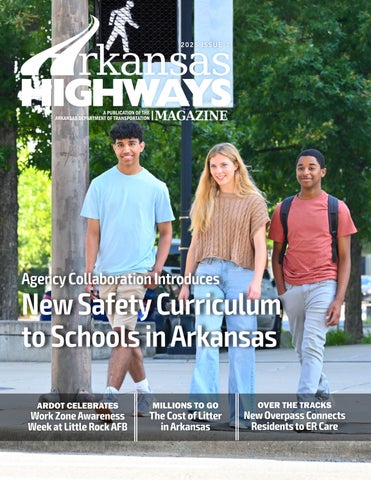

New Safety Curriculum to Schools in Arkansas
Hello ARDOT,
CONSTRUCTION SEASON IS IN FULL SWING IN ARKANSAS, AND I WANT TO THANK YOU FOR THE OUTSTANDING WORK BEING DONE ACROSS THE STATE. Our maintenance forces continue to make sure that the highway system is in good shape as we approach that beautiful color the fall season brings. As you know, heavy spring rains took a toll on many roadways. The rains resulted in 157 highway closures in April and May. Another 75 highway segments were partially flooded. Our crews’ efforts to combat the damage from the winter freeze and the spring rains are commendable. They answer the call no matter the hour and stay until the job is done.
The pipeline for construction projects is open and flowing well. Currently, 162 highway projects are under construction, representing more than $2.5 billion in total contract value. Even with this high volume of work, our construction staff is pushing forward to modernize the way we inspect highway projects with the use of new technology and updated specifications. We are grateful for the contracting industry’s support of this effort, which will enable us to deliver projects more efficiently.
Many people do not realize that highway construction projects take years to develop, and our preconstruction team handles their business like clockwork. In my two decades with the agency, I have never seen a more active project development pipeline than we have today. I’m proud of this team’s dedication to making sure projects are ready to go when the time is right.

Our administrative team is making great strides to recruit, retain, and support a strong workforce to help us accomplish our overarching mission of delivering a modern transportation system. We appreciate the Highway Commission’s support of recent cost-of-living raises, performance-based pay, and other salary adjustments – investments that make a real difference to our 4,000 talented employees. Our staffing levels have not been this robust in several decades, and it’s something that we all should take pride in.
Each of you make a difference every day in the lives of those around you. Whether it is serving the traveling public or supporting the person working alongside you, we are doing vitally important work and doing it with excellence.
I look forward to seeing you out there on our highways. Stay safe.

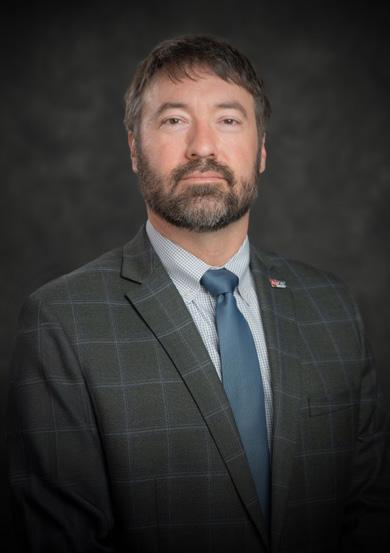
Jared D. Wiley, P.E., Director
FRONT COVER:
Arkansas teens film Street Smart videos in downtown Little Rock.
BACK COVER: Scenic view of State Highway 309 near Mount Magazine.
EDITOR
Ruthie Berryhill
Ruthie.Berryhill@ardot.gov
STAFF WRITERS
Emma Goad
Emma.Goad@ardot.gov
Kaitlin Worley Kaitlin.Worley@ardot.gov
GRAPHIC DESIGNERS
Marrissa Brickey
Marrissa.Brickey@ardot.gov
Aimee Goode Aimee.Goode@ardot.gov
Lamarie Rutelonis
Lamarie.Rutelonis@ardot.gov
PHOTOGRAPHER
Rusty Hubbard
Russell.Hubbard@ardot.gov
Correspondence should be directed to: Ruthie.Berryhill@ardot.gov
ARKANSAS HIGHWAYS
Communications P.O. Box 2261 Little Rock, AR 72203-2261

Arkansas Highways is published by and for employees of the Arkansas Department of Transportation as a medium of departmental news and other information. It is also distributed free of charge to the public upon request.
The Arkansas Department of Transportation (Department) complies with all civil rights provisions of federal statutes and related authorities that prohibit discrimination in programs and activities receiving federal financial assistance. Therefore, the Department does not discriminate on the basis of race, sex, color, age, national origin, religion (not applicable as a protected group under the Federal Motor Carrier Safety Administration Title VI Program), disability, Limited English Proficiency (LEP), or low-income status in the admission, access to and treatment in the Department's programs and activities, as well as the Department's hiring or employment practices. Complaints of alleged discrimination and inquiries regarding the Department's nondiscrimination policies may be directed to Joanna P. McFadden Section Head – EEO/ DBE (ADA/504/Title VI Coordinator), P. 0. Box 2261, Little Rock, AR 72203, (501)569-2298, (Voice/TTY 711), or the following email address: Joanna.McFadden@ARDOT.gov. Free language assistance for Limited English Proficient individuals is available upon request. This notice is available from the ADA/504/Title VI Coordinator in large print, on audiotape and in Braille.
ARKANSAS STATE HIGHWAY COMMISSION
PHILIP TALDO Chairman

KEITH GIBSON Vice Chairman
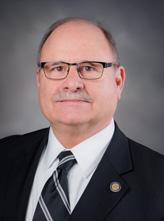
MARIE HOLDER Member

JERRY L. HALSEY, JR. Member

DAVID HAAK Member


Agency Collaboration Introduces NEW SAFETY CURRICULUM TO SCHOOLS IN ARKANSAS
BY EMMA GOAD

THE ARKANSAS DEPARTMENT OF TRANSPORTATION (ARDOT) IS PREPARING TO ROLL OUT A NEW STATEWIDE SAFETY INITIATIVE, STREET SMART, AIMED AT EDUCATING K-12 STUDENTS ABOUT ROAD SAFETY. Set to launch during the 2025–2026 school year, the program will be geared toward grades six through eight, equipping students with essential skills and knowledge before they become drivers. The goal is for the program to expand to include additional grades in subsequent years.
The program will focus on pedestrian, bicycle, passenger, and motor vehicle safety, delivering age-appropriate materials in a format that engages students through multiple learning styles. It is being developed collaboratively by ARDOT and the Arkansas Department of Education (ADE).
This is coming on the heels of the Slow Down, Phone Down campaign, now in its fourth year. Slow Down, Phone Down is a work zone safety campaign that encourages drivers to slow down and minimize distractions while driving in work zones to protect both themselves and road workers. Recently, advertising for this campaign has been focused toward 18 to 24-year-olds. To reach people in
this age range, ARDOT is pushing this campaign on social media platforms like Snapchat and Instagram, gaming websites such as Twitch, and streaming services like Crunchyroll, among others.
While the Slow Down, Phone Down campaign is currently targeting young drivers specifically in work zones, the Street Smart campaign shapes the next generation of drivers, those who are still passengers and observers, to prepare them before it’s their turn behind the wheel.
“The K-12 educational program is trying to instill safety conscious behavior in young people,” Jessie X. Jones, ARDOT’s Chief Engineer
(continued on page 6)
Arkansas teens in downtown Little Rock filming Street Smart videos.

If we can get this in their hands year after year before they start driving, I really feel like it could save lives.

-

for Preconstruction, said. “We want Arkansas students to possess the skills needed to be more than just safe drivers. We want them to also be safe passengers, cyclists, and pedestrians when they are traveling.”
The inter-agency collaboration between ARDOT and ADE brings together transportation expertise and relevant educational standards to ensure success in the classroom. ARDOT utilized data and statistics to determine which transportation-related topics should be addressed, and ADE provided recommendations on how best to deliver the message to students.
“We’re looking at several delivery modes to engage students in different ways,” Travis Brooks, Division Head of ARDOT’s Planning & Research Division, said. “Some of the materials are lecture-style, but we’ll also have hands-on exercises, traditional testing objectives, and shortform videos designed for a student body that is used to platforms like Instagram.”
The Street Smart curriculum will progress by grade level. In sixth grade, students will learn the basics of pedestrian, bicycle, and bus safety. In seventh grade, more advanced safety principles are introduced, including how to be a safe passenger and how to avoid distracting the driver. In eighth grade, students will begin preparing for the responsibilities of being behind the wheel.
“We started with sixth to eighth graders because that’s the age group that would be the best to target at the beginning,” Jones said. “They haven’t started driving yet.”
EDUCATOR PANEL SHAPED EARLY DEVELOPMENT
To ensure the curriculum would be practical and effective in real-world classroom settings, ARDOT hosted a panel of educators in the early stages of development. Adam Stage,

the principal of Fountain Lake Middle School and panelist, helped provide insights into how the curriculum could be implemented and what would resonate with students.
“We really dealt more with the implementation,” Stage said. “How do we actually get it into a classroom effectively? What class do we put it in?”
The panel helped shape the curriculum by categorizing it into pedestrian, bicycle, and driver safety modules, with the goal of keeping the educational material relevant to the grade-level. The panel also determined the lessons would be best suited under the health curriculum, although the content is designed to be cross-curricular.
Stage described the collaboration as “very productive,” noting that former educators involved in the project had already contributed valuable foundational work.
“ARDOT worked very well with us. They brought in the transportation expertise, and we brought in the classroom perspective,” Stage said.
Stage was inspired to participate due to a personal experience that underscored the curriculum's importance.
“I remember there was a kid when I was a teacher at Magnet Cove who died in a car accident. The whole community was heartbroken. That stuck with me,” Stage said. “If we can get this in their hands year after year before they start driving, I really feel like it could save lives.”
He emphasized that while students currently study for a driver’s test by memorizing answers from a handbook, Street Smart offers a deeper, more meaningful engagement with safety.
“I don’t think we’ve ever had a curriculum that really focused on what you do as a bicyclist or pedestrian,” Stage said.
Adam Stage, Principal Fountain Lake Middle School & Street Smart panelist

HANDS-ON LEARNING AND REAL-WORLD APPLICATIONS
The curriculum will include interactive web-based games, as well as short videos featuring teen actors from Arkansas to present safety messages in a relatable way.
To create the videos, actors spent a week filming at various locations across Little Rock with the video production company Waymack & Crew. Six Arkansas teens learned and recorded ten scripts, which were then edited and produced for the curriculum. Some videos were shot at a crosswalk downtown, others on a neighborhood sidewalk, and some inside a car mounted on a trailer. These teens are the face of Street Smart.
The educational materials will be designed for use in several subject areas. One example Brooks cited is a hands-on physics experiment designed to show how speed impacts crash outcomes, which connects road safety to science education.
The program draws inspiration from a successful curriculum implemented by the Georgia Department of Transportation. After seeing Georgia’s results presented at a national conference, ARDOT initiated its own campaign, adapting the concept to fit Arkansas’ educational standards. Under the direction of previous ARDOT Director Lorie Tudor, Jones was put to the task of learning from Georgia’s experience.
“She thought it was a great idea that could potentially benefit Arkansas,” Jones said. “So, she asked us to look into it, and the Commission authorized us to proceed.”
Georgia’s perspective was eye-opening for ARDOT, but Jones wanted to be sure that the program was tailored to Arkansas specifically to be successful.
“We want to make sure this material is developed and
Short videos featuring teen actors from Arkansas will be used to present safety messages in a relatable way.
meets the standards that Arkansas has, whether that’s in social studies, health, or science,” Jones said.
“The Department of Education is reviewing everything just like ARDOT is,” Brooks said. “Educators from across the state provided early feedback on educational objectives, opportunities for integration into the curriculum, and the tools for engaging with students.”
FUNDING AND FUTURE EXPANSION
Funded through the Highway Safety Improvement Program (HSIP), ARDOT has committed $500,000 to the development of the sixth through eighth grade phase. Pending success with phase one, future phases, including full K-12 implementation, will be supported through additional HSIP funds.
“Arkansas receives approximately $40 million per year in HSIP funds,” Brooks said. “Most of that goes to infrastructure projects, but educational programming is also eligible, and that’s what we’re doing here.”
Early measures of success will focus on distribution and implementation, such as how many classrooms and students the curriculum reaches. Long-term, the goal is to impact behavior and reduce injuries and fatalities.
“That is daunting,” Jones said of the current crash statistics. “If we instill safety in the minds of students before they get behind the wheel, we expect to see a reduction in crashes.”
Brooks echoed this goal. “There are certainly some very concerning trends in the safety data—distracted driving, seat belt use, impaired driving. We're going to be educating students about all of those.”
ARDOT and ADE have formed a working group that meets regularly to review the program’s development.
“It’s really a team effort,” Brooks said. “Everyone’s bringing something essential to the table, whether it’s safety, academic standards, or creative content. That collaboration is what will make this successful.”
Street Smart is a program that encourages students to not just be safe drivers someday, but also to understand the importance of being a safe pedestrian, bicyclist, or passenger. Instilling this knowledge at the educational level will ensure students see that they’re just as impacted by road safety as anyone else.
“We hope this will resonate with students, and that they will go home, talk to their parents, siblings, and neighbors about this,” Jones said. “It could be something propagated through them, and we hope to really see a difference in people’s behavior.”
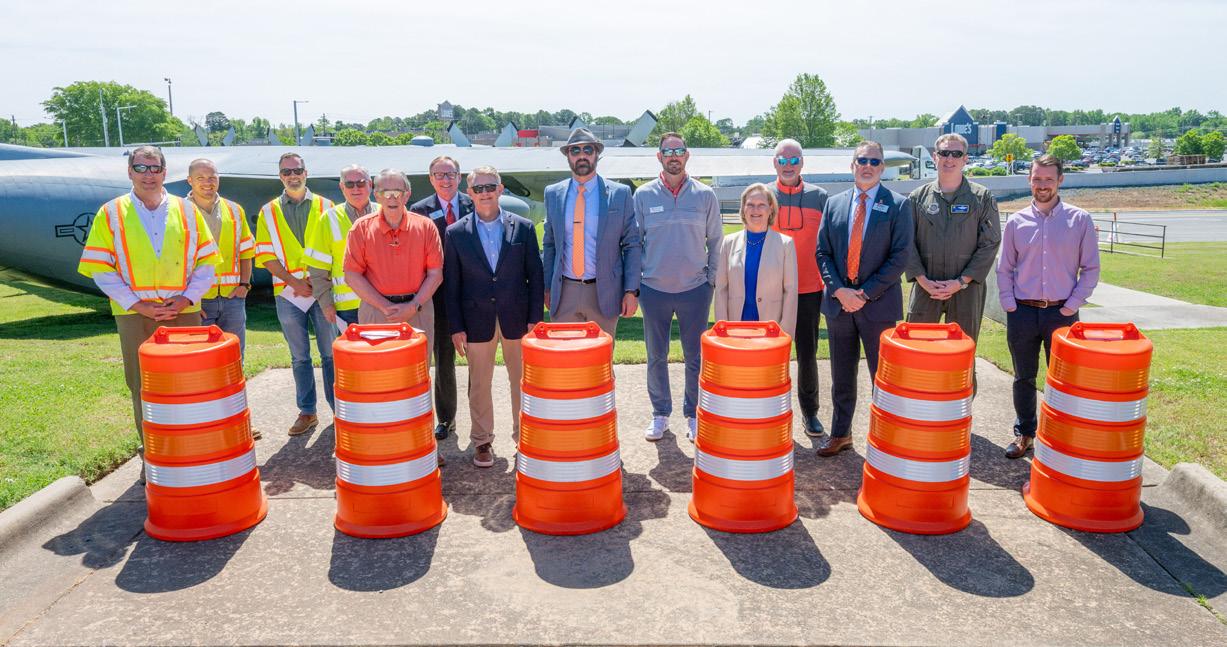
L.–R.: Guy Washburn, Cranford Construction Company; Jonathan Foster, Weaver-Bailey Contractors; Jon Stalnaker, Weaver-Bailey Contractors; Don Weaver, Weaver-Bailey Contractors; D.B. Hill III, D.B. Hill Contractors, Inc.; Jerry L. Halsey, Jr., Arkansas Highway Commission; Arkansas State Senator Ricky Hill; ARDOT Director Jared D. Wiley; Brad Spradlin, Associated General Contractors of s; Sarah Stillman, Creative Design Concepts; Park Estes, Arkansas Asphalt Pavement Association; Rex Vines, ARDOT Chief Engineer for Operations; Lt. Col. Jonathan Feucht, Deputy Commander, 19 Airlift Wing, U.S. Air Force; Tyler Lachowsky, American Concrete Pavement Association, Oklahoma/Arkansas Chapter.
ARDOT CELEBRATES WORK ZONE AWARENESS WEEK at Little Rock Air Force Base
BY RUTHIE BERRYHILL
EVERY SPRING, TRANSPORTATION
DEPARTMENTS ACROSS THE COUNTRY PARTICIPATE IN WORK ZONE AWARENESS WEEK (WZAW), A NATIONAL AWARENESS CAMPAIGN TO ENCOURAGE SAFE DRIVING IN HIGHWAY WORK ZONES. The Arkansas Department of Transportation (ARDOT) kicked off Arkansas’ WZAW on April 21 with an event at the Little Rock Air Force Base, overlooking construction on Interstate 57. In its 26th year, this year’s WZAW theme was “Respect the Zone So We All Get Home.”
“Without work zones, we couldn’t get out and repair the roads, maintaining them for everyone’s safety,” Travis Sisco, Area Maintenance Supervisor, District 8, Montgomery County, said. “Traveling carefully through the work zone ensures that everyone gets home safe.”
Each day of Work Zone Awareness Week is assigned a specific theme. This year’s schedule included: “Work Zone Safety Training Day” on Monday, the national kick-off event and ARDOT’s Safety Day on Tuesday, “Go Orange Day” was
Wednesday, “Social Media Storm” was Thursday, and Friday set aside a moment of silence to remember the men and women whose lives were lost in a work zone incident.
“Drivers going through a work zone may not realize how important it is to be aware of their surroundings, but when you are working on the roadways, you are standing out there at the mercy of the traveling public. It is a lot to take in, not just for us but also for the public,” Ginger Crain, Construction Project Coordinator, District 4 Resident Engineer Office 42, said. “Please remember that we are trying to keep everyone safe, not just us but also those traveling through our work zone. We’ve all got someone to go home to.”
ARDOT’s kick-off media event and the week-long activities helped remind drivers of why there is so much emphasis on being alert while driving through a work zone.
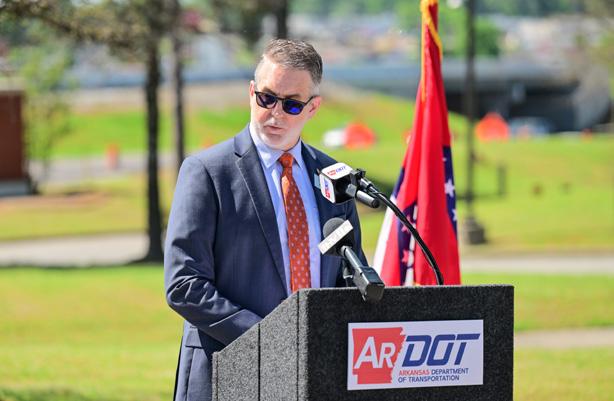
“As we kick off this year’s Work Zone Awareness campaign, we are even more mindful of its significance,” Rex Vines, ARDOT Chief Engineer for Operations and event emcee said. “Since the spring of 2023, we’ve lost three employees from incidents within or just outside the limits of a work

. . . a law was passed to incorporate work zone information in the driver’s license manual and test for new drivers. This will ensure that our newest drivers know what to do when they encounter road work.
- Director Jared D. Wiley, P.E.
zone: Timothy Harris, Brandon Lee Jones, and Charles Tony Glover. Their loss reminds us of how important it is that we remain diligent about safety.”
Vines reminded drivers that “We all play a role in keeping workers and motorists safe while traveling through work zones.”
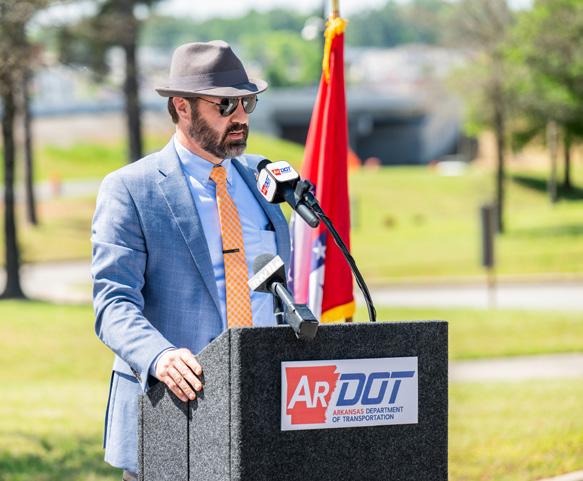
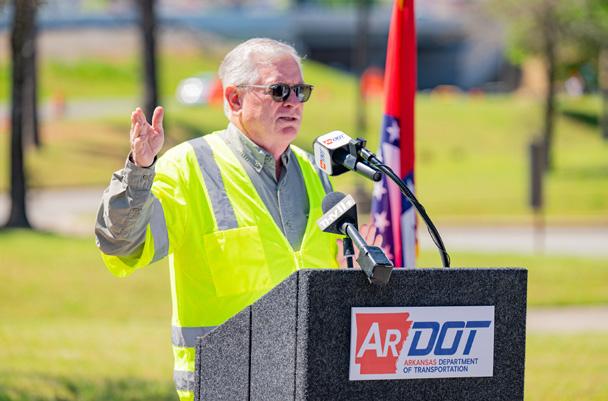
At the kick-off event, the Arkansas Highway Police Honor Guard presented the colors and D. B. Hill, President of D.B. Hill Contractors, Inc. gave the invocation. Speakers included Arkansas State Senator Ricky Hill of Cabot; Don Weaver, President and Chief Executive Officer for Weaver-Bailey Contractors Inc.; and Jared Wiley, ARDOT Director. State Senator Mark Johnson was out of state and unable to attend, but he sent a letter for Wiley to read at the event. The speakers, as well as the letter from Senator Johnson, emphasized the importance of safety in highway work zones and discussed efforts being made to make these areas safer for workers and motorists, including newly passed legislation.
“As you heard from Senator Johnson’s letter, a law was passed to incorporate work zone information in the driver’s license manual and test for new drivers,” Wiley said. “This
will ensure that our newest drivers know what to do when they encounter road work.”
Wiley then recognized Park Estes, Executive Director of the Arkansas Asphalt Paving Association, who he credited with the idea of including this information in the manual and test.
“Park brought this idea to us in one of our partnering meetings and we were able to work with Senator Johnson to get it enacted into law,” Wiley said.
He then discussed ARDOT’s new safety education campaign, Street Smart, another partnering project that ARDOT has worked with the Arkansas Department of Education to implement.
“Work Zone Awareness Week, everyday safety practices, and the new Street Smart education campaign are all aimed at reducing fatal and serious injuries in work zones,” Wiley said.
You can read more about the new legislation and about ARDOT’s Street Smart campaign in this issue of Arkansas Highways and learn more about ARDOT’s new safety measures in the Winter 2024 issue at ardot.gov/winter2024. In the meantime, remember to Respect the Zone So We All Get Home.
MILLIONS TO GO
The Cost of Litter in Arkansas
BY EMMA GOAD
EACH DAY, MOTORISTS
TRAVEL MILLIONS OF MILES ON HIGHWAYS AND INTERSTATES, LARGELY UNAWARE OF THE EFFORT REQUIRED TO KEEP THOSE ROADS CLEAN. BENEATH THE RUMBLE OF TIRES AND THE BLUR OF PASSING LANDSCAPES IS A QUIET BUT COSTLY STRUGGLE AGAINST LITTER.
In 2024, the Arkansas Department of Transportation (ARDOT) spent approximately $8 million on litterrelated cleanup efforts across the state.
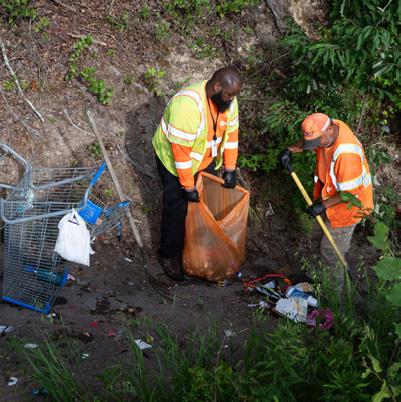
The costs come from a variety of programs and contracts aimed at keeping Arkansas roads clean including mowing contractors, inmate labor, organizations serving adults with disabilities, volunteers, and ARDOT crews themselves.
BREAKING DOWN THE BILL
Of that $8 million, around $2 million was spent through mowing contracts that include litter pick-up requirements.
“We mow all of our highway routes at least three times per year,” Steve Frisbee, Assistant Chief Engineer for Maintenance, said. “About half of our 16,000-mile system we mow with our own crews. The other half — really the bigger routes, the interstates and major U.S. highway routes — we contract out.”
The contractors bid by acre for mowing services, but they must also include litter removal both before and after mowing.
Another leg of the effort is the County Jail Inmate Litter Program, which began in 2007. While participation is voluntary, seven counties currently take part. The
inmates involved do this as a part of their commitment to the court system. It can be used as community service.
“We’re not paying the inmates themselves,” Frisbee said. “We are paying the county for their cost. It’s at a rate of $2 per inmate per hour.”
In 2024, $20,000 was allocated to support the County Jail Inmate Litter Program. ARDOT includes this program in its annual budget and has set aside additional funds to accommodate participation from more counties as the program expands.
Additionally, about $400,000 goes toward contracts with work centers through a state law that allows public agencies to partner with organizations serving adults with disabilities.
Nonprofits like Pathfinder, Inc. in Little Rock and Abilities Unlimited in Fort Smith employ individuals who are able to assist with litter collection.
While partnerships and contracts play a critical role, most of the cleanup cost comes from ARDOT’s own workforce and totals just over $5 million annually.
“We spent over 118,000 crew hours of work in 2024 just picking up litter across our 75 counties,” Frisbee said. “That’s a lot of hours.”
In previous years, $5 million was the total amount spent by ARDOT on all methods of litter management. Rising costs in labor, fuel, equipment, and contractor rates have all contributed to the increase to the current $8 million litter cost.
SAFETY AND INNOVATION
The job doesn’t stop at plastic bottles and fast-food wrappers.
“A big chunk of our litter pickup is that debris you see on the side of the road — tires, mattresses, shovels, grills,” Frisbee said. “Especially in urban areas like Little Rock, where it collects on the inside shoulder of an interstate and becomes a safety issue.”
Because of this, ARDOT invested in Lane Blade devices. Lane Blade devices are truck attachments that allow crews to safely push large debris out of traffic lanes. ARDOT has the largest fleet of these safety devices in the United States.
“We got a $1 million grant last year that’s going to allow us to buy 31 more Lane Blades,” Frisbee said. “We’re going to have enough to cover the entire interstate system in the State.”
Though vital, these high-tech safety measures are not included in the $8 million annual litter budget, making ARDOT’s true cost of addressing roadway debris even higher.
A STATEWIDE ISSUE
While urban areas with high average daily traffic see more litter, no district is immune.
“Litter is really an issue from the largest highway down to the lowestvolume routes,” Frisbee said.
Some crew areas dedicate a full week

A big chunk of our litter pickup is that debris you see on the side of the road — tires, mattresses, shovels, grills . . .

in spring to litter cleanup, while others strive to clean up every few weeks. But with limited staffing, efforts are often dependent on availability.
“The crews picking up litter are the same crews that mow, they're the same crews that patch potholes, repair cable barriers, and clean ditches. We don't have special litter crews available,” Frisbee said. “It’s just a challenge with so many priorities.”
ARKANSAS INITIATIVES
One bright spot in ARDOT’s cleanup strategy is the Adopt-A-Highway program, which includes 688 volunteer groups across the state. This effort is helpful, but with the amount of highway and interstate miles ARDOT manages, there is a constant need for more Adopt-A-Highway groups.
“Oh, it’s been a great help,” Frisbee said. “There are some districts that only have 20 or 30 active groups, and when you have 2,000 miles of highway, you could literally have up to 2,000 groups to keep up. So, the need is still there.”
Frisbee also praised the ongoing partnership with the Keep Arkansas
- Steve Frisbee, Assistant Chief Engineer for Maintenance
Beautiful Commission, which plays a key role in engaging the public through educational campaigns and community events. The Commission promotes litter prevention, encourages personal responsibility, and helps organize
(continued on page 12)
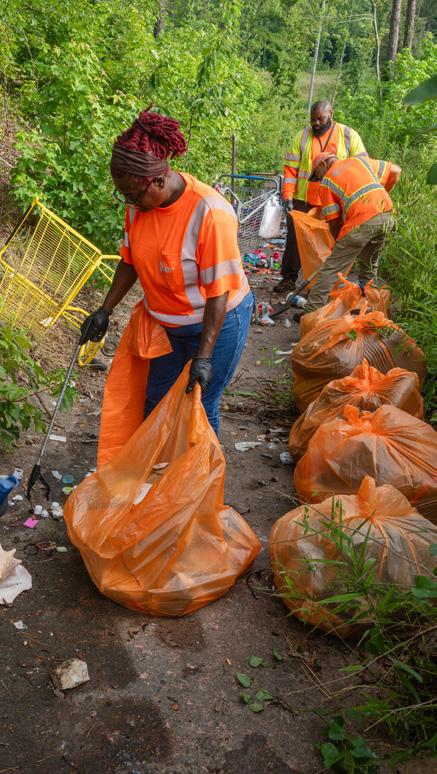
large-scale cleanup efforts like the annual Great American Cleanup and the Keep Arkansas Beautiful Cleanup. These statewide initiatives mobilize thousands of volunteers to remove litter and beautify public spaces, which helps ARDOT’s day-to-day efforts.
“Those are always a big help to raise awareness and rallying our communities to pitch in,” Frisbee said.
GETTING THE PUBLIC’S ATTENTION
Despite the Department’s efforts, Frisbee believes Arkansans still don’t realize the cost or scope of the litter issue in the State.
“No, I don’t believe the public really has a clue how much litter is costing them,” Frisbee said. “I think they just think we have crews that have just nothing to do but pick up litter.”
To raise awareness, ARDOT launched a cleanup campaign in March called Spring Clean-Up Day.
“On March 19 th, we picked up about 6,500 bags in one day across 75 counties,” he said. “We picked up over 10,000 bags of litter just that one week.”
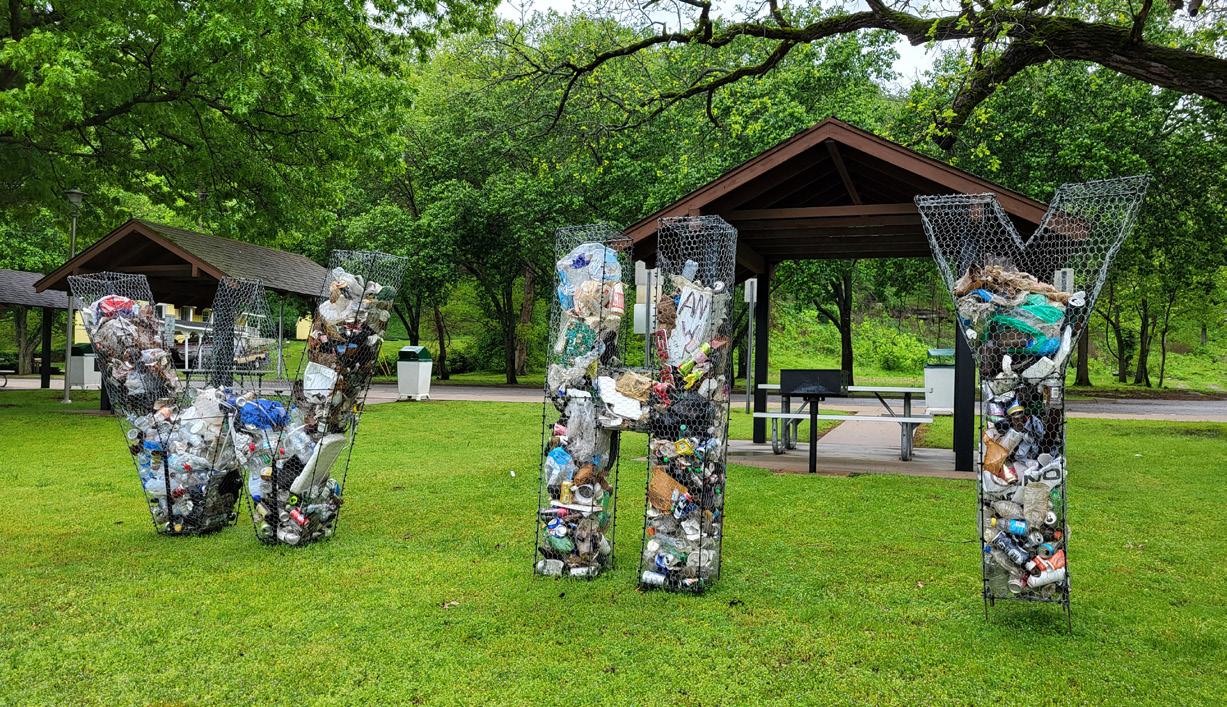
One of the most creative awareness initiatives came from a group called the Bella Vista Litter Patrol. They approached ARDOT with a concept called “Litter Letters,” which are wire-framed letters filled with trash, spelling out a message.
“They actually spell out the letters W-H-Y,” he said. “To ask the public, you know, why do you litter?”
(See Dear ARDOT for more information about Litter Letters on page 32.)
LOOKING AHEAD
Frisbee is working to expand partnerships with centers for adults with disabilities and increase participation in county inmate programs. But the ultimate solution, he believes, lies in prevention.
“I’m not sure what else as far as a change other than just get the litter stopped,” Frisbee said. “And I’m not sure that’s feasible.”
Until then, the effort continues bag by bag, mile by mile, at a cost that affects every Arkansan.
"Litter Letters" is a creative awareness initiative by the Bella Vista Litter Patrol.
Spring Clean-Up Day launched on March 19, 2025.
THE RISE OF THE ROUNDABOUT
BY KAITLIN WORLEY
AS POPULATIONS GROW AND COMMUNITIES CHANGE, ROADS
MUST ALSO EVOLVE TO KEEP UP WITH THE NEEDS OF THE PUBLIC. Over time, we’re able to get a better sense of how to meet evolving safety and mobility needs. When intersections need improvement, a proven method is through construction of a roundabout.
A roundabout is a circular intersection where traffic moves in a counterclockwise direction around a central island. Entering traffic yields to traffic that is already present in the roundabout, so traffic generally travels at a slow, even pace, avoiding lengthy stops.
“There are over 170 roundabouts on public roads in Arkansas, and more are being built all the time,” Andrew Warren, ARDOT Staff Traffic Safety Engineer in the Planning & Research Division, explained. Twelve roundabouts were constructed in Arkansas in 2023, and six were constructed in 2024, according to the Roundabouts Database maintained by Kittelson & Associates, Inc., a transportation engineering and planning firm. The first recorded roundabout in Arkansas, according to the database, was built in Little Rock at the intersection of Brodie Creek Trail and Woodsgate Drive in 2000. One of the primary benefits to using a roundabout as opposed to a more traditional intersection, such as a stop sign or traffic signal, is

increased safety. Roundabouts reduce the number of “conflict points” at an intersection. A conflict point is a point in a traffic intersection in which two or more vehicles have intersecting movement paths. A conventional intersection has a total of 32 conflict points, while a roundabout intersection typically only contains eight. Because each of these points has potential for collision, reducing the number of conflict points also reduces the chances of a crash occurring.
In addition to the reduction in conflict points, travel speeds are also decreased in a roundabout. “When drivers slow down, crashes are less severe. Slower speeds also give drivers more time to react if something goes wrong,” Warren said. Due to the combination of reduced speed and fewer conflict points, roundabouts experience 76 percent fewer injuries and 90 percent fewer fatalities than a comparable traffic signal.
Not only do roundabouts increase safety, but they can also decrease traffic delays. Even though the speed
of travel is reduced in this type of intersection, traffic can maintain a steady pace of movement rather than idling at a red light. Because vehicles spend less time idling, this design also leads to a reduction in overall fuel consumption.
Although roundabouts are growing in popularity around the state, they do not always have an enthusiastic reception from the public. “Residents are sometimes hesitant when the first roundabout is built in a community. Many people come around when they discover they don’t have to wait on the light to turn green or when the intersection, where traffic used to back up, now operates more efficiently,” Warren said.
Even though roundabouts often improve the flow of traffic in many areas, “Roundabouts are not the solution everywhere.” Warren explained. While roundabouts may not be able to replace every stop sign or traffic signal, their increased prevalence is improving safety and traffic flow across the state.
Roundabout in Marmaduke (2023)
OVER THE TRACKS
New Overpass Connects Residents to Emergency Care
BY RUTHIE BERRYHILL
UNTIL RECENTLY, MOTORISTS IN MONTICELLO WERE UNABLE TO CROSS FROM ONE SIDE OF THE CITY TO ANOTHER WHEN A TRAIN WAS TRAVELING THROUGH TOWN. Although inconvenient, the larger issue was that it cut off access to anyone needing emergency medical care on the other side of the tracks when a train was passing.
The train tracks cross Highway 425 and Highway 83, the main thoroughfares through town.
“Arkansas Midland Railroad (AKMD) track divided Monticello in half, north from south, in the middle of the city,” Nita McDaniel, Monticello Economic Development Commission Director, said. “There were no railroad overpasses to connect any street or highway to the Health and Education Complex.”
In 2008, the Arkansas Department of Transportation (ARDOT) programmed the overpass project after implementing a Monticello Bypass study. In 2011, McDaniel, at the request of then Monticello Mayor Allen Maxwell,
began working with ARDOT to develop a plan for improving street and highway connectivity in Monticello.
Scott Barrilleaux, President, Baptist Health – Drew County explained that the connectivity was an issue because the hospital, clinics, schools, and the university are all located in the same area of town. “There's only a couple of roads in and out. From 7 in the morning to about 8, 8:15, traffic's pretty tough, during the school year especially,” Barrilleaux said.
At the time of the study, AKMD’s train schedule included two trains per day traveling through Monticello at busy times of day. “Since then, the schedule has increased in frequency and is expected to continue to increase with growing industry use,” McDaniel said.
The project was funded and included in ARDOT’s 2016 Statewide Transportation Improvement Program (STIP).
In 2019, the City of Monticello, Drew County, and ARDOT signed an Agreement of Understanding (AOU) formalizing their partnership on the project.
“During the course of Project Development, Drew County Judge Robert Akin requested that roundabouts be studied for the Jordan Drive intersection and the Old Warren Road intersection,” McDaniel said. “The stop signs at these
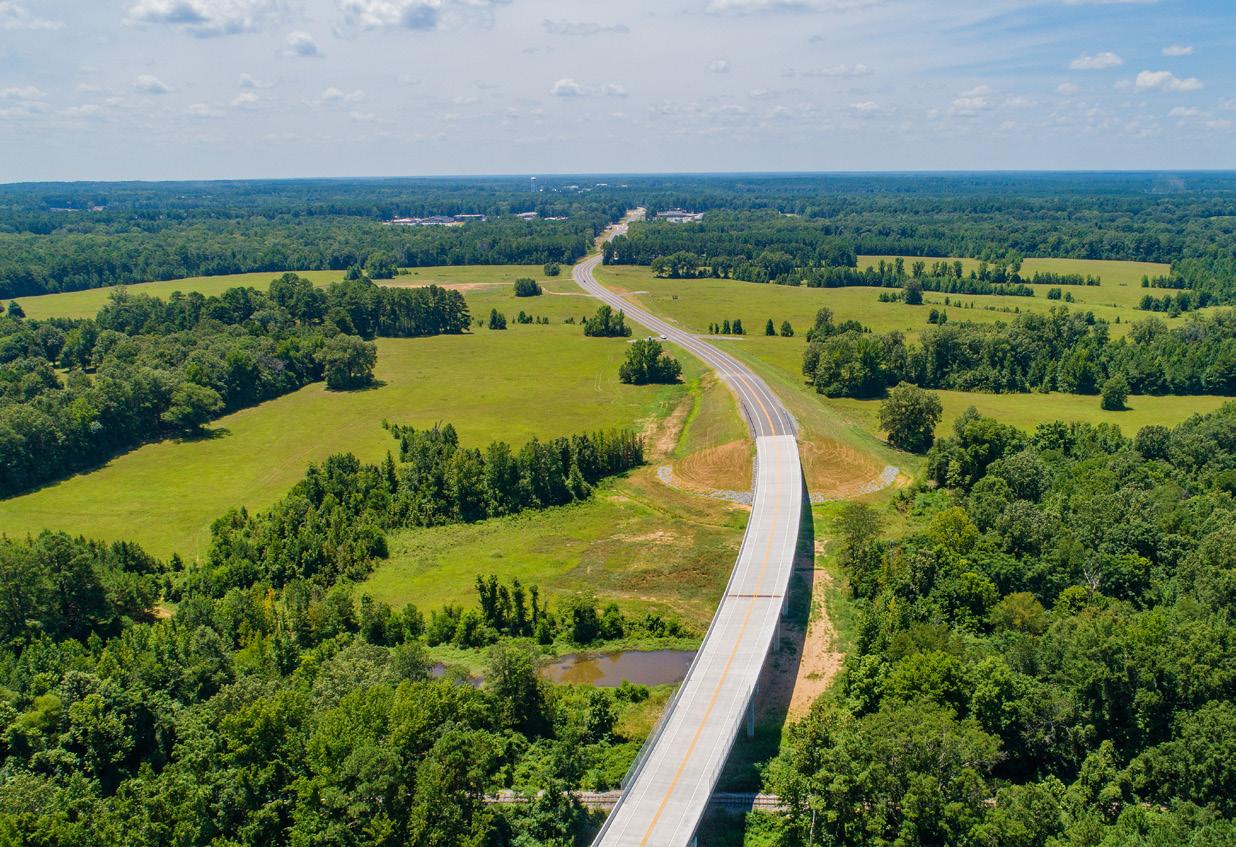
The new railroad overpass in Monticello connects Highway 83 Spur and Highway 278.

intersections seemed to cause traffic backups which resulted in delays and accidents during peak times.”
After the study was completed, two roundabouts were added to the project. The AOU was updated to reflect this change in plans and to update funding commitments.
This project begins at the intersection of Scogin Drive and Highway 83 Spur (Jordan Drive) and continues north for 1.5 miles where it connects with Highway 278 and goes over the railroad crossing. It provides a north-south connection for Monticello and includes two roundabouts, one at the Scogin Drive and Highway 83 Spur (Jordan Drive) intersection and one at the Scogin Drive and Old Warren Road intersection. As part of the agreement, a future project will resurface portions of Highway 83 and Highway 83 Spur, remove them from the State Highway System, and turn them over to the city and county.
“The roundabouts have been highly successful in keeping high traffic flow moving freely and efficiently,” McDaniel said.
The project was let in January 2023. Mobley Contractors, Incorporated was awarded the $30 million project and the groundbreaking was celebrated in July 2023. The City of Monticello contributed $2.5 million, and Drew County
contributed $505,000 toward the total project cost. ARDOT received a $4 million Better Utilizing Investments to Leverage Development (BUILD) grant for the project and the remaining funding came from ARDOT’s share of Federal Funding.
“Getting into the emergency department when someone has a life-saving emergency, it's important – every second counts,” Barrilleaux said. “Having better access, more reliable pathways into the hospital and into the emergency department is a big deal for everyone.”
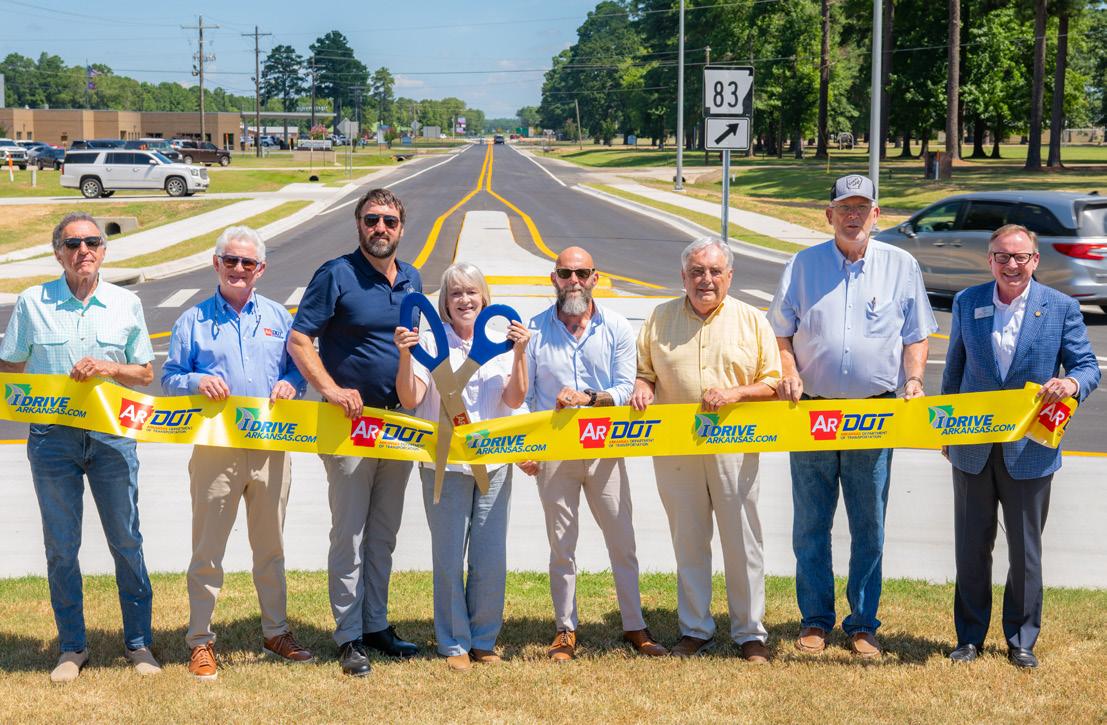
The project was celebrated with a ribbon-cutting ceremony in July 2025. A valuable improvement for the community, the overpass guarantees that cars and emergency vehicles won’t be cut off from emergency services by a passing train.
“The traffic moves so much smoother and it's so much safer for everyone that's involved. We're just not seeing the traffic hold-ups that we've had in the past and that's a blessing,” Sandra Lanehart, Superintendent of Monticello School District, said.
Top Photo, L.–R.: Robert Moore, Jr., Former Arkansas Highway Commission Chairman; Keith Gibson, Arkansas Highway Commission Vice Chairman; Jared D. Wiley, ARDOT Director; Nita McDaniel, Director of Monticello Economic Development Commission; Jason Akers, Mayor of Monticello; David Haak, Arkansas Highway Commission; Jessie Griffin, Drew County Judge; Jerry L. Halsey, Jr., Arkansas Highway Commission
ARDOT EMPLOYEES HONORED BY AAPA

BY RUTHIE BERRYHILL
WORKING ON OUR ROADWAYS CAN BE A THANKLESS JOB – PEOPLE ARE VOCAL ABOUT DELAYS AND INCONVENIENCES CAUSED BY CONSTRUCTION. MOST MOTORISTS DON’T UNDERSTAND ALL THE PIECES THAT GO INTO PLANNING, BUILDING, AND MAINTAINING A SAFE STATEWIDE HIGHWAY NETWORK. Those who work behind the scenes with the Arkansas Department of Transportation (ARDOT), such as members of the Arkansas Asphalt Pavement Association (AAPA), understand the hard work ARDOT employees put into every highway project.
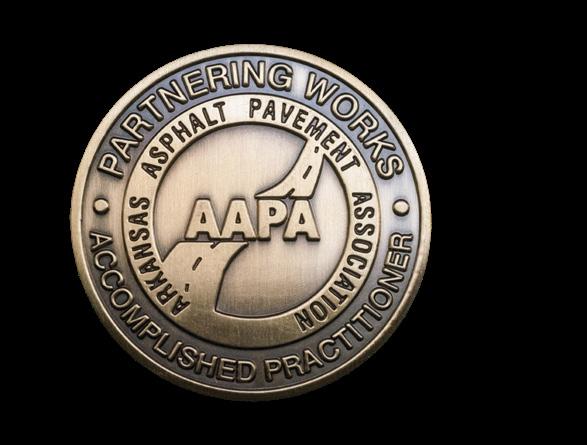
In collaboration with ARDOT, AAPA has recently chosen three ARDOT employees to recognize with a partnership coin. These individuals were chosen for their contribution to enhancing safety, communication, collaboration, innovation, and excellence on asphalt projects.
Kyle Battenfield, Senior Inspector for the District 4 Fayetteville Resident Engineer (RE) Office (RE Office 43); Joe Ferguson, Senior Inspector for the District 10 Osceola RE Office (RE Office 5); and Robert McCollum, Senior Materials Inspector for the District 10 Paragould RE Office (RE Office 4) received partnering coins. They were honored for their service at the April 2025 Arkansas State Highway Commission meeting.
Battenfield was nominated for the award by local contractor APAC-Central for his work on the Interstate 49 Wedington Interchange project. The job replaced the existing fivelane overpass with a new, eight-lane structure. The project included a raised median, a 14-foot side path for pedestrians and bicycles, and a partial cloverleaf interchange. APACCentral selected Battenfield for the AAPA Partnering Coin because of his positive approach and decision-making in the field.
According to APAC-Central’s nomination, Battenfield’s “willingness to address issues as they arise, especially during our night operations, and his consistent communication with our crews have been invaluable. Kyle’s efforts have ensured that we can continue working with minimal delays, demonstrating a commendable commitment to the project’s success.”
ARDOT District 4 Engineer Jason Hughey agreed with APAC-Central’s nomination of Battenfield.
“It came as no surprise to me when I was contacted by one of our contractors notifying me of their intent to present Kyle with a partnering coin,” Hughey said. “Kyle is well known and highly respected for his efforts in working with the contractor, adjacent property owners, and various other entities to find solutions to whatever problems may arise. Kyle was partnering before partnering was cool. He is a leader and role model to his coworkers. We will not be successful in continuing to improve our partnering efforts
without people like Kyle leading the way.”
Ferguson was selected for his work on Interstate 55 in Mississippi County. Delta Companies, the prime contractor on the project, praised Ferguson’s diligence in addressing concerns and resolving unforeseen challenges. The project rubblized and overlayed 4.2 miles of existing concrete roadway. Rubblizing is a rehabilitation process used to break up deteriorated concrete into smaller pieces to be incorporated into the new pavement structure.
“Joe is an excellent communicator and is very diligent at staying ahead of inspections that are coming,” Bob Reddell, ARDOT District 10 Resident Engineer, RE Office 5, said. “He works hard to keep all parties in the loop, so surprises are at a minimum, and expectations are well established on the front-end. Joe is proud of his work and the legacy he leaves for the traveling public as well as his coworkers.”
Delta Companies said: “Even as we were in the final hours of completion, which was rather late in the night, Joe was there to ensure that work was performed in accordance with the specifications.”
Delta Companies also nominated McCollum, who worked with them as an asphalt plant inspector. ARDOT’s lab is next door to Delta Companies’ lab. McCollum provided knowledge and expertise that helped their quality control technicians with tests they don’t perform on a regular basis. In their nomination, Delta Companies praised McCollum for his willingness to listen and commitment to ensuring the
quality of the products being used.
“On multiple occasions he has shared his knowledge and experience with QC technicians to help them become more confident and efficient; specifically with proctors, as our technicians have limited experience since it is a test that they don’t perform on a regular basis. Rob conducts his testing and promptly provides the results, giving contractors valuable data that enables them to monitor the products being produced and ensures the highest quality products for the projects are being used.”
Ryan Blankenship, ARDOT District 10 Resident Engineer, RE Office 4, echoed Delta Companies’ sentiment.
“I have been working with Rob for four years now, and he has always shown himself to be extremely knowledgeable in the field of materials testing,” Blankenship said. “His attitude of professionalism and teamwork has undoubtedly led to his nomination for the AAPA Partnering Coin. His willingness to help others, whether Department personnel or contractor personnel, has always been a strong suit of Rob’s.”
As part of this ongoing initiative, members of the AAPA will continue to acknowledge ARDOT employees who exhibit outstanding partnering actions and attitudes, like Battenfield, Ferguson, and McCollum. They exemplify ARDOT’s core values of safety, trust, excellence, accountability, and modern; their efforts ensure that ARDOT is moving Full STEAM Ahead.
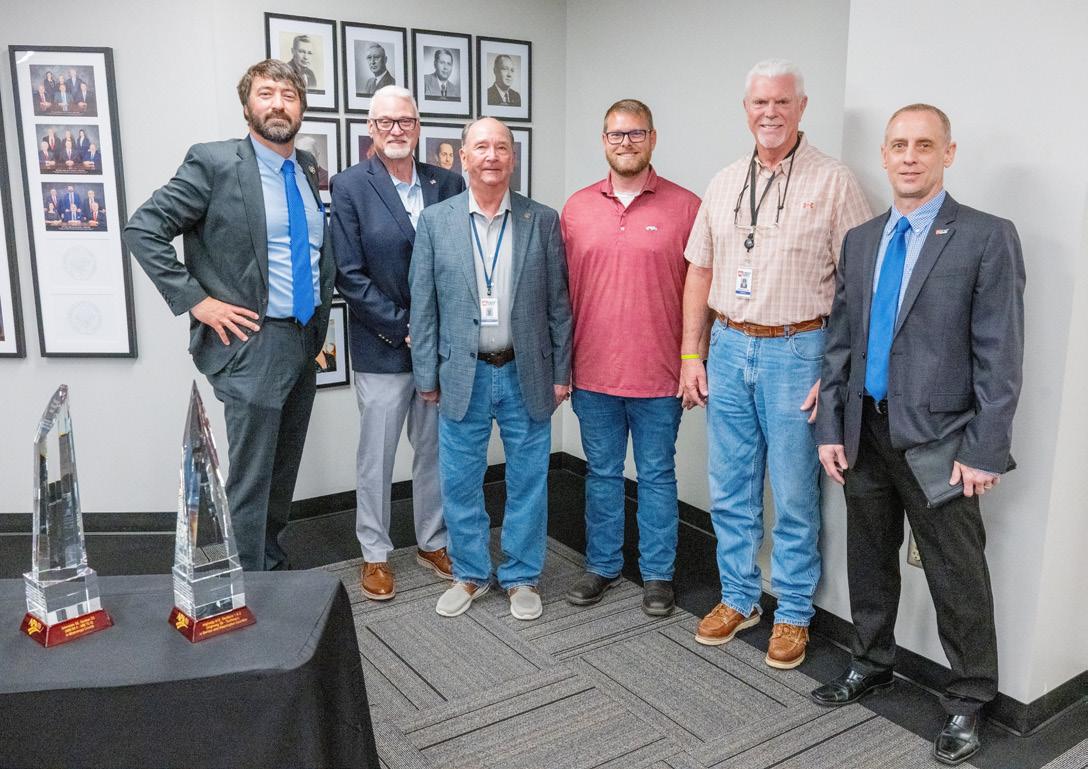
L-R.: ARDOT Director Jared D. Wiley, Park Estes, Arkansas Asphalt Pavement Association; Joe Ferguson, ARDOT District 10 - Osceola; Kyle Battenfield, ARDOT District 4; Rob McCollum, ARDOT District 10 - Paragould; Chad Adams, ARDOT Assistant Chief Engineer for Construction.
DIGGING UP THE SECRETS TO A SAFER, SMOOTHER RIDE
BY RUTHIE BERRYHILL
MOST TRAVELERS ARRIVE AT THEIR DESTINATION WITHOUT THINKING ABOUT THE CONDITION OF THE ROADWAY OR WHAT LIES BENEATH IT— BUT UNDERSTANDING WHAT’S UNDERGROUND IS KEY TO THE SAFETY AND LONGEVITY OF OUR HIGHWAYS.
Luckily, engineers have tools to gather data that helps them “see” underground conditions.
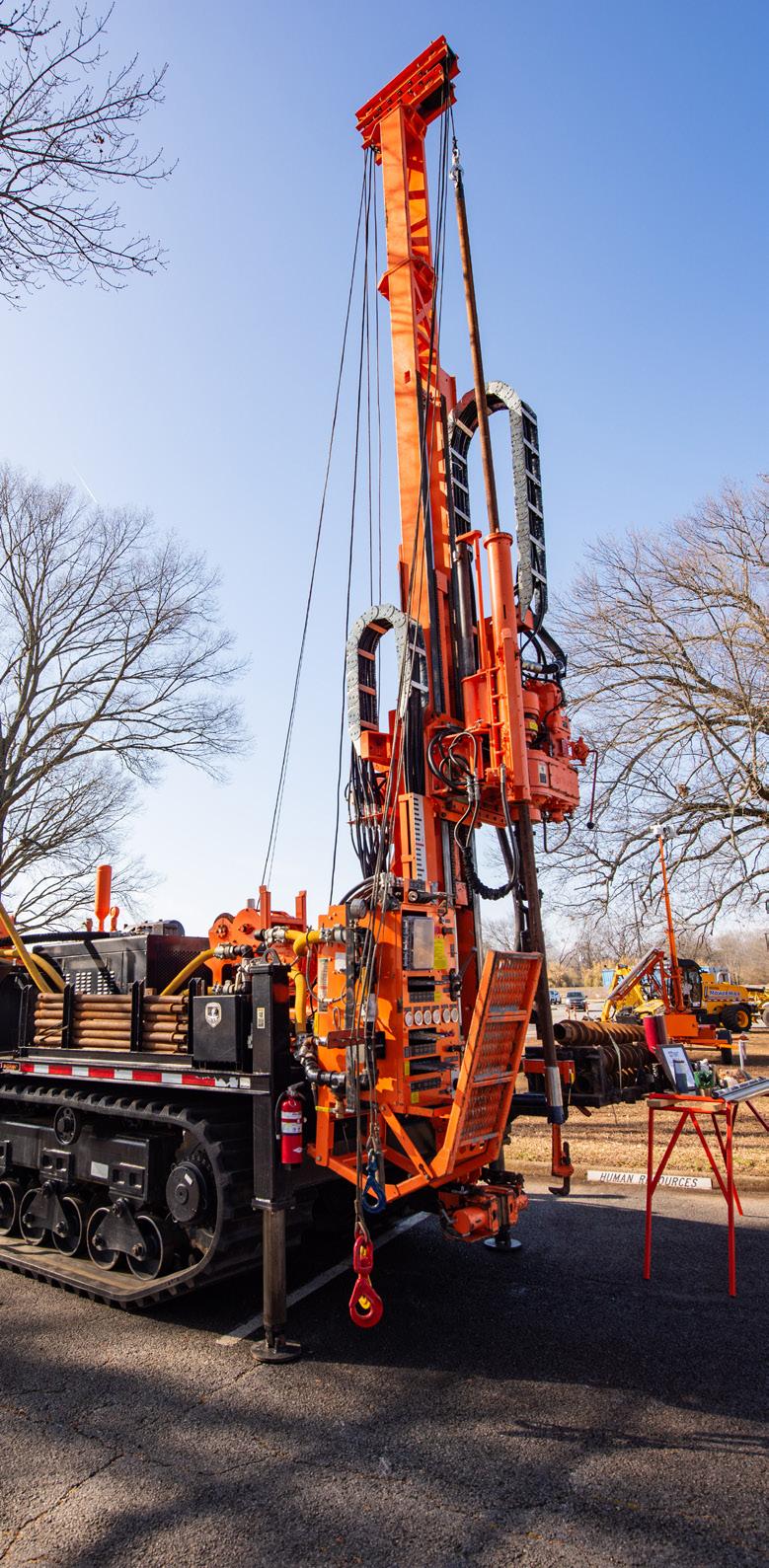
The Arkansas Department of Transportation (ARDOT) uses ground penetrating radar (GPR), a falling weight deflectometer (FWD), and a core drilling rig to gather data to determine the strength of our roadways.
“If we don’t account for what’s going on under the surface of pavements, then they may not last their expected lifetime,” Sarah Tamayo, ARDOT State Pavement and Asset Engineer in the Maintenance Division, said. “Currently, the surface layer of asphalt lasts 10 to 12 years on average. A lot of our pavements are perpetual pavements – meaning we replace the surface and leave the structure. We typically try to look at the condition of the structure before doing a project in the planning stages.”
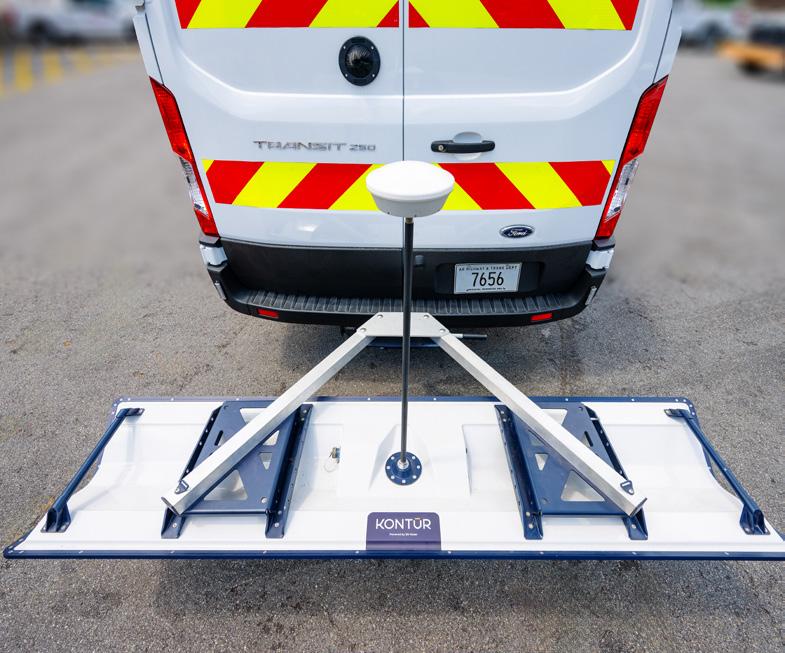
GPR is used to determine the thickness of the entire pavement structure, which helps ARDOT determine the structural condition of the roadway. It works by sending a radio signal into the ground and then reading the signal that “bounces” back. The radio waves bounce off underground layers, creating a distinct signal for different layers.
ARDOT’s GPR unit is installed on a transit van that can travel at highway speeds to collect data. Data collection technicians work on ARDOT’s team running the GPR equipment in the field. A technician in the office processes the data and completes an initial evaluation of the pavement layer thickness. The data then goes to an engineer to interpret the reading. In the past, only a geophysicist with a master’s degree or Ph.D. had the level of knowledge needed to analyze the complex data collected by the GPR. Now, with new GPR software, an advanced technician or engineer can perform the same data analysis that was previously only conducted by a geophysicist. The software enables a technician to read the data after completing hands-on training –although some have a related academic degree as well.
Because the GPR wasn’t commercially available until 1972, it is often perceived as a new technology. Yet as early as 1929, Walter Stern used a GPR to measure the depth of a glacier in Austria. In 1972, Apollo 17 carried a GPR unit with it to the moon where it was used to map the subsurface. Since then, GPR has been used in many applications, including locating archeological sites and grave sites, detecting buried explosives, and mapping groundwater levels. ARDOT has been using GPR since 2012.
FWD
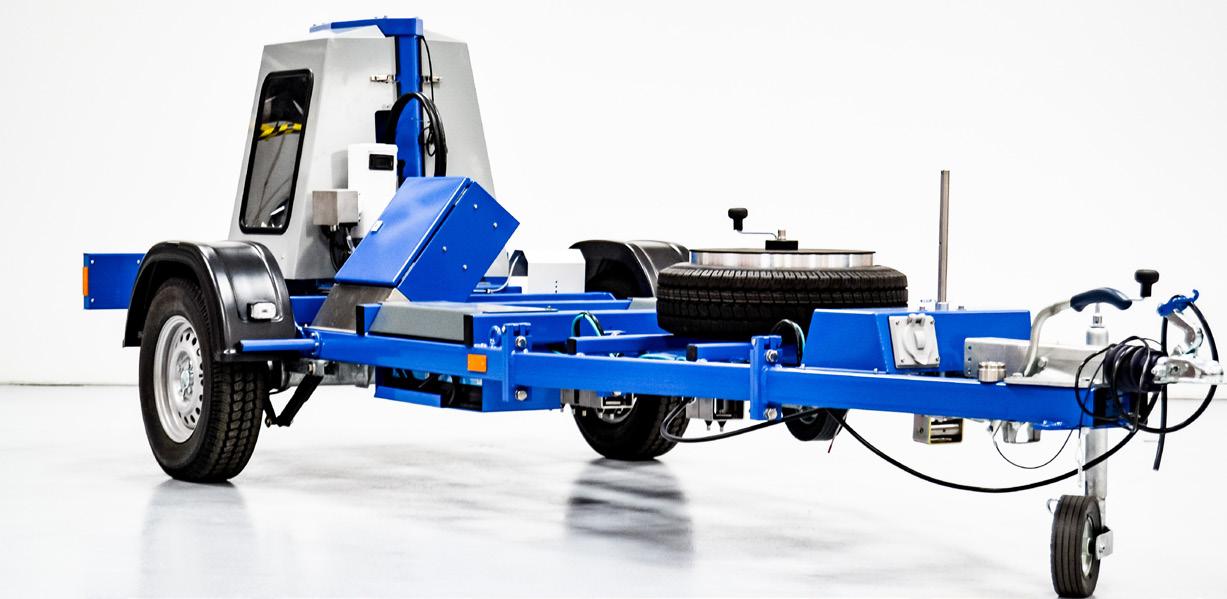
The FWD is used to determine the strength of a pavement. The FWD, which ARDOT has been using since 1985, replaced an older type of
equipment, the Benkelman Beam (BB).
The BB used a long rod and a fully loaded, dual-tire dump truck to take measurements. The BB required more maneuvering and more calculations to determine the strength of the pavement. The FWD is easier to transport to a site and more efficient at getting the same measurements.
Both pieces of equipment exert heavy loads on the pavement and measure the deflections, or how much the pavement moves. This movement of the pavement is not visible to the human eye. The data from this equipment can also be used to determine the joint load transfer, or the strength of concrete joints.
The FWD equipment is trailermounted, towed by a vehicle, and operated by a technician. The technician pulls the vehicle up to a test site, places it in park, and lowers the foot of the machine until it contacts the pavement. The machine lifts weights and drops them from a specific height to simulate the pressure the pavement would experience under traffic. Seismic sensors measure the actual deflection (deviation from a zero
reading) under the load and store the data for analysis.
“The GPR and FWD are used together in the field to get a complete picture that helps to ascertain the structural condition of the roadway and the condition of concrete pavements,” Tamayo said. “GPR determines the layers of the pavement, including any voids under the pavement. The FWD helps detect the structural condition, needed overlay thicknesses, and the remaining life of the pavement. The computer program used to analyze the FWD data also needs to know the pavement thickness, which is collected by the GPR.”
The data collected by the GPR and FWD help ARDOT’s engineers ensure a roadway’s pavement is strong enough for the projected traffic. This information can be used for determining the necessary weight restrictions for roadways, developing projects for the Statewide Transportation Improvement Program (STIP), analyzing potential damage if additional traffic is put onto a route, or determining the pavement thickness needed for roadway sections, such as
GPR equipment mounted on an ARDOT van
turning a shoulder into a turning lane.
ARDOT recently upgraded its GPR unit to a newer one that can collect information in a wider path than the previous unit (6 feet rather than 6 inches) and deeper into the ground.
ARDOT also recently acquired an additional FWD unit that uses electric power rather than hydraulics to lower the foot and drop weights. The new electric FWD unit is more efficient – it collects data three times faster than the old hydraulic unit. To cover more of ARDOT’s roadways, ARDOT uses the older FWD unit in addition to the new unit.
“The biggest difference with the new FWD is that the older version was hydraulic driven. It took longer. The electronically driven FWD runs off marine batteries,” Braden Graddy, Pavement Data Collection Technician in the Maintenance Division, said. “I compare the old FWD to a Model T but the new one is like an electric vehicle – it is so much more efficient in collecting the same information.”
When looking at the data from the GPR and FWD, engineers want to see good, solid layers of pavement and determine that the pavement is thick enough to last for the entirety of its estimated lifetime. They don’t want to find big holes, pockets, or loose
material in any of the layers. These can indicate failure of the pavement structure and a need for heavier rehabilitation or reconstruction.
CORING
When GPR can’t get good data or the data is not conclusive, core sampling or coring, is used to measure underground conditions. A core rig, or drill machine, is used to cut cylindrical samples of pavement, called cores.
According to Bobbie Jordan, ARDOT Senior Geotechnical Engineer, most coring work for pavement testing is used in preliminary design. It is used when planning bridge replacement projects, widening current roadways, and constructing new location roadways. Coring samples are sometimes requested to be used in addition to the GPR reading. If the GPR data shows areas of distress, then pavement cores can be a determining factor in evaluating the roadway’s condition.
Before any cores are taken, the pavement is marked in intervals along the roadway to be evaluated. Then, a core barrel is used to cut through the concrete or asphalt and retrieve a core. The pavement depth varies, but it is usually 1 to 24 inches before aggregate base or soil is reached. A
soil sample may also be collected once the pavement core is removed. This process is then repeated until all the marked areas are sampled.
Like the GPR and FWD, the coring sample helps diagnose what is happening underground. Each core is visually inspected, photographed, and logged. If the pavement is in good condition, the core comes out in one piece. Another indicator of a healthy pavement is a core that cuts smoothly and quickly. The team can sometimes determine the condition of the pavement by how it cuts; if the process takes a long time to cut, the pavement is likely in poor condition.
Coring can also be used for purposes other than testing the health of pavement. ARDOT subsurface crews use coring to sample soil and bedrock to determine the stability of certain areas. This type of coring can be used to study things like landslides and emergency projects.
Being able to see what is happening underground is a significant factor in how engineers assess the health of the pavement we drive on. GPR, FWD, and coring all help provide insight into what the naked eye cannot see, helping engineers ensure our roadways are as safe and durable as possible.
Scan
Falling Weight Deflectometer (FWD)
ARDOT BREAKS GROUND WITH MODERN APPROACH TO SOIL TESTING
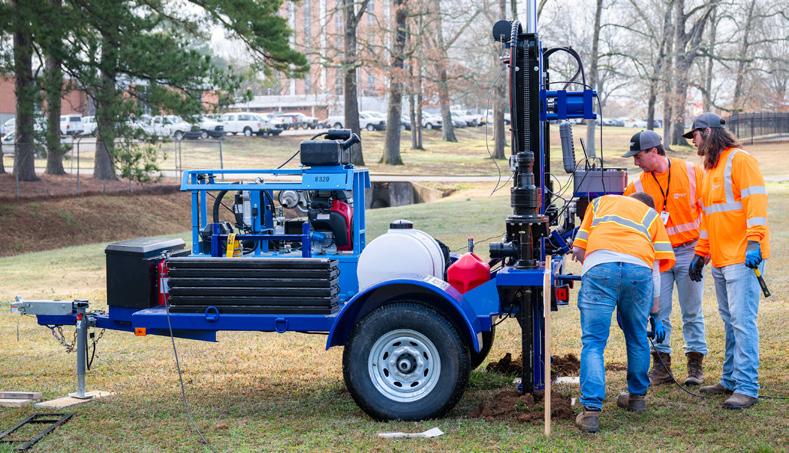
THE ARKANSAS DEPARTMENT OF TRANSPORTATION (ARDOT) IS ADVANCING ITS APPROACH TO GEOTECHNICAL INVESTIGATIONS WITH THE ADDITION OF A NEW CONE PENETROMETER TESTING (CPT) MACHINE. This new equipment reshapes how geotechnical engineers assess soil conditions beneath critical infrastructure.
Traditionally, soil analyses for bridges, embankments, and retaining walls involved labor-intensive drilling for days to weeks and manually collecting samples (also called boring). These samples would have to be transported back to the laboratory for further evaluation and testing to determine the soil design parameters. The CPT machine changes that. It pushes a 11/2 inch in diameter cone-shaped sensor into the ground at a steady
2 centimeters per second, capturing detailed data in real-time, all without collecting a single soil sample.
Conventional drilling and sampling are typically still required to help calibrate findings and verify the results from the CPT. However, in certain circumstances, CPT can be used in place of conventional drilling, accelerating timelines.
This streamlined process allows crews to complete a 100- to 150-foot exploratory boring in just two to three hours, a major reduction from the two days typically needed with conventional soil boring methods. Geotechnical engineers get instant readings on tip resistance, sleeve friction, pore water pressure, and even seismic shear wave velocity, all of which are collected and used for design recommendations.
The CPT system also brings efficiencies in manpower and cost. Conventional drilling methods utilizing Standard Penetration Testing (SPT) require four-person crews and weeks
of lab analysis. In contrast, CPT can be performed by just two technicians, with results available in real-time.
While ARDOT has only used the CPT machine on two projects since putting it into service at the beginning of March, early results are promising. ARDOT Advanced Geotechnical Engineer, Paul Tierney, said that we will begin using this technology more as soil projects become readily available.
“You typically utilize CPT in soil country—where bedrock isn’t shallow. We plan to use the CPT rig on any soil project we can going forward,” Tierney said.
Soil country is anywhere in the State’s West Gulf Coastal and Mississippi River regions.
“Anything below the surface in these zones typically consists of sands, silt, clay, gravel, or any different combinations of those,” Tierney said.
With this new technology in place, ARDOT is poised to streamline its operations and deliver more efficient, cost-effective infrastructure projects statewide. Applications may include bridge projects, slope failure analysis, and ARDOT facility projects.
Still, CPT isn’t a complete replacement. Conventional drilling with SPT sampling will remain the primary method of subsurface exploration; however, ARDOT plans to continue expanding the use of CPT and integrating it more extensively into design recommendations. The advantages in speed, staffing, and data quality make CPT a compelling addition to the Department’s toolkit.
ARDOT staff demonstrate the new Cone Penetrometer Testing (CPT) machine.

BY EMMA GOAD
SMART SOLUTIONS FOR GROWING NEEDS:
First Smart Commercial Truck Parking Lot
THE ARKANSAS DEPARTMENT OF TRANSPORTATION (ARDOT) HAS TAKEN A SIGNIFICANT STEP IN IMPROVING TRUCK PARKING WITH THE LAUNCH OF THE STATE’S FIRST SMART COMMERCIAL PARKING LOT IN WEST MEMPHIS.
Chosen because of its location at the east edge of Arkansas at a major river crossing, the smart upgrades to this commercial parking lot will begin allowing truck drivers to be notified that there are open parking spaces available to them digitally. This pilot project aims to address the growing need for truck parking while also integrating innovative technology that works to enhance driver efficiency and safety.
According to Joseph Hawkins, ARDOT Transportation Systems Management and Operations (TSMO) Division Head, the new smart parking system has become increasingly important due to Federal regulations requiring truck drivers to electronically log their travel information. Full compliance with this regulation was necessary for all truck drivers by December 2019.
For the truck drivers who stay on the road longer than is allowed, the District Court Judge in their county will fine them anywhere from $100 to $1,000, in addition to a 10-hour out-of-service requirement.
“With electronic logging, it’s reported back, and when truck drivers drive longer than they’re supposed to, they get penalized,” Hawkins said. “So, they’re actively looking for a spot to park with no luck, and that’s why we’re seeing illegal truck parking everywhere.”
The original project repurposed the old West Memphis Welcome Center into a dedicated truck parking facility
with 84 officially marked spaces to accommodate the need for overnight parking. ARDOT cut a ribbon to dedicate the opening of the truck parking lot in May of 2023. According to Arkansas Highway Police Major Ross Batson, the West Memphis lot has been full every night since its opening. Funded through Arkansas Commercial Truck Safety and Education program and grant program funding, the lot was recently upgraded with new concrete, bathrooms, Arkansas Highway Police substations, and safety features such as lighting and permanent traffic operation cameras.
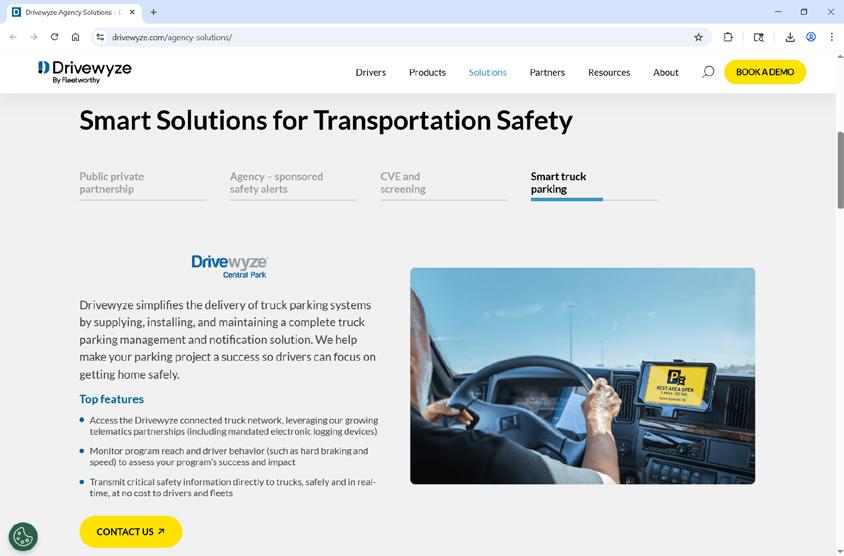
These cameras play a crucial role in the parking system by feeding real-time data into Drivewyze, the current software vendor used for this project, which calculates the number of available spaces. Next, the TSMO team will be working on dynamic signage along the highway that will give truck drivers an immediate idea of how many parking spots will be available as they approach the lot using the data sourced from Drivewyze.
Hussain Alfaraj, ARDOT TSMO Assistant Division Head, emphasized the importance of accuracy before fully rolling out the smart commercial parking lot system across the state.
“Before that happens, we’re going to make sure that there are accuracies in the system. As Drivewyze pushes the number back to us, the Traffic Management Center operators will verify that it is accurate,” Alfaraj said.
The Drivewyze system uses machine vision technology to detect the distance between parked trucks to calculate the available spots.
The West Memphis truck lot is currently serving as a trial site to refine the system before expanding to the 19 other ARDOT-owned truck parking access locations across the state.

“This is all part of us learning to crawl or walk before we go running,” Alfaraj said. “If we’re going to do it, we’re going to do it right.”
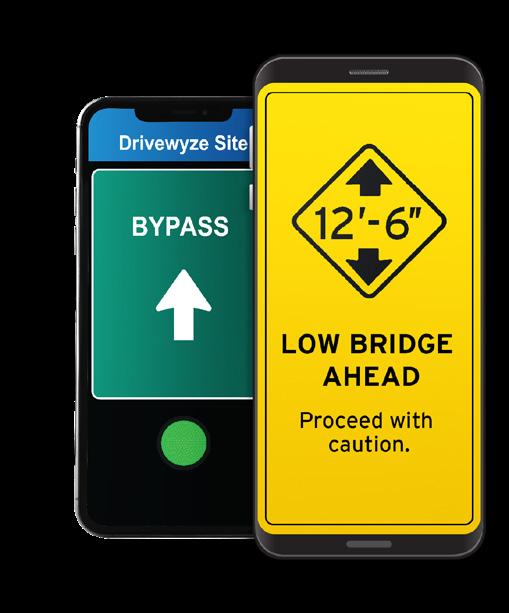
As it stands now, Drivewyze’s notification system will alert truck drivers directly through in-cab tablet devices that are mounted on the dashboard of the truck, informing drivers of available parking miles ahead. Hawkins explained that this direct notification method is crucial to ensure truck drivers don’t overlook traditional highway signs.
“When a notification pops up in their cab device, they’ll think, ‘Whoa, I’ve got to pay attention to that’,” Hawkins said.
The long-term goal is to implement this smart parking technology statewide as funding becomes available. Hawkins expressed confidence in this project’s potential.
“We obviously know that truckers need places to park, so we’re hoping if we can get this working, show that it’s working, and come up with a cost to maintain it, we can bring it to leadership with the numbers needed to work this out,” Hawkins said.
If the system is fully developed in-house with ARDOT staffing in addition to the Drivewyze partnership, Hawkins estimates the statewide rollout could be completed by 2029. Additionally, there is potential for integrating parking data into the iDrive Arkansas system in the future, further enhancing accessibility for truck drivers.
Shannon Newton, President of the Arkansas Trucking Association, emphasized the importance of driver safety and capacity.
“I do think that there is value in sharing that information and having it available,” she said. “Ninety-eight percent of truck drivers regularly experience problems in finding safe parking. And so, in that case, having that information perhaps makes that a little bit less stressful.”
Newton also pointed out that many people fail to recognize the significance of having enough lots to fulfill the needs of truck drivers.
“I don’t think the average person thinks about where the truck driver rests, or the value of that rest, or how important it is to have a safe place to rest,” she said. “I think we see the trucks on ramps or overflowing rest areas and it looks like they are a nuisance or an inconvenience, and I don’t think we always relate that to the quality of life for that truck driver.”
While smart lots may help alleviate some of the stress associated with truck parking, Newton stressed that the lack of truck driver parking is an underlying issue that remains unsolved.
“It sounds like there’s opportunity to be had with neighboring states and sharing data that way as well. It’s a national problem, and there’s going to have to be a national solution,” Newton said about truck driver parking.
The West Memphis pilot project marks a crucial step in addressing commercial truck parking challenges. By leveraging technology and careful planning, Hawkins and his team hopes to create a network of smart truck parking facilities, improving the experience for truck drivers navigating the state.
NEW LEGISLATION:
A RECAP OF THE 95 TH GENERAL ASSEMBLY
BY RUTHIE BERRYHILL
WHEN ARKANSAS’ 95TH GENERAL ASSEMBLY WRAPPED UP ON MAY 5, IT HAD PASSED SEVERAL NEW LAWS THAT WILL IMPACT MOTORISTS AND ARKANSAS DEPARTMENT OF TRANSPORTATION’S (ARDOT) ROADWAY WORKERS. This new legislation will enhance the safety of roadway workers and motorists, reduce work zone related injuries, improve driver awareness, and reinforce safe driving behaviors. Other laws were passed that helped increase efficiency in processes and to clarify language. The new laws went into effect on August 5, 2025.
“During this last legislative session, our lawmakers worked with us to adopt new legislation that will help ensure our workers are safer every day,” Jared D. Wiley, ARDOT Director, said. “We are grateful to them for their support and carrying this important legislation for the Department. They are true advocates for the community, and we thank them.”
ARDOT GETS A GREEN LIGHT (ACT 209)
Sponsored by State Representative Joey Carr of Blytheville and State Senator Steve Crowell of Magnolia, Act 209 allows the continued use of green lights by ARDOT and its contractors. After a successful pilot program in 2023, ARDOT was granted approval by the Department of
Emergency Management (ADEM) in 2024 to use flashing green lights for its maintenance and construction vehicles, as well as on contractor’s vehicles working with ARDOT.
“Although ADEM granted ARDOT permission to use green lights on our vehicles, we wanted to make sure that there was no question about us being able to use them if ADEM’s authority on the issue was ever challenged,” Gill Rogers, ARDOT Governmental Relations Officer, said.
Flashing green lights improve visibility on bright, sunny days, in fog, and during inclement weather. Each state regulates the use of colored lights on vehicles. In Arkansas, red, blue, or green lights are prohibited on any vehicle other than those specifically authorized to use them.
FINES DOUBLE IN MAINTENANCE WORK ZONES (ACT 327)
Act 327, sponsored by State Representative Trey Steimel of Pocahontas and State Senator Kim Hammer of Benton, doubles fines for a moving traffic violation within a mobile maintenance operation.
In the past, fines doubled only for moving traffic violations within a static (fixed) highway or interstate work zone. Now the rule applies to both highway and interstate work zones and mobile maintenance operations, which include any roadway area where ARDOT maintenance crews are present and working in the roadway. ARDOT’s Maintenance Division has developed new signage that will be attached to the back

of an ARDOT truck used in mobile work zones that reads “Work Zones/Fines Double” and will help improve visibility for equipment and workers that perform short duration or mobile work in the traffic lanes.
WORK ZONE SAFETY ADDED TO ARKANSAS DRIVER’S LICENSE TEST AND MANUAL (ACT 117)
Sponsored by State Senator Mark Johnson of Little Rock and State Representative Mindy McAlindon of Centerton, Act 117 amends the Arkansas Driver’s License Manual and Test to include additional information on how to drive safely through work zones. Work zone crash statistics, testimonials from highway workers, the importance of work zone awareness, and information about the safe operation of a vehicle in a work zone will be included.
“This is an extremely important change that will hopefully help reduce the dangers for our dedicated highway workers, both ARDOT employees and those of our road contractors,” Senator Johnson said.
PAYMENTS INCREASED TO SURVIVING BENEFICIARIES (ACT 414)
As part of Act 414, surviving beneficiaries of ARDOT employees killed while in the line of duty will now receive higher benefit payments, in line with other state jobs that are classified as hazardous. The act was sponsored by Arkansas State Representative Wade Andrews of Camden and Senator Hammer. The state will now pay $250,000 to qualified beneficiaries. As it pertains to ARDOT, this law originally only covered Arkansas Highway Police and provided $150,000 to the beneficiary of a fallen officer.
THE MAKING OF A LEGISLATIVE PACKAGE
Acts 209, 327, and 117 were part of ARDOT’s Legislative Package for the 95th General Assembly. Act 414 was not part of ARDOT’s Legislative Package but received the Department’s support. What exactly is a legislative package and who decides what goes in it?
ARDOT begins working on its Legislative Package prior to the start of a Legislative Session. The package addresses issues and makes improvements through proposed legislation with the goal of delivering a safe, modern transportation system for our state. Rogers begins the process of building the package by asking for suggestions from ARDOT’s Division Heads and District Engineers.
From there, he prepares a list of proposals for ARDOT’s Administrative team. They review the proposals and narrow them down to the ones they think should be pursued. Then the package goes to the Director for review.
The package must be approved by the Arkansas Highway Commission before December 1 of the year immediately preceding the session. Once the Commission approves the package, ARDOT begins the process of finding sponsors to file the proposed legislation on our behalf. Approved drafts are sent to the Bureau of Legislative Research, who prepares the final proposals and submits them to the General Assembly. The Director (or the Director’s representative) presents the package to the Arkansas Legislative Council.
Once the session starts, the bills are considered by the General Assembly who ultimately decides if the bills will be sent to the Governor for her signature.
Courtesy of the Arkansas House of Representatives
GETTING THE PUBLIC INVOLVED
ALL ABOUT PUBLIC INVOLVEMENT MEETINGS
BY KAITLIN WORLEY
IMPROVEMENTS TO INTERSTATES AND HIGHWAYS CAN HAVE A MAJOR IMPACT ON LOCAL COMMUNITIES. Whether it’s widening a road, adding a new lane, or relocating a roadway, these changes often affect nearby properties and businesses, which can make a notable difference to the everyday lives of residents and commuters.
To address the potential impact these kinds of changes can have, the Arkansas Department of Transportation (ARDOT) hosts Public Involvement Meetings, which are events that are open to the public and provide an opportunity to learn about and discuss upcoming projects in the area as well as voice opinions and concerns about proposed plans. They are organized by ARDOT’s Public Involvement Section, which is a part of the Environmental Division. The Environmental Division is responsible for ensuring the Department operates in compliance with environmental laws, regulations, and policies consistent with that of the Federal Highway Administration (FHWA) and ensures compliance with the National Environmental Policy Act (NEPA) regulations. Including public involvement in the development process for proposed projects is required by both FHWA and NEPA.
In addition to Public Involvement Meetings, other public meetings are held prior to the implementation of a new project, such as Design Public Hearings, which are required for more complex or impactful projects.
Before a Public Involvement Meeting is held, all citizens and property owners within the vicinity of the job are notified about it.
“Every single post office box or mailbox on a mail carrier's route will get one of these invites,” Matt Strawn, ARDOT
Section Head of Public Involvement, said. ARDOT also places advertisements in the local newspaper and on local radio stations and often hands out invitations directly as well. “We want you to come to the meeting, ask questions, and tell us your concerns. That’s the whole reason that we do it,” Strawn said.
ARDOT wants the public’s input because “They help provide a full picture of what the impact is going to be,” Rosana Lavender, ARDOT Public Involvement Specialist, added.
“The whole purpose of public involvement is to have better projects,” Strawn explained. “A lot of the time, when ARDOT is designing these projects, there are things on the ground that we might not consider until we go to a Public Involvement Meeting. One example that has come up recently is a request from emergency services for mountable curbs, allowing fire trucks and ambulances to bypass backedup traffic. This can be accommodated in the design.”
WHAT TO EXPECT
Public Involvement Meetings have an open style as opposed to being formal. There is a sign-in table toward the front, where members of the public, public officials, and other attendees can receive a project location map and a comment form, but general resources are also provided, such as the latest highway map and informational brochures about various topics related to ARDOT.
Project details are displayed throughout the room.
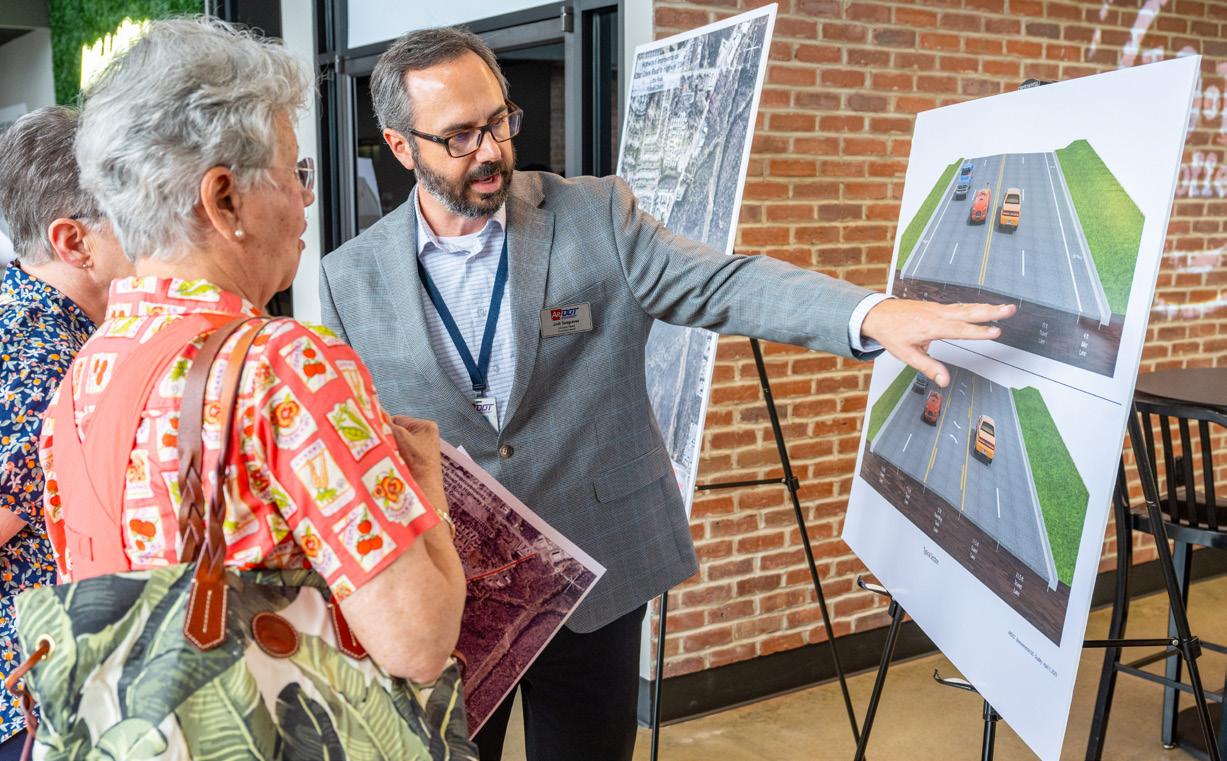
Roadway Design provides a roll-plot of the proposed design, which is a large print of a project’s plans. Interactive maps are also displayed on a screen. “We’ll also have representatives from Right of Way Acquisition, Relocation, Appraisal, and Utilities on hand – typically, someone from
each of those sections is present at the meetings,” Strawn further explained.
The locations for these events are accessible to differently abled individuals, and translators are also available at the events. “We always make sure that our meeting locations are accessible to everyone. We make sure that we’re providing the same information to English speakers and non-English speakers. For example, with the Marshallese population in Northwest Arkansas – if we have a project up there, we’ll hire a translator for that meeting and translate those materials too, so we can work with any population in Arkansas,” Strawn said.
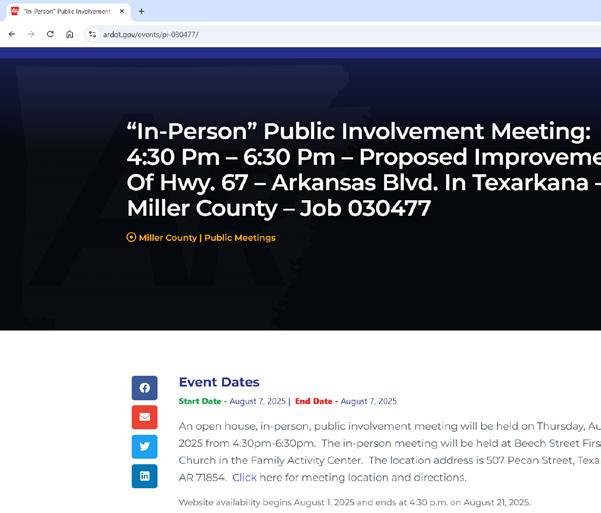
Every upcoming Public Involvement Meeting has a web page prior to the event, and all the information offered on the page is also available in Spanish. Members of the public are also able to submit comments online.
HOW IT WORKS
“At the Public Involvement Meeting, we engage in discussions with attendees about their comments and concerns,” Austin Hales, ARDOT Staff Engineer of Roadway Consultant Review, explained. “We encourage attendees to fill out a comment form so their comments are on the record and can be further considered.”
During the 15-day comment period, the public is encouraged to submit any concerns or issues with the
(continued on page 28)
Josh Seagraves, ARDOT Environmental Division Head, talks with members of the public at a Public Involvement Meeting in Little Rock in June 2025.
During the 15-day comment period, the public is encouraged to submit any concerns or issues with the proposed project.

proposed project. The comments are then compiled and distributed to ARDOT’s Roadway Design Division. Roadway Design uses the compiled comments to make feasible changes that provide an overall benefit to all the individuals who have stakes in the matter.
These comments are also extremely important to ARDOT’s Right of Way Division, which is charged with the responsibility of acquiring all right of way necessary for the construction and maintenance of highways in the State of Arkansas. “Right of way” is an area of land acquired and dedicated to the construction, operation, and maintenance of a transportation facility for the benefit of the traveling public in Arkansas.
“Appraisers, acquisition agents, and relocation coordinators all use the comments in their work,” Nathaniel Williams, ARDOT Senior Right of Way Project Manager, said. These comment forms provide the opportunity for local property owners to provide contact information and express their concerns. “This enables our staff to more easily reach property owners affected by a project and to speak knowledgeably about their concerns from the inception of the right-of-way acquisition phase of the project,” Williams explained.
Information provided by these forms also helps the Right of Way Division become aware of unforeseen circumstances,
“such as septic systems in the proposed right of way,” Williams said. The information provided by the comment forms enables the Right of Way Division “to set priorities for evaluation during the right of way process or suggest revisions to the design if necessary to avoid or mitigate significant impacts,” Williams explained.
GETTING INVOLVED
On May 8, 2025, a Public Involvement Meeting was held in Jonesboro regarding changes to Highway 91 west of Jonesboro. Michael Langley, a local resident, attended the meeting. He said he attended the event because “the construction was coming up near my house, so I was there to see it. A couple months prior, there were people surveying in front of our house. I wanted to know what they were planning.”
Langley said he found the event extremely helpful and enjoyed seeing the big, detailed map on the table, which he said was “easier to see than the smaller maps.” He enjoyed listening to the engineers. “There were a lot of people there. I would definitely recommend it to the public,” Langley said. In addition to information about upcoming meetings, comment forms and other resources can be found at ardot.gov/publicmeetings. Official websites are created for each project or plan at least five business days prior to the event.

A PASSION FOR WEATHER AND HELPING PEOPLE –METEOROLOGIST CHRISTOPHER PIPKIN
BY RUTHIE BERRYHILL
CHECKING THE WEATHER FORECAST PLAYS A BIG PART IN EVERYDAY LIFE –WHETHER YOU’RE FIGURING OUT IF YOU NEED A JACKET, MAKING PLANS WITH FRIENDS, KEEPING AN EYE OUT FOR STORMS, OR JUST TRYING TO AVOID THE SUN DURING A HEAT ADVISORY.
Christopher Pipkin, Geospatial Analyst in ARDOT’s Program Management Division, knows firsthand how much weather influences daily life. He’s been creating weather forecasts since he was a child in Quitman, Arkansas. Pipkin earned a degree in professional meteorology from Mississippi State University in 2021 with an emphasis in Geographic Information Systems (GIS) and now – in addition to his career at ARDOT – serves as a weekend meteorologist for KARK 4/ Fox 16’s Arkansas Storm Team.
A FIRST LOVE
His fascination with weather began as early as he can remember.
“I just remember even before kindergarten, loving weather,” Pipkin said. “There’s a VHS tape of me somewhere that my dad has of me from sometime around two years old. I was pretending to be on the weather.”
Pipkin remembers watching the late meteorologist Ed Buckner doing weather forecasts on THV11. He credits Buckner with accelerating his love of meteorology.
“When I was in kindergarten, there was a tornado outbreak, and I watched him and it sparked something in me,” Pipkin said. “I just knew in the back of my head ‘Oh, that’s what I want to do,’ and have ever since.”
(continued on page 30)

My passion for weather keeps me going, and it doesn’t feel like work. I love what I do, and that drives me through even the busiest, most intense days.
- Christopher Pipkin, Geospatial Analyst

“It became this community thing,” Pipkin said. “I just kept it up. I built that page from zero followers to about a thousand while working there. Today it’s at 53,000 and I couldn’t have done it without the folks at the gas station.”
INTERNSHIP AT NASA
While in high school, Pipkin was able to meet Buckner and spend a day job-shadowing him.
“He was my role model growing up,” Pipkin said. “I watched him a lot and I always loved his calmness whenever he was covering storms. He was very humble whenever he was on air.”
SMALL TOWN ROOTS
When he was young, Pipkin’s mother – and before her, his grandmother – managed the local gas station. When their community experienced heavy rain, the store often flooded.
“I would forecast the weather to help my mom and grandma know when to expect flooding, so we could all pitch in to get the store back in order. It was a family effort,” Pipkin said.
Pipkin originally thought that he would work as a meteorologist in the private sector, not in broadcast meteorology. He soon realized that the communication skills he learned from working with his mom at the gas station would serve him well in a career in broadcast journalism.
“My mom let me start working at the gas station when I was fifteen,” Pipkin said. “I was able to learn how to communicate with people from all different backgrounds and from all walks of life.”
Also at age fifteen, Pipkin created a weather page for the town of Quitman on Facebook. He promoted the page through the gas station, sharing weather information with customers. Even now, Pipkin’s page continues to gain followers.
His passion for studying meteorology, combined with his ingenuity forecasting for the local community, likely helped Pipkin stand out when he applied for a competitive internship with NASA and the National Weather Service during his junior year in college.
“There were over a thousand applicants, and they were only accepting ten. I did not think I was going to get it,” Pipkin said. “I wasn’t one of those students who had a 4.0 GPA. I just told them about my passion, background, and all the things that I’d done growing up. And, sure enough, I got the phone call.”
The internship was offered through the Research Experiences for Undergraduates (REU) program through the National Science Foundation. Pipkin spent the summer at the University of Alabama in Huntsville (UAH), with a few days spent at NASA's Marshall Space Flight Center.
“It ended up being one of the most rewarding experiences because I was able to learn a lot about radar and got to talk to different folks with different backgrounds, like GIS. A memorable moment was listening to the crew aboard the International Space Station, which broadened my understanding of how meteorology connects to space weather.”
As an intern, Pipkin researched detecting tornado intensity in real time and was asked to present his research at the national American Meteorological Society Conference in Boston. He credits his internship experience with his interest in GIS, which he uses daily in his job at ARDOT. GIS is a technology used to collect, map, and analyze data linked to locations on Earth.

THE ROAD TO ARDOT
After graduation, Pipkin worked as a broadcast meteorologist for a few years at a TV station in Jackson, Mississippi. He moved back to Arkansas to be closer to family but was unable to find a job in broadcast meteorology. Until then, he had never really considered a career in anything other than meteorology.
“I had tunnel vision with meteorology until I got out of it for a short period,” Pipkin said. “I knew my love for weather was still there but I just kind of needed to step back and reassess and learn other skills while doing so. That’s when I started looking at other things.”
In 2023, Pipkin found the Geospatial Analyst position with ARDOT where he was able to merge his meteorology background with his GIS skills.
“I fell in love with mapmaking,” Pipkin said.
As a Geospatial Analyst, Pipkin assists in the preconstruction phases of transportation projects by managing and analyzing geographic data. This includes creating and maintaining detailed maps using GIS software such as ArcGIS Pro.
In this role, Pipkin collaborates with various ARDOT sections, particularly the Project Development Section in the Program Management Division, to ensure that accurate location-based data is available for project planning, funding, and reporting. He also tracks and supports the progress of projects, contributes to the development of location maps, and ensures that data aligns with project needs and funding forecasts.
“One of my favorite maps I've worked on was visualizing traffic speeds during weather events like the 2021 snowstorm and the March 31, 2023 Little Rock tornado. I was able to integrate weather data with traffic data, which allowed us to track how traffic was moving and where the heaviest congestion was during the storm. It’s my favorite because it’s a unique blend of both weather and
GIS data, providing real-time insights that are actionable for emergency management and traffic planners,” Pipkin said. “It was especially rewarding to present this data at conferences, such as the Arkansas GIS Symposium and the 2024 Arkansas Emergency Management Conference, alongside Sharon Hawkins, ARDOT Staff GIS and Mapping Administrator. We won Best Presentation at the Symposium! It was such an honor, and an even bigger honor to work with Sharon on this project. She was so much fun to collaborate with.”
BACK ON THE AIR AGAIN
In December 2024, Todd Yakoubian, Chief Meteorologist with KARK 4/Fox 16, reached out to Pipkin about working at the station as a meteorologist. Pipkin grew up reading Yakoubian’s Arkansas Weather Blogs.
“It is such a full-circle moment for me to now work alongside him,” Pipkin said. “He has been a big inspiration throughout my career.”
In addition to working full time at ARDOT, Pipkin works part time at KARK 4/Fox 16 on the weekends and during severe weather events. Although it makes for a full schedule, Pipkin is enthusiastic about doing both.
“It’s a challenge working both jobs, especially during severe weather, but it’s incredibly rewarding,” Pipkin said. “My passion for weather keeps me going, and it doesn’t feel like work. I love what I do, and that drives me through even the busiest, most intense days. It’s the same feeling I had when I started working at the gas station, when I created my weather page for Quitman. Back then, I connected with so many different people, and that sense of purpose and helping people still fuels me today.”
Pipkin says what he loves most about meteorology is helping people.
“It’s not just about the weather—it’s about how you can make someone’s day easier or safer with the right information,” Pipkin said.
Christopher Pipkin on-air with the Arkansas Storm Team at KARK 4/Fox 16 in Little Rock.
RE: LITTER LETTERS PLACED AT THE WELCOME CENTER IN BELLA VISTA
The following is referencing an art installation of letters that spell out “Why” on the grounds of the Bella Vista Welcome Center. The letters are filled with the litter collected from the area and are locally known as “litter letters.”
I couldn’t quite fill the letters to the top as planned, thanks to the heavy rain those last few days of the month. I even went hunting for litter on the 30th, but honestly, I couldn’t find enough to finish them off, so I’m calling that a win!
The impact is clear – the entire city seems to be talking about the letters, and I’m seeing more and more people picking up litter on their own. I’ve even noticed comments on social media about the difference we’re making in the visible trash around town. As much of a hassle as it all was, it feels like it was worth it. Also, a quick shout out to the team at the Visitor's
Center. Stan Weaver, the ARDOT Rest Area Attendant, is a phenomenal guy. William Armacost, Arkansas Department of Parks and Tourism Welcome Center Manager, was such an amazing host and spread the word far and wide about what we were doing. They all keep that place spotless, and I was genuinely impressed by their dedication. They were thrilled to have some “art” on site – even if it was made of trash. Apparently, they’ve been hoping for something like this for a long time, and it was great to see how much they appreciated it.
Thank you for your patience and guidance throughout this process. I truly appreciate it. Until our next adventure . . .
Take care,
Wendy Picklesimer, Bella Vista Litter Patrol
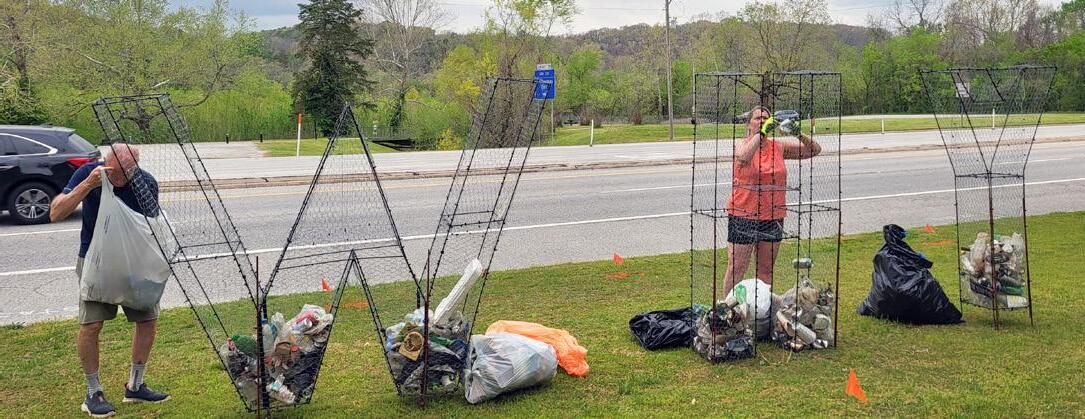

FACEBOOK COMMENTS
Such an important message—thank you for spreading awareness and reminding us to protect those who keep our roads safe. Slow down, move over, save a life. [Response to post regarding the "Slow Down, Move Over" press event.]

Appreciate all of the help and support from ARDOT. Appreciate you being there today! [Response to a post regarding the ribbon cutting for Old River Bridge in Saline County.]
Shane Broadway

GOOD JOB ON HIGHWAY 146
The following excerpt was taken from an email exchange between Arkansas County resident Alan Dill and ARDOT’s Assistant Chief Engineer for Maintenance Steve Frisbee, regarding a letter Mr. Dill had sent about Highway 146.
I just wanted to thank you and your crews for the work that they have been doing on Highway 146 (River Road). It has made a big difference in the spots they have paved and patched so far. It is a lot smoother in the most needed places now. Thank you, sir.
I'm guessing when they finish up with their paving work they will come back and install the signage we talked about earlier. There is only one drawback to the paving, Boats are no longer bouncing coolers, jackets, etc. out of the boats that we can reclaim in the ditches. LOL. Seriously though, the work your crews have done so far have made a tremendous difference in the smoothness and safety of River Road.
Please thank your Pine Bluff District and Stuttgart District crews for the good job they have done making River Road a better and safer road to travel for the folks using it. It is with great appreciation for the work you and your crews have done, I thank you.
— Alan Dill, Preston Ferry

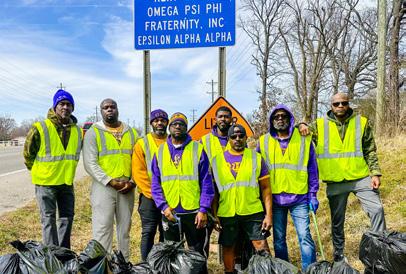
ARDOT’S ADOPTA-HIGHWAY PROGRAM WAS CREATED IN 1987 TO SOLICIT PUBLIC INVOLVEMENT IN CONTROLLING LITTER ALONG SELECTED SECTIONS OF STATE HIGHWAYS. Since that time, more than 4,500 organizations have adopted stretches of Arkansas highways. The program has the impact that it does because of its exceptional volunteers.
To those that made it happen – THANK YOU!!!
It’s a pleasure to drive Highway 45 between Hindsville and Fayetteville since the resurfacing. My note is long overdue. HIGHWAY 45 RESURFACING
— Charlisa Cato, Eureka Springs
I’m so excited to see this, for someone that travels almost every week through XNA.
[PROJECT UPDATE: Construction on the new road to XNA Airport.]
Bobby Romero
In each edition of Arkansas Highways we spotlight an Adopt-A-Highway volunteer. This edition’s volunteer spotlight features Arkansas State University’s Omega Psi Phi Fraternity, Inc., Epsilon Alpha Alpha. A part of the program since March 2025, the group adopted a section of Highway 49 in Craighead County.
We extend a warm thank you to the Omega Psi Phi Fraternity, Inc., Epsilon Alpha Alpha for their dedication and service to the Adopt-A-Highway program.
Learn more about Adopt-A-Highway

OUT & ABOUT
CALENDAR OF EVENTS AROUND THE STATE
As you travel Arkansas over the next few months, consider checking out some of these listed events. Our state is full of interesting things to do, no matter what highway you take. For additional event listings, check out Arkansas.com/events
BUDDY BASS TOURNAMENT: The 40 th annual Buddy Bass Tournament is coming back to Crossett, and this year there will be over $16,500 in cash and over $3,000 in prizes to various winners. Throw on a lure and see what bites for your chance to win!
September 6
BEATLES AT THE RIDGE: Celebrating the 1964 Beatles visit, join a festival in Walnut Ridge that has several attractions, from food trucks to car shows. Liverpool Legends will be headlining, accompanied by three other bands throughout the day.
September 20
ARKANSAS GOAT FESTIVAL: Live music, over 130 vendors, and 20 food trucks will all come together in October to celebrate the Arkansas Goat Festival. This is a party for all things goat, including a costume contest and a parade.
October 4
ARKANSAS PARANORMAL EXPO: UFO’s, Bigfoot, and Psychics—Oh my! The Arkansas Paranormal Expo has grown to be the biggest of its kind in the State. There will be vendors, food, and all things paranormal. All admission, vendor fees, and raffle proceeds go directly to MacArthur Museum of Arkansas Military History.
October 25

SEPTEMBER 6
BUDDY BASS TOURNAMENT Crossett Chamber Crossett, AR
SEPTEMBER 20
BEATLES AT THE RIDGE 300 West Main Street Walnut Ridge, AR
OCTOBER 4
ARKANSAS GOAT FESTIVAL Recreation Drive Perryville, AR
OCTOBER 25
ARKANSAS PARANORMAL EXPO 503 East Ninth Little Rock, AR

DISTRICT 6
WEAVER-BAILEY CONTRACTORS, INC. WAS AWARDED A $117 MILLION CONTRACT IN NOVEMBER 2023 TO WIDEN HIGHWAY 67/167 (INTERSTATE 57) IN CABOT. The project begins just south of the Highway 5 interchange and extends approximately half a mile north of Highway 89. Construction will expand this section of interstate to six lanes by filling in the existing grass median and adding a concrete barrier wall for improved safety. Additional components of the project include the replacement of two bridges and two box culverts, the installation of permanent traffic cameras and dynamic message signs, and the construction of a noise barrier wall to buffer a nearby neighborhood.
This section is a critical corridor for daily commuters and regional travelers between Little Rock and Cabot. When completed, the improvements will help relieve congestion, particularly during peak travel times, and improve overall traffic flow for the 41,000 vehicles that travel this route daily.
“U.S. Interstate Highway 57 is a game changer for our community,” Cabot Mayor, Ken Kincade, said. “Cabot is in growth mode and this only helps its mission to become a community that offers a wide range of amenities to its citizens.”
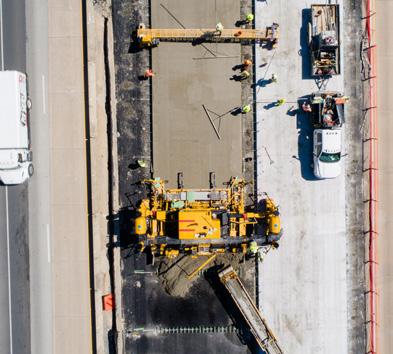
This project is on track to be completed mid-2027, around the same time as the ongoing widening project in Jacksonville. Together, these efforts will provide three lanes in each direction for Highway 67/167 (Interstate 57) from Little Rock to Cabot, offering a continuous, high-capacity route for traffic.
“These capacity improvements are enough to accommodate the growth in that corridor of Central Arkansas,” ARDOT Resident Engineer Sam Davies said. “Once the Jacksonville project is complete, we’ll have six lanes all the way to Cabot.”
Construction has been progressing smoothly, with the job currently 46% complete and on pace to finish ahead of schedule.
Once complete, the widened section will enhance longterm traffic capacity, reduce travel delays, and improve driving conditions for thousands of Arkansans and interstate travelers alike.
“It’s just been a notably smooth-running project overall,” Davies said. “We’ve got a good, collaborative relationship with the contractor and a talented inspection team.”
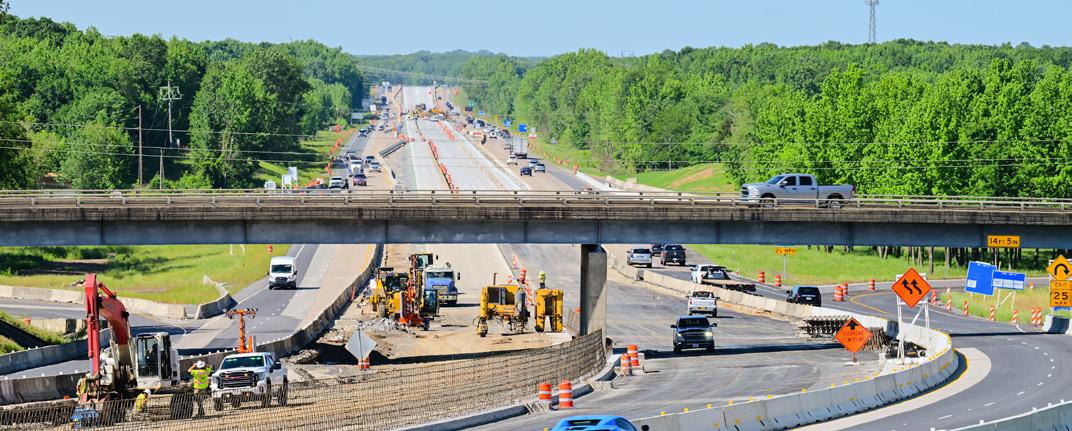
Arkansas Department of Transportation
P.O. Box 2261
Little Rock, AR 72203-2261