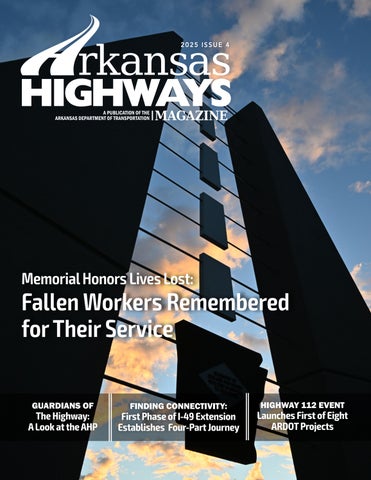
2025 ISSUE 4
A PUBLICATION OF THE ARKANSAS DEPARTMENT OF TRANSPORTATION
Memorial Honors Lives Lost:
Fallen Workers Remembered for Their Service GUARDIANS OF
The Highway: A Look at the AHP
FINDING CONNECTIVITY:
First Phase of I-49 Extension Establishes Four-Part Journey
HIGHWAY 112 EVENT
Launches First of Eight ARDOT Projects
DIRECTOR ’S MESSAGE
Season’s greetings.
A
S I SIT DOWN TO WRITE THIS MESSAGE, I REFLECT ON THE YEAR THAT HAS PASSED WITH HAPPINESS AND GRATITUDE. WHAT A YEAR 2025 HAS BEEN FOR OUR AGENCY. We prioritized safety, relationships, and communication and I am proud when I reflect on the great things we have achieved together. New communication platforms like On the DOT and Poppulo have kept us better informed and helped us to stay more connected. Safety initiatives including legislation authorizing the use of green lights, double fines in mobile work zones, and the inclusion of work zone safety material in the driver’s test are improving safety for everyone. Street Smart is bringing roadway safety to classrooms statewide. Be on the lookout for updated Slow Down, Phone Down content as we wrap up that campaign in a big way next year. It was good to see so many of you at the dedication of the Fallen Worker Memorial. The event was meaningful, impactful, and respectful. The Memorial stands today as a permanent tribute to our 92 fallen comrades. It also provides a place of reflection for loved ones and a reminder to our workforce about the inherent dangers of our work. As we enter the holiday season, I encourage you to take a few minutes to do your own reflecting on the year that has passed. Resist the temptation to dwell on shortcomings. Shortcomings are simply opportunities for growth and positive change. Instead, reflect on the successes that your crew, squad, section, or troop has achieved. Those successes keep the team strong and uplift the users of the Highway System at the same time. Consider the actions that you can take to keep the positive momentum going into 2026. Together, we are unstoppable. Together, we are making a difference.
Jared D. Wiley, P.E., Director
2 || WWW.ARDOT.GOV/MAGAZINE
FRONT COVER: Fallen Worker Memorial
BACK COVER: Bridge on U.S. Highway 64
ARKANSAS STATE HIGHWAY
COMMISSION
EDITOR Ruthie Berryhill
Ruthie.Berryhill@ardot.gov
STAFF WRITERS Emma Goad
PHILIP TALDO Chairman
Emma.Goad@ardot.gov
Kaitlin Worley
Kaitlin.Worley@ardot.gov
GRAPHIC DESIGNERS Marrissa Brickey Marrissa.Brickey@ardot.gov
Aimee Goode
Aimee.Goode@ardot.gov
Lamarie Rutelonis
Lamarie.Rutelonis@ardot.gov
KEITH GIBSON Vice Chairman
PHOTOGRAPHER Rusty Hubbard Russell.Hubbard@ardot.gov
Correspondence should be directed to:
Ruthie.Berryhill@ardot.gov ARKANSAS HIGHWAYS Communications P.O. Box 2261 Little Rock, AR 72203-2261
Arkansas Highways is published by and for employees of the Arkansas Department of Transportation as a medium of departmental news and other information. It is also distributed free of charge to the public upon request.
The Arkansas Department of Transportation (Department) complies with all civil rights provisions of federal statutes and related authorities that prohibit discrimination in programs and activities receiving federal financial assistance. Therefore, the Department does not discriminate on the basis of race, sex, color, age, national origin, religion (not applicable as a protected group under the Federal Motor Carrier Safety Administration Title VI Program), disability, Limited English Proficiency (LEP), or low-income status in the admission, access to and treatment in the Department's programs and activities, as well as the Department's hiring or employment practices. Complaints of alleged discrimination and inquiries regarding the Department's nondiscrimination policies may be directed to Joanna P. McFadden Section Head – EEO/ DBE (ADA/504/Title VI Coordinator), P. 0. Box 2261, Little Rock, AR 72203, (501)569-2298, (Voice/TTY 711), or the following email address: Joanna.McFadden@ARDOT.gov. Free language assistance for Limited English Proficient individuals is available upon request. This notice is available from the ADA/504/Title VI Coordinator in large print, on audiotape and in Braille.
MARIE HOLDER Member
DAVID HAAK Member
JERRY L. HALSEY, JR. Member
ARKANSAS HIGHWAYS MAGAZINE | 2025: ISSUE 4
|| 3
Read this issue and more online! issuu.com/arkansashighways
MAGAZINE
2025 ISSUE 4
CONTENTS STORIES
5 �������������������������������������������������������� Memorial Honors Lives Lost:
Fallen Workers Remembered for Their Service 12 ��������������������������������������� Guardians of the Highway: A Look at the Arkansas Highway Police 15 �������������������������� Finding Connectivity: First Phase of I-49 Extension Establishes Four-Part Journey 19 ������������������������������������������������������ Highway 112 Event Launches First of Eight ARDOT Projects 21 ������������������������������ A Bridge to Honor a King . . . or Three 23 �������������������������������������������� Out of the Box Thinking: Moving Unique Loads on Arkansas Highways 27 ����������������������������Northeast Arkansas Flooding Concerns Lead to Hydraulic Study Model Revamp 30 ���������������������������������������������������������� Bridging the Gap: ARDOT’s First Known Female Engineer 32 ����������������������������������������������Traffic Counts: The Story Behind the Data Everyone Wants 35 ������������������������������������������������������������������������������ On the Road Again: Traveling Arkansas Bike Routes 37 ������������������������������������������������������������������������ The Flower of ARDOT
12
21
REGULAR FEATURES Director’s Message............................ 2 Equipment Feature......................... 26 Dear ARDOT........................................ 40 AAH Volunteer Spotlight.............41 Out & About........................................ 42 Construction Corner...................... 43
IN THE
NEXT i s s u e 4 || WWW.ARDOT.GOV/MAGAZINE
➤ A New Era for Arkansas Highway Police ➤ ARDOT Fights Human Trafficking ➤ A Look at Underwater Bridge Inspections
Memorial Honors Lives Lost:
FALLEN WORKERS REMEMBERED FOR THEIR SERVICE BY RUTHIE BERRYHILL
M
EMORIALS CREATE A PUBLIC ACKNOWLEDGMENT OF A PERSON’S LIFE. THEY ARE SOMETHING TANGIBLE – A PHYSICAL PLACE TO VISIT AND REFLECT, A CONCRETE REMINDER THAT A PERSON LIVED AND WAS LOVED. Until recently, the Arkansas Department of Transportation (ARDOT) did not have a permanent, physical memorial for employees who lost their lives while on the job. On October 9, ARDOT held an event to dedicate its new Fallen Worker Memorial on the Central Office campus in Little Rock. THE ROAD TO THE MEMORIAL Previously, workers who were killed in construction zones were honored with a temporary memorial of orange traffic cones, each with the name of a fallen worker. This modest memorial was displayed in ARDOT’s Central Office lobby and taken on the road to display at safety events. (continued on page 6) ARKANSAS HIGHWAYS MAGAZINE | 2025: ISSUE 4 ||
5
“The original traffic cone memorial only represented those employees who lost their lives in work zones,” former ARDOT Director Lorie Tudor said. Tudor knew that the Department could do better. “In May 2023, we lost a young man who was attempting to remove debris from the road and was struck and killed. Since I had become director, he was the sixth employee we had lost,” Tudor said. “When the tragedy happened, the orange cones were on display in the auditorium, and it just seemed so inadequate. That is when we began in earnest to figure out how to build a memorial that was worthy of the sacrifice of our fallen employees.” In December 2023, Tudor revealed that ARDOT would soon begin plans to construct a permanent ARDOT Fallen Worker Memorial to honor all employees who died while on the clock. “This was a project we really wanted to get behind, but we didn’t want to use any of the taxpayer dollars for it,” Arkansas Highway Commissioner Marie Holder said. “We eventually turned to the Arkansas Good Roads Foundation, a nonprofit that has helped ARDOT with education in the state. All the fundraising dollars went into a special fund with them. They helped us build this Memorial.” The Arkansas Good Roads Foundation (AGRF) is a 501(c)(3) nonprofit, tax-exempt, and tax-deductible organization. “The Arkansas Good Roads Foundation made sure that everything stayed on track ethically and then also financially,” Robert Moery, AGRF Executive Board President, said. To keep employees included in the design process, Tudor asked them to contribute ideas for the monument’s design. In early 2024, a concept drawing based on employee suggestions was created by Edgar Ariza, an ARDOT employee who has since retired. DESIGNING THE MEMORIAL Garver, an engineering firm, approached ARDOT and volunteered to turn the concept drawing into construction plans. As part of the process, they looked at different materials and costs. Many of the traditional monument materials like stone, wood, and steel would be costprohibitive for a structure this size. “We kept going back to ‘What does ARDOT do? Well, they build roads and bridges. What do they build it with? Concrete’,” John Ramsey, Garver Senior Architect, said. “So we hit upon the idea of, ‘Let’s see if we can do this same thing out of concrete.’ And so that was the genesis of the design.” Garver was able to create construction plans that were true to the original concept and presented 3D models and flythroughs to ARDOT leadership. Once they received approval to go forward, Garver created the technical drawings needed to build the monument. The memorial consists of two columns climbing into the sky,
6 || WWW.ARDOT.GOV/MAGAZINE
Thank you
Approximately $97,000 was raised through cookouts, bake sales, raffles, donations, and auctions by our team.
symbolizing praying hands. The space between the columns is meant to symbolize a highway to heaven or to infinity. Brick pavers with the names of fallen workers line a pathway that flows through the monument. Landscaped greenery surrounds a seating area that is available for resting and reflecting. The monument is situated near the walking trail on the east side of ARDOT’s Little Rock campus, near the Planning Annex. It honors the 92 employees who have died while on the job. Construction broke ground on March 10, 2025. “It can’t ever replace the loved one that they lost, but maybe in a small way, it provides some comfort,” Tudor said. BURGERS, DOGS, AND SONGS – EMPLOYEE FUNDRAISING Employee fundraising for the memorial began in May 2024 and included a variety of activities across ARDOT’s Districts and at the Central Office. Bake sales, a silent auction, t-shirt sales, meals, and raffles created a sense of camaraderie. James Patrick, ARDOT Legislative Specialist, created and performed songs for many of the Central Office lunchtime fundraisers, including “Mouth Full of BBQ,” “Burgers, Dogs, and Songs,” and “Smoked Bologna.” “The construction of the memorial would not have been possible without the outpouring of support from our ARDOT family, including current and former employees, retirees, Commissioners, and former Commissioners,” ARDOT Director Jared D. Wiley said. “Approximately $97,000 was raised through cookouts, bake sales, raffles, donations, and auctions by our team. All of the fundraising activities were done on staff’s personal time because of their belief in and realization of the importance of the job we do and the sacrifice that so many have made to deliver on our commitment to a safe and efficient transportation system.” INDUSTRY DONATIONS Industry fundraising launched at the 2024 Work Zone Awareness Week Kick-off event, when the Arkansas Asphalt Paving Association (AAPA), the Associated General Contractors of Arkansas, and the American Traffic Safety
Special thanks to all who contributed to and supported the construction of ARDOT’s Fallen Worker Memorial, including current, former, and retired Department employees, current and former Arkansas Highway Commission members, and our industry partners listed below.
ACME Brick Company American Concrete Pavement Association, OK/AR Chapter American Traffic Safety Services Association, Arkansas Chapter APAC-Central, Inc. Arkansas Asphalt Pavement Association Arkansas Good Roads Foundation Arkansas State Chamber of Commerce Associated General Contractors of Arkansas Atlas Asphalt, Inc. Broadview Strategies Clements Construction Crafton Tull Cranford Construction D.B. Hill Contractors, Inc. Darragh Company Drainage Pipe, LLC Forsgren, Inc. Garver Granite Mountain Quarries HDR, Inc. HNTB Corporation Hossley Lighting and Power Solutions James A. Rogers Excavating, Inc. Kinco Constructors Quinn & Associates Consulting Riggs Cat Time Striping The Tree Marshall Total Erosion Control, Inc. W&W | AFCO Steel Weaver-Bailey Contractors, Inc. WK Contractors, Inc.
(continued on page 8) ARKANSAS HIGHWAYS MAGAZINE | 2025: ISSUE 4 ||
7
Learn more about the memorial by scanning here or visiting ardot.gov/memorial.
Services Association, Arkansas Chapter presented the AGRF with checks to help pay for the memorial, totaling $25,000. Later, the AAPA contributed additional funds to the project, bringing their total contribution to $30,000.
(AHP) and his father, Edgar, had served in law enforcement for 31 years. Edgar talked about how his family was proud of Chandler for his service and that those who worked with him cared so much for him.
About $88,000 total was donated by industry partners. In addition, materials, services, and labor were donated to the cause, bringing the total from industry up to $258,000.
“We went over there to West Memphis where he worked and those people that he worked with and those under him, he treated them so good, that they were crying worse than we were when he passed away,” Edgar said. “He was a good officer.”
Industry partners included Kinco Constructors, Cranford Construction, Darragh Company, Garver, Granite Mountain Quarries, Hossley Lighting & Power Solutions, James A. Rogers Excavating, Inc., WK Contractors, Inc., Weaver-Bailey Contractors, W&W | AFCO Steel, ACME Brick, Tree Marshall, Clements Construction, and Total Erosion. The Arkansas State Highway Commission donated a bench in Tudor’s name for the site. WEBSITE SERVES AS DIGITAL MEMORIAL, TELLS WORKERS’ STORIES A memorial website featuring the names of employees and stories about their lives was created to complement the physical memorial site. It also includes a memorial timeline, a page about ARDOT’s safety initiatives, and a plot map for the bricks. When possible, the next of kin of fallen employees were contacted to gather details for the memorial stories. Matthew “Chandler” Moore’s family is one of the families who responded to our request. Chandler was a Sergeant in the Arkansas Highway Police
8 || WWW.ARDOT.GOV/MAGAZINE
Paula Beard, niece of Sharren Richards, visited with us about her aunt. Sharren was a Rest Area Attendant at the Van Buren Welcome Center in District 4. “She was comical. She would always have you laughing,” Beard said. “That’s why she was so awesome at the Welcome Center because regardless of who entered the door, she made them feel at home. She put her heart into her job there.” Chandler and Sharren’s stories are just a few of the stories featured on the memorial website. In addition to the website, ARDOT is working on a documentary, “The Making of a Memorial,” that will focus on the memorial and the individuals it honors. More details will be shared in the future. THE DEDICATION In October, ARDOT welcomed families, friends, and coworkers to acknowledge and remember those who made the ultimate sacrifice in service to our state. Many family
I hope that in 20 years I can walk in and see no more new bricks.” — Commissioner Marie Holder
and acknowledged the sacrifice they made. Arkansas Senator Frederick J. Love, who represents District 15, comprised of parts of Little Rock and Pulaski County, spoke of the Legislature’s efforts to support the safety of highway workers and AHP. Between speakers, representatives from ARDOT’s 10 Districts, AHP, Divisions, and Administration read the names of the fallen workers from their respective area of ARDOT. members traveled from far away, one even as far as Indiana. ARDOT estimates that between 1,100 and 1,200 people were in attendance. “As I look out onto the crowd, I’m filled with pride by the number of you who made it a point to be here today with us to support each other,” Wiley said. “In the crowd today we have Highway Commissioners, elected officials, industry partners, and the largest single gathering of ARDOT employees in history.” The dedication began with several ARDOT and AHP vehicles lit up in a semicircle behind the memorial. “The blue and green lights you see behind the memorial, for us, signify the role that each of our public servants play and the role they’re tasked with on a daily basis,” Wiley said. “We are all part of the same family.” Following the display of vehicle lights, the event began with the presentation of the colors by the AHP’s Honor Guard, an invocation by D. B. Hill, III, Secretary and Treasurer of the AGRF, and the National Anthem played by the Arkansas Symphony Orchestra’s Rockefeller Quartet. Arkansas Governor Sarah Huckabee Sanders was unable to attend the event, but asked Arkansas Highway Commissioner Jerry Halsey, Jr. to read a letter from her. She praised ARDOT’s employees for their service to the state
Tudor also spoke at the dedication, explaining how the memorial was a very personal project for her. Reflecting on the completion of the memorial, Tudor said, “Now, to think less than two years ago, all we had was a concept and a determination to make it happen, and now the dream has become a reality. We have this beautiful and meaningful memorial that will remember and honor those we have lost. We also have a way to show how much we value and respect our brave men and women that work for ARDOT.” Each name etched in brick tells the story of commitment to public service and of sacrifice. Beard attended the dedication and shared her reaction to seeing Sharren’s brick. “You know, people will come and see this memorial. They’ll see her name in the walk and they’ll not know her personally, but they’ll know that she was very important to be part of this display,” Beard said. The memorial provides a place for quiet reflection and honors the memory of our coworkers, friends, and family. It is a permanent reminder to all drivers to slow down and avoid distraction while driving, especially when workers are present. “I hope that there are no more bricks placed,” Holder said. “I hope that in 20 years I can walk in and see no more new bricks.”
L .-R.: ARDOT Director Jared D. Wiley; Arkansas State Senator Fredrick J. Love; Former ARDOT Director Lorie H. Tudor; Jerr y L . Halsey, Jr., Arkansas Highway Commission; and D. B. Hill, President of D.B. Hill Contractors, Inc. ARKANSAS HIGHWAYS MAGAZINE | 2025: ISSUE 4 ||
9
A MOMENT OF SILENCE
10 || WWW.ARDOT.GOV/MAGAZINE
ARKANSAS HIGHWAYS MAGAZINE | 2025: ISSUE 4
|| 11
Guardians of the Highway:
A LOOK AT THE ARKANSAS HIGHWAY POLICE BY K AITLIN WORLE Y
I
N THE 1920s, THE POPULARITY OF THE AUTOMOBILE WAS QUICKLY GROWING. AS MOTOR VEHICLES BECAME MORE COMMONPLACE, ROAD SAFETY BECAME A MAJOR CONCERN ACROSS THE STATE. In an effort to protect the citizens of Arkansas and keep the roads safe, Act 299 of 1929 was passed by the Arkansas General Assembly to establish the State Road Patrol, now known as the Arkansas Highway Police (AHP), making it the oldest statewide law enforcement agency in Arkansas at 96 years old. The State Road Patrol began its journey under the jurisdiction of the Arkansas Highway Commission. “We were put under the Highway Commission to protect the motoring public and to protect the state’s investment in roads and bridges,” AHP Chief Jeff Holmes said. However, the State Road Patrol did not consistently remain under the jurisdiction of the Highway Commission throughout the course of its history. For example, the responsibility for the State Road Patrol was transferred to the Arkansas Revenue Department in 1933, and in 1937, the duties of the State Road Patrol were divided between the Arkansas State Police and the Arkansas Highway Department (now Arkansas Department of Transportation).
Over the years, while the organization responsible for road safety hopped from agency to agency, it also went through various name changes. In 1953, these duties were consolidated under the Weights and Standards Division and placed under the leadership of the State Police. After being transferred back to ARDOT in 1963, the Weights Division (as it was then called) officially became the Arkansas Highway Police in 1979, as it is known today. In 1989, the Transportation Safety Agency, which was a separate entity, merged with AHP. “That’s how we got started inspecting commercial motor vehicles,” Holmes said. AHP AND ASP It is not uncommon for the Arkansas State Police (ASP) and AHP to be mistaken for one another, but the two agencies are very different. ASP, a division within the Arkansas Department of Public Safety, was created in 1935 in response to rising traffic fatalities and the end of Prohibition in Arkansas, making it the second-oldest statewide law enforcement agency in the state. While both entities are known to operate on Arkansas highways, their responsibilities differ. “ASP is the state’s primary law enforcement agency. They perform traffic enforcement, criminal enforcement, and accident investigation and have a Criminal Investigation Division,”
L .-R.: Lieutenant Jamie Glanton, Patrolman First Class Taylor Wilson, Patrolman First Class Shuf ford Day, Lieutenant Jennifer Evans, Patrolman First Class Andrew French, Corporal Natasha Williams, Captain Tyrone Dillard
12 || WWW.ARDOT.GOV/MAGAZINE
Weights & Standards Division – 19 6 3
State Road Patrol inspection – 19 2 9
Holmes explained. “AHP’s primary focus is on commercial motor vehicles and protecting the highway infrastructure.” Even though the two agencies differ, they work together frequently when their responsibilities overlap, such as on highway interdiction efforts, which are a tactic for preventing and intercepting transportation of illegal materials, including illegal drugs. AHP and ASP also work together on human trafficking initiatives, DWI enforcements, work zone camera speed enforcement, and patrolling in work zones. “The partnership between ASP and AHP reflects a commitment to enhancing road safety and reducing traffic fatalities and serious injuries throughout Arkansas,” Cindy Murphy, Director of Communications at the Arkansas Department of Public Safety, said. “This teamwork emphasizes the belief that achieving the goal of zero deaths and serious injuries on Arkansas highways is possible through collective effort. By working together with AHP, ASP is fostering a transportation system that prioritizes safety. This partnership focuses on collaborative law enforcement, education, and innovative safety strategies.” “Any time we can help them at all, we’re willing to help, and they help us any time we need them to,” Holmes said.
Legislative transfer to AHTD – 19 8 9
10 districts. The headquarters for each patrol district are located in Little Rock, Russellville, Barling, Hope, and West Memphis. In addition to the patrol districts, AHP contains three sections: Permits, Special Operations, and Special Services. The Permits Section is responsible for issuing permits, such as oversized/overweight permits and hazardous waste permits. The Special Operations Section includes the fleet, K-9 officers1, the Criminal Interdiction Team, and the High Enforcement Area Team (HEAT), which focuses on work zone enforcement. Lastly, the Special Services Section handles administrative functions, which include recruitment, training, and other administrative duties. “A lot of people don’t know what all the Highway Police do,” Holmes said. One of the primary responsibilities of AHP is inspecting large trucks and commercial vehicles. Inspections can be prompted by a variety of factors, including traffic violations, unsecured loads, or malfunctioning lights. “We are looking to see if there are obvious vehicle defects or issues with the cargo securement,” AHP Sergeant Charles Tolliver said.
HOME WITH ARDOT AHP has continued to operate under ARDOT since it transferred to the Department in 1963. Both AHP and ARDOT share a mission to serve the people of Arkansas by enhancing safety and quality of life in the state by maintaining safe roadways. The duties of AHP are an essential part of the mission of ARDOT.
One of the ways AHP enforces weight requirements is through weigh stations. There are eight weigh stations, located in several points of entry to the state. All commercial vehicles, with few exceptions, are required to enter one of the weigh stations when entering the state unless a weigh station is closed. The purpose of a weigh station is to ensure commercial vehicles are being operated in accordance with Arkansas size and weight laws.
AHP often works together with other divisions of the Department toward common goals. “We work in conjunction with ARDOT’s bridge engineers to make sure heavy loads can travel the state. We work in work zones to protect our maintenance workers. We’re there with blue lights to slow people down in work zones,” Holmes said.
While the primary focus of AHP is on commercial traffic, officers are not limited to commercial vehicles. For example, they can also issue speeding tickets to members of the motoring public. “We will stop any vehicle being operated in such a manner that it is an imminent danger to the motoring public, especially in a work zone,” Tolliver said.
AHP OVERVIEW AHP currently has 193 employees across the state – 154 are certified officers and the additional staff are civilian personnel. The organization is divided into five patrol districts. Each patrol district incorporates two of ARDOT’s
While AHP does issue tickets, AHP and the rest of the Department do not profit from issuing citations. “Traffic tickets are a tool to encourage safe driving and compliance with the law – not a revenue source,” Holmes said. “Funds collected from citations are distributed by local District (continued on page 14) ARKANSAS HIGHWAYS MAGAZINE | 2025: ISSUE 4 ||
13
L .-R.: Sergeant Zachar y Emrick, K-9 Mack, Patrolman First Class Nicholas Murphy, and K-9 Jackie. Courts according to state law, while our focus remains on public safety.” The extensive responsibilities of AHP ensure that each day on the job is different. For instance, a typical day for AHP Patrol Officer First Class E. G. Morgan, can vary significantly. Morgan’s Patrol District contains 14 counties, and he may end up anywhere in the area, depending on the needs of the Department. “I’m glad I took this position – knowing I’m making a difference,” Morgan said. AHP Lieutenant Jennifer Evans spends half of her time conducting training and half of her time patrolling the District. She provides training for firearms, active shooters, and other important topics for officer education. When she is working in the District, she makes sure the officers in the District have their needs met and also inspects trucks herself. “It’s one of the most important jobs out there. I wake up in disbelief that I have this amazing job,” Evans stated. As a member of the HEAT Team, Lieutenant Jamie Glanton spends the majority of his time in construction zones. He patrols work zones and construction sites to not only keep the public safe but to protect road workers as well. “Being a part of AHP means protecting the state of Arkansas and the motoring public. We’re serving the state. It’s an honor and a privilege for me to serve in AHP,” Glanton said.
14 || WWW.ARDOT.GOV/MAGAZINE
HEART OF AHP Throughout all its changes and iterations, AHP always retained its dedication to protecting Arkansas roads and keeping the public safe. “Keeping everybody safe is important to me and everyone here,” AHP Sergeant Seth Debord said. From a young age, Debord has had a deep understanding of the significance of AHP when it comes to the safety of the motoring public. His dad, Sergeant Johnny Debord, served in AHP throughout his childhood and continues to serve with him today. Debord has seen firsthand through his own service the measures, precautions, and sacrifices AHP officers make to keep the public safe. “The impact we have goes unnoticed because you never know what we stopped from happening,” Debord explained. “We’re out here every day on the interstates and highways to help the motoring public move safely through work zones, to help stranded motorists, to make sure they get safely from point A to point B, and to protect their investment in the state’s highway infrastructure,” Holmes said. “These officers are the ones who make sure that we can get to where we need to go and do it safely.” 1 AHP is set to add three more K-9s to the force within the year. More information on K-9s can be found in 2025 Arkansas Highways Magazine Issue 2.
FINDING CONNECTIVITY: First Phase of I-49 Extension Establishes Four-Part Journey BY EMMA GOAD
T
HE ARKANSAS DEPARTMENT OF TRANSPORTATION (ARDOT) HAS LAUNCHED THE FIRST PHASE OF THE AMBITIOUS INTERSTATE 49 (I-49) EXTENSION PROJECT, MARKING THE BEGINNING OF A FOUR-PHASE CONSTRUCTION PLAN THAT WILL EVENTUALLY CONNECT ALMA TO BARLING WITH A NEW 14-MILE INTERSTATE CORRIDOR. Manhattan Road & Bridge Company is now constructing Phase One under a $282.5 million contract that represents the critical first step in closing the last remaining gap in the I-49 corridor. A BILLION-DOLLAR VISION The full I-49 Extension from Alma to Barling carries an estimated construction cost of $1 billion. Rather than attempt this massive undertaking as a single project, ARDOT strategically divided the work into four distinct phases to balance statewide transportation priorities while maintaining steady progress toward completion. “That is the Department’s total annual construction budget, so it was evident that the overall segment would need to be broken into multiple construction projects in order to balance priorities across the state,” Keli Wylie, ARDOT Assistant Chief Engineer for Program Delivery, said. Phase One focuses on the foundational elements that will support the entire corridor. The current construction includes pavement, earthwork, and eight bridge structures between Highway 22 and Gun Club Road. Significant clearing and early infrastructure work has already been
completed. This phase will construct the most critical component of the 14-mile corridor, the Arkansas River Bridge Crossing, and is set to be complete in 2029. Phase Two will construct the four-lane interstate facility from Gun Club Road to Clear Creek Road, creating the transportation corridor that will allow traffic to travel from Barling to Clear Creek Road, including paving, earthwork, and five bridges. Phase Three will concentrate on earthwork and constructing six bridge structures from Clear Creek Road to Interstate 40 (I-40). This phase is currently wrapping up design, right of way acquisition, and utility relocations. It’s expected to be let to contract in late 2026 and has an anticipated start date of mid-2027. Phase Four will complete the remaining scope elements including paving and the six remaining structures from Clear Creek Road to the I-40 Interchange. This phase will deliver the completed interstate connection from Alma to Barling FEDERAL INVESTMENT LAUNCHES PROJECT The importance of the project was validated by a $25 million Rebuilding American Infrastructure with Sustainability and Equity (RAISE) Grant from the U.S. Department of Transportation (USDOT) in June 2024. Following the USDOT’s announcement of the funding opportunity on November 30, 2023, the Arkansas Highway Commission authorized the Department to submit an application for the grant during their December 2023 meeting. The project received strong congressional support. (continued on page 16) ARKANSAS HIGHWAYS MAGAZINE | 2025: ISSUE 4 ||
15
DECADES OF DEVELOPMENT While not part of the original 1957 Interstate Highway Plan, the I-49 corridor has been driven by community support since 1965. “I can go back to when I was a teenager. There was talk in the River Valley among the community leaders of the need for I-49 to be completed, or an interstate to be completed,” Arkansas Highway Commission Vice Chairman Keith Gibson said. “So, this has been a project that's been needed for a long time, and now we're in a period of time where it's even more important.” The project gained federal recognition when Congress designated it as High Priority Corridor 1 in the 1991 Intermodal Surface Transportation Efficiency Act (ISTEA). This designation signifies I-49’s strategic importance to the nation’s transportation system for fostering economic development, improving national security and energy supply, and enhancing multi-state and regional connectivity for people and goods. “Over $1.6 billion has been spent on major improvements to 135 miles of the corridor in Arkansas, beginning with the first 42-mile segment between Interstate 40 and Fayetteville being let to contract in 1987 and opened to traffic in 1999,” Wylie said.
“I-49 is a critical artery to our state and nation,” Senator John Boozman said. “Investments in this corridor will help ensure we are more connected while strengthening economic growth and development.” In addition to regular federal formula funds and federal grants, another source of funding comes from the Renew Arkansas Highways Program. “We can’t talk about funding for this project without mentioning the voter support of Amendment 101, or Issue 1 as we called it back in 2020,” ARDOT Director Jared D. Wiley said. “Without that vote from the people to make the halfcent sales tax permanent, we wouldn’t have the state match that we need to match the federal funding that’s on the project.” “I want to say, the first thank you goes to everyone who’s bought a gallon of gas and who’s paid sales tax in the state of Arkansas,” Congressman Bruce Westerman said. “This moment is made possible by the work that you’ve done.” ARDOT is actively pursuing additional funding opportunities to support this critical infrastructure project. The Department applied for three cycles of the Multimodel Project Discretionary Grant (MPDG) Program and continues to seek other federal funding opportunities, including Congressionally Directed Spending.
16 || WWW.ARDOT.GOV/MAGAZINE
The path toward the current project involved a significant strategic shift from the original scope. Initial plans called for a more modest, two-lane approach funded through a half-cent sales tax program. “Initially, the plan was to build two lanes, one in each direction, of I-49 between I-40 and Barling and also from Fort Smith to 'Y' City. The intent was to establish the connection and build two more lanes at a later time,” Chad Adams, ARDOT Assistant Chief Engineer for Construction, said. However, leadership recognized the limitations of this approach and refocused efforts on the current full build-out strategy. “A decision was made to evaluate and focus on connecting the section between Barling and Alma,” Adams said. “The full build-out of this section is beneficial for more than just the people in the immediate vicinity. Once completed, this section will connect with a previously constructed six-mile section that extends to the south side of Fort Smith. This will result in an almost 20-mile extension of uninterrupted, four-lane interstate facility, allowing quicker and easier access to I-40 and I-49 for all travelers in that area.” CONSTRUCTION ALREADY UNDERWAY Although not currently visible to most Arkansas travelers, Phase One construction activities are well underway.
Extensive preliminary work has created the foundation for the more visible construction phases behind the curtain of trees alongside the site. “Not many people realize we’ve already been working. The contractor has cleared the path of trees for the full length of the job,” Adams said. “They’ve also started the early stages of the supports for the bridges.” A CAUSE FOR CELEBRATION To commemorate the beginning of Phase One of this project, ARDOT hosted a groundbreaking on August 22 in Barling overlooking the construction site. Speakers included ARDOT Director Wiley, Arkansas Highway Commission Chairman Philip Taldo, Congressman Bruce Westerman, Congressman Steve Womack, and Governor Sarah Huckabee Sanders. These speakers, along with the rest of the Arkansas Highway Commission and former Governor Asa Hutchinson, drove spikes into a trough using sledgehammers to mark where the bridge will begin. The project was celebrated with attendance from the Southside High School Maverick Band, who played the national anthem after the presentation of the colors by the Arkansas Highway Police Honor Guard. In addition, the crowd was full of community leaders, news media stations, and locals who had been anticipating this project since its inception in the ‘90s. “This corridor aligns with local land use and economic development plans. It’s strategic, it’s community-driven, and it fosters a more resilient and prosperous community,” Wiley said in his opening statement at the event.
“We will continue our work to do everything possible to ensure that the proper funding streams come back to the Opportunity State, that we continue to press forward on getting this project through — completely around Fort Smith, on down to 'Y' City, on down to Texarkana, in a fast pace,” Congressman Womack said. “Arkansas sits right in the heart of the heartland with easy access to road, to river, to rail, and runway to some of our country's biggest markets, and today we're making our sales pitch even stronger, even better, even more appealing,” Governor Sanders said. “For any major economic development project in Fort Smith or the surrounding communities, today's groundbreaking means better access to this region's strong workforce, better availability of resources, and better connectivity to the rest of Arkansas. It will be a catalyst that will allow this entire region to continue to thrive.” ENGINEERING CHALLENGES ACROSS ALL PHASES Each phase presents distinct challenges, with the Arkansas River crossing and I-40 interchange representing the most complex elements of the overall project. “The biggest phase, building the bridge over the river, is going to be the most difficult, but the interchange with Interstate 40 on the north end is going to be pretty difficult, too,” Adams said. “Certain phases of the construction to connect these two interstates will significantly impact I-40, a major traffic corridor.” (continued on page 18)
L .-R.: Former Governor Asa Hutchinson, Arkansas Highway Commission (AHC) Member Jerr y L . Halsey, Jr., Representative Bruce Westerman, Representative Steve Womack, ARDOT Director Jared D. Wiley, Governor Sarah Huckabee Sanders, AHC Member Marie Holder, AHC Chairman Philip Taldo, AHC Vice Chairman Keith Gibson, AHC Member David Haak. ARKANSAS HIGHWAYS MAGAZINE | 2025: ISSUE 4
|| 17
The new location will present both advantages and challenges compared to typical projects.
want to go to northwest Arkansas. It’s just such a growing community.”
“This project is on new location, so the issues of maintaining traffic during construction or coordinating construction phases do not exist,” Wylie said. “However, a new location project is sometimes located in an area where trees must be cleared to create a work road to access the site or get equipment mobilized.”
Although this project will serve as a primary connector nationally, Arkansas will reap the benefits in an entirely new way.
TRANSFORMATIONAL IMPACT FOR ARKANSAS The complete four-phase project positions Arkansas for significant economic and social transformation. “Expanding this vital transportation corridor will enhance economic competitiveness for the region by lowering costs, improving efficiency, and expanding market access for businesses. This expansion will be transformational not only for the region, but for the state and the rest of the nation,” Wiley said. The improvements to connectivity could reshape regional development patterns and economic relationships. “I could easily see Fort Smith becoming like a bedroom community to northwest Arkansas, where people live here and work there or vice versa,” Adams said. “It’s the same thing for people from south of Fort Smith. A lot of people
18 || WWW.ARDOT.GOV/MAGAZINE
“There are so many things in southern Arkansas we need to get connected with – not just our neighbors, but the people in north Arkansas and northwest Arkansas,” Gibson said. “It’s just hard to get there right now. What opportunities this could create once we get it finished.” LONG-TERM VISION AND IMMEDIATE PROGRESS While the complete I-49 corridor buildout extends far into the future, the four-phase Alma-to-Barling extension represents crucial progress toward closing the 155-mile gap between Alma and Texarkana. “The corridor will eventually connect Canada and Louisiana. The biggest gap left is through Arkansas from Texarkana up to the Fort Smith area,” Adams said. As each subsequent phase builds upon the foundation of Phase One, Arkansas will move steadily toward completing a vital link in the National Highway System that will serve the state and nation for generations to come.
Highway 112 Event
Launches First of Eight ARDOT Projects BY RUTHIE BERRYHILL
I
N EARLY NOVEMBER, THE ARKANSAS DEPARTMENT OF TRANSPORTATION (ARDOT) HOSTED A GROUNDBREAKING EVENT TO CELEBRATE THE BEGINNING OF A PROJECT TO WIDEN APPROXIMATELY 1.4 MILES OF HIGHWAY 112 FROM TRUCKERS DRIVE TO HOWARD NICKELL ROAD IN FAYETTEVILLE FROM TWO TO FOUR LANES. The project originally ended at Van Asche Drive but was extended to Howard Nickell Road through a 2019 partnering agreement with the City of Fayetteville. This project will also construct three roundabouts, two turnaround locations, and a pedestrian tunnel. APAC-Central was awarded the contract for this job in October for $43.9 million.
“This project is a win for the entire region,” Nelson Peacock, President and CEO of the Northwest Arkansas Council, a nonprofit advancing economic development and quality of life, said. “Highway 112’s transformation will improve safety, reduce travel times, and create new opportunities for active transportation, helping Northwest Arkansas remain a great place to live and work.” In 2015, ARDOT published the findings of a Highway 112 Corridor Study of Benton and Washington counties. The study, requested by the Northwest Arkansas Regional Planning Commission (NWARPC), was conducted to determine if improvements to Highway 112 were feasible to address capacity and safety needs in the area. Much of the Highway 112 corridor has been transitioning from a rural to an urban setting, which has led to an increase in traffic volume.
Highway 112 is the only north-south corridor in the metro area west of Interstate 49. The corridor study found that development in the area was causing congestion at various locations that would worsen in future years. Improvements were needed to better accommodate anticipated growth and increase safety. “I have watched this region grow in leaps and bounds,” Arkansas Highway Commission Chairman Philip Taldo said. “Today, it’s the 18th fastest growing metro area in the U.S., with an estimated 36 people a day moving here. More people moving here equals more homes, more businesses, more schools, and more vehicles on the road. All good things for our local economy, but it also comes with a price. Increased traffic, longer travel times, and congestion.”
(continued on page 20)
L .-R.: Nelson Peacock, Nor thwest Arkansas Council; Tim Conklin; Nor thwest Arkansas Regional Planning Commission; Arkansas Highway Commission (AHC) Chairman Philip Taldo; Congressman Steve Womack; ARDOT Director Jared D. Wiley; AHC Vice Chairman Keith Gibson; Chris Brown, Fayet teville Public Works; State Representative Robin Lundstrum; State Senator Greg Leding; and Keith Macedo, Fayet teville Mayor's Of fice. ARKANSAS HIGHWAYS MAGAZINE | 2025: ISSUE 4 ||
19
Strong highways are the arteries and veins of our state." — Robin Lundstrum, Arkansas State Representative
The eight widening projects in the area will make improvements to address these needs. The remaining seven projects will be shovel-ready in phases between now and 2028. “Construction funding for three of these projects has been secured and identified by ARDOT,” ARDOT Director Jared D. Wiley said. “The remaining four projects will be delivered as soon as funding becomes available. We estimate the entire widening project will cost about a half billion dollars for construction, and when you factor in right of way and utilities, we’re looking at about $700 million total. It is no small feat, but we are working hard to secure additional funding.” In the 2019 Agreement, ARDOT extended the project to Howard Nickell Road in exchange for the City of Fayetteville agreeing to contribute $350,000 toward the Highway 112 widening project and to take over ownership of Highway 71B between South Fulbright Expressway and North Fulbright Expressway. That portion of Highway 71B was transferred to the City in 2020 following agreed upon preservation work. In 2024, the City requested that a pedestrian tunnel be added to the
20 || WWW.ARDOT.GOV/MAGAZINE
first Highway 112 widening project. The tunnel would connect Clabber Creek Trail under Highway 112. The City has committed to fully funding the construction of the pedestrian tunnel and will continue to seek additional Federal-aid funding as needed to supplement the construction costs of the tunnel. “Without this partnership, the extension of the widening to Howard Nickell Road would have been pushed to a later project phase, and the pedestrian tunnel would have required a separate construction effort after the widening project was finished, resulting in added costs and additional traffic disruptions,” David Siskowski, ARDOT Division Head for Local Programs, said. “Coordinating their inclusion within the current project demonstrates how partnerships can improve efficiency and strengthen our regional transportation network.” Additionally, the City requested that related City water and sewer relocations be included in the construction contract. ARDOT agreed to this request with the assurance that the inclusion would be cost-neutral to ARDOT. In January 2025, the U.S. Department
of Transportation awarded the NWARPC a $25 million Rebuilding American Infrastructure with Sustainability and Equity (RAISE) discretionary grant to assist in funding a 12-foot-wide bicycle and pedestrian shared-use path running the length of the Highway 112 widening projects between Fayetteville and Bentonville. The shared-use path will connect neighborhoods, schools, and businesses. There are still many pieces involved in the project development process. Although all of the Highway 112 corridor widening projects are not expected to be completed for several more years, upon completion Northwest Arkansas will have another major north-south corridor to accommodate this fast-growing region. “Strong highways are the arteries and veins of our state,” Robin Lundstrum, Arkansas District 18 State Representative, said. “So, what we do today is really important to the taxpayers of Arkansas. Finally, in Ecclesiastes 3:3, it says there is a time to tear down and a time to build. This is our time to build Highway 112 folks.”
A BRIDGE TO HONOR A KING . . . OR THREE BY RUTHIE BERRYHILL
Dr. Martin Luther King, Jr.
B.B. King
Elvis Presley
this national corridor and the thousands of individuals who depend on this connection each day.”
O
PENED TO TRAFFIC IN 1949, THE INTERSTATE 55 (I-55) MEMPHISARKANSAS BRIDGE HAS AGED GRACEFULLY OVER THE PAST 76 YEARS. Although the bridge has served the region and nation well, it is time to replace the existing structure with one that can handle the area’s increasing traffic volume and provide earthquake resiliency. The Arkansas Department of Transportation (ARDOT) and the Tennessee Department of Transportation (TDOT) are working together to replace the bridge. As part of the process, the two departments of transportation have named the new bridge “Kings’ Crossing” to honor civil rights leader Dr. Martin Luther King, Jr., American blues musician and producer B.B. King, and rock ‘n’ roll pioneer Elvis Presley. “It’s only fitting to name this vital crossing after three historic figures from this region,” ARDOT Director Jared D. Wiley said. “We’re grateful for the partnership and collaboration with TDOT on this project. It truly is the result of a regional effort that will benefit industry across
One of only two Mississippi River crossings between Memphis, Tennessee, and West Memphis, Arkansas, the existing structure has served as a critical connector for residents, local workers, and freight, as well as a major crossing linking commerce and the country from east to west and north to south. The next closest vehicular crossings of the Mississippi River are located approximately 71 miles north (I-155 bridge between Missouri and Tennessee) and approximately 54 miles south (US Highway 49 bridge between Helena, Arkansas and Mississippi). “Kings’ Crossing is more than just a piece of infrastructure; it is a symbol of our collective history, heritage, and the enduring spirit of unity that defines this region,” TDOT Commissioner Will Reid said. “Naming this bridge in honor of these gentlemen pays tribute to their extraordinary legacies – individuals who transcended barriers, fostered cultural exchange, and used their talents to build bridges between people.” The bridge carries nearly 40,000 vehicles a day with 28 percent of those classified as commercial motor vehicles. By the year 2050, the I-55 Bridge is projected to have approximately 64,000 vehicles crossing over it each day. “The infrastructure’s vital importance was emphasized by the temporary closure of the Interstate 40 Hernando de Soto Bridge in May 2021,” Keli Wylie, ARDOT Assistant Chief Engineer for Program Delivery, said. “The I-55 Bridge (continued on page 22) ARKANSAS HIGHWAYS MAGAZINE | 2025: ISSUE 4 ||
21
BIP Grant in late 2023, with ARDOT providing both technical expertise and cost-sharing for the project,” Wylie said. In addition to the grant, ARDOT and TDOT have each committed to contributing 50 percent of the remaining project costs. This marks the single-largest transportation investment in the history of both Arkansas and Tennessee. PIECES MOVING INTO PLACE Since funding was announced, the project has been moving ahead at a steady pace. In October 2024, engineering firm HNTB was selected to serve as Project Management Consultant. In this role, they are tasked with supporting ARDOT and TDOT to ensure the project is delivered on time and on budget. A public meeting was held in Memphis, Tennessee, and another in West Memphis, Arkansas, in April 2025. Soon after, the Federal Highway Administration (FHWA) issued a Finding of No Significant Impact (FONSI), meaning the proposed project will not have a significant impact on the environment. This cleared the way for the project to move ahead.
stood as the sole alternative crossing of the Mississippi River between Tennessee and Arkansas at that time, servicing this nationally significant corridor.” The I-55 Bridge predates the Interstate Highway System created with the Federal-Aid Highway Act of 1956, which authorized the construction of a 41,000-mile highway interstate system. Interstate highways built after the system’s establishment are required to meet specific design and construction standards. In addition, the I-55 bridge was not built to withstand a significant earthquake which could occur in the New Madrid Seismic Zone where it is located. Because of the age of the structure, it is more cost effective to build a new bridge than to retrofit the old bridge to withstand seismic activity. The new Kings’ Crossing Bridge will be a modern structure with six lanes and wider shoulders to bolster route resiliency and maintain optimal operational conditions. “The new cable-supported spans of the I-55 Bridge over the Mississippi River will be designed for a 100-year life,” Wylie said. A span is the horizontal space between two supports of a bridge. In 2024, ARDOT and TDOT were jointly awarded a $394 million Bridge Investment Program (BIP) Grant from the U.S. Department of Transportation (USDOT) for replacing the I-55 Bridge over the Mississippi River. The BIP Grant proposal estimated the total project cost at approximately $800 million. “As with any project, communication is key to working collaboratively on a major project like the replacement of the I-55 Bridge. TDOT was the lead applicant for the USDOT
22 || WWW.ARDOT.GOV/MAGAZINE
The geotechnical investigation began in January 2025 with bridge borings. Borings are taken by drilling into the ground to collect soil and rock samples. The samples help to determine the characteristics of the subsurface so the bridge foundations can be designed. “The foundation supports the loads of the bridge itself, and the external loads applied to it,” Rick Ellis, ARDOT Bridge Division Head, said. “These borings will allow the designers to design the best and most efficient foundation. They will also provide the contractor with better information, so they have the proper personnel and equipment on site to construct the foundation.” In July 2025, preliminary plans were submitted by Parsons Transportation Group, Inc., who was selected to provide engineering and design services for the project. ARDOT and TDOT are partnering to design and construct the bridge using the Construction Manager-General Contractor (CM-GC) project delivery method, which is used for complex projects, aligning technical direction, risk identification and allocation, innovative design and construction concepts, and budgets with the Departments’ strategic visions. Kiewit Infrastructure South Co. was selected in March 2025 as the Construction Manager for the project. Construction is anticipated to begin in 2027. Located on both a nationally recognized interstate and freight corridor, the Kings’ Crossing bridge will enhance safety, add capacity, streamline traffic flow, and maintain connections to jobs and key transportation pathways. Truly a bridge fit to honor a king, or three, it will maintain the region’s long-term resiliency, connecting Memphis to West Memphis and beyond.
Out of the Box Thinking Moving Unique Loads on Arkansas Highways BY RUTHIE BERRYHILL
T
HERE IS SOMETHING EXCITING ABOUT WATCHING AN OVERSIZED OR “SUPER” LOAD TRAVEL ON THE HIGHWAY. Perhaps it is the sheer magnitude of the pieces moved, the coordination required to get it safely to its destination, or just the idea that something that big can move from one location to another.
The route is then supplied to the carrier, who must analyze the proposed route and provide a route survey, which conveys that they are able to travel the proposed route safely. Carriers are only allowed to transport these loads on Sundays, and they are encouraged to begin movement as close to sunrise as possible when traffic volume is low.
The Arkansas Department of Transportation (ARDOT) is no stranger to oversized or super loads. In state Fiscal Year 2025, the Arkansas Highway Police (AHP), a division of ARDOT, issued 26 permits for loads over 20 feet wide and 3,192 for loads over 180,000 pounds. THE SPECIFICS: OVERSIZED VS. SUPER LOAD An oversized load is any load that surpasses the maximum legal limits specified by Arkansas law, usually exceeding 8 feet, 6 inches wide; 14 feet tall; or has an overall weight heavier than 80,000 pounds. A super load is a load that exceeds 16 feet, 6 inches wide; 15 feet, 6 inches tall; and 100 feet long; or has a gross weight above 180,000 pounds.
6 inches wide Oversized >> 814feet, feet tall OR load > 80,000 pounds
Some recent notable transports include a 300-ton kiln in 2023 that measured over 22 feet tall and 23 feet wide whose journey through south Arkansas was tracked on social media. In 2024, a silo lid, weighing 110 tons and measuring 16 feet tall and 28 feet wide, moved through northeast Arkansas. AHP only permits loads over 20 feet wide on Arkansas highways if the load has an origin or destination within our state. When a company applies for a permit, AHP finds a proposed route, taking into consideration the size of the roadway and overall dimensions of the load, avoids construction zones, and ensures the weight of the load does not exceed the maximum weight for bridges along the route.
> 16 feet, 6 inches wide
SUPER > 15 feet, 6 inches tall 100 feet long OR LOAD >> 180,000 pounds.
(continued on page 24) ARKANSAS HIGHWAYS MAGAZINE | 2025: ISSUE 4 ||
23
The Crossover Wind Project includes 30 completed wind towers, requiring 12 oversized/ overweight permitted loads each. That makes for a total of 360 oversized or super loads traversing on our highways.
Darren Henderson, ARDOT District 1 Permit Of ficer The route survey, proposed movement date, and other important details are sent to the ARDOT District Engineer in the area of the transport, who examines it and gives their approval. The AHP Chief also must approve the plan before any permits are issued. Once issued, AHP contacts the Arkansas State Police and local emergency medical services so they can plan accordingly. Although moving oversized loads is not unusual for ARDOT or AHP, District 1 in Eastern Arkansas has seen some exceptionally long loads headed to the Crossover Wind Project, Arkansas’ first wind farm, located in Cross County. Cordelio Power of Toronto, Canada, has been building the wind farm, which has resulted in wind turbine blades, crawler cranes, and other wind turbine parts moving through the area. Those loads are exceptional due to the length of the wind turbine blades – each blade is over 200 feet long. “From the ARDOT perspective, this was an unusual project to coordinate bringing the exceptionally long and heavy loads to the project site. Each intersection was
24 || WWW.ARDOT.GOV/MAGAZINE
unique and sometimes required unconventional solutions,” Cannon Callicott, ARDOT District 1 Engineer, said. “For example, one location was near an adjacent railroad track that prevented the long wind turbine blades and bases from being able to traverse the intersection and clear the crossing gates. With the approval of the owner of a nearby convenience store, permits were issued to modify the store’s driveways to allow a connector road to be built behind the store. This accommodated for the space needed to maneuver the extra-long loads,” Callicott said. Thus far, AHP has only issued permits for loads to one other wind farm in the state. Another wind farm has been proposed, but no permits have been issued yet. THE LOGISTICS AHP was contacted in January 2024 by ATS Specialized, the primary carrier contracted by the wind tower manufacturer, Vestas, to transport the wind turbine pieces. The Crossover Wind Project includes 30 completed wind towers, requiring 12 oversized/overweight permitted loads each. That makes for a total of 360 oversized or super loads traversing on our highways. “Our Permits and District staff did a great job of being open to different solutions and thinking and working ‘outside of the box’ as needed,” Callicott said. Months in advance, the carrier requested an on-site meeting to address the logistics of moving so many large loads. AHP Permit Office Manager Lela Cook; AHP Major Ross Batson; and ARDOT Bridge Division Staff Engineer Tammy Herman met with ATS and Vestas to form a plan.
“We do not have many on-site meetings with carriers, and we normally do not start planning this far in advance unless it is a very big project such as this one,” Cook said. In preparation, Cook and Herman began working on possible routes, checking load drawings from ATS to see if bridges along the way could handle the weight of the load, and checking ARDOT’s construction schedule to ensure that there wouldn’t be any construction projects along the route. ARDOT District 1 Permit Officer Darren Henderson was responsible for working with the carrier company to find solutions to move these large loads. “Several road segments, including tight corners and narrow approaches, weren’t suited for the oversized loads, like turbine blades and tower sections. I conducted on-site route assessments and worked with engineers and subcontractors to come up with practical solutions – such as temporary road widening, removing fixed obstacles, and modifying driveway approaches to support wide-radius turns,” Henderson said. The cost of all of these modifications falls on the company that pays for the permit. Mortenson, the company that assembled the wind towers, contacted Cook about moving the crawler cranes required to assemble the wind towers. Not only did they need to move site-to-site, but they also needed to be disassembled before traveling on any highways. Each crane piece was permitted by truck and trailer or self-propelled trailers on highways between the wind tower sites. Each time the cranes needed to travel on the highway to another site, 10 super load permits were needed. The crane pieces moved from site to site on nine different occasions. “I believe this is one of the first times that we have permitted a crane of this size in this manner,” Cook said. “This was also a very large volume of permits to be moved into one area of the state.” After all the loads were delivered to the wind farm, the
temporary connectors and crossings were removed, as per the permit. Some access drives were permitted as permanent and will remain. They have been reshaped, if needed, to comply with ARDOT’s driveway policy. THE CROSSOVER WIND FARM The Crossover Wind Farm in Wynne became commercially operational in June 2025. The project was originally developed by Steelhead Americas, who chose the site based on available transmission capacity and available land in an area with strong wind resource. “Cordelio has also appreciated the warmth and support from Wynne and Cross County as we advanced the project to completion,” Paulette Rush, Community Relations Manager for Cordelio, said. Cordelio leases the land for the wind farm from local landowners, many of whom are farmers. “Over the 30-year life of the project, the landowners will receive in excess of $52 million in lease payments. This is a great hedge against crop and farm input prices,” Rush said. The wind farm is expected to generate as much as 135 megawatts of renewable power during windy periods, which will provide enough energy to power 50,000 Arkansas homes each year. Power from the project will feed into the local power grid, using preexisting transmission lines. Cordelio has a contract to sell that power to an offtake company for the next 20 years. According to Rush, the wind farm has employed 500 people to date, with a team of 12 to 15 people performing on-site maintenance. The logistics of moving oversized and super loads may seem daunting, but ARDOT and AHP have the skills and knowledge to safely get the loads where they are going. Whether it is a large kiln or extra long wind turbine blades, our staff are prepared to meet the challenge.
The wind farm will provide enough energy to power 50,000 Arkansas homes each year.
ARKANSAS HIGHWAYS MAGAZINE | 2025: ISSUE 4 ||
25
BY EMMA GOAD
EQUIPMENT FEATURE
GATOR GETTERS GET ‘ER DONE
W
HEN DRIVERS SPOT TIRE SHREDS, COMMONLY CALLED “GATORS,” SCATTERED ACROSS THE HIGHWAY, IT’S NOT JUST AN EYESORE — IT’S A SERIOUS SAFETY HAZARD. For Arkansas Department of Transportation (ARDOT) maintenance crews, removing that debris used to primarily be done on foot alongside traffic, creating a high-risk environment. One approach to addressing this challenge involves a piece of specialized equipment known as the Gator Getter.
WHAT IS THE GATOR GETTER? “The Gator Getter looks like a giant hay bale mounted to the front of a dump truck,” Deric Wyatt, ARDOT State Maintenance Engineer, said. “It mounts where a snowplow would, and its job is to pick up tire treads and other bulky debris at highway speeds.” The Gator Getter is designed to withstand normal highway speeds up to 65 mph. As the truck drives over the debris, the device collects it up into a large drum, where it’s then captured and cradled until crews can safely unload it later at a maintenance yard. “That’s the main benefit,” Wyatt said. “It allows our people to stay in the vehicle and pick up debris safely without having to slow down the flow of traffic or walk out into oncoming traffic. You’re not just pushing it to the side, you’re collecting it.” CONSIDERATIONS FOR GATOR GETTER OPERATIONS Because of its size and mounting requirements, the Gator Getter works best for planned operations rather than immediate response situations. “It takes a little while to mount and unmount, and it limits what the truck can be used for when it’s on,” Wyatt said. “Most of our dump trucks are needed for other things, like hauling asphalt or construction materials, so we can’t just leave the Gator Getter mounted all the time.” As a result, Gator Getter operations tend to be scheduled, particularly during hot weather months when tire blowouts are more common. “We’ll send trucks out on a planned basis, maybe once a week, to clear stretches of interstate,” Wyatt said. “Places where the lanes or shoulders are narrow or there’s no safe place to stop are ideal for this type of equipment.” In those situations, Gator Getters can cover a long distance
26 || WWW.ARDOT.GOV/MAGAZINE
in a short amount of time, removing dozens of tire treads without stopping or putting workers at risk. GATOR GETTERS AND LANE BLADES The Lane Blade serves as another debris removal tool available to maintenance crews. It’s a permanently mounted push bumper with blade on the front of certain maintenance trucks that can be deployed to push debris safely to the shoulder, and ARDOT currently has the largest fleet of these devices in the United States. Unlike the Gator Getter, the Lane Blade will not deploy until the vehicle is slowed to 20 mph or below, and it doesn’t actually collect the debris — it moves it out of the lane onto the shoulder. “The Lane Blades are more universal, quicker to deploy, and better for rapid response,” Wyatt said. “But when you need to actually pick up a high volume of debris, especially tire treads at highway speeds, the Gator Getter is unmatched.” THE BIGGER PICTURE: SAFER HIGHWAYS ARDOT currently owns 17 Gator Getters and deploys them based on operational needs and conditions. While they may not always be the first response option, they’re useful for high-traffic corridors and limited access areas. “Essentially, the Gator Getter keeps our people safe while also improving the flow of traffic,” Wyatt said. “The faster we can clear the road, the fewer crashes we’ll have from people swerving or slamming on their brakes to avoid debris.”
Northeast Arkansas Flooding Concerns Lead to Hydraulic Study Model Revamp BY EMMA GOAD
W
HEN THE ARKANSAS DEPARTMENT OF TRANSPORTATION (ARDOT) BEGAN THE ENVIRONMENTAL REVIEW PROCESS FOR THE EXPANSION OF FUTURE INTERSTATE 57 (I-57) THROUGH NORTHEAST ARKANSAS, THE RESPONSE FROM THE COMMUNITY WAS IMMEDIATE AND CLEAR: RESIDENTS WERE DEEPLY CONCERNED ABOUT HOW THE NEW ROADWAY MIGHT AFFECT FLOODING IN THEIR ALREADY VULNERABLE REGION. The concerns came through multiple channels during the National Environmental Policy Act (NEPA) process, prompting ARDOT to undertake an extensive hydraulic study that goes beyond typical planning requirements. A hydraulic study is a comprehensive analysis that examines how water flows through an area, evaluating factors such as drainage patterns, flood risks, and the potential impacts of proposed infrastructure on existing waterways and flood plains. “We started getting phone calls from the farmers in the area, legislators, and local officials expressing their concerns about the flooding they have already experienced and then concerns about a new interstate and what that new interstate is going to do to the region,” Jessie Jones, ARDOT Chief Engineer for Preconstruction, said. Those concerns led the Department to commit to a more comprehensive approach to flood modeling, designed
specifically to address the concerns of residents who had lived through major flooding events and questioned whether existing models accurately reflected their local conditions. UNDERSTANDING THE CHALLENGE AHEAD The future I-57 corridor passes through a unique and challenging geographical area where three rivers — the Black River, Current River, and Fourche River — converge at a single point. The convergence creates a hydraulically complex situation that becomes an issue during major rainfall events. “It’s kind of like pipes,” Jones said. “If you have water coming to the same place from three different pipes, it’s going to need a much bigger pipe to house all of that water coming in.” The timing of peak flows from each river system can vary depending on storm patterns, creating situations where multiple flood crests arrive at the convergence point simultaneously or in rapid succession. “If there’s a lot of rain up in southern Missouri, and all of that water flows into the Current River, and it starts flowing down — depending on the intensity of the rainfall in that area — that storm system can move further to the east and will start hitting the area that is contributing to the Black River,” Jones said. “So, they may crest at different times, but when they all converge at the same point, it can overwhelm the stream system.” (continued on page 28) ARKANSAS HIGHWAYS MAGAZINE | 2025: ISSUE 4 ||
27
ADDRESSING DATA LIMITATIONS Community members continued to express concern over the use of existing Federal Emergency Management Agency (FEMA) flood models. Residents did not hesitate to pick up a phone and let ARDOT know their feelings. “They don’t feel like the existing model is accurately depicting the flood condition or flow of the area. The reason the farmers and locals are concerned about existing models being insufficient is because, for a long time, we didn’t have a streamgage along the Current River. The closest streamgage on the Current River is in Missouri. It’s so far away from our area,” Jones said. To address this data gap, ARDOT reached out to the U.S. Geological Survey (USGS) to install temporary gauges in the Current River. With ARDOT funding, an agreement has been executed to fund the installation of two permanent monitoring stations that will provide continuous data for future modeling efforts. DEVELOPING A CALIBRATED MODEL In response to community concerns, ARDOT has developed a new hydraulic model using detailed topographical surveys, flow data from streamgages, and historical flood information. The model was then calibrated against actual flood events to verify its accuracy. For the 2017 major flooding event, the old model showed calibration accuracy within six inches of the actual measured flood stages. For the 2025 spring flooding event, with more sophisticated modeling techniques and supplemental survey data, the accuracy improved significantly.
the floodplain,” Jones said. “We wanted to show the public that we listened, we responded, and we want to do the best for the community and for our state.”
“We’re able to calibrate this event down to within three inches of the actual flood stage, so that’s telling us our model is really very good,” Jones said.
The study results will directly inform critical design decisions for I-57, including the sizing and configuration of drainage structures, bridge spans, and other features that could affect flood patterns.
The model’s accuracy was further validated using highdefinition aerial photographs taken during actual flood events, which showed remarkable correlation between predicted and actual flooded areas.
“This bridge may need to be longer. Maybe we need to have a relief structure instead of just embankment, so this model helps inform our design of the new roadway,” Jones said.
“Between the first model and the most updated model, we actually collected more survey information,” Jones said. “That was because we discovered a discrepancy between the model output and the actual streamgage reading. The supplemental survey information helped us to refine and calibrate the model so the results are more accurate.” BEYOND STANDARD PRACTICE The decision to present hydraulic modeling results to the public is a step further than the normal project development process. While not required under NEPA, the Department is committed to this additional step to build community trust and demonstrate responsiveness to local concerns. “While hydraulic studies are part of the normal design process, it is not our regular process to present a study of
28 || WWW.ARDOT.GOV/MAGAZINE
SEEKING COMMUNITY INPUT ARDOT presented the calibrated model at two public involvement meetings in Pocahontas and Corning to gather feedback from residents who have firsthand experience with flooding in the area. The Department views this community input as valuable for further refining the model and ensuring that local knowledge is incorporated into the design process. “We want to convey to the public that we listened because they expressed concerns to us, and we are trying to perfect our modeling to help inform our design of the project,” Jones said. At the Pocahontas public involvement meeting, Graycen Bigger, Executive Director of the Northeast Arkansas
2017 flooding in Pocahontas, AR. Drone footage cour tesy of Danny Ellis of FalconEye Drone.
Regional Intermodal Authority, expressed that the flooding concerns in the area have become more prevalent. “We’ve had some major floods occurring over the last 10, 15 years,” Bigger said. “But with something like this meeting, it’s really appreciated because it allows the public to be involved and for it to be a transparent process. What I really appreciate about this meeting is that ARDOT takes these comments and really reviews them. They take that public feedback and then usually make some small adjustments here and there to make a better product overall.” The public involvement meetings are designed to identify any aspects of local flood behavior that might not be captured in the model, drawing on the expertise of residents who have observed multiple flood events over time. “As locals, I feel like we do have a lot to offer, seeing how the river moves and how it rises quickly and where it causes problems,” Pocahontas landowner Alex Baltz said. “I think the meetings do provide us a little bit of opportunity to voice that.” Hearing from the public is the main goal of these meetings — and locals are more than willing to help ARDOT in finetuning the plans.
engagement in the development of major transportation infrastructure. The Department will use feedback from public meetings to make any necessary model refinements before proceeding with detailed design work on I-57. “Their feedback from the public involvement meeting will help us with the calibration of the model, and then we’ll use the model to inform our design — all the major drainage structures and major crossings like bridge structure crossings for our next phase of I-57,” Jones said. The project involves a multidisciplinary team of staff working on environmental assessment, roadway design, hydraulic analysis, and surveying to ensure that all aspects of the project are properly coordinated.
View the virtual map! Scan here.
MOVING FORWARD The comprehensive hydraulic study represents ARDOT’s commitment to thorough planning and community ARKANSAS HIGHWAYS MAGAZINE | 2025: ISSUE 4 ||
29
Bridging the Gap: ARDOT’s First Known Female Engineer BY K AITLIN WORLE Y
I
N APRIL 2025, THE ARKANSAS ACADEMY OF CIVIL ENGINEERING (AACE), WHICH RECOGNIZES OUTSTANDING PROFESSIONALS IN CIVIL ENGINEERING, INDUCTED 14 DISTINGUISHED PROFESSIONALS INTO THE ACADEMY. Among the inductees were three current employees of the Arkansas Department of Transportation (ARDOT): Stacy Burge, District 9 Engineer; Johnathon Mormon, Maintenance Division Staff Engineer; and Kevin White, Right of Way Division Head. In addition to the three current ARDOT employees, a former employee and the first known female engineer at ARDOT, Alice Dong (who preferred to be referred to by her maiden name, Alice Joe), was awarded an honorary membership to the Academy posthumously. AACE, founded in 1980, annually selects new members
30 || WWW.ARDOT.GOV/MAGAZINE
from a pool of nominations, and membership is awarded to individuals who have made significant contributions to the field of civil engineering. Alice Joe grew up in Altheimer, Arkansas, where her parents owned and operated the local grocery store, Benson & Company. Growing up, she had a penchant for mathematics, so when she attended the University of Arkansas, majoring in engineering seemed like a natural choice. She was accepted into the program, which, at the time, was predominantly male. “Then I had to fend for myself,” she said in the June 1964 issue of Arkansas Highways Magazine. In 1950, just a month after receiving her bachelor’s degree in civil engineering, Joe began working at ARDOT, or the Arkansas Highway Department, as it was known back then. When she began her career as a draftsperson, she was the only female engineer in the Department and one of only three female engineers in the entire city of Little Rock.
After advancing to Bridge Designer in 1952, she shortly left the Department for an opportunity with the Arkansas Foundry Corporation and later, the Bechtel Corporation in San Francisco, but she returned to Arkansas in 1957 and resumed working for the Department. In 1964, Joe was appointed by Governor Orval Faubus to represent the State of Arkansas in the first ever International Conference of Women Engineers and Scientists, which took place in New York City. In the September 1964 issue of Arkansas Highways Magazine, she reflected on the experience as enriching, expressing she was glad to learn about other successful women in technical fields. When retired Bridge Designer Ken Holmes first started at ARDOT in 1978, he felt immediately welcomed by Joe. He warmly remembers her as a small lady with a big car (a Monte Carlo) and a big personality. The two quickly bonded over their shared alma mater, Memphis State University, where she obtained her Master of Science in Civil Engineering in 1970, and they worked side by side for many years. “She was a bright spot in my life,” Holmes reflected. “We would just laugh.” Joe quickly became the “Bridge Division Mom.” Holmes recalls that her kindness was matched only by her brilliance and exceptional attention to detail. “She was so meticulous,” Holmes said. “She was a sweet lady, and she was as sharp as a tack. She deserves recognition.” “Everybody loved her,” David Plugge, retired Senior Bridge Design Engineer, said. When he began working in the Department in 1979, Joe was on the Checking Squad, where she reviewed shop drawings for the steel beams used in bridges. Plugge worked in another office but made a visit to her nearly every day. The temperature in the office was less than ideal for her and the others in the Checking Squad, and he was their chosen hero. “She would come get me just about every day to move the thermostat,” Plugge recalled. Debbie Mathis, retired Senior Bridge Design Engineer, began working at ARDOT in 1983. She recalls that Joe made her immediately feel welcome at the Department by going out of her way to befriend her. “She was very personable,” Mathis said. “I enjoyed getting to know her.” Joe ultimately retired from ARDOT as a Senior Bridge Designer in December 1987. After her retirement, she remained active in ARDOT’s retirement community. She always made sure to bring cookies to the Bridge Division when she attended Department Retirement Association meetings, continuing her legacy of generosity, even after retirement. Although Joe passed away in April 2023, she is remembered not only as a talented engineer who led the way for other women but as a dear friend to everyone who encountered her.
ARDOT INDUCTEES Chad Adams Carl Bachelor Emanuel Banks Mark Wayne Barton Anthony J. Batey James S. Beatty Harold Beaver Danny R. Bennett Gary E. Bennett Scott Bennett Jamey Bertram Tommy R. Bond Luther H. Boudra William F. (Will) Boudra Andrew Brewer Keith Britton Keith Brooks Chris Brown John Bufford Stacy Burge John Cantabery D. Kit Carson Kenneth W. Carter James R. Chaney Charles D. Clements Ricky C. Clifft Billy Cline Murry Cline Randell C. Coleman Chris Corbitt Bob H. Crafton Alice Dong Donald Dunn Jason Dupree Edward T. Fain Thomas G. Fisher Dan Flowers David L. Foster Steve Frisbee Michael D. Fugett R.T. Fulton Catherine Funkhouser Larry D. Gaddis David W. Gambill Dinah Gail Gant Joseph E. (Jerry) Gardner Marcellus Gross Mark A. Gross Kevin D. Hall Ralph J. Hall Ronnie David Hall, Jr. Robert Hart Grady E. Harvell Robert F. Hayden
Kipp Hearne Allan L. Holmes Jason Hughey Stephen H. Jeffus Jere M. Johnson Craig Johnson Jessie X. Jones Kenneth L. Jones R. Wayne Jones John Lawrence William C. Linam Ronny Loe Phillip McConnell Shannon D. McGarrah Frank McIllwain Alan Meadors Richard W. Mills Johnathon Mormon T. Kirk Morrow Todd Mueller Jason R. Myers Peter Nierengarten A.J. (Tommy) Papageorge Herbert J. (Bert) Parker Ronald S. Petrie Steven W. Peyton Wade W. Phillips Mark E. Rickett Todd V. Robbins Aaron Robinson Jerry R. Rogers Wiliam E. (Bill) Ruck J. Kyle Salyer Michael D. Selig Paul T. Selig Philip A. Selig Edward J. (Joe) Shipman Trinity Smith Ralph J. Stiefvater Michael Tarini Evan A. Teague Steve Teague Kevin Thornton Lorie H. Tudor Delbert Vanlandingham Lyndal Waits Robert L. Walters Guy A. Washburn Richard Welcher Kevin White Robert (Lawren) Wilcox Vernon Williams Carroll D. Winter
ARKANSAS HIGHWAYS MAGAZINE | 2025: ISSUE 4 ||
31
TRAFFIC COUNTS The Story Behind the Data Everyone Wants BY RUTHIE BERRYHILL
T
HE ARKANSAS DEPARTMENT OF TRANSPORTATION (ARDOT) COLLECTS DETAILED TRAFFIC DATA, INCLUDING THE NUMBER, SIZE, AND TYPES OF VEHICLES USING A ROADWAY; THEIR SPEEDS; AND TRAFFIC VOLUME BY TIME OF DAY AND DAY OF THE WEEK. This information is called traffic count data, and it is a critical tool used by city and county governments, urban planners, civil engineers, real estate professionals, economic development organizations, tourism agencies, grant writers, and corporate site selection consultants. They rely on the data to guide decisions that shape infrastructure, attract investment, and plan for the future of their communities. ARDOT uses this data for project selection, project reporting, creating roadway designs, and planning highway improvement projects. In 2024, ARDOT conducted 12,928 traffic counts. HOW DOES ARDOT COLLECT THIS DATA? ARDOT’s Transportation Systems Management and Operations Division (TSMO) collects traffic count data by measuring and recording traffic characteristics such as vehicle volume, classification, speed, weight, or a combination of these characteristics. To do so, ARDOT uses portable monitoring systems and permanent continuous count stations. The continuous count station is embedded into the pavement, and the portable monitoring system is designed to be taken to different sites.
32 || WWW.ARDOT.GOV/MAGAZINE
TRAFFIC MONITORING DEVICES A portable traffic monitoring device (PTMD) is a temporary, movable system made up of pneumatic hoses and placed across the road. Pneumatic hoses are similar to the black tubes you drive over at an old-school gas station or a small-town drive-through—the kind that rings a bell to let staff know a car has arrived. The hoses connect to a traffic counter that is secured to a signpost, temporary stake, or power pole. As each vehicle axle passes over the pneumatic hoses, a burst of air is sent into the traffic counter. The timing from each burst can determine the vehicle classification (car, bus, motorcycle, etc.). The PTMD collects data for a short duration – usually 48 hours – which is used to determine the Average Daily Traffic (ADT) count. “As a portable crew data collector, you plan where you are going to work, make a route with all your stations, and set out tubes and counters at each location,” Tiffany Burke, Lead Data Collection Technician for TSMO, said. “After about 48 hours, you go back to each location to pick up tubes and counters, download the data collected, review the data, and send it into the office for the final processing. This process repeats each week, just in a different county.” The PTMD is powered by long-life lithium batteries, and the data is downloaded from the counter using a flash drive or USB cable. The PTMD can collect data about volume, classification, and speed, and it is used throughout the state. It is used at the same sites every year at many different types of locations within the state. Unlike the portable systems, the permanent continuous count stations are embedded in the pavement and provide
Traffic count data is invaluable for the planning, design, and maintenance of our state highway system and is useful to stakeholders within our communities for urban planning purposes. ARDOT crews set up pneumatic hoses. day-to-day traffic information throughout the year. The information collected is used to determine the Annual Average Daily Traffic (AADT) count for each permanent location and to estimate seasonal factors. The permanent continuous count stations use inductive loops to detect vehicles and record the traffic volumes each hour. A single loop is needed to collect traffic volume; two loops are needed to record speed data. Two loops and an axle sensor are needed to collect vehicle classification data and one loop with two weight sensors is needed to collect vehicle weight data. ARDOT also collects data through radar sensors. These sensors are installed on an ARDOT sign structure (sometimes called a cantilever) that already has IDrive cameras installed on it. “We found we can actually hang our equipment on the cantilevers, and we can use the same communication systems, the same modem batteries. We’re saving lots of time and lots of money being able to go out there, put it onto a pole, and tie into their system,” Gator Denis, Lead Data Collection Technician for TSMO, said. “With them having everything already there, all we had to do was go out there with a bucket truck, mount the radar on the side of the pole, run our wires down, and go into the machine that processes the radar. Then, we put a small cabinet on the backside of the pole and jump the power and communications over.” Radar equipment is beneficial because the installation process doesn’t interrupt the flow of traffic. Currently, ARDOT has three functioning radar sensor sites but has plans to install more in the near future. “We’ll still have some count sites in the ground but probably just on our urban sections and interstates with high truck traffic,” Michael Henry, Staff Traffic Information Engineer for TSMO, said.
HOW COUNT DATA IS USED Once collected, the data is processed and used internally as well as made available to the public on ARDOT’s website and by request. It is also submitted to the Federal Highway Administration (FHWA) to meet federal reporting requirements. The collected data helps ARDOT and community stakeholders to make data-driven decisions, such as whether a bypass or a traffic light is needed in an area, if a roadway design needs to accommodate for the wider turning radius of 18-wheelers, whether a highway needs to be weight restricted, and more. It is used to calculate accurate travel times between locations that can then be displayed on Dynamic Message Signs (DMS) on highways, helping to inform the traveling public and illustrating the reliability of our roadways. “ARDOT’s Planning and Research Division has many uses for traffic count data,” Travis Brooks, Planning and Research Division Head, said. According to Brooks, the Traffic Safety Section uses the data to develop crash rates, which provide a basis for comparing the safety performance of different highway types and segments. They also use pedestrian counts to determine the need for and feasibility of pedestrian safety treatments. The Statewide Planning Section uses traffic counts to analyze traffic operations, and it uses historical traffic counts as a tool for projecting future traffic volumes. In the Performance Management Section, traffic counts are used to perform statewide level of service analyses and to calibrate and validate the Statewide Travel Demand Model. The Performance Management Section also uses truck counts to identify truck bottlenecks. Another ARDOT Division that regularly uses traffic count data is Roadway Design. (continued on page 34) ARKANSAS HIGHWAYS MAGAZINE | 2025: ISSUE 4 ||
33
Figure 3.1:FHWA Vehicle Classification 9 Source: TxDOT
“Two of Roadway’s main uses for traffic counts are for finalizing geometric design criteria and developing pavement design,” David Baker, Roadway Design Division Head, said. “Traffic counts are a crucial factor in determining the final criteria that is to be used for design.” According to Baker, there is a direct correlation between the traffic that utilizes a particular route and the thickness of the pavement for that route, so traffic counts are vital for the development of pavement design. There are various other aspects of the design that are affected by traffic counts, from the roadside design to the pavement markings to the temporary traffic control devices, and so on. “Bottom line – traffic counts are a critical factor in the design of a highway improvement project,” Baker said. ARDOT’s Program Management Division uses ADT counts in a variety of different ways to facilitate project selection and project reporting. “We incorporated ADT into the Staff Minutes for every project. This allows for quick reference when discussing the projects,” Melana Cotton, Program Management Assistant Division Head, said. “ADT is also incorporated into our dynamic ranking system that we use for STIP development, and it also assists us when making informed project selections.”
34 || WWW.ARDOT.GOV/MAGAZINE
STIP stands for Statewide Transportation Improvement Program, a plan required by the federal government for every state department of transportation. The STIP is updated every two years and lists planned projects over the next four fiscal years. Learn more about the STIP in the story “STIP: ARDOT’s Playbook” in the Summer 2024 issue of Arkansas Highways magazine. A new way ARDOT uses traffic count data is to digitally notify commercial truck drivers when there are open parking spaces in ARDOT’s Smart Commercial Parking lot in West Memphis. As part of a pilot program, this lot aims to address the growing need for truck parking by integrating innovative technology that works to enhance driver efficiency and safety (see related story “Smart Solutions for Growing Needs: First Smart Commercial Truck Parking Lot” in the 2025 Issue 3 of Arkansas Highways magazine). The data included in traffic counts gives ARDOT an accurate picture of how many vehicles, the classification of vehicles, and the number of a specific classification of vehicles that travel through the area being studied. Traffic count data is invaluable for the planning, design, and maintenance of our state highway system and is useful to stakeholders within our communities for urban planning purposes.
ON THE ROAD AGAIN:
Traveling Arkansas Bike Routes BY EMMA GOAD
T
HE U.S. BICYCLE ROUTE (USBR) SYSTEM IS A NATIONAL NETWORK OF OFFICIALLY RECOGNIZED LONGDISTANCE CYCLING ROUTES DESIGNED FOR TOURING AND TRANSPORTATION. Managed by the American Association of State Highway and Transportation Officials (AASHTO) in collaboration with State Departments of Transportation, these routes span multiple states, offering cyclists extensive connectivity across the country. U.S. BICYCLE ROUTES IN ARKANSAS Arkansas is home to three segments of the growing USBR System, each offering a unique cycling experience through the state’s diverse landscapes. USBR 80 stretches from the Tennessee state line to North Little Rock. It was the first designated
segment of USBR 80 in the nation and begins with a scenic ride across the Harahan Bridge (Big River Bridge) from Memphis into Arkansas. The route passes through towns such as Marianna, Clarendon, Stuttgart, and England. Cyclists along this path can enjoy southern cuisine, camping options, and ultimately reach the Big Dam Bridge in North Little Rock. USBR 51 currently runs from the Missouri state line to Alma, with plans to extend it south to the Louisiana border. Approximately 35 miles of this route follow the Razorback Greenway, a separate trail system that connects riders to restaurants, hotels, and entertainment throughout Benton and Washington counties. The route features a mix of urban and natural scenery, with highlights including Lake Fort Smith and the Boston Mountains. THE NEWEST ROUTE: USBR 251 The most recent addition to the Arkansas bike route system is USBR
251, a 110-mile route that begins in Springfield, Missouri. It crosses into Arkansas on Highway 256 and continues for 11 miles into the northwest part of the state, ending in Bella Vista. “This started in Missouri. Missouri Bicycle Federation, which is their statewide bicycle advocacy group, wanted to create this route and it starts in Springfield,” Kimberly Sanders, ARDOT Bicycle-Pedestrian Coordinator, said. “They asked us if we would designate the last 11 miles from the Missouri border down into Bella Vista.” The Arkansas section includes a mix of surfaces — partially gravel city and county roads in Pea Ridge transitioning to paved highway in Bella Vista and ending on the Blowing Springs Trail. Cyclists are encouraged to prepare accordingly for the varied terrain. (continued on page 36) ARKANSAS HIGHWAYS MAGAZINE | 2025: ISSUE 4 ||
35
The process of establishing these routes involves careful collaboration.
“It's not paved completely, but it's accidentally a good thing, because gravel riding is becoming very, very popular,” Sanders said. “Bikers enjoy not being on the highway system or city streets. So, if you go ride it, just know that there's some gravel.” USBR 251 was approved by AASHTO during its spring 2025 meeting. ARDOT is now working with local governments to install signage along the route to guide riders. FOLLOWING THE PATH FORWARD While USBR 251 is now complete through Bella Vista, there are still plans for expanding the network. Work continues on extending both USBR 51 and USBR 80 as well. The process of establishing these routes involves careful collaboration. ARDOT staff first conducts field work to identify corridors that meet the Adventure Cycling Association's guidelines. Adventure Cycling Association, which partners with AASHTO on designations, verify each submission using mapping applications like Map My Ride to ensure accuracy before final approval. This thorough process maintains the high standards that make USBRs reliable for long-distance cycling across state lines such as offering services and amenities along the route, the inclusion of spurs to target destinations, and suitability for utility cycling. “I personally would like to do it before I retire,” Sanders said. “It’s a lot of work. And then, ideally, we’ll finish USBR 51 all the way down to the Louisiana border, but that probably won't happen in my career. These things take time” ARDOT’s goal is to eventually complete USBR 80 continuing west from Little Rock to the Oklahoma border, closing a key gap in the route’s east-west corridor. THE PURPOSE BEHIND THE ROUTES Although USBR 251 was initially created at Missouri’s request, it brings lasting benefits to Arkansas cyclists and communities. “Bike tourism, just getting people riding through the state, is a very important part of establishing these routes,” Sanders said. “And the northwest part of the state does very well with bike tourism.” Both USBR 51 and USBR 251 connect Arkansas with Missouri and help promote the region’s reputation for cycling. USBR 80, which travels through central Arkansas toward Tennessee, supports the same goals, just along a different corridor. “For the Little Rock to Tennessee border, or the Little Rock to Oklahoma border, again, you've got people riding their bikes, and they need to eat, they need to sleep,” Sanders said. “Bike tourism is huge. Having those opportunities along the way is huge.”
36 || WWW.ARDOT.GOV/MAGAZINE
The Flower
of ARDOT BY K AITLIN WORLE Y
B
EING THE EXTERNAL INFORMATION COORDINATOR AT THE ARKANSAS DEPARTMENT OF TRANSPORTATION (ARDOT) REQUIRES HANNAH WRIGHT TO CREATE DETAILED AND EYE-CATCHING, YET CRUCIAL, PRESENTATIONS – OFTEN FOR THE DIRECTOR OR FOR MEMBERS OF THE ARKANSAS HIGHWAY COMMISSION. Her work must be both appealing and accurate. Outside of her time at the Department, Wright demonstrates those same qualities, but rather than crafting informative PowerPoint presentations, she creates exquisite floral arrangements. Wright knows flowers like ARDOT knows engineers. Wright’s interest in flowers was sown early in her childhood and has since blossomed into an enviable skill. The seed was first planted by her grandmothers. Tucked back in the Ozark woods, her paternal grandmother, Earlene, had a flower nursery called Rock Spring Gardens. The nursery had a greenhouse, a gift shop, and a gazebo with a sprawling cut flower bed behind it. Wright and her cousins spent many summer days playing in the rocky creek that ran through the property, weeding flower beds, and deadheading packs of flowers, which is removing faded flowers to encourage further blooms. That was also where she remembers creating her first arrangement – a potted collection of wildflowers to give to her new teacher on the first day of school in the fourth grade. “That was the point of no return,” Wright joked. Wright also gained inspiration from her maternal grandmother, Elaine, who had an artistic flair. She was known
to frequently host others in the community. “Elaine was a military wife, and hosting was a large part of making friends and passing time. I think it also gave her a creative outlet – a reason to make new dishes and create inviting tablescapes, and flowers were a large part of that picture,” Wright said. “There was a sense of community to her craft.” Wright’s mother, Angie, is artistic, just like her mother. “For holidays, seasons, and events, there are always flowers – whether they’re out of the flower bed or from the store,” Wright said. “She always takes time and care to make things special for other people. Any time I came home from college for the weekend or for the summer, there would be flowers on my nightstand, and the same is true today when I go home.” (continued on page 38) ARKANSAS HIGHWAYS MAGAZINE | 2025: ISSUE 4 ||
37
When Wright graduated from college and began her career, she felt a tug to return to her creative past, so she began to work part-time for a floral design company. “I worked on and off, after work and on the weekends. I learned so much and am grateful for the opportunities they gave me,” Wright reflected. In early 2024, Wright made the decision to continue working with flowers – but on her own terms this time, leading her to create STEMS, a floral design business with an emphasis on community and education. “My goal was to host classes in the community, where people could come learn about flowers, make friends, leave with their own arrangement, and have more skills the next time they make an arrangement at home,” Wright said. Wright taught her first class through the Central Arkansas Library System that summer, and that fall, she taught a class at Eggshells, a kitchen supply store in Little Rock. When preparing for each class, Wright enjoys going through the order list, choosing the flowers, and picking out the colors. “The Eggshells class was starting to get into fall, so those flowers had jewel tones,” Wright explained. “I also had a butter-yellow Butterfly Ranunculus, which I thought was a
38 || WWW.ARDOT.GOV/MAGAZINE
soft take on the jewel-tone flowers.” Earlier this year, Wright taught a community education class through the University of Arkansas – Pulaski Technical College. It took place over Easter weekend, and she was surprised to see a full class of 14 people. “Everyone may have the same vases, same instruction, and same flowers, but they leave with arrangements that look completely different. That was so cool to see,” Wright reminisced. For Wright, community involvement is one of the primary benefits of working with plants. She has a bed at a nearby community garden, where she grows vegetables, flowers, and herbs, including tomatoes, marigolds, basil, and parsley. She especially enjoys fall and spring, when she can grow various lettuces, carrots, and radishes. There are also shared garden beds in the community garden where anyone can contribute and benefit, which also contain a variety of vegetables, herbs, and flowers. “It’s been cool to have these relationships and be in the presence of people who know a lot about gardening and care about it,” Wright said. “Similar to the flower classes that I’ve taught – the people who show up are what make it so fun for me.”
Similar to the flower classes that I’ve taught – the people who show up are what make it so fun for me.
In addition to her individual work and work with the community, Wright has also used her floral skills to benefit ARDOT. In August 2024, she created the floral arrangements for the Southeastern Association of State Highway and Transportation Officials (SASHTO) Conference in Rogers, Arkansas. She also designed and created the arrangements for the recent Fallen Worker Memorial Dedication at ARDOT, which added a thoughtful and elegant touch to the event.
marigolds, and cilantro that had “gone to flower.”
“I feel really grateful for all the opportunities I’ve been given here,” Wright said. "The best part about working with flowers and making arrangements is how happy people are to see them. I don’t think that will ever get old.”
For Wright, flower arrangements are more than something pretty to look at; they are a form of communication. She uses the medium to show appreciation for the people in her life and the community around her. “It’s a way for me to express my care for other people when I may not be able to express it accurately otherwise,” Wright said.
Wright’s favorite floral arrangements are the ones that push her to be inventive. “What typically ends up being my favorites are the ones I have to scavenge the goods for – working with what the seasons give me is challenging and fun.” Last summer, Wright took a trip to the farmer’s market and felt inspired, so she headed to the community garden to hunt for flowers. “It was in the heat of the summer, and very few things looked great at that point.” After hunting for what was salvageable, Wright ended up with zinnias,
Thinking of her mother, she listened to Norah Jones, an American singer and songwriter, as she worked. “I don’t know if I truly like Norah Jones to this day or if I just love that my mom loved her,” Wright said. “That arrangement with garden scraps in a two-dollar blue and white chinoiserie cereal bowl from Goodwill is one of my favorite arrangements to date.”
Wright’s advice for anyone thinking about getting into floral arrangements is simple: enjoy it. “I’m a firm believer that if you like it, it goes,” Wright explained. “As long as it makes you happy, that’s what really matters.” For Wright, the beauty of floral arranging is not in a perfect design or ideal combination but in the happiness it brings, the relationships it strengthens, and the community it facilitates.
ARKANSAS HIGHWAYS MAGAZINE | 2025: ISSUE 4 ||
39
THANK YOU CARDS FROM RESIDENTS OF DISTRICT 4 The following came in the form of handwritten notes referencing patch work performed by the Franklin County Maintenance Crew (04241) on Highway 219. The District 4 Sealing Crew (04006) then scrub sealed the route as a mass crack treatment. The route will eventually be leveled in another phase.
We are all like one big family and we love our homes. You have made traveling up and down the Mountain from top to bottom so much easier and it has been worth the wait! Each and every one of us want each and every one of you to know how much we appreciate your hard work in the sun. The final touches will make it even better.
Rhonda Robison/Spirit Mountain Trail
Thanks for the improvement! . . . and keeping rocks out of my yard.
Zach Pebbles
Thank you guys for working hard in the hot sun to fix this mountain road. We look forward to seeing the finished surface!
YWAM Ozarks staff, students, and volunteers We appreciate you and your hard work.
The Dusty Jones Family
Thanks y’all so much for keeping Ozark Road nice and neat and clean! It’s amazing to have a beautiful road. Blessing!
Chan’s Fam
This road was/is in need of serious attention – finally it is getting the work it requires.
Curtis Atkins
Thank you guys for working hard in the hot sun to fix this mountain road. We look forward to seeing the finished surface!
YWAM Ozarks staff, students, and volunteers
Thank you for all your hard work! We are so excited to have a smooth road to drive up the mountain on. May God bless you and your families as much as you’ve blessed us!
The Keller Family
40 || WWW.ARDOT.GOV/MAGAZINE
ADOPT-A-HIGHWAY
SIGNAL RESTORATION EFFORTS On behalf of the City of Hot Springs, I want to extend our sincere appreciation to the Arkansas Department of Transportation for their rapid response and outstanding support following the damage to the signal pole at Hwy 270 and the MLK Bypass. The loss of signals at this busy intersection — particularly near Lakeside School — created a potentially dangerous situation, and your swift action made all the difference.
We are especially grateful to Joe Hawkins and his team at TSMO for quickly installing temporary signals, and again to Joe and also Angela Bettis with District 6 Permitting for expediting the necessary approvals. Their responsiveness allowed us to engage a local contractor immediately — before he left town for another project — and begin repairs without delay. Because of this collaborative effort, we are hopeful of having the system fully restored early next week. Thank you again for your commitment, professionalism, and exceptional teamwork in support of our community.
Sincerely, Bill Burrough City Manager City of Hot Springs
POTHOLE REPORTING ON ASK ARDOT Wow! I am sincerely impressed that this is available to the public and will continue to use it. I think I am even more impressed that the site was monitored, the problem rectified, and that I was notified all over the course of a few days. Many citizens in other states simply wouldn’t believe this. I love Arkansas!
— Richard Crawford
BY RUTHIE BERRYHILL
VOLUNTEER SPOTLIGHT
A
RDOT’S ADOPTA-HIGHWAY PROGRAM WAS CREATED IN 1987 TO SOLICIT PUBLIC INVOLVEMENT IN CONTROLLING LITTER ALONG SELECTED SECTIONS OF STATE HIGHWAYS. Since that time, more than 4,500 organizations have adopted stretches of Arkansas highways. The program has the impact that it does because of its exceptional volunteers. In each edition of the Arkansas Highways magazine, we spotlight an Adopt-A-Highway volunteer. This edition’s volunteer spotlight features the Russellville Lion’s Club. A part of the program since August 2001, the group adopted a section of Highway 326 in Pope County. We extend a warm thank you to the Russellville Lion’s Club for their dedication and service to the Adopt-A-Highway Program.
Learn more about Adopt-A-Highway
ARKANSAS HIGHWAYS MAGAZINE | 2025: ISSUE 4
|| 41
OUT & ABOUT
CALENDAR OF EVENTS AROUND THE STATE
As you travel Arkansas over the next few months, consider checking out some of these listed events. Our state is full of interesting things to do, no matter what highway you take. For additional event listings, check out Arkansas.com/events
HOLIDAY LIGHTS EXTRAVAGANZA: Every Friday and Saturday night ❋ 2025 through December 20, experience the 2025 Holiday Lights Extravaganza at Arkansas Museum of Natural Resources State Park. Each $10 entry (per car) allows after-hours access to walk the paved trail decorated in light displays and free hot chocolate. NOW - December 20
ZOPPE WINTER CIRCUS: A magical circus experience awaits all who ❋ PICCOLO enter at the Piccolo Zoppe Winter Circus! No one is more than 18 feet away from galloping horses, performing dogs, aerial feats, and more. This family-friendly experience comes with a rich history – the Zoppe family has been enchanting audiences worldwide since 1942. NOW – January 4
BIG FORK TRAIL MARATHON: Immerse yourself in the Big Fork Trail to ❋ ATHENS start your year off strong! The Athens Big Fork Trail Marathon and 17-mile Blaylock Creek Fun Run are both out-and-back courses using the Athens-Big Fork Trail. This is not an event for newbies – if you’re an experienced trail runner, this is the course for you! January 3
❋ BALLET ARKANSAS’ WORLD PREMIERE “CINDERELLA": Reimagine Cinderella in this new version of the beloved fairytale! This is a funny, heartwarming story with all-new sets and costumes. Audiences are welcome to enjoy all there is to offer from the glittering ballroom to the chaotic stepsisters. February 20 – February 26
❋ EL DORADO FILM FESTIVAL: Founded in 2014 as part of the South Arkansas Arts
Center’s 50th anniversary, the El Dorado Film Festival is an inspiring experience for both film makers and film lovers, keeping a strong emphasis on southern hospitality. This event is about connection. Come celebrate the art of storytelling! February 25 – March 1
42 || WWW.ARDOT.GOV/MAGAZINE
NOW - DECEMBER 20
2025 HOLIDAY LIGHTS EXTRAVAGANZA 4087 Smackover Highway Smackover, AR
NOW – JANUARY 4
PICCOLO ZOPPE WINTER CIRCUS Various Locations Statewide JANUARY 3
ATHENS BIG FORK TRAIL MARATHON Big Fork Community Center 6118 AR-8 Mena, AR
FEBRUARY 20 – FEBRUARY 26
BALLET ARKANSAS’ WORLD PREMIERE “CINDERELLA” Robinson Center 426 West Markham Street Little Rock, AR
FEBRUARY 25 – MARCH 1
EL DORADO FILM FESTIVAL 217 South Jefferson Avenue El Dorado, AR
DIS TRIC T 4 & 9
T
WO MAJOR PROJECTS, A SEGMENT OF THE SPRINGDALE BYPASS AND THE NORTHWEST ARKANSAS NATIONAL AIRPORT (XNA) CONNECTOR, ARE UNDER CONSTRUCTION IN THE NORTHWEST CORNER OF THE STATE. These projects are located in Benton County and Washington County near Springdale, Arkansas. The Springdale Bypass is overseen by ARDOT District 4, while the XNA Connector is overseen by ARDOT District 9. District 4 is located along the western border of the state and consists of six counties. It includes the cities of Fayetteville, Tontitown, and most of Springdale. District 9 begins in the northwest corner of the state and traces along the northern border. It consists of eight counties and contains the cities of Rogers, Bentonville, and the northern part of Springdale. The Springdale Bypass is currently in Phase Two of a fourphase construction plan. The project was awarded to Emery Sapp & Sons, Inc. This 7-mile bypass will be a four-lane, divided highway from Highway 412 in Tontitown to Highway 112. It is approximately 70 percent complete, and Phase Two has an estimated completion date of late 2027. Additionally, work on the XNA Connector is underway.
CORNER This job will construct four miles of new location, four-lane, divided highway and 11 new bridges. It will function as an access point to XNA in Bentonville. Crossland Construction, Inc., the primary contractor for this project, has completed approximately 61 percent of the work. The project is estimated to be completed in mid-2027. “Pavement is going down, and it’s moving fast,” David Bushey, District 9 Resident Engineer 94, said. The two districts must collaborate to ensure that the projects connect and function together, and with collaboration comes friendly competition. “It’s kind of a race to see who finishes first. There’s a bit of a bragging right. You always want to do your best, so there’s a bit of a competition there,” Jason James, District 4 Resident Engineer 43, said. Upon completion, this portion of the Springdale Bypass will provide an interstate-grade connection between Highway 412 in Tontitown and Interstate 49 (I-49), which will relieve congestion in the area and improve safety. The XNA Connector will link the Springdale Bypass and I-49 to the airport, paving the way for another interstate facility in Arkansas and providing safe and convenient access to the airport.
ARKANSAS HIGHWAYS MAGAZINE | 2025: ISSUE 4 ||
43
PRSRT STD U.S. POSTAGE
Arkansas Department of Transportation P.O. Box 2261 Little Rock, AR 72203-2261
PAID
Little Rock, AR 72203 Permit No. 2556
FORWARDING SERVICE REQUESTED