Print and digital subscription inquires or changes, please contact Urszula Grzyb,
Audience Development Manager
Tel: (416) 510-5180
Fax: (416) 510-6875
Email: ugrzyb@annexbusinessmedia.com
Mail: 111 Gordon Baker Rd., Suite 400, Toronto, ON M2H 3R1
EDITOR | JAY KOBLUN jkoblun@annexbusinessmedia.com • 519-410-0600
NATIONAL ACCOUNT MANAGER | LAURA GOODWIN lgoodwin@annexbusinessmedia.com • 289-928-8543
MEDIA DESIGNER | SVETLANA AVRUTIN savrutin@annexbusinessmedia.com
ACCOUNT COORDINATOR | BROOKLYN VAN DYK bvandyk@annexbusinessmedia.com
REGULAR CONTRIBUTORS
Saul Chernos, Doug Younger, Nelson Dewey, Matt Jones, Judy Mellott-Green
GROUP PUBLISHER | TODD HUMBER thumber@annexbusinessmedia.com
COO | SCOTT JAMIESON sjamieson@annexbusinessmedia.com
PUBLISHED BY ANNEX BUSINESS MEDIA 105 Donly Drive South, Simcoe, ON N3Y 4N5
Crane & Hoist Canada is published six times a year by Annex Business Media. Reference to named products or technologies does not imply endorsement by the publisher.
Subscription rates (six issues)
Canada: $37.00 + tax per yea • USA: $37.00 USD Send cheque or VISA/Mastercard number to Subscription Department, Crane & Hoist Canada, 111 Gordon Baker Rd., Suite 400, Toronto ON M2H 3R1. Fax orders to 416-5106875. Or subscribe online at www.craneandhoistcanada.com
RETURN UNDELIVERABLE CANADIAN ADDRESSES TO: Crane & Hoist Canada. CIRCULATION DEPT. 111 Gordon Baker Rd., Suite 400, Toronto ON M2H 3R1
PRINTED IN CANADA ISSN 1923-788X Publications Mail Agreement #PM40065710
Next Advertising Deadline: January 29, 2021 Don’t miss the opportunity to be part of this exciting new industry publication. For more information, or to reserve space in the next issue, call Laura Goodwin at our Advertising Department Tel: +1-289-928-8543 lgoodwin@annexbusinessmedia.com
Next Editorial Deadline: January 29, 2021 For writers’ guidelines and submission requirements get in touch with the editor, Jay Koblun, at +1-519-410-0600 Email: jkoblun@annexbusinessmedia.com
What’s your pandemic routine?
Ijust took a look online at our Crane & Hoist Canada archived issues and this time last year we were preparing for CONEXPO-CONAGG 2020 in Las Vegas. It’s likely you too were getting ready to participate in the event in some way, shape or form, either as an exhibitor, visitor, vendor, or organizer.
That week at CONEXPO the World Health Organization declared COVID-19 a global pandemic, and we all know that this time around — what happened in Vegas, didn’t quite stay in Vegas. It’s been almost a full year since of the heavy lifting and construction industry pivoting around, working with, and trying to move forward from the effects of the pandemic and as much as it’s affected the industry it’s also changed how we live our regular lives. So, what’s been some of the non-work-related habits and practices you’ve picked up?
Did you turn your home into some sort of education centre, a daycare or school like some did? Others took some time to cross off every show on their Netflix watch list they’ve been saying they’ll get to but never did. Many Canadians became self-proclaimed professional bread-bakers, gamers, writers. For me it was tuning into my green thumb and filling my place with plants. Others took time to themselves, got comfy, didn’t see the need to start a new hobby. Whether you fall into the more productive category of a pandemic survivor or the ‘relaxer’ we can definitely say it’s been a big year and we’d love to know what some of the things are you and those closest to you,
or should say — those in your bubble — got up to during COVID-19.
Riding that thought, it is important for the Canadian lifting industry to know how it can be better prepared for the next pandemic that may hit the globe. I recently spoke with a professor from the University of Toronto and he reminded me that this is not the first, nor will it be the last viral pandemic the world sees. So, it’s not a matter of will there be another? It’s when. And how can we be better prepared for it?
Those researchers partnered with several construction associations and created a survey to address and answer that question. But the survey can only be effective if they can get people to participate. There’s an article in this issue explaining the study a little better and how management and decision makers can help spread the word.
We will be celebrating International Women’s Day the same way we did last year with a month-long celebration of success stories, challenges, profiles, podcasts and more. In March we are also hosting a virtual event partnering with seven other industry magazines to hear from those who first-hand have been driving change in the industry. We have Mary Van Buren, president of the Canadian Construction Association, slotted in as the keynote speaker for the event and six other speakers and panellists all prepared to talk to us on how to build a better and more diverse Canadian construction industry. Make sure to register.
jkoblun@annexbusinessmedia.com
Sandy Hammonds elected to Link-Belt Board of Directors
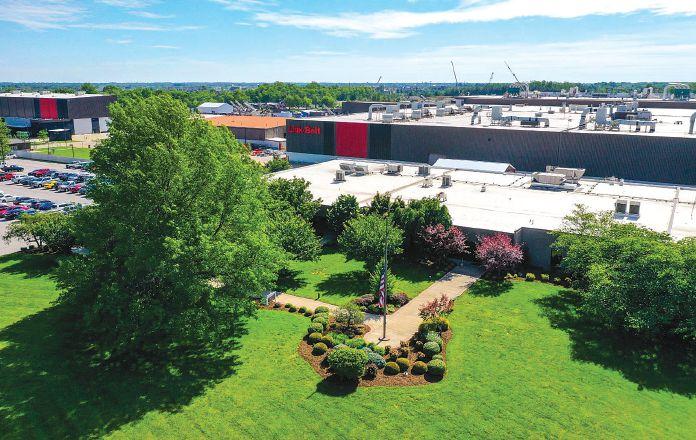
Sandy Hammonds, CFO and vice-president of finance for Link-Belt Cranes, was elected to Link-Belt Cranes’ Board of Directors during the January 2021 board meeting.
Melvin Porter, Link-Belt’s CEO and president, announced her appointment at Link-Belt Cranes headquarters in Lexington, Ky.
“Sandy is a dynamic, highly-focused leader committed to innovation and continuous improvement,” said Porter. “She is an invaluable asset as we implement strategies and goals for the future growth of Link-Belt.”
Hammonds began her Link-Belt career as a cost accountant in 1988 and progressed through all levels of accounting and finance departments. She holds a Bachelor of Science degree in accounting from the University of Kentucky, and a Master of Business Administration from Xavier University. Additionally, Hammonds maintains a Certified Public Accountant designation.
Konecranes president and CEO comments on first year in role
Konecranes President and CEO Rob Smith commented on his first year in the role saying Konecranes would continue to implement its strategic initiatives in 2021.
“It has been an exciting, eventful and rewarding year, but also very difficult for all of us. I’m immensely proud of what our team accomplished in the face of unprecedented adversity – overcoming lockdowns, separation, infection, illness and the passing of people close to us,” he said. “I want to warmly thank all employees, customers, business partners, shareholders and other stakeholders for your cooperation and commitment in such a challenging year.”
Continuing to implement its strategic initiatives in 2021 is important for the company.
“Our achievements have positioned us well for the future, and the journey of transforming Konecranes from a good company into a great one has only just begun,” Smith concluded.
Manitex repays debt
Manitex repaid two convertible notes that were due in December 2020 and January 2021, totalling $15.5 million. The company also paid off $2 million in European term debt associated with the PM subsidiary.
“Despite the very challenging operating environment, largely caused by the global COVID-19 pandemic, we have taken consistent actions throughout the year to align our production with forecasted demand, focus on cash generation, and improve our balance sheet,” said, Manitex Chief Financial Officer Joe Doolan. “We expect to enter 2021 with net debt of approximately $30 million, the lowest level for our company in nearly a decade, and global liquidity of approximately $30 million between our cash and credit lines.”
The notes, issued by Manitex in 2014 and 2015 to both Terex Corporation and MI Convert Holdings, funded various Manitex acquisitions and other strategic growth initiatives. Terex Corporation remains a significant investor in Manitex.
Thousands of construction jobs at risk if funds don’t flow, labour-management alliance warns
The Residential and Civil Construction Alliance of Ontario (RCCAO) is warning that construction jobs and the economic recovery of the province are at risk if the provincial and federal governments don’t collaborate on a Safe Restart Agreement 2.0 early on in 2021.
“This is a very urgent matter as failure to come up with a deal will result in massive job
losses, deteriorating infrastructure and stall any possibility of an economic recovery,” says RCCAO Board Chair Peter Smith. “Governments must once again work together to enable funds to flow and ensure that municipalities don’t have to raid their capital budgets to pay for COVID-19-related operating expenses.”
RCCAO made the points in a pre-budget document submitted to Finance Minister Peter Bethlenfalvy. RCCAO maintains that a second round of funding for 2021, or Safe Restart Agreement 2.0, is urgent as municipalities are again facing significant deficits this year due to COVID-19. The City of Toronto, for example, will have to use $800 million of capital funds to cover its 2021 deficit in the absence of a new deal.
If financial assistance is not made available soon, municipalities will have to cancel state-of-good-repair projects to keep their books balanced in 2021. This would have disastrous effects on the construction industry and economy.
Tenders for infrastructure projects have been on the decline since last summer and a report commissioned by RCCAO from Prism Economics and Analysis, titled Averting a Crisis: The Need to Protect Ontario’s Infrastructure Investments, found that 41,000 construction-related jobs are at risk if permits continue to decline.
“Investing in state-of-good-repair projects will help Ontario recover from the effects of COVID-19 as it will create jobs and spur economic growth,” says RCCAO Interim Executive Director Nadia Todorova. “We know that every dollar spent on infrastructure will have a positive multiplier spinoff effect on the economy. We are encouraging the Province of Ontario and the Government of Canada to once again work in partnership and provide financial assurances to municipalities.”
Sandy Hammonds’ appointment was announced at Link-Belt Cranes’ headquarters in Lexington, Ky. PHOTO: LINK-BELT
Konecranes President and CEO
Rob Smith.
PHOTO: KONECRANES
Manitex Chief Financial Officer Joe Doolan.
SALES, LEASES, PARTS & SERVICE
Offering a full line of equipment from the industries top manufacturers. Including Manitowoc, Grove and National Boom Trucks.
Western Pacific has the crane to get the job done.
Surrey, V4N 4G2 9538 195th St. (855) 342-7263 Kitimat, V8G 1K8 5035 Keith Ave. (778) 908-4566
Anchorage, AK
6720 Arctic Blvd (907) 331-4876
Bakersfield, CA 3521 Alken Street (661) 578-5854
Fontana, CA
8600 Calabash Ave (562) 286-6618
Tracy, CA 275 W Larch Road (209) 597-3824
Kapolei, HI 91-210 Kalaeloa Blvd (808) 682-7263
Portland, OR 8912 Northeast Vancouver Way (971) 202-4002
Arlington, WA 19602 60th Avenue Northeast (253) 254-7950
Ontario TRI-Lift now Bronto Skylift distributor
TRI-Lift is a new Canadian distributor for Bronto Skylift. TRI-Lift is a division of Ontario-based TRI-Crane and will be carrying out sales, service, spare parts and rentals of Bronto’s non-insulated aerial platforms.
Tri-Crane was founded by three partners, Jason Hanna, Mark Williams and Aaron Hanna, in March 2019. TRI-Lift was established in 2020. Williams is a TRI-Crane partner, Jason is the president of TRI-Crane and TRI-Lift, and Aaron is the vice-president of sales at TRI-Lift.
“When we got to know Bronto Skylift we did some background research and saw great potential in the Canadian market. We have good experiences of the European OEM’s. I know how Finns do business and really look forward to the co-operation,” said Williams.
TRI-Lift and Bronto Skylift were brought together by Jason Darnell, sales manager of Bronto Skylift, who knew the crew from his previous career. A statement from TRI-Lift said in addition to selling and renting the non-insulated models of Bronto Skylift aerial platforms, TRI-Lift will provide full maintenance and spare part services for Bronto aerials. A S230XR is already ordered and will be available for demonstration and rentals in March 2021.
All three founders have an extensive career in the lifting and rental industry. Williams is a third-generation family business owner and has grown into the industry from a young age; Jason has been in the industry from the late ‘80s and served as a crane operator and various managerial roles; Aaron brings 20 years of sales experience in the industry. Aaron also began his career in the industry as a crane operator.
Jason said the TRI-Lift crew enjoys working hands-on in the industry’s most difficult projects and going the extra mile.
“This is really exciting for us and we’re looking forward to making sure our custom-
ers have what they need as we become distributors of the Bronto lifts,” he said.
Jason said it is his passion to find a solution for even the most difficult projects that nobody else wants to do.
Being able to provide Bronto aerial platforms gives TRI-Lift the flexibility to cover multiple industries and complicated projects in the filming industry, the wind sector and other applications.
Current distributor, Hycotec Inc., will also continue to operate as a Bronto Skylift distributor in Canada.
A1A Software recognizes Level 3 Certificants of 3D Lift Plan
A1A Software LLC, congratulated six individuals who achieved Level 3 Certification of 3D Lift Plan in 2020. The company offers three levels of certification in order to verify a user’s product knowledge and proficiency of the lift planning program.
To achieve Level 3 Certification, users must pass knowledge and practical exams at each previous level.
“Level 3 users have demonstrated the ability to complete complex lift planning tasks. We commend these individuals for their achievement,” said Tawnia Weiss, president of A1A Software.
Examples of complex lift planning tasks include planning multi-crane lifts, creation of custom rigging or loads in the 3D environment, determining ground bearing pressure and selecting crane mats, uploading Google Earth images and creating lift plan videos.
A1A Software offers weekly online training for basic, intermediate and web tools users. Advanced training is available online by appointment and exams can be executed remotely.
“Depending on your role in your organization, there are benefits for achieving any level of certification. Level 1 and 2 users may be involved in sales or project management, while Level 3 users may be lift directors or lift planners, safety personnel, or engineers,” said Weiss.
2020 Level 3 3D Lift Plan Certified Users
• Jonathan Hoadley of Area Erectors Inc., Rockford, Ill.
• Jerry Davis of BNSF Logistics
• Caleb McKee of Erlinger Crane Service Inc., Lebanon, Ill.
• Dustin Rowe of Peterson Beckner Industries, Houston, Tex.
• Wafik Tadros of Peterson Beckner Industries, Houston, Tex.
• Mike Crouse of Vic’s Crane & Heavy Haul, Inc., Rosemount, Minn.
Skills Ontario supports Ontario’s Skills Development Fund to boost economic recovery
Minister of Labour Training and Skills Development Monte McNaughton announced the Skills Development Fund, a new opportunity for businesses, union leaders, and training providers to submit their ideas on how to relieve pandemic-induced barriers to hiring, training and retaining workers.
The Government of Ontario is dedicating $115 million to this fund and applications are now open. As an organization dedicated to building the province’s future skilled workforce, Skills Ontario applauds this initiative.
“As Minister McNaughton stated in today’s announcement: skilled workers are the backbone of our society,” says Ian Howcroft, CEO of Skills Ontario. “It is crucial to ensure that Ontarians are supported while they pursue their careers, and Skills Ontario applauds the inclusion of employers, apprenticeship training delivery agents, and more, in this project.”
“The pandemic has had an enormous impact on everyone, but particularly those who have lost work and employment opportunities. This new fund will help address this by offering assistance and support– it’s an important step on our road to economic recovery.”
Howcroft adds that the government is demonstrating leadership and innovation in a way that will help thousands of individuals move forward in their careers and make a meaningful contribution to the success of the province and to their own lives.
Applicants, including employers, apprenticeship training delivery agents, unions, post-secondary institutions, community organizations and others can submit proposals on the government of Ontario website until February 28, 2021.
Skills Ontario recognizes the Government of Ontario’s efforts to support skilled
Sample 3D Lift Plan submitted by Wafik Tadros of Peterson Beckner Industries for Level 3 Certification.
TRI-Lift and Bronto Skylift were brought together by Jason Darnell, sales manager of Bronto Skylift, who knew the crew from his previous career. IMAGE: BRONTO SKYLIFT
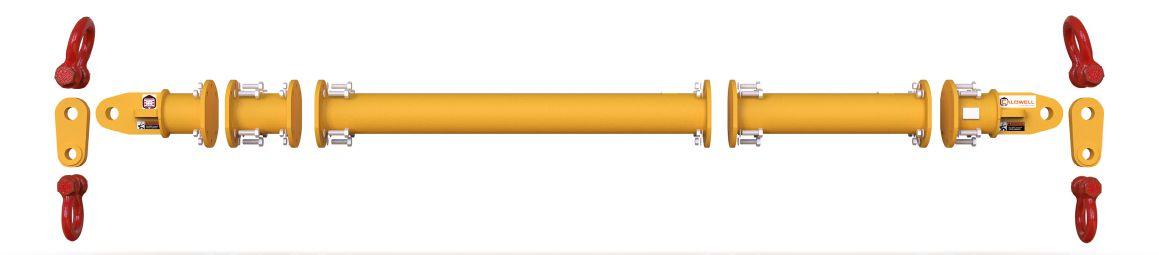
Dura-Mod Modular Spreader Beam
In an effort to add to our large range of below-the-hook lifting devices, Caldwell is proud to introduce the Dura-Mod Modular Spreader Beam. Our new product will come in a variety of sizes that allow the user to configure a spreader beam suitable for different projects and applications depending on the desired capacity and spread.
Lightweight in comparison to fixed/multiple point beams.
Easy to transport & store; single longest component is only 20’!
Two end units, drop links, and spreader sections make it fully customizable.
Distributors are able to keep them stocked, offering customers quick ship access to certified spreaders.
World-renowned Caldwell brand name on a modular spreader system.
Components can be added and bought separately; take what you need now, add later!
Dura-Mod can be used with corner fittings to create box and rectangular configurations
All of the Dura-Mod spreaders conform to ASME B30.20, BTH-1, DESIGN CATEGORY B, CLASS 0.
For additional Dura-Mod information, contact Caldwell or scan the QR code!
professionals and looks forward to working together to continue to provide learning opportunities and build a strong and robust skilled workforce.
MCWP becomes fourth sustaining member of IPAF
The International Powered Access Federation (IPAF) welcomed Alimak Group, the global mast-climbing work platform (MCWP) and construction hoist (passenger, goods, transport platforms) manufacturer, as its fourth Sustaining Member.
With headquarters located in Stockholm, Sweden, and no fewer than 26 subsidiary companies and a presence in more than 20 countries worldwide, including Canada, all of the Alimak Group are now members of IPAF following discussions and an agreement to sign up to the Sustaining Member category during 2020. Alimak Group joins Haulotte, APEX and Henderson Insurance Brokers, part of AON Group, as Sustaining Members of the federation.
“Alimak has long been a very active member supporting IPAF in the development of training courses and safety campaigns, especially from the UK branch, as well as being members of the MCWP, lift & hoist dedicated work group,” said Angel Ibañez, IPAF’s global representative for MCWPs and related products.”
“In the past five years, IPAF has intensified its activity in the realm of MCWPs and hoists and has expanded its involvement in developing training and standards for the sector, so to have Alimak Group on board as a sustaining member will be excellent as it will allow us to tap into the company’s expertise and global presence to help promote quality training and safety best practice regarding MCWPs and hoists worldwide.”
Sustaining Member is a relatively new category of IPAF membership designed to recognise and sustain IPAF’s strategic initiatives and overall contribution to improving safety and productivity in powered access worldwide.
“The past year has shown us how important it is to work together for the collective benefit of our industry, and the value that IPAF can offer as a key point of reference for vital safety and technical advice, advocacy when developing new standards or dealing with government bodies, and offering business intelligence to our members and the wider industry,” said Peter Douglas, CEO and MD of IPAF.
“IPAF would of course not exist without our members and we could not progress our strategic objectives without them, including improving global incident reporting and developing our training programme and safety and technical materials in response to what accident data is telling us. We are very grateful that Alimak Group has decided to join Haulotte, APEX and Henderson Insurance in recognising this and committing to sustaining the work we do now and in the future.”
Crosby Group launches Global Vaccine Support Program
The COVID-19 vaccine is becoming more available to the public and The Crosby Group launched its Vaccine Support Program to help its team members have an easier time being vaccinated.
The new program provides all employees across the globe with four additional hours of sick leave, paid time off, or equivalent, to offset any work time missed after completion of the COVID-19 vaccine.
“Since the beginning of the pandemic we’ve focused on the safety and wellbeing of our team members,” said Robert Desel, CEO of The Crosby Group. “We put guidelines in place such as temperature checks at the door, social distancing, and a lot of other initiatives to keep the team safe so this new program is really just an extension of all of the other new policies.
“It’s the logical thing to do right now because we still view COVID-19 as a very significant health and safety risk,” said Desel.
Local site leadership will also work with team members to accommodate and support individuals experiencing post-vaccine side-effects that may impact their ability to safely come to work.
“Safety is core to who we are, and we don’t want our employees choosing between getting the vaccine and earning a full paycheck. Our Vaccine Support Program removes that barrier and supports our team of essential workers,” he said.
The Crosby Group is headquartered in Richardson, Texas, with approximately 30 sites globally including factories in Tulsa, Oklahoma, Longview, Texas and several countries in Europe. At the onset of the pandemic, The Crosby Group formed a Pandemic Safety Council with internal leadership and outside medical experts to monitor and advise on best practices.
This led to a multifaceted safety program to stop the spread of COVID-19 including a work from home initiative, travel restrictions and guidelines, site health screening procedures, social distancing policies, increased cleaning protocols, virtual customer support and training, modified and flexible work schedules, and other mitigation measures consistent with the guidelines provided by the Centers for Disease Control and Prevention (CDC) and World Health Organization (WHO).
The Crosby Group CEO told Crane & Hoist Canada magazine it learned where the vaccine centres were in relation to its plants, average wait times to receive the vaccine, and that immunization takes two doses of the vaccine before determining how much extra time off to include in its program.
“We decided on four extra hours by determining it may take an individual roughly two hours per shot considering wait times, travel and potential recovery. If it takes longer, then obviously in the spirit of the program we would make adjustments. But this seemed appropriate.”
Desel said he believes The Crosby Group is one of the first in the rigging and lifting sector to implement an initiative such as its Global Vaccine Support Program and so far has received a lot of positive feedback regarding it.
“Feedback from team members has been very positive,” he said. “It was received as very consistent with our values and everything we have done regarding COVID-19 from March up until now.”
The Crosby Group manufactures lifting, rigging, and load securement hardware and employs roughly 1,500 people.
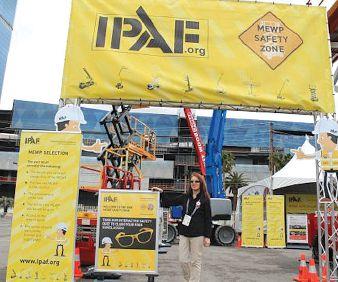
Faith Cobaine, IPAF marketing and membership manager at the IPAF booth at CONEXPO/CON-AGG. PHOTO: JAY KOBLUN
Robert Desel, CEO of The Crosby Group. SUBMITTED PHOTO
Retired Crane Inspector Gina Cody joins Order of Canada
Gina Cody, a building scientist and namesake of Concordia University’s Gina Cody School of Engineer and Computer Science, was appointed to the Order of Canada. Cody, a retired engineering executive and crane inspector, also received the Canadian Standards Association’s Award of Merit and the Order of Honour from the Professional Engineers of Ontario.
Cody’s announcement, along with 60 other companions, officers and members, was made on Dec. 30 by Governor General Julie Payette. The Order of Canada is one of the country’s highest civilian honours.
She was cited “for her long-standing career as an engineer and business leader, and for being a trailblazer for women in the field”. She was the first woman to earn a PhD in building engineering from Concordia University; in 2010 she was named one of Canada’s top women entrepreneurs; and she was ranked as a top 25 Women of Influence in 2020.
As of January 2020, more than 7,000 people have been appointed to the Order of Canada.
Cody’s career in the public sector began with performing crane inspections for the consulting engineering firm, Construction Control Group—the was the first woman to take on the role—and culminated as CCG Groups president and principal shareholder. After her retirement in 2016, the firm merged with McIntosh Perry Consulting Engineers.
The Order of Canada is the highest honour bestowed to civilian citizens and recognizes exemplary contributions that enrich the lives of others and make a difference to the country.
A LONG WAY TOGETHER
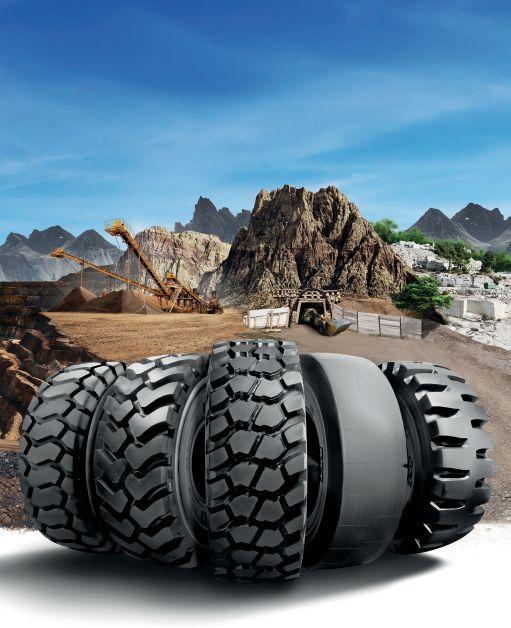
WHEREVER YOU ARE, BKT IS WITH YOU
No matter how challenging your needs, BKT is with you offering a wide range of OTR tires specifically designed for the toughest operating conditions: from mining to construction sites. Sturdy and resistant, reliable and safe, able to combine comfort and high performance.
BKT is with you, even when work gets tough.
Gina Cody was the first woman to earn a PhD in building engineering from Concordia University; in 2010 she was named one of Canada’s top women entrepreneurs; and she was ranked as a top 25 Women of Influence in 2020.
For info: Western Canada 604-701-9098 Eastern Canada 514-792-9220
Gina Cody was appointed to the Order of Canada in January.
U of T survey to help lifting industry prepare for future pandemics
Collecting best
practices
on how to better manage
and
deal with future pandemics in the construction sector By
Jay Koblun
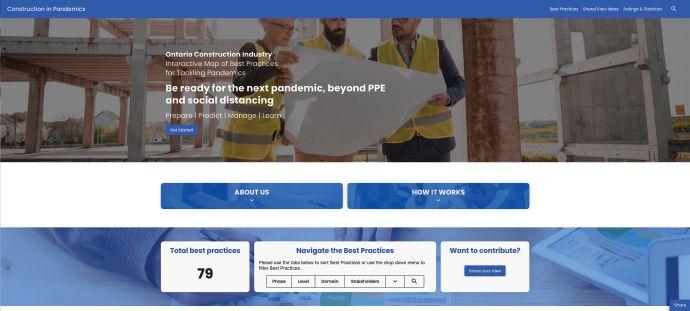
COVID-19 is not the first, nor will it be the last pandemic the world will see. The question being asked by the Canadian government now is, what steps can the construction industry take to address future pandemics?
A research team from the University of Toronto was approved for funding in 2020 to conduct a survey for the Canadian construction industry seeking to address future pandemics in construction.
The survey was developed by a team of researchers at the University of Toronto with full engagement and support from OSPE (Ontario Society of Professional Engineers), RESCON (Residential Construction Council of Ontario), and RCCAO (Residential Construction Council of Ontario).
Professor Tamer El-Diraby at U of T is the lead researcher on the project.
“The government noted two things when the pandemic hit. COVID-19 will not be the world’s last pandemic, it’s actually the third in about 15 years, and second, the government is interested in research that would go into increasing resiliency against COVID. OSPE, RESCON, and RCCAO applied together to create a survey that would help the construction industry be better prepared for whichever global pandemic comes next.”
Initial thoughts for the survey began in April of last year and the organizations involved received funding in June.
“The plan is not to tell the industry what to do, we want to let the industry tell us what they learned in the last year,” said El-Diraby. “First, there is no playbook for a pandemic that will work for everyone and every company. Second, we also don’t want this to just be an academic exercise that. And finally, we want this to be very informative work.”
El-Diraby said he and his team are trying to encourage the industry to generate those lessons and to use those lessons to benchmark them against other industries and best practices, especially manufacturing.
“We want to see if we can transfer these findings from just being a research paper or survey into a policy the government can use. How many times has the country experi-
enced a crisis and we say we need to learn something from it but nothing happened?”
Benefits of a survey
El-Diraby said a survey is ideal because the team is not looking to tell the industry what to do but to listen to them.
“This is an unprecedented field with research that cannot be learned in a lab. These are people who faced the challenges of COVID-19 and have a lot to say. We want to capture this for the future use of other people and help the industry establish a plan.”
The survey was opened in November of last year and will be made available until June, 2021.
The survey
The researcher said the survey is not asking about health and safety, PPE, masking concerns or social distancing.
“We are aware that masking and social distancing is ultra-important, and the most assured way to save lives during the pandemic. By not including this in the survey we are not diminishing its importance. What we are saying is it is the local health authorities who have the resources, means, knowledge, and authority to implement those specific guides. We are complimenting those policies with a guide with what has not yet bene addressed.
“Having the proper PPE is important but making sure construction does not stop is another.”
Who should participate
El-Diraby said he is looking for everyone
involved in the industry to participate but particularly those on executive teams. Managers who play a role I the survival of the industry.
“We are looking for those who have knowledge in the resiliency of the industry who can answer the questions ‘How can we ensure projects continue?’, ‘How can we control costs?’, and ‘How can we make sure people working in the industry are not going to lose their jobs?’
“We want to create a system where owners, contractors, and consultant work together to save a project and make changes to ensure projects stay within cost and under expected timelines.”
Industry support
OSPE, RESCON, and RCCAO help with three things: help the researchers to reach out to industry experts and get the participate in the survey, give valuable background information on available resources and practices already in place, and help guide the team into evaluation the results of the survey and the means to make it implementable.
“The main concerned right now is we need more participation,” said El-Diraby. “We are not simply looking for positive feedback, we want to listen to everyone. Hopefully word gets around and others are invited to participate. Everybody’s experience is valuable and can help someone or someone’s company in the future.”
A link to the survey can be found at research.net/r/constructioninpandemics and the research website at, constructioninpandemics.ca/our-guides.
MI-JACK CANADA offers unsurpassed customer support, led by the best Factory Trained Service Technicians, the most knowledgeable Parts Professionals, all backed by North America’s leading equipment group. As a part of the Lanco Equipment Group, along with Walter Payton Power Equipment and Western Pacific Crane & Equipment, we are now part of the World’s Largest Manitowoc Dealer group.
MI-JACK CANADA stocks Manitowoc and Grove cranes and is part of North America’s largest parts inventory, on-hand and ready to ship.
New and Used sales along with Rental Purchase options, MI-JACK CANADA is your source for Immediate Availability on the full line of Manitowoc and Grove cranes.
Your Authorized Distributor in Alberta and Saskatchewan for Manitowoc and Grove Sales, Parts and Service.
Tadano ATF 200G-5 hits the mark in British Columbia
Armstrong Crane & Rigging Inc. takes pride in its family values, quality operators and customer service.
“Family translates into work ethic,” says Greg Nachtegaele, whose father, Dave, started the business in 1992 in the Okanagan region in British Columbia with a 50-ton truck crane. Greg adds, “Our customers are treated like family, and they know we are reliable. They see the pride we take in our service and equipment, and they appreciate the planning and detail that goes into each job.”
With demand for larger and more complex projects growing in their service region, Armstrong Crane & Rigging determined they needed a crane in its fleet that would position them as competitive bidders for these higher-capacity jobs.
“It seemed like our clientele always asked about something a little bit further, a little bit bigger. Things like bigger precast panel installation and tower crane erection,” says Greg.
The Nachtegaeles knew they needed a crane that was reliable and that would bring new lifting opportunities to catalyze the growth of their business. Dave and Greg put their trust into a Tadano ATF 200G-5.
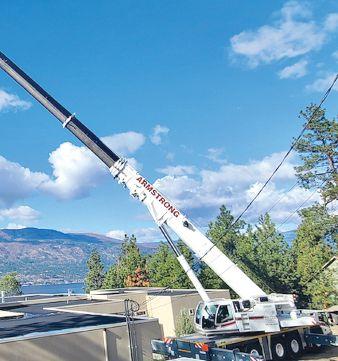
This new 220-ton capacity Tadano all-terrain crane with its 197-foot boom and integrated heavy lift jib was put to work on cell towers, roads, and bridges. “Where we used to have to subcontract some larger lifts, now that business will stay in-house,” says Greg.
Armstrong Crane & Rigging has owned an 18-ton Tadano boom truck for years and said it appreciated the quality of service received from Tadano’s office in Leduc, Alta.
That trust in Tadano helped lead to the purchase of the industry-leading ATF 200G-5. The team at Armstrong Crane & Rigging said the 220-ton machine is easy to operate.
Armstrong Crane & Rigging said it likes the cranes drivability, the lift adjuster feature, and how effective the Intarder
“Our customers are treated like family, and they know we are reliable. They see the pride we take in our service and equipment, and they appreciate the planning and detail that goes into each job.”
feature performs on the steep winding roads of the Okanagan Valley. A custom-built Transworld three-axle dolly has also helped achieve the ideal axle weights needed for customers in British Columbia.
“Our operators really like how intuitive the AML-F Crane Control System is. The machine has a great feel,” says Greg. He said he is also pleased with the flexibility of the crane, which can be run with multiple effective setups.
Location: San Antonio, Tex. www.craneandhoistcanada.com/ events/scra-annual-conference-2/
PHOTO: ARMSTRONG CRANE & RIGGING INC.
Five predictions for an unpredictable 2021
By Paul Wilson, Senior Director Commercial Development of AEM’s member company
ZTR Industrial
What’s in store for the construction industry? How will OEMs and rental companies adapt to better serve their customers? How are customer needs changing? And in the face of a global pandemic –what does recovery look like? The even bigger question? Who will emerge stronger and how will they do it? Leading global telematics provider ZTR knows connectivity and technology adoption will play a key role. No one predicted the onset of COVID-19 and the degree to which the pandemic would impact the industry. But in many ways, it catapulted us forward. Here’s what we predict for 2021:
1.
Touchless services will dramatically increase The need to adapt and stay connected will be more readily accepted and expected. The COVID environment may persist well into 2022 and the demand for touchless functionality and associated solutions will become more widespread. More data will flow as a result of expanded services including:
• Remote diagnostics
• Remote control
• Automated monitoring
• Enhanced predictive and remote maintenance
• More intuitive and context-driven user interfaces
Businesses that have already invested in remote connectivity enabled by telematics will emerge from the pandemic even stronger. Those who haven’t invested are going to need to catch up in 2021 and be ready for a different operating future.
2.
OEMS will shift from selling technology to unlocking and providing valuable services Many OEMs understand the importance of technology how that translates to the addition of valuable services for the life of the equipment. Some OEMs are starting to recognize there’s a gap in the technology space that they need to fill. They’ll move beyond the technology sale to capitalize on the greater opportunity for long-term revenue. By leveraging telematics and the power of connection, they’ll provide improved machine design, greater safety, new services and expanded customer support that they couldn’t previously offer.
Enhanced machine data and machine control is driving the future of the industrial IoT.
Paul Wilson. PHOTO: AEM
PHOTO: ANDRESR/ E+ /GETTY IMAGES
3.
Data brokerage, partnerships and APIS will rule Businesses that embrace the power of data sharing will achieve greater maturity in their digital evolution –knowing that by doing so, everyone wins. There is a growing need for simplicity, which is possible only if implementation and integration are unlocked. Increased access to rich data insights is inevitable, and the complexity will demand a simple approach. It will be necessary for businesses to act pragmatically to serve their customers. When the industry works together, effectively combining their individual OEM, rental and general contractor strengths into a collective purpose, data sharing becomes a key model of what it means to operate stronger together.
4.
Sustainability will become a crucial trend
As we continue to use up more the world’s resources, recognizing our own inefficiencies and identifying ways we can operate with greater efficacy will become a central focus and tenet upon which many companies will operate. Businesses need to embrace a global perception versus a regional one and create sustainable products that in turn will generate revenue with sustainable services.
Data insights enable proactive equipment maintenance, fleet health monitoring and smarter machine designs. Companies will be looking to leverage telematics to reduce machine idling, better allocate resources, manage transport and service logistics and measure in-field performance data to meet elevated standards.
Only the strong will survive
5.
Established companies are moving up the digital maturity curve and face the threat of disruption from innovations offered by smaller technology companies and startups. Mature companies will need to have a team devoted to the new and innovative to stay relevant. Successful businesses will elevate the adoption of their digital strategy and re-evaluate their future technology requirements and the need for a strong provider/partner. Choosing a trusted and capable telematics partner – one that demonstrates both expertise and vision will be crucial. Telematics providers who are investing in the future will prove their value through seamless, efficient and targeted IoT innovations that help transform their customers’ business.
What it all means
Technology users in construction environments will see it is no longer enough to focus solely on the basics (run hours and location). Enhanced machine data and machine control is driving the future of the industrial IoT. The telematics industry is going beyond simple monitoring and moving faster toward configuration and control, not only to understand what’s happening but to control it, predict it and serve customers with remote or hands-off protocols. Those who emerge stronger will do so by recognizing that the importance of technology isn’t just about a tangible product or device, it’s what you do with it that sets you apart. Paul Wilson is the Senior Director of
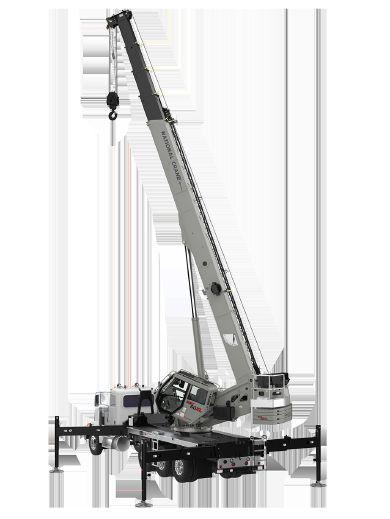
• Capacity: 60 USt (54.5 t) rating
• Main boom: 151 ft (46 m) five-section
• Max tip height main boom: 196 ft (59.7 m)
• Optional 36 ft (11 m) fixed offsettable lattice jib: 0, 15 or 30 degrees
• Operator focused design
• Available NTC Performance package
• Operator focused design
The NBT60XL provides the best possible capacity and reach combination of any 60 ton crane on the market – boom truck or truck crane – all while maintaining easy to road characteristics.
The NBT60XL provides the best possible capacity and reach combination of any 60 ton crane on the market – boom truck or truck crane – all while maintaining easy to road characteristics.
DELIVERIES AND EQUIPMENT
Updated rope pull technology for Liebherr LTC 1050-3.1 compact crane
Liebherr developed another option for its LTC 1050-3.1 compact crane. Crane contractors will have the choice between the existing 36-metre telescopic boom with the TELEMATIK fast cycle telescoping system and a new 31-metre boom featuring rope extension technology. The first machines with the new telescopic boom will be delivered in the second half of 2021.
This lightweight single-cylinder extension system delivers high lifting capacities with long booms and large radii. But even with the booms not fully extended, TELEMATIK delivers high lifting capacities as the individual telescoping sections can be extended in any sequence and independently of each other.
As a result of its many benefits, Liebherr used TELEMATIK on the LTC 1045-3.1, which was launched in 2010, and its successor, the LTC 1050-3.1, which replaced it as from 2015.
Boom with rope extension mechanism
Crane contractors who chiefly use the Liebherr compact crane inside buildings and mostly do not need the full length of the 36-metre telescopic boom see also benefits of a boom with rope pull technology. Liebherr says the telescoping process is faster and many operators of mobile cranes in the lifting capacity class up to 50 tonnes are familiar with rope pull technology.
Liebherr uses a hydro-mechanical telescoping system on LTM mobile cranes whose telescopic boom consists of the pivot section and a maximum of three telescoping sections. The integral rope pull technology enables the telescopic
boom to be extended to the required length particularly easily and quickly.
Liebherr decided to develop a boom with a rope extension mechanism as an alternative for the LTC 1050-3.1. This is 31 metres long and consists of a pivot section and 4 telescoping sections – one less than the TELEMATIK boom.
The telescoping sections are extended and retracted using a dual-action 2-stage hydraulic cylinder. Stage 1 extends telescoping section 1. Stage 2 extends telescoping sections 2 to 4 synchronously using a 2-way pulley block. The new boom also delivers high telescoping lifting capacities, an important feature for use inside buildings.
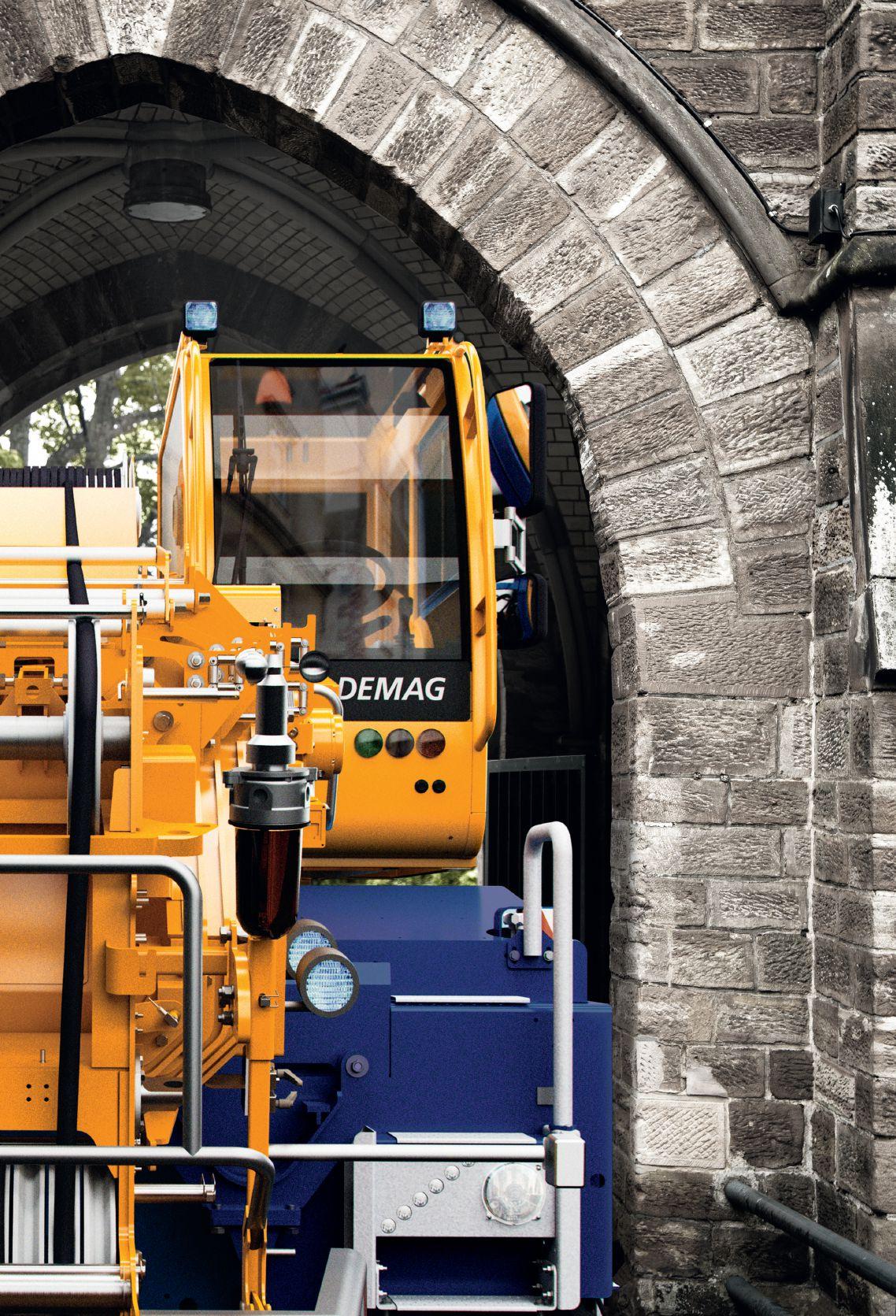
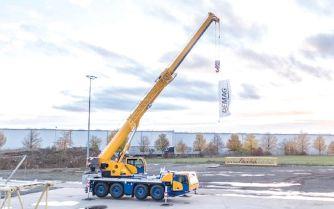
Demag added the AC 80-4 to its product portfolio. The new crane features a main boom that is 60 metres long.
All Demag all-terrain cranes are characterized by a compact design, and the new AC 80-4 is no exception. Its total length is 12.15 metres, the carrier length is 10.60 metres, its height does not exceed 3.85 metres, and the front overhang is 1.49 metres.
The AC 80-4 is equipped with a Mercedes-Benz engine for efficient travel and operation. It outputs a maximum power of 340 kW and delivers a maximum torque of 2,200 Nm. The state-of-the-art diesel engine conforms to EU Stage V and Tier 4 Final emission requirements and can be downgraded to meet ECE-R96 regulation
A Mercedes-Benz G230-12 transmission, together with a drivetrain from the same manufacturer, is in charge of transmitting the engine’s power to the road.
Other features
Once at the worksite, the new Demag Surround View makes it easier for crane operators to position the AC 80-4. This patented system uses the four crane cameras to show a computer-assisted diagram of the possible outreach of the outriggers,
as well as the counterweight tailswing radius at the crane’s current location.
The AC 80-4 also comes with the innovative Demag IC-1 Plus control system.
In addition to the IC-1 Plus control system, the crane is available with the IC-1 Remote telematics solution, which makes it possible to remotely read and diagnose important crane data and enables owners to integrate the AC 80-4 into their fleet management system.
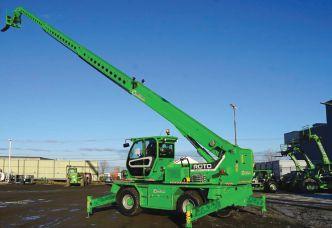
Manulift is introducing the Roto 70.24 S Plus to the Canadian market for the first time.
“We’re very excited to add the Roto 70.24 S Plus to our fleet. With a 7-ton load capacity, it’s definitely powerful, but more so it reflects the pure impressive R&D efforts at Merlo, which delivers unequal productivity, precision and safety,” said Martin Drolet, president at Manulift.
Boasting enhanced performance and lifting power, the 70.24 S Plus offers the industrial and construction markets a new high-end telehandler to complement their current product offerings in the Canadian market.
The new Roto provides a high maximum load capacity of 15, 430 pounds and 79 feet boom height to help tackle projects in all terrains and conditions.
The 70.24 S Plus offers a powerful FPT NEF45 engine with 170 HP and a maximum speed of 40 kilometres per hour and stands as one of Merlo’s most powerful units in Canada.
Merlo’s Roto Range allows the machine to rotate a full 360 degrees without having to reposition the unit. It also features a 20-degree tilt cab designed to give the operator a continuous view of the boom and its load.
The Advanced Safety System displays the telehandler’s parameters in real-time, including the stabilizer position, boom extension angle, turret position, carriage rotation, load position and weight.
Manulift adds Merlo Roto 70.24 S Plus
New AC 80-4 all terrain crane from Demag
FOCUS30 crane completes testing phase
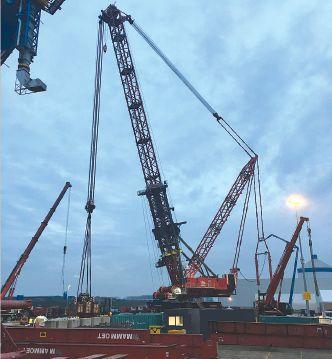
Mammoet’s crane for confined spaces, the FOCUS30, has completed all its required testing and is now ready to be moved to its first project. The crane undertook a series of controlled tests to certify its strength and safety.
Mammoet says the FOCUS30 will enhance construction projects in oil refineries and cities where stronger regulation and a growing population means lifts are surrounded by live plant, buildings and people. Its low ground bearing pressure helps to protect underfoot infrastructure such as tunnels and cabling and reduce disturbing the land prior to lifts.
Testing of the FOCUS30 took place in two phases, under the eye of Lloyd’s Register, an independent 3rd party surveyor who worked alongside Mammoet during the design of the FOCUS30. First, the crane was assembled in its SFSL fixed jib configuration and subjected to 125 per cent of its maximum recommended load.
Next, the crane was re-assembled, this time to its SSL configuration, with a 90-metre boom but no jib, and again loaded with 1,250 tons. Testing of the crane in its SFSL configuration lasted for approximately one week, while testing in its SSL configuration lasted for three days in total.
Sideload, swing load and maximum radius testing was performed during both phases, while the crane’s international crew looked on. Repositioning of its superlift between tests took just two hours each time, rather than one to two days.
Following completion on both phases, the crane is now fully compliant with the EN 13000 standard for mobile cranes, and with F.E.M. 5.004, which governs the design of steel structures of general use. The crane will now be disassembled, ready for mobil-
ization to its first active project, taking place in the UK. Mammoet has produced a 360-degree virtual tour of the crane.
Insulated Z-45 Boom Lift from Terex Utilities
Terex Utilities announced its new Genie Z-45 Substation Utility Boom (SUB). The Z-45 SUB is a mobile elevated work platform (MEWP). It is designed for substation work and other applications where an insulated device is needed but the use of traditional bucket trucks is prohibitive due to size and manoeuvrability.
“The Z-45 SUB’s features isolate the boom tip from the chassis ground, which eliminates the need to perform boom tip grounding,” said Joe Caywood, director of marketing. “The concept for the Z-45 SUB was first shared with customers in late 2017 and early 2018. The final product is the result of collaboration with substation operations and engineering teams and is the only insulated aerial device of this kind currently available on the market.”
Featuring a fibreglass jib section and fibreglass platform with a swing gate, the Z-45 SUB complies with ANSI A92.2 standard for Category E insulating rating of 20 kV, as measured between the boom tip and the chassis. The standard fibreglass platform comes with floor grating and optional cutouts for increased visibility, access and water egress.
The Z-45 SUB has zero tail-swing and 355-degree rotation in tight quarters, self-propelled control, and up-and-over capability of the boom to give utility workers greater positioning flexibility. Operators can precisely position the boom with fully proportional drive and boom functions. Lift Guard Contact Alarm provides a secondary warning designed to reduce crushing hazards. If an operator is caught between the controls and another object, a breakaway cable activates to disable the lift and drive functions and trigger visual and audible alarms.
Based on the Genie Z-45 XC, the articulating boom has a maximum platform height of 45’6” and a horizontal reach of
24’9”. Continuously monitored load sensing enables dual work zones with a capacity of 660 lbs. at maximum outreach or 1,000 pounds. in the maximum capacity zone. If the platform is overloaded, all lift and drive functions are interrupted, and the engine will shut down. Function is restored by removing the excess load.
Enhanced cab on Grove three-axle all-terrain cranes from Manitowoc
With the introduction of Manitowoc’s new carrier cabin, cab2020, Grove has updated its comfort and ergonomics for crane operators. The new cab2020 is now available on all Grove three-axle all-terrain cranes, the GMK3050-3, GMK3060-2 and GMK3060L-1.
The Company says space inside the updated cab is used more efficiently. The layout offers plenty of room for the cab’s controls, which are clearly arranged. The crane control system display is positioned slightly higher to ensure it is within the operator’s sight and reach.
Instead of building on previous carrier cabs, the cab2020 designers established a new concept based on close involvement of end-users and customers. Initially, Grove asked users about their personal requirements for a driver’s cab, including their priorities and preferences when driving to the job site. The result of this study led to a prototype model of the cab2020, which was shown on the Manitowoc booth at bauma 2019 in Munich.
The all-terrain product management team from Wilhelmshaven gathered further first-hand opinions from bauma visitors. Grove took all feedback into account when refining the design.
“It was important for us to retain what was deemed as perfect and tried and tested by crane operators. But by adding the extra bits and pieces, we have achieved real improvements in design and function, which resulted in our new cab2020 becoming the new carrier cab for the smaller range of our Grove all-terrain cranes,” said Andreas Cremer, vice president product management mobile cranes at Manitowoc.
PHOTO: MAMMOET
PHOTO: TEREX UTILITIES
Spotlight on Prairie Crane rental company
Saskatchewan family-owned business puts push on JVs and a balanced, diverse workforce
By Jay Koblun
When Prairie Crane was started in 2004, the Saskatoon-based rental company had only a few pieces of equipment. Fast-forward to 2021 and the family-owned company now has 14 cranes and serves Manitoba, Saskatchewan, and Alberta.
“It’s a pipe dream of mine to one day also serve B.C.,” says Matthew Hnatuk, general manager at Prairie Crane. Hnatuk owns part of the company along with Don and Kathy Hnatuk, his parents, and his sister Stephanie. Matthew has been with Prairie Crane now for 15 years.
“I didn’t necessarily plan on being a part of the family business. I planned on being a heavy-duty mechanic. After I was working in that trade for about three months I was given the chance to go out and work with a crane, get in the seat of it, and I just fell in love with it and switched my trade over to crane and hoist. That’s how my journey began at Prairie Crane.”
He began his career at Prairie Crane by working in the shop, rigging for cranes, and learning the equipment; he eventually managed his first projects at the Kerrobert gas plants following the receival of his Proficiency Crane Operator Ticket in 2012.
Matthew’s leadership skills have developed by working on a wide range of jobs and equipment, as well as being involved with organizations such as the Saskatchewan Apprenticeship Board. He has worked on a variety of projects from residential and commercial construction to more complex projects such as: train derailments, short span bridges, Saskatoon North Commuter and Traffic Bridge Projects, the shaft sinking and largest camp build in Saskatchewan at BHP Jansen, the PCS Allan headframe upgrade, North Battleford Energy Centre, underground crane assemblies at PCS Cory and Mosaic Colonsay, Cargill canola oil expansions and more.
“I love the different challenges being in the crane rental industry presents itself,” Hnatuk says. “Always something new. I don’t come to work every day having the same routine or schedule.”
He says sometimes you have to be creative with how he and his team work around barriers and challenges.
“I enjoy working through all these challenges with my team. My sister is Prairie Cranes operations manager and she and I work closely on different projects and jobs. Sometimes you think or hear ‘Oh you’re working with a 500-ton crane that must be really challenging and difficult.’ Well it can be but it can be just as difficult dealing with a 15-ton smaller crane job where you have to try and figure out how to get it underground in a potash mine for example, or perform different types of lifts like a tandem. So, I love how jobs can be challenging and different even from the smallest crane you own to the largest machine in your fleet.”
Hnatuk said about a year and a half ago Prairie Crane was asked to perform demolition on a coal shoot that was built around 1930 at a power station here in Saskatoon.
“No one knew the weights, no one knew anything about the drawings because they were so ancient. On that project we came
Matthew Hnatuk, general manager at Prairie Crane.
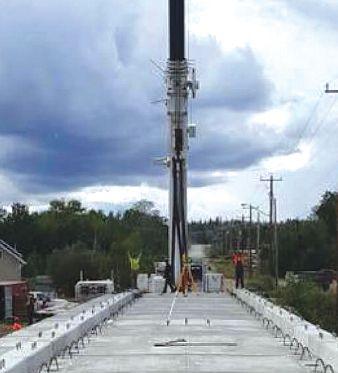
Prairie Crane’s expertise was put to work with assisting in the Brandon Bridge Project. Hoisting massive girders took precision and skill, neither of which Prairie Crane lacks. This project went off without a hitch in terms of efficiency and safety.
Stephanie Hnatuk, operations manager at Prairie Crane
in with myself, Stephanie the operations manager, another supervisor and also some of our engineers. We went through the building foot by foot, figured how much everything weighed and came up with a plan for which cranes we were going to use and where to position them. We lifted out all the galleries and old trusses and roof of the building and took it apart pretty much piece by piece. It was a great example of what we offer and how we can all work together.”
The team
Hnatuk said in a busy season Prairie Crane has had up to 65 staff. His parents are president of the company and one day he and his sister will eventually run it.
“We have staff that aren’t family members, but management and ownership is all family-run. I think one of the biggest benefits to working with family is you don’t hold back on pushing each other forward, or telling each other when you’re wrong or need to correct something,” said Hnatuk. “Not that we don’t also push our regular staff forward, but with family there’s no filter. Less formal. Make decisions a little quicker as we are around one another a lot more than other families may be.”
Hnatuk joked and said sometimes what makes working with family great can also add to some of the frustrations.
“I’d say a downfall to working with so much family can also be the no filter,” he laughed. “It’s the same thing. Sometimes you can very much get in a heated conversation at work where things not work related might get pulled into it. That can be a bit of a struggle sometimes. Sometimes too you end up spending so much time together, but it’s a good system.”
The company
Prairie Crane also has a heavy-duty division – NCCHD. NCCHD is a 24/7 shop specializing in crane and heavy-duty repairs with four full time mechanics on staff. NCCHD is also able to enter mine sites throughout the province and has an ‘A’ rating on ISNetworld.
The company is qualified to enter all job sites, including mine sites throughout the province. It has a full Health and Safety Program, is COR Certified, and fulfills all third-party requirements such as an ‘A’ rating on ISNetworld.
Prairie Crane also has approximately a 20 per cent Indigenous and 50 per cent female workforce; ensuring a wide range
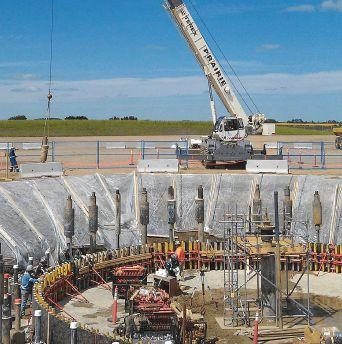
One of the worlds most advanced potash projects is located at Jansen, Sask. Prairie Crane was fortunate to assemble the large camp on site and to assist in the sinking of both shafts during the earlier stages of construction as well as the full assembly of the freeze plant and winch houses.
SUBMITTED PHOTO
of diversity within the company. Prairie Crane is also joint ventured with a 100 per cent Indigenous-owned company, Iron Buffalo. Prairie Crane also donates to charities within the province such as the Jim Pattison Children’s Hospital, the Saskatchewan Kinsmen Club, B’nai Brith Lodge 739, as well as supplying services to groups such as Habitat for Humanity.
“Our joint venture (JV) is with Iron Buffalo, a small construction company located in Regina who has been around for about two years. We got together with the owner Brendan Morin and looked at some projects of his and said ‘We can definitely work together and support you.’ We’ve done about three projects together. Iron Buffalo does a lot of asbestos reclamation, scaffold-
ing and dirt work. We partner up on projects together and we support each other.
“Indigenous communities kind of have a raw deal especially here in the North. And there’s a lot of them that have been frowned upon because they’re Indigenous so it’s important for us to continue these types of JVs and work together. We saw Iron Buffalo is very heavily involved in the community and helping people with Indigenous backgrounds get more work and we want to be a part of that same mindset. Help people grow and help our province and country grow.”
Hnatuk says he can’t speak for the country as a whole but sees Saskatchewan as having been doing a good job at getting more involved with promoting Indigenous-owned work in construction. “There’s a big push from the government. Is it perfect? Definitely not but it seems that the province is headed in the right direction.”
A balanced workforce
Hnatuk said there is only benefits to making diversification in the workplace a priority.
“Look at the world right now, what countries are doing the best—the ones run by females,” he said. “I think it’s a very good idea to have diversification in a balanced work force because females and males look at things differently and they always have. We look at projects differently and each see things we the other doesn’t.”
He says it helps to keep a better norm in the office and field.
“We have female crane operators as well and it has been stated and seen first-hand that females tend to be gentler on controls. They run machines with a nicer finesse. They don’t get as rammy, and they don’t get as impatient.”
Don Hnatuk, president at Prairie Crane
Kathy Hnatuk, president at Prairie Crane
First Nation artists feature artwork on tower crane climbing systems
Creating opportunities for local community members is one of the goals of the Workforce Development and Participation Strategy (WDPS) of the Gordie Howe International Bridge.
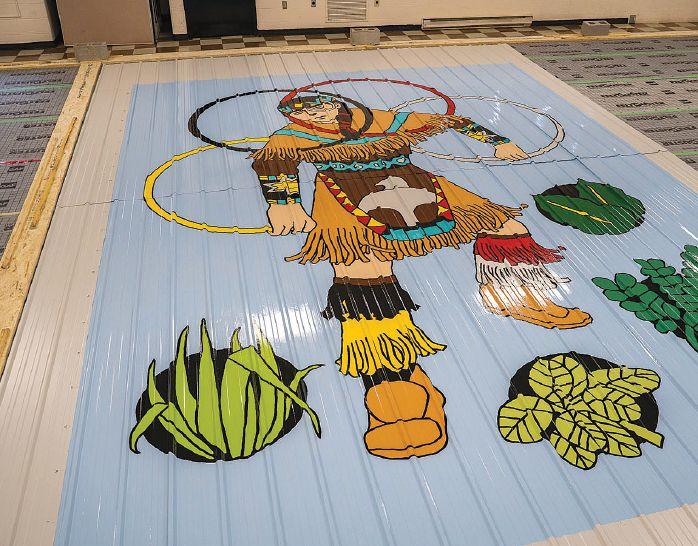
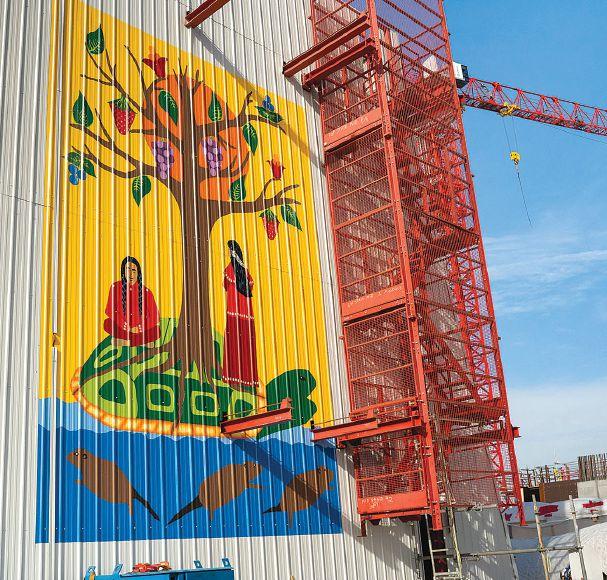
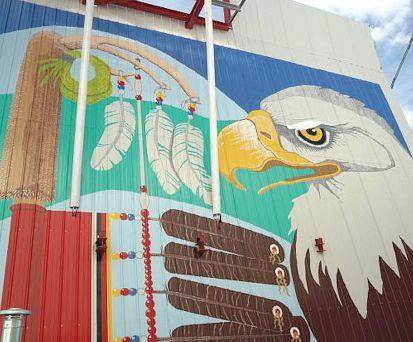
While most commonly thought of as jobs for construction and skilled trade workers, a special initiative gave local artists from Walpole Island First Nation, Caldwell First Nation and southwest Detroit the chance to contribute their talents to the Canadian and U.S. construction sites.
Part of the Community Benefits Plan includes a commitment to engage an Indigenous artist in Canada to create artwork for the construction site. There are six pieces on the Canadian side and dour art pieces on the U.S. side of varying sizes. The largest piece measures 15 metres by 12 metres.
“This innovative opportunity for local artists to participate directly in the project, through a collaborative relationship with the project team and to reflect the character of the region is representative of WDBA’s goals behind the Community Benefits Plan,” said Bryce Phillips, CEO, Windsor-Detroit Bridge Authority (WDBA). “We celebrate the remarkable craftsmanship and contributions the region has to offer.”
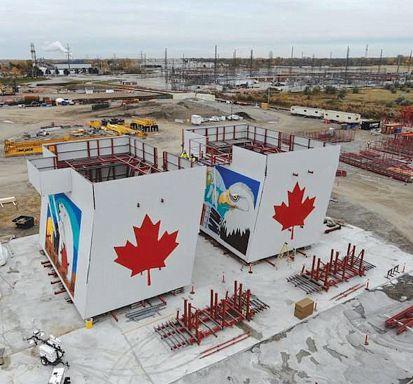
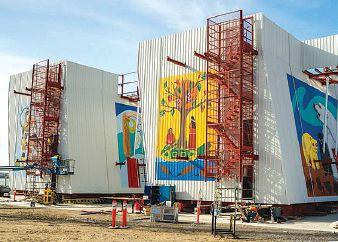
When working to implement this commitment, Bridging North America recognized that the outside panels of the tower crane climbing system provided perfect canvasses for painting murals. With four climbing systems in place – two on each side of the bridge – this initiative was expanded to include a Southwest Detroit artist on the U.S. site.
“The tower crane panels are a perfect location for these on-site art pieces.”
Paul White, Teresa Altiman and Daisy White from Walpole Island First Nation, Naomi Peters from Caldwell First Nation, and Roberto Villalobos from southwest Detroit are the artists who were asked to participate. They were approached in summer 2020 and began designing their paintings.
The art features the international aspect of the project with the Canadian maple leaf and the American stars and stripes. The artists were encouraged to make recommendations to the project team and to take creative liberties in the art to not only share the history of the lands on which the bridge is being constructed but also to tell a few of the many stories about the culture and diversity of the region.
“The tower crane panels are a perfect location for these on-site art pieces. While the construction site remains inaccessible to the public, the murals will be visible from land and water,” said Bridging North America CEO Aaron Epstein. “Our workers will also enjoy this impressive art
which will serve as inspiration and a reminder of the unique communities we are a part of.”
The tower crane climbing systems on which the murals will be displayed are temporary steel structures used to provide access for workers constructing the two massive bridge towers supporting the bridge. Once the tower cranes reach their final height, they will more than double the height of Windsor’s tallest building and will be taller than the 73-story GM Renaissance Center in Detroit.
As the tower cranes are extended to their ultimate height of 250 metres, so will the artwork, making them visible from land on both sides of the border and from the Detroit River. The panels for the Canadian tower crane were painted at Walpole Island and transported to the bridge construction site in fall 2020 and the U.S. panels were painted on site. The murals will remain on the climbing systems for approximately two years before being repurposed once the bridge is complete.
The region’s culture and history will be reflected through other initiatives in the Gordie Howe International Bridge Community Benefits Plan including a series of plaques/interpretive signage. WDBA will engage local historians and residents through further consultation starting in 2021.
State Route 224 Ottawa,
Driving change in construction industry with International Women’s Day month-long women celebration
Women make up a larger percentage of the Canadian construction workforce each year. Job sites that have been stuck in the past are evolving, as companies, governments and industry groups focus on inclusivity. Join us as we celebrate International Women’s Day on Monday, March 8.
Crane & Hoist Canada magazine is partnering with Glass Canada, Canadian Contractor, Canadian Consulting Engineer, Rock to Road, Fenestration Review, Canadian Rental Service, and On-Site magazine, to kick off International Women’s Day with a Virtual Event highlighting successes in the industry. The event will also share insights on how to address and solve challenges women continue to face in construction and you can visit www. women-in-construction.ca for shared content across all the construction brands.
Mary Van Buren will be the keynote speaker for the event on March 8 and she is going to speak on “Building a better Canada: The power of diversity and inclusion in the construction industry.”
SC&RA AT YOUR FINGERTIPS
Download the new 'SC&RA' app to access all of your membership benefits right through your phone!
The future growth of the construction industry will depend on its ability to attract, develop and retain women and other under-represented groups. Van Buren, president of the Canadian Construction Association (CCA), will speak about the importance of inspiring the next generation of workers to join the multi-faceted field of construction. She will discuss what needs to happen to foster an inclusive construction industry and initiatives CCA has spearheaded to actively champion diversity.
Van Buren is a proven leader with an exceptional track record in advancing member interests by introducing innovative worldclass member services, promoting the value of the profession and advocating adoption of technology and standards to improve professionalism. She excels at creating and communicating a compelling vision combined with focusing on developing and empowering people to generate positive outcomes for members.
An expert in marketing, communications, strategy and digital, she has worked in the private, public and not-for-profit sectors and has held executive roles at leading associations and not-forprofits, including the Canadian Medical Association’s subsidiary, MD Financial Management, and Export Development Canada. In her previous role as vice-president of marketing and IT at the Canadian Real Estate Association, Mary led a team of 60 to grow its premier services, REALTOR.ca and WEBForms in the double digits, collaborating with over 90 boards and associations across Canada, significantly generating member value and promoting the value of REALTORS.
In addition to her broad business experience and financial acumen, Mary holds an MBA in international business from McGill and a B.Com from the University of Ottawa, is bilingual and is a Certified Association Executive.
Following the keynote address will be sessions with guest speakers sharing on two different topics: Driving Change in the Construction Industry, and Solving Challenges Women Continue to Face in Construction
• Nancy Chadwick, Senior HSE Director at Graham Construction
Mary Van Buren
We created Women in Construction to promote gender diversity in one of Canada’s critical economic sectors. Women are playing an increasingly important part in all roles, from front-line positions to senior management.
OZ Lifting launches stainless steel beam clamp
New lifting industry children’s book
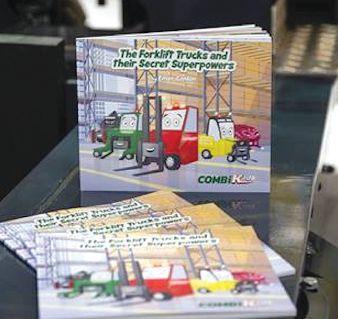
A new children’s book has been launched by Combilift and author Emer Conlon.
“I approached Combilift just over a year ago, with a view to proposing a novel, unique way to communicate with existing and potential customers, as well as being involved in the education of the next generation,” said Conlon. “The idea was to write a children’s book which ‘cartoon-izes’ the main Combilift products and transforms them into characters that children will love. I wanted to also use it as a marketing tool for the adults and so I used the USPs of the actual forklifts and turned them into the superpowers of the characters.”
New heated gear from Bosch Power Tools
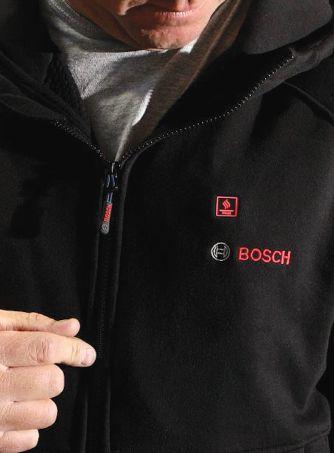
Bosch Power Tools just launched its newest heated gear, the GHJ12V Heated Jacket and GHH12V-20 Heated Hoodie. The jacket and hoodie feature three temperature settings for enhanced control and comfort, and are made with light, durable materials. Strategically placed heat zones in the chest and lower back offers efficient heating in a lightweight, easy-to-wear package.
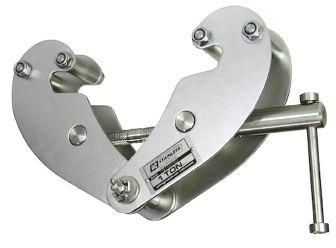
OZ Lifting Products has launched a new beam clamp. The third in a new range of stainless steel products. The launch of the clamp, available in 2,000-pound and 4,000-pound capacities, follows the company’s recent unveiling of a stainless steel chain hoist, designed for lifting and pulling, and a push beam trolley.
The beam clamp is for I-beams and will often be used in conjunction with a hoist. It serves as an additional option if the end-user wants to quickly mount the beam clamp along a beam and attach a hoist to make a lift.
“In simple terms, a beam clamp allows the user to quickly and easily attach and remove the clamp to both sides of a beam to add an anchor point for hoists and other overhead lifting equipment,” said Steve Napieralski, president at OZ Lifting. “Importantly, beam clamps are not intended to be used as a lifting device; they are to be used as an anchor point for a hoist or other overhead equipment and the capacity applies only to vertical loads.”
The beam clamps are designed for use in corrosive environments where the properties of stainless steel make it a preferred material. As Napieralski explained, they are suited to any application where the user needs to be able to quickly and easily attach and remove the clamp as an anchor point for their hoist or other lifting devices. It requires no assembly and is ready to use out of the box. The stainless steel beam clamp, like the hoist and trolley, does not require maintaining beyond that of a traditional steel product.
“The benefits of Grade 304 stainless steel are well known in and out of industry, and we anticipate interest in individual units and multiples thereof. We have had a lot of positive feedback as it gives distributors and end-users another option for lifting equipment where corrosion resistance is critical to their application,” Napieralski added.
The new book launched by Combilift is titled, The Forklift trucks and their Secret Superpowers. PHOTO: COMBILIFT
According to Emer, when writing the book, “The Forklift trucks and their Secret Superpowers”, it was important to achieve a balance between Combilift branding and creating a story featuring endearing characters that children would fall in love with. The Combilift adventure is a real page-turner, filled with drama and excitement.”
Martin McVicar, Combilift CEO and co-founder said education and learning are important.
“We believe it was very important to be involved with the education of the next generation; however, our new CombiKids initiative will involve even younger children with Combilift,” said McVicar.
CombiKids book highlights overcoming difficulties, the importance of friendship and that bullying is unacceptable. The forklift trucks are all different shapes and sizes so, there is an element of, no matter what someone looks like or what shape or size they are, it is important to be accepting of others and of differences.
Both products come packaged with the Bosch GAA12V-21 12V Max Portable Power Adapter, enabling users to take full advantage of their Bosch 12V Max Battery, delivering heat as well as 2.1 amps of accessory power for mobile devices, phones, tablets and more.
GHJ12V Heated Jacket:
• Jacket has three warming heat zones and six pockets for storage
• High-quality water and wind-resistant design for maximum comfort
• Portable adapter delivers fast charging to phones and other devices
GHH12V-20 Heated Hoodie:
• Hoodie has three warming heat zones and large adjustable hood
• Portable adapter for fast charging cell phones, other devices
• Specially designed lightweight fabric design for maximum comfort
OZ Lifting’s new stainless steel beam clamp is available in 2,000-pound and 4,000-pound capacities. PHOTO: OZ LIFTING
Bosch Power Tools launched a new jacket and a new hoodie.
PHOTO: BOSCH POWER TOOLS
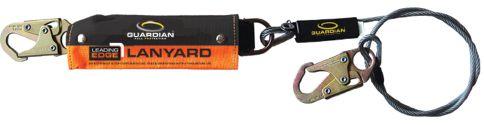
Guardian Fall Protection’s new lanyard features a high-visibility orange shock pack cover to help confirm proper application suitability.
New cable lanyard from Guardian Fall Protection
Pure Safety Group’s Guardian Fall Protection brand has introduced a new cable lanyard. The new lanyard is compatible for leading edges and combines the lightweight durability of a fixed-length lanyard that permits up to 12 feet of fall protection during the event of a free fall from an at-height working surface.
The company established rigorous leading-edge verification testing procedures to ensure consistent performance of the lanyard over a wide range of extreme conditions. Drop-tested in both a perpendicular and offset orientation against .005-inch radius steel, the Guardian Cable Leading Edge Lanyard exhibited high performance and predictability.
The Cable Leading Edge Lanyards feature a vinyl-coated quarter-inch galvanized steel cable, combined with Guardian’s external shock absorber that keeps maximum and average arrest forces low during fall deceleration. Cable Leading Edge Lanyards are available in single- or dual-leg configurations with steel rebar or snap hooks. A high-visibility orange shock pack cover helps confirm proper application suitability, even from a distance.
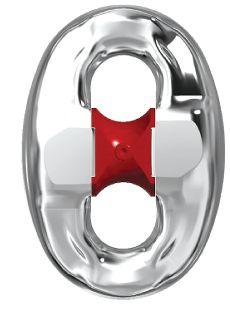
The Crosby Group introduces high fatigue life shackle in offshore mooring sector
The Crosby Group launched the HFL Kenter, a new high fatigue life shackle, under the Crosby Feubo brand. The Crosby Group is a pioneer in offshore mooring components for the oil and gas and wind energy markets strengthened by the recent acquisition of Feubo in early 2020. The new HFL Kenter shackle showcases design improvements on the popular Crosby Feubo NDur Link, an accessory used for temporary and mobile mooring applications such as rigging and anchoring offshore platforms or vessels. The HFL represents the latest state-of-the-art evolution of the Kenter shackle concept, which is more than 100 years old.
“The fatigue life is superior, and it can connect to a variety of stud link anchor chain or other mooring accessories such as sockets and swivels. This feature separates the Crosby Feubo solution from any other worldwide and was accomplished by making it from Grade 6 steel. A logical evolution from the Grade 4 Trident Slim and Grade 5 Raptor Crosby Feubo concepts,” said Oliver Feuerstein, global director of mooring at The Crosby Group.
The Crosby Group provides connectors for anchors, chains, wire rope, a range of synthetics, and a variety of other components that are utilized in many applications by oil and gas and wind energy professionals.
PHOTO: GUARDIAN FALL PROTECTION
The HFL Kenter is a new high fatigue life shackle.
PHOTO: THE CROSBY GROUP
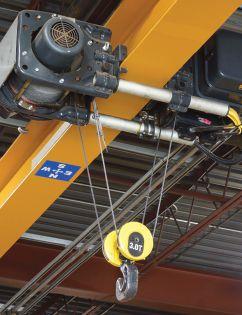
OZ Lifting launches wireless builder’s hoist
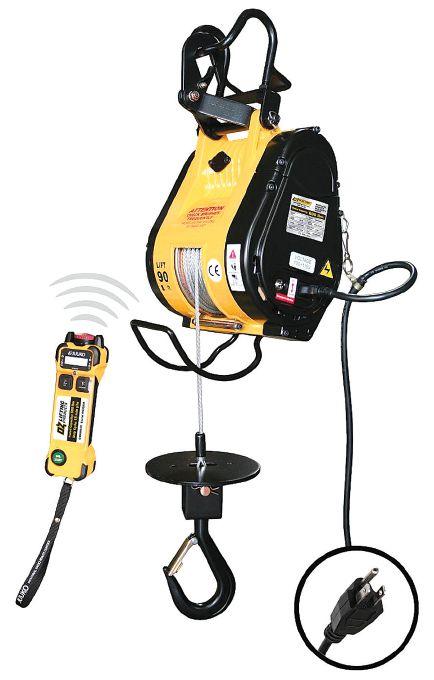
OZ Lifting Products launched a 600-pound capacity wireless builder’s (wire rope) hoist, designed for use beyond the construction and building industries. The 115V single-phase powered hoist offers lifting speeds of 52 feet per minute and 90 feet height of lift as standard, with custom options available.
Steve Napieralski, president at OZ Lifting, explained that the “builder’s hoist” name derives from the fact that the hoist is often used in the construction and building industries. However, over the years, similar products have found their way into a variety of applications outside of the construction sphere. It is now a popular lifting concept among end-users in manufacturing, warehousing, and even elevator applications, for example. Similar solutions continue to gain popularity anywhere the user needs to move a load quickly and safely.
Napieralski also pointed to the 360-degree hook, which allows the load to rotate, thus, reducing the chance of kinking or fraying of the wire rope. It also helps to keep the wire rope spooled correctly on the drum. The hook gives the user the added ability of better positioning the load when lowering. Finally, 15-minute continuous use means the hoist can be utilized in permanent and short-term applications.
End-users should note that the hoist can be rigged outdoors, but it is not rated to be operated in the rain or wet environments. Typically, users will cover the hoist and remove the power and pendant control cables when not in use.
time to shine the light on Canada! The Crane Rental Association of Canada welcomes your application. Visit www.crac-aclg.ca for Awards’ criteria and information.
OZ Lifting’s 600-pound capacity wireless builder’s hoist. PHOTO: OZ LIFTING
Tadano Demag and Faun submit restructuring plan
Tadano Demag and Tadano Faun submitted their restructuring plan to the Zweibrücken District Court. Both companies are owned by Japanese crane and aerial lift manufacturer Tadano.
The insolvency process for the two businesses is expected to open in January, based on the normal protocol for Schutzschirmverfahren (protective shield proceedings), meanwhile, the restructuring plans of the two businesses are progressing as planned.
The companies will continue to be managed independently under the leadership of chief executive Jens Ennen, while Martin Mucha, a restructuring lawyer from the law firm of Grub Brugger law firm, will support the management as general representative. In addition, Arndt Geiwitz, from lawyers SGP Schneider Geiwitz & Partner,
will act as the provisional trustee of Tadano Demag and Tadano Faun.
“With the completion and submission of the restructuring plan, we have taken an important step in the reorganization of Tadano Demag and Tadano Faun,” said Ennen. “I would like to explicitly thank the employee representatives and the creditors’ committee for their constructive co-operation, as well as our employees, customers and business partners for their
trust. The results and rapid progress we have already been able to achieve in the first weeks of the protective shield proceedings make us very confident about the future and future competitiveness of Tadano Demag and Tadano Faun.”
Once the official proceedings commence, implementation of the restructuring plan will begin under the regulations of the German Insolvency Code and will include discussions and a ballot meeting with the creditors, which the court is expected to hold in mid to late February.
The plan encompasses a restructuring in both of the companies’ key areas, including an ‘organizational realignment’, along with the modernization and optimization of the product ranges in order to improve profitability.
While the two German companies will continue to operate under the rules of the protective shield process, production at both facilities will continue as before, with existing and new orders fulfilled. Sales, service, warranty and spare parts deliveries will continue as normal.
Crane & Hoist Canada readers sharpen up on mental health
Thanks for participating in Crane & Hoist Canada’s colouring contest!
In the November/December issue of Crane and Hoist Canada magazine we ran an article discussing mental health in the workplace during the COVID-19 pandemic and how important it is for the industry to remember to check in on our employees, employers, and colleagues. We asked to see some of our creative readers colour in our cover image and here we’d like to share some of those submissions! Thanks to everyone who submitted and to see the article visit www.craneandhoistcanada.com/digital-edition.
Submitted by Fern.
Submitted by Kyra.
Submitted by Mya.
SUPERIOR LUBRICATION PRODUCTS
ALL Erection & Crane Rental Co-Founder Jake Liptak passes
With brothers and sister-in-law, he helped create the crane rental category in 1964
Jerome “Jake” Liptak, one of the co-founders of ALL Erection & Crane Rental and a pioneer in the crane rental category, has died. Jake was 83 years old. Jake co-founded the company in 1964 with his brothers Mike and Larry, and Mike’s wife, Marvine.
Jake Liptak is remembered as an industrious man who loved his work in the field, even after ALL became a leading construction brand across all of North America. He remained active in the company until just a few years ago, when he retired from his day-to-day work to focus more on his health. He passed Wednesday, January 27, with his family by his side.
As word of Jake’s passing spread, Jake’s nephew, and current CEO and president of ALL, Michael L. Liptak, said he’s been overwhelmed with tales of his uncle’s generosity.
“It seems everyone has a Jake story,” said Liptak. “He was a ‘shirt off his back’ type of person and we’re finding out how many times he came to someone’s aid, without seeking attention and without expecting anything in return. He had friends everywhere and will be missed by so many people.”
Another nephew, Lawrence M. Liptak, corporate controller for ALL, remembers Jake as vital to maintaining the family atmosphere as the company grew.
“Jake never met a stranger,” he said. “He was accessible, knew everyone’s name, and always had time to listen. That went a long way toward creating the type of culture we are now so blessed to have here at ALL.”
At the time of ALL’s founding, most contractors had to purchase and maintain their own cranes. Jake Liptak and his brothers recognized a customer need and, in a moment of entrepreneurial genius, bought their own crane and began renting it.
The company says Jake and his brothers had created a new category—crane rental—and backed it with hard work, reliable products, and outstanding customer service. In doing so, they laid the foundation for a company that would stand the test of time.
“They worked 100-hour weeks to get this company up and running,” said Michael L. Liptak. “I’m still amazed by what they built.”
From humble beginnings, Jake and his brothers were trailblazers, literally building the company from one crane to the collective it is today. The ALL Family of Companies is now the largest privately-owned crane rental and sales enterprise in North America, with 33 branches, 1,500 employees, and more than 3,500 pieces of equipment in its fleet.
“The brothers and my mother all complemented one another,” said Michael L. Liptak. “In those early days, each was crucial to establishing the company we know today. Without Jake, ALL Crane as we know it would not exist.”
Left to right: Procurement Director Larry Jeppe, and Co-Founder Jake Liptak.
PHOTO: ALL ERECTION & CRANE RENTAL
Experience the Progress.
Liebherr crawler cranes – LR Series
Superior lifting capacities, on-line load chart calculation
Great variety of boom configurations
Quick and easy assembly
Easy and cost-effective transportation
Liebherr-Canada Ltd.
1015 Sutton Drive, Burlington, Ontario L7L 5Z8
Phone: +1 905 319 9222
E-mail: info.lca@liebherr.com
www.facebook.com/LiebherrConstruction
www.liebherr.ca
• New operator aids with kickout
• Free swing modes
• Simple interface with large touchscreen
• Wi-Fi enabled to update and service remotely
• Calculate outrigger positioning
• Real-time 360°charts
• Live preview mode
• Incorporated swing arrest
• Anti-skid paint on allowable walking surfaces
• No trip points
• Large walking area
• Guided, sequential, fail-safe fly erection
• Control fly assist and boom hoist cylinder from the ground
• One person operation
• Minimal ladder climbs
• Swing around at 0°
• Pivot-point & boom head speed screws
• Heated back-up, winch and right-side cameras with night vision