Inside: The Source The official magazine of the Ontario Ground Water Association
groundwatercanada.com
WINTER 2026
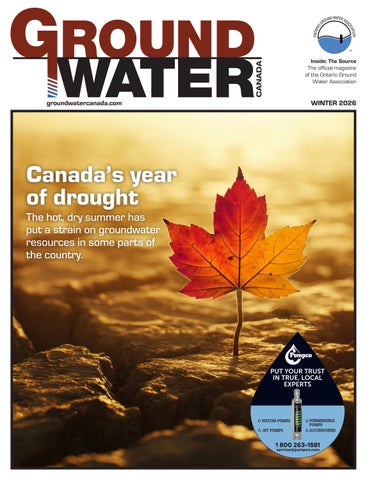
Canada’s year of drought
The hot, dry summer has put a strain on groundwater resources in some parts of the country.
PUT YOUR TRUST IN TRUE, LOCAL EXPERTS
WINTER 2026 Vol.52, No. 1 Annex Business Media P.O. Box 530, Simcoe, Ontario N3Y 4N5 (800) 265-2827 or (519) 429-3966 Fax: (519) 429-3094 Reader Service Print and digital subscription inquiries or changes, please contact Customer Service Administrator | Angelita Potal Tel: (416) 510-5113 | Fax: (416) 510-6875 apotal@annexbusinessmedia.com Mail: 111 Gordon Baker Rd., Suite 400, Toronto, ON M2H 3R1
Departments
8
4 6
Editor | Mike Jiggens mjiggens@annexbusinessmedia.com (519) 429-5184
Features
8
Hot and dry weather has challenged water sources in parts of Canada
12 GROUNDWATER AND TDS
CEO | Scott Jamieson sjamieson@annexbusinessmedia.com
Total Dissolved Solids are the com bined content of all inorganic and organic substances contained in liquid
Printed in Canada, All rights reserved. Editorial material is copyrighted. Permission to reprint may be granted on request. ISSN 0383-7920 Subscription Rates Canada - 1 Year $22.28 U.S.A. - 1 Year $63.65 CAD Annex Privacy Officer: Privacy@annexbusinessmedia.com Tel: 800-668-2374 Occasionally, Ground Water Canada will mail information on behalf of industry-related groups whose products and services we believe may be of interest to you. If you prefer not to receive this information, please contact our circulation department in any of the four ways listed above.
Serving the Canadian Ground Water industry for more than 50 years.
12
OUR YEAR OF DROUGHT
Group Publisher | Michelle Bertholet mbertholet@annexbusinessmedia.com
Publication Mail Agreement #40065710. RETURN UNDELIVERABLE CANADIAN ADDRESS TO CIRCULATION DEPARTMENT, P.O. BOX 530, SIMCOE, ON N3Y 4N5 e-mail: subscribe@groundwatercanada.com
INDUSTRY NEWS
33 NEW PRODUCTS
Account Coordinator | Melissa Gates mgates@annexbusinessmedia.com (416) 510-5217
Media Designer | Jaime Ratcliffe jratcliffe@annexbusinessmedia.com
By Mike Jiggens
16 GUEST COLUMN
Advertising Manager | Sharon Kauk skauk@annexbusinessmedia.com (519) 429-5189
Audience Development Manager | Shawn Arul sarul@annexbusinessmedia.com (416) 510-5181
EDITORIAL: DROUGHT’S IMPACT ON OUR GROUNDWATER
LEVELS
18 THE SOURCE
News and views from the OGWA
16
31
31 SAFETY IN DRILLING
Promoting safer practices for water well drilling crews
ON THE WEB:
Dried-up Nova Scotia wells are refilling, but water is discoloured Steady rain throughout November filled several dug wells in the province that had dried up during summer’s drought. But water drawn from some wells is discoloured, leaving private well owners wondering if it’s safe to drink. CBC News report Right to access safe drinking water should not have to be taken to court, says First Nations Canada should not have to be taken to court in a class action suit over the issue of safe drinking water, federal ministers attending the Assembly of First Nation’s 2025 special chiefs heard. APTN News report
groundwatercanada.com WINTER 2026 | GROUND WATER CANADA 3
EDITORIAL
Drought’s impact on our groundwater It’s one of several concerning water issues
T
here were several water-related matters of note in 2025 that impacted Canadians in different ways. The fluoride issue continued to be top of mind, with municipalities debating whether its inclusion in drinking water supplies made the best sense from a health perspective. The presence of PFAS in groundwater and the means to eradicate it remains an ongoing concern. Elevated lead levels in the drinking water in some Northwest Territories by Mike Jiggens schools made headlines in 2025. Of course, there remains the yet-to-be-resolved matter of the multitude of First Nations communities in Canada that don’t have safe drinking water coming from their taps. Arguably, though, the biggest water-related issue of 2025 was the summer of drought which segued into the fall of drought and threatened to move on to the winter of drought. Several regions in Canada felt the Even when water is seemimpact of months-long dry and hot weather which resulted in shallow ingly plentiful, we have an wells drying up, river flows being reduced and water restrictions obligation to conserve it. implemented. Severe drought was experienced in many regions of the country, including areas in New Brunswick and Nova Scotia where matters were particularly significant. The Nova Scotia government treated the summer’s drought as an emergency, yet added it’s becoming more predictable which has presented an opportunity for the province to shift from being reactive to proactive. The executive director of the New Brunswick Ground Water Association suspects the worst drought conditions in the province may yet to come. He says communications with the public must be stepped up so the attitude that water is taken for granted yields to measurable conservation efforts. He adds municipal and provincial governments must develop water conservation policies to remind the masses that water isn’t an infinite resource. 4 GROUND WATER CANADA | WINTER 2026
This gentleman is one of a few individuals who were interviewed for our cover feature in this issue, addressing the serious matter of dealing with drought. One thing he said toward the end of the story struck a nerve. He feared groundwater resources in Canada could become depleted or sufficiently polluted to the point that extensive treatment will be required. There have been plenty of horror stories in Canada related to this year’s drought – several of which we’ve posted to our Ground Water Canada website. People with dried up private wells are going elsewhere to shower such as at in-town arenas and are having to get the water they need for drinking and cooking at locations a significant distance from home. Even when water is seemingly plentiful, we have an obligation to conserve it. Often, it’s the little things that can add up. There’s no need to keep the tap running while we’re brushing our teeth. There’s no need to spend 15 minutes in the shower. There’s no need to keep water running until it’s deemed cold enough to drink when it can be placed in a jug and refrigerated until needed. These may seem like “small fish” gestures, but they quickly add up, especially in communities whose populations are in the tens of thousands or hundreds of thousands or more. Just because water is readily available in most of Canada doesn’t give us cause to take it for granted. It’s a precious commodity that future generations may struggle to obtain if we don’t set the right example now. Groundwater is facing enough threats as it is with PFAS contamination, sea water infiltration in coastal zones and the impacts of wind turbine and mining operations. The average Canadian doesn’t need to unnecessarily add to these challenges. @GroundWaterMag
groundwatercanada
company/groundwatercanada
NEXT ISSUE: The Spring issue of Ground Water Canada will include information on new water projects. Watch for it this spring.
Powerful Compact
The CME-55/300 The power of a truck mounted drill on a carrier that goes where trucks can’t Spindle torque rating up to 10,410 ft/lbs and 28,275 pounds of retract force for those deep auger borings. Detent feed with adjustable pulldown pressure and rate controls for efficient core drilling operation. Available optional equipment includes angle drilling, automatic SPT hammer, up to 6-5/8” capacity hydraulic rod holder and break-out wrench, cathead, water tank, a variety of hydraulic hoists, water pumps and much more.
You’ve got to get to the job to get the job done The CME-300 remote control driven, rubber track carrier is specifically designed and built by CME in our St. Louis factory. The walking beam suspension provides excellent stability when negotiating uneven terrain, whether it’s curbs in the city or logs in the forest. Couple that with a compact, low ground bearing pressure, zero turn carrier and now you’re getting to sites where your trucks can’t go. Give us a call or visit our website to learn more about the advantages of the one-source CME-55/300 multipurpose rubber track drill.
CENTRAL MINE EQUIPMENT COMPANY 800-325-8827 • info@cmeco.com • www.cmeco.com
INDUSTRY NEWS GROUNDWATER WEEK CONFERENCE SETS NEW FIRSTS More than 4,700 people attended Groundwater Week 2025 in December, making it the best-attended event outside of Las Vegas. New Orleans was the site for the annual National Ground Water Association (NGWA) conference following a multiyear run in Las Vegas. Groundwater Week is returning to Las Vegas in 2026, from Dec. 8-10. December’s conference made history for a couple of other reasons: it set a record of 81,900 square feet of exhibit space, and the NGWA elected a woman as its president for the first time ever. “We’re grateful for another record-setting Groundwater Week that caps a successful and busy year for the industry,” NGWA CEO Terry S. Morse said following the conference which co-located with the Irrigation Association. Groundwater Week’s trade show floor featured 38 firsttime exhibitors. Seth Kellogg, a senior principal geologist at Geosyntec Consultants in Pennington, N.J., made history as the NGWA’s first woman to be elected as president. Her foremost concern within the industry is workforce development. She has worked with the association’s workforce development task force in recent years on tools, ideas and strategies to recruit and retain individuals working in the industry. Although the task force has more recently discussed what the lifecycle of a groundwater career looks like, she envisions a five-year workforce development plan with measurable goals, allowing her presidential successors to track progress. “We want to make sure we’re good stewards of the association’s resources,” NGWA’s 75th president said. Nearly 40 educational workshops led by industry experts addressed industry challenges and explored solutions across eight different topic areas. The conference’s 4,712 attendees represented 35 countries. For the first time, a program track – called “Crossroad of Collaboration: Better Together in Action” – crossed over into all four membership sections in which seven workshops addressed topics ranging from well development concepts and considerations to finding and mentoring replacements who will understand well fouling in advance of well rehabilitation or failure. The industry’s workforce development concern was explored in multiple workshops, including the advancement of women in the groundwater industry. Attendees who may have missed a session will have access to all contractor workshops from Feb. 1-15. Access from the NGWA’s Learning Center can be made at https://www. pathlms.com/ngwa. 6 GROUND WATER CANADA | WINTER 2026
A new marketing video on workforce development made its debut at the delegates meeting. It can be viewed at https://www.youtube.com/watch?v=AyI5zk-xuY4. The launch of the 2026 Darcy Lecture was presented by Dr. Steven P. Loheide II on the topic, “Groundwater Recharge Regimes are in Flux.” The Science and Engineering Forum featured several platform topic presentations as groundwater modeling, groundwater-surface water interactions, managed aquifer recharge, PFAS and geophysical techniques and applications. For the fourth consecutive year, a tour of the exhibit hall led by seasoned groundwater veterans took place to explain how the tools and machinery seen on the floor are used daily in the industry. The NGWA Awards of Excellence ceremony and keynote address spotlighted the industry’s best while musicians from the world-famous Preservation Hall took attendees through a brief history of jazz in New Orleans, with the band performing classic pieces and sharing the stories behind them.
PHOTO CREDIT: MIKE JIGGINS
By Ground Water Canada staff
INDUSTRY NEWS BCGWA PLANS STUDENT OPEN HOUSE FOR APRIL CONVENTION
A free student open house will be part of the British Columbia Ground Water Association’s convention and trade show April 9-11 in Kamloops. The two-hour open house is designed for high school and postsecondary students to explore careers in groundwater, drilling, engineering, environmental science, and related trades. Students will have the opportunity to walk the trade show floor, view equipment and demonstrations, connect with industry professionals, and learn about education and career pathways in B.C.’s groundwater sector. Opportunities for students include: • Exploring dozens of exhibitor booths where they can meet suppliers, drillers, engineers, regulators, hydrologists, and industry leaders who keep B.C.’s groundwater systems running.
•
•
•
•
Viewing the tools of the trade. Many exhibitor displays will feature tools of the trade where they can explain how and why these tools are utilized – explaining groundwater science to visiting students firsthand. Asking questions and learning about career pathways. Students can find out what training, certifications, education, and skills are needed to build a rewarding future in this diverse sector. Joining a guided group or exploring on their own. Students can choose to walk the trade show independently using a booth map or joining a volunteer-led group for a guided overview. Connecting with industry mentors. Volunteers from BCGWA and British Columbia Society of Engineering and Geoscience will be available
throughout the open house to support group visits. Those encouraged to attend include high school students exploring skilled trades, technology programs, or STEM careers; post-secondary students in science, engineering, geoscience, or environmental programs; teachers and career educators; youth organizations and community groups; and students curious about water, sustainability, machinery, or science-based problem solving. Although the open house is free to attend, registration is encouraged to help organizers better prepare for the event. To register, email Bret.Tegarthen@ fele.com.
DON’T MAKE ICE RINKS, OTTAWA URGES WELL OWNERS The City of Ottawa is asking its residents with private wells to refrain from creating backyard skating rinks as the region continues to deal with its ongoing dry spell. Officials are hoping the groundwater supply can be preserved if water isn’t used to flood rinks, CBC News reports. Open community rinks are being planned by the city in rural locations to give residents with wells a place to skate and play hockey, Ottawa has experienced about 25 per cent less precipitation this year than average, although recent improvements have been realized of late.
WINTER 2026 | GROUND WATER CANADA 7 Untitled-4 1
2023-04-04 4:22 PM
COVER STORY
OUR YEAR OF DROUGHT
Hot and dry weather has challenged water sources in parts of Canada
by JAMES CARELESS
Dealing with the drought compelled many Canadian governments to take action. A case in point: Kim Masland is Nova Scotia’s emergency management minister. In response to questions from Ground Weather Canada magazine, her office replied, “Minister Masland has been 8 GROUND WATER CANADA | WINTER 2026
treating this year’s drought as an emergency, and to date, more than $700,000 worth of bottled water has been distributed to affected communities. This was a one-time program designed to meet the immediate needs created by this summer’s severe conditions. That said,
PHOTO CREDIT: GOVERNMENT OF CANADA
T
his year was Canada’s summer of drought – a crisis that lingered well into fall. According to Agriculture and Agri-Food Canada’s Current Drought Conditions webpage (https://agriculture.canada.ca/en/agricultural-production/ weather/canadian-drought-monitor/current-drought-conditions), “In September drought conditions continued to deteriorate throughout much of Canada. At the end of the month, 85 per cent of the country was classified as Abnormally Dry (D0) or Moderate to Extreme Drought (D1 to D3), including 76 per cent of the country’s agricultural landscape.”
3135GT Geotech Rig
• FASTER — 134HP Cat C3.6 engine powers:
• GR10.1 6-speed rotary head (10,000 ft-lb torque, 1,000 rpm) • GH64 percussion hammer (36,000 lb push, 48,000 lb pull) • Dual hydraulic circuits (maintain hydraulic flow and pressure for both drilling functions and fluid circulation)
• EASIER — Mobilize one rig, with minimal mast or machine movement to complete: Augering l Mud rotary l SPT l Shelby tubes Hard rock cores l CPT l Direct push
• SAFER — Reduce operator strain and stay out of danger zone using: • Hands-free automatic drop hammer • Hands-free rotation and head feed
FIELDWORK SIMPLIFIED™ 420M 540MT 6011DT
20CPT
6712DT
7822DT
3100GT
INCLUDES REAL-TIME DRILL RIG INSIGHTS DELIVERED TO PHONE OR COMPUTER
3126GT
3135GT
8150LS
SRC30DT
DM250
DM450
DM650
CONTACT GEOPROBE®
785-825-1842 to discuss options best suited for your unique challenges.
COVER STORY
we also recognize that drought is becoming a predictable and recurring challenge in parts of the province. This means we need to shift our approach from emergency response to preparedness. The province will work toward creating a strategy for just this.” While Nova Scotia treated the 2025 drought as an emergency, experts across Canada were dealing with the same challenge in different ways. To explore these regional responses, Ground Water Canada convened the following roundtable. Roger Roy is executive director of the New Brunswick Ground Water Association, while Kayla Giovannini is environmental co-ordinator with the City of Dawson Creek, B.C. In this discussion, they described the impact of the drought on their communities, the steps that were taken to mitigate it, and the “lessons learned” in 2025 that can be applied to droughts going forward. Ground Water Canada: How severe was the drought in your area this summer? Roy: Drought in New Brunswick was seen mainly in shallow wells in the Acadian Peninsula and in the area going from St. Stephen to Moncton. It started mid-summer due to higherthan-normal dry weather where these areas received over 100 millimetres less rain this summer. Giovannini: The Kiskatinaw River is the sole source of drinking water for the City of Dawson Creek, the Village 10 GROUND WATER CANADA | WINTER 2026
of Pouce Coupe, and surrounding rural residents. The Kiskatinaw River Watershed, located within the East Peace Basin, has experienced ongoing drought conditions, remaining at a Drought Level 3 for most of the summer and escalating to Level 4 as of Oct. 9, 2025 (BC Drought Portal). Recorded flows at the Water Survey of Canada station on the Kiskatinaw River have been among the lowest ever observed since records began in 1944, persisting through much of the 2025 season (BC River Forecast Centre – Low Flow Monitoring). At times, these extremely low flows have limited the city’s ability to meet community demand without drawing on reservoir storage. Ground Water Canada: What impact did the drought have on water supplies? Giovannini: Ongoing drought and low river flows meant the Kiskatinaw River couldn’t always meet community demand throughout the summer and fall. As part of water security planning, the city operates a system of five reservoirs that provides approximately 200 days of storage when full. The city is preparing for the possibility that, with such low flows heading into winter, sections of the Kiskatinaw River may freeze. This may require relying on reservoir storage for an extended period, potentially until spring freshet in April or May. Roy: Dry wells are now being seen all over the province. The northern
part of the province seems less affected even though the water level in the rivers is very low. Ground Water Canada: What steps were taken to help water consumers deal with the drought? Giovannini: The City of Dawson Creek implemented Stage 1 Water Conservation Measures on May 1, followed by Stage 2 on July 25, and Stage 3 on Sept. 11, 2025 (City of Dawson Creek – Stage 3 Water Conservation Notice) Thanks to these measures, the community has successfully reduced daily average water use from 6,448 cubic metres per day under Stage 1, to 6,178 cubic metres under Stage 2, and 5,649 cubic metres under Stage 3 to date. Many rural residents in the area rely on bulk water hauling from the city’s fill stations to supply tanks and cisterns. For those whose dugouts or groundwater wells have been affected by drought, bulk water fill stations remain available to help meet essential needs. Roy:In New Brunswick, water well contractors have redrilled and/ or deepened water wells throughout the summer. This is because some wells were dry, or the available water quantity was not enough to supply the house adequately. Throughout the summer, the New Brunswick Ground Water Association was a guest on CBC Radio, trying to explain how the aquifer works, how rainfall affects the aquifer, and that
PHOTO CREDIT: KAYLA GIOVANNINI, KIM MASLAND, ROGER ROY
Left to Right: Kim Masland, Kayla Giovannini, Roger Roy
rain doesn’t mean the aquifer will replenish overnight: It may take months or even years to replenish the aquifer, depending on the amount of rain we receive. We also discussed using your common sense to conserve water, by waiting for the dishwasher to be full before using it, and not washing your car or driveway. Ground Water Canada: Are you still in drought conditions? Giovannini: Flows in the Kiskatinaw River have increased slightly thanks to recent fall rains, reduced water uptake by vegetation, and lower evaporation rates with cooler temperatures. However, winter conditions will ultimately determine how much the city will need to rely on its reservoir system in the coming months. If precipitation remains low and temperatures continue to drop, conditions could lead to an early freeze-up on the Kiskatinaw this season.
Roy: New Brunswick is not yet feeling the impact of the unusually warm weather that we have been having over the last few years. When it comes to drought conditions in our province, the worst is still to come. I have a trailer near the intersection of the Little Main, Kedgwick and Restigouche rivers. Over the last three to four years, water levels have been dropping from lots of water in the spring to not enough water for salmon fishermen to put their boats in the water in July 2025. Ground Water Canada: Finally, what lessons could be learned from this year’s drought that can be applied to next year? Roy: We need the public to be more informed about the things we take for granted like potable water, and what the cost to society will be if we run out. When you hear on the news that the reservoir of potable water in a
municipality is low, but that there is nothing to worry about if we get rain and snow in normal quantities this fall and winter – that’s a red flag to me. This is why municipal and provincial governments need a water conservation policy to inform the public that water is not an infinite resource, and that clean potable water is a luxury we presently have at a low cost. I may be pessimistic, but I fear that our groundwater resources, rivers and streams will be depleted or so polluted that they will require extensive treatment. Canadians spend billions of dollars every year to treat water from private wells, rivers, and lakes to be able to drink it. Are we ready to spend more and more every year? I don’t think so. This is why we need action now from municipal, provincial governments to protect and preserve groundwater, and indeed all potable water sources
EXPERIENCE THAT RUNS DEEP — IN WATER WELLS & CUSTOMER CARE. “Cotey Chemical has been providing products and services to our company for the past eight years. As a result we have increased our services to our customers with excellent results and profits.” SERGIO A. LEON ZAMUDIO
POZOS DINAMICOS, S.A. DE C.V. HERMOSILLO, SONORA, MEXICO To learn more, contact our experienced team at (800) 457-2096 4410 MLK Jr. Blvd. Lubbock, TX 79404 | coteychemical.com WINTER 2026 | GROUND WATER CANADA 11 GWC_Cotey_Fall25_CSA.indd 1
2025-09-09 3:54 PM
SCIENCE
GROUNDWATER & TDS LEVELS Total Dissolved Solids are the combined content of all inorganic and organic substances contained in liquid
W
ater is commonly known as the universal solvent; consequently, when it encounters soluble material, particles of that material are absorbed into the water. This process creates Total Dissolved Solids (TDS).
Jeff Wahl is principal owner and water educator at Wahl Water in Mindemoya, Ont. stratification and benthic hypoxia are locked
TDS adsorption in water generally stems from two primary categories: natural and humanmade sources.
12 GROUND WATER CANADA | WINTER 2026
reduced filtration capacity facilitates higher solute loads.
HYDROGEOCHEMICAL ORIGINS OF TDS Water acts as a powerful solvent due to its polarity. As groundwater moves through the hydrologic cycle, it undergoes water-rock interaction, dissolving minerals from the geological formations it traverses. TDS adsorption in water generally stems from two primary categories: • Geogenic (natural) sources: Dissolution of carbonate rocks (limestone), evaporites, and mineralized springs. • Anthropogenic (human-made) sources</ Agricultural runoff (fertilizers), road de-icing
PHOTO CREDIT: WAHL WATER
by JEFF WAHL
TDS represents the combined content of all inorganic and organic substances contained in a liquid in molecular, ionized, or micro-granular suspended form. While often invisible to the naked eye, TDS is a critical parameter in characterizing groundwater quality, determining hydrogeochemical evolution, and assessing drinking water suitability. Historically, TDS levels are frequently unmonitored in private water systems. However, hydrogeological data indicates that unmonitored groundwater sources specifically dug, drilled, or shore wells are statistically more susceptible to elevated TDS concentrations than surface water sources (lakes and rivers). This susceptibility is particularly acute in regions with thin overburden (soil cover) and exposed bedrock, where
salts (chlorides), industrial effluent, municipal water treatment additives, and plumbing leachate. The chemical composition of TDS is a fundamental aspect of water quality characterization, typically quantified using units of milligrams per litre (mg/L) or parts per million (ppm). This measurement represents the sum total of all dissolved inorganic and minor organic substances present in the water volume. These dissolved constituents are present as ions (electrically charged atoms or molecules) derived primarily from the dissolution of minerals and salts as water interacts with its environment. The major ions contributing to the TDS measurement are split into two groups: Cations (positively charged ions) and Anions (negatively charged ions). The most common cations include Calcium (Ca2+), which contributes significantly to water hardness; Magnesium (Mg2+), also a primary component of hardness; Sodium (Na); and Potassium (Ka). The balance of the electrical charge in
the water is maintained by the major anions present. These anions frequently include Bicarbonate (HCO3− ,CO32−), often a result of carbon dioxide dissolution and the weathering of carbonate minerals; Chloride (Cl −), which can indicate inputs from road salts or industrial effluent; Sulphate (SO²), typically originating from the dissolution of gypsum and other sulfate-bearing minerals; and Nitrate (NO3−), which is an important indicator of agricultural or septic system contamination.
REGULATORY FRAMEWORK IN CANADA The Guidelines for Canadian Drinking Water Quality establish an Aesthetic Objective (AO) for TDS of ≤ 500 mg/L (ppm). It is important to note that: • Enforcement: These guidelines are not federally enforceable standards; regulatory adoption varies by province and territory. • Public health: Elevated TDS is primarily treated as an aesthetic issue (taste and scaling) rather than a direct health hazard, though
levels exceeding 1,000 mg/L are generally deemed unacceptable for consumption. Consequently, public health units rarely include TDS in standard bacteriological screening.
WATER HARDNESS AND TDS Water hardness is a specific subset of TDS, defined primarily by the concentration of dissolved calcium and magnesium. There is often a direct correlation between high TDS and high hardness, particularly in aquifers situated within limestone or dolomite bedrock. By converting hardness values into equivalent TDS, it is possible to calculate the presence of non-hardness ions (such as chlorides or sulphates). • Conversion Factor: 1 Grain per Gallon (gpg)=17.1 ppm (or mg/L). Example calculation: If a water sample has a hardness of 20 gpg: 20 Grains per Gallon (gpg) Hardness × 17.1 = 342 ppm of the TDS Total Value If the total TDS of the sample is measured at 600 ppm, and the hardness contributes
WINTER 2026 | GROUND WATER CANADA 13 GWC_HeronInstruments_Summer25_CSA.indd 1
2025-05-29 11:00 AM
SCIENCE UV disinfection: In UV disinfection systems, elevated TDS, particularly high levels of certain constituents like iron, manganese, or organic compounds, presents operational challenges. These dissolved solids can lead to scaling or fouling of the quartz sleeve which reduces the necessary UV light intensity reaching the water. This reduction in light transmittance compromises the system’s ability to effectively inactivate pathogens, a problem technically known as UV transmittance loss, thereby impacting the microbiological safety of the treated water. Reverse osmosis:The operation of reverse osmosis (RO) systems is highly dependent on influent TDS concentration. The RO membrane is engineered to reject these dissolved solids. High influent TDS requires the system to operate at significantly higher pressures to force the water across the semi-permeable membrane, which in turn accelerates membrane fouling and inorganic scaling. This not only increases energy consumption but also reduces the desired permeate flow rate and drastically shortens the membrane’s service life, substantially increasing overall operational and maintenance costs. Hot water heaters & plumbing fixtures High concentrations of TDS severely impact home water systems by promoting scale formation when water is heated. In hot water heaters, scale acts as an insulator on elements, drastically reducing energy efficiency and potentially causing premature failure. This mineral buildup also restricts flow and clogs components in plumbing fixtures (faucets, showerheads) and water using appliances (dishwashers, washing machines), ultimately compromising their performance and shortening their operational lifespan.
ANALYTICAL METHODS AND IDENTIFICATION
342 ppm, the remaining 258 ppm consists of other dissolved solids (e.g., sodium, sulphates, or nitrates). This differential analysis is critical for selecting appropriate water treatment technologies.
TDS, WATER TREATMENT AND PLUMBING FIXTURES The concentration of TDS is critically relevant to the performance and lifespan of common water treatment technologies, including water softeners, ultraviolet (UV) disinfection systems, and reverse osmosis (RO) systems. TDS is an important factor that affects the lifespan and performance of appliances, boilers, on-demand tankless heaters, electric, propane or natural gas heaters, hydronic HVAC systems, washing machines, dishwashers, plumbing fixtures or any other system in which water is used. Water Softeners: High TDS levels introduce a greater concentration of competing ions, not just the hardness causing calcium and magnesium ions, but also non-hardness ions like sodium and potassium that compete for binding sites on the softener’s resin beads. This competition accelerates the exhaustion of the resin’s exchange capacity, impeding operation and requiring the softener to undergo more frequent regenerations and resin replacement. 14 GROUND WATER CANADA | WINTER 2026
The common methods for testing TDS in water include laboratorybased gravimetric analysis (the most accurate reference method) and the more frequently used field method of measuring electrical conductivity (EC) with a portable meter, which serves as a rapid and reliable proxy. Field screening: Portable handheld TDS meters (often measuring electrical conductivity and converting to TDS) provide immediate results. Frequent calibration is essential to prevent drift caused by scale buildup on the sensor electrodes. Laboratory analysis: For definitive results, samples should be submitted to accredited laboratories for gravimetric analysis or comprehensive ionic testing. Target range: While 0–170 ppm is often cited as an ideal range for certain treatment targets (e.g., reverse osmosis), the aesthetic guideline remains 500 ppm. Qualitative field observation (freeze concentration) can visually indicate high TDS. Because the forming ice crystal lattice rejects dissolved impurities (freeze concentration), ice cubes made from high-TDS water may appear discoloured, contain “white flakes” (precipitated solids), or exhibit irregular physical formation compared to ice from low TDS water.
WELL WATER – TDS CASE STUDY The water quality analysis is a standard and often mandatory component of the financing agreement when executing the sale of a rural property utilizing a private well. This case study details
a transaction where the required testing revealed significantly adverse well water results, providing a compelling example of the critical challenges and complex ramifications that arise during the attempt to sell a home with a compromised water source. A water sample was submitted for testing after the client expressed concerns regarding the well water quality at their residence prior to listing the property for sale. Testing results revealed astonishingly high levels of dissolved solids (9,973 ppm), no data overgrown with target (NDOGT) values for coliform and E. coli bacteria, as well as hardness (116.7 gpg) present in the water source. These measurements severely exceeded the Canadian Drinking Water Quality Guidelines (CDWQG), which recommend non-consumption levels when the concentration of total dissolved solids is greater than 1,000 ppm, bacterial contamination (for coliform and E. coli is greater than 0, and water hardness is greater
than 29.2 gpg. A review of the drilled well report revealed a critical issue: the well’s flow rate was only one-half gallons per minute (gpm), which is significantly below the minimum required for a standard home, typically set between three to five gpm, with six to 12 gpm being the ideal range for reliable supply. This insufficient water volume meant that there was not enough water available to effectively run the necessary treatment systems to address the well’s high levels of hardness, total dissolved solids, and bacteria. The adverse nature of the well water and its lack of volume resulted in the homeowner seeking a different source of water prior to selling the home. Water testing, conducted in advance, successfully avoided potential problems. These issues, related to the water quality and the challenges of treating it to acceptable levels for consumption and use in the home, could have otherwise prevented the sale from being finalized.
IMPORTANCE OF TDS LEVELS IN GROUNDWATER Groundwater chemistry is not static; it fluctuates due to seasonal precipitation, aquifer recharge rates, and drought conditions, which is why routine monitoring of TDS is essential for owners of private water sources, requiring comprehensive analysis at regular intervals to maintain water quality and assess its impact on infrastructure. Testing for TDS is beneficial to plumbing and fixtures because it prevents the accumulation of mineral scale (limescale), which otherwise reduces water flow, corrodes piping, and shortens the lifespan of water-using appliances and fixtures. This testing is crucial for real estate transparency, where TDS analysis should be a mandatory component of water potability inspections during property transactions to quantify the water’s quality characteristics. TDS are often colourless, tasteless, and completely undetectable by human senses in well water.
PUT YOUR TRUST IN TRUE, LOCAL EXPERTS Piston pumps Jet pumps
Submersible pumps Accessories
1-800-263-1581 | service@pompco.com
pompco.com/en WINTER 2026 | GROUND WATER CANADA 15 GWC_Pompco_Winter26_ASK.indd 1
2026-01-02 9:31 AM
ASSOCIATIONS
Thoughts from the BCGWA A preview look at April’s conference and other matters of interest in British Columbia
H
omeowners with drilled wells often believe that a good initial test result combined with proper well depth guarantees that their water is free of bacterial contamination. This is only part of a much larger perception that water can be considered safe without further assessment or treatment. Consequently, when groundwater is blindly perceived as safe, additional testing is often not conducted to verify its suitability for drinking and household use. I’d like to thank the staff at Ground Water Canada for the opportunity to provide some thoughts and information regarding everything groundwater in British Columbia. I have the privilege to work for the BC Groundwater Association (BCGWA). The BCGWA is based in British Columbia and provides professional and technical leadership in the advancement of the groundwater industry and in the protection, promotion, and responsible development of groundwater resources. Our membership includes water well drillers, well pump installers, equipment suppliers and manufacturers, as well as geoscientists and engineers. We hold a convention each year, and I would like to take the opportunity to personally invite the Ground Water Canada readership to the BCGWA Annual Conference, which will be held in Kamloops at the Coast Hotel and Convention Centre from April 9-10, 2026 with our Annual General Meeting happening on April 11. We will be opening the trade show to local students for specific periods during the conference to expose youth to the possibility of careers in the groundwater industry. BCGWA provides two multi-day trades courses at our annual convention – water well drilling (with a breakout for Geo-tech), and water well pump installer training. We will also be presenting a course on water rights for groundwater users. Details will be available at www.bcgwa.org
16 GROUND WATER CANADA | WINTER 2026
PROPOSED B.C. WATER SUSTAINABILITY ACT CHANGES The province of B.C. regulates water resources through the Water Sustainability Act and through the associated Groundwater Protection Regulation. This provincial law (https://www.bclaws.gov.bc.ca/civix/ document/id/complete/statreg/39_2016), regulates activities related to water wells. Recently the B.C. government has undertaken an initiative to work across the natural resource sector to streamline permitting, remove barriers and delays, eliminate duplication, simplify processes and shift permitting while maintaining high environmental standards and the commitment under the Declaration on the Rights of Indigenous Peoples Act. As part of this work, 16 topics have been identified under the Water Sustainability Act, Water Sustainability Regulation, Riparian Areas Protection Act, Riparian Areas Protection Regulation and the Forest Act. The provincial government is exploring opportunities to improve permitting processes for each of these topics. Selected topics/initiatives that relate to groundwater are: • Low volume water use without an authorization • The province is exploring how to allow low volume groundwater use (up 2,000 litres) per day without an authorization in areas with available groundwater. • Low volume water use streamlined authorization process • In situations where there is a desired use of small quantities of water on streams and aquifers where the withdrawal is not expected to have an impact on other authorized water users, on land or other property, and where there are no other significant environmental or cultural concerns, the province is looking to streamline its review process.
PHOTO CREDIT: JAMES SPANKIE
by James Spankie
• •
• •
• •
Expediting existing use groundwater applications For applications that are submitted where there is an existing groundwater use, the province wants to explore ways to expedite and streamline the amount of time that it takes to approve the review and decision process for those applications Administrative penalties timelines There has historically been a big lag between the time of an offence and when a penalty is levied by the province. They would like to explore ways to better align the timelines and processes for administering penalties under the WSA with the administrative penalty frameworks under other natural resource sector statues. Exemption for construction dewatering Construction projects that require excavation can encounter subsurface water or infiltration. In
situations when there is low risk of consequence due to that water removal from the construction area, the province is exploring the removal of existing authorization requirements. Registration of wells in B.C. has been an area of focus for several years, and the B.C. Ministry of Water Land and Resource Stewardship has identified a strong desire to bring as much of the information about wells as possible into the provincial GWells database. Despite the intent to remove the requirement for authorizations in situations identified in above in the list of initiatives, the provincial government still wants water wells to be registered – authorization or not. The hope is that streamlining the approval requirements and process will encourage well registration, particularly in situations where a proponent feels that well registration may hamper their ability to proceed with desired work.
SKILLED TRADES AND WATER WELLS In British Columbia, water well drillers and
North East Equipment Nord Est Equipements Equipements de forage / Drill rigs and HP compressors
water well pump installers are required to be registered with the provincial government or work under someone who is a registered tradesperson or professional. All registered drillers and pump installers are identified in a publicly accessible database which is maintained by the Province of B.C. BCGWA has been working with Skilled Trades BC (including previous incarnations) to act as a vetting provider for these trades for at least 20 years. Our role is to ensure that applicants who want to be certified to work in the province have enough verifiable, and supervised work experience to show that they will be able to provide the highquality work that is required when drinking water is provided using well systems. While this is specific to B.C. it would be wonderful to work with other Canadian jurisdictions to ensure consistent certification standards and encourage more interprovincial travel for this type of work! James Spankie is general manager of the British Columbia Ground Water Association.
450-250-2442 www.ebostiguy.com info@neequip.com
North East Equipment, 5640 C rue Barré St-Hyacinthe (Québec) J2R 1E4
FOR SALE
FOR SALE
FOR SALE
WINTER 2026 | GROUND WATER CANADA 17 GWC_NordEst_Fall24_EJS.indd 1
2024-08-21 11:41 AM
OGWA GOLF TOURNEY PG 4 | RIPPLE EFFECT PG 6 | • ATTENDING THE AGM PG 7
A MESSAGE FROM THE OGWA PRESIDENT As we wrap up 2025, I want to take a moment to reflect on the year we’ve shared as members of the Ontario Ground Water Association. It’s been a year full of shifting priorities, unexpected challenges, and a few curveballs that none of us ordered – but through it all, our groundwater community showed resilience, adaptability, and no shortage of determination. Across Canada and beyond, industries have been navigating a landscape that at times felt like someone shuffled the deck and forgot to tell the players. Tariffs, material cost increases, global uncertainties, and evolving government priorities have kept many of us on our toes. For some members, this meant adjusting operations, rethinking timelines, or finding creative ways to work around supply delays. (If you finally received that back-ordered part from 2022, congratulations. We’re all celebrating with you.) And while Mother Nature didn’t exactly send us a memo, the ongoing impacts of climate change made themselves felt. Extreme weather, changing recharge patterns, and increased pressure on water supplies reminded us – as they do every year – that groundwater professionals remain at the front lines of resilience and sustainability. In times like these, having a strong trade association isn’t just helpful – it’s essential. The Role of OGWA in a Changing World Throughout 2025, the OGWA has worked hard to support our members in navigating an evolving landscape. This year, we: • Strengthened our advocacy efforts, pushing forward on meaningful regulatory conversations and continuing the long, steady work toward modernizing outdated frameworks, 1
theSOURCE
keeps changing, our sessions should, too. These efforts are a testament to what happens when a dedicated membership and a committed association move in the same direction.
KYLE SMITH
•
•
•
•
President
including the one we all know well: Regulation 903. Continued progress toward new education content, laying the groundwork and securing support to expand the curriculum so members have access to training that reflects today’s realities – not yesterday’s manuals. Engaged deeply with collaborative sector initiatives, including active participation in Health Canada working groups and Morwick G360 workshops that bring science, evidence, and policy together in one room (and occasionally, one very lively conversation). Represented our members across multiple provincial forums, ensuring that groundwater professionals have a respected and credible voice in decision-making spaces. Prepared an energized Convention & AGM, including the creation of new sessions designed to tackle emerging hot topics – because if the industry
Why Your Trade Association Matters In a world where the only constant seems to be change – and sometimes unpredictable change – OGWA remains a reliable resource, a guiding voice, and occasionally, the calm in the storm. (Or at least the person handing out umbrellas.) Membership offers something no individual company can achieve alone: a collective voice strong enough to influence policy, defend the interests of the sector, and champion the value of the work we do. Your membership supports: • effective advocacy, • timely information, • strong professional standards, • expanded training and resources, and • a united community of experts who understand the challenges you face.
INSIDE THE ISSUE HEALTH & SAFETY REPORT WSIB Updates
PROPER GLOVE SELECTION One size does not fit all
DISABILITY INSURANCE
Why it matters to OGWA members
MESSAGE FROM OGWA’S GM Strengthening our role as partners
Looking Ahead to 2026 As we head into 2026, I feel genuinely optimistic. There is fresh energy within the association, a renewed commitment to our big-picture goals, and a shared belief in the importance of the work ahead. We’re building momentum, strengthening relationships, and moving forward with initiatives that will support our members and help the entire groundwater industry continue to grow and adapt. In the coming year, you can expect us to keep expanding communication and member support, reinvigorate our leadership in advocacy and regulatory reform, make significant progress in curriculum development, and deepen our collaboration with provincial and federal partners. Most importantly, we will be listening to you. Together, we will continue building a future-ready industry – one equipped to navigate environmental pressures, regulatory change, and the realities of an ever-shifting world. Thank you for your commitment to the OGWA and to groundwater protection across Ontario. I’m deeply grateful for your engagement, your expertise, and the dedication you bring to this industry every single day. Our members are true stewards of the environment – protecting a vital resource, strengthening our communities, and ensuring a sustainable future for generations to come. As we look ahead to 2026, may we move forward with purpose, optimism, and a renewed sense of unity. Together, we can continue building an industry that is resilient, respected, and ready for whatever comes next. Sincerely, KYLE SMITH, President, Ontario Ground Water Association
HEALTH & SAFETY REPORT
Hello, OGWA members! Well, winter is here. I’m not sure what else to say on that topic… Per usual, I have a couple of updates for you! Please make sure that you check your WSIB account for the 2nd WSIB SURPLUS Rebate. The money arrived in the accounts of my WSIB members in November, 2025, so you should see that money there. Remember: If you want that money back, you’ll need to apply for it. There is information on this link if you wish to receive a cheque: https://www.wsib.ca/en/rebate Don’t forget to check to ensure that you have the most current WSIB Form 82 (The In Case of Injury Poster) posted in your workplace. The newer one has the QR Code and the new WSIB logo. The WSIB Excellence program is still here, offering Rebates to members who participate. If you are interested in getting a) up to double your annual premiums back OR b) $2,000 per topic, up to 5 topics (yes, that’s $10,000) then please contact me! Each business will now receive $1,000 to offset provider fees in addition to the Rebates! New Regulation 480/24 coming into effect for Jan. 1, 2026 re: records of cleaning for washroom facilities, regardless of where that washroom is located or what type of washroom it is (porta potties): Records re washroom facility cleaning 1. For the purposes of subsections 23.1 (2) and 25.3 (3) of the Act, an employer or constructor, as the case may be, may satisfy the requirement to keep, maintain and make available records of the cleaning of washroom facilities by ensuring that, 2. (a) the record is posted in a conspicuous place in or near the washroom facility to which the record pertains where it is likely to come to the attention of workers; or 3. (b) the record is posted electronically where it can be accessed by workers, and workers are provided with direction on where and how to access the record. 4. (2) A record of the cleaning of washroom facilities described in subsection (1) must include the date and time of the two most recent cleanings of the washroom facility. 5. Lots of changes in place or coming for advertising job openings. Make sure you know before you advertise! 6. New Regulation for Construction Projects O. Reg. 157/25 will require defibrillators on site if the project has 20 or more worker and is expected to last 3 months or longer. Now, the WSIB will provide some reimbursement, however, WSIB has no information on this right now. I have tried to get that information but to no avail. Stay tuned to this one. 7. New administrative penalties at the OHSA and the WSIB- the WSIB portion is around making false or misleading statements or representations in connection with a claim. If you don’t keep accurate records of wages paid or do not produce them when the WSIB asks, you can also receive an administrative penalty. If you have any questions on any of this, please just give me a call at 905-741-5001 or email me at info@ safetyworksconsulting.com. I wish you all a very Merry Christmas and all the very best for the New Year.
ELLALINE (ELLA) DAVIES
President, Safety Works Consulting Inc
PUBLISHED FOR THE ONTARIO GROUND WATER ASSOCIATION Ph: 519-245-7194
TRISH LUTY, General Manager Ext. 1 / trish@ogwa.ca KARINA PAKALNIS, Administrative Assistant Ext. 3 / Karina@ogwa.ca DEBBIE STOJKOVIC, Accounts Ext. 2 / accounts@ogwa.ca EXECUTIVE KYLE SMITH President STEPHEN BLEIZEFFER Vice President BOYD BENDLETON Treasurer MATT WILSON Secretary DWAYNE GRAFF Past President DIRECTORS STEPHEN BLEIZEFFER BrokerLink Inc. 519-579-3330
RACHEL BOURNE Elements Geo Corp. 289-927-4078 DWAYNE GRAFF Well Initiatives Ltd. 519-846-8289 JAMES DENNIS CanPipe 613-930-5595 BRUCE HIETKAMP Geo Kamp Limited 905-825-8007 SHAWN HOPPER SD Hopper Drilling 519-272-5490 (cell) MIKE MINOR Franklin Electric 437-240-3179 HARRY OUSSOREN Institu Contractors 519-763-0770
BOYD PENDLETON Lotowater Technical Services Inc. 519-442-2086 RICK PETTIT Rideau Supply 800-463-7648 KYLE SMITH Aardvark Drilling Inc. 613-296-8779 MIKE STEFFEN Steffen Well Drilling 519-357-1960 / 519-531-0355 BRYAN WATSON G. Hart & Sons Well Drilling Ltd. 705-887-3331 MATTHEW D. WILSON J.B. Wilson & Son Well Drilling ltd. 519-269-3364 IAN GAWEL Desjardins Financial Security Independent Network 647-285-1390 416-695-1713 (fax) theSOURCE
2
A Groundwater Contractor’s Guide to Proper Glove Selection and Other General PPE Requirements By Stephen Bleizeffer, Vice-President, Ontario Ground Water Association Drilling and Ground Water Construction is a demanding profession that exposes workers to a diverse range of hazards, from falling equipment and chemical exposure to the risks of working with heavy machinery. Personal Protective Equipment (PPE) is a critical component of safety, but it only works if it’s the right gear for the specific job. One size does not fit all in the world of drilling safety. Here are the key considerations for selecting the correct PPE and gloves for a water well driller. The Foundation: The first step in any operation should be a thorough Job Safety Analysis (JSA). This assessment identifies potential hazards associated with each task and dictates the necessary controls, like PPE. The environment on a drilling site changes constantly, so regular reassessments are vital. Essential Glove Safety Practices: • Fit is Non-Negotiable: Gloves must fit snug but not so tightly they restrict blood flow. Poorly fitting gloves compromise dexterity and increase the severe risk of entanglement in rotating machinery. • Select the correct type.No single glove material protects against all hazards. Different tasks and environments require different gloves. Consider hazards such as chemicals, abrasions, cuts, punctures, or extreme temperatures. • For chemical handling,you need chemical-resistant gloves like those made from nitrile, neoprene, or butyl rubber. Check a manufacturer’s safety data sheet to find out what gloves are recommended for your product. • For cut hazards, use cut-resistant gloves made from materials that will reduce cuts. • Inspect and Replace: Inspect every pair of gloves daily for cuts, punctures, or signs of chemical degradation before each use. Replace damaged gloves immediately. • Hygiene: Proper removal (doffing) of chemical or biohazard gloves is vital to prevent self-contamination. Use a method that prevents skin contact with the contaminated exterior of the glove, such as the “glove-in-glove” technique. • Always wash hands thoroughly after removing gloves and before eating or drinking. • Training: Ensure all workers are trained in the limitations of their gloves and which type to use for each specific task. Glove Safety: Matching the Glove to the Task • The hands are the most exposed body part in drilling operations, making glove selection paramount. Crucially, one type of glove will not suffice for all tasks. General Site PPE Requirements The Regulations for Construction Projects (O.Reg. 213/91) indicates mandatory PPE: 3
theSOURCE
•
Head Protection: Hard hats are a minimum requirement. For sites near power lines or electrical equipment, an ANSI Type 2, Class E (electrical rated) hard hat. • Eye and Face Protection: Safety glasses with side shields are standard. Flying chips, dust, and splash risks may necessitate sealed goggles or a full-face shield. • Foot Protection: Steel-toed boots with robust, non-skid soles are critical for protecting feet from heavy, falling objects and maintaining stability on slippery, muddy surfaces. Rubber boots may be necessary for working in consistently wet or chemical-exposure areas which will also require a steel toe. • Body and Hearing Protection: High-visibility clothing is required for clear visibility on site. Earplugs or earmuffs should be worn when operating any equipment or machinery. • Weather Conditions: Protection extends to the elements. Waterproof outerwear for heavy rain and insulated gear for cold weather prevent hypothermia, while sunscreen and adequate hydration prevent heat stroke and dehydration. By understanding the diverse risks on a drilling site and rigorously adhering to proper PPE selection and usage guidelines, groundwater contractors can protect themselves and foster a safer work environment. The goal is to return everyone home safely at the end of every day. Some article research provided by Ellaline Davies of Safety Works Consulting.
GOLF TOURNEY’S SPONSOR SUPPORT KEY TO EVENT’S SUCCESS The 9th Annual OGWA Scholarship Golf Tournament, held on Sept. 5, 2025, at the beautiful Conestoga Golf Course, stands as a clear reflection of the generosity and leadership within Ontario’s groundwater community. This event was made possible by sponsors whose support extends far beyond the fairways, strengthening professional connections, advancing shared industry goals, and helping shape the future of groundwater stewardship across the province. Through the collective support of sponsors, golfers, and OGWA members, the tournament raised more than $4,000 in funding for student scholarships through OGWA and Fleming College. These contributions directly support education, workforce development, and future opportunity, ensuring that emerging professionals are equipped to carry Ontario’s groundwater industry forward. The sponsor spotlights that follow honour the organizations that continue to invest in OGWA’s mission. Their commitment plays a vital role in building a strong, connected, and forward-looking groundwater community, and their impact will be felt well beyond this year’s tournament.
Golf Sponsorship Responses: 1.Rideau (Gold): This year marks a significant milestone for Rideau Supply as the company celebrates 50 years of supporting Ontario’s water and groundwater professionals. Founded in 1975, Rideau Supply has built a trusted reputation as a comprehensive supplier of water treatment systems, pumping equipment, drilling and well supplies, piping solutions, and related infrastructure for residential, commercial, and industrial applications. Over five decades, the company has grown alongside the industry, adapting to changing
Golfers playing in the 9th annual OGWA Scholarship Golf
technologies, regulations, and water challenges while maintaining a consistent focus on reliability and service. Rooted in the belief that “water is our business, and people are our greatest strength,” Rideau Supply emphasizes human-to-human relationships, ensuring that professionals in the field receive the guidance and products they need to deliver reliable outcomes for their clients. This people-first philosophy underpins the company’s longevity and continued relevance, supported by strong technical knowledge and hands-on service tailored to real-world applications. Celebrating 50 years is not only a reflection of Rideau Supply’s history, but also of its ongoing commitment to the future of the groundwater industry. Their support of the OGWA aligns with a long-standing dedication to collaboration, education, and shared industry standards. As a OGWA sponsor, Rideau Supply helps strengthen professional networks, promote responsible groundwater practices, and support the next generation of water
professionals. This milestone year highlights their enduring role as a trusted partner and advocate for a resilient, knowledgeable groundwater community.
2. Cetco (Silver): CETCO Drilling Products is a division of CETCO, a wholly owned subsidiary of Minerals Technologies Inc. and offers an assortment of high-quality bentonite drilling fluids, grouts, polymers, and additives. CETCO helps maximize your drilling efficiency and surpass your needs in the field. Our complete line of products is specially designed to enhance the cost-effectiveness of drilling operations by controlling and improving drilling fluid properties. Each drilling product is supported by our experienced field team and research scientists. CETCO is committed to bringing you innovative, cost-effective products that go beyond meeting your needs for all drilling-related markets. theSOURCE
4
LEFT: Golfers get ready to head out on their carts to begin play. RIGHT: OGWA Past President Dwayne Graff checks in at the registration table.
3.Hole Products (Silver): Hole Products specializes in monitoring well supplies and water well drilling tooling and have proudly served Ontario’s groundwater industry for seven years. Our work is guided by a strong focus on customer service and a commitment to meeting certified industry standards for safe groundwater practices. We believe we are part of a larger industry and have an obligation to contribute positively through event sponsorships and bursaries. Supporting OGWA is our way of giving back and showing appreciation to drilling companies in the association. OGWA events allow us to connect with the community and strengthen Ontario’s groundwater future.
4. Pompco (Bronze): Pompco is a Canadian manufacturer of high-quality water pumps, including piston, centrifugal, jet, and submersible models designed for 5
theSOURCE
diverse applications. With roots dating back to 1977, Pompco combines durable construction with responsive technical support and training for distributors and customers alike. Their commitment to reliable, made-in-Canada products, quick delivery, and custom pump design reflects a practical focus on performance and customer needs. Pompco’s support of OGWA highlights their alignment with industry innovation and excellence in groundwater and water-related infrastructure throughout Canada.
5. Institu (Bronze): Insitu Contractors Inc. has been serving Ontario’s groundwater industry since 1994, specializing in groundwater control and treatment for construction projects. The company is guided by a practical, solutions-focused approach, prioritizing responsible problem-solving even when it does not maximize revenue. Insitu remains committed to the groundwater sector due to continued demand for its expertise and
services. The company values its relationship with OGWA for the networking opportunities it provides and hopes the association can help influence positive government policy changes. By supporting OGWA initiatives, Insitu contributes to industry collaboration and helps ensure a skilled workforce is available to carry out future groundwater projects.
6. Wellmaster (Bronze): Wellmaster has built a reputation for more than 30 years as a Canadian supplier of high-performance water well and environmental products used by drillers and groundwater professionals. Their wide range of durable tools and components, including drive shoes, couplings, and other well-related equipment, reflects a long-standing commitment to quality, innovation, and practical solutions for demanding jobsite conditions. Wellmaster’s sponsorship of the OGWA demonstrates their ongoing support for the groundwater industry and their investment in a community of professionals dedicated to reliable water-resource management.
OGWA’S RIPPLE EFFECT SCHOLARSHIP RECIPIENTS The Ripple Effect Scholarship is offered to support the children and dependants of OGWA members as they pursue their education and future careers. Through this scholarship, the Ontario Ground Water Association is investing in the next generation – helping build opportunities today that will create lasting benefits for families, communities, and our industry. RIPPLE EFFECT SCHOLARSHIP WINNERS
Lexey Royer “This year has been rewarding and transformative as I continue my fourth year studying the Science of Physical Activity with Applied Studies in Kinesiology at the University of Ottawa. My coursework and internship have strengthened my passion for rehabilitation sciences and confirmed my goal of pursuing graduate studies next year. I have always been drawn to supporting others through volunteering, coaching, or community involvement, and studying movement helped me realize that what I value most is helping people feel capable, confident, and able to reclaim meaningful parts of their lives. “Receiving the Ripple Effect Scholarship eased financial pressure and gave me greater capacity for learning, clinical development, and community engagement, while inspiring me to one day support others the way I have been supported. “I come from an entrepreneurial family where helping others runs deep. Over 30 years ago, my grandparents, Berthe and Robert Viau, founded B&R Water Treatment in Northern Ontario, specializing in water filtration and wells. The dedication and service shown by my grandparents, carried forward by my parents, Tammy and Roly Royer, and brother, Riley Royer, inspire me every day and shaped my desire to return north and expand access to rehabilitation services in smaller communities.”
Jordan Cooke “I’m currently in Queen’s University Physics program and hoping to get the grades to be accepted into their astrophysics program! I’m also planning on completing a minor in geology. I’m enrolled in 1st-year physics, linear algebra, calculus, computer science and geology courses, and they’re all going well so far, I’m getting high grades and enjoying everything. I’m learning. Going into exams, stress is inevitable, but it’s all worth it! “Getting into astrophysics (hopefully!) came about because I’ve been interested in space and how the Universe functions ever since I was a kid, so this is already feeling like a dream come true to be able to learn more about what I love. “For the future: this summer, I’m reaching out to my physics professor to get a job as a lab assistant over the summer in Kingston, I’ll be attending the 2026 Canadian Space conference in January at Ottawa U, all in an effort to get as much astrophysics experience as possible! My ideal career in the future would absolutely be in research and helping in the hunt for extraterrestrial life in rock samples, as well as understanding the geology of bodies in our solar system. “Receiving the Ripple Effect Scholarship has helped pay for my academic year at Queen’s, staying in residence at Kingston and to attend all my courses, and aided my choice to pick this opportunity, and I couldn’t be more grateful!”
SCAN THE QR CODE TO LEARN MORE AND APPLY theSOURCE
6
Should I Attend the OGWA Convention & Annual General Meeting? A member of the Ontario Ground Water Association (OGWA) should attend the annual AGM and members’ meeting to actively shape the future of the groundwater industry in the province, stay compliant with professional licensing requirements, and gain a competitive edge through exclusive insights and networking opportunities. Key benefits specific to OGWA members include: Professional Development and Regulatory Compliance • Earn Continuing Education Credits (CEC): The OGWA endeavors to provide annual CEC courses and training events in conjunction with its AGM, which are essential for licensed well technicians, contractors, and other professionals to renew their licenses with the Ministry of the Environment, Conservation, and Parks (MECP) under Regulation 903 of the Ontario Water Resources Act. • Stay Informed on Regulations and Policy: The meetings provide a platform to learn about new and changing government regulations, such as the draft procedure for the disinfection of municipal drinking water wells or amendments to the Condominium Act that might impact their work. This helps members avoid misinterpretations of the law that could raise costs or hinder their work. • Access Expert Information: Members can receive valuable technical information and new scientific approaches that improve their technical abilities and allow for new science to be adapted quickly. Networking and Business Growth • Connect with Industry Peers: The events provide a forum for exchanging information among groundwater
7
theSOURCE
•
•
professionals, governmental representatives, suppliers, and other interested parties. Generate Business Leads: Attending allows members to promote their services and gain exposure to potential clients, who can use the member directory to find qualified contractors and professionals. Exclusive Member Perks: Members can learn about and leverage exclusive benefits negotiated by the OGWA, such as discounts on vehicles, insurance, software, or financial services through affiliated organizations like the Canadian Federation of Independent Business (CFIB).
Governance and Advocacy • Influence the Association’s Direction: AGMs allow members to vote on crucial matters, including the election of directors, approval of financial statements, and changes to bylaws. This ensures the board of directors remains accountable to the membership and that the association’s priorities align with members’ interests. • Advocate for the Industry: Members can make their voice heard on issues that affect the local aquifers and groundwater protection in the province, helping the association form a strong, unified voice when advocating to the government and the public. • Problem Solving: The meetings facilitate opportunities for idea exchange and problem-solving, which is a core benefit of the OGWA’s function as an information hub. In essence, attending the OGWA’s AGM is an investment in a member’s business and professional future, ensuring they remain compliant, competitive, and connected within the Ontario groundwater community.
GENERAL MANAGER’S MESSAGE Learning, Listening and Strengthening our Role as Partners This year has been a defining one for me personally, and for my role within the Ontario Ground Water Association. The more time I spend alongside our members, the more I come to appreciate just how vital this industry is – not only to water security in Ontario, but to public health, environmental protection, and the resilience of our communities. Groundwater work is deeply technical, highly specialized, and often carried out quietly, without much public attention. Yet the expertise required to do this work well is exceptional. It has been a privilege to learn from professionals who bring that knowledge and commitment to the field every day. Over the past year, I’ve had the opportunity to be welcomed into spaces that are not always easy to access – including technical workshops, policy discussions, research forums, and multi-day working sessions with organizations such as Morwick G360, Health Canada, and others across government, academia, and the broader water sector. Being part of these conversations has reinforced just how complex groundwater systems are, and how important it is that decisions affecting them are informed by both sound science and real-world experience. Many of these sessions involved several full days of discussion focused on what is working within our current models, where there may be vulnerabilities, and how we can collectively strengthen them. These were not conversations about fault or failure, but about improvement – how to adapt frameworks, share information more effectively, and build approaches that are better suited to today’s environmental, technical, and operational realities. A recurring theme throughout the year has been the health of our wells and groundwater systems. While there is a strong foundation of knowledge, there is also recognition across agencies and researchers that uncertainty remains
Trish Luty, General Manager, Ontario Ground Water Association
– particularly as climate variability, land-use pressures, and infrastructure demands continue to evolve. These moments of uncertainty are not weaknesses; they are opportunities for collaboration, learning, and better alignment between policy, research, and practice. Equally important has been time spent with members at industry events. These gatherings showcase innovation and emerging technologies, but they also provide invaluable opportunities to listen. Hearing directly from members about changing site conditions, client concerns, and day-to-day realities has deepened my understanding of how policy and practice intersect. I have also gained a deeper appreciation for the role groundwater professionals play in supporting homeowners. As water quality, availability, and climate-driven challenges become more visible, many homeowners are navigating complex questions about their wells and responsibilities. Our members are often the first point of contact, translating technical requirements into practical,
safe solutions – a responsibility that should not be underestimated. This year, I worked closely with the President on a series of webinars delivered with Conservation Authorities, focused on giving homeowners the knowledge and confidence to properly own and maintain their wells, while encouraging strong, informed relationships with Licensed Well Professionals. These efforts support better outcomes for homeowners and strengthen trust in the industry. Ontario is currently experiencing significant changes related to construction, land use, and infrastructure planning. OGWA is working to engage thoughtfully and constructively within this environment – not by reacting from the sidelines, but by positioning ourselves as informed, credible partners who want to contribute to better outcomes. Our goal is to remain present, collaborative, and solutions-focused, ensuring that groundwater considerations are well understood and appropriately integrated into broader conversations. This work requires patience, respect and consistency. It means keeping doors open, building trust, and continuing to show up. I am encouraged by the willingness I’ve seen across regulators, agencies, researchers, and industry leaders to engage openly and learn from one another. I am grateful to the many organizations, associations, researchers, and members who have generously shared their time and expertise this year. The more I learn, the more respect I have for this industry and the people who uphold its standards every day. As we move forward, OGWA will continue to listen, learn, and engage – strengthening our role as a trusted partner in groundwater protection. I am proud of our members and optimistic about what we can achieve together through collaboration and shared commitment. theSOURCE
8
TECHNOLOGY
SAFETY ON THE ROAD
Dashcams can promote safety among drilling company drivers and defend against fraudulent insurance claims
by MIKE JIGGENS
It’s one thing to initiate the necessary measures to ensure job sites are as safe as possible. But safety protocols are important at more than just the job site itself. Travel between job sites and to and from company depots can be impacted by modern technology, helping businesses to better track their crews’ driving habits, optimize travel routes, minimize fuel consumption and defend against fraudulent insurance claims. Many drilling businesses have installed dashboard cameras (dashcams) in their company vehicles in recent years to safeguard against staged collisions and exaggerated minor accident claims. While on the road, video footage is recorded from front-mounted and often rear-mounted cameras that can provide irrefutable evidence to determine if an accident was staged or if a minor accident is blown out of proportion. Without such video evidence, many companies would incur higher insurance premiums
A windshield-positioned dashcam can see and record an abundance of vital information.
26 GROUND WATER CANADA | WINTER 2026
they might not be able to afford. At a job site, company trucks may be parked along the side of a road, leaving them vulnerable to being clipped by another vehicle or to the theft of inside items. Many dashcams feature a parking mode which detects movement nearby and begins recording footage of a break-in attempt or the impact of another vehicle. In either situation, the recording will provide the evidence that insurance companies and the authorities need to see. “Road safety is very important, and I believe a dashcam can help,” George Chen, CEO and founder of Vantrue says. A leading manufacturer of dashboard cameras, Vantrue has been in business since 2015.
PEACE OF MIND Chen says dashcams give drivers peace of mind, providing them with greater assurance while they’re behind the wheel because they realize video footage is
PHOTO CREDIT: MIKE JIGGENS
D
rilling companies are getting savvier about how technological advances can not only enhance their bottom line but can help to keep their labour forces safer and more productive.
being recorded. Today’s dashcams produce up to 4K-quality video, enabling a clear picture of another vehicle’s licence plate, even after dark or when it’s raining. Dashcams can either be hard-wired into a vehicle or be plugged into its electrical outlet, often referred to as a cigarette lighter socket. The advantage of hard wiring is that it enables the dashcam’s parking mode for round-the-clock protection. A lower powered voltage can be set up to prevent the vehicle’s battery from draining. Chen says about 40 per cent of Vantrue’s customers have their systems hard wired to allow for parking mode operation. In addition to producing a video record of a vehicle’s movements, other dashcam features promote better driving habits among operators. Some systems with AI can detect dangerous driving habits such as speeding, hard braking, lane drifting and distracted driving, including cell phone use while in motion. Dashcams equipped with an interior cab camera will capture other driving faults, including vehicle operation
with an unfastened seat belt, allowing company managers to review the footage and better train their employees so that they adhere to a safer driving culture. The Allstate Insurance Company of Canada reports the three most common types of road collisions are rear-end accidents, lane-changing incidents and single-vehicle crashes. Most of these accidents occur in January, with December and February, respectively, reporting the next highest incidents. “Rear-end crashes can stem from following too closely, busy urban traffic, sudden slowdowns, poor weather conditions, and more,” George Ljubicic, agency manager at Allstate Canada, says. “With the colder months ahead, drivers should be aware of the risks of slippery roads and maintain more space around their vehicle to safely brake.”
MITIGATING POOR DRIVING HABITS Drilling company vehicles often travel along highways or busy arteries, and drivers can be lulled into maintaining higher speeds
www.amedrillsupply.ca
Dealers Wanted
once entering residential areas or they may tail too closely behind another motorist. Dashcams can help mitigate such poor driving habits. Drivers of company vehicles who are motivated by the various features that dashcams provide will lessen their chances of being involved in accidents, allowing companies to extend the lifespan of their fleets, reduce downtime and bolster the efficiency of their businesses. Inefficiencies in route plotting can be identified through GPS tracking data which can lead to reduced fuel consumption and time spent idling. Enhanced productivity comes from better route planning, and GPS tracking allows managers to keep better tabs on where their company’s vehicles are located. Dashcams are available with various features and at different price points for commercial operations. Some are equipped with dual camera capabilities, depicting what is taking place in front of the vehicle and inside the cab. Other dashcams feature a rear-view camera.
Empowering Your Business’s Financial Future Introducing
IAN GAWEL
VINCE VIVONA
Life and Health Insurance Advisor Mutual Fund Representative*
Life and Health Insurance Advisor Group Insurance Advisor
647-285-1390 ian.gawel@dfsin.ca
416-571-6568 vince.vivona@dfsin.ca
as your new member benefit partners, approved by Ontario Groundwater Association, for the following financial services: • • • •
Group Benefits Plans Group Pension Plans Business Owner Financial Services Individual Employee Financial Services
W E LO O K FO RWA R D TO M E E T I N G W I T H YO U A N D D I S C U S S I N G E AC H O F YO U R S P EC I F I C N E E DS.
*
Tel.: 1-506-855-3355 / 229-8899
E-mail: amedrillservice@gmail.com
Desjardins ® and related trademarks are trademarks of the Fédération des caisses Desjardins du Québec used under licence. *Mutual funds are distributed through Desjardins Financial Security Investments Inc.
WINTER 2026 | GROUND WATER CANADA 27
WATER QUALIT Y
HABS’ THREAT TO WATER HEALTH
Common misconceptions regarding harmful algal blooms are keeping lakes ‘sick’
H
armful Algal Blooms (HABs) are an escalating concern for both recreational and municipal water bodies. Driven primarily by nutrient enrichment and rising temperatures, HABs – caused by toxinproducing cyanobacteria – pose a significant threat to lake health, public safety, and water infrastructure.
Commonly held misconceptions about how to manage algae blooms are effectively keeping lakes “sick,” says an official with a company offering biological water management solutions for managing water quality.
Cyanobacteria are highly adaptable organisms that thrive in stagnant, nutrient-rich, and warm environments. As these conditions become more common, blooms are appearing earlier in the season, lasting longer, and covering larger surface areas. In many regions, what were once sporadic or seasonal events are now near-permanent features of the aquatic landscape. Moreover, recent blooms are demonstrating higher concentrations of cyanotoxins, increasing the risk to human and animal health. These more toxic and widespread blooms place additional strain on drinking water treatment systems, raise public safety concerns, and complicate lake management strategies. “Without long-term strategies focused on
28 GROUND WATER CANADA | WINTER 2026
prevention and ecological balance, the risks to both environmental and public health will continue to intensify,” says Dave Shackleton, president of CleanFlo International, a U.S.-based company offering biological water management solutions for managing water quality in environments such as lakes, reservoirs, rivers, and wastewater treatment facilities. Shackleton says commonly held misconceptions about how to manage algae blooms are effectively keeping lakes “sick” by facilitating the dominance of cyanobacteria and accelerating the deterioration of the lake’s ecosystem. These challenges range from a long-held belief that chemical interventions are an effective solution, as well as misconceptions about the root causes of
PHOTO CREDIT: GEMINI AI
by GROUND WATER STAFF
HABs, and even confusion over the metrics used to assess lake health. He addresses these misconceptions to highlight the true root causes, such as hypoxia, sediment accumulation, and nutrient recycling, and the goal of promoting more effective, natural, chemical-free management strategies. MISCONCEPTION: Chemical applications effectively control HABs The most common conventional approaches to addressing invasive weeds and algae blooms typically rely on the use of treatment chemicals. However, biocides (herbicides and algaecides) as well as chemicals designed to reduce phosphorus levels accelerate the deterioration of the reservoir’s ecosystem while increasing the frequency and intensity of HAB events. Algaecides Algaecides are chemicals specifically formulated to kill algae, including cyanobacteria. While effective, it is the “side effects” of the process that keep lakes sick. In fact, over time the use of algaecides accelerates the onset of toxic HABs and intensifies them. Algaecides, specifically, have been proven to be more effective against beneficial algae than against toxic cyanobacteria. “By killing algae and cyanobacteria cells, toxins are released that lead to the destruction of more beneficial organisms,” explains Shackleton. The dead algae cells also sink to the sediment and, as they decompose, recycle nutrients to fuel more algae blooms. This decomposition causes oxygen to be consumed in the water, leading to hypoxic conditions, or “dead zones,” where aquatic life cannot survive. “Over time, the continued application of algaecides causes compounds, the sediment nutrient stockpile at the bottom of a lake that are recycled to feed more algae blooms, and shifts the profile of the phytoplankton towards more and more cyanobacteria,” Shackleton says. Herbicides Herbicides are applied to manage invasive or nuisance aquatic weeds growing in the nutrient-rich sediment. Like algae, dead
GWC_Sego_AgressivePump_Winter26_CSA.indd 1
MANUFACTURE
2025-12-23 11:53 AM
DISTRIBUTE
SERVICE
WATERWELL & ROTARY SUPPLY DRILL ROD - SUBS & CASINGS PREPACK SCREENS
FISHING TOOLS
DRILL BITS & ACCESSORIES HAMMERS & BITS
WELL COMPLETION & PROTECTION
MUD PUMPS & PARTS
STAINLESS STEEL SCREEN & RISER
PIPE HANDLING & HOISTING
HOSE & FITTINGS
TORONTO, ON 877.377.8257
DRILLING FLUIDS & GROUTS SWIVELS & SPARES
PVC SCREEN & RISER
SAFETY EQUIPMENT
VANCOUVER, BC 888.486.1915 WINTER 2026 | GROUND WATER CANADA 29
GWC_Hole Products _Winter25_CSA.indd 1
2025-01-15 1:51 PM
WATER QUALIT Y weeds sink to the sediment and decompose, contributing to oxygen depletion and fueling more algae blooms. Other secondary effects of herbicides include habitat loss and ecosystem imbalance. They can even pose risks to human and wildlife health, especially in drinking or recreation waters. Alum and other phosphorus precipitants Alum and other phosphorus precipitants are chemical agents used to reduce the levels of total phosphorus (TP). Alum, short for aluminum sulfate, is the most used of these compounds. Other precipitants, such as ferric chloride or ferric sulfate (iron-based), and calcium compounds like lime, function similarly by chemically binding phosphorus and precipitating it out of the water, down into the sediment. The logic is reasonable: take phosphorous out of the water that cyanobacteria use as a nutrient source. Precipitants deposit phosphorus into sediment. When sediment is hypoxic, the microbiology changes and recycling of nutrients accelerates. Beneficial algae cannot access them there, because they can only float passively near the surface. Cyanobacteria can control their buoyancy and descend to the sediment to use those nutrients, so precipitating phosphorus into the sediment helps cyanobacteria become even more dominant over time. In short, Shackleton says lake management reports that tout the killing of algae with algaecides and weeds with herbicides are not telling the whole story. “…chemical and physical methods either dampen the effects of a bloom or shorten the bloom, but do not prevent the bloom,” says Wayne Carmichael, PhD, a prominent expert in aquatic toxicology, known for his work on toxic cyanobacteria. He adds that the net effect is often only a temporary improvement of lake conditions for a few weeks, or months. MISCONCEPTION: There are no visible algae blooms and aquatic life is evident, so the lake must be healthy A common misconception in lake monitoring is the reliance on surface-level measurements of dissolved oxygen to assess 30 GROUND WATER CANADA | WINTER 2026
overall water quality. While surface readings may appear normal, they provide no indication of the oxygen conditions at depth where the most serious problems originate. Hypoxia, or low oxygen levels, begins in the deeper layers of a lake due to decomposition of organic matter which causes sediment nutrient accumulation. These conditions go undetected when monitoring is limited to the upper water column. As a result, stakeholders may develop a false sense of security, unaware that the lower strata are highly hypoxic – an environment that supports internal nutrient recycling and fuels the proliferation of harmful algal blooms (HABs). Other indicators, such as evidence of aquatic life, can be misleading. “If you are only catching fish in the upper levels of the lake then that may be because the deeper waters are hypoxic and all the fish are being forced up to shallower water that is still oxygenated, making them easier to catch,” says Shackleton. MISCONCEPTION: Nutrient inflows are the primary problem A common misconception in lake management is the belief that nutrient inflows from the watershed are the primary issue, and therefore, financial and operational resources should be concentrated exclusively on mitigating these external sources. These external sources of nitrogen and phosphorus include agricultural runoff, sewage, stormwater, septic systems, groundwater, and atmospheric deposition that run into the lake. “That ship probably sailed 25 years ago,” says Shackleton. “In many lakes, it is the internal sources that contribute more nitrogen and phosphorus to algae blooms.” The threat is from the decades of accumulated phosphorous and nitrogen stored in the organic sediment. “These act like a high risk ‘time bomb’ that is released under low-oxygen or stratified conditions, particularly during warmer months,” explains Shackleton. Lake Honeoye, one of the Finger Lakes in upstate New York, is a textbook example. Despite significant and expensive efforts
to eliminate nutrient inflows from its watershed, persistent harmful algal blooms worsen every year. “When the lake’s deep-water oxygen levels drop below 1.0 mg/L, sediment-bound phosphorus is released into the water column,” explains Shackleton. “This internal recycling becomes a self-sustaining driver of eutrophication and recurring HABs.” MISCONCEPTION: A good Trophic State Index (TSI) score means the lake is healthy For the past five decades, the TSI has served as a standardized eutrophication assessment, but it has significant limitations and redundancies, according to Shackleton. The traditional TSI, which was developed in the 1970s by Robert E. Carlson to quantify nutrient-driven productivity in lakes and reservoirs (Carlson, 1977, Limnology and Oceanography), only measures and correlates symptoms and gives little indication of conditions at depth, which is where the root causes of the problems play out. Shackleton says the narrow emphasis on symptoms has led to many misguided lake management practices. This includes reactive, short-term actions such as the use of algaecides and phosphorus precipitants that temporarily improve TSI scores but ultimately worsen the underlying causes and hasten the development of harmful algae blooms. A more effective approach to assessing lake health involves quantifying the volume of hypoxic water to evaluate the extent of oxygen-depleted zones within the reservoir, combined with continuous phytoplankton monitoring to track the balance between beneficial algae and harmful cyanobacteria. These factors can be systematically monitored using the Reservoir Risk Assessment and Tracking System (RRATS), which consolidates the data into a streamlined Reservoir Risk Index score. “This score provides a clear and actionable indicator of a reservoir’s current risk status,” says Shackleton. “Only with this foundational understanding can lake managers effectively prioritize interventions, allocate resources strategically, and implement early risk mitigation measures.”
DRILLING
SAFETY IN DRILLING Promoting safer practices for water well drilling crews
W
by JOE HAYNES
ater well jobsite safety begins long before the rig starts drilling. From pre-project planning to post-drilling cleanup, every step matters in protecting crews and equipment. The key to water well drilling success is promoting a culture of safety and relying on safe equipment practices.
PREPPING AND PACKING
EQUIPMENT MAINTENANCE Completing regular equipment maintenance is an essential safety measure because it helps
PHOTO CREDIT: LONE STAR DRILLS
Proper preparation and training go a long way when it comes to maximizing safety on drill sites. Before arriving on-site, operators should familiarize themselves with the equipment and review product manuals and training materials. It helps to partner with a drill manufacturer that offers training videos, safety guides and technical support. Proper training helps drill team members become familiar with the drill and reduces the risk of serious injury. Clear role assignment reduces confusion and improves jobsite safety. Each person should be assigned a specific responsibility for the project. The team should include a foreman overseeing the jobsite, lead driller supervising the drilling operation, assistant driller supporting the lead driller and a helper to provide direction and make sure the crew is safe. Once training is complete and team members know their responsibilities, it’s time to pack the proper attire and any necessary tools. Always dress appropriately with work boots, hard hats and other safety gear. It’s important to wear clothing that doesn’t restrict movement but also won’t be loose enough to get caught in any moving parts. Additionally, sunscreen and a portable canopy can offer protection against sunburns and reduce the risk of heat stroke. When the crew is prepared to head to the jobsite, it’s time to do a review of the equipment. Some manufacturers offer service kits stocked with common wear parts and tools to help operators complete repairs quickly. Photo credit: Lone Star Drills WINTER 2026 | GROUND WATER CANADA 31
DRILLING CHOOSING THE RIGHT DRILL
Determine a safe well location with stable ground, low risk of contamination and convenient access.
minimize downtime, as well as injuries caused by worn or damaged equipment. Make a daily habit of checking equipment for proper lubrication to prolong the life of the drill. Greasing equipment and examining the drive chain offers the team an opportunity to look through all the drill’s major components – mast, swivel and draw works, to name a few. Be sure to reference a torque guide when checking any loose fasteners, nuts or bolts, including the shuttle bolt, rotary head bolt and table base. Preventative maintenance helps negate minor servicing inconveniences from becoming large safety or operational problems. Determine a safe well location with stable ground, low risk of contamination and convenient access. When it’s time to drill, rope off the jobsite to ensure bystander safety and organize tools on dry ground. Position the rig in a shaded area, if possible, and make sure it’s properly anchored on stable ground. Anchoring stabilizes the drill platform and helps force drill bits through soil and rock. Some manufacturers include anchoring kits with the drill to shorten setup times.
SITUATIONAL AWARENESS Once the drill bit starts spinning, situational awareness is key. Pay close attention to the environment and the task at hand. Be alert for any hazards or sounds indicating a potential concern. If the drill starts making an unusual sound, a slapping chain for example, isolate the issue and troubleshoot it using the operators’ manual. If the manual does not provide a solution, contact the drill’s manufacturer. Being proactive and choosing a manufacturer that is quick to ship replacement parts and offers technical support to answer any questions can greatly impact success. Some manufacturers offer service kits stocked with common wear parts and tools to help operators complete repairs quickly. Check with the manufacturer about any recommended supply packages and a mobilization checklist to ensure nothing is left behind. While drilling, always monitor open boreholes and cover them with plywood or a bucket during breaks to avoid injuries. Dropped tools can be irretrievable and may require relocating the entire project to avoid injuries. 32 GROUND WATER CANADA | WINTER 2026
Selecting the right drill for the soil conditions minimizes premature wear and reduces the risk of breakdowns, which can result in safety hazards. Mechanical rotary drills are often used to bore shallow wells – as deep as 200 feet – in cohesive and granular soils. If the project requires deeper drilling in tougher soil, a hydraulic drill might be the better option. Hydraulic drills can reach deeper depths in sand, clay and rock. Some compact, trailer-mounted hydraulic rotary drills weigh less than 8,000 pounds, offering powerful downforce for drilling through challenging soil while remaining compact for easy transport to remote jobsites. Remember that, when working with hydraulic drills, it’s important to never use bare hands to search for hydraulic oil leaks as the force of pressurized hydraulic oil escaping from couplings and hoses can penetrate skin. Instead, use a piece of cardboard or wood. These drills might feature a bypass control that allows operators to tailor the downforce to fit their needs. This contributes to safer drilling by making equipment easily manageable. A release lever is another safety feature on some hydraulic models. It allows the operator to safely react to changing conditions without risking a borehole collapse. If a crew member starts showing symptoms of heat stroke, for instance, the operator can let go of the release lever, causing the drive head to cease upward or downward movement immediately, so he or she can help that person. The drive head will continue rotating after the operator releases the lever to prevent borehole cuttings from settling around the drill pipe or the borehole from collapsing.
THE POST-DRILLING ROUTINE After drilling is complete, cleaning the equipment and drill site is an essential safety step. Properly caring for equipment saves tremendous amounts of time and ensures a safe start for the next project. Wash muddy drill pipe to avoid slippery handling and prevent rust. Replace the thread protector caps before storing pipe on a trailer. Flush the mud pump and hoses with clean water. Remove soil and coat drill bits with oil before storing to minimize corrosion. Clear box threads of dirt and grease with a wire brush. Any potential hazards, such as drilling debris, should be removed from the area to avoid injury. Keep the drill site roped off until completion of well development practices, such as cleaning out clay and slit. This prevents bystanders from wandering and potentially injuring themselves on equipment or stepping into the borehole. Once the water is clear and all safety standards are met, pour concrete around the well and install a pump. Following these procedures helps to ensure well users receive safe and quality water.
SAFER PRACTICES A successful water well drilling project is one that delivers clean water without compromising crew safety. By prioritizing preventative maintenance, increasing situational awareness and engaging in postproject cleanup, operators can ensure a safe, efficient jobsite. Joe Haynes is president of Lone Star Drills, whose products are used in water well drilling, soil sampling and geotechnical testing.
NEW PRODUCTS Heat-Line’s freeze-protection heating cable systems support the integrity and reliability of groundwater supply systems (and related drainage/wastewater systems) in cold environments by preventing freezing of supply or drainpipes. This indirectly contributes to keeping groundwater clean and safely delivered by ensuring the infrastructure remains sound, does not crack/rupture under frost stress, and does not allow infiltration of contaminants due to freeze damage. Specific benefits for groundwater systems include: • Reduces risk of pipe freeze-up, which can lead to contamination events (e.g., cracks, infiltration). • Enables more reliable year-round supply of groundwater in cold climates, which supports consistent water quality monitoring, treatment, and delivery. • Helps maintain system integrity (avoiding leaks and breakages), reducing the likelihood of mixing surface runoff, GWC_WellBusters_Spring23_MLD.indd 1 snowmelt, or nearby contaminant sources with clean groundwater. • In remote/seasonal sites (camps, cottages, off-grid) that draw from groundwater or lake/river supplies, the maintenance burden of freeze-damage is reduced. • Purpose-built, certified systems for each application, such as dedicated designs for water supply and sewer drain lines, ensure safe and reliable freeze protection. heatline.com
2023-03-24 1:07 PM
AD INDEX
This issue of Ground Water Canada magazine has been brought to you by the following: Aggressive Pump & Supply................................................................................................29 Ame Drill Supply & Services Inc......................................................................................27 Brokerlink Inc .................................................................................................................................7 Central Mine Equipment Co...................................................................................................5 Cotey Chemical ........................................................................................................................11 Derex Inc...........................................................................................................................................2 GWC_JandKTool_Spring23_CSA.indd 1 Desjardins.....................................................................................................................................27 Geoprobe..........................................................................................................................................9 Heron Instruments Inc..........................................................................................................13 Hole Products Corporation................................................................................................29 J&K Tool Company, Inc.........................................................................................................33 Nord Est Equipements/Enterprise Bernard Ostiguy Inc.................................17 Pompco Inc.............................................................................................................................1, 15 Rideau Supply.............................................................................................................................36 Well Busters Inc.......................................................................................................................33 Westlake Pipe and Fittings.................................................................................................35
2023-04-05 7:39 AM
NEXT ISSUE:
In the Spring Issue, we look at groundwater challenges. Watch for it! WINTER 2026 | GROUND WATER CANADA 33 GWC_WellBusters_Spring23_MLD.indd 2
2023-03-24 1:07 PM
HEALTH & SAFET Y
Know the risks of back injuries By the Canadian Centre for Occupational Health & Safety
T
he variety that comes with drilling work can be rewarding, but it also brings the risk of musculoskeletal injuries – especially to the lower back. Back injuries are the most common type of injury linked to manual handling tasks. While it may not be realistic to eliminate hazards entirely, there are ways to reduce both the number and severity of injuries.
UNDERSTAND THE RISKS
LIGHTEN THE LOAD The best way to prevent back injury is to reduce or eliminate heavy manual handling. Whenever possible, use powered or mechanical systems to limit physical effort. Tools like lift tables, conveyors, wheelbarrows, trucks, and dollies can make moving materials safer.
SIMPLIFY TASKS When heavy handling cannot be avoided, look for ways to reduce the demand of the work. Careful planning can prevent unnecessary re-handling of the same materials. Make loads lighter by splitting them into smaller containers, using lightweight packaging, or having two people share the task. Changing the type of movement also makes a difference. Lowering is less demanding than lifting, pushing is easier than pulling, and pulling is easier than carrying. Shorten lifting distances and travel routes to reduce strain and alternate heavy tasks with lighter ones to prevent fatigue from building up.
AVOID RISKY MOVEMENTS Even when materials are not heavy, awkward movements like bending, twisting, or reaching can cause 34 GROUND WATER CANADA | WINTER 2026
injury. Design jobs so workers can avoid these positions. Storing the most used supplies at a comfortable height, making sure there is room to turn the whole body, and keeping tools within easy reach all reduce strain. Containers with handles or loads shaped so they can be held close to the body are safer for workers to carry. Balanced and sturdy containers prevent sudden shifts that could put stress on the back. Provide shovels with a variety of shaft lengths. Longer shafts (up to chest height) ease the strain on back muscles by reducing the amount of bending required. Shorter lengths result in better stability when transferring the load. In general, when the blade is placed on the ground, the total shovel length should come up to the worker’s elbow when their arms are at their side.
CONSIDER THE WORK ENVIRONMENT The work environment plays an important role in injury prevention. Adequate lighting (around 200 lux) helps workers see clearly. Extra lighting and colour contrast can improve depth perception. For outdoor work, temperature must also be considered. In cold conditions, tasks should be limited when the wind chill falls below minus 25 degrees Celsius, and work stopped below minus 35 degrees.
PHOTO CREDIT: GEMINI AI
Anyone who lifts, carries, pushes, or pulls is at some risk of injury. In this line of work, tasks often involve repeated bending, having to handle heavy or awkward loads, and working outdoors in challenging conditions. Back injuries can happen suddenly but are more often the result of strain building up over time. To prevent injuries, consider how a lift is performed and factors like workflow, equipment, work pace, and the environment.
Durability That Goes Deep. Prevent Rust & Corrosion. Westlake Pipe & Fittings is the name that contractors have come to associate with the industry’s broadest line of high-quality PVC water well products, including the durable Certa-Lok® Slotted PVC Well Casing. Our slotted casing is produced with open areas and efficiencies that rival those of other screens, often at a fraction of the cost. Slotted casing is produced in sizes 2” up to 17.4” O.D., and field fabrication is not required. Combine PVC screens with PVC well casing and drop pipe for the ultimate corrosion-resistant, low-maintenance water well.
Learn more at westlakepipe.com/gc westlakepipe.com © 2026 Westlake Pipe & Fittings. All rights reserved.
1-800-463-7648 THE PRO’S PARTNER FOR WATER SOLUTIONS
50 Years
THE PRO’S PARTNER FOR WATER + SOLUTIONS
LET RIDEAU SUPPLY
GIVE YOU A BOOST At Rideau Supply, we are committed to being the pump installers' top choice for reliable booster pumps solutions. With our top-tier products and unmatched customer support, we ensure seamless installations and optimal performance every time.
www.RideauSupply.com