



We offer a wide range of services ranging from the intricate to the convenient, all to make your next project as seamless as possible. Our expert staff are skilled in multiple aspects of the fabrication process, allowing us to maintain the highest standards of quality in every project we undertake.
Water jet cutting
Our precise water jet cutting equipment allows us to create virtually any designs or shape in your glass for hardware and accessory application. We’ve cut a guitar out of 19mm glass and even a maple leaf out of a 6mm mirror. Your imagination is the limit.
Glass distribution
AGM has the transportation equipment required to safely transport your glass, from packs and cases to stock sheets to custom size and custom-built units. On request, we can deliver the glass directly to your jobsite or shop in our own trucks, which are outfitted for the safe loading and unloading of glass products.
Custom-fabricated glass
Not every project is the same, which is why AGM offers custom fabrication services to all of our clients. Whether you need holes, hinges, notches, or complex cutout in your glass or mirror, we have the equipment and expertise to turn your vision into a reality.
Vertical/Horizontal high-speed polishing
Our high-speed polishers have the ability to polish many profile edges, leaving a smooth, safe surface for your aesthetic style preferences or functional needs.
CAD details
AGM has the ability to engineer and create CAD drawings for units that require special fabrication. We can also take care of all your hardware needs with details provided by the supplier, saving you time and money.

They’re young in age but their achievements are great. Celebrating 10 young glazing professionals across Canada.
CI and Lean: How do they work in fenestration?
Aynsley Dueck is operations manager at Duxton Windows and Doors and has focused on bringing Continuous Improvement and Lean processes to Duxton for years now. She talks about what these concepts are and how they can be applied to window, door and commercial facade manufacturing. We also look at some of the tangible and less-tangible benefits of CI and Lean and pick up some CI tips from Aynsley.
18 Combustible code changes
Restrictions on the use of combustible building materials have been eased. Here’s what it means for glass facades.
7 Canada’s Glass Associations 17 Fenestration and Glazing Industry Alliance 24 New products
Magnifying the latest technology in architectural glass. 21 The Engineer By David Heska 26 That’s Rich By Rich Porayko


internet outage prompts reflection on our readiness for trouble.
I’m writing this in the middle of the Great Rogers Outage of July 8. No Wi-Fi, no cell service and basic cable TV only. It’s unclear to me how such a broad failure across different systems can occur, but then again I’m no telecommunications engineer.
The Tim Hortons Wi-Fi connected me but I couldn’t do anything online, probably because their system was overwhelmed. I can do some things (like write this) offline but, were this situation to persist, I’d be unable to really do my job at all without some major adjustments to how and where I work.
As if it wasn’t clear before, our economy is now almost as dependant on internet access as it is on any other basic service like electricity, roads and fuel delivery. Data is the most valuable commodity in the world if you think about the market price less the cost of acquisition. We fight wars, write laws and contort public policy in order to protect oil supply. Maybe it’s time we take steps to guarantee reliable internet access to everyone and at least provide some kind of backstop when private companies fail? Providing broadband to remote areas would seem to be an important step in this direction.
• Embodied carbon
• Opioids in the workplace
More broadly, both this experience and the COVIDrelated supply chain shortages we are all facing have underlined a principle of business that I think has been neglected for at least the last 25 years: contingency planning.
Corporations used to be very concerned with insulating themselves against any threats to their ability to deliver their products. Legal, financial, infrastructure, supply chain, personnel, governance, succession – companies would spend significant organizational capital ensuring some level of redundancy or alternatives in all these systems to minimize their exposure to risk. The great waste-cutting initiatives of the late ‘80s and ‘90s (think just-in-time manufacturing) eroded these efforts. Then, when they seemed to be broadly successful, reduced them to an afterthought in many companies.
(For an example of a sharp young glass industry executive who is skeptical about just-in-time, questions it’s applicability in our sector and has found advantages investing in pre-production and product storage, see my GlassTalk conversation with Ryan Spurgeon of Antamex.)
Like my work-from-home situation, just-in-time is great when everything is working properly. But if there’s one thing we’ve learned over the past three years, things don’t always work properly. Contingency planning is something that costs you a little but seems to to deliver no benefit most of the time. Until it spares you huge costs when the black swan lands on your doorstep.
Side note: As I left to go try the Wi-Fi at Tim Hortons this morning, I left my sleeping teenage daughter a note telling her where I was going and why. I ended with, “Books still work. Read something LOL.” One thing that won’t become unavailable in an internet outage – or even a power outage – is your print issue of this magazine. Call it your contingency for critical industry information in the event of a total war on our information space. •
August 2022
Volume 34 • Number 4
Annex Business Media
P.O. Box 530, Simcoe, Ontario N3Y 4N5
READER SERVICE
Print and digital subscription inquiries or changes, please contact
Angelita Potal, Customer Service Rep.
Tel: 416.510.5113
Fax: 416.510.6875
Email: apotal@annexbusinessmedia.com
Mail: 111 Gordon Baker Rd., Suite 400, Toronto, ON M2H 3R1
EDITOR | Patrick FLANNERY pflannery@annexbusinessmedia.com 226.931.0545
ASSOCIATE EDITOR | Daniel REALE-CHIN dreale-chin@annexbusinessmedia.com 289.259.1408
PUBLISHER | Danielle LABRIE dlabrie@annexbusinessmedia.com 519.429.5187
BRAND SALES MANAGER | Nav MATHARU nmatharu@annexbusinessmedia.com 226.931.5095
ACCOUNT COORDINATOR | Barb COMER bcomer@annexbusinessmedia.com 519.429.5171
AUDIENCE DEVELOPMENT MANAGER | Shawn ARUL sarul@annexbusinessmedia.com 416.510.5181
MEDIA DESIGNER | Curtis MARTIN
COO | Scott JAMIESON sjamieson@annexbusinessmedia.com
SUBSCRIPTION RATES
Canada - 1 Year $37.00 (plus tax) U.S.A. - 1 Year $85.00 (in CDN dollars)
Publication Mail Agreement #40065710 Printed in Canada ISSN 0843-7041
Occasionally, Glass Canada will mail information on behalf of industry-related groups whose products and services we believe may be of interest to you. If you prefer not to receive this information, please contact our circulation department in any of the four ways listed above.
Annex Privacy Officer privacy@annexbusinessmedia.com Tel: 800-668-2374
No part of the editorial content of this publication may be reprinted without the publisher’s written permission. ©2022 Annex Business Media. All rights reserved. Opinions expressed in this magazine are not necessarily those of the editor or the publisher. No liability is assumed for errors or omissions. All advertising is subject to the publisher’s approval. Such approval does not imply any endorsement of the products or services advertised. Publisher reserves the right to refuse advertising that does not meet the standards of the publication.
www.glasscanadamag.com




FGIA brings industry leaders together to improve home and building performance through better glass, window, door and skylight technologies and standards.
FGIA’s Insulating Glass (IG) Fabricators Workshop offers:
• Knowledge expansion on insulating glass best practices
• In-person instruction from industry experts
• Hands-on experience at seven instruction stations in a unique lab setting
• Newly released video series option available for those unable to attend in-person
Registration opens August 15 with limited space available. Reserve your spot today at FGIAonline.org/IGWorkshop


The
International Union of Painters and Allied Trades and the Architectural Glass and Metal Contractors Association reached an agreement on a new contract for unionized glaziers working under the Ontario Provincial ICI Construction Collective Agreement on June 29, ending a strike that began on June 13. The package will increase by $7 in total, over three years in Toronto, Ottawa and Hamilton and by $6.50 in total, over three years in all other locals. The negotiated agreement will improve the ratio of apprentices to
journeypersons (2:1), ease certain restrictions on province-wide mobility, increase Torontoarea zone allowances and provide paid parking to a maximum of $10 daily. Monetary bonuses include: changehands increased to $5 per hour, leadhands increased to $1.50 per hour and elected safety representatives will receive $0.50 per hour. IUPAT and the AGMCA also negotiated the contract’s language in respect to caulking, among other items. IUPAT noted the vote was 73 percent in favour of acceptance.
Cathie Saroka, former CEO and co-founder of Goldray Glass stepped down from her role and transitioned to executive chair in February, handing over her CEO responsibilities to Michael Saroka. Michael previously held the role of Goldray’s chief operating officer. Having grown up in the glass industry, he has embraced his journey of working his way up through Goldray Glass to become a leader and innovator in the industry. This has earned him the reputation of being a
hands-on leader who brings integrity, passion and a deep understanding of the industry.
“Touching glass, researching it and playing with it for such a long time, has led to a healthy respect for this inorganic solid material,” said Micheal. “Over the years, I have worked alongside some incredible people in our industry. This, I believe, will help me guide the people of Goldray to reach new heights.”
“Goldray Glass is entering its 37th year of operation and Michael has been very active in the

company from an early age. I am so proud of how he continues to lead our people and all that we have accomplished,” said Cathie. “I am confident that under Michael’s leadership the company will further grow and expand.”
2022
Sept. 10 – 25 Vitrum Milan, Italy vitrum-milano.com
Sept. 20 – 23
Glasstec Dusseldorf, Germany glasstec-online.com
Sept. 22
OGMA Fall Golf King, Ont. ogma.ca
Sept. 25
FGIA Fall Conference Las Vegas, Nev. fgiaonline.org
Oct. 6 – 7
Intersections: Resilient Futures Online aia.org
Oct. 18 – 20
GlassBuild Las Vegas, Nev. glassbuildamerica.com
Nov. 30 – Dec. 2
Glasstech Mexico Mexico City, Mexico glasstechmexico.com
2023
Feb. 19 – 22
FGIA Annual Conference Ameila Island, Fla. fgiaonline.org
April 19
Top Glass Mississauga, Ont. topglasscanada.com
FenBC is contemplating some major changes to its structure and governance that are still in the planning stages. Most activities have been suspended pending these deliberations. Stay tuned for further announcements.
The AVFQ’s board of directors adopted its strategic plan for 2022 to 2025 in June. With it, the AVFQ plans to consolidate the sharing of technical information and bring together the industry’s stakeholders. The organization will continue its actions to promote and influence the advancement of the industry. The AVFQ also launched its re-designed Curtain Wall Guide for AVFQ members and Quebec architects in May. Visits to the website are breaking records, demonstrating the relevance of the tool. From July 9 to 17, the organization ran a one-week French-language trade mission to Germany. During this trade mission, participants were able to visit three plants in Germany and attend the largest fenestration exhibition in the world: Fensterbau Frontale. The exhbition was originally set to take place in March but was moved to July because of the pandemic. The AVFQ is in the midst of organizing other trade missions, including to the GlassBuild show in Las Vegas in October.
COVID-19 brought on a bit of an identity crisis for the PGAA. After lying dormant for a couple years, the PGAA’s team of executives came together to discuss the organization’s purpose and value. Prior to the
pandemic, the main focus of the PGAA had been on developing and implementing a master glazier program. Despite countless hours of volunteer work on it, the program ultimately failed to pick up enough momentum to carry on. After much debate over future directions, the PGAA’s executives came together near the original vision for why the PGAA was created: advocacy, education and collaboration. The organization plans to become more involved with local construction associations, retaining its advocacy for the industry. Keeping an eye on Bill 67, which could have major impacts for the industry and especially the technical training programs, the PGAA plans to use its position to advocate for a continued high standard of education for glaziers. It will also continue to maintain and seek to improve its website, which functions as a landing pad for collaboration between the separate glazing associations in Alberta, (GAMA and GTA). To accomplish these goals, the PGAA has slimmed down it’s number of executive members to maintain the most engaged members and remain nimble enough to adapt with this dynamic glazing industry in our ever-changing world.
At the time of writing, ICI glaziers in the province of Ontario represented by the IUPAT were on strike. This action followed months of intense negotiations. The AGMCA was among many employer bargaining agencies that faced similar difficulties in this round of bargaining. The problem was industry-wide, as described in the following newsletter put out by the Construction
Coordinating Council of Ontario, entitled “A Negotiation Round of Firsts.” The first bargaining round “first” was a comment made at a construction labour conference in the fall of 2021. There, an economist used fuzzy logic to assert that productivity in the construction industry had risen by 14 percent, implying that the reputed gain was due to the construction workforce and that they should reap the rewards of this increase. The economist also used cherry-picked data, advising the construction union workforce that their yearly increases had fallen behind the rate of inflation and that they were entitled to a significant wage increase. It can certainly be argued that this single event provided a backdrop for this round of construction contract negotiations. A climate of entitlement and an unprecedented level of expectation appeared to permeate through the construction labour force. Not wanting to negotiate through the press, management took no action to dispel the myth created by the economist. In hindsight, an error, perhaps? Second among firsts? The devastating trifecta of unprecedented labour requirements, the dramatic rise in the cost of living and rising interest rates. Third among firsts was the number of tentative agreements signed off by experienced labour and management negotiating committees that did not get ratified by membership. Individuals who know and understand the complexities of the industry, the market and market share met across the bargaining table, discussed the issues extensively and agreed to tentative settlements that both labour and management could live with. Fourth among firsts, and possibly the most
critical to the long-term health of the unionized construction industry was social media. It appears that a cohort of the union membership became social media influencers, taking both senior labour officials and management representatives off-guard. These influencers lacked an understanding of what it takes to make the unionized industry successful and hijacked the negotiating process for short-term gain, possibly causing permanent damage to the industry.It is imperative that experienced labour and management representatives come together at the conclusion of this round of negotiations to discuss how we move forward to ensure the wellbeing of our industry.
TheOGMA regrets to inform of the resignation of our president, Jeff Makimoto. Jeff was a director of OGMA for the last five years, served as vice-president of the organization for two years and served half a year as president. Jeff has left to pursue new opportunities and we wish him well. Steve Ringler has been voted on as acting president and Steve Gusterson has been voted in as acting vice-president. Both are long-serving directors and past presidents leaving the OGMA in very capable hands moving forward. On June 2, the OGMA was thrilled to put on the annual Spring Golf Tournament after a two-year hiatus. A big thank you to all the companies that sponsored the tournament and all who attended. This year’s OGMA Fall Golf tournament will be held at the prestigious Cardinal Golf Club on Sept. 22. Email blast registrations will be sent out in August.
TheOntario Glass and Metal Association gathered for its first golf tournament since the start of the pandemic on June 2 at Piper’s Heath Golf Course in Milton, Ont. About 100 golfers took part on a day that alternated between cool and warm but never broke out into rain. The dinner afterward featured the usual handing out of prizes and a raffle for a big TV. Nick Hedden of Tower Glazing was on hand to accept the $1,000 OGMA apprenticeship bursary recognizing his dedication as a student in the trade. The big event was the presentation of the OGMA Lifetime Achievement award to Wesley Sanders, founder and president of Spandreltech. The Sanders contingent filled a table, with wife and co-founder Irene on hand as well as sons Blake and Corey and daughter Erica.

After years of dedicated leadership in the OGMA, Wes and Irene got their welldeserved recognition.
Blake and Corey read the testimonial to their father, injecting several humorous anecdotes from their time growing up in the business with him. They chronicled

Guardian Glass announced price increases of up to 40 per cent on some of its primary glass products, effective June 20. Vitro followed suit with similar increases taking effect July 27. Glass industry veterans say they cannot remember ever seeing such an extreme one-time increase. In the announcement obtained by Glass Canada, Guardian vice-president for the Americas, Rick Zoulek, and vice-president of sales for the Americas, Lance Altizer, explain that volatility in raw material costs and supply chain disruptions have placed “unprecedented pressure” on the business. The 40-percent Vitro increase applies to all thicknesses of clear and tinted float, UltraClear, tempered float, SatinDeco, tempered coated and patterned glass. Coated SunGuard and ClimaGuard, ShowerGuard and laminated glass will see a 20-percent increase. Energy, transportation and silver surcharges are also moving to a monthly adjustment.
Wes’ journey from his beginnings on a family farm near Erin, Ont., through his introduction to metal fabrication at Irene’s father’s company, ECF Metal Fabrication, in Acton, Ont., to his exposure to the fenestration business at Egon Filter. Spandreltech was started in 1991 and its growth driven, the sons said, by the blood, sweat, tears and sheer stubborn determination of their father, with Irene’s tireless assistance. The company moved to Georgetown, Ont., in 1994 then to its present location in Erin in 1998. The company now ships fabricated architectural metal products across North America and as far afield as Argentina, using advanced CNC brake presses and fiber-optic lasers in its processes. Accepting the award was an emotional task for Wes as he thanked Irene for her support.
Petersen continues to expand the reach of its trusted Pac-Clad brand by opening a manufacturing facility in Bonney Lake, Wash. The 57,000-square-foot facility shipped its first order in May, and will be fully operational in early 2023. The facility will be equipped to provide new and existing customers in the northwestern U.S., as well as western Canada with steel and aluminum cladding products, including standing seam roof panels, wall panel systems, sheet and coil.
“Petersen’s expansion into northwest U.S. and western Canada follows the success of our Pac-Clad facility that opened in Phoenix in 2018, which has served the northwest region and created a foundation of business from architects, specifiers and installing contractors,” said Mike Weis, vice-president of sales and marketing for Petersen. “This facility will allow Petersen to more effectively serve the architectural metal cladding market in the northwest U.S. and western Canada. We’re excited about this expansion, and we’re ready to satisfy demand for the trusted Pac-Clad architectural metal cladding products we’ve been making since 1965.” The Bonney Lake manufacturing process is overseen by Lance Valiquette, operations manager.
Petersen’s facility is located in existing commercial space 30 miles south of Seattle, Wash., and will serve customers in Washington, Oregon, Montana, Idaho, Utah, Calif. ornia and British Columbia. The Washington location is the seventh for Petersen, joining the company’s other facilities in Elk Grove Village, Ill., Acworth, Ga., Tyler, Texas, Annapolis Junction, Md., Phoenix, Ariz. and Andover, Minn.
TheFenestration and Glazing Industry Alliance has announced the Canadian General Standards Board has received funding approval for updating three Canadian glass standards. The CGSB is a federal government organization offering comprehensive standards development. CGSB is accredited by the Standards Council of Canada as a standards-development organization. This formal recognition is contingent upon CGSB providing a consensus process. CGSB has selected three glass standards for which the SCC have committed funding to update, with the intent of undertaking a review of the environmental and climate resiliency components in the next editions. This is in support of the Canadian government’s efforts to prioritize environmental issues.
“This is wonderful news,” said Amy Roberts, FGIA’s director of Canadian and technical glass operations. “Some of the Canadian glass standards are long overdue for revision. With changes to the National Building Codes as well as more stringent energy requirements, keeping the standards relevant is vitally important.”
The three standards that will be updated by CGSB with funding approval from SCC are: CAN/CGSB-12.1-2022 Safety Glazing; CAN/ CGSB-12.8-2017 (R2022) Insulating Glass Units; and CAN/CGSB-12.20M89 Structural Design of Glass for Buildings (withdrawn). Efforts were made in 2019 and 2020 by FGIA and the Fenestration Association of B.C. to secure funding for revisions to these standards with no success, Roberts said. “To have the Standards to Support Resilience in Infrastructure Program, led by the Standards Council of Canada, offering funding for updating these valuable glass standards is a big step forward.”
The CAN/CGSB 12.20 Structural Design of Glass in Buildings, has not been revised since 1989 and is currently in a “withdrawn” status. According to CGSB, the information contained in a withdrawn standard may no longer represent the most current, reliable and/or available information on the identified subject. Additionally, the CAN/CGSB 12.8 Insulating Glass Units, is the standard used for IGMAC insulating glass certification. While the latter standard was reaffirmed in 2022, it has not been revised since 1997.
“Canada is leading the way with environmental and climate change goals,” said Roberts. “To support these initiatives, related standards, including the three recently identified by CGSB, are being prioritized for development and update. Canada has been long known for having the leading edge on codes and standards. We are not losing that identity.”
In other FGIA news, the association has released a new specification providing a framework for creating a safety program within a glass manufacturing facility. IGMA TM-5000-22 Do’s and Don’ts of Glass Safety seeks to provide a framework for an insulating glass manufacturer to use as the basis for a specific program geared to the unique requirements of each facility. The outline provided within it is directed toward those areas in the manufacturing area to be inspected, assessed for hazards and mitigated. This new document is now available for purchase. Per the document, all areas involved in the manufacturing of insulating glass units must be assessed for safety hazards. Once assessed, each area needs detailed safety procedures written to provide uniformity in the process between individual operators and work shifts. All operators then need to be trained in these practices and use them as a matter of routine to carry out their job functions. For a longer discussion of TM-5000-22, see Robert’s column on page 17 of this issue.
The total value of building permits in Canada rose 2.3 percent in May to $12.1 billion. The non-residential sector increased seven percent, to $4.3 billion, while the residential sector edged down 0.1 percent to $7.8 billion. On a constant-dollar basis, the total value of building permits increased 1.8 percent to $7.7 billion. Residential permits edged down 0.1 percent to $7.8 billion in May. Increases in Ontario and British Columbia were offset by losses in seven other provinces. Construction intentions in the multi-family component decreased 5.9 percent in May, with Quebec returning to more normal levels. Conversely, British Columbia saw a 10.1 percent increase in part due to a $112 million permit for a condominium building in Surrey. Single-family homes have continued their comeback since the COVID-19 pandemic downturn and longer-term secular decline, increasing seven percent in total value nationally this month. Overall, the number of new units created decreased 3.4 percent compared with April. The decline in the multi-family component (which was down by 6.4 percent) was partially offset by the increase in the single-family home component (which increased by 5.4 percent). The total value of non-residential sector permits increased seven percent to $4.3 billion in May. Gains in the commercial and institutional sectors outweighed losses in the industrial component, which declined 6.1 percent. Commercial permit values increased sharply by 15.6 percent in May, driven by British Columbia with an overall increase of 73.8 percent for the month. Construction intentions in the institutional component rose 4.3 percent in May. Gains were led by British Columbia (which increased by 54.9 percent), reflecting an $82 million permit for a hospital in Fort St. James. New Brunswick also saw notable gains due to permits for a police station and a school in Moncton. Conversely, gains were largely countered by decreases in Quebec (which decreased by 20.2 percent) and Ontario (which decreased by 8.1 percent).
They come from all walks of life and all levels of education. Someway, somehow, these 10 young professionals found themselves in the architectural glass industry. Many were raised in it – running around windowand-door shops as children, or working at their parents’ fabrication plants as a part-time job – but others stumbled upon the world of glazing by chance and discovered a unique quality and a compelling passion in the glazing community. Hailing from the plains of Manitoba to the chilly foot of the Laurentian Mountains in Blainville, Que., for the first time, Glass Canada is proud to celebrate 10 outstanding young people in the Canada’s glazing industry.
Step-brother duo by
Treena Hein
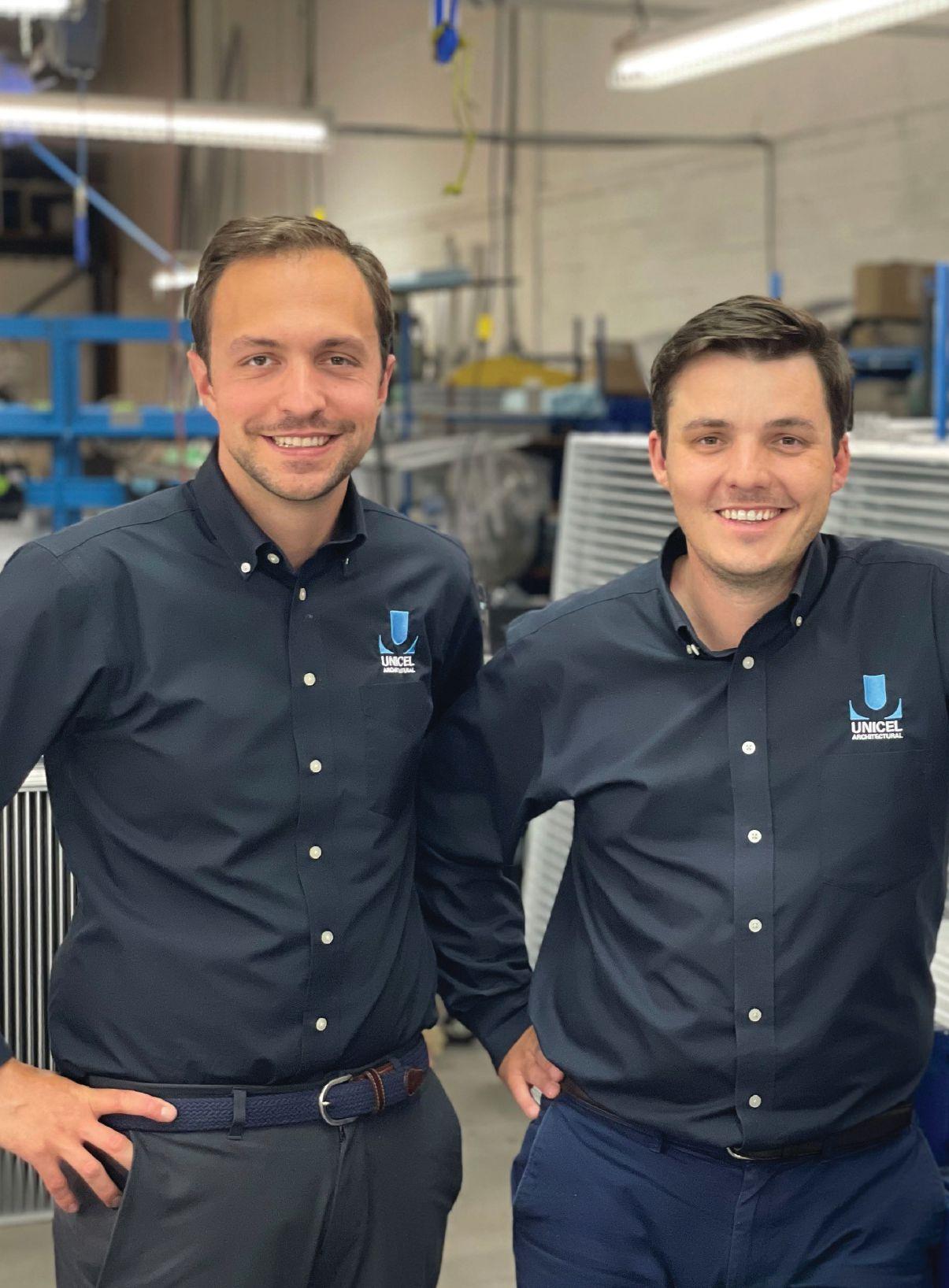
Curious, competitive, driven, fearless – these words best describe Vincent Couturier and Samuel Doyon-Bissonnette, who became copresidents at Longueuil, Que.,-based Unicel Architectural in January 2022.
Started in 1964, Unicel Architectural has been transformed into a maker of unique glass, timber and aluminum products that are used in highly-specialized building projects in the U.S. and Canada. Couturier and Doyon-Bissonnette are continuing to lead the company in a time of explosive growth and innovation. They are stepbrothers who have known each other since childhood.
Couturier is a mechanical engineer and has always been entrepreneurial. During his degree, he completed three internships at Unicel Architectural, where his father was owner. He had also made Canada’s national fencing team and was competing at World Cups. “I was highly competitive and had a fearlessness to compete, to perform and get greater results than before,” he says. “That’s still a big part of me. Since I started full-time in 2015, every day I want to deliver better than expected. And to learn from mistakes. We have made mistakes, everyone does, but they are very valuable because you learn and grow from them. That philosophy comes directly from being a high-level athlete.”
Doyon-Bissonnette is also an engineer, civil in his case, and is driven to dig into problems at the same time he harnesses his natural urge to question conventional solutions. “I like to examine problems thoroughly and look at all the angles to get a thorough understanding,” he says. “I don’t generally accept the
rules of thumb. I want to make new rules and find new solutions for problems. Challenges are what makes life interesting.”
Doyon-Bissonnette enrolled in a master’s degree at Concordia University in order to get a solid background on building envelopes (and Unicel Architectural has actually collaborated with engineers at that university over many years). “We find that the area of building envelope has been very open to change with lot of opportunities to innovate,” he says. “People were and are wanting to invest in new solutions, better insulation, new types of glass and many other exciting things, and that’s what draws me to it every day.”
Doyon-Bissonnette started out at Unicel Architectural as a project manager and then became director of engineering. Couturier started as a production engineer and became production manager. In 2020, they were in a meeting and looked at each other. It was time for them to do the buyout.
“We got the financing and it’s been full steam ahead,” says Couturier. “Following the acquisition of IC2 Technologies in 2018, we now have two plants, Longueuil and Portneuf, which allow us to adapt very fast and keep on developing new products,” he says. “We’re having a lot of growth right now. We have hired a PhD to head our R&D and we’re integrating photovoltaics into the business.”
“There is a huge demand for thermal technologies, for new products to meet the demands of tomorrow,” says Doyon-Bissonnette. “We are able to create highly customized solutions for designers and architects for unique projects all over North America. We are very specialized and we take pride that we can do projects that no one else can.”
by Treena Hein
Employees at High Performance Glazing know they can count on their vice-president, Ameet Bality, for many reasons. He’s always there for them, he shows appreciation for them and he knows the exact types of challenges they can face because he started on the shop floor. Bality had worked part-time at Regal (HPG’s parent company, a window firm co-owned by his father) during high school and university, and when a job came up at HPG about 12 years ago, his father urged him to give it a chance.
“I thought I’d have a career in computers, but I had liked the glazing industry, particularly the automation,” he says. “I cut

glass, then did delivery, ran the tempering oven and then went into purchasing. Then I did two years as sales manager and about four years ago, became vice-president. It’s really good to know the whole process.”
During Bality’s time as vicepresident, the HPG plant footprint has doubled. Bality has modified the entire plant layout to improve efficiency and added significant automation. Putting the skills needed for all that aside, Bality also understands the value of those he leads. “My team is really great, from the office to the plant floor to the shippers,” he says. “You are only as good as your team. I hope that they enjoy working with me. We have a good atmosphere where we show our team regularly that we appreciate them. And we continue to grow and they are happy about that security.”
They also know that if something happens with a machine or an order, Bality is always willing to do whatever needs to be done. He’s hopeful that in the next five years or so, he’ll be able to help design a second facility, taking HPG to new heights.
by Daniel Reale-Chin

On July 3, 2001, Cameron Wright began his first day of work at Alpine Glass. “It was a Monday,” Wright recalls, “the week before I started – the day after I graduated highschool actually – I got a call from Norm Post, who was the manager of Alpine Glass at the time. My dad worked there at the time and told him I needed work for the summer.”
Wright’s father, Allan Wright, wanted his son to go to university in September, but for the summer father and son would work side-by-side and Allan would teach his son about the glazing industry. Twenty-one years later, Wright, now 38, is still at Alpine Glass employing 21 years of knowledge as the senior field superintendent and is now a partial owner of the company.
“My dad didn’t want me in the trade because he lived through the ‘80s and saw how hard the industry could be,” says Wright. In fact, Wright took his father’s advice and spent two years studying nuclear physics at the University of Calgary. “High schools have this bad habit of churning people to universities rather than the trades. But it wasn’t for me. As soon as I finished my second year, I decided to go back to Alpine full time,” says Wright.
His first full-time stint at Alpine was as a shop fabricator, a
position that Wright spent three years in. “As a shop fabricator, I worked with two of the best guys in the industry, Brian and Travis Berends, who taught me everything they knew about glass fabrication,” says Wright.
After three years, Wright went on the road with Ken Lee, who he says was a very experienced service man. “I learned a lot of lessons selling with Lee,” says Wright, “but the biggest lesson was probably how to deal with people. I learned how to work with customers and manage their expectations. In the five years I spent traveling with him, I probably learned all there is to know about customer relations.”
In 2004, Wright started in the government of Alberta’s apprenticeship program at the Southern Alberta Institute of Technology and in 2008 got his journeyperson accreditation and Red Seal. After that, Wright got the keys to a truck and was given a partner to start running his own small projects. “By 2009, I was running some of our largest projects on the books,” says Wright.
“I don’t think I could have been successful in that position without some of the partners I worked with along the way, people like Dawari Miadonye, Skyler Swaim, Tayler Dalzell and Dave Beckner, who all helped in my own success,” says Wright.
In 2009, Wright started as the field superintendent at Alpine Glass and stepped into ownership in 2015. “My day-today tasks have evolved since then. Each day brings something new, but I start every morning the same: I walk the shop, see what material is out there, what material’s come in and see what the staff are working on. I go meet with each crew member daily and see if they need anything and then I sit down with the project managers to ensure they have everything they need to get their jobs done,” says Wright. With around 20 team members under him, Wright’s day can be very busy, but he values the people around him.
After managing people all day at Alpine, Wright goes home to spend time with his wife and his six-year-old daughter. He’s also very involved with Alpine’s summer league hockey team, with his local union (Local 177, District Council 17, IUPAT Glaziers) and runs a small honey farm with his cousin, Colin Wauthier, who also works at Alpine. “We produce around 600 pounds of honey a year,” says Wright.
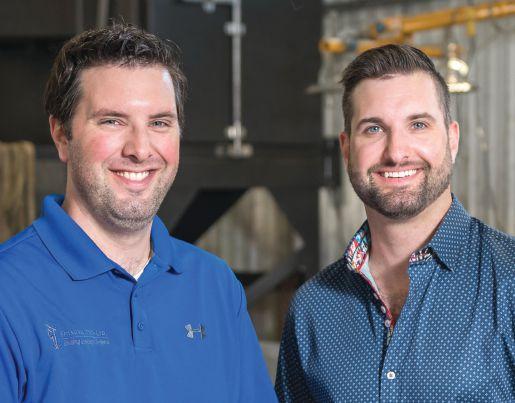
It’s no surprise, when you look at their drive to succeed, abilities and family values, that brothers Corey and Blake Sanders continue to lead Spandreltech to new heights. Corey is now vicepresident of operations, and Blake vice-president of finance, at the company founded by their parents Irene and Wesley in 1991. Irene’s parents had immigrated from Germany and started a metal fabrication business, which soon expanded into panelling, backpans and more. In 1991 Irene and Wes created Spandreltech and the company now serves markets across North America.
Corey was destined to join Spandreltech, as he has quite literally grown up in the shop. By 16, he worked at Spandreltech before and after school, on weekends and ran the night shift during the summers. “It has always been important to me that I know how to run every machine in our shop and our production
manager, Brian, has always encouraged that,” he says. “In high school I did a co-op at Spandreltech and learned CNC programming. This has been the most valuable skill I have ever learned, and I owe a great deal to our head programmer, Brad, for all he has taught me. While working towards my diploma, I worked remotely. Dad would email me drawings, I would do the DXF panel layouts and send them back.”
Blake enjoyed the business and worked on nights with Co rey during high school. He studied kinesiology at university and
had planned to make that a career – until third year. “I realized the opportunity I had that so many other people do not,” he says. “I’d learned ordering and business financing already and excelled in math in school, so finance was naturally a great fit for me.”
At that point, Blake knew the basics but still had a lot to learn. In 2014, when their parents were in a serious vehicle accident, Blake (20) and Corey (23) jumped right in. “We had to take the ball and run with it overnight,” says Blake. “We’d propped each other up. We knew we could count on each other and we still do. We both can and will do whatever it takes to get it done. That includes rolling up our sleeves and getting our hands dirty.”
During COVID their perseverance was again tested. “We were feeding nine assembly lines in North America,” says Corey. “We had many sleepless nights. We had employees and customers looking at us for answers, relying on us to know what to do next. Fortunately, several of our projects were medical facilities and we were declared an essential service.”
Corey and his wife Christina have two boys and Corey jokes that he already has a future brake-press operator and front office administration. Blake is engaged to Jessica and they are also planning for their future.
by Daniel Reale-Chin
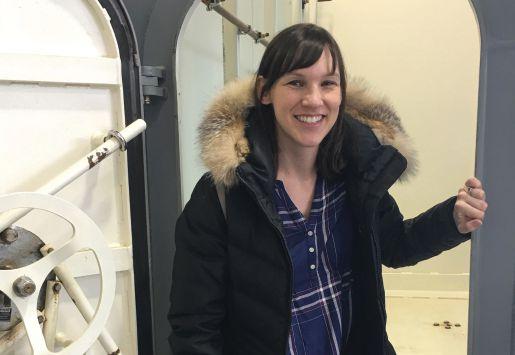
If there’s one thing that defines Aynsley Dueck it’s a passion for learning. After growing up around window and door displays in her father’s Winnipeg company, Duxton Windows and Doors, she moved to Vancouver to carve out a life of her own. It was in October 2012 that Dueck, 34, returned to the plains of Winnipeg and took her spot in the family business.
“I don’t think you should ever just work for your parents,” says Dueck. “I think you have to know what it’s like to not be related to your boss.”
In the 10 years that she’s been at Duxton, Dueck’s role has evolved from a position in marketing to her current position as operations manager. Since 2012, she’s leveraged the marketing skills she learned at the Art Institute of Vancouver and her business degree from the Asper School of Business at the University of Manitoba to grow Duxton’s presence in the fenestration industry.
From the start, Dueck knew she would have to take some punches when she came into construction. “When I started, my dad told me to tear down the website and do it again, tear down the showroom and do it again and I think that was really important because it taught me to speak the language of specifiers, of building envelope engineers and of homeowners.”
It’s that type of baptism by fire that Dueck says has shaped her into who she is. She learned from the bottom up, rebuilt systems and structures to better understand them and gained the depth of knowledge she needed to genuinely understand the science and design that goes into window manufacturing. An operations manager, Aynsley uses her penchant for detail to refine the manufacturing process. In fact, she says that her attention to detail is one of her greatest strengths in the business, “I know that it’s very easy to drown in the details if you’re not careful but I know just how much details matter in window manufacturing.”
Her meticulous nature and background in business led Dueck to studying the ways of Continuous Improvement and grasping the importance of Lean manufacturing. For the past sixplus years, Aynsley has played a sort of alchemist, using the principles of CI and Lean to fine-tune Duxton’s manufacturing processes, shave off redundant steps, reduce waste in the operations procedure and turn seconds of saved time on daily tasks into saved minutes over the year and saved dollars over the long-term.
“Early on, Aynsley quickly understood the critical importance of performance testing through lab and onsite testing and has been closely involved in that process,” says Al Dueck, Aynsley’s father and owner and president of Duxton.
Over time, Aynsley has gained a deep appreciation for working with her father. “He gives me the time that I need to be a mother, to be a wife and still be challenged here at Duxton,” she says.
When she’s not continuously improving the manufacturing process at work, Aynsley spends time with her son, decorates cakes and is also a huge soccer fan.
Daniel Reale-Chin

At 37, Jonathan Brosseau is a powerhouse. His titles are many including president, CEO and founder of Groupe Brosseau Vitrerie, as well as vice-president of the Quebec glass association, AVFQ. Now Brosseau is also pursuing an intensive entrepreneurship program at Ecole d’Entrepreneurship de Beauce.
Despite his accolades, Brosseau retains a sort of humility, “I’m really happy for this nomination,” says Brosseau, “because it took a lot of hard work to get here. It also makes me realize that I’m still very young to be the leader of such a big company.”
Brossseau was even younger when he first started Groupe Brosseau in 2011, at the impressive age of 24.
“I started Groupe Brosseau after five years of working in glass installation for another company. I wanted it to be an innovative company with good values that focused on the well-being of its employees,” says Brosseau.
This year, the Blainville, Que.-based company was listed among the top 10 biggest employers in the glazing industry in Quebec – 11 years after Brosseau started it.
“The story behind Groupe Brosseau is a story of teamwork,” says Brosseau, who credits the people he surrounds himself with, their shared values and the company’s partner-suppliers with the steadfast growth of the company.
Brosseau’s humble beginnings in the glass industry started at 17. Before that, he says he was always surrounded by glaziers.
“I have family that work in the industry on my mother’s side. What attracted me to the industry is how glass finalizes everything. Glass makes a building look complete, it really adds that wow-factor. Everybody is attracted to glass when they look at a building,” he says.
As for learning experiences, Brosseau says the biggest lesson he’s learned is the importance of relationships with clients and suppliers and staying up-to-date with what is happening in the industry. His role as vice-president of the AVFQ is something that’s also given him an ear-to-the-ground on industry happenings and trends.
“I got that role two years ago because I wanted to be more invested in the industry, to learn more about all the problems and the new practices in the hope to be able to transfer all of that information to my team,” says Brosseau.
His involvement with the industry is something that’s felt by the employees at Groupe Brosseau.
“Jonathan has a really big heart and gives everything he can offer to his team. He is appreciated by all,” says Vicnent Quessy, project director at Groupe Brosseau.
As Brosseau has grown into his position as leader, he’s made it a priority to give back to his community. He’s made it a goal to empower the younger generations in the glazing community and supports them with the scholarships he provides to students from Centre de Formation le Chantier and Study Center Professionnelles Saint-Jerome, two professional schools in Quebec.
As for down-time, Brosseau says he spends most of it sleeping.
by Daniel Reale-Chin
Laura Little, 35, followed an unconventional path to glazing. From early on in her career journey, it’s clear she inherited her parents’ entrepreneurial spirit, using a university degree in developmental psychology to start her own business as a doula.
After six years helping mothers give birth and couples start families, Little heeded the call home – back to the familial nest and the family business. In 2015, Little left the nativity scene and joined her family at Goldray Glass, where she grew up.
“As much as I tried to blaze my own trail I ended up back in the glass industry, which I’m so happy for,” says Little. Her parents started Goldray Glass in 1985 – a couple years before she was born – which Little’s thankful for, because otherwise, she says she would have never thought of a career in glass manufacturing. “I grew up in a glass factory, so I learned a lot by osmosis.”
Her formal career at Goldray began in marketing, where she nurtured the family brand and fostered its image as the marketing and communications manager. Nearly a decade later, Little recently assumed the position of vice-president of sales and marketing. “I stayed because I saw an industry full of genuine, supportive and good-quality people,” says Little.
In her new position, she’s busy. Our first call was interrupted by the sound of announcements over an airplane’s PA system. Laura was on a flight back from San Francisco, where she went to represent Goldray. Since joining, Little has promoted the brand across North America. She often travels across Canada and to the U.S. and spends her day solving problems and growing Goldray’s footprint. “We work with architects in the U.S. and Canada, so it’s my job to make sure we’re being true to who we are, no matter who we’re interacting with,” she says.
In the time she’s been at Goldray, Little has also seen interesting projects from
thought to finish. One that stands out is Goldray’s installation at the Union Station bus terminal on Bay Street in Toronto. “It was the first big installation of our framed wall-cladding system. I got to watch the project being born from ideation to finish. The team was working with a new product and there were huge risks and headaches along the way, but watching the way my brother, the architects and the glazingcontractors solved problems together was fascinating.”
Despite the daily meetings, crossborder collaboration and the teams she manages, Little is able to retain a certain poise, even in the midst of voyage. She says her confidence is a quality she got from her mother, Cathie Saroka, who is executive chair at Goldray Glass. “She’s been in the glass industry since the ‘80s. Back then it wasn’t easy being a woman in the construction industry. She had to be confident, bold and an expert to get the respect that the men around her were given. At the same time, she retained her lovingness, her kindness and her patience.”
At home, Little does her own childrearing, raising a family with two kids and a dog named Archie. In the future, Little says she wants to keep pushing the industry. She wants to make life easier for glazing contractors, grow the company and make Goldray Glass the recognized household name for decorative glass.

by Daniel Reale-Chin
Ryan Spurgeon always imagined he’d become a doctor. He was following a straight path until he was 17 – to Dr. Spurgeon – until an accounting class in his final year of high school changed his trajectory from medical school, upended a couple of early-acceptance offers from multiple pre-med programs and started his impassioned pursuit of business.
“There was something about the simplicity of accounting that made me fall in love,” says Spurgeon, now 34.
In February, 2005, while in his first year of university, Spurgeon found parttime work doing office jobs and accounting for Paul Brown, president of Barrie Metro Glass. At Barrie Metro, the accounting work was easy, according to Spurgeon, and what started as a part-time office job evolved into working in nearly every part of the back office, front office, manufacturing floor and eventually led to him being on the road, doing glazing installations. “We all start somewhere, but my journey started with installing shower doors with two hinges and a handle,” says Spurgeon.
Spurgeon spent his summers following Brown’s lead, doing installations for Barrie Metro on commercial projects. In the winter, he balanced a a full slate of classes in university with his office duties at Barrie Metro. While working there he learned the estimating, sales and project management aspects of the commercial glazing industry. “The four years I spent doing that were chaos, I made more mistakes than I want to admit, but I was always given the rope to learn,” says Spurgeon. “But those years and learning have done more for my career than anything I’ve done since.”
In fact, Spurgeon credits Brown, who encouraged him to learn to do everything himself, as one of the three greatest mentors in his career. “Working for a small family business forced me to learn every job in the trade. What I learned there was invaluable and something that I don’t think I would have been able to get in larger process-driven corporations where everyone has a defined role,” says Spurgeon.
The other two mentors are Steve Gusterson, vice-president of sales at Alumicor, who took his time to teach

Ryan Spurgeon challenges employees with a simple answer to any question: “No. Why?”
Spurgeon how to navigate the aluminum side of the industry and provided him introductions at every level of the industry, and Dan Muccelli, a manager (since retired) at ProTemp Glass, who he says taught him everything he knows about glass coatings, technology, limitations and capabilities. Spurgeon notes, “I just kept asking questions and they kept giving answers. Too often people are afraid to ask for fear of failure, but that’s part of being mentored – put yourself out there.”
Spurgeon started the next phase of his career at OldCastle Building Envelope in 2015, at the tender age of 27. “What pushed me toward OldCastle was their global locations and diverse portfolio of businesses. My wife and I watched too much Anthony Bourdain at the time, and I was sold on the idea that OldCastle/ CRH could take my career around the world one day.”
In 2019, after a string of mergers and acquisitions, he found himself as the president of Antamex Industries, a title he currently holds. Since then, he’s worked hard to build Antamex’s business profile, repositioned it for the
future as a modular-facade company with multiple product lines and works to expand the company’s footprint.
As a leader, Spurgeon prides himself on a philosophy of giving broad responsibilities, letting his staff surprise him with their outcomes. He pushes his team by answering their requests with “No. Why?”, encouraging them to advocate for their vision. He also maintains a Don’t Do It Again book, compiled of lessons he’s learned from his own failures, witnessed failures of others on his journey and fixes over the 17-years he’s spent in the glazing industry.
Despite the hiccups early on in his career, Spurgeon is passionate about the work he does and the industry he stumbled on.
“What sucked me in, what made me fall in love, were the bigger projects. They’re tangiable. You can drive around the city and say, ‘Look, I did that,’” he says.
When he’s not busy at work, Spurgeon spends time with his wife, Rebekah and sons, Xander, who’s 10 and Holden, who’s eight. He’s is an avid skier, coaches his sons’ lacrosse and sits on two charity boards. •

by AMY ROBERTS
To prevent accidents, every plant should establish a safety culture that combines training with enforcement. To facilitate establishing such a culture and implementing an effective preventive program, FGIA has developed the publication IGMA TM-5000 Do’s and Don’ts of Glass Safety, a compendium of safety assessment procedures and safety measures for every stage of a glass fabrication operation. It is based on ASTM E2875 Standard Guide for Personal Protective Equipment for the Handling of Flat Glass and recommendations from the U.S. OSHA and the National Safety Council as well as the direct experience of FGIA members.
The goal of the safety program is to provide a framework for an insulating glass manufacturer to develop a safety program in their own unique facilities. This framework includes the typical insulating glass fabrication facility flow chart with internal references to the relevant sections within the manual: hazard risk assessment, which includes identification of hazards germane to each job and workstation task; assessing the level of severity and probability of occurrence for each risk; prioritizing; identifying appropriate controls; and monitoring results. Example assessment forms are provided. It also includes recommendations for PPE for each operational section and best practices for material handling, such as the appropriate way to carry glass. A table is also provided indicating the weight of a glass sheet given its dimensions and thickness. It also shows those weights considered safe for handling by an individual and those that require a team or mechanical equipment to lift and move. It includes other potential safety issues, such as what to do when there is broken glass in the middle of the glass pack and conducting periodic safety audits
Observing proper glass handling techniques is a major aspect of safety in any workplace where large volumes of glass are handled daily.
that include reviews of records and a system to correct deficiencies.
Recommended PPE and a list of best safety practices are listed for each step of specific operations: glass receiving and storage; tempering furnace, cutting; seaming and washing. A table of hazards is given for each step of the operation.
Developing a thorough safety program begins by establishing management policies and procedures for assigning responsibilities; establishing work practices through job safety analysis and preventive maintenance; implementing a training program; establishing a means of reporting and reviewing observed hazards and accident near misses; and conducting safety audits.
“Do’s and Don’ts” summaries are given for:
1. Housekeeping and walkway safety (visitors and plant personnel)
2. Use of glass racks pre- and post-assembly
3. Working around moving vehicles and robotics
4. Receiving new glass shipments and storage
5. A glass-movement optimizer for within the plant between work stations
6. Insulating glass unit assembly (including proper handling of desiccant, spacers, and sealant)
7. Racking, packaging and shipping
The manual also includes a safe practices for glass handling checklist, suitable for posting in the workplace. It covers how to hold, carry and securely store sheets of glass; handling of broken shards; and awareness of the surroundings and potential issues. Other working examples include a sample job safety analysis and a glass-handling checklist.
Observing proper glass-handling techniques is a major aspect of safety in any workplace where large volumes of glass are handled daily. FGIA suggests that by using TM-5000 as a roadmap, each manufacturer can evaluate their own operation and develop safety measures to ensure a safe work environment. IGMA TM-5000 may be purchased in the FGIA Online Store by visiting fgiaonline.org. •
by AL JAUGELIS
The Canadian fenestration industry is welcoming a code change that is the culmination of an eightyear effort to lift long-standing and outdated restrictions on combustible window frame materials.
The 2020 National Building Code, published in March 2022, amends Sentence 3.1.5.4.(5), removing the restrictions on the spacing and overall area of combustible window frames that had remained unchanged since 1965. These restrictions were historical artifacts that had long ago ceased to be relevant. The code change proposal was filed by a consortium of Canadian manufacturers and profile suppliers and was supported by a research and testing program designed and executed by the National Research Council .

A years-long initiative culminates in code changes that open up new design possibilities.
This initiative to amend the code actually began with the NRC reaching out to the Canadian window industry to fund research that could lead to a code change. They did so after being approached by several Quebec manufacturers that had conducted informal fire testing of wood, aluminum and vinyl windows that showed frame material did not materially influence the growth or spread of fire, and therefore questioned why the restrictions
on combustible window frames had remained in the code. NRC appreciated that the industry had legitimate concerns and sought a suitable opportunity to engage with stakeholders.
Fenestration Canada provided the NRC with a venue, an open-industry meeting held during the WinDoor trade show in Toronto, in November 2014. Phillip Rizcallah, the director of building regulations and manager of the Canadian Codes Centre at the time, frankly acknowledged that the fire provisions of
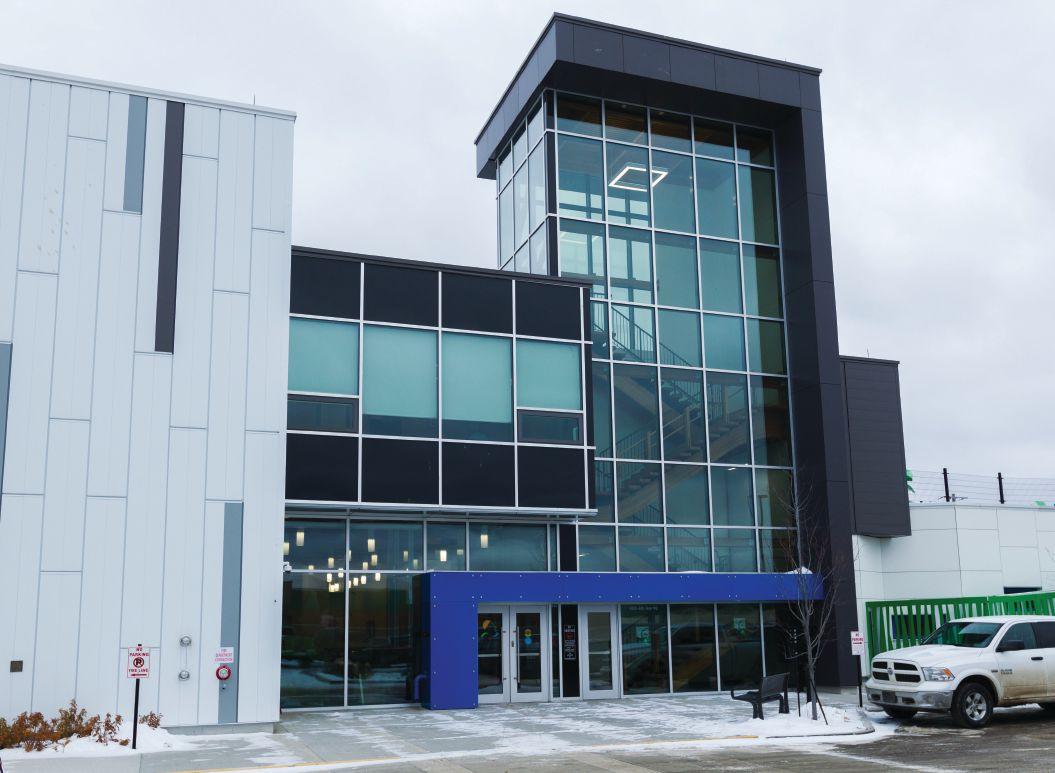
ABOVE: Cascadia’s product was used at The Chelsea in Vancouver, B.C.
the code “needed to be modernized” and invited the industry to fund a research project that could support an industry-led code change. With him was Peter Senez of Sereca Fire Consulting, who presented the historical background of the restrictions in Sentence 3.1.5.4.(5) and sketched out the outlines of a research program that would include full-scale fire testing to ULC CAN-SS134 Standard Method of Fire Test of Exterior Wall Assemblies
Discussions between Fenestration Canada and NRC continued through 2015 and, in February 2016, a consortium of 11 funding stakeholders accepted a costed testing proposal from NRC.
The consortium members engaged a consultant-representative to work directly with NRC researchers on their behalf and to prepare a code change request in parallel with the testing program. The code change request was filed on August 30, 2016, and was presented to the Standing Committee on Fire Protection (SCFP) on Sept. 29 of that year. In response to the consortium representative’s presentation, several standing committee members agreed that this code change request was relevant and timely and volunteered to strike a working group to keep this code change on the agenda and to monitor the progress of the NRC test program.
The test program included ULC CAN-SS134 testing of both combustible and non-combustible floor-to-ceiling window assemblies in a multi-storey arrangement. It was completed in March, 2018, and, several months later, a proposed change (PCF 1355) was issued in time for the fall 2018 public review of proposed changes to the NBC. The proposed change – drafted by the SCFP, not the industry – went beyond the initial code change request to simply remove all existing restrictions on combustible window frames.
PCF 1355 proposed to amend Sentence 3.1.5.4.(5) in the 2015 NBC by striking out the following restrictive clauses:
5) Combustible window sashes and frames are permitted in a building required to be of noncombustible construction provided
a) each window in an exterior wall face is an individual unit separated by noncombustible wall construction from every other opening in the wall,
b) windows in exterior walls in contiguous storeys are separated by not less than 1 m of noncombustible construction, and
c) the aggregate area of openings in an exterior wall face of a fire compartment is not more than 40 per cent of the area of the wall face.
Following the public review, the proposed change was approved at the April 2019 SCFP meeting with a single amendment to address a concern raised by several parties that the proposed change should not permit curtainwall or window wall assemblies composed of continuous, end-to-end combustible framing members.
Here is the amended Sentence 3.1.5.4.(5) as it is present in the 2020 NBC:
5) Combustible window sashes and frames are permitted in a building required to be of noncombustible construction, provided they are vertically non-contiguous between storeys.
The Merriam-Webster dictionary defines contiguous in this way: “1. being in actual contact: touching along a boundary or at a point...4. touching or connected throughout in an unbroken sequence”.
It is interesting to note that at the time this proposed change was being debated at the Standing Committee on Fire Protection, two Canadian manufacturers introduced to the market combustible products some public review commenters were concerned about.
In July 2018, GlasCurtain announced that their GlasCurtain 134 fiberglass curtain wall was successfully tested to ULC CAN-

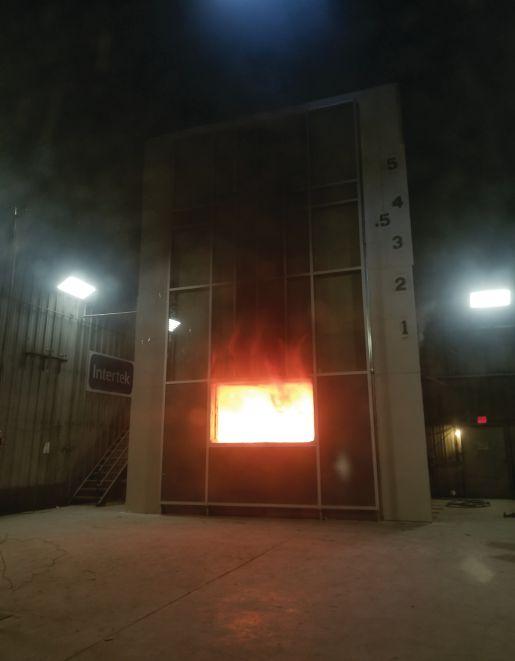
SS134 Standard Method of Fire Test of Exterior Wall Assemblies, the same test that was used for the combustible windows test program.
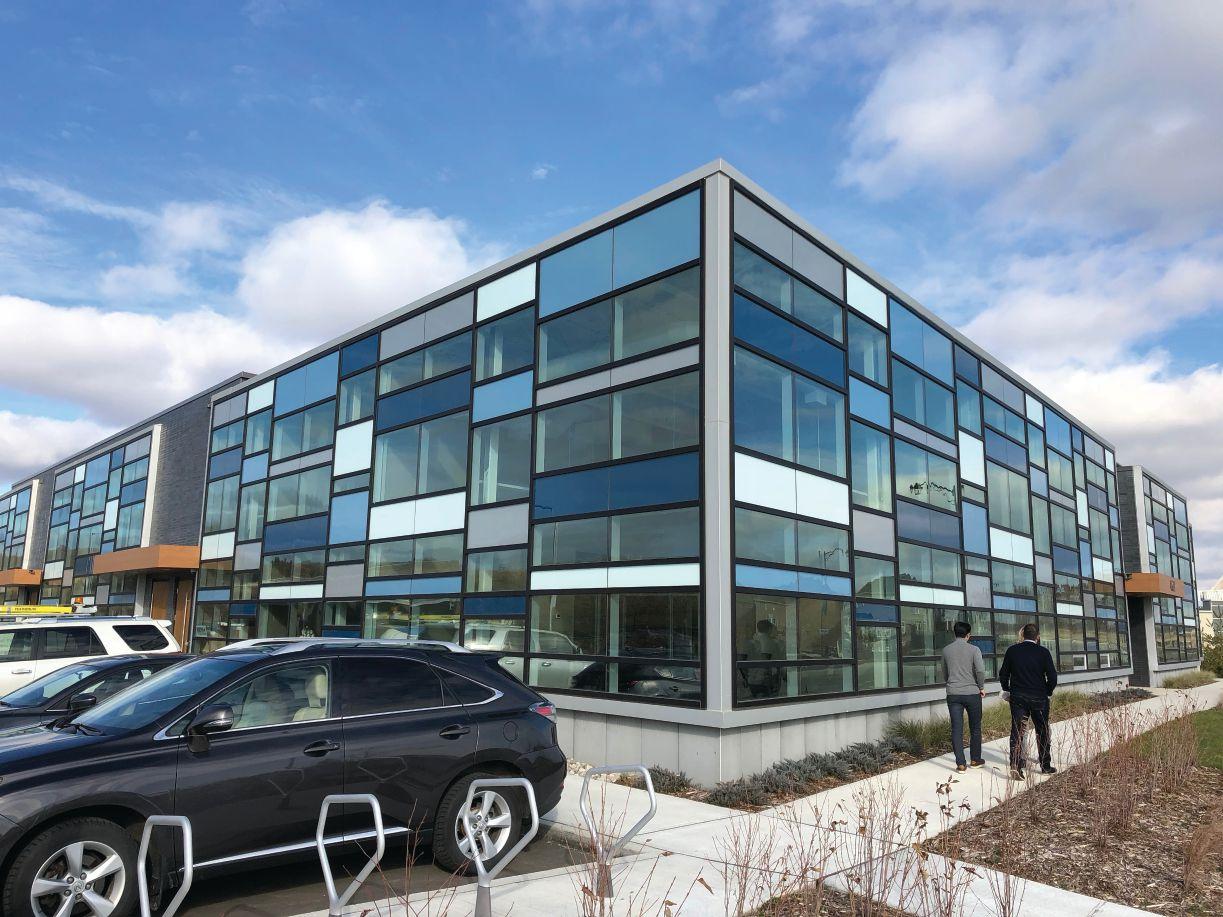
In 2019, Cascadia Windows announced the successful delivery of all-fiberglass window wall products to a high-rise building site in Vancouver. The Cascadia product has the appearance of being a contiguous window wall assembly, but in fact has noncombustible slab-edge spandrel covers, complying with the 2020 NBC.
It could take up to two years before all provinces and territories adopt the 2020 NBC. In this code cycle, provinces have committed to harmonize with the national model code and to avoid or minimize deviations. In the meantime, interested parties could consider following the alternative solution option in the code, relying on the 2020 NBC code change as being sufficient grounds to address fire growth safety concerns implied in the original wording of Sentence 3.1.5.4.(5) that are no longer recognized to be valid.

About the author
Al Jaugelis was a fenestration specialist at RDH Building Science at the time he was engaged by a consortium of Canadian fenestration suppliers to manage the combustible windows testing program and the combustible windows code change initiative. He is currently the director for regulatory affairs at Fenestration Canada. •

by DAVID HESKA
David Heska, P.Eng. is a director with WSP’s building sciences team in southwestern Ontario. david.heska@wsp.com.
As we enjoy the warm weather of a Canadian summer I thought I’d take the opportunity this month to write about a few hot topics that have been on my mind inside and outside the workplace. Here they are in no particular order: inflation, recession, shortages and regathering.
First, let’s address the elephant in the room: inflation. In the past few months we’ve gone from 5.1 percent to 6.7 to 7.7 percent and who knows what’s next. The Associated General Contractors of America has issued a construction inflation alert that the change in price for new non-residential construction inputs went up 21 percent and bid prices went up 17 percent from September 2020 to February 2022. We should pay attention. We’ve all seen the dramatic rises in glass prices announced in early July. I won’t claim to have the answers to this dilemma but we should all be aware of the economic times we find ourselves in. It’s a bit of a rollercoaster right now, with more up then down and it’s not likely to calm down any time soon. We know what happens when prices go up: they go down very slowly if at all. My guess is we are all going to have to plan for higher costs as part of our business models going forward.
That leads to the next topic: the R word. For those who want the formal definition, a recession occurs when real GDP growth is negative for two successive quarters. We are not there yet – we haven’t even had one quarter of negative growth – but some are saying it may be on the horizon. Others claim we are still in a period of bounce-back growth after the pandemic with
To me it seems that the pendulum has started to swing back to normal, or maybe we’re just getting used to this reality.
unemployment at an all-time low; which are not typical signs of a coming recession. Either way, it’s still fair to ask whether or not your business is ready when the next recession comes. How resilient are you, your team and your client base? While the low unemployment numbers are usually taken to be a good sign for the economy generally, in our industry they have signalled a near-impossibility to find the qualified help we need in order to grow. Companies not growing means economies not growing...which is the definition of recession. We are used to recessions coming from the demand side with customers not wanting to buy enough of what we want to sell, for whatever reason. This situation where there’s lots of demand but we can’t take the work is weird, and I worry that rising prices will soon add a demand problem to the mix.
Third, let’s talk about shortages. I recently read an article about a distillery in Ottawa reusing maple syrup bottles due to a shortage of glass bottles. For the past two years all of us in the window and glass industry have been trying our best to make do with what we have. Schedule and delivery delays have become regular, and, like this distillery, we have all had to be creative. To me it seems that the pendulum has started to swing back to normal, or maybe we’re just getting used to this reality.
Finally, the subject of regathering. Recently I was together with over 70 people at a restaurant in Toronto celebrating our colleague’s retirement. There was something about having people together from different cities, different offices, some interacting face-to-face for the first time and others reconnecting after two-and-a-half years apart. Virtual calls are helpful, but the personal interaction can not be replaced. This coming fall as employees return from summer vacations it’s my prediction that socials, outside of the formal nine-to-five office setting, will increase in popularity and importance.
With that I’ll sign off and wish you an enjoyable rest of the summer. These hot topics are going to be with us for the next while, so let me encourage you to unwind and cool off. Enjoy the pool, the beach and a cold beverage. Until next time. •
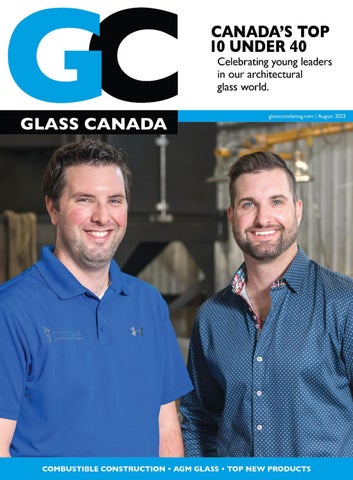
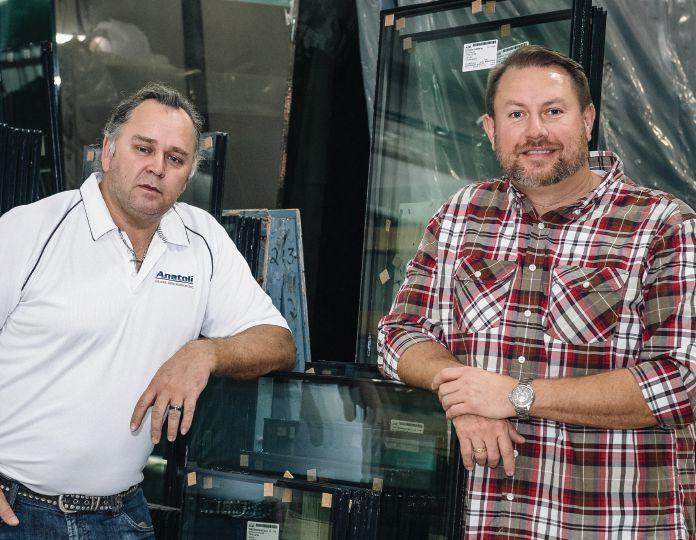
Anatoli Schneider and Martin Kania. The wunderteam says they’ve found success in Manitoba through their relationships with their customers.
Founded: 2008
In 2008, a glass wholesaler and his client seized an opportunity in Winnipeg. Martin Kania started his career selling glass with Guardian Industries in Toronto about 20 years ago. In 2006, he went from Guardian Industries to Northwest Glass Products – a Triple Seal company – and made the fateful move to Manitoba, selling glass for the company in Winnipeg.
It was during his time as general manager for Northwest that Kania met Anatoli Schneider. “Anatoli was my customer, he would buy a block of glass every few months,” says Martin Kania, vice-president and co-owner of AGM Glass Fabricators. Schneider started his manufacturing career in Germany before moving to Canada with his family and getting into the PVC extrusion industry. When he and Kania met, Schneider was producing residential sealed units out of a small shop in Lorette, Man.
Triple Seal eventually left the Manitoba area, but Kania saw a market potential in the province and asked Schneider to partner up. “I approached Schneider and my exact words were, ‘How big do you want to get?’,” says Kania.
Years later, the two have built AGM Glass up from a 2,000-square-foot shop into a 46,000-square-foot manufacturing space, equipped with tempering ovens, a waterjet cutter and all the bells-and-whistles needed to manufacture customfabricated, insulating and tempered glass.
Owners: Anatoli Schneider and Martin Kania
Number of Staff: 45
Headquarters: Winnipeg, Man.
Facility: 46,000 square feet
Products and services: Commercial sealed-units, residential sealed-units, custom tempered glass, water-jet cutting, glass distribution and more.
Kania calls AGM’s original shop an oversized garage. “The shop was only 2,000 square feet, with about five of us working around one free-fold table and a 60-inch open-top washer; while doing everything else by hand.”
At the time, AGM’s payroll maintained a team of five, including Schneider’s wife, Alla Schneider, who fed the washer at the time. “Two people cut and moved the glass, two people washed and cleaned the glass and one person caulked. All in 2000 square feet. It was tight,” says Kania, with a chuckle.
AGM was producing about 10 to 15 sealed-units a day and Kania and Schneider gained a reputation with their Manitoba clients for being the rush guys, praised for the quality of their glass, brisk turn-around time and hand delivery.
“The other glass manufacturers in the area had 10- to 12-week lead times, so we were picking up the projects for clients that needed glass delivered on-site and within the week,” says Anatoli Schneider, president and co-owner.
As a team, Kania and Schneider have made a 16-year partnership by giving each other the space and resources to use their own strengths. “Schneider’s incredible at the machinery and equipment stuff,” says Kania. At AGM, Schneider focuses on the manufacturing process and equipment maintenance, while Kania uses his knowledge of the market in western Canada to find customers, drive business and make AGM profitable.
By 2008, the humble five-person team had outgrown the 2,000-square-foot garage. A team that would hand-make 10 triple-sealed units a day, grew to produce 70 pieces a day, and Kania and Schneider agreed it was time to expand. They found some land, got a loan from the bank, and by July, 2010, AGM had a new 15,000-square-foot building to call home.
“We only had enough money for used machinery at the time,” says Kania. “But, we needed more equipment so we could cut glass automatically.” They bought an XYZ cutting machine and an 84-inch washer, but still applied the spacer and assembled the sealed-units by hand.
Looking back, Kania is still shocked about AGM’s growth in the first few years. “It was extremely busy. I was basically loading the truck, delivering sealed units and then coming back and doing it again. We went from being the rush guys who customers came to in an emergency, to being real fabricators.”
AGM’s second expansion came in 2014 with a 16,000-square-foot addition. Kania and Schneider decided to get into the tempering business and needed the space to fit a tempering oven and all the subsequent machinery. “Customers found out we were getting into the tempering business and we started getting calls from people asking when we’d finally start,” says Kania.
Kania and Schneider launched AGM into commercial insulating glass in 2014. With the expansion, they were able to give the company its first tempering line and the supporting fabrication equipment it needed, including a horizontal polisher, vertical polisher, a new XYZ cutting table and new waterjet cutters. They also expanded their Forel automated line, which allowed them to produce more in less time.
“With that second addition we were able to grow to what we are today,” says Kania. With the freedom of automation and the ability to temper, they were able to expand their offering. “We now manufacture sealed units for the residential and commercial markets, custom-fabricate glass for showers and railings and distribute glass of various substrates.”
AGM’s next and final expansion came in 2018, when Kania and Schneider added 15,000 square feet of manufacturing space to support the strong growth and demand.
Over the years, AGM’s customers have essentially stayed the same. The company prides itself on having all the equipment necessary to serve the Manitoba market and to dip into the northern Ontario and Saskatchewan markets. “We found that we’ve been successful because a lot of our customers look like us – blue-collar workers – based here, in Manitoba,” says Kania.
AGM’s been able to take on more work, and bigger contracts
since installing the tempering oven and Forel line in 2014.
“Our business went from being about 90-percent residential in the past to now 40-percent residential and 60-percent commercial since we purchased our tempering oven. With our equipment and material, we serve about 95 percent of our market’s needs” says Kania.
With new machinery like the Forel line, the Bavalone line, the Intermac machine, sand blasters, waterjets and polishing lines, AGM is able to cut intricate shapes in custom-fabricated glass, polish glass as thin as three millimetres and serve commercial and residential customers. They even cut glass for tractor cabs.
As for sourcing material, Kania leverages legacy relationships from his days at Guardian Industries to source glass. Quanex supplies the spacer and the silicone sealant comes from Dow Corning.
“Our sweet-spot has become the 2,000- to 20,000-squarefoot projects like police stations, schools and malls,” says Schneider.
A big project for AGM was renovating the RBC Convention Centre in Winnipeg, which was completed in 2016. The team worked along with some of the top architects and glazing contractors in the country for the project.
“We’ve spent years building strong relationships with our clients. And over time, they’ve trusted us with more and more of their projects. That’s the story with how we got to where we are now – building trust over time, and relationships,” says Schneider. •
Glass has manufactured tempered glass for showers, railings, entrance systems, interior partitions and architectural glass applications since 2007. • Tempered up to 96 x 144 • Custom Laminated up to 86 x 144
• Bent Tempered Laminated to 66 x 96
• Back Painted Glass • SentryGlas Lamination • Opaci-Coat-300 Spandrel

kawneer.com
Maximum transparency, optimal bird protection are the qualities Sedak promises from its new bird-protection printing on glass. Large-area glazing on buildings – regardless of how heavily structured it is – brings with it the risk of not being seen by birds. Reflections of trees or particular lighting conditions cause danger for birds as they have only limited spatial vision. The idea is simple: make glazing recognizable for birds without compromising the view for humans. Sedak has managed to achieve optimal collision protection, reducing collisions to 10 percent, while printing on less than two percent of the glass area. This has been confirmed by a scientific analysis performed by the internationally recognized institute, Collision Laboratories in Austria, which specializes in bird protection. The scratch and UV-resistant patterns are put onto the glass using digital printing. When it is further processed into laminated panes, the printing is on the outside. With Sedak’s technology, insulation and safety glass with highly effective bird protection can be created up to a format of 3.6-by-20 meters. The print comes in dots or squares variations that are arranged in a simple grid. Sedak also offers printing with precious metal colours. The printed image and colour tone have a discreet, elegant and esthetic appearance. The printing is also ideally suited to sophisticated architectural design.
agc.com
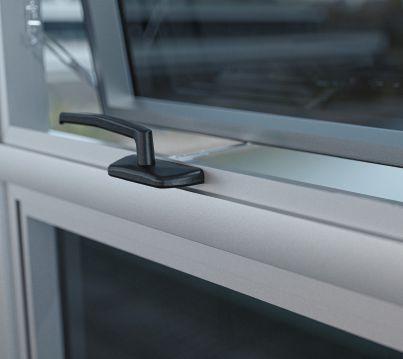
Kawneer recently introduced an ADA-compliant operating handle option for its Glassvent ultra-thermal project-out windows. This new option provides a solution to meet the Americans with Disabilities Act recommendation that operable windows require no more than a five-pound operating force while also providing a coordinating handle for non-ADA applications. It also features an esthetically pleasing design. The Glassvent windows are designed to provide fresh-air ventilation while maintaining thermal performance in curtainwall or storefront applications. With the new operating handle, the indoor air quality benefits of the Glassvent design do not have to be sacrificed to meet ADA requirements. The operating handles are laboratorytested and come with an easy-to-operate horizontal handle config uration, which comes in two sizes: a 12-inch handle size for ADA compliance and an eight-inch handle size for other non-ADA applications. The new design option incorporates the Omni Drive operator from Caldwell. The easy-to-use horizontal handle movement provides smooth, single-hand operation from the inside, while maintaining sleek, exterior architectural sight lines. The new ADA-compliant design provides an excellent solution for architects, engineers and designers who are required to specify windows with hardware capable of meeting the operating force and limited motion requirements or are looking for more inclusive designs. The Glassvent ultrathermal windows are also tested for air, water, structural, thermal and condensation performance.
AGC introduced two new thicknesses in its low-iron float glass range: Planibel Clearvision 15-millimetre and 19-millimetre. AGC’s Planibel Clearvision line is already used by architects and designers in projects that demand great transparency and the new products deliver the crystal-clear vision and total clarity count that AGC is known for. With the introduction of two new thicknesses, the Clearvision range now offers a wide variety of thicknesses ranging from three to 19 millimetres, enabling top designers and furniture makers to work with thicker lowiron glass for larger pieces. Planibel Clearvision is produced in Boussois, France and Cuneo, Italy. For the 15- and 19-millimetre versions, a special technology is used to ensure perfectly uniform thickness, making the glass easier to process (cutting, laminating, etc.). The product’s neutral colour is the same in all thicknesses. Planibel Clearvision is Cradle-to-Cradle-Certified Bronze. By committing to C2C standards, AGC can deliver high-quality products while protecting people and the environment. More than 75 percent of AGC’s products are Cradle-toCradle Certified.
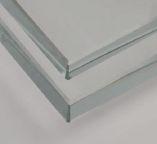
guardianglass.com

Guardian Glass North America introduced its Guardian Bird First etch glass. It comes in four distinct bird-friendly patterns made for exterior building applications. This is the latest addition to Guardian’s lineup of bird-friendly products, giving architects additional options to achieve different esthetics, maintain optimal glass performance and reduce the likelihood of bird collisions with windows. It’s all about flexibility with Guardian’s coated-glass lineup, which makes four different patterns on translucent glass. Guardian Bird First etch glass also includes threat factor scores to quantify collision-avoidance effectiveness. The products are available on Guardian’s UltraClear low-iron glass and standard clear glass and are meant to be paired with Guardian SunGuard SuperNeutral 68, SNX 62/27 and SNX 51/23 coatings on the same lite of glass, as part of an insulating glass unit. The glass can be heat-treated and used with laminated glass for safety and other benefits. Guardian Bird First etch glass is currently available in 96-by-30-inch sizes on six-millimetre-thick float glass through the Guardian Select Fabricator network.
vitroglazings.com
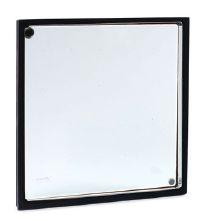
Vitro Architectural Glass has launched VacuMax vacuum insulating glass. The new vacuum-insulating glass units integrate traditional and advanced glazing systems to deliver great R-values with exceptional insulating performance. Vitro Glass gained an exclusive-rights agreement from LandGlass and VIG Technologies that made Vitro the exclusive provider of their high-performance tempered vacuum insulating glass products in North America. The new 8.3-millimetre tempered VIG units consist of two fully tempered lites of glass separated by a non-leaded metal seal and a vacuum space. The units’ slim construction and light weight allow them to be incorporated into virtually any traditional glazing system, window frame or curtainwall application. The units can enhance the performance of any insulating glass unit by significantly improving thermal efficiency, delivering insulation performance that is two to four times better than conventional insulating glass and six to 10 times better than standard monolithic glass. The units deliver an R-value of 14, which is closer to the R-value of a traditional wall than glass. The improved R-values will help with incentives to minimize environmental impact, from the new stringent energy code updates to net zero energy goals. The units are available with Solarban 60 solar control low-E coatings by Vitro Glass, which can further enhance the energy efficiency of the insulating glass unit. Vitro’s units can be used alone as a replacement for monolithic glass or as a substitute for the interior lite in a traditional oneinch insulating glass unit, where it forms a second airspace and creates a hybrid IGU that can achieve an R-value of 16. The units also deliver better noise abatement and eliminate condensation.










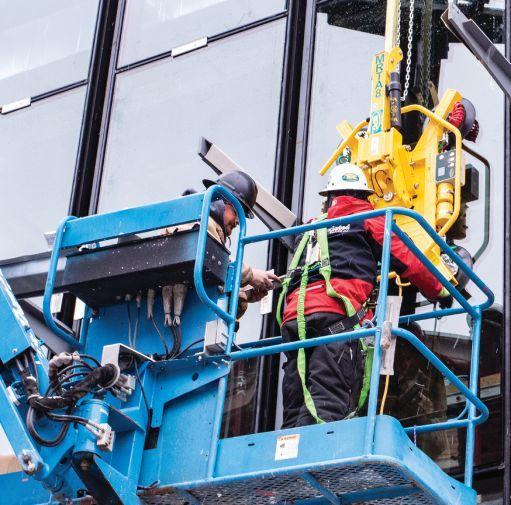




by RICH PORAYKO
Rich Porayko is a professional writer and founding partner of Construction Creative, a marketing and communications company. richp@ constructioncreativecom
For my entire life, I’ve managed my priorities in the same manner: whatever fire is burning hottest or whoever is screaming loudest gets the appropriate attention. With the use of a lot of lists and, more recently, Monday.com, it’s worked well but I still knew I could be more productive.
One of the authors I’ve discovered over the pandemic has been Mel Robbins. Mel is freaking incredible. In her flagship book The 5-Second Rule, Mel issues a “30-before-7:30” challenge that I found to be a productivity gamechanger.
The minute you wake up, the timer is on. Until I started practicing 30-before-7:30 last winter, my alarm would go off at 6:05 a.m. and I would intentionally lay in bed for 20 or 25 minutes, let the house heat up and jump into email, news and social media. Then I’d get ready, slam a large glass of Metamucil and attack whatever was most pressing in my day by around 7:00 a.m. Turns out, I’m not the only one that does this. Mel says a majority of adults check email before they get out of bed. Apparently, a third of adults wake up to check their phones during the night.
Do you think Richard Branson lays in bed and checks his email in the morning? Not a chance. He knows what he needs to be working on and doesn’t let his email tell him. Not lolling in bed is an obvious timesaver but I really didn’t realize was how distracting checking email and social media first thing is and how much it can throw you off track until I started this challenge. Checking email right away always just felt like a productive best-practice when I woke up. According to Mel, it’s actually more of an addiction similar what gamblers experience from pulling the arm of a slot machine. Every X times I check email, I receive good news or a “reward” that
Wrapping my head around the fact that wasting 20 or 30 minutes of my brain’s best performance has been a real wake-up call; literally.
THAT’S RICH
has conditioned me to compulsively check email. Obsess much? Yes, we do.
By spending 30 minutes before 7:30 a.m. devoted specifically to planning first, I’m giving my priorities a fighting chance. Robbins also says your brain is operating at peak performance for the first two to three hours of your day, giving you the optimum focus to plan tasks or goals without yet being bombarded by other people’s crap. She is absolutely right. Change my mind.
If you are waking up and spending the most productive time of your day on Wordle, you might want to think about pushing the games back until after work. As Robbins says, “Save the cat videos for later.” It’s not just using your brain’s freshest time of the day efficiently, it’s the political, health, celebrity and world news that you are inundated with as soon as you look at your phone. So instead of planning your priorities when you are at the sharpest you’re going to be all day, your time-sensitive mindshare is focusing on things it shouldn’t be.
Wrapping my head around the fact that wasting 20 or 30 minutes of my brain’s best performance has been a real wake-up call; literally.
What follows is my adaptation of Mel’s 30-before-7:30 challenge, that I am hereby passing to you:
1. Set the alarm for 30 minutes before you normally wake up. For me, it’s 5:35 a.m., which isn’t easy but my internal clock adapted quickly. Now I can’t turn it off.
2. The most critical part of the challenge is to get up immediately when your alarm goes off. This is non-negotiable. “Do not hit snooze. Do not look at your phone.” According to Robbins, when you hit the snooze button, it can cause sleep inertia seriously disrupting your whole day.
3. Get ready. Exercise or stretch if possible. Still no phone.
4. Tackle 30 minutes of planning before 7:30 a.m. without checking email or social.
a. What two things that matter most can you do to move forward today?
b. Organize the remainder of the daily/weekly priorities.
c. Run a short quarterly/yearly goal review if time allows.
5. Pick a quitting time for the day and stick to it.
6. Start working on the two things that matter most.
7. Read The 5 Second Rule by Mel Robbins. •