ACCouNT MANAGer Peter helston phelston@annexweb.com (905) 726-4666 Supplement of June 2015
In Co-operation with
(519)-376-0470 (866)-323-4362
eNerAl MANAGer Al Diggins • adiggins@emccanada.org
dIreCTor oF STrATeGIC PlANNING & CoMMuNICATIoNS Scott McNeil-Smith • smcneilsmith@emccanada.org
SeNIor CoMMuNITY deVeloPMeNT MANAGer Bren de leeuw • bdeleeuw@emccanada.org
Food & Beverage Powerhouse
Chew on this: The food and beverage sector generates $39 billion in economic activity and exports close to $7 billion in product annually.
That’s according to Food and Beverage Ontario (FBO), which also reports that the food and beverage manufacturing and agriculture sectors together generate more revenue annually than the motor vehicle manufacturing sector. In 2010, food and beverage processors comprised the second largest manufacturing sector in terms of value of shipments and employment in Ontario. In addition, the processor businesses are responsible for creating 132,000 direct, plus 172,000 indirect employment positions.
These facts are impressive and signal the collective strength of the sector.
One way to keep the momentum going is to be collaborative and share best practices. However, not all facilities are at the same level of maturity, and it’s up to each facility to set a critical path to achieving its goals. Food & beverage plants that are serious about improving their productivity should rely on benchmarking to set targets and improve their track records.
One way to keep the momentum going is to be collaborative and share best practices.
However, not all facilities are at the same level of maturity, and it’s up to each facility to set a critical path to achieving its goals.
A common refrain from industry insiders is that while senior management uses key performance indicators for measuring improvement, there is often a disconnect between what is being measured and how to interpret these measurements in a way that can drive performance and profitability. As a result, there’s no way of definitively knowing how effective plants are in making improvements. Therefore, to prevail in challenging conditions, stakeholders in all sectors are turning to predictive metrics, as opposed to only using historical data.
To get ahead, food & beverage facilities need to work towards benchmarking against those in better positions to identify best practices and uncover
innovative ways to transform their current practices. Facilities can also compare their standards internally against other departments or branches to foster collegial exchange of ideas and improvements.
Successfully managing Ontario’s 3,000 food and beverage processing businesses requires commitment from each plant, starting with leadership redoubling their efforts to create strategic plans and soliciting the engagement of every team member to implement those plans.
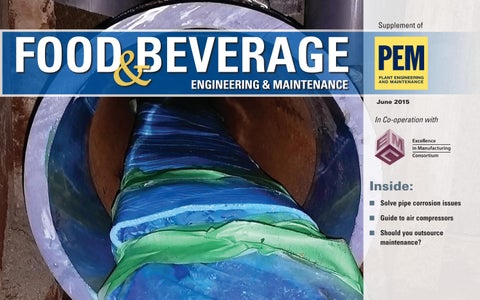
Solving pipe corrosion issues at a leading soft drink facility.
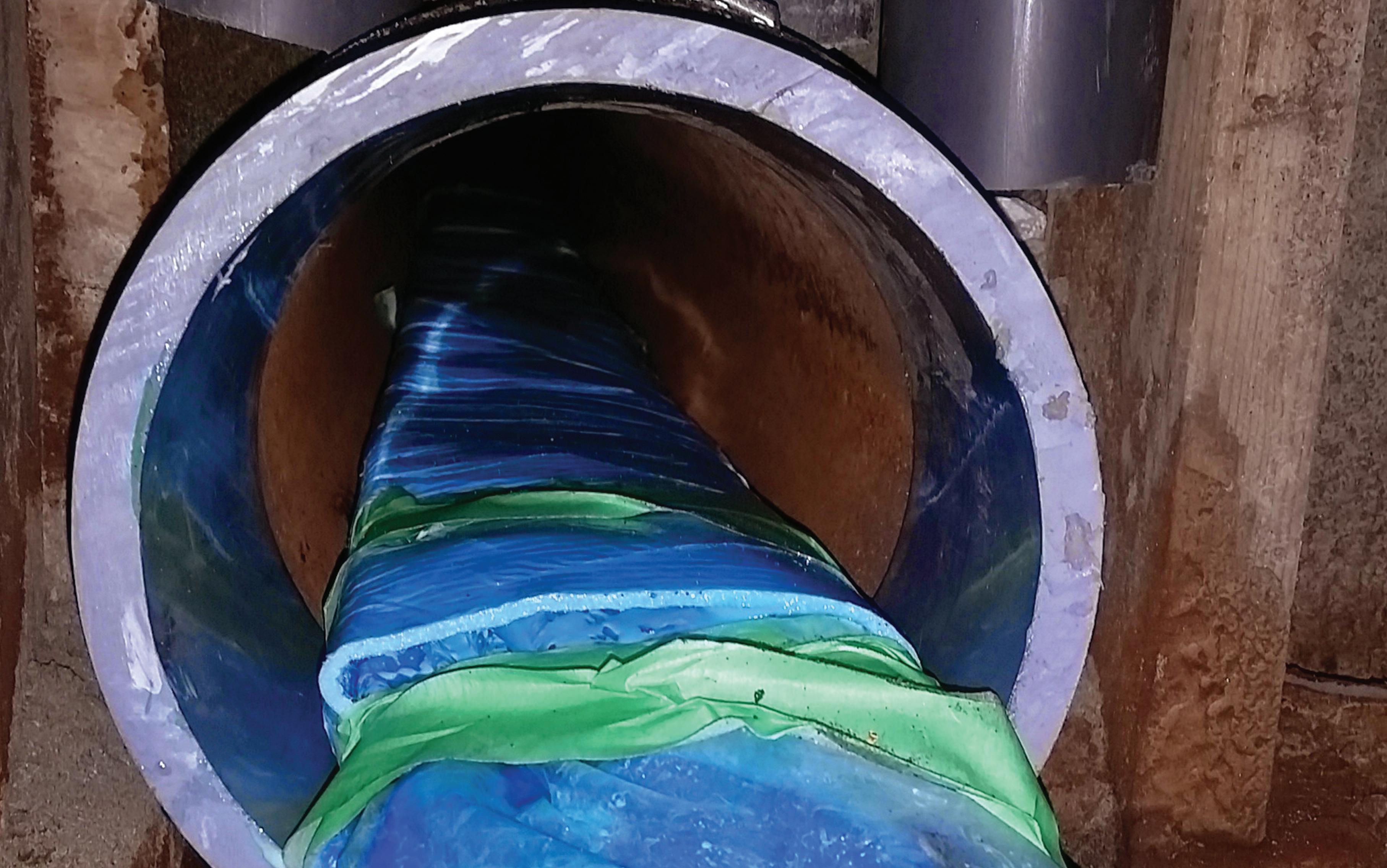
When Nu Flow Services of Vancouver had the opportunity to work in one of North America’s leading soft drink manufacturing facilities in Delta, B.C., there were problems walking into the job: large voids of pipe were missing due to corrosion and there was minimal access in confined spaces. Yet, Nu Flow, which rehabilitates deteriorated or failing water piping systems using an array of cured-in-place epoxy pipe lining solutions, was able to meet the client’s deadline and save them money compared to the cost of shutting down production and replacing the existing pipe system.
AlysCIA sutCh & MIChAel PhIlPot
Failing water pipe systems can be rehabilitated with cured-in-place pipe lining solutions.
T HE Sy STEM
The facility is North America’s second most advanced bottling plant. Each day the factory bottles popular soft drinks and other products that are distributed worldwide. The system consists of 330 feet of 8-inch trade water lines that run from a drink production line, to the building’s exterior pH adjustment tank and back to the city system. The trade water lines are located throughout production, a storage warehouse and down near the main loading area where inventory is loaded.
T HE S IT u ATION
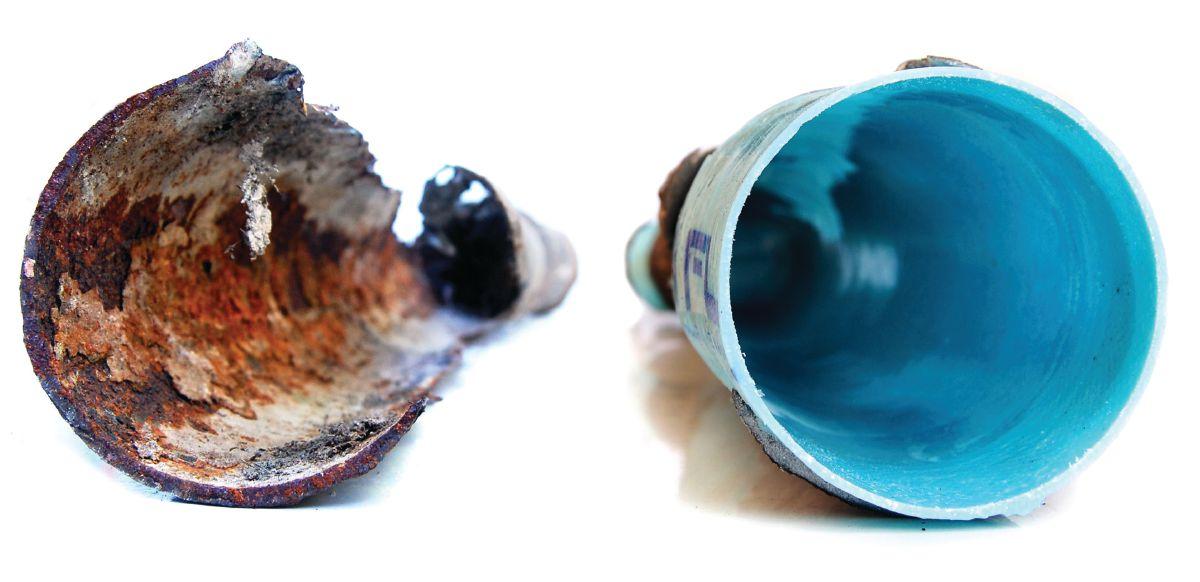
Two years ago the manufacturer added a new soft drink line in the facility during a $30 million project. The trade water runoff from cleaning the equipment began eating away at the bottom of their cast steel pipes causing sand and rock to destroy the pump motors in their pH adjustment pit and pollution to the groundwater table. “In just two short years the bottom of the pipe was missing in sections,” says Michael Philpot, owner, NuFlow Services, B.C.
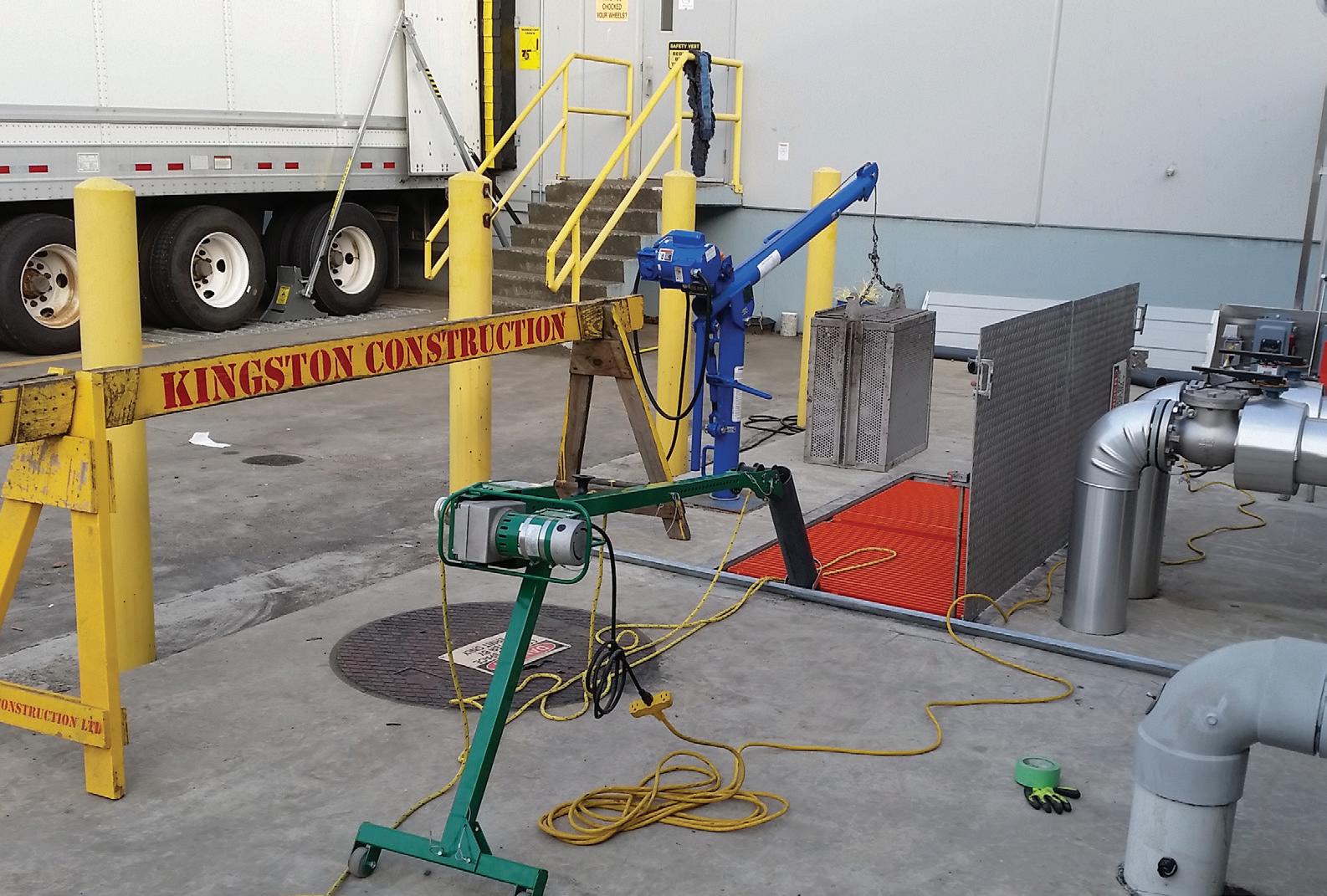
The facility chose to jet the 8-inch line in preparation for Nu Flow and by doing so the entire bottom of a 170-foot pipe opened up and the sand below washed away. The bottom of the host pipe was missing large sections for the entire length. In addition to these already difficult
No digging or destruction is required.
circumstances, the end of each pipe is located in a confined space that is difficult to work around. Most facilities built prior to the 1970s have sewer lines composed of cast iron and clay. The most common problem found with these lines is cracking at the joints, root intrusion and the bottom of the pipe rusting out; this can ultimately be a result of or lead to root
intrusion. With the pipe lining method, roots can be removed and a liner can be pulled into place, creating a structurally sound pipe within the existing pipe. Other common problems include calcification in sewer lines and ground movement. Millions of linear feet of drain and lines have been saved using the pull-in-place structural lining process.
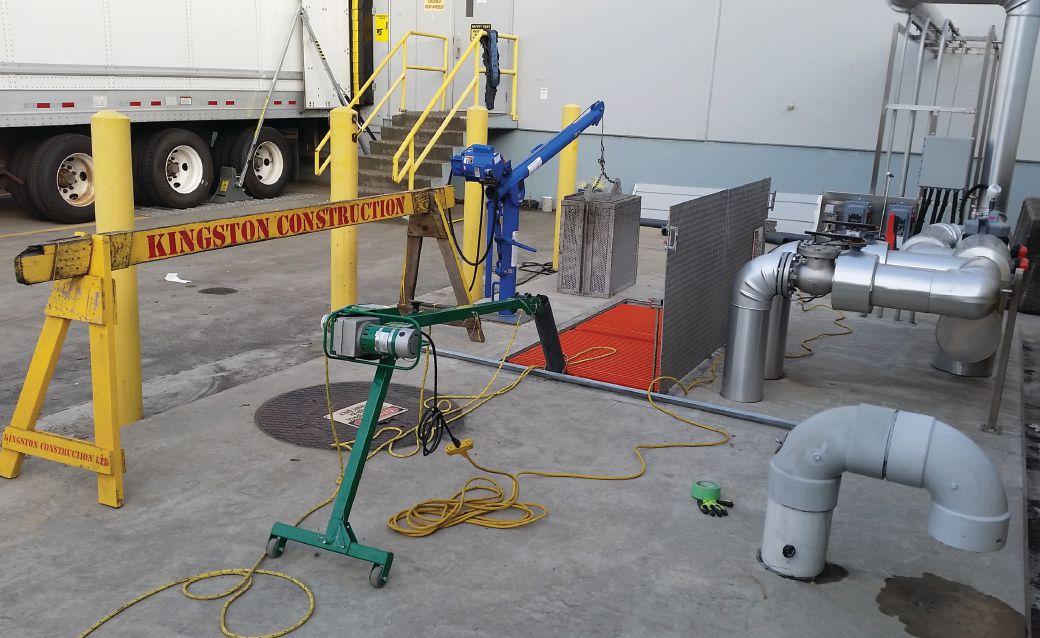
Pipe lining is an effective, long-term solution that can be located inside and outside of buildings.
T HE S O lu TION
Pipe lining technology requires no digging or destruction and is the most effective, long-term solution for failing pipe systems located both inside and outside of buildings. Pipe lining is an optimal solution for increasing flow, eliminating root intrusion and preventing leaks. It can hold up to the structural strength of a new pipe, without the costly digging and replacement repairs.
The structural lining project begins with mapping the internal plumbing system and camera inspection of drain and sewer lines. A plan is implemented to minimize disruption and affords the most efficient timeline for work completion.
In this case Nu Flow BC technicians showed up on the job with a schedule that allowed them to work 24 hours per day, running a double shift to meet the customer’s two-week deadline. Depending on the lining method to be used, pipes may be drained or air-dried. After testing for leaks, the pipes are prepared for cleaning.
The next step involves removing roots and calcite in order to return the pipe to its original functioning diameter. Nu Flow was able to clean and prepare the pipe with access where the floor was open midway to allow liners to be installed in both directions.
The careful planning by Nu Flow BC allowed them to install 3-inch electrical duct in 10-foot
Millions of linear feet of drain and lines have been saved using the pull-in-place structural lining process.
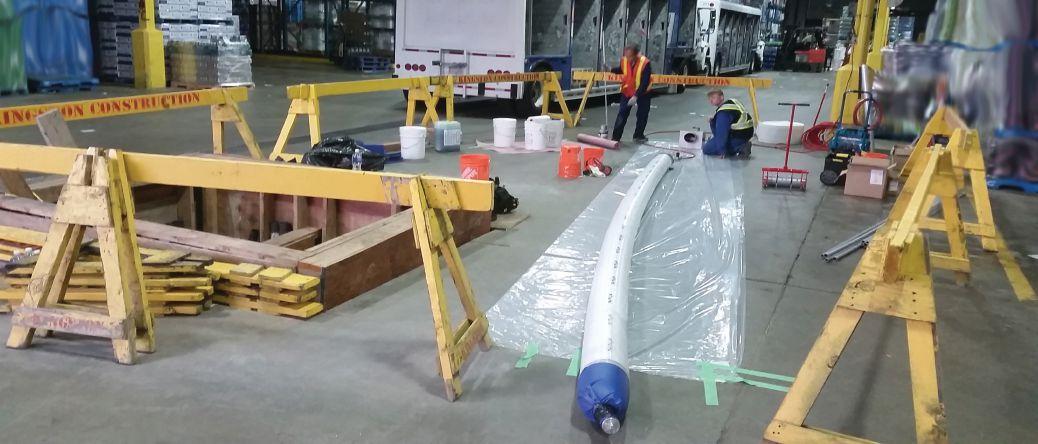
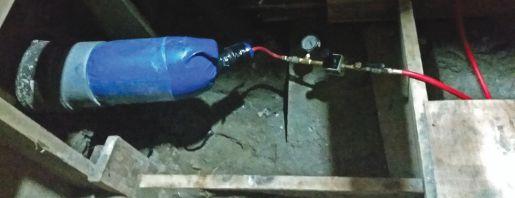
A bladder is inflated to cure epoxy and is later removed.
sections that were slid into the existing open pipe to allow the push rod access. Nu Flow BC also used pieces of PVC to add four inches onto the confined pipes allowing them to pull 25-foot sections of 8-inch liner into place.
This lining method provides the ability to line multiple 45° and 90° angles, as well as the option of lining specific sections of pipe without lining the entire length.
Nu Flow Technologies used its Nu Drain System to get the job done without causing downtime to the soft drink plant. Once complete, a final leak test and camera inspection was performed and the system is now a smooth, jointless pipe within the existing host pipe.
This article was submitted Nu Flow Services. For more information, visit www.nuflowbc.com or email Michael Philpot at mike@nuflowbc.com.
Rittal. Remarkable Protection!
Faster — Our range of modular solutions guarantees time-sensitive planning, assembly, conversion and commissioning.
Better — We are quick to translate market trends into innovative, best-in-class products.
Everywhere — With a global presence, including 11 production facilities on 3 continents, wherever you are located, we’re nearby and easy to find!
Learn more about our remarkable protection at www.rittal.ca
uNDER P RESS u RE
By AMIn AlMAsI
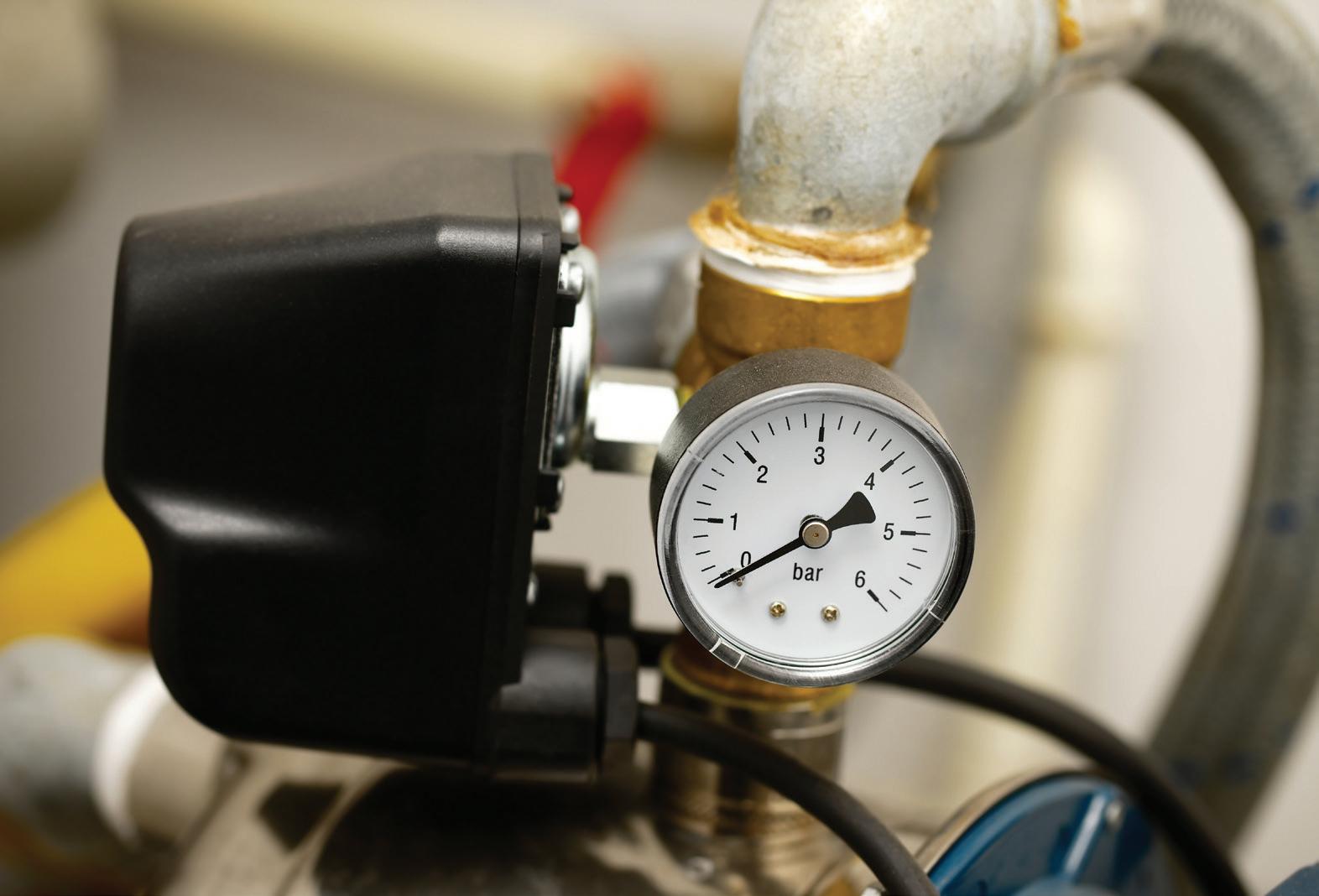
stringent air quality class is nearly always required for food and beverages, limiting oil contamination in liquid, aerosol and vapour forms. Air compressors are most often positive displacement compressors. Integrally-geared centrifugal compressors are sometimes used for very large applications, but the majority of air compressors are dry screw compressors for medium-size applications. There should be no oil or lubricant within the compressor chambers regardless of what type of compressor is used.
On this basis, dry screw compressors are employed for wide ranges of medium sizes (including some small and large sizes). Oil-free reciprocating compressors for very small units and oil-free integrallygeared centrifugal compressors for very large packages have been used. Each air compressor for food & beverage air applications should be furnished as a packaged unit mounted on a baseplate, complete with interconnecting piping and wiring. Inter-coolers and aftercoolers with moisture separator and automatic moisture removal
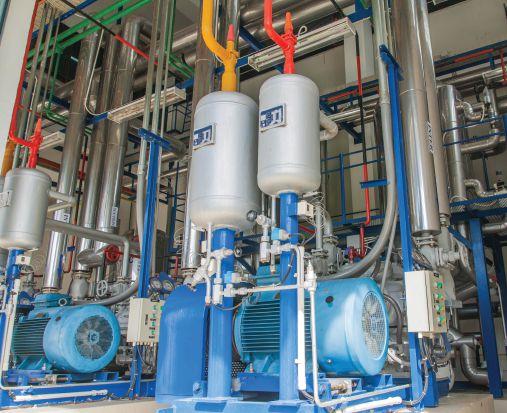
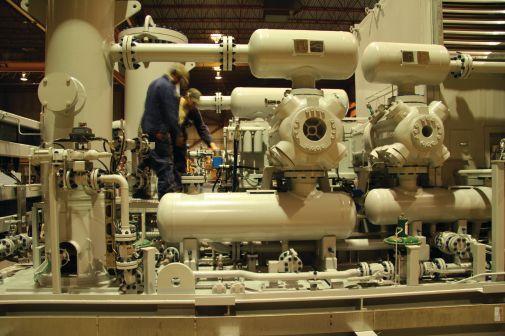
A complete guide to air compressor packaged units
are needed for air compression packages. If the cooling water is available, water-cooled heatexchangers would be used; otherwise, forced draft air-cooled are good options.
D Ry S CREW C OMPRESSORS
In a dry screw compressor (also known as an oilfree screw compressor), helical lobe screws use no liquid for sealing the rotor clearances and driving the non-coupled rotor. The rotor-to-rotor relationship is maintained by timing gears on each screw rotor, and the non-coupled rotor is driven by the coupled rotor through the timing gears. No rotor-to-rotor contact should normally occur in the dry screw compressor. These compressors have commonly been used to replace reciprocating compressors for medium size packages.
In a dry screw compressor, the air is compressed entirely through the action of the screws, without the assistance of an oil or any injected liquid. They usually have lower maximum discharge pressure capability (compared to oil-injected screw compressors) as a result. However, multi-stage oil-free compressors, where the air is compressed by several sets of screws, can achieve pressures of over 10 Barg.
Dry screw compressors are used in many applications for food & beverage; the entrained oil carry-over is not acceptable. However, this does not preclude the need for the filtration and dryer as
Air compressor packages should operate at any demand flow-rate. Practical limitations should always be considered for an optimum solution.
contaminants ingested from the ambient air should also be removed prior to the point-of-use. Subsequently, sophisticated air treatment is still required to ensure a given quality of compressed air.
Dry screw compressor rotors should have rigid designs and operate at lower speeds than the first lateral critical and are practically insensitive to vibration due to imbalance.
COMPRESSOR COMPONENTS
Screw rotors should be of one-piece construction, usually from properly selected high-quality forged materials. Internal cooling is usually not acceptable, nor used. Screw rotor stiffness should be adequate to prevent contact between the rotor bodies and the casing and between gear-timed rotor bodies at the most unfavourable specified conditions.
Air coming to the compressor should be very clean; although some tiny (around 1 micron or less) particles might be entered to the machine. Clearances between the components are very small; however, very low quantity of tiny particles might not be harmful for dry screw compressors. In fact, these tiny foreign matters sticking to the rotors after some duration of operation may even increase efficiency, due to decreased inter-lobe leakage, if they are in low quantities.
Screw rotors should ideally be supported on each end by rolling-element type bearings, even for medium and large compressors. Hydrodynamic bearings because of relatively large gaps (compared to internal tight clearances between components) are not suitable for screw compressors, they are only used for very large screw compressors.
Timing gears are important parts in a dry screw compressor. These gears should be made of highquality forged steel. Timing gears should usually be of the helical type. ISO/AGMA service factor should be high, ideally “2.5”, “3” or even more. The meshing relationship between gear-timed rotors should be adjustable with proper positive locking devices. Timing gears for helical lobe compressors should have the same helix hand (right or left) as the rotors so that axial position has minimal effect on timing.
Dry screw machineries still need lubrication oil for the bearing systems and timing gears.
Air compressors for food & beverage air applications should be furnished as packaged units.
Lubrication systems for the dry screw compressor should usually include a directly-driven oil pump. For critical, large packages, a standby electric motor driven oil pump is also required. Duplex oil filters are needed.
I N l ET A IR F I lTER
A properly-designed air inlet filter is an excellent investment payback by trouble-free compressor operation and high quality of produced air. As an indication, each dry screw compressor for air
service should be furnished by dry-type multistage high-efficiency air intake filter capable of removing 98 per cent of particles 1 micron or larger over the inlet capability range. To save energy and for proper operation, ideally, the maximum clean filter pressure drop should not exceed 0.01 – 0.02 Bar.
Air inlet filters should be provided with a weather hood or louvers. For plant locations subject to unusual conditions, such as heavy snow, the inlet to the filter may be elevated some distance above the compressor. Each filter should be provided with a differential pressure for the monitoring. Filters should be designed such that the first-stage (pre-filter) elements may be changed while the unit is operating.
C APACIT y C ONTRO l
Ideally an air compressor package should be capable of operating at any demand flow-rate from zero to maximum capacity. However, this is just theory and practical limitations should always be considered for an optimum solution. The first consideration is most often several air compressor packages are supplied in “N+1” or “N+2” arrangements (with one spare or two spares, respectively) for high value food and beverage plants. In this respect, an air compressor should be suitable for single compressor operation and parallel operation with an already
operating air compressor. The fact that two or three compressors will supply the required air of the food & beverage plant ease the capacity control situation, because one machine can be stopped to reach part-load. For instance, some plants use a “2+1” arrangement; in other words, two operating 50 per cent of the total required air with another 50 per cent package as standby. In this case 50 per cent part-load can be achieved when only one package is operating.
A good option for large dry screw compressors is the variable speed. While an air compressor powered by a variable speed drive (VSD) can offer the lowest operating energy cost without reductions in service life over a properly maintained load/unload compressor, VSD system typically adds significant cost to such a compressor package, negating its economic benefits if there are limited variations in demand. However, a VSD provides for a nearly linear relationship between compressor power consumption and air delivery. In many
air compression applications, VSD may not be suitable due to high initial cost, complexity or the sensitivity of VSD equipment.
V IBRATION M ONITORING
For medium and large dry screw compressors (say above 90 - 120 kW), provisions should be made for mounting two radial vibration sensors (X-Y vibration probes) on each bearing, one axial position probe on each rotor and a one-event per revolution probe (key-phasor). For small compressors, if sensors cannot be located inside the screw compressor (because of space limitation or other reasons), accelerometers can be provided on the casing; for instance, two per bearing, two on the gear set casing, and one axial sensor for the compressor. For many screw compressors, axial sensors were not provided due to some excuses that they might not be so useful, etc. Axial monitoring is needed and it should be furnished; the reason is axial forces, axial displacement, and axial vibration are important in screw compressors and they should be monitored.
From farm to table...
Whether your equipment is in the field or factory, you need the right bearings to keep things moving
NTN has the perfect bearing for every application in agriculture and food processing
Pul SATION FOR lARGE D Ry S CREW C OMPRESSORS
In screw compressor systems, the flow of air is not steady, but moves through the piping and equipment in a series of flow pulses which are superimposed upon the steady (average) flow. The characteristics of the flow pulses are determined by the size and the operating conditions of the compressor, such as displacement, speed, or rotor pressures. The mechanical and acoustical response from the piping system and equipment is a function of the amplitude and frequencies of the pulses, and the characteristics of equipment and piping system (layout, supports, natural frequencies). Screw compressors generate pulses that often are three-dimensional. Moreover, high frequencies combined with large diameter vessels, equipment or piping make circumferential modes more important to consider.
For large dry screw compressors, pulsation vessels or silencers are needed; their primary function is to provide the maximum practical reduction of pulsations in the frequency range of audible sound without exceeding the pressure drop limits. As rough indications, pressure drop through the pulsation vessels or silencers should be below 1% and 2.5% of the absolute pressure at the suction and discharge, respectively. Based on experience, maximum silencer efficiency results from mounting the pulsation vessels,
The air compressor unit should be fully assembled and performance tested before delivery to the job site.
suppressors or silencers directly on the compressor flanges, with a very short piping connection just to facilitate the access and maintenance (if needed) . Long piping between these equipment and the screw compressor can be source of new resonance cases, operational issues and complicated problems.
S HOP T ESTS
At the manufacturer shop, the complete air compressor unit should be fully assembled and performance tested prior to final inspection and delivery to the job site. Heat run test, four hours mechanical run test, and complete performance test should be done. The testing procedure should necessarily include a complete performance test
for whole operating range. The details of the test need to be developed for each package, based on the compressor details the manufacturer’s shop capabilities.
For dry screw compressors, a heat run should be performed prior to the four hours mechanical test run. The compressor should be run at the maximum continuous speed, with the discharge temperature stabilized at the maximum operating temperature at any of the specified operating conditions plus 10°C (or 11°C) for a minimum of 30 minutes. The heat run temperature relates to actual operating temperature at specified conditions, not relief valve settings, or maximum allowable operating temperature. Excessive internal clearances required for higher temperature operation result in decreased volumetric efficiency under normal operating conditions. The fact is, for some dry screw compressors, the heat run cannot be performed with the above procedure and a lower temperature (the rise lower than 10°C) or a modified procedure should be considered. High discharge temperature shutdown point should usually be set below the heat run temperature.
Amin Almasi is a rotating equipment consultant. He specializes in rotating machinery including centrifugal, screw and reciprocating compressors. Email Almasi at amin.almasi@ymail.com.
DO yOu CONTRACT yOuR MAINTENANCE?
By Arnold F. neWlAnd
Ihave led internal maintenance teams towards world-class reliability, I have outsourced specialized maintenance functions (predictive technologies) and I have worked with companies outsourcing all maintenance.
Maintenance outsourcing continues to grow with 65 per cent of large companies outsourcing some maintenance – but perhaps for the wrong reasons.
It all starts with the corporate philosophy: are you an owner or a renter? Successful companies that invest in long-term sustained growth (owners) recognize the strategic impact of maintenance, realize it is a core function, and invest in their own people versus advocation of responsibility to a third party (renters). I remain unconvinced that a contractor can come in and provide a more skilled workforce with a better understanding of my business and reliability improvement ownership all at a lower total maintenance cost than I can.
In the examples that I have seen the incumbent contractor absorbs the key maintenance personnel of the contracting company to buy the needed immediate plant and equipment knowledge at the same or lower wage rate and often without the benefit packages of the contracting company or no benefits at all. This with a typical lower initial overall headcount is how they can come in cheaper and still make a profit.
Companies without current solid resource management and robust processes and systems won’t just buy them by outsourcing maintenance especially in high-mix, low-volume specialized manufacturing industries. This is where you want to own your maintenance to minimize risk.
Most maintenance outsourcing firms, although they may possess certain specialized skill sets, that is, predictive technologies or building management systems, do not understand, present and promote a proactive condition-based maintenance
The maintenance contract is a critical part of the outsourcing decision.
CONTRACTS
and reliability culture.
The key to maintenance outsourcing is the contract. Most are written accepting the majority of the current workforce leaving little room to bring in needed special skills, accepting the current maintenance CMMS data and history, for the most part severely lacking, and without the right and sometimes no defined measurements. If your reliability processes are poor, just contracting out maintenance in most cases won’t provide the desired improvements.
A maintenance contract should be a performance-based contract with world-class KPIs and pay for increased reliability creating a win-win situation. Most don’t.
Finally the site maintenance contractor representative and the company contract manager must be seasoned professionals of the highest integrity who understand the contract intimately, understand the company philosophy and business model, understand the processes and critical control
points, understand the people and personalities on both sides, understand their own team member strengths and weaknesses and above all possess a strong desire to constantly strive for improvement and added value.
Modelling a tried-and-tested approach, such as the Lifetime Reliability Solutions 6 Step Plant
Wellness Methodology, provides a clear path to identification, control and reduction of risk. Developing a dedicated, skilled workforce, creating an open architecture work environment, rewarding high performance and having a clearly defined path forward, all in combination with the Plant and
Equipment Wellness (PEW) way will deliver superior sustainable long-term savings whether through outsourcing or insourcing.
This is an edited article written by Arnold (Arnie) F. Newland, CMRP, Lifetime Reliability Solutions, Inc. Reach him by email at newlandaf@ gmail.com.
It has been an incredibly interesting spring – one filled with a number of great opportunities to connect, engage, discuss and share ideas with peers! Best practices, subject matter experts, plant tours, lean productivity workshops, conferences, summits and company visits across the province!
Through EMC’s special GF2 Funded Food Sector Networking Events and Regional Strategic Interest Group (SIG) sessions, participating manufacturers have covered a lot of territory in these first six months and toured interesting facilities.
We had a fabulous overview with a company embracing going paperless on the shop floor and learned what was working well and where the challenges lie and
the importance of having a solid supporting IT department. Subject matter experts provided an overview on the latest in Food Safety and Food Labelling Legislation. Complementing that theme, Sleeman Breweries invited peers to their facility to discuss Food Safety and Traceability and eagerly accepted thoughts from participants on next steps in their journey. We invited Canada-Ontario Export Forum and OMAFRA to share information on their support and resources in our third Food Export Workshop. The Craig Richardson Institute of Food Processing Technology (CRIFPT) in Cambridge graciously hosted and provided an overview of the IFPT Technology Trades and Apprenticeship Programs. This month, we are off to Ottawa to learn from Beau’s
Brewery Sustainability and Energy
Management Journey followed by a tour at HFS-Healthcare Food Services who is hosting this special event. Our last session for the spring will be held in Mississauga and looks at “Dealing with Business Growth.” Matt & Steve’s together with a variety of community partners, such as the City of Mississauga – Economic Development, OMAFRA, Export Development Canada, Colliers International, Coldbox Builders, CPG Executive Search and Value Stream Solutions will share their expertise and experiences relating to our topic. A final presentation by Northbridge Consultants on SR&ED and related funding will also be available for companies wishing to know more about potential opportunities.
One session in particular this spring marries well with the theme of this magazine and focused solely on the opportunity to connect with maintenance representatives to share best practices and network and will be hosted by Hartmann Canada Inc. of Brantford. There are only three industries like Hartmann in Canada and having a chance to tour this amazing facility was very exciting to everyone in attendance and left us all with a whole new appreciation when it comes to manufacturing environmentally friendly egg cartons from moulded fibre material. They showed us a very interesting and unique process and I was mesmerized by the accuracy of their fleet of AGV’s (Automated Guided Vehicles) – all working
simultaneously picking and placing pallets of cartons on pre-charted paths without error – a definite highlight for me.
If the tour was the “icing on the cake,” it was followed by an amazing non-stop discussion on all things maintenance – from best practices to challenges and educational opportunities.
Conversation brimmed with thoughts and shared perspectives on a multitude of topics, ranging from the aging population and the challenge of replacing lost knowledge as people retire, to contract labour requirements. We discussed strategically planning equipment changes from new to old while running a 24/7 operation and complementary discussions ensued with respect to run-to-fail programs, processes for purchasing new equipment, and the need for staying on top of the wave by servicing equipment on a repetitive and regular basis. Having dedicated staff to look after the day-to-day items so nothing gets missed or delayed and the establishment of “Maintenance Bees” who can help out the maintenance team when required.
Production and maintenance combined meetings has resulted in action lists from purchasing, safety and the continuous improvement team. Regular meetings enable action and keep departments in a preventative stance. This is a wonderful way to engage others as well and encourages people to share their ideas and suggestions for improvement.
The discussion also considered lean and implementation of the tools and elements and the necessity of ensuring the culture is set up to embrace a journey of that nature. Similarly, we explored sustainability programs and recycling opportunities.
If the tour was “icing on the cake,” it was followed by an amazing non-stop discussion on all things maintenance –from best practices to challenges and educational opportunities.
maintenance. We talked about career fairs, high school presentations, connecting with colleges and universities, as well as utilization of co-op placements and apprenticeship programs and involvement in organizations that are working to get the word out about a career path towards maintenance.
This is what happens when you take part in an EMC Networking Activity – a perfect cake baked with great ideas, lessons shared, friendships established and connections made – and iced with the best of opportunities from a continuous improvement standpoint!
With any discussion on maintenance and software implementation and programs, there is bound to be diverse perspectives and experience when it comes to software implementation and program management. We touched on new CMMS implementations and service providers, considered where technology fit into maintenance programs and what some of the virtual opportunities might be, what the advantages of iPhones and instant photos and adding comments are, and the potential of going paperless on the shop floor.
Education was our final topic and there was considerable talk around how to engage the youth in a manufacturing setting in
Excellence In Manufacturing Consortium (EMC) embraces over 5,000 consortium and online members across Canada. Through a variety of services and programs, companies are able to benchmark and connect with peers and subject matter experts in an effort to reduce costs, increase efficiencies, open the door for potential opportunities, and seek out ways to engage their workforces. There are almost 60 EMC Peer Networking Consortiums spread across the country. Participants in these groups meet monthly, work together to solve interesting challenges, share lessons learned and journey progresses and tour member facilities to enhance continuous improvement initiatives within their own facilities. It’s amazing what “outside sets of eyes” can do for solving an issue or presenting an opportunity to see a solution in a different way!
Our next set of GF2 EMC Food Sector Networking Events and an upcoming conference are listed in the table below. A Food Sector Calendar is also available on the EMC Website (www.emccanada.org) and has the latest in event information as activities are always being added. Please watch as well for our free EMC GF2 Productivity Workshops featuring introductory courses on Lean Productivity (Lean 101), Lean Management Systems, Value Stream Mapping and Productivity/Lean Tools and Leadership and
Culture for Productivity Improvement. These events are scheduled across Ontario and taking place in September and October. Wishing you the very best for a safe and happy summer!
For more information on the Excellence in Manufacturing Consortium and the Food Sector Initiative, please feel free to touch base with Bren de Leeuw, Director – Field Operations Canada and EMC Food, Beverage and Bio Sector Program (bdeleeuw@ emccanada.org) anytime.
24-sep-15
Bonduelle North America strathroy and tecumseh, oN
Energy Management “The Road to Net Zero Waste – Sustainability, Energy Management, Culture Development and Lean Opportunities” Best Practices
10-Nov-15 Chapman’s Ice Cream Markdale, oN HR Management
Everyday, thousands of Canadian manufacturers are connecting through EMC ... to skills and training, vital programs and resources, and EACH OTHER
An interactive Summit hosted by the Strategy Institute that hosts a number of speakers on issues such as: CFIA Complaints & Appeals, GMO Labelling, FSMA Updates, GFSI Compliance, Export Excellence, etc.