Brian Robinson
Ur Wayii (Incoming Tide)
Walter Reeks
Pioneering naval architect
Focus on nature
Ocean Photographer of the Year
Brian Robinson
Ur Wayii (Incoming Tide)
Walter Reeks
Pioneering naval architect
Focus on nature
Ocean Photographer of the Year
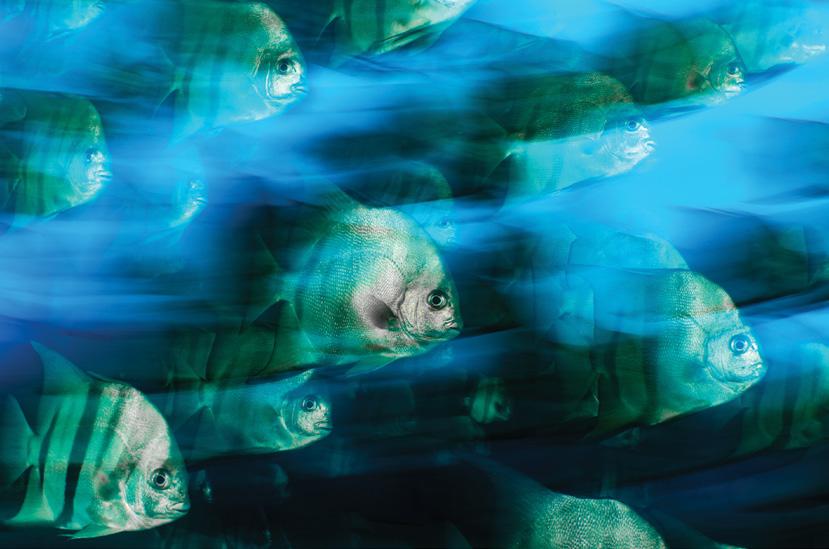
WELCOME to the latest edition of Signals
As we move towards the holiday period, the museum gears up for our usual jam-packed program, and this issue of Signals presents a raft of summer reading for you to enjoy.
We are proud to again present Ocean Photographer of the Year, and in this edition you will meet two Australian category winners. Craig Parry (Human Impact category) and Marcia Riederer (Fine Art category) each talk about their work, and in particular their winning image.
Our centrepiece for summer at the museum will be a project called The Beach, an intergenerational, immersive playground that captures the spirit of the season. It’s bright, breezy and full of surprises: digital storytelling, exhibition, play and performance all come together to explore how the beach connects us, shapes our stories and brings communities together. Visitors are invited to slow down, reflect and get lost in a space that feels both nostalgic and new – a summer escape without leaving the city.
We feature an article on Brian Robinson, whose work is showcased in a beautiful exhibition called Ur Wayii (Incoming Tide). Brian combines traditional Torres Strait art with contemporary references, in work that is both thoughtful and whimsical.
Still on the Torres Strait Islands, we look back at a maritime strike in 1936 that was a catalyst for Indigenous workers’ rights and the broader land rights campaigns that have followed.
We also profile Sam Wallman and his art focused on the maritime union; mark the centenary of the death of Walter Reeks, designer of our beloved SY Ena; and much more.
Next year will mark 125 years of the Australian Navy, and we preview some of the events and programs being planned in commemoration.
I am always happy to hear from the museum family about what matters to you, so please, if you have any ideas, drop me a line to thedirector@sea.museum. I may not be able to respond directly to every person, but please be assured, different voices are both welcome and encouraged.
Daryl Karp AM Director and CEO
Acknowledgment of Country
The Australian National Maritime Museum acknowledges the Gadigal people of the Eora nation as the traditional custodians of the bamal (earth) and badu (waters) on which we work.
We also acknowledge all traditional custodians of the land and waters throughout Australia and pay our respects to them and their cultures, and to elders past and present.
The words bamal and badu are spoken in the Sydney region’s Eora language.
Supplied courtesy of the Metropolitan Local Aboriginal Land Council.
Cultural warning
People of Aboriginal and Torres Strait Islander descent should be aware that Signals may contain names, images, video, voices, objects and works of people who are deceased. Signals may also contain links to sites that may use content of Aboriginal and Torres Strait Islander people now deceased.
The museum advises there may be historical language and images that are considered inappropriate today and confronting to Aboriginal and Torres Strait Islander peoples.
The museum is proud to fly the Australian flag alongside the flags of our Aboriginal, Torres Strait Islander and Australian South Sea Islander communities.


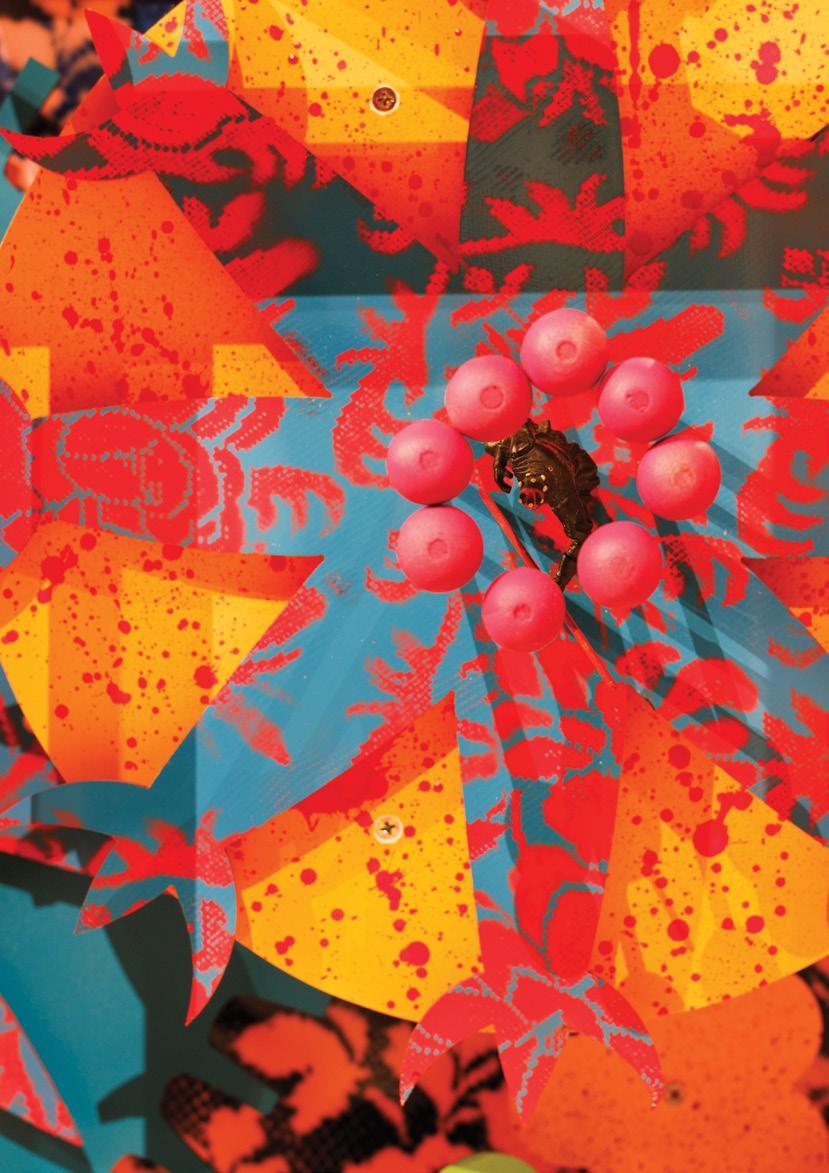
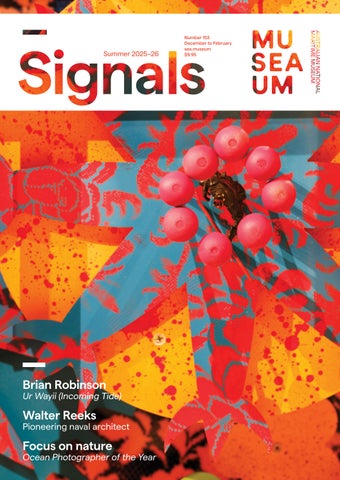
Cover Detail of Brian Robinson’s sculpture Banks’ Bounty: Exotic Cargo, on display in Ur Wayii (Incoming Tide)
See article page 2. Image Marinco Kojdanovski
2 A captivating confluence of worlds
Brian Robinson: art from the Torres Strait
10 Ocean Photographer of the Year
We chat with Marcia Reiderer and Craig Parry
18 Art and activism
Illustrator Sam Wallman’s View from the Docks
22 Tides of change in the pearl shell industry
The 1936 Torres Strait maritime strike
28 Navy 125
A preview of anniversary celebrations in 2026
32 A pioneering naval architect
The maritime mastery of Walter Reeks
40 Australian Sailing Hall of Fame
The latest honourees
46 Deadline 2025
Digitisation preserves analogue collections
50 A new museum publication
The World Remade: How World War II changed everything
52 The Global Maritime Histories Project New perspectives on heritage
56 Foundation
Help replace Endeavour ’s standing rigging
60 Join our unique tour in Indonesia
Spice, spirits and shipwrights: cultures and coastlines of Sulawesi
64 Members news and events
The latest talks and tours this spring
68 Summer program
Special events for the summer holidays
70 Exhibitions
What’s on display this season
74 National Monument to Migration
The tale of Australia’s 50,000th postwar migrant
78 Readings
Yarra Birrarung by Judith Buckrich; The Spice Ports by Nicholas Nugent
84 Currents
Vale Jimmy Donovan, union stalwart
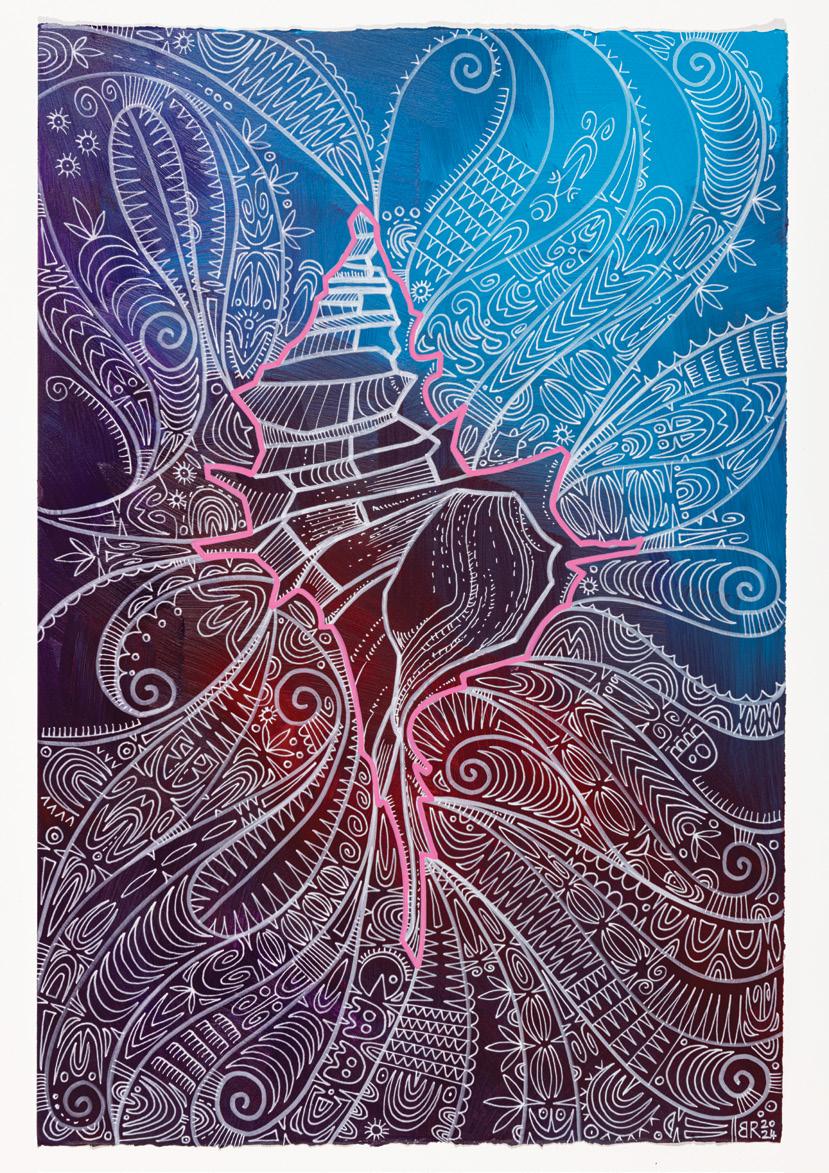
A new exhibition, Ur Wayii (Incoming Tide) features the art of Brian Robinson, which navigates the intricate waterways of history, myth, personal memory and global narratives. It offers a timely and insightful reflection on what it means to connect, survive and thrive in an ever-changing world, writes Indigenous Programs Manager Matt Poll.
Brian has described his creations as ‘seemingly incongruous concoctions’ that intertwine historical narrative, personal history and humour with motifs and characters ‘co-opted into the spirit world of the Islander imagination’.
UR WAYII, meaning ‘incoming tide’, fittingly describes the art of Brian Robinson. Like a tide gathering flotsam and driftwood, Robinson’s art collects and combines a rich array of subjects and materials in his vibrant printmaking and sculptural installations. It is an essential resource for anyone seeking a deeper understanding of the unique richness of Torres Strait Island art and culture and their enduring relevance in today’s globalised world.
This distinctive style is deeply rooted in Robinson’s upbringing on Waiben (Thursday Island) – a maritime crossroads where Japanese, Malay, Pacific Islander and European fleets have all found harbour, leaving behind a mosaic of cultures and stories. Robinson’s work reflects this dynamic and captivating confluence of worlds.
Brian Robinson speaks fondly of life on the islands of the Torres Strait in the 1970s and 80s. His artistic path was profoundly shaped by his grandfather, Ali Drummond –a lifelong pearl shell diver and skipper who was the subject of a poem by his close friend Seaman Dan. Brian recalls: I spent many years living with my grandfather, going out early in the morning before the crack of dawn to catch fish, go turtle hunting, hunt for dugong, collect pigeon eggs, prawning, and the whole host of sea-related activities that happens up in the Torres Straits … He taught me how to navigate out on the water, both during the day as well as during the evening, looking at certain star constellations and things like that.
Ali’s vibrant, chaotic home evokes vivid memories for Robinson. His collection of Phantom comics, in particular, sparked a magnetic fascination that would later influence Brian’s career as a printmaker. The Phantom exerts a strange allure among many Aboriginal artists and those of the Papua New Guinea highlands, where shields decorated with images of the Phantom, created in the 1960s, today fetch astronomical prices in auction markets around the world.
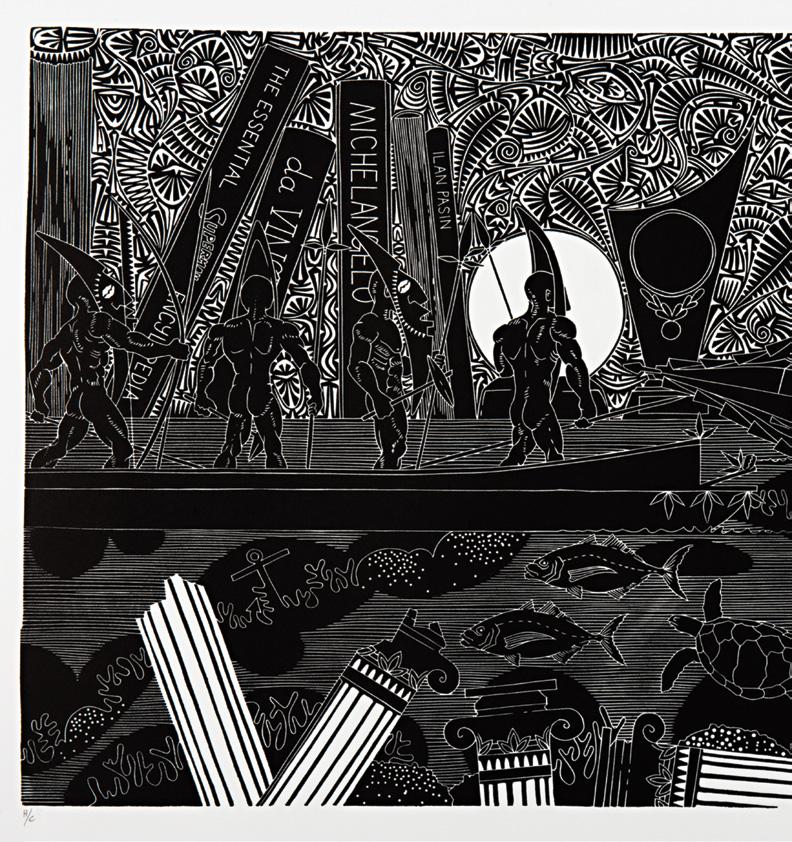
The artworks in Ur Wayii blend traditional patterns with a vibrant mix of global pop culture, from science fiction films to superhero comics
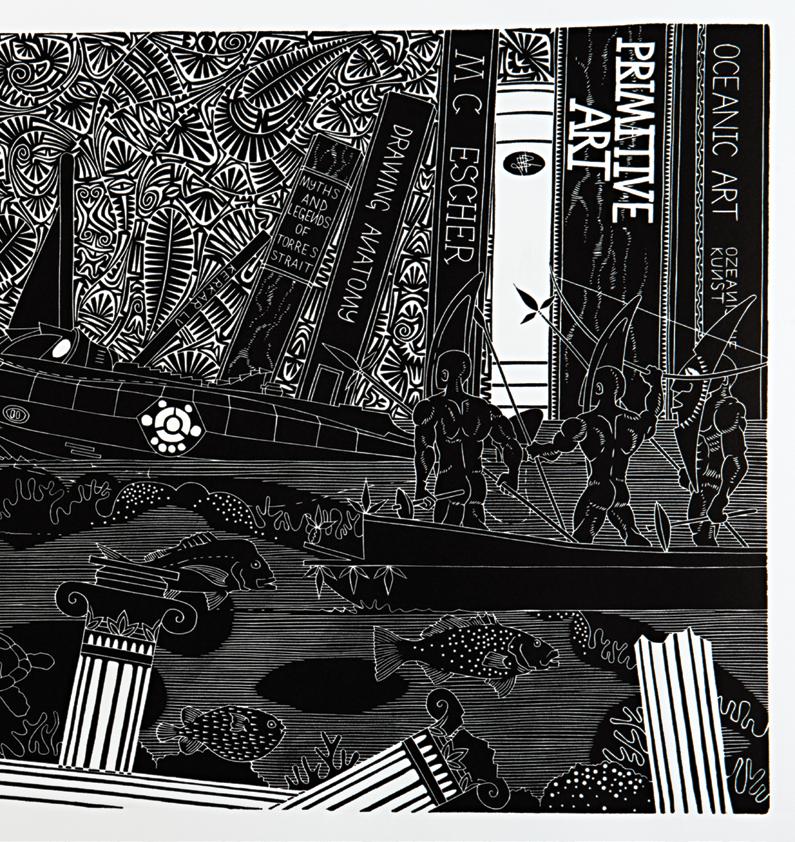
Childhood memories and cultural encounters
Robinson’s artworks are imbued with his history and memories. They detail daily rituals of preparing the dinghy, catching sardines and fishing at secret spots, where his athe (grandfather) had an uncanny ability to identify fish on the line. In Robinson’s world, the comic book storyboard is transformed into the black and white lino print. Robinson’s work often presents a collision of ancient Torres Strait mythology and the superheroes of modern cinema.
The unique patterns found in Torres Strait Island printmaking are not just abstract designs; they are a modern evolution of traditional practices. These distinct motifs, known as minaral, are rooted in the ancient art of decorating spears, shields, drums and masks. The artworks in Ur Wayii blend these traditional patterns with a vibrant mix of global pop culture, from science fiction films to superhero comics. The result is a dynamic and often surprising fusion of ancient traditions and contemporary influences.
Brian Robinson doesn’t just borrow from Western literary and artistic icons; he reimagines them, pulling them from their European origins and casting them into a Torres Strait context. Navigating Narrative: Nemo’s Encounter in the Torres Strait is a prime example of this audacious creativity. In this piece, he takes Captain Nemo and the Nautilus from Jules Verne’s classic novel Twenty Thousand Leagues Under the Seas and subverts their purpose. Instead of an emblem of solitary ocean exploration, the Nautilus becomes a symbol of both escape and capture.
Robinson imagines a new chapter in which Torres Strait Islander warriors capture and wreck the Nautilus , leaving it to rest on the ocean floor. This act of reimagining transforms the vessel and its journey, placing them among the ruins of antiquity and art history – both Western and Oceanic. Robinson uses Nemo’s submarine, Nautilus, which is exploring beyond governmental reach, as a metaphor for the colonisation of Terra Australis, including a poignant quote from Nemo challenging the notion of ‘savages’. Through this collision of science fiction and Indigenous narratives, Robinson’s work echoes the prescient ideas of HG Wells who, as far back as 1898, explored themes of otherworldly encounters and colonisation in The War of the Worlds
Robinson’s work often presents a collision of ancient Torres Strait mythology and the superheroes of modern cinema
01
Brian Robinson in front of his work Shoal (2025), a vinylcut print mounted to aluminium composite panel
02
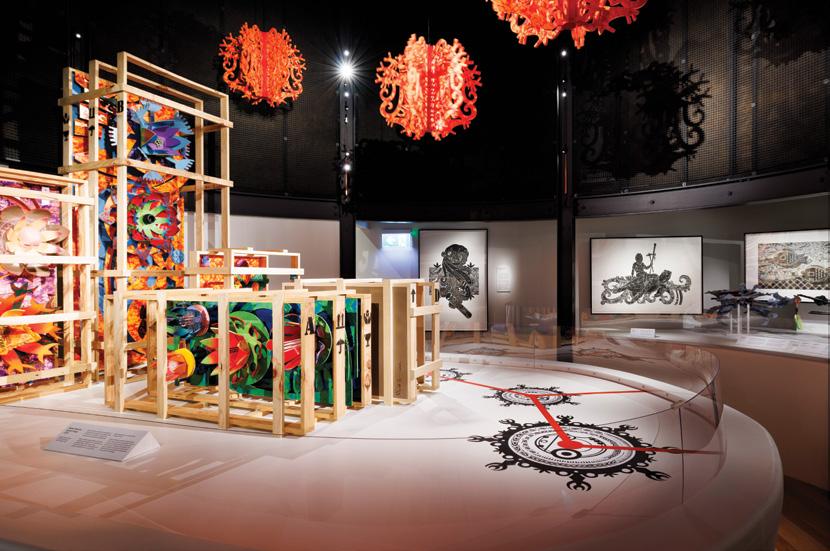
Multimedia sculpture Banks’ Bounty: Exotic Cargo (left); lino prints Proteus Ocean Guardian, Reef Guardian and One Fish Two Fish (on back wall); and Baidtham Zugubal (hanging from ceiling and decals on plinth).
Images Marinco Kojdanovski
In his sculpture Banks’ Bounty: Exotic Cargo, Robinson critiques the legacy of Sir Joseph Banks, who, during Lieutenant James Cook’s 1770 voyage aboard HM Bark Endeavour, amassed a vast botanical collection with Daniel Solander. While this collection cemented Banks’ reputation as a significant scientist, Robinson’s work highlights how this ‘scientific’ act was an integral part of Britain’s colonial ambitions. The artwork exposes the fallacy of terra nullius (‘nobody’s land’) by contrasting the European ‘discovery’ of plants with the thousands of years Indigenous Australians had already known and used them for food and medicine. By displaying the sculpture on a central stage, Robinson draws attention to Banks as a key architect of the colonial enterprise in Australia.
Robinson’s Baidtham Zugubal works – comprising laser-cut stars suspended from the ceiling, above corresponding vinyl decals linked by red lines– create a powerful visual representation of Torres Strait cosmology. Islanders, like astronomers of old, discerned order in the apparent chaos of the night sky, naming constellations and associating them with heroic, beautiful, fantastic and monstrous characters from their myths and legends – which is why the superheroes of modern action and science-fiction films blend so easily into the picture planes that Robinson creates.
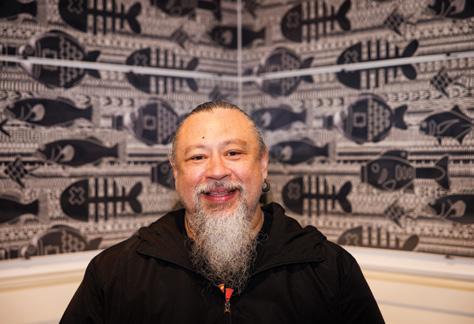
The unique patterns found in Torres Strait Island printmaking are not just abstract designs; they are a modern evolution of traditional practices
01
Tropical Efflorescence Hibiscus
02
Detail of Banks’ Bounty: Exotic Cargo.
Images Marinco Kojdanovski

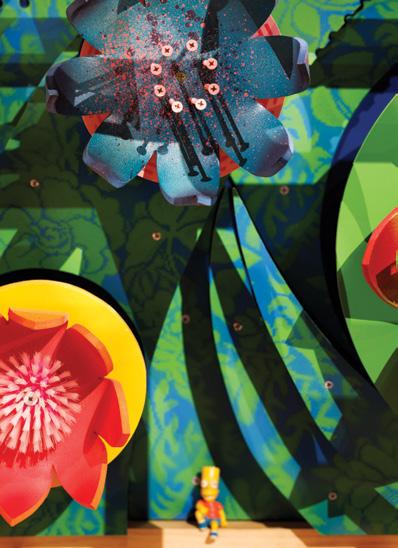
Robinson’s work reflects the very essence of his home – a dynamic and captivating confluence of different worlds
Brian Robinson’s artistic process can be seen as a grand weaving, much like the intricate woven fish objects (zagal ) he creates by scanning then 3D printing traditional coconut palm fibre toys and then handpainting them with patterns of tropical fish. Just as these zagal sculptures blend traditional craft with modern technology and natural patterns, Robinson’s art interlaces the ancient threads of his Torres Strait Islander heritage with the vibrant, contemporary fibres of global popular culture and Western thought, creating a rich, multi-layered tapestry that is both deeply personal and universally resonant.
Robinson has carved out a distinctive presence within Australia’s contemporary art scene, consistently delivering bold, innovative works across printmaking, sculpture and public art. His unique aesthetic blends Indigenous heritage, storytelling, interconnected bloodlines and a global cultural imagination with critical social commentary. His visual language invites viewers to spend ever-increasing lengths of time uncovering more layers of intricate textures, shapes and meaning. Robinson’s artworks extend to the built environment through major public art commissions, including Woven Fish (2003) and Reef Guardian (2017), both installed on The Esplanade in Cairns, Queensland. His work has been exhibited nationally and internationally and is held in major collections, such as the National Gallery of Australia, the Queensland Art Gallery/Gallery of Modern Art, the Australian National Maritime Museum and the Metropolitan Museum of Art in New York.
Ur Wayii is more than an exhibition; it is an invitation to engage with the profound cultural landscape of the Torres Strait, seen through the eyes of a master storyteller.
In conversation with Marcia Riederer and Craig Parry
The Australian National Maritime Museum is thrilled to again be hosting Ocean Photographer of the Year. Emily Jateff, Senior Curator, Ocean Futures, sat down with two of this year’s Australian award-winners, Marcia Riederer and Craig Parry, to find out more about the life of a nature photographer.
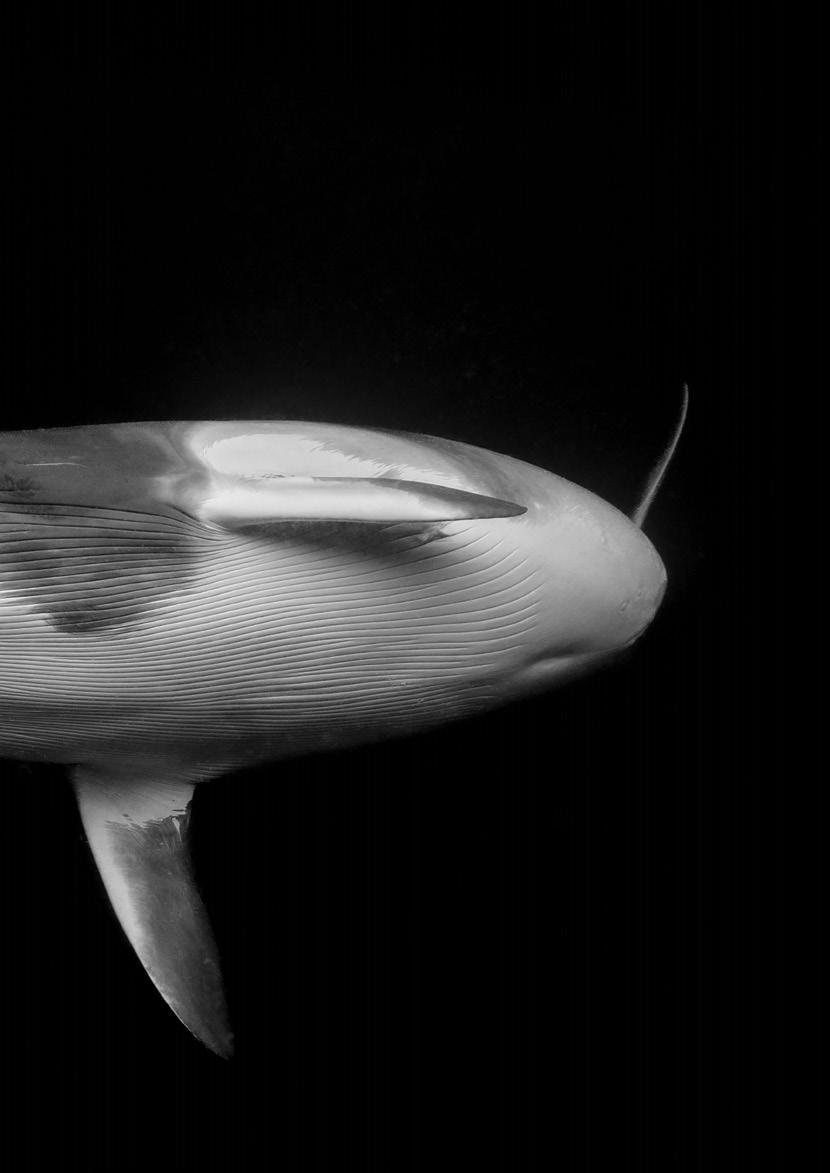
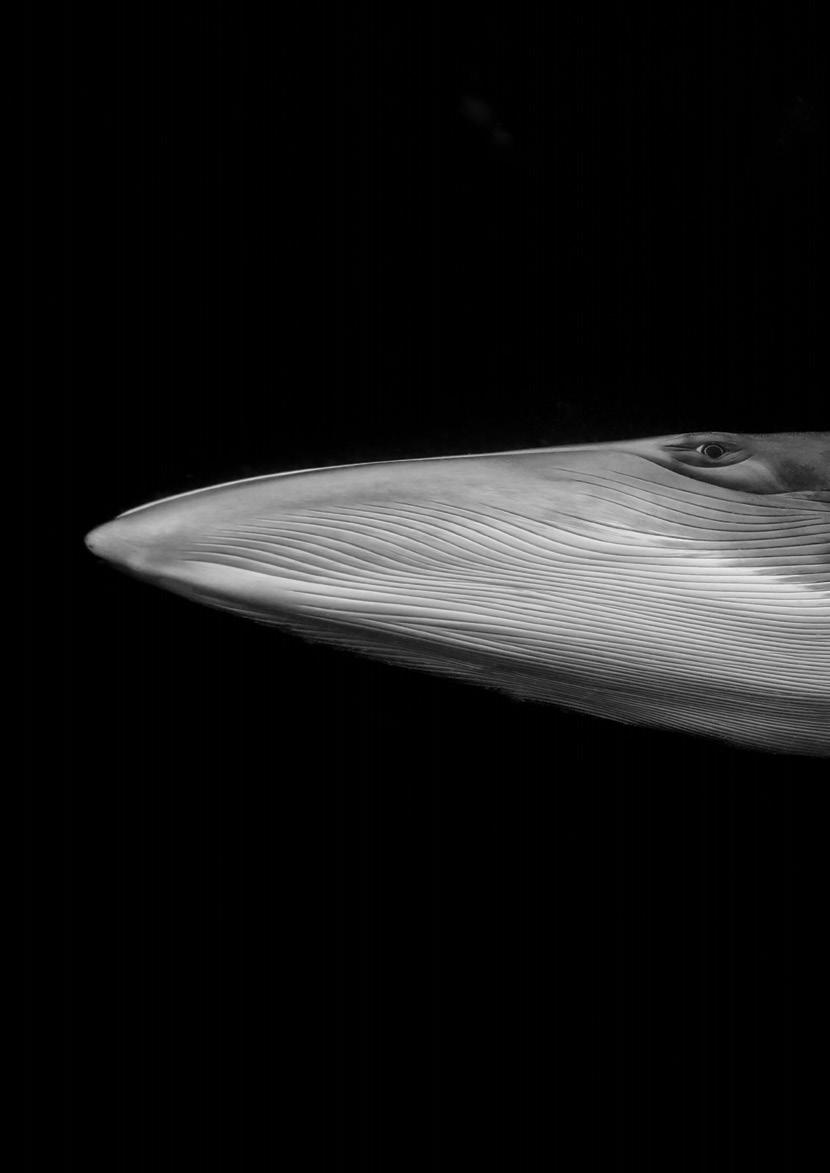
Dwarf minke whales are curious giants that approach swimmers with an almost playful curiosity
THIS YEAR, the Ocean Photographer of the Year competition received more than 15,000 submissions from around the globe. They have been distilled into a breathtaking gallery of 116 images, comprising the finalists and winners in each category: Ocean, Wildlife, Fine Art, Adventure, Conservation (Hope), Conservation (Impact), Human Connection, Young Photographer of the Year and the Ocean Portfolio Award. Thirteen of the photographers in this year’s exhibition are Australians. From intricate macro shots of tiny amphipods to vast underwater vistas and dramatic drone scenes, striking images celebrate the ocean’s beauty, spotlight its ecological crises and emphasise the urgency of marine conservation. Presented by Oceanographic magazine and Blancpain, this powerful exhibition is a reminder of how photography can connect us to the ocean.
Marcia Riederer
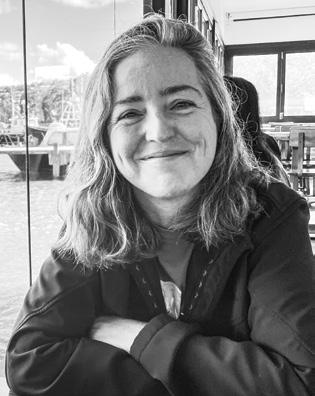
Marcia Reiderer grew up in Brazil but now lives in Australia. She has always been passionate about the ocean and wildlife and grew up watching documentaries and looking at photos in National Geographic. She took up photography about 30 years ago, finding it a great combination with her field work as a biologist.
Marcia, take us on your journey to becoming a nature photographer.
I first took an interest in photography while doing a university internship with wildlife rescue in remote national parks. It quickly became very clear that I was privileged to have those experiences, and that most people would never have a chance to see those places. So, I started taking an old camera along to record and share what I saw.
Despite always having a strong connection with the ocean, it wasn’t until much later that I started diving and taking the camera under water with me. I had to learn a lot about light and how to manage the camera equipment inside a housing.
How has your style evolved over your career?
Since the start of my career, I’ve been interested in animal behaviour and conservation. Those are still my focus in photography too. I believe that understanding why any animal does what it does builds a connection and greater appreciation for individual welfare and species conservation.
Marcia Riederer is a Brazilianborn wildlife and underwater photographer based in Australia. A biologist by training, she spends countless hours diving and snorkelling, capturing marine creatures and chasing underwater light. Image courtesy Marcia Reiderer
Do nature photographers tribe together or are you a solo warrior?
There are moments when I enjoy my own company and taking my time to photograph, to find the moment, the right light, and re-do it as many times as I need. But photography has led me to meet amazing people who are now part of my daily life. So, I would say both, at different times.
What’s the most difficult shot you ever captured?
In Western Australia, when I was observing a humpback whale from the coast, I noticed something floating and moving with the whale. I put the drone up and confirmed my suspicion – the whale was entangled with a cray pot. I contacted the authorities and spent the day at the spot, monitoring the whale’s location, while National Parks staff tried to rescue it. Unfortunately, it was late in the day, and a storm was coming, so the whale could not be saved.
What gives you hope for the future? What can we do about it?
I think we need urgent and radical changes to be hopeful for a better future. We need commitment and action from politicians and companies. And we need pressure from individuals to make that happen – changes in our consumption patterns, eating habits and approach to wildlife. All living beings have the same rights to inhabit this planet.
Winner, Fine Art Photographer of the Year 2025
Marcia Riederer says: Dwarf minke whales are known to visit the northern Great Barrier Reef during the winter, making it the only known predictable aggregation of these whales in the world. These curious giants approach swimmers with an almost playful curiosity. As you float in the turquoise water, watching a sleek, dark body glide effortlessly towards you, its eye meets yours in a moment of connection. The whales seem to acknowledge your presence, circling and interacting with you. It’s a humbling experience, reaffirming the wonder of the ocean and its inhabitants, and the urgent need to conserve it.
The strongest point of this image is the connection that the eye contact creates with the viewer. I hope it makes people realise that we are equals, we share the same needs and the same emotions.
Location Ribbon Reefs, Great Barrier Reef, Australia Equipment Canon 5DIV camera, 16-35mm lens and Nauticam housing
Settings 1/200sec, f/7.1 and ISO 400
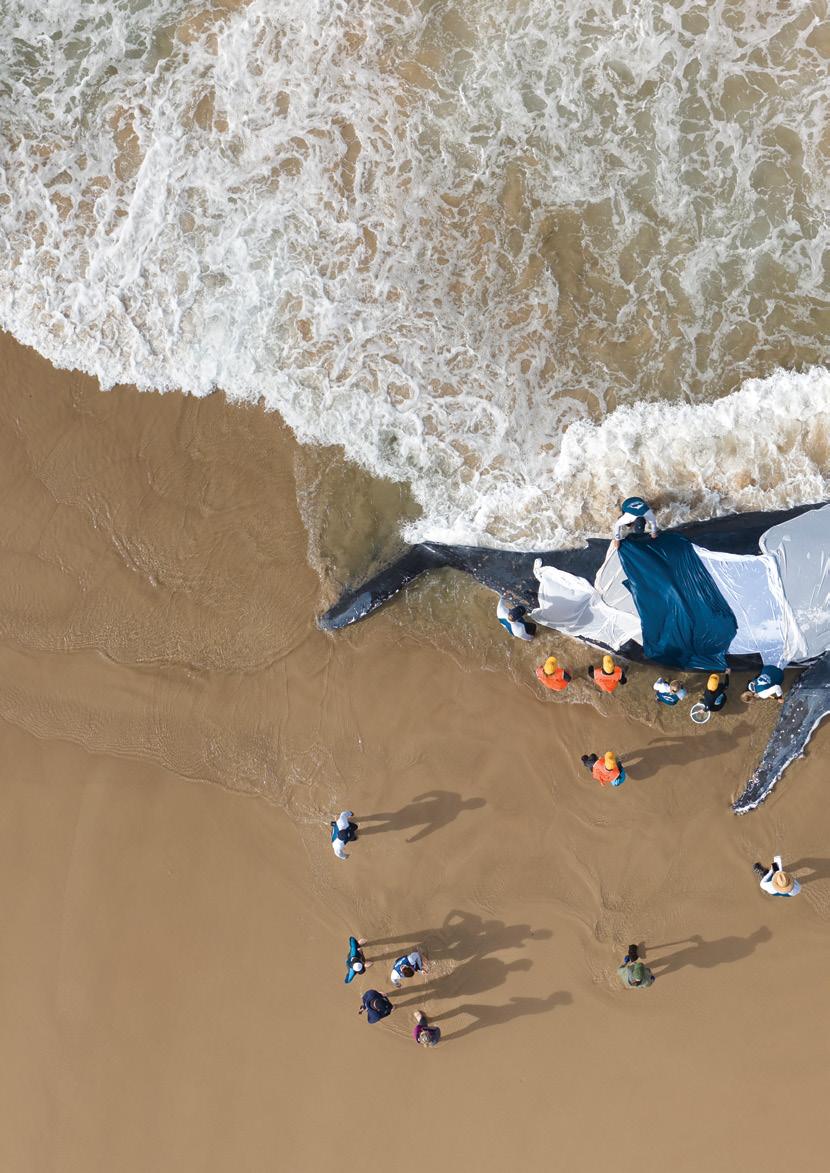
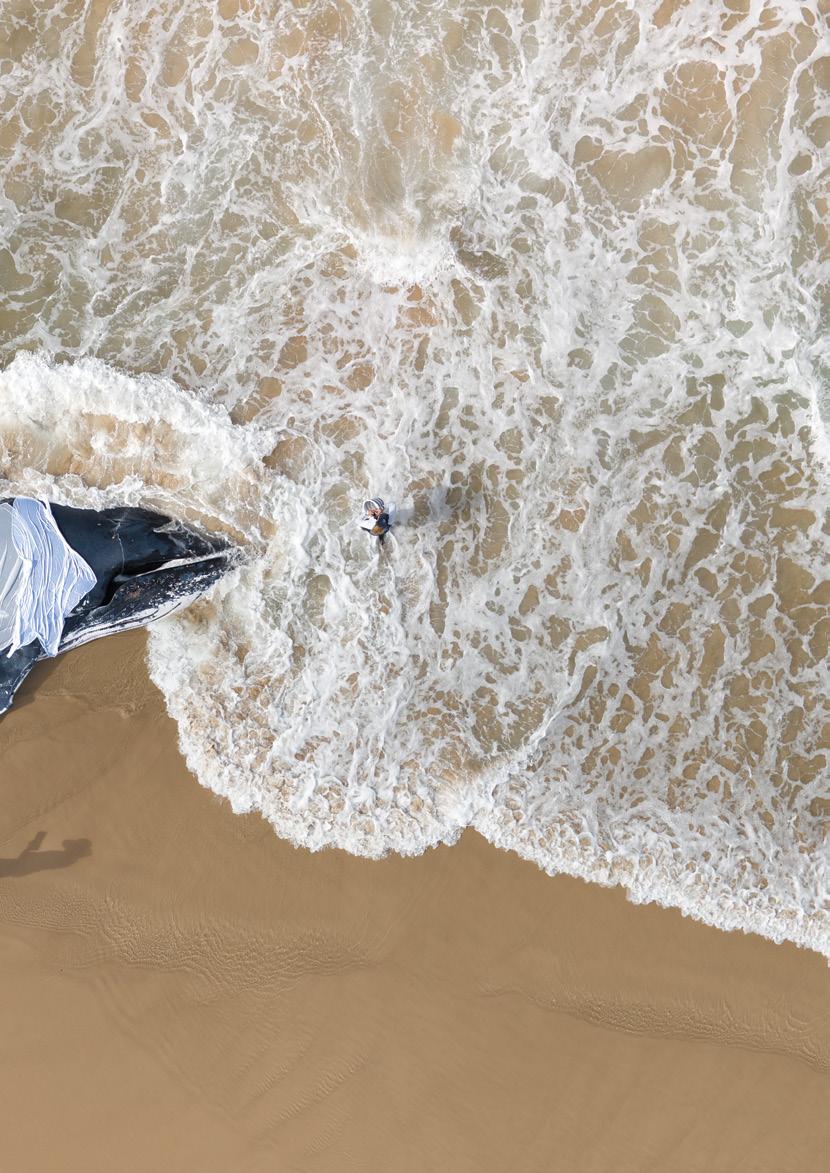
For 15 hours, rescue teams and the local community worked tirelessly in a unified effort to save the stranded humpback
Craig Parry
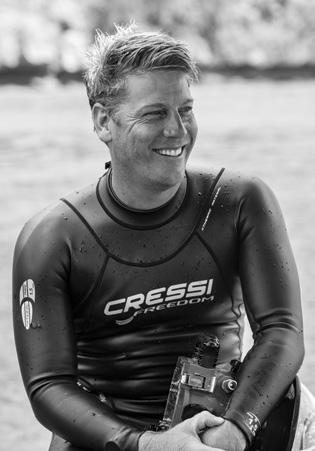
Craig Parry grew up in Byron Bay, on the coast of northern New South Wales. His parents’ gift of a disposable waterproof camera when he was five years old set him on the path to his passion. When he turned 13, he spent all his savings on a 35-millimetre SLR. Entirely self-taught, Craig worked hard at his craft before making a life-changing decision and becoming a full-time professional photographer in 2004.
Craig, what’s your favourite dive spot?
At home in Byron Bay – it’s a place of diverse species and has a variety of spots for me and my kids to enjoy together, but I am always excited to go on assignment to a place in the world I haven’t dived or to encounter a species of animal I haven’t seen before.
What’s your dream shoot, or what would you most like to capture?
It would have to be a close encounter with an orca. I have had a few encounters, but not face to face, so that’s on my bucket list!
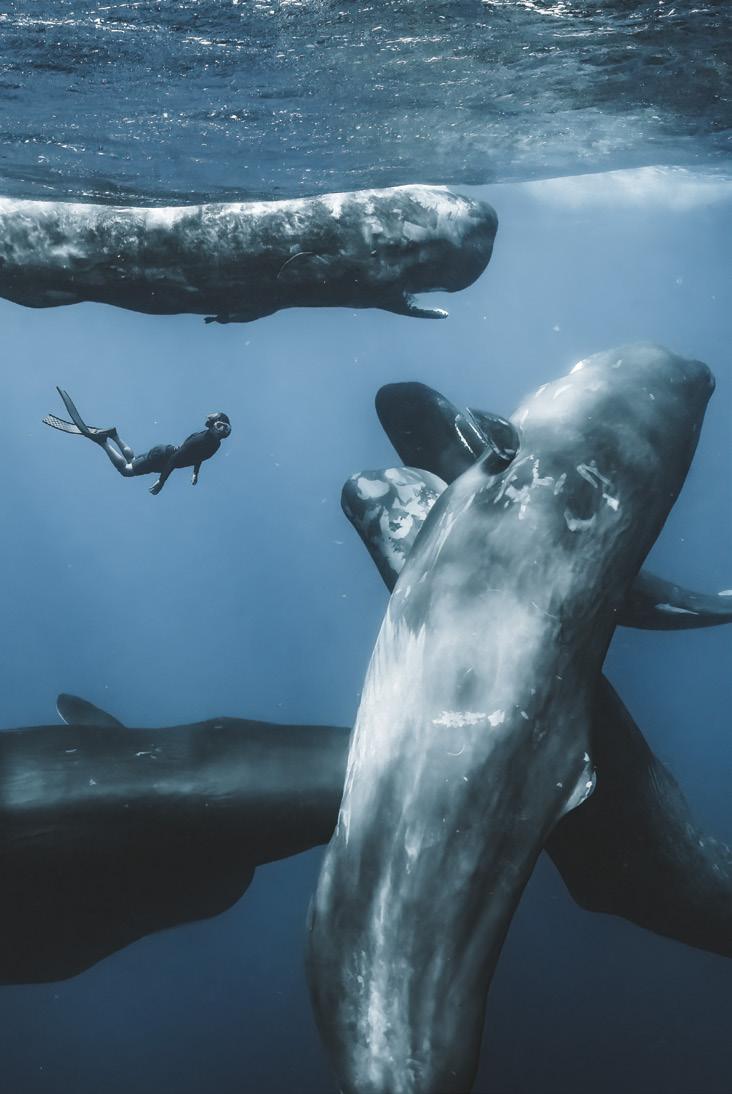
Let’s talk about Migaloo, the world-famous all-white male humpback whale first sighted off Australia’s eastern seaboard in 1991. You took the only known underwater shot of Migaloo, in 2016.
Craig Parry says: In the early hours of 1 July, we received a call about a stranded humpback whale. A wildlife veterinarian quickly assessed the situation and contacted SeaWorld Marine Rescue and other key agencies to co-ordinate a response. For 15 hours, rescue teams and the local community worked tirelessly in a unified effort to save her. Sadly, despite their dedication, she could not be saved. While the outcome was heartbreaking, witnessing the collaboration and compassion shown by multiple agencies and volunteers was incredibly moving – a powerful reminder of what can be achieved when people come together with a shared purpose.
Location Seven Mile Beach, NSW
Equipment DJI Inspire 3 + X9 Camera with 35-mm f2.8 Zenmuse Lens
Settings 1/2000 sec f4 ISO 200
Yes, it was the highlight of my career and the most unforgettable moment I’ve ever experienced under water. The whole morning felt surreal – the swell was up, and crossing the mouth of the Brunswick River was already a challenge. At one point our boat hit a wave and went completely vertical! But once we made it offshore from Byron Bay, the ocean turned calm and still. To my surprise, the water visibility was more than 20 metres – rare for July.
My father and I were sipping hot soup when, in the distance, I noticed a news helicopter circling. That’s when I knew we’d struck gold. Moments later, Migaloo appeared. I quickly and quietly slipped into the water and he swam directly towards me. When he came face to face with me, he let out the loudest whale song I’ve ever heard — the vibration echoed through every bone in my body. This image is special to me not just because it captures a beautiful portrait of Migaloo, but because it’s a memory of him singing to me — a connection I’ll never forget.
The last confirmed sighting of Migaloo was off Port Macquarie, NSW, in 2020. In October this year, a different white humpback was sighted south of Kaikoura in New Zealand.
The museum wishes to thank Oceanographic magazine and their partner Blancpain for the development and delivery of the Ocean Photographer of the Year competition and their support in the production of this exhibition.
PRESENTED BY
6 November 2025 – 3 May 2026
EXHIBITION SPONSORS
TICKETS

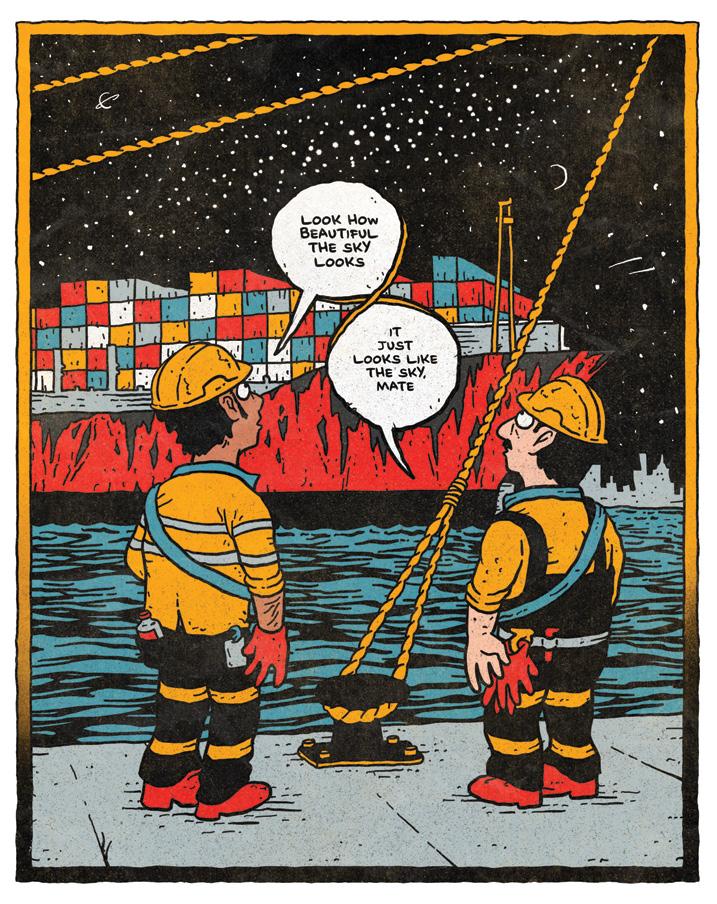
A new exhibition by Sam Wallman, a wharf worker and award-winning writer and illustrator, explores how life on the docks has changed – and stayed the same – over the past decades. By Tim Barlass.
WHEN YOUNG ILLUSTRATOR SAM WALLMAN had a chance encounter at a New York comic festival with Matt Groening, creator of The Simpsons, he hoped for a few words of encouragement. Sam had produced a complete handmade comic and excitedly offered it for inspection:1
His response was: ‘Wow, this is very ambitious’. I reflected on that later and thought, well, that doesn’t say much about the quality.
He was undeterred. Wallman now has two parallel careers: illustrator and part-time wharfie at a container terminal in Melbourne. His artworks spread his tradeunionist views of the concept of equality and ‘a fair go’.
The two careers developed in symbiosis. He has compulsively drawn since he was a child, but his first union-related drawings were created in his late teens, when he worked at a call centre:
View from the Docks is a contemporary response to The Wharfies’ Mural, which hangs opposite
With the headset on and getting abused by people, I would just draw what I imagined the caller looked like or I would draw myself hung by the cord we used to tether ourselves to the phone. I would pass them to my workmates mid-call. The drawings were just a pressure valve because the work was kind of hard.
The drawings started to resonate with people, which made him think that they could have a more meaningful purpose. He started to learn about the high-water marks of Australian unionism, such as the Green Bans and solidarity with Aboriginal people, women and homosexual people. He has since published two books internationally and his artworks have been exhibited widely, including at the Museum of Australian Democracy, the Australian Museum, the National Gallery of Victoria and the Chicago Labor Notes Conference.
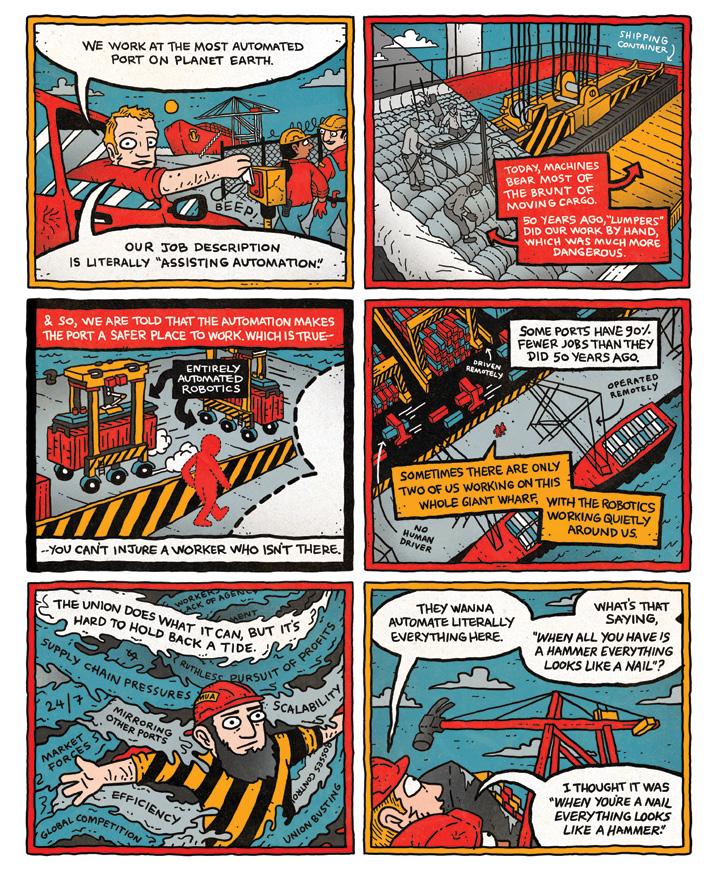
Sam Wallman’s works spread his trade unionist views of the concept of equality and ‘a fair go’
01 Automation, 2025,
His latest exhibition, now showing at the museum, is View from the Docks – a contemporary response to The Wharfies’ Mural, which hangs opposite. The Wharfies’ Mural was created in the mid-20th century by a group of worker artists to document that era’s key industrial and political struggles, victories and aspirations.
View from the Docks depicts a day on the wharf in 14 drawings against a backdrop of a huge decal of the dock and a giant crane. The powerful images are produced not on paper with ink or pastel, but on an iPad with a stylus pen.
‘The museum has given me a lot of opportunity for self-expression and I really appreciate that’, Sam says. In the same collaborative spirit as The Wharfies’ Mural, he told a meeting of the Maritime Union of Australia about the project, because he wanted to let everyone have their say:
I thought everybody would say ‘Who cares?’, but probably 20 people started calling out suggestions: ‘You’ve got to have the Indigenous struggle and our relationship with that, you’ve got to have women on the wharf’ … I’ve tried my best to put them all in.
Dock workers used to have to line up to secure their shifts, but they now receive them digitally:
I get my shifts the day before, sometimes 3 or 4 pm when I’m starting at 5.30 am the next day. I’m not lining up but I’m waiting for my phone to tell me if I’m working the next day. It’s not that much better.
On today’s wharves, smart machines have replaced physical labour, and the pay is better, but some aspects of dock life remain unchanged:
There are still really serious injuries, though not in the same numbers. And a worker is still a worker and a boss is still a boss.
Wallman’s next book, All Out: Pink Bans and Blue Collars, explores intersections of queer and working-class organising efforts. It centres on the Pink Bans, a time in the 1970s when construction workers refused to work on projects with links to organisations that persecuted queer people:
‘All Out is about that and what it’s like for me to be out and gay as a wharfie because I’m in the minority, that’s for sure. I want us to celebrate that we can change things.’
1 All quotes by Sam Wallman are from an interview conducted with Tim Barlass in September 2025.
Tim Barlass is a journalist who has worked at The Sydney Morning Herald and is currently contracted to write for the museum.
The 1936 Torres Strait Maritime Strike
The island of Badu, in Torres Strait, was once the centre of the lucrative – and exploitative – pearl shell industry. Ninety years ago, an extensive strike brought the industry to a halt, changed the governance of Torres Strait for all time and sparked a nationwide Indigenous land rights movement. By Tim Barlass.
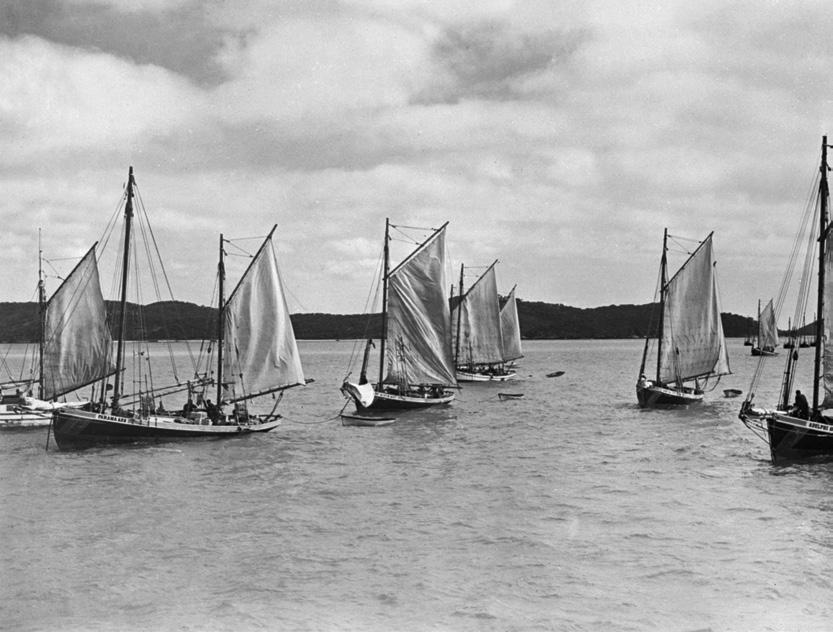
EVERY NIGHT AT 9 PM, a church bell used to toll on the Torres Strait island of Badu, followed by the shrill of a whistle. In the 1930s, this marked the nightly curfew and warned every ‘native’ to be indoors or face the consequences. Those breaching the curfew might the next day find themselves at the palm-thatched courthouse before island ‘queen’ Mrs Ethel Zahel – judge, governor, schoolteacher and overseer of the island’s approximately 500 Indigenous people.
Zahel lived in an official bungalow on the shore, where crocodiles called daily to steal her poultry. At her school, girls could be fined two shillings and sixpence (about $15 today) for ‘promiscuous kissing’.1 She endeavoured to teach the natives ‘perfect’ English by eradicating their pidgin language.
Many islanders became increasingly unhappy with government control of the islands and their boats
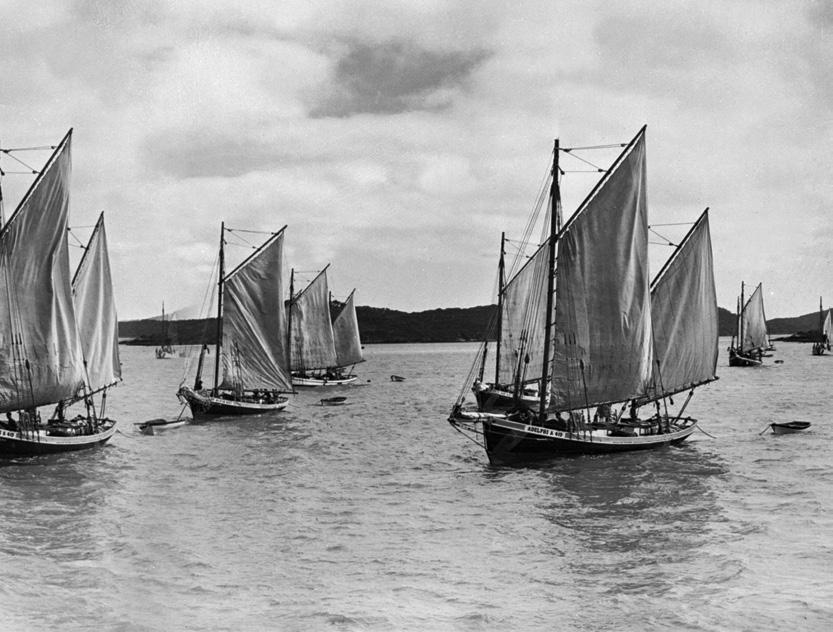
The pearl shell industry relied on the exploitation of Torres Strait Islanders and imported, mostly Japanese, labour. But the growing influence that people like Zahel and so-called government ‘Protectors’ had over islanders caused underlying friction. One islander, apparently referring to Zahel, said: 2
For a very long time we had one lady, Mrs Z. She was a very hard lady; she was a good teacher but she was the boss over the whole island. So [unrest] started from there; you could hardly see a piece of money.
In 1936, Badu erupted into a maritime dispute that would redefine politics within the Torres Strait and the plight of its Indigenous people, whose employment was described at the time as ‘a position of slavery in all but name’. 3
The strike was not just about the poor wages and appalling conditions experienced by islanders working in the trade. It was about their broader right to be treated with respect and equality, and to have self-determination and control over their own lives.
Thomas Mayo is Assistant National Secretary of the Maritime Union of Australia (MUA), which, through its founding unions – the Waterside Workers’ Federation (WWF) and the Seamen’s Union of Australia – has had a long history of solidarity with Aboriginal and Torres Strait Islander people. He notes: 4
In the Torres Strait, Indigenous workers standing up for their rights started early and were quite effective. Torres Strait Islanders had been members of the MUA’s predecessor unions at the time of the 1936 maritime strike, as wharfies and merchant seamen … But most importantly, the people of the Torres Strait had strong kinship connections, they had great community spirit, and they had a warrior’s willingness to fight for each other, and for what is right.
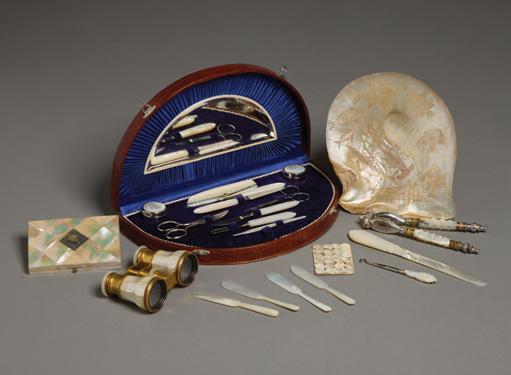
The pearl shell industry had nothing to do with pearls. The ‘catch’ was the iridescent shells, known as motherof-pearl, which had been commercially harvested since the 1860s. Pearl shell was used to make buttons and knife handles and to decorate items such as jewellery boxes and musical instruments. Its use was widespread until the advent of plastics in the 1940s.
There were two types of employment in the pearl shell industry: an islander could sign on to either a native boat or a ‘master’s’ boat. European and Japanese industries owned the masters’ boats and generally paid higher wages. The industry was inherently risky, as a newspaper report noted: 5
While diving for pearl shell near Badu Island, a Japanese diver, Hackiro Kamada, met his death. He had descended into eight fathoms [15 metres] of water and about five minutes later was noticed on top of the water with no helmet or corselet on.
The Japanese were the main divers within the Torres Strait pearling industry, and many died from the bends or faulty equipment. There are more than 700 Japanese graves on Thursday Island; more than half are of people aged under 21.
Alongside the inherent dangers were rewards – for some. Native pearling boats could earn up to £2,000 a year ($235,000 today), and in 1928 one such boat earned a record £3,100 ($365,000 today).6
The late 1920s was a boom time for the pearl shell industry, with high demand and high prices, but in the early 1930s prices collapsed and shell harvesting was restricted. With the decline came interference in all aspects of islander life.
The pearl shell industry relied on the exploitation of Torres Strait Islanders and imported, mostly Japanese, labour
01
Items made from pearl shell, including a boxed manicure set, button hook, opera glasses, card case, buttons, butter knives, nut crackers and a half shell incised with tropical fish. ANMM Collection
02
Pearl fishers in the Torres Strait, c 1920. Image State Library of Queensland
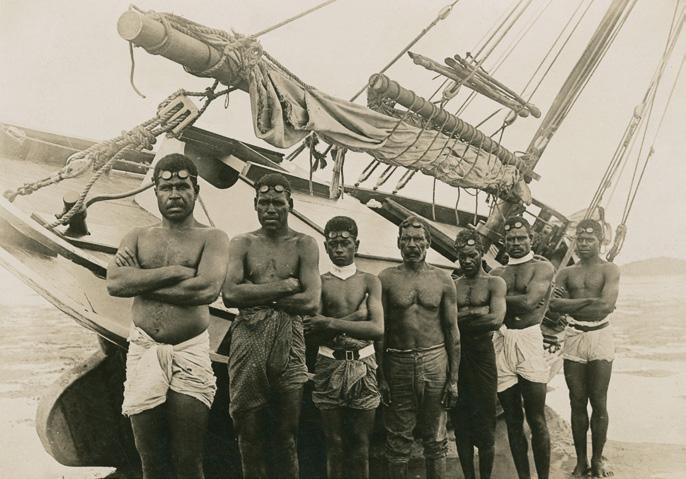
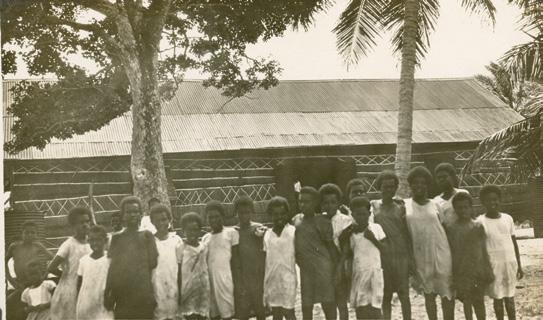
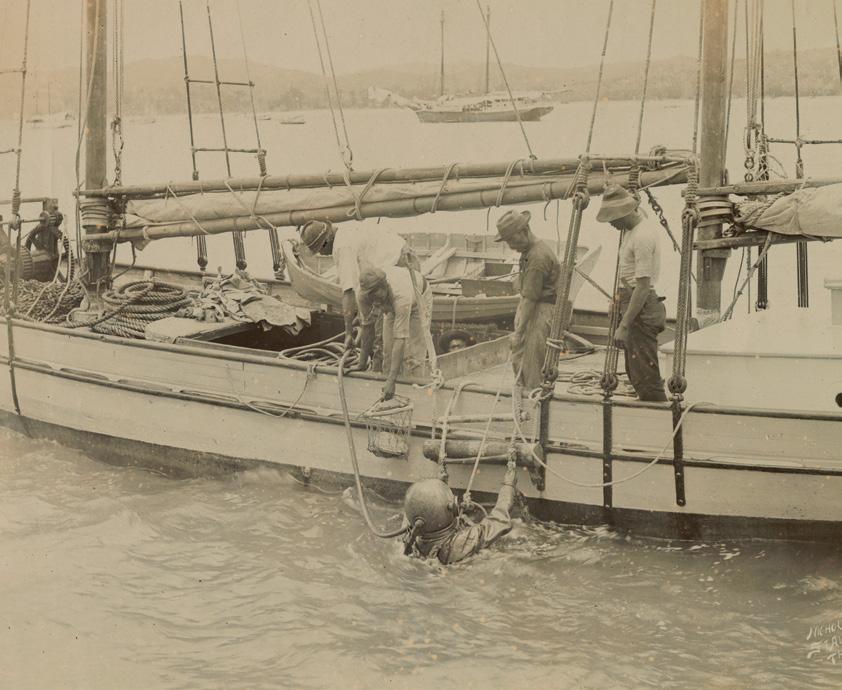
In 1936, Badu erupted into a maritime dispute that would redefine politics within the Torres Strait and the plight of its native people
01
Badu school house, where strikers jumped from the windows, c 1928.
Image National Library of Australia
02 Diver returning to a lugger with pearl shells in the waters off Thursday Island, c 1905.
Image Nicholas St Austen Studio, State Library of Queensland
Although islanders built the native boats, the local Queensland Government ‘Protector’ controlled them. Many islanders became increasingly unhappy with government control of the islands and their boats. They also resented being paid not in cash to spend as they wished, but in credits that could only be redeemed at government-recognised stores. The tipping point came when the Queensland Government Protector’s Department increased the pressure on islanders to improve performance to match the foreign-owned boats. Torres Strait Islander people took a stand in January 1936, when workers scheduled on the native boats refused to work. ‘Natives on Strike, Decline to Work Island Luggers’, ran one headline. ‘On Strike, Torres Strait Boys, Dissatisfied with Pay’ was another.
When the issue of native boats was raised at a meeting convened in the island’s schoolhouse and attended by Protector of Aboriginals, J D McLean, the islanders refused to discuss the matter and, as an act of defiance, jumped out of the windows. One said: 7
When Mr McLean comes here he puts up the board and writes down the names of the boats: Wakaid, Ngainga, Yasa ... But nobody stood up. And one man said: ‘Come on, all of us jump through the windows’. Mr McLean, Mrs Z –and the other native councillors sitting beside him. They were sitting watching us, never say nothing because we jumping out, nobody was left in the room.
The striking workers were offered pay increases in late February to tempt them back to work. After several months of a sustained strike, McLean was forced to leave the islands, which met with great celebration from the strikers.
In mid-September, a number of key concessions were made. The nightly curfew was abolished and wages were increased. Islanders could choose their own crews and control their own boats.
Before the year was out, many of the powers of government teacher–superintendents such as Ethel Zahel had been transferred to island councils. The first all-island Councillors Conference was convened in 1937. ‘Indirect rule’ was formalised in Queensland by the passing of the Torres Strait Islanders Act 1939. For the first time, island councils were constituted by an Act of Parliament.
Kenny Bedford lives on the remote island of Erub (Darnley), which he represents on the Torres Strait Regional Authority Board. He is also a board member of Reconciliation Australia and is on the museum’s First Nations Advisory Committee. He notes that the 1936 strike was significant both to Torres Strait maritime and political history and for its domino effect on mainland Aboriginal workers’ rights and land rights: 8
Within a year of the maritime strike, the first Inter-Inland Council Conference happened for us on Masig [Yorke Island] on 23 August 1937. On the same date 30 years later, for example, Vincent Lingiari led the Gurindji Strike of Stockmen [known as the Wave Hill walk-off] , for similar reasons. To get back control of their land and their affairs.
The Gurindji strike helped to spark Australia’s land rights movement and to increase understanding of Indigenous land ownership in Australia. It led to the passing of the Aboriginal Land Rights (Northern Territory) Act 1976, the first legislation allowing for a land rights claim if the First Nations claimants could prove their traditional relationship to the land.
1 ‘Where girls can be fined 2/6 for kissing’, The Australian Women’s Weekly, 20 January 1934.
2 Nonie Sharp, ‘Culture Clash in the Torres Strait Islands: The Maritime Strike of 1936’, presented to Royal Historical Society of Queensland, 24 June 1982.
3 ‘Terrorism against Aborigines’, The Workers’ Weekly, 21 January 1936.
4 Email to author Tim Barlass, 28 August 2025.
5 ‘Diver’s death’, Maryborough Chronicle, Wide Bay and Burnett Advertiser, 27 April 1935
6 ‘A visit to Badu’, The Australasian, 30 March 1935.
7 Islander interview by Nonie Sharp, ‘Culture Clash in the Torres Strait Islands: The Maritime Strike of 1936’, presented to Royal Historical Society of Queensland, 24 June 1982.
8 Email to author Tim Barlass, 26 August 2025.
Tim Barlass is a journalist who has worked at The Sydney Morning Herald and is currently contracted to write for the museum.
A milestone for the Australian navy
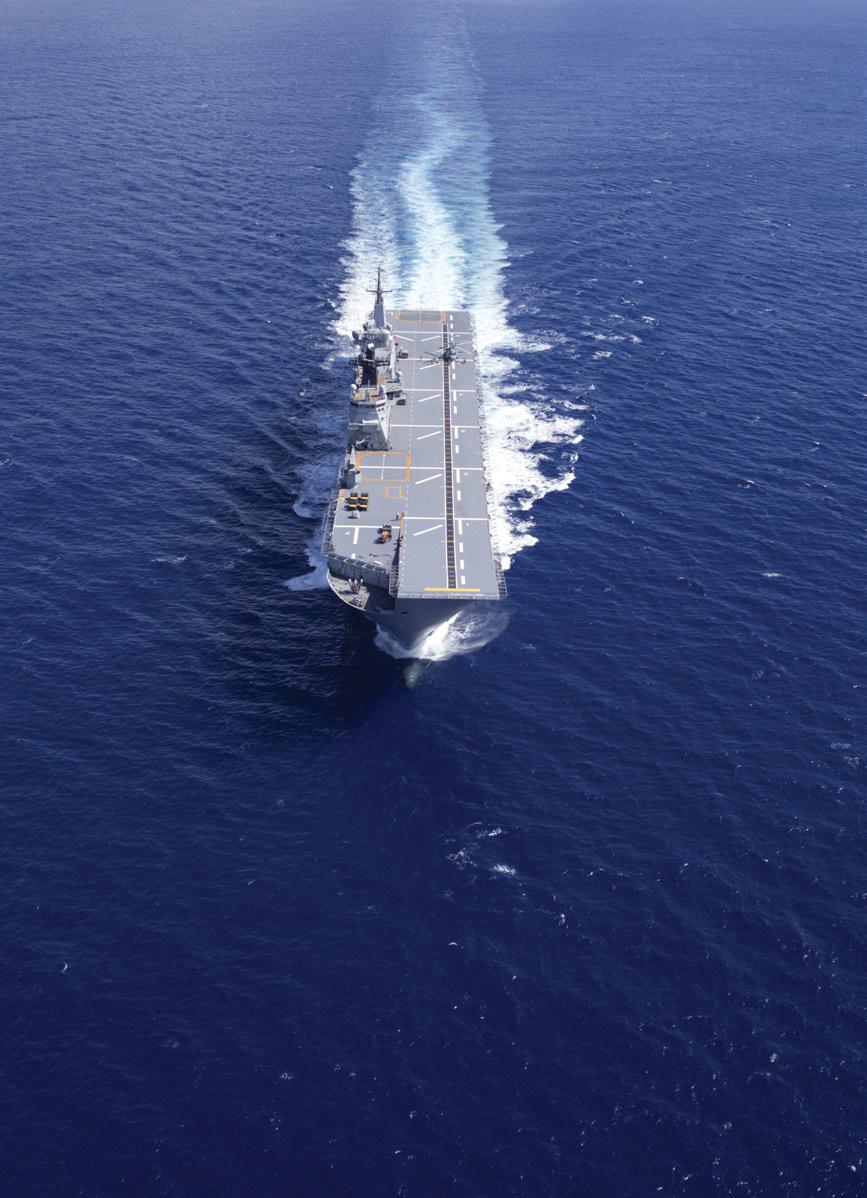
Preparations are well under way to commemorate 125 years since the foundation of Australia’s naval service. Tim Barlass previews what to look forward to.

Navy 125 celebrations will include a fleet of Australian and international naval ships on Sydney Harbour
WHEN THE AUSTRALIAN NAVY marks its 125th anniversary next year, celebrations will include the biggest assembly of international naval sea power on Sydney Harbour for more than a decade.
Up to 20 visiting ships are expected, and the flotilla will pass through Sydney Heads and into the harbour on the morning of Saturday 21 March 2026 for the International Fleet Review (IFR).
The naval procession will be led by HMAS Canberra (III) – a landing helicopter dock (LHD) and the largest ship in the Royal Australian Navy (RAN). Many other RAN ships will be involved, and a number of our neighbours and partner nations plan to commit a vessel to the review. As Signals goes to press, eight Pacific nations – Fiji, Solomon Islands, Micronesia, Palau, Kiribati, Tonga, Papua New Guinea and the Cook Islands – have each committed to send a Guardian-class patrol boat.
The official reviewing officer, who is yet to be named, will be accompanied by Chief of Navy Vice Admiral Mark Hammond AO RAN, Fleet Commander Rear Admiral Chris Smith AM CSM RAN (who sits on the museum’s Council) and other dignitaries. They will pass each vessel, taking the salute as part of the Ceremonial Fleet Review, before a fly-past of fixed-wing aircraft of the Royal Australian Air Force and helicopters of the Fleet Air Arm.
The last gathering of warships on the harbour was in October 2013, as part of the celebrations to commemorate the centenary of the entry of the first Royal Australian Navy fleet into Sydney Harbour.
That anniversary was attended by Prince Harry, on his first official trip to Australia representing the British royal family, and was watched by thousands of spectators at prime harbourside viewing points. It is as yet unknown whether a representative of the royal family will attend next March.
When Federation in Australia established the Commonwealth, on 1 January 1901, the colonial naval forces were amalgamated into the Commonwealth Naval Force. It took about three months for the national Navy and the Army to become official, which is why both organisations mark their commencement date as 1 March 1901. Ten years later, on 10 July 1911, King George V granted the naval forces the title of Royal Australian Navy, and its warships were given the prefix His Majesty’s Australian Ship (HMAS).
01
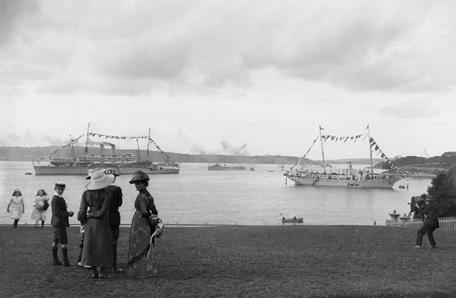
Spectators on the lawn of Government House, Sydney, view the arrival of ships of the first Royal Australian Navy, October 1913. Image Samuel J Hood Studio/Mitchell Library, State Library of New South Wales
02
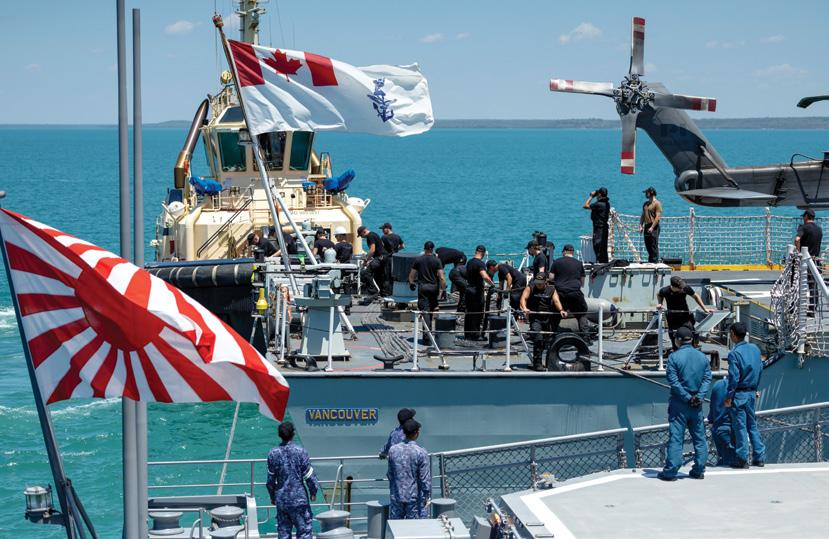
Exercise Kakadu 2024. Normally held in the waters off Darwin, this biennial international training exercise will take place off the coast of New South Wales in 2026. Image IBIS Jasmine Saunders/ RAN
On the day
‘Participating ships from our partner nations will pass through our northern ports before exercising their way down the east coast,’ says Royal Australian Navy spokesman Captain Tony Raeside. ‘After final briefings, all ships involved in the IFR will enter Sydney Harbour during the morning of Saturday 21 March 2026.’
Soon after 8 am, lead ship HMAS Canberra will pass the Bradleys Head Naval Memorial and the HMAS Sydney (I) mast, which commemorates the Sydney–Emden action of World War I. A flag-raising ceremony will be held at Bradleys Head underneath the memorial, while an Indigenous welcoming ceremony will take place on Canberra as it passes Bradleys Head. The ships are expected to be at anchor by midday, and the afternoon will feature a 21-gun salute from the gun battery at Garden Island Naval Base. The International Fleet Review will conclude at about 4 pm.
Vessels will leave Sydney Harbour later in the week to participate in Exercise Kakadu off Sydney. Usually held in the waters off Darwin, this biennial, multinational maritime warfare exercise is hosted by the Royal Australian Navy. The 16th iteration of the exercise, in 2024, involved some 3,000 personnel from over 30 countries, 10 warships and aircraft from five nations.
Capt Raeside added:
We know all the Australian ships involved and the names of six partner nations’ ships, and a further 10 countries have made firm commitments to participate. Having numerous Pacific nations represented is, I think, amazing. It shows that our partners in the Pacific value working with the Australian navy, they value Australia’s partnership, and they’re prepared to commit to an event like this, and Exercise Kakadu as well.
Security on the harbour will be tight, but all other harbour functions will be maintained and ferry routes will remain operational. Public access will be freely available. Capt Raeside noted:
Security and keeping our ships and our people safe are fundamental to everything that we do, and we have a series of working groups with the New South Wales Police and the Water Police and Federal authorities.
Australian vessels at the International Fleet Review
HMAS Canberra (III), landing helicopter dock (LHD)
HMAS Perth (III), ANZAC class helicopter frigate
A Collins class submarine
HMAS Choules, Bay class landing ship dock (LSD)
HMAS Diamantina (II), Huon class minehunter coastal vessel
HMAS Yarra (IV), Huon class minehunter coastal vessel
STS Young Endeavour, sail training ship
Events around Australia
A series of events will take place around Australia throughout 2026 under the banner ‘Navy 125’.
TAS: 6–9 February, Hobart Regatta.
ACT: March, Navy Week, Australian War Memorial forecourt, Canberra.
NSW: 21 March, International Fleet Review and ADF combined flypast, Sydney Harbour.
NT: April, Northern Australian Defence Summit (Australian Defence Magazine conference), Darwin.
WA: 26–28 May, Indian Ocean Defence and National Security (IODS) Summit, Perth/Fremantle/Rockingham.
SA: 7 July, South Australian Defence Summit ( Australian Defence Magazine conference) and Defence Week, Adelaide.
QLD: 30 July, Queensland Defence Summit ( Australian Defence Magazine conference), Cairns
Tim Barlass is a journalist who has worked at The Sydney Morning Herald and is currently contracted to write for the museum.
This October marked 100 years since the death of Walter Reeks, whose innovative and sometimes unorthodox designs spanned a broad range of commercial and recreational vessels. David Payne profiles his life and achievements.
AUSTRALIA’S FIRST qualified naval architect, Walter Reeks, died at his home in the Sydney suburb of Mosman in October 1925, having lived and practised his profession in the city since his arrival 40 years earlier. His life spanned many technical developments in the marine field: the application of more rigorous scientific methods; new materials and configurations for the craft he designed; and the replacement of sails, first by steam engines and, later, those using oil or petrol. Propellers were superseding paddle wheels, and steel construction was replacing timber. Reeks mastered them all.
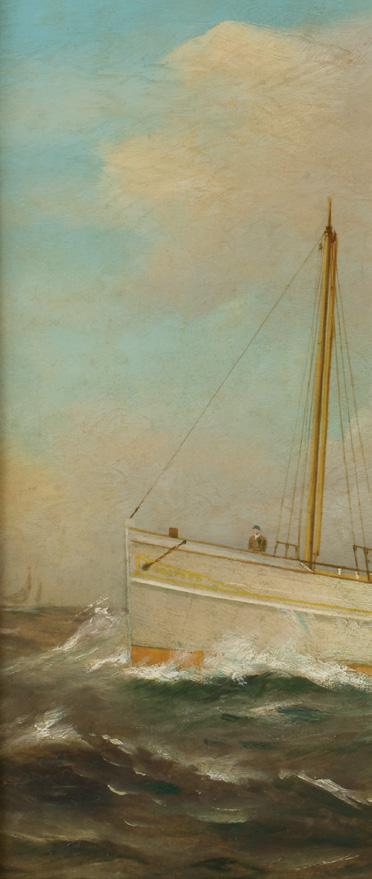
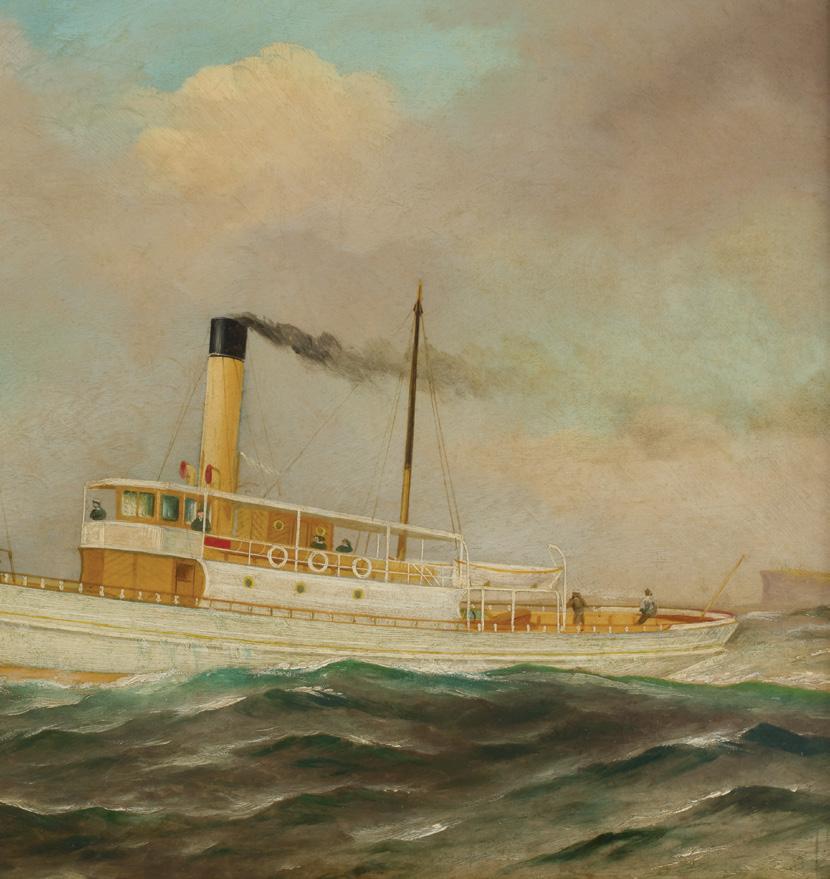
Oil painting of screw steamer Gosford by A Dufty, c 1900. Designed by Walter Reeks and launched in 1886, Gosford had a career of almost 50 years in Australia and New Zealand. ANMM Collection 00000053
Walter Reeks’ career had a positive impact on many people, events and happenings throughout Australia and New Zealand
01
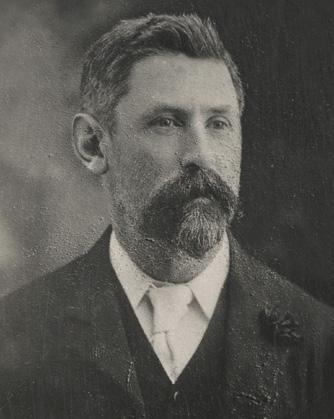
Portrait of Walter Reeks. ANMM Collection ANMS0529[003] Gift from Bruce Stannard
02
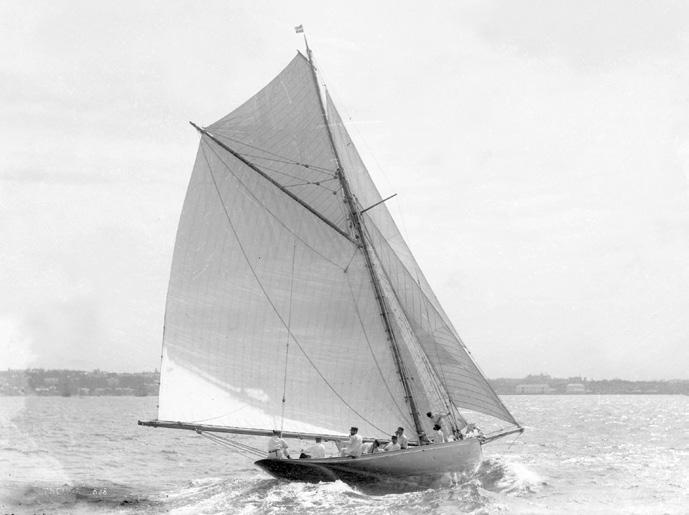
The elegant Thelma (seen on Sydney Harbour, c 1900) was named for Reeks’ daughter and was one of his favourite designs. Image William Hall Studio, ANMM Collection 00013816
Reeks’ client list shows he made time to work on projects big and small, mainstream and intriguing
Both Reeks’ design progress and his life reflected an ability to adapt to change. He was always moving along with the next project, the next event, the next chapter. The seeds of this seem to be in his early days in England. His father, Charles, had an entrepreneurial streak, and gradually moved upwards in society. At the time of Walter’s birth in 1861, Charles was a corn dealer, but he soon created or took advantage of other business opportunities. He also saw the value of education and community involvement. Walter attended the prestigious Hartley Institution in Southampton (now the University of Southampton), where he gained a foundation in technical studies that were then developed practically through his apprenticeship to the Inman Shipyard in Lymington. This led directly to an apprenticeship with Liverpool naval architect Alexander Richardson. He couldn’t have had a much better grounding, with both employers displaying a professionalism and attention to detail that put them at the top of their trade.
When Reeks left England, he may have planned to do a return trip, but on arrival in Australia he left the ship in Melbourne, came to Sydney and stayed. Perhaps his entrepreneurial sense showed its hand here. He had landed in a place that offered an outstanding professional opportunity, and he soon advertised
himself as a professional naval architect and marine engineer – a single cap which, it appears, no one had yet worn in the colony.
On 30 May 1885, just seven weeks after Reeks’ arrival, a piece published in The Sydney Mail and New South Wales Advertiser discussed the merits of naval architects:1
No man thinks of building nowadays from designs other than those supplied by a recognised and qualified naval architect, and … I find one of these, Mr Reeks, of long experience in England, is about to practise in Sydney.
Professional vessel design and engineering were becoming an affordable necessity for many projects in which formerly the builder had also been the designer. Technology was moving ahead, driven by commercial competition and social pressures, and becoming more complex. The place for full-time professional practitioners in design had been firmly established. Before long, Reeks was consulting on improvements to existing yachts, then delivering his own designs commissioned by clients. The need for a naval architect translated across to commercial vessels, too, and he was soon designing ferries and other craft for Sydney and elsewhere in New South Wales. The vessels began to show his penchant for being unorthodox, while still meeting the clients’ desire for speed and other commercial objectives. Of the steamer Gosford, launched in 1886, the Sydney Morning Herald noted:2
She differs in design from the steamers usually built here, in that instead of the usual ram bow she is cut away or rounded in the forefoot. There is just the suspicion of hollow in the fore end, swelling away to a full round middle body, and lapsing again into a clean tail, thus giving free grip to the propeller.
She is a study in symmetry. Bow, stern, topsides and bottom blend beautifully one into the other round and clean. Fore-and-aft she is a perfect picture in the way of a model. If she is not fast it will be a puzzle to everybody, for she looks like speed, every inch of her.
Equally important, Reeks was making contacts at many social levels and learning how to become a respected professional in this new society. He maintained this respect throughout, developing his network and becoming a national figure in his field. His client list shows he made time to work on projects big and small, mainstream and intriguing, for both the well-off and those of lesser means. His involvement in society beyond work encompassed a similar range of interests and causes, and he was proud to be an Australian.
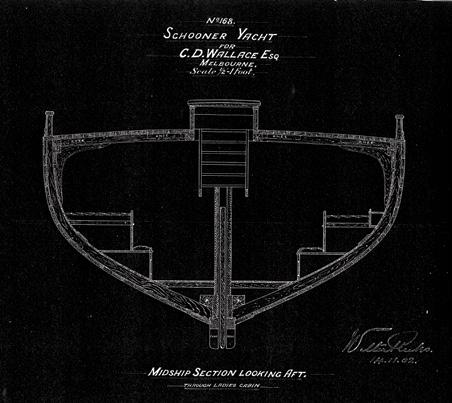
A review of his specific accomplishments is impressive. The yachts Era, Iduna, Volunteer and Thelma dominated the fleet on Sydney Harbour from 1887 into the 1890s, and later the 20-year-old Thelma nearly won the Sayonara Cup when brought up to speed for the match race in 1909. Reeks was commissioned to design a yacht for a proposed challenge for the America’s Cup in 1889–90, and went to the USA to investigate what was required, but having designed the 90-foot waterline yacht, the challenge failed to eventuate. He was quick to begin designing launches to be powered by oil or petrol engines, with some of his first designs and their tunnel hulls setting the standard early for both speed and style. Refined elegance was still on show with the Edwardian steam yacht Ena, matched by the classic schooner Bona (later Boomerang ).
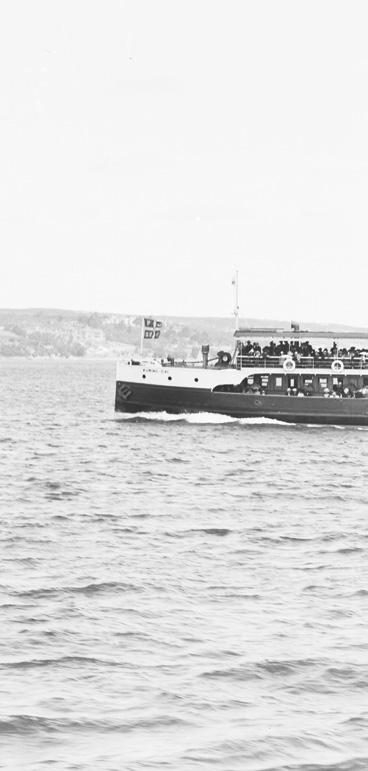
Reeks’ designs for the doubleended Manly ferries remain the archetype for this class of vessel. Pictured is Kuring-Gai, which served from 1901 to 1928. ANMM Collection ANMS1092[223]
The need for a naval architect translated across to commercial vessels, too, and Reeks was soon designing ferries and other craft
01
Plans for Project no 168, Bona (later Boomerang ). Courtesy Sydney Heritage Fleet
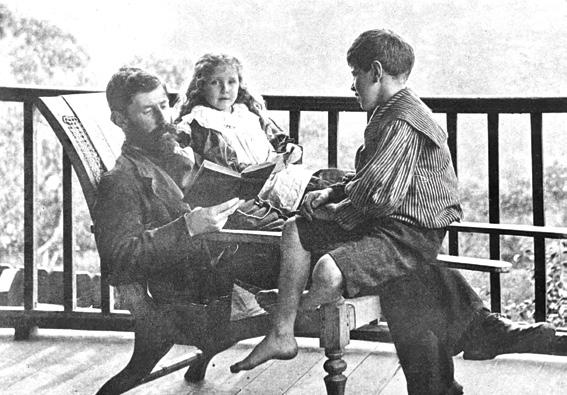
02 Walter, Thelma and Kent Reeks at their home Twynham in the Sydney suburb of Mosman, late 1890s. Image Rae Fidock Collection
Before long, Reeks was consulting on improvements to existing yachts, and then delivering his own designs commissioned by clients
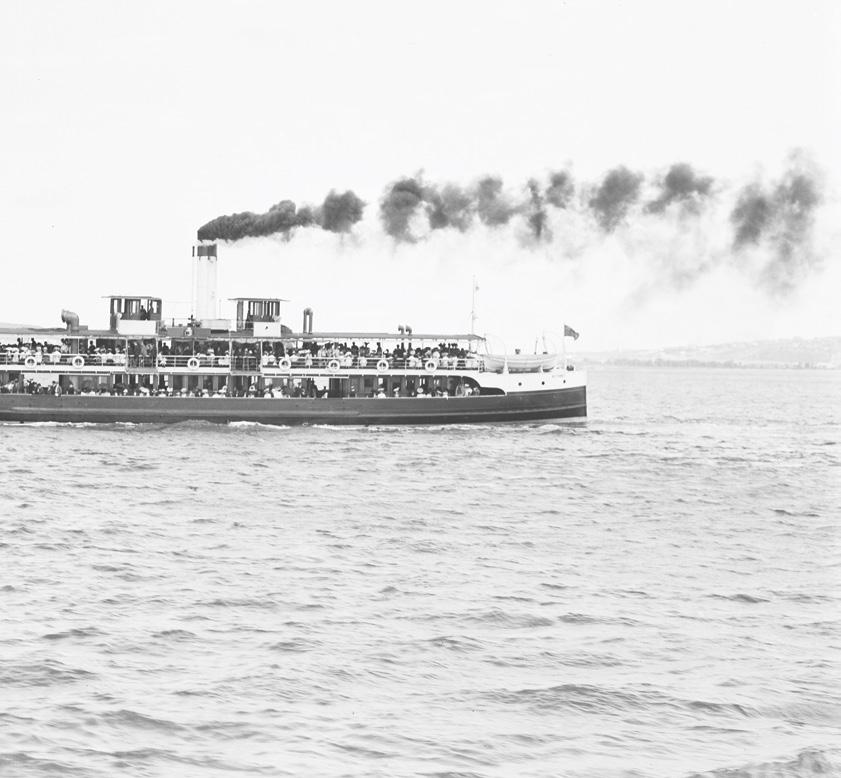
In the commercial arena, Reeks’ ferries stand out. Among his designs for craft in Sydney, Hobart and Brisbane, some featured his unorthodox camber keel profile and a single propeller on a double-ended hull shape. His two Manly ferries, Manly and Kuring-Gai, were the first propeller designs for the route in the early 1900s, and established a concept for that fleet that continued through other additions in the following decades. Even his designs for steam tugs and lighters were novel and elegant.
The pearling trade was a significant industry for Australia from the 1880s to the 1930s, with the ‘pearl king’ James Clarke a key player in the 1890s and 1900s. Clarke sought Reeks’ skills to create much of his new fleet of luggers in the Torres Strait, where the yacht-like hull shape favoured by Reeks was mimicked by others.
Reeks created more than 300 designs, and his vessels operated in ports and waterways around Australia, in New Zealand and as far away as Papua New Guinea (PNG). Some, such as his last yacht design, San Pan, were totally unorthodox. Others included an extraordinary project in 1900 that turned individual decks of the decommissioned frigate HMS Nelson into a number of coal punts as it was being dismantled in Sydney. At the same time as designing his America’s Cup yacht, but at the other end of the scale, he was doing a model pond yacht for a client with smaller ambitions. He created a grandiose design for a steel steam yacht for the governor of PNG, which never left the drawing board. Instead, in 1917, a more subdued motor vessel design from his pen arrived in Port Moresby, only to have a short life before a fiasco – not a design fault – sank the vessel in the main harbour. However, the innovative Musa, an early oil launch with sail assist, made the long passage from Sydney up the coast to successfully explore the Musa River in eastern PNG.
Sadly, Reeks’ family life had significant setbacks. His first wife, Mary, died young, leaving the 34-year-old Reeks with two small children. Then, in 1914, his son Kent, who was following in his maritime engineering footsteps, was murdered in England, in a crime that remains unsolved. A third tragedy played out on Sydney Harbour when his prized design Thelma was wrecked in a gale, with the loss of a close friend, who was swept overboard and never seen again.
Reeks’ career had a positive impact on many people, events and happenings throughout Australia and New Zealand. His was a life full of accomplishments, and his surviving craft continue to tell this story.
The Australian National Maritime Museum is home to two Reeks vessels, steam yacht Ena (1900) and gaff racing cutter Jenny Wren (1889). Alongside on the wharves is the schooner Bona (1903), now known as Boomerang , operated by Sydney Heritage Fleet. Their elegant lines and decorative features are characteristic of their era. The double-ended ferry Lady Denman, with its single push–pull propeller, highlights one of Reeks’ innovations; it remained active from 1911 through to the early 1980s, way past its useby date. This functional design – which once took this author on his daily school travel to and from the city in the 1970s – rests in Huskisson, New South Wales, inside its own gallery at the Jervis Bay Maritime Museum. Private owners are custodians of a modest number of other Reeks designs, including the yachts Landseer III, near-sister Gypsy, Shona, Roona, Wyruna, Sea Scout and Mischief Lotus II and Earlie are two motor launches, and the former steam tug and lighter Pegasus, now a stately motor vessel, is a tribute to Reeks’ commercial design for a working craft that also carries his trademark elegance and flair.
Collectively, the surviving vessels represent a small portion of a career that set the tone for the work of many subsequent designers, showing that Australia can deliver craft as fine as any worldwide.
David Payne has extensive experience as a designer of yachts and small craft. He is an Honorary Research Associate of the museum and its former Curator of Historic Vessels. With Nicole Mays, he has written Walter Reeks: Naval architect, yachtsman and entrepreneur (Navarine Publishing, Hobart, 2023).
Jointly established by the museum and Australian Sailing in 2017, the Australian Sailing Hall of Fame recognises and promotes the greats of the sport. The newest honourees epitomise sustained success in high-performance sailing.
THE AUSTRALIAN SAILING HALL OF FAME seeks to acknowledge the depth and breadth of Australian sailing, from the sport’s early years in 19th-century colonial Australia to today. The latest honourees are Glenn Ashby, Nathan Outteridge OAM and Iain Jensen OAM
Glenn Ashby
Growing up in country Victoria, Glenn Ashby learned to sail on Lake Eppalock, where time on the water quickly turned from a hobby into a lifelong passion and a successful career. By the age of 15, he had earned selection in the Victorian Youth Squad, and at just 19 he was competing at his first world championship.
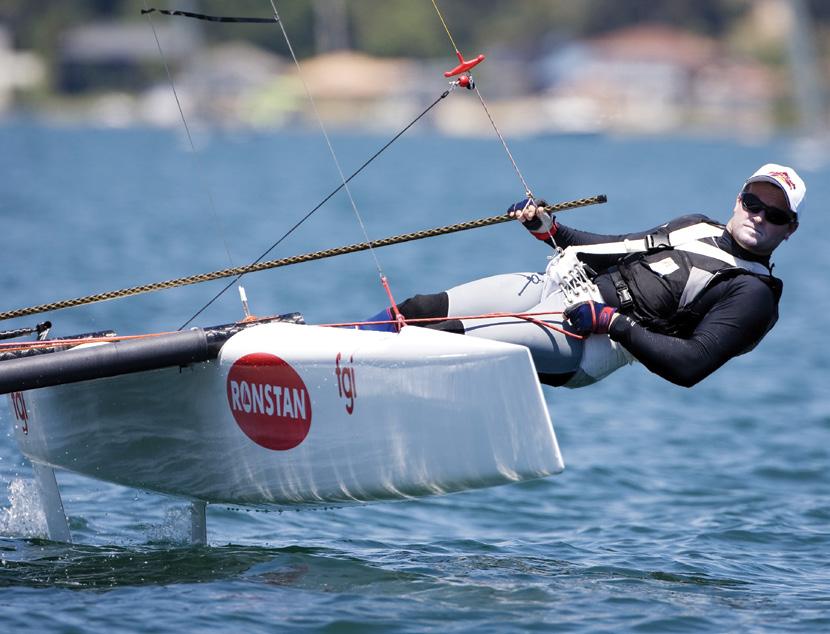
From there, Glenn’s rise was meteoric. He is now one of the most successful multihull sailors in history, collecting an extraordinary 17 world titles across several classes. His first came in 1996 at the A-Class Catamaran World Championships, a victory that marked the beginning of an era of dominance in high-performance catamaran sailing. Over the next two decades, he added nine more A-Class world championships,
displaying an unmatched ability to stay at the cutting edge of both technology and technique as the sport evolved.
In partnership with Darren Bundock, Glenn also achieved exceptional success in two-person multihulls, winning three Tornado World Championships and three Formula 18 World Championships. The pair represented Australia at the 2008 Beijing Olympic Games, earning a silver medal in the Tornado class.
In 2018, Glenn once again demonstrated his versatility and dominance, adding another world championship crown in the G32 foiling catamaran class.
Glenn’s reputation as a foiling and multihull specialist soon drew him into the world’s most prestigious sailing competition – the America’s Cup. He joined BMW Oracle Racing in 2010 as a coach during their successful campaign, before moving to Emirates Team New Zealand (ETNZ) ahead of the 2013 Cup. His technical expertise, innovative mindset and calm leadership played a pivotal role in shaping the team’s revolutionary approach to foiling technology, helping redefine what was possible in yacht racing.
01
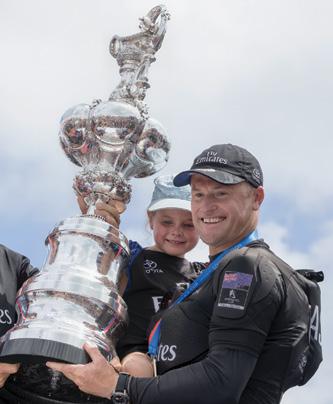
Glenn Ashby has participated in four America’s Cup challenges, including the successful Emirates Team New Zealand campaigns of 2017 and 2021.
02
Glenn Ashby on his way to win the 2009 A-Class catamaran world title on Lake Macquarie, NSW. Images courtesy Sailing Australia
In 2023 Glenn Ashby set a new world land sailing speed record, reaching an incredible 222.4 kilometres per hour
The Australian Sailing Hall of Fame is a program developed between the Australian National Maritime Museum and Australian Sailing.
To find out more, or to nominate, visit sailinghalloffame.org.au/
Iain Jensen
and Nathan
Image © Sailing Energy/World Sailing
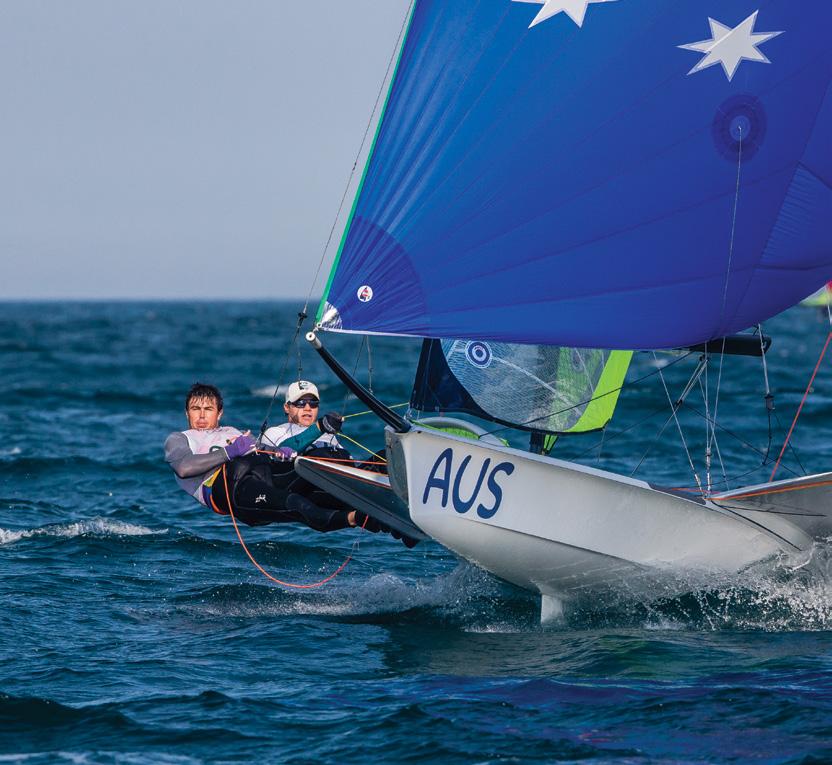
In 2017, Glenn skippered ETNZ to a historic victory in Bermuda, serving as wing trimmer on the AC50, and reclaiming the America’s Cup for New Zealand. Four years later, he remained central to the team’s success, trimming the mainsail during their successful defence in Auckland, this time on the groundbreaking AC75 foiling monohull, a design that once again changed the face of the sport.
Glenn turned his attention from water to land in 2022, leading a project that set a new world land sailing speed record aboard Horonuku on Lake Gairdner, South Australia, in April 2023. Powered only by the wind, Glenn reached 222.4 kilometres per hour, showcasing the same innovation and courage that have defined his entire career.
Nathan Outteridge and Iain Jensen grew up on the waters of Wangi Wangi, New South Wales. Iain first stepped into a dinghy at the age of five, learning the basics while racing on Lake Macquarie. Nathan, just two years older, quickly showed his natural talent, winning his first regattas in the Manly Juniors before progressing to national and international youth competitions. Their friendship and shared passion for the sport laid the foundation for a lasting sailing partnership. Iain tasted international success at just 16, winning the ISAF Youth World Championship in the 420 class with Nathan. Nathan had also already secured three consecutive ISAF Youth World Championships from 2002 to 2004 across the 29er and 420 classes. These early experiences shaped both sailors, teaching resilience, precision and the importance of teamwork.
Their partnership in the 49er class began in 2009, after Nathan narrowly missed a medal at the Beijing Olympics. The impact was immediate – they won the 49er World Championship in only their second regatta together, announcing themselves as a team to be reckoned with. Over the next four years, they dominated the class: finishing second in 2010, winning the world title again in 2011, along with the Olympic Test Event, and reclaiming the 49er World Championship in 2012 ahead of the London Olympics. Their consistency, speed and tactical mastery made them one of the most formidable teams in international sailing.
At the 2012 London Olympics, they converted that dominance into gold. Nathan and Iain took the lead after the third race and never looked back, securing the gold medal before the medal race. Across 16 races, they finished outside the top six only three times and were first past the line five times. Following London, the pair joined Artemis Racing for the 2013 America’s Cup challenge.
Nathan and Iain’s friendship and shared passion for the sport laid the foundation for a lasting sailing partnership
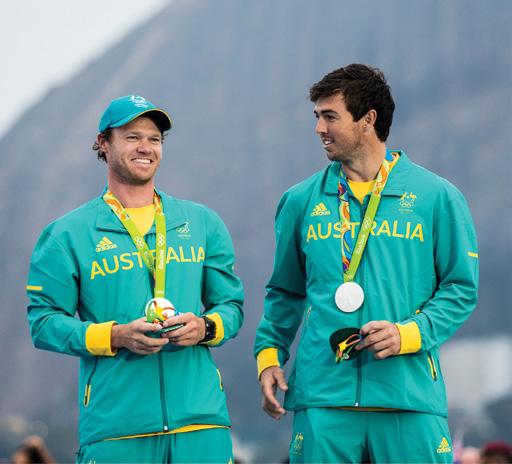
At the 2016 Rio Olympics, Nathan and Iain added silver medals in the 49er class to the gold they had won four years earlier in London. Image © Sailing Energy/ World Sailing
While also training for the Rio 2016 Olympics, they were heavily involved as a challenger for the 2017 Louis Vuitton Cup, with Iain as the trusted wing-trimmer to skipper and helmsman Nathan.
At the Rio 2016 Olympics, they added a silver medal to their collection, narrowly beaten to gold by their New Zealand training partners and rivals.
Beyond Olympic sailing, both have excelled across multiple classes: Iain finishing third at the 2017 Moth World Championship, and Nathan claiming multiple Moth World titles and a Nacra 17 World Championship silver in 2020. Together, they competed in SailGP, with Nathan helming the Japanese team to a second-place finish in 2019, with Iain once again his wingman.
The physicality and technical skill required to compete at the top of 49er sailing, and their sustained dominance at World Championships for multiple years, testify to their dedication and mastery of the sport.
Text courtesy Sailing Australia
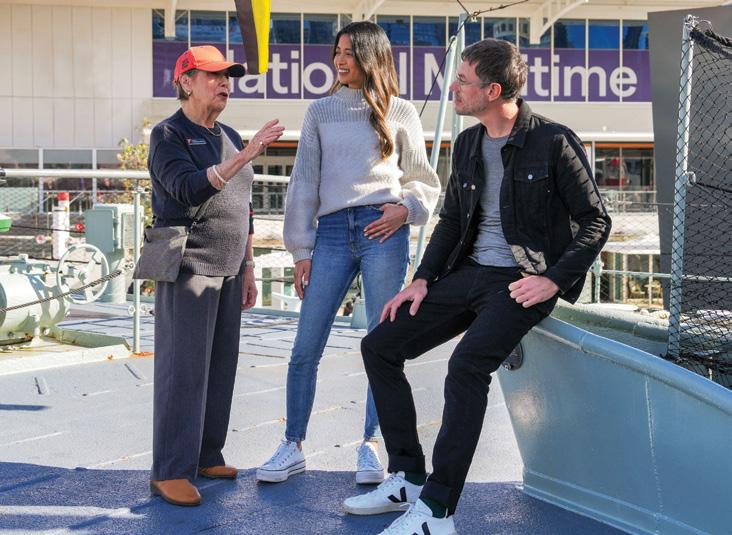
Our volunteers are the beating heart of the museum. We’re always on the lookout for new members of our crew. Whether you’re a maritime buff or just looking to be part of your community, we have a wide range of roles for people of all interests and backgrounds.
For more information sea.museum/volunteer
unique and meaningful gift
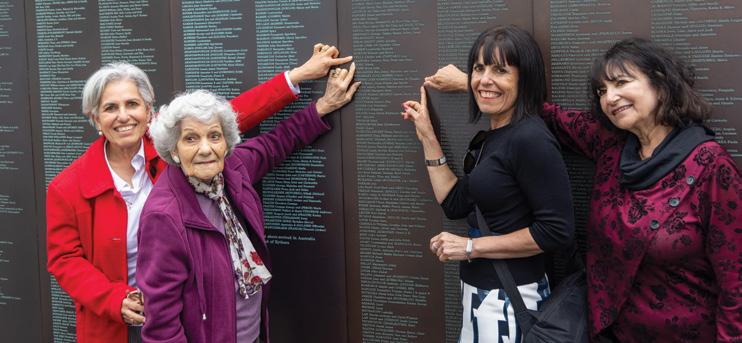
As an acknowledgement of your tax-deductible gift of $500 your name, or the name of a family member, relative, co-worker or friend will be etched in bronze onto the museum’s Welcome Wall, Australia’s National Monument to Migration in recognition of their journey across the seas to make Australia their new home. Register for the next unveiling.
For more information sea.museum/national-monument
Through an ambitious project funded by the Australian Government, all national cultural institutions are aiming to digitise their at-risk analogue formats by the end of this year. Rhondda Orchard and Paula Grunseit report on the museum’s progress.
IN 2015, THE NATIONAL Film and Sound Archive (NFSA) released a report titled Deadline 2025: Collections at Risk 1 The report highlighted that analogue magnetic tape and optical disc formats not digitised to National Archives of Australia standards by 2025 might become unreadable. The potential for irreparable degradation could lead to loss of fidelity and hence of audiovisual content. Recognising this risk to Australia’s cultural heritage, in 2021 the Australian Government allocated $41.9 million to the NFSA to digitise at-risk audiovisual materials for national cultural institutions. When the AudioVisual Australia (AVA) program was launched, the Australian National Maritime Museum was one of the first institutions to partner in the pilot stage. The museum’s AVA project team involved collaboration across the organisation, including staff of the Vaughan Evans Library (VEL), Registration, Conservation, Knowledge, ICT and Digital sections.
Since opening to the public in 1991, the museum had accumulated many at-risk media items across various areas. However, the two main repositories were the VEL and the National Maritime Collection (NMC), the latter representing objects formally acquired under the Australian National Maritime Museum Act 1990
Team members prepared a representative sample of 20 items, which travelled to the NFSA at the end of June 2022. The first digitised files were returned three months later. The first large batch of 589 video and cassette formats was sent in early December 2022, and in 2023 another batch followed, comprising 600 audio formats, containing oral histories held by the VEL. The third batch, in 2024, added 800 video items from the VEL and 50 open-reel films from the NMC, including cellulose nitrate items. Video formats included VHS Pal and NTSC (as the NFSA had recently added NTSC machines for digitisation), Betacam, Umatic and DVD. Our final batch, sent in January 2025, comprised a mix of formats, including a selection of vinyl recordings.
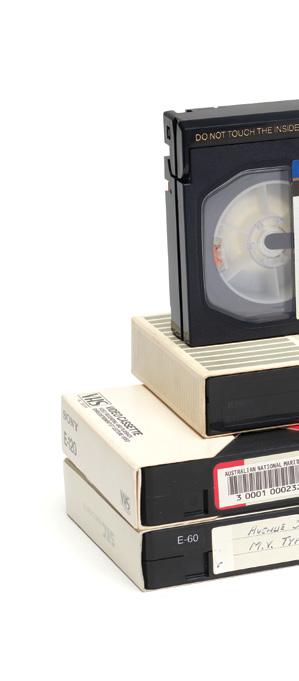
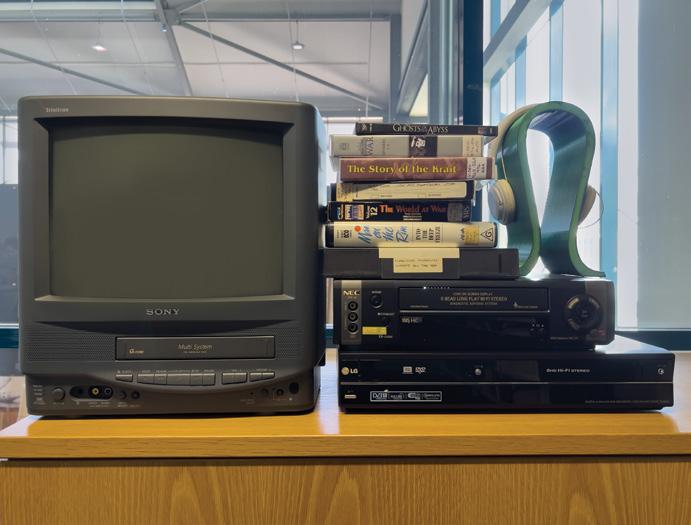
ANMM analogue formats. Over the past 34 years, the museum has probably used every format as it became available, thus representing the evolution of AV media.
Image Jasmine Poole/ANMM
After two and a half years, four batches and 2,000 items, the project is finally nearing its conclusion
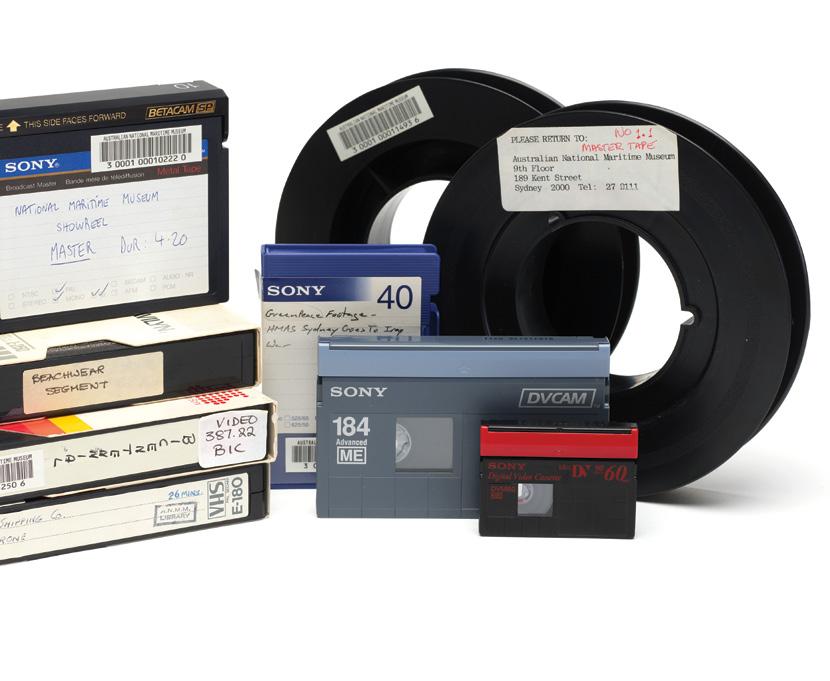
Digitisation allows discovery of museum content beyond physical items and descriptive data
01
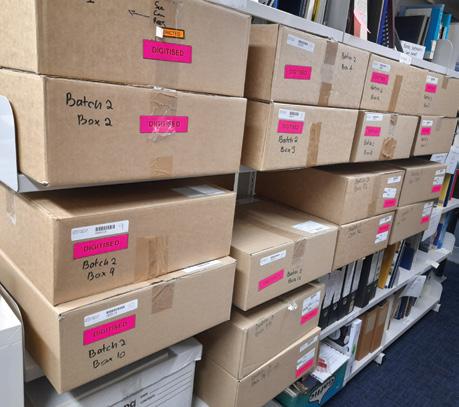
Boxes returned from the NFSA, labelled ‘Digitised’. Among the items sent to the NFSA were a number of hidden gems of archival value – a welcome embellishment to the museum’s Vaughan Evans Library. Image Paula Grunseit
02
Outdated formats such as DVDs and VHS and Betamax tapes, now digitised, have been archived, along with the machines used to view them. Image Janine Flew/ ANMM
An extensive cataloguing backlog in the VEL resulted in numerous holdings being ‘discovered’, many proving to be hidden gems of archival value. An unanticipated but welcome benefit of the AVA program was, therefore, the embellishment of the library’s holdings.
Previous museum policies to digitise and retain access and preservation copies meant some assets from the NMC were duplicated in the VEL and in our corporate archives. It was impossible to correctly identify if specific items were unique holdings or a copy of an asset. As the stability of these at-risk materials was unknown, the NFSA advised us not to view items, as this could result in damage either to the medium or to the machine required to access it. In most cases, due to the wide range of legacy formats we were processing, we did not have the required technical facilities to access items anyway.
Several file formats of varying sizes have been provided by the NFSA for preservation, broadcast or access, including MP3, MP4, WAV, MOV, MDF and MXF files. All files will be integrated into our digital asset management system and database, and SydneyDigital. These enhancements will allow for public access, subject to intellectual property (IP) constraints.
The key to locating and tracking our items is always a unique identifier – represented by a barcode for the library and an object number for collections. This unique identifier ensures easy access to records in databases, spreadsheets, hard drives and servers.
Metadata across the museum’s holdings incorporates industry standards, including the Dublin Core Metadata Initiative, Open Archives Initiative Protocol for Metadata Harvesting, and the Australian Government Recordkeeping Metadata Standard 2.2. These standards were also discussed with the NFSA prior to the first digitisation batch.
Data captured in both of the museum’s systems includes descriptors, detailed contents lists, oral history transcripts and any restriction information, including copyright and cultural restrictions pertaining to handling, viewing or listening.
Once assets are available on our collection website, they are ‘harvested’ to TROVE via the Open Archives Initiative Protocol for Metadata Harvesting, further extending their reach and thus contributing to the ‘social echo’ of our work.
It was initially estimated that the project would comprise one batch of around 1,000 items to send to the NFSA for digitisation. However, after two and a half years, four batches and 2,000 items, the project is finally nearing its conclusion. The museum will be delighted to have beaten Deadline 2025 by the end of the year.
All physical items have been returned to the museum and will be stored in our cool room. The NFSA will retain our files on their servers for two years. The management of these files now rests with our internal ICT department to steer their integrity into the future.
One of our biggest challenges continues to be navigating the complexities around copyright clearances, permissions and licensing information. Currently, the museum does not have a dedicated team to manage collection rights, and historically this process has not been applied consistently across our collections. The Registration team assesses all new acquisitions for IP rights at the time of acquisition; assessing IP for the backlog collection and other museum collections operates on a ‘case by case’ basis, driven by demand from the inhouse Curatorial and Digital teams and public access requests.
Seemingly intractable problems were solved with an extremely generous and most welcome one-off funding program from the Australian Government. This project also provided a great opportunity for us to collaborate internally and to learn from our colleagues at the NFSA, who so openly share their expertise.
Digitisation allows discovery of museum content beyond physical items and descriptive data. This project enabled the museum to turn our focus inward to our collections. It allowed us time to enhance, standardise and devote attention to a section of our holdings that had been overlooked due to resources and access difficulties.
AVA enabled the museum to float these ‘hidden’ items to the surface, where they open a window into our maritime history in an age where the moving image is often preferred over the written word. It is rewarding that we can now provide the public with a snapshot into our collective maritime past.
1 <https://www.nfsa.gov.au/corporate-information/publications/ deadline-2025>
Rhondda Orchard is the museum’s Managing Registrar, Collection Management. Paula Grunseit was the Digitisation Project Leader.
When six years of global war ended in 1945, everything had changed. A new publication by the museum, The World Remade, considers the local and international effects of World War II, examining postwar migration and displacement, the Cold War and its aftermath, and revolutions in defence, technology, trade, industry and societal attitudes.
THE WORLD AFTER 1945 really was a world remade. Wartime had mobilised economies and industries beyond all precedents. An escalating consumer society – made possible by the mass production systems set up for wartime needs – created comfort, safety and prosperity. The war had developed many things we take for granted today – radar, sonar, microwave technology and plastics. But postwar comfort and optimism were counterbalanced by the Cold War, four decades of political antagonism and fears of global annihilation driven by World War II’s rapid advances in weapons systems. A profound shift in gender roles after the war owed something to wartime mobilisation, which drew large numbers of women to join the armed forces in signals intelligence, codebreaking or nursing or to take on farming, manufacturing and administrative jobs in the civilian workforce. A more literal shift – that of millions of migrants entering Australia from Turkey, Greece, Italy, Malta, Yugoslavia, Germany, the Netherlands and the United Kingdom – changed our country irrevocably. Leaving homelands scarred by World War II and subsequent conflicts, these ‘new Australians’ enriched our society and helped break down entrenched bigotry.
The war changed the Indo-Pacific region, too.
As the Allied navies and armies drove toward victory, they liberated former colonial nations: the Solomon Islands, Papua New Guinea, Indonesia, Borneo, the Philippines and Vietnam. None of these peoples wanted to return to being colonised: they sought their own independent nations. In some cases, such as Papua New Guinea, the struggle was slow and non-violent. In others, especially Indonesia and Vietnam, the conflicts were costly and protracted. Refugees from these clashes – especially in southeast Asia – continued to reshape Australian society for decades.
The legacies of this war transformed our world. New nations emerged from former colonial regimes, new identities and alliances were formed, social attitudes were transformed, and new global systems were forged, not always equitably. The World Remade draws together articles from curators, historians and journalists that reflect on the eight decades since World War II, through some of the museum’s key objects, events and areas of research.
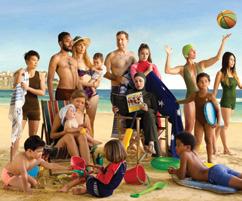

Onthebeach High tech and high stakes in the global Cold War
ThemassdestructionofWorldWarIIhad barelyendedbeforeanew,high-techand high-stakesconflictemerged:theColdWar. DrPeterHobbinsexploreshowwartime technologyhelpedavoidanall-outnuclear exchangebutperpetuatedotherbattles.
voyagedtoSanFrancisco,onlytoreturnwithdismalnews. FearSpoileralert:nobodywinsanuclearwar. Americanof‘thebomb’hungoverthedecadesafterthe nuclearattacksonHiroshimaandNagasakiinAugust1945.Theabilityofasingleweaponto flattenamajorcitydrovetheJapanesetosuefor peace.Anothermajorfactorwastheexpiryoftheir nation’snon-aggressionpactwiththeUnionofSoviet SocialistRepublics.Indeed,theRussiansignoredJapan’s thesurrenderandoccupiedlargepartsofMongoliaand northernhalfofKorea,withthe
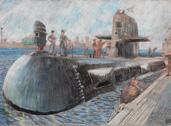
offerednohappyendings.Firsta1957 bynovelbyNevilleShute,thena1959moviedirected falloutStanleyKramer,thestorycentredaroundnuclear obliteratinghumanlife.Atomicwarfarewipedout thenorthernhemisphereanditsdeadlyradiationwas crewmovinginexorablysouthward.AnAmericansubmarine undertookahazardousjourneyfromMelbourne
comingunderAmericancontrol.BySeptember1945,
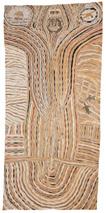
Once the Chinese Civil War ended with Communist victoryin1949,theoldalliancesofWorldWarIIhad asbeenreplacedbyEast-Westhostilityknownuniversally the Cold War. Intheory,thiswarneverturned‘hot’–atleast,notas depictedin On the Beach.However,tworazor-edge Themomentsriskedseeingnuclearweaponsagaindeployed. firstcamein1950,afterthecommunistNorth KoreanforcesinvadedUS-backedSouthKorea.WithaUnitedNations(UN)counter-offensivepushingNorth theKoreanforcestowardtheChineseborder,Chinaentered Thefrayandnearlyoverwhelmedthewesternoffensive. GeneralsupremecommanderofUNforces,American weaponsDouglasMacArthur,soughttodeployatomic onthebattlefield.Hewasinsteadrelieved TheofcommandbytheUSPresident,HarryTruman. begansecondpivotcamein1962whentheSovietUnion buildingrocketlaunchplatformsontheislandof toCuba,just145kilometresofftheUScoast.Warseemed turningbebarehoursaway,whentheRussiansbackeddown, aroundshipsdeliveringnuclear-capablemissiles. ButnuclearweaponswereonlyoneoftheWorldWarII developmentsthattransformedtheworldafter1945.
In The World Remade, curators, historians and journalists reflect on the changes wrought by World War II through items and stories from our collection
The World Remade is available from the museum’s shop and online. ISBN 9780975643020, 72 pages, RRP $14.95 (10% discount for members). See shop/sea.museum

subs,AmericanandSovietnaviesrethinkinghowtoshapetheir rapidpost-wardevelopmentsinnuclearenergyledtothefirstatomic-poweredsubmarine,USSNautilus launchedin1954.Thisvesselcouldoperateforprotracted
ofmissilewhilesubmerged.Almostovernight,thenature strikeconflictwasreshaped:anundetectedsubmarinecould fromanywhere,firingnuclear-armedrocketsandgivinganopponentlittletimetorespond.
manydiasporas.Themodernageof


01
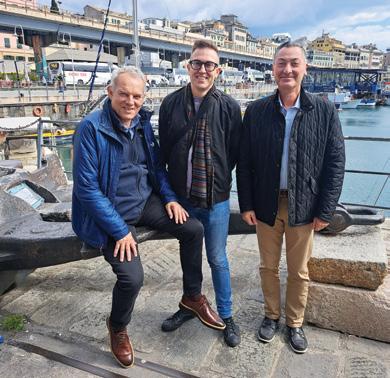
GMHP Project Directors
Richard Wesley (Australian National Maritime Museum), Vincent Lipanovich (New Zealand Maritime Museum Hui Te Ananui a Tangaroa) and Andrés Rodrigo (National Maritime Museum of Chile) in Genoa, Italy, March 2025.
Image Felicity Ferguson
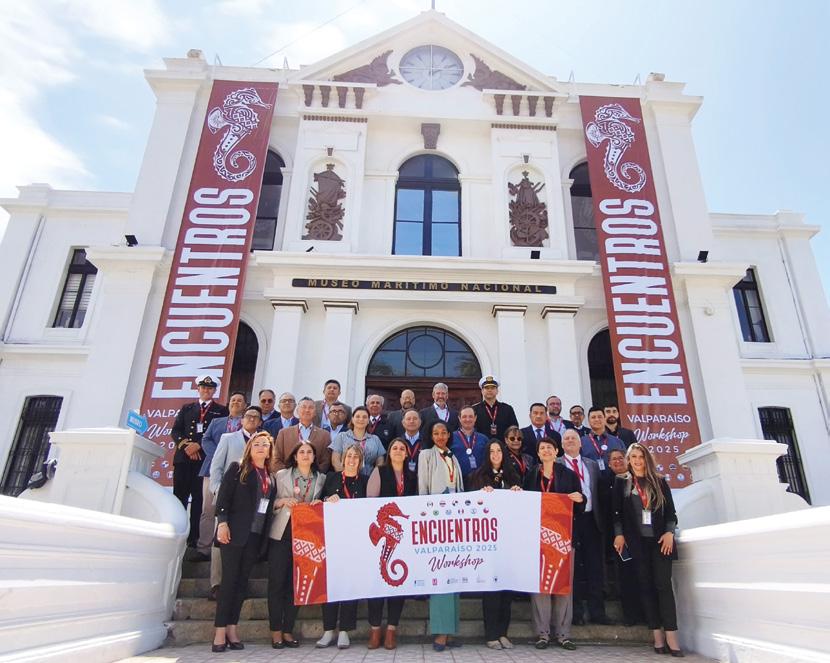
02 Participants at the Encuentros conference held in Valparaiso, Chile, October 2025.
Image National Maritime Museum of Chile
Generous support by the charitable Lloyd’s Register Foundation is enabling members of the International Congress of Maritime Museums to participate in a project called Global Maritime Histories: Case Studies for Change. By Felicity Ferguson and Richard Wesley.
THE INTERNATIONAL CONGRESS of Maritime Museums (ICMM) was established in 1972 and held its first formal Congress in Oslo, Norway, in 1975. ICMM now has more than 230 members across the world and has expanded to also include organisations and individuals connected with the wider world of maritime heritage.
The ICMM’s strengths include its global reach and connections between museum professionals who are passionate about maritime heritage – particularly evident when members gather for the biennial ICMM Congress. The most recent, held in Rotterdam and Amsterdam in September 2024, was attended by over 200 delegates from six global regions: Africa, Asia, Europe, North America, Oceania and South America. ICMM and the Lloyd’s Register Foundation have aligned to create a new funding opportunity for ICMM member museums and organisations. The three institutions that bear the Lloyd’s name – Lloyd’s Register, the Lloyd’s Register Foundation and Lloyd’s List – all grew through a mercantile network that originated in Edward Lloyd’s coffee house, founded in London in 1689. While the three enterprises are separate, all have a maritime focus and continue to have a strong influence and impact across global maritime operations to this day.
Lloyd’s Register Foundation (LRF) is a registered charity, which partners with other organisations to work together and use their expertise, knowledge and reach to engineer a safer world. Following a successful submission for funding, LRF partnered with the International Congress of Maritime Museums in 2023 with a generous six-year grant to develop and deliver a project called Global Maritime Histories: Case Studies for Change Project (GMHP).
The vision for GMHP is to leverage the expertise, collections and programs of more than 130 member museums around the world to provide historical context for the challenges currently facing maritime industries, build capacity in the global maritime heritage community and support the local voice in a global context. The project is providing opportunities for ICMM member organisations and their partners to connect with community through delivery of transformative maritime-focused projects that amplify contemporary issues. The projects will be designed around material that enriches understanding of the human experience of past transitions and the history of technical developments related to a safe and sustainable future.
ICMM Mission
The International Congress of Maritime Museums (ICMM) connects maritime museums worldwide to preserve maritime culture, inspire ocean stewardship, and empower members as cultural leaders safeguarding our shared maritime heritage.
ICMM Vision
The International Congress of Maritime Museums (ICMM) is a vibrant global network where maritime heritage institutions and individuals collaborate without boundaries to inspire a profound worldwide appreciation for our shared maritime heritage and the oceans.
01
From left: Felicity Ferguson (Project Manager – ICMM Global Maritime Histories), Shane Addicoat (LRF Grants Coordinator – Operations), Louise Sanger (LRF Head of Research, Interpretation and Engagement – Heritage Education Centre) and ICMM Hon Secretary Sally Archer at Lloyd’s Register headquarters, London, October 2024. Image Felicity Ferguson 02
Participants at the Oceania Maritime Museum Administrators training course, held in Suva, Fiji, in November this year. Image Felicity Ferguson/National Museum of Fiji
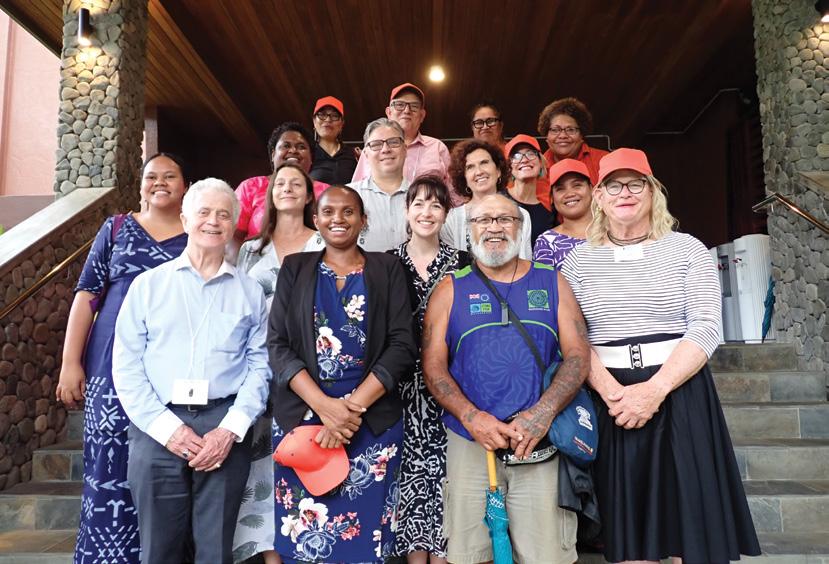
The Oceania Maritime Museums Administrators Course brought together 11 delegates from nine Pacific countries
Between 2024 and 2030, ICMM is funding selected projects in three consecutive two-year phases, led by ICMM member organisations or groups of organisations. The GMHP aims to:
• map maritime heritage organisations worldwide, especially in the global south, and connect them under the ICMM ‘umbrella’;
• support research on maritime collections to develop case studies that ‘learn from the past’, which may help with solutions to contemporary maritime challenges;
• enable ICMM to speak with one voice on common themes (such as ocean literacy) that engage with global museum audiences.
Twelve prospective projects were reviewed during the second half of 2024, ahead of members being invited to apply for Phase One funding. Phase One, running between December 2024 and March 2026, was designed as a pilot or proof-of-concept, with a view to a global call to members for Phase Two.
The Project Steering Group awarded the first round of grants, totalling £150,000 (AU$300,000), to four maritime organisations based in the global south, for the following projects:
• Australian National Maritime Museum – Oceania Maritime Museum Administrators five-day training course in partnership with the Fiji National Museum
• New Zealand Maritime Museum – Ocean Literacy and Te Moananui a Toi
• National Maritime Museum of Chile – Encounters: A Knowledge-Sharing Workshop and New Network for Maritime Museums in Latin America
• Australian Wooden Boat Festival 2025 – Seafarers of the Pacific: Celebrating the Maritime Culture of the Global South
In late October this year, the National Maritime Museum of Chile, in Valparaiso, hosted Encounters: A Knowledge-Sharing Workshop and New Network for Maritime Museums in Latin America. Twenty-eight delegates from 25 museums in Mexico, Costa Rica, Panama, Colombia, Ecuador, Peru, Brazil, Uruguay, Argentina and Chile participated in a four-day workshop focusing on maritime heritage, culture and contemporary issues. It featured not only large and medium-sized maritime museums, but also emerging museums distinguished by their interesting collections and curatorial perspectives, or by their outstanding community engagement work that could serve as a model for global debate. Andrés Rodrigo, ICMM Executive Council Member and Director of the National Maritime Museum of Chile, stated:
Thanks to the support of the Lloyd’s Register Foundation and the sponsorship of ICMM, we have held for the first time a meeting of maritime museums from this region. It has generated great interest with many keen to participate, strengthening new ties of cooperation and partnership.
Maritime Museums Administrators Course
The delivery of the Oceania Maritime Museums Administrators Course took place at the Fiji National Museum, Suva, in early November under the leadership of the Australian National Maritime Museum’s Richard Wesley, Assistant Director Collections.
This course was modelled on a highly successful similar program held annually at the ANMM and funded by the Maritime Museums of Australia Project Support Scheme (MMAPSS). The course in Fiji, delivered over five days, brought together 11 delegates from nine Pacific countries. Funding to the value of £50,000 (AU$100,000) from the Lloyd’s Register Foundation through the Global Maritime Histories Project enabled the development and delivery of this new regional cultural initiative.
A global call was made to ICMM member organisations in October 2025 seeking expressions of interest to participate in Phase Two of the project. After review, selected applicants will be invited to submit a fully developed and costed application for projects to be delivered between June 2026 and May 2028.
Further projects will be reported in future issues of Signals
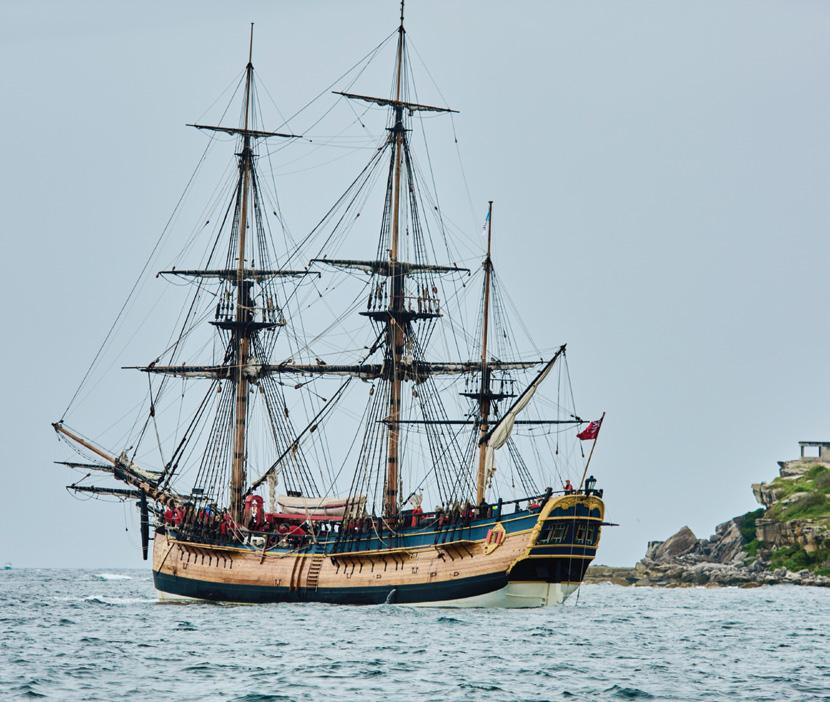
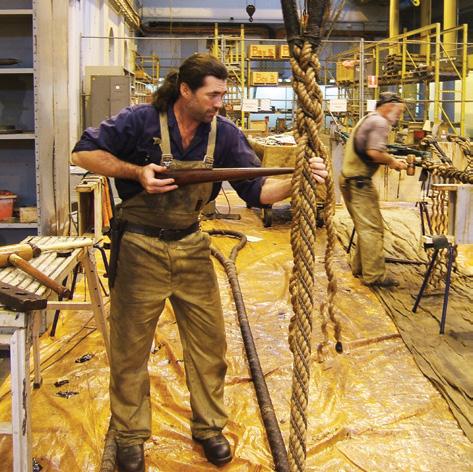
AS THE YEAR DRAWS TO A CLOSE, we are asking for your support to safeguard one of Australia’s most iconic ships – the Fremantlebuilt replica of Lt James Cook’s HM Bark Endeavour. Renowned as one of the world’s most accurate maritime reconstructions, Endeavour has circumnavigated Australia three times since its launch in 1993, and carried our maritime story to Europe, the United States and beyond.
This vessel is a living classroom – a place for people of all ages to learn and reckon with Australia’s complex seafaring history. While Endeavour stands as a testament to expert craftsmanship and the adventurous spirit of maritime exploration, it also offers a unique space to reflect on the lasting effects of British colonisation on First Nations communities. Supporting Endeavour means helping us preserve a vessel that tells the full story – both of epic voyages of exploration, and their profound impacts.
Right now, Endeavour faces a critical challenge in its standing rigging. Its masts rely on its shrouds – 80-mm-thick ropes, expertly spliced and kept under constant strain. After decades of service, the rigging must now be replaced to protect the masts from potential failure.
Your support will ensure this essential rigging is restored, guaranteeing Endeavour remains seaworthy and continues to inspire, educate and ignite curiosity in generations to come.
Endeavour is a living classroom –a place for people of all ages to learn and reckon with Australia’s complex seafaring history
01
Endeavour departs Sydney for Hobart and the Australian Wooden Boat Festival earlier this year. Image David Mandelberg
02
Endeavour ’s standing rigging was last replaced in 2011. Here, Anthony Longhurst, now Endeavour ’s master, puts an eye splice into a main shroud at Sydney’s Garden Island Dockyard, where the museum stretched, tarred and constructed the ship’s new rigging. Image Amy Spets/ANMM
Recently, the generosity of the Sutherland Foundation has enabled essential maintenance of SY Ena and supported the installation of new timber decking
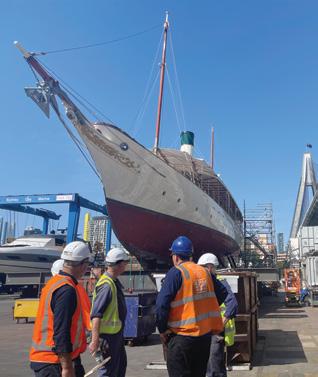
SY Ena update – with gratitude to the Sutherland Foundation
We extend our deepest gratitude to the Sutherland Foundation, under the stewardship of Dr David and Jennie Sutherland, for their generous and ongoing support of our elegant Edwardian steam yacht Ena. Their most recent contribution has enabled essential maintenance and supported the installation of new timber decking – vital work that will safeguard Ena ’s structural integrity and preserve its timeless workmanship and beauty. Through the continued commitment of the Sutherland Foundation, SY Ena will continue to stand proudly as one of the museum’s most cherished heritage vessels.
Over the last few months, the museum has hosted several events for our donor group the Chair’s Circle, whose members enjoy special behind-the-scenes access to the collection and to the museum’s curators and researchers. In recent months, they have had exclusive access to some of the museum’s most exciting projects:
• Senior Curator Daina Fletcher and Senior Conservator Jeff Fox revealed the story and technical analysis research of a rare 19th-century First Nations figurehead acquired earlier this year with Foundation support.
Join us in keeping history alive
Your support helps preserve our vessels, care for our collection and share Australia’s maritime stories nationally and around the world. Please consider donating today:
• Online via the QR code
• By direct deposit BSB 062 000 Account number: 16169309
• By phone to the Foundation Office: 02 9298 3777
• By emailing foundation@sea.museum

• Maritime archaeologist Benjamin Wharton offered an exclusive look at the timbers of the early colonial boat discovered on the site of the Barangaroo Metro station, and shared insights into their planned reassembly and future exhibition.
• Manager of Maritime Archaeology Dr James Hunter presented his research confirming the Rhode Island shipwreck RI 2394 as James Cook’s Endeavour (later renamed Lord Sandwich).
• Head of Indigenous Programs Matt Poll joined artist Brian Robinson in conversation to launch Ur Wayii (Incoming Tide), exploring Torres Strait culture and contemporary art.
Monica Connors, Foundation Manager, with contributions from Richard Wesley, Assistant Director Collections, and Scott Grant, Manager Fleet
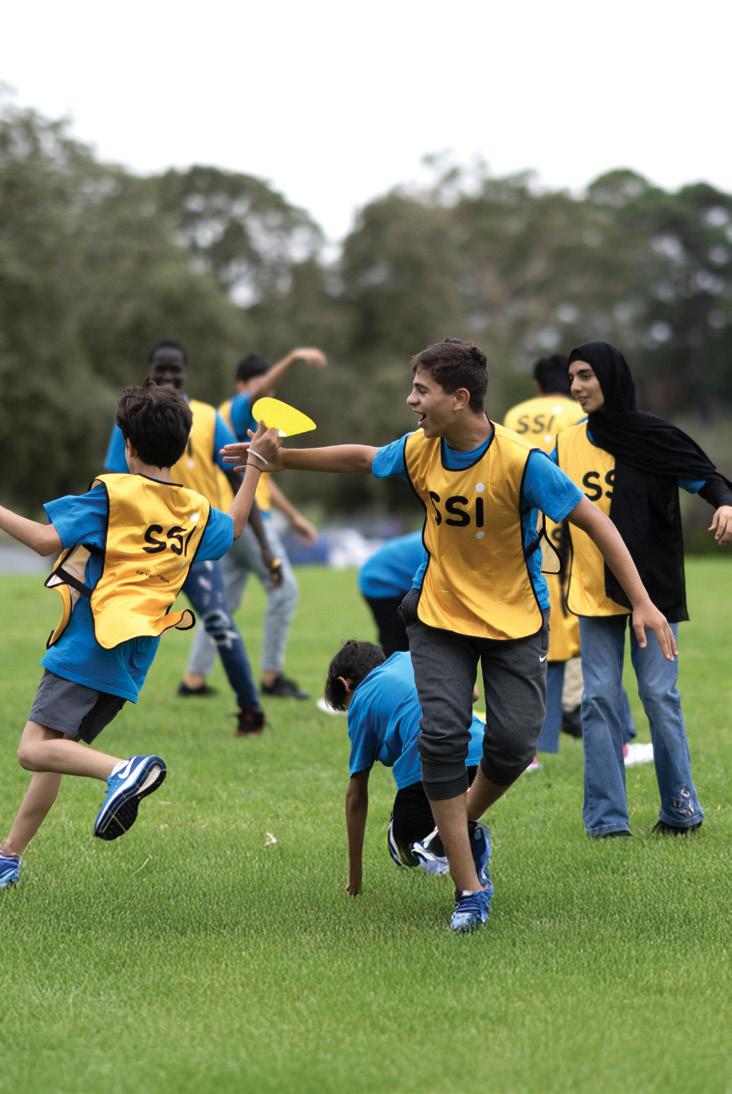
Spice, spirits and shipwrights: cultures and coastlines of Sulawesi
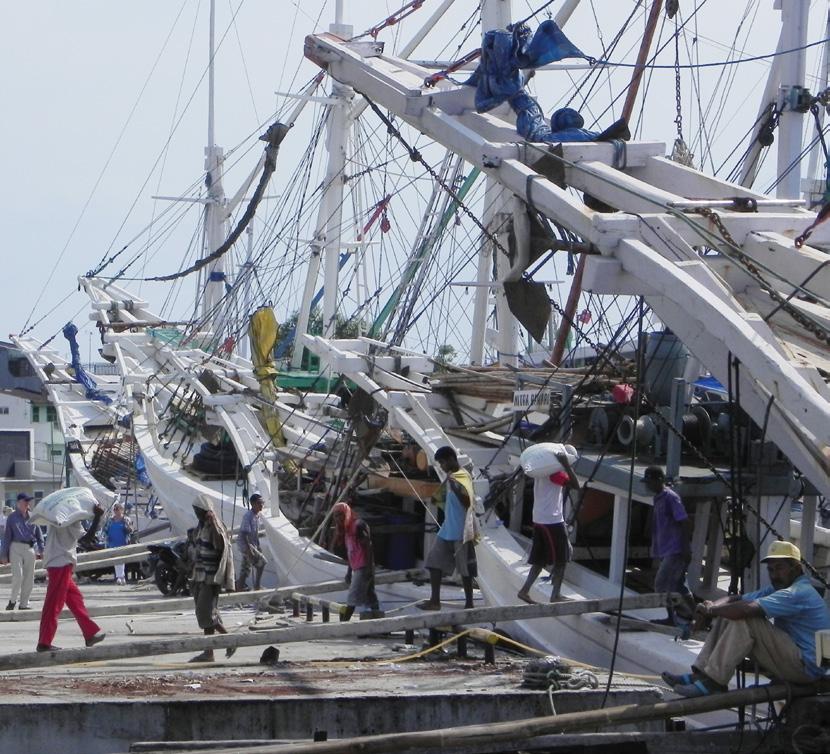
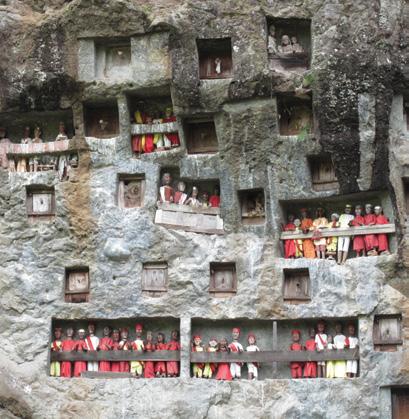
01
Pinisi motor-sailers being loaded for inter-island trade at Makassar’s prahu harbour, Pelabuhan Paotere.
02
Effigies (tau-tau) of deceased ancestors watch from balconies hewn alongside crypts in the limestone cliffs of the highlands Toraja people.
Images Jeffrey Mellefont
For more information, to register interest or to make a booking, see www.worldexpeditions. com/ssmm
IN SEPTEMBER NEXT YEAR, our museum members can join with visiting maritime museum professionals to experience an extraordinary journey through southern Sulawesi, the orchid-shaped island where Asia meets Australasia, and where ancient sailing routes once linked its entrepot Makassar with northern Australia well before its European colonisation.
This exclusive maritime-themed tour has been developed by the museum in conjunction with the 2026 International Congress of Maritime Museums (see details on page 63). The 14-day Sulawesi tour is priced at a very reasonable AU$5,500 per person (excluding air fares to and from Sulawesi via Bali, Jakarta or Singapore). See next pages for more tour and pricing information.
Once known as the fabled Celebes, Sulawesi was home to rival sultans, fearless Bugis sailors, and sea-gypsies who roamed the waters in their prahus long before European ships arrived. Today, its seaport Makassar is a thriving city with a rich maritime soul. Its old forts, bustling bazaars, Chinese and Arab quarters, and timber-hulled trading fleet tell a vivid story of cultural exchange – and its seafood and street food are among the best in Indonesia.
On tour we’ll meet the island’s legendary boatbuilders and seafarers, the Makassarese, as well as the Bugis, Mandar and Bajo peoples who still live closely connected to the sea. We’ll travel inland to explore remote rivers, lakes and the dramatic Toraja highlands, known for spectacular rice terraces, grand carved houses, ancestral ceremonies and mountain landscapes.
Retracing the paths of naturalist Alfred Russel Wallace and novelist Joseph Conrad, we’ll discover the layers of Sulawesi’s history and ecology – from tropical coastline to forested highlands, through ever- changing landscapes, with unforgettable meals.
Hosted by Jeffrey Mellefont, this is a journey through one of Indonesia’s most fascinating and diverse regions. The tour’s bookings and logistics are being handled through the leading international travel specialist World Expeditions, whose consultants can also advise on flights and pre- or post-tour travel and accommodation. See www.worldexpeditions.com/ssmm
Jeffrey Mellefont is an Honorary Research Associate of the Australian National Maritime Museum, where he was a founding consultant, long-time staff member and the developer and editor of its magazine Signals. Formerly a blue-water mariner and navigator, he has been visiting Indonesia since 1975 as a traveller, sailor and researcher, publishing widely on its diverse maritime traditions and lecturing on expedition ships in Southeast Asian waters. Jeffrey’s fluency in the Indonesian language and personal contacts open doors and provide opportunities to meet local people and experience their culture.
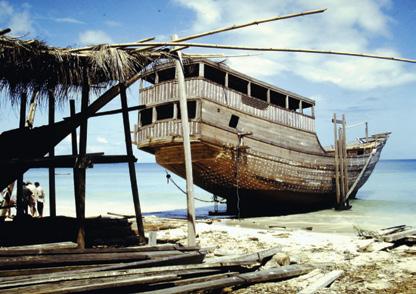
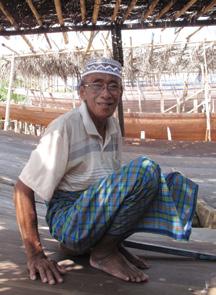
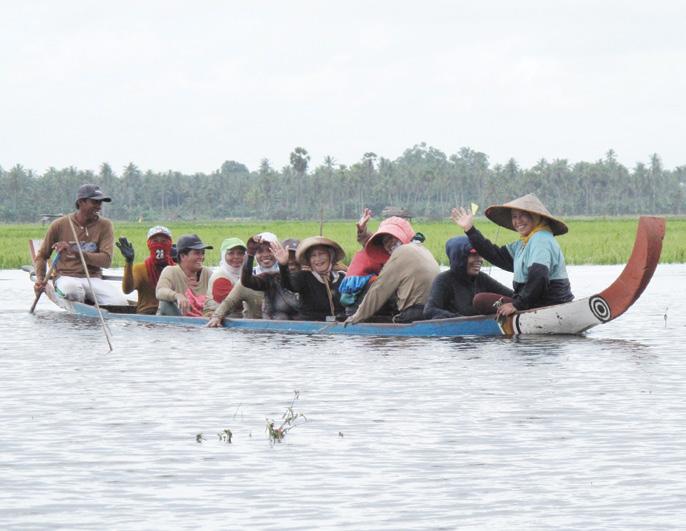
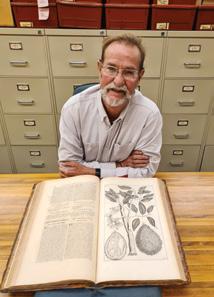
01
A motor trader built on the beach at Tana Beru by Makassarese shipwrights – one of several boat-building sites the tour will visit.
02
A Muslim Makassarese master shipwright in his white-sand shipyard at Tana Beru.
03
Residents of the floating villages on Lake Tempe, another location that the tour will visit.
04
Tour leader Jeffrey Mellefont studies the 1741 Herbarium of Ambon by Georg Eberhard Rumphius in the rare book collection of Sydney’s Royal Botanic Garden.
Images Jeffrey Mellefont
A highlight of this tour will be encountering the Sulawesi shipwrights and seafarers whose ancestors undertook an organised annual fishery to tropical northern Australian shores to harvest trepang (sea slugs). These visits certainly predate the continent’s British settlement and indeed its European discovery.
The trepang were gathered and preserved in collaboration with Indigenous Australians, then traded on to China.
The trepang fishery created significant social, cultural and economic exchanges between the two cultures in what is now the Northern Territory. This now well-documented example of pre-European cultural contact highlights a model of collaborative rather than conflicting relations with Indigenous Australians.
In September 2026 the Australian National Maritime Museum will host the pre-eminent international meeting of maritime museums, when the 22nd Biennial Congress of the International Congress of Maritime Museums is held in Sydney.
Running from 13–18 September 2026, this Congress will explore the theme Maritime Museums in Action –Moving Forward with Courage and Conviction through presentations, professional workshops, curated question and answer sessions and field trips. There will also be plenty of opportunities for sociable and professional networking in a welcoming and inclusive environment.
For more details on the Congress, go to sea.museum/icmm-26
Tour details
Dates in Sulawesi 21 September–4 October 2026
Price $5,500 twin-share; single supplement $1,290 (same-gender room share available)
Trip grading Adventure touring
What’s included
Trip escorted by ANMM specialist Jeffrey Mellefont
English-speaking Sulawesi guide-coordinator
All land transport by air-conditioned coach
Entrance fees to all sites listed in the itinerary
Meals included as specified in itinerary
Traditional wooden boat ride Makassar to Samalona Island
Traditional wooden boat ride Bira to Liukang Island
Long-boat ride at Sengkang on Tempe Lake
Airport transfers between Makassar airport (UPG) and hotel, on days 1 & 14
www.worldexpeditions.com/ssmm
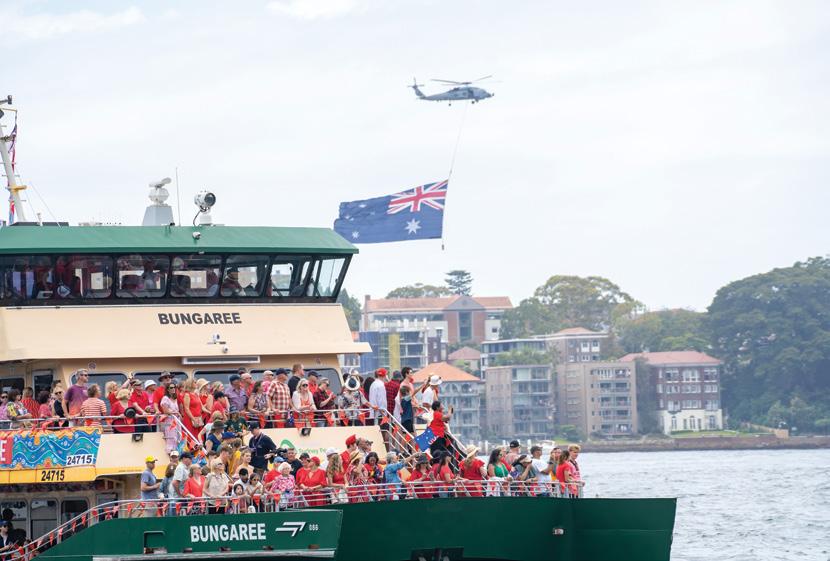
Join us over summer for a wide variety of events and activities, including harbour cruises and an expanded range of sensory-friendly sessions.
AS WE FINISH 2025, can I say a big thank you to all members for your support of the museum over the past year. We hope you have enjoyed our members events throughout the year and we look forward to sharing an exciting and varied events program in 2026. This will kick off with our everpopular Australia Day cruise – your chance for a front-row seat to see the spectacular Tall Ships race, Ferrython and flotilla of boats of all sizes parading around Sydney Harbour.
New events will be regularly added, so make sure you are signed up for our monthly events email to be kept up to date. 2026 is also the museum’s 35th anniversary, so we will be celebrating with you and wanting to hear what you love about the Maritime Museum.
Until then, wishing you all a very merry Christmas, an enjoyable holiday season and all the best for a happy new year.
Matt Lee and the Members team
On the water
Harbour cruises on SY Ena
10 am or 1 pm
Thursday 11 December
Enjoy a leisurely two-hour cruise on Sydney Harbour on our glamorous Edwardian steam yacht Ena.
SY Ena was designed by Sydney naval architect Walter Reeks and built by WM Ford boatbuilders in 1900, in Berrys Bay, North Sydney. Its original owner was local banker and yacht racing enthusiast Thomas Dibbs, who named it after his wife Tryphena and used it on Sydney Harbour for government functions and weekend entertaining.
In 1987, shipwright Nick Masterman fully restored Ena as closely as possible to its original specifications as a pleasure yacht. Includes light refreshments.
$100 / $70 members. Enter promo code MEMBER
Step aboard and admire the Edwardian elegance of SY Ena. Image Andrew Frolows/ ANMM
Author talk
Great Australian Odysseys – Jim Haynes
2 pm Saturday 13 December
Join Jim Haynes OAM as he talks about his new book Great Australian Odysseys – a treasury of unsung heroes and extraordinary journeys that have shaped Australia’s history.
Navigate the high seas with daring rescues of the shipwrecked and marooned and our first submariners’ record-breaking journeys. Trace tales of hardy truckers braving isolation, mechanical mishaps and political battles. Relive the golden age of rail with evocative stories celebrating Australia’s railway heritage, from Mark Twain down under to Ben Chifley’s locomotive legacy. Soar through the skies with aviation legends such as Smithy, Bert Hinkler and Francis Birtles, whose courage and innovation transformed how we travel.
With humour, heartbreak and a deep respect for history, bestselling chronicler of Australia Jim Haynes brings to life the pioneers, larrikins and legends who define our country’s unique spirit and who dared to dream big and journey across this vast continent.
Copies of the book will be available for purchase and signing by the author. Free for all attendees
Access program
Sensory-friendly days
8.30–11.30 am Sundays 21 December, 18 January, 1 February
3.30–6.30 pm Fridays 9 January, 20 February
On sensory-friendly days in summer, our galleries and new exhibitions, one of our vessels and all of our creative activity areas will be open extra early or extra late for a quieter experience and modified to suit people on the autism spectrum and with a range of differing abilities. Our trained staff and volunteers will be on hand to facilitate creative activities.
Sessions between 21 December and 1 February will include access to new exhibitions, including Ocean Photographer of the Year, The Beach experience, Kids on Deck maker space, the build-aboat bay and exclusive early or late access to submarine HMAS Onslow
Proud to support the sunflower
The museum supports the Hidden Disabilities Sunflower. You are encouraged to bring and wear your sunflower lanyard, or pick one up for free on arrival at the museum. Staff trained to support visitors with hidden disabilities will also be wearing a sunflower badge or sticker.
Adult or child $12 / free for children under 4 and members or annual pass holders. Min height 90 cm for entry to vessels. Pre-booking encouraged Young visitors at a sensory-friendly session.
Image Rhiannon Hopley
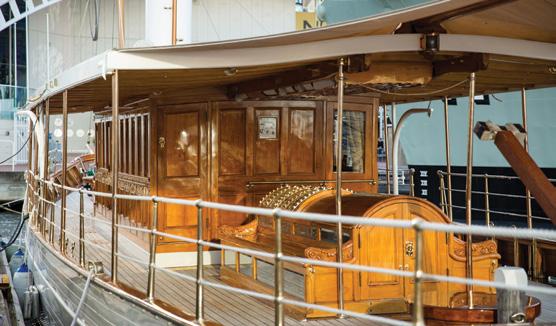
Exclusive tour
Inside the Maritime Collection
10.30 am–12.30 pm alternate Tuesdays and Thursdays
Our popular tour of the National Maritime Collection has been expanded to include exclusive access to the museum’s Ship and Boat Models Store.
Examine scores of amazing models representing navy, commerce, sport and exploration, from the early days of sail through to the 2000s. See shipbuilders’ marvellous half-block models used to determine hull design details, and models of famous and infamous vessels, such as schooner America, after which the America’s Cup is named; Flinders’ Investigator ; Darwin’s Beagle; legendary clipper Cutty Sark ; HMAS Sydney (I); SMS Emden; container ship Tampa and an incredible 1800s model intricately made from mutton bones by POWs of the Napoleonic War – and so much more.
You can also explore more than 100 other historic objects. Wearing white cotton gloves, you can handle a 400-year-old legendary ‘piece of eight’ and other iconic salvaged coins and historic artefacts, including a delicate hand-embroidered map of James Cook’s famous voyages, attributed to his wife Elizabeth.
The tour finishes with a visit to our Conservation Lab to see first-hand some of the current work in progress.
$35 / $25 Members. Enter promo code MEMBER
ANMM image
On the water Australia Day cruise
10.30 am–3 pm Monday 26 January
Experience the best-value catered fourhour Australia Day Cruise on Sydney Harbour!
Join us aboard MV Eclipse and absorb the colour and spectacle of the annual Australia Day Parade, including the famous Ferrython and Tall Ships Race. Relax, take in the harbour activities and stunning views and enjoy a gourmet catered lunch of sausages, prawns, chicken kebabs, salads, rolls and classic Aussie desserts of lamingtons and pavlova. Yum!
Includes morning tea, lunch, tea and coffee. There will also be a cash bar on board.
$150 / $135 Members. Enter promo code MEMBER
Speakers talk
HMAS Voyager/HMAS Melbourne disaster
Thursday 26 February
In 1964 the destroyer HMAS Voyager was cut in two by aircraft carrier HMAS Melbourne with the loss of 82 lives. Find out how it happened. Could it have been avoided? Has the blame been fairly apportioned? What happened to the survivors? Hear about selfless acts of heroism that night by individuals who put the safety of others above their own.
Presented by Gillian Lewis of the museum’s Speakers group.
$10 / Free for members. Enter promo code MEMBER
Voyager survivors aboard Melbourne after the collision. ANMM Collection Gift from John Withers OAM
More events will be announced shortly. Please keep an eye on our website. Bookings are essential. Email memberevents@sea.museum and tell us which event you wish to attend, and who is coming. Or book through Eventbrite, phone us on 02 9298 3777, or scan the QR code below.
For all other events, please see sea.museum/whats-on

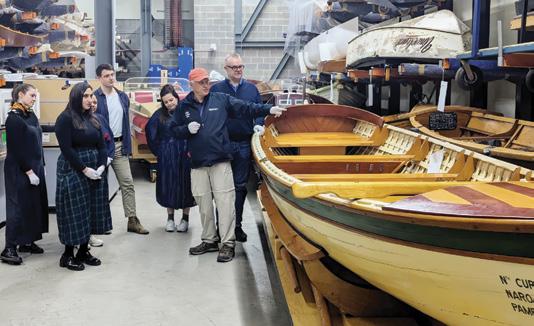
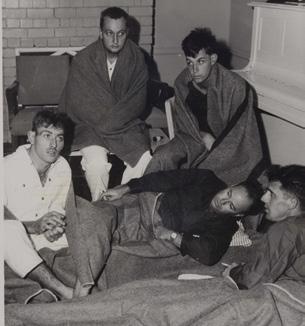
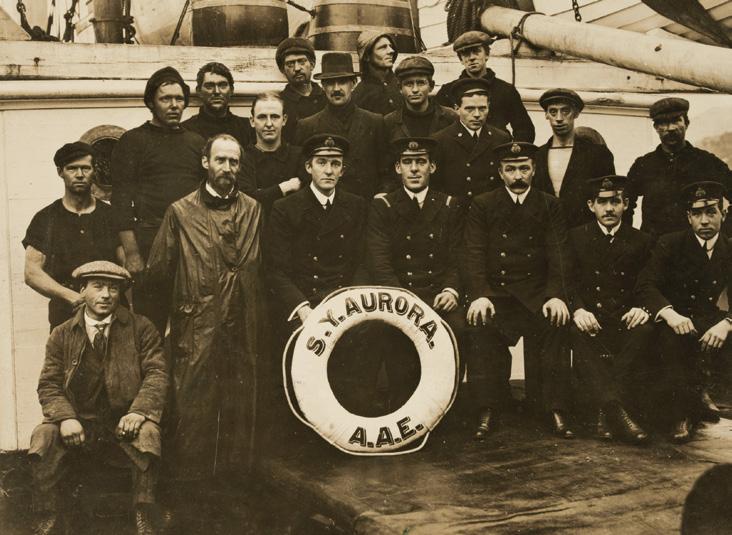
Exhibition on now sea.museum/frozen-witness
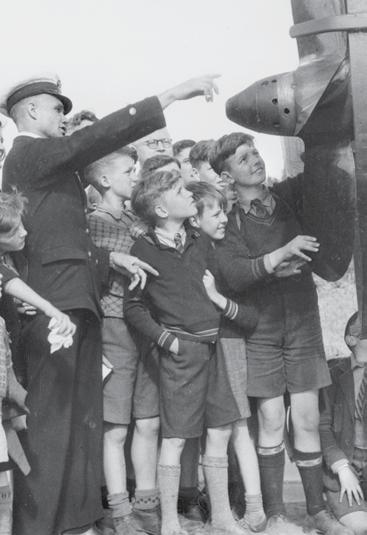
The 80th anniversary of the end of World War II
To mark the end of the war in the Pacific, the museum is delivering a series of programs, events, activations and exhibitions under the banner The World Remade Look out for this logo to discover our objects and stories.
sea.museum/ WWII-80-years
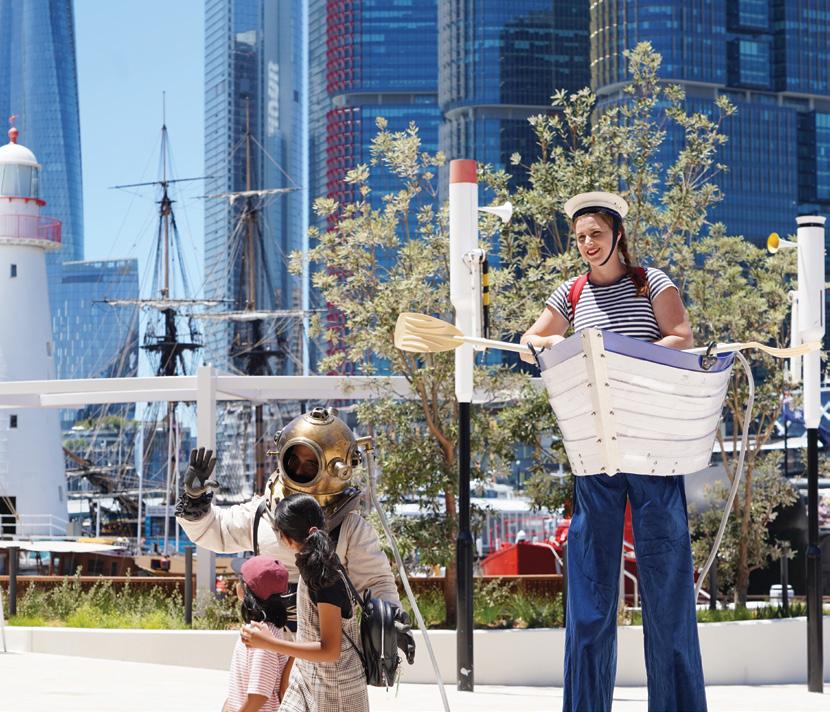
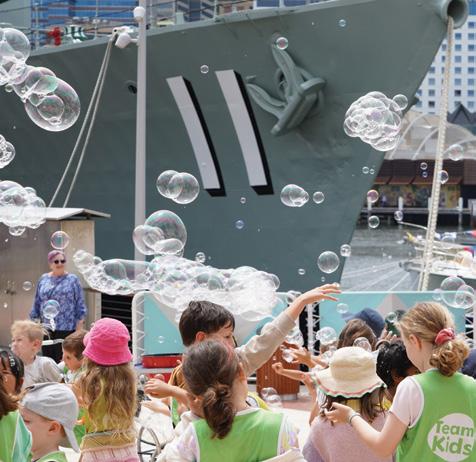
Kids on Deck offers a space bursting with colour and creativity
WITH SUMMER UPON US, there’s a familiar, seasonal pull towards the water. The air is warmer, the days stretch longer, and the city starts to shimmer with the promise of holidays. This year, the museum captures that feeling, bringing the beach to the heart of the harbour with a program that celebrates sunshine, culture and the simple pleasure of being in, on or by the water.
Inside the Lighthouse Gallery, The Beach beckons – an intergenerational, immersive playground that captures the spirit of the season. It’s bright, breezy and full of surprises: digital storytelling, exhibition, play and performance all come together to explore how the beach connects us, shapes our stories and brings communities together. Visitors are invited to pause, reflect and get lost in a space that feels both nostalgic and new – a summer escape without leaving the city.
Across the museum, boats are again in the spotlight as we celebrate these symbols of leisure and craftsmanship. From floating model boats gliding across the marina to live demonstrations by model makers and a LEGO® boatbuilding space, it’s a celebration of vessels as both transport and tradition, linking past and present through play. Families can also join the museum’s Indigenous Programs team to learn about traditional watercraft through hands-on storytelling, and create their own miniature nawi from paperbark.
The program is rich with opportunities to connect, create and unwind. Early-morning yoga and late life drawing in The Beach offer moments of calm reflection, while art and maker workshops invite everyone to imagine and create. There’s shell artmaking, a film program in our theatre screening beachy classics, and artist talks celebrating Australian creatives who have long gained inspiration from the coast.
Kids on Deck offers a space bursting with colour and creativity, where kids can design their own sunglasses and beach flags, make whimsical windsocks, or create a collage of their own summer safety slogan. Budding scientists can experiment with seaweed bio-yarn or learn how to turn marine debris into new creations. And when it’s too nice to stay indoors, little visitors can cool off and splash about on the water-play terrace.
Outside, the boardwalk and wharves will buzz with the spirit of summer holidays. Roving performers will fill the wharf with movement, and the public piano will invite a quick tune from passing hands. Ripples Cafe will transform into a fish and chippery with a menu that nods to old-school seaside favourites: think paper-wrapped fish and chips, burgers with the lot and colourful ice creams of summers past.
This summer, skip the sand and crowds and make the museum your ‘vacay’ by the harbour. Come and meet us between the flags!
Explore the awe-inspiring beauty and fragility of our oceans through Ocean Photographer of the Year, returning to the Australian National Maritime Museum this summer.
FEATURING 116 EXTRAORDINARY IMAGES, this exhibition celebrates the beauty of our planet by showcasing the wonders of our oceans and the urgent need to protect them.
On show are shortlisted and winning images by photographers from around the world, both amateur and professional, in nine categories – Fine Art, Wildlife, Adventure, Conservation (Impact), Conservation (Hope), Human Connection, and Young Photographer of the Year – plus the overall winner.
A special prize, the Female Five Fathoms Award, is given to the female photographer with the most outstanding portfolio.
sea.museum/ocean-photographer
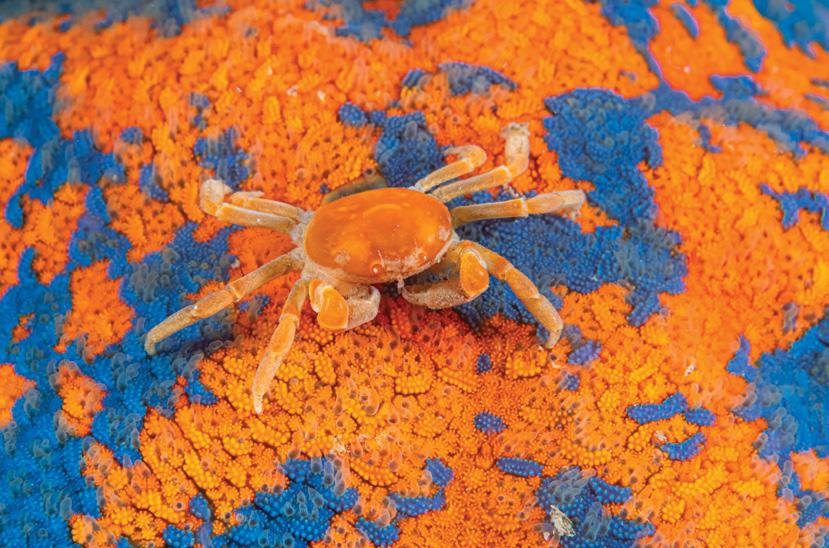
Torres Strait artist Brian Robinson uses painting, printmaking, sculpture and design to illustrate the region’s mythology, cosmology and spirituality. Robinson, who grew up on Waiben (Thursday Island), incorporates contemporary icons taken from video games and Hollywood movies to reflect on Islander history, humour and love of fishing.
sea.museum/incoming-tide
Banks’ Bounty: Exotic Cargo by Brian Robinson. Image Marinco Kojdanovski
Frozen Witness: Aurora’s polar voyages
Now showing
Voyage back in time to the early decades of Australia’s Antarctic exploits and the journeys of SY Aurora Generously supported by Charlotte Fairweather through the ANMM Foundation, the exhibition features the expeditions of Ernest Shackleton and Douglas Mawson – and the remarkable story of a wooden vessel pitched into the icy unknown.
sea.museum/frozen-witness
View from the Docks: written and illustrated by Sam Wallman Now showing
In the mid-20th century, a group of worker-artists created The Wharfies’ Mural to capture the industrial and political struggles of their time. Today, the wharves are dominated by smart machines – but has everything changed?
Artist and wharfie Sam Wallman thinks not. He offers a contemporary lens on dock life, capturing its enduring spirit through bold, graphic artworks that connect past and present.
sea.museum/sam-wallman
Aishah by Sam Wallman
Ultimate Depth: A Journey to the Bottom of the Sea Now showing
There is only one world ocean, and it covers 70 per cent of the planet. Ultimate Depth invites you to experience and understand our ocean, so together we can help to protect it. Join us as we dive in to experience each zone, encounter extraordinary creatures, and uncover the cutting-edge technologies that reveal their secrets and their hidden world.
Make your own deep-sea creature and release it into the midnight zone, then end your adventure in the deepest reaches of our ocean, the hadal zone, where you can investigate the DEEPSEA CHALLENGER , the submersible that took James Cameron to these extreme depths in 2012.
sea.museum/ultimate-depth
The Halvorsen Centenary: crafting a legacy on water
Now showing
The Halvorsen family has shaped Australian boatbuilding since 1925. This display showcases the journey of the Halvorsen family from Norway to Sydney and the evolution of Halvorsen designs, from classic wooden craftsmanship to modern innovations. It offers a rare insight into the artistry and engineering that have endured for 100 years.
sea.museum/halvorsen
Strike: War on our shores Now showing
This year marks the 80th anniversary of the end of World War II. To commemorate this historic milestone, a new temporary exhibition focuses on the 1942 Japanese midget submarine attack on Sydney Harbour. Secret Strike: War on our shores features the stern section of the midget submarine M22 and voice pipes from HMAS Kuttabul. The exhibition explores the raid and includes historic images of the aftermath of the attack and first-hand accounts of the impact it had on ordinary people’s lives.
*Please note, Secret Strike: War on our shores is located in Wharf 7, adjacent to the main museum building, and is not open on weekends or public holidays.
sea.museum/secret-strike
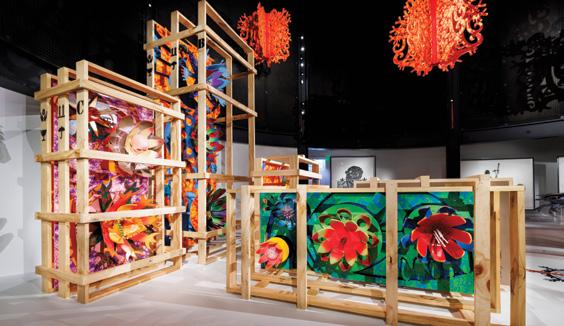
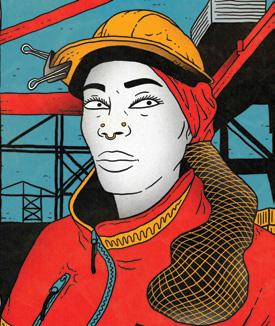
Victory
Now showing
This display tells the story of Operation Jaywick, the secret commando raid on Japanese shipping in Singapore Harbour in September 1943, and its unforeseen consequences for the civilian population. Jaywick stunned the Japanese military with its audacity and success. Not believing that the Allied military could be responsible, they immediately suspected the civilian population. Local Chinese and Malay, prisoners of war and European civilians topped the list of suspects, and a wave of arrests, torture and executions followed.
sea.museum/dark-victory
War Brides, Grooms and Babies
Now showing
War splits families apart and throws people together. This exhibit explores images and stories of wartime marriages, and features objects from our collection, including the ‘stars and stripes’ jumper knitted by Audrey Capuano on her voyage to a new life in the USA, and a pressed gardenia corsage, memento of a wartime romance in Melbourne.
This project is supported by the museum’s USA Bicentennial Gift Fund.
sea.museum/war-brides
Image Jasmine Poole/ANMM
Mariw Minaral – Spiritual patterns
Jervis Bay Maritime Museum & Gallery, Jervis Bay, NSW
From 19 December
This beautiful exhibition brings together some of the finest examples of Zenadth Kes (Torres Strait Islander) artist Alick Tipoti’s unique and intricate linocut printmaking practice. The exhibition also contains some of his award-winning sculptural works, contemporary masks and film.
Japanese maritime postcards –きかは便動 Movement is convenient
Now showing
This display showcases a series of postcards that combined traditional design with photographs of innovative maritime technology. On show in the museum’s Vaughan Evans Library, it features a selection of postcards from the early 20th century, issued by major Japanese shipping line Nippon Yusen Kaisha (NYK).
Please note, this display is located in Wharf 7, adjacent to the main museum building, and is closed on weekends and public holidays. Ask at reception on the ground floor of Wharf 7, and a library staff member will collect you.
sea.museum/japanese-postcards
NYK Line Suwa Maru (detail). Image Jasmine Poole/ANMM

Touring exhibitions
Croc! Lost giants to living legends
Queensland Museum Kurilpa, Brisbane
Now showing
Meet one of the planet’s most powerful and fascinating animals – the crocodile. This interactive all-ages exhibition brings you face to face with the ancient ‘supercrocs’ that once roamed alongside the dinosaurs, right up to today’s crocodile species. Croc! Lost giants to living legends explores the science, culture and enduring connections between people and these remarkable creatures.
Co-produced by Australian National Maritime Museum, Queensland Museum and Museum and Art Gallery of the Northern Territory.
James Cameron – Challenging the Deep Vasa Museum, Stockholm, Sweden
From 14 February
Encounter the deep-ocean discoveries, technical innovations and scientific and creative achievements of underwater explorer James Cameron.
Created by the Australian National Maritime Museum’s USA Programs and supported by the USA Bicentennial Gift Fund. Produced in association with Avatar Alliance Foundation.
For information regarding all touring exhibitions, please see sea.museum/touring-exhibitions
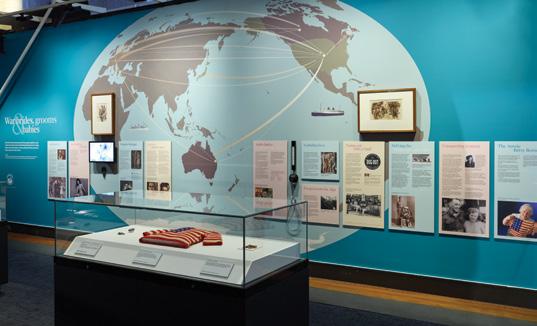
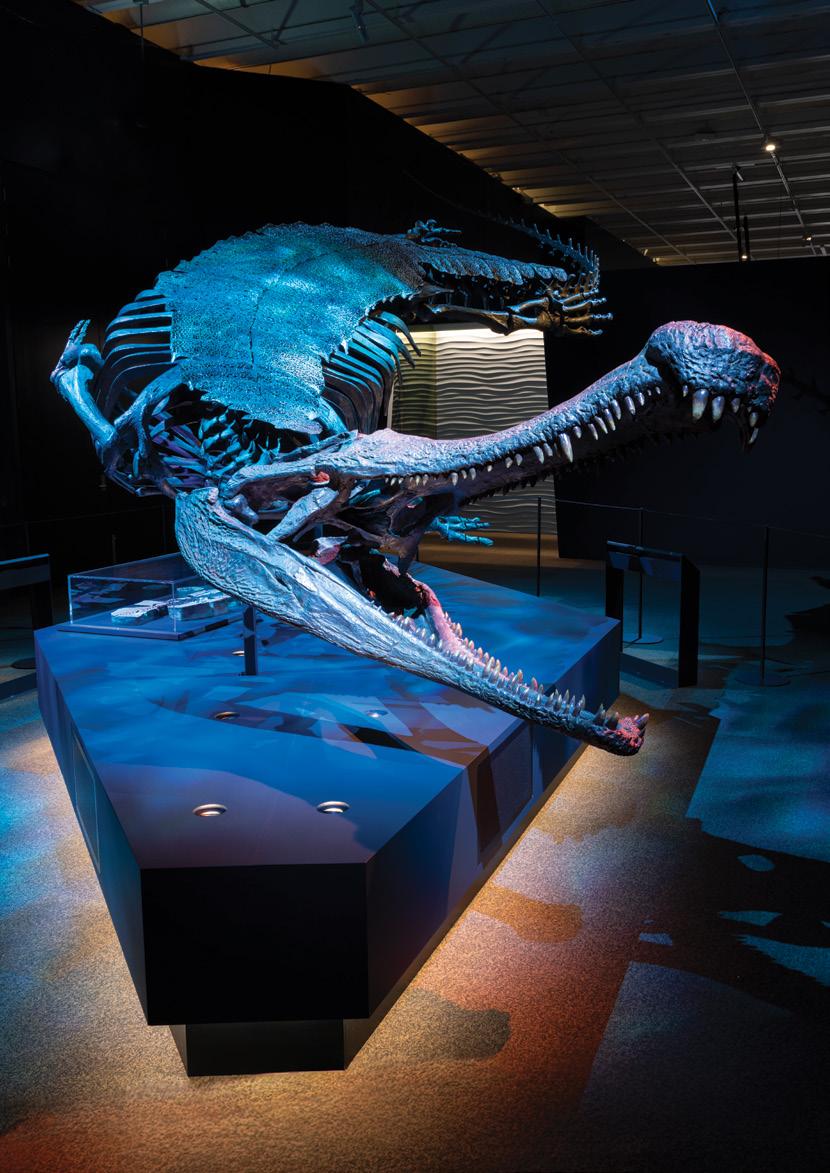
In 1949, the immigration department was keen to identify the 50,000th person to find a new postwar life in Australia
Richard, Zenta, Maira and Inars Kalnins on Fairsea. They were among some 19,700 Latvians who migrated to Australia between 1947 and 1952. Image National Archives of Australia
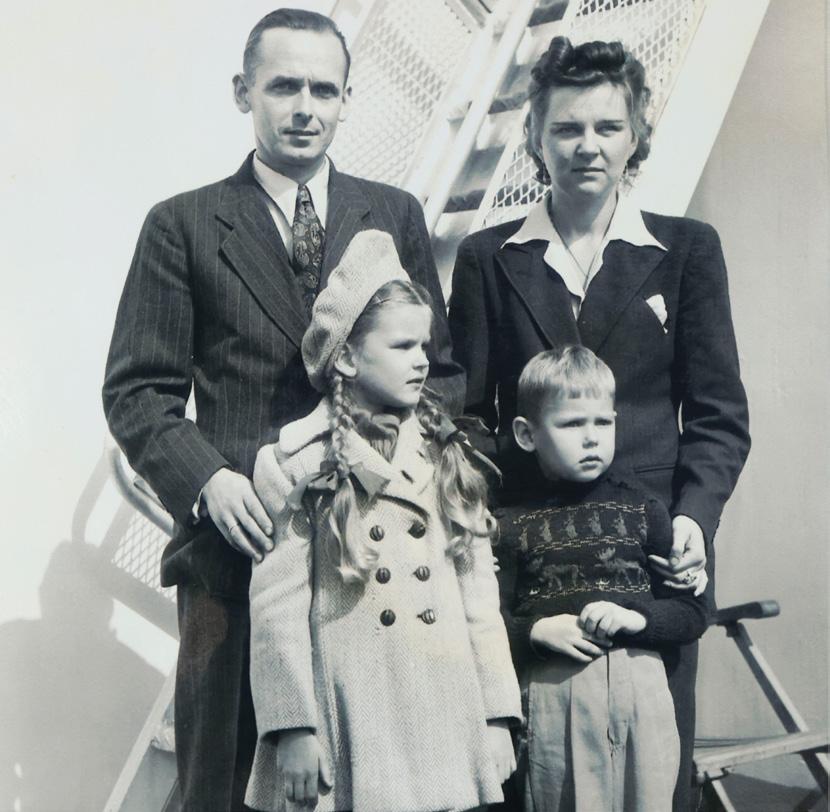
After the upheaval of World War II, many displaced Europeans sought refuge in other nations. In 1949, the arrival of seven-year-old Latvian Maira Kalnins caused a media fuss and a political furore. Tim Barlass traces what happened to Maira and how her new life worked out.
SEVEN-YEAR-OLD MAIRA KALNINS was just what the Australian government was looking for. In 1949, immigration authorities were keen to identify the 50,000th displaced person to find a new postwar life in Australia. To trumpet the government’s achievements, they wanted an ‘attractive female child under 10’ who would be a ‘suitable subject for publicity’.1
The names of Maira’s family were added to the museum’s Welcome Wall in March 2022. This year, 76 years after her arrival, museum staff set out to find her – but was she even still alive? And, without knowing her married surname, how could we trace her?
Our sleuthing involved phone calls to several Kalnins found in the online phone directory and then the Sydney Latvian Society, who knew of her. That same evening Maira called, happy to talk to us.
What emerged was the amazing story of a new beginning and a government publicity stunt that didn’t go quite as planned. There were allegations that the Kalnins’ ship Fairsea, bound for Newcastle, New South Wales, was diverted via Fremantle, Western Australia, so that Immigration Minister Arthur Calwell could present Maira with a toy koala and plant a kiss on her forehead. He flew 3,500 kilometres to be there, at a cost of £1,000 – equivalent to some $27,000 today.
The press had a field day. ‘£1,000 for Calwell to stage kiss’, said the Sydney Sun. 2 Questions were asked in Parliament, and Prime Minister Ben Chifley was called on to explain. The furore is documented in a National Archives file titled ‘Reception – Arrival of Fifty-thousandth Displaced Person’.3
Maira Kluina, now 83, lives in the Sydney suburb of Turramurra in a house built by her husband John, who died four years ago. Her journey to Australia began in 1944 when, with Russia occupying Latvia, the family –father Richard, serving in the Latvian Air Force, mother Zenta, Maira and her younger brother Inars – were forced to evacuate Riga for Germany. There they lived in a series of displaced persons camps, where they endured Allied bombing. Maira says:
I can remember hiding in houses under stairs and lots of kids and mothers screaming and carrying on as the things were going off. My father was standing there saying, ‘That one’s okay, that one won’t hit us, oh that one looks a bit close’.
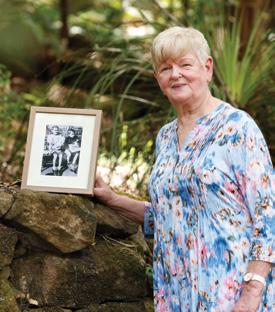
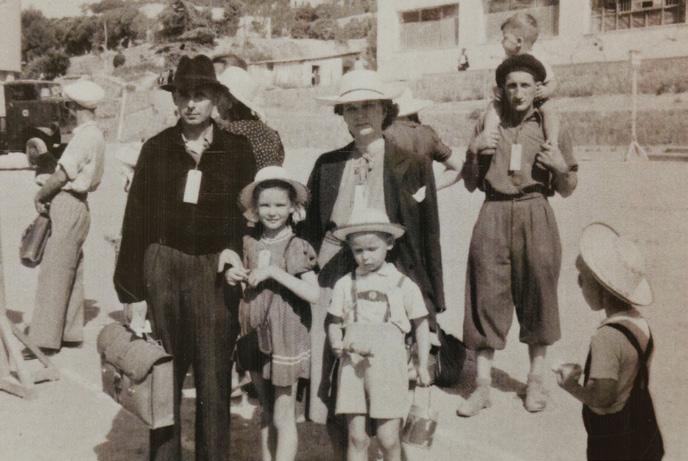
See your name on the Welcome Wall
For the chance to share and record your story, register now at sea.museum/national-monument or by phoning (02) 9298 3777
01 Arthur Calwell with Inars and Maira in Fremantle. Questions were asked over whether the Fairsea was diverted for Calwell’s ‘meet and greet’ of Maira, and if so, how much the publicity stunt cost. Image Kalnins family
02 Maira, at home in Turramurra, Sydney, with a photo of her and Inars on the day of the ‘£1,000 kiss’. Image Grant Turner
03
The Kalnins in Italy, about to embark on their voyage to Australia. Image Kalnins family
After the war, Australia and other countries were looking to expand their domestic workforces and sent representatives to such camps in search of suitable candidates. The Kalnins chose Australia and were soon boarding the migrant ship MV Fairsea, a converted aircraft carrier, in Naples, Italy.
Maira was seasick (‘the food was spaghetti, spaghetti and more spaghetti’), then she caught mumps and was in the ship’s hospital. She had just recovered when told by the government representative on board that she had to learn English. She was to learn to say, ‘I am very happy to be here in Australia today’.
The ship stopped in Fremantle on 12 August 1949, where Maira was the subject of a government photo opportunity. She didn’t know what was going on:
Men and photographers came on board. We were herded up on the top deck – I think with the captain – then we were given toys. I couldn’t understand why, really. I didn’t know what a koala was, and it wasn’t a nice, soft, cuddly one, it was all stiff. I remember a man came and gave me this stuff and gave me a kiss.
My brother got a kangaroo and a football. He was expecting a soccer ball, because that’s what football is in Europe, but it was a rugby ball.
National Monument to Migration
After arrival a week later in Newcastle, the family was taken to the local ABC radio station to be interviewed. Maira repeated her sentence: ‘I am very happy to be here in Australia today’.
The Kalnins, like many others, were taken by bus to the Greta Migrant Camp (formerly an army camp) north of Cessnock. Maira’s mother worked as a nurse’s aide and her father drove the camp’s trucks and ambulance.
A sister, Sandra, was born at the camp in 1952.
The Kalnins family left the camp soon after when they bought a house at Tuggerawong on the Central Coast. When her brother Inars finished school, the family moved to Sydney. Maira studied fashion design, married John Kluina and moved to Cooma, where John worked on the Snowy Mountains hydro-electric scheme. They had one son, Karl, then returned to Sydney, where Maira worked as a manager at Reader’s Digest.
Only in recent years did the family become aware of the government ‘kerfuffle’, when her sister came across the file ‘Arrival of 50,000th Displaced Person’ in an exhibition at the National Archives in Canberra. Maira’s sister, Sandra Kalnins-Cole, says:
I just walked in and there was a table with displays by year. I hit 1949 and up came my sister, brother, mother and father right in front of me and I went, ‘What?!’
So how did Australia treat Maira? She says:
Mum and Dad did very well. We were very lucky in that, with our upbringing, we had to be strong, and we sort of made good with whatever we did. You had to be resourceful. It’s been wonderful and there have been great opportunities for people who want to work hard and get educated. And it’s a welcoming country.
1 National Archives of Australia NAA: A434, 1949/3/16408
2 The Sun (Sydney), 18 August 1949, page 7.
3 National Archives of Australia, op cit.
Embrace the opportunity to honour your migration journey at the National Monument. Register by 22 December and be part of this ever-lasting tribute.
Tim Barlass is a journalist who has worked at The Sydney Morning Herald and is currently contracted to write for the museum.
BIRRARUNG IS THE WURUNDJERI NAME of the Yarra River, meaning ‘place of mists and shadows.’
Through carefully selected text, paintings, etchings and photographs, Judith Buckrich’s Yarra Birrarung offers a comprehensive insight into the many environmental, social, spiritual and artistic connections that flow from the river’s 242 kilometres and 60 tributaries.
From the first page, an abundance of information and visual material highlights both Buckrich’s scholarly rigour and her passion for telling intimate stories of the river. She carefully curates primary sources, told through the eyes of artists and writers, that inspire emotional and visual connection to the river. A quote on page 19 by early artist Robert Russell (1808–1900), for example, evocatively describes the many black swans that greeted him at Port Phillip/Naarm in 1836:
The afternoon was fine, the atmosphere dazzling and of that transparent blue which can never be painted, the deeper tones of the misty distance quieting the scene, and the dark dresses of my paddling companions sparkling and giving life to the picture.
Yet Buckrich does not shy away from the profound human impact on the Yarra Birrarung and ‘the way modern life shatters the landscape’ (page 226).
She dedicates significant sections of the book to the damage done to the river since European colonisation: the expanding settlement, changing landscapes and intense industrialisation. Buckrich frames these topics as a reminder of our shared responsibility to care for our environment.
Buckrich flows between topics with ease, offering something for everyone, from the first grapevines of the Yarra Valley to drunken punt rides across the waterway and even Harry Houdini’s iconic escape from 11 kilograms of shackles at the bottom of the river in 1910.
She also relates the story of Solomon Islander Alick F Wickham (inventor of the Australian crawl swimming stroke), who broke a world record by diving from 62.7 metres into the Yarra Birrarung in 1918, in front of 70,000 people.
Buckrich shines in the chapter ‘Artists and their Communities’, where she speaks of the artist communes that congregated along the Yarra Birrarung, including the Heidelberg School of Artists and its later incarnation, Heide, as well as Montsalvat.
The expansive coverage of this book is a triumph. At times, the breadth of information can seem overwhelming, but Buckrich acknowledges that she can only touch on the many stories, and leaves room for readers to explore their own interests. The book features many high-quality reproductions of primary sources, and while reading it I found myself repeatedly drawn to explore paintings, places and artists. Despite my being a Sydneysider, with little connection to Victoria, this book made the Yarra Birrarung feel vividly familiar.
Buckrich’s subject is important and timely. As she notes on page 7, the book is:
the story of our complex relationship with the river and surrounding country. Despite often being unaware of it, the river is our lifeblood. As well as providing us with water, food and places to live and work, it is a place of dreaming, creation and recreation.
This notion is as relevant today as it has been since time immemorial for the Wurundjeri people.
Reviewer Talisa Rimland, a Masters student in Museum and Heritage studies at the University of Sydney, undertook a curatorial placement at the museum this year.
Buckrich does not shy away from the profound human impact on the Yarra Birrarung
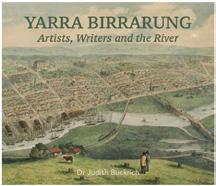
By Judith Buckrich.
Published by Melbourne Books, Melbourne, 2024. Hardcover, 256 pages, illustrations, bibliography, index. ISBN 9781922779328 RRP $50.00 VEL 305.89915 BUC
01
An encampment of Aboriginal people on the banks of the Yarra, John Cotton, c 1845. State Library of Victoria 02
Evensong , Clara Southern, 1900. National Gallery of Victoria
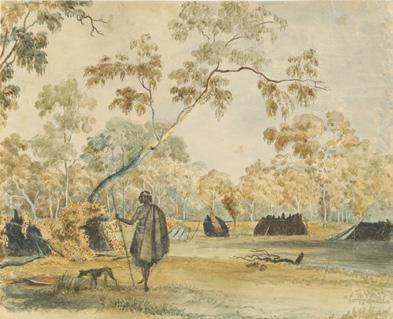
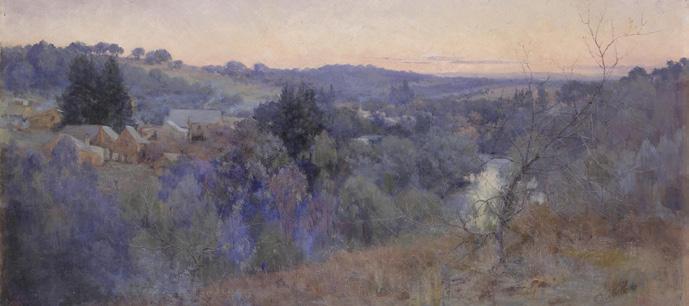
THE SPICE PORTS is a beautiful book, elegantly bound and sumptuously illustrated with colour images of historic paintings, drawings and maps. No expense has been spared in its design and production, using the resources of the British Library. The volume would look magnificent on a coffee table, although it is much more than a coffee table book.
The book’s chapters describe some of the world’s major spice ports: Venice, Alexandria, Goa, Lisbon, Malacca, Amsterdam, Batavia, Cape Town, Mauritius, Bombay, London, New York and Singapore. Nicholas Nugent has used these places to tell a tale of the European development of the spice trade.
The origins of the spice trade date back thousands of years, when pepper from India and cloves and nutmeg from the Spice Islands of eastern Indonesia were traded across the Middle East to the Mediterranean Sea and then to Europe. Indonesians, Malays, Indians, Persians, Arabs and Venetians participated in this trade, which brought great wealth to them and the ports along the Spice Route.
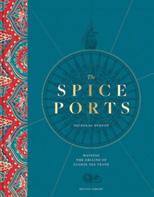
The Spice Ports: Mapping the Origins of Global Sea Trade By Nicholas Nugent. Published by The British Library, London, 2024. Hardcover, 288 pages, illustrations, notes, bibliography, index, ISBN 9780712355957. RRP $90.00. Vaughan Evans Library VEL 382.41383 NUG
By modern standards, European food was bland, and spices such as pepper, cinnamon, nutmeg and cloves not only helped disguise the flavour of salted or rancid meat, but their antibacterial properties helped preserve meats that would otherwise putrefy. After the Crusades of the 11th to 13th centuries, the demand for spices increased further as the knights returned from their occupation of the Holy Lands with an acquired taste for the exotic flavours and heady scents of the East.
Spices became the most extensively traded of all commodities. The book begins with Venice, the main European distribution point for spices coming from across the Middle East by Muslim traders. From there, traders distributed spices to the great trading markets, or ‘fairs’, such as those in Frankfurt, Bruges, Champagne and Medina del Campo, then to the spice shops of the cities and the weekly markets of the smaller towns.
Jealous of the wealth of Venice and the Muslim domination of this trade, the Crowns of Portugal and Spain backed explorers such as Christopher Columbus, Vasco da Gama and Ferdinand Magellan, hoping to capture the trade by sailing directly to the Spice Islands.
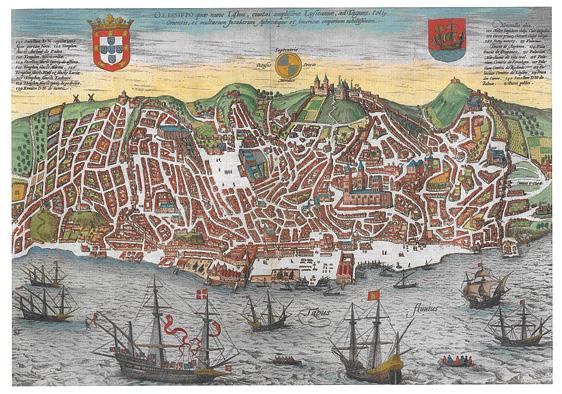
This drove the maritime exploration of the world that is now known as the ‘Age of Discovery’. These voyages only became possible after specific technical innovations and improvements in ship design, compasses and mapping, which enabled navigation across unprecedented distances. They embarked from European cities such as Lisbon, Seville, Amsterdam and London, and their destinations were exotic ports of the East, including Goa, Malacca and the Spice Islands.
The Portuguese became involved in the trade after Vasco da Gama rounded the Cape of Good Hope in 1497. The capture of Goa opened up a direct seaborne route to Malacca and the Spice Islands of eastern Indonesia, allowing the Portuguese to bring large cargoes of spices around the Cape of Good Hope. Lisbon became the successor to Venice and the wealthiest city in Europe.
The Portuguese expanded and controlled the spice trade for the next 100 years until they were challenged by the Dutch in the 1600s. After the Dutch East India Company was founded in 1602, the establishment of the spice port of Batavia in Java in 1619 allowed the development of a nearcomplete monopoly over the spice trade from Indonesia.
Lisbon became the successor to Venice and the wealthiest city in Europe
and Hogenberg’s
Consequently, Amsterdam became the centre of the spice trade and the wealth flowing into Holland led to what became known as the ‘Dutch Golden Age’.
The English East India Company was founded in London in 1602 but was defeated by the Dutch in its attempt to trade with the Spice Islands. However, its capture of Calcutta and Indian Bengal in 1757, and the commercial success of its trade from there, led to the development of the spice ports of Bombay and Singapore.
Spice Ports is a recommended read. This wide-ranging account of a fascinating period of global history relates how each port developed individually, while also encouraging us to consider contrasting viewpoints of the benefits and the damaging consequences of the maritime spice trade.
Reviewer Ian Burnet is the author of numerous books, including Spice Islands, which tells the 2,000-year history of the spice trade, and East Indies, about the 200-year struggle between the Portuguese Crown, the Dutch East India Company and the English East India Company for trade supremacy in the Eastern seas.
HENRY REYNOLDS had never travelled further north than Sydney when he moved his family to Townsville in 1965 to take up a lectureship at what is now James Cook University. He successfully adapted to life in Australia’s tropical north, applying his skills as a historian to a largely unspoken historical trove of the history of race relations in Australia’s tropics. His extensive bibliography, which includes over 20 influential books, fundamentally reshaped public and academic understanding of the nation’s past.
A major strength of Reynolds’s work was his adept use and explanation of the value of Aboriginal oral histories –many of which concerned events within the living memory of Aboriginal and Torres Strait Islander people, who had directly witnessed the nation’s pastoral and mining expansions that occurred more than a century after the initial land expropriation in the south.
For many students of history, arts and humanities in the early 1990s, encountering a Henry Reynolds publication was a defining moment. His work prompted them to rethink what they had been taught, challenging the national historical narrative – often referred to as ‘The Great Australian Silence,’ a phrase coined by WEH Stanner in 1968.
In her new publication, The Australian Wars, Rachel Perkins vividly recounts reading Reynolds’ The Other Side of the Frontier as an 18-year-old student at the Central Australian Aboriginal Media Association. She describes that experience as a formative step in her journey as a world-renowned filmmaker, whose most recent work is almost a visual response to the historical questions Reynolds first raised.
Reynolds was an active observer of some of the 20th century’s most significant moments in relation to Aboriginal land rights and the insistence on a space for a self-determined Aboriginal- and Islander-authored history that was written by Aboriginal and Islander people, not about them.
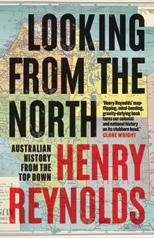
Looking from the North
By Henry Reynolds. Published by NewSouth Books, Sydney, 2025. Softcover, 240 pages, bibliography, index. ISBN 9781761170119
RRP $35.00 VEL 994.02 REY
There is much new information in Reynolds’ conversational, yet adept and concise, accounts of the application of Australian law of land title in Australia today. Particularly revealing is his discussion of a foundational legal precedent pertinent to the very extension of land rights to sea rights – a concept powerfully documented by the museum’s own foundational Aboriginal collections, including the Saltwater Bark paintings. To trace this crucial legal lineage, Reynolds expertly resurrects the lesserknown 1975 judgment in the Seas and Submerged Lands case,1 positioning it as a critical, overlooked precursor to the landmark Mabo decision of 1992.
Reynolds shows how this ruling presented for Australian legal scholars the ‘extraordinary proposition’ that Australia’s highest court was unable to ‘challenge a decision made in the late 18th century on the other side of the world in the reign of George III’.2
Reynolds concludes the chapter on decolonisation with a powerful message that Australia must ‘ignite rather than extinguish the First Nations’ demand for a resolution of the enduring question of their sovereignty and its continuity, as delineated in the Uluru Statement’. 3
1 New South Wales v Commonwealth [1975] HCA 58, (1975) 135 CLR 337, 50 ALJR 218, 8 ALR 1, ILDC 2581 (AU 1975), 17 December 1975.
2 Page 196.
3 Page 197.
Reviewer Matt Poll is the museum’s Manager of Indigenous Programs.
We are constantly adding new works to our library across a wide range of topics, including naval history, immigration, diverse local cultures, ocean science, river stories, Australian history, school textbooks and titles for kids. We also offer new magazines and a variety of maritime, genealogical and general research databases. Check our library catalogue, schedule a visit and enjoy our wonderful new books. Visit sea.museum/collections/library
Iran Davar Ardalan
AI for community: preserving culture and tradition
006.3 AIF
Kate Darian-Smith, Sue Turnbull, Sukhmani Khorana and Kyle Harvey
Migrants, television and Australian stories: a new history 302.23089 MIG
Pieter C Emmer and Jos JL Gommans (eds)
The Dutch overseas empire, 1600–1800 949.204 EMM
Flinders University Art Museum Crosscurrents
709.2423 CRO
Rebecca Giggs
Fathoms: The world in the whale 599.5 GIG
Ross Gillett
HMAS Melbourne: 25 years and beyond (2nd ed)
359.32550994 GIL
Verity Harding
AI needs you: How we can change AI’s future and save our own 303.4834 HAR
Peter Hore
The wrens of World War II: Bletchley’s secret source 940.5486 HOR
Shirley Le Funny ethnics 823.4 LE
Inger Leemans and Anne Goldgar (eds) Early modern knowledge societies as affective economies 338.9402 LEE
Roderick G Maclean
Never to return: Convoys to Russia in the Second World War 940.545 MAC
Nathan D Gardner Molina
In the face of diversity: A history of Chinese Australian community organisations 1970s–2020s 994.004951 MOL
Patricia M O’Connor and Fidelma McCorry
Continuity and change: postwar migration between Ireland and Australia 1945–2024 304.809 OCO
Nathaniel Philbrick
Away off shore: Nantucket Island and its people, 1602–1890 974.497 PHI
Killian Quigley
Reading underwater wreckage: An encrusting ocean 577.79 QUI
Ed Rodley
Designing for playful engagement in museums: immersion, emotion, narrative, and gameplay 069.16 ROD
Tom Trumble
Survival in Singapore: the triumph and tragedy of Australia’s greatest commando operation: Elizabeth Choy, Operation Jaywick and the battle for truth in Changi 940.545994 TRU
Matthew Wright
The battlecruiser New Zealand: A gift to empire 940.545993 WRI
Andrés Zarankin, Michael Pearson and Melisa A Salerno
Archaeology in Antarctica 998.9 ARC
Vale Jimmy Donovan (1940–2025)
JIMMY DONOVAN DEDICATED HIS LIFE to the working class. He was an uncompromising leader of trade and labour unions, a lifelong member of the Communist Party and an official of the Sydney branch of the Maritime Union of Australia (MUA). He understood the importance of class struggle driven by unity, peace, social justice and universal respect and recognition for worker and human rights.
At the age of nine, Jimmy was enrolled as an art student at the rooms of the Waterside Workers’ Federation (WWF) by his mum, Jessie. After a boiler-making apprenticeship at the NSW Government Railways, Jimmy came back to the waterfront in 1963, where he quickly became a workplace leader and political activist. Jim’s life was driven by courage and determination, often during times of significant challenge and hardship for working people both in Australia and around the world. In line with this commitment to working class internationalism, Jimmy was one of the instrumental players in the formation of the International Dockworkers Council. Likewise, at home, he was a leader of the MUA after its inception in 1993 from the amalgamation of the WWF and the Seamen’s Union of Australia. He served as both a Sydney Branch Secretary and the MUA’s National President.
During these periods, one of the MUA’s most challenging chapters unfolded: the 1998 Patricks dispute. Jimmy was in the thick of it, day in and day out, alongside the tens of thousands of MUA members, supporters, fellow travellers and ordinary Australians who flocked to the picket lines to defend Australian wharfies’ right to a dignified, safe and respectful workplace.
It was a source of immense pride for him when the Australian National Maritime Museum unveiled The Wharfies’ Mural in 2022. The permanent acquisition and display of the mural at the museum was made possible by Jim’s foresight in working with Tassie Bull through the early 1990s to preserve the mural for future generations.
Aside from his contribution to workers’ lives in their employment, Jim was an energetic campaigner for the preservation of the communities and streetscapes that the working-class people of Sydney had built. He carried this torch on behalf of his mother, Jessie, who had fought in the 1950s to protect workers’ housing in Woolloomooloo.
Later in life, after retiring as a full-time official, Jimmy devoted himself to the ongoing cultivation and mentorship of young maritime union activists as a leader of the MUA Veterans. Jimmy was also a tremendous custodian of the great oral history of the MUA and its predecessor, the Waterside Workers’ Federation.
Vale Jimmy, friend and comrade, person of family, peace and equal opportunity and justice for all. Now at rest after a long and important life’s journey.
Author Paddy Crumlin is the MUA National Secretary and a member of the Australian National Maritime Museum Council.
For more information about The Wharfies’ Mural, see Signals 140 (Spring 2022).
Jimmy Donovan at World Maritime Day 2022.
Jimmy at the 2022 unveiling of The Wharfies’ Mural at the museum. Jimmy had seen the mural taking shape at the Waterside Worker’s Federation rooms as a child when his mother, Jessie, enrolled him there as an art student. Decades later, when the WWF rooms were demolished, he was instrumental in the mural’s preservation.
Images Tom Harris-Brassil/MUA

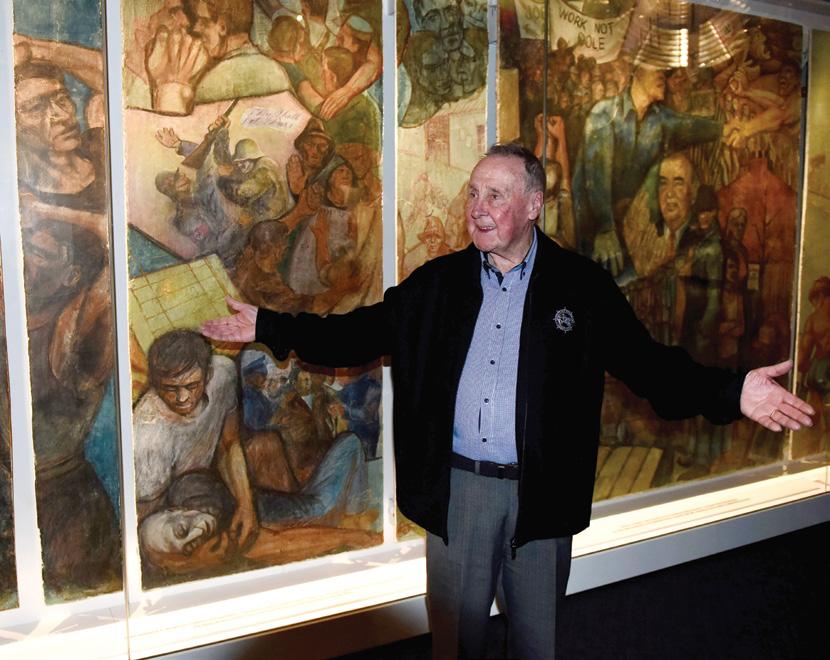
The museum’s honours system recognises individuals who have made a significant contribution to the museum and to Australian maritime heritage and culture generally.
Honorary Fellowships are the highest honour conferred by the Council, awarded to people who have made an exceptional contribution to the museum and whose status and ongoing association will serve to promote the museum and its activities.
Ambassadorships are awarded by Council to people who have donated $100,000 or more to the Australian National Maritime Museum Foundation.
Peter Dexter AM
John Mullen AM
Valerie Taylor AM
Ambassadors
Norman Banham
Christine Sadler
Dr David and Jennie Sutherland
Major Donors
Peter Dexter AM
Daniel Janes
David Mathlin
Benefactors
Margaret Cusack
Basil Jenkins
Dr Keith Jones
Janette Parkinson
RADM Andrew Robertson AO DSC RAN
Peter Whitsed
Geoff and Beryl Winter
Signals
ISSN 1033-4688
Editor Janine Flew
Staff photographer Jasmine Poole
Design & production Austen Kaupe
Printed in Australia by Pegasus
Media & Logistics
Material from Signals may be reproduced, but only with the editor’s permission.
Editorial and advertising enquiries signals@sea.museum
Not a museum member?
Receive Signals via iSubscribe: www.isubscribe.com.au
Signals back issues
Back issues $4 each or 10 for $30
Extra copies of current issue $4.95
Email theshop@sea.museum
Search all issues at sea.museum/signals
Australian National Maritime Museum
2 Murray Street Sydney NSW 2000 Australia. Phone 02 9298 3777
Our opening hours are 10 am–4 pm (NSW school holidays 9.30 am–5 pm)
The Australian National Maritime Museum is a statutory authority of the Australian Government
Become a museum member
Options for individuals, families and people who live interstate or overseas offer a great range of benefits, such as unlimited entry to our museum, vessels and exhibitions, as well as special discounts. Visit sea.museum/members

Signals is printed in Australia on Sovereign Silk 250 gsm (cover) and Sovereign Silk 113 gsm (text) using vegetable-based inks.
Honorary Research Associates
RADM Peter Briggs AO RAN
John Dikkenberg
Dr Nigel Erskine
Dr Ian MacLeod
Jeffrey Mellefont
David Payne
Dr Vanessa Pirotta
Lindsey Shaw
ANMM Council
Hon Hieu Van Le AC (Chair)
Ms Daryl Karp AM
Councillors
Mr Padraig (Paddy) Crumlin
Dr Bülent (Hass) Dellal AO
Ms Nataliya Dikovskaya
Dr Kevin Fewster AM CBE FRSA
Hon Donald Harwin
Hon Leo McLeay
Ms Alison Page
RADM Christopher Smith AM CSM RAN
Australian National Maritime Museum
Foundation Board
Mr Daniel Janes, Chair
Hon Hieu Van Le AC (ex officio)
Ms Daryl Karp AM (ex officio)
Mr John Barbouttis
Mr Simon Chan AM
Mr James Emmett SC
Mr David Mathlin
Dr Jeanne-Claude Strong
Ms Arlene Tansey
Ms Grazyna Van Egmond
Mr Nick Wappett
American Friends of the
Australian National Maritime Museum
Mr Robert Moore II
Mr John Mullen AM
Ms Daryl Karp AM
Grab some gear for sunny beach days or leisurely times at home! Check our website for clothing, homewares, books, toys and much more.
Adults’ unisex Panamate hats, five colours
$85.00 / Members $76.50
Kids’ Reggie cotton hats, various fun prints
$35.00 / Members $31.50
Australia Scape microfibre beach towels
$75.00 / Members $67.50
Swim ring for kids
$29.95 / Members $26.95
Beach bucket toy set, durable silicone
$69.95 / Members $62.95
Puzzle Snax, 48 pieces, ages 5 and up
$16.95 / Members $15.25
Sydney Opera House 1,000 piece puzzle
$49.95 / Members $44.95
HeyDoodle reusable silicone learning mats
Standard $34.95 / Members $31.45
Mini $22.95 / Members $20.65
HeyDoodle non-toxic markers
$16.95 / Members $15.25
Members receive 10% discount
Open 7 days a week
Email us at theshop@sea.museum
Shop online sea.museum/shop
Follow us on Instagram instagram.com/seamuseum_shop
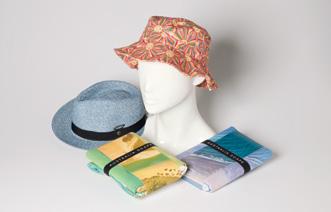
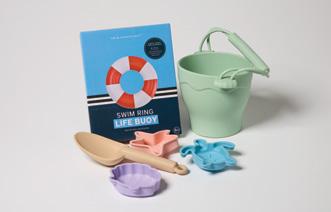
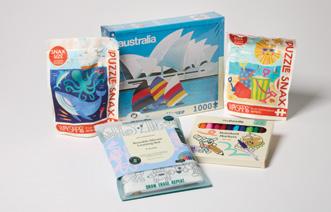
Thank you to our partners
We gratefully acknowledge the generous support of our valued partners. Their commitment empowers the Australian National Maritime Museum to inspire current and future generations to explore, understand and connect with Australia’s rich maritime heritage and the oceans that shape our world.