22
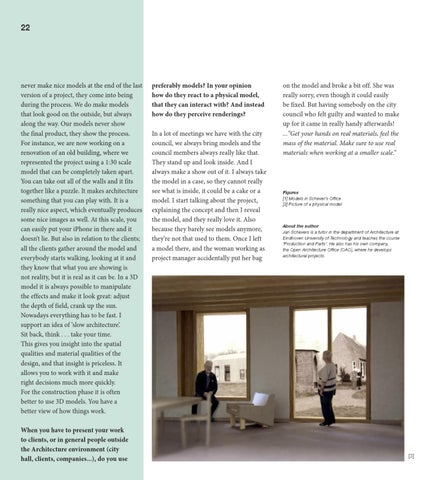
never make nice models at the end of the last version of a project, they come into being during the process. We do make models that look good on the outside, but always along the way. Our models never show the final product, they show the process. For instance, we are now working on a renovation of an old building, where we represented the project using a 1:30 scale model that can be completely taken apart. You can take out all of the walls and it fits together like a puzzle. It makes architecture something that you can play with. It is a really nice aspect, which eventually produces some nice images as well. At this scale, you can easily put your iPhone in there and it doesn’t lie. But also in relation to the clients; all the clients gather around the model and everybody starts walking, looking at it and they know that what you are showing is not reality, but it is real as it can be. In a 3D model it is always possible to manipulate the effects and make it look great: adjust the depth of field, crank up the sun. Nowadays everything has to be fast. I support an idea of ‘slow architecture’. Sit back, think . . . take your time. This gives you insight into the spatial qualities and material qualities of the design, and that insight is priceless. It allows you to work with it and make right decisions much more quickly. For the construction phase it is often better to use 3D models. You have a better view of how things work. When you have to present your work to clients, or in general people outside the Architecture environment (city hall, clients, companies...), do you use
preferably models? In your opinion how do they react to a physical model, that they can interact with? And instead how do they perceive renderings? In a lot of meetings we have with the city council, we always bring models and the council members always really like that. They stand up and look inside. And I always make a show out of it. I always take the model in a case, so they cannot really see what is inside, it could be a cake or a model. I start talking about the project, explaining the concept and then I reveal the model, and they really love it. Also because they barely see models anymore, they’re not that used to them. Once I left a model there, and the woman working as project manager accidentally put her bag
on the model and broke a bit off. She was really sorry, even though it could easily be fixed. But having somebody on the city council who felt guilty and wanted to make up for it came in really handy afterwards! ...“Get your hands on real materials, feel the mass of the material. Make sure to use real materials when working at a smaller scale.”
Figures [1] Models in Schever’s Office [2] Picture of a physical model
About the author Jan Schevers is a tutor in the department of Architecture at Eindhoven University of Technology and teaches the course ‘Production and Parts’. He also has his own company, the Open Architecture Office (OAO), where he develops architectural projects.
[3]